

 The W3C Internationalization (I18n) Activity works with W3C working groups and liaises with other organizations to ensure Web technologies work for everyone, regardless of their language, script, or culture.
From this page you can find articles and other resources about Web internationalization, and information about the groups that make up the Activity.
Read also about opportunities to participate and fund work via the new Sponsorship Program.
What the W3C Internationalization Activity does
Selected quick links
Selected quick links
Selected quick links
Lokalisierung vs. Internationalisierung
Thanks to Jens Meiert the FAQ-based article “Localization vs. Internationalization” has now been translated into German (language negotiated).
Introduction to Internationalization
Presentation by Richard Ishida at the Open Road Conference, Melbourne, the Victoria Online Seminar, Melbourne, and Web Standards Group meetings in Melbourne and Canberra, February, 2006.
Arabic mathematical notation
The Math IG just published this Note which analyzes potential problems with the use of MathML for the presentation of mathematics in the notations customarily used with Arabic, and related languages. The goal is to clarify avoidable implementation details that hinder such presentation, as well as to uncover genuine limitations in the specification. These limitations in the MathML specification may require extensions in future versions of the specification.
The XHTML+MathML version displays the examples better, if your user agent supports it.
New article: Introducing Character Sets and Encodings
Getting Started material. The W3C GEO Working Group has published the first in a series of articles aimed at those who are new to internationalization. These pages will introduce you to key internationalization topics and tasks, and direct you towards articles or resources on the W3C Internationalization subsite that will take you to the next level of understanding.
This document introduces topics in the general area of character sets, encoding, escapes, etc.
The document is linked from a new ‘Getting Started‘ page that also explains various ways to find information on the W3C Internationalization subsite, and points to some key definitions.
Request for feedback: Usefulness of ::first-letter in non-Latin scripts
The W3C i18n Working Group would like to hear from you if you have some knowledge/thoughts in this area. We would like to gather information about the usefulness, in general, of the ::first-letter pseudo-element in non-Latin scripts, and any particular issues or differences arising from the different characteristics of the scripts.Please send your comments to www-international @ w3.org (Archive and subscription: http://lists.w3.org/Archives/Public/www-international/)
The latest working draft of CSS3 Selectors proposes the ::first-letter pseudo-element.
See http://www.w3.org/TR/2005/WD-css3-selectors-20051215/#first-letter
The ::first-letter pseudo-element represents the first letter of the first line of a block, if it is not preceded by any other content (such as images or inline tables) on its line.
It allows that first letter to be styled individually, without markup. It may be used for “initial caps” and “drop caps”, which are common typographical effects in text in Latin script.
We commented to the CSS Working Group that they need to define ‘letter’ more carefully, and proposed that they specify that ‘letter’ equates to ‘default grapheme cluster’, as described in the Unicode Standard Annex #29.
See http://www.unicode.org/reports/tr29/#Grapheme_Cluster_Boundaries
(A rough and ready explanation of this is that base characters and any following combining characters are styled together. So
0065: e LATIN SMALL LETTER E + 0301: ́ COMBINING ACUTE ACCENT
would be handled as a single letter.)
We also suggested that implementors should then be encouraged to provide tailored algorithms on a per language basis to cope with anomolies, particularly such as may occur in non-Latin scripts.
Here are some initial questions:
[1] Are there scripts that would never use this approach?
[2] We mention ‘initial caps’ and ‘drop caps’ above. What other types of styling would be commonly applied in other scripts if this feature were available?
[3] What script features would cause difficulties, eg syllabic groupings (see the example of indic script example below), ligatures, cursive text (eg. Arabic, Urdu, etc.), and how would the script normally deal with them?
Please send your comments to www-international @ w3.org
Archive: http://lists.w3.org/Archives/Public/www-international/
————
What follows are some examples of questions that spring to mind.
SYLLABIC INDIC SCRIPTS
In the Hindi word स्थिति (‘sthiti’) the sequence of characters in the first syllable is as follows in memory:
0938: स DEVANAGARI LETTER SA
094D: ् DEVANAGARI SIGN VIRAMA
0925: थ DEVANAGARI LETTER THA
093F: ि DEVANAGARI VOWEL SIGN I
The displayed text, however, is 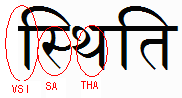
Note how the vowel sign appears to the left of the first character, not the third.
The default grapheme clusters here are, I believe, 0938+094D, then each of the following two characters.
Would Devanagari-based languages use special styling for initial syllables? If so, would they actually apply the styling to the vowel sign alone, or to the whole syllable?
LIGATURES
If a script styles the ‘first letter’, but that letter is part of a ligature (ie. a single glyph representing more than one underlying character), would it be ok to split the ligature, or should the other characters that compose the ligature also be styled?
CURSIVE SCRIPTS
Since Arabic and Mongolian letters in a word are normally joined, has first letter styling been used at all in these scripts?
CHINESE, JAPANESE, KOREAN
Do languages using these scripts do first letter styling?
RUSSIAN, GREEK, ARMENIAN, etc.
Is first letter styling common practise in these scripts too?
24 ways to impress your friends
Molly Holzschlag, I18n GEO Working Group member, recently published an on-line article entitled Putting the World into “World Wide Web”, part of a series entitled 24 ways to impress your friends. She makes the point that the art and science of creating sites for global audiences requires a lot more preparation and planning than one might think at first glance.
New article: Localization vs. Internationalization
FAQ-based article: What do the terms ‘internationalization’ and ‘localization’ mean, and how are they related?
By Richard Ishida, W3C & Susan K. Miller, Boeing.
New article: xml:lang in XML document schemas
FAQ-based article: When should I use xml:lang and when should I define my own element or attribute for passing language values in an XML document schema (DTD)?
By Addison Phillips.
מה שאתם צריכים לדעת לגבי האלגוריתם הדו-כיווני וסימון פנימי
Thanks to Oleg Gaivoronsky the translation of the article “What you need to know about the bidi algorithm and inline markup” has now been updated in Hebrew (language negotiated).
Internationalization Tag Set (ITS)
This document defines data categories and their implementation as a set of elements and attributes called the Internationalization Tag Set (ITS). ITS is used with new and existing schemas to support the internationalization and localization of schemas and documents. Implementations of ITS are provided for three schema languages: XML DTDs, XML Schema and RELAX NG. In addition, implementations are provided as fixed modularizations of various existing vocabularies (e.g. XHTML, DocBook, Open Document). The definition of the data categories is still in an early draft stage.