

Category: Translation needed
Posts
New articles have been published
Two articles have been published:
Address formats vary widely across the globe, with differences in structure, content, and the level of granularity. For authors and developers designing forms, databases, or systems that handle addresses, understanding these variations is crucial to avoid frustrating users from other countries. The first article will introduce some of the key differences in address formats around the world and provide guidance on how to design systems that can handle them effectively.
The second article will serve as a practical overview of the most essential parts of the Intl API, providing actionable examples you can use to internationalize your web applications today.

New article: How to make list markers stand upright in vertical text
The article How to make list markers stand upright in vertical text has been published.
In Chinese, Japanese, Korean, and Mongolian vertically-set text it is normal for list counters to sit upright above the start of the list. Until recently this was problematic, because browsers would only show the numbers lying on their side. This article describes how to make them stand upright, and the currently remaining issues to make this look perfect.
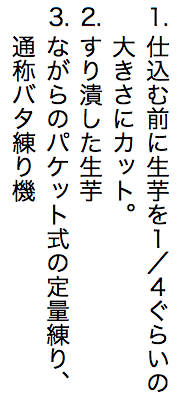
New article: How can I use direction metadata in native APIs?
The article How can I use direction metadata in native APIs? has now been published.
This article provides links to documentation in many different operating systems, programming environments, and user experience frameworks. These APIs can then be used to consume language and string direction metadata received on the Web or in other APIs or formats.
New article: Font styles & font fallback
The article Font styles & font fallback has now been published.
This article provides a non-exhaustive set of examples where choice of a font style may have a practical application. The existence of these distinct styles, with their practical influence on the reading of the text, has implications for fonts on the Web – you would typically want to choose a fallback font that has the same style, if one is available. We look at some implications for generic fonts and fallback mechanisms near the end.
Updated article: Normalization in HTML and CSS
The article Normalization in HTML and CSS was largely rewritten. It now describes the various normalization forms, and clarifies that W3C doesn’t require all content to be strictly NFC-normalized. It also warns about the dangers of blindly normalizing content to a particular normalization form (unless performing a match/sort procedure).
Translators are invited to update the translations in German, Spanish, French, Polish, Brazilian Portuguese, Russian, and Ukrainian.
New article: Ruby Styling
The article Ruby Styling provides guidance for content authors on CSS features available for styling ruby text in Japanese, Chinese, Korean, and Mongolian. It is a companion article to Ruby Markup. It includes information about what is and isn’t currently supported in major browsers.
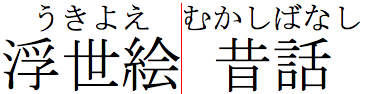
Translators are invited to provide translations.
Please raise any comments as github issues by clicking on the “Leave a comment” link at the bottom of the article.
Updated article: Languages using right-to-left scripts
The article “Script direction and languages” now has the title “What languages are written with right-to-left scripts?“, and provides insights into right-to-left (RTL) script usage around the world.
In a substantial revision, previous tables have been replaced with a completely new table which lists 12 scripts and over 200 languages using RTL scripts in the modern day. While it is only possible to give a rough idea of usage, the table includes information about which countries use those languages and figures for speakers of those languages. The data is gathered from the SIL Ethnologue.
Updated article: Declaring language in HTML
An update for the article Declaring language in HTML has just been published.
This page describes how to mark up an HTML page so that it gives information about the language of the page. It begins with an overall summary, then provides additional details in subsequent sections.
The material was reorganised to expand the quick answer section and de-emphasise the information about XML/XHTML declarations.
Article published: Can we derive base direction from language?
Sometimes people wonder whether it’s possible to obtain a definitive list of language tags which indicate a RTL base direction, so that there would be no need for separate direction metadata. This article looks into whether that is really feasible. (Spoiler: The W3C Internationalization Working Group believes it is not.)
To comment on this article, raise a GitHub issue.
Article published: Use cases for bidi and language metadata on the Web
Information about text direction and language needs to be associated with strings used on the Web. This article explores use cases that support that need.
To send a comment, raise a GitHub issue.
W3C® liability, trademark and permissive license rules apply.
Questions or comments? xfq@w3.org