W3CAbout W3C > History

In 1989, Tim Berners-Lee invented the World Wide Web (see the original proposal). He coined the term "World Wide Web," wrote the first World Wide Web server, "httpd," and the first client program (a browser and editor), "WorldWideWeb," in October 1990. He wrote the first version of the "HyperText Markup Language" (HTML), the document formatting language with the capability for hypertext links that became the primary publishing format for the Web. His initial specifications for URIs, HTTP, and HTML were refined and discussed in larger circles as Web technology spread.
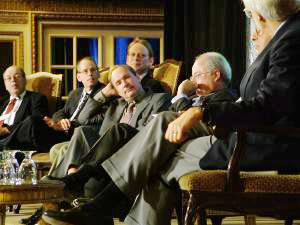
Some of the individuals involved in the creation of the Web and of W3C recount key events at the Tenth Anniversary Celebration of W3C

W3C10 panel recounts important early Web and W3C events

A graduate of Oxford University, England, Tim Berners-Lee has served as Director of the World Wide Web Consortium (W3C) since its inception. More information on Tim Berners-Lee is available; see also the Tim Berners-Lee's FAQ.

In October 1994, Tim Berners-Lee founded the World Wide Web Consortium (W3C) at the Massachusetts Institute of Technology, Laboratory for Computer Science [MIT/LCS] in collaboration with CERN, where the Web originated (see information on the original CERN Server), with support from DARPA and the European Commission. For further information on the joint initiative and the contributions of CERN, INRIA, and MIT, please see the statement on the joint World Wide Web Initiative.

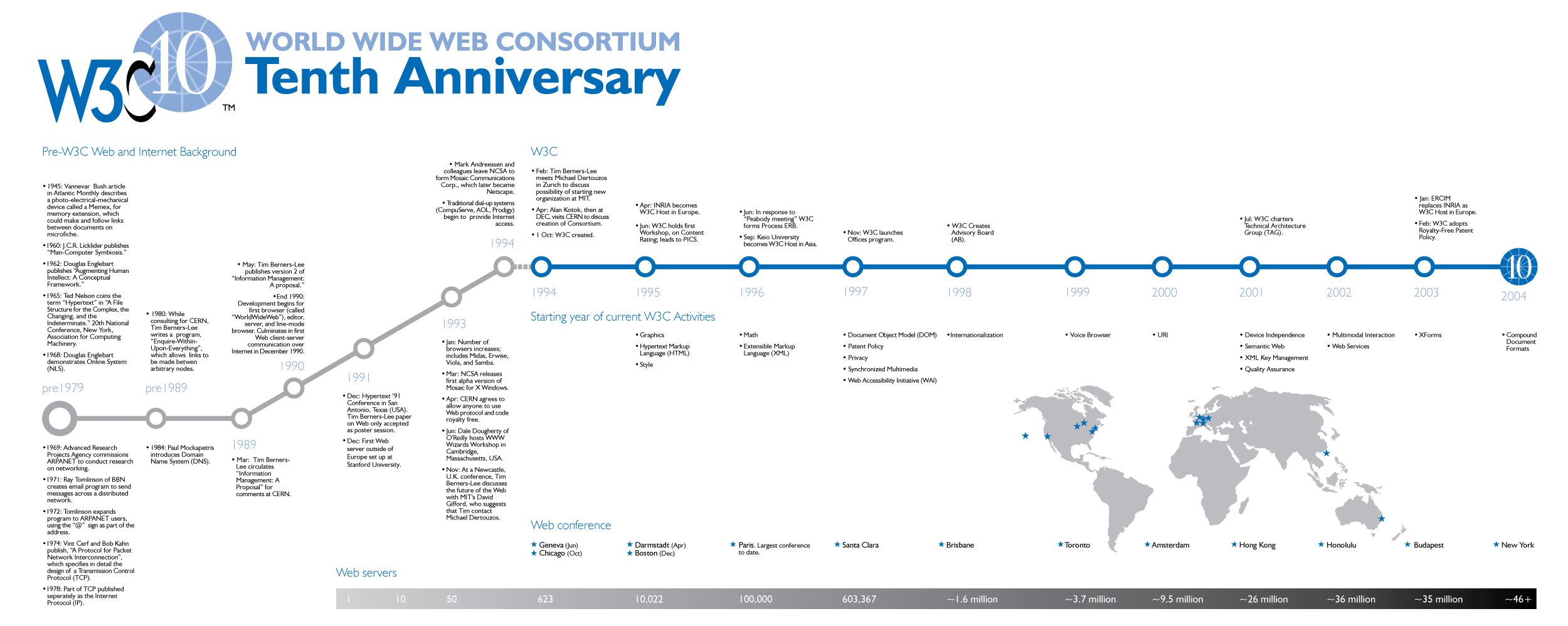
W3C time line
W3C10 Time Line Graphic
(other formats and description)

In April 1995, INRIA (Institut National de Recherche en Informatique et Automatique) became the first European W3C host, followed by Keio University of Japan (Shonan Fujisawa Campus) in Asia in 1996. In 2003, ERCIM (European Research Consortium in Informatics and Mathematics) took over the role of European W3C Host from INRIA.

In December 2004 (in Boston, USA), in June 2005 (in Sophia-Antipolis, France), and in December 2006 (in Tokyo, Japan) W3C celebrated its tenth anniversary with symposia about the history and future of the Web and W3C.

More historical (but unmaintained) information about the World Wide Web is available from the W3C Web site.

Major W3C Achievements

Below you will find some of W3C's most important achievements. Obviously, this type of list is subjective and does not represent every aspect of W3C work. For a complete view of W3C work, please consult the list of W3C Activities and the index of W3C's technical reports.

October 1996First W3C Recommendation published is Portable Network Graphics (PNG) 1.0. In the mid-'90s, more industrial and academic users were discovering the Web and its graphics capabilities. W3C developed Portable Network Graphics (PNG) to provide a cross-platform alternative to the graphics formats most prevalent at that time, some of which had raised some patent licensing concerns.

December 1996Separating content from structure, CSS Level 1 is published. Cascading Style Sheets (CSS) is a simple mechanism for adding style (e.g. fonts, colors, spacing) to Web documents. CSS Level 2 (1998) included further and more sophisticated features.

February 1997Web Accessibility Initiative launched. W3C's Web Accessibility Initiative (WAI) guidelines for Web content, user agents, and authoring tools would become very popular among the Web community. WAI, in coordination with organizations around the world, pursues accessibility of the Web through four primary areas of work: technology, tools, education and outreach, and research and development.

December 1997HTML 4.0 adds tables, scripting, style sheets, internationalization, and accessibility features to Web publishing. Whereas HTML 3.2 had been published to capture the then current state of support for HTML on the Web, HTML 4.0 added new features to enable authors to create significantly richer Web content. These features included the ability to specify style sheets, create tables, and make pages more dynamic through scripting (see also W3C's work on the Document Object Model, or DOM). HTML 4.0 also included important features to promote more internationalized content and content more accessible to some users with disabilities.

February 1998XML 1.0 promotes interoperability and domain-specific markup. Soon to become the lingua franca of the Web, XML would serve as the basis for dozens of standards ranging from digital signatures (XML-Sig) and Web forms (XForms), to privacy technologies (P3P).

August 2000Scalable Vector Graphics (SVG) 1.0 enriches Web graphics. A language to describe two-dimensional graphics and graphical applications in XML, SVG will serve as the foundation for new-generation mobile applications (SVG Mobile Profiles).

May 2001XML Schema provides an essential piece for XML to reach its full potential. This important specification delivers on the true promise of XML by providing a standard way to create XML vocabularies that permit mixing and a way to build more versatile and powerful commercial applications.

January 2002W3C launches Web Services Activity. Subsuming the XML Protocol Activity and extending its scope, Web services provide a standard means of interoperating between different software applications, running on a variety of platforms and/or frameworks.

May 2003W3C adopts royalty-free Patent Policy. The W3C Patent Policy governs the handling of patents in the process of producing Web standards, and explicitly encourages the development of open standards.

February 2004RDF and OWL make a strong foundation for Semantic Web applications. RDF and OWL are Semantic Web standards that provide a framework for asset management, enterprise integration and the sharing and reuse of data on the Web. Respectively, they deliver structured descriptions and Web-based ontologies.

March 2004W3C gives voice to the Web with VoiceXML 2.0. Voice interaction can escape the physical limitations of keypads and displays as mobile devices become even smaller. The goal of VoiceXML 2.0 is to bring the advantages of Web-based development and content delivery to interactive voice response applications.

December 2004W3C describes principles of Web architecture. W3C's Technical Architecture Group (TAG) publishes "Architecture of the World Wide Web," a description of the principles that make the Web we know work, and work well. This condensed assessment of fifteen years of observations about the Web authored by many of those who designed the core Web standards is a valuable foundation on which to design future Web standards.

February 2005Character Model brings unified approach to using characters on the Web. W3C's Internationalization Core Working Group publishes "Character Model for the World Wide Web 1.0: Fundamentals" with a goal of making it easier for all people to use the World Wide Web, regardless of their language, script, writing system, and cultural conventions, in accordance with the W3C mission of universal access. Building on the Universal Character Set (defined jointly by the Unicode Standard and ISO/IEC 10646), the Character Model provides authors of specifications, software developers, and content developers with a common reference for interoperable text manipulation on the World Wide Web.

May 2005Mobile Web Initiative launched to facilitate mobile Web access. W3C launched the Mobile Web Initiative (MWI) with the mission of making Web access from a mobile device as simple as Web access from a desktop device. MWI sponsors and participants develop authoring guidelines, checklists and best practices, as well as a database of descriptions that can be used by content authors to adapt their content to the strengths and capabilities of a particular device.

November 2005 W3C Launches Group Linking Medical Industry with Semantic Web. W3C launched an Interest Group to connect medical industry verticals with Semantic Web experts in an effort to improve collaboration, research and development, and innovation adoption in the health care and life science industries. The first of its kind for W3C, the Semantic Web for Health Care and Life Sciences Interest Group (HCLSIG) deploys standardized Semantic Web specifications into specific services defined by a user community.

Photo credit: Richard Ishida. Time line graphic: Skymedia

Valid XHTML 1.0!