W3C establishes Representative Office in Shenzhen, reinforcing commitment to open web standards in China
The World Wide Web Consortium (W3C) today announced the establishment of a W3C Representative Office in Shenzhen, China. An opening ceremony was held in Shenzhen on 18 April 2026, a few days before the celebration of the 20th anniversary of W3C in China.
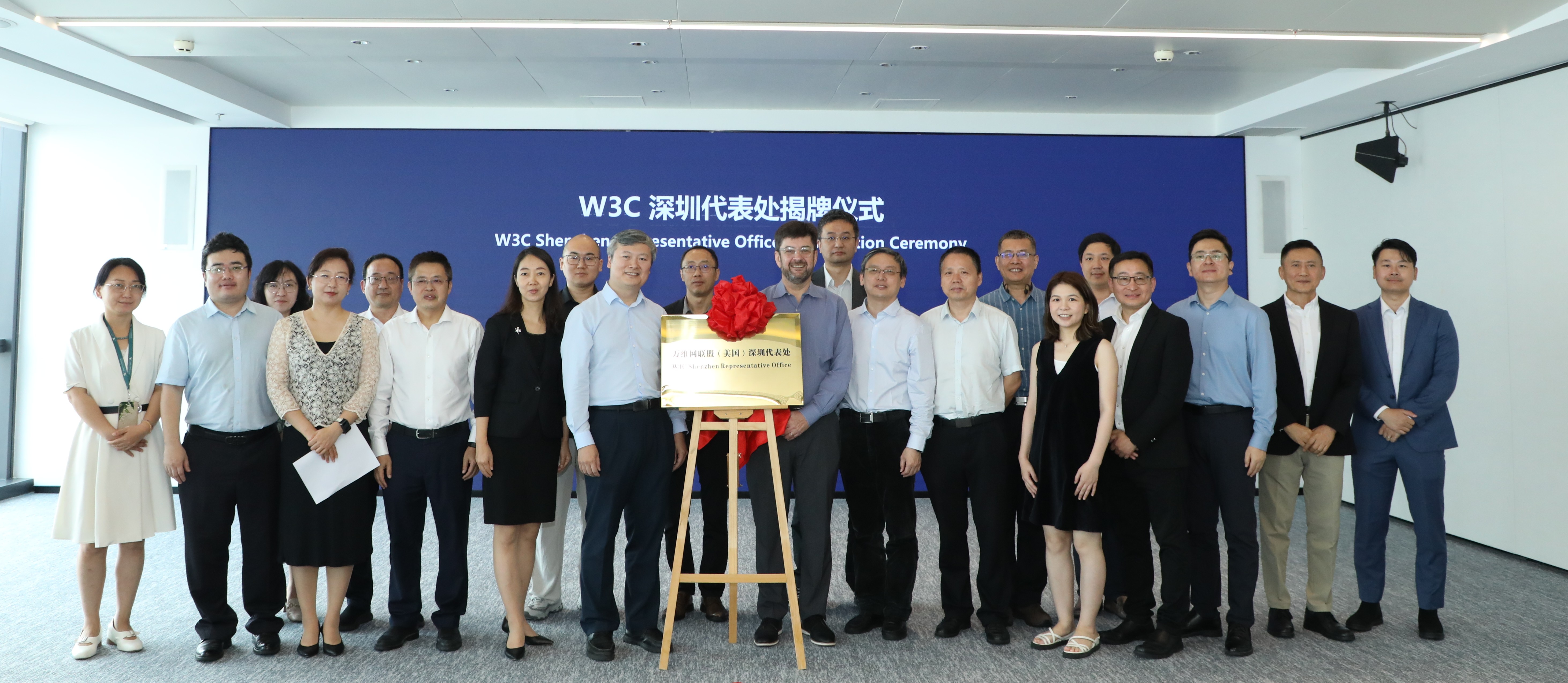
Representatives from W3C, Beihang University (W3C Partner in China), Guangdong Provincial Association of Science and Technology, Shenzhen Association of Science and Technology, Shenzhen Hetao Development Authority, and W3C Members Huawei and Tencent attended the opening ceremony of the Shenzhen office.
The establishment of the Representative Office follows unanimous approval from the W3C Board of Directors to fulfill a primary role in legal compliance and to expand the reach of W3C’s existing Partner Beihang University. This opening represents a significant milestone in the Consortium’s long-standing collaboration with the Chinese web community.
"It has been my privilege to participate in and witness the operation and growth of W3C in China since 2006, first as an Office, then as a W3C Host and W3C Partner and for the past three years to work on establishing the W3C Representative Office in Shenzhen. I am looking forward to the wonderful advances this cooperation will yield, ushering in a new chapter for W3C's development in the Greater Bay Area and the Asia-Pacific."
W3C previously operated as an agreement among four host institutions: Beihang University in China, ERCIM in France, Keio University in Japan, and MIT in the US. W3C re-launched as a public-interest non-profit organization in January 2023. As of January 2025, W3C Inc. has fulfilled the legal requirements — having been legally established and actively operating overseas for more than two years — to register a representative office in China. The establishment thus complies with the Law of the People's Republic of China on the Administration of Activities of Overseas Non-Governmental Organizations within the Territory of China.
Rooted in Shenzhen, serving China, embracing the world
W3C's engagement with the city of Shenzhen dates back to the launch of the W3C China Office in 2006, hosted by Beihang University. Since then, numerous organizations from Shenzhen have joined W3C as members and actively contributed to global web standards. A landmark moment occurred in October 2013, when W3C held its annual technical conference (TPAC 2013) in Shenzhen—the first time the event took place in China—attracting 500 participants from over 20 countries. More recently, in January 2025, Beihang University, as W3C's Partner in China, hosted a seminar on AI and high-performance web applications at its Shenzhen campus, bringing together more than 20 organizations. These sustained efforts have firmly established Shenzhen as a vital bridge between Chinese innovation and the global web standards community.
The W3C Representative Office in Shenzhen will operate as a branch of W3C Inc., working with Beihang University as W3C Partner to maintain a global web technology standard innovation and technology collaboration platform. The expected functions of this Representative Office include:
- Ensuring the W3C China Representative Office's primary role in legal compliance, while exploring — subject to stakeholder collaboration and available resources — opportunities to facilitate dialogue on China's web standards landscape and support W3C's strategic objectives.
- Providing a venue and platform for W3C's global technology standards activities in southern China, complementing Beihang University — the W3C Partner in the north, thereby better responding to the needs of the broader membership and community.
- Deepening cooperation with web communities across the Greater Bay Area and the Asia-Pacific region with the goal to initiate more joint efforts on web technology innovation.
A collaborative path forward
Looking ahead, W3C intends to assemble its members and the broader community driving technical advancements in key areas of web technologies and standards—including around agentic web, high-performance web engines, and decentralized identifiers—through dedicated events and to foster deeper collaboration across the global web community.
“The presence of W3C China in the web community and participation in the World Wide Web Consortium has been critical since 2006 to making our work truly global, and I see this office in part as confirming our long term commitment to the Chinese tech industry. I am confident that the W3C Representative Office in Shenzhen will complement W3C Partner’s Beihang University in being key to helping us realize our vision of a single interoperable web that benefits humanity.”
With the establishment of its Representative Office in Shenzhen, W3C embarks on a new phase of collaboration with the Chinese web community — one built on decades of trust, shared innovation, and a mutual commitment to an open, neutral, secure, accessible and truly World Wide Web.
Our warm congratulations on the smooth establishment of the W3C Representative Office in Shenzhen. We look forward to deepening digital technology exchanges and collaboration through this international standards platform, jointly advancing innovation and development in Web technologies.
The W3C Representative Office has officially established itself in Shenzhen Hetao, significantly strengthening the cluster of international industry and standards organizations in the area. The Authority looks forward to collaboration among international organizations and industries in Hetao to support the development of the Guangdong-Hong Kong-Macao Greater Bay Area. Moving forward, the Shenzhen Hetao Development Authority will assist the W3C in fully leveraging the unique clustering and policy advantages within the Hetao Cooperation Zone, building a new bridge for China’s participation in international exchanges and cooperation on Web technologies.
About the World Wide Web Consortium (W3C)
The mission of the World Wide Web Consortium (W3C) is to make the web work — for everyone. W3C offers a unique platform for creating and maintaining a broad range of technical standards and guidelines that enable a World Wide Web which connects and empowers humanity.
W3C convenes hundreds of member organizations, thousands of dedicated technologists and the broad global community, who together shape the future of web technologies, advancing the benefits that accessibility, internationalization, security, and privacy bring to the web and everyone who uses it.
W3C standards enable people and businesses on the web to address society’s social, cultural and economic needs by ensuring an open, accessible, and interoperable web. Some examples are WCAG, SVG, WebRTC, and HTML and CSS, two of the foundational technologies upon which websites are built.
W3C’s work is created in the open and provided for free under the groundbreaking W3C Patent Policy that ensures web standards can be implemented and used widely without complex licensing or costly royalties, which in turn helps to foster open development, and supports the web's growth as a common global infrastructure for all.
W3C is a public-interest, non-profit organization incorporated in the United States of America, led by a Board of Directors and employing a global staff. W3C is funded through Member dues as well as donations, sponsorships, and grants. Supporting us makes a huge difference to our operations and helps W3C to achieve its vision. For more information, see https://www.w3.org/.
End Press Release
Media Contact
Amy van der Hiel, W3C Media Relations Manager and Brand Coordinator, w3t-pr@w3.org
+1.617.453.8943 (US, Eastern Time)