TPAC events and participation rules
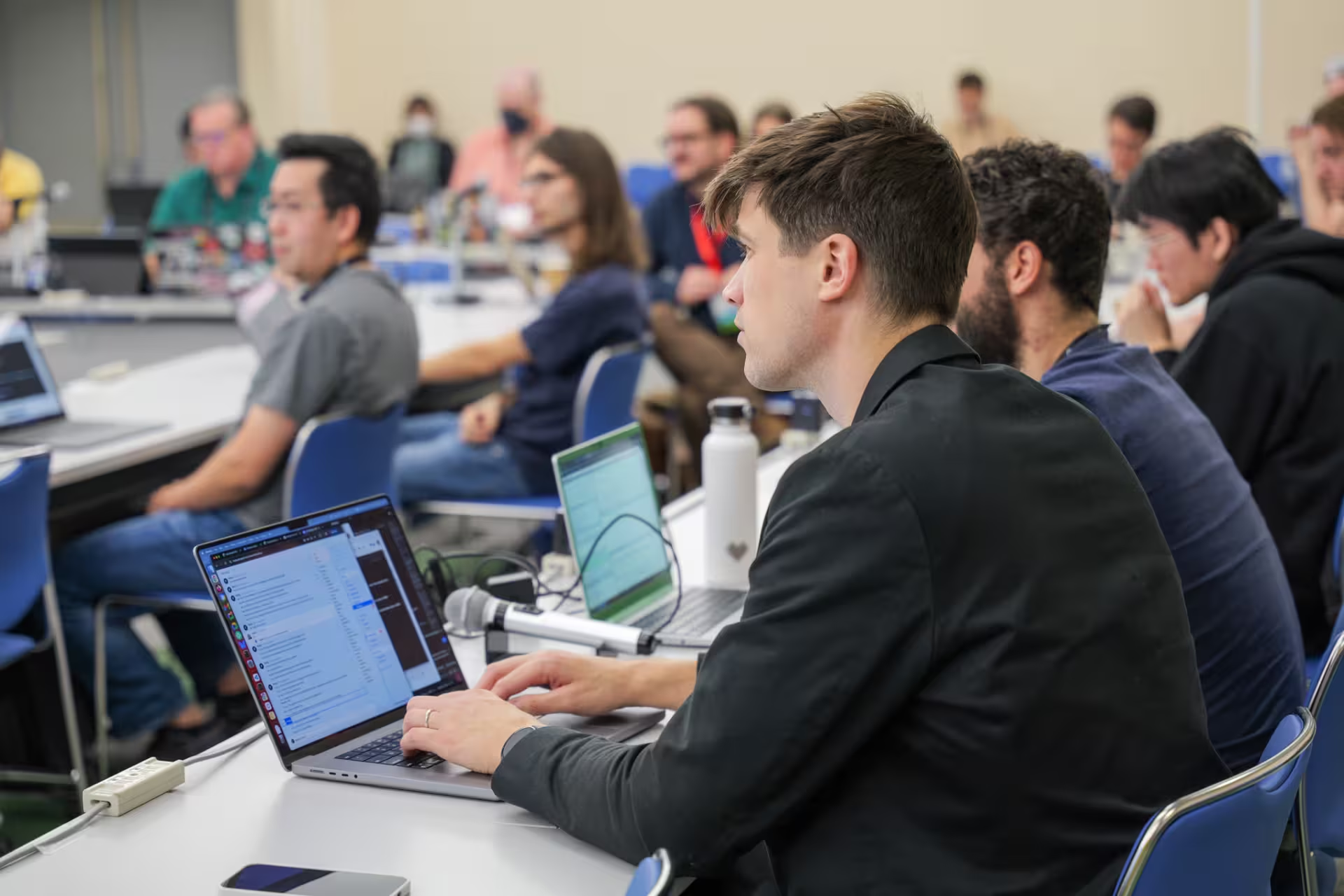
Before you register to attend a meeting, please read the session descriptions below.
See the high-level summary of the TPAC schedule to check the times for each day's meetings.
Participation rules
W3C meetings operate under the following policies:
- W3C Code of Conduct
- W3C Antitrust and Competition Policy
- Photography policy: Do not take photos of people with red lanyards.
Participation rules apply to both in-person and remote participants.
Welcome session for TPAC newcomers
If you are attending TPAC for the first time, join us for a warm welcome and general introduction to W3C and the event.
Working, interest, business, and community group meetings
W3C working group meetings at TPAC are multi-hour collaborative sessions where the experts responsible for web standards meet to develop and review specifications, resolve technical issues, coordinate with other groups, and plan the future evolution of the web.
Registration and attendance are open to:
- participants in a W3C working, interest, business or community group scheduled to meet during TPAC 2026
- representatives on the W3C Advisory Committee
- participants on the W3C Board of Directors, W3C Advisory Board and the W3C Technical Architecture Group
- employees of a W3C Member organization
- invited guests
- W3C evangelists
- W3C staff or W3C chapters staff
Observer and guest attendance: Eligible participants may attend as an observer any group meetings that are open to observers.
Community group participants: Participants of community groups scheduled to meet at TPAC may attend other group meetings as observers.
Breakout sessions
Breakout sessions are a popular feature of TPAC with often between 80 and 90 sessions organized over the week.
TPAC participants propose and run the sessions, covering a wide range of web and W3C topics that are of interest to the broader community.
Breakout sessions provide an opportunity to share new ideas for the web with the broader W3C community, explore challenging problems from different perspectives, and spark longer-term collaboration — for example, through a W3C Workshop or the creation of a community group.
Registration and attendance are open to:
- participants in a W3C working, interest, business or community group scheduled to meet during TPAC
- representatives on the W3C Member Advisory Committee
- participants on the W3C Board of Directors, W3C Advisory Board, and the W3C Technical Architecture Group
- employees of a W3C Member organization
- invited guests
- W3C evangelists
- W3C staff or W3C chapters staff
Breakouts that are free to attend by the public
We also offer a selection of breakout sessions that are open to the broader public. We particularly welcome individuals from communities that are under-represented in tech, in general, and in W3C discussions, in particular. No prior experience with W3C is needed — all are welcome.
Breakout sessions designated as public are open to anyone with a W3C account to join remotely, free of charge, without registering for TPAC. For more details on breakout sessions, see the TPAC 2026 schedule.
Policy engagement at W3C
New for TPAC 2026!
This year, W3C is running a dedicated session for policymakers. W3C brings together global stakeholders to develop open standards, and policymakers are an important part of this conversation. This session provides an approachable introduction to the web standards process, familiarizing attendees with relevant technical work at W3C and helping them to develop sound policies that make the web work — for everyone.
Who can attend?
This session is by invitation only. We are designing this event for government employees who are working on digital policy and governance; participants do not need to have a technical background.
Advisory Committee meeting
The W3C Advisory Committee meeting gathers representatives from member organizations of the World Wide Web Consortium (W3C). It provides an opportunity to discuss the strategic direction for W3C, review ongoing standards work, share updates across groups, and make decisions on governance and priorities.
Attendance:
- The Advisory Committee representatives from all W3C members are invited to this meeting as an important in-person opportunity for AC representatives to ask questions of W3C leadership bodies and hear their colleagues' perspectives.
- Each Advisory Committee Representative may also invite up to 3 additional representatives from their organization to attend. (Note: The list of any additional representatives must be communicated to acregister@w3.org before they can register.)
- Representatives from W3C leadership bodies: the Board of Directors, the Technical Architecture Group (TAG), and Advisory Board (AB).
- Group chairs. For this reason we do not schedule the AC Meeting in parallel with group meetings.
- W3C chapters staff.
- For any additional guests, please see the W3C guest policy for meetings.
All-community meeting
This is a plenary session that brings together all TPAC participants to share and develop a common vision of the challenges and priorities shaping the future of the web. It aims to foster dialogue and collaboration across W3C's communities.
Attendance is open to all TPAC participants.
Hackathon
The Hackathon is an informal evening event where in-person TPAC attendees collaborate, experiment, and build ideas that advance the web. As a friendly competition, it provides an opportunity to create, innovate, and showcase ideas in a relaxed, fun, and welcoming setting.
The event is limited to 30 participants. (A separate registration will open soon.)
Mini Workshops
W3C organizes workshops to gather perspectives from W3C members on strategic topics and, in some cases, identify opportunities for new work.
Inspired by the strong interest in the TPAC 2025 breakout session on the "Future of the Open Web", we are organizing our inaugural “Mini Workshops”. These extended sessions will provide an opportunity for deeper discussion on three strategic topics (still being confirmed):
- AI and society
- Web wallets and identity on the web
- Re-decentralizing the web
The W3C Mini Workshops aim to:
- provide the W3C community with extended discussion time for topics of strategic importance to W3C
- bring together perspectives on technology development and its impact on people, taking advantage of the broad participation at TPAC
Each W3C Mini Workshop will last between 2.5 and 3.5 hours, consisting of one hour of discussion, a break (coffee or lunch), and a second hour of discussion. All workshops will take place on Wednesday, one after the other, in parallel with the Wednesday breakout sessions.
Each W3C Mini Workshop lead will develop the agenda and structure of the session, which may include a call for position papers, as is common for W3C workshops. As a result, the agenda for each workshop will be available before TPAC begins, likely several weeks in advance.