When will HTML 5 support <video>? Sooner if you help
Author(s) and publish date
- By:
-
-
Dan Connolly
-
- Published:
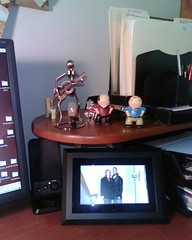
To make the distance to home when I travel a little shorter, for my birthday I got one of these digital picture frames. With a little fiddling, I got the picture and music features working, but I'm stumped on video. When I searched for support, I found I wasn't the only one:
I converted my file to various formats but unfortunately none of them would play on my frame.
When I picked up co-chairing the HTML Working group with Chris Wilson in March this year, little did I know how much video codecs would impact that part of my life too.
The scope of the HTML 5 draft is considerably larger than the scope of the HTML 4 Recommendation, and the Working Group is looking at the major differences in a couple ways:
Among those requirements issues is ISSUE-6, videoaudio. It has been discussed informally as far back as March/April (Opera, Apple and Microsoft, etc.) and it was added to the issue tracker during a discussion of media elements on the first day of our our November meeting in Cambridge.
A few minutes later, we added a design issue, ISSUE-7 video-codecs, regarding which codecs, should/must/may implementations of HTML 5 support. David Singer of Apple wrote an excellent summary on 9 November:
... interoperability at the markup level does not ensure interoperability for the user, unless there are commonly supported formats for the video and audio encodings, and the file format wrapper. For images there is no mandated format, but the widely deployed solutions (PNG, JPEG/JFIF, GIF) mean that interoperability is, in fact, achieved.
Licensing:
The problem is complicated by the IPR situation around audio and video coding, combined with the W3C patent policy. "W3C seeks to issue Recommendations that can be implemented on a Royalty-Free (RF) basis." Note that much of the rest of the policy may not apply (as it concerns the specifications developed at the W3C, not those that are normatively referenced). However, it's clear that at least RF-decode is needed.
So when Rudd-O's article says, "Nokia and Apple have privately pushed to give Ogg the noose treatment," that's just sensationalism. The truth is that Apple and Nokia are participating in an open discussion of the issue.
Many of us share the goal of an open, interoperable video codec for the web. But the state-of-the-art as of Nov 2007 is that there is no video codec that meets the community requirements. In that context, the 30 Nov message from Mikko Honkala of Nokia that said, "we support publication of HTML5 WD, including the canvas, audio, and video elements, but not the SHOULD clause for the baseline codec until proper patent assessment has been made" is not a "noose treatment"; it's just working group members trying to prevent the disappointment of authors coding to the spec and then finding out that it doesn't work.
The 11 December response from the editor, Ian Hickson, was to acknowledge the issue in the draft:
It would be helpful for interoperability if all browsers could support the same codecs. However, there are no known codecs that satisfy all the current players: we need a codec
- that is known to not require per-unit or per-distributor licensing,
- that is compatible with the open source development model,
- that is of sufficient quality as to be usable, and
- that is not an additional submarine patent risk for large companies.
This is an ongoing issue and this section will be updated once more information is available.
3.14.7.1. Video and audio codecs for video elements the HTML 5 draft, formatted for emphasis/clarity
Worse than not acknowledging the openness of the discussion, Rudd-O continues, "This destroyed all hope of having free (as in freedom) media embedded in HTML5 in an interoperable way." To give up hope at this point is the most counter-productive thing to do.
The response to the W3C Video on the Web Workshop Call for Participation was an outpouring of resources to tackle this issue. The presentations were inspiring.
I was also inspired by Håkon's demo in the video panel in the W3C Technical Plenary; he took the wikipedia octopus article and replace the photo with a video. It was easy to think back to when I was in third grade and imagine how much more of an impact it would have on me; then I remembered I have a third-grader at home; see One laptop per Kyle for more of that story, including a little video production of my own.
Putting that video of Kyle together was pretty easy with current consumer technology: I shot it with a digital video camera that we bought years ago, edited it with Apple iMovie, and an online service took the iMovie output and converted it to whatever everybody is using these days. But as Eric Hyche of RealNetworks pointed out last week, somewhere in the process I had to execute some terms and conditions with that online service; it's my video; what business is it of theirs? When I take a picture and put it up on the Web, I can use flickr if I want their value-add services, but I can also just stick the JPG file on an HTTP server of my own; the corresponding option for video is beyond the reach of the typical Web user.
Though I'd rather somebody more qualified chaired the W3C standardization effort to choose between video codecs, I have been studying digital media enough to be confident I could produce Ogg/Theora or Dirac; but I'm not sure my audience can consume it. After the workshop discussions, I'm particularly sympathetic to comments such as this one about the rich network of support for H.264:
... pushing Ogg/Theora might make you proud to have voted, but it will only distract from the industry's coalition to unitedly back H.264 from mobile devices to HD. There's far more FOSS support for MPEG-4 and H.264 than for Ogg/Theora ... Having wide support behind one good, open portfolio of standards will make it easier for FOSS to compete with and participate in the desktop computing world.
DECS (891519) on Sunday December 09, @05:33PM
H.264 has a lot going for it; the two main issues I see are:
- the H.264 patent licensing situation
- competition with VC-1 in Windows Media
Microsoft didn't send anyone to the workshop last week, so I'll leave the second issue for another day.
I heard a lot of creative ideas about the patent licensing situation and support for free software, though. Everything from stop-gap measures involving binary blobs to using the full force of W3C to address the patent situation head-on as we did in the P3P and Eolas cases. If you want to join the W3C members who have expressed an interest to help, please contact me and Philippe Le Hégaret and Chris Lilley, preferably with a copy in a public archive.

Here's a hint: binary blobs are not acceptable, even as a stop-gap. Fedora, which is a nice baseline for these sorts of things as it's strictly FOSS and its parent, RedHat is extremely patent averse, doesn't ship the no-cost GStreamer binary MP3 playback plugin, so the chances of it shipping a binary H.264 blob is zero.
Also, aren't the P3P and Eolas cases instances of submarine patents? If so, surely that means you could use the "full force of the W3C" to address the patent situation of Ogg Theora.
FOSS support for H264 is illegal, because the patent holders prohibit distributing software which implements the algorithms under terms compatible with FLOSS licensing.
Just because small time infringers are not rigorously pursued, as in some other industries, does not make the situation acceptable. For example, Microsoft does not pursue users of unlicensed Windows as hard as the MPAA pursues infringers of music copyrights, but that does not make an unlicensed copy of Windows software any more legal than an unlicensed implementation of the H264 codec.
It is unacceptable to exclude FOSS software from music/video on the Internet.
Yes, we can investigate the patent situation around Ogg Theora, but if we can clear the hurdles around H.264, it's not clear what critical need Theora would fill.
p.s. James, have we met? Do you keep a blog or homepage or the like?
The first and last terms of Ian Hickson's wishlist are too hard to satisfy and misses the point. Actually, what we need is not a codec that "do not require a per-unit or per-distributor licensing", the license just has to be permissive enough. Xiph's license could hardly be more permissive.
All innovation is an "additional submarine patent risk". Rather than wish for a miracle, we should seek and support, at least suggest the least patented soulution. Submarines are only a part of the patent problem, focusing only on those misses the point. It is particularly unfair to disqualify Vorbis/Theora on this point. Think of it, all competitors are more patented.
I think H.264 would be a good codec to use in the HTML 5 standard. The patent issues need to be resolved first though. Also the W3C could use it's full force to resolve the second issue. Actually it's not like Microsoft has always been implementing standards the way they should, so why should anyone actually care about their point of view?
Not wanting to delve into the CODEC can of worms (but wishing they'd just use OGG/Theora), can anyone tell me why <video> is preferable to using <object> ? And if it is preferable why introduce a new (non-backward-compatible) tag rather than an attribute to specify media type on the object element?
It would be nice to see W3C working actively in this area to try and open the patent minefield. Although I hope with more success than in the EOLAS case - although that patent still seems entirely without merit, the end result of all the work is apparently that it is available on discriminatory royalty-bearing terms, which is about as bad as it was at the beginning.
H.264 is currently not compatible with the open source model, so it is currently not a valid option. If MPEG-LA could lax the terms a little so Open Source decoders (not encoders) could be implemented without any licensing, it would be a very strong contender.
I think the best thing would be for W3C to put official force behind an outreach and plea to MPEG-LA to revise the licensing terms so at least H.264 and perhaps even the whole of MPEG-4 can be implemented license- and royalty-free in Open Source.
I think too many people are focusing on the H.264 standard's commercial codec implementations, as there are FLOSS alternatives out there:
http://www.videolan.org/developers/x264.html
However, I am not familiar with the patent landscape surrounding the H.264 standard, so I will refrain from commenting upon that. It is, however, well worth investigating this venue.
If you look the Anime fansub-scene, which seems to be in the future when it comes to adopting standards that turns out to be commonplace, then you'll see that the combination MKV/x264 seems to be the second most common combination. Only beaten by AVI/Xvid, and that is only used for NON-HDTV/low-quality content.
Both MKV and x264 are FLOSS, and as such must be excellent candidates for W3c?
Another idea, what could be worth thinking about, is using system codecs. Would make it much easier to keep the codecs up to date, remove a whole lot of wasps nests, and decrease the complexity neccesary to implement the video playback (by not having codecs implementet directly into the browser).
Not that I've kept myself up-to-date on the HTML4 WD, so my apologies if this has already been discussed.
This report I wrote last year may be of interest " FOSS Codecs for Online Video: Usability, Uptake and Development". It is a review of the best available tools for the creation, playback and embedding of online video using Free and Open Source Software video codecs, and a set of recommendations for development to enhance their adoption by social change video projects on the web.
< a href="http://wiki.transmission.cc/index.php/FOSSCodecsForOnlineVideo:UsabilityUptakeandDevelopment_1.2"> Report Viewable Online
or available as a PDF here:
Download PDF
You say "I have been studying digital media enough to be confident I could produce Ogg/Theora or Dirac; but I'm not sure my audience can consume it." I understand your hesitation here. We authored this report to identify the areas for improvement to get Ogg Theora to a stage where it "just works".
But as with all digital distribution strategies you must think about who your audience is, and what technology they are able to use. Eg. the excellent VLC media player (VideoLan Client) plays Ogg in addition to just about any other format/codec you can name, and is available cross-platform. GUIs are now available to transcode to Ogg on Windows, Mac and Linux. Options for embedded playback of Ogg are being developed by projects such as Metavid and Wikipedia.
You might need to help your audience a little and educate them as you go along, and there are gaps in usability that do need to be filled. But the future is looking brighter for Ogg. I for one will very much enjoy the ability to play back Theora video files in FF without the need for a plugin - in fact this will be a big step-forward for usability that users will no doubt rally behind.
You state that the Ogg codecs (Theora/Vorbis/Flac/Speex) have the risk of a submarine patent claim. However, this is the case with all codecs. Every conceivable piece of technology could be patented without you knowing about it. There is no reason to trust any codec to be free of patent claims.
Theora is based on On2's VP3 codec. On2 has granted a universal royalty-free license on the patented technology. This means that On2 won't sue you. But another company might if they claim that you infringe their patent.
H.264 is an MPEG4 codec. MPEG-LA has not granted a royalty-free license. They will definitely sue you. If you convince MPEG-LA to grant a royalty-free license, still another company might claim that you infringe their patent, and therefore sue you.
So, there is NO difference, except that Theora is free as far as we know it, and H.264 is NOT. Even if you convince MPEG-LA to relinquish their patents, it might still be subject to submarine patents, like any other technology.
I guess Apple and NOKIA should really pack their stuff and go home while they still can, because they might be sued for infringing the patent on:
h.264 all the way.
ogg is nice but too much politics
I think HTML5 should support open standard all the way. It is not just a matter of ideology, it's a matter of compatibility, portability and non-discriminating choices for every user.
Regarding the audio I don't think there's any discussion: Vorbis is the only feasible solution.
The fact that there are some open implementation of h.264 (x264 by VLC developers and ffh264 by the ffmpeg team) does not justify the our support for it. It may very well be that tomorrow we'll not be able to play those files, or that Apple decides to make its codec a little bit different for commercial or DRM realted purposes... who knows.
The point is: it should be accessible from any device, running under any OS, any architecture, and through any browser that supports the HTML5 specs. Period. Somehow I don't feel like we are going to achieve that with h.264.
So either we find a way to build the implementation around x264 or libavcodec (ffh264) or we take Theora.
In big point in favour of Ogg (vorbis+theora) is that a HUGE website like Wikipedia (~#7 most visited in the world) choose to adopt Ogg for all a/v files. If the HTML5 supported really open standards it would make the companies change the way the think products and consumers.
Open standars please, for the sake of everyone.
Hi Federico,
for small devices, we have to keep in mind that the issue is not only software related, but also materials. Basically, small devices have to include video processors to not drain the batteries. So deployment and updates are a bigger issue.
I can certainly understand the worries about submarine patents, but there is no way of avoiding the problem. Imagine, for example, that H.264 was adopted as a mandatory codec. All the big browser players negotiate a deal with MPEG-LA which allows them to ship a decoder. At this point in time, MPEG-LA has an incentive to offer a deal at a reasonable price. If they asked for silly amounts of money, the community would not adopt H.264 at all.
Now suppose that, unknown to you, I have a patent on some essential aspect of H.264. I could license my patent to MPEG-LA and collect a small share of the royalties. On the other hand, I might make more money by holding on to it and keeping quiet. Once H.264 is used universally on the web, I come out of hiding. Now I can ask for $50M or $100M for licensing, because everyone is committed to supporting H.264.
It's tempting to think you can sign a license with MPEG-LA, and then implement H.264 risk free. In fact, you have no guarantee that all the IP owners are participating in that group. If I really did own IP in H.264 then there would be arguments both ways. Participating would give me a low risk income, and staying out would be higher risk while giving me the chance of a huge payoff.
Once you've given your money to MPEG-LA, you have licensed all known patents. Similarly, when you've downloaded Theora for free, you have licensed all known patents. The situation is identical, but in one case you have paid money and prevented legal open source implementations. We can conclude that Theora is better in some ways (free licensing of known patents) and identical in all other ways (submarine patents). No one can guarantee that any codec is free of submarine patent claims, even in theory; Theora is as good as it gets. IMHO this means it is the only reasonable candidate for the mandatory algorithm.
It is possible that MPEG-LA would agree to free licensing of decoders, while charging for encoders. This would make H.264 a better choice, but still not as good as Theora, which is completely free. The ability to do open source web development is important, just as it's important to have a standards-compliant open source browser.
There does indeed seem to be a consensus behind H.264, as mentioned in the quotation. The difference is that the web is designed to be open in a way that a set-top box, for example, is not. H.264 is a reasonable choice for a closed system like a set-top box, but on the web, it doesn't achieve the essential objectives of openness and non-discrimination. Following consensus only makes sense if the original design decisions can be justified in the new situation, and in this case, they can't be.
Finally, we could have no mandatory codec at all. This would be better than mandating a non-free codec, but it would harm interoperability. Interoperability is, of course, the point of a specification like HTML 5, so it would be a shame if things went this way.
Why doesn't the W3C call for the abolition of software patents? They're clearly impeding standardization efforts. This seems like a socially useful function for the W3C to perform.
How about MPEG-1 video with Layer II Audio? I have searched on the internet, wrote a kuro5hin article, and asked on the gstreamer mailing list and have yet to find any unexpired patents that have been named as applying to MPEG-1 video with Layer II Audio. There certainly are patents that are claimed on MPEG-2 and on MPEG-1 Layer II audio (MP3), and there could be some unexpired patents on the rest of MPEG-1, but if Apple and Nokia don't want to use Ogg Vorbis, they could certainly look at MPEG-1 (which the free version of Apple Quicktime already decodes).
A vote for ogg-vorbis and ogg-theora. We need open standards - it is good for the competition and the development. The use of software patents makes it difficult or imposible for small companies to compete with the big companies.
We need open standards, I actually don't care if we use ogg or another format, but it must be open.
For a video producer wanting to deliver the highest quality video with the least amount of pain to the web OGG is not an option. There is virtually no professional back-end available with support that would allow a small producer to make their video available fast and reliable and with help support etc. pp. This is not a "lets make a web-export from photoshop" jpeg scenario - we are talking about difficult technology that needs to synch and stream and be small to fit through the pipe and not look like it has been encoded in the 90s (and Theora is THAT bad if you have worked with both Theora and compared it to H264 with a video professional eye). there are millions of options to make good looking H264 some/most straight out of production software that is mostly used to actually produce video (not just ripped or downloaded and re-encoded like most Theora content out there). There are only a handful of mostly unusable Theora encoding options and most of these are only available on Linux / running on webservers (something absolutly great for your cat movie - absolutely unworkable for a big production company wanting the best quality possible and therefore not re-encode you works twice (to upload and then to present). I am normally an advocate for free software and open society and all but I am at loss to understand why a group of vocal OSS developers can wreak so much havoc on the net by proposing a video codec as STANDARD that is about 150 internet years old and has been surpassed. Its like people arguing for intelligent design - purely ideologic arguments actually reminds of what Microsoft did with IE over the years (the ideology is more important then the web).
If ogg theora would appeal it would have made inroads - most video encoding technicians are very aware of the issue and are looking at the market. Thats why flash made such a huge splash - its easy to post and once it added H264 the big guys hopped onto it with their good quality content too.
As a personal note - I am working like mad to produce video - it takes sometimes days to make a good visual fx shot or even month to make a music video. I would always choose the BEST LOOKING option over any ideologic free version - heck I would even pay for a codec if I had too if the end result looked closer to what I was doing then like an 8bit pixel mash up. Also I rather spend 3 days in production doing cool stuff then 4 days trying to find out how to best compress a video and try to remember some command line code. OSS developers have to understand that or their whole ideology fails because they have alianated even those that are normally sympathetic to their cause.
As far as I can remember members of MPEG-LA charged everyone they could, including open source and revenue free implementations of MPEG codecs. And with H.264 this won't get any better. The companies that own patents will seek to drain every possible cent it can before the patent expires.
See Multimedia Patent Trust v. Microsoft Corp.
If there were to be submarine patents for Vorbis/Theora, wouldn't it have surfaced already? Think of the dozens of success games and commercial applications that used it and have been sold across the world? Think about the per-unit royalties that some patent owner could have charged?
Anyway, why should we keep losing time waiting for patents to expire? We could already implement Theora/Vorbis as standard and later if better technologies became available (like it always has), there could be a room for expanding or replacing the standards. We cannot wait more 10 years to decide for a final solution that will be final just as long as our technology don't evolve.
And the last 10 years proved that it has evolved and it will keep evolving and changing. Standards can make or life easier, but history has shown that standards take too long to rise and innovations demand far more agility.
Ogg is more free then H.264, not much to question there. H.264 might have more support on closed and more prominent platforms as well as have hardware decoders available in mobile devices but using ogg as a standard in HTML5 would make it a lot more popular and as a result would create more incentive for supporting ogg in closed players and mobile hardware as well. I see no reason for not supporting ogg here unless one is worried of it becoming more popular and providing less possibilities for implementing DRM as well as making it easier for new players to enter the market.
IMHO, quality should be take more seriously on this matter.
In the first priority, FOSS of course, but we shouldn't face a world where we'd be stuck with low quality audio and video, even worse than FLV. FLV itself remembers me of Real Media, which I used to watch video almost a decade ago. I feel as if we were downgrading with FLV.
Hardware power is what we shouldn't worry, because until HTML 5 be available hardware will be much more powerful than today. Bandwidth on the other hand doesn't evolve so fast, and I'm sure there will be millions of people using dial up still on the end of 2010 decade.
Users won't watch videos that take long to download, unfortunately that's the reality. But we also can't use a 128Kbps MPEG1 video that is 10 times worse than VHS!
I'm not also on the lawyer department, but I know that for H.264 there are at least x264 for encoding and libavcodec for decoding that are open source. I belive, but I'm not sure, that any developer can get them as a basis and develop their own version to be embedded on their softwares.
For video, H.264 has a very nice quality and can be small if it is not a HD video. If H.264 can't be used, I'd rather use xvid than Ogg.
Dear Hikari,
please read why audio format matters. The same goes for video formats. It's not about open source codec implementation of proprietary formats, it's about FREEDOM to play you own content, encoded in some format, freely on ANY platform, because open source doesn't mean patent- and royalty-free. Period. So, free and open standards for everyone, please. Theora is a way to go.
"RedHat is extremely patent averse, doesn't ship the no-cost GStreamer binary MP3 playback plugin, so the chances of it shipping a binary H.264 blob is zero."
Sounds like a problem with Red Hat. Maybe you should be using someone else's product.
I'm not sure I understand the problem. It seems to me that when you have completely free codecs and containers (theora, vorbis, xvid, ogg) which , via HTML5, make it possible for the masses to produce professional quality embedded videos, consumers will demand support from their vendors. This is not Netscape's flashing text feature; we're talking about an amazing standard that could revolutionize the web. This is the sort of thing FOSS is for: distributing information and ideas freely and without restriction to a world-wide audience. Considering a proprietary codec is beyond repugnant. It flies in the face of the design goals of HTML. HTML is great because it let's anyone format and share the content they've made with anyone else. These dissenting companies need to jump on board or get left behind. I half think Apple doesn't want ogg as a standard in HTML5 so that they won't have to support it in browser on the iPhone and iPod and so that they won't lose sales of their Quicktime encoding software. The W3C need not be concerned with corporate pocketbooks, but with disseminating information in as user-friendly and open way as possible. The book industry had the same concerns with libraries, but publishers learned to deal with it; let Apple, and Nokia learn to deal with it. Maybe I don't understand the problem because there isn't one, not a legitimate one anyway. Move forward with ogg and don't look back. It's the sensible and right thing to do.
"Sounds like a problem with Red Hat. Maybe you should be using someone else's product."
There is no problem with Red Hat. The problem is with software patents
https://fedoraproject.org/wiki/Software_Patents
Whatever we do, it needs to be completely open. That means no binary blobs, no patented decoders or encoders. What will make this succeed is when anyone can, at no expense, encode a video, host it on any server they can, and have it play on anything.
If we go with something that has free decoders but patented encoders, people will still be stuck using proprietary software to encode the video. That may seriously harm popularity if this software is expensive or just not very good.
If we go with something that's only available as a binary blob, we are at the mercy of the author of that blob whenever we want to write a web browser for a new platform. Without getting them to write a decoder we will not be able to implement HTML5. Then, their decoder might just be a piece of crap, lagging or crashing the browser or even containing spyware.
A few people have said that Theora won't do because it doesn't offer as high video quality as they'd like. Consider that being an open standard, anyone is free to improve it - and if it becomes the standard for online video, and it really does need improving, someone is going to improve it. That's how open-source works. Make something good, get it popular, and others will improve it.
I am tempted to say that for audio, MP3 should be supported in addition to OGG and FLAC, simply because it is a very popular format and a lossy encoding. People are going to want to just drop their MP3s in a page, without having to figure out how to convert to some other format, and if they do convert they'll lose sound quality. In fact I would say that browsers are recommended to support MP3, but only required to support OGG and FLAC.
The same argument cannot really be made for any particular video format, as none are really as popular as MP3. If you wanted to do the same for video, you'd have to support just about everything and it's just not worth the trouble.
Very well put Rena.
Not very well put falkg, it seems your trying to use your job as an authority for forcing misleading information, when it would more likely make you oblivious to your well rehearsed process.
I imagine the problems falkg has had whilst likely unrelated to web content, maybe related to my experience.
I found theora to be easily comparable to h264 encoding in terms of size to quality ratio, maybe better when tweaked and with the right source, that was untill imported to adobe premiere.
After exporting (Adobe seems extremely limited in this) it was difficult to get comparable results. As I'm sure falkg could tell me. You should produce and encode in one format for best results. These programs will be tested for good results encoding to, say h264 but this could soon be theora.
This I feel, he should have expected from something so new. Large companies who involve in video wars and companies like adobe, who's dreamweaver cs3 design view does not support CSS as well as 95% of browsers of it's time, will all produce better and easier to use products if a conherent strategy like ogg theora is accepted. It will also allow easier to develop and use web pages, without ugly and confusing backup links, in case someones plugin is broken.
I hope is something everyone can use and play safely and reliably, such as mozilla is pushing.
Nokia and apples remarks have been heavily weighted mixing truths and untruths in a fashion that can only be described as an attempt to bully/dominate in a clever way.
Yes mobile devices that exist today may not support theora currently, but they support so little, such as full css, and have so many limitations that they will all be replaced before long. It is often said mobile devices are a 10 year old pc, but they are far slower than that, risc mhz are not comparable and busses are way slower than that.
I'm personally more interested in audio but I'm very annoyed by the use of adobe flash everywhere, thus this comment.
To help out at a free software orchestration project I recently tried to find free software encoders for multichannel audio formats that can be used together with video.
I was quite surprised to find next to nothing, the best known formats for this purpose are only basically supported, if at all, and in the oldest incarnation (Dolby Digital aka. ac-3).
This is very far from state-of-the-art and tells me that there are legal or technical (missing specification) barriers that are hard to overcome.
The most feasible options I found are uncompressed formats and free codecs: vorbis, flac, wavpack
I'm sure this situation is very similar in the world of digital video, so the only real options I know of are theora and dirac.
Both codecs are liberally licensed and can certainly be used in free as well as proprietary software.
To comment on theora quality: I was satisfied when I watched the Linux audio conference from home the last two years, which was broadcast using ogg theora.
While I love the convenience of digital audio generally, on many occasions mp3 licensing has been a huge pain for me (and I'm just an end user!). Why why why would the working group consider anything but Ogg as the primary candidate for video (and audio)?
Specifying the most open format available could easily drive support of that format. Software can follow very quickly when there is a demand and there are no licensing restrictions. In many cases I fail to understand why theora support hasn't been included already (IE - it's there in Firefox and Chrome). Admittedly hardware may take a little longer but in the case of a browser this will only affect a small minority, for a period. Nokia and Apple can and will introduce more Ogg support pretty damn quickly if they discover the wind is blowing that way (especially since it costs them nothing, license-wise). Wireless routers often support standards long before they are published.
In contrast, using a less open format could potentially make support more restrictive as the license owners seek to cash in on a captive audience. Licensing issues could start appearing left, right and centre. Maybe that's a little cynical, but why take the risk?
As mentioned several times, submarine patent risk can never be entirely avoided, so surely the wise decision is to use the most open format available and keep your fingers crossed.
If the standard can specify support for further formats without any inconvenience to the user, then fine, but if Ogg support increases then surely there are benefits across the board.
Open standards please.
On the codec side, I agree with Theora for the video codec, and Vorbis as the audio codec of choice. As for the container format, I would point out that such choice does not imply automatically the choice of the ogg format...
The fact being, the ogg container has some strictly technical drawbacks to keep in mind - a somewhat complex layout that require resources not always availables on typical embedded systems, a marked tradeoff for latency vs. overhead in streaming applications and a generally bulkier overhead than most other containers...- and there is another suitable open source format - mkv - that has demonstrated a remarcable flexibility, it is quite widely used (admittedly, mostly by the anime community, where it is the first choice container for high quality videos, multiple audio and/or subtitles content) and address some of the aforementioned problems of ogg.
MKV supports not only also the inclusion of subtitles, but also of chapter declarations - nice - and other kind of content, lyke the files for the fonts used in the subtitles (in itself, this is a potential issue, as often you find commercial fonts embedded with free content).
Speaking of subtitles, I noticed they lack from the discussion, but it would be nice that they would be covered in the draft too.
At the moment, the more versatile and rich (it allows complex styling of the text, with different fonts, sizes, weights, forecoleor, shadow colors - a very important feature for subtitles, as monochrome subs "fade" where the image colors approach their own, and should ever present) of the subtitle formats is the "Advanced SubStation Alpha" which is open source and can be produced using a variety of Open source tools, like Aegisub, and can be displayed on pcs through VsFilter (Again, opensource).
For small capabilities application, the alternative should be the subrip format.
So, my unenlighted and humble recommendation can be summarized in:
Video codec: Theora
Audio Codec: Vorbis
Container: MKV
Subtitles: Advanced Substation Alpha or
Subrip, UTF-8
Features allowed by said formats, whose implementation should not be mandatory and hence could be optional:
Chapter declarations (though, nested chapters declarations in MKV are XML streams, so browsers got them "almost free"... that said, there are not that much videos on youtube that need chapters)
Embedded fonts
Rich formatting for subtitles.