Web Compatibility Test strikes back
Author(s) and publish date
- By:
-
-
Dominique Hazaël-Massieux
-
- Published:
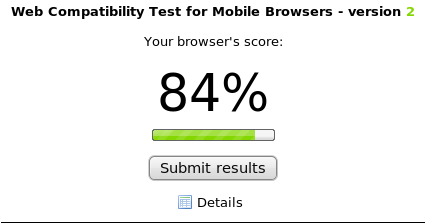
Back in 2008, the Mobile Web Test Suites Working Group released its first Web Compatibility Test for Mobile Browsers that packed 12 (and later, 16) important Web technologies into a single page that would tell you at a glance how well your browser supported them.
Fast forward to 2010, the level of support on this first Web compatibility test has tremendously improved, although the browsers that show a fully green grid are still few.
But in the meantime, the technologies have also evolved, and while many of them are still not final by any means, it seemed that getting an overview of which of these technologies are available today on what browsers would make a good follow-up to our first test.
That's the goal of our second Web compatibility test for mobile browsers that tests a number of Web technologies through their JavaScript interfaces, and collects detailed results on which browsers pass which tests.
This is the first release of the test, so it likely isn't quite perfect, and as always, the choice of the tested technologies is somewhat arbitrary; we are very much looking for feedback, either in the comments here, on our Working Group blog, or to our public mailing list.

who is deciding what goes into those test suites and what doesn't? i don't want to criticize this test's utility as a tool, but i am definitely curious to understand why this specific set of tests made it into the test. there is an infinite number of ways how you could choose and combine tests to come up with a some score in a "browser test", and unless there is some explanation as to why the test is doing what it is doing now, it seems a bit random to me. the blog entry itself says "the choice of the tested technologies is somewhat arbitrary", but i sure hope it's not completely random, so explaining at least a bit why the test has been designed this way would be very useful.
Hello there dret,
The W3C Mobile Web Test Suites Working Group met and discussed publicly tests that might help solidify the Web platform on mobile devices.
Though the group is closed, the list is open and I'm very open to specific discussion on individual tests and perhaps even proposals for new ones.
Actually I think all the important new features of the html5 draft are covered by the Web Compatibility Test for Mobile Browsers. I think it´s a great tool to get a first impression of a browser´s support for html5.
I can attest to the much better browser support in the last 1 to 2 years. We have struggled in the past with our browser web page and getting it to show properly on all platforms. It would be nice to have a simple program that could test the webs compatibility on the fly to make sure your business page displays properly.
Our page was just redesigned a 3rd time for the Iphone applications.
Fred
Senior Designer