Past, present and future: An update on W3C’s Strategic Objectives on the 37th anniversary of the Web proposal
Author(s) and publish date
- By:
-
-
Seth Dobbs, W3C CEO and President
-
- Published:
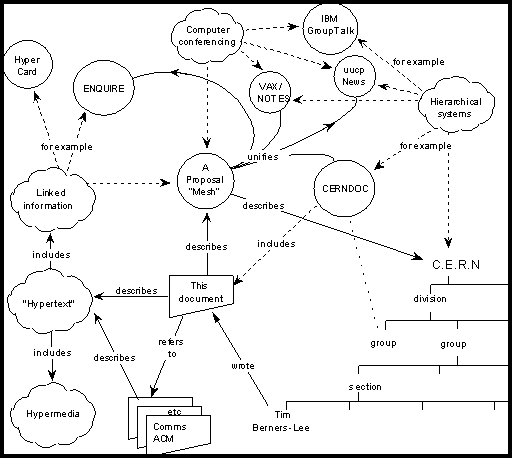
Diagram illustrating "Information Management: A Proposal" by Tim Berners-Lee, 12 March 1989
Today’s anniversary of "Information Management: A Proposal" that Tim Berners-Lee wrote on 12 March 1989 prompts me to stop and reflect on the importance of the web, and the key role the World Wide Web Consortium plays in making the web work — for everyone. I want to take a brief moment to celebrate the importance of the platform, and to call out key initiatives from our strategic objectives.
The last time I wrote at the occasion of this anniversary was two years ago. I hinted that while the W3C community has been doing the essential hard work to ensure we are addressing the challenges that the web faces, we as an organization needed to evolve our structure to better listen and increase our reach to include more of the world in our work. Then in June 2025 we identified our strategic objectives for the next few years.
There is absolutely no question that the invention of the web was revolutionary. Since its launch 35 years ago (first via the Line Mode browser available at CERN in March 1991, and then as software on the Internet in August 1991), the web has morphed, evolved and expanded. In the scale of things it rapidly went from a connection means to one of our most extraordinary global commons. The web today is a ubiquitous and multimodal platform that empowers people and enables so many aspects of life — from education to democracy, but also entertainment, commerce, creativity, etc. Billions of people use the web everyday.
Tim Berners-Lee created W3C in 1994 as a single organization that works around the globe to develop web standards. He aimed to foster a consistent and interoperable architecture accommodating the web’s rapid pace of progress; a single global Consortium that coordinates hundreds of Members and a community of over 12,000 individuals working on the creation of open web standards — meeting the requirements of web accessibility, internationalization, privacy, and security — for the benefit of humanity.
Through our strategic objectives we are putting emphasis primarily on impact and stakeholder outreach which beget a solidified structure, diversified support, and broaden our footprint. By being more deliberate about measuring our success we anticipate to have an even bigger impact. Given the prevalence of the web, we are striving to both reinforce relationships with existing stakeholders and to establish new relationships that help further our mission. Particular attention is given to our methods for engaging with unserved/underserved regions.
We’ve laid out our strategic roadmap according to a timeline that uses three horizons of one to one-and-a-half years. As we are planning transition to Horizon 2 I expect we will be able to engage in more durable activities, and to report as we progress. This is challenging and humbling but quite exciting. Many W3C Members stepped up to contribute to this immense opportunity to gain greater influence in the world, to gather new stakeholders, and to help direct the future.
Notes
The World Wide Web Consortium is a unique global space where a wide range of stakeholders leveraging the web and its infrastructure work together to address society’s social, cultural and economical needs, powering the technologies that make the web work — for everyone.
Please consider donating. Your donation contributes directly and makes a huge difference to our operations as a public-interest non-profit.

Comments (0)
Comments for this post are closed.