CSS WG Blog front page
Minutes Tokyo F2F June 2013 Part IV: Priorities, Grid Layout, Alignment, Stacking Contexts, Backporting Policy
CSSWG Priorities
Philippe Le Hégaret, W3C’s Interaction Domain Leader, presented on the metrics W3C Management (W3M) has about the CSSWG’s progress over the past charter period. Discussed what was accomplished and whether that fits with the CSSWG’s own interests and priorities.
Full minutes
CSS Grid Layout
- Resolved: Snap-to-grid is out-of-scope for CSS Grid Layout module
- Discussed use of
position: grid to pull descendant elements up into an ancestor grid.
- Resolved: Absolute-positioning rules for grid items accepted as described in the spec, with
auto offsets meaning use padding edge of containing block.
- Resolved: Change issue 8 on sizing collapsed tracks into a more general issue about how to collapse a grid track.
- Plan to change
grid-definition-* and grid-template properties to grid-template-[rows|columns|areas] and look into defining grid-template as a shorthand for all three, using syntax similar to that in the Template module.
- Long discussion of default handling of grid container’s contents. Tentatively resolved on making
grid-auto-flow: row the default, which turns all grid container children into grid items and auto-flows them (similar to Flexbox). Issue still open for future discussion.
Full minutes
Alignment
Tab and fantasai presented the new CSS Box Alignment draft, explaining changes in design and details since the earlier FPWD.
- Resolved: Need more work on baseline section; define first-line and last-line baseline for all things.
Full minutes
Stacking Contexts
- Resolved: Table cells do create pseudo stacking-contexts (as resolved before) but borders and backgrounds (of the cell or its ancestors) are not in that pseudo stacking-context.
Full minutes
Backporting Policy
Principle: A change to a CSS3 spec that would make all CSS 2.1-compliant UAs incompliant needs to be backported to CSS2.1.
Note: If it would break content, we shouldn’t be making the change.
Full minutes
Minutes Tokyo F2F June 2013 Part III: Counter Styles, Cascade, Transitions
Counter Styles
Discussed Last Call publication of Counter Styles and linking to Internationalization WG’s Counter Styles NOTE.
Full minutes
CSS3 Cascade
- Resolved: Close issue on how
!important interplays with scoped styles; current spec is good.
- Resolved: Ok with current definition of
default, remove issue, but also clarify the spec and add examples.
- Discussed adding a new keyword for
inherit-or-initial depending on whether property inherits by default.
- Resolved: Adopt A, C, D, and E from David Baron’s message on Transitions and Animations cascading order, use the cascade as currently-specified in CSS3 Cascade, plus magic: animation on an element turns off transitions for the affected properties. Re-evaluate after implementation experience.
- Resolved: Take CSS3 Cascade to Last Call, with edits mentioned in minutes today. Ping HTMLWG especially, also notify WebApps, SVG, WAI. Set 4-week comment period.
Full minutes
Transitions
- Resolved: dbaron’s proposal for reversing interrupted transitions is accepted.
- (See also earlier resolution on cascading order of Transitions.)
Full minutes
Minutes Tokyo F2F June 2013 Part II: Zoom Media Queries, Cross-site Security, Shapes, Events and Fragmentation
Zoom Media Queries
Discussed SVG use case of including more details as user zooms in, e.g. on a map. While discussing how to solve this, it became clear that while people have some idea of how zooming is interpreted wrt Media Queries, the whole interaction of resolution and resizing is vastly underdefined and needs work before we can sensibly add related new features.
Full minutes
Cross-site Security
Discussed possibilities of cross-site attacks via CSS. One case that krit brought up wrt importing shapes was dismissed as Not a Problem. Some others raised by roc & bz might need more thought and discussion.
Full minutes
Shapes Dependencies
- Brief discussion of SVG proposals’ dependencies on Shapes and how to deal with that.
- Resolved: Move contours from rendered content to next level
- Discussed using same-origin restrictions for shapes.
- Resolved: Close the float/exclusion harmonizing issue. Exclusion wrapping context does not include floats.
Full minutes: Part I, Part II
Events and Fragmentation
- Resolved: Work on
pointer-events: elements-from-point solution that will walk the elementsFromPoint() chain instead of the ancestor chain (problem is passing events from content to fragmentation container)
- Issue raised against Selectors 4 wrt whether
::pseudo:pseudo combinations are invalid or match nothing.
Full minutes
Minutes Tokyo F2F June 2013 Part I: Animations, SVG Text, Compositing and Blending
Web Animations
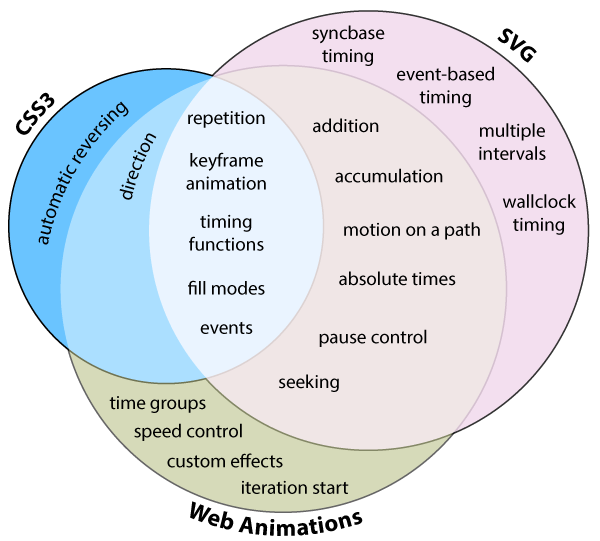
Brian Birtles presented the Web Animations editor’s draft with an overview of its contents. (See also diagram.)
Dean Jackson of Apple expressed some concern at adding so much API to
the Web platform at once:
[We’re] concerned about the massive amount of new API to add in one step. Generally Web improvements are more successful when iterative rather than massive new feature.
And also expressed that
Apple’s main interest in this type of work is very much in the form of declarative approaches to animation backed by a strong API.
and so there was some concern over leaving out features needed for declarative control.
However, everyone agreed that the spec was in good shape for FPWD, so
- Resolved: Publish Web Animations as First Public Working Draft (resolved by both CSS and SVG WGs).
P.S. There is an experimental JS shim for the draft available.
Full minutes
Reusing Stroke and Fill in CSS
The CSS and SVG WGs discussed the possibility of reusing the SVG stroke and fill properties to stroke and fill text in CSS. Some concerns raised:
- controlling pattern fill boundaries when an inline breaks across lines
- figuring out appropriate initial values and interaction with
color
- inheriting a pattern fill doesn’t work in CSS; need to know which element specified the pattern, otherwise adding unstyled inline around part of the text will reset the pattern
- SVG properties don’t follow the CSS shorthanding patterns; need to check back-compat wrt whether this can be fixed
- need some control over where the stroke sits on the glyph outline
fantasai and Tab volunteered to draw up a proposal for how this should work
Full minutes
SVG Text Wrapping
Discussed SVGWG’s proposals ([1], [2]) for adding soft-wrapping to SVG. The goal is to re-use CSS functionality (and layout engines) for SVG text layout. No objections so far to proposal to add a width attribute to <text> for wrapping; however it was felt by some that for formatting multi-block content, HTML markup should be reused. In general, people want CSS text formatting to Just Work in SVG, not require special rules for SVG text content.
Full minutes
Compositing and Blending
Reviewed Compositing and Blending draft, which now contains only 3 CSS properties: mix-blend-mode, isolation, background-blend-mode. Discussed use cases, design, interaction with stacking contexts, forwards-compatibility, etc. The draft needs more review. Meanwhile,
Full minutes
CSS Masking Draft Updated
The CSS Working Group and the SVG Working Group have published an updated Working Draft of CSS Masking. CSS Masking provides two means for partially or fully hiding portions of visual elements: masking and clipping.
With this draft, CSS Masking integrates better with terms and definitions of the CSS Backgrounds and Borders module. The syntax of the ‘mask’ shorthand property is conformant with the ‘background’ shorthand property. Authors can switch between alpha and luminance masking on mask-image now. The IDL definitions of SVGMaskElement and SVGClipPathElement were adapted to use WebIDL.
Changes since the last Working Draft are listed in the Changes section.
Please send feedback to the (archived) public mailing list public-fx@w3.org with the spec code ([css-masking]) and your comment topic in the subject line. (Alternatively, you can email one of the editors and ask them to forward your comment.)
CSS Shapes First Public Working Draft
The CSS Working Group has published the First Public Working Draft of CSS Shapes.
This draft was previously part of the CSS Exclusions and Shapes specification. Exclusions and Shapes have been split out into two separate specifications, and this draft contains only the Shapes part. Future levels of these specifications will describe how these two features interact.
CSS Shapes extends wrapping behavior to shapes other than rectangles. The first level of CSS Shapes allows a shape to be applied to floats, so inline wrapping around a float can happen around an arbitrary shape. This draft includes a syntax for defining basic shapes, extracting a shape from the alpha channel of an image, and applying these shapes to floats using new shape-outside, shape-margin and shape-image-threshold properties.
All of the changes since this new draft was split from CSS Exclusions and Shapes are listed in the Changes section.
As always, please send feedback to www-style@w3.org with the spec code ([css-shapes]) and your comment topic in the subject line. (Alternatively, you can email one of the editors and ask them to forward your comment.)
Minutes Telecon 2013-05-29
- Reviewed shortname renaming plan with Philippe Le Hégaret.
- Resolved: Publish a new WD of CSS Masking.
- Resolved: Minimal expectation is that animations are ignored in non-interactive media, but implementations are allowed snapshot them somehow instead.
- Resolved: ‘not’, ‘only’, ‘and’, ‘or’ are invalid media types.
- Resolved: Background images are positioned to the scrollable area for
background-attachment:local.
- Deferred issue on defining exact color of 3D border styles to L4.
- Wrt repetition in media queries, belongs to set of problems to solve with macros.
- Resolved: Allow at-rules inside declaration blocks per Simon Sapin’s proposal.
- Discussed a few other syntax issues; deferred to F2F.
- dbaron requests comments on outline properties.
Full minutes
Minutes Telecon 2013-05-22
- Resolved: Publish Counter Styles as Last Call Working Draft with 4-week comment period. Contact HTML, Internationalization, and Accessibility groups for feedback.
- Resolved: Pull Shapes out into a new FPWD, update WD of Exclusions.
- Resolved: Publish a new WD of Regions.
- Discussed adding Sunday to TPAC meeting.
- Discussed
an+b grammar changes in Syntax 3.
- Reviewed issues wrt computed values of font-relative lengths vs.
font-size-adjust, font size availability.
- Resolved: No change for ID selector syntax: must be identifier. This is consistent with implementations and class selectors.
- Brought up issue of
background-attachment: local positioning.
Full minutes
CSS Exclusions Draft Separation
The CSS Working Group has published an updated Working Draft of CSS Exclusions.
This draft was previously part of the CSS Exclusions and Shapes specification. Exclusions and Shapes have been split out into two separate specifications, and this draft contains only the Exclusions part. A new draft of CSS Shapes will follow shortly. Future levels of these specifications will describe how these two features interact.
CSS Exclusions allows content wrapping around any element, extending this functionality that has been limited to floats.
The first level of CSS Exclusions allows wrapping around the bounding box of an exclusion. This draft includes improvements to the exclusions processing model, a new value for wrap-flow, and clarification on how exclusions interact with writing modes.
All of the changes since the last Working Draft are listed in the Changes section.
As always, please send feedback to www-style@w3.org with the spec code ([css-exclusions]) and your comment topic in the subject line. (Alternatively, you can email one of the editors and ask them to forward your comment.)
CSS Regions Draft Updated
The CSS Working Group has published an updated Working Draft of CSS Regions.
CSS Regions allows you to collect content in a named flow, then directly define where this content flows through boxes in a region chain.
This new draft contains many improvements to the CSSOM section, as well as scattered improvements throughout. The issues list for CSS Regions has gone from 24 in the last draft to 4 today. The region-overset property has its new name, and the flow-into property now has keywords that choose whether an element or its content is placed into a named flow. Region styling is now accessed through a ::region() pseudo-element instead of an @region rule.
All of the changes since the last Working Draft are listed in the Changes section.
As always, please send feedback to www-style@w3.org with the spec code ([css-regions]) and your comment topic in the subject line. (Alternatively, you can email one of the editors and ask them to forward your comment.)
Archives

Browse by date:
Browse by category:
![[Photo: group photo of the CSS working group in San Francisco]](/Style/CSS/csswg-2016.jpg) Contact:
Contact: