The Resource Description Framework (RDF) is a language for
representing information about resources in the World Wide Web.
This Primer is designed to provide the reader with the basic
knowledge required to effectively use RDF. It introduces the basic
concepts of RDF and describes its XML syntax. It describes how to
define RDF vocabularies using the RDF Vocabulary Description
Language, and gives an overview of some deployed RDF applications.
It also describes the content and purpose of other RDF
specification documents.
1.
Introduction
The Resource Description Framework (RDF) is a language for
representing information about resources in the World Wide Web.
It is particularly intended for representing metadata about Web
resources, such as the title, author, and modification date of a
Web page, copyright and licensing information about a Web
document, or the availability schedule for some shared resource.
However, by generalizing the concept of a "Web resource", RDF can
also be used to represent information about things that can be
identified on the Web, even when they cannot be directly
retrieved on the Web. Examples include information about
items available from on-line shopping facilities (e.g.,
information about specifications, prices, and availability), or
the description of a Web user's preferences for information
delivery.
RDF is intended for situations in which this information
needs to be processed by applications, rather than being
only displayed to people.
RDF provides a common framework for expressing this
information so it can be exchanged between applications without
loss of meaning. Since it is a common framework, application
designers can leverage the availability of common RDF parsers and
processing tools. The ability to exchange information between
different applications means that the information may be made
available to applications other than those for which it was
originally created.
RDF is based on the idea of identifying things using Web
identifiers (called Uniform Resource Identifiers,
or URIs), and describing resources in terms of simple
properties and property values. This enables RDF to represent
simple statements about resources as a graph of nodes
and arcs representing the resources, and their properties and
values. To make this discussion somewhat more concrete as soon as
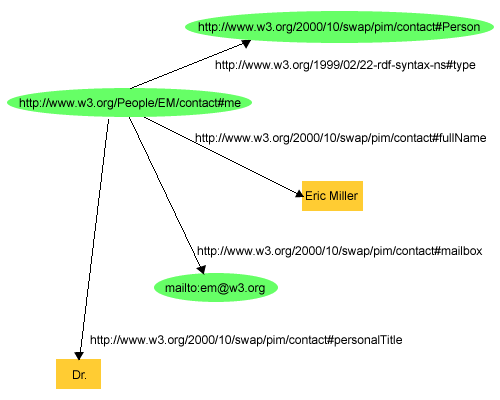
possible, the group of statements "there is
a Person
identified by http://www.w3.org/People/EM/contact#me, whose name is
Eric Miller, whose email address is em@w3.org, and whose title is
Dr." could be represented as the RDF graph in Figure 1:
Figure 1 illustrates that RDF uses URIs
to identify:
- individuals, e.g., Eric Miller, identified by
http://www.w3.org/People/EM/contact#me
- kinds of things, e.g., Person, identified by
http://www.w3.org/2000/10/swap/pim/contact#Person
- properties of those things, e.g., mailbox, identified by
http://www.w3.org/2000/10/swap/pim/contact#mailbox
- values of those properties, e.g.
mailto:em@w3.org
as the value of the mailbox property (RDF also uses character
strings such as "Eric Miller", and values from other datatypes
such as integers and dates, as the values of properties)
RDF also provides an XML-based syntax (called RDF/XML) for
recording and exchanging these graphs. Example 1 is a small chunk of RDF in RDF/XML
corresponding to the graph in Figure
1:
<?xml version="1.0"?>
<rdf:RDF xmlns:rdf="http://www.w3.org/1999/02/22-rdf-syntax-ns#"
             xmlns:contact="http://www.w3.org/2000/10/swap/pim/contact#">

  <contact:Person rdf:about="http://www.w3.org/People/EM/contact#me">
    <contact:fullName>Eric Miller</contact:fullName>
    <contact:mailbox rdf:resource="mailto:em@w3.org"/>
    <contact:personalTitle>Dr.</contact:personalTitle>
  </contact:Person>

</rdf:RDF>
Note that this RDF/XML also contains URIs, as well as
properties like mailbox and fullName (in an
abbreviated form), and their respective values
em@w3.org, and Eric Miller.
Like HTML, this RDF/XML is machine processable and, using
URIs, can link pieces of information across the Web. However,
unlike conventional hypertext, RDF URIs can refer to any
identifiable thing, including things that may not be directly
retrievable on the Web (such as the person Eric Miller). The
result is that in addition to describing such things as Web
pages, RDF can also describe cars, businesses, people, news
events, etc. In addition, RDF properties themselves have URIs, to
precisely identify the relationships that exist between
the linked items.
The following documents contribute to the specification of
RDF:
This Primer is intended to provide an introduction to RDF and
describe some existing RDF applications, to help information
system designers and application developers understand the
features of RDF and how to use them. In particular, the Primer is
intended to answer such questions as:
- What does RDF look like?
- What information can RDF represent?
- How is RDF information created, accessed, and
processed?
- How can existing information be combined with RDF?
The Primer is a non-normative document, which means
that it does not provide a definitive specification of RDF. The
examples and other explanatory material in the Primer are
provided to help readers understand RDF, but they may not always
provide definitive or fully-complete answers. In such cases, the
relevant normative parts of the RDF specification should be consulted.
To help in doing this, the Primer describes the roles these other
documents play in the complete specification of RDF, and provides
links pointing to the relevant parts of the normative specifications,
at appropriate places in the discussion.
It should also be noted that these RDF documents update and clarify
previously-published RDF specifications, the Resource
Description Framework (RDF) Model and Syntax Specification [RDF-MS] and the
Resource Description Framework (RDF) Schema Specification 1.0
[RDF-S].
As a result, there have been some changes in terminology, syntax, and concepts.
This Primer reflects the newer set of RDF specifications given in the
bulleted list of RDF documents cited above. Hence, readers
familiar with the older specifications, and with earlier tutorial and
introductory articles based on them, should be aware that there may be
differences between the current specifications and those previous documents.
The RDF Issue
Tracking document [RDFISSUE]
can be consulted for a list of issues
raised concerning the previous RDF specifications, and their resolution in
the current specifications.
2. Making Statements
About Resources
RDF is intended to provide a simple way to make statements
about Web resources, e.g., Web pages. This section
describes the basic ideas behind the way RDF provides these
capabilities (the normative specification describing these
concepts is RDF
Concepts and Abstract Syntax [RDF-CONCEPTS]).
2.1 Basic
Concepts
Imagine trying to state that someone named
John Smith created a particular Web page. A straightforward way
to state this in a natural language such as English would be in the form of a simple
statement such as:
http://www.example.org/index.html
        has a creator whose value is John Smith
Parts of this statement are emphasized to illustrate that,
in order to describe the properties of something, there need to be ways
to name, or identify, a number of things:
- the thing the statement describes
(the Web page, in this case)
- a specific property (creator,
in this case) of the thing the statement describes
- the thing the statement says is
the value of this property (who the creator is), for the
thing the statement describes
In this statement, the Web page's URL (Uniform
Resource Locator) is used to identify it. In addition, the
word "creator" is used to identify the property,
and the two words "John Smith" to identify the thing (a person)
that is the value of this property.
Other properties of this Web page could be described by writing
additional English statements of the same general form, using
the URL to identify the page, and words (or other expressions)
to identify the properties and their values. For example, the
date the page was created, and the language in
which the page is written, could be described using the additional
statements:
http://www.example.org/index.html
        has a creation-date whose value is August 16,
        1999
http://www.example.org/index.html has a
        language whose value is English
RDF is based on the idea that the things being described
have properties
which have values, and that resources can be described by
making statements, similar to those above, that specify those
properties and values. RDF uses a particular terminology for
talking about the various parts of statements. Specifically,
the part that identifies the thing the statement is about (the
Web page in this example) is called the subject.
The part that identifies the property or characteristic of the
subject that the statement specifies (creator, creation-date,
or language in these examples) is called the predicate,
and the part that identifies the value of that property is
called the object.
So, taking the English statement
http://www.example.org/index.html
        has a creator whose value is John Smith
the RDF terms for the various parts of the statement
are:
- the subject is the URL
http://www.example.org/index.html
- the predicate is the word "creator"
- the object is the phrase "John Smith"
However, while English is good for communicating between
(English-speaking) humans, RDF is about making
machine-processable statements. To make these kinds of
statements suitable for processing by machines, two
things are needed:
- a system of machine-processable identifiers
for identifying a subject, predicate, or object in a statement
without any possibility of confusion with a similar-looking
identifier that might be used by someone else on the
Web.
- a machine-processable language for representing these
statements and exchanging them between machines.
Fortunately, the existing Web architecture provides both
these necessary facilities.
As illustrated earlier, the Web already provides one form of
identifier, the Uniform Resource Locator (URL).
A URL was used in the original example to identify the Web page
that John Smith created. A URL is a character string that
identifies a Web resource by representing its primary access
mechanism (essentially, its network "location"). However, it
is also important to be able to record information about many
things that, unlike Web pages, do not have network locations or
URLs.
The Web provides a more general form of identifier for these
purposes, called the Uniform Resource
Identifier (URI). URLs are a particular kind of URI. All
URIs share the property that different persons or organizations
can independently create them, and use them to identify things.
However, URIs are not limited to identifying things that have
network locations, or use other computer access mechanisms. In
fact, a URI can be created to refer to anything that needs
to be referred to in a statement, including
- network-accessible things, such as an electronic
document, an image, a service (e.g., "today's weather report
for Los Angeles"), or a group of other resources.
- things that are not network-accessible, such as human
beings, corporations, and bound books in a library.
- abstract concepts that do not physically exist, such as the
concept of a "creator".
Because of this generality, RDF uses URIs as the basis of
its mechanism for identifying the subjects, predicates, and
objects in statements. To be more precise, RDF uses URI
references [URIS]. A URI reference
(or URIref) is a URI, together with an optional
fragment identifier at the end. For example, the URI
reference http://www.example.org/index.html#section2
consists of the URI http://www.example.org/index.html
and (separated by the "#" character) the fragment identifier
Section2.
RDF URIrefs can contain Unicode [UNICODE] characters (see [RDF-CONCEPTS]), allowing many languages to be reflected in URIrefs.
RDF defines a resource as anything
that is identifiable by a URI reference, so using URIrefs
allows RDF to describe practically anything, and to state
relationships between such things as well. URIrefs and fragment
identifiers are discussed further in Appendix A, and in [RDF-CONCEPTS].
To represent RDF statements in a machine-processable way,
RDF uses the Extensible
Markup Language [XML]. XML was
designed to allow anyone to design their own document format
and then write a document in that format. RDF defines a
specific XML markup language, referred to as RDF/XML,
for use in representing RDF information, and for exchanging it
between machines. An example of RDF/XML was given in Section 1. That example (Example 1) used tags such as
<contact:fullName> and
<contact:personalTitle> to delimit the text
content Eric Miller and Dr., respectively.
Such tags allow programs written with an understanding of what
the tags mean to properly interpret that content.
Both XML content and (with certain exceptions) tags can contain Unicode [UNICODE] characters, allowing information from many languages to be directly represented.
Appendix B provides further background on
XML in general. The specific RDF/XML syntax used for RDF is
described in more detail in Section 3,
and is normatively defined in [RDF-SYNTAX]
2.2 The RDF Model
Section 2.1 has introduced
RDF's basic statement concepts, the idea of using
URI references to identify the things referred to
in RDF statements, and RDF/XML as a machine-processable way to
represent RDF statements. With that background, this section
describes how RDF uses URIs to make statements about resources. The
introduction said that RDF was based on the idea of
expressing simple statements about resources, where each
statement consists of a subject, a predicate, and an object.
In RDF, the English statement:
http://www.example.org/index.html
        has a creator whose value is John Smith
could be represented by an RDF statement having:
- a subject
http://www.example.org/index.html
- a predicate
http://purl.org/dc/elements/1.1/creator
- and an object
http://www.example.org/staffid/85740
Note how URIrefs are used to identify not only the
subject of the original statement, but also the predicate and
object, instead of using the words "creator" and "John Smith",
respectively (some of the effects of using URIrefs in this
way will be discussed later in this section).
RDF models statements as nodes and arcs in a graph. RDF's graph
model is defined in [RDF-CONCEPTS]. In this notation,
a statement is represented by:
- a node for the subject
- a node for the object
- an arc for the predicate,
directed from the subject node to the object node.
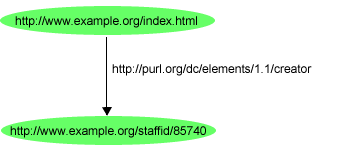
So the RDF statement above would be represented by the graph
shown in Figure 2:
Groups of statements are represented by corresponding groups
of nodes and arcs. So, to reflect the additional English statements
http://www.example.org/index.html
        has a creation-date whose value is August 16,
        1999
http://www.example.org/index.html has a
        language whose value is English
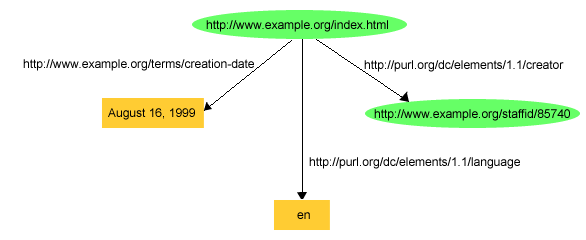
in the RDF graph, the graph shown in Figure 3 could be used
(using suitable URIrefs to name the properties
"creation-date" and "language"):
Figure 3 illustrates that objects
in RDF statements may be either URIrefs, or constant values (called literals)
represented by character strings, in order to represent certain
kinds of property values.
(In the case of the predicate http://purl.org/dc/elements/1.1/language
the literal is an international standard two-letter code for English.)
Literals may not be used as subjects or
predicates in RDF statements. In drawing RDF
graphs, nodes that are URIrefs are shown as ellipses,
while nodes that are literals are shown as boxes.
(The simple character string
literals used in these examples are called plain
literals, to distinguish them from the typed
literals to be introduced in Section 2.4. The various kinds of
literals that can be used in RDF statements are defined in [RDF-CONCEPTS].
Both plain and typed literals can contain Unicode [UNICODE] characters, allowing information from many languages to be directly represented.)
Sometimes it is not convenient to draw graphs when
discussing them, so an alternative way of writing down the
statements, called triples,
is also used. In the triples notation, each statement in the
graph is written as a simple triple of subject, predicate, and
object, in that order. For example, the three statements shown in Figure 3 would be written in the triples notation as:
<http://www.example.org/index.html> <http://purl.org/dc/elements/1.1/creator> <http://www.example.org/staffid/85740> .

<http://www.example.org/index.html> <http://www.example.org/terms/creation-date> "August 16, 1999" .

<http://www.example.org/index.html> <http://purl.org/dc/elements/1.1/language> "en" .
Each triple corresponds to a single arc in the graph,
complete with the arc's beginning and ending nodes (the subject
and object of the statement). Unlike the drawn graph (but like
the original statements), the triples notation requires that a
node be separately identified for each statement it appears in.
So, for example, http://www.example.org/index.html
appears three times (once in each triple) in the triples
representation of the graph, but only once in the drawn graph.
However, the triples represent exactly the same information as
the drawn graph, and this is a key point: what is fundamental
to RDF is the graph model of the statements. The
notation used to represent or depict the graph is
secondary.
The full triples notation requires that URI references be
written out completely, in angle brackets, which, as the
example above illustrates, can result in very long lines on a page. For
convenience, the Primer uses a shorthand way of writing triples
(the same shorthand is also used in other RDF specifications).
This shorthand substitutes an XML qualified name
(or QName) without angle brackets as an abbreviation
for a full URI reference (QNames are discussed further in Appendix B).
A QName contains a prefix that has
been assigned to a namespace URI, followed by a colon, and then
a local name. The full URIref is formed
from the QName by appending the local name to the
namespace URI assigned to the prefix. So, for example, if the
QName prefix foo is assigned to the namespace URI
http://example.org/somewhere/, then the QName
foo:bar is shorthand for the URIref
http://example.org/somewhere/bar.
Primer examples will also use several "well-known" QName
prefixes (without explicitly specifying them
each time), defined as follows:
prefix rdf:, namespace URI:
http://www.w3.org/1999/02/22-rdf-syntax-ns#
prefix rdfs:, namespace URI:
http://www.w3.org/2000/01/rdf-schema#
prefix dc:, namespace URI:
http://purl.org/dc/elements/1.1/
prefix owl:, namespace URI:
http://www.w3.org/2002/07/owl#
prefix ex:, namespace URI:
http://www.example.org/ (or
http://www.example.com/)
prefix xsd:, namespace URI:
http://www.w3.org/2001/XMLSchema#
Obvious variations on the "example" prefix
ex: will also be used as needed in the examples, for instance,
prefix exterms:, namespace URI:
http://www.example.org/terms/ (for terms used by an
example organization),
prefix exstaff:, namespace URI:
http://www.example.org/staffid/ (for the example
organization's staff identifiers),
prefix ex2:, namespace URI:
http://www.domain2.example.org/ (for a second example
organization), and so on.
Using this new shorthand, the previous set of
triples can be written as:
ex:index.html  dc:creator             exstaff:85740 .

ex:index.html  exterms:creation-date  "August 16, 1999" .

ex:index.html  dc:language            "en" .
Since RDF uses URIrefs instead of words to name things in statements, RDF refers to a set of URIrefs (particularly a set intended for a specific purpose) as a vocabulary. Often, the URIrefs in such vocabularies are organized so that they can be represented as a set of QNames using a common prefix. That is, a common namespace URIref will be chosen for all terms in a vocabulary, typically a URIref under the control of whoever is defining the vocabulary. URIrefs that are contained in the vocabulary are formed by appending individual local names to the end of the common URIref. This forms a set of URIrefs with a common prefix. For instance, as illustrated by the previous examples, an organization such as example.com might define a vocabulary consisting of URIrefs starting with the prefix http://www.example.org/terms/ for terms it uses in its business, such as "creation-date" or "product", and another vocabulary of URIrefs starting with http://www.example.org/staffid/ to identify its employees. RDF uses this same approach to define its own vocabulary of terms with special meanings in RDF. The URIrefs in this RDF vocabulary all begin with http://www.w3.org/1999/02/22-rdf-syntax-ns#, conventionally associated with the QName prefix rdf:.
The RDF Vocabulary Description Language (described in Section 5) defines an additional set of terms having URIrefs that begin with http://www.w3.org/2000/01/rdf-schema#, conventionally associated with the QName prefix rdfs:. (Where a specific QName prefix is commonly used in connection with a given set of terms in this way, the QName prefix itself is sometimes used as the name of the vocabulary. For example, someone might refer to "the rdfs: vocabulary".)
Using common URI prefixes provides a convenient way to organize the URIrefs for a related set of terms. However, this is just a convention. The RDF model only recognizes full URIrefs; it does not "look
inside" URIrefs or use any knowledge about their structure. In particular, RDF does not assume there is any relationship between URIrefs just because they have a common leading prefix (see Appendix A for further discussion). Moreover, there is nothing that says that URIrefs with different leading prefixes cannot be considered part of the same vocabulary. A particular organization, process, tool, etc. can define a vocabulary that is significant for it, using URIrefs from any number of other vocabularies as part of its vocabulary.
In addition, sometimes an organization will use a vocabulary's namespace URIref as the URL of a Web resource that provides further information about that vocabulary. For example, as noted earlier, the QName prefix dc: will be used in Primer examples, associated with the namespace URIref http://purl.org/dc/elements/1.1/. In fact, this refers to the Dublin Core vocabulary described in Section 6.1. Accessing this namespace URIref in a Web browser will retrieve additional information about the Dublin Core vocabulary (specifically, an RDF schema). However, this is also just a convention. RDF does not assume that a namespace URI identifies a retrievable Web resource (see Appendix B for further discussion).
In the rest of the Primer, the term vocabulary will be used when referring to a set of URIrefs defined for some specific purpose, such as the set of URIrefs defined by RDF for its own use, or the set of URIrefs defined by example.com to identify its employees. The term namespace will be used only when referring specifically to the syntactic concept of an XML namespace (or in describing the URI assigned to a prefix in a QName).
URIrefs from different vocabularies can be freely mixed in RDF graphs. For example, the graph in Figure 3 uses URIrefs from the exterms:, exstaff:, and dc: vocabularies. Also, RDF imposes no restrictions on how many statements using a given URIref as predicate can appear in a graph to describe the same resource. For example, if the resource ex:index.html had been created by the cooperative efforts of several staff members in addition to John Smith, example.org might have written the statements:
ex:index.html  dc:creator  exstaff:85740 .

ex:index.html  dc:creator  exstaff:27354 .

ex:index.html  dc:creator  exstaff:00816 .
These examples of RDF statements begin to
illustrate some of the advantages of using URIrefs as RDF's
basic way of identifying things. For instance, in the first
statement, instead of
identifying the creator of the Web page by
the character string "John Smith", he has been assigned a URIref,
in this case (using a URIref based on his employee number)
http://www.example.org/staffid/85740 . An advantage of
using a URIref in this case is that the identification
of the statement's subject can be more precise.
That is, the creator of the page is not the
character string "John Smith", or any one of the thousands of
people named John Smith, but the particular John Smith
associated with that URIref (whoever created the URIref defines
the association). Moreover, since there is a URIref to refer to
John Smith, he is a full-fledged resource, and
additional information can be recorded about him, simply by adding
additional RDF statements with John's URIref as the subject.
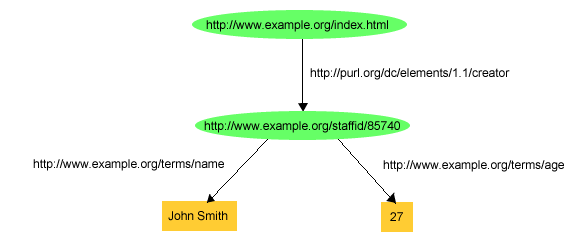
For example, Figure 4 shows some additional
statements giving John's name and age.
These examples also illustrate that RDF uses URIrefs as
predicates in RDF statements. That is, rather than
using character strings (or words) such as "creator" or "name"
to identify properties, RDF uses URIrefs. Using URIrefs to
identify properties is important for a number of reasons.
First, it distinguishes the properties one person may use from
different properties someone else may use that would otherwise be
identified by the same character string. For instance, in the
example in Figure
4, example.org uses "name" to mean someone's full name
written out as a character string literal (e.g., "John Smith"),
but someone else may intend "name" to mean something different
(e.g., the name of a variable in a piece of program text). A
program encountering "name" as a property identifier on the Web
(or merging data from multiple sources) would not necessarily be
able to distinguish these uses. However, if example.org writes
http://www.example.org/terms/name for its "name"
property, and the other person writes
http://www.domain2.example.org/genealogy/terms/name
for hers, it is clear that there are distinct
properties involved (even if a program cannot automatically
determine the distinct meanings). Also, using URIrefs to identify properties
enables the properties to be treated as resources themselves.
Since properties are resources, additional
information can be recorded about them (e.g., the English description of what
example.org means by "name"), simply by adding additional RDF
statements with the property's URIref as the subject.
Using URIrefs as subjects, predicates, and objects in RDF
statements supports the development and use of shared
vocabularies on the Web, since people can discover and begin using
vocabularies already used by others to describe things, reflecting
a shared understanding of those concepts. For example, in
the triple
ex:index.html dc:creator exstaff:85740 .
the predicate dc:creator, when fully expanded as a
URIref, is an unambiguous reference to the "creator" attribute
in the Dublin Core metadata attribute set (discussed further in
Section 6.1), a widely-used set of
attributes (properties) for describing information of all
kinds. The writer of this triple is effectively saying that the
relationship between the Web page (identified by
http://www.example.org/index.html ) and the creator of
the page (a distinct person, identified by
http://www.example.org/staffid/85740 ) is exactly the
concept identified by
http://purl.org/dc/elements/1.1/creator.
Another
person familiar with the Dublin Core vocabulary,
or who finds out what dc:creator
means (say by looking up its definition on the Web)
will know what is meant by this relationship.
In addition, based on this understanding, people can
write programs to behave in accordance with
that meaning when processing triples containing the predicate
dc:creator.
Of course, this depends on increasing the general use of URIrefs to refer to things instead of using literals; e.g., using URIrefs like exstaff:85740 and dc:creator instead of character string literals like John Smith and creator.
Even then, RDF's use of URIrefs does not solve all identification
problems because, for example, people can still use different
URIrefs to refer to the same thing.
For this reason, it is a good idea to try to use terms from existing vocabularies (such as the
Dublin Core) where possible, rather than making up new terms that might overlap with those of
some other vocabulary. Appropriate vocabularies for use in specific application areas are
being developed all the time, as illustrated by the applications described in Section 6.
However, even when synonymns are created, the fact that
these different URIrefs are used in the commonly-accessible
"Web space" provides the opportunity both to identify
equivalences among these different references, and to migrate
toward the use of common references.
In addition, it is important to distinguish between any meaning that RDF itself associates with terms (such as dc:creator in the previous example) used in RDF statements and additional, externally-defined meaning that people (or programs written by those people) might associate with those terms.
As a language, RDF directly defines only the graph syntax of subject, predicate, and object triples, certain meanings associated with URIrefs in the rdf: vocabulary, and certain other concepts to be described later. These things are normatively defined in [RDF-CONCEPTS] and [RDF-SEMANTICS]. However, RDF does not define the meanings of terms from other vocabularies, such as dc:creator, that might be used in RDF statements. Specific vocabularies will be created, with specific meanings assigned to the URIrefs defined in them, externally to RDF. RDF statements using URIrefs from these vocabularies may convey the specific meanings associated with those terms to people familiar with these vocabularies, or to RDF applications written to process these vocabularies, without conveying any of these meanings to an arbitrary RDF application not specifically written to process these vocabularies.
For example, people can associate meaning with
a triple such as
ex:index.html dc:creator exstaff:85740 .
based on the meaning they associate with the appearance of the
word "creator" as part of the URIref dc:creator, or based on
their understanding of the specific definition of dc:creator
in the Dublin Core vocabulary.
However, as far as an arbitrary RDF application is concerned the triple might as
well be something like
fy:joefy.iunm ed:dsfbups fytubgg:85740 .
as far as any built-in meaning is concerned. Similarly, any
natural language text describing the meaning of dc:creator
that might be found on the Web provides no
additional meaning that an arbitrary RDF application can directly use.
Of course, URIrefs from a particular vocabulary can be used in RDF statements even though a given application may not be able to associate any special meanings with them.
For example,
generic RDF software would recognize that
the above expression is an RDF statement, that ed:dsfbups is the
predicate, and so on. It will simply not associate with the triple any special meaning that the vocabulary developer might have associated with a URIref like ed:dsfbups. Moreover, based on their understanding of a given vocabulary, people can write RDF applications to behave in accordance with the special meanings assigned to URIrefs from that vocabulary, even though that meaning will not be accessible to RDF applications not written in that way.
The result of all this is that RDF provides a way to make
statements that applications can more easily process. An
application cannot actually "understand" such statements, as noted
already, any more than a database system "understands" terms like "employee" or "salary" in processing a query like SELECT NAME FROM EMPLOYEE WHERE SALARY > 35000.
However, if an application is appropriately written,
it can deal with RDF statements in a way that makes it seem
like it does understand them, just as a database system and its applications can do useful work in processing employee and payroll information without understanding "employee" and "payroll".
For example, a user could search the Web for all
book reviews and create an average rating for each book. Then,
the user could put that information back on the Web. Another
Web site could take that list of book rating averages and
create a "Top Ten Highest Rated Books" page. Here, the
availability and use of a shared vocabulary about ratings, and
a shared group of URIrefs identifying the books they apply to,
allows individuals to build a mutually-understood and
increasingly-powerful (as additional contributions are made)
"information base" about books on the Web. The same principle
applies to the vast amounts of information that people create
about thousands of subjects every day on the Web.
RDF statements are similar to a number of other formats for
recording information, such as:
- entries in a simple record or catalog listing describing
the resource in a data processing system.
- rows in a simple relational database.
- simple assertions in formal logic
and information in these formats can be treated as RDF
statements, allowing RDF to be used to integrate data from many
sources.
2.3 Structured Property Values
and Blank Nodes
Things would be very simple if the only types of information
to be recorded about things were obviously in the form of the
simple RDF statements illustrated so far. However, most
real-world data involves structures that are more complicated
than that, at least on the surface. For instance, in the
original example, the date the Web page was created is recorded
as a single exterms:creation-date property, with a
plain literal as its value. However, suppose
the value of the exterms:creation-date property
needed to record
the month, day, and year as separate pieces of information? Or,
in the case of John Smith's personal information, suppose
John's address was being described. The whole address could be
written out as a plain literal, as in the triple
exstaff:85740 exterms:address "1501 Grant Avenue, Bedford, Massachusetts 01730" .
However, suppose John's address needed to be recorded as a
structure consisting of separate street, city, state,
and postal code values? How would this be done in RDF?
Structured information like this is represented in RDF by
considering the aggregate thing to be described (like
John Smith's address) as a resource, and then making statements
about that new resource. So, in the RDF graph, in order to
break up John Smith's address into its component parts,
a new node is created to represent the concept of John Smith's
address, with a new URIref to identify it,
say http://www.example.org/addressid/85740
(abbreviated as exaddressid:85740).
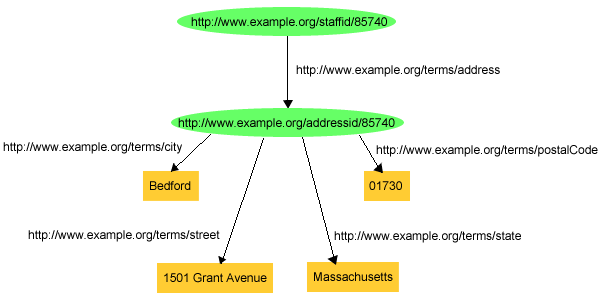
RDF statements (additional arcs and nodes) can then be
written with that
node as the subject, to represent the additional information,
producing the graph shown in Figure
5:
or the triples:
exstaff:85740       exterms:address        exaddressid:85740 .
exaddressid:85740   exterms:street         "1501 Grant Avenue" .
exaddressid:85740   exterms:city           "Bedford" .
exaddressid:85740   exterms:state          "Massachusetts" .
exaddressid:85740   exterms:postalCode     "01730" .
This way of representing structured information in RDF can
involve generating numerous "intermediate" URIrefs
such as exaddressid:85740 to represent aggregate concepts such as
John's address. Such concepts may never need to be referred to
directly from outside a particular graph, and hence may not
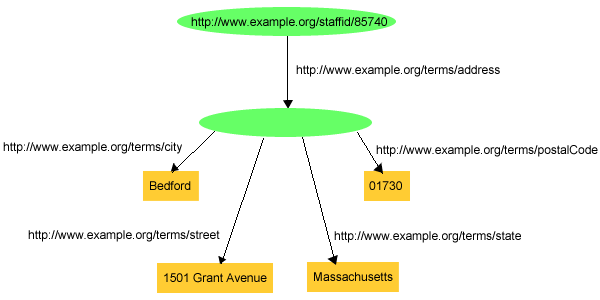
require "universal" identifiers. In addition, in the
drawing of the graph representing the group of
statements shown in Figure 5,
the URIref assigned to identify "John Smith's
address" is not really needed, since the graph could just as easily
have been drawn as in Figure 6:
Figure 6, which is a perfectly
good RDF graph, uses a node without a URIref to stand for
the concept of "John Smith's address". This blank
node serves its purpose in the drawing without needing a
URIref, since the node itself provides the necessary
connectivity between the various other parts of the graph.
(Blank nodes were called anonymous resources in [RDF-MS].) However, some
form of explicit identifier for that node is needed in order to
represent this graph as triples. To see this, trying to
write the triples corresponding to what is shown in Figure 6 would produce something like:
exstaff:85740   exterms:address         ??? .
???             exterms:street          "1501 Grant Avenue" .
???             exterms:city            "Bedford" .
???             exterms:state           "Massachusetts" .
???             exterms:postalCode      "01730" .
where ??? stands for something that indicates the presence
of the blank node. Since a complex graph might contain more
than one blank node, there also needs to be a way to differentiate
between these different blank nodes in a triples representation
of the graph. As a result, triples use blank
node identifiers, having the form _:name, to
indicate the presence of blank nodes. For instance,
in this example a blank node identifier _:johnaddress
might be used to refer to the blank node, in which
case the resulting triples might be:
exstaff:85740   exterms:address         _:johnaddress .
_:johnaddress   exterms:street          "1501 Grant Avenue" .
_:johnaddress   exterms:city            "Bedford" .
_:johnaddress   exterms:state           "Massachusetts" .
_:johnaddress   exterms:postalCode      "01730" .
In a triples representation of a graph, each distinct blank
node in the graph is given a different blank node identifier.
Unlike URIrefs and literals, blank node identifiers are not
considered to be actual parts of the RDF graph (this can be
seen by looking at the drawn graph in Figure
6 and noting that the blank node has no blank node
identifier). Blank node identifiers are just a way of
representing the blank nodes in a graph (and distinguishing one
blank node from another) when the graph is written in triple
form. Blank node identifiers also have significance only within
the triples representing a single graph (two different
graphs with the same number of blank nodes might independently
use the same blank node identifiers to distinguish them, and it
would be incorrect to assume that blank nodes from different
graphs having the same blank node identifiers are the same). If
it is expected that a node in a graph will need to be
referenced from outside the graph, a URIref should be assigned
to identify it. Finally, because blank node identifiers represent
(blank) nodes, rather than arcs, in the triple form of
an RDF graph, blank node identifiers may only appear as subjects or
objects in triples; blank node identifiers may not be used as
predicates in triples.
The beginning of this section noted that aggregate structures,
like John Smith's address, can be represented by
considering the aggregate thing to be described as a separate
resource, and then making statements about that new resource.
This example illustrates an important aspect of RDF: RDF
directly represents only binary relationships, e.g.
the relationship between John Smith and the literal
representing his address. Representing the
relationship between John and the group of separate
components of this address involves dealing with an
n-ary (n-way) relationship (in this case, n=5) between
John and the street, city, state, and postal code components. In order
to represent such structures directly in RDF (e.g., considering
the address as a group of street, city, state, and postal code
components), this n-way relationship must be broken up
into a group of separate binary relationships. Blank nodes provide
one way to do this. For each n-ary relationship,
one of the participants is chosen as the subject of the
relationship (John in this case), and a blank node is created to
represent the rest of the relationship (John's address in this
case). The remaining participants in the
relationship (such as the city in this example) are then
represented as separate
properties of the new resource represented by the blank
node.
Blank nodes also provide a way to more accurately make
statements about resources that may not have URIs, but that are
described in terms of relationships with other resources that
do have URIs. For example, when making statements
about a person, say Jane Smith, it may seem natural to use a
URI based on that person's email address as her URI, e.g.,
mailto:jane@example.org. However, this approach can
cause problems. For example, it may be necessary to record information
both about Jane's mailbox (e.g., the server it is on) as well as
about Jane herself (e.g., her current physical address), and using a
URIref for Jane based on her email address makes it difficult
to know whether it is Jane or her mailbox that is being described.
The same problem exists when a company's Web page URL, say
http://www.example.com/, is used as the URI of the
company itself. Once again, it may be necessary to record information
about the Web page itself (e.g., who created it and when) as well as
about the company, and using http://www.example.com/
as an identifier for both makes it difficult to know which
of these is the actual subject.
The fundamental problem is that using Jane's
mailbox as a stand-in for Jane is not really
accurate: Jane and her mailbox are not the same thing, and
hence they should be identified differently. When Jane herself
does not have a URI, a blank node provides a more accurate way
of modeling this situation. Jane can be represented by a blank
node, and that blank node used as the subject of a statement
with exterms:mailbox as the property
and the URIref mailto:jane@example.org as
its value. The blank node could also be described with an
rdf:type property having a value of
exterms:Person (types are discussed in more detail
in the following sections), an exterms:name property
having a value of "Jane Smith", and any other
descriptive information that might be useful, as shown in
the following triples:
_:jane   exterms:mailbox   <mailto:jane@example.org> .
_:jane   rdf:type          exterms:Person .
_:jane   exterms:name      "Jane Smith" .
_:jane   exterms:empID     "23748"  .
_:jane   exterms:age       "26" .
(Note that mailto:jane@example.org
is written within angle brackets in the first triple. This is because
mailto:jane@example.org is a full URIref in the
mailto URI scheme, rather than a QName abbreviation,
and full URIrefs must be enclosed in angle brackets in the triples
notation.)
This says, accurately, that "there is a resource of type
exterms:Person, whose electronic mailbox is identified
by mailto:jane@example.org, whose name is Jane
Smith, etc." That is, the blank node can be read as "there
is a resource". Statements with that blank node as subject then
provide information about the characteristics of that
resource.
In practice, using blank nodes instead of URIrefs in these
cases does not change the way this kind of
information is handled very much. For example, if it is known
that an email address uniquely identifies someone at
example.org (particularly if the address is unlikely to be
reused), that fact can still be used to associate information
about that person from multiple sources, even though the email
address is not the person's URI. In this case, if some
RDF is found on the Web that describes a book, and
gives the author's contact information as
mailto:jane@example.org, it might be reasonable,
combining this new information with the previous set of
triples, to conclude
that the author's name is Jane Smith. The point is that saying
something like "the author of the book is
mailto:jane@example.org" is typically a shorthand for
"the author of the book is someone whose mailbox is
mailto:jane@example.org". Using a blank node to
represent this "someone" is just a more accurate way to
represent the real world situation. (Incidentally, some
RDF-based schema languages allow specifying that certain
properties are unique identifiers of the resources they
describe. This is discussed further in
Section 5.5.)
Using blank nodes in this way can also help avoid the use of
literals in what might be inappropriate situations. For example,
in describing Jane's book, lacking a URIref to identify the author,
the publisher might have written (using the
publisher's own ex2terms: vocabulary):
ex2terms:book78354 rdf:type ex2terms:Book .
ex2terms:book78354 ex2terms:author "Jane Smith" .
However, the author of the book is not really the character
string "Jane Smith", but a person whose name is
Jane Smith. The same information might be more accurately
given by the publisher using a blank node, as:
ex2terms:book78354   rdf:type          ex2terms:Book .
ex2terms:book78354   ex2terms:author   _:author78354 .
_:author78354        rdf:type          ex2terms:Person .
_:author78354        ex2terms:name     "Jane Smith" .
This essentially says "resource ex2terms:book78354
is of type ex2terms:Book, and its author is a resource of type
ex2terms:Person, whose name is Jane
Smith." Of course, in this particular case the publisher might instead
have assigned its own URIrefs to its authors instead of using blank nodes to
identify them, in order to encourage external
references to its authors.
Finally, the example above giving Jane's age as 26 illustrates the fact that sometimes the value of a property may appear to be simple, but actually may be more complex. In this case, Jane's age is actually 26 years, but the units information (years) is not explicitly given. Such information is often omitted in contexts where it can be safely assumed that anyone accessing the property value will understand the units being used. However, in the wider context of the Web, it is generally not safe to make this assumption. For example, a U.S. site might give a weight value in pounds, but someone accessing that data from outside the U.S. might assume that weights are given in kilograms. In general, careful consideration should be given to explicitly representing units and similar information. This issue is discussed further in Section 4.4, which describes an RDF feature for representing such information as structured values, as well as some other techniques for representing such information.
2.4 Typed
Literals
The last section described how to handle situations
in which property values represented by plain
literals had to be broken up into structured values to
represent the individual parts of those literals. Using
this approach, instead of, say, recording the date a Web page
was created as a single exterms:creation-date
property, with a single plain literal as its value,
the value would be represented as a structure consisting of the month,
day, and year as separate pieces of information, using separate
plain literals to represent the corresponding values.
However, so
far, all constant values that serve as objects in RDF statements
have been represented by these plain
(untyped) literals, even when the intent is probably for the value
of the property to be a number (e.g., the value of a
year or age property) or some other kind of
more specialized value.
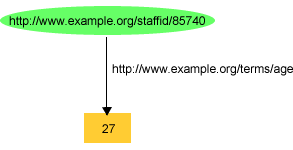
For example, Figure 4
illustrated an RDF graph recording information about John
Smith. That graph recorded the value of John Smith's
exterms:age property as the plain literal "27", as
shown in Figure 7:
In this case, the hypothetical organization example.org
probably intends for "27" to be interpreted as a number, rather
than as the string consisting of the character "2" followed by
the character "7"
(since the literal represents the value of an "age"
property). However, there is no information in Figure 7's graph
that explicitly indicates that "27" should be interpreted as
a number. Similarly, example.org also
probably intends for "27" to be interpreted as a decimal
number, i.e., the value twenty seven, rather than, say,
as an octal number, i.e., the value twenty three.
However, once again there is no information in Figure 7's graph that
explicitly indicates this. Specific applications might be written
with the understanding that they should
interpret values of the exterms:age property as decimal
numbers, but this would mean that proper interpretation of this
RDF would depend on information not explicitly provided
in the RDF graph, and hence on information that would not necessarily
be available to other applications that might need to interpret this RDF.
The common practice in
programming languages or database systems is to provide this
additional information about how to interpret a literal
by associating a datatype with the
literal, in this case, a datatype like decimal or
integer. An application that understands the datatype
then knows, for example, whether the literal "10" is intended
to represent the number ten, the number two,
or the string consisting of the character "1" followed by the
character "0", depending on whether the specified datatype is
integer, binary, or string.
(More specialized datatypes could also be used to include the units information mentioned
at the end of Section 2.3, e.g., a datatype
integerYears, although the Primer will not elaborate on this idea.)
In RDF,
typed
literals are used to provide this kind of information.
An RDF typed literal is formed by pairing a string
with a URIref that identifies a particular datatype. This
results in a single literal node in the RDF graph with the pair as the literal.
The value represented by the typed literal is the value that
the specified datatype associates with the specified string.
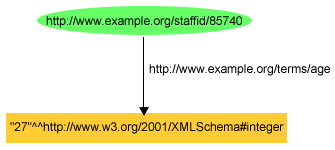
For example, using a typed literal, John Smith's age could be described as
being the integer number 27 using the triple:
<http://www.example.org/staffid/85740> <http://www.example.org/terms/age> "27"^^<http://www.w3.org/2001/XMLSchema#integer> .
or, using the QName simplification for writing long
URIs:
exstaff:85740 exterms:age "27"^^xsd:integer .
or as shown in Figure 8:
Similarly, in the graph shown in Figure
3 describing information about a Web page, the
value of the page's exterms:creation-date property
was written as
the plain literal "August 16, 1999". However, using a typed
literal, the creation date of the Web page could be explicitly described as
being the date August 16, 1999, using the triple:
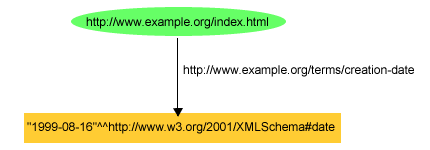
ex:index.html exterms:creation-date "1999-08-16"^^xsd:date .
or as shown in Figure 9:
Unlike typical programming languages and database systems,
RDF has no built-in set of datatypes of its own, such as
datatypes for integers, reals, strings, or dates.
Instead,
RDF typed literals simply provide a way to explicitly
indicate, for a given literal, what datatype should be used to
interpret it. The datatypes used in typed literals are defined
externally to RDF, and identified by their datatype
URIs.
(There is one exception: RDF defines a built-in datatype with the
URIref rdf:XMLLiteral to represent XML content as a literal
value. This datatype is defined in
[RDF-CONCEPTS], and its use is
described in Section 4.5.)
For instance, the examples in Figure 8
and Figure 9 use the datatypes integer and
date from the XML Schema datatypes defined in XML Schema Part 2:
Datatypes [XML-SCHEMA2].
An advantage of this approach is that it
gives RDF the flexibility to directly represent information
coming from different sources without the need to perform type
conversions between these sources and a native set of RDF
datatypes. (Type conversions would still be required when
moving information between systems having different sets of datatypes,
but RDF would impose no extra conversions into and out
of a native set of RDF datatypes.)
RDF datatype concepts are based on
a conceptual framework
from XML Schema datatypes [XML-SCHEMA2], as described
in RDF
Concepts and Abstract Syntax [RDF-CONCEPTS].
This conceptual framework defines a datatype as consisting of:
- A set of values, called the value space, that
literals of the datatype are intended
to represent. For example, for the XML Schema datatype
xsd:date, this set of values is a set of dates.
- A set of character strings, called the lexical space, that
the datatype uses to represent its values. This set determines
which character strings can legally be used to represent
literals of this datatype. For example, the datatype
xsd:date defines 1999-08-16 as being a legal
way to write a literal of this type
(as opposed, say, to August 16, 1999).
As defined in [RDF-CONCEPTS], the lexical space of a datatype is a set of Unicode [UNICODE] strings, allowing information from many languages to be directly represented.
- A lexical-to-value mapping from the lexical
space to the value space. This determines the value that a
given character string from the lexical space represents
for this particular datatype. For example,
the lexical-to-value mapping for datatype
xsd:date
determines that, for this datatype, the string 1999-08-16
represents the date August 16, 1999. The lexical-to-value
mapping is a factor because the same character string may represent
different values for different datatypes.
Not all datatypes are suitable for use in RDF. For a datatype
to be suitable for use in RDF, it
must conform to the conceptual framework just described. This basically means
that, given a character string, the datatype must
unambiguously define
whether or not the string is in its lexical space, and
what value in its value space the string represents.
For example, the basic XML Schema datatypes
such as xsd:string, xsd:boolean, xsd:date,
etc. are suitable
for use in RDF. However, some of the built-in XML Schema datatypes
are not suitable for use in RDF. For example, xsd:duration does
not have a well-defined value space, and xsd:QName requires an
enclosing XML document context. Lists of the XML Schema datatypes
that are currently considered suitable and unsuitable for use in
RDF are given in [RDF-SEMANTICS].
Since the value that a given typed literal denotes is defined
by the typed literal's datatype, and, with the exception of
rdf:XMLLiteral, RDF does not define any datatypes,
the actual interpretation of a
typed literal appearing in an RDF graph (e.g., determining
the value it denotes) must be performed by software
that is written to correctly process not only RDF, but the
typed literal's datatype as well. Effectively, this software must
be written to process an extended language that includes not
only RDF, but also the datatype, as part of its built-in
vocabulary.
This raises the issue of which datatypes will be generally available in
RDF software.
Generally, the XML Schema datatypes that are listed as suitable
for use in RDF in [RDF-SEMANTICS]
have a "first among equals" status in RDF.
As noted already, the examples in Figure 8 and
Figure 9
used some of these XML Schema datatypes, and the Primer will be
using these datatypes in
most of its other examples of typed literals as well (for one thing, XML Schema
datatypes already have assigned URIrefs that can be used to refer to them, specified
in [XML-SCHEMA2]). These XML Schema datatypes are
treated no differently than any other datatype, but they are
expected to be the most widely used, and therefore the most
likely to be interoperable among different software. As a
result, it is expected that much RDF software will also be
written to process these datatypes. However, RDF software
could be written to process other sets of datatypes as
well, assuming they were determined to be suitable for use
with RDF, as described already.
In general, RDF software may be called on to process RDF
data that contains references to datatypes that the software
has not been written to
process, in which case there are some things the software
will not be able to do.
For one thing, with the exception of rdf:XMLLiteral,
RDF itself does not define the URIrefs that identify datatypes.
As a result, RDF software, unless it has been written to recognize specific
URIrefs, will not be able to determine whether or not
a URIref written in a typed literal actually identifies a datatype.
Moreover, even when a URIref does identify a datatype, RDF
itself does not define the validity of pairing that datatype
with a particular literal. This validity can only be determined
by software written to correctly process that particular datatype.
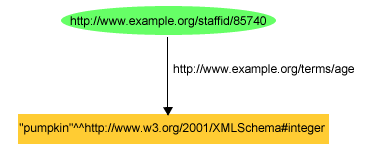
For example, the typed literal in the triple:
exstaff:85740 exterms:age "pumpkin"^^xsd:integer .
or the graph shown in Figure 10:
is valid RDF, but obviously an error as far as the
xsd:integer datatype is concerned, since "pumpkin" is
not defined as being in the lexical space of
xsd:integer.
RDF software not written to
process the xsd:integer datatype would not be able
to recognize this error.
However, proper use of RDF typed literals provides more information about
the intended interpretation of literal values, and hence makes
RDF statements a better means of information exchange among applications.
Taken as a whole, RDF is basically simple: nodes-and-arcs diagrams
interpreted as statements about things identified by URIrefs.
This section has presented an introduction to these concepts.
As noted earlier, the normative (i.e., definitive) RDF
specification describing these concepts is RDF Concepts and
Abstract Syntax [RDF-CONCEPTS], which should be
consulted for further information. The formal semantics (meaning)
of these concepts is defined in the (normative) RDF Semantics [RDF-SEMANTICS] document.
However, in addition to the basic techniques for
describing things using RDF statements discussed
so far, it should be clear that people or organizations also need a way
to describe the vocabularies (terms) they intend to use in those
statements, specifically, vocabularies for:
- describing types of things (like
exterms:Person)
- describing properties (like
exterms:age and
exterms:creation-date), and
- describing the types of things that can serve as the
subjects or objects of statements involving those properties
(such as specifying that the value of an
exterms:age
property should always be an xsd:integer).
The basis for describing such vocabularies in RDF is the RDF Vocabulary
Description Language 1.0: RDF Schema [RDF-VOCABULARY], which will be
described in Section 5.
Additional background on the basic ideas underlying RDF, and
its role in providing a general language for describing Web
information, can be found in [WEBDATA]. RDF draws upon ideas from
knowledge representation, artificial intelligence, and data
management, including Conceptual Graphs, logic-based knowledge
representation, frames, and relational databases. Some possible
sources of background information on these subjects include [SOWA], [CG], [KIF], [HAYES], [LUGER], and [GRAY].
3. An XML Syntax for RDF:
RDF/XML
As described in Section 2, RDF's conceptual model is a
graph. RDF provides an XML syntax for writing down and exchanging
RDF graphs, called RDF/XML. Unlike triples, which are
intended as a shorthand notation, RDF/XML is the normative syntax
for writing RDF. RDF/XML is defined in the RDF/XML Syntax
Specification [RDF-SYNTAX].
This section describes this RDF/XML syntax.
The basic ideas behind the RDF/XML syntax can be illustrated
using some of the examples presented already. Take as an example
the English statement:
http://www.example.org/index.html
        has a creation-date whose value is August 16,
        1999
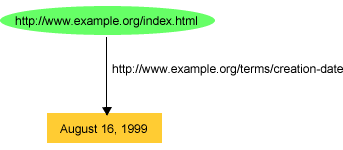
The RDF graph for this single statement, after assigning a
URIref to the creation-date property, is shown in Figure 11:
with a triple representation of:
ex:index.html exterms:creation-date "August 16, 1999" .
(Note that a typed literal is not used for the date value in
this example. Representing typed literals in RDF/XML will be
described later in this section.)
Example 2 shows the RDF/XML syntax
corresponding to the graph in Figure
11:
1. <?xml version="1.0"?>
2. <rdf:RDF xmlns:rdf="http://www.w3.org/1999/02/22-rdf-syntax-ns#"
3.             xmlns:exterms="http://www.example.org/terms/">

4.   <rdf:Description rdf:about="http://www.example.org/index.html">
5.       <exterms:creation-date>August 16, 1999</exterms:creation-date>
6.   </rdf:Description>

7. </rdf:RDF>
(Line numbers are added to help in explaining the
example.)
This seems like a lot of overhead. It is easier to understand
what is going on by considering each part of this XML in turn
(a brief introduction to XML is provided in Appendix B).
Line 1, <?xml version="1.0"?>, is the XML
declaration, which indicates that the following content is XML,
and what version of XML it is.
Line 2 begins an rdf:RDF element. This indicates
that the following XML content (starting here and ending with
the </rdf:RDF> in line 7) is intended to
represent RDF. Following the rdf:RDF on this same line
is an XML namespace declaration, represented as an
xmlns attribute of the rdf:RDF start-tag.
This declaration
specifies that all tags in this content
prefixed with rdf: are part of the namespace
identified by the URIref
http://www.w3.org/1999/02/22-rdf-syntax-ns#.
URIrefs beginning with the string
http://www.w3.org/1999/02/22-rdf-syntax-ns#
are used for terms from the RDF vocabulary.
Line 3 specifies another XML namespace declaration, this
time for the prefix exterms:. This is expressed as
another xmlns attribute of the rdf:RDF
element, and specifies that the namespace URIref
http://www.example.org/terms/ is to be associated with
the exterms: prefix.
URIrefs beginning with the string
http://www.example.org/terms/
are used for terms from the vocabulary defined by the example organization,
example.org.
The ">" at the end of line 3 indicates the end
of the rdf:RDF start-tag. Lines 1-3 are general
"housekeeping" necessary to indicate that this is
RDF/XML content, and to identify the namespaces being used
within the RDF/XML content.
Lines 4-6 provide the RDF/XML for the specific statement
shown in Figure
11. An obvious way to talk about any RDF
statement is to say it is a description, and that it is
about the subject of the statement (in this case,
about http://www.example.org/index.html), and this is the way
RDF/XML represents the statement. The rdf:Description
start-tag in line 4 indicates the start of a
description of a resource, and goes on to identify the
resource the statement is about (the subject of the
statement) using the rdf:about attribute to specify
the URIref of the subject resource.
Line 5 provides a
property element, with the QName
exterms:creation-date as its tag, to
represent the predicate and object of the statement.
The QName exterms:creation-date is chosen
so that appending
the local name creation-date to the URIref of the
exterms: prefix (http://www.example.org/terms/)
gives the statement's predicate URIref
http://www.example.org/terms/creation-date.
The content of this property element is the object of the
statement, the plain literal August 19, 1999
(the value of the creation-date property of the subject resource).
The property element is nested within the containing
rdf:Description element, indicating that this property
applies to the resource specified in the rdf:about
attribute of the rdf:Description element. Line 6
indicates the end of this particular rdf:Description
element.
Finally, Line 7 indicates the end of the rdf:RDF
element started on line 2. Using an rdf:RDF element
to enclose RDF/XML content is optional in situations where
the XML can be identified as RDF/XML by context. This is discussed
further in [RDF-SYNTAX]. However, it
does not hurt to provide the rdf:RDF element in any case,
and Primer examples will generally (but not always) provide one.
Example 2 illustrates the basic
ideas used by RDF/XML to encode an RDF graph as XML elements,
attributes, element content, and attribute values. The URIrefs
of predicates (as well as some nodes) are written as XML
QNames, consisting of a short prefix denoting
a namespace URI, together with a local name denoting a
namespace-qualified element or attribute, as described in Appendix B. The (namespace URIref, local
name) pair is chosen so that concatenating them forms the
URIref of the original node or predicate. The URIrefs of subject nodes are
written as XML attribute values (URIrefs of object nodes may sometimes be
written as attribute values as well). Literal nodes
(which are always object nodes) become element text content or
attribute values. (Many of these options are described later in
the Primer; all of these options are described in [RDF-SYNTAX].)
An RDF graph consisting of multiple statements can be represented
in RDF/XML by using RDF/XML similar to Lines 4-6 in
Example 2 to separately represent each
statement. For example, to write the following two
statements:
ex:index.html   exterms:creation-date   "August 16, 1999" .
ex:index.html   dc:language             "en" .
the RDF/XML in Example
3 could be used:
1.  <?xml version="1.0"?>
2.  <rdf:RDF xmlns:rdf="http://www.w3.org/1999/02/22-rdf-syntax-ns#"
3.              xmlns:dc="http://purl.org/dc/elements/1.1/"
4.              xmlns:exterms="http://www.example.org/terms/">

5.    <rdf:Description rdf:about="http://www.example.org/index.html">
6.        <exterms:creation-date>August 16, 1999</exterms:creation-date>
7.    </rdf:Description>

8.    <rdf:Description rdf:about="http://www.example.org/index.html">
9.        <dc:language>en</dc:language>
10.   </rdf:Description>

11. </rdf:RDF>
Example 3 is the same as Example 2, with the addition of
a second rdf:Description element (in lines 8-10)
to represent the second statement. (An additional namespace declaration
is also given in line 3
to identify the additional namespace used in this statement.)
An arbitrary number of
additional statements could be written in the same way, using a separate
rdf:Description element for each additional statement.
As Example 3 illustrates, once the
overhead of writing the XML and namespace declarations is dealt
with, writing each additional RDF statement in RDF/XML is both
straightforward and not too complicated.
The RDF/XML syntax provides a number of abbreviations to
make common uses easier to write. For example, it is typical
for the same resource to be described with several properties
and values at the same time, as in Example
3, where the resource ex:index.html is the subject
of several statements. To handle such cases, RDF/XML allows
multiple property elements representing those properties to be
nested within the rdf:Description element that
identifies the subject resource. For example, to
represent the following group of statements about
http://www.example.org/index.html:
ex:index.html   dc:creator              exstaff:85740 .
ex:index.html   exterms:creation-date   "August 16, 1999" .
ex:index.html   dc:language             "en" .
whose graph (the same as Figure 3) is
shown in Figure 12:
the RDF/XML shown in Example 4 could be written:
1.  <?xml version="1.0"?>
2.  <rdf:RDF xmlns:rdf="http://www.w3.org/1999/02/22-rdf-syntax-ns#"
3.              xmlns:dc="http://purl.org/dc/elements/1.1/"
4.              xmlns:exterms="http://www.example.org/terms/">

5.    <rdf:Description rdf:about="http://www.example.org/index.html">
6.         <exterms:creation-date>August 16, 1999</exterms:creation-date>
7.         <dc:language>en</dc:language>
8.         <dc:creator rdf:resource="http://www.example.org/staffid/85740"/>
9.    </rdf:Description>

10. </rdf:RDF>
Compared with the previous two examples, Example 4 adds an additional dc:creator
property element (in line 8). In addition, the
property elements for the three properties whose subject is
http://www.example.org/index.html are nested within a single
rdf:Description element identifying that subject,
rather than writing a separate rdf:Description element
for each statement.
Line 8 also introduces a new form of property element. The
dc:language element in line 7 is similar to the
exterms:creation-date element used in Example 2. Both these elements represent
properties with plain literals as property values, and such
elements are written by enclosing the literal within start-
and end-tags corresponding to the property name. However, the
dc:creator element on line 8 represents a property
whose value is another resource, rather than a
literal. If the URIref of this resource were written as a
plain literal within start- and end-tags in the same way as
the literal values of the other elements, this would
say that the value of the dc:creator element was
the character string
http://www.example.org/staffid/85740, rather than the
resource identified by that literal interpreted as a URIref. In
order to indicate the difference, the
dc:creator element is written using what XML calls an
empty-element tag (it has no separate end-tag), and
the property value is written using an rdf:resource
attribute within that empty element. The rdf:resource
attribute indicates that the property element's value is
another resource, identified by its URIref. Because the URIref
is being used as an attribute value, RDF/XML requires
the URIref to be written out (as an absolute or relative URIref),
rather than abbreviating it as a
QName as was done in writing element and attribute
names (absolute and relative URIrefs are discussed in
Appendix A).
It is important to understand that the RDF/XML in Example 4 is an abbreviation. The
RDF/XML in Example 5, in which each
statement is written separately, describes exactly the same RDF
graph (the graph of Figure 12):
 <?xml version="1.0"?>
 <rdf:RDF xmlns:rdf="http://www.w3.org/1999/02/22-rdf-syntax-ns#"
             xmlns:dc="http://purl.org/dc/elements/1.1/"
             xmlns:exterms="http://www.example.org/terms/">

   <rdf:Description rdf:about="http://www.example.org/index.html">
       <exterms:creation-date>August 16, 1999</exterms:creation-date>
   </rdf:Description>

   <rdf:Description rdf:about="http://www.example.org/index.html">
       <dc:language>en</dc:language>
   </rdf:Description>

   <rdf:Description rdf:about="http://www.example.org/index.html">
       <dc:creator rdf:resource="http://www.example.org/staffid/85740"/>
   </rdf:Description>

 </rdf:RDF>
The following sections will describe a few additional
RDF/XML abbreviations. [RDF-SYNTAX] provides a more thorough
description of the abbreviations that are available.
RDF/XML can also represent graphs that include
nodes that have no URIrefs, i.e., the blank nodes
described in Section 2.3. For
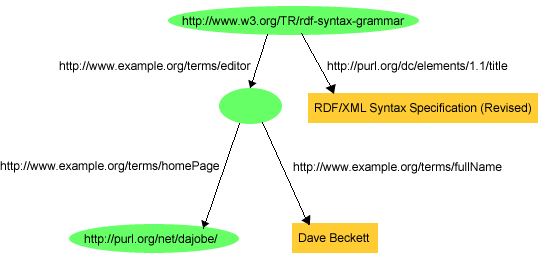
example, Figure 13 (taken from [RDF-SYNTAX]) shows a graph saying
"the document 'http://www.w3.org/TR/rdf-syntax-grammar' has a
title 'RDF/XML Syntax Specification (Revised)' and has an
editor, the editor has a name 'Dave Beckett' and a home page
'http://purl.org/net/dajobe/' ".
This illustrates an idea discussed in Section 2.3: the use of a
blank node to represent something that does not have a URIref,
but can be described in terms of other information. In this
case, the blank node represents a person, the editor of the
document, and the person is described by his name and home
page.
RDF/XML provides several ways to represent graphs
containing blank nodes. These are all described in [RDF-SYNTAX]. The approach
illustrated here, which is the most direct approach, is to
assign a blank node identifier to each blank node. A
blank node identifier serves to identify a blank node within a
particular RDF/XML document but, unlike a URIref, is unknown
outside the document in which it is assigned. A blank node is
referred to in RDF/XML using an rdf:nodeID attribute,
with a blank node identifier as its value, in places where the
URIref of a resource would otherwise appear. Specifically,
a statement with a blank node as its subject can be written in
RDF/XML using an rdf:Description element with
an rdf:nodeID attribute instead of an
rdf:about attribute. Similarly, a statement with a
blank node as its object can be written using a property
element with an rdf:nodeID attribute instead of an
rdf:resource attribute. Using rdf:nodeID, Example 6 shows the RDF/XML corresponding
to Figure 13:
1.  <?xml version="1.0"?>
2.  <rdf:RDF xmlns:rdf="http://www.w3.org/1999/02/22-rdf-syntax-ns#"
3.              xmlns:dc="http://purl.org/dc/elements/1.1/"
4.              xmlns:exterms="http://example.org/stuff/1.0/">

5.     <rdf:Description rdf:about="http://www.w3.org/TR/rdf-syntax-grammar">
6.       <dc:title>RDF/XML Syntax Specification (Revised)</dc:title>
7.       <exterms:editor rdf:nodeID="abc"/>
8.     </rdf:Description>

9.     <rdf:Description rdf:nodeID="abc">
10.        <exterms:fullName>Dave Beckett</exterms:fullName>
11.        <exterms:homePage rdf:resource="http://purl.org/net/dajobe/"/>
12.    </rdf:Description>

13. </rdf:RDF>
In Example 6, the blank node
identifier abc is used in line 9 to identify the blank
node as the subject of several statements, and is used in line
7 to indicate that the blank node is the value of a resource's
exterms:editor property. The advantage of using a
blank node identifier over some of the other approaches
described in [RDF-SYNTAX] is that
using a blank node identifier allows the same blank node to be
referred to in more than one place in the same RDF/XML
document.
Finally, the typed literals described in Section 2.4 may be used as property
values instead of the plain literals used in the
examples so far. A typed literal is represented in RDF/XML by
adding an rdf:datatype attribute specifying a datatype
URIref to the property element containing the literal.
For example, to change the statement in Example 2 to use a typed literal instead
of a plain literal for the exterms:creation-date property, the
triple representation would be:
ex:index.html exterms:creation-date "1999-08-16"^^xsd:date .
with corresponding RDF/XML syntax shown in Example 7:
1. <?xml version="1.0"?>
2. <rdf:RDF xmlns:rdf="http://www.w3.org/1999/02/22-rdf-syntax-ns#"
3.             xmlns:exterms="http://www.example.org/terms/">

4.   <rdf:Description rdf:about="http://www.example.org/index.html">
5.     <exterms:creation-date rdf:datatype=
         "http://www.w3.org/2001/XMLSchema#date">1999-08-16
       </exterms:creation-date>
6.   </rdf:Description>

7. </rdf:RDF>
In line 5 of Example 7, a typed
literal is given as the value of the exterms:creation-date
property element by adding an rdf:datatype attribute
to the element's start-tag to specify the datatype. The value
of this attribute is the URIref of the datatype, in this case,
the URIref of the XML Schema date datatype. Since this
is an attribute value, the URIref must be written out, rather
than using the QName abbreviation xsd:date
used in the triple. A literal appropriate to this datatype is
then written as the element content, in this case, the literal
1999-08-16, which is the literal representation for
August 16, 1999 in the XML Schema date datatype.
In the
rest of the Primer, the examples will
use typed literals from appropriate datatypes rather than
plain (untyped) literals, in order to emphasize the value of
typed literals in conveying more information about the intended
interpretation of literal values. (The exceptions will be that plain
literals will continue to be used in
examples taken from actual applications that do not currently use
typed literals, in order to accurately reflect the usage in those
applications.)
In RDF/XML, both plain and typed literals (and, with certain exceptions, tags) can contain Unicode [UNICODE] characters, allowing information from many languages to be directly represented.
Example 7 illustrates that using typed literals requires writing an rdf:datatype attribute with
a URIref identifying the datatype for each element whose value is a typed literal. As noted earlier, RDF/XML requires that URIrefs used as attribute values
must be written out, rather than abbreviated as a QName.
XML entities can be used in RDF/XML to improve readability
in such cases, by providing an additional abbreviation
facility for URIrefs. Essentially, an XML entity declaration
associates a name with a string of characters. When the entity
name is referenced elsewhere within an XML document, XML processors replace
the reference with the corresponding string. For example, the
ENTITY declaration (specified as part of a DOCTYPE
declaration at the beginning of the RDF/XML document):
<!DOCTYPE rdf:RDF [<!ENTITY xsd "http://www.w3.org/2001/XMLSchema#">]>
defines the entity xsd to be the string representing the
namespace URIref for XML Schema datatypes. This declaration allows
the full namespace URIref to be abbreviated elsewhere in the XML
document by the entity reference &xsd;.
Using this abbreviation,
Example 7 could also be written as shown in
Example 8.
1. <?xml version="1.0"?>
2. <!DOCTYPE rdf:RDF [<!ENTITY xsd "http://www.w3.org/2001/XMLSchema#">]>

3. <rdf:RDF xmlns:rdf="http://www.w3.org/1999/02/22-rdf-syntax-ns#"
4.             xmlns:exterms="http://www.example.org/terms/">

5.   <rdf:Description rdf:about="http://www.example.org/index.html">
6.     <exterms:creation-date rdf:datatype="&xsd;date">1999-08-16
       </exterms:creation-date>
7.   </rdf:Description>

8. </rdf:RDF>
The DOCTYPE declaration in line 2 defines the entity
xsd, which is used in line 6.
The use of XML entities as an abbreviation mechanism is optional
in RDF/XML, and hence the use of an XML DOCTYPE declaration
is also optional
in RDF/XML. (For readers familiar with XML, RDF/XML is only required
to be "well-formed" XML. RDF/XML is not designed to be
validated against a DTD by a validating XML processor. This is
discussed more fully in Appendix B, which
provides additional information about XML.)
For readability purposes, examples in the rest of the
Primer will use the XML entity xsd as just described.
XML entities are discussed
further in Appendix B.
As illustrated in Appendix B,
other URIrefs (and, more generally, other strings)
can also be abbreviated using XML entities.
However, the URIrefs for XML Schema datatypes are the only ones that will be
abbreviated in this way in Primer examples.
Although additional abbreviated forms for writing RDF/XML
are available, the facilities illustrated so far
provide a simple but general way to express graphs in
RDF/XML. Using these facilities, an RDF graph is written in
RDF/XML as follows:
- All blank nodes are assigned blank node identifiers.
- Each node is listed in turn as the subject of an
un-nested
rdf:Description element, using an
rdf:about attribute if the node has a URIref, or
an rdf:nodeID attribute if the node is
blank.
For each triple with this node as subject, an appropriate
property element is created, with either literal content
(possibly empty), an rdf:resource attribute
specifying the object of the triple (if the object node has a
URIref), or an rdf:nodeID attribute specifying
the object of the triple (if the object node is blank).
Compared to some of the more abbreviated
approaches described in [RDF-SYNTAX], this simple
approach provides the most direct representation
of the actual graph structure, and is particularly recommended
for applications in which the output RDF/XML is to be used in
further RDF processing.
So far, the examples have assumed that the resources
being described have been given URIrefs already. For instance, the initial
examples provided descriptive information about
example.org's Web page, whose URIref was
http://www.example.org/index.html. This resource was identified
in RDF/XML
using an rdf:about attribute citing its full URIref.
Although RDF does not specify or control how URIrefs are
assigned to resources, sometimes it is desirable to achieve the
effect of assigning URIrefs to resources that are part
of an organized group of resources. For example, suppose a
sporting goods company, example.com, wanted to provide an
RDF-based catalog of its products, such as tents, hiking boots,
and so on, as an RDF/XML document, identified by (and located
at) http://www.example.com/2002/04/products. In that
resource, each product might be given a separate RDF
description. This catalog, along with one of these
descriptions, the catalog entry for a model of tent called the
"Overnighter", might be written in RDF/XML as shown in Example 9:
1.   <?xml version="1.0"?>
2.   <!DOCTYPE rdf:RDF [<!ENTITY xsd "http://www.w3.org/2001/XMLSchema#">]>
3.   <rdf:RDF xmlns:rdf="http://www.w3.org/1999/02/22-rdf-syntax-ns#"
4.               xmlns:exterms="http://www.example.com/terms/">

5.     <rdf:Description rdf:ID="item10245">
6.          <exterms:model rdf:datatype="&xsd;string">Overnighter</exterms:model>
7.          <exterms:sleeps rdf:datatype="&xsd;integer">2</exterms:sleeps>
8.          <exterms:weight rdf:datatype="&xsd;decimal">2.4</exterms:weight>
9.          <exterms:packedSize rdf:datatype="&xsd;integer">784</exterms:packedSize>
10.    </rdf:Description>

  ...other product descriptions...

11.  </rdf:RDF>
Example 9 is similar to previous
examples in the way it represents the properties (model,
sleeping capacity, weight) of the resource (the tent) being
described.
(The surrounding xml, DOCTYPE, RDF, and namespace
information is included in lines 1 through 4, and line 11, but this
information would only need to be provided once for the whole
catalog, not repeated for each entry in the catalog.
Note also that although the datatypes associated with the various property values
are given explicitly, the units associated with some of these property values are not, even
though this information should be available to properly interpret the values. Representing units and similar information that may be associated with property values is discussed in Section 4.4. In this example, the value of exterms:sleeps is the number of persons the tent can sleep, the value of exterms:weight is given in kilograms, and the value of exterms:packedSize is given in square centimeters, the area the tent occupies on a backpack.)
An important difference from previous examples
is that, in line 5, the rdf:Description
element has an rdf:ID attribute instead of an
rdf:about attribute. Using rdf:ID specifies
a fragment identifier, given by the
value of the rdf:ID attribute (item10245 in
this case, which might be the catalog number assigned by
example.com), as an abbreviation of the complete URIref of the
resource being described. The fragment identifier
item10245 will be interpreted relative to a base
URI, in this case, the URI of the containing catalog
document. The full URIref for the tent is formed by taking the
base URI (of the catalog), and appending the character
"#" (to
indicate that what follows is a fragment identifier) and then
item10245 to it, giving the absolute URIref
http://www.example.com/2002/04/products#item10245.
The rdf:ID attribute is somewhat similar to the ID
attribute in XML and HTML, in that it defines a name which must
be unique relative to the current base URI (in this example, that of the catalog).
In this case, the rdf:ID
attribute appears to be assigning a name (item10245)
to this particular kind of tent. Any other RDF/XML within this
catalog could refer to the tent by using either the absolute URIref
http://www.example.com/2002/04/products#item10245,
or the relative URIref #item10245. The
relative URIref would be understood as being a URIref defined relative to the
base URIref of the catalog. Using a similar abbreviation,
the URIref of the tent could also be given by specifying
rdf:about="#item10245" in the catalog entry (i.e., by
specifying the relative URIref directly) instead of
rdf:ID="item10245" . As an abbreviation mechanism,
the two forms are essentially
synonyms: the full URIref formed by RDF/XML is the same in
either case:
http://www.example.com/2002/04/products#item10245.
However, using rdf:ID provides an additional check
when assigning a set of distinct names, since a given value of the
rdf:ID attribute can only appear once relative to the
same base URI (the catalog document, in this example). Using
either form, example.com would be giving the URIref for the
tent in a two-stage process, first assigning the URIref for the
whole catalog, and then using a relative URIref in the
description of the tent in the catalog to indicate the URIref
that has been assigned to this particular kind of tent.
Moreover, this use of a relative URIref can be thought of either
as being an abbreviation for a full URIref that has been
assigned to the tent independently of the RDF, or as being the
assignment of the URIref to the tent within the catalog.
RDF located outside the catalog could refer to this
tent by using the full URIref, i.e., by concatenating the
relative URIref #item10245 of the tent to the base URI
of the catalog, forming the absolute URIref
http://www.example.com/2002/04/products#item10245. For
example, an outdoor sports Web site exampleRatings.com might
use RDF to provide ratings of various tents. The (5-star)
rating given to the tent described in Example 9 might then be represented on
exampleRatings.com's Web site as shown in Example 10:
1.  <?xml version="1.0"?>
2.  <!DOCTYPE rdf:RDF [<!ENTITY xsd "http://www.w3.org/2001/XMLSchema#">]>
3.  <rdf:RDF xmlns:rdf="http://www.w3.org/1999/02/22-rdf-syntax-ns#"
4.              xmlns:sportex="http://www.exampleRatings.com/terms/">

5.    <rdf:Description rdf:about="http://www.example.com/2002/04/products#item10245">
6.         <sportex:ratingBy rdf:datatype="&xsd;string">Richard Roe</sportex:ratingBy>
7.         <sportex:numberStars rdf:datatype="&xsd;integer">5</sportex:numberStars>
8.    </rdf:Description>
9.  </rdf:RDF>
In Example 10, line 5 uses an
rdf:Description element with an rdf:about
attribute whose value is the full URIref of the tent. The use
of this URIref allows the tent being referred to in the rating
to be precisely identified.
These examples illustrate several points. First, even though
RDF does not specify or control how URIrefs are assigned to
resources (in this case, the various tents and other items in
the catalog), the effect of assigning URIrefs to
resources in RDF can be achieved by combining a process
(external to RDF) that identifies a single document (the
catalog in this case) as the source for descriptions of those
resources, with the use of relative URIrefs in descriptions of
those resources within that document. For instance, example.com
could use this catalog as the central source where its products
are described, with the understanding that if a product's item
number is not in an entry in this catalog, it is not a product
known to example.com. (Note that RDF does not assume any
particular relationship exists between two resources just
because their URIrefs have the same base, or are otherwise
similar. This relationship may be known to example.com, but it
is not directly defined by RDF.)
These examples also illustrate one of the basic
architectural principles of the Web, which is that
anyone
should be able to freely add information
about an existing resource, using any vocabulary they
please [BERNERS-LEE98]. The examples
further illustrate that the RDF describing a particular
resource does not need to be located all in one place; instead,
it may be distributed throughout the Web. This is true not only
for situations like this one, in which one organization is
rating or commenting on a resource defined by another, but also
for situations in which the original definer of a resource (or
anyone else) wishes to amplify the description of that resource
by providing additional information about it. This may be done
by modifying the RDF document in which the resource was
originally described, to add the properties and values needed
to describe the additional information. Or, as this example
illustrates, a separate document could be created, providing the
additional properties and values in rdf:Description
elements that refer to the original resource via its URIref
using rdf:about.
The discussion above indicated that relative URIrefs
such as #item10245 will be interpreted relative to a
base URI. By default, this base URI would be the URI
of the resource in which the relative URIref is used.
However, in some cases it is desirable to be able to explicitly
specify this base URI. For instance, suppose that in addition
to the catalog located at
http://www.example.com/2002/04/products, example.org
wanted to provide a duplicate catalog on a mirror site, say at
http://mirror.example.com/2002/04/products. This could
create a problem, since if the catalog was accessed from the
mirror site, the URIref for the example tent would be generated
from the URI of the containing document, forming
http://mirror.example.com/2002/04/products#item10245,
rather than
http://www.example.com/2002/04/products#item10245, and
hence would apparently refer to a different resource than the
one intended. Alternatively, example.org might want to assign a
base URIref for its set of product URIrefs without publishing a
single source document whose location defines the base.
To deal with such cases, RDF/XML supports XML
Base [XML-BASE], which allows
an XML document to specify a base URI other than the URI of the
document itself. Example 11 shows how
the catalog would be described using XML Base:
1.   <?xml version="1.0"?>
2.   <!DOCTYPE rdf:RDF [<!ENTITY xsd "http://www.w3.org/2001/XMLSchema#">]>
3.   <rdf:RDF xmlns:rdf="http://www.w3.org/1999/02/22-rdf-syntax-ns#"
4.               xmlns:exterms="http://www.example.com/terms/"
5.               xml:base="http://www.example.com/2002/04/products">

6.     <rdf:Description rdf:ID="item10245">
7.          <exterms:model rdf:datatype="&xsd;string">Overnighter</exterms:model>
8.          <exterms:sleeps rdf:datatype="&xsd;integer">2</exterms:sleeps>
9.          <exterms:weight rdf:datatype="&xsd;decimal">2.4</exterms:weight>
10.         <exterms:packedSize rdf:datatype="&xsd;integer">784</exterms:packedSize>
11.    </rdf:Description>

  ...other product descriptions...

12.  </rdf:RDF>
In Example 11, the
xml:base declaration in line 5 specifies that the base
URI for the content within the rdf:RDF element (until
another xml:base attribute is specified) is
http://www.example.com/2002/04/products, and all
relative URIrefs cited within that content will be interpreted
relative to that base, no matter what the URI of the containing
document is. As a result, the relative URIref of the tent,
#item10245, will be interpreted as the same absolute
URIref,
http://www.example.com/2002/04/products#item10245, no
matter what the actual URI of the catalog document is, or
whether the base URIref actually identifies a particular
document at all.
So far, the examples have used a single product
description, a particular model of tent, from example.com's
catalog. However, example.com will probably offer several
different models of tents, as well as multiple instances of
other categories of products, such as backpacks, hiking boots,
and so on. This idea of things being classified into different
kinds or categories is similar to the
programming language concept of objects having different
types or classes. RDF supports this concept
by providing a predefined property, rdf:type. When an
RDF resource is described with an rdf:type property,
the value of that property is considered to be a resource that
represents a category or class of things, and the
subject of that property is considered to be an
instance of that category or class. Using
rdf:type, Example 12 shows
how example.com might indicate that the product description is
that of a tent:
1.   <?xml version="1.0"?>
2.   <!DOCTYPE rdf:RDF [<!ENTITY xsd "http://www.w3.org/2001/XMLSchema#">]>
3.   <rdf:RDF xmlns:rdf="http://www.w3.org/1999/02/22-rdf-syntax-ns#"
4.               xmlns:exterms="http://www.example.com/terms/"
5.               xml:base="http://www.example.com/2002/04/products">

6.     <rdf:Description rdf:ID="item10245">
7.          <rdf:type rdf:resource="http://www.example.com/terms/Tent"/>
8.          <exterms:model rdf:datatype="&xsd;string">Overnighter</exterms:model>
9.          <exterms:sleeps rdf:datatype="&xsd;integer">2</exterms:sleeps>
10.         <exterms:weight rdf:datatype="&xsd;decimal">2.4</exterms:weight>
11.         <exterms:packedSize rdf:datatype="&xsd;integer">784</exterms:packedSize>
12.    </rdf:Description>

  ...other product descriptions...

13.  </rdf:RDF>
In Example 12, the
rdf:type property in line 7 indicates that the
resource being described is an instance of the class identified by the URIref
http://www.example.com/terms/Tent. This assumes
that example.com has described its classes as part of
the same vocabulary that it uses to describe its other terms
(such as the property exterms:weight), so the
absolute URIref of the class is used to refer to it. If example.com had
described these classes as part of the product catalog itself,
the relative URIref #Tent could have been used to refer
to it.
RDF itself does not provide facilities for defining
application-specific classes of things, such as Tent
in this example, or their properties, such as exterms:weight.
Instead, such classes would be described in an RDF schema,
using the RDF Schema language
discussed in Section 5. Other such
facilities for describing classes can also be defined, such as
the DAML+OIL and OWL languages described in
Section 5.5.
It is fairly common in RDF for resources to have rdf:type
properties that describe the resources as instances of specific types
or classes. Such resources are called typed nodes in the
graph, or typed node elements in the RDF/XML.
RDF/XML provides a special abbreviation for describing
these typed nodes. In this abbreviation, the
rdf:type property and its value are removed, and the
rdf:Description element for the node is replaced by an element
whose name is the QName corresponding to the value of the
removed rdf:type property (a URIref that names a class).
Using this abbreviation, example.com's tent from Example 12 could also be described as
shown in Example 13:
1.   <?xml version="1.0"?>
2.   <!DOCTYPE rdf:RDF [<!ENTITY xsd "http://www.w3.org/2001/XMLSchema#">]>
3.   <rdf:RDF xmlns:rdf="http://www.w3.org/1999/02/22-rdf-syntax-ns#"
4.               xmlns:exterms="http://www.example.com/terms/"
5.               xml:base="http://www.example.com/2002/04/products">

6.     <exterms:Tent rdf:ID="item10245">
7.          <exterms:model rdf:datatype="&xsd;string">Overnighter</exterms:model>
8.          <exterms:sleeps rdf:datatype="&xsd;integer">2</exterms:sleeps>
9.          <exterms:weight rdf:datatype="&xsd;decimal">2.4</exterms:weight>
10.         <exterms:packedSize rdf:datatype="&xsd;integer">784</exterms:packedSize>
11.    </exterms:Tent>

  ...other product descriptions...

12.  </rdf:RDF>
Since a resource may be described as an instance of more
than one class, a resource may have more than one
rdf:type property. However, only one of these
rdf:type properties can be abbreviated in this way.
The others must be written out using rdf:type properties,
in the manner illustrated by the
rdf:type property in Example 12.
In addition to its use in describing instances of user-defined
classes such as exterms:Tent, the typed node abbreviation
is also commonly used in RDF/XML when describing instances of
the built-in RDF classes (such as rdf:Bag) to be
described in Section 4, and
the built-in RDF Schema classes (such as rdfs:Class) to be described in
Section 5.
Both Example 12 and Example 13 illustrate that RDF statements
can be written in RDF/XML in a way that closely resembles
descriptions that might have been written directly in (non-RDF) XML. This
is an important consideration, given the increasing use of XML
in all kinds of applications, since it suggests that RDF could
be used in these applications without requiring major changes
in the way their information is structured.
The examples above have illustrated some of the basic ideas
behind the RDF/XML syntax. These examples provide enough
information to begin writing useful RDF/XML.
A more thorough discussion of the principles behind the
modeling of RDF statements in XML (known as striping),
together with a presentation of the other RDF/XML abbreviations
available, and other details and examples about writing RDF in
XML, is given in the (normative) RDF/XML Syntax
Specification [RDF-SYNTAX].
4.
Other RDF Capabilities
RDF provides a number of additional capabilities,
such as
built-in types and properties for representing groups of
resources and RDF statements, and capabilities for representing
XML fragments as property values. These additional capabilities
are described in the following sections.
There is often a need to describe groups of things:
for example, to say that a book was created by
several authors, or to list the students in a course, or the
software modules in a package. RDF provides several predefined
(built-in) types and properties that can be used to describe such
groups.
First, RDF provides a container vocabulary
consisting of three predefined types (together with some
associated predefined properties). A container is a
resource that contains things. The contained things are called
members. The members of a container may be resources
(including blank nodes) or literals. RDF defines three types of containers:
A Bag (a resource having type rdf:Bag)
represents
a group of resources or literals, possibly including duplicate
members, where there is no significance in the order of the
members. For example, a Bag might be used to describe a group
of part numbers in which the order of entry or processing of
the part numbers does not matter.
A Sequence or Seq (a resource having type
rdf:Seq) represents
a group of resources or literals, possibly
including duplicate members, where the order of the members is
significant. For example, a Sequence might be used to describe
a group that must be maintained in alphabetical order.
An Alternative or Alt (a resource having
type rdf:Alt) represents
a group of resources or literals that
are alternatives (typically for a single value of a
property). For example, an Alt might be used to describe
alternative language translations for the title of a book, or
to describe a list of alternative Internet sites at which a
resource might be found. An application using a property whose
value is an Alt container should be aware that it can choose
any one of the members of the group as appropriate.
To describe a resource as being one of these types of
containers, the resource is given an rdf:type property
whose value is one of the predefined resources
rdf:Bag, rdf:Seq, or rdf:Alt
(whichever is appropriate). The container resource (which may
either be a blank node or a resource with a URIref) denotes the
group as a whole. The members of the container can be
described by defining a container membership property
for each member with the container resource as its subject and
the member as its object. These container membership properties
have names of the form rdf:_n, where
n is a decimal integer greater than zero, with no
leading zeros, e.g., rdf:_1, rdf:_2,
rdf:_3, and so on, and are used specifically for
describing the members of containers. Container resources may
also have other properties that describe the container, in
addition to the container membership properties and the
rdf:type property.
It is important to understand that while these types of
containers are described using predefined RDF types and
properties, any special meanings associated with these
containers, e.g., that the members of an Alt container are
alternative values, are only intended meanings. These
specific container types, and their definitions, are provided
with the aim of establishing a shared convention among those
who need to describe groups of things. All RDF does is provide
the types and properties that can be used to construct the RDF
graphs to describe each type of container. RDF has no more
built-in understanding of what a resource of type
rdf:Bag is than it has of what a resource of type
ex:Tent (discussed in Section 3.2) is. In each case,
applications must be written to behave according to the
particular meaning involved for each type. This point will be
expanded on in the following examples.
A typical use of a container is to indicate that the value
of a property is a group of things. For example, to represent
the sentence "Course 6.001 has the students Amy, Mohamed, Johann,
Maria, and Phuong", the course could be described by giving it a
s:students property (from an appropriate vocabulary)
whose value is a container of type
rdf:Bag (representing
the group of students). Then, using the
container membership properties, individual
students could be identified as being members of that group,
as in the RDF
graph shown in Figure 14:
Since the value of the s:students property in this
example is described as a Bag, there is no intended
significance in the order given for the URIrefs of the
students, even though the membership properties in the graph have integers
in their names. It is up to applications creating and
processing graphs that include rdf:Bag containers to
ignore any (apparent) order in the names of the membership
properties.
RDF/XML provides some special syntax and abbreviations to
make it simpler to describe such containers. For example, Example 14 describes the graph shown in
Figure 14:
<?xml version="1.0"?>
<rdf:RDF xmlns:rdf="http://www.w3.org/1999/02/22-rdf-syntax-ns#"
         xmlns:s="http://example.org/students/vocab#">

   <rdf:Description rdf:about="http://example.org/courses/6.001">
      <s:students>
         <rdf:Bag>
            <rdf:li rdf:resource="http://example.org/students/Amy"/>
            <rdf:li rdf:resource="http://example.org/students/Mohamed"/>
            <rdf:li rdf:resource="http://example.org/students/Johann"/>
            <rdf:li rdf:resource="http://example.org/students/Maria"/>
            <rdf:li rdf:resource="http://example.org/students/Phuong"/>
         </rdf:Bag>
      </s:students>
   </rdf:Description>
</rdf:RDF>
Example 14 shows that RDF/XML
provides rdf:li as a convenience element to avoid having
to explicitly number each membership property. The numbered
properties rdf:_1, rdf:_2, and so on are
generated from the rdf:li elements in forming the
corresponding graph. The element name rdf:li was chosen to
be mnemonic with the term "list item" from HTML. Note also the
use of a <rdf:Bag> element nested within the
<s:students> property element. The
<rdf:Bag> element is another example of the
abbreviation used in Example 13
that replaces both an rdf:Description element
and an rdf:type element with a single element
when describing an instance of a type (an instance of
rdf:Bag in this case). Since
no URIref is specified, the Bag is a blank node. Its nesting
within the <s:students> property element is an
abbreviated way of indicating that the blank node is the value
of this property. These abbreviations are described further in
[RDF-SYNTAX].
The graph structure for an rdf:Seq container, and
the corresponding RDF/XML, are similar to those for an
rdf:Bag (the only difference is in the type,
rdf:Seq). Once again, although an rdf:Seq
container is intended to describe a sequence, it is up to
applications creating and processing the graph to appropriately
interpret the sequence of integer-valued property names.
To illustrate an Alt container, the sentence "The
source code for X11 may be found at ftp.example.org,
ftp1.example.org, or ftp2.example.org" could be expressed in
the RDF graph shown in Figure 15:
Example 15 shows how the graph in
Figure 15 could be written in
RDF/XML:
<?xml version="1.0"?>
<rdf:RDF xmlns:rdf="http://www.w3.org/1999/02/22-rdf-syntax-ns#"
         xmlns:s="http://example.org/packages/vocab#">

   <rdf:Description rdf:about="http://example.org/packages/X11">
      <s:DistributionSite>
         <rdf:Alt>
            <rdf:li rdf:resource="ftp://ftp.example.org"/>
            <rdf:li rdf:resource="ftp://ftp1.example.org"/>
            <rdf:li rdf:resource="ftp://ftp2.example.org"/>
         </rdf:Alt>
      </s:DistributionSite>
   </rdf:Description>
</rdf:RDF>
An Alt container is intended to have at least one member,
identified by the property rdf:_1. This member is
intended to be considered as the default or preferred value.
Other than the member identified as rdf:_1, the order
of the remaining elements is not significant.
The RDF in Figure 15 as
written states simply that the value of the
s:DistributionSite site property is the Alt container
resource itself. Any additional meaning that is to be read into
this graph, e.g., that one of the members of the Alt
container is to be considered as the value of the
s:DistributionSite site property, or that
ftp://ftp.example.org is the default or preferred
value, must be built into an application's understanding of
the intended meaning of
an Alt container, and/or into the meaning defined
for the particular property (s:DistributionSite in
this case), which also must be understood by the
application.
Alt containers are frequently used in conjunction with
language tagging. (RDF/XML permits the use of the xml:lang
attribute defined in [XML] to indicate
that the element content is in a specified language. The use
of xml:lang is described in [RDF-SYNTAX], and illustrated later in
Section 6.2.) For example, a work whose title has been
translated into several languages might have its title
property pointing to an Alt container holding literals representing
the titles expressed in each of the language variants.
The distinction between the intended meanings of a Bag and
an Alt can be further illustrated by considering the authorship
of the book "Huckleberry Finn". The book has exactly one
author, but the author has two names (Mark Twain and Samuel
Clemens). Either name is sufficient to specify the author. Thus
using an Alt container for the author's names more accurately
represents the relationship than using a Bag (which might
suggest there are two different authors).
Users are free to choose their own ways to describe groups of
resources, rather than using the RDF container vocabulary. These RDF
containers are merely provided as common definitions that, if
generally used, could help make data involving groups of
resources more interoperable.
Sometimes there are clear alternatives to using these RDF
container types. For example, a relationship between a
particular resource and a group of other resources could be
indicated by making the first resource the subject of multiple
statements using the same property. This is structurally different
from the resource being the subject of a single
statement whose object is a container containing multiple
members. In some cases, these two structures may have
equivalent meaning, but in other cases they may not. The choice
of which to use in a given situation should be made with this
in mind.
Consider as an example the relationship between a writer and
her publications, as in the sentence:
Sue has written "Anthology of Time", "Zoological
Reasoning", and "Gravitational Reflections".
In this case, there are three resources each of which was
written independently by the same writer. This could be
expressed using repeated properties as:
exstaff:Sue   exterms:publication   ex:AnthologyOfTime .
exstaff:Sue   exterms:publication   ex:ZoologicalReasoning .
exstaff:Sue   exterms:publication   ex:GravitationalReflections .
In this example there is no stated relationship between the
publications other than that they were written by the same
person. Each of the statements is an independent fact, and so
using repeated properties would be a reasonable choice.
However, this could just as reasonably be represented as a
statement about the group of resources written by Sue:
exstaff:Sue   exterms:publication   _:z .
_:z           rdf:type              rdf:Bag .
_:z           rdf:_1                ex:AnthologyOfTime .
_:z           rdf:_2                ex:ZoologicalReasoning .
_:z           rdf:_3                ex:GravitationalReflections .
On the other hand, the sentence:
The resolution was approved by the Rules Committee, having
members Fred, Wilma, and Dino.
says that the committee as a whole approved the resolution;
it does not necessarily state that each committee member
individually voted in favor of the resolution. In this case, it
would be potentially misleading to model this sentence as three
separate exterms:approvedBy statements, one for each
committee member, as shown below:
ex:resolution   exterms:approvedBy   ex:Fred .
ex:resolution   exterms:approvedBy   ex:Wilma .
ex:resolution   exterms:approvedBy   ex:Dino .
since these statements say that each member individually
approved the resolution.
In this case, it would be better to model the sentence as a
single exterms:approvedBy statement whose subject is
the resolution and whose object is the committee itself. The
committee resource could then be described as a Bag whose
members are the members of the committee, as in the following
triples:
ex:resolution       exterms:approvedBy   ex:rulesCommittee .
ex:rulesCommittee   rdf:type             rdf:Bag .
ex:rulesCommittee   rdf:_1               ex:Fred .
ex:rulesCommittee   rdf:_2               ex:Wilma .
ex:rulesCommittee   rdf:_3               ex:Dino .
When using RDF containers, it is important to
understand that the statements are not constructing containers,
as in a programming language data structure. Instead,
the statements are describing containers (groups of things) that
presumably exist. For instance, in the Rules Committee example
just given, the Rules Committee is an unordered group of
people, whether it is described in RDF that way or not.
Saying that the resource ex:rulesCommittee has type
rdf:Bag is not saying that the Rules Committee is a data
structure, or constructing a particular data structure
to hold the members of the group (the
Rules Committee could be described as a Bag without
describing any members at
all). Instead, it is describing the Rules Committee as having
characteristics corresponding to those associated with a Bag
container, namely that it has members, and their order of description
is not significant.
Similarly, using the container membership
properties simply describes a container resource as
having certain things as members. This does not necessarily
say that the things described as members are the
only members that exist. For example, the triples
given above to describe the Rules Committee say only that Fred,
Wilma, and Dino are members of the committee, not that they are the
only members of the committee.
Also, Example 14 and
Example 15 illustrated a common "pattern"
in describing containers, regardless of the type of container
involved (e.g., use of a blank node with
an appropriate rdf:type property to
represent the container itself, and use of rdf:li to
generate sequentially-numbered container membership properties).
However, it is important to understand that RDF does not
enforce this particular way of using the RDF
container vocabulary, and so it is possible to use this
vocabulary in other ways. For example, in some cases
it might be appropriate to
use a container resource having a URIref rather
than using a blank node.
Moreover, it is possible
to use the container vocabulary in ways that may not
describe graphs with the "well-formed" structures
shown in the previous examples.
For example, Example 16 shows
the RDF/XML for a graph similar to the Alt container shown in
Figure 15, but which writes the container
membership properties explicitly, rather than using
rdf:li to generate them:
<?xml version="1.0"?>
<rdf:RDF xmlns:rdf="http://www.w3.org/1999/02/22-rdf-syntax-ns#"
         xmlns:s="http://example.org/packages/vocab#">

 <rdf:Description rdf:about="http://example.org/packages/X11">
    <s:DistributionSite>
       <rdf:Alt>
          <rdf:type rdf:resource="http://www.w3.org/1999/02/22-rdf-syntax-ns#Bag"/>
          <rdf:_2 rdf:resource="ftp://ftp.example.org"/>
          <rdf:_2 rdf:resource="ftp://ftp1.example.org"/>
          <rdf:_5 rdf:resource="ftp://ftp2.example.org"/>
      </rdf:Alt>
    </s:DistributionSite>
 </rdf:Description>
</rdf:RDF>
As noted in [RDF-SEMANTICS],
RDF imposes no "well-formedness" conditions on the use of
the container vocabulary, so Example 16
is perfectly legal, even though the container
is described as both a Bag and an Alt, it is
described as having
two distinct values of the rdf:_2 property,
and it does not have rdf:_1, rdf:_3,
or rdf:_4 properties.
As a result, RDF applications that require containers
to be "well-formed" should be written to check that the
container vocabulary is being used appropriately, in order to
be fully robust.
A limitation of the containers described in Section 4.1 is that there is no way to
close them, i.e., to say "these are all the members of
the container". As noted in Section 4.1, a container
only says that certain identified
resources are members; it does not say that other members do
not exist. Also, while one graph may describe
some of the members, there is no way to exclude the possibility
that there is another graph somewhere that describes additional
members. RDF provides support for describing groups containing
only the specified members, in the form of RDF
collections. An RDF collection is a group of things
represented as a list structure in the RDF graph. This list
structure is constructed using a predefined collection
vocabulary consisting of the predefined type
rdf:List, the predefined properties rdf:first
and rdf:rest, and the predefined resource
rdf:nil.
To illustrate this, the sentence "The
students in course 6.001 are Amy, Mohamed, and Johann" could be represented
using the
graph shown in Figure 16:
In this graph, each member of the collection, such as
s:Amy, is the object of an rdf:first property whose
subject is a resource (a blank node in this example) that
represents a list.
This list resource is linked to the rest of the list by an
rdf:rest property. The end of the list is indicated by
the rdf:rest property having as its object the resource
rdf:nil (the resource rdf:nil represents the empty
list, and is defined as being of type rdf:List).
This structure will be familiar to those who
know the Lisp programming language. As in Lisp, the
rdf:first and rdf:rest properties allow
applications to traverse the structure.
Each of the blank nodes forming this list structure is
implicitly of type rdf:List
(that is, each of these nodes implicitly has an rdf:type property whose
value is the predefined type rdf:List),
although this is not explicitly shown in the graph.
The RDF Schema language [RDF-VOCABULARY]
defines the properties rdf:first and rdf:rest
as having subjects of type rdf:List, so the information about
these nodes being lists can generally be inferred, rather than the corresponding
rdf:type triples being written out all the time.
RDF/XML provides a special notation to make it easy to
describe collections using graphs of this form.
In RDF/XML, a collection can be described by
a property element that has the attribute
rdf:parseType="Collection", and that contains a group
of nested elements representing the members of the collection.
RDF/XML provides the rdf:parseType attribute to
indicate that the contents of an element are to be interpreted
in a special way. In this case, the rdf:parseType="Collection"
attribute indicates that the enclosed elements are to be used to
create the corresponding list structure in the RDF graph
(other values of the rdf:parseType attribute will
be described in later sections of the Primer).
To illustrate how rdf:parseType="Collection" works,
the RDF/XML from Example 17 would result in the RDF graph
shown in Figure 16:
<?xml version="1.0"?>
<rdf:RDF xmlns:rdf="http://www.w3.org/1999/02/22-rdf-syntax-ns#"
         xmlns:s="http://example.org/students/vocab#">

   <rdf:Description rdf:about="http://example.org/courses/6.001">
      <s:students rdf:parseType="Collection">
            <rdf:Description rdf:about="http://example.org/students/Amy"/>
            <rdf:Description rdf:about="http://example.org/students/Mohamed"/>
            <rdf:Description rdf:about="http://example.org/students/Johann"/>
      </s:students>
   </rdf:Description>
</rdf:RDF>
The use of rdf:parseType="Collection" in RDF/XML always
defines a list structure like the one
shown in Figure 16, i.e., a
fixed finite list of items with a given length and terminated
by rdf:nil, and which uses "new" blank nodes that are
unique to the list structure itself. However, RDF does not
enforce this particular way of using the RDF
collection vocabulary, and so it is possible to use this
vocabulary in other ways, some of which may not describe lists
or closed collections.
To see why, note that the graph shown in Figure 16
could also be written in RDF/XML by writing out the same triples "in longhand"
(without using rdf:parseType="Collection") using the
collection vocabulary, as in
Example 18:
<?xml version="1.0"?>
<rdf:RDF xmlns:rdf="http://www.w3.org/1999/02/22-rdf-syntax-ns#"
         xmlns:s="http://example.org/students/vocab#">

<rdf:Description rdf:about="http://example.org/courses/6.001">
   <s:students rdf:nodeID="sch1"/>
</rdf:Description>

<rdf:Description rdf:nodeID="sch1">
   <rdf:first rdf:resource="http://example.org/students/Amy"/>
   <rdf:rest rdf:nodeID="sch2"/>
</rdf:Description>

<rdf:Description rdf:nodeID="sch2">
   <rdf:first rdf:resource="http://example.org/students/Mohamed"/>
   <rdf:rest rdf:nodeID="sch3"/>
</rdf:Description>

<rdf:Description rdf:nodeID="sch3">
   <rdf:first rdf:resource="http://example.org/students/Johann"/>
   <rdf:rest rdf:resource="http://www.w3.org/1999/02/22-rdf-syntax-ns#nil"/>
</rdf:Description>
</rdf:RDF>
As noted in [RDF-SEMANTICS]
(and as was the case for the container vocabulary described
in Section 4.1),
RDF imposes no "well-formedness"
conditions on the use of the collection vocabulary so, when
writing triples in longhand, it is possible to define RDF
graphs with structures other than the well-structured graphs
that would be automatically
generated by using rdf:parseType="Collection".
For example, it is not illegal to assert that a given node has
two distinct values of the rdf:first property, to
create structures that have forked or non-list tails, or to
simply omit part of the description of a collection.
Also, graphs defined by using the collection vocabulary
in longhand could use URIrefs to identify the components of the list
instead of blank nodes unique to the list structure. In this case,
it would be possible to create triples in other graphs that
effectively added elements to the collection, making it non-closed.
As a result, RDF applications that require collections
to be well-formed should be written to check that the
collection vocabulary is being used appropriately, in order to
be fully robust. In addition, languages such as
OWL [OWL],
which can define additional constraints on
the structure of RDF graphs, can rule out some of these cases.
RDF applications sometimes need to describe other RDF statements
using RDF, for instance, to record information about when
statements were made, who made them, or other similar
information (this is sometimes referred to as "provenance"
information). For example, Example 9 in
Section 3.2
described a particular tent with URIref exproducts:item10245,
offered for sale by example.com.
One of the triples from that description, describing the weight
of the tent, was:
exproducts:item10245 exterms:weight "2.4"^^xsd:decimal .
and it might be useful for example.com to record who provided that particular
piece of information.
RDF provides a built-in vocabulary intended for describing RDF statements.
A description of a statement using this vocabulary is called a
reification of the statement.
The RDF reification vocabulary consists of the type
rdf:Statement, and the properties
rdf:subject, rdf:predicate, and
rdf:object. However, while RDF provides this
reification vocabulary, care is needed in using it, because it
is easy to imagine that the vocabulary defines some things that are
not actually defined. This point will be discussed further later in
this section.
Using the reification vocabulary, a reification of the statement
about the tent's weight would be given by assigning the statement
a URIref such as exproducts:triple12345
(so statements can be written describing it), and then
describing the statement using the statements:
exproducts:triple12345   rdf:type        rdf:Statement .
exproducts:triple12345   rdf:subject     exproducts:item10245 .
exproducts:triple12345   rdf:predicate   exterms:weight .
exproducts:triple12345   rdf:object      "2.4"^^xsd:decimal .
These statements say that the resource identified by the URIref
exproducts:triple12345 is an RDF statement, that the subject
of the statement refers to the resource identified by exproducts:item10245,
the predicate of the statement refers to the resource identified by exterms:weight,
and the object of the statement refers to the decimal value identified by the typed literal
"2.4"^^xsd:decimal.
Assuming that the original statement is actually identified by
exproducts:triple12345, it should be clear by comparing the original
statement with the reification that the reification
actually does describe it. The conventional use of the RDF reification
vocabulary always involves describing a statement using four statements
in this pattern; the four statements are sometimes referred to as a
"reification quad" for this reason.
Using reification according to this convention, example.com could
record the
fact that John Smith made the original statement about the tent's weight
by first assigning the original statement a URIref (such as
exproducts:triple12345 as before), describing that statement
using the reification just described, and then adding an additional
statement that exproducts:triple12345 was
written by John Smith (using a URIref to identify which John
Smith is being referred to). The resulting statements would be:
exproducts:triple12345   rdf:type        rdf:Statement .
exproducts:triple12345   rdf:subject     exproducts:item10245 .
exproducts:triple12345   rdf:predicate   exterms:weight .
exproducts:triple12345   rdf:object      "2.4"^^xsd:decimal .
exproducts:triple12345   dc:creator      exstaff:85740 .
The original statement, together with the reification
and the attribution of the statement to John Smith,
forms the graph shown in Figure 17:
This graph
could be written in RDF/XML as shown in
Example 19:
<?xml version="1.0"?>
<!DOCTYPE rdf:RDF [<!ENTITY xsd "http://www.w3.org/2001/XMLSchema#">]>
<rdf:RDF xmlns:rdf="http://www.w3.org/1999/02/22-rdf-syntax-ns#"
            xmlns:dc="http://purl.org/dc/elements/1.1/"
            xmlns:exterms="http://www.example.com/terms/"
            xml:base="http://www.example.com/2002/04/products">

  <rdf:Description rdf:ID="item10245">
     <exterms:weight rdf:datatype="&xsd;decimal">2.4</exterms:weight>
  </rdf:Description>

  <rdf:Statement rdf:about="#triple12345">
     <rdf:subject rdf:resource="http://www.example.com/2002/04/products#item10245"/>
     <rdf:predicate rdf:resource="http://www.example.com/terms/weight"/>
     <rdf:object rdf:datatype="&xsd;decimal">2.4</rdf:object>

     <dc:creator rdf:resource="http://www.example.com/staffid/85740"/>
  </rdf:Statement>

</rdf:RDF>
Section 3.2 introduced the use of the
rdf:ID attribute in RDF/XML in an rdf:Description
element to abbreviate the URIref of the subject of a statement.
rdf:ID can also be used in a
property element to automatically produce a reification of the triple that
the property element generates. Example 20
shows how this could be used to produce the same graph
as Example 19:
<?xml version="1.0"?>
<!DOCTYPE rdf:RDF [<!ENTITY xsd "http://www.w3.org/2001/XMLSchema#">]>
<rdf:RDF xmlns:rdf="http://www.w3.org/1999/02/22-rdf-syntax-ns#"
            xmlns:dc="http://purl.org/dc/elements/1.1/"
            xmlns:exterms="http://www.example.com/terms/"
            xml:base="http://www.example.com/2002/04/products">

  <rdf:Description rdf:ID="item10245">
     <exterms:weight rdf:ID="triple12345" rdf:datatype="&xsd;decimal">2.4
     </exterms:weight>
  </rdf:Description>

  <rdf:Description rdf:about="#triple12345">
     <dc:creator rdf:resource="http://www.example.com/staffid/85740"/>
  </rdf:Description>

</rdf:RDF>
In this case, specifying the attribute rdf:ID="triple12345"
in the exterms:weight element results in
the original triple describing the tent's weight:
exproducts:item10245 exterms:weight "2.4"^^xsd:decimal .
plus the reification triples:
exproducts:triple12345   rdf:type        rdf:Statement .
exproducts:triple12345   rdf:subject     exproducts:item10245 .
exproducts:triple12345   rdf:predicate   exterms:weight .
exproducts:triple12345   rdf:object      "2.4"^^xsd:decimal .
The subject of these reification triples
is a URIref formed by concatenating the base URI of the document
(given in the xml:base declaration), the character
"#" (to indicate that what follows is a fragment
identifier), and the value of the rdf:ID attribute;
that is, the triples have the same subject
exproducts:triple12345 as in the previous examples.
Note that asserting the reification is not
the same as asserting the original statement, and
neither implies the other. That is, when someone says that
John said something about the weight of a tent, they are
not making a statement about the weight of a tent themselves,
they are making a statement about something John said.
Conversely, when someone describes
the weight of a tent, they are
not also making a statement about a statement they made (since they
may have no intention of talking about things called "statements").
The text above deliberately referred in a number of places to
"the conventional use of reification". As noted earlier, care is needed when using
the RDF reification vocabulary because it is easy to imagine that
the vocabulary defines some things that are not actually defined.
While there are applications that successfully use reification, they do so by
following some conventions, and making some assumptions, that are
in addition to the actual meaning that RDF defines for the reification
vocabulary, and the actual facilities that RDF provides to support it.
For one thing, it is important to
note that in the conventional use of reification, the subject of
the reification triples is assumed to identify
a particular instance
of a triple in a particular RDF document, rather than some
arbitrary triple having the same subject, predicate, and
object. This particular convention is used because
reification is intended for expressing properties such
as dates of composition and source information, as in the
examples given already, and these properties need to be applied to specific
instances of triples. There could be several triples that have the same
subject, predicate, and object and, although a graph is
defined as a set of triples, several instances with the same
triple structure might occur in different documents. Thus,
to fully support this convention,
there needs to be some means of associating the subject of the reification
triples with an individual triple in some document.
However, RDF provides no way to do this.
For instance, in the examples above, there is no explicit information
in either the triples or the RDF/XML that actually indicates that
the original statement describing the tent's weight is the resource
exproducts:triple12345, the resource that is the subject of
the four reification statements and the statement
that John Smith created it.
This can be seen by looking at the drawn graph shown in
Figure 17.
The original statement is certainly part of this graph, but
as far as the information in the graph is concerned,
exproducts:triple12345 is a separate resource, rather
than identifying that part of the graph.
RDF does not provide a built-in way of indicating how a URIref
like exproducts:triple12345 is associated
with a particular statement or graph, any more than it provides
a built-in way of indicating how a URIref like exproducts:item10245
is associated with an actual tent.
Associating specific URIrefs with specific resources (statements
in this case) must be done using mechanisms outside of RDF.
Using rdf:ID as shown in Example 20
generates the reification
automatically, and provides a convenient way of indicating the
URIref to be used as the subject of the statements in the reification.
Moreover, it provides a partial "hook" relating the triples
in the reification with the piece of RDF/XML syntax that caused
them to be created, since the value triple12345 of
the rdf:ID attribute is used to generate the URIref
of the subject of the reification triples. However, this
relationship is once again outside RDF, since there is nothing
in the resulting triples that explicitly says that the original
triple had the URIref exproducts:triple12345 (RDF
does not assume there is any relationship between a URIref
and any RDF/XML that it might have been used or abbreviated in).
The lack of a built-in means for assigning URIrefs to
statements does not mean that "provenance" information
of this kind cannot
be expressed in RDF, just that it cannot be done using only the
meaning RDF associates with the reification vocabulary. For
example, if an RDF document (say, a Web page) has a URI,
statements could be made about the resource identified by that URI
and, based on some application-dependent understanding of how
those statements should be interpreted, an application could act as if those
statements "distribute" over (apply equally to) all the
statements in the document. Also, if some mechanism exists
(outside of RDF) to assign URIs to individual RDF statements,
then statements could certainly be made about those individual
statements, using their URIs to identify them. However, in these cases,
it would also not be strictly necessary to use the reification vocabulary
in the conventional way.
To see this, assuming the original statement:
exproducts:item10245 exterms:weight "2.4"^^xsd:decimal .
had a URIref of
exproducts:triple12345, the statement could be
attributed to John Smith simply by the statement:
exproducts:triple12345 dc:creator exstaff:85740 .
with no use of the reification vocabulary (although the
description of exproducts:triple12345 as having
rdf:type rdf:Statement might also be helpful).
In addition, the reification vocabulary could be used
directly according to the convention described
above, along with an application-dependent understanding as to
how to associate specific triples with their reifications.
However, other applications receiving this RDF would not
necessarily share this application-dependent understanding, and
thus would not necessarily interpret the graphs
appropriately.
It is also important to note that the interpretation of reification described here is not the same as "quotation", as found in some languages. Instead, the reification describes the relationship between a particular instance of a triple and the resources the triple refers to. The reification can be read intuitively as saying "this RDF triple talks about these things", rather than (as in quotation) "this RDF triple has this form." For instance, in the reification example used in this section, the triple:
exproducts:triple12345 rdf:subject exproducts:item10245 .
describing the rdf:subject of the original statement says that the subject of the statement is the resource (the tent) identified by the URIref exproducts:item10245. It does not say that the subject of the statement is the URIref itself (i.e., a string beginning with certain characters), as quotation would do.
Section 2.3 noted
that the RDF model intrinsically supports only
binary relations; that is, a statement specifies a
relation between two resources. For example, the statement:
exstaff:85740 exterms:manager exstaff:62345 .
states that the relation exterms:manager holds between two
employees (presumably one manages the other).
However, in some cases it is necessary to represent
information involving higher arity relations (relations between
more than two resources) in RDF.
Section 2.3 discussed one example of
this, where
the problem was to represent the relationship between John
Smith and his address information, and the value of John's
address was a structured value of his street, city, state, and
postal code. Writing this as a relation shows that this
address is a 5-ary relation of the form:
address(exstaff:85740, "1501 Grant
        Avenue", "Bedford", "Massachusetts", "01730")
Section 2.3 noted that
this kind of structured information can be represented
in RDF by considering the aggregate thing be described
(here, the group of components representing
John's address) as a separate resource, and then making
separate statements about that new resource, as in the
triples:
exstaff:85740   exterms:address        _:johnaddress .
_:johnaddress   exterms:street         "1501 Grant Avenue" .
_:johnaddress   exterms:city           "Bedford" .
_:johnaddress   exterms:state          "Massachusetts" .
_:johnaddress   exterms:postalCode     "01730" .
(where _:johnaddress is the blank node identifier
of the blank node representing John's address.)
This is a general way to represent any n-ary relation in
RDF: select one of the participants (John in this case) to
serve as the subject of the original relation (address
in this case), then specify an intermediate resource to
represent the rest of the relation (either with or without
assigning it a URI), then give that new resource properties
representing the remaining components of the relation.
In the case of John's address, none of the individual parts
of the structured value could be considered the "main" value of
the exterms:address property; all of the parts
contribute equally to the value. However, in some cases one of
the parts of the structured value is often thought of as the
"main" value, with the other parts of the relation providing
additional contextual or other information that qualifies the
main value. For instance, in Example 9 in Section 3.2, the weight of a
particular tent was given as the
decimal value 2.4 using a typed literal,
i.e.,
exproduct:item10245 exterms:weight "2.4"^^xsd:decimal .
In fact, a more complete description of the weight would
have been 2.4 kilograms rather than just the decimal value
2.4. To state
this, the value of the exterms:weight property would
need to have two components, the typed literal for the decimal value and an
indication of the unit of measure (kilograms). In this
situation the decimal value could be considered the "main"
value of the exterms:weight property, because
frequently the value would be recorded simply as the typed literal
(as in the triple above), relying on an
understanding of the context to fill in the unstated units
information.
In the RDF model a qualified property value of this kind can be
considered as simply another kind of structured value. To
represent this, a separate resource could be used to represent the
structured value as a whole (the weight, in this case), and to
serve as the object of the original statement.
That resource could then be given properties representing the individual parts of
the structured value. In this case, there should be a property for the
typed literal representing the decimal value, and a property for
the unit. RDF provides a predefined rdf:value property to describe
the main value (if there is one) of a structured value. So in
this case, the typed literal could be given as the value of the
rdf:value property, and the resource
exunits:kilograms as the value of an
exterms:units property (assuming the resource
exunits:kilograms is defined as part of example.org's
vocabulary). The resulting
triples would be:
exproduct:item10245   exterms:weight   _:weight10245 .
_:weight10245         rdf:value        "2.4"^^xsd:decimal .
_:weight10245         exterms:units    exunits:kilograms .
which can be expressed using the RDF/XML shown in Example 21:
<?xml version="1.0"?>
<!DOCTYPE rdf:RDF [<!ENTITY xsd "http://www.w3.org/2001/XMLSchema#">]>
<rdf:RDF xmlns:rdf="http://www.w3.org/1999/02/22-rdf-syntax-ns#"
            xmlns:exterms="http://www.example.org/terms/">

  <rdf:Description rdf:about="http://www.example.com/2002/04/products#item10245">
     <exterms:weight rdf:parseType="Resource">
       <rdf:value rdf:datatype="&xsd;decimal">2.4</rdf:value>
       <exterms:units rdf:resource="http://www.example.org/units/kilograms"/>
     </exterms:weight>
  </rdf:Description>

</rdf:RDF>
Example 21 also illustrates a second use of
the rdf:parseType attribute introduced in
Section 4.2,
in this case, rdf:parseType="Resource". An
rdf:parseType="Resource" attribute is used to indicate
that the contents of an element are to be interpreted as the description
of a new (blank node) resource, without actually having to write a
nested rdf:Description element. In this case, the
rdf:parseType="Resource" attribute used in the
exterms:weight property element indicates that a
blank node is to be created as the value of the exterms:weight
property, and that the enclosed elements (rdf:value and
exterms:units) describe properties of that blank node.
Further details on rdf:parseType="Resource" are given
in [RDF-SYNTAX].
The same approach can be used to represent quantities using
any units of measure, as well as values taken from different
classification schemes or rating systems, by using the
rdf:value property to give the main value, and using
additional properties to identify the classification scheme or
other information that further describes the value.
There is no need to use rdf:value for these purposes
(e.g., a user-defined property name, such as
exterms:amount, could have been used instead of rdf:value
in Example 21), and RDF does not
associate any special meaning with rdf:value.
rdf:value is simply provided as a convenience for use in these
commonly-occurring situations.
However, even though much existing data in databases and on the Web
(and in later Primer examples) takes the form of simple values for properties
such as weights, costs, etc., the principle that such simple values are often
insufficient to adequately describe these values is an important one. In a global
environment such as the Web, it is generally not safe to make the
assumption that anyone accessing a property value will understand the units
being used (or other contextually-dependent information that may be involved).
For example, a U.S. site might give a weight value in pounds, but someone accessing
that data from outside the U.S. might assume that weights are given in kilograms.
The correct interpretation of data in the Web environment may require that
additional information (such as units information) be explicitly recorded.
This can be done in many ways, such as using rdf:value, building
units into property names (e.g., exterms:weightInKg), defining
specialized datatypes that include units information (e.g., extypes:kilograms),
or adding additional user-defined properties to specify this information
(e.g., exterms:unitOfWeight), either in descriptions of individual
items or products, in descriptions of sets of data (e.g., all the data in a
catalog or on a site), or in schemas (see Section 5).
Sometimes the value of a property needs to be a fragment of XML,
or text that might contain XML markup. For example, a publisher might
maintain RDF metadata that includes the titles of books and articles.
While such titles are often just simple strings of characters, this is
not always the case. For instance, the titles of books on mathematics
may contain mathematical formulas that could be represented using
MathML [MATHML]. Titles might also include
markup for other reasons, such as for Ruby annotations
[RUBY], or for bidirectional rendering or
special glyph variants (see, e.g., [CHARMOD]).
RDF/XML provides a special notation to make it easy to write
literals of this kind. This is done using a third value of the
rdf:parseType attribute. Giving an element the attribute
rdf:parseType="Literal" indicates that the contents of
the element are to be interpreted as an XML fragment.
Example 22 illustrates the use of
rdf:parseType="Literal":
<?xml version="1.0"?>
<rdf:RDF xmlns:rdf="http://www.w3.org/1999/02/22-rdf-syntax-ns#"
xmlns:dc="http://purl.org/dc/elements/1.1/"
xml:base="http://www.example.com/books">
<rdf:Description rdf:ID="book12345">
<dc:title rdf:parseType="Literal">
<span xml:lang="en">
The <em><br /></em> Element Considered Harmful.
</span>
</dc:title>
</rdf:Description>
</rdf:RDF>
The RDF/XML in Example 22 describes a
graph containing a single triple with subject
ex:book12345, and predicate dc:title.
The rdf:parseType="Literal" attribute in the RDF/XML
indicates that all the XML within the <dc:title>
element is an XML fragment that is the value of the
dc:title property.
In the graph, this value is a typed literal, whose datatype,
rdf:XMLLiteral, is defined in [RDF-CONCEPTS] specifically to
represent fragments of XML (including character sequences that may
or may not include XML markup). The XML fragment is canonicalized according
to the XML Exclusive Canonicalization recommendation
[XML-XC14N]. This causes declarations
of used namespaces to be added to the fragment,
the uniform escaping or unescaping of characters,
the expansion of empty-element tags,
and other transformations. (For these reasons, and the fact that the
triples notation itself requires further escaping, the
actual typed literal is not shown here. RDF/XML provides the
rdf:parseType="Literal" attribute so that RDF users will
not have to deal directly with these transformations. Those
interested in the details should consult [RDF-CONCEPTS] and [RDF-SYNTAX].)
Contextual attributes, such as xml:lang and xml:base
are not inherited from the RDF/XML document, and, if required, must,
as shown in the example, be explicitly specified in the XML fragment.
This example illustrates that care must be taken in designing RDF data.
It might appear at first glance that titles are simple strings best
represented as plain literals, and only later might it be discovered
that some titles contain markup. In cases where the value of a property
may sometimes contain markup and sometimes not, either
rdf:parseType="Literal" should be used throughout,
or software must handle both plain literals and literals of type
rdf:XMLLiteral as values of the property.
5. Defining RDF
Vocabularies: RDF Schema
RDF provides a way to express simple statements about
resources, using named properties and values. However, RDF user
communities also need the ability
to define the vocabularies
(terms) they intend to use in those statements, specifically,
to indicate that they are
describing specific kinds or classes of resources, and will use
specific properties in describing those resources. For example,
the company example.com from the examples in Section 3.2 would want to describe
classes such as exterms:Tent, and use properties such as
exterms:model, exterms:weightInKg, and
exterms:packedSize to describe them (QNames with
various "example" namespace prefixes are used as the names of classes and
properties here as a reminder that in RDF these names are
actually URI references, as discussed in Section 2.1). Similarly, people
interested in describing bibliographic resources would want to
describe classes such as ex2:Book or
ex2:MagazineArticle, and use properties such as
ex2:author, ex2:title, and ex2:subject
to describe them. Other applications might need to describe
classes such as ex3:Person and ex3:Company, and
properties such as ex3:age, ex3:jobTitle,
ex3:stockSymbol, and ex3:numberOfEmployees.
RDF
itself provides no means for defining such application-specific
classes and properties.
Instead, such classes and properties are described as an RDF
vocabulary, using extensions to RDF provided by the RDF Vocabulary
Description Language 1.0: RDF Schema [RDF-VOCABULARY], referred
to here as RDF Schema.
RDF Schema does not provide a vocabulary of
application-specific classes like exterms:Tent,
ex2:Book, or ex3:Person, and properties like
exterms:weightInKg, ex2:author or
ex3:JobTitle. Instead, it provides the facilities needed
to describe such classes and properties,
and to indicate which classes and properties are
expected to be used together (for example, to say that the
property ex3:jobTitle will be used in describing a
ex3:Person). In other words, RDF Schema provides a
type system for RDF. The RDF Schema type system is
similar in some respects to the type systems of object-oriented
programming languages such as Java. For example, RDF Schema
allows resources to be defined as instances of one or more
classes. In addition, it allows classes to be organized
in a hierarchical fashion; for example a class ex:Dog
might be defined as a subclass of ex:Mammal which is a
subclass of ex:Animal, meaning that any resource which
is in class ex:Dog is also implicitly in class
ex:Animal as well. However, RDF classes and properties are in
some respects very different from programming language types. RDF
class and property descriptions do not create a straightjacket
into which information must be forced, but instead provide
additional information about the RDF resources they describe.
This information can be used in a variety of ways, which will be
discussed in Section
5.3.
The RDF Schema facilities are themselves provided in the form of
an RDF vocabulary; that is, as a specialized set of predefined RDF
resources with their own special meanings. The resources in the
RDF Schema vocabulary have URIrefs with the prefix
http://www.w3.org/2000/01/rdf-schema# (conventionally
associated with the QName prefix rdfs:).
Vocabulary descriptions (schemas) written in the RDF Schema language
are legal RDF graphs. Hence, RDF software that is not written
to also process
the additional RDF Schema vocabulary can still interpret a schema as a legal
RDF graph consisting of various resources and properties,
but will not "understand" the additional built-in
meanings of the RDF Schema terms. To understand these additional
meanings, RDF software must
be written to process an extended language that includes not
only the rdf: vocabulary, but also the rdfs:
vocabulary, together with their built-in meanings.
This point will be illustrated in the next section.
The following sections will illustrate RDF Schema's
basic resources and properties.
A basic step in any kind of description process is
identifying the various kinds of things to be described. RDF
Schema refers to these "kinds of things" as classes. A
class in RDF Schema corresponds to the generic concept
of a Type or Category, somewhat like the
notion of a class in object-oriented programming languages such
as Java. RDF classes can be used to represent almost any
category of thing, such as Web pages, people, document types,
databases or abstract concepts. Classes are described using the
RDF Schema resources rdfs:Class and
rdfs:Resource, and the properties rdf:type
and rdfs:subClassOf.
For example, suppose an organization
example.org wanted to use RDF to provide
information about different kinds of motor vehicles. In RDF
Schema, example.org would first need a class to represent the category
of things that are motor vehicles. The resources that belong to
a class are called its instances. In this case, example.org
intends for the instances of this class to be resources that are
motor vehicles.
In RDF Schema, a class is any resource having an
rdf:type property whose value is the
resource rdfs:Class. So the motor vehicle class would
be described by assigning the class a URIref, say
ex:MotorVehicle (using ex:
to stand for the URIref
http://www.example.org/schemas/vehicles, which is used
as the prefix for URIrefs from example.org's vocabulary)
and describing that resource with an
rdf:type property whose value is the
resource rdfs:Class. That is, example.org would write the RDF
statement:
ex:MotorVehicle rdf:type rdfs:Class .
As indicated in Section 3.2,
the property rdf:type is used to indicate that a
resource is an instance of a class. So, having described
ex:MotorVehicle as a class, resource exthings:companyCar
would be described as a motor vehicle by
the RDF statement:
exthings:companyCar rdf:type ex:MotorVehicle .
(This statement uses a common convention that class names
are written with an initial uppercase letter, while property
and instance names are written with an initial lowercase
letter. However, this convention is not required in RDF Schema.
The statement also assumes that example.org
has decided to define separate vocabularies for classes of things, and
instances of things.)
The resource rdfs:Class itself has an
rdf:type of rdfs:Class. A resource may be an
instance of more than one class.
After describing class ex:MotorVehicle, example.org might
want to describe additional classes representing various
specialized kinds of motor vehicle, e.g., passenger vehicles,
vans, minivans, and so on. These classes can be described in the
same way as class ex:MotorVehicle, by
assigning a URIref for each new class, and writing RDF
statements describing these resources as classes, e.g.,
writing:
ex:Van     rdf:type   rdfs:Class .
ex:Truck   rdf:type   rdfs:Class .
and so on. However, these statements by themselves only describe
the individual classes. example.org may also want to
indicate their special
relationship to class ex:MotorVehicle, i.e., that they
are specialized kinds of MotorVehicle.
This kind of specialization relationship between
two classes is described using the predefined rdfs:subClassOf
property to relate the two classes.
For example, to state that ex:Van is a
specialized kind of ex:MotorVehicle, example.org
would write the RDF statement:
ex:Van rdfs:subClassOf ex:MotorVehicle .
The meaning of this rdfs:subClassOf relationship is
that any instance of class ex:Van is also an instance
of class ex:MotorVehicle.
So if resource exthings:companyVan is an instance of
ex:Van then, based on the declared
rdfs:subClassOf relationship,
RDF software written to understand the RDF Schema vocabulary
can infer the additional information
that exthings:companyVan
is also an instance of ex:MotorVehicle.
This example of exthings:companyVan
illustrates the point made earlier about RDF Schema defining
an extended language. RDF itself does not define the special
meaning of terms from the RDF Schema vocabulary such as rdfs:subClassOf.
So if an RDF schema defines this rdfs:subClassOf relationship
between ex:Van and ex:MotorVehicle,
RDF software not written to understand the RDF Schema terms
would recognize this as a triple,
with predicate rdfs:subClassOf, but it would not
understand the special significance of rdfs:subClassOf,
and not be able to
draw the additional inference that exthings:companyVan
is also an instance of ex:MotorVehicle.
The rdfs:subClassOf property is
transitive. This means, for example, that given
the RDF statements:
ex:Van       rdfs:subClassOf   ex:MotorVehicle .
ex:MiniVan   rdfs:subClassOf   ex:Van .
RDF Schema defines ex:MiniVan as also being a subclass of
ex:MotorVehicle. As a result, RDF Schema defines resources that are
instances of class ex:MiniVan as also being
instances of class ex:MotorVehicle (as well as being instances of
class ex:Van). A class may be a subclass of more than
one class (for example, ex:MiniVan may be a subclass
of both ex:Van and ex:PassengerVehicle).
RDF Schema defines all classes as subclasses of class
rdfs:Resource (since the instances belonging to all
classes are resources).
Figure 18 shows the full class
hierarchy being discussed in these examples.
(To simplify the figure, the rdf:type properties
relating each of the classes to rdfs:Class are omitted in
Figure 18. In fact, RDF Schema defines
both the subjects and objects of statements that use the
rdfs:subClassOf property to be resources of type
rdfs:Class, so this information could be inferred.
However, in actually writing schemas, it is good practice to
explicitly provide this information.)
This schema could also be described by the triples:
ex:MotorVehicle       rdf:type          rdfs:Class .
ex:PassengerVehicle   rdf:type          rdfs:Class .
ex:Van                rdf:type          rdfs:Class .
ex:Truck              rdf:type          rdfs:Class .
ex:MiniVan            rdf:type          rdfs:Class .

ex:PassengerVehicle   rdfs:subClassOf   ex:MotorVehicle .
ex:Van                rdfs:subClassOf   ex:MotorVehicle .
ex:Truck              rdfs:subClassOf   ex:MotorVehicle .

ex:MiniVan            rdfs:subClassOf   ex:Van .
ex:MiniVan            rdfs:subClassOf   ex:PassengerVehicle .
Example 23 shows how this schema
could be written in RDF/XML.
<?xml version="1.0"?>
<!DOCTYPE rdf:RDF [<!ENTITY xsd "http://www.w3.org/2001/XMLSchema#">]>
<rdf:RDF
  xmlns:rdf="http://www.w3.org/1999/02/22-rdf-syntax-ns#"
  xmlns:rdfs="http://www.w3.org/2000/01/rdf-schema#"
  xml:base="http://example.org/schemas/vehicles">

<rdf:Description rdf:ID="MotorVehicle">
  <rdf:type rdf:resource="http://www.w3.org/2000/01/rdf-schema#Class"/>
</rdf:Description>

<rdf:Description rdf:ID="PassengerVehicle">
  <rdf:type rdf:resource="http://www.w3.org/2000/01/rdf-schema#Class"/>
  <rdfs:subClassOf rdf:resource="#MotorVehicle"/>
</rdf:Description>

<rdf:Description rdf:ID="Truck">
  <rdf:type rdf:resource="http://www.w3.org/2000/01/rdf-schema#Class"/>
  <rdfs:subClassOf rdf:resource="#MotorVehicle"/>
</rdf:Description>

<rdf:Description rdf:ID="Van">
  <rdf:type rdf:resource="http://www.w3.org/2000/01/rdf-schema#Class"/>
  <rdfs:subClassOf rdf:resource="#MotorVehicle"/>
</rdf:Description>

<rdf:Description rdf:ID="MiniVan">
  <rdf:type rdf:resource="http://www.w3.org/2000/01/rdf-schema#Class"/>
  <rdfs:subClassOf rdf:resource="#Van"/>
  <rdfs:subClassOf rdf:resource="#PassengerVehicle"/>
</rdf:Description>

</rdf:RDF>
As discussed in Section 3.2
in connection with Example 13,
RDF/XML provides an abbreviation for describing
resources having an rdf:type property (typed nodes).
Since RDF Schema classes are RDF resources,
this abbreviation can be applied to the description of classes.
Using this abbreviation, the schema could also be described
as shown in Example 24:
<?xml version="1.0"?>
<!DOCTYPE rdf:RDF [<!ENTITY xsd "http://www.w3.org/2001/XMLSchema#">]>
<rdf:RDF
  xmlns:rdf="http://www.w3.org/1999/02/22-rdf-syntax-ns#"
  xmlns:rdfs="http://www.w3.org/2000/01/rdf-schema#"
  xml:base="http://example.org/schemas/vehicles">

<rdfs:Class rdf:ID="MotorVehicle"/>

<rdfs:Class rdf:ID="PassengerVehicle">
  <rdfs:subClassOf rdf:resource="#MotorVehicle"/>
</rdfs:Class>

<rdfs:Class rdf:ID="Truck">
  <rdfs:subClassOf rdf:resource="#MotorVehicle"/>
</rdfs:Class>

<rdfs:Class rdf:ID="Van">
  <rdfs:subClassOf rdf:resource="#MotorVehicle"/>
</rdfs:Class>

<rdfs:Class rdf:ID="MiniVan">
  <rdfs:subClassOf rdf:resource="#Van"/>
  <rdfs:subClassOf rdf:resource="#PassengerVehicle"/>
</rdfs:Class>

</rdf:RDF>
Similar typed node abbreviations will be used throughout the rest of
this section.
The RDF/XML in Example 23
and Example 24 introduces names, such as
MotorVehicle, for the resources (classes) that it
describes using rdf:ID, to give the effect of
"assigning" URIrefs relative to the schema document as
described in Section 3.2.
rdf:ID is useful here because
it both abbreviates the URIrefs, and also provides an additional
check that the value of the rdf:ID attribute is
unique against the current base URI (usually the document URI).
This helps pick up repeated rdf:ID values when defining
the names of classes and properties in RDF schemas.
Relative
URIrefs based on these names can then be used in other class
definitions within the same schema (e.g., as
#MotorVehicle is used in the description of the other
classes). The full URIref of this class, assuming that the
schema itself was the resource
http://example.org/schemas/vehicles, would be
http://example.org/schemas/vehicles#MotorVehicle
(shown in Figure 18). As noted in Section 3.2, to ensure that the
references to these schema classes would be consistently
maintained even if the schema were relocated or copied (or to
simply assign a base URIref for the schema classes without
assuming they are all published at a single location), the
class descriptions could also include an explicit
xml:base="http://example.org/schemas/vehicles"
declaration. Use of an explicit
xml:base declaration is considered good practice,
and one is provided in both examples.
To refer to these classes in RDF instance data (e.g., data
describing individual vehicles of these classes) located
elsewhere, example.org would need to identify
the classes either by writing absolute URIrefs,
by using relative URIrefs together with an appropriate
xml:base declaration, or by using QNames
together with an appropriate namespace declaration that allows the
QNames to be expanded to the proper URIrefs. For example, the resource
exthings:companyCar could be described as an instance of the class
ex:MotorVehicle described in the schema of
Example 24 by
the RDF/XML shown in Example 25 :
<?xml version="1.0"?>
<rdf:RDF
  xmlns:rdf="http://www.w3.org/1999/02/22-rdf-syntax-ns#"
  xmlns:ex="http://example.org/schemas/vehicles#"
  xml:base="http://example.org/things">

   <ex:MotorVehicle rdf:ID="companyCar"/>

</rdf:RDF>
Note that the QName ex:MotorVehicle, when expanded using the
namespace declaration xmlns:ex="http://example.org/schemas/vehicles#",
becomes the full URIref http://example.org/schemas/vehicles#MotorVehicle,
which is the correct URIref for the MotorVehicle class
as shown in Figure 18. The xml:base declaration
xml:base="http://example.org/things" is provided
to allow the rdf:ID="companyCar" to expand to the proper
exthings:companyCar URIref (since a QName cannot be used as the
value of the rdf:ID attribute).
In addition to describing the specific classes of
things they want to describe, user communities also need to be
able to describe specific properties that characterize
those classes of things (such as rearSeatLegRoom to
describe a passenger vehicle). In RDF Schema, properties are
described using the RDF class rdf:Property,
and the RDF Schema properties rdfs:domain,
rdfs:range, and rdfs:subPropertyOf.
All properties in RDF are described as instances of class
rdf:Property. So a new property, such as
exterms:weightInKg, is described by assigning the
property a URIref, and describing that resource with an
rdf:type property whose value is the resource
rdf:Property, for example, by writing the RDF
statement:
exterms:weightInKg rdf:type rdf:Property .
RDF Schema also provides vocabulary for describing how
properties and classes are intended to be used together in RDF
data. The most important information of this kind is supplied
by using the RDF Schema properties rdfs:range and
rdfs:domain to further describe application-specific
properties.
The rdfs:range property is used to indicate that
the values of a particular property are instances of a
designated class. For example, if example.org wanted to indicate that
the property ex:author had values that are instances
of class ex:Person, it would write the RDF
statements:
ex:Person   rdf:type     rdfs:Class .
ex:author   rdf:type     rdf:Property .
ex:author   rdfs:range   ex:Person .
These statements indicate that ex:Person is a
class, ex:author is a property, and that RDF
statements using the ex:author property have instances
of ex:Person as objects.
A property, say ex:hasMother, can have zero, one,
or more than one range property. If ex:hasMother has
no range property, then nothing is said about the values
of the ex:hasMother property. If ex:hasMother
has one range property, say one specifying ex:Person
as the range, this says that the values of the
ex:hasMother property are instances of class
ex:Person. If ex:hasMother has more than one
range property, say one specifying ex:Person as its
range, and another specifying ex:Female as its range,
this says that the values of the ex:hasMother property
are resources that are instances of all of the classes
specified as the ranges, i.e., that any value of
ex:hasMother is both a ex:Female
and a ex:Person.
This last point may not be obvious. However, stating
that the property ex:hasMother has the two ranges
ex:Female and ex:Person involves making
two separate statements:
ex:hasMother   rdfs:range   ex:Female .
ex:hasMother   rdfs:range   ex:Person .
For any given statement using this property, say:
exstaff:frank ex:hasMother exstaff:frances .
in order for both the rdfs:range
statements to be
correct, it must be the case that exstaff:frances is
both an instance of ex:Female and
of ex:Person.
The rdfs:range property can also be used to
indicate that the value of a property is given by a typed
literal, as discussed in Section
2.4. For example, if example.org wanted to indicate that the
property ex:age had values from the XML Schema
datatype xsd:integer, it would write the RDF
statements:
ex:age   rdf:type     rdf:Property .
ex:age   rdfs:range   xsd:integer .
The datatype xsd:integer is identified by its
URIref (the full URIref being
http://www.w3.org/2001/XMLSchema#integer). This URIref
can be used without explicitly stating in the schema that
it identifies a datatype. However, it is often useful to
explicitly state that a given URIref identifies a datatype.
This can be done using the RDF Schema class
rdfs:Datatype. To state that xsd:integer is a
datatype, example.org would write the RDF statement:
xsd:integer rdf:type rdfs:Datatype .
This statement says that xsd:integer is the URIref
of a datatype (which is assumed to conform to the requirements
for RDF datatypes described in [RDF-CONCEPTS]). Such a statement
does not constitute a definition of a
datatype, e.g., in the sense that example.org is defining a new
datatype. There is no way to define datatypes in RDF Schema. As noted
in Section 2.4, datatypes are
defined externally to RDF (and to RDF Schema), and
referred to in RDF statements
by their URIrefs. This statement simply serves to document the
existence of the datatype, and indicate explicitly that it is
being used in this schema.
The rdfs:domain property is used to indicate that a
particular property applies to a designated class. For example,
if example.org wanted to indicate that the property ex:author
applies to instances of class ex:Book, it would write
the RDF statements:
ex:Book     rdf:type      rdfs:Class .
ex:author   rdf:type      rdf:Property .
ex:author   rdfs:domain   ex:Book .
These statements indicate that ex:Book is a
class, ex:author is a property, and that RDF
statements using the ex:author property have instances
of ex:Book as subjects.
A given property, say exterms:weight, may have
zero, one, or more than one domain property. If
exterms:weight has no domain property, then
nothing is said about the resources that exterms:weight
properties may be used with (any resource could have a
exterms:weight property). If exterms:weight
has one domain property, say one specifying ex:Book as
the domain, this says that the exterms:weight property
applies to instances of class ex:Book. If
exterms:weight has more than one domain property, say
one specifying ex:Book as the domain and another one
specifying ex:MotorVehicle as the domain, this says
that any resource that has a exterms:weight property
is an instance of all of the classes specified as the
domains, i.e., that any resource that has a
exterms:weight property is both a ex:Book
and a ex:MotorVehicle (illustrating the need
for care in specifying domains and ranges).
As in the case of rdfs:range, this last point may
not be obvious. However, stating
that the property exterms:weight has the two domains
ex:Book and ex:MotorVehicle involves making
two separate statements:
exterms:weight   rdfs:domain   ex:Book .
exterms:weight   rdfs:domain   ex:MotorVehicle .
For any given statement using this property, say:
exthings:companyCar exterms:weight "2500"^^xsd:integer .
in order for both the rdfs:domain
statements to be
correct, it must be the case that exthings:companyCar is
both an instance of ex:Book and
of ex:MotorVehicle.
The use of these range and domain
descriptions can be illustrated by extending the vehicle schema, adding two
properties ex:registeredTo and
ex:rearSeatLegRoom, a new class ex:Person,
and explicitly describing the datatype xsd:integer as
a datatype. The ex:registeredTo property applies to
any ex:MotorVehicle and its value is a
ex:Person. For the sake of this example,
ex:rearSeatLegRoom applies only to instances of class
ex:PassengerVehicle. The value is an
xsd:integer giving the number of centimeters of rear
seat legroom. These descriptions are shown in Example 26:
<rdf:Property rdf:ID="registeredTo">
  <rdfs:domain rdf:resource="#MotorVehicle"/>
  <rdfs:range rdf:resource="#Person"/>
</rdf:Property>

<rdf:Property rdf:ID="rearSeatLegRoom">
  <rdfs:domain rdf:resource="#PassengerVehicle"/>
  <rdfs:range rdf:resource="&xsd;integer"/>
</rdf:Property>

<rdfs:Class rdf:ID="Person"/>

<rdfs:Datatype rdf:about="&xsd;integer"/>
Note that an <rdf:RDF>
element is not used in Example 26, because
it is
assumed this RDF/XML is being added to the vehicle schema
described in Example 24. This same
assumption also allows the use of relative URIrefs like
#MotorVehicle to refer to other classes from that
schema.
RDF Schema provides a way to specialize properties
as well as classes. This specialization
relationship between two properties is described using the predefined
rdfs:subPropertyOf property. For example, if
ex:primaryDriver and ex:driver are both
properties, example.org could describe these properties,
and the fact that
ex:primaryDriver is a specialization of
ex:driver, by writing the RDF statements:
ex:driver          rdf:type             rdf:Property .
ex:primaryDriver   rdf:type             rdf:Property .
ex:primaryDriver   rdfs:subPropertyOf   ex:driver .
The meaning of this rdfs:subPropertyOf relationship
is that if an instance exstaff:fred is an
ex:primaryDriver of the instance
ex:companyVan, then
RDF Schema defines exstaff:fred as also being
an ex:driver of
ex:companyVan. The RDF/XML describing these properties
(assuming again that it is being added to the vehicle schema
described in Example 24)
is shown in Example
27.
<rdf:Property rdf:ID="driver">
  <rdfs:domain rdf:resource="#MotorVehicle"/>
</rdf:Property>

<rdf:Property rdf:ID="primaryDriver">
  <rdfs:subPropertyOf rdf:resource="#driver"/>
</rdf:Property>
A property may be a subproperty of zero, one or more
properties. All RDF Schema rdfs:range and
rdfs:domain properties that apply to an RDF property
also apply to each of its subproperties. So, in the above example,
RDF Schema defines ex:primaryDriver
as also having an rdfs:domain of ex:MotorVehicle,
because of its subproperty
relationship to ex:driver.
Example 28 shows the RDF/XML for the
full vehicle schema, containing all the descriptions
given so far:
<?xml version="1.0"?>
<!DOCTYPE rdf:RDF [<!ENTITY xsd "http://www.w3.org/2001/XMLSchema#">]>
<rdf:RDF
  xmlns:rdf="http://www.w3.org/1999/02/22-rdf-syntax-ns#"
  xmlns:rdfs="http://www.w3.org/2000/01/rdf-schema#"
  xml:base="http://example.org/schemas/vehicles">

<rdfs:Class rdf:ID="MotorVehicle"/>

<rdfs:Class rdf:ID="PassengerVehicle">
  <rdfs:subClassOf rdf:resource="#MotorVehicle"/>
</rdfs:Class>

<rdfs:Class rdf:ID="Truck">
  <rdfs:subClassOf rdf:resource="#MotorVehicle"/>
</rdfs:Class>

<rdfs:Class rdf:ID="Van">
  <rdfs:subClassOf rdf:resource="#MotorVehicle"/>
</rdfs:Class>

<rdfs:Class rdf:ID="MiniVan">
  <rdfs:subClassOf rdf:resource="#Van"/>
  <rdfs:subClassOf rdf:resource="#PassengerVehicle"/>
</rdfs:Class>

<rdfs:Class rdf:ID="Person"/>

<rdfs:Datatype rdf:about="&xsd;integer"/>

<rdf:Property rdf:ID="registeredTo">
  <rdfs:domain rdf:resource="#MotorVehicle"/>
  <rdfs:range rdf:resource="#Person"/>
</rdf:Property>

<rdf:Property rdf:ID="rearSeatLegRoom">
  <rdfs:domain rdf:resource="#PassengerVehicle"/>
  <rdfs:range rdf:resource="&xsd;integer"/>
</rdf:Property>

<rdf:Property rdf:ID="driver">
  <rdfs:domain rdf:resource="#MotorVehicle"/>
</rdf:Property>

<rdf:Property rdf:ID="primaryDriver">
  <rdfs:subPropertyOf rdf:resource="#driver"/>
</rdf:Property>

</rdf:RDF>
Having shown how to describe classes and properties
using RDF Schema, instances using those classes and properties
can now be illustrated. For example, Example 29 describes an instance of the
ex:PassengerVehicle class described in
Example 28, together
with some hypothetical values for its properties.
<?xml version="1.0"?>
<!DOCTYPE rdf:RDF [<!ENTITY xsd "http://www.w3.org/2001/XMLSchema#">]>
<rdf:RDF xmlns:rdf="http://www.w3.org/1999/02/22-rdf-syntax-ns#"
            xmlns:ex="http://example.org/schemas/vehicles#"
            xml:base="http://example.org/things">

  <ex:PassengerVehicle rdf:ID="johnSmithsCar">
       <ex:registeredTo rdf:resource="http://www.example.org/staffid/85740"/>
       <ex:rearSeatLegRoom
           rdf:datatype="&xsd;integer">127</ex:rearSeatLegRoom>
       <ex:primaryDriver rdf:resource="http://www.example.org/staffid/85740"/>
  </ex:PassengerVehicle>
</rdf:RDF>
This example assumes that the instance is described in a
separate document from the schema. Since the
schema has an xml:base of
http://example.org/schemas/vehicles, the
namespace declaration
xmlns:ex="http://example.org/schemas/vehicles#"
is provided to allow
QNames such as ex:registeredTo in the instance data to
be properly expanded to the URIrefs of the classes and
properties described in that schema. An
xml:base declaration is also provided for this
instance, to allow
rdf:ID="johnSmithsCar" to expand to the proper URIref
independently of the location of the actual document.
Note that an ex:registeredTo property can be used in
describing this instance of ex:PassengerVehicle,
because ex:PassengerVehicle is a subclass of
ex:MotorVehicle. Note also that a typed literal is used
for the value of the ex:rearSetLegRoom property in this
instance, rather than a plain literal (i.e., rather than stating the value
as <ex:rearSeatLegRoom>127</ex:rearSeatLegRoom>).
Because the schema describes the range of this property as an
xsd:integer, the value of the property should be a typed
literal of that datatype in order to match the range description
(i.e., the range declaration does not
automatically "assign" a
datatype to a plain literal, and so a typed literal of the
appropriate datatype must be explicitly provided).
Additional information, either in the schema, or in additional
instance data, could also be provided to explicitly specify the
units of the ex:rearSetLegRoom property
(centimeters), as discussed in Section 4.4.
As noted earlier, the RDF Schema type system is similar in
some respects to the type systems of object-oriented
programming languages such as Java. However, RDF differs from
most programming language type systems in several important
respects.
One important difference is that instead of describing a
class as having a collection of specific properties, an RDF
schema describes properties as applying to specific classes of
resources, using domain and range properties.
For example, a typical object-oriented programming language
might define a class Book with an attribute called
author having values of type Person. A
corresponding RDF schema would describe a class
ex:Book, and, in a separate description, a property
ex:author having a domain of ex:Book and a
range of ex:Person.
The difference between these approaches may seem to be only
syntactic, but in fact there is an important difference. In the
programming language class description, the attribute
author is part of the description of class
Book, and applies only to instances of class
Book. Another class (say, softwareModule)
might also have an attribute called author, but this
would be considered a different attribute. In other
words, the scope of an attribute description in most
programming languages is restricted to the class or type in
which it is defined. In RDF, on the other hand, property
descriptions are, by default, independent of class
definitions, and have, by default, global scope
(although they may optionally be declared to apply only to
certain classes using domain specifications).
As a result, an RDF schema could describe a property
exterms:weight without a domain being specified. This
property could then be used to describe instances of any class
that might be considered to have a weight. One benefit of the
RDF property-based approach is that it becomes easier to extend
the use of property definitions to situations that might not
have been anticipated in the original description. At the same time,
this is a "benefit" which must be used with care, to insure
that properties are not mis-applied in inappropriate
situations.
Another result of the global scope of RDF property descriptions
is that it is not possible in an RDF schema to define a specific property as
having locally-different ranges depending on the class of the resource
it is applied to.
For example, in defining the property ex:hasParent, it
would be desirable to be able to say that if the property is used
to describe a resource of class ex:Human, then the range
of the property is also a resource of class ex:Human,
while if the property is used
to describe a resource of class ex:Tiger, then the range
of the property is also a resource of class ex:Tiger.
This kind of definition is not possible in RDF Schema. Instead, any
range defined for an RDF property applies to all uses of the
property, and so ranges should be defined with care. However, while
such locally-different ranges cannot be defined in RDF Schema,
they can be defined in some of the richer schema languages discussed in
Section 5.5.
Another important difference is that RDF Schema descriptions
are not necessarily prescriptive in the way
programming language type declarations typically are. For
example, if a programming language declares a class
Book with an author attribute having values
of type Person, this is usually interpreted as a group
of constraints. The language will not allow the
creation of an instance of Book without an
author attribute, and it will not allow an instance of
Book with an author attribute that does not
have a Person as its value. Moreover, if
author is the only attribute defined for
class Book, the language will not allow an instance of
Book with some other attribute.
RDF Schema, on the other hand, provides schema information
as additional descriptions of resources, but does not
prescribe how these descriptions should be used by an
application. For example, suppose an RDF schema states that an
ex:author property has an rdfs:range of class
ex:Person. This is simply an RDF statement that RDF
statements containing ex:author properties have
instances of ex:Person as objects.
This schema-supplied information might be used in different
ways. One application might interpret this statement as
specifying part of a template for RDF data it is creating, and
use it to ensure that any ex:author property has a
value of the indicated (ex:Person) class. That is,
this application interprets the schema description as a
constraint in the same way that a programming language
might. However, another application might interpret this
statement as providing additional information about data it is
receiving, information which may not be provided explicitly in
the original data. For example, this second application might
receive some RDF data that includes an ex:author
property whose value is a resource of unspecified class, and
use this schema-provided statement to conclude that the
resource must be an instance of class ex:Person. A
third application might receive some RDF data that includes an
ex:author property whose value is a resource of class
ex:Corporation, and use this schema information as the
basis of a warning that "there may be an inconsistency here,
but on the other hand there may not be". Somewhere else there
may be a declaration that resolves the apparent inconsistency
(e.g., a declaration to the effect that "a Corporation is a
(legal) Person").
Moreover, depending on how the application interprets the
property descriptions, a description of an instance might be
considered valid either without some of the
schema-specified properties (e.g., there might be an instance
of ex:Book without an ex:author property,
even if ex:author is described as having a domain of
ex:Book), or with additional properties (there
might be an instance of ex:Book with an
ex:technicalEditor property, even though the schema
describing class ex:Book does not describe such
a property).
In other words, statements in an RDF schema are always
descriptions. They may also be prescriptive
(introduce constraints), but only if the application
interpreting those statements wants to treat them that way. All
RDF Schema does is provide a way of stating this additional
information. Whether this information conflicts with explicitly
specified instance data is up to the application to determine
and act upon.
RDF Schema provides a number of other built-in properties, which
can be used to provide documentation and other information
about an RDF schema or about instances. For example the
rdfs:comment property can be used to provide a
human-readable description of a resource. The
rdfs:label property can be used to provide a more
human-readable version of a resource's name. The
rdfs:seeAlso property can be used to indicate a
resource that might provide additional information about the
subject resource. The rdfs:isDefinedBy property is a
subproperty of rdfs:seeAlso, and can be used to
indicate a resource that (in a sense not specified by RDF;
e.g., the resource may not be an RDF schema) "defines" the
subject resource. RDF Vocabulary
Description Language 1.0: RDF Schema [RDF-VOCABULARY]
should be consulted for further discussion of these properties.
As with a number of the built-in RDF properties such as
rdf:value, the uses described for these RDF Schema properties
are only their intended uses. [RDF-SEMANTICS] defines no special
meanings for these properties, and RDF Schema does
not define any constraints based on these intended uses.
For example, there is no constraint specified that
the object of a rdfs:seeAlso property
must provide additional information about the subject of the
statement in which it appears.
RDF Schema provides basic capabilities for describing RDF
vocabularies, but additional capabilities are also possible,
and can be useful. These capabilities may be provided through
further development of RDF Schema, or in other languages based
on RDF. Other
richer schema capabilities that have been identified as useful
(but that are not provided by RDF Schema) include:
- cardinality constraints on properties, e.g.,
that a Person has exactly one biological
father.
- specifying that a given property (such as
ex:hasAncestor) is transitive, e.g., that if A
ex:hasAncestor B, and B ex:hasAncestor C, then A
ex:hasAncestor C.
- specifying that a given property is a unique identifier
(or key) for instances of a particular class.
- specifying that two different classes (having different
URIrefs) actually represent the same class.
- specifying that two different instances (having different
URIrefs) actually represent the same individual.
- specifying constraints on the range or cardinality
of a property that depend on the class of resource
to which a property is applied, e.g., being able to
say that for a soccer team the
ex:hasPlayers
property has 11 values, while for a basketball team
the same property should have only 5 values.
- the ability to describe new classes in terms of
combinations (e.g., unions and intersections) of other
classes, or to say that two classes are disjoint (i.e., that
no resource is an instance of both classes).
The additional capabilities mentioned above, in addition to
others, are the targets of ontology languages such as
DAML+OIL
[DAML+OIL] and OWL [OWL]. Both these languages are based on
RDF and RDF Schema (and both currently provide all the
additional capabilities mentioned above). The intent of such
languages is to provide additional machine-processable
semantics for resources, that is, to make the machine
representations of resources more closely resemble their
intended real world counterparts. While such capabilities are
not necessarily needed to build useful applications using RDF
(see Section 6 for a description of
a number of existing RDF applications), the development of such
languages is a very active subject of work as part of the
development of the Semantic Web.
6. Some RDF
Applications: RDF in the Field
The previous sections have described the general
capabilities of RDF and RDF Schema. While examples were used
in those sections to illustrate those capabilities, and some
of those examples may have suggested potential RDF applications,
those sections did not actually discuss any real applications.
This
section will describe some actual deployed RDF applications,
showing how RDF supports various real-world requirements to
represent and manipulate information about a wide variety of
things.
Metadata is data about data. Specifically,
the term refers to data used to identify, describe, or locate
information resources, whether these resources are physical or
electronic. While structured metadata processed by computers is
relatively new, the basic concept of metadata has been used for
many years in helping manage and use large collections of
information. Library card catalogs are a familiar example of
such metadata.
The Dublin Core is a set of "elements" (properties) for
describing documents (and hence, for recording metadata). The
element set was originally developed at the March 1995 Metadata
Workshop in Dublin, Ohio. The Dublin Core has subsequently been
modified on the basis of later Dublin Core Metadata workshops,
and is currently maintained by the Dublin Core Metadata
Initiative. The goal of the Dublin Core is to provide a
minimal set of descriptive elements that facilitate the
description and the automated indexing of document-like
networked objects, in a manner similar to a library card
catalog. The Dublin Core metadata set is intended to be
suitable for use by resource discovery tools on the Internet,
such as the "Webcrawlers" employed by popular World Wide Web
search engines. In addition, the Dublin Core is meant to be
sufficiently simple to be understood and used by the wide range
of authors and casual publishers who contribute information to
the Internet. Dublin Core elements have become widely used in
documenting Internet resources (the Dublin
Core creator element has already been used in earlier examples).
The current
elements of the Dublin Core are defined in the Dublin Core
Metadata Element Set, Version 1.1: Reference Description [DC], and contain definitions for
the following properties:
- Title: A name given to the
resource.
- Creator: An entity primarily responsible
for making the content of the resource.
- Subject: The topic of the content of the
resource.
- Description: An account of the content
of the resource.
- Publisher: An entity responsible for
making the resource available
- Contributor: An entity responsible for
making contributions to the content of the resource.
- Date: A date associated with an event in
the life cycle of the resource.
- Type: The nature or genre of the content
of the resource.
- Format: The physical or digital
manifestation of the resource.
- Identifier: An unambiguous reference to
the resource within a given context.
- Source: A reference to a resource from
which the present resource is derived.
- Language: A language of the intellectual
content of the resource.
- Relation: A reference to a related
resource.
- Coverage: The extent or scope of the
content of the resource.
- Rights: Information about rights held in
and over the resource.
Information using the Dublin Core elements may be
represented in any suitable language (e.g., in HTML meta
elements). However, RDF is an ideal representation for Dublin
Core information. The examples below represent the simple
description of a set of resources in RDF using the Dublin Core
vocabulary. Note that the specific Dublin Core RDF vocabulary
shown here is not intended to be authoritative. The Dublin Core
Reference Description [DC] is
the authoritative reference.
The first example, Example 30,
describes a Web site home page using Dublin Core
properties:
<rdf:RDF
    xmlns:rdf="http://www.w3.org/1999/02/22-rdf-syntax-ns#"
    xmlns:dc="http://purl.org/dc/elements/1.1/">
    <rdf:Description rdf:about="http://www.dlib.org">
      <dc:title>D-Lib Program - Research in Digital Libraries</dc:title>
      <dc:description>The D-Lib program supports the community of people
       with research interests in digital libraries and electronic
       publishing.</dc:description>
      <dc:publisher>Corporation For National Research Initiatives</dc:publisher>
      <dc:date>1995-01-07</dc:date>
      <dc:subject>
        <rdf:Bag>
          <rdf:li>Research; statistical methods</rdf:li>
          <rdf:li>Education, research, related topics</rdf:li>
          <rdf:li>Library use Studies</rdf:li>
        </rdf:Bag>
      </dc:subject>
      <dc:type>World Wide Web Home Page</dc:type>
      <dc:format>text/html</dc:format>
      <dc:language>en</dc:language>
    </rdf:Description>
</rdf:RDF>
Note that both RDF and the Dublin Core define an (XML)
element called "Description" (although the Dublin Core element
name is written in lowercase). Even if the initial letter were
identically uppercase, the XML namespace mechanism enables
these two elements to be distinguished (one is
rdf:Description, and the other is
dc:description). Also, as a matter of interest,
accessing http://purl.org/dc/elements/1.1/
(the namespace URI used to identify the Dublin Core vocabulary in this
example)
in a Web browser (as of the current writing) will retrieve an
RDF Schema declaration for [DC].
The second example, Example 31,
describes a published magazine:
<rdf:RDF
    xmlns:rdf="http://www.w3.org/1999/02/22-rdf-syntax-ns#"
    xmlns:dc="http://purl.org/dc/elements/1.1/"
    xmlns:dcterms="http://purl.org/dc/terms/">
    <rdf:Description rdf:about="http://www.dlib.org/dlib/may98/05contents.html">
      <dc:title>DLIB Magazine - The Magazine for Digital Library Research
        - May 1998</dc:title>
      <dc:description>D-LIB magazine is a monthly compilation of
       contributed stories, commentary, and briefings.</dc:description>
      <dc:contributor>Amy Friedlander</dc:contributor>
      <dc:publisher>Corporation for National Research Initiatives</dc:publisher>
      <dc:date>1998-01-05</dc:date>
      <dc:type>electronic journal</dc:type>
      <dc:subject>
        <rdf:Bag>
          <rdf:li>library use studies</rdf:li>
          <rdf:li>magazines and newspapers</rdf:li>
        </rdf:Bag>
      </dc:subject>
      <dc:format>text/html</dc:format>
      <dc:identifier rdf:resource="urn:issn:1082-9873"/>
      <dcterms:isPartOf rdf:resource="http://www.dlib.org"/>
    </rdf:Description>
 </rdf:RDF>
Example 31 uses (in the
third line from the bottom) the Dublin Core qualifier
isPartOf (from a separate vocabulary) to indicate that
this magazine is "part of" the previously-described Web
site.
The third example, Example 32,
describes a specific article in the magazine described in Example 30.
<rdf:RDF
    xmlns:rdf="http://www.w3.org/1999/02/22-rdf-syntax-ns#"
    xmlns:dc="http://purl.org/dc/elements/1.1/"
    xmlns:dcterms="http://purl.org/dc/terms/">
    <rdf:Description rdf:about="http://www.dlib.org/dlib/may98/miller/05miller.html">
      <dc:title>An Introduction to the Resource Description Framework</dc:title>
      <dc:creator>Eric J. Miller</dc:creator>
      <dc:description>The Resource Description Framework (RDF) is an
       infrastructure that enables the encoding, exchange and reuse of
       structured metadata. rdf is an application of xml that imposes needed
       structural constraints to provide unambiguous methods of expressing
       semantics. rdf additionally provides a means for publishing both
       human-readable and machine-processable vocabularies designed to
       encourage the reuse and extension of metadata semantics among
       disparate information communities. the structural constraints rdf
       imposes to support the consistent encoding and exchange of
       standardized metadata provides for the interchangeability of separate
       packages of metadata defined by different resource description
       communities. </dc:description>
      <dc:publisher>Corporation for National Research Initiatives</dc:publisher>
      <dc:subject>
        <rdf:Bag>
          <rdf:li>machine-readable catalog record formats</rdf:li>
          <rdf:li>applications of computer file organization and
           access methods</rdf:li>
        </rdf:Bag>
      </dc:subject>
      <dc:rights>Copyright © 1998 Eric Miller</dc:rights>
      <dc:type>Electronic Document</dc:type>
      <dc:format>text/html</dc:format>
      <dc:language>en</dc:language>
      <dcterms:isPartOf rdf:resource="http://www.dlib.org/dlib/may98/05contents.html"/>
    </rdf:Description>
</rdf:RDF>
Example 32 also uses the
qualifier isPartOf, this time to indicate that this
article is "part of" the previously-described magazine.
Computer languages and file formats do
not always make explicit provision for
embedding metadata with the
data it describes. In many cases, the metadata has to be specified
as a separate resource and explicitly linked to the data
(this has been done for the RDF metadata that describes the Primer;
there is an explicit link to this metadata at the end of the Primer).
However, applications and languages are increasingly making explicit
provision for embedding metadata directly with the data. For example, the
W3C's Scalable Vector Graphics language
[SVG] (another XML-based language)
provides an explicit metadata element for recording metadata
along with other SVG data.
Any XML-based metadata language can be used inside this element.
[SVG] includes the example
shown in Example 33 of
how to embed metadata describing an SVG document in the SVG document itself.
The example uses the Dublin Core vocabulary, and RDF/XML for recording
the metadata.
<?xml version="1.0"?>
<svg width="4in" height="3in" version="1.1"
    xmlns = 'http://www.w3.org/2000/svg'>
    <desc xmlns:myfoo="http://example.org/myfoo">
      <myfoo:title>This is a financial report</myfoo:title>
      <myfoo:descr>The global description uses markup from the
        <myfoo:emph>myfoo</myfoo:emph> namespace.</myfoo:descr>
      <myfoo:scene><myfoo:what>widget $growth</myfoo:what>
      <myfoo:contains>$three $graph-bar</myfoo:contains>
        <myfoo:when>1998 $through 2000</myfoo:when> </myfoo:scene>
   </desc>
    <metadata>
      <rdf:RDF
           xmlns:rdf = "http://www.w3.org/1999/02/22-rdf-syntax-ns#"
           xmlns:rdfs = "http://www.w3.org/2000/01/rdf-schema#"
           xmlns:dc = "http://purl.org/dc/elements/1.1/" >
        <rdf:Description rdf:about="http://example.org/myfoo"
             dc:title="MyFoo Financial Report"
             dc:description="$three $bar $thousands $dollars $from 1998 $through 2000"
             dc:publisher="Example Organization"
             dc:date="2000-04-11"
             dc:format="image/svg+xml"
             dc:language="en" >
          <dc:creator>
            <rdf:Bag>
              <rdf:li>Irving Bird</rdf:li>
              <rdf:li>Mary Lambert</rdf:li>
            </rdf:Bag>
          </dc:creator>
        </rdf:Description>
      </rdf:RDF>
    </metadata>
</svg>
Adobe's
Extensible Metadata Platform (XMP)
is another example of technology that allows metadata
about a file to be embedded into the file itself.
XMP uses RDF/XML as the basis of its metadata representation.
A number of Adobe products already support XMP.
PRISM:
Publishing Requirements for Industry Standard Metadata [PRISM] is a metadata specification
developed in the publishing industry. Magazine publishers and
their vendors formed the PRISM Working Group to
identify the industry's needs for metadata and define a
specification to meet them. Publishers want to use existing
content in many ways in order to get a greater return on the
investment made in creating it. Converting magazine articles to
HTML for posting on the Web is one example. Licensing it to
aggregators like LexisNexis
is another. All of these are "first
uses" of the content; typically they all go live at the time
the magazine hits the stands. The publishers also want their
content to be "evergreen". It might be used in new issues, such
as in a retrospective article. It could be used by other
divisions in the company, such as in a book compiled from the
magazine's photos, recipes, etc. Another use is to license it
to outsiders, such as in a reprint of a product review, or in a
retrospective produced by a different publisher. This overall
goal requires a metadata approach that emphasizes
discovery, rights tracking, and
end-to-end metadata.
Discovery: Discovery is a general term for finding
content which encompasses searching, browsing, content routing,
and other techniques. Discussions of discovery frequently
center on a consumer searching a public Web site. However,
discovering content is much broader than that. The audience may
consist of consumers, or it may consist of internal users such
as researchers, designers, photo editors, licensing agents,
etc. To assist discovery, PRISM provides properties to describe
the topics, formats, genre, origin, and contexts of a resource.
It also provides means for categorizing resources using
multiple subject description taxonomies.
Rights Tracking: Magazines frequently contain
material licensed from others. Photos from a stock photo agency
are the most common type of licensed material, but articles,
sidebars, and all other types of content may be licensed.
Simply knowing if content was licensed for one-time use,
requires royalty payments, or is wholly-owned by the publisher
is a struggle. PRISM provides elements for basic tracking of
such rights. A separate vocabulary defined in the
PRISM specification supports description of places, times, and
industries where content may or may not be used.
End-to-end metadata: Most published content already
has metadata created for it. Unfortunately, when content moves
between systems, the metadata is frequently discarded, only to
be re-created later in the production process at considerable
expense. PRISM aims to reduce this problem by providing a
specification that can be used in multiple stages in the
content production pipeline. An important feature of the PRISM
specification is its use of other existing specifications.
Rather than create an entirely new thing, the group decided to
use existing specifications as much as possible, and only
define new things where needed. For this reason, the PRISM
specification uses XML, RDF, Dublin Core, and well as various
ISO formats and vocabularies.
A PRISM description may be as simple as a few Dublin Core
properties with plain literal values. Example 34 describes a photograph, giving
basic information on its title, photographer, format, etc.
<?xml version="1.0" encoding="UTF-8"?>
<rdf:RDF xmlns:rdf="http://www.w3.org/1999/02/22-rdf-syntax-ns#"
         xmlns:dc="http://purl.org/dc/elements/1.1/"
         xml:lang="en-US">

 <rdf:Description rdf:about="http://travel.example.com/2000/08/Corfu.jpg">
  <dc:title>Walking on the Beach in Corfu</dc:title>
  <dc:description>Photograph taken at 6:00 am on Corfu with two models
  </dc:description>
  <dc:creator>John Peterson</dc:creator>
  <dc:contributor>Sally Smith, lighting</dc:contributor>
  <dc:format>image/jpeg</dc:format>
 </rdf:Description>
</rdf:RDF>
PRISM also augments the Dublin Core to allow more detailed
descriptions. The augmentations are defined as three new
vocabularies, generally cited using the prefixes prism:,
pcv:, and prl:.
prism: This prefix refers to the main PRISM
vocabulary, whose terms use the URI prefix
http://prismstandard.org/namespaces/basic/1.0/. Most
of the properties in this vocabulary are more specific versions of properties from
the Dublin Core. For example, more specific versions of
dc:date are provided by properties like
prism:publicationTime, prism:releaseTime,
prism:expirationTime, etc.
pcv: This prefix refers to the PRISM Controlled
Vocabulary (pcv) vocabulary, whose terms use the URI prefix
http://prismstandard.org/namespaces/pcv/1.0/.
Currently, common practice for describing the subject(s) of an
article is by supplying descriptive keywords. Unfortunately,
simple keywords do not make a great difference in retrieval
performance, due to the fact that different people will use
different keywords [BATES96]. Best
practice is to code the articles with subject terms from a
"controlled vocabulary". The vocabulary should provide as many
synonyms as possible for its terms in the vocabulary. This way
the controlled terms provide a meeting ground for the keywords
supplied by the searcher and the indexer. The pcv vocabulary
provides properties for specifying
terms in a vocabulary, the relations between terms, and
alternate names for the terms.
prl: This prefix refers to the PRISM Rights
Language vocabulary, whose terms use the URI prefix
http://prismstandard.org/namespaces/prl/1.0/. Digital
Rights Management is an area undergoing considerable upheaval.
There are a number of proposals for rights management
languages, but none are clearly favored throughout the
industry. Because there was no clear choice to recommend, the
PRISM Rights Language (PRL) was defined as an interim measure.
It provides properties which let people say if an item can or
cannot be "used", depending on conditions of time, geography,
and industry. This is believed to be an 80/20 trade-off which
will help publishers begin to save money when tracking rights.
It is not intended to be a general rights language, or allow
publishers to automatically enforce limits on consumer uses of
the content.
PRISM uses RDF because of its abilities for dealing with
descriptions of varying complexity. Currently, a great deal of
metadata uses simple character string (plain literal) values,
such as:
<dc:coverage>Greece</dc:coverage>
Over time the developers of PRISM expect uses of the PRISM
specification to become more sophisticated, moving from simple
literal values to more structured values. In fact, that range
of values is a situation being faced now. Some publishers
already use sophisticated controlled vocabularies, others are
barely using manually-supplied keywords. To illustrate this,
some examples of the different kinds of values that can be
given for the dc:coverage property are:
<dc:coverage>Greece</dc:coverage>

<dc:coverage rdf:resource="http://prismstandard.org/vocabs/ISO-3166/GR"/>
(i.e., using either a plain literal or a URIref to identify
the country) and
<dc:coverage>
  <pcv:Descriptor rdf:about="http://prismstandard.org/vocabs/ISO-3166/GR">
    <pcv:label xml:lang="en">Greece</pcv:label>
    <pcv:label xml:lang="fr">Grèce</pcv:label>
  </pcv:Descriptor>
</dc:coverage>
(using a structured value to provide both a URIref and names
in various languages).
Note also that there are properties whose meanings are
similar, or subsets of other properties. For example, the
geographic subject of a resource could be given with
<prism:subject>Greece</prism:subject>
<dc:coverage>Greece</dc:coverage>
or
<prism:location>Greece</prism:location>
Any of those properties might use the simple literal value,
or a more complex structured value. Such a range of
possibilities cannot be adequately described by DTDs, or even
by the newer XML Schemas. While there is a wide range of
syntactic variations to deal with, RDF's graph model has a
simple structure - a set of triples. Dealing with the metadata
in the triples domain makes it much easier for older software
to accommodate content with new extensions.
This section closes with two final examples. Example 35 says that the image
(.../Corfu.jpg) cannot be used (#none) in the
tobacco industry (code 21 in SIC, the Standard Industrial
Classifications).
<rdf:RDF xmlns:prism="http://prismstandard.org/namespaces/basic/1.0/"
         xmlns:prl="http://prismstandard.org/namespaces/prl/1.0/"
         xmlns:rdf="http://www.w3.org/1999/02/22-rdf-syntax-ns#"
         xmlns:dc="http://purl.org/dc/elements/1.1/">

 <rdf:Description rdf:about="http://travel.example.com/2000/08/Corfu.jpg">
  <dc:rights rdf:parseType="Resource"
         xml:base="http://prismstandard.org/vocabularies/1.0/usage.xml">
     <prl:usage rdf:resource="#none"/>
     <prl:industry rdf:resource="http://prismstandard.org/vocabs/SIC/21"/>
  </dc:rights>
 </rdf:Description>
</rdf:RDF>
Example 36 says that the
photographer for the Corfu image was employee 3845, better
known as John Peterson. It also says that the geographic
coverage of the photo is Greece. It does so by providing, not
just a code from a controlled vocabulary, but a cached version
of the information for that term in the vocabulary.
<?xml version="1.0" encoding="UTF-8"?>
<rdf:RDF xmlns:rdf="http://www.w3.org/1999/02/22-rdf-syntax-ns#"
         xmlns:pcv="http://prismstandard.org/namespaces/pcv/1.0/"
         xmlns:dc="http://purl.org/dc/elements/1.1/"
         xml:base="http://travel.example.com/">

  <rdf:Description rdf:about="/2000/08/Corfu.jpg">
    <dc:identifier rdf:resource="/content/2357845" />
    <dc:creator>
      <pcv:Descriptor rdf:about="/emp3845">
        <pcv:label>John Peterson</pcv:label>
      </pcv:Descriptor>
    </dc:creator>
    <dc:coverage>
      <pcv:Descriptor
          rdf:about="http://prismstandard.org/vocabs/ISO-3166/GR">
        <pcv:label xml:lang="en">Greece</pcv:label>
        <pcv:label xml:lang="fr">Grece</pcv:label>
      </pcv:Descriptor>
    </dc:coverage>
  </rdf:Description>
</rdf:RDF>
Many situations involve the need to maintain information
about structured groupings of resources and their associations
that are, or may be, used as a unit. The XML Package
(XPackage) specification [XPACKAGE] provides a framework for
defining such groupings, called packages. XPackage
specifies a framework for describing the resources included in
such packages, the properties of those resources, their method
of inclusion, and their relationships with each other. XPackage
applications include specifying the style sheets used by a
document, declaring the images shared by multiple documents,
indicating the author and other metadata of a document,
describing how namespaces are used by XML resources, and
providing a manifest for bundling resources into a single
archive file.
The XPackage framework is based upon XML, RDF, and the XML Linking Language [XLINK], and provides multiple RDF
vocabularies: one for general packaging descriptions, and
several other vocabularies for providing supplemental
resource information useful to package processors.
One application of XPackage is the description of XHTML
documents and their supporting resources. An XHTML document
retrieved from a Web site may rely on other resources such as
style sheets and image files that also need to be retrieved.
However, the identities of these supporting resources may not
be obvious without processing the entire document. Other
information about the document, such as the name of its author,
may also not be available without processing the document.
XPackage allows such descriptive information to be stored in a
standard way in a package description document containing RDF.
The outer elements of a package description document describing
such an XHTML document might look like Example 37 (with namespace declarations
removed for simplicity):
<?xml version="1.0"?>
<xpackage:description>
  <rdf:RDF>

    (description of individual resources go here)

  </rdf:RDF>
</xpackage:description>
Resources (such as the XHTML document, style sheets, and
images) are described within this package description document
using standard RDF/XML syntax.
Each resource description element may include
RDF properties from various vocabularies (XPackage uses the
term "ontology" for what RDF calls a "vocabulary").
Besides the main packaging vocabulary, XPackage itself
specifies several supplemental vocabularies, including:
- a vocabulary (using prefix
file:) for describing files
(with properties such as file:size)
- a vocabulary (using prefix
mime:) for providing MIME information
(with properties such as mime:contentType)
- a vocabulary (using prefix
unicode:) for providing character usage information
(with properties such as unicode:script)
- a vocabulary (using prefix
x:) for describing XML-based resources
(with properties such as x:namespace and x:style)
In Example 38, the document's MIME content
type ("application/xhtml+xml") is defined using a standard
XPackage property from the XPackage MIME vocabulary,
mime:contentType. Another property, the document's
author (in this case, "Garret Wilson"), is described using a
property from the Dublin Core vocabulary, defined outside
of XPackage, resulting in a dc:creator
property.
<?xml version="1.0"?>
<xpackage:description
           xmlns:xpackage="http://xpackage.org/namespaces/2003/xpackage#"
           xmlns:rdf="http://www.w3.org/1999/02/22-rdf-syntax-ns#"
           xmlns:rdfs="http://www.w3.org/2000/01/rdf-schema#"
           xmlns:dc="http://purl.org/dc/elements/1.1/"
           xmlns:mime="http://xpackage.org/namespaces/2003/mime#"
           xmlns:x="http://xpackage.org/namespaces/2003/xml#"
           xmlns:xlink="http://www.w3.org/1999/xlink">
    <rdf:RDF>

    <!--doc.html-->
    <rdf:Description rdf:about="urn:example:xhtmldocument-doc">
      <rdfs:comment>The XHTML document.</rdfs:comment>
      <xpackage:location xlink:href="doc.html"/>
      <mime:contentType>application/xhtml+xml</mime:contentType>
      <x:namespace rdf:resource="http://www.w3.org/1999/xhtml"/>
      <x:style rdf:resource="urn:example:xhtmldocument-stylesheet"/>
      <dc:creator>Garret Wilson</dc:creator>
      <xpackage:manifest rdf:parseType="Collection">
         <rdf:Description rdf:about="urn:example:xhtmldocument-stylesheet"/>
         <rdf:Description rdf:about="urn:example:xhtmldocument-image"/>
      </xpackage:manifest>
    </rdf:Description>

    </rdf:RDF>
</xpackage:description>
The xpackage:manifest property indicates that both
the style sheet and image resources are necessary for
processing; those resources are described separately within the
package description document. The example style sheet resource
description in Example 39 lists its
location within the package ("stylesheet.css") using the
general XPackage vocabulary
xpackage:location property (which is compatible with
XLink), and shows through use of the XPackage MIME vocabulary
mime:contentType property that it is a CSS
style sheet ("text/css").
<?xml version="1.0"?>
<xpackage:description
           xmlns:xpackage="http://xpackage.org/namespaces/2003/xpackage#"
           xmlns:rdf="http://www.w3.org/1999/02/22-rdf-syntax-ns#"
           xmlns:rdfs="http://www.w3.org/2000/01/rdf-schema#"
           xmlns:dc="http://purl.org/dc/elements/1.1/"
           xmlns:mime="http://xpackage.org/namespaces/2003/mime#"
           xmlns:x="http://xpackage.org/namespaces/2003/xml#"
           xmlns:xlink="http://www.w3.org/1999/xlink">
    <rdf:RDF>

    <!--stylesheet.css-->
    <rdf:Description rdf:about="urn:example:xhtmldocument-css">
      <rdfs:comment>The document style sheet.</rdfs:comment>
      <xpackage:location xlink:href="stylesheet.css"/>
      <mime:contentType>text/css</mime:contentType>
    </rdf:Description>

    </rdf:RDF>
</xpackage:description>
The full version of this example may be found in [XPACKAGE].
People sometimes need to access a wide variety of information on
the Web on a day-to-day basis, such as schedules, to-do lists, news
headlines, search results, "What's New", etc. As the sources
and diversity of the information on the Web increases, it becomes
increasingly difficult to manage this information and integrate
it into a coherent whole. RSS
1.0 ("RDF Site Summary") is an RDF vocabulary that provides
a lightweight, yet powerful way of describing information for
timely, large-scale distribution and reuse. RSS 1.0 is also perhaps
the most widely deployed RDF application on the Web.
To give a simple example, the W3C home page is a primary point of contact
with the public and serves in part to disseminate information
about the deliverables of the Consortium.
An example of the W3C home page as of a certain date is shown
in Figure 19. The center column of
news items changes frequently. To support the timely
dissemination of this information, the W3C Team has implemented
an RDF Site Summary (RSS
1.0) news feed that makes the content in the center column
available to others to reuse as they will. News syndication
sites may merge the headlines into a summary of the day's
latest news, others may display the headlines as links as a
service to their readers, and, increasingly, individuals may
subscribe to this feed with a desktop application. These
desktop RSS readers allow their users to keep track of
potentially hundreds of sites, without having to visit each one
in their browser.
Numerous sites all over the Web provide RSS 1.0 feeds. Example 40 is an example of the W3C
feed (from a different date):
<?xml version="1.0" encoding="utf-8"?>

<rdf:RDF xmlns="http://purl.org/rss/1.0/"
    xmlns:dc="http://purl.org/dc/elements/1.1/"
    xmlns:rdf="http://www.w3.org/1999/02/22-rdf-syntax-ns#">

  <channel rdf:about="http://www.w3.org/2000/08/w3c-synd/home.rss">
    <title>The World Wide Web Consortium</title>
    <description>Leading the Web to its Full Potential...</description>
    <link>http://www.w3.org/</link>

    <dc:date>2002-10-28T08:07:21Z</dc:date>

    <items>
        <rdf:Seq>
            <rdf:li rdf:resource="http://www.w3.org/News/2002#item164"/>
            <rdf:li rdf:resource="http://www.w3.org/News/2002#item168"/>
            <rdf:li rdf:resource="http://www.w3.org/News/2002#item167"/>
        </rdf:Seq>
    </items>

  </channel>

  <item rdf:about="http://www.w3.org/News/2002#item164">
    <title>User Agent Accessibility Guidelines Become a W3C
       Proposed Recommendation</title>
    <description>17 October 2002: W3C is pleased to announce the
       advancement of User Agent Accessibility Guidelines 1.0 to
       Proposed Recommendation. Comments are welcome through 14 November.
       Written for developers of user agents, the guidelines lower
       barriers to Web accessibility for people with disabilities
       (visual, hearing, physical, cognitive, and neurological).
       The companion Techniques Working Draft is updated. Read about
       the Web Accessibility Initiative. (News archive)</description>
    <link>http://www.w3.org/News/2002#item164</link>
    <dc:date>2002-10-17</dc:date>
  </item>

  <item rdf:about="http://www.w3.org/News/2002#item168">
    <title>Working Draft of Authoring Challenges for Device
       Independence Published</title>
    <description>25 October 2002: The Device Independence
       Working Group has released the first public Working Draft of
       Authoring Challenges for Device Independence. The draft describes
       the considerations that Web authors face in supporting access to
       their sites from a variety of different devices. It is written
       for authors, language developers, device experts and developers
       of Web applications and authoring systems. Read about the Device
       Independence Activity (News archive)</description>
    <link>http://www.w3.org/News/2002#item168</link>
    <dc:date>2002-10-25</dc:date>
  </item>

  <item rdf:about="http://www.w3.org/News/2002#item167">
    <title>CSS3 Last Call Working Drafts Published</title>
    <description>24 October 2002: The CSS Working Group has
       released two Last Call Working Drafts and welcomes comments
       on them through 27 November. CSS3 module: text is a set of
       text formatting properties and addresses international contexts.
       CSS3 module: Ruby is properties for ruby, a short run of text
       alongside base text typically used in East Asia. CSS3 module:
       The box model for the layout of textual documents in visual
       media is also updated. Cascading Style Sheets (CSS) is a
       language used to render structured documents like HTML and
       XML on screen, on paper, and in speech. Visit the CSS home
       page. (News archive)</description>
    <link>http://www.w3.org/News/2002#item167</link>
    <dc:date>2002-10-24</dc:date>
  </item>

</rdf:RDF>
As Example 40 shows, the format is
designed for content that can be packaged into easily
distinguishable sections. News sites, Web logs, sports scores,
stock quotes, and the like are all use-cases for RSS 1.0.
The RSS feed can be requested by any application able to
"speak" HTTP. More recently, however, RSS 1.0 applications are
splitting into three different categories:
- On-line aggregators - Sites such as
Meerkat and NewsIsFree,
shown side-by-side in Figure 20 (each
mirroring W3C's column of news). These gather feeds from
thousands of sources, separate each of the
<item>s out, and add them together again into
one large group. The whole group is then made searchable. In
this way, one can search for the latest news on, for example,
"Java" from perhaps thousands of sites, without having to
search them all.
- Desktop Readers - Utilities such as Amphetadesk
and NetNewsWire
Lite allow their users to subscribe to hundreds of feeds
from their desktop. Readers customarily refresh each feed
once an hour, allowing users to stay up to date.
- Scripts - RSS's original purpose was to allow Webmasters
to include the content of another's site within their own.
RSS 1.0 is still used in this way, with many sites (Slashdot for example)
incorporating RSS feeds on their front page.
RSS 1.0 is extensible by design. By importing additional RDF
vocabularies (or modules as they are known within the
RSS development community), the RSS 1.0 author can provide
large amounts of metadata and handling instructions to the
recipient of the file. Modules can, as with more general RDF
vocabularies, be written by anyone. Currently there are 3 official modules
and 19
proposed modules readily recognized by the community at
large. These modules range from the complete Dublin Core
module to more specialized RSS-centric modules such as the
Aggregation
module.
Care should be taken when discussing "RSS" in the scope of
RDF. There are currently two RSS specification strands. One
strand (RSS 0.91,0.92,0.93,0.94 and 2.0) does not use RDF. The
other strand (RSS 0.9 and 1.0) does.
6.5 CIM/XML
Electric utilities use power system models for a number of
different purposes. For example, simulations of power systems
are necessary for planning and security analysis. Power system
models are also used in actual operations, e.g., by the Energy
Management Systems (EMS) used in energy control centers. An
operational power system model can consist of thousands of
classes of information. In addition to using these models
in-house, utilities need to exchange system modeling
information, both in planning, and for operational purposes,
e.g., for coordinating transmission and ensuring reliable
operations. However, individual utilities use different
software for these purposes, and as a result the system models
are stored in different formats, making the exchange of these
models difficult.
In order to support the exchange of power system models,
utilities needed to agree on common definitions of power system
entities and relationships. To support this, the Electric Power Research
Institute (EPRI) a non-profit energy research consortium,
developed a Common
Information Model (CIM) [CIM].
The CIM specifies common semantics
for power system resources, their attributes, and
relationships. In addition, to further support the ability to
electronically exchange CIM models, the power industry has
developed CIM/XML, a
language for expressing CIM models in XML. CIM/XML is an RDF
application, using RDF and RDF Schema to organize its XML
structures. The North American
Electric Reliability Council (NERC) (an industry-supported
organization formed to promote the reliability of electricity
delivery in North America) has adopted CIM/XML as the standard
for exchanging models between power transmission system
operators. The CIM/XML format is also going through an IEC
international standardization process. An excellent discussion
of CIM/XML can be found in [DWZ01].
[NB: This power industry CIM should not be confused with the
CIM developed by the Distributed
Management Task Force for
representing management information for distributed software,
network, and enterprise environments. The DMTF CIM also has an
XML representation, but does not currently use RDF, although
independent research is underway in that direction.]
The CIM can represent all of the major objects of an
electric utility as object classes and attributes, as well as
their relationships. CIM uses these object classes and
attributes to support the integration of independently
developed applications between vendor specific EMS systems, or
between an EMS system and other systems that are concerned with
different aspects of power system operations, such as
generation or distribution management.
The CIM is specified as a set of class diagrams using the
Unified Modeling Language
(UML). The base class of the CIM is
the PowerSystemResource class, with other more
specialized classes such as Substation,
Switch, and Breaker being defined as
subclasses. CIM/XML represents the CIM as an RDF Schema
vocabulary, and uses RDF/XML as the language for exchanging
specific system models. Example 41
shows examples of CIM/XML class and property definitions:
<rdfs:Class rdf:ID="PowerSystemResource">
  <rdfs:label xml:lang="en">PowerSystemResource</rdfs:label>
  <rdfs:comment>"A power system component that can be either an
    individual element such as a switch or a set of elements
    such as a substation. PowerSystemResources that are sets
    could be members of other sets. For example a Switch is a
    member of a Substation and a Substation could be a member
    of a division of a Company"</rdfs:comment>
</rdfs:Class>

<rdfs:Class rdf:ID="Breaker">
  <rdfs:label xml:lang="en">Breaker</rdfs:label>
  <rdfs:subClassOf rdf:resource="#Switch" />
  <rdfs:comment>"A mechanical switching device capable of making,
     carrying, and breaking currents under normal circuit conditions
     and also making, carrying for a specified time, and breaking
     currents under specified abnormal circuit conditions e.g. those
     of short circuit. The typeName is the type of breaker, e.g.,
     oil, air blast, vacuum, SF6."</rdfs:comment>
</rdfs:Class>

<rdf:Property rdf:ID="Breaker.ampRating">
   <rdfs:label xml:lang="en">ampRating</rdfs:label>
   <rdfs:domain rdf:resource="#Breaker" />
   <rdfs:range rdf:resource="#CurrentFlow" />
   <rdfs:comment>"Fault interrupting rating in amperes"</rdfs:comment>
</rdf:Property>
CIM/XML uses only a subset of the complete RDF/XML syntax,
in order to simplify expressing the models. In addition,
CIM/XML implements some extensions to the RDF Schema vocabulary.
These extensions support the description of inverse
roles and multiplicity (cardinality) constraints describing how
many instances of a given property are allowed for a given
resource (allowable values for a
multiplicity declaration are zero-or-one, exactly-one,
zero-or-more, one-or-more). The properties in Example 42 illustrate these
extensions (which are identified by a cims: QName prefix):
<rdf:Property rdf:ID="Breaker.OperatedBy">
   <rdfs:label xml:lang="en">OperatedBy</rdfs:label>
   <rdfs:domain rdf:resource="#Breaker" />
   <rdfs:range rdf:resource="#ProtectionEquipment" />
   <cims:inverseRoleName rdf:resource="#ProtectionEquipment.Operates" />
   <cims:multiplicity rdf:resource="http://www.cim-logic.com/schema/990530#M:0..n" />
   <rdfs:comment>"Circuit breakers may be operated by
       protection relays."</rdfs:comment>
</rdf:Property>

<rdf:Property rdf:ID="ProtectionEquipment.Operates">
   <rdfs:label xml:lang="en">Operates</rdfs:label>
   <rdfs:domain rdf:resource="#ProtectionEquipment" />
   <rdfs:range rdf:resource="#Breaker" />
   <cims:inverseRoleName rdf:resource="#Breaker.OperatedBy" />
   <cims:multiplicity rdf:resource="http://www.cim-logic.com/schema/990530#M:0..n" />
   <rdfs:comment>"Circuit breakers may be operated by
       protection relays."</rdfs:comment>
</rdf:Property>
EPRI has conducted successful interoperability tests using
CIM/XML to exchange real-life, large-scale models (involving,
in the case of one test, data describing over 2000 substations)
between a variety of vendor products, and validating that these
models would be correctly interpreted by typical utility
applications. Although the CIM was originally intended for EMS
systems, it is also being extended to support power
distribution and other applications as well.
The Object Management
Group has adopted an object interface standard to access
CIM power system models called the Data Access Facility [DAF]. Like the CIM/XML language, the DAF
is based on the RDF model and shares the same CIM schema.
However, while CIM/XML enables a model to be exchanged as a
document, DAF enables an application to access the model as a
set of objects.
CIM/XML illustrates the useful role RDF can play in
supporting XML-based exchange of information that is naturally
expressed as entity-relationship or object-oriented classes,
attributes, and relationships (even when that information will
not necessarily be Web-accessible). In these cases, RDF
provides a basic structure for the XML in support of
identifying objects, and using them in structured
relationships. This connection is illustrated by a number of
applications using RDF/XML for information interchange, as well
as a number of projects investigating linkages between RDF (or
ontology languages such as OWL) and UML (and its XML
representations).
CIM/XML's need to extend RDF Schema to support cardinality
constraints and inverse relationships also illustrates the kinds
of requirements
that have led to the development of more powerful
RDF-based schema/ontology languages such as DAML+OIL and OWL
described in Section 5.5. Such
languages may be appropriate in supporting many similar
modeling applications in the future.
Finally, CIM/XML also illustrates an important fact for
those looking for additional examples of "RDF in the Field":
sometimes languages are described as "XML" languages, or
systems are described as using "XML", and the "XML" they are
actually using is RDF/XML, i.e., they are RDF applications.
Sometimes it is necessary to go fairly far into the description
of the language or system in order to find this out (in some
examples that have been found, RDF is never explicitly
mentioned at all, but sample data clearly shows it is RDF/XML).
Moreover, in applications such as CIM/XML, the RDF that is
created will not be readily found on the Web, since it is
intended for information exchange between software components
rather than for general access (although future scenarios could
be imagined in which more of this type of RDF would become
Web-accessible).
6.6 Gene Ontology
Consortium
Structured metadata using controlled vocabularies such as SNOMED RT (Systematized
Nomenclature of Medicine Reference Terminology) and MeSH
(Medical Subject Headings) plays an important role in medicine,
enabling more efficient literature searches and aiding in the
distribution and exchange of medical knowledge [COWAN]. At the same time, the field of
medicine is rapidly changing, and with that comes the need to
develop additional vocabularies.
The objective of the Gene Ontology (GO)
Consortium [GO] is to provide controlled vocabularies to
describe specific aspects of gene products. Collaborating
databases annotate their gene products (or genes) with GO
terms, providing references and indicating what kind of
evidence is available to support the annotations. The use of
common GO terms by these databases facilitates uniform queries
across them. The GO ontologies are structured to allow both
attribution and querying to be performed at different levels of
granularity. The GO vocabularies are dynamic, since knowledge
of gene and protein roles in cells is accumulating and
changing.
The three organizing principles of the GO are molecular
function, biological process, and cellular component.
A gene
product has one or more molecular functions and is used in one
or more biological processes; it may be, or may be associated
with, one or more cellular components. Definitions of the terms
within all three of these ontologies are contained in a single
(text) definition file. XML formatted
versions, containing all three ontology files and all available
definitions, are generated monthly.
Function, process and component are represented as directed
acyclic graphs (DAGs) or networks. A child term may be an
"instance" of its parent term (isa relationship) or a component
of its parent term (part-of relationship). A child term may
have more than one parent term and may have a different class
of relationship with its different parents. Synonyms and
cross-references to external databases are also represented in
the ontologies.
GO uses RDF/XML facilities to represent the relationships
between terms in the XML versions of
the ontologies, because of its flexibility in representing these
graph structures, as well as its widespread tool support.
At the same time, GO currently uses non-RDF nested XML structures
within the term descriptions, so the language used is not
pure RDF/XML.
Example 43 shows some sample GO
information from the GO
documentation:
<?xml version="1.0" encoding="UTF-8"?>
<!DOCTYPE go:go>
<go:go xmlns:go="http://www.geneontology.org/xml-dtd/go.dtd#"
       xmlns:rdf="http://www.w3.org/1999/02/22-rdf-syntax-ns#">
  <go:version timestamp="Wed May 9 23:55:02 2001" />

  <rdf:RDF>
     <go:term rdf:about="http://www.geneontology.org/go#GO:0003673">
        <go:accession>GO:0003673</go:accession>
        <go:name>Gene_Ontology</go:name>
        <go:definition></go:definition>
     </go:term>

     <go:term rdf:about="http://www.geneontology.org/go#GO:0003674">
        <go:accession>GO:0003674</go:accession>
        <go:name>molecular_function</go:name>
        <go:definition>The action characteristic of a gene product.</go:definition>
        <go:part-of rdf:resource="http://www.geneontology.org/go#GO:0003673" />
        <go:dbxref>
           <go:database_symbol>go</go:database_symbol>
           <go:reference>curators</go:reference>
        </go:dbxref>
     </go:term>

     <go:term rdf:about="http://www.geneontology.org/go#GO:0016209">
        <go:accession>GO:0016209</go:accession>
        <go:name>antioxidant</go:name>
        <go:definition></go:definition>
        <go:isa rdf:resource="http://www.geneontology.org/go#GO:0003674" />
        <go:association>
           <go:evidence evidence_code="ISS">
              <go:dbxref>
                 <go:database_symbol>fb</go:database_symbol>
                 <go:reference>fbrf0105495</go:reference>
              </go:dbxref>
           </go:evidence>
           <go:gene_product>
              <go:name>CG7217</go:name>
              <go:dbxref>
                 <go:database_symbol>fb</go:database_symbol>
                 <go:reference>FBgn0038570</go:reference>
              </go:dbxref>
           </go:gene_product>
        </go:association>
        <go:association>
           <go:evidence evidence_code="ISS">
              <go:dbxref>
                 <go:database_symbol>fb</go:database_symbol>
                 <go:reference>fbrf0105495</go:reference>
              </go:dbxref>
           </go:evidence>
           <go:gene_product>
              <go:name>Jafrac1</go:name>
              <go:dbxref>
                 <go:database_symbol>fb</go:database_symbol>
                 <go:reference>FBgn0040309</go:reference>
              </go:dbxref>
           </go:gene_product>
        </go:association>
      </go:term>
  </rdf:RDF>
</go:go>
Example 43 illustrates that
go:term is the basic element. In some cases, the GO has
defined its own terms rather than using RDF Schema. For
example, term GO:0016209 has the element
<go:isa
        rdf:resource="http://www.geneontology.org/go#GO:0003674"
        />
. This tag represents the relationship
"GO:0016209 isa GO:0003674", or, in English,
"Antioxidant is a molecular function." Another specialized
relationship is go:part-of. For example,
GO:0003674 has the element <go:part-of
rdf:resource="http://www.geneontology.org/go#GO:0003673"
/>. This says that "Molecular function is part of the
Gene Ontology".
Every annotation must be attributed to a source, which may
be a literature reference, another database or a computational
analysis. The annotation must indicate what kind of evidence is
found in the cited source to support the association between
the gene product and the GO term. A simple controlled
vocabulary is used to record evidence. Examples include:
- ISS means "inferred from sequence similarity [with
<database:sequence_id>]"
- IDA means "inferred from direct assay"
- TAS means "traceable author statement"
The go:dbxref element represents the term in an
external database, and go:association represents the
gene associations of each term. go:association can
have both go:evidence, which holds a
go:dbxref to the evidence supporting the association,
and a go:gene_product, which contains the gene symbol
and go:dbxref.
These elements illustrate
that the GO XML syntax is not "pure" RDF/XML, since the
nesting of other elements within these elements does not
conform to the alternate node/predicate arc "stripes" described in
Sections 2.1 and 2.2 of [RDF-SYNTAX].
The GO illustrates a number of interesting points. First, it
shows that the value of using XML for information exchange can
be enhanced by structuring that XML using RDF. This is
particularly true for data that has an overall graph or network
structure, rather than being a strict hierarchy. The GO is also
another example in which data using RDF will not necessarily appear
for direct use on the Web (although the files are
Web-accessible). It is also another example of data which is,
on the surface, described as "XML", but on closer examination
uses RDF/XML facilities (albeit not "pure" RDF/XML).
Finally, the GO illustrates the role RDF can
play as a basis for representing ontologies. This role will be
further enhanced once richer RDF-based languages for specifying
ontologies, such as the DAML+OIL or OWL languages discussed in
Section 5.5, become more widely
used. In fact, a Gene Ontology
Next Generation project is
currently developing a representation of the GO ontologies in
these richer languages.
In recent years a large number of new mobile devices for
browsing the Web have appeared. Many of these devices have
highly divergent capabilities including a wide range of input
and output capabilities as well as different levels of language
support. Mobile devices may also have widely differing network
connectivity capabilities. Users of these new devices expect a
usable presentation regardless of the device's capabilities or
the current network characteristics. Likewise, users want their
dynamically changing preferences (e.g. turn audio on/off) to be
considered when content or an application is presented. The
reality, however, is that device heterogeneity, and the lack of
a standard way for users to convey their preferences to the
server, may result in: content that cannot be stored on the
device, content that cannot be displayed, or content that
violates the desires of the user. Additionally, the resulting
content may take too long to convey over the network to the
client device.
A solution for addressing these problems is for a client to
encode its delivery context - the device's
capabilities, the user's preferences, the network
characteristics, etc. - in such a way that a server can use the
context to customize content for the device and user (see [DIPRINC] for a definition of delivery
context). The W3C's Composite Capabilities/Preferences Profile
(CC/PP) specification [CC/PP] helps to
address this problem by defining a generic framework for
describing a delivery context.
The CC/PP framework defines a relatively simple structure -
a two-level hierarchy of components and attribute/value pairs.
A component may be used to capture a part of a
delivery context (e.g. network characteristics, software
supported by a device, or the hardware characteristics of a
device). A component may contain one or more
attributes. For example a component that encodes user
preferences may contain an attribute to specify whether or not
AudioOutput is desired.
CC/PP defines its structure (the hierarchy described above)
using RDF Schema (see [CC/PP] for
details of the structure schema). A CC/PP vocabulary
defines specific components and their attributes. [CC/PP], however, does not define such
vocabularies. Instead, vocabularies are defined by other
organizations or applications (as described below). [CC/PP] also does not define a protocol
for transporting an instance of a CC/PP vocabulary.
An instance of a CC/PP vocabulary is called a
profile. CC/PP attributes are encoded as RDF
properties in a profile. Example 44
shows a profile fragment of user preferences for a user that
prefers an audio presentation:
 <ccpp:component>
  <rdf:Description rdf:ID="UserPreferences">
   <rdf:type rdf:resource="http://www.example.org/profiles/prefs/v1_0#UserPreferences"/>
   <ex:AudioOutput>Yes</ex:AudioOutput>
   <ex:Graphics>No</ex:Graphics>
   <ex:Languages>
    <rdf:Seq>
     <rdf:li>en-cockney</rdf:li>
     <rdf:li>en</rdf:li>
    </rdf:Seq>
   </ex:Languages>
  </rdf:Description>
 </ccpp:component>
There are several advantages to using RDF in this
application. First, a profile encoded via CC/PP may include
attributes that were defined in schemas created by different
organizations. RDF is a natural fit for these profiles because
no single organization is likely to create a super
schema for the aggregated profile data. A second advantage of
RDF is that it facilitates (by virtue of its graph-based data
model) the insertion of arbitrary attributes (RDF properties)
into a profile. This is particularly useful for profiles that
include frequently changing data such as location
information.
The Open Mobile Alliance has defined the User Agent Profile
(UAProf) [UAPROF] - a CC/PP-based
framework that includes a vocabulary for describing device
capabilities, user agent capabilities, network characteristics,
etc., as well as a protocol for transporting a profile. UAProf
defines six components including: HardwarePlatform,
SoftwarePlatform, NetworkCharacteristics and
BrowserUA. It also defines several attributes for each
of its components although a component's attributes are not
fixed - they may be supplemented or overridden. Example 45 shows a fragment of UAProf's
HardwarePlatform component:
 <prf:component>
  <rdf:Description rdf:ID="HardwarePlatform">
   <rdf:type rdf:resource="http://www.openmobilealliance.org/profiles/UAPROF/ccppschema-20021113#HardwarePlatform"/>
   <prf:ScreenSizeChar>15x6</prf:ScreenSizeChar>
   <prf:BitsPerPixel>2</prf:BitsPerPixel>
   <prf:ColorCapable>No</prf:ColorCapable>
   <prf:BluetoothProfile>
    <rdf:Bag>
     <rdf:li>headset</rdf:li>
     <rdf:li>dialup</rdf:li>
     <rdf:li>lanaccess</rdf:li>
    </rdf:Bag>
   </prf:BluetoothProfile>
  </rdf:Description>
 </prf:component>
The UAProf protocol supports both static profiles
and dynamic profiles. A static profile is
accessed via a URI. This has several advantages: a client's
request to a server only contains a URI rather a potentially
verbose XML document (thus minimizing over the air traffic);
the client does not have to store and/or create the profile;
the implementation burden on a client is relatively
light-weight. Dynamic profiles are created on-the-fly
and consequently do not have an associated URI. They may
consist of a profile fragment containing a difference
from a static profile, but they may also contain unique data
that is not included in the client's static profile. A request
may contain any number of static profiles and dynamic profiles.
However, the ordering of the profiles is important as later
profiles override earlier profiles in the request. See [UAPROF] for more information about
UAProf's protocol and its rules for resolving multiple
profiles.
Several other communities (i.e. 3GPP's TS 26.234 [3GPP] and the WAP Forum's Multimedia
Messaging Service Client Transactions Specification [MMS-CTR]) have defined vocabularies based
on CC/PP. As a result, a profile may take advantage of the
distributed nature of RDF and include components defined from
various vocabularies. Example 46
shows such a profile:
<rdf:RDF xmlns:rdf="http://www.w3.org/1999/02/22-rdf-syntax-ns#"
         xmlns:prf="http://www.wapforum.org/profiles/UAPROF/ccppschema-20010330#"
         xmlns:mms="http://www.wapforum.org/profiles/MMS/ccppschema-20010111#"
     xmlns:pss="http://www.3gpp.org/profiles/PSS/ccppschema-YYYYMMDD#">

 <rdf:Description rdf:ID="SomeDevice">
  <prf:component>
   <rdf:Description rdf:ID="Streaming">
    <rdf:type rdf:resource="http://www.3gpp.org/profiles/PSS/ccppschema-PSS5#Streaming"/>
    <pss:AudioChannels>Stereo</pss:AudioChannels>
    <pss:VideoPreDecoderBufferSize>30720</pss:VideoPreDecoderBufferSize>
    <pss:VideoInitialPostDecoderBufferingPeriod>0</pss:VideoInitialPostDecoderBufferingPeriod>
    <pss:VideoDecodingByteRate>16000</pss:VideoDecodingByteRate>
   </rdf:Description>
  </prf:component>

  <prf:component>
   <rdf:Description rdf:ID="MmsCharacteristics">
    <rdf:type rdf:resource="http://www.wapforum.org/profiles/MMS/ccppschema-20010111#Streaming"/>
    <mms:MmsMaxMessageSize>2048</mms:MmsMaxMessageSize>
    <mms:MmsMaxImageResolution>80x60</mms:MmsMaxImageResolution>
    <mms:MmsVersion>2.0</mms:MmsVersion>
   </rdf:Description>
  </prf:component>

  <prf:component>
   <rdf:Description rdf:ID="PushCharacteristics">
    <rdf:type rdf:resource="http://www.openmobilealliance.org/profiles/UAPROF/ccppschema-20010330#PushCharacteristics"/>
    <prf:Push-MsgSize>1024</prf:Push-MsgSize>
    <prf:Push-MaxPushReq>5</prf:Push-MaxPushReq>
    <prf:Push-Accept>
     <rdf:Bag>
      <rdf:li>text/html</rdf:li>
      <rdf:li>text/plain</rdf:li>
      <rdf:li>image/gif</rdf:li>
     </rdf:Bag>
    </prf:Push-Accept>
   </rdf:Description>
  </prf:component>

 </rdf:Description>
</rdf:RDF>
The definition of a delivery context and the data within a
context will continually evolve. Consequently, RDF's inherent
extensibility, and thus support for dynamically changing
vocabularies, make RDF a good framework for encoding a delivery
context.
Appendix
A: More on Uniform Resource Identifiers (URIs)
Note: This section is intended to provide a
brief introduction to URIs. The definitive specification
of URIs is RFC 2396 [URIS], which should be consulted for further
details. Additional discussion of URIs
can also be found in Naming
and Addressing: URIs, URLs, ... [NAMEADDRESS].
As discussed in Section 2.1, the Web
provides a general form of identifier, called the Uniform Resource
Identifier (URI), for identifying (naming) resources on the
Web. Unlike URLs, URIs are not limited to identifying things that
have network locations, or use other computer access mechanisms.
A number of different URI schemes (URI forms) have been
already been developed, and are being used, for various purposes.
Examples include:
http: (Hypertext Transfer Protocol, for Web
pages)mailto: (email addresses), e.g.,
mailto:em@w3.orgftp: (File Transfer Protocol)urn: (Uniform Resource Names, intended to be
persistent location-independent resource identifiers), e.g.,
urn:isbn:0-520-02356-0 (for a book)
A list of existing URI schemes can be found in Addressing
Schemes [ADDRESS-SCHEMES],
and it is a good idea to consider adapting one of the existing
schemes for any specialized identification purposes,
rather than trying to invent a new one.
No one person or organization controls who makes URIs or how
they can be used. While some URI schemes, such as URL's
http:, depend on centralized systems such as DNS, other
schemes, such as freenet:, are completely decentralized.
This means that, as with any other kind of name, no one needs
special authority or permission to create a URI for something.
Also, anyone can create URIs to refer to things they do not own, just as in
ordinary language anyone can use whatever name they like for things
they do not own.
As also noted in Section 2.1,
RDF uses URI references [URIS] to
name subjects, predicates, and objects in RDF statements. A URI
reference (or URIref) is a URI, together with an
optional fragment identifier at the end. For example,
the URI reference
http://www.example.org/index.html#section2 consists of
the URI http://www.example.org/index.html and (separated
by the "#" character) the fragment identifier
Section2.
RDF URIrefs can contain
Unicode [UNICODE] characters (see [RDF-CONCEPTS]), allowing many languages to be reflected in URIrefs.
URIrefs may be either absolute or relative.
An absolute URIref refers to a resource independently of
the context in which the URIref appears, e.g., the URIref
http://www.example.org/index.html. A relative
URIref is a shorthand form of an absolute URIref, where some
prefix of the URIref is missing, and information from the context
in which the URIref appears is required to fill in the missing
information. For example, the relative URIref
otherpage.html, when appearing in a resource
http://www.example.org/index.html, would be filled out
to the absolute URIref
http://www.example.org/otherpage.html. A URIref without
a URI part is considered a reference to the current document (the
document in which it appears). So, an empty URIref within a
document is considered equivalent to the URIref of the document
itself. A URIref consisting of just a fragment identifier is
considered equivalent to the URIref of the document in which it
appears, with the fragment identifier appended to it. For
example, within http://www.example.org/index.html, if
#section2 appeared as a URIref, it would be considered
equivalent to the absolute URIref
http://www.example.org/index.html#section2.
[RDF-CONCEPTS] notes that RDF
graphs (the abstract models) do not use relative URIrefs, i.e.,
the subjects, predicates, and objects (and datatypes in typed
literals) in RDF statements must always be identified
independently of any context. However, a specific concrete RDF
syntax, such as RDF/XML, may allow relative URIrefs to be used as
a shorthand for absolute URIrefs in certain situations. RDF/XML
does permit such use of relative URIrefs, and some of the RDF/XML
examples in this Primer illustrate such uses.
[RDF-SYNTAX] should be
consulted for further details.
Both RDF and Web browsers use URIrefs to identify things.
However, RDF and browsers interpret URIrefs in slightly different
ways. This is because RDF uses URIrefs only to identify
things, while browsers also use URIrefs to retrieve
things. Often there is no effective difference, but in some cases
the difference can be significant. One obvious difference is that when
a URIref is used in a browser, there is the expectation that it
identifies a resource that can actually be retrieved: that
something is actually "at" the location identified by the URI.
However, in RDF a URIref may be used to identify something, such
as a person, that cannot be retrieved on the Web. People
sometimes use RDF together with a convention that, when a URIref
is used to identify an RDF resource, a page containing
descriptive information about that resource will be placed on the
Web "at" that URI, so that the URIref can be used in a browser to
retrieve that information. This can be a useful convention in
some circumstances, although it creates a difficulty in
distinguishing the identity of the original resource from the
identity of the Web page describing it (a subject discussed
further in Section 2.3).
However, this convention is not an explicit part of the
definition of RDF, and RDF itself does not assume that a URIref
identifies something that can be retrieved.
Another difference is in the way URIrefs with fragment
identifiers are handled. Fragment identifiers are often seen in
the URLs that identify HTML documents, where they serve to
identify a specific place within the document identified by the
URL. In normal HTML usage, where URI references are used to
retrieve the indicated resources, the two URIrefs:
http://www.example.org/index.html
http://www.example.org/index.html#Section2
are related (they both refer to the same document, the second
one identifying a location within the first one). However, as
noted already, RDF uses URI references purely to
identify resources, not to retrieve them, and RDF
assumes no particular relationship between these two URIrefs. As
far as RDF is concerned, they are syntactically different URI
references, and hence may refer to unrelated things. This
does not mean that the HTML-defined containment relationship might
not exist, just that RDF does not assume that a relationship
exists based only on the fact that the URI parts of the URI
references are the same.
Carrying this point further, RDF
does not assume that there is any relationship between URI references
that share a common leading string, whether there is a fragment
identifier or not. For example, as far as RDF is concerned, the
two URIrefs:
http://www.example.org/foo.html
http://www.example.org/bar.html
have no particular relationship even though both of them start
with the string http://www.example.org/. To RDF, they
are simply different resources, because their URIrefs are different.
(They may in fact be two files located in the same directory, but
RDF does not assume this or any other relationship exists.)
Appendix B:
More on the Extensible Markup Language (XML)
Note: This section is intended to provide a
brief introduction to XML. The definitive specification
of XML is [XML], which should be consulted for
further details.
The Extensible
Markup Language [XML] was designed to
allow anyone to design their own document format and then write a
document in that format. Like HTML documents (Web pages), XML
documents contain text. This text consists primarily of plain
text content, and markup in the form of tags. This
markup allows a processing program to interpret the various
pieces of content (called elements).
Both XML content and (with certain exceptions) tags can contain Unicode [UNICODE] characters, allowing information from many languages to be directly represented.
In HTML, the set of
permissible tags, and their interpretation, is defined by the
HTML specification. However, XML allows users to define their own
markup languages (tags and the structures in which they can
appear) adapted to their own specific requirements
(the RDF/XML language described in Section
3 is one such XML markup language). For example,
the following is a simple passage marked up using an XML-based
markup language:
<sentence><person webid="http://example.com/#johnsmith">I</person>
just got a new pet <animal>dog</animal>.</sentence>
Elements delimited by tags (<sentence>,
<person>, etc.) are introduced to reflect a
particular structure associated with the passage. The tags allow
a program written with an understanding of these particular
elements, and the way they are structured, to properly interpret
the passage. For example, one of the elements in this example is
<animal>dog</animal>. This consists of the
start-tag <animal>, the element
content, and a matching end-tag
</animal>. This animal element, together
with the person element, are nested as part of the
content of the sentence element. The nesting is possibly
clearer (and closer to some of the more "structured" XML
contained in the rest of this Primer) if the sentence is
written:
<sentence>
    <person webid="http://example.com/#johnsmith">I</person>
    just got a new pet
    <animal>dog</animal>.
</sentence>
In some cases, an element may have no content. This can be
written either by enclosing no content within the pair of
delimiting start- and end-tags, as in
<animal></animal>, or by using a shorthand
form of tag called an empty-element tag, as in
<animal/>.
In some cases, a start-tag (or empty-element tag) may contain
qualifying information other than the tag name, in the form of
attributes. For example, the start-tag of the
<person> element contains the attribute
webid="http://example.com/#johnsmith" (presumably
identifying the specific person referred to). An attribute
consists of a name, an equal sign, and a value (enclosed in
quotes).
This particular markup language uses the words "sentence,"
"person," and "animal" as tag names in an attempt to convey some
of the meaning of the elements; and they would convey
meaning to an English-speaking person reading it, or to a program
specifically written to interpret this vocabulary. However, there
is no built-in meaning here. For example, to non-English
speakers, or to a program not written to understand this markup,
the element <person> may mean absolutely nothing.
Take the following passage, for example:
<dfgre><reghh bjhbw="http://example.com/#johnsmith">I</reghh>
just got a new pet <yudis>dog</yudis>.</dfgre>
To a machine, this passage has exactly the same structure as
the previous example. However, it is no longer clear to an
English-speaker what is being said, because the tags are no
longer English words. Moreover, others may have used the same
words as tags in their own markup languages, but with completely
different intended meanings. For example, "sentence" in another
markup language might refer to the amount of time that a
convicted criminal must serve in a penal institution. So
additional mechanisms must be provided to help keep XML
vocabulary straight.
To prevent confusion, it is necessary to uniquely identify
markup elements. This is done in XML using XML Namespaces [XML-NS]. A namespace is just
a way of identifying a part of the Web (space) which acts as a
qualifier for a specific set of names. A namespace is created for
an XML markup language by creating a URI for it. By qualifying
tag names with the URIs of their namespaces, anyone can create
their own tags and properly distinguish them from tags with
identical spellings created by others. A convention that is
sometimes followed is to
create a Web page to describe the markup language (and the
intended meaning of the tags) and use the URL of that Web page as
the URI for its namespace. However, this is just a convention, and
neither XML nor RDF assumes that a namespace URI identifies a
retrievable Web resource.
The following example illustrates the
use of an XML namespace.
<user:sentence xmlns:user="http://example.com/xml/documents/">
   <user:person user:webid="http://example.com/#johnsmith">I</user:person>
just got a new pet <user:animal>dog</user:animal>.
</user:sentence>
In this example, the attribute
xmlns:user="http://example.com/xml/documents/" declares a
namespace for use in this piece of XML. It maps the
prefix user to the namespace URI
http://example.com/xml/documents/. The XML content can
then use qualified names (or QNames) like
user:person as tags. A QName contains a prefix that
identifies a namespace, followed by a colon, and then a local
name for an XML tag or attribute name. By using namespace
URIs to distinguish specific groups of names, and qualifying tags
with the URIs of the namespaces they come from, as in this
example, there is no need to worry about tag names conflicting. Two
tags having the same spelling are considered the same only if
they also have the same namespace URIs.
Every XML document is required to be well-formed.
This means the XML document must satisfy a number of syntactic
conditions, for example, that every start-tag must have a matching
end-tag, and that elements must be properly nested within other elements
(elements may not overlap). The complete set of well-formedness
conditions is defined in [XML].
In addition, an XML document may optionally include an XML
document type declaration to define additional constraints
on the structure of the document, and to support the use of
predefined units of text within the document.
The document type declaration (introduced with DOCTYPE)
contains or points to declarations that define a grammar for the
document. This grammar is known as a document type definition,
or DTD.
The declarations in a DTD specify such things as
which XML elements and attributes
may appear in XML documents corresponding to the DTD, the relationships
of these elements and attributes (e.g., which elements can be nested within
which other elements, or which attributes may appear with which elements),
and whether elements or attributes are required or optional.
The document type declaration can point to a set of declarations located
outside the document (called the external subset, which can
be used to allow common declarations to be shared among multiple
documents), can include
the declarations directly in the document (called the
internal subset), or can have both internal and external
DTD subsets.
The complete DTD for a document consists of both subsets taken together.
A simple example of an XML document with a document type declaration
is shown in Example 47:
<?xml version="1.0"?>
<!DOCTYPE greeting SYSTEM "http://www.example.org/dtds/hello.dtd">
<greeting>Hello, world!</greeting>
In this case, the document has only an external DTD subset, and the
system identifier http://www.example.org/dtds/hello.dtd
provides its location (a URIref).
An XML document
is valid if it has an associated document type declaration
and the document complies with the constraints defined by the document
type declaration.
An RDF/XML document is only required to be well-formed XML; it is not
intended to be validated against an XML DTD (or an XML Schema), and
[RDF-SYNTAX] does not specify a normative
DTD that could be used for validating arbitrary RDF/XML (an appendix of
[RDF-SYNTAX] does provide a non-normative
example schema for RDF/XML). As a result, more detailed
discussion of XML DTD grammars is beyond the scope of this Primer.
Further information on XML DTDs and XML validation can be found in
[XML], and the numerous books on XML.
However, there is one use of XML document type declarations
that is relevant to RDF/XML, and that is their use in defining XML
entities. An XML entity
declaration essentially associates a name with a string of characters.
When the entity name is used elsewhere within an XML document, XML
processors replace the entity name with the corresponding string.
This provides a way to abbreviate long strings such as URIrefs, and can
help make XML documents containing such strings more readable.
Using a document type declaration just to declare
XML entities is allowed, and can be useful, even when (as in
RDF/XML) the documents are not intended to be validated.
In RDF/XML documents, entities are generally declared within the
document itself, i.e., using only an internal DTD subset (one reason
for this is that RDF/XML is not intended to be validated, and non-validating
XML processors are not required to process external DTD subsets).
For example, providing the document type declaration
shown in Example 48
at the beginning of an RDF/XML document allows the URIrefs in that document
for the rdf,
rdfs, and xsd namespaces to be abbreviated as
&rdf;, &rdfs;, and &xsd; respectively,
as shown in the example.
<?xml version='1.0'?>

<!DOCTYPE rdf:RDF [
    <!ENTITY rdf "http://www.w3.org/1999/02/22-rdf-syntax-ns#">
    <!ENTITY rdfs "http://www.w3.org/2000/01/rdf-schema#">
    <!ENTITY xsd "http://www.w3.org/2001/XMLSchema#">
]>

<rdf:RDF
    xmlns:rdf = "&rdf;"
    xmlns:rdfs = "&rdfs;"
    xmlns:xsd = "&xsd;">

...RDF statements...

</rdf:RDF>