 International Outreach, Standard Liaisons and Offices Executive
Summary
International Outreach, Standard Liaisons and Offices Executive
Summary
This is an extract of the full report presented at the
Advisory Committee Meeting 6 - 8 May 2007, Banff, Alberta,
Canada
Daniel Dardailler, Associate Chair, Europe -
Head of Offices
This executive summary is a new AC document presenting W3C
activities in the area of International liaisons and our Office program. This data was
previously included in the overall Management report.
These activities, among many others, reinforce the commitment from W3C to
develop one Web for everyone. The focus is on spreading the
W3C words beyond our usual geographical and Web community frontiers, pursuing
the vision and plan outlined in the white paper "Worldwide
Participation in the World Wide Web Consortium"and making it easier
for new stake-holders to participate and be aware of W3C's work and
values.
In the past 6 months, the most important achievements have been:
- 34 Members have joined under the program offering
reduced Membership fees for organizations in developing countries,
with a focus on India and China, where we created Offices in the past two
years.
- The working language and the official version of W3C documents is U.S.
English but W3C tries to reach as many people and organizations around
the world as possible. Our volunteer Translations page
now refers to 860 translations in 47 languages and since the last
AC meeting, we published 24
new translations:
- 4 Translations for Recommendations
- 5 Translations for W3C Notes
- 10 Translations for Internationalization Documents
- 5 Translations for Tutorials, FAQs
- The first translation under the recently approved authorized
translations policy has been completed, WCAG
1.0 in Catalan by the Universitat de Barcelona.
- On April 3rd, W3C released Internationalization
Tag Set (ITS) Version 1.0 as a W3C Recommendation, allowing for
easier localization and internationalization for a global audience. Read
the press
release and visit the Internationalization home
page.
Regarding events:
- The Mobile Web Initiative held a Workshop in
Bangalore in early December 2006, as a means to bridge
the "digital divide" and to leverage access to Information and
Communication Technologies (ICT) for populations in developing economies.
A report
on the findings and outcomes of this event is available.
- A third Workshop
on Internationalizing the Speech Synthesis Markup Language (SSML) was
held on 13-14 January 2007, hosted by Bhrigus Software in
Hyderabad, India. The focus of Voice Browser Working Group was on
improvements to SSML to render under-represented languages including
Arabic, Hebrew and Hindi.
- Two W3C Working Groups had meetings face to face in Beijing and
Rio.
W3C maintains liaisons with over 40
organizations and interfaces with many others at various technical and
diplomatic levels. The goal of our liaison tracking and surrounding
activities is to better coordinate strategic approaches to important
relationships, and facilitate the partnering decisions that W3C has to make
on a regular basis.
A specific Task Force is operated within the Consortium staff to oversee
the course of W3C actions in the area of Official Standard
Liaison, that is, the relationship between W3C and governmental
driven organizations like ISO, ITU, EU normalisation (ETSI, CEN), UN efforts
like IGF/WSIS, National bodies (ANSI,
AFNOR, etc), but also our political liaison activities with other internet
organizations like ICANN, OASIS, Liberty Alliance, etc.
- On 30 January 2007, W3C and OASIS jointly released WebCGM 2.0 as
a single open standard for CGM on the Web, approved by the membership of
both organizations. The benefits of this cooperative work between W3C and
OASIS go to developers and designers using new standard features and
improvements in this critical technology. Read the press
release.
- Liberty
Alliance and W3C are about to sign an MoU to improve mutual awareness
of work items and plans, in particular in the areas of privacy and
security, and coordinating the participation of staff and members in each
other's organization meetings.
- American National Standards Institute. W3C is involved in
the ANSI Consortium Outreach Group (COG) at various levels, and will
participate in a U.S. – China Symposium on Active Industry
Participation in Standardization, on 30 May 2007 in Beijing, China.
- European
Commission. W3C is still tracking the ongoing EU Study on the
specific policy needs for ICT standardization in Europe, in the Information and Communication Technology
Standards Board. a forum of European standardization bodies including
EC representatives. W3C's Rigo Wenning, who also led our COPRAS effort with the main ICTSB
partners (ETSI, CEN, CENelec), is organizing the ICTSB face-to-face
meeting in Sophia Antipolis in November 2007. The ICTSB chair is now
Kirit Lathia from Siemens and the hot topic is coordination around
RFID.
- Internet Corporation for Assigned Names and Numbers.
Daniel Dardailler and Thomas Roessler have served their terms in ICANN in
2006 (see acknowledgement).
Daniel participated in the Lisbon ICANN meeting in March 2007, where
discussions around internationalized domain names (and IRI) took
place.
- Internet Engineering Task Force. The IETF and W3C
communities collaborate through their public mailing list, public-ietf-w3c and regular meetings and using the IETF
new-work list, along with IEEE, ITU, OMA and others. In March 2007,
the IETF-W3C liaison call discussed HTTP, Charmod, and XML Security.
- The MWI Steering Council, in
liaising with the Open Ajax Forum
has agreed to jointly hold a Workshop on Mobile Ajax, user experiences,
tools, need for standardization, etc. Timeframe is Summer 2007.
- W3C and Sun, in the context of the Java Community Process (JCP), have been liaising to integrate JSR
287 into the org.w3c package. This work will improve the support of JSR
280 and JSR 290 to enable Java for devices with reduced capabilities.
- Référentiel
Général d'Interopérabilité, part of a new legal framework listing
mandatory ICT Open Standards, largely dominated by W3C and IETF
standards. Daniel Dardailler is tracking the activity of the Expert group
in charge of the evolution of this document.
- United Nations
Organizations. Daniel Dardailler is a member of the Internet Governance
Forum (IGF) Advisory Group. W3C participates in the Dynamic Coalition on
Open Standards and tracks privacy work as well.
- W3C staff tracking eGovernment have met with the European Commission DG
IT unit in charge of the European
Interoperability Framework. More and more national governmental
agencies are getting concrete about embracing open standards such as
W3C's, and the examples of France or USA in this report are symptomatic
of a real international trend.
To ensure that W3C continues to produce standards that meet the needs of
the global community, W3C must broaden participation to include more
stake-holders from around the world.
The W3C Offices play a
key role in helping W3C reach these goals. They help understand and satisfy
the linguistic and cultural requirements of many different communities and
gain a better understanding of the technological problems deriving from
linguistic and structural differences.
The institutions hosting our Offices receive a commission on the
membership revenue in their region (25-20-15%, depending on the Member join
date), which usually only cover extra expenses but not the human resource
allocated to W3C (nor the Office overhead, building, etc).
Statistics
2006 was a successful year for Offices. In addition to the creation of a
new Office in Beijing, China, the
performance can be seen in a number of annual statistics.
- Recruiting: with an increase of 3 Full Members, 2 Intermediates, and 19
Affiliates/Dev Country members (which is +20%, +200%, +12%) there is
significantly more growth in officeland than in W3C
including Offices on average (+4%, +200%, +8%).
- Offices did 150 translations of pressreleases (into 17 different
languages)
- 62 presentations where held on behalf of Offices
- ~50 events (symposia, conferences, fairs, tutorials) were either
organized or supported by Offices or Offices maintained a booth.
Changes
After Daniel Dardailler took over as Head of Offices from Ivan Herman last
year, a management team consisting of Klaus Birkenbihl, Daniel Dardailler (chair) and
Mauro
Nunez was formed to coordinate Offices activities.
Four Office institutes changed their Office management:
Highlights Since Last AC Meeting
On 1 and 2 February the W3C Spain Office
organized a European W3C
Symposium on eGovernment. This event lays the ground for W3C's further
work in the area of eGovernment.
W3C Offices held their recent annual face to face meeting on 5 and 6
February in Sophia Antipolis, France. Representatives of all sixteen W3C
world Offices met to discuss W3C Membership issues, Office events and new
staff, outreach, and plans for the future.
Together with the NJSZT (Janos Neumann
Computer Science Association) the W3C Hungary Office organized a Webconference in Hungary (Magyarországi Web
Konferencia 2007) for the second time.
The W3C Korea Office held its W3C
Korean Members' Workshop on 13-14 April.
At the occasion of CeBIT 2007 Thomas Tikwinski from W3C Germany and Austria Office had an
opportunity to write an essay on W3C for one of Germany's most renowned
newspapers, Frankfurter Allgemeine.
New Southern Africa Office
On April 17th 2007, W3C announced the launch of its new Southern Africa Office, based at the Meraka Institute, a unit of CSIR, in
Pretoria, South Africa.
An opening ceremony on 14 May at Meraka will mark the start of the new
partnership between the two organizations.
This new Office, like UK & Ireland, or Germany and Austria, is a
regional one, covering what is defined as Southern Africa by
the UN and also the Southern African Customs Union. The list of countries is:
Botswana, Lesotho, Namibia, South Africa and Swaziland.
Current List of Offices
Here's a map of our host and office presence World Wide, including our new
Southern Africa Office region.
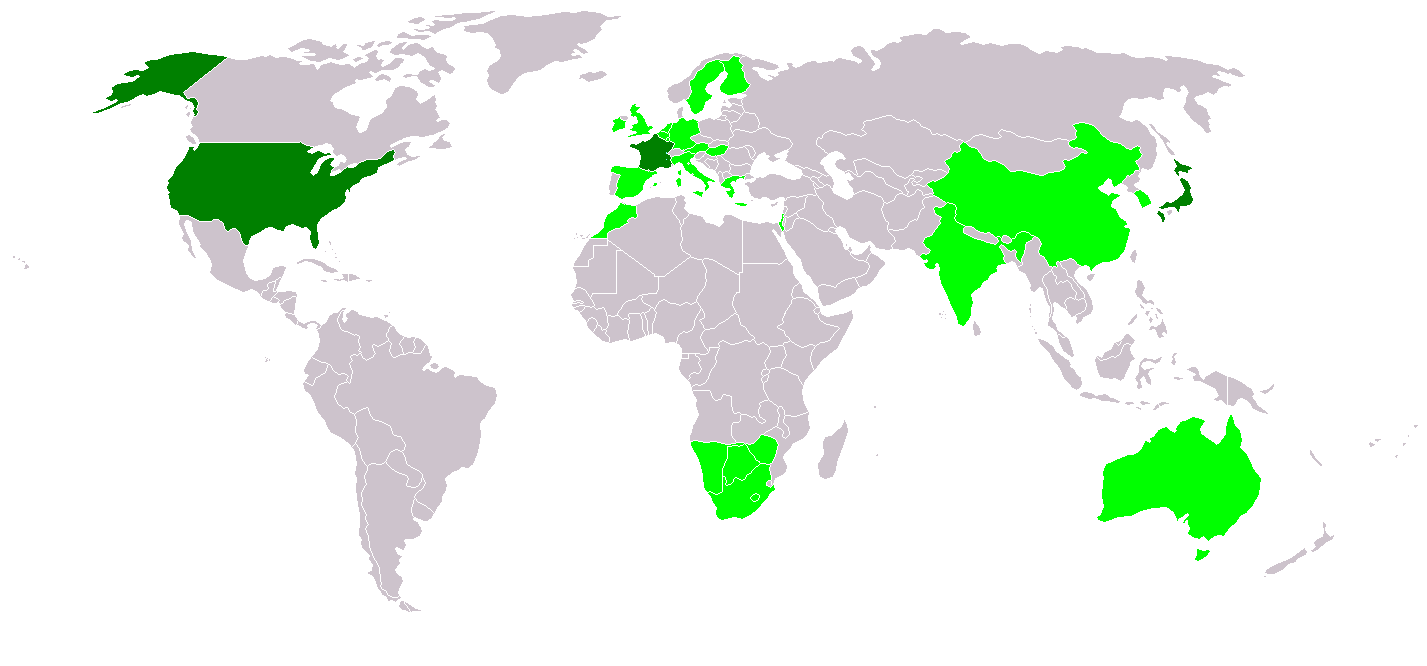
See the W3C
Offices contact list for more details.
Future Offices
W3C is already in contact with organizations in many countries for
potential new Offices in the coming years and as we're also ready to
celebrate the 10th Anniversary of the W3C Office Program in
2007. We're also thinking about the kind of expansion we want for the program
in the future, and welcome feedback.
As food for thought, here is a table showing the creation years for our
existing 17 Offices, and some potential countries or regions where we're
missing a presence.
| 1997 |
UK |
| 1998 |
Germany, Hong-Kong, Greece, Nederland, Sweden |
| 1999 |
Italy |
| 2000 |
Australia, Israel, Morocco |
| 2001 |
(working on UK+Ireland and
Germany+Austria) |
| 2002 |
Hungary, Finland, Korea |
| 2003 |
Spain |
| 2004 |
|
| 2005 |
India |
| 2006 |
China |
| 2007 |
Southern Africa |
And the criteria we're considering for expansion:
- Internationalization of W3C, being truly worldwide
- Increasing membership in the region, better participation and transfer
of knowledge from/about the region to W3C
- Raising W3C awareness in the region, through appearances, events
organized by Offices
- Regional networking, especially with governmental agencies, eGov
advocates
- Improving press contacts, local education and dissemination of our
results
- Keeping the program under control, human and scalable.
Feedback welcome, as usual.