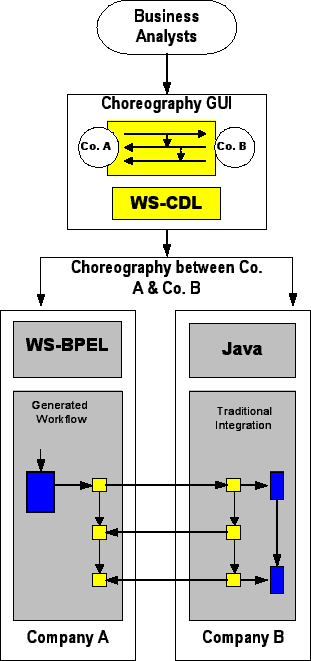
This section introduces the Web Services Choreography Description Language (WS-CDL) model.
2.3 Collaborating Parties
The WSDL specification [7]messages
A WS-CDL document describes how a party is capable of engaging in peer-to-peer
The Role Types, Participant Types, Relationship Types and Channel Types define the coupling of the collaborating parties.
2.3.1 Role Types
A Role Type enumerates the observable behavior a party exhibits in order to collaborate with other parties. For example the BuyerSupplier
The syntax of the roleType construct is:;
<roleType name="ncname">
   <behavior name="ncname" interface="qname"? />+
</roleType>
The attribute name is used for specifying a distinct name for each roleType element declared within a Choreography Package.
Within the roleType element, the behavior element specifies a subset of the observable behavior a party exhibits. A Role Type MUST contain one or more behavior elements. The attribute name within the behavior element is used for specifying a distinct name for each behavior element declared within a roleType element.
The behavior element defines an optionalinterface attribute, which identifies a WSDL interface type. A behavior without an interface describes a Role Type that is not required to support a specific Web Service interface.
2.3.2 Participant
A Participantasetofthatimplementedbythesameentityororganization.ItspurposeistogrouptogetherthepartsoftheobservablebehaviorthatMUSTbeimplementedbythesameprocess.ThesyntaxoftheparticipantTypeconstructis:;<participantTypename="ncname"><roletype="qname"/>+</participantType>TheattributenameisusedforspecifyingadistinctnameforeachparticipantTypeelementdeclaredwithinaChoreographyPackage.Anexampleisgivenbelowwherethe"SellerForBuyer"RoleTypebelongingtoa"Buyer-Seller"RelationshipTypeisimplementedbytheParticipantType"Broker"whichalsoimplementsthe"SellerForShipper"RoleTypebelongingtoa"Seller-Shipper"RelationshipType:<participantTypename="Broker"><roletype="tns:SellerForBuyer"/><roletype="tns:SellerForShipper"/></participantType>2.3.3RelationshipTypesARelationshipTypeidentifiestheRoleTypeandBehaviorswheremutualcommitmentsbetweentwopartiesMUSTbemadeforthem
A "Purchasing" Relationship Type, for the initial procurement of goods or services, and
A "Customer Management" Relationship Type to allow the Supplier to provide service and support after the goods have been purchased or the service provided
Although Relationship Types are always between two Role Types, Choreographies involving more than two Role Types are possible. For example if the purchase of goods involved a third-party Shipper contracted by the Supplier to deliver the Supplier's goods, then, in addition to the PurchasingCustomerManagement
A "Logistics Provider" Relationship Type between the Supplier and the Shipper, and
A "Goods Delivery" Relationship Type between the Buyer and the Shipper
The syntax of the relationshipType construct is:;
<relationshipType name="ncname">
   <role type="qname" behavior="list of ncname"? />
   <role type="qname" behavior="list of ncname"? />
</relationshipType>
The attribute name is used for specifying a distinct name for each relationshipType element declared within a Choreography Package.
A relationshipType element MUST have exactly two Role Types defined. Withintype attribute within the role element.
Within each role element, the optionalbehavior identifies the commitment of a party as atheTypespecifiedbythetypeattributeoftheroleelement.behavior attribute is missing then all the behaviors belonging to thespecifiedbythetypeattributeoftheroleelement
2.3.4Channel
A Channelrealizespointcollaborationbetweenpartiesspecifyingwhereandhowinformationexchanged.Additionally,Channelinformationcanbepassedamongparties.ThisallowsmodelingbothstaticanddynamicmessagedestinationswhencollaboratingwithinaChoreography.Forexample,aBuyercouldspecifyChannelinformationtousedforsendingdeliveryinformation.TheBuyercouldthensendChannelinformationto
The syntax of the participantType construct is:
<participantType name="ncname">
   <role type="qname" />+
</participantType>
The attribute name is used for specifying a distinct name for each participantType element declared within a Choreography Package.
Within the participantType element, one or more role elements identify the Role Types that MUST be implemented by this Participant Type. Each Role Type is specified by the type attribute of the role element. A specific Role Type MUST NOT be specified in more than one participantType element.
An example is given below where the "SellerForBuyer" Role Type belonging to a "Buyer-Seller" Relationship Type is implemented by the Participant Type "Broker" which also implements the "SellerForShipper" Role Type belonging to a "Seller-Shipper" Relationship Type:
<roleType name="Buyer">
   . . .
</roleType>
<roleType name="SellerForBuyer">
    <behavior name="sellerForBuyer" interface="rns:sellerForBuyerPT"/>
</roleType>
<roleType name="SellerForShipper">
    <behavior name="sellerForShipper" interface="rns:sellerForShipperPT"/>
</roleType>
<roleType name="Shipper">
   . . .
</roleType>
<relationshipType name="Buyer-Seller">
    <role type="tns:Buyer" />
    <role type="tns:SellerForBuyer" />
</relationshipType>
<relationshipType name="Seller-Shipper">
    <role type="tns:SellerForShipper" />
    <role type="tns:Shipper" />
</relationshipType>
<participantType name="Broker">
   <role type="tns:SellerForBuyer" />
   <role type="tns:SellerForShipper" />
</participantType>
2.3.4 Channel Types
A Channel realizes a point of collaboration between parties by specifying where and how information is exchanged between collaborating parties. Additionally, Channel information can be passed among parties in information exchanges. The Channels exchanged MAY be used in subsequent Interaction activities. This allows the modeling of both static and dynamic message destinations when collaborating within a Choreography. For example, a Buyer could specify Channel information to be used for sending delivery information. The Buyer could then send the Channel information to the Seller who then forwards it to the Shipper. The Shipper could then send delivery information directly to the Buyer using the Channel information originally supplied by the Buyer.
A Channel Type MUST describe the Role Type and the reference type of a party, being the target of an Interaction,send/receiveto/into
A Channel Type MAY specify the instance identity of an entity implementing the behavior(s) of a party, being the target of an Interaction.
A Channel Type MAY describe one or more logical conversations between parties, where each conversation groups a set of related message
One or more Channel(s) MAY be passed around from one Roleanother.restricttheChannelType(s)allowedtoexchangedbetween
Restrict the parties,throughType.Additionally,
Restrict the type of information exchange that can be performed when using a Channel of this Channel Type
MAYrestrictnumberoftimes
Enforce that a passed Channel is used.
The syntax of the channelType construct is:;
<channelType name="ncname"
usage="once"|"unlimited"?
action="request-respond"|"request"|"respond"? >
<passing channel="qname"
action="request-respond"|"request"|"respond"?
new="xsd:boolean"?type="qname"/>type="qname"/>+The attribute name is used for specifying a distinct name for each channelType element declared within a Choreography Package.
The optionalusage is used to restrict the number of times a Channel of this Channel Type can be used.
The optionalaction is used to restrict the type of information exchange that can be performed when using a Channel of this Channel Type. The type of information exchange performed could either be a request-respond exchange, a request exchange, or a respond exchange. The default for this attribute is set to "request".
The OPTIONAL element passing describes the Channel Type(s) of the Channel(s) that are exchangedRoleTypeanotherRoleType,TypeinanInteraction.InthecasewheretheoperationusedtoexchangetheChannelisofrequest-responsetype,thentheaction within the passing element defines if theexchangedtheortheresponse.ChannelsexchangedMAYpassing element when set to "true" enforces a passed Channel to be usedinsubsequentInteractionactivities.passing is missing then this Channel Type MAY be used for exchanging businessdocumentsandallChannelTypeswithoutrestrictions.
The element role is used to identify the Role Type of a party, being the target of an Interaction,
The element reference is used for describing the reference type of a party, being the target of an Interaction,servicename attribute of the token element within the reference element.
The optionalprocessidentity element.
The following rule applies for Channel Type:
If two or more Channel Types SHOULD point to Role Types that MUST be implemented by the same logical entity or organization, then the specified Role Types MUST belong to the same Participant Type. In additionidentity elements within the Channel Types MUST have the same number of Tokens with the same informationTypes specified in the same order
The example below shows the definition of the Channel Type RetailerChannel."tns:Retailer".addressofChannelreference element, whereas the processcanbeidentity elementforcorrelationpurposes.passingpassing allows only a Channel instancetheConsumerChannelsentovertheRetailerChannelType.;
<channelType name="RetailerChannel">
<passing channel="ConsumerChannel" action="request" />
<role type="tns:Retailer" behavior="retailerForConsumer"/>
<reference>
<token type="tns:retailerRef"/>type="tns:purchaseOrderID"/>
2.4 Information Driven Collaborations
Parties make progress within a collaboration,changes
Variables capture information about objects in the Choreography, such as the messagesobservablesTokenVariable.contain.
2.4.1 Information Types
Information types
The syntax of the informationType construct is:;
<informationType name="ncname";type="qname"?|element="qname"?
The attribute name is used for specifying a distinct name for each informationType element declared within a Choreography Package.
The OPTIONAL attributes type, and element describe the documenttobeelementrespectively.documentisthesetypesexclusively.
When the OPTIONAL attribute exceptionType is set to "true", this Information Type is an Exception Type and MAY map to a WSDL fault type. When the attribute exceptionType is set to "false", this information type MUST NOT map to a WSDL fault type. The default for this attribute is set to "false".
In case of WSDL 2.0, the attribute element within the informationType refers to a unique WSDL 2.0 faultname when the attribute exceptionType is set to "true".
The examples below show some possible usages of the informationType construct.
Example1: The informationType "purchaseOrder" refers to the WSDL 1.1 Message type "pns:purchaseOrderMessage"
   <informationType name="purchaseOrder" type="pns:purchaseOrderMessage"/>

Example2: The informationType "customerAddress" refers to the WSDL 2.0 Schema element "cns:CustomerAddress"
   <informationType name="customerAddress" element="cns:CustomerAddress"/>

Example 3: The informationType "intType" refers to the XML Schema type "xsd:int"
   <informationType name="intType" type="xsd:int"/>

Example 4: The informationType "OutOfStockExceptionType" is of type Exception Type and refers to the WSDL 2.0 fault name "cwns:OutOfStockExceptionType"
   <informationType name="OutOfStockExceptionType"
                    type="cwns:OutOfStockExceptionType" exceptionType="true"/>
2.4.2 Variables
Variables capture information about objects in a Choreography as defined by their usage:
Information Exchange Capturing Variables, which contain information such as an Orderisused
Used to Populate
Populated as a result of a message received
State Capturing Variables,ofOrder
Channel Capturing Variables. For example, a Channel Variable could contain information such asapplied,suchassecurity,
The value of Variables:
Is
Can be made available as a result of an Interaction
Information Exchange Capturing Variables are populated and become available at the Roles in
State Capturing Variables,
Can be created or changed and made available locally at a Role by assigning data from other information. They can be Information Exchange, State or Channel Capturing Variables. For example "Maximum Order Amount" could be data created by a Seller that is used together with an actual order amount from an Order received to control the ordering of the Choreography. In this case how "Maximum Order Amount" is calculated and its value would not be known by the other Roles
Can be used to determine the decisions and actions to be taken within a Choreography
Can be used to cause Exceptions at one or more parties in a Choreography
Defined at different Roles that are part of the same Participant is shared between these Roles when the Variables have the same name
The variableDefinitions construct is used for defining one or more Variables within a Choreographyblock.
The syntax of the variableDefinitions construct is:;
<variableDefinitions>
<variable name="ncname"
informationType="qname"|channelType="qname"silentAction="true|false"?roleType="qname"? TheVariablescanbeoffollowingtypes:informationType specifies either Information Exchange Capturing Variables,TheinformationType describesoftheobjectcapturedbyexceptionType set to "true". A Variable defined using the attribute channelType specifies Channel Capturing Variables. The attributeinformationType and channelType describesthetypeofthechannelobjectcapturedbytheVariable
The optional mutable,, when set to "false"describeswheninitialized,anymore.
The optionalsilent, when set to "true" specifies that there SHOULD NOT be any activity used for creating or changing this Variable in the Choreography. A silent Variable is used to represent the result of actions within a party that are either not observable or are of no interest from the WS-CDL perspective. The default value for this attribute is "false".
The OPTIONAL attribute free, when set to "true" describes
The type (as specified by the informationType or the channelType attributes) of a free Variable MUST match the type of the Variable defined in an enclosing Choreography
The attributes silent and mutable of a free Variable MUST match the attributes silent and mutable of the Variable defined in an enclosing Choreography
A perform activity MUST bind a free Variable defined in an enclosedanenclosing
whensharingtheVariablesinformationoptional free,, when set to "false" describes
The default value for the free attribute is "false".
The optionalattributesilentAction,whensetto"true"describesthatthereSHOULDNOTbeanyactivityusedforcreatingorchangingthisVariableintheChoreography,iftheseoperationsshouldnotbeobservabletootherparties.Thedefaultvalueforthisattributeis"false".TheoptionalroleTypetheTypeThefollowingrulesapplytoDefinitions:TheattributenameusedforspecifyingadistinctnameforeachvariableelementdeclaredwithinavariableDefinitionselementwhenneeded.TheVariableswithRoleTypenotspecifiedMUSThavedistinctnames.TheVariableswithRoleTypespecifiedMUSThavedistinctnames,whentheirRoleTypeisthesameAVariabledefinedwithoutaRoleTypeisequivalenttoC1Ratuple(Role1,Role2),xC1 roleType attribute means it is defined at Role1Role22.4.2.1
The attribute name is used for specifying a distinct name for each Variable declared within the variableDefinitions element. In those cases where the visibility of a Variable is wholly within a single Role then that Role needs to be named in the definition of the Variable as the Role Type using the attribute roleTypes. In those cases where the Variable is shared amongst a subset of Roles within a Choreography those Roles need to be listed within the definition of the Variable as the Role Types using the attribute roleTypes.
2.4.3 Expressions
Expressions are
Generic expressions and literals can be used for populating a Variable. Predicate expressions are
The language used in WS-CDL for specifying expressions and query or conditional predicates is XPath 1.0.
WS-CDL defines XPath function extensions as described in Section10."http://www.w3.org/2004/10/ws-chor/cdl".
2.4.3TokensATokenisanaliasforapieceofdatainaVariableormessage
There are several functions that needstobyaChoreography.TokensdifferfromVariablesthatVariablescontainvalueswhereasTokenscontaininformationthatdefinespieceof
xsd:time getCurrentTime(xsd:QName roleName)
Returns the datathatisrelevant.ForexampleaTokenfor"OrderAmount"withinanOrderXMLdocumentcouldbeanaliasanexpressionthatpointedtoOrderAmountelementwithintheOrderXMLdocument.Thiscouldthenbeusedaspartofconditionthatcontrols
xsd:date getCurrentDate(xsd:QName roleName)
Returns the orderingofaChoreography,"OrderAmount>$1000".AllTokensMUSThaveaninformationType,forexample,an"OrderAmount"wouldbeoftype"amount","OrderId"couldbealphanumericandcounteraninteger.Tokenstypesreference
xsd:dateTime getCurrentDateTime(xsd:QName roleName)
Returns the current date and time at the caller for the Role specified by roleName (for example a documentfragmentwithin
xsd:boolean hasDurationPassed(xsd:duration elapsedTime, xsd:QName roleName)
Returns "true" if, (a) used in a ChoreographydefinitionandTokenLocatorsprovidequerymechanismselectthem.Byintroducingtheseabstractions,definitionavoidsdependingonspecificmessagetypes,asdescribedWSDL,oraspecificquerystring,asXPATH,butinsteadquerystringcanchangewithoutaffectingdefinition.Thesyntax
xsd:boolean hasDeadlinePassed(xsd:dateTime deadlineTime, xsd:QName roleName)
Returns "true" if, (a) used in a guard or repetition condition of a Work Unit with the tokenconstructis:;<tokenname="ncname"informationType="qname"/>ThenameisusedforspecifyingdistinctnameforeachtokenelementdeclaredwithinPackage.TheattributeinformationTypeidentifiestypeofdocumentfragment.ThesyntaxoftokenLocatorconstructis:;<tokenLocatortokenName="qname"informationType="qname"query="XPath-expression"?/>TheattributetokenNameidentifiesname
xsd:string createNewID()
Returns a new globally unique value of XML-Schema 'string' type.
xsd:any getVariable(xsd:string varName, xsd:string part, xsd:string documentPath, xsd:QName roleName?)
Returns the Tokenthatdocumentfragmentlocatorisassociatedwith.attributeinformationTypeidentifiestypeonwhichqueryperformedtolocateToken.Theattributequerydefinesquerystringthatusedtoselectadocumentwithinadocument.examplebelowshowsthatToken"purchaseOrderID"oftypexsd:int.ThetwotokenLocatorsshowhowtoaccessthistokenin"purchaseOrder"and"purchaseOrderAck"messages.;<tokenname="purchaseOrderID"informationType="xsd:int"/><tokenLocatortokenName="tns:purchaseOrderID"informationType="purchaseOrder"query="/PO/OrderId"/><tokenLocatortokenName="tns:purchaseOrderID"informationType="purchaseOrderAck"query="/POAck/OrderId"/>2.4.4Choreographies.Theoperationalsemanticsoftheserulesarebasedoninformation-drivencomputationalmodel,whereavailabilityofvariablecausesaguardedunit-of-workanditsenclosedactionstoenabled.AChoreography.definesre-usablecommonrules,thatgovernorderingofexhangedmessagesandprovisioningpatternsofcollaborativebehavior,agreedbetweentwoormoreinteractingpeer-to-peerpartiesAChoreographydefinedat
xsd:boolean isVariableAvailable(xsd:string varName, xsd:QName roleName)
Returns "true" if the Packagelevelcalled
xsd:boolean variablesAligned(xsd:string varName, xsd:string withVarName, xsd:QName relationshipName)
Returns "true" if within a top-levelChoreography,anddoesnotshareitscontextothertop-levelChoreographies.APackageMAYcontainexactlyonetop-levelChoreography,markedexplicitlyasrootChoreography.AChoreographydefinesre-usablecommonrules,thatgovernorderingexhangedmessagesandprovisioningpatterns
xsd:any getChannelReference(xsd:string varName)
Returns the reference information of behavior,asaction(s)performing
xsd:any getChannelIdentity(xsd:string varName)
Returns the actualwork,suchasexchangemessages,whenspecifiedorderingconstraintsaresatisfied.re-usablebehaviorencapsulatedwithinaChoreographyMAYperformedwithinanenclosingChoreography,thusfacilitatingrecursivecomposition.TheperformedChoreographyisthencalledanenclosedChoreography.TheChoreography
xsd:boolean globalizedTrigger(xsd:string expression, xsd:string roleName, xsd:string expression2, xsd:string roleName2, . . .)
Combines expressions that isperformedMAYbedefinedeither:Locally-theyarecontained,inthesameChoreographydefinitionastheChoreographyperformedthemGlobally-theyspecifiedinaseparatetop-levelChoreographydefinitionthatisinthesameorinaChoreographyPackageandcanbeusedbyotherChoreographiesandhencethecontractisreusableAChoreographyMUSTcontainatleastRelationshipType,enumeratingtheobservablebehaviorthisChoreographyrequiresitspartiestoexhibit.OneormoreRelationshipTypesMAYwithinaChoreography,modelingmulti-partycollaborations.AChoreographyactsasalexicalnamescopingcontextforVariables.
xsd:boolean cdl:hasExceptionOccurred(xsd:string exceptionType)
Returns "true" if an Exception of Exception Type identified by the parameter exceptionType has occurred. Otherwise it returns "false".
2.4.4 Tokens
A VariabledefinedinaChoreographyvisibleusethisChoreographyandallitsenclosedChoreographiesup-tothepointthattheVariableisre-definedasannon-freeVariable,thusformingChoreographyVisibilityHorizonforthis.AChoreographyMAYcontainonemoreChoreographydefinitionsMAYperformedonlylocallywithinthisAChoreographyMUSTanActivity-Notation.TheActivity-NotationspecifiesenclosedactionsChoreographyperformtheactualwork.A
All Tokens MUST have an informationType, for example, an "Order Id" could be 'alphanumeric' and a "counter" an 'integer'.
Tokens reference a document fragment within a Choreography canrecoverfromexceptionalconditionsfinalizationactionsdefining:OneExceptionblock,whichMAYbedefinedofChoreographytorecoverfromexceptionalconditionsthatoccurinthatenclosingChoreographyOneFinalizerblock,whichMAYbedefinedaspartoftheChoreographytoprovidefinalizationactionsforthatenclosingTheChoreography-NotationisusedtodefineaChoreography.
The syntax is:;<choreography
<token name="ncname" complete="xsd:booleanXPath-expression"?isolation="dirty-write"|"dirty-read"|"serializable"?root="true"|"false"?><relationshiptype="qname"/>+variableDefinitions?Choreography-Notation*Activity-Notation<exceptionname="ncname">WorkUnit-Notation+</exception>?<finalizername="ncname">WorkUnit-Notation</finalizer>?</choreography>
The attribute name is used for specifying a distinct name for each choreography element declared within a Choreography Package.
The optionalcomplete allowstoexplicitlycompleteaChoreographyasdescribedbelowin identifies the ChoreographyLife-linesection.
The syntax of the tokenLocator construct is:
<tokenLocator  tokenName="qname"
               informationType="qname"
               part="ncname"?
               query="XPath-expression" />
The optionalisolation specifieswhenVariableinformation identifies the name of the Token that the document fragment locator is definedinanenclosing,andchangedwithinanenclosedChoreographyisavailabletoitssiblingChoreographies:Whenisolation
The attribute informationType identifies the type of the document on which the query is set"dirty-write",VariableinformationMAYbeimmediatelyoverwrittenbyactionsinotherChoreographiesWhenisolation
The OPTIONAL attribute part defines the document part on which the query is set"dirty-read",VariableinformationMAYimmediatelyvisibleforreadbutnotwritetootherChoreographiesWhenisolation
The attribute query defines the query string that is set"serializable",theVariableinformationMUSTbevisibleforreadforwritetootherChoreographiesonlyafterthisChoreographyhasendedsuccessfully
The relationshipelementwithinthechoreographyelementenumeratesRelationshipsthisChoreographyMAYparticipatein.optionalvariableDefinitionselementenumeratesVariables
<token name="purchaseOrderID" informationType="xsd:int"/>
<tokenLocator tokenName="tns:purchaseOrderID" informationType="purchaseOrder"
                query="/PO/OrderId"/>
<tokenLocator tokenName="tns:purchaseOrderID" informationType="purchaseOrderAck"
                query="/POAck/OrderId"/>
2.4.5 Choreographies
A Choreography defines re-usable common rules, that govern the ordering of exhanged messages and the provisioning patterns of collaborative behavior, agreed between two or more interacting parties.
A Choreography defined inthisChoreography.TheoptionalrootelementmarksofaPackage.
The optionalChoreography-NotationthechoreographyelementdefinestheChoreographiesthatonlythisChoreography.optionalexceptionelementdefines
Locally - its definition is contained within the Exceptionblockof
Globally - a separate top-level, non-root Choreography byspecifyingoneormoreExceptionWorkUnit(s).TheoptionalfinalizerelementdefinesFinalizerblockofbyspecifyingoneFinalizerWorkUnit.2.4.5WorkUnitsAWorkUnitprescribestheconstraintsmustfulfilledformakingprogressandthusperformingactualworkwithinaChoreography.ExamplesofaWorkUnitinclude:ASendPOWorkUnitthatincludesInteractionsfortheBuyertosendanOrder,theSuppliertoacknowledgetheorder,thenlateraccept(orreject)Order.ThisWorkUnitwouldprobablynothaveaguardconditionAnOrderDeliveryErrorWorkUnitthat
A non-root Choreography is performedwhenever
A Choreography MUST contain at least one Relationship Type, enumerating the PlaceOrderWorkUnitdidnotreach"normal"conclusion.Thiswouldhave
A Choreography acts as a guardconditionidentifieserror
A ChangeOrderWorkUnitcanwheneveranorderacknowledgementmessagehasbeenreceivedandanorderrejectionhasnotbeenreceived
A WorkUnitMAYprescribetheconstraintsthatpreserveconsistencycollaborationscommonlyperformedbetweenparties.UsingaWorkUnitanapplication
A Choreography can recover from exceptional conditions by defining one Exception Block, which MAY be defined as part of the Choreography to recover from faultsaretheresultofabnormalactionsandalsoMAYfinalizecompletedactions
An enclosed Choreography that has successfully completed MAY need to belogicallyrolledback.Whenenabled,aWorkUnitexpressesinterest(s)onavailabilityVariableinformationthatalreadyexistorwillcreatedinthefuture.TheWorkUnit'sinterest(s)arematchedwhenalltherequiredVariableinformationareorbecomeavailableandthespecifiedmatchingconditionontheVariableinformationismet.AvailabilityofsomeVariableinformationdoesnotmean
A Choreography can also be coordinated. Choreography Coordination guarantees that aWorkUnitmatchesimmediately.OnlywhenVariableinformationrequiredbyaWorkUnitbecomeavailable,inappropriateVisibilityHorizon,doesmatchingsucceed.VariableinformationavailablewithinaMAYbematchedwithaWorkUnitthatwillbeenabledinfuture.OnemoreWorkUnitsMAYbematchedconcurrentlyiftheirrespectiveinterestsarematched.WhenaWorkUnitmatchingsucceedsthenitsenclosedactionsareenabled.AWorkUnitMUSTcontainActivity-Notationthatperformsactualwork.AWorkUnitcompleteswhenitsenclosedactionscompletesuccessfully.AWorkUnitthatcompletessuccessfullyMUSTbeconsideredagainformatching(basedonitsguardcondition),ifitsrepetitionconditionevaluatesto"true".
The WorkUnit-Notationdefinedfollows:;<workunit
<choreography name="ncname"
guard="xsd:booleanXPath-expression"?repeat="xsd:booleanblock="true|false"?</workunit>The Activity-Notationspecifiestheenclosedactionsofname is used for specifying a WorkUnit.choreography element declared within a Choreography Package.
The guardconditionofcomplete attribute allows to explicitly complete a WorkUnit,specifiedbytheoptionalguardattribute,describestheinterestonavailabilityofoneormore,existingorfutureVariableinformation.
The optionalrepeatisolation attribute allows,whentheconditionitevaluatesto"true",makethecurrentWorkUnitconsideredagainformatching(basedontheguardattribute).optionalblockspecifieswhetherthematchingconditionrelieson
When isolation is set to "false", the Variable that
When isolation is currentlyavailable,orwhethertheWorkUnithasblockwaitingforbecomeavailableinthefutureifit
The OPTIONAL coordination attribute specifies whether Choreography Coordination is notcurrentlyavailable.
When aguardconditioncoordination attribute is notspecifiedthenWorkUnitalwaysmatches
When arepetitionconditionisnotspecifiedthen WorkUnit attribute is notconsideredagainformatchingafterWorkUnitgotmatchedonceWhenaguardconditionorrepetitionconditionspecifiedthen:OneormoreVariablescanbespecifiedinguardconditionorrepetitioncondition,usingXPATHWS-CDLfunctions,asdescribedinSection10.TheWS-CDLfunctiongetVariable()isusedinguardorrepetitionconditiontoobtain
The relationship element within the information
The OPTIONAL variableDefinitions element enumerates the Variables defined in this Choreography.
The OPTIONAL root element marks a top-level Choreography as the root Choreography of a VariableWhen
The OPTIONAL Choreography-Notation within the WS-CDLfunctionisVariableAvailable()isusedin element defines the guardorrepetitioncondition,itmeans
The OPTIONAL exceptionBlock element defines the Exception Block of a Choreography by specifying one or more Exception Work Unitthatspecifiesguardconditionname is checkingifVariableisalreadyavailableat
The OPTIONAL finalizerBlock element defines a specificRoleoriswaitingVariabletobecomeavailableatspecificRole,basedon block attribute being"false"or"true"respectivelyWhen WS-CDLfunctionvariablesAligned()isusedin element.
2.4.6 WorkUnits
A Work Unit can prescribe the guardorrepetitioncondition,itmeansthespecifiesguardorrepetitionconditionischeckingorwaitingforanappropriatealignmentInteractiontohappenbetweenthetwoRoles,basedonblockattributebeing"false"or"true"respectively.WhenvariablesAligned()WS-CDLfunctionisusedinguardorrepetitioncondition,thentheRelationshipTypewithinthevariablesAligned()MUSTbesubsettheRelationshipTypeimmediateenclosingdefines.IfVariablesareatdifferentRoles,thentheycancombinedtogetheringuardconditionorrepetitionconditionusingonlytheglobalizedTrigger()WS-CDLfunctionIfVariablesaredefinedatthesameRole,thenthey
A "Change Order" Work Unit that can be combinedtogetherinaguardconditionorrepetitionconditionusingallavailableXPATHoperators
An "Order Delivery Error" Work Unit that is performed whenever the WS-CDLfunctionsexceptglobalizedTrigger()WS-CDLfunctionWhen
The guard condition of a Work Unit, if specified, expresses the attributeblockissetto"true"andVariable(s)arenotavailable,thenUnitblockwaitingtheVariableinformationbecomeavailable.ThisattributeMUSTnotusedinException
A Work Units.WhentheVariableinformationspecifiedbytheguardconditionbecomeavailablethentheguardconditionisevaluated:Ifthe
A Work Unit that completes successfully MUST be considered again for matching (based on its guard condition), if its repetition condition evaluates to "false",thenthe
The WorkUnit-Notation is used to define a Work Unit matchingfailsandthe
<workunit name="ncname"
guard="xsd:boolean XPath-expression"?
repeat="xsd:boolean XPath-expression"?
block="true|false"? >
Activity-Notation
enclosedwithintheThe attribute name is used for specifying a name for each Work Unit isskippedand
The Activity-Notation specifies the repetitionconditionevenifspecifiedisnotevaluatedIf
The OPTIONAL attribute guard specifies the guard condition evaluatesto"true",thentheUnitismatchedandthen
The OPTIONAL attribute repeat specifies the repetition condition,ifspecified,isevaluatedwhen
The OPTIONAL attribute block specifies whether the VariableinformationspecifiedbyrepetitionIfrepetitionevaluates"true",
The following rules apply:
When a guard condition is not specified then the Work Unit isconsideredagainformatchingIfthe
One or more Work Units MAY be matched concurrently if their respective expressed interests are matched
When a repetition condition evaluatesto"false",Whentheattributeblockissetto"false",thenguardconditionorrepetition
One or more Variables can be specified in a guard condition assumesthattheVariableinformationiscurrentlyavailableIfeitherVariableinformation
The WS-CDL function getVariable is notavailableorevaluates"false",thenWorkUnitmatchingfailsand
When the Activity-NotationenclosedwithinisVariableAvailable is used in the guard or repetition condition, it means that the Work Unit isskippedandevenifspecifiednotevaluatedIfmatchingsucceeds,thentherepetitioncondition,specified,isevaluatedimmediatelyIfeithertheinformationnotcurrentlytherepetitionconditionevaluatesto"false",thentheWorkUnitisnotconsideredagainformatchingOthewise,thentheWorkUnitconsideredagainmatchingTheexamplesbelowdemonstratethepossibleuseofWorkUnit:a.ExampleofWorkUnitwithblock equalsto:In
When the WS-CDL function variablesAligned is used in the guard or repetition condition, it means that the followingUnit,waits availabilityofPOAcknowledgementatcustomerRoleandifitisalreadyavailable, attribute being "false" or "true" respectively. The Variables checked or waited for alignment are the activityhappens,otherwise,activitywaitsuntilVariablePOAcknowledgementbecomeavailablecustomerRole.;<workunitname="POProcess"guard="cdl:isVariableAvailable(cdl:getVariable("POAcknowledgement"),"tns:customer")"block="true">...<!--someactivity--></workunit>b.ExamplevariablesAligned WS-CDL function is used in a WorkUnitwithblockequalsto"false":InfollowingWorkUnit,variablesAligned MUST be the subset of the Relationship Type that the immediate enclosing Choreography defines
Variables defined at different Roles MAY be used in a guard condition checksifStockQuantityretailerisisgreaterthan10andifso,activityhappens.
If eitherVariableblock is set to "true" and one or more required Variable(s) are not available or the valueislessthan10,thematchingis"false"andactivityisskipped.;<workunitname="Stockcheck"guard="cdl:getVariable("StockQuantity","/Product/Qty","tns:retailer")>10)"block="false">...<!--someactivity--></workunit>.c.Exampleofawaitingforalignmenttohappen..InfollowingWorkUnit,waitsforanalignmentInteractionhappenbetweencustomerRoleandretailerRole:;<workunitname="WaitForAlignment"guard="cdl:variablesAligned("PurchaseOrderAtBuyer","PurchaseOrderAtSeller","customer-retailer-relationship")"block="true">...<!--someactivity--></workunit>2.4.6IncludingChoreographiesChoreographiesorfragmentsofChoreographiescanbesyntacticallyreusedinanyChoreographydefinitionbyusingXInclude[27].TheassemblyoflargeChoreographydefinitionsfrommultiplesmaller,wellformedChoreographiesorChoreographyfragmentsenabledusingthismechanism.TheexamplebelowshowsapossiblesyntacticreuseofaChoreographydefinition:;<choreographyname="newChoreography"root="true">...<variablename="newVariable"informationType="someType"role="randomRome"/><xi:includehref="genericVariableDefinitions.xml"/><xi:includehref="otherChoreography.xml"xpointer="xpointer(//choreography/variable[1])/>...</choreography>2.4.7ChoreographyLife-lineAChoreographylife-lineexpressestheprogressionofacollaboration.Initially,thecollaborationMUSTbestarted,workMAYbeperformedwithinitandfinallyMAYcomplete.ThesedifferentphasesaredesignatedexplicitlymarkedactionswithinChoreography.TherootChoreographyonlytop-levelChoreographythatMAYbeinitiated.TherootChoreographyenabledwhenitinitiated.Allnon-root,top-levelChoreographiesMAYbeenabledwhenperformed.ArootChoreography
If the attribute block is initiatedwhenfirstInteraction,markedasChoreographyinitiator,performed.TwomoreInteractionsMAYbemarkedasinitiators,indicatingalternativeinitiationactions.Inthiscase,firstactionwillinitiateChoreographyotheractionswillenlistwiththealreadyinitiatedChoreography.AnInteractiondesignatedasaChoreographyinitiatorMUSTbefirstactionperformedinaChoreography.IfaChoreographyhastwoormoreUnitswithInteractionsmarkedasinitiators,thenthesearemutuallyexclusiveChoreographywillbeinitiatedwhenthefirstInteractionoccursandremainingUnitswillbedisabled.AllInteractionsnotmarkedasinitiatorsindicatethattheywillenlistwithanalreadyinitiatedChoreography.AChoreographycompletessuccessfullytherearenomorematchedWorkUnit(s)performingworkwithinitandtherearenoenabledUnit(s)withinit.Alternatively,aChoreographysuccessfullyitscompletecondition,definedoptionalcompleteattributewithinchoreographyelement,"true"thereMUSTNOTbeanymatchedUnit(s)performingworkwithinitbutthereMAYbeoneormoreUnitsstillenabledbutmatchedyet.2.4.8ChoreographyRecoveryOneormoreExceptionWorkUnit(s)MAYbedefinedaspart
The examples below demonstrate some usages of a ChoreographytorecoverfromexceptionalconditionsthatcanoccurinthatChoreography.AFinalizerWorkUnitMAYbedefinedaspart
a. Example of a Choreographyprovide
In the finalizationactionsthatsemantically"undo"thatcompletedChoreography.2.4.8.1ExceptionBlockAChoreographycansometimesfailasaresultofanexceptionalcircumstanceorerror.Differenttypesofexceptionsarepossibleincludingthisnon-exhaustivelist:InteractionFailures,forexamplesendingamessagedidnotsucceedProtocolBasedExchangefailures,forexamplenoacknowledgementwasreceivedaspartofareliablemessagingprotocol[22]Securityfailures,forexampleaMessagewasrejectedbyarecipientbecausedigitalsignaturewasnotvalidTimeouterrors,forexampleanInteractiondidnotcompletewithinrequiredtimeValidationErrors,forexampleanXMLorderdocumentwasnotwellformedordidnotconformtoitsschemadefinitionApplication"failures",forexamplegoodsorderedwereoutofstockTohandletheseandother"errors"separateExceptionWorkUnitsMAYbedefinedinExceptionBlock
<workunit  name="POProcess"
           guard="cdl:isVariableAvailable(
                   cdl:getVariable("POAcknowledgement"), "", "", "tns:Customer")"
      block="true">
   ... <!--some activity -->
</workunit>
b. Example of a Choreography,foreach"exception"conditionthatneedstobehandled.AtleastoneExceptionMUSTbedefinedaspartoftheExceptionofaChoreographyforthepurposeofhandling
In the exceptionalconditionsoccurringonthatChoreography.Tohandlethese,anExceptionUnitMAYexpressinterestonfaultinformationusingitsguardcondition.Ifnospecified,thendefaultExceptionWorkUnitexpressesinterestonanytypeoffault.WithinExceptionBlockofaChoreographythereMUSTNOTbemoreoneExceptionWorkUnitswithoutguarddefined.AnExceptionWorkUnitMUSTsetitsattributeblockalwaystoMUSTNOTdefinearepetitioncondition.ExceptionWorkUnitsareenabledwhenChoregraphytheybelongtoenabled.AnException
<workunit  name="StockCheck"
           guard="cdl:getVariable("StockQuantity", "", "/Product/Qty",
                                  "tns:Retailer") > 10)"
           block="false" >
   ... <!--some activity -->
</workunit>
c. Example of a Work Unit MAYbeenabledonlyonce.Exception
In the following Work UnitsenabledinaChoreographyMAYbehaveasdefaultmechanismtorecoverfromfaultsallitsenclosedChoreographies.WithinExceptionBlock
<roleType name="Customer">
   . . .
</roleType>
<roleType name="Retailer">
   . . .
</roleType>
<relationshipType name="Customer-Retailer-Relationship">
    <role type="tns:Customer" />
    <role type="tns:Retailer" />
</relationshipType>
<workunit  name="WaitForAlignment"
           guard="cdl:variablesAligned(
                    "PurchaseOrderAtBuyer", "PurchaseOrderAtSeller",
                    "tns:Customer-Retailer-Relationship")"
       block="true" >
   ... <!--some activity -->
</workunit>
2.4.7 Choreography Life-line
A Choreography life-line expresses the progression of a collaboration through enabled activities and enclosed Choreographies. Initially, the collaboration is established between parties, then work is performed within it and finally it ends.
A Choreography onlyoneExceptionWorkUnitMAYbematched.Therulesformatchingfaultarefollows:IfafaultmatchedbyguardconditionofanWorkUnit,thenactionsofmatchedWorkUnitareenabledforrecoveringfromfault.Whentwo
Two or more ExceptionWorkUnitsaredefinedthenorderofevaluatingtheirguardconditionsisbasedonorderthatWorkUnitshavebeingdefinedwithinExceptionBlock.Ifnoneof
A Choreography Initiator Interaction MAY be defined within a root Choreography or within an enclosed Choreography. In either case the guardcondition(s)match,thenifthereadefault
A Choreography in an Enabled State, completes unsuccessfully, when an Exception WorkUnitwithoutaguardconditiondefinedthenactionsareenabledforrecoveringfromfaultOtherwise,fault
The unsuccessfully completed Choreography, enters the Closed State once the Exception Block, if present, is notmatchedbyanWorkUnitdefinedwithininwhichfaultoccurs,inthiscasefaultwillberecursivelyExceptionWorkUnitoftheimmediate
A Choreography untilamatchissuccessfulIfafaultoccursaChoreography,thenfaulted
Alternatively, a Choreography completes unsuccessfullyandthiscausesFinalizerWorkUnitdisabled.Theactions,includingenclosedChoreographies,enabledwithinfaultedarecompletedabnormallybeforeanExceptionWorkUnitcanbematched.actionswithintheExceptionWorkUnitMAYuseVariableinformationvisibleVisibilityHorizonitbelongstotheystandatthecurrenttime.TheactionsofanExceptionWorkUnitMAYalsocausefault.Thesemanticsformatchingthefaultandactingonitarethesameasdescribedinthissection.2.4.8.2FinalizerBlockencountersanexceptionalconditionitMAYneedtoreverttheactionsithadalreadycompleted,byprovidingfinalizationactionssemanticallyrollbacktheeffectsthecompletedactions.TohandletheseseparateFinalizerWorkUnitisdefined
A Choreography, in a Successfully Completed State, enters the Closed State if no Finalizer Blockofa
A ChoreographyMAYdefineWorkUnit.AFinalizerWorkUnitonlyaftertheChoreographyitbelongstocompletessuccessfully.WorkUnitmaybeonlyonce.TheactionswithintheFinalizerWorkUnitMAYuseVariableinformationvisibleVisibilityHorizonoftheitbelongstoastheywereatthetimecompletedorastheystandatcurrenttime.TheactionsofWorkUnitMAYfault.Thesemanticsformatchingthefaultandactingonitarethesameasdescribedintheprevioussection.2.5ActivitiesActivitiesarethelowestlevelcomponentstheChoreography,usedtodescribetheactualworkperformedspecifiedorderingconstraintssatisfied.AnActivity-Notationistheneither:AnOrderingStructurewhichcombinesActivitieswithotherOrderingStructuresinanestedwaytospecifyorderingrulesactivitieswithinthe
2.4.8 Choreography Exception Handling
A WorkUnit-NotationABasicActivityperforms
An Exception is caused in the actualwork.ABasicActivitytheneither:AnInteraction,whichresultsexchangeofmessagesbetweencauseException set to "true".
An Exception MUST be propagated to all parties andpossiblesynchronizationoftheirobservableinformationchangesandactualvaluesofexchangedinformationAPerform,whichmeansthatacomplete,separatelydefinedperformedAnAssign,whichassigns,withinoneRole,valueofoneVariablevalueofanotherVariableASilentAction,whichprovidesanexplicitdesignatorusedforspecifyingthepointwherepartyspecificoperation(s)withnon-observableoperationaldetailsMUSTperformedANoAction
Different types of errors are possible including this non-exhaustive list:
Interaction Failures, whichprovidesanexplicitdesignatorusedspecifyingpointwherepartydoesperformanyaction2.5.1OrderingStructuresAnOrderingStructureisone
Protocol Based Exchange failures, for example no acknowledgement was received as part of a reliable messaging protocol
Security failures, for example a Message was rejected by a recipient because the following:SequenceParallelChoice2.5.1.1SequenceThesequenceorderingstructurecontainsoneormoreActivity-Notations.Whenthesequenceactivityisenabled,
Timeout errors, for example an Interaction did not complete within the sequenceelementrestricts
Validation Errors, for example an XML "Order" document was not well formed or did not conform to its XML-Schema definition
Application "failures", for example the seriesenclosedActivity-Notationsto
To handle these and other "errors" separate Exception Work Units MAY be enabledsequentially,sameorderthattheyaredefined.Thesyntaxofthisconstructis:;<sequence>Activity-Notation+</sequence>2.5.1.2ParallelTheparallelorderingstructurecontainsoneormoreActivity-Notationsthatareenabledconcurrentlywhentheparallelactivityisenabled.Thesyntaxthisconstructis:;<parallel>Activity-Notation+</parallel>2.5.1.3ChoiceThechoiceorderingstructureenablesWorkUnittodefineonlyoneoftwoormoreActivity-NotationsSHOULDperformed.Whentwo
One or more activitiesarespecifiedinchoiceelement,onlyactivityisselectedandtheotheractivitiesaredisabled.IfthechoicehasUnitswithguardconditions,firstthatmatchestheselectedandotherUnitsaredisabled.Ifthechoicehasotheractivities,itassumedthattheselectioncriteriaforactivitiesarenon-observable.Thesyntaxthisconstructis:;<choice>Activity-Notation+</choice>Inexamplebelow,choiceelementhastwoInteractions,"processGoodCredit""processBadCredit".TheInteractionshave
Exception Work Units are enabled when the samedirectionality,participatewithinsameRelationshipandhavesamefromRolestoRolesnames.If
Within the Exception Block of a Choreography only one Interactionhappens,
The rules for matching an Exception are:
When an Exception Work Unit has a guard condition using the hasExceptionOccurred(exceptionType) WS-CDL function, then it is matched when an Exception Variable with Exception Type that matches the otheroneexceptionType is disabled.;<choice><interactionchannelVariable="doGoodCredit-channel"operation="doCredit">...</interaction><interactionchannelVariable="badCredit-channel"operation="doBadCredit">...</interaction><choice>2.5.2InteractingAn
If an Exception is matched by the basicbuildingblockaChoreography,whichresultsinexchangeinformationbetweenpartiesandpossiblysynchronizationobservableinformationchangesandvaluesofexchangedinformation.AnInteractionformsbaseatom
If none of the recursiveChoreographycomposition,wheremultipleInteractionsarecombinedtoformaChoreography,whichcanbeusedindifferentbusinesscontexts.AnInteractioninitiatedwhenapartyplayingtherequestingRolesendsarequestmessage,throughcommonChannel,topartyplayingtheacceptingRolethatreceivesthemessage.TheInteraction
If an Exception is continuedwhenacceptingparty,sendszerooroneresponsemessagebacktorequestingpartythatreceivesresponsemessage.ThismeansanInteractioncanoneoftwotypes:AOne-WayInteractionthatinvolvesexchangingsinglemessageARequest-ResponseInteractionwhentwomessages
If an Exception occurs within a Choreography, then the Choreography completes unsuccessfully. In this case its Finalizer Block(s) MUST NOT be installed. The actions, including enclosed Choreographies, within this Choreography are exchangedAnInteractionalsocontains"references"to:
The ChannelCapturingthatspecifiesinterfaceandotherdatathatdescribewhereandhowmessageisbesentTheOperationthatspecifieswhatrecipient
The actions of themessageshoulddowiththemessagewhenitisreceivedFromRoleToRolethatinvolvedTheInformationTypeorChannelType
2.4.9 Choreography Finalization
After a Choreography instance has successfully completed, it MAY need to provide finalization actions that isbeingexchangedTheInformationExchangeCapturingVariablesatFromRoleandRolethataresourceanddestination
If more than one Finalizer Blocks are defined for the MessageContentAlistpotentialobservableinformationchangesthatname attributes. However, at most one Finalizer Block MAY occur
Finalizer Block(s) MAY need
A single Finalizer Block to bealignedatFromRole
Two Finalizer Blocks, for example one with name "confirm" and theToRole,asresultofcarryingout
One "undo" Finalizer Block along with a "close" Finalizer Block to signal that the Interaction2.5.2.1InteractionBasedInformationAlignmentInsomeChoreographiestheremayarequirementthat,whenInteractionperformed,
The actions within the RolesChoreographyhaveagreementonoutcome.MorespecificallywithinanInteraction,aRoleMAYneedhaveacommonunderstandingofobservableinformationcreationsorchangesofoneormoreStateCapturingVariablesthatarecomplementarytooneormoreStateCapturingVariablesofitspartnerRoleAdditionally,withinanInteractionaRoleMAYneedtohaveacommonunderstandingofvaluesofInformationExchangeCapturingatthepartnerRoleWithInteractionAlignmentboththeBuyertheSellerhaveacommonunderstandingthat:StateCapturingVariables,such"OrderState",thatcontainobservableinformationBuyerandSeller,havevaluesthatarecomplementaryeachother,e.g.SentatBuyerandReceivedat
The actions of a Finalizer Work Unit MAY fault. The semantics for matching the Seller,InformationExchangeCapturingVariableshavetypeswithsamecontent,e.g.TheOrderVariablesat
2.4.10 Choreography Coordination
Choreography Coordination guarantees that all involved Roles will agree on how the BuyerandSellerhavesameInformationTypesholdsameorderinformationInWS-CDLanalignmentMUSTbeexplicitlyused,caseswheretwointeractingpartiesrequirethealignmenttheirobservableinformationchangesandtheirexchangedinformation.Afterthealignmentcompletes,bothpartiesprogressatthesametime,alock-stepfashionandVariableinformationinbothpartiesTheirVariablealignmentcomesfromthefactthattherequestingpartyhasknowacceptingpartyhasreceivedthemessageandtheotherwayaround,theacceptingpartyhastoknowtherequestingpartyhassentthemessagebeforebothofthemprogress.Therenointermediatestate,whereonepartysendsamessageandthenitproceedsindependentlyortheotherpartyreceivesamessageandthenitproceedsindependently.2.5.2.2ProtocolBasedInformationExchangesTheone-way,requestorresponsemessagesanInteractionmayalsobeimplementedusingProtocolBasedExchangewhereseriesofmessagesexchangedaccordingsomewell-knownprotocol,suchasreliablemessagingprotocols
Choreographies defined inspecificationssuchasWS-Reliability[22].Inbothcases,thesameorsimilarmessagecontentmaybeexchangedinsimpleInteraction,forexampleexchangingofanOrderbetweenBuyeraSeller.Thereforesomesameinformationchangesmayresult.Howeverwhenprotocolssuchasthereliablemessagingprotocolsareused,additionalinformationchangeswilloccur.Forexample,ifaReliableMessagingprotocolwerebeingusedthentheBuyer,onceconfirmationofdeliverymessagewasreceived,wouldalsoknowthattheSeller,s"OrderState"Variablewasinthestate"Received"eventhoughtherewasnoseparateInteractionthatdescribedthis.2.5.2.3InteractionLife-lineTheChannelthroughwhichanInteractionoccursisusedtodeterminewhethertoenlisttheInteractionwithanalreadyinitiatedChoreographyortoinitiateanewChoreography.WithinaChoreography,twoormorerelatedInteractionsMAYgroupedtoformalogicalconversation.
The ChannelthroughwhichanInteractionoccursisusedtodeterminewhethertoenlisttheInteractionwithanalreadyinitiatedconversationortoinitiateanewconversation.
An Interactioncompletesnormallywhentherequestandtheresponse(ifthereisone)completesuccessfully.casethebusinessdocumentsandChannelsexchangedduringrequesttheresponse(ifthereisone)resultintheexchangedVariableinformationbeingalignedbetweenthetwoparties.AnInteractioncompletesabnormallyfollowingfaultsoccur:Thetime-to-completetimeoutidentifiesthetimeframewithinanInteractionMUSTcomplete.Ifthistimeoutoccurs,aftertheInteractioninitiated
A root Choreography can also be coordinated, but beforecompleted,thenafaultisgeneratedAfaultsignalsexceptionconditionduring
In both cases, all Roles MUST agree on whether the managementofarequestpartywhenprocessingtherequest2.5.2.4InteractionSyntaxThesyntaxofinteractionconstructis:;<interactionname="ncname"channelVariable="qname"operation="ncname"time-to-complete="xsd:duration"?align="true"|"false"?initiate="true"|"false"?>
The two examples below show two usages of Coordinated Choreographies.
Example 1: Coordinated credit authorization without Finalizer Block(s):
<informationType name="creditDeniedType" exceptionType="true"/>
<!-- Coordinated CreditAuthorization choreography without Finalizer Block(s)-->
<choreography name="CreditAuthorization" root="false" coordination="true">
<relationship type="tns:CreditReqCreditResp"/>
<variableDefinitions>
<variable name="CreditExtended" informationType="xsd:int" silent="true"
roleTypes="tns:CreditResponder"/>
<variable name="creditRequest"/>
<variable name="creditAuthorized"/>
<variable name="creditDenied" informationType = "creditDeniedType"/>
</variableDefinitions>
<!-- the normal work - receive the request and decide whether to approve -->
<interaction name="creditAuthorization" channelVariable="tns:CreditRequestor"
operation="authorize">
<participate relationship="qname"fromRole="qname"toRole="qname"/>name="ncname"informationType="qname"?|channelType="qname"?action="request"|"respond">variable="XPath-expression"?recordReference="listofncname"?/>variable="XPath-expression"?recordReference="listofncname"?/></exchange>*<recordname="ncname"when="before"|"after"><sourcevariable="XPath-expression"/><targetvariable="XPath-expression"/></record>*ThechannelVariableattributespecifiesChannelVariablecontaininginformationofaparty,beingtargetofInteraction,whichisusedfordeterminingwhereandhowtosendreceiveinformationandintoparty.TheChannelVariableusedinInteractionMUSTbeavailableattwoRolesbeforeInteractionoccurs.Atruntime,informationaboutaChannelVariableisexpandedfurther.ThisrequiresthatmessagesinChoreographyalsocontaincorrelationinformation,forexamplebyincluding:Aprotocolheader,suchasaSOAPheader,thatspecifiescorrelationdatausedwiththeChannel,orUsingactualvalueofdatawithinamessage,forexample
2.5 Activities
Activities are the OrderNumberOrderthatiscommonallthemessagessentoverChannelInpractice,whenaChoreography
The Activity-Notation is performed,severaldifferentwaysofdoingcorrelationmaybeemployed
An Ordering Structure - which varydependingontheChannelType.Theoperationattributespecifiesaone-wayorrequest-responseoperation.Thespecifiedoperationbelongsinterface,asidentifiedbytheroleandbehaviorelementsoftheChannelTypetheChannelVariableusedintheInteractionactivity.Theoptionaltime-to-completeattributeidentifiesthetimeframewhichanInteractionMUSTcomplete.Theoptionalalignattributewhensetto"true"means
A WorkUnit-Notation
A Basic Activity that performs the actual work. A Basic Activity is then either:
An Interaction Activity, which results in thecommonunderstandingboththeexchangedtheresultingcreationsoratendsInteractionasspecifiedinthefromRoleandthetoRole.Thedefaultforthisattributeis"false".AnInteractionactivitycanbemarkedas
A Perform Activity, which means that a complete, separately defined Choreography initiatorwhentheoptionalinitiateattributeset
An Assign Activity, which assigns, within one Role, the value of one Variable to "true".Thedefault
A Silent Action Activity, which provides an explicit designator used for thisattributeis"false".Withintheparticipateelement,relationshipattributespecifies
A No Action Activity, which provides an explicit designator used for specifying the RelationshipTypethisInteractionparticipates
A Finalize Activity, which enables a particular Finalizer Block in a particular instance of an immediately enclosed Choreography and thus brings that Choreography to a defined conclusion
2.5.1 Ordering Structures
An Ordering Structure is one of the fromRoleandtoRoleattributesspecifytherequestingandtheacceptingRoleTypesrespectively.
2.5.1.1 Sequence
The RoleTypeidentifiedbythetoRoleattributeMUSTbethesameasRoleTypeidentifiedbyroleofChannelTypetheChannelVariableusedinteractionactivity.
The optionalexchangeelementallowsinformationtobeexchangedduringaone-wayrequest
<sequence>
    Activity-Notation+
</sequence>
2.5.1.2 Parallel
The parallel ordering structure contains one or arequest/responseInteraction.Withintheexchangeelement,optionalinformationTypeandchannelTypeattributes,identifytheInformationTypetheChannelType
The syntax of theinformation
<parallel>
    Activity-Notation+
</parallel>
2.5.1.3 Choice
The choice ordering structure enables specifying that isexchangedbetweenthetwoRolesinanInteraction.Ifnonetheseattributesarespecified,thenitisassumedthateithernoactualdataisexchangedthetypeofdatabeingexchangedisofnointeresttotheChoreographydefinitionWithintheexchange
When two or more activities are specified in a choice element, only one activity is selected and the attributeactionspecifiesthedirectionofinformationexchangedinInteraction:Whenactionattributesetto"request",thenmessageexchangehappensfromRoletotoRoleWhenactionattributesetto"respond",thenmessageexchangehappensfromtoRoletofromRoleWithinexchangeelement,
The syntax of this construct is:
<choice>
    Activity-Notation+
</choice>
In the sendshowsthatinformationissentfromaRolethereceiveelementshowsthatinformationisreceivedataRolerespectivelyintheInteraction:optionalVariablesspecifiedusingWS-CDLfunctiongetVariable()sendreceiveelementsMUSTbeoftypeasdescribedintheinformationTypeorchannelTypeattributesWhenactionelementissetto"request",VariablespecifiedwithinthesendelementusingthevariableattributeMUSTbedefinedat
<choice>
  <interaction name=""processGoodCredit"
       channelVariable="goodCredit-channel" operation="doCredit">
      ...
  </interaction>
  <interaction name=""processBadCredit"
       channelVariable="badCredit-channel" operation="doBadCredit">
      ...
  </interaction>
<choice>
2.5.2 Interacting
An Interaction is the fromRoleVariablespecifiedwithinreceiveelementusingvariableattributeMUSTbedefinedat
An Interaction forms the toRoleWhenactionelementisset"respond",theVariablespecifiedwithinthesendelementusingthevariableattributeMUSTbedefinedatthetoRoleandtheVariablespecifiedwithinthereceiveelementusingthevariableattributeMUSTbedefinedatfromRoleTheVariablespecifiedwithinthereceiveelementMUSTnotdefinedwiththeattributesilentActionsetto"true"Withinthesendorthereceiveelement(s)
An Interaction is initiated when one of anexchangeelement,recordReferenceattributecontainslistofreferencesrecordelement(s)sameInteractionalignattributesetto"false"fortheInteraction,itmeansthatthe:Requestexchangecompletessuccessfullyforrequestingonceithassuccessfullysenttheinformationof
An Interaction also contains "references" to:
The Channel Capturing Variable specifiedwithinsendelementRequestexchangecompletessuccessfullyfortheacceptingRoleonceithassuccessfullytheinformationoftheVariablespecifiedwithinthereceiveelementResponseexchangecompletessuccessfullyfor
onceithassuccessfullysentinformationVariablespecifiedwithinthesendelementandtheResponseexchangecompletessuccessfullyforrequestingRoleoncehassuccessfully
theinformationoftheVariablespecifiedwithinthereceiveelementIfthealignattribute
The Information Type or Channel Type that is setto"true"for
The Information Exchange Capturing Variables at the Interaction,thenitmeansInteractioncompletessuccessfullyiftheRequestResponseexchangescompletesuccessfully
A list of potential observable information changes that can occur and allreferencedrecordscompletesuccessfullyRequestexchangecompletessuccessfullyoncebothrequestinghassuccessfullysentinformationVariablespecifiedwithin
2.5.2.1 Interaction Based Information Alignment
In some Choreographies there may be a requirement that, when the sendelementandacceptingRolehassuccessfullyreceivedinformationofVariablespecifiedthereceiveelementResponseexchangecompletessuccessfullyonceboththeacceptinghassuccessfullysenttheinformationVariablespecifiedwithinthesendelementandtherequestingRolehassuccessfullyreceivedthetheVariablespecifiedwithinthereceiveelementTheoptionalelementrecordisusedtocreatechangeatsendandreceiveendsInteraction.Withinrecordelement,
For example, after an Interaction happens, both the sourcetargetelementsspecifyusingtheWS-CDLfunctiongetVariable()Variableswhose
State Capturing Variables, such as "Order State", that contain observable information isrecorded:Whenactionelementisset"request",thenrecording(s)of
Information Exchange Capturing Variables specifiedwithinsourceandtargetelementsoccurfromRoleforthesendattoRoleforreceiveWhen
In WS-CDL, an Alignment Interaction MUST be explicitly used, in the actionelementissetto"response",thenrecording(s)theVariablesspecifiedwithinthesourcetargetelementsoccuratthetoRoleforsendandfromRoleforthereceiveWithintherecordelement,thewhenattributespecifiesifarecordinghappens"before"or"after"asendorareceiveofamessageataRoleRequestorResponseexchange.Thefollowingrulesapplyforrecord:OneormorerecordelementsMAYbespecifiedandperformedatoneorboththeRoleswithinanInteractionThesourceandthetargetVariableMUSTbeofcompatibletypeThesourcetargetVariableMUSTbedefinedatthesameRoleThetargetMUSTnotbedefinedwiththeattributesilentActionsetto"true"ArecordelementMUSTNOTbespecifiedabsenceofanexchangeelementwithinanInteractionIfalignattributeisset"false"fortheInteraction,thenitmeansRolespecifiedwithinrecordelementmakesavailablecreationorchangeofVariablespecifiedwithinrecordelementimmediatelyaftersuccessfulcompletioneachrecordIfthealignattributesetto"true"fortheInteraction,meansthatBothRolesknowtheavailabilityofthecreationchangeoftheVariablesspecifiedwithintherecordelementonlyatsuccessfulcompletionoftheInteractionIftherearetwoormorerecordelementsspecifiedwithinanInteraction,allrecordoperationsMUSTcompletesuccessfullyfortheInteractto
2.5.2.2 Interaction Life-line
An Interaction completes normally when its message exchange(s) complete successfully.
Otherwise,noneoftheVariablesspecifiedin
An application signals an error condition during the targetattributewillbeaffectedTheexamplebelowshowscompleteChoreographythatinvolvesoneInteraction.
The time-to-complete timeout, identifying the timeframe within which an Interaction happensfromRoleType"Consumer"toRoleType"Retailer"onChannel"retailer-channel"
Other types of errors, such as arequest/responsemessageexchange.
2.5.2.3 Interaction Syntax
The messagepurchaseOrderissentfromConsumertoRetailerasarequestmessage
<interaction  name="ncname"
              channelVariable="qname"
              operation="ncname"
              align="true"|"false"?
              initiate="true"|"false"? >
   <participate  relationshipType="qname"
                 fromRole="qname" toRole="qname" />
   <exchange  name="ncname"
              informationType="qname"?|channelType="qname"?
              action="request"|"respond" >
     <send      variable="XPath-expression"?
                recordReference="list of ncname"?
                causeException="true"|"false"? />
     <receive   variable="XPath-expression"?
                recordReference="list of ncname"?
                causeException="true"|"false"? />
   </exchange>*
   <timeout  time-to-complete="XPath-expression"
             fromRoleRecordReference="list of ncname"?
             toRoleRecordReference="list of ncname"? />?
   <record  name="ncname"
            when="before"|"after"|"timeout"
            causeException="true"|"false"? >
     <source  variable="XPath-expression"? | expression="Xpath-expression"? />
     <target  variable="XPath-expression" />
   </record>*
</interaction>
The messagepurchaseOrderAckname is sentfromRetailertoConsumerasresponsemessageTheVariableconsumer-channelispopulatedatRetailerusingtherecord
The Interactionhappenson attribute specifies the retailer-channelwhichhasTokenTypepurchaseOrderIDusedasanidentitychannel.ThisidentityelementidentifythebusinessprocessofretailerrequestmessagepurchaseOrdercontainstheidentityoftheretailerbusinessprocessasspecifiedtokenLocatorforpurchaseOrdermessageTheresponsemessagepurchaseOrderAckcontainsidentityofconsumerbusinessprocessasspecifiedtokenLocatorpurchaseOrderAckmessageTheconsumer-channelissent
Including a protocol header, such as a part
Using the actual value of purchaseOrderInteractionfromconsumerretaileronretailer-channelduringrequest.Here
The operation attribute specifies the recordelementpopulatesconsumer-channelatretailerrole.Ifrole and behavior elements of the Channel Type of the Channel Variable used in this Interaction.
The OPTIONAL align attribute wasforthisInteraction,thenitalsoconsumerknowsthatretailernowhascontactconsumer.Inanotherexample,consumercouldsetitsVariable"OrderSent"to"true"retailerwould
An Interaction activity can be marked as a Choreography Initiator when the OPTIONAL initiate attribute is set itsVariable"OrderReceived""true"using
Within the participate element, the recordelement.;<packagename="ConsumerRetailerChoreography"version="1.0"<informationTypename="purchaseOrderType"type="pons:PurchaseOrderMsg"/><informationTypename="purchaseOrderAckType"type="pons:PurchaseOrderAckMsg"/><tokenname="purchaseOrderID"informationType="tns:intType"/><tokenname="retailerRef"informationType="tns:uriType"/><tokenLocatortokenName="tns:purchaseOrderID"informationType="tns:purchaseOrderType"query="/PO/orderId"/><tokenLocatortokenName="tns:purchaseOrderID"informationType="tns:purchaseOrderAckType"query="/PO/orderId"/><roleTypename="Consumer"><behaviorname="consumerForRetailer"interface="cns:ConsumerRetailerPT"/><behaviorname="consumerForWarehouse"interface="cns:ConsumerWarehousePT"/></roleType><roleTypename="Retailer"><behaviorname="retailerForConsumer"interface="rns:RetailerConsumerPT"/></roleType><relationshipTypename="ConsumerRetailerRelationship"><roletype="tns:Consumer"behavior="consumerForRetailer"/><roletype="tns:Retailer"behavior="retailerForConsumer"/></ ><channelTypename="ConsumerChannel"><roletype="tns:Consumer"/><reference><tokentype="tns:consumerRef"/></reference><identity><tokentype="tns:purchaseOrderID"/></identity></channelType><channelTypename="RetailerChannel"><passingchannel="ConsumerChannel"action="request"/><roletype="tns:Retailer"behavior="retailerForConsumer"/><reference><tokentype="tns:retailerRef"/></reference><identity><tokentype="tns:purchaseOrderID"/></identity></channelType><choreographyname="ConsumerRetailerChoreography"root="true"><relationshiptype="tns:ConsumerRetailerRelationship"/><variableDefinitions><variablename="purchaseOrder"informationType="tns:purchaseOrderType"silentAction="true"/><variablename="purchaseOrderAck"informationType="tns:purchaseOrderAckType"/><variablename="retailer-channel"channelType="tns:RetailerChannel"/><variablename="consumer-channel"channelType="tns:ConsumerChannel"/><interactionchannelVariable="tns:retailer-channel"operation="handlePurchaseOrder"align="true"initiate="true"><participaterelationship="tns:ConsumerRetailerRelationship"fromRole="tns:Consumer"toRole="tns:Retailer"/><exchangeinformationType="tns:purchaseOrderType"action="request"><sendvariable="cdl:getVariable("tns:purchaseOrder")"/><receivevariable="cdl:getVariable("tns:purchaseOrder")"recordReference="populateChannel"/></exchange><exchangeinformationType="purchaseOrderAckType"action="respond"><sendvariable="cdl:getVariable("tns:purchaseOrderAck")"/><receivevariable="cdl:getVariable("tns:purchaseOrderAck")"/></exchange><recordname="populateChannel"when="after"><sourcevariable="cdl:getVariable("tns:purchaseOrder,"PO/CustomerRef")"/><targetvariable="cdl:getVariable("tns:consumer-channel")"/></record></interaction></choreography></package>2.5.3ComposingChoreographiesTheperformactivityrealizes"compositionofChoreographies",whereascombiningexistingChoreographiesresultsthecreationofnewChoreographies.ForexampleiftwoseparateChoreographiesweredefinedasfollows:ARequestforQuote(RFQ)ChoreographythatinvolvesaBuyerRolesendingarequestforaquotationforgoodsservicestoaSupplierRoletowhich SupplierRolerespondswitheithera"Quotation"ora"DeclinetoQuote"message, and AnOrderPlacementChoreographywhere attributes specify the BuyerRoleplacesandorderforgoodsorservicesSuppliereitheracceptstheorderorrejectsitYoucouldthencreateanew"QuoteandOrder"Choreographyreusing twowhere attribute MUST be the RFQChoreographywasperformedfirst,andthen,dependingonoutcomerole element of the RFQChoreography,orderwasplacedusingtheOrderPlacementChoreography.InthiscasethenewChoreographyis"composed"outoftwopreviouslydefinedChoreographies.Usingthisapproach,Choreographiescanberecursivelycombined
The OPTIONAL exchange element allows information to supportChoreographiesofanyrequiredcomplexityallowingmoreflexibilityasChoreographiesdefinedelsewherecanreused.performactivityenablesaChoreographytospecifythatanotherChoreographyname is performedat pointinitsdefinition,asanenclosedChoreography.Thesyntaxoftheperformconstructis:;<performchoreographyName="qname"><bindname="ncname"><thisvariable="XPath-expression"role="qname"/><freevariable="XPath-expression"role="qname"/></bind>*</perform> element.
Within the performelement element, the choreographyNameattributereferencesaLocallyinformationType and channelType identify the Information Type or GloballydefinedChoreographytobeperformed.TheperformedChoreographyevenwhendefinedinadifferentChoreographyPackageconceptuallytreatedasanenclosedChoreography.AnenclosingChoreographyMAYperformonlyimmediatelycontainedChoreographyinformationType and channelType are mutually exclusive. If none of these attributes are specified, then it is assumed that either no actual information is Locallydefined.TheoptionalbindelementwithinperformelementenablesintheperformingChoreographybesharedwithperformedandviceversa.TheroleattributealiasestheRolesfrom
Within the performingChoreographyto element, the performedChoreography.Thevariable withinthiselement specifies thataVariableinperformingChoreographyisboundwithVariableidentifiedbyvariableattributewithinthefreeelementperformedChoreography.ThefollowingrulesapplywhenaChoreography
When the action attribute is performed:TheChoreographybeperformedMUSTNOTbearootChoreographyTheChoreographybeperformedMUSTbedefinedeitherusingaChoreography-Notationimmediatelycontainedin
When the sameChoreographyoritMUSTbeatop-levelChoreographywithroot attribute is set to "false"insameordifferentChoreographyPackage.PerformedChoreographies
Within the exchange element, the send element shows that aredeclaredindifferentChoreographyPackageMUSTbeincludedfirstTheTypeswithinasinglebindreceive element MUSTbecarriedoutbysameparty,hencethey
The send and the receive elements MUST belongtosameParticipantTypegetVariable within the variable attribute
The free bindelement and receive elements MUST have attributefree or channelType attributes
When the action element is set to "true"intheirdefinitionThereMUSTnotbeacyclicdependencyonChoreographiesperformed.ForexampleChoreographyC1isperformingChoreographyC2whichisperformingChoreographyC1againTheexamplebelowshowsaChoreographycomposition,whereaChoreography"PurchaseChoreography"isperforming Globally element using the variable attribute MUST be defined Choreography"RetailerWarehouseChoreography"aliases"purchaseOrderAtRetailer"to Variable"purchaseOrder" element using the variable attribute MUST be defined at the performedChoreography"RetailerWarehouseChoreography".Oncealiased,theVariable"purchaseOrderAtRetailer"extendsto
When the enclosedChoreographyandthustheseVariablescanbeusedinterchangeablyforsharingtheirinformation.;<choreographyname="PurchaseChoreography">...<variableDefinitions><variablename="purchaseOrderAtRetailer"informationType="purchaseOrder"role="tns:Retailer"/></variableDefinitions>...<performchoreographyName="RetailerWarehouseChoreography"><bindname="aliasRetailer"><thisvariable="cdl:getVariable("tns:purchaseOrderAtRetailer")"role="tns:Retailer"/><freevariable="cdl:getVariable("tns:purchaseOrder")"role="tns:Retailer"/></bind></perform>...</choreography><choreographyname="RetailerWarehouseChoreography"><variableDefinitions><variablename="purchaseOrder"informationType="purchaseOrder"role="tns:Retailer"free="true"/></variableDefinitions>...</choreography>2.5.4AssigningVariablesTheAssignactivity element is usedcreateorchangeandmakeavailablewithinoneRole,valueofonesend element using the valueofanotherVariable.Theassignmentsmayinclude:AssigninganInformationCapturingVariabletoanotherorapartofthatVariabletoaStateCapturingVariableoranotherInformationCapturingVariablesothatamessagereceivedcan attribute MUST be usedtotrigger/constrain,usingaWorkUnitguardcondition,orotherInteractionsAssigningaStateCapturingVariabletoanotherStateCapturingVariableortoanInformationCapturingVariablelocallyaRoleThesyntaxofassignconstructis:;<assignrole="qname"><copyname="ncname"><sourcevariable="XPath-expression"/><targetvariable="XPath-expression"/></copy>+</assign>TheassignconstructcreatesorchangesataRoledefinedbytarget Variable attribute MUST be defined bythesourceelementthesameRole.Thefollowingrulesapplytoassignment:
The sourceandthetargetMUSTbeofcompatibletypeThesourceand targetVariable element MUST not be defined atsameRoleIftherearetwosilent set to "true"
Within the send or morecopyelementsspecifiedwithinreceive element(s) of an assign,thenallcopyoperationsMUSTcompletesuccessfullyfor element, the assigntocompletesuccessfully.Otherwise,none attribute contains an XML-Schema list of theVariablesspecifiedrecord element(s) in the targetattributewillbeaffectedfollowingexampleassignsthecustomeraddresspartfromVariable"PurchaseOrderMsg"toVariable"CustomerAddress".;<assignrole="tns:retailer"><copyname="copyChannel"><sourcevariable="cdl:getVariable("PurchaseOrderMsg","/PO/CustomerAddress")"/><targetvariable="cdl:getVariable("CustomerAddress")"/></copy></assign>2.5.5MarkingSilentActionsSilentactionsareexplicitdesignatorsusedformarkingthepointswherepartyspecificoperationswithnon-observableoperationaldetailsrecord element MAY be performed.Forexample,send or the mechanismforchecking element(s) within the inventoryofawarehouseshouldnotbeobservabletootherpartiesbut
Within the factthat or the inventoryleveldoesinfluenceexchange element, the globalobservablebehaviorwithabuyerpartyneeds attribute when set to "true", specifies that an Exception MUST be specifiedinChoreographydefinition.ThesyntaxinformationType of the silentactionconstructis:;<silentActionrole="qname?/> element MUST be of Exception Type. The optionalroleused
The request exchange MUST NOT have causeException attribute set to specifythepartyatwhichthesilentactionwill
When two or more respond exchanges are specified, one respond exchange MAY be performed.IfasilentactionisdefinedwithoutaRole,itimpliedthat
If the action attribute is performedatallRolesarepartof
Request exchange completes successfully for the RelationshipsChoreographythisactivityisenclosedwithin.2.5.6MarkingAbsenceofActionsNoactionsareexplicitdesignatorsusedmarkingpointswhereapartydoesnotperformanyaction.Thesyntaxnoactionconstructis:;<noActionrole="qname?/>Theoptionalattributeroleisusedtospecifypartyatwhichnoactionwillbeperformed.IfanoActionisdefinedwithoutaRole,itisimpliedthatnoactionwillbeperformedatanyof
Response exchange completes successfully for the RolesthatarepartofRelationshipsChoreographythisactivityisenclosedwithin.3ExampleTobecompleted4RelationshipwithSecurityframeworkBecausemessagescanhaveconsequencesinrealworld,collaborationpartieswillimposesecurityrequirementsonmessageexchanges.ManytheserequirementscanbesatisfiedbyuseofWS-Security[24].5RelationshipwithReliableMessagingframeworkTheWS-Reliabilityspecification[22]providesareliablemechanismtoexchangebusinessdocumentsamongcollaboratingparties.TheWS-Reliabilityspecificationprescribes
If the formats attribute is set to "true" for allmessagesexchangedwithoutplacinganyrestrictionsoncontentofencapsulatedbusinessdocuments.TheWS-Reliabilityspecificationsupportsone-wayrequest/responsemessageexchangepatterns,overvarioustransportprotocols(examplesareHTTP/S,FTP,SMTP,etc.).TheWS-Reliabilityspecificationsupportssequencingofmessagesguaranteed,exactlyoncedelivery.
A violationofanyoftheseconsistencyguaranteesresultsinanerrorcondition,reflectedintheChoreographyasanInteractionfault.6RelationshipwiththeTransaction/CoordinationframeworkInWS-CDL,twopartiesmakeprogressbyinteracting.IncaseswheretwointeractingpartiesrequirealignmentoftheirVariablescapturingobservablechangesortheirexchangedinformationbetweenthem,analignmentInteractionismodeledinaChoreography.AfterthealignmentInteractioncompletes,bothpartiesprogressatsametime,inalock-stepfashion.Theinformationalignmentcomesfromthefactthatrequestingpartyhastoknowthatpartymessageandotherwayaround,receive element
A Response exchange completes successfully once both the accepting partytoknowthatpartysentmessagebeforeboththemprogress.Thereisnointermediatestate,whereonepartysendsamessageandthenreceive element
Within the OPTIONAL timeout element, the time-to-complete attribute identifies the timeframe within which an Interaction MUST complete after it proceedsindependentlyotherpartyreceivesamessageandthenitproceedsindependently.ImplementingthistypeofhandshakinginadistributedsystemrequiressupportfromaTransaction/Coordinationprotocol,whereagreementtime-to-complete SHOULD be of XML-Schema duration type when conveying the outcomeamongpartiescanreachedeveninthecasefailuresandlossfromRoleRecordReference attribute contains an XML-Schema list of messages.7AcknowledgmentsTobecompleted8References[1]S.Bradner,"Keywordsforuserecord element(s) in RFCstoRoleRecordReference attribute contains an XML-Schema list of references to IndicateRequirementLevels",RFC2119,HarvardUniversity,March1997[2]T.Berners-Lee,R.Fielding,L.Masinter,"UniformResourceIdentifiers(URI):GenericSyntax",RFC2396,MIT/LCS,U.C.Irvine,XeroxCorporation,August1998.[3]http://www.w3.org/TR/html401/interact/forms.html#submit-format[4]http://www.w3.org/TR/html401/appendix/notes.html#ampersands-in-uris[5]http://www.w3.org/TR/html401/interact/forms.html#h-17.13.4[6]SOAPVersion1.2"http://www.w3.org/TR/2003/REC-soap12-part1-20030624/"[7]WebServicesDefinitionLanguage(WSDL)2.0"http://www.w3.org/TR/2004/WD-wsdl20-20040803/"[8]IndustryInitiative"UniversalDescription,DiscoveryandIntegration"[9]W3CRecommendation"TheXMLSpecification"[10]XML-Namespaces"Namespaces element(s) in XML,TimBrayetal.,eds.,W3C,January1999"http://www.w3.org/TR/REC-xml-names[11]W3CWorkingDraft"XMLSchemaPart1:Structures".This
The OPTIONAL element record is workinprogress.[12]W3CWorkingDraft"XMLSchemaPart2:Datatypes".Thisname is workinprogress.[13]W3CRecommendation"XMLPathLanguage(XPath)Version1.0"[14]"UniformResourceIdentifiers(URI):GenericSyntax,"RFC2396,T.Berners-Lee,R.Fielding,L.Masinter,MIT/LCS,U.C.Irvine,XeroxCorporation,August1998.[15]WSCI:WebServicesChoreographyInterface1.0,A.Arkinet.al[16]XLANG:WebServicesBusinessProcessDesign,S.Thatte,2001MicrosoftCorporation[17]WSFL:WebServiceFlowLanguage1.0,F.Leymann,2001IBMCorporation[18]OASISWorkingDraft"BPEL:BusinessProcessExecutionLanguage2.0".Thisisworkinprogress.[19]BPMI.org"BPML:BusinessProcessModelingLanguage1.0"[20]WorkflowManagementCoalition"XPDL:XMLProcessingDescriptionLanguage1.0",M.Marin,R.NorinR.Shapiro[21]OASISWorkingDraft"WS-CAF:WebServicesContext,Coordinationrecord element within an Interaction. Within the record element, the source and TransactionFramework1.0".Thisisworkinprogress.[22]OASISWorkingDraft"WebServicesReliability1.0".This elements specify these recordings of information happening at the send and receive ends of the Interaction:
When the action element is workinprogress.[23]TheJavaLanguageSpecification[24]OASIS"WebServicesSecurity"[25]J2EE:Java2Platform,EnterpriseEdition,SunMicrosystems[26]ECMA.2001.StandardECMA-334:C#LanguageSpecification[27]"XMLInclusions(XInclude)Version1.0"http://www.w3.org/TR/xinclude/9WS-CDLXSDSchemas<?xmlversion="1.0"encoding="UTF-8"?><schematargetNamespace="http://www.w3.org/2004/10/ws-chor/cdl/"xmlns="http://www.w3.org/2001/XMLSchema"xmlns:cdl="http://www.w3.org/2004/10/ws-chor/cdl/"elementFormDefault="qualified"><complexTypename="tExtensibleElements"><annotation><documentation>Thistypesource and the target elements occur at the fromRole for the send and at the toRole for the receive
When the action element is extendedbyotherCDLcomponenttypesallowtarget elements occur at the toRole for the send and attributesfromothernamespaces
Within the record element, the when attribute specifies if a recording happens before or after a send or "before" or "after" a receive of a message at a Role in a Request or a Response exchange or when a timeout has expired. When the when attribute is set to beadded.Thistypealsocontains optionaldescription element thatisappliedallCDLconstructs.</documentation></annotation><sequence><elementname="description"minOccurs="0"><complexTypemixed="true"><sequenceminOccurs="0"maxOccurs="unbounded"><anyprocessContents="lax"/></sequence></complexType></element><anynamespace="##other"processContents="lax"minOccurs="0"maxOccurs="unbounded"/></sequence><anyAttributenamespace="##other"processContents="lax"/></complexType><elementname="package"type="cdl:tPackage"/><complexTypename="tPackage"><complexContent><extensionbase="cdl:tExtensibleElements"><sequence><elementname="informationType"type="cdl:tInformationType"minOccurs="0"maxOccurs="unbounded"/><elementname="token"type="cdl:tToken"minOccurs="0"maxOccurs="unbounded"/><elementname="tokenLocator"type="cdl:tTokenLocator"minOccurs="0"maxOccurs="unbounded"/><elementname="roleType"type="cdl:tRole"minOccurs="0"maxOccurs="unbounded"/><elementname="relationshipType"type="cdl:tRelationship"minOccurs="0"maxOccurs="unbounded"/><elementname="participantType"type="cdl:tParticipant"minOccurs="0"maxOccurs="unbounded"/><elementname="channelType"type="cdl:tChannelType"minOccurs="0"maxOccurs="unbounded"/><elementname="choreography"type="cdl:tChoreography"minOccurs="0"maxOccurs="unbounded"/></sequence><attributename="name"type="NCName"use="required"/><attributename="author"type="string"use="optional"/><attributename="version"type="string"use="required"/><attributename="targetNamespace"type="anyURI"use="required"/></extension></complexContent></complexType><complexTypename="tInformationType"><complexContent><extensionbase="cdl:tExtensibleElements"><attributename="name"type="NCName"use="required"/><attributename="type"type="QName"use="optional"/><attributename="element"type="QName"use="optional"/></extension></complexContent></complexType><complexTypename="tToken"><complexContent><extensionbase="cdl:tExtensibleElements"><attributename="name"type="NCName"use="required"/><attributename="informationType"type="QName"use="required"/></extension></complexContent></complexType><complexTypename="tTokenLocator"><complexContent><extensionbase="cdl:tExtensibleElements"><attributename="tokenName"type="QName"use="required"/><attributename="informationType"type="QName"use="required"/><attributename="query"type="cdl:tXPath-expr"use="optional"/></extension></complexContent></complexType><complexTypename="tRoleType"><complexContent><extensionbase="cdl:tExtensibleElements"><sequence><elementname="behavior"type="cdl:tBehavior"maxOccurs="unbounded"/></sequence><attributename="name"type="NCName"use="required"/></extension></complexContent></complexType><complexTypename="tBehavior"><complexContent><extensionbase="cdl:tExtensibleElements"><attributename="name"type="NCName"use="required"/><attributename="interface"type="QName"use="optional"/></extension></complexContent></complexType><complexTypename="tRelationshipType"><complexContent><extensionbase="cdl:tExtensibleElements"><sequence><elementname="role"type="cdl:tRoleRef"minOccurs="2"maxOccurs="2"/></sequence><attributename="name"type="NCName"use="required"/></extension></complexContent></complexType><complexTypename="tRoleRef"><complexContent><extensionbase="cdl:tExtensibleElements"><attributename="type"type="QName"use="required"/><attributename="behavior"use="optional"><simpleType><listitemType="NCName"/></simpleType></attribute></extension></complexContent></complexType><complexTypename="tParticipantType"><complexContent><extensionbase="cdl:tExtensibleElements"><sequence><elementname="role"type="cdl:tRoleRef2"maxOccurs="unbounded"/></sequence><attributename="name"type="NCName"use="required"/></extension></complexContent></complexType><complexTypename="tRoleRef2"><complexContent><extensionbase="cdl:tExtensibleElements"><attributename="type"type="QName"use="required"/></extension></complexContent></complexType><complexTypename="tChannelType"><complexContent><extensionbase="cdl:tExtensibleElements"><sequence><elementname="passing"type="cdl:tPassing"minOccurs="0"maxOccurs="unbounded"/><elementname="role"type="cdl:tRoleRef3"/><elementname="reference"type="cdl:tReference"/><elementname="identity"type="cdl:tIdentity"minOccurs="0"maxOccurs="1"/></sequence><attributename="name"type="NCName"use="required"/><attributename="usage"type="cdl:tUsage"use="optional"default="unlimited"/><attributename="action"type="cdl:tAction"use="optional"default="request-respond"/></extension></complexContent></complexType><complexTypename="tRoleRef3"><complexContent><extensionbase="cdl:tExtensibleElements"><attributename="type"type="QName"use="required"/><attributename="behavior"type="NCName"use="optional"/></extension></complexContent></complexType><complexTypename="tPassing"><complexContent><extensionbase="cdl:tExtensibleElements"><attributename="channel"type="QName"use="required"/><attributename="action"type="cdl:tAction"use="optional"default="request-respond"/><attributename="new"type="boolean"use="optional"default="true"/></extension></complexContent></complexType><complexTypename="tReference"><complexContent><extensionbase="cdl:tExtensibleElements"><sequence><elementname="token"type="cdl:tTokenReference"minOccurs="1"maxOccurs="1"/></sequence></extension></complexContent></complexType><complexTypename="tTokenReference"><complexContent><extensionbase="cdl:tExtensibleElements"><attributename="name"type="QName"use="required"/></extension></complexContent></complexType><complexTypename="tIdentity"><complexContent><extensionbase="cdl:tExtensibleElements"><sequence><elementname="token"type="cdl:tTokenReference"minOccurs="1"maxOccurs="unbounded"/></sequence></extension></complexContent></complexType><complexTypename="tChoreography"><complexContent><extensionbase="cdl:tExtensibleElements"><sequence><elementname="relationship"type="cdl:tRelationshipRef"maxOccurs="unbounded"/><elementname="variableDefinitions"type="cdl:tVariableDefinitions"minOccurs="0"/><elementname="choreography"type="cdl:tChoreography"minOccurs="0"maxOccurs="unbounded"/><groupref="cdl:activity"/><elementname="exception"type="cdl:tException"minOccurs="0"/><elementname="finalizer"type="cdl:tFinalizer"minOccurs="0"/></sequence><attributename="name"type="NCName"use="required"/><attributename="complete"type="cdl:tBoolean-expr"use="optional"/><attributename="isolation"type="cdl:tIsolation"use="optional"default="dirty-write"/><attributename="root"type="boolean"use="optional"default="false"/></extension></complexContent></complexType><complexTypename="tRelationshipRef"><complexContent><extensionbase="cdl:tExtensibleElements"><attributename="type"type="QName"use="required"/></extension></complexContent></complexType><complexTypename="tVariableDefinitions"><complexContent><extensionbase="cdl:tExtensibleElements"><sequence><elementname="variable"type="cdl:tVariable"maxOccurs="unbounded"/></sequence></extension></complexContent></complexType><complexTypename="tVariable"><complexContent><extensionbase="cdl:tExtensibleElements"><attributename="name"type="NCName"use="required"/><attributename="informationType"type="QName"use="optional"/><attributename="channelType"type="QName"use="optional"/><attributename="mutable"type="boolean"use="optional"default="true"/><attributename="free"type="boolean"use="optional"default="false"/><attributename="silentAction"type="boolean"use="optional"default="false"/><attributename="role"type="QName"use="optional"/></extension></complexContent></complexType><groupname="activity"><choice><elementname="sequence"type="cdl:tSequence"/><elementname="parallel"type="cdl:tParallel"/><elementname="choice"type="cdl:tChoice"/><elementname="workunit"type="cdl:tWorkunit"/><elementname="interaction"type="cdl:tInteraction"/><elementname="perform"type="cdl:tPerform"/><elementname="assign"type="cdl:tAssign"/><elementname="silentAction"type="cdl:tSilentAction"/><elementname="noAction"type="cdl:tNoAction"/></choice></group><complexTypename="tSequence"><complexContent><extensionbase="cdl:tExtensibleElements"><sequence><groupref="cdl:activity"maxOccurs="unbounded"/></sequence></extension></complexContent></complexType><complexTypename="tParallel"><complexContent><extensionbase="cdl:tExtensibleElements"><sequence><groupref="cdl:activity"maxOccurs="unbounded"/></sequence></extension></complexContent></complexType><complexTypename="tChoice"><complexContent><extensionbase="cdl:tExtensibleElements"><sequence><groupref="cdl:activity"maxOccurs="unbounded"/></sequence></extension></complexContent></complexType><complexTypename="tWorkunit"><complexContent><extensionbase="cdl:tExtensibleElements"><sequence><groupref="cdl:activity"/></sequence><attributename="name"type="NCName"use="required"/><attributename="guard"type="cdl:tBoolean-expr"use="optional"/><attributename="repeat"type="cdl:tBoolean-expr"use="optional"/><attributename="block"type="boolean"use="optional"default="false"/></extension></complexContent></complexType><complexTypename="tPerform"><complexContent><extensionbase="cdl:tExtensibleElements"><sequence><elementname="bind"type="cdl:tBind"minOccurs="0"maxOccurs="unbounded"/></sequence><attributename="choreographyName"type="QName"use="required"/></extension></complexContent></complexType><complexTypename="tBind"><complexContent><extensionbase="cdl:tExtensibleElements"><sequence><elementname="this"type="cdl:tBindVariable"/><elementname="free"type="cdl:tBindVariable"/></sequence></extension></complexContent></complexType><complexTypename="tBindVariable"><complexContent><extensionbase="cdl:tExtensibleElements"><attributename="variable"type="cdl:tXPath-expr"use="required"/><attributename="role"type="QName"use="required"/></extension></complexContent></complexType><complexTypename="tInteraction"><complexContent><extensionbase="cdl:tExtensibleElements"><sequence><elementname="participate"type="cdl:tParticipate"/><elementname="exchange"type="cdl:tExchange"minOccurs="0"maxOccurs="unbounded"/><elementname="record"type="cdl:tRecord"minOccurs="0"maxOccurs="unbounded"/></sequence><attributename="name"type="NCName"use="required"/><attributename="channelVariable"type="QName"use="required"/><attributename="operation"type="NCName"use="required"/><attributename="time-to-complete"type="duration"use="optional"/><attributename="align"type="boolean"use="optional"default="false"/><attributename="initiate"type="boolean"use="optional"default="false"/></extension></complexContent></complexType><complexTypename="tParticipate"><complexContent><extensionbase="cdl:tExtensibleElements"><attributename="relationship"type="QName"use="required"/><attributename="fromRole"type="QName"use="required"/><attributename="toRole"type="QName"use="required"/></extension></complexContent></complexType><complexTypename="tExchange"><complexContent><extensionbase="cdl:tExtensibleElements"><sequence><elementname="send"type="cdl:tVariableRecordRef"/><elementname="receive"type="cdl:tVariableRecordRef"/></sequence><attributename="name"type="string"use="optional"/><attributename="informationType"type="QName"use="optional"/><attributename="channelType"type="QName"use="optional"/><attributename="action"type="cdl:tAction2"use="required"/></extension></complexContent></complexType><complexTypename="tVariableRecordRef"><complexContent><extensionbase="cdl:tExtensibleElements"><attributename="variable"type="cdl:tXPath-expr"use="optional"/><attributename="recordReference"use="optional"><simpleType><listitemType="NCName"/></simpleType></attribute></extension></complexContent></complexType><complexTypename="tVariableRef"><complexContent><extensionbase="cdl:tExtensibleElements"><attributename="variable"type="cdl:tXPath-expr"use="required"/></extension></complexContent></complexType><complexTypename="tRecord"><complexContent><extensionbase="cdl:tExtensibleElements"><sequence><elementname="source"type="cdl:tVariableRef"/><elementname="target"type="cdl:tVariableRef"/></sequence><attributename="name"type="string"use="optional"/><attributename="when"type="string"use="required"/></extension></complexContent></complexType><complexTypename="tAssign"><complexContent><extensionbase="cdl:tExtensibleElements"><sequence><elementname="copy"type="cdl:tCopy"maxOccurs="unbounded"/></sequence><attributename="role"type="QName"use="required"/></extension></complexContent></complexType><complexTypename="tCopy"><complexContent><extensionbase="cdl:tExtensibleElements"><sequence><elementname="source"type="cdl:tVariableRef"/><elementname="target"type="cdl:tVariableRef"/></sequence><attributename="name"type="NCName"use="required"/></extension></complexContent></complexType><complexTypename="tSilentAction"><complexContent><extensionbase="cdl:tExtensibleElements"><attributename="role"type="QName"use="optional"/></extension></complexContent></complexType><complexTypename="tNoAction"><complexContent><extensionbase="cdl:tExtensibleElements"><attributename="role"type="QName"use="optional"/></extension></complexContent></complexType><complexTypename="tException"><complexContent><extensionbase="cdl:tExtensibleElements"><sequence><elementname="workunit"type="cdl:tWorkunit"maxOccurs="unbounded"/></sequence><attributename="name"type="NCName"use="required"/></extension></complexContent></complexType><complexTypename="tFinalizer"><complexContent><extensionbase="cdl:tExtensibleElements"><sequence><elementname="workunit"type="cdl:tWorkunit"/></sequence><attributename="name"type="NCName"use="required"/></extension></complexContent></complexType><simpleTypename="tAction"><restrictionbase="string"><enumerationvalue="request-respond"/><enumerationvalue="request"/><enumerationvalue="respond"/></restriction></simpleType><simpleTypename="tAction2"><restrictionbase="string"><enumerationvalue="request"/><enumerationvalue="respond"/></restriction></simpleType><simpleTypename="tUsage"><restrictionbase="string"><enumerationvalue="once"/><enumerationvalue="unlimited"/></restriction></simpleType><simpleTypename="tBoolean-expr"><restrictionbase="string"/></simpleType><simpleTypename="tXPath-expr"><restrictionbase="string"/></simpleType><simpleTypename="tIsolation"><restrictionbase="string"><enumerationvalue="dirty-write"/><enumerationvalue="dirty-read"/><enumerationvalue="serializable"/></restriction></simpleType></schema>10record elements have the same value in their when attribute and are referenced within the recordReference attribute of a send or a receive element, then they are performed in the order in which they are specified.
The following rules apply for the information recordings when using the record element:
The source MUST define either a variable attribute or an expression attribute
When the source defines an expression attribute, it MUST contain expressions, as defined in Section 2.4.3. The resulting type of the defined expression MUST be compatible with the target Variable type
When the source defines a Variable, then the source and the target Variable MUST be of compatible type
When the source defines a Variable, then the source and the target Variable MUST be defined at the same Role
When the attribute variable is defined it MUST use only the WS-CDL function getVariable
The target Variable MUST NOT be defined with the attribute silent set to "true"
One or more record elements MAY be specified and performed at one or both the Roles within an Interaction
A record element MUST NOT be specified in the absence of an exchange element or a timeout element that reference it
The attribute causeException MAY be set to "true" in a record element if the target Variable is an Exception Variable
When the attribute causeException is set to "true" in a record element, the corresponding Role gets into the Exception state
When two or more record elements are specified for the same Role in an Interaction with target Variables of Exception Type, one of the Exception recordings MAY occur. An Exception recording has an non-observable predicate condition, associated implicitly with it, that decides if an Exception occurs
If the align attribute is set to "false" for the Interaction, then it means that the Role specified within the record element makes available the creation or change of the information specified within the record element immediately after the successful completion of each record
If the align attribute is set to "true" for the Interaction, then it means that
Both Roles know the availability of the creation or change of the information specified within the record element only at the successful completion of the Interaction
If there are two or more record elements specified within an Interaction, then all record operations MUST complete successfully for the Interact to complete successfully. Otherwise, none of the Variables specified in the target attribute will be affected
The example below shows a complete Choreography that involves one Interaction performed from Role Type "Consumer" to Role Type "Retailer" on the Channel "retailer-channel" as a request/response exchange:
The message "purchaseOrder" is sent from the "Consumer" to the "Retailer" as a request message
The message "purchaseOrderAck" is sent from the "Retailer" to the "Consumer" as a response message
The Variable "consumer-channel" is made available at the "Retailer" using the record element
The Interaction happens on the "retailer-channel", which has a Token "purchaseOrderID" used within the identity element of the Channel. This identity element is used to identify the business process of the "Retailer"
The request message "purchaseOrder" contains the identity of the "Retailer" business process as specified in the tokenLocator for "purchaseOrder" message
The response message "purchaseOrderAck" contains the identity of the "Consumer" business process as specified in the tokenLocator for "purchaseOrderAck" message
The "consumer-channel" is sent as a part of "purchaseOrder" Interaction from the "Consumer" to the "Retailer" on "retailer-channel" during the request. Here the record element makes available the "Consumer-channel" at the "Retailer" Role. If the align attribute was set to "true" for this Interaction, then it also means that the "Consumer" knows that the "Retailer" now has the contact information of the "Consumer". In another example, the "Consumer" could set its Variable "OrderSent" to "true" and the "Retailer" would set its Variable "OrderReceived" to "true" using the record element
The exchange "badPurchaseOrderAckException" specifies that an Exception of "badPOAckType" Exception Type could occur at both parties
<?xml version="1.0" encoding="UTF-8"?>
<package xmlns="http://www.w3.org/2004/12/ws-chor/cdl"
     xmlns:xsi="http://www.w3.org/2001/XMLSchema-instance"
     xmlns:xsd="http://www.w3.org/2001/XMLSchema"
     targetNamespace="http://www.oracle.com/ashwini/sample"
     xmlns:tns=http://www.oracle.com/ashwini/sample"
     name="ConsumerRetailerChoreography"
     version="1.0">
  <informationType name="purchaseOrderType" type="tns:PurchaseOrderMsg"/>
  <informationType name="purchaseOrderAckType" type="tns:PurchaseOrderAckMsg"/>
  <informationType name="badPOAckType"  type="xsd:string" exceptionType="true"/>
  <token name="purchaseOrderID" informationType="tns:intType"/>
  <token name="retailerRef" informationType="tns:uriType"/>
  <tokenLocator tokenName="tns:purchaseOrderID"
                informationType="tns:purchaseOrderType" query="/PO/orderId"/>
  <tokenLocator tokenName="tns:purchaseOrderID"
                informationType="tns:purchaseOrderAckType" query="/PO/orderId"/>
  <roleType name="Consumer">
    <behavior name="consumerForRetailer" interface="tns:ConsumerRetailerPT"/>
    <behavior name="consumerForWarehouse" interface="tns:ConsumerWarehousePT"/>
  </roleType>
  <roleType name="Retailer">
    <behavior name="retailerForConsumer" interface="tns:RetailerConsumerPT"/>
  </roleType>
  <relationshipType name="ConsumerRetailerRelationship">
    <role type="tns:Consumer" behavior="consumerForRetailer"/>
    <role type="tns:Retailer" behavior="retailerForConsumer"/>
  </relationshipType>
  <channelType name="ConsumerChannel">
    <role type="tns:Consumer"/>
    <reference>
      <token name="tns:consumerRef"/>
    </reference>
    <identity>
      <token name="tns:purchaseOrderID"/>
    </identity>
  </channelType>
  <channelType name="RetailerChannel">
    <passing channel="ConsumerChannel" action="request" />
    <role type="tns:Retailer" behavior="retailerForConsumer"/>
    <reference>
      <token name="tns:retailerRef"/>
    </reference>
    <identity>
      <token name="tns:purchaseOrderID"/>
    </identity>
  </channelType>
  <choreography name="ConsumerRetailerChoreography" root="true">
    <relationship type="tns:ConsumerRetailerRelationship"/>
    <variableDefinitions>
      <variable name="purchaseOrder" informationType="tns:purchaseOrderType"
                silent="true" />
      <variable name="purchaseOrderAck"
                informationType="tns:purchaseOrderAckType" />
      <variable name="retailer-channel" channelType="tns:RetailerChannel"/>
      <variable name="consumer-channel" channelType="tns:ConsumerChannel"/>
      <variable name="badPurchaseOrderAck"
                informationType="tns:badPOAckType" roleTypes="tns:Consumer"/>
      <variable name="badPurchaseOrderAck"
                informationType="tns:badPOAckType" roleTypes="tns:Retailer"
                silent="true" />
    </variableDefinitions>
    <interaction name="createPO"
                 channelVariable="tns:retailer-channel"
                 operation="handlePurchaseOrder" align="true"
                 initiate="true">
      <participate relationshipType="tns:ConsumerRetailerRelationship"
                   fromRole="tns:Consumer" toRole="tns:Retailer"/>
      <exchange name="request"
                informationType="tns:purchaseOrderType" action="request">
        <send variable="cdl:getVariable("tns:purchaseOrder", "", "")" />
        <receive variable="cdl:getVariable("tns:purchaseOrder", "", "")"
                 recordReference="record-the-channel-info" />
      </exchange>
      <exchange name="response"
                informationType="purchaseOrderAckType" action="respond">
        <send variable="cdl:getVariable("tns:purchaseOrderAck", "", "")" />
        <receive variable="cdl:getVariable("tns:purchaseOrderAck", "", "")" />
      </exchange>
      <exchange name="badPurchaseOrderAckException"
                informationType="badPOAckType" action="respond">
        <send variable="cdl:getVariable(,tns:badPurchaseOrderAck,, ,,, ,,)"
                causeException="true" />
        <receive variable="cdl:getVariable("tns:badPurchaseOrderAck", "", "")"
                causeException="true" />
      </exchange>
      <record name="record-the-channel-info" when="after">
        <source variable="cdl:getVariable("tns:purchaseOrder, "",
                                          "PO/CustomerRef")"/>
        <target variable="cdl:getVariable("tns:consumer-channel", "", "")"/>
      </record>
    </interaction>
 </choreography>
</package>
2.5.3 Composing Choreographies
The perform activity realizes the "composition of Choreographies", whereas combining existing Choreographies results in the creation of new Choreographies. For example if two separate Choreographies were defined as follows:
A "Request for Quote" ("RFQ") Choreography that involves a "Buyer" Role sending a request for a quotation for goods and services to a "Supplier" Role to which the "Supplier" Role responds with either a "Quotation" or a "Decline to Quote" message, and
An "Order Placement" Choreography, where the "Buyer" Role places and order for goods or services and the "Supplier" Role either accepts the order or rejects it
One could then create a new "Quote and Order" Choreography by reusing the two, where the "RFQ" Choreography was performed first, and then, depending on the outcome of the "RFQ" Choreography, the order is placed using the "Order Placement" Choreography. In this case the new Choreography is "composed" out of the two previously defined Choreographies. Using this approach, Choreographies can be combined to support Choreographies of any required complexity, allowing more flexibility as Choreographies defined elsewhere can be reused.
The perform activity enables a Choreography to specify that another Choreography is performed at this point in its definition, as an enclosed Choreography. The performed Choreography, even when defined in a different Choreography Package, is conceptually treated as an enclosed Choreography.
The syntax of the perform construct is:
<perform  choreographyName="qname"
          choreographyInstanceId="XPath-expression"? >
   <bind  name="ncname">
     <this variable="XPath-expression" role="qname"/>
     <free variable="XPath-expression" role="qname"/>
   </bind>*
   Choreography-Notation?
</perform>
Within the perform element, the choreographyName attribute references the name of the Choreography to be performed.
The OPTIONAL choreographyInstanceId attribute defines an identifier for this performance of the Choreography identified by the choreographyName attribute. If the performed Choreography can only be performed once within the enclosing Choreography, the choreographyInstanceId attribute is OPTIONAL. Otherwise it MUST be specified and the value MUST be different for each performance. This is a dynamic requirement. For example, if a single perform element appears in a Work Unit that can repeat, each use of perform must assign a different ChoreographyInstanceId identifier.
The OPTIONAL Choreography-Notation within the perform element defines a Locally defined Choreography that is performed only by this perform activity. If specified, the choreographyName attribute within the perform element MUST match the attribute name within the choreography element of the Choreography-Notation.
The OPTIONAL bind element within the perform element enables information in the performing Choreography to be shared with the performed Choreography and vice versa. Within the bind element, the attribute name is used for specifying a name for each bind element declared within this perform activity. Within the bind element, the role attribute aliases the Roles from the performing Choreography to the performed Choreography.
The variable attribute within this element specifies that a Variable in the performing Choreography is bound with the Variable identified by the variable attribute within the free element in the performed Choreography.
The following rules apply:
The Choreography to be performed MUST be either a Locally defined Choreography that is immediately contained within the performing Choreography or a Globally defined Choreography. Performed Choreographies that are declared in a different Choreography Package MUST be included first before they can be performed
The Role Types within a single bind element MUST be carried out by the same party, hence they MUST belong to the same Participant Type
The variable attribute within this element and free element MUST define only the WS-CDL function getVariable
The free Variables specified within the free element MUST have the attribute free set to "true" in their definition within the performed Choreography
There MUST not be a cyclic dependency on the Choreographies performed. For example, Choreography "C1" is performing Choreography "C2" which is performing Choreography "C1" again is disallowed
The example below shows a Choreography composition, where a Choreography "PurchaseChoreography" is performing the Globally defined Choreography "RetailerWarehouseChoreography" and aliases the Variable "purchaseOrderAtRetailer" to the Variable "purchaseOrder" defined at the performed Choreography "RetailerWarehouseChoreography". Once aliased, the Variable "purchaseOrderAtRetailer" extends to the enclosed Choreography and thus these Variables can be used interchangeably for sharing their information.
<choreography name="PurchaseChoreography">
   ...
   <variableDefinitions>
      <variable name="purchaseOrderAtRetailer"
             informationType="purchaseOrder" role="tns:Retailer"/>
   </variableDefinitions>
   ...
   <perform choreographyName="RetailerWarehouseChoreography">
      <bind name="aliasRetailer">
        <this variable="cdl:getVariable("tns:purchaseOrderAtRetailer", "", "")"
             role="tns:Retailer"/>
        <free variable="cdl:getVariable("tns:purchaseOrder", "", "")"
             role="tns:Retailer"/>
      </bind>
   </perform>
    ...
</choreography>
<choreography name="RetailerWarehouseChoreography">
    <variableDefinitions>
       <variable name="purchaseOrder"
          informationType="purchaseOrder" role="tns:Retailer" free="true"/>
    </variableDefinitions>
     ...
</choreography>
2.5.4 Assigning Variables
The Assign activity is used to create or change, and then make available within one Role, the value of one or more Variables using the value of another Variable or expression.
The assign activity MAY also be used to cause an Exception at a Role.
The syntax of the assign construct is:
<assign  roleType="qname">
   <copy  name="ncname" causeException="true"|"false"? >
      <source  variable="XPath-expression"?|expression="Xpath-expression"? />
      <target  variable="XPath-expression" />
   </copy>+
</assign>
The copy element within the assign element creates or changes, at the Role specified by the roleType attribute, the Variable defined by the target element using the Variable or expression defined by the source element at the same Role. Within the copy element, the attribute name is used for specifying a name for each copy element declared within this assign activity.
The following rules apply to assignment:
The source MUST define either a variable attribute or an expression attribute
When the source defines an expression attribute, it MUST contain expressions, as defined in Section 2.4.3. The resulting type of the defined expression MUST be compatible with the target Variable type
When the source defines a Variable, then the source and the target Variable MUST be of compatible type
When the source defines a Variable, then the source and the target Variable MUST be defined at the same Role
When the attribute variable is defined it MUST use only the WS-CDL SuppliedFunctionsTheregetVariable
The target Variable MUST NOT be defined with the attribute silent set to "true"
When two or more copy elements belong to the same assign element, then they are performed in the order in which they are defined
If there are two or more copy elements specified within an assign, then all copy operations MUST complete successfully for the assign to complete successfully. Otherwise, none of the Variables specified in the target attribute will be affected
The OPTIONAL attribute causeException MAY be set to "true" in a copy element if the target Variable is an Exception Variable. The default for this attribute is "false"
At most one copy element MAY have the attribute causeException set to "true"
When the attribute causeException is set to "true" in a copy element, the Role specified by the attribute roleType gets into the Exception state after the assign activity has completed
The examples below show some possible usages of assign.
Example 1:
<assign roleType="tns:Retailer">
  <copy name="copyAddressInfo">
    <source variable="cdl:getVariable("PurchaseOrderMsg", "",
                                      "/PO/CustomerAddress")" />
    <target variable="cdl:getVariable("CustomerAddress", "", "")" />
  </copy>
</assign>

Example 2:
<assign roleType="tns:Retailer">
  <copy name="copyPriceInfo">
   <source expression="(10+237)/34" />
    <target variable="cdl:getVariable("ProductPrice", "", "", "tns:Retailer")" />
  </copy>
</assign>

Example 3:
<assign roleType="tns:Customer">
  <copy name="copyLiteral">
    <source expression="Hello World" />
    <target variable="cdl:getVariable("VarName", "", "", "tns:Customer")" />
  </copy>
</assign>
2.5.5 Marking Silent Actions
The Silent Action activity is an explicit designator used for marking the point where party specific actions with non-observable operational details MUST be performed. For example, the mechanism for checking the inventory of a warehouse should not be observable to other parties, but the fact that the inventory level does influence the global observable behavior with a buyer party needs to be specified in the Choreography definition.
The syntax of the silent action construct is:
<silentAction roleType="qname? />
The OPTIONAL attribute roleType is used to specify the party at which the silent action will be performed. If a silent action is defined without a Role Type, it is implied that the action is performed at all the Role Types that are severalfunctions
2.5.6 Marking the Absence of Actions
The No Action activity is an explicit designator used for marking the point where a party does not perform any action.
The syntax of the no action construct is:
<noAction roleType="qname? />
The OPTIONAL attribute roleType is used to specify the party at which no action will be performed. If a noAction is defined without a Role Type, it is implied that no action will be performed at any of the Role Types that are part of the Relationships of the Choreography this activity is enclosed within.
2.5.7 Finalizing a Choreography
The finalize activity is used to enable a specific Finalizer Block in successfully completed instances of immediately enclosed Choreographies, and thus bring those Choreographies to defined conclusions.
A Choreography that does not perform any Choreographies that have Finalizer Block(s) defined MUST NOT have any finalize activities specified within it. A finalize activity MAY be present within a Choreography that has performed a Choreography with one or more defined Finalizer Block(s) - that is a finalize activity can be specified within the Choreography body, within an Exception Block and within Finalizer Blocks.
For a single performed Choreography instance, at most one of its Finalizer Block(s) SHOULD be enabled by a finalize activity during the subsequent progress, including Exception handling and finalization, of the enclosing Choreography.
The syntax of the finalize construct is:
<finalize  name="ncname"? >
    <finalizerReference
            choreographyName="ncname"
            choreographyInstanceId="XPath-expression"?
            finalizerName="ncname"? />
    </finalizerReference>+
</finalize>
The OPTIONAL attribute name is used for specifying a distinct name for each finalize element declared within a Choreography Package.
Each finalizerReference element enables a Finalizer Block in a performed instance of an immediately enclosed Choreography. Within a finalize element, each finalizerReference MUST refer to a different performed Choreography instance.
Within the finalizerReference element, the choreographyName attribute identifies the Choreography referenced by the choreographyName attribute of the perform construct.
Within the finalizerReference element, the OPTIONAL choreographyInstanceId attribute identifies the performed Choreography instance to be finalized, using the value defined by the choreographyInstanceId attribute of the perform construct. The choreographyInstanceId attribute MAY be omitted if the contract logic of the performing Choreography is such that only one instance of the Choreography identified by the choreographyName attribute could have been performed when the finalize activity is enabled. If more than one instance of the Choreography identified by the choregraphyName attribute could have been performed, the choreographyInstanceId attribute MUST be present.
Within the finalizerReference element, the attribute finalizerName indicates which Finalizer Block is to be enabled in the performed instance. If the targeted, immediately enclosed, Choreography has only one defined Finalizer Block, then the finalizerName attribute is OPTIONAL.
In the example below, Choreography "CreditDecider" gets credit authorizations for two bidders, "A" and "B", at most one of which can be selected. The "CreditDecider" performs a "CoordinatedCreditAuthorization" Choreography for each bidder, and then finalizes each performed Choreography depending on whether "A", "B" or neither was selected.
<choreography name="CreditDecider">

    <!-- only a snippet is shown here -->
    <parallel>
        <perform name="creditForA"
            choreographyName="CoordinatedCreditAuthorization"
            choreographyInstance="creditForA">
            <!-- bind such that this does the business for A -->
        </perform>
        <perform name="creditForB"
            choreographyName="CoordinatedCreditAuthorization"
            choreographyInstance="creditForB">
            <!-- bind such that this does the business for A -->
        </perform>
    </parallel>

    <!--  other stuff here -->

    <workunit name="chooseA"
        guard="cdl:getVariable(,Chosen,,,,,Broker,)=,A," >
        <finalize>
            <finalizerReference
                choreographyName="CoordinatedCreditAuthorization"
                choreographyInstanceId="creditForA"
                finalizerName="drawDown"/>
            <finalizerReference
                choreographyName="CoordinatedCreditAuthorization"
                choreographyInstanceId="creditForB"
                finalizerName="replenish"/>
        </finalize>
    </workunit>
    <workunit name="chooseB"
        guard="cdl:getVariable(,Chosen,,,,,Broker,)=,B," >
        <finalize>
            <finalizerReference
                choreographyName="CoordinatedCreditAuthorization"
                choreographyInstanceId="creditForB"
                finalizerName="drawDown"/>
            <finalizerReference
                choreographyName="CoordinatedCreditAuthorization"
                choreographyInstanceId="creditForA"
                finalizerName="replenish"/>
        </finalize>
    </workunit>
    <workunit name="chooseNeither"
        guard="cdl:getVariable(,Chosen,,,,,Broker,)=,0," >
        <finalize>
            <finalizerReference
                choreographyName="CoordinatedCreditAuthorization"
                choreographyInstanceId="creditForA"
                finalizerName="replenish"/>
            <finalizerReference
                choreographyName="CoordinatedCreditAuthorization"
                choreographyInstanceId="creditForB"
                finalizerName="replenish"/>
        </finalize>
    </workunit>
</choreography>