W3C

Web Services Description Language (WSDL) Version 1.2 Part 1: Core Language

W3C Working Draft 11 June 2003

This version:
http://www.w3.org/TR/2003/WD-wsdl12-20030611
Latest version:
http://www.w3.org/TR/wsdl12
Previous versions:
http://www.w3.org/TR/2003/WD-wsdl12-20030303
Editors:
Roberto Chinnici, Sun Microsystems
Martin Gudgin, Microsoft
Jean-Jacques Moreau, Canon
Sanjiva Weerawarana, IBM Research

This document is also available in these non-normative formats: postscript, PDF, XML, and plain text.


Abstract

This document describes the Web Services Description Language (WSDL) Version 1.2, an XML language for describing Web services. This specification defines the core language which can be used to describe Web services based on an abstract model of what the service offers.

Status of this Document

This section describes the status of this document at the time of its publication. Other documents may supersede this document. The latest status of this document series is maintained at the W3C.

This is a W3C Working Draft of the Web Services Description Language (WSDL) 1.2 document.

This document has been produced as part of the W3C Web Services Activity. The authors of this document are the Web Services Description Working Group members.

This is a draft document and may be updated, replaced or obsoleted by other documents at any time. It is inappropriate to use W3C Working Drafts as reference material or to cite them as other than "work in progress". This is work in progress and does not imply endorsement by, or the consensus of, either W3C or members of the Web Services Description Working Group.

Comments on this document are invited and are to be sent to public-ws-desc-comments@w3.org (public archive). It is inappropriate to send discussion emails to this address. Discussion of this document takes place on the public www-ws-desc@w3.org mailing list (public archive).

Patent disclosures relevant to this specification may be found on the Working Group's patent disclosure page.

A list of current W3C Recommendations and other technical documents can be found at http://www.w3.org/TR.


Short Table of Contents

1. Introduction
2. Component Model
3. Types
4. Modularizing WSDL descriptions
5. Documentation
6. Language Extensibility
7. References
A. The application/wsdl+xml Media Type
B. Acknowledgements (Non-Normative)
C. URI References for WSDL constructs (Non-Normative)
D. Migrating from WSDL 1.1 to WSDL 1.2 (Non-Normative)
E. Examples of Specifications of Extension Elements for Alternative Schema Language Support. (Non-Normative)
F. Part 1 Change Log (Non-Normative)


Table of Contents

1. Introduction
    1.1 Web Service
    1.2 Notational Conventions
2. Component Model
    2.1 Definitions
        2.1.1 The Definitions Component
        2.1.2 XML Representation of Definitions Component
            2.1.2.1 targetNamespace attribute information item
        2.1.3 Mapping Definitions' XML Representation to Component Properties
    2.2 Message
        2.2.1 The Message Component
        2.2.2 XML Representation of Message Component
            2.2.2.1 name attribute information item with message [owner]
        2.2.3 Mapping Message's XML Representation to Component Properties
    2.3 Part
        2.3.1 The Part Component
        2.3.2 XML Representation of Part Component
            2.3.2.1 name attribute information item with part [owner]
            2.3.2.2 element attribute information item
            2.3.2.3 type attribute information item
        2.3.3 Mapping Part's XML Representation to Component Properties
    2.4 Interface
        2.4.1 The Interface Component
        2.4.2 XML Representation of Interface Component
            2.4.2.1 name attribute information item with interface [owner]
            2.4.2.2 extends attribute information item
        2.4.3 Mapping Interface's XML Representation to Component Properties
    2.5 Feature
        2.5.1 The Feature Component
        2.5.2 XML Representation of Feature Component
            2.5.2.1 uri attribute information item with feature [owner]
            2.5.2.2 required attribute information item with feature [owner]
        2.5.3 Mapping Feature's XML Representation to Component Properties
    2.6 Property
        2.6.1 The Property Component
        2.6.2 XML Representation of Property Component
            2.6.2.1 uri attribute information item with property [owner]
            2.6.2.2 value element information item with property [parent]
            2.6.2.3 constraint element information item with property [parent]
        2.6.3 Mapping Property's XML Representation to Component Properties
    2.7 Interface Operation
        2.7.1 The Interface Operation Component
        2.7.2 XML Representation of Interface Operation Component
            2.7.2.1 name attribute information item with operation [owner]
            2.7.2.2 pattern attribute information item with operation [owner]
        2.7.3 Mapping Interface Operation's XML Representation to Component Properties
    2.8 Message Reference
        2.8.1 The Message Reference Component
        2.8.2 XML Representation of Message Reference Component
            2.8.2.1 name attribute information item with input, or output [owner]
            2.8.2.2 message attribute information item with input, or output [owner]
        2.8.3 Mapping Message Reference's XML Representation to Component Properties
    2.9 Fault Reference
        2.9.1 The Fault Reference Component
        2.9.2 XML Representation of Fault Reference Component
            2.9.2.1 name attribute information item with infault or outfault [owner]
            2.9.2.2 messages attribute information item with infault or outfault [owner]
        2.9.3 Mapping Fault Reference's XML Representation to Component Properties
    2.10 Binding
        2.10.1 The Binding Component
        2.10.2 XML Representation of Binding Component
            2.10.2.1 name attribute information item with binding [owner]
            2.10.2.2 interface attribute information item with binding [owner]
            2.10.2.3 Binding extension elements
        2.10.3 Mapping Binding's XML Representation to Component Properties
    2.11 Binding Operation
        2.11.1 The Binding Operation Component
        2.11.2 XML Representation of Binding Operation Component
            2.11.2.1 name attribute information item with operation [owner]
            2.11.2.2 Binding operation extension elements
        2.11.3 Mapping Binding Operation's XML Representation to Component Properties
    2.12 Binding Message Reference
        2.12.1 The Binding Message Reference Component
        2.12.2 XML Representation of Binding Message Reference Component
            2.12.2.1 name attribute information item with input, output or fault [owner]
            2.12.2.2 Binding message reference extension elements
        2.12.3 Mapping Binding Message Reference's XML Representation to Component Properties
    2.13 Service
        2.13.1 The Service Component
        2.13.2 XML Representation of Service Component
            2.13.2.1 name attribute information item with service [owner]
            2.13.2.2 targetResource attribute information item with service [owner]
            2.13.2.3 interface attribute information item with service [owner]
        2.13.3 Mapping Service's XML Representation to Component Properties
    2.14 Endpoint
        2.14.1 The Endpoint Component
        2.14.2 XML Representation of Endpoint Component
            2.14.2.1 name attribute information item with endpoint [owner]
            2.14.2.2 binding attribute information item with endpoint [owner]
            2.14.2.3 Endpoint extension elements
        2.14.3 Mapping Endpoint's XML Representation to Component Properties
    2.15 Equivalence of components
    2.16 Symbol Spaces
    2.17 QName resolution
3. Types
    3.1 Using W3C XML Schema Description Language
        3.1.1 Importing XML Schema
            3.1.1.1 namespace attribute information item
            3.1.1.2 schemaLocation attribute information item
        3.1.2 Embedding XML Schema
            3.1.2.1 targetNamespace attribute information item
        3.1.3 References to Type and Element Definitions
    3.2 Using Other Schema Languages
4. Modularizing WSDL descriptions
    4.1 Including Descriptions
        4.1.1 location attribute information item with include [owner]
    4.2 Importing Descriptions
        4.2.1 namespace attribute information item
        4.2.2 location attribute information item with import [owner]
5. Documentation
6. Language Extensibility
    6.1 Element based extensibility
        6.1.1 Mandatory extensions
        6.1.2 required attribute information item
    6.2 Attribute based extensibility
7. References
    7.1 Normative References
    7.2 Informative References

Appendices

A. The application/wsdl+xml Media Type
    A.1 Registration
    A.2 Security considerations
B. Acknowledgements (Non-Normative)
C. URI References for WSDL constructs (Non-Normative)
    C.1 WSDL URIs
    C.2 Fragment Identifiers
    C.3 Extension Elements
    C.4 Example
    C.5 Relation to WSDL 1.1
D. Migrating from WSDL 1.1 to WSDL 1.2 (Non-Normative)
    D.1 Operation Overloading
    D.2 PortTypes
    D.3 Ports
E. Examples of Specifications of Extension Elements for Alternative Schema Language Support. (Non-Normative)
    E.1 DTD
        E.1.1 namespace attribute information item
        E.1.2 location attribute information item
        E.1.3 References to Element Definitions
    E.2 RELAX NG
        E.2.1 Importing RELAX NG
            E.2.1.1 ns attribute information item
            E.2.1.2 href attribute information item
        E.2.2 Embedding RELAX NG
            E.2.2.1 ns attribute information item
        E.2.3 References to Type and Element Definitions
F. Part 1 Change Log (Non-Normative)
    F.1 WSDL Specification Changes


1. Introduction

Web Services Description Language (WSDL) provides a model and an XML format for describing Web services. WSDL enables one to separate the description of the abstract functionality offered by a service from concrete details of a service description such as "how" and "where" that functionality is offered.

This specification defines a language for describing the abstract functionality of a service as well as a framework for describing the concrete details of a service description. The WSDL Version 1.2 Part 2: Message Patterns specification [WSDL 1.2 Message Patterns] defines define the sequence, direction, and cardinality of abstract messages sent or received by an operation. The WSDL Version 1.2 Part 3: Bindings specification [WSDL 1.2 Bindings] defines a language for describing such concrete details for SOAP 1.2 [SOAP 1.2 Part 1: Messaging Framework], HTTP [IETF RFC 2616] and MIME [IETF RFC 2045].

1.1 Web Service

WSDL describes Web services starting with the messages that are exchanged between the service provider and requester. The messages themselves are described abstractly and then bound to a concrete network protocol and message format. A message consists of a collection of typed data items. An exchange of messages between the service provider and requester is described as an operation.

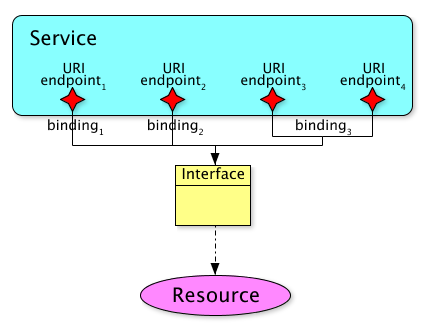
A collection of operations is called an interface. An interface is bound to a concrete protocol and message format via one or more bindings. A binding, and therefore an interface, is accessible via one or more endpoint, each endpoint having its own URI. A service is a collection of endpoints bound to the same interface.

WSDL further considers that an interface represents (some of) the behavior of a resource on the World-Wide-Web. A service can thus be seen as a collection of endpoints bound to the same resource.

Figure 1-1 shows a service offering a single interface to a resource, but this interface being accessible at multiple addresses (endpoints).


A resource offering a single Web Service

Figure 1-1. A resource offering a single Web Service [SVG 1.0 version]

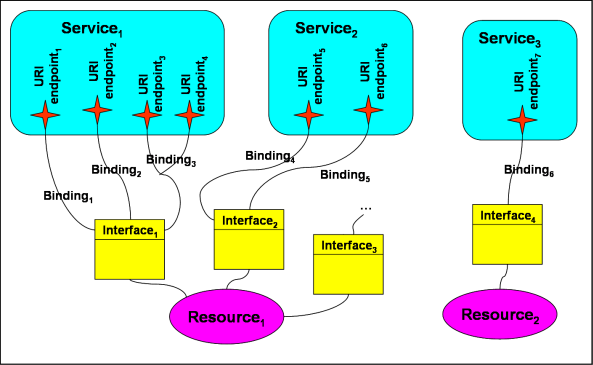
Figure 1-2 shows two services (Service1 and Service2) bound to the same resource (Resource1), but offering different interfaces (Interface1 and Interface2). Interface1 and Interface2 may be related to each other, but this specification is NOT defining what this relationship might be. For example, Interface1 may be an operational interface, may Interface2 might be a management interface.


Two resources and three Web Services

Figure 1-2. Two resources and three Web Services

In addition, Figure 1-2 shows a third service (Service3) bound to a different resource (Resource2), and offering a single interface (Interface4). Resource1 and Resource2 are shown as having NO relationship; but they may in fact be related. This relationship can be defined using languages such as RDF, if necessary, but this is outside the scope of this specification.

1.2 Notational Conventions

The keywords "MUST", "MUST NOT", "REQUIRED", "SHALL", "SHALL NOT", "SHOULD", "SHOULD NOT", "RECOMMENDED", "MAY", and "OPTIONAL" in this document are to be interpreted as described in RFC 2119 [IETF RFC 2119].

This specification uses properties from the XML Information Set [XML Information Set]. Such properties are denoted by square brackets, e.g. [namespace name].

This specification uses namespace prefixes throughout; they are listed in Table 1-1. Note that the choice of any namespace prefix is arbitrary and not semantically significant (see [XML Information Set]).


Table 1-1. Prefixes and Namespaces used in this specification
Prefix Namespace Notes
wsdl "http://www.w3.org/2003/06/wsdl" A normative XML Schema [XML Schema: Structures], [XML Schema: Datatypes] document for the "http://www.w3.org/2003/06/wsdl" namespace can be found at http://www.w3.org/2003/06/wsdl. WSDL documents that do NOT conform to this schema are not valid WSDL documents. WSDL documents that DO conform to this schema and also conform to the other constraints defined in this specification are valid WSDL documents.
soap12 "http://www.w3.org/2003/06/wsdl/soap12" Defined by WSDL 1.2: Bindings [WSDL 1.2 Bindings].
http "http://www.w3.org/2003/06/wsdl/http"
mime "http://www.w3.org/2003/06/wsdl/mime"
xs "http://www.w3.org/2001/XMLSchema" Defined in the W3C XML Schema specification [XML Schema: Structures], [XML Schema: Datatypes].
xsi "http://www.w3.org/2001/XMLSchema-instance"

Namespace names of the general form "http://example.org/..." and "http://example.com/..." represent application or context-dependent URIs [IETF RFC 2396].

All parts of this specification are normative, with the EXCEPTION of pseudo-schemas, examples, and sections explicitly marked as "Non-Normative". Pseudo-schemas are provided for each component, before the description of this component.

2. Component Model

This section describes the conceptual model for WSDL as a set of components with properties, each aspect of a Web service that WSDL can describe having its own property. In addition an XML Infoset representation for these components is provided, along with a mapping from that representation to the various component properties. How the XML Infoset representation of a given set of WSDL components is constructed is outside the scope of this specification.

2.1 Definitions

<definitions
      targetNamespace="xs:anyURI" >
  <documentation />?
  [ <import /> | <include /> ]*
  <types />?
  [ <message /> | <interface /> | <binding /> | <service /> ]*
</definitions>

2.1.1 The Definitions Component

At the abstract level, the Definitions Component is just a container for two categories of component; WSDL components and type system components. WSDL components are messages, interfaces, bindings and services.

Type system components are element declarations and type definitions drawn from some type system. The former define the [local name], [namespace name], [children] and [attributes] properties of an element information item; the latter define only the [children] and [attributes] properties.

The properties of the Definitions Component are as follows:

  • {messages} A set of named message definitions

  • {interfaces} A set of named interface definitions

  • {bindings} A set of named binding definitions

  • {services} A set of named service definitions

  • {type definitions} A set of named type definitions, each one isomorphic to a simple or complex type as defined by XML Schema

  • {element declarations} A set of named element declarations, each one isomorphic to a global element declaration as defined by XML Schema

2.1.2 XML Representation of Definitions Component

WSDL definitions are represented in XML by one or more WSDL Information Sets (Infosets), that is one or more definitions element information items. A WSDL Infoset contains representations for a collection of WSDL components which share a common target namespace. A WSDL Infoset which contains one or more import element information items 4.2 Importing Descriptions corresponds to a collection with components drawn from multiple target namespaces.

The target namespace represents an unambiguous name for the intended semantics of the WSDL Infoset. The targetNamespace URI SHOULD point to a human or machine processable document that directly or indirectly defines the semantics of the WSDL Infoset.

The definitions element information item has the following Infoset properties:

2.1.2.1 targetNamespace attribute information item

The targetNamespace attribute information item defines the namespace affiliation of top-level components defined in this definitions element information item. Messages, interfaces, bindings and services are top level components.

The targetNamespace attribute information item has the following Infoset properties:

  • A [local name] of targetNamespace

  • A [namespace name] which has no value

The type of the targetNamespace attribute information item is xs:anyURI.

2.1.3 Mapping Definitions' XML Representation to Component Properties

The mapping between the properties of the Definitions Component (see 2.1.1 The Definitions Component) and the XML Representation of the definitions element information item (see 2.1.2 XML Representation of Definitions Component) is described in Table 2-1.


Table 2-1. Mapping between Definitions Component Properties and XML Representation
Property Mapping
{messages} The message definitions corresponding to all the message element information items in the [children] of the definitions element information item, if any, plus any included or imported definitions (see 4. Modularizing WSDL descriptions).
{interfaces} The interface definitions corresponding to all the interface element information items in the [children] of the definitions element information item, if any, plus any included or imported definitions (see 4. Modularizing WSDL descriptions).
{bindings} The binding definitions corresponding to all the binding element information items in the [children] of the definitions element information item, if any, plus any included or imported definitions (see 4. Modularizing WSDL descriptions).
{services} The service definitions corresponding to all the service element information items in the [children] of the definitions element information item, if any, plus any included or imported definitions (see 4. Modularizing WSDL descriptions).
{type definitions} The type definition components corresponding to all the type definitions defined as descendants of the types element information item, if any, plus any imported definitions. At a minimum this will include all the types defined by XML Schema simpleType and complexType element information items. It MAY also include any definition from some other type system which describes the [attributes] and [children] properties of an element information item.
{element declarations} The element declaration components corresponding to all the element declarations defined as descendants of the types element information item, if any, plus any imported definitions. At a minimum this will include all the global element declarations defined by XML Schema element element information items. It MAY also include any definition from some other type system which describes the [local name], [namespace name], [attributes] and [children] properties of an element information item.

2.2 Message

<definitions>
  <message
        name="xs:NCName" >
    <documentation />?
    <part />*
  </message>
</definitions>

2.2.1 The Message Component

A message component describes the abstract format of a particular message that a Web service sends or receives. The format of a message is typically described in terms of XML element information items and attribute information items. A message binding (see 2.10 Binding) describes how the abstract content is mapped into a concrete format. However, in some cases, the abstract definition may match the concrete representation very closely or exactly for one or more bindings. Such bindings will supply little or no mapping information. However, another binding of the same message definition may require extensive mapping information. For this reason, it is not until the binding is inspected that one can determine "how abstract" a message really is.

Messages are named constructs and can be referred to by QName (see 2.17 QName resolution). For instance, interface components refer to messages in this way (see 2.8 Message Reference).

The properties of the Message Component are as follows:

  • {name} An NCName as defined by [XML Namespaces].

  • {target namespace} A namespace name, as defined in [XML Namespaces].

  • {parts} A list of named part definitions.

For each message component in the {messages} property of a definitions container the combination of {name} and {target namespace} properties MUST be unique.

2.2.2 XML Representation of Message Component

The XML representation for a message definition component is an element information item with the following Infoset properties:

  • A [local name] of message

  • A [namespace name] of "http://www.w3.org/2003/06/wsdl"

  • One or more attribute information items amongst its [attributes] as follows:

  • Zero or more element information items amongst its [children], in order as follows:

  • Zero or more namespace qualified element information items amongst its [children]. Such element information items MUST be a member of one of the element substitution groups related to messages described in 6. Language Extensibility.

2.2.2.1 name attribute information item with message [owner]

The name attribute information item together with the targetNamespace attribute information item of the definitions element information item forms the QName of the message,

The name attribute information item has the following Infoset properties:

  • A [local name] of name

  • A [namespace name] which has no value

The type of the name attribute information item is xs:NCName.

2.2.3 Mapping Message's XML Representation to Component Properties

The mapping between the properties of the Message Component (see 2.2.1 The Message Component) and the XML Representation of the message element information item (see 2.2.2 XML Representation of Message Component) is as described in Table 2-1.


Table 2-1. Mapping between Message Component Properties and XML Representation
Property Mapping
{name} The actual value of the name attribute information item
{target namespace} The actual value of the targetNamespace attribute information item of the [parent] definitions element information item
{parts} The list of part definitions corresponding to the part element information items in [children], if any.

2.3 Part

<definitions>
  <message>
    <part
          name="xs:NCName" 
          element="xs:QName"? 
          type="xs:QName"? >
      <documentation />?
    </part>
  </message>
</definitions>

2.3.1 The Part Component

A part component describes a portion of a particular message that a web service sends or receives. The format of a part is described by reference to type definition or element declaration components. Such components may be drawn from any appropriate type system. However WSDL makes special recognition of the XML Schema language [XML Schema: Structures],[XML Schema: Datatypes] as the RECOMMENDED type specification language (see 3. Types).

Part components are local to a given message component, they cannot be referred to by QName.

The properties of the Part Component are as follows:

  • {name} An NCName as defined by [XML Namespaces].

  • {content reference} A reference to either an element declaration or a type definition component

For each part component in the {parts} property of a given message component the {name} property MUST be unique.

2.3.2 XML Representation of Part Component

The XML representation for a part definition is an element information item with the following Infoset properties:

  • A [local name] of part

  • A [namespace name] of "http://www.w3.org/2003/06/wsdl"

  • Two or more attribute information items amongst its [attributes] as follows:

    • A name attribute information item as described below in 2.3.2.1 name attribute information item with part [owner].

    • One of the following:

    • Zero or more namespace qualified attribute information items. The [namespace name] of such attribute information items MUST NOT be "http://www.w3.org/2003/06/wsdl".

  • Zero or more element information items amongst its [children] in order, as follows:

    • An optional documentation element information item (see 5. Documentation) amongst its [children].

    • Zero or more namespace qualified element information items. Such element information items MUST be a member of one of the element substitution groups related to message parts described in 6. Language Extensibility.

A part carries information about its type system by the reference contained in the type, element, or alternative qualified attribute information item. The schema language used is determined by examining the referred-to namespace and associating it with an imported or embedded schema. WSDL uses the type and element attribute information items to refer to constructs in XML Schema [XML Schema: Structures],[XML Schema: Datatypes]. Alternative schema languages may re-use these attribute information items if appropriate. If the concepts embodied by the type and element attribute information item are not appropriate for an alternative schema language, that language should specify an alternative attribute information item with prescribed semantics. Such attribute information items are not defined by this specification.

2.3.2.1 name attribute information item with part [owner]

The name attribute information item identifies a given part element information item inside a given message element information item.

The name attribute information item has the following Infoset properties:

  • A [local name] of name

  • A [namespace name] which has no value

The type of the name attribute information item is xs:NCName.

2.3.2.2 element attribute information item

The element attribute information item refers, by QName, to an element declaration component.

The element attribute information item has the following Infoset properties:

  • A [local name] of element

  • A [namespace name] which has no value

The type of the element attribute information item is xs:QName.

2.3.2.3 type attribute information item

The type attribute information item refers, by QName, to a type description component.

The type attribute information item has the following Infoset properties:

  • A [local name] of type

  • A [namespace name] which has no value

The type of the type attribute information item is xs:QName.

2.3.3 Mapping Part's XML Representation to Component Properties

The mapping between the properties of the Part Component (see 2.3.1 The Part Component) and the XML Representation of the part element information item (see 2.3.2 XML Representation of Part Component) is as described in Table 2-1.


Table 2-1. Mapping between Part Component Properties and XML Representation
Property Mapping
{name} The actual value of the name attribute information item
{content reference} The element declaration resolved to by the value of the element attribute information item if present, otherwise the type definition resolved to by the value of the type attribute information item if present, otherwise a similar construct in some type system as referred to by some other attribute information item

2.4 Interface

<definitions>
  <interface
        name="xs:NCName" 
        extends="list of xs:QName"? >
    <documentation />?
    [ <operation /> | <feature /> | <property /> ]*
  </interface>
</definitions>

2.4.1 The Interface Component

An interface component describes a set of messages that a service sends and/or receives. It does this by grouping related messages into operations. An operation is a set of input and output messages, an interface is a set of operations.

An interface can optionally extend one or more other interfaces. In such cases the interface contains the operations of the interfaces it extends, along with any operations it defines. The interfaces a given interface extends MUST NOT themselves extend that interface either directly or indirectly.

Interfaces are named constructs and can be referred to by QName (see 2.17 QName resolution). For instance, binding components refer to interfaces in this way.

The properties of the Interface Component are as follows:

  • {name} An NCName as defined by [XML Namespaces].

  • {target namespace} A namespace name, as defined in [XML Namespaces].

  • {extended interfaces} A set of named interface definitions.

  • {operations} A set of named interface operation definitions.

  • {features} A set of named feature definitions.

  • {properties} A set of named property definitions.

For each interface component in the {interfaces} property of a definitions container the combination of {name} and {target namespace} properties must be unique.

2.4.2 XML Representation of Interface Component

The XML representation for an interface definition component is an element information item with the following Infoset properties:

2.4.2.1 name attribute information item with interface [owner]

The name attribute information item together with the targetNamespace attribute information item of the definitions element information item forms the QName of the interface.

The name attribute information item has the following Infoset properties:

  • A [local name] of name

  • A [namespace name] which has no value

The type of the name attribute information item is xs:NCName.

2.4.2.2 extends attribute information item

The extends attribute information item lists the interfaces that this interface derives from.

The extends attribute information item has the following Infoset properties:

  • A [local name] of extends

  • A [namespace name] which has no value

The type of the extends attribute information item is a list of xs:QName.

2.4.3 Mapping Interface's XML Representation to Component Properties

The mapping between the properties of the Interface Component (see 2.4.1 The Interface Component) and the XML Representation of the interface element information item (see 2.4.2 XML Representation of Interface Component) is as described in Table 2-1.


Table 2-1. Mapping between Interface Component Properties and XML Representation
Property Mapping
{name} The actual value of the name attribute information item
{target namespace} The actual value of the targetNamespace attribute information item of the [parent] definitions element information item
{extended interfaces} The set of interface definitions resolved to by the values in the extends attribute information item if any, plus the set of interface definitions in the {extended interfaces} property of those interface definitions, otherwise empty.
{operations} The set of interface operation definitions corresponding to the operation element information items in [children], if any, plus the set of interface operation definitions in the {operations} property of the interface definitions in {extended interfaces}, if any.
{features} The set of feature definitions corresponding to the feature element information items in [children], if any, plus the set of feature definitions in the {features} property of the feature definitions in {extended interfaces}, if any.
{properties} The set of property definitions corresponding to the property element information items in [children], if any, plus the set of property definitions in the {properties} property of the property definitions in {extended interfaces}, if any.

Note:

Per 2.4.1 The Interface Component, the interface components in the {extended interfaces} property of a given interface component MUST NOT contain that interface component in any of their {extended interfaces} properties, that is to say, recursive extension of interfaces is disallowed.

2.5 Feature

<feature
      uri="xs:QName" 
      required="xs:boolean"? >
  <documentation />?
</feature>

2.5.1 The Feature Component

A feature component describes a particular feature that a Web service accepts or requires in particular interactions. Features can be engaged in inbound, outbound messages, or both. Features in the feature component are identified by their URI. Unless otherwise specified, recognizing a feature's URI is assumed to be semantically equivalent to understanding the feature's specification.

The properties of the Feature Component are as follows:

  • {name} A URI as defined by [IETF RFC 2396].

  • {required} A boolean value.

2.5.2 XML Representation of Feature Component

The XML representation for a feature definition component is an element information item with the following Infoset properties:

  • A [local name] of feature

  • A [namespace name] of "http://www.w3.org/2003/06/wsdl"

  • One or more attribute information items amongst its [attributes] as follows:

  • Zero or more element information items amongst its [children], in order as follows:

    • An optional documentation element information item (see 5. Documentation).

    • Zero or more namespace qualified element information items amongst its [children]. Such element information items MUST be a member of one of the element substitution groups related to features described in 6. Language Extensibility.

2.5.2.1 uri attribute information item with feature [owner]

The uri attribute information item specifies the URI of the feature.

The uri attribute information item has the following Infoset properties:

  • A [local name] of uri

  • A [namespace name] which has no value

The type of the uri attribute information item is xs:anyURI.

2.5.2.2 required attribute information item with feature [owner]

The required attribute information item specifies whether the use of the feature is mandatory or optional.

The required attribute information item has the following Infoset properties:

  • A [local name] of required

  • A [namespace name] which has no value

The type of the required attribute information item is xs:boolean.

2.5.3 Mapping Feature's XML Representation to Component Properties

The mapping between the properties of the Feature Component (see 2.5.1 The Feature Component) and the XML Representation of the feature element information item (see 2.5.2 XML Representation of Feature Component) is as described in Table 2-1.


Table 2-1. Mapping between Feature Component Properties and XML Representation
Property Mapping
{name} The actual value of the uri attribute information item
{required} If the value of the required attribute information item is "true" or "1", then "true", otherwise "false".

2.6 Property

<property
      uri="xs:QName" 
      required="xs:boolean"? >
  <documentation />?
  [ <value /> | <constraint /> ]
</property>

2.6.1 The Property Component

A property component describes the set of possible values for a particular property. The permissible values are specified by references to a Schema description. A property is typically used to control a feature's behavior. Properties, and hence property values, can be shared amongst features.

The properties of the Property Component are as follows:

  • {name} A URI as defined by [IETF RFC 2396].

  • {value constraint} A type definition constraining the value of the property.

2.6.2 XML Representation of Property Component

The XML representation for a property definition component is an element information item with the following Infoset properties:

2.6.2.1 uri attribute information item with property [owner]

The uri attribute information item specifies the URI of the property. It has the following Infoset properties:

  • A [local name] of uri

  • A [namespace name] which has no value

The type of the uri attribute information item is xs:anyURI.

2.6.2.2 value element information item with property [parent]
<property>
  <value>
    xs:anySimpleType
  </value>
</property>

The value element information item specifies the value of the property. It has the following Infoset properties:

  • A [local name] of value

  • A [namespace name] of "http://www.w3.org/2003/06/wsdl"

The type of the value element information item is xs:anySimpleType.

2.6.2.3 constraint element information item with property [parent]
<property>
  <constraint>
    xs:QName
  </constraint>
</property>

The constraint element information item specifies a constraint on the value of the property. It has the following Infoset properties:

  • A [local name] of constraint

  • A [namespace name] of "http://www.w3.org/2003/06/wsdl"

The type of the constraint attribute information item is xs:QName.

2.6.3 Mapping Property's XML Representation to Component Properties

The mapping between the properties of the Property Component (see 2.6.1 The Property Component) and the XML Representation of the property element information item (see 2.6.2 XML Representation of Property Component) is as described in Table 2-1.


Table 2-1. Mapping between Property Component Properties and XML Representation
Property Mapping
{name} The actual value of the uri attribute information item
{value constraint} If the constraint element information item is present, the type referred to by the value of this element information item. Otherwise, if the value element information item is present, an anonymous simple type, whose base type is "xs:anySimpleType", with a single "enumeration" facet whose value is that of the element information item. Otherwise, "xs:anySimpleType".

2.7 Interface Operation

<definitions>
  <interface>
    <operation
          name="xs:NCName" 
          pattern="xs:anyURI" >
      <documentation />?
      [ <feature /> | <property /> | 
        [ <input /> | <output /> | <infault /> | <outfault /> ]+
      ]*
    </operation>
  </interface>
</definitions>

2.7.1 The Interface Operation Component

An interface operation component describes an operation that a given interface supports. An operation is a set of message references and an associated message pattern. Message references are references either to messages accepted by this operation (input messages), or messages sent by this operation (output messages).Such messages may be ordinary messages or fault messages.

Interface operation components are local to interface components, they cannot be referred to by QName, despite having both {name} and {target namespace} properties

The properties of the Interface Operation Component are as follows:

  • {name} An NCName as defined by [XML Namespaces].

  • {target namespace} A namespace name, as defined in [XML Namespaces].

  • {message pattern} A URI identifying the message pattern used by the operation

  • {message references} A set of message reference components for the ordinary messages the operation accepts or sends

  • {fault references} A set of fault reference components for the fault messages the operation accepts or sends

  • {features} A set of named feature definitions used by the operation

  • {properties} A set of named property definitions used by the operation

For each interface operation component in the {operations} property of an interface component the combination of {name} and {target namespace} properties must be unique.

In cases where, due to an interface extending one or more other interfaces, two or more interface operation components have the same value for their {name} and {target namespace} properties, then the component models of those interface operation components MUST be equivalent (see 2.15 Equivalence of components). If the interface operation components are equivalent then they are considered to collapse into a single component. It is an error if two interface operation components have the same value for their {name} and {target namespace} properties but are not equivalent.

Note:

Due to the above rules, if two interfaces that have the same value for their {target namespace} property also have one or more operations that have the same value for their {name} property then those two interfaces cannot both form part of the derivation chain of a derived interface unless those operations are the same operation. Therefore it is considered good practice to ensure, where necessary, that operation names within a namespace are unique, thus allowing such derivation to occur without error.

2.7.2 XML Representation of Interface Operation Component

The XML representation for an interface operation component is an element information item with the following Infoset properties:

2.7.2.1 name attribute information item with operation [owner]

The name attribute information item identifies a given operation element information item inside a given interface element information item.

The name attribute information item has the following Infoset properties:

  • A [local name] of name

  • A [namespace name] which has no value

The type of the name attribute information item is xs:NCName.

2.7.2.2 pattern attribute information item with operation [owner]

The pattern attribute information item identifies the message pattern a given operation uses.

The pattern attribute information item has the following Infoset properties:

  • A [local name] of pattern

  • A [namespace name] which has no value

The type of the pattern attribute information item is xs:anyURI.

2.7.3 Mapping Interface Operation's XML Representation to Component Properties

The mapping between the properties of the Interface Operation Component (see 2.7.1 The Interface Operation Component) and the XML Representation of the interface element information item (see 2.7.2 XML Representation of Interface Operation Component) is as described in Table 2-1.


Table 2-1. Mapping between Interface Operation Component Properties and XML Representation
Property Mapping
{name} The actual value of the name attribute information item
{target namespace} The actual value of the targetNamespace attribute information item of the [parent] definitions element information item of the [parent] interface element information item.
{message pattern} The actual value of the pattern attribute information item
{message references} The set of message references corresponding to the input and output element information items in [children], if any.
{fault references} The set of fault references corresponding to the infault and outfault element information items in [children] if any.
{features} The set of features corresponding to the feature element information items in [children], if any.
{properties} The set of properties corresponding to the property element information items in [children], if any.

2.8 Message Reference

<definitions>
  <interface>
    <operation>
      <input
            name="xs:NCName"? 
            message="xs:QName" >
        <documentation />?
      </input>
      <output
            name="xs:NCName"? 
            message="xs:QName" >
        <documentation />?
      </output>
    </operation>
  </interface>
</definitions>

2.8.1 The Message Reference Component

A message reference component refers to a named message that forms part of an operation.

Message reference components are local to a given interface operation component, they cannot be referred to by QName

The properties of the Message Reference Component are as follows:

For each message reference component in the {message references} and {fault references} properties of an interface operation component the {name} property must be unique.

2.8.2 XML Representation of Message Reference Component

The XML representation for a message reference component is an element information item with the following Infoset properties:

  • A [local name] of input or output

  • A [namespace name] of "http://www.w3.org/2003/06/wsdl"

  • Two or more attribute information items amongst its [attributes] as follows:

  • Zero or more element information items amongst its [children], in order, as follows:

    • An optional documentation element information item (see 5. Documentation).

    • Zero or more namespace qualified element information items. Such element information items MUST be a member of one of the element substitution groups related to input, output or fault children of interface operations described in 6. Language Extensibility.

2.8.2.1 name attribute information item with input , or output [owner]

The name attribute information item identifies a given message reference element information item within a given operation element information item.

The name attribute information item has the following Infoset properties:

  • A [local name] of name

  • A [namespace name] which has no value

The type of the name attribute information item is xs:NCName.

2.8.2.2 message attribute information item with input , or output [owner]

The message attribute information item refers, by QName, to a message component.

The message attribute information item has the following Infoset properties:

  • A [local name] of message

  • A [namespace name] which has no value

The type of the message attribute information item is xs:QName.

2.8.3 Mapping Message Reference's XML Representation to Component Properties

The mapping between the properties of the Message Reference Component (see 2.8.1 The Message Reference Component) and the XML Representation of the message reference element information item (see 2.8.2 XML Representation of Message Reference Component) is as described in Table 2-1.


Table 2-1. Mapping between Message Reference Component Properties and XML Representation
Property Mapping
{name} The actual value of the name attribute information item
{direction} If the [local name] of the element information item is input then "in", else if the [local name] of the element information item is output then "out".
{message} The message component resolved to by the value of the message attribute information item

2.9 Fault Reference

<definitions>
  <interface>
    <operation>
      <infault
            name="xs:NCName" 
            messages="list of xs:QName" >
        <documentation />?
      </infault>
      <outfault
            name="xs:NCName" 
            messages="list of xs:QName" >
        <documentation />?
      </outfault>
    </operation>
  </interface>
</definitions>

2.9.1 The Fault Reference Component

A fault reference component refers to named fault messages that form part of an operation.

Fault reference components are local to a given interface operation component, they cannot be referred to by QName.

The properties of the Fault Reference Component are as follows:

  • {name} An NCName as defined by [XML Namespaces].

  • {direction} One of in or out.

  • {messages} A set of references, by QName (see 2.17 QName resolution), to named message components.

For each fault reference component in the{fault references} properties of an interface operation component the {name} property must be unique.

2.9.2 XML Representation of Fault Reference Component

The XML representation for a fault reference component is an element information item with the following Infoset properties:

  • A [local name] of infault or outfault

  • A [namespace name] of "http://www.w3.org/2003/06/wsdl"

  • Two or more attribute information items amongst its [attributes] as follows:

  • Zero or more element information items amongst its [children], in order, as follows:

    • An optional documentation element information item (see 5. Documentation).

    • Zero or more namespace qualified element information items. Such element information items MUST be a member of one of the element substitution groups related to infault or outfault children of interface operations described in 6. Language Extensibility.

2.9.2.1 name attribute information item with infault or outfault [owner]

The name attribute information item identifies a given fault reference element information item within a given operation element information item.

The name attribute information item has the following Infoset properties:

  • A [local name] of name

  • A [namespace name] which has no value

The type of the name attribute information item is xs:NCName.

2.9.2.2 messages attribute information item with infault or outfault [owner]

The messages attribute information item refers, by QNames, to a set of message components.

The messages attribute information item has the following Infoset properties:

  • A [local name] of message

  • A [namespace name] which has no value

The type of the message attribute information item is a list of xs:QName.

2.9.3 Mapping Fault Reference's XML Representation to Component Properties

The mapping between the properties of the Fault Reference Component (see 2.8.1 The Message Reference Component) and the XML Representation of the fault reference element information item (see 2.9.2 XML Representation of Fault Reference Component) is as described in Table 2-1.


Table 2-1. Mapping between Fault Reference Component Properties and XML Representation
Property Mapping
{name} The actual value of the name attribute information item
{direction} If the [local name] of the element information item is infault then "in", else if the [local name] of the element information item is outfault then "out".
{messages} The message components resolved to by the value of the QNames listed in the message attribute information item

2.10 Binding

<definitions>
  <binding
        name="xs:NCName" 
        interface="xs:QName" >
    <documentation />?
    [ <feature /> | <property /> | <operation /> ]*
  </binding>
</definitions>
Editorial note: Should WSDL 1.2 (part 3) including bindings for SOAP 1.1? June 25, 2002
The WS Description WG currently investigating whether it will support SOAP 1.1 in this specification, as a W3C note, or otherwise. We will of course support SOAP 1.2.

2.10.1 The Binding Component

A binding component described a concrete binding of an interface component and associated operations to a particular concrete message format and transmission protocol.

No concrete binding details are given in this specification. The companion specification, WSDL (Version 1.2): Bindings [WSDL 1.2 Bindings] defines such bindings for SOAP 1.1 [SOAP 1.1], SOAP 1.2 [SOAP 1.2 Part 1: Messaging Framework], HTTP [IETF RFC 2616] and MIME [IETF RFC 2045]. Other specifications MAY define additional binding details. Such specifications are expected to annotate the binding component (and its sub-components) with additional properties and specify the mapping between those properties and the XML representation.

Bindings are named constructs and can be referred to by QName (see 2.17 QName resolution). For instance, service components refer to bindings in this way.

The properties of the Binding Component are as follows:

  • {name} An NCName as defined by [XML Namespaces].

  • {target namespace} A namespace name, as defined in [XML Namespaces].

  • {interface} A named interface definition

  • {operations} A set of named binding operation definitions

  • {features} A set of named feature definitions

  • {properties} A set of named property definitions

For each binding component in the {bindings} property of a definitions container the combination of {name} and {target namespace} properties must be unique.

2.10.2 XML Representation of Binding Component

The XML representation for a binding component is an element information item with the following Infoset properties:

2.10.2.1 name attribute information item with binding [owner]

The name attribute information item together with the targetNamespace attribute information item of the definitions element information item forms the QName of the binding.

The name attribute information item has the following Infoset properties:

  • A [local name] of name

  • A [namespace name] which has no value

The type of the name attribute information item is xs:NCName.

2.10.2.2 interface attribute information item with binding [owner]

The interface attribute information item refers, by QName, to an interface component

The interface attribute information item has the following Infoset properties:

  • A [local name] of interface

  • A [namespace name] which has no value

The type of the interface attribute information item is xs:QName.

2.10.2.3 Binding extension elements

Binding extension elements are used to provide information specific to a particular binding. The semantics of such element information items are defined by the specification for those element information items. Such specifications are expected to annotate the binding component with additional properties and specify the mapping between those properties and the XML representation.

2.10.3 Mapping Binding's XML Representation to Component Properties

The mapping between the properties of the Binding Component (see 2.10.1 The Binding Component) and the XML Representation of the binding element information item (see 2.10.2 XML Representation of Binding Component) is as described in Table 2-1.


Table 2-1. Mapping between Binding Component Properties and XML Representation
Property Mapping
{name} The actual value of the name attribute information item
{target namespace} The actual value of the targetNamespace attribute information item of the [parent] definitions element information item
{interface} The interface definition resolved to by the actual value of the interface attribute information item.
{operations} The set of binding operation definitions corresponding to the operation element information items in [children], if any.
{features} The set of feature definitions corresponding to the feature element information items in [children], if any.
{properties} The set of property definitions corresponding to the property element information items in [children], if any.

2.11 Binding Operation

<definitions>
  <binding>
    <operation
          name="xs:NCName" >
      <documentation />?
      [ <feature /> | <property /> | 
        [ <input /> | <output /> | <infault /> | <outfault /> ]+
      ]*
    </operation>
  </binding>
</definitions>

2.11.1 The Binding Operation Component

A binding operation component describes a concrete binding for a particular operation of an interface to a particular concrete message format.

Binding operation components are local to a given binding component

The properties of the Binding Operation Component are as follows:

  • {name} An NCName as defined by [XML Namespaces].

  • {target namespace} A namespace name, as defined in [XML Namespaces].

  • {messages} A set of binding message reference components

For each binding operation component in the {operations} property of a binding component the combination of {name} and {target namespace} properties must be unique.

2.11.2 XML Representation of Binding Operation Component

The XML representation for a binding operation component is an element information item with the following Infoset properties:

  • A [local name] of operation

  • A [namespace name] of "http://www.w3.org/2003/06/wsdl"

  • One or more attribute information items amongst its [attributes] as follows:

  • Zero or more element information items amongst its [children], in order, as follows:

  • Zero or more element information items amongst its [children] from among the following, in any order:

    • Zero or more feature element information items

    • Zero or more property element information items

  • Zero or more namespace qualified element information items amongst its [children]. Such element information items MUST be a member of one of the element substitution groups related to binding operations described in 6. Language Extensibility. Such element information items are considered to be binding operation extension elements as described below (see 2.11.2.2 Binding operation extension elements).

2.11.2.1 name attribute information item with operation [owner]

The name attribute information item identified a given operation element information item within a given binding element information item.

The name attribute information item has the following Infoset properties:

  • A [local name] of name

  • A [namespace name] which has no value

The type of the name attribute information item is xs:NCName.

2.11.2.2 Binding operation extension elements

Binding operation extension elements are used to provide information specific to a particular operation in a binding. The semantics of such element information items are defined by the specification for those element information items. Such specifications are expected to annotate the binding operation component with additional properties and specify the mapping between those properties and the XML representation.

2.11.3 Mapping Binding Operation's XML Representation to Component Properties

The mapping between the properties of the Binding Operation Component (see 2.11.1 The Binding Operation Component) and the XML Representation of the binding element information item (see 2.11.2 XML Representation of Binding Operation Component) is as described in Table 2-1.


Table 2-1. Mapping between Binding Operation Component Properties and XML Representation
Property Mapping
{name} The actual value of the name attribute information item
{target namespace} The actual value of the targetNamespace attribute information item of the [parent] definitions element information item of the [parent] interface element information item.
{messages} The set of binding message reference components corresponding to the input , output and fault element information items in [children], if any.
{features} The set of feature components corresponding to the feature element information item in [children], if any.
{properties} The set of property components corresponding to the property element information item in [children], if any.

2.12 Binding Message Reference

<definitions>
  <binding>
    <operation>
      <input
            name="xs:NCName"? >
        <documentation />?
      </input>
      <output
            name="xs:NCName"? >
        <documentation />?
      </output>
      <infault
            name="xs:NCName" >
        <documentation />?
      </infault>
      <outfault
            name="xs:NCName" >
        <documentation />?
      </outfault>
    </operation>
  </binding>
</definitions>

2.12.1 The Binding Message Reference Component

A binding message reference component describes a concrete binding for a particular message in an operation to a particular concrete message format.

Binding message reference components are local to a given binding operation component, they cannot be referred to by QName.

The properties of the Binding Message Reference Component are as follows:

  • {name} An NCName as defined by [XML Namespaces].

  • {direction} One of in or out

For each binding message reference component in the {messages} property of a binding operation component the {name} property must be unique.

2.12.2 XML Representation of Binding Message Reference Component

The XML representation for a binding message reference component is an element information item with the following Infoset properties:

  • A [local name] of input , output , infault or outfault .

  • A [namespace name] of "http://www.w3.org/2003/06/wsdl"

  • Zero or more attribute information items amongst its [attributes] as follows:

  • Zero or more element information items amongst its [children], in order, as follows:

    • An optional documentation element information item (see 5. Documentation).

    • Zero or more namespace qualified element information items. Such element information items MUST be a member of one of the element substitution groups related to input, output or fault children of binding operations described in 6. Language Extensibility. Such element information items are considered to be binding message reference extension elements, as described below (see 2.12.2.2 Binding message reference extension elements).

2.12.2.1 name attribute information item with input , output or fault [owner]

The name attribute information item identifies a given binding message reference element information item within a given operation element information item.

The name attribute information item has the following Infoset properties:

  • A [local name] of name

  • A [namespace name] which has no value

The type of the name attribute information item is xs:NCName.

2.12.2.2 Binding message reference extension elements

Binding message reference extension elements are used to provide information specific to a particular message in an operation. The semantics of such element information items are defined by the specification for those element information items. Such specifications are expected to annotate the binding message reference component with additional properties and specify the mapping between those properties and the XML representation.

2.12.3 Mapping Binding Message Reference's XML Representation to Component Properties

The mapping between the properties of the Binding Message Reference Component (see 2.12.1 The Binding Message Reference Component) and the XML Representation of the binding element information item (see 2.12.2 XML Representation of Binding Message Reference Component) is as described in Table 2-1.


Table 2-1. Mapping between Binding Message Reference Component Properties and XML Representation
Property Mapping
{name} The actual value of the name attribute information item if present, otherwise the actual value of the name attribute information item on the element information item with the same [local name] whose [parent] operation element information item has the same value for its name attribute information item as the operation element information item in the binding element information item but is rather in the interface element information item referred to by the type attribute information item.
{variety} If the [local name] of the element information item is input or infault then in, else if the [local name] of the element information item is output or outfault then out.

2.13 Service

<definitions>
  <service
        name="xs:NCName" 
        interface="xs:QName" 
        targetResource="xs:anyURI"? >
    <documentation />?
    <endpoint />*
  </service>
</definitions>

2.13.1 The Service Component

A service component describes one and only one interface that a service provides, and the endpoints it is provided over.

Service are named constructs and can be referred to by QName (see 2.17 QName resolution).

The properties of the Service Component are as follows:

  • {name} An NCName as defined by [XML Namespaces].

  • {target namespace} A namespace name, as defined in [XML Namespaces].

  • {target resource} A URI as defined by [IETF RFC 2396].

  • {interface} An interface component

  • {endpoints} A set of endpoint components

For each service component in the {services} property of a definitions container the combination of {name} and {target namespace} properties MUST be unique.

2.13.2 XML Representation of Service Component

The XML representation for a service definition component is an element information item with the following Infoset properties: