See also
Address
Talks, articles etc
Speaking engagements
Press interviews
Research at MIT-CSAIL
Design Issues: web architecture
World Wide Web Consortium Frequently Asked Questions
Kids' Questions
2025 book: This is for Everyone




Sir Tim Berners-Lee invented the World Wide Web while at CERN, the European Particle Physics Laboratory, in 1989. He wrote the first web client and server in 1990. His specifications of URIs, HTTP and HTML were refined as Web technology spread.
He is the co-founder and CTO of Inrupt.com, a tech start-up that uses, promotes and helps develop the open source Solid platform. Solid aims to give people control and agency over their data, questioning many assumptions about how the web has to work. Solid technically is a new level of standard at the web layer, which adds features never put into the original spec, such as global single sign-on, universal access control, and a universal data API so that any app can store data in any storage place. Socially Solid is a movement away from much of the issues with the current WWW, and toward a world in which users are in control, and empowered by large amounts of data, private, shared, and public.
Sir Tim is the Founder, Emeritus Director, and an Honorary Member of the Board of Directors of the World Wide Web Consortium (W3C), a Web standards organization that he founded in 1994 which develops interoperable technologies (specifications, guidelines, software, and tools) to lead the Web to its full potential. He is a Director of the World Wide Web Foundation that was launched in 2009 to coordinate efforts to further the potential of the Web to benefit humanity.
He is the Emeritus 3Com Founders Professor of Engineering in the School of Engineering with a joint appointment in the Department of Electrical Engineering and Computer Science at the Laboratory for Computer Science and Artificial Intelligence ( CSAIL) at the Massachusetts Institute of Technology (MIT) where he founded the Decentralized Information Group (DIG).
Research at DIG and its collaborators was the origin of what became the Solid Platform.
He is also a Professor in the Computer Science Department, and an Honorary Student at Christ Church, at the University of Oxford, UK. He is President of and co-founder the Open Data Institute in London.
In 2001 he became a Fellow of the Royal Society. He has been the recipient of several international awards including the Japan Prize, the Prince of Asturias Foundation Prize, the Millennium Technology Prize and Germany's Die Quadriga award. In 2004 he was knighted by H.M. Queen Elizabeth and in 2007 he was awarded the Order of Merit. In 2009 he was elected a foreign associate of the National Academy of Sciences. He is the author of "Weaving the Web".
On March 18 2013, Sir Tim, along with Vinton Cerf, Robert Kahn, Louis Pouzin and Marc Andreesen, was awarded the Queen Elizabeth Prize for Engineering for "ground-breaking innovation in engineering that has been of global benefit to humanity."
On 4 April 2017, Sir Tim was awarded the ACM A.M. Turing Prize for inventing the World Wide Web, the first web browser, and the fundamental protocols and algorithms allowing the Web to scale. The Turing Prize, called the "Nobel Prize of Computing" is considered one of the most prestigious awards in Computer Science.
In September 2022, he won the Seoul Peace Prize for his work promoting data sovereignty and leading the movement to “decentralize” the web dominated by tech giants.
In September 2025, Sir Tim released his new book: This is for Everyone.
My blog on technology and society is called DesignIssues.
Videos
Essays and articles in text form
Interviews:
If you want to know what W3C are working on now, look at the W3C site and check out all the activities at W3C. Also see:
I do a limited amount of speaking. If you have something you think I would be interested in speaking at, for academic events email timbl+speaking@w3.org with details of the event, projected audience size and profile, location and date.
My professional speaking is handled by Molly Cotter at the Harry Walker Agency, (MollyC@harrywalker.com) (you may also cc Don Walker donw@harrywalker.com and please cc me as above).
Please use an email subject line with relevant information such as: : "Keynote in Milan, 23 February 2100 at ISWC2100" including the date and place proposed.
If I use slides (I often do not) I use a laptop -- currently a Mac running OSX. I do not need audio from the laptop.
If you need a photo for publication, please complete the W3C photo request form. You do not need an account to complete the form, but an email address is required.
Alternatively, you can ask:
If you need an interview for an article, please check the
first, then please use email rather than phone. Please contact my Chief of Staff (cos@timbl.com).
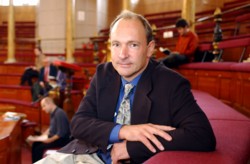
[Photo: in Sheldonian, Oxford: LeFevre communications, 2001.]
Accessibility at MIT and at W3C
$Id$ for timbl