CSS Ruby reverts to Working Draft
Posting on behalf of Richard Ishida:
The CSS Working Group has republished the CSS3 Ruby Module specification as a Working Draft. The document had previously been published in 2003 as a Candidate Recommendation.
“Ruby” are short runs of text alongside the base text, typically used in East Asian documents to indicate pronunciation or to provide a short annotation. This document proposes a set of CSS properties associated with ruby elements. They can be used in combination with the ruby elements of HTML.
The present Working Draft prepares the ground for the specification to be changed in a number of areas. Motivations for these changes include introduction of requirements arising from the Requirements for Japanese Text Layout document, updates to the handling of bopomofo ruby, and most importantly adaptations needed to support the new ruby markup model being introduced by HTML5.
To be extra clear, this is not an update to a CR: it’s revoking CSS Ruby’s CR status and returning it to WD for rework. The good news is that it’s now under active editorship, which means the problems with the spec can now be fixed.
Minutes and Resolutions Telecon 2011-06-22
- Resolved: CSSWG F2F July 24-26, Sunday-Tuesday, in Seattle, FXTF on Tuesday
- Resolved: Close normalization issue as out-of-scope, send response to i18n, and take Namespaces to PR.
- CSSWG has no comments on DOM3 Events LC, but some members have comments which they will send separately.
- CSS3 Writing Modes issues will now be tracked in Tracker. Send only one issue per email to www-style therefore.
- Molly is looking for ideas for SXSW; email her about it.
Full minutes
Minutes and Resolutions Telecon 2011-06-15
- Considering last week of July for F2F in Seattle
- There will be some kind of internal W3C telecon about Unicode normalization
- Resolved: use idents for flow names in CSS Regions
- Disagreement on whether CSS Regions should use the
content property
or have separate flow-from property that overloads content: normal.
- Resolved: Content selection is a UI issue, no need to spec it in CSS Regions
- Resolved: No change to event propagation model due to regions
- Resolved: Publish update of CSS Ruby once outstanding edits are folded in
- Action all: Review CSS3 Writing Modes and report any issues that should be addressed before LCWD is published.
Full minutes
Minutes and Resolutions F2F Kyoto Sat: CSS3 Fonts, Regions, @viewport, Variables, @supports, Selectors4, Administrivia
CSS3 Fonts
- Discussed same origin restriction on @font-face. There are differing
opinions on whether resources loaded through @font-face should be
restricted or unrestricted by default. It was pointed out that the
restriction is on anything loaded through @font-face, not on fonts
only; conversely it does not apply to font files loaded via other
mechanisms. It was also pointed out that the suggested solutions were
HTTP-specific, whereas @font-face is protocol-agnostic.
- Discussed superscripts/subscripts and fantasai and dbaron’s proposal: The proposal handles nested superscripts/subscripts, changes in font
size within the superscript/subscript, and the inclusion of atomic
inlines such as images. It works by computing values that synthesize
the superscripts/subscripts and then undoing the synthesis settings
when setting characters for which specialized glyphs are available.
Flexbox
- Reviewed status of spec and implementations
CSS Regions
- Resolved: Switch content-order to take <integer>
- Discussed syntax for pushing to/pulling from named flows.
- Briefly discussed integration of regions with multicol and grid layout
Device Adaptation
Re-reviewed the draft. Some issues were raised against the draft;
some concerns were raised about putting this in CSS. No objections
were raised for moving towards FPWD.
Variables and Mixins
- Resolved: Allow Tab to work on a css3 variables editor’s draft, no guarantee we’ll move it to FPWD.
- Tab presented a mixins proposal and received very strong objections.
- Tab presented a proposal to nest style rules which received a lukewarm reception.
CSS3 Conditional Rules
- David Baron presented a draft for:
- @supports rule to check for property:value support in the UA
- @document rule to apply rules to a particular set of URLs
- nesting at-rules inside @media
- Resolved: Add this draft as CSS3 Conditional Rules (css3-conditional)
Selectors Level 4
- fantasai presented the idea of a new level of Selectors. The current
draft excludes pseudo-elements (which would be a separate module) and
adds
- :matches() and :not() that take a comma-separated list of selectors
- :dir(ltr) and :dir(rtl) that match against the markup-determined
directionality
- the ability to choose which component of a selector represents its
subject
- Resolved: Move forward with Selectors 4
Other: text-overflow, gradients
- Resolved: Add the two-value <string> syntax to text-overflow in CSS3 Basic UI, marked at-risk.
- Resolved: gradients use bearing angles (0deg upwards, increasing clockwise)
Administrivia: Module Template, Test Suite Owners, Charter, F2F Scheduling
- Resolved: Update all modules to the latest module template, once
it has been updated with the latest Snapshot wording.
- Resolved: Establish official “test owner” position parallel to the editor,
who is responsible for ensuring the correctness and completion
of the test suite.
- Resolved: that the charter lists should be organized not by “priority” but
by what status we expect specs to reach by the end of the charter
(and need to be edited accordingly)
- Resolved: Meet for 3 days at TPAC
- Resolved: Try to schedule a meeting in August probably in Seattle
or France
Full minutes
Minutes and Resolutions Kyoto F2F Fri: Transitions, IVS, CSS3 Text, Floats and Exclusions, Regions, Pagination
Transitions
- Tab presented a proposal for dealing with shortcomings in the Transitions
spec. < insert url here when Tab gets around to posting it 😐 >
Ideographic Variants
- Resolved: Send comment to Unicode on behalf of CSSWG requesting stronger requirements for sharing IVSes across IVD collections, and the creation of a mapping table among existing duplicate IVSes (and any matching CJK compatiblity ideographs). (See UTS#37.)
- Resolved: Font fallback goes all the way to system fallback with the IVS before repeating with base. We will add a property to switch between that and font-consistency-priority matching.
CSS3 Text
- Discussed Håkon’s list of issues.
- Resolved: Change
bikeshedding (previously known as white-space-collapsing) to text-space-collapse since white-space-collapse is taken by XSL.
- Resolved: Mark ‘line-break: loose’ at-risk
- Suggested to pull out codepoint lists from ‘line-break’ rules into an appendix and make it clearer that
line-break doesn’t affect non-CJK codepoints except when the text is tagged as Chinese or Japanese.
- Discussed
text-spacing property and text-justify property, assigned many edits to the editors.
- Discussed ‘text-transform’ property, assigned many edits to the editors.
- Resolved: Drop ‘hyphens: all’ and switch properties currently marked optional to at-risk.
- Discussed whether to rename
word-wrap to overflow-wrap. The name overflow-wrap is a much better description of what it does, but word-wrap is already implemented across browsers (unprefixed). This remains an open issue pending feedback from WebKit and Opera.
- Resolved: Drop
text-outline since the new spread argument to text-shadow can handle it.
Other: Charter, Floats, Regions
- Resolved: List CSS 2.0 as maintenance in charter, asterisk saying to be obsoleted asap.
- Resolved: Make CSS3 Floats module to bring together proposals for floats and exclusions.
- Discussed pagination and forced breaks across pages, regions, columns.
Full minutes
Minutes and Resolutions Kyoto F2F Thurs: Vertical Text, Bidi, Line Grid, Unencoded Characters
Kyoto Forum Issues
- Reviewed feedback from Kyoto Forum on CSS (Minutes). Line stacking was a major issue.
- Discussed how to represent unencoded characters; concluded that this is a content/semantics issue, and probably needs markup to be solved.
Line Grid
- Discussed line stacking and the line grid. A new proposal was drawn up to address the issues and use cases, including for complex layouts (floats, positioning, multicol).
- Resolved: Merge line grid proposal into CSS3 Line Layout Module. (No separate line grid spec.)
Writing Modes
- Long discussion of
text-orientation cases. Concluded that all the values are indeed justified by actual use cases. Suggested to rename rotate-* to sideways-*.
- Resolved: Rename the SVG-compatibility value for text-orientation from
auto to something more specific, and mark the value at-risk.
- Reviewed how baselines work in vertical text.
- Resolved: Remove OpenType baselines section from the Writing Modes spec.
- Redesigned existing
text-combine property to work better with markup, and to add some controls for whether/how to scale to fit.
- Reviewed interaction of
text-orientation and punctuation. Inconclusive, other than “this is hard”.
- Rearranged some of the new values of
unicode-bidi to create a simpler and more consistent model for plaintext.
- Resolved: The sides of a box that are drawn when it is broken across lines is determined by the
direction of the parent, not the inline itself. Fix this in CSS2.1 and CSS3 Writing Modes.
Full minutes
About the CSSWG Redesign
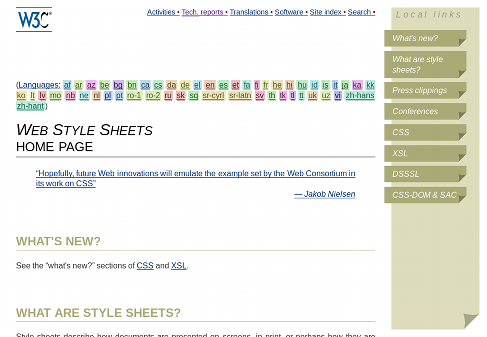
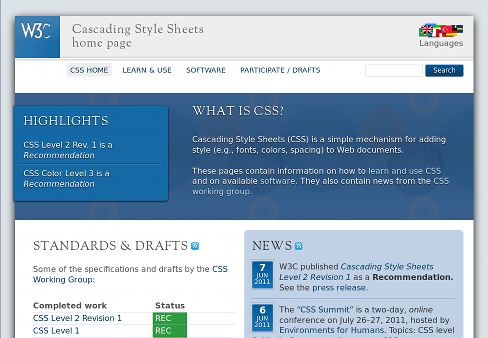
Along with the CSS2.1 Recommendation, we just went live with a new design for the CSS Working Group home page!
To give credit where it’s due, I thought I’d go over the history of the design and how it’s changed hands over the years.
Originally, the idea for a redesign came from Jason Cranford Teague who was AOL’s rep on the CSS Working Group back in 2008. He drew up the design briefs, while I worked out a new information architecture. He aimed to create a mood that was flowing, transparent, layered, professional, and informed
. Jason sketched wireframes for a new front page, and later, with feedback from the WG, several iterations of a
new design. This was before the W3C redesign, and so there wasn’t any concern for integration with the rest of W3C.
But the project, being a side-project for both of us, didn’t move very quickly. Then AOL pulled the plug on its W3C membership, leaving the CSSWG without a designer and Jason’s design work incomplete. In the meantime, W3C went live with its redesign.
Fast forward to late 2010, Bert Bos, our W3C Staff Contact who is in charge of the CSSWG website, was getting tired of the old design. In the process of setting up a new localizable templating system for the static pages that were there, he redesigned the site and pushed it live.
Shortly after this, Divya Manian realized the CSSWG could use some web design help and offered to implement Jason’s redesign. I forwarded her Jason’s earlier work and she worked those ideas into a new design that integrated better with W3C’s redesign. We worked together to improve the rendering on various screens sizes, using new CSS3 technology such as Media Queries to create a fluid layout that remains beautiful and readable at any window size. (Try resizing the design.) When it was finally presented on April 13th the CSSWG unanimously resolved to adopt Divya’s redesign.
Since then Bert, as the webmaster, decided the design needed some improvements. He reworked Divya’s redesign and, to mark the publication of the CSS2.1 Recommendation, pushed it live on June 7th.
Minutes and Resolutions Telecon 2011-05-25
- Discussed some details of CSS2.1 publication.
- Discussed Kyoto F2F agenda
- Resolved: Publish CSS Writing Modes as WD.
- Resolved: Once the WG gets an email saying that CSS Regions edits are done, publish as FPWD.
- Discussed what remains to publish CSS3 Images updated WD
- Discussed Namespaces and Unicode normalization
- Discussed CSSWG website and switching the blog to WordPress
Full minutes
CSS Lists Level 3 WD Published!
Posting on behalf of Tab Atkins:
The CSS Lists module was just published as a Working Draft yesterday. The previous WD was published 8½ years ago. Unless I get hit by a bus, we’ll finish the process to Rec in less time than that. ^_^
A quick summary of the changes since the last WD:
- Split the
outside value for list-style-position into two values: outside and hanging, reflecting the two classes of outside positioning that browsers actually do (Webkit and IE’s behavior is
close to the new outside, while Firefox and Opera are close to the
new hanging). hanging attaches the marker to the outside of the
text, while outside attaches it to the box, and makes it draw some
things (like ‘direction’) from the parent element.
- You can now specify a string as the value to
list-style-type to
use that as the list marker.
- The
inline value for list-style-type was added, alongside the new (well, repurposed) marker value for display. Using these in concert makes the first element with display:marker use its text
contents as the marker value. This is useful for documents where the list marker is a vital part of the content, and so must be included inline to ensure that it is displayed properly even when CSS is missing.
- The
::marker pseudoelement was defined, representing the list marker. It’s treated similarly to ::before and ::after in that it
accepts all properties.
- Most significantly, the
@counter-style rule was added, to allow
authors to define their own counter styles. As well, the giant list of counter styles in the old WD was recast as @counter-style rules in the UA style sheet.
- Processed a lot of corrections and feedback about the list of predefined counter styles.
The module should be feature-complete now, so I’m primarily seeking feedback on the new features. Are they defined well? Are there holes? Blatant mistakes? I’m also interested in any feedback on the predefined counter styles, as it’s still very possible that there are lingering mistakes I can’t catch because I’m solely an English speaker.
~TJ
Minutes and Resolutions Telecon 2011-05-18
Lots of key people missing this time, so no technical decisions were made.
- Discussed Kyoto F2F planning.
- Discussed status of Multi-col test suite, CSS2.1, Namespaces, Regions, and proposal to define intrinsic widths of multi-column elements.
- Resolved: Switch CSS test suites to Mercurial, providing there is adequate easy-to-follow documentation.
Full minutes


![[Photo: group photo of the CSS working group in San Francisco]](/Style/CSS/csswg-2016.jpg) Contact:
Contact:


