W3C First Public Working Draft
Copyright © 2026 World Wide Web Consortium. W3C® liability, trademark and permissive document license rules apply.
This specification describes a mechanism to protect optical barcodes, such as those found on driver's licenses (PDF417) and travel documents (MRZ), using Verifiable Credentials [VC-DATA-MODEL-2.0]. The Verifiable Credential representations are compact enough such that they fit in under 150 bytes and can thus be integrated with traditional two-dimensional barcodes that are printed on physical cards using standard printing processes.
This section describes the status of this document at the time of its publication. A list of current W3C publications and the latest revision of this technical report can be found in the W3C standards and drafts index.
This specification is experimental.
This document was published by the Verifiable Credentials Working Group as a First Public Working Draft using the Recommendation track.
Publication as a First Public Working Draft does not imply endorsement by W3C and its Members.
This is a draft document and may be updated, replaced, or obsoleted by other documents at any time. It is inappropriate to cite this document as other than a work in progress.
This document was produced by a group operating under the W3C Patent Policy. W3C maintains a public list of any patent disclosures made in connection with the deliverables of the group; that page also includes instructions for disclosing a patent. An individual who has actual knowledge of a patent that the individual believes contains Essential Claim(s) must disclose the information in accordance with section 6 of the W3C Patent Policy.
This document is governed by the 18 August 2025 W3C Process Document.
Physical credentials, such as driver's licenses, passports, and travel credentials often include machine-readable data that can be used to quickly read the information from the document. This information is encoded in formats such as PDF417 [ISO15438-2015], machine-readable zone (MRZ) [ICAO9303-3], and other optically scannable codes that are formatted in one-dimensional or two-dimensional "bars"; thus the term "barcode". This information is often not protected from tampering and the readily available barcode generation and scanning libraries mean that it is fairly trivial for anyone to generate these barcodes.
It is, therefore, useful for an issuer of these barcodes to protect the information contained within the barcode as well as the entity that generated the barcode.
The Verifiable Credentials Data Model v2.0 specification provides a global standard for expressing credential information, such as those in a driver's license or travel document. The Verifiable Credential Data Integrity 1.0 specification provides a global standard for securing credential information. These two specifications, when combined, provide a means of protecting credentials from tampering, expressing authorship of the credential, and providing the current status of a credential in a privacy-protecting manner. These data formats, however, tend to be too large to express in an optical barcode.
The Compact Binary Object Representation for Linked Data v0.7 specification provides a means of compressing secured verifiable credentials to the point at which it becomes feasible to express the information as an optical barcode, or embedded within an optical barcode.
This specification describes a mechanism to protect optical barcodes, such as those found on driver's licenses (PDF417) and travel documents (MRZ), by using a verifiable credential [VC-DATA-MODEL-2.0] to express information about the barcode, which is then secured using Data Integrity [VC-DATA-INTEGRITY], and then compressed using CBOR-LD [CBOR-LD]. The resulting verifiable credential representations are compact enough such that they fit in under 140 bytes and can thus be integrated with traditional two-dimensional barcodes that are printed on physical cards using standard printing processes. This adds tamper resistance to the barcode while optionally enhancing the barcode to provide information related to whether or not the physical document has been revoked or suspended by the issuer.
The following sections provide a few introductory examples of the ways this specification can be used to enhance existing physical credentials with digital signatures via verifiable credentials.
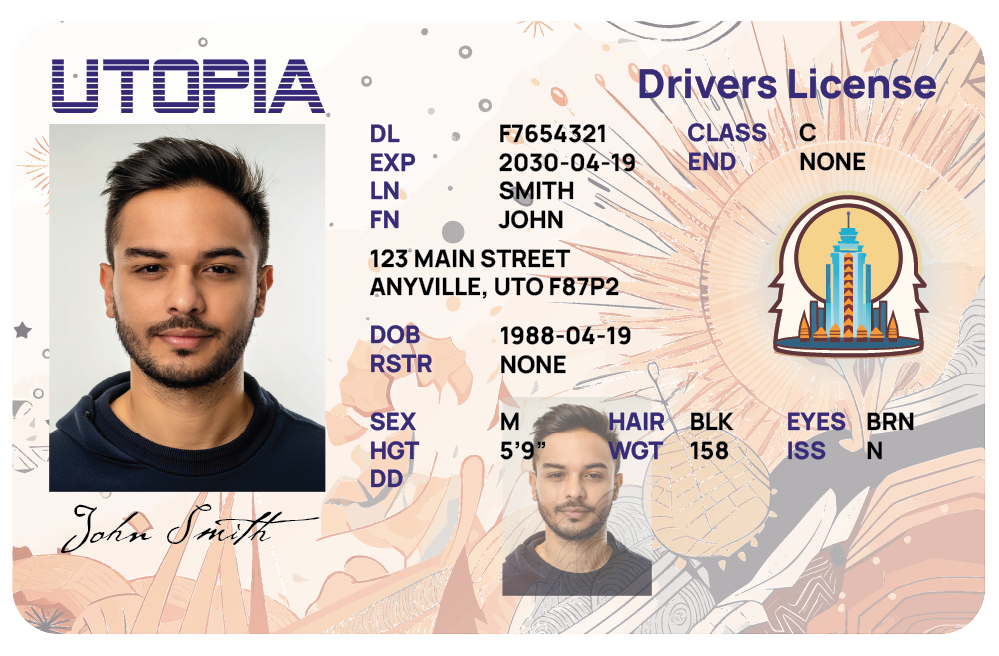
This section provides an example on how the technology in this specification can be utilized to secure the optical barcode on a driver's license that uses a PDF417 barcode. We start off with an example driver's license:
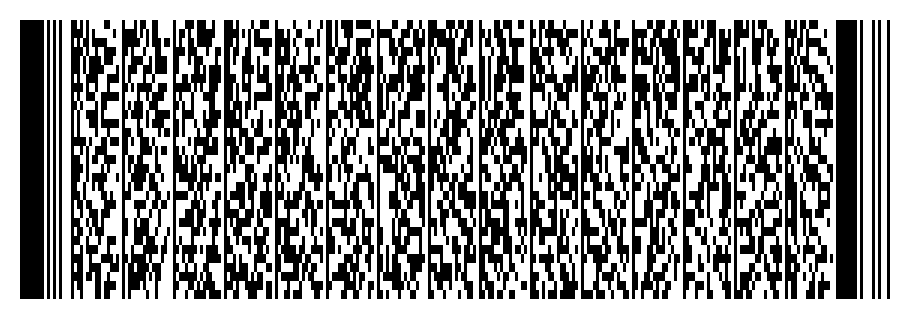
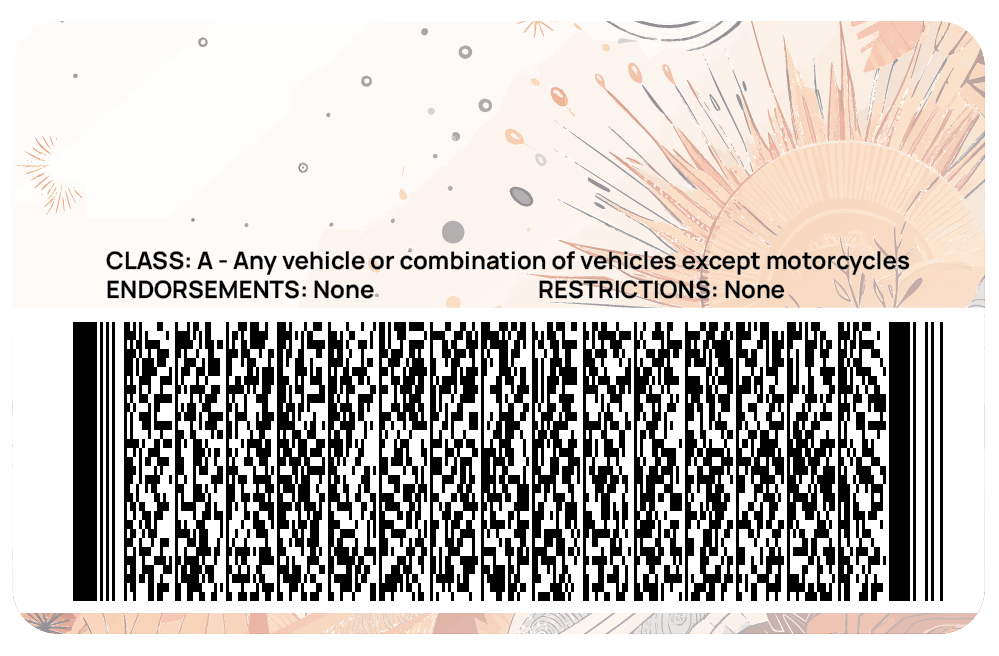
The back of the driver's license contains a PDF417 barcode:
The PDF417 data contains information that is secured using the algorithms described in this specification. Namely, the PDF417 barcode contains a verifiable credential of the following form.
{
"@context": [
"https://www.w3.org/ns/credentials/v2",
"https://w3id.org/vdl/v2",
"https://w3id.org/vdl/utopia/v1"
],
"type": [
"VerifiableCredential",
"OpticalBarcodeCredential"
],
// the issuer value below is defined as a URL in the 'utopia/v1' context above
"issuer": "did:web:dmv.utopia.example",
"credentialStatus": {
"type": "TerseBitstringStatusListEntry",
"terseStatusListBaseUrl": "https://dmv.utopia.gov/statuses/12345/status-lists"
"terseStatusListIndex": 123567890
},
"credentialSubject": {
"type": "AamvaDriversLicenseScannableInformation",
"protectedComponentIndex": "uP_BA"
},
"proof": {
"type": "DataIntegrity",
"cryptosuite": "ecdsa-xi-2023",
// the public key below is defined as a URL in the 'utopia/v1' context above
"verificationMethod": "did:web:dmv.utopia.example#key-1",
"proofPurpose": "assertionMethod",
"proofValue": "z4peo48uwK2EF4Fta8P...HzQMDYJ34r9gL"
}
}
The verifiable credential above is then compressed using [CBOR-LD] to the following output (in CBOR Diagnostic Notation):
1281{
1 => [ 32768, 32769, 32770], // @context
155 => [ 116, 164 ], // type
192 => 174, // issuer
186 => { 154 => 166, 206 => 178, 208 => 1234567890 }, // credentialStatus
188 => { 154 => 172, 180 => h'753FF040 }, // credentialSubject
194 => { // proof
154 => 108, // type
214 => 4, // cryptosuite
224 => 230 // verificationMethod
228 => 176, // proofPurpose
210 => Uint8Array(65) [ ... ], // proofValue
}
}
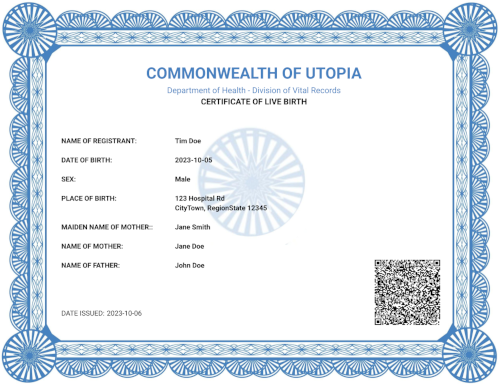
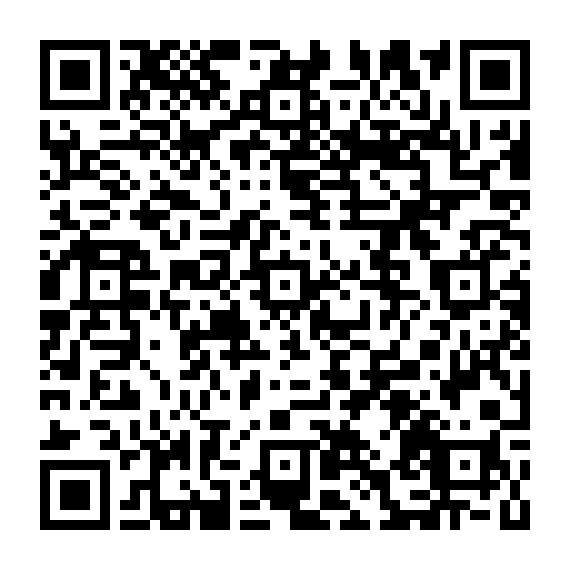
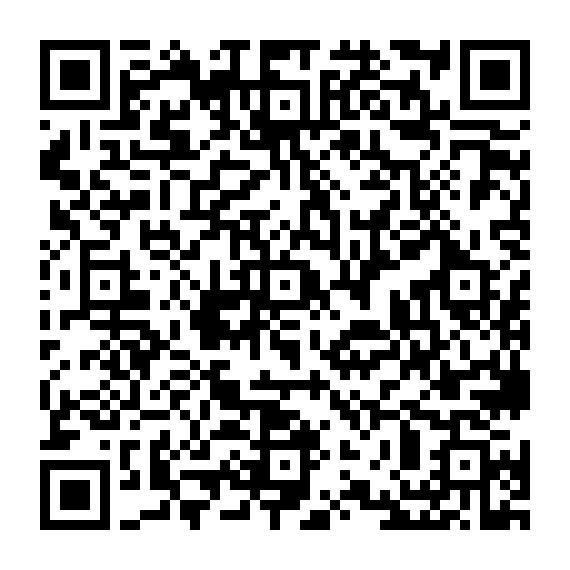
This section provides an example on how the technology in this specification can be utilized to secure a birth certificate as a verifiable credential, which is then expressed as a QR Code on the printed paper document:
The QR Code encodes the following verifiable credential. The details of the encoding are available as separate tabs below:
{
"@context": [
"https://www.w3.org/ns/credentials/v2",
"https://w3id.org/vital-records/v1rc1"
],
"type": [
"VerifiableCredential",
"BirthCertificateCredential"
],
"issuer": "https://hospital.example/issuer",
"validFrom": "2023-09-30T11:30:00Z",
"credentialSubject": {
"type": "BirthCertificate",
"certificationDate": "2023-09-30T13:44:52Z",
"newborn": {
"type": "Newborn",
"name": "Tim Doe",
"gender": "Male",
"birthDate": "2023-10-05T14:29:00Z",
"birthPlace": {
"type": "PostalAddress",
"streetAddress": "123 Hospital Rd",
"addressLocality": "Utopia Town",
"addressRegion": "Utopolis",
"postalCode": "12345",
"addressCountry": "Utopia"
},
"parent": [{
"type": "Mother",
"name": "Jane Doe",
"namePriorToMarriage": "Jane Smith"
}, {
"type": "Father",
"name": "John Doe"
}]
}
}
}{
"@context": [
"https://www.w3.org/ns/credentials/v2",
"https://w3id.org/vital-records/v1rc1"
],
"type": [
"VerifiableCredential",
"BirthCertificateCredential"
],
"issuer": "https://hospital.example/issuer",
"validFrom": "2023-09-30T11:30:00Z",
"credentialSubject": {
"type": "BirthCertificate",
"certificationDate": "2023-09-30T13:44:52Z",
"newborn": {
"type": "Newborn",
"name": "Tim Doe",
"gender": "Male",
"birthDate": "2023-10-05T14:29:00Z",
"birthPlace": {
"type": "PostalAddress",
"streetAddress": "123 Hospital Rd",
"addressLocality": "Utopia Town",
"addressRegion": "Utopolis",
"postalCode": "12345",
"addressCountry": "Utopia"
},
"parent": [
{
"type": "Mother",
"name": "Jane Doe",
"namePriorToMarriage": "Jane Smith"
},
{
"type": "Father",
"name": "John Doe"
}
]
}
},
"proof": {
"type": "DataIntegrityProof",
"created": "2026-04-09T20:55:04Z",
"verificationMethod": "did:key:zDnaeeFjSVHX7L5soLDPtUjBYxY8diEwRyMfej4ikeaFLrJow",
"cryptosuite": "ecdsa-rdfc-2019",
"proofPurpose": "assertionMethod",
"proofValue": "zTABDMQVnBWodddfDUvd5NhypRXCmpfqpXNQgJrFNgW4tf3kazJGJo2wq4aLEvnMMJe2BLtVkNBYeY7bL
2E4ZBHG"
}
}
51997(
[
1,
{
1: [
"https://www.w3.org/ns/credentials/v2",
"https://w3id.org/vital-records/v1rc1"
],
157: [
118,
164
],
304: {
156: 162,
204: "2023-09-30T13:44:52Z",
260: {
150: "Tim Doe",
156: 174,
188: "2023-10-05T14:29:00Z",
196: {
156: 178,
324: "Utopia",
326: "Utopia Town",
328: "Utopolis",
330: "12345",
332: "123 Hospital Rd"
},
226: "Male",
267: [
{
150: "Jane Doe",
156: 172,
258: "Jane Smith"
},
{
150: "John Doe",
156: 170
}
]
}
},
308: [
2,
"hospital.example/issuer"
],
310: {
156: 108,
336: 1775768104,
338: "ecdsa-rdfc-2019",
348: 354,
350: h'7a168ecefe36aeab3aaaa50d89d428365250d0611599423faaddaaa7d6d1668e9f895d7e68c8f07512a90
a55bd761b170ef6678c54af06953c5c41915d91502c27',
352: [
1025,
h'802402cd646cb3635ba4fc9204a3bb63e6ee0988f442017ec0d0f12ea7889e3470465e'
]
},
320: 1696073400
}
])}
VC1-R0OR*W3H90Q80L8FA9DIWENPEJ/5S4F03F53F7*5$KE$:5CPEXPC C1$CBWEAECCPEI.EL8FA9DIWENPEJ/553FPED7*5$K
E006-EDAECOX5Z C04EKVC006DB6DOC1534KG$-EOXKY60$RK0XJ6MK5%PNF6QF63W5CA79L6/SAJL6:Q66G7KG6B73KQ0*43$2D
YEDP34W3E053I53W531VE8466L6$963W5HX6-963G7PA7646OHBW%O053M53B735T86 A/3EMEDB73R+86 A/3EMED-3454EF-DD
70O8DHWES9EXVDZOEF70UZCQF60R6B73$T9*96%K6379WQE-EDAEC*34JTC-RS9Z9TVDB73LK1$RKT0J6I91/DP34W3E053G53B7
3XD06I91/D+34J$DAWE6MKT0JKI949DP34W3E053E53B73WS61E059DWQE-EDAEC.%5$9FQ$DTVDW:5ZQE%$E4JE+60+:K0XJ/TD
L70BF39ER535N70W3EJPCHQEOX57VC9OCNF61A6B73.SB*70B73W-BMC8BIM0LBYYT79DN+8KQ4LY4ZBAXH6NLN081F2MCKKHX4P
2UTITR.SYY5HG4M*L9-QCHJ7.UAENL-S: KCWF3YE7DLEB2V20GALB7319CE73T70/L4%O4K/PHXDAPCQ%KUKIKVKESC74U5EHMF
831GTIQI+59CHES6E+8B73U485ZCA%0
{
"@context": [
"https://www.w3.org/ns/credentials/v2",
"https://w3id.org/vital-records/v1rc1"
],
"type": [
"VerifiableCredential",
"BirthCertificateCredential"
],
"issuer": "https://hospital.example/issuer",
"validFrom": "2023-09-30T11:30:00Z",
"credentialSubject": {
"type": "BirthCertificate",
"certificationDate": "2023-09-30T13:44:52Z",
"newborn": {
"type": "Newborn",
"name": "Tim Doe",
"gender": "Male",
"birthDate": "2023-10-05T14:29:00Z",
"birthPlace": {
"type": "PostalAddress",
"streetAddress": "123 Hospital Rd",
"addressLocality": "Utopia Town",
"addressRegion": "Utopolis",
"postalCode": "12345",
"addressCountry": "Utopia"
},
"parent": [
{
"type": "Mother",
"name": "Jane Doe",
"namePriorToMarriage": "Jane Smith"
},
{
"type": "Father",
"name": "John Doe"
}
]
}
},
"proof": {
"type": "DataIntegrityProof",
"created": "2026-04-09T20:55:04Z",
"verificationMethod": "did:key:zDnaeeFjSVHX7L5soLDPtUjBYxY8diEwRyMfej4ikeaFLrJow",
"cryptosuite": "ecdsa-rdfc-2019",
"proofPurpose": "assertionMethod",
"proofValue": "z4YX7BdLAErePQyLc6H8SNU9thJSepopoCnnYPvndxjZMs8ZWnXTv8Ddod3WsK73osbj5WgXprSuqJvfu
x3xXDWjx"
}
}}
The following are the design goals of the technology in this specification:
Terminology used throughout this document is defined in the Terminology section of the Verifiable Credentials Data Model v2.0 specification as well as the Verifiable Credential Data Integrity 1.0 specification.
A and B),
using Unicode Codepoint Collation,
as defined in [XPATH-FUNCTIONS],
which defines a
total ordering
of strings comparing code points.
Note that for UTF-8 encoded strings, comparing the byte sequences gives the same result as code point order.
As well as sections marked as non-normative, all authoring guidelines, diagrams, examples, and notes in this specification are non-normative. Everything else in this specification is normative.
The key words MUST, RECOMMENDED, REQUIRED, and SHOULD in this document are to be interpreted as described in BCP 14 [RFC2119] [RFC8174] when, and only when, they appear in all capitals, as shown here.
A conforming document is any concrete expression of the data model that complies with the normative statements in this specification. Specifically, all relevant normative statements in Sections 2. Data Model and 3. Algorithms of this document MUST be enforced.
A conforming processor is any algorithm realized as software and/or hardware that generates or consumes a conforming document. Conforming processors MUST produce errors when non-conforming documents are consumed.
This document contains examples of JSON and JSON-LD data. Some of these examples
are invalid JSON, as they include features such as inline comments (//)
explaining certain portions and ellipses (...) indicating the omission of
information that is irrelevant to the example. Such parts need to be
removed if implementers want to treat the examples as valid JSON or JSON-LD.
The following sections outline the data model that is used by this specification to express verifiable credentials that secure optically printed information such as barcodes and machine-readable zones on travel documents.
An OpticalBarcodeCredential is used to secure the contents of an optical
barcode in a way that provides 1) authorship information , 2) tamper
resistance, and 3) optionally, revocation and suspension status. In other words,
the credential can tell you who issued the optical barcode, if the
optical barcode has been tampered with since it was first issued, and
whether or not the issuer of the optical barcode still warrants that
the document is still valid or not. These features provide significant
anti-fraud protections for physical documents.
The credentialSubject of an OpticalBarcodeCredential is either of type
AamvaDriversLicenseScannableInformation or a MachineReadableZone. A
AamvaDriversLicenseScannableInformation signifies that
the verifiable credential secures the PDF417 barcode on the physical
document as well as the information expressed in the
verifiable credential. A MachineReadableZone signifies that
the verifiable credential secures the machine-readable zone on the
physical document as well as the information expressed in the
verifiable credential.
If an OpticalBarcodeCredential is of type AamvaDriversLicenseScannableInformation,
there is a REQUIRED additional field protectedComponentIndex that contains information about which fields
in the PDF417 are digitally signed. protectedComponentIndex MUST be a three byte/24 bit value that is
multibase-base64url encoded for a total of 5 characters in the JSON-LD credential. There are 22
mandatory fields in an AAMVA compliant driver's license PDF417 [aamva-dl-id-card-design-standard],
and the first 22 bits of the protectedComponentIndex value correspond to these fields. Each AAMVA mandatory
field begins with a three character element ID (e.g., DBA for document expiration date). To construct
a mapping between bits in the protectedComponentIndex value and these fields, sort these element IDs
according to Unicode code point order. Then, if a bit in position i of protectedComponentIndex is 1, the
AAMVA mandatory field in position i of the sorted element IDs is protected by the digital signature. The last two
bits in protectedComponentIndex MUST be 0. For more information, see Section 3.2.4.4 Create opticalDataBytes.
In order to achieve as much compression as possible, it is RECOMMENDED that the
issuer and verificationMethod fields utilize terms from a JSON-LD Context,
which can then be compressed down to a few bytes due to CBOR-LD's semantic
compression mechanism.
An example of an optical barcode credential that utilizes the properties specified in this section is provided below:
{
"@context": [
"https://www.w3.org/ns/credentials/v2",
"https://w3id.org/vdl/v2",
"https://w3id.org/vdl/utopia/v1"
],
"type": [
"VerifiableCredential",
"OpticalBarcodeCredential"
],
"issuer": "did:web:dmv.utopia.example",
"credentialStatus": {
"type": "TerseBitstringStatusListEntry",
"terseStatusListBaseUrl": "dmv.utopia.gov/statuses/12345/status-lists"
"terseStatusListIndex": 123567890
},
"credentialSubject": {
"type": "AamvaDriversLicenseScannableInformation",
"protectedComponentIndex": "uP_BA"
}
}
A TerseBitstringStatusListEntry is a compact representation
of a BitstringStatusListEntry as defined in the Bitstring Status List v1.0
specification.
An object of type TerseBitstringStatusListEntry MUST have two additional properties:
terseStatusListBaseUrl, which identifies the location of the status lists associated with this credential.
terseStatusListBaseUrl MUST be a URL [URL].
terseStatusListIndex, which specifies an individual status at the above URL. terseStatusListIndex MUST be
representable as a 32 bit unsigned integer.
To process a TerseBitstringStatusListEntry, apply the algorithm in Section
3.2.3 Convert Status List Entries to convert it to a BitstringStatusListEntry,
then process it as in Bitstring Status List v1.0.
Implementers need to set a value listLength for the length of an individual status list. This then yields
a number of status lists listCount = 2^32 / listLength for a 32-bit terseStatusListIndex.
listLength is needed to convert from a TerseBitstringStatusListEntry to a BitstringStatusListEntry.
Noting that some values of listLength will harm the privacy-preserving properties of these status lists,
implementations MUST use listLength = 2^26 and listCount = 2^6.
It is RECOMMENDED that implementers character-encode CBOR-LD encoded AamvaDriversLicenseScannableInformation
credentials as base64url before encoding them in a PDF417.
It is REQUIRED that implementers re-encode CBOR-LD encoded MachineReadableZone credentials
as base45-multibase with the string 'VC1-' prepended before encoding them in a QR code.
The following section describes algorithms for adding and verifying digital proofs that protect optical information, such as barcodes and machine-readable zones, on physical media, such as driver's licenses and travel documents.
This section contains algorithms that are general to encoding and decoding verifiable credentials.
This specification requires that an application-specific compression table is provided to a CBOR-LD processor when encoding and decoding verifiable credentials. A registry for all context URLs for various issuers is provided as a comma-separated value file and can be updated and modified via change requests to the file on an append-only and first-come-first-served basis. Implementations SHOULD retrieve and utilize the latest file on a monthly basis to ensure that compression and decompression supports the latest values.
The following algorithm specifies how to encode a verifiable credential into a text string that can be expressed in a QR Code. Required inputs are a verifiable credential (map inputDocument), and a set of options (map options). The output is an encoded verifiable credential (string) or an error. Whenever this algorithm encodes strings, it MUST use UTF-8 encoding.
45 as targetBase, and
0123456789ABCDEFGHIJKLMNOPQRSTUVWXYZ $%*+-./: as the baseAlphabet.
VC1-,
R (the Multibase prefix for base45), and
base45Value.
The following algorithm specifies how to decode a verifiable credential that has been encoded into a QR Code. Required inputs are a text string (string inputDocument), and a set of options (map options). The output is a verifiable credential (map) or an error. Whenever this algorithm encodes strings, it MUST use UTF-8 encoding.
VC1-R. If it does not an
error MUST be raised.
VC1-R)
removed.
45 as sourceBase, and
0123456789ABCDEFGHIJKLMNOPQRSTUVWXYZ $%*+-./: as the baseAlphabet.
This section contains algorithms that are specific to encoding and decoding
verifiable credentials that have a type of OpticalBarcodeCredential.
BitstringStatusListCredential
(as defined in the Bitstring Status List v1.0 specification) that the issuer
wishes to add to the OpticalBarcodeCredential.
TerseBitstringStatusListEntry and statusListEntryTerse.index to the integer representation of statusListEntryVerbose.statusListIndex.
OpticalBarcodeCredential with
unsignedStatus.issuer set to issuerUrl and unsignedStatus.credentialStatus
set to statusListEntryTerse.
OpticalBarcodeCredential in securedDocument.
The algorithm in this section is used to convert the
TerseBitstringStatusListEntry to a BitstringStatusListEntry, which is used
after verification has been performed on the verifiable credential,
during the validation process.
After verifiable credential verification has been performed, the
algorithm takes an OpticalBarcodeCredential verifiable credential
(struct vc), an integer listLength containing the number of entries
in the BitstringStatusListCredential associated with vc, and a string
statusPurpose (e.g., 'revocation', 'suspension'...) as input and returns
a 'BitstringStatusListEntry' object.
floor() operation).
result can be used as input to the validation algorithm in the Bitstring Status List v1.0 specification.
Implementers are advised that not all issuers will publish status list information for their verifiable credentials. Some issuers might require authorization before allowing a verifier to access a status list credential.
The ecdsa-xi-2023 cryptosuite is effectively the ecdsa-rdfc-2019
algorithm [VC-DI-ECDSA] with an added step that takes some "extra information"
(xi) as input, such as the original optical barcode data, and includes that data
in the information that is protected by the digital signature. The algorithms in
this section detail how such a signature is created and verified.
To generate a proof, the algorithm in Section 4.1: Add Proof in the Data Integrity [VC-DATA-INTEGRITY] specification MUST be executed. For that algorithm, the cryptographic suite specific transformation algorithm is defined in the Transformation (ecdsa-rdfc-2019) section of the Data Integrity ECDSA Cryptosuites v1.0, the hashing algorithm is defined in Section 3.2.4.3 Hashing (ecdsa-xi-2023), and the proof serialization algorithm is defined in the Proof Serialization (ecdsa-rdfc-2019) section of the Data Integrity ECDSA Cryptosuites v1.0.
To verify a proof, the algorithm in Section 4.2: Verify Proof in the Data Integrity [VC-DATA-INTEGRITY] specification MUST be executed. For that algorithm, the cryptographic suite specific transformation algorithm is defined in the Transformation (ecdsa-rdfc-2019) section of the Data Integrity ECDSA Cryptosuites v1.0, the hashing algorithm is defined in Section 3.2.4.3 Hashing (ecdsa-xi-2023), and the proof verification algorithm is defined in the Proof Verification (ecdsa-rdfc-2019) section of the Data Integrity ECDSA Cryptosuites v1.0.
The hashing algorithm is what is defined in the Hashing (ecdsa-rdfc-2019) section of the Data Integrity ECDSA Cryptosuites v1.0 specification with the addition of the hashing of the optical data, as described below. It is presumed that the implementation makes the machine-readable optical data (PDF417 or MRZ data) available to this hashing algorithm.
The required inputs to this algorithm are a transformed data document (transformedDocument), a canonical proof configuration (canonicalProofConfig), and the optical data (opticalDataBytes). A single hash data value represented as series of bytes is produced as output.
The hashing algorithm is what is defined in the Hashing (ecdsa-rdfc-2019) section of the Data Integrity ECDSA Cryptosuites v1.0 with step 3 replaced with the following two steps:
credentialSubject.protectedComponentIndex from multibase-base64url to binary.
1 in bitfieldDecoded:
\n, U+000A) to the end,
and append the result to dataToCanonicalize.
The proof configuration algorithm is what is defined in the Proof Configuration (ecdsa-rdfc-2019) section of the Data Integrity ECDSA Cryptosuites v1.0 with step 4 replaced with the following step:
DataIntegrityProof and
proofConfig.cryptosuite is not set to ecdsa-xi-2023, an
INVALID_PROOF_CONFIGURATION error MUST be raised.
This section is non-normative.
Before reading this section, readers are urged to familiarize themselves with general security advice provided in the Security Considerations section of the Data Integrity specification as well as the specific security advice provided in the Security Considerations section of the ECDSA Cryptosuites specification.
In the following sections, we review these important points and direct the reader to additional information.
One attack vector against OpticalBarcodeCredentials involves duplicating
an optical barcode containing a digital signature for use on a fraudulent document.
While a duplicated barcode will pass signature validation like the original, this attack
is mitigated by the document verifier checking the following three things: the signed data
matches the data visible on the document, the signed data matches the physical attributes of
the user, and the visible data matches the physical attributes of the user. When these
three are all equivalent, the only way the OpticalBarcodeCredential could be a
duplicate is if the fraudulent document creator had access to a real
OpticalBarcodeCredential where the signed physical attributes fully overlapped
with those of the user of the fraudulent document. The low likelihood of an undetected
stolen OpticalBarcodeCredential existing that completely matches the appearance
of an arbitrary person makes this attack unlikely to succeed.
It is possible that in some cases the digital signature cannot be created
over the entirety of the existing optical data. For example, consider a case
where a serial number is injected by a physical credential manufacturer such
that it is not known to the issuer at signature time. In this case, the verifier
will assume that any data not digitally signed could have been changed in
the optical barcode without impacting the OpticalBarcodeCredential's
ability to successfully validate.
When checking that data from the optical barcode matches the data visible on the document as well as the characteristics of the document holder, implementers are advised to only use the fields that are digitally signed. Verifiers are advised to only use fields protected by the digital signature, no matter how commonly the other fields are used for fraud detection on unsigned documents. For example, if eye color and hair color are protected by the signature, but the holder's portrait is not, verifiers are advised to emphasize the eye color and hair color when attempting to detect fraud over the portrait.
Implementers of software used by verifiers are advised to only display card data that has been secured via digital signature during the verification process. Displaying unsigned data, which could have been tampered with, could interfere with fraud detection.
Verifiers are advised to always use trusted programs and interfaces to check the validity
of the OpticalBarcodeCredential. Use of untrusted software to verify a document
could result in a fraudulent credential being accepted, or a genuine credential being stolen.
Before reading this section, readers are urged to familiarize themselves with general security advice provided in the Security Considerations section of the Data Integrity specification as well as the specific security advice provided in the Security Considerations section of the ECDSA Cryptosuites specification.
The following section describes privacy considerations that developers implementing this specification should be aware of in order to avoid violating privacy assumptions.
This section is non-normative.
This section contains examples of Verifiable Credential Barcodes as well as step-by-step processes for how they are generated and how they are verified.
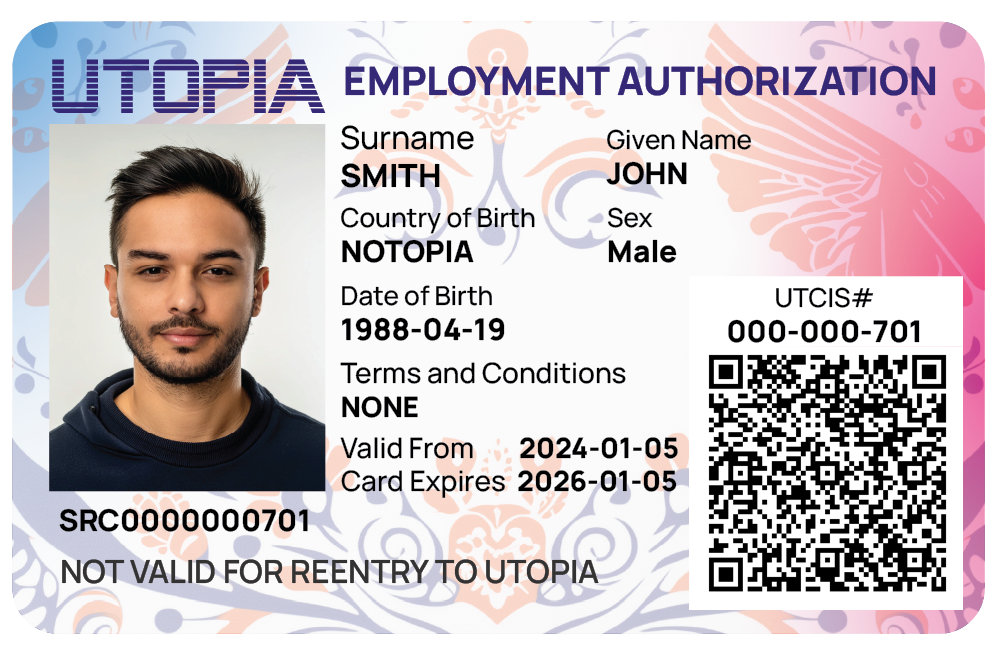
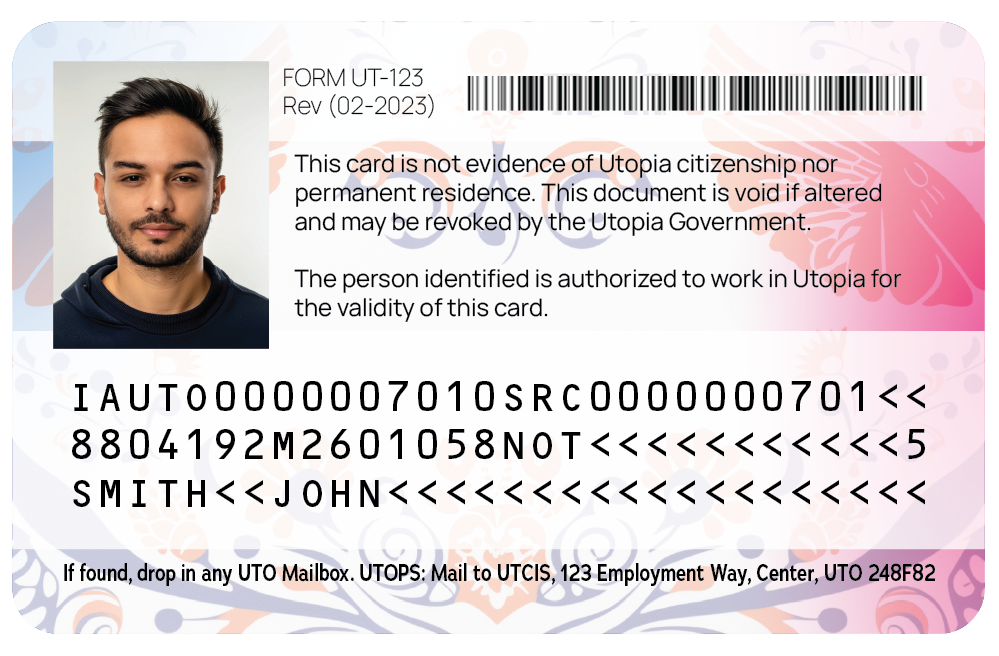
In this section we will analyze two running examples: a VCB securing the MRZ of a Utopia Employment Authorization Document, and a VCB securing the PDF417 of a Utopia Driver's License.
We start with the data that will be signed by the VCB (i.e., mandatory AAMVA fields from a PDF417):
DACJOHN DADNONE DAG123 MAIN ST DAIANYVILLE DAJUTO DAKF87P20000 DAQF987654321 DAU069 IN DAYBRO DBA04192030 DBB04191988 DBC1 DBD01012024 DCAC DCBNONE DCDNONE DCFUTODOCDISCRIM DCGUTO DCSSMITH DDEN DDFN DDGN
Assume for simplicity that the only data in the PDF417 that you want to sign is first
name (DAC), last name (DCS), and license number (DAQ). The bitstring value for use in
protectedComponentIndex is then 100000100000000000100000, and the value of
protectedComponentIndex is "uggAg". Applying
3.2.4.4 Create opticalDataBytes, we get
canonicalizedData = 'DACJOHN\nDAQ987654321\nDCSSMITH\n' opticalDataBytes: [188, 38, 200, 146, 227, 213, 90, 250, 50, 18, 126, 254, 47, 177, 91, 23, 64, 129, 104, 223, 136, 81, 116, 67, 136, 125, 137, 165, 117, 63, 152, 207]
We can now use this hash value with
3.2.4.3 Hashing (ecdsa-xi-2023) to sign the VC.
Executing 3.2.1 Encode OpticalBarcodeCredential with a
BitstringStatusListCredential, we get the following JSON-LD VC:
{
"@context": [
"https://www.w3.org/ns/credentials/v2",
"https://w3id.org/vc-barcodes/v1",
"https://w3id.org/utopia/v2"
],
"type": [
"VerifiableCredential",
"OpticalBarcodeCredential"
],
"credentialSubject": {
"type": "AamvaDriversLicenseScannableInformation",
"protectedComponentIndex": "uggAg"
},
"issuer": "did:key:zDnaeWjKfs1ob9QcgasjYSPEMkwq31hmvSAWPVAgnrt1e9GKj",
"credentialStatus": {
"type": "TerseBitstringStatusListEntry",
"terseStatusListBaseUrl": "https://sandbox.platform.veres.dev/statuses/z19rJ4oGrbFCqf3cNTVDHSbNd/status-lists",
"terseStatusListIndex": 3851559041
},
"proof": {
"type": "DataIntegrityProof",
"verificationMethod": "did:key:zDnaeWjKfs1ob9QcgasjYSPEMkwq31hmvSAWPVAgnrt1e9GKj#zDnaeWjKfs1ob9QcgasjYSPEMkwq31hmvSAWPVAgnrt1e9GKj",
"cryptosuite": "ecdsa-xi-2023",
"proofPurpose": "assertionMethod",
"proofValue": "z4g6G3dAZhhtPxPWgFvkiRv7krtCaeJxjokvL46fchAFCXEY3FeX2vn46MDgBaw779g1E1jswZJxxreZDCrtHg2qH"
}
}
We can now apply CBOR-LD compression to this VC. Here, we use the newest version of CBOR-LD; however, at the end of the section, we provide VCBs encoded using older versions of CBOR-LD for interoperability testing with CBOR-LD implementations that are not up to date.
For this specification, we have reserved the CBOR-LD registry entry
with value 100 (i.e., these payloads will begin with tag 0x0664). The parameters
to encode using CBOR-LD, which can be found in the registry in the CBOR-LD
specification, are then as follows:
registryEntryId: 100
typeTable:
{
"context":
{
"https://www.w3.org/ns/credentials/v2": 32768,
"https://w3id.org/vc-barcodes/v1": 32769,
"https://w3id.org/utopia/v2": 32770
},
"https://w3id.org/security#cryptosuiteString":
{
"ecdsa-rdfc-2019": 1,
"ecdsa-sd-2023": 2,
"eddsa-rdfc-2022": 3,
"ecdsa-xi-2023": 4
}
}
The term-to-ID mapping that should result from processing the contexts and assigning integer values to context terms is as follows:
Map(97) {
'@context' => 0,
'@type' => 2,
'@id' => 4,
'@value' => 6,
'@direction' => 8,
'@graph' => 10,
'@included' => 12,
'@index' => 14,
'@json' => 16,
'@language' => 18,
'@list' => 20,
'@nest' => 22,
'@reverse' => 24,
'@base' => 26,
'@container' => 28,
'@default' => 30,
'@embed' => 32,
'@explicit' => 34,
'@none' => 36,
'@omitDefault' => 38,
'@prefix' => 40,
'@preserve' => 42,
'@protected' => 44,
'@requireAll' => 46,
'@set' => 48,
'@version' => 50,
'@vocab' => 52,
'...' => 100,
'BitstringStatusList' => 102,
'BitstringStatusListCredential' => 104,
'BitstringStatusListEntry' => 106,
'DataIntegrityProof' => 108,
'EnvelopedVerifiableCredential' => 110,
'EnvelopedVerifiablePresentation' => 112,
'JsonSchema' => 114,
'JsonSchemaCredential' => 116,
'VerifiableCredential' => 118,
'VerifiablePresentation' => 120,
'_sd' => 122,
'_sd_alg' => 124,
'aud' => 126,
'cnf' => 128,
'description' => 130,
'digestMultibase' => 132,
'digestSRI' => 134,
'exp' => 136,
'iat' => 138,
'id' => 140,
'iss' => 142,
'jku' => 144,
'kid' => 146,
'mediaType' => 148,
'name' => 150,
'nbf' => 152,
'sub' => 154,
'type' => 156,
'x5u' => 158,
'AamvaDriversLicenseScannableInformation' => 160,
'MachineReadableZone' => 162,
'OpticalBarcodeCredential' => 164,
'TerseBitstringStatusListEntry' => 166,
'protectedComponentIndex' => 168,
'did:key:zDnaeWjKfs1ob9QcgasjYSPEMkwq31hmvSAWPVAgnrt1e9GKj' => 170,
'did:key:zDnaeWjKfs1ob9QcgasjYSPEMkwq31hmvSAWPVAgnrt1e9GKj#zDnaeWjKfs1ob9QcgasjYSPEMkwq31hmvSAWPVAgnrt1e9GKj' => 172,
'did:key:zDnaeZSD9XcuULaS8qmgDUa6TMg2QjF9xABnZK42awDH3BEzj' => 174,
'did:key:zDnaeZSD9XcuULaS8qmgDUa6TMg2QjF9xABnZK42awDH3BEzj#zDnaeZSD9XcuULaS8qmgDUa6TMg2QjF9xABnZK42awDH3BEzj' => 176,
'https://sandbox.platform.veres.dev/statuses/z19rJ4oGrbFCqf3cNTVDHSbNd/status-lists' => 178,
'confidenceMethod' => 180,
'credentialSchema' => 182,
'credentialStatus' => 184,
'credentialSubject' => 186,
'evidence' => 188,
'issuer' => 190,
'proof' => 192,
'refreshService' => 194,
'relatedResource' => 196,
'renderMethod' => 198,
'termsOfUse' => 200,
'validFrom' => 202,
'validUntil' => 204,
'terseStatusListBaseUrl' => 206,
'terseStatusListIndex' => 208,
'challenge' => 210,
'created' => 212,
'cryptosuite' => 214,
'domain' => 216,
'expires' => 218,
'nonce' => 220,
'previousProof' => 222,
'proofPurpose' => 224,
'proofValue' => 226,
'verificationMethod' => 228,
'assertionMethod' => 230,
'authentication' => 232,
'capabilityDelegation' => 234,
'capabilityInvocation' => 236,
'keyAgreement' => 238
}
For more information on the above, see 6.3 Implementation Notes.
This results in the following encoded credential:
D9CB1D821864A60183198000198001198002189D82187618A418B8A3189C18A618CE18B218D01AE592208118BAA2189C18A018A8447582002018BE18AA18C0A5189C186C18D60418E018E618E258417AB7C2E56B49E2CCE62184CE26818E15A8B173164401B5D3BB93FFD6D2B5EB8F6AC0971502AE3DD49D17EC66528164034C912685B8111BC04CDC9EC13DBADD91CC18E418AC
diagnostic:
51997([
100,
{
1: [32768, 32769, 32770],
157: [118, 164],
184: {156: 166, 206: 178, 208: 3851559041},
186: {156: 160, 168: h'75820020'},
190: 170,
192: {
156: 108,
214: 4,
224: 230,
226: h'7AB7C2E56B49E2CCE62184CE26818E15A8B173164401B5D3BB93FFD6D2B5EB8F6AC0971502AE3DD49D17EC66528164034C912685B8111BC04CDC9EC13DBADD91CC',
228: 172
}
}
])
Encoding the Driver's License CBOR-LD as base64url and inserting the result into the PDF417 bytes in the 'ZZA' field in the 'ZZ' subfile:
bytes(@\n\x1e\rANSI 000000090002DL00410234ZZ02750202DLDAQF987654321\nDCSSMITH\nDDEN\nDACJOHN\nDDFN\nDADNONE\nDDGN\nDCAC\nDCBNONE\nDCDNONE\nDBD01012024\nDBB04191988\nDBA04192030\nDBC1\nDAU069 IN\nDAYBRO\nDAG123 MAIN ST\nDAIANYVILLE\nDAJUTO\nDAKF87P20000 \nDCFUTODOCDISCRIM\nDCGUTO\nDAW158\nDCK1234567890\nDDAN\rZZZZA2csdghhkpgGDGYAAGYABGYACGJ2CGHYYpBi4oxicGKYYzhiyGNAa5ZIggRi6ohicGKAYqER1ggAgGL4YqhjApRicGGwY1gQY4BjmGOJYQXq3wuVrSeLM5iGEziaBjhWosXMWRAG107uT/9bSteuPasCXFQKuPdSdF+xmUoFkA0yRJoW4ERvATNyewT263ZHMGOQYrA==\r)
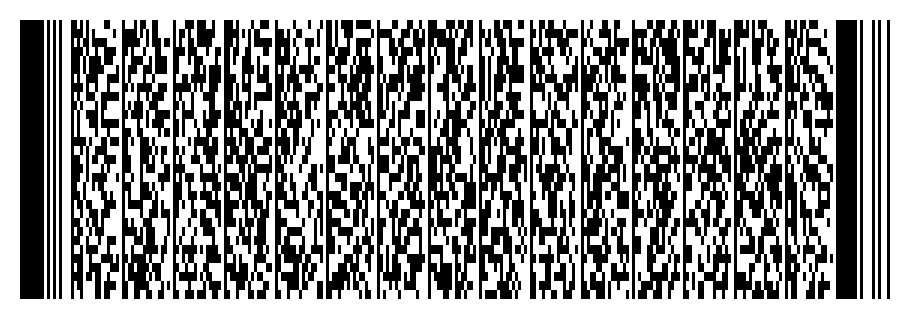
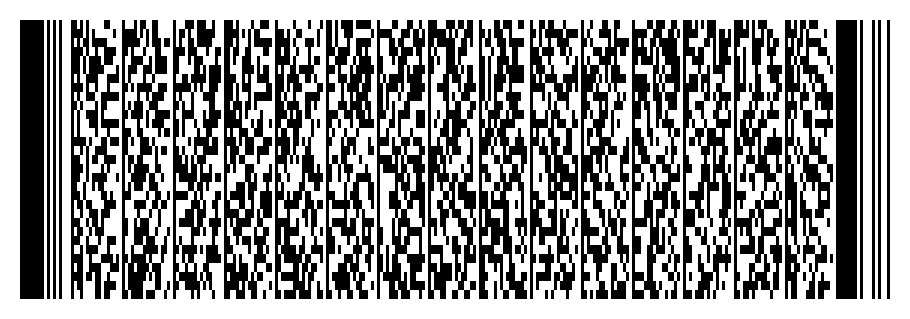
The above can now be turned into a barcode:
We now apply the reverse process to verify.
We first read the data from the PDF417:
bytes(@\n\x1e\rANSI 000000090002DL00410234ZZ02750202DLDAQF987654321\nDCSSMITH\nDDEN\nDACJOHN\nDDFN\nDADNONE\nDDGN\nDCAC\nDCBNONE\nDCDNONE\nDBD01012024\nDBB04191988\nDBA04192030\nDBC1\nDAU069 IN\nDAYBRO\nDAG123 MAIN ST\nDAIANYVILLE\nDAJUTO\nDAKF87P20000 \nDCFUTODOCDISCRIM\nDCGUTO\nDAW158\nDCK1234567890\nDDAN\rZZZZA2QZkpgGDGYAAGYABGYACGJ2CGHYYpBi4oxicGKYYzhiyGNAa5ZIggRi6ohicGKAYqER1ggAgGL4YqhjApRicGGwY1gQY4BjmGOJYQXq3wuVrSeLM5iGEziaBjhWosXMWRAG107uT_9bSteuPasCXFQKuPdSdF-xmUoFkA0yRJoW4ERvATNyewT263ZHMGOQYrA==\r)
We extract the data in field 'ZZA' in subfile 'ZZ', undoing the base encoding:
d90664a60183198000198001198002189d82187618a418b8a3189c18a618ce18b218d01ae592208118baa2189c18a018a8447582002018be18aa18c0a5189c186c18d60418e018e618e258417ab7c2e56b49e2cce62184ce26818e15a8b173164401b5d3bb93ffd6d2b5eb8f6ac0971502ae3dd49d17ec66528164034c912685b8111bc04cdc9ec13dbadd91cc18e418ac
We now decompress with CBOR-LD to get the original JSON-LD VC to be
verified. Again, the parameters are associated with CBOR-LD
registry entry 100.
typeTable:
{
"context":
{
"https://www.w3.org/ns/credentials/v2": 32768,
"https://w3id.org/vc-barcodes/v1": 32769,
"https://w3id.org/utopia/v2": 32770
},
"https://w3id.org/security#cryptosuiteString":
{
"ecdsa-rdfc-2019": 1,
"ecdsa-sd-2023": 2,
"eddsa-rdfc-2022": 3,
"ecdsa-xi-2023": 4
}
}
The ID-to-term mapping that should result from processing the contexts and assigning integer values to context terms is as follows. Note that this is the inverse of the map constructed during compression.
Map(97) {
0 => '@context',
2 => '@type',
4 => '@id',
6 => '@value',
8 => '@direction',
10 => '@graph',
12 => '@included',
14 => '@index',
16 => '@json',
18 => '@language',
20 => '@list',
22 => '@nest',
24 => '@reverse',
26 => '@base',
28 => '@container',
30 => '@default',
32 => '@embed',
34 => '@explicit',
36 => '@none',
38 => '@omitDefault',
40 => '@prefix',
42 => '@preserve',
44 => '@protected',
46 => '@requireAll',
48 => '@set',
50 => '@version',
52 => '@vocab',
100 => '...',
102 => 'BitstringStatusList',
104 => 'BitstringStatusListCredential',
106 => 'BitstringStatusListEntry',
108 => 'DataIntegrityProof',
110 => 'EnvelopedVerifiableCredential',
112 => 'EnvelopedVerifiablePresentation',
114 => 'JsonSchema',
116 => 'JsonSchemaCredential',
118 => 'VerifiableCredential',
120 => 'VerifiablePresentation',
122 => '_sd',
124 => '_sd_alg',
126 => 'aud',
128 => 'cnf',
130 => 'description',
132 => 'digestMultibase',
134 => 'digestSRI',
136 => 'exp',
138 => 'iat',
140 => 'id',
142 => 'iss',
144 => 'jku',
146 => 'kid',
148 => 'mediaType',
150 => 'name',
152 => 'nbf',
154 => 'sub',
156 => 'type',
158 => 'x5u',
160 => 'AamvaDriversLicenseScannableInformation',
162 => 'MachineReadableZone',
164 => 'OpticalBarcodeCredential',
166 => 'TerseBitstringStatusListEntry',
168 => 'protectedComponentIndex',
170 => 'did:key:zDnaeWjKfs1ob9QcgasjYSPEMkwq31hmvSAWPVAgnrt1e9GKj',
172 => 'did:key:zDnaeWjKfs1ob9QcgasjYSPEMkwq31hmvSAWPVAgnrt1e9GKj#zDnaeWjKfs1ob9QcgasjYSPEMkwq31hmvSAWPVAgnrt1e9GKj',
174 => 'did:key:zDnaeZSD9XcuULaS8qmgDUa6TMg2QjF9xABnZK42awDH3BEzj',
176 => 'did:key:zDnaeZSD9XcuULaS8qmgDUa6TMg2QjF9xABnZK42awDH3BEzj#zDnaeZSD9XcuULaS8qmgDUa6TMg2QjF9xABnZK42awDH3BEzj',
178 => 'https://sandbox.platform.veres.dev/statuses/z19rJ4oGrbFCqf3cNTVDHSbNd/status-lists',
180 => 'confidenceMethod',
182 => 'credentialSchema',
184 => 'credentialStatus',
186 => 'credentialSubject',
188 => 'evidence',
190 => 'issuer',
192 => 'proof',
194 => 'refreshService',
196 => 'relatedResource',
198 => 'renderMethod',
200 => 'termsOfUse',
202 => 'validFrom',
204 => 'validUntil',
206 => 'terseStatusListBaseUrl',
208 => 'terseStatusListIndex',
210 => 'challenge',
212 => 'created',
214 => 'cryptosuite',
216 => 'domain',
218 => 'expires',
220 => 'nonce',
222 => 'previousProof',
224 => 'proofPurpose',
226 => 'proofValue',
228 => 'verificationMethod',
230 => 'assertionMethod',
232 => 'authentication',
234 => 'capabilityDelegation',
236 => 'capabilityInvocation',
238 => 'keyAgreement'
}
For more information on the above, see 6.3 Implementation Notes.
Decompression then yields the following credential:
{
"@context": [
"https://www.w3.org/ns/credentials/v2",
"https://w3id.org/vc-barcodes/v1",
"https://w3id.org/utopia/v2"
],
"type": [
"VerifiableCredential",
"OpticalBarcodeCredential"
],
"credentialSubject": {
"type": "AamvaDriversLicenseScannableInformation",
"protectedComponentIndex": "uggAg"
},
"issuer": "did:key:zDnaeWjKfs1ob9QcgasjYSPEMkwq31hmvSAWPVAgnrt1e9GKj",
"credentialStatus": {
"type": "TerseBitstringStatusListEntry",
"terseStatusListBaseUrl": "https://sandbox.platform.veres.dev/statuses/z19rJ4oGrbFCqf3cNTVDHSbNd/status-lists",
"terseStatusListIndex": 3851559041
},
"proof": {
"type": "DataIntegrityProof",
"verificationMethod": "did:key:zDnaeWjKfs1ob9QcgasjYSPEMkwq31hmvSAWPVAgnrt1e9GKj#zDnaeWjKfs1ob9QcgasjYSPEMkwq31hmvSAWPVAgnrt1e9GKj",
"cryptosuite": "ecdsa-xi-2023",
"proofPurpose": "assertionMethod",
"proofValue": "z4g6G3dAZhhtPxPWgFvkiRv7krtCaeJxjokvL46fchAFCXEY3FeX2vn46MDgBaw779g1E1jswZJxxreZDCrtHg2qH"
}
}
We apply 3.2.4.4 Create opticalDataBytes
to create the opticalDataBytes that ecdsa-xi-2023 requires, using the
scanned PDF417 and protectedComponentIndex as input.
canonicalizedData = 'DACJOHN\nDAQ987654321\nDCSSMITH\n' opticalDataBytes: [188, 38, 200, 146, 227, 213, 90, 250, 50, 18, 126, 254, 47, 177, 91, 23, 64, 129, 104, 223, 136, 81, 116, 67, 136, 125, 137, 165, 117, 63, 152, 207]
We then apply 3.2.4.3 Hashing (ecdsa-xi-2023) and 3.2.4.2 Verify Proof (ecdsa-xi-2023) to verify the credential.
The last step is to check the status information on the Driver's License
credential. We apply 3.2.3 Convert Status List Entries
to convert the TerseBitstringStatusListEntry into a BitstringStatusListEntry.
Here we check two status types, 'revocation' and 'suspension', passing those
strings as values of statusPurpose.
{
type: 'BitstringStatusListEntry',
statusListCredential: 'https://sandbox.platform.veres.dev/statuses/z19rJ4oGrbFCqf3cNTVDHSbNd/status-lists/revocation/29385',
statusListIndex: 8321,
statusPurpose: 'revocation'
}
{
type: 'BitstringStatusListEntry',
statusListCredential: 'https://sandbox.platform.veres.dev/statuses/z19rJ4oGrbFCqf3cNTVDHSbNd/status-lists/suspension/29385',
statusListIndex: 8321,
statusPurpose: 'suspension'
}
These can then be validated as in the Bitstring Status List v1.0: Validate Algorithm.
When building maps from context terms to CBOR-LD integers, note that some contexts include other contexts inside of them, nested under particular types of objects. These nested contexts are called "type-scoped contexts" and they only become active when the associated type is used in the data. This is important for term ID assignment because the terms in a context are only assigned IDs once that context becomes active. In these test vectors, this is why the maps created for the Driver's License and the Employment Authorization Document are different even though the two credentials use identical contexts.
In addition, note that odd numbers are used in CBOR-LD to express terms when the associated value is plural. For example, in the CBOR-LD term-to-ID and ID-to-term maps above, "type" is mapped to 156, but in places where multiple types are expressed in a VC, 157 is used instead.
appContextMap: [['https://www.w3.org/ns/credentials/v2', 32768], ['https://w3id.org/vc-barcodes/v1', 32769], ['https://w3id.org/utopia/v2', 32770]]
This section is non-normative.
This section contains the substantive changes that have been made to this specification over time.
The content for this specification will be filled in after the standards-track process has been started.