W3C

XQuery 1.0 and XPath 2.0 Functions and Operators

W3C Working Draft 12 November 2003

This version:
http://www.w3.org/TR/2003/WD-xpath-functions-20031112/
Latest version:
http://www.w3.org/TR/xpath-functions/
Previous version:
http://www.w3.org/TR/2003/WD-xpath-functions-20030502/
Editors:
Ashok Malhotra (XML Query and XSL WGs), Microsoft <ashokma@microsoft.com>
Jim Melton (XML Query WG), Oracle Corp <jim.melton@acm.org>
Norman Walsh (XSL WG), Sun Microsystems <Norman.Walsh@Sun.COM>

Abstract

This document defines basic operators and functions on the datatypes defined in [XML Schema Part 2: Datatypes] and the datatypes defined in this document for use in [XPath 2.0], [XQuery 1.0: An XML Query Language] and [XSLT 2.0] and other related XML standards. It also discusses operators and functions on nodes and node sequences as defined in the [XQuery 1.0 and XPath 2.0 Data Model] for use in [XPath 2.0], [XQuery 1.0: An XML Query Language] and [XSLT 2.0] and other related XML standards.

Status of this Document

This section describes the status of this document at the time of its publication. Other documents may supersede this document. A list of current W3C publications and the latest revision of this technical report can be found in the W3C technical reports index at http://www.w3.org/TR/.

This is a Last Call Working Draft. Comments on this document are due by 15 February, 2004. Comments should be sent to the W3C mailing list, public-qt-comments@w3.org (archived at http://lists.w3.org/Archives/Public/public-qt-comments/).

This is a Public Working Draft for review by W3C Members and other interested parties. Publication as a Working Draft does not imply endorsement by the W3C Membership. This is a draft document and may be updated, replaced or obsoleted by other documents at any time. It is inappropriate to cite this document as other than work in progress.

This document describes constructor functions, operators and functions that are used in [XPath 2.0], [XQuery 1.0: An XML Query Language] and [XSLT 2.0] and possibly other W3C specifications.

A number of changes have been made to this document as a result of "Last Call" comments on the previous version of the document. Feedback is solicited on these changes. The more significant of these changes are listed below.

A proposal related to the two totally ordered subtypes of xs:duration, xdt:yearMonthDuration and xs:dayTimeDuration has been received. See http://lists.w3.org/Archives/Public/public-qt-comments/2003Sep/0114.html.

This proposal argues that since the value space for these datatypes is integer months and decimal seconds respectively, these datatypes should be removed and functions that work with these datatypes should be removed and replaced by functions on numeric types. An alternative is to retain the datatypes but remove the functions and provide casting facilities for these datatypes to and from numbers.

This is a far-reaching proposal and the Working Groups felt that its consideration should be postponed until after this document was published. This note is to alert readers that such a change may appear in future versions of this document.

We have also been made aware of ongoing work to provide URI-based names for collations and collation algorithms and to create an IANA registry for such names. See member-only communication: http://lists.w3.org/Archives/Member/w3c-query-operators/2003Aug/0017.html. References to this work may also appear in future versions of this document.

In addition, a number of editorial corrections and improvements have been made as the result of public and member-only comments. The editors wish to thank the people who have sent in comments for their close reading of the document.

XQuery 1.0 and XPath 2.0 Functions and Operators has been defined through the efforts of a joint task force of the XML Query Working Group and the XSL Working Group (both part of the XML Activity). It is designed to be read in conjunction with the following documents: [XQuery 1.0 and XPath 2.0 Data Model], [XPath 2.0], [XQuery 1.0: An XML Query Language] and [XSLT 2.0].

This is a Last Call Working Draft which consolidates changes and editorial improvements undertaken in response to feedback received during the previous Last Call publication which began on 2 May 2003. A list of the first Last Call issues addressed by the Working Groups is also available at http://www.w3.org/XML/2003/05/xpath-functions-issues.

Comments on this document are due on 15 February 2004. Comments should be sent to the W3C mailing list public-qt-comments@w3.org (archived at http://lists.w3.org/Archives/Public/public-qt-comments/) with "[F&O]" as the beginning of the subject field.

Patent disclosures relevant to this specification may be found on the XML Query Working Group's patent disclosure page and the XSL Working Group's patent disclosure page.

A list of current W3C Recommendations and other technical documents can be found at http://www.w3.org/TR/.

Table of Contents

1 Introduction
    1.1 Function Overloading
    1.2 Function Signatures and Descriptions
    1.3 Namespace Terminology
    1.4 Type Hierarchy
    1.5 xdt:anyAtomicType and xdt:untypedAtomic
        1.5.1 xdt:anyAtomicType
        1.5.2 xdt:untypedAtomic
        1.5.3 xdt:untypedAny
    1.6 xs:dateTime, xs:date and xs:time values
        1.6.1 Examples
    1.7 Namespaces and Prefixes
    1.8 Terminology
2 Accessors
    2.1 fn:node-name
    2.2 fn:string
    2.3 fn:data
    2.4 fn:base-uri
    2.5 fn:document-uri
3 The Error Function
    3.1 Examples
4 The Trace Function
    4.1 Examples
5 Constructor Functions
    5.1 Constructor Functions for XML Schema Built-in Types
    5.2 Constructor Functions for User-Defined Types
6 Functions and Operators on Numerics
    6.1 Numeric Types
    6.2 Operators on Numeric Values
        6.2.1 op:numeric-add
        6.2.2 op:numeric-subtract
        6.2.3 op:numeric-multiply
        6.2.4 op:numeric-divide
        6.2.5 op:numeric-integer-divide
        6.2.6 op:numeric-mod
        6.2.7 op:numeric-unary-plus
        6.2.8 op:numeric-unary-minus
    6.3 Comparison of Numeric Values
        6.3.1 op:numeric-equal
        6.3.2 op:numeric-less-than
        6.3.3 op:numeric-greater-than
    6.4 Functions on Numeric Values
        6.4.1 fn:abs
        6.4.2 fn:ceiling
        6.4.3 fn:floor
        6.4.4 fn:round
        6.4.5 fn:round-half-to-even
7 Functions on Strings
    7.1 String Types
    7.2 Functions to Assemble and Disassemble Strings
        7.2.1 fn:codepoints-to-string
        7.2.2 fn:string-to-codepoints
    7.3 Equality and Comparison of Strings
        7.3.1 Collations
        7.3.2 fn:compare
    7.4 Functions on String Values
        7.4.1 fn:concat
        7.4.2 fn:string-join
        7.4.3 fn:substring
        7.4.4 fn:string-length
        7.4.5 fn:normalize-space
        7.4.6 fn:normalize-unicode
        7.4.7 fn:upper-case
        7.4.8 fn:lower-case
        7.4.9 fn:translate
        7.4.10 fn:escape-uri
    7.5 Functions Based on Substring Matching
        7.5.1 fn:contains
        7.5.2 fn:starts-with
        7.5.3 fn:ends-with
        7.5.4 fn:substring-before
        7.5.5 fn:substring-after
    7.6 String Functions that Use Pattern Matching
        7.6.1 Regular Expression Syntax
        7.6.2 fn:matches
        7.6.3 fn:replace
        7.6.4 fn:tokenize
8 Functions and Operators on Boolean Values
    8.1 Additional Boolean Constructor Functions
        8.1.1 fn:true
        8.1.2 fn:false
    8.2 Operators on Boolean Values
        8.2.1 op:boolean-equal
        8.2.2 op:boolean-less-than
        8.2.3 op:boolean-greater-than
    8.3 Functions on Boolean Values
        8.3.1 fn:not
9 Functions and Operators on Durations, Dates and Times
    9.1 Duration, Date and Time Types
        9.1.1 Limits and Precision
    9.2 Two Totally Ordered Subtypes of Duration
        9.2.1 xdt:yearMonthDuration
        9.2.2 xdt:dayTimeDuration
    9.3 Comparisons of Duration, Date and Time Values
        9.3.1 op:yearMonthDuration-equal
        9.3.2 op:yearMonthDuration-less-than
        9.3.3 op:yearMonthDuration-greater-than
        9.3.4 op:dayTimeDuration-equal
        9.3.5 op:dayTimeDuration-less-than
        9.3.6 op:dayTimeDuration-greater-than
        9.3.7 op:dateTime-equal
        9.3.8 op:dateTime-less-than
        9.3.9 op:dateTime-greater-than
        9.3.10 op:date-equal
        9.3.11 op:date-less-than
        9.3.12 op:date-greater-than
        9.3.13 op:time-equal
        9.3.14 op:time-less-than
        9.3.15 op:time-greater-than
        9.3.16 op:gYearMonth-equal
        9.3.17 op:gYear-equal
        9.3.18 op:gMonthDay-equal
        9.3.19 op:gMonth-equal
        9.3.20 op:gDay-equal
    9.4 Component Extraction Functions on Duration, Date and Time Values
        9.4.1 fn:get-years-from-yearMonthDuration
        9.4.2 fn:get-months-from-yearMonthDuration
        9.4.3 fn:get-days-from-dayTimeDuration
        9.4.4 fn:get-hours-from-dayTimeDuration
        9.4.5 fn:get-minutes-from-dayTimeDuration
        9.4.6 fn:get-seconds-from-dayTimeDuration
        9.4.7 fn:get-year-from-dateTime
        9.4.8 fn:get-month-from-dateTime
        9.4.9 fn:get-day-from-dateTime
        9.4.10 fn:get-hours-from-dateTime
        9.4.11 fn:get-minutes-from-dateTime
        9.4.12 fn:get-seconds-from-dateTime
        9.4.13 fn:get-timezone-from-dateTime
        9.4.14 fn:get-year-from-date
        9.4.15 fn:get-month-from-date
        9.4.16 fn:get-day-from-date
        9.4.17 fn:get-timezone-from-date
        9.4.18 fn:get-hours-from-time
        9.4.19 fn:get-minutes-from-time
        9.4.20 fn:get-seconds-from-time
        9.4.21 fn:get-timezone-from-time
    9.5 Arithmetic Functions on xdt:yearMonthDuration and xdt:dayTimeDuration
        9.5.1 op:add-yearMonthDurations
        9.5.2 op:subtract-yearMonthDurations
        9.5.3 op:multiply-yearMonthDuration
        9.5.4 op:divide-yearMonthDuration
        9.5.5 op:add-dayTimeDurations
        9.5.6 op:subtract-dayTimeDurations
        9.5.7 op:multiply-dayTimeDuration
        9.5.8 op:divide-dayTimeDuration
    9.6 Timezone Adjustment on dateTime, date and time Values
        9.6.1 fn:adjust-dateTime-to-timezone
        9.6.2 fn:adjust-date-to-timezone
        9.6.3 fn:adjust-time-to-timezone
    9.7 Adding and Subtracting Durations From dateTime, date and time
        9.7.1 fn:subtract-dateTimes-yielding-yearMonthDuration
        9.7.2 fn:subtract-dateTimes-yielding-dayTimeDuration
        9.7.3 op:subtract-dates
        9.7.4 op:subtract-times
        9.7.5 op:add-yearMonthDuration-to-dateTime
        9.7.6 op:add-dayTimeDuration-to-dateTime
        9.7.7 op:subtract-yearMonthDuration-from-dateTime
        9.7.8 op:subtract-dayTimeDuration-from-dateTime
        9.7.9 op:add-yearMonthDuration-to-date
        9.7.10 op:add-dayTimeDuration-to-date
        9.7.11 op:subtract-yearMonthDuration-from-date
        9.7.12 op:subtract-dayTimeDuration-from-date
        9.7.13 op:add-dayTimeDuration-to-time
        9.7.14 op:subtract-dayTimeDuration-from-time
10 Functions Related to QNames
    10.1 Additional Constructor Functions for QNames
        10.1.1 fn:resolve-QName
        10.1.2 fn:expanded-QName
    10.2 Operators and Functions Related to QNames
        10.2.1 op:QName-equal
        10.2.2 fn:get-local-name-from-QName
        10.2.3 fn:get-namespace-uri-from-QName
        10.2.4 fn:get-namespace-uri-for-prefix
        10.2.5 fn:get-in-scope-prefixes
11 Functions and Operators for anyURI
    11.1 fn:resolve-uri
    11.2 op:anyURI-equal
        11.2.1 Examples
12 Functions and Operators on base64Binary and hexBinary
    12.1 Comparisons of base64Binary and hexBinary Values
        12.1.1 op:hexBinary-equal
        12.1.2 op:base64Binary-equal
13 Functions and Operators on NOTATION
    13.1 Operators on NOTATION
        13.1.1 op:NOTATION-equal
14 Functions and Operators on Nodes
    14.1 Functions and Operators on Nodes
        14.1.1 fn:name
        14.1.2 fn:local-name
        14.1.3 fn:namespace-uri
        14.1.4 fn:number
        14.1.5 fn:lang
        14.1.6 op:is-same-node
        14.1.7 op:node-before
        14.1.8 op:node-after
        14.1.9 fn:root
15 Functions and Operators on Sequences
    15.1 Functions and Operators on Sequences
        15.1.1 fn:zero-or-one
        15.1.2 fn:one-or-more
        15.1.3 fn:exactly-one
        15.1.4 fn:boolean
        15.1.5 op:concatenate
        15.1.6 fn:index-of
        15.1.7 fn:empty
        15.1.8 fn:exists
        15.1.9 fn:distinct-values
        15.1.10 fn:insert-before
        15.1.11 fn:remove
        15.1.12 fn:reverse
        15.1.13 fn:subsequence
        15.1.14 fn:unordered
    15.2 Equals, Union, Intersection and Except
        15.2.1 fn:deep-equal
        15.2.2 op:union
        15.2.3 op:intersect
        15.2.4 op:except
    15.3 Aggregate Functions
        15.3.1 fn:count
        15.3.2 fn:avg
        15.3.3 fn:max
        15.3.4 fn:min
        15.3.5 fn:sum
    15.4 Functions and Operators that Generate Sequences
        15.4.1 op:to
        15.4.2 fn:id
        15.4.3 fn:idref
        15.4.4 fn:doc
        15.4.5 fn:collection
16 Context Functions
    16.1 fn:position
    16.2 fn:last
    16.3 fn:current-dateTime
        16.3.1 Examples
    16.4 fn:current-date
        16.4.1 Examples
    16.5 fn:current-time
        16.5.1 Examples
    16.6 fn:default-collation
    16.7 fn:implicit-timezone
17 Casting
    17.1 Casting from primitive types to primitive types
    17.2 Casting to derived types
    17.3 Casting from derived types to parent types
    17.4 Casting within a branch of the type hierarchy
    17.5 Casting across the type hierarchy
    17.6 Casting from xs:string and xdt:untypedAtomic
    17.7 Casting to xs:string and xdt:untypedAtomic
    17.8 Casting to numeric types
        17.8.1 Casting to xs:float
        17.8.2 Casting to xs:double
        17.8.3 Casting to xs:decimal
        17.8.4 Casting to xs:integer
    17.9 Casting to duration types
    17.10 Casting to date and time types
    17.11 Casting to xs:boolean
    17.12 Casting to xs:base64Binary and xs:hexBinary
    17.13 Casting to xs:anyURI
    17.14 Casting to xs:QName
        17.14.1 Usage Note
    17.15 Casting to xs:NOTATION

Appendices

A References
    A.1 Normative
    A.2 Non-normative
B Compatibility with XPath 1.0 (Non-Normative)
C Illustrative User-written Functions (Non-Normative)
    C.1 eg:if-empty and eg:if-absent
        C.1.1 eg:if-empty
        C.1.2 eg:if-absent
    C.2 union, intersect and except on sequences of values
        C.2.1 eg:value-union
        C.2.2 eg:value-intersect
        C.2.3 eg:value-except
    C.3 eg:index-of-node
    C.4 eg:string-pad
    C.5 eg:distinct-nodes-stable
    C.6 Working With xs:duration Values
D Error Summary (Non-Normative)
E Functions and Operators Issues List (Non-Normative)
F ChangeLog since Last Call Version on 2003-05-02 (Non-Normative)
G Function and Operator Quick Reference (Non-Normative)
    G.1 Functions and Operators by Section
    G.2 Functions and Operators Alphabetically


1 Introduction

The purpose of this document is to catalog the functions and operators required for XPath 2.0, XML Query 1.0 and XSLT 2.0. The exact syntax used to invoke these functions and operators is specified in [XPath 2.0], [XQuery 1.0: An XML Query Language] and [XSLT 2.0].

This document defines a few new datatypes, constructor functions and functions that take typed values as arguments. Some of the functions define the semantics of operators discussed in [XQuery 1.0: An XML Query Language].

[XML Schema Part 2: Datatypes] defines a number of primitive and derived datatypes, collectively known as built-in datatypes. This document defines operations on these datatypes as well as the two datatypes defined in 1.5 xdt:anyAtomicType and xdt:untypedAtomic and the two totally ordered subtypes of xs:duration defined in 9.2 Two Totally Ordered Subtypes of Duration, for use in [XPath 2.0], [XQuery 1.0: An XML Query Language] and [XSLT 2.0] and related XML standards. This document also discusses operators and functions on nodes and node sequences as defined in the [XQuery 1.0 and XPath 2.0 Data Model] for use in [XPath 2.0], [XQuery 1.0: An XML Query Language] and [XSLT 2.0] and other related XML standards.

References to specific sections of some of the above documents are indicated by cross-document links in this document. Each such link consists of a pointer to a specific section followed a superscript specifying the linked document. The superscripts have the following meanings: 'XQ' [XQuery 1.0: An XML Query Language], 'XT' [XSLT 2.0], 'XP' [XPath 2.0], 'DM' [XQuery 1.0 and XPath 2.0 Data Model] and 'FS' [XQuery 1.0 and XPath 2.0 Formal Semantics].

1.1 Function Overloading

In general, the specifications named above do not support function overloading. Consequently, there are no overloaded functions in this document except for legacy [XPath 1.0] functions such as fn:string(), which accepts a single argument of a variety of types, and concat() which accepts a variable number of xs:string arguments. In addition, the functions defined in 6 Functions and Operators on Numerics that accept numeric arguments accept arguments of type xs:integer, xs:decimal, xs:float or xs:double. See 1.2 Function Signatures and Descriptions. Operators such as "+" may be overloaded.

1.2 Function Signatures and Descriptions

Each function is defined by specifying its signature, a description of the return type and each of the parameters and its semantics. For many functions, examples are included to illustrate their use.

Each function's signature is presented in a form like this:

fn:function-name($parameter-name as parameter-type, ...) as return-type

In this notation, function-name, in bold-face, is the name of the function whose signature is being specified. If the function takes no parameters, then the name is followed by an empty set of parentheses: "()"; otherwise, the name is followed by a parenthesized list of parameter declarations, each declaration specifying the static type of the parameter, in italics, and a non-normative name used to describe the function's semantics. If there are two or more parameter declarations, they are separated by a comma. The return-type, also in italics, specifies the static type of the value returned by the function. In most cases, the dynamic type returned by the function is the same as its static type. The types "node" and "item" are indicated in function signatures as "node()" and "item()" repectively.

In some cases the word "numeric" is used in function signatures as a shorthand to indicate the four numeric types: xs:integer, xs:decimal, xs:float and xs:double. For example, a function with the signature

fn:numeric-function($arg as numeric) as ...
represents the following four functions signatures:
fn:numeric-function($arg as xs:integer) as ...
fn:numeric-function($arg as xs:decimal) as ...
fn:numeric-function($arg as xs:float) as ...
fn:numeric-function($arg as xs:double) as ...
Similarly, for return types.

For most functions there is a initial paragraph describing what the function does followed by semantic rules. These rules are meant to be followed in the order that they appear in this document.

In some cases, the dynamic type returned by a function depends on the type(s) of its argument(s). These special functions are indicated by using bold italics for the return type. The semantic rules specifying the type of the value returned are documented in the function definition. The rules are described more formally in Section 6.2 Standard functions with specific typing rulesFS.

The function name is a QName as defined in [XML Schema Part 2: Datatypes] and must adhere to its syntactic conventions. Following [XPath 1.0], function names are composed of English words separated by hyphens,"-". If a function name contains a [XML Schema Part 2: Datatypes] datatype name, it may have intercapitalized spelling and is used in the function name as such. For example, fn:get-timezone-from-dateTime.

As is customary, the parameter type name indicates that the function accepts arguments of that type, or types derived from it, in that position. This is called subtype substitution. Details of the semantics of passing arguments to functions are discussed in Section B.1 Type PromotionXQ .

Some functions accept the empty sequence as an argument and some may return the empty sequence. This is indicated in the function signature by following the parameter or return type name with a question mark: "?", indicating that either a single value or the empty sequence must appear. See below.

fn:function-name($parameter-name as parameter-type?) as return-type?

Note that this function signature is different from a signature in which the parameter is omitted. See, for example, the two signatures for fn:string(). In the first signature, the parameter is omitted and the argument defaults to the context-item(.). In the second signature, the argument must be present but may be the empty sequence ().

Some functions accept a sequence as an argument. This is indicated by following the name of type of the items in the sequence with *. The sequence may contain zero or more items of the named type. For example, the function below accepts a sequence of xs:double and returns a xs:double or the empty sequence.

fn:median($arg as xs:double*) as xs:double?

1.3 Namespace Terminology

This document uses the phrase "namespace URI" to identify the concept identified in [Namespaces in XML] as "namespace name", and the phrase "local name" to identify the concept identified in [Namespaces in XML] as "local part".

It also uses the term "expanded-QName".

[Definition] Expanded-QName

An expanded-QName is a pair of values consisting of a namespace URI and a local name. They belong to the value space of the [XML Schema Part 2: Datatypes]datatype xs:QName. When this document refers to xs:QName we always mean the value space, i.e. a namespace URI, local name pair (and not the lexical space referring to constructs of the form prefix:local-name).

1.4 Type Hierarchy

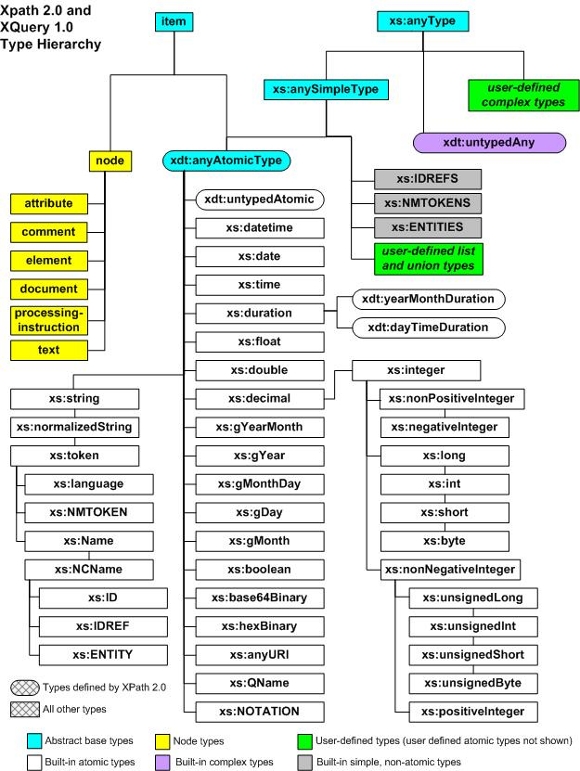
The diagram below shows the types for which functions are defined in this document. These include the built-in types defined by [XML Schema Part 2: Datatypes] (shown on the right) as well as types defined in [XPath 2.0] (shown on the left). Solid lines connect a base datatype above to a derived datatype except in the case of xsIDREFS, xs:IDREFS, xs:NMTOKENS, xs:ENTITIES and user-defined list and union types. These types are lists or unions of their parent types(s) rather than true subtypes. Dashed lines connect a union type above with its component types below.

Type hierarchy graphic

The information in the above diagram is reproduced below in tabular form. For ease of presentation the information is divided into three tables. The first table shows the top three layers of the hierarchy starting at xs:anyType. The second table shows the types derived from xdt:anyAtomicType. The third table shows the types defined in [XPath 2.0]

Each type whose name is indented is derived from the type whose name appears nearest above with one less level of indent.

xs:anyType
user-defined complex types
xdt:untypedAny
xs:anySimpleType
user-defined list and union types
xs:IDREFS
xs:NMTOKENS
xs:ENTITIES
xdt:anyAtomicType

The table below shows the datatypes derived from xdt:anyAtomicType. This includes all the [XML Schema Part 2: Datatypes] built-in datatypes as well as the two totally ordered subtypes of duration defined 9.2 Two Totally Ordered Subtypes of Duration.

Each type whose name is indented is derived from the type whose name appears nearest above with one less level of indent.

xdt:untypedAtomic
xs:dateTime
xs:date
xs:time
xs:duration
xdt:yearMonthDuration
xdt:dayTimeDuration
xs:float
xs:double
xs:decimal
xs:integer
xs:nonPositiveInteger
xs:negativeInteger
xs:long
xs:int
xs:short
xs:byte
xs:nonNegativeInteger
xs:unsignedLong
xs:unsignedInt
xs:unsignedShort
xs:unsignedByte
xs:gYearMonth
xs:gYear
xs:gMonthDay
xs:gDay
xs:gMonth
xs:string
xs:normalizedString
xs:token
xs:language
xs:NMTOKEN
xs:Name
xs:NCName
xs:ID
xs:IDREF
xs:ENTITY
xs:boolean
xs:base64Binary
xs:hexBinary
xs:anyURI
xs:QName
xs:NOTATION

The table below shows type hierarchy for the types introduced in [XPath 2.0]. For these types, each type whose name is indented is a component of the union type whose name appears nearest above with one less level of indent.

item
xdt:anyAtomicType
node
attribute
user-defined attribute types
comment
document
user-defined document types
element
user-defined element types
processing-instruction
text

1.5 xdt:anyAtomicType and xdt:untypedAtomic

1.5.1 xdt:anyAtomicType

The abstract datatype xdt:anyAtomicType is a child of xs:anySimpleType and is the base type for all the primitive atomic types described in [XML Schema Part 2: Datatypes]. This datatype cannot be used in [XML Schema Part 1: Structures] type declarations, nor can it be used as a base for user-defined atomic types. It can be used, as discussed in the Section 3.12 Expressions on SequenceTypesXQ, to define a required type (for example in a function signature) to indicate that any of the primitive atomic types or xdt:untypedAtomic is acceptable. This datatype resides in the namespace http://www.w3.org/2003/11/xpath-datatypes.

1.5.2 xdt:untypedAtomic

The abstract datatype xdt:untypedAtomic is a child of xdt:anyAtomicType and serves as a special type annotation to indicate atomic values that have not been validated by a XML Schema or a DTD or have received an instance type annotation of xs:anySimpleType in the PSVI. This datatype cannot be used in [XML Schema Part 1: Structures] type declarations, nor can it be used as a base for user-defined atomic types. It can be used, as discussed in the Section 3.12 Expressions on SequenceTypesXQ, to define a required type (for example in a function signature) to indicate that only an untyped atomic value is acceptable. This datatype resides in the namespace http://www.w3.org/2003/11/xpath-datatypes.

1.5.3 xdt:untypedAny

The abstract datatype xdt:untypedAny is a child of xs:anyType and serves as a special type annotation to indicate types that have not been validated by a XML Schema or a DTD. This type cannot be used in [XML Schema Part 1: Structures] type declarations, nor can it be used as a base for user-defined types. It can be used, as discussed in the Section 3.12 Expressions on SequenceTypesXQ, to define a required type (for example in a function signature) to indicate that only an untyped value is acceptable. This datatype resides in the namespace http://www.w3.org/2003/11/xpath-datatypes.

1.6 xs:dateTime, xs:date and xs:time values

xs:dateTime, xs:date and xs:time values are represented in the Section 3.3.1 Mapping PSVI Additions to TypesDM as tuples: a xs:dateTime, xs:date or xs:time value without a timezone and a timezone represented as a xdt:dayTimeDuration value. The value space of these types consists of the normalized value for these datatypes. This means that the xs:dateTime, xs:date or xs:time is first normalized to UTC or timezone Z. To create a value from a lexical representation of xs:dateTime, xs:date and xs:time lexical representations that have a timezone are converted to timezone Z as defined by [XML Schema Part 2: Datatypes] and the timezone in the lexical representation is converted to a xdt:dayTimeDuration value. Lexical representations that do not contain a timezone are assumed to be in timezone Z and the timezone part of the value set to the empty sequence "()".

We also define the localized value for a xs:dateTime, xs:date and xs:time as the xs:dateTime, xs:date and xs:time value in its original timezone or no timezone, as the case may be, followed by the timezone represented as a xdt:dayTimeDuration. Lexical representations that do not contain a timezone are given a timezone value set to the empty sequence "()".

1.6.1 Examples

  • A dateTime with lexical representation 1999-05-31T05:00:00 has a value represented by the tuple (1999-05-31T05:00:00Z, ())

  • A dateTime with lexical representation 1999-05-31T13:20:00-05:00 has a value represented by the tuple (1999-05-31T18:20:00Z, -PT5H)

1.7 Namespaces and Prefixes

The functions and operators discussed in this document are contained in one of three namespaces (see [Namespaces in XML]) and referenced using a xs:QName. Constructor functions for the built-in datatypes defined in [XML Schema Part 2: Datatypes] discussed in 5 Constructor Functions are in the XML Schema namespace, http://www.w3.org/2001/XMLSchema, and named in this document using the xs: prefix. The namespace prefix used in this document is fn: for the functions available to users and op: for the operator functions. The purpose of the functions indicated by the op: prefix is to define the semantics of operators in the host languages. In [XQuery 1.0: An XML Query Language] and [XPath 2.0] they are not directly accessible by users.

The datatypes described in this document in 1.5 xdt:anyAtomicType and xdt:untypedAtomic and 9.2 Two Totally Ordered Subtypes of Duration are contained in a separate namespace and are named using the prefix xdt:.

The namespace prefix for these functions and datatypes can vary, as long as the prefix is bound to the correct URI.

The URIs of the namespaces are:

  • http://www.w3.org/2001/XMLSchema for constructors

  • http://www.w3.org/2003/11/xpath-functions for functions.

  • http://www.w3.org/2003/11/xpath-datatypes for the datatypes.

The functions defined with an fn: prefix are callable by the user. Functions defined with the op: prefix are described here to underpin the definitions of the operators in [XPath 2.0], [XQuery 1.0: An XML Query Language] and [XSLT 2.0]. These functions are not available directly to users, and there is no requirement that implementations should actually provide these functions. For this reason, no namespace is associated with the op: prefix. For example, multiplication is generally associated with the * operator, but it is described as a function in this document:

op:multiply($arg1 as numeric, $arg2 as numeric) as numeric

1.8 Terminology

The terminology used to describe the functions and operators on [XML Schema Part 2: Datatypes] is defined in the body of this specification. The terms defined in the following list are used in building those definitions:

[Definition] for compatibility

A feature of this specification included to ensure that implementations that use this feature remain compatible with [XPath 1.0]

[Definition] may

Conforming documents and processors are permitted to, but need not, behave as described.

[Definition] must

Conforming documents and processors are required to behave as described; otherwise, they are either non-conformant or else in error.

[Definition] implementation defined

Possibly differing between implementations, but specified and documented by the implementor for each particular implementation.

[Definition] implementation-dependent

Possibly differing between implementations, but not specified by this or other W3C specification, and not required to be specified by the implementor for any particular implementation.

[Definition] stable

Most of the functions in the core library have the property that calling the same function twice with the same arguments returns the same result: these functions are said to be stable. This category includes a number of functions such as fn:doc(), fn:collection(), fn:current-dateTime(), fn:current-date and fn:current-time() whose result depends on the external environment. Where the function returns nodes, stability means that the returned nodes are identical, not merely equal. The scope over which the results are stable depends on the processing context. In XSLT, it applies to any two calls on the function executed during the same transformation. In XQuery, it applies to any two calls executed during the evaluation of a top-level expression i.e. an expression not contained in any other expression. In other contexts, the scope is specified by the host environment that invokes the function library.

Some other functions, for example fn:position() and fn:last(), depend on the dynamic context and may, therefore, produce different results each time they are called. These functions are said to be contextual.

2 Accessors

Accessors and their semantics are described in [XQuery 1.0 and XPath 2.0 Data Model]. Some of these accessors are exposed to the user through the functions described below.

Function Accessor Accepts Returns
fn:node-name node-name an optional node zero or one xs:QName
fn:string string-value an optional item or no argument xs:string
fn:data typed-value zero or more items a sequence of atomic values
fn:base-uri base-uri an optional node or no argument zero or one xs:string
fn:document-uri document-uri an optional node zero or one xs:string

2.1 fn:node-name

fn:node-name($arg as node()?) as xs:QName?

Summary: Returns an expanded-QName for node kinds that can have names. For other kinds of nodes it returns the empty sequence. If $arg is the empty sequence, the empty sequence is returned.

2.2 fn:string

fn:string() as xs:string
fn:string($arg as item()?) as xs:string

Summary: Returns the value of $arg represented as a xs:string. If no argument is supplied, this function returns the string value of the context item (.).

If $arg is the empty sequence, the zero-length string is returned.

If $arg is a node, the function returns the string-value of the node, as obtained using the dm:string-value accessor defined in the Section 5.5 string-value AccessorDM.

If $arg is an atomic value, then the function returns the same string as is returned by the expression "$arg cast as xs:string" (see 17 Casting).

2.3 fn:data

fn:data($arg as item()*) as xdt:anyAtomicType*

Summary: fn:data takes a sequence of items and returns a sequence of atomic values.

The result of fn:data is the sequence of atomic values produced by applying the following rules to each item in $arg:

  • If the item is an atomic value, it is returned.

  • If the item is a node, fn:data() returns the typed value of the node as defined by the accessor function dm:typed-value in Section 5.6 typed-value AccessorDM.

2.4 fn:base-uri

fn:base-uri($arg as node()?) as xs:string?

Summary: Returns the value of the base-uri property for $arg as defined by the accessor function dm:base-uri for that kind of node in Section 5.1 base-uri AccessorDM.

If $arg is the empty sequence, the empty sequence is returned.

Document, element and processing-instruction nodes have a base-uri property which may be empty. The base-uri of all other node types is the empty sequence. If the base-uri property for $arg is non-empty, its value is returned. If the base-uri property for $arg is empty, the base-uri of that node's parent is returned. If the node has no parent, the empty sequence is returned.

fn:base-uri() as xs:string

Summary: This version of the function returns the value of the base-uri property from the static context using the preceding rules. The static context is discussed in Section 2.1.1 Static ContextXQ .

2.5 fn:document-uri

fn:document-uri($arg as node()?) as xs:string?

Summary: Returns the value of the document-uri property for $arg as defined by the accessor function dm:document-uri in Section 5.1 base-uri AccessorDM.

If $arg is the empty sequence, the empty sequence is returned.

Returns the empty sequence if the node is not a document node or if its document-uri property is a relative URI. Otherwise, returns an absolute URI expressed as an xs:string.

If the document-uri property of $arg is not the empty sequence, then the following expression always holds:

fn:doc(fn:document-uri($arg)) is $arg

3 The Error Function

In this document, as well as in [XQuery 1.0: An XML Query Language], [XPath 2.0], and [XQuery 1.0 and XPath 2.0 Formal Semantics], the phrase "an error is raised" is used to describe the behavior of conforming processors in certain situations. When such situations arise in a running system, a conforming implementation of this specification must invoke the fn:error function defined in this section.

The phrase is normally accompanied by specification of a specific error, in which case the phrase "an error is raised [name of error]" is used. The "name of error" specifies a phrase that is mnemonic for the actual error, but the error code to which it refers is an xs:QName. Each error defined in this document is identified by an xs:QName that is in the namespace asssociated with the xdt: prefix. It is the xs:QName that is actually passed as an argument to the fn:error function invocation. Invocation of this function causes the evaluation phase of the outermost XQuery or transformation to be terminated. For a more detailed treatment of error handing, see Section 2.5.2 Handling Dynamic ErrorsXQ and Section 6.2.5 The fn:error functionFS.

The fn:error function is a general function that may be invoked as above but may also be invoked from XQuery and XPath 2.0 applications with, for example, an xs:string argument.

fn:error() as none
fn:error($arg as item()?) as none

One version of the fn:error function takes no argments; a second version of the function accepts an optional item() as argument. The fn:error function never returns a value.

Note that "none" is a special type defined in [XQuery 1.0 and XPath 2.0 Formal Semantics] and is not available to the user. It indicates that the function never returns and ensures that it has the correct static type.

3.1 Examples

  • fn:error()

  • fn:error(xs:QName("xdt:FOAR0003"))

  • fn:error("Catch Fire and Burn!")

4 The Trace Function

This function is intended to be used in debugging queries by providing a trace of their execution.

fn:trace($value as item()*, $label as xs:string) as item()*

The input $value is returned, unchanged, as the result of the function. In addition, the inputs $value and $label are directed to a trace data set. The location and format of the trace data set are ·implementation dependent·. The ordering of output from invocations of the fn:trace() function is ·implementation dependent·.

4.1 Examples

  • Consider a situation in which a user wants to investigate the actual value passed to a function. Assume that in a particular execution, $v is an xs:decimal with value 124.84. Writing fn:trace($v, 'the value of $v is:') will put the strings "124.84" and "the value of $v is" in the trace data set in implementation defined order.

5 Constructor Functions

5.1 Constructor Functions for XML Schema Built-in Types

Every built-in atomic type that is defined in [XML Schema Part 2: Datatypes], except xs:NOTATION has an associated constructor function; as do xdt:untypedAtomic, defined in 1.5 xdt:anyAtomicType and xdt:untypedAtomic and the two derived types xdt:yearMonthDuration and xdt:dayTimeDuration defined in 9.2 Two Totally Ordered Subtypes of Duration. The form of that function for a type pref:TYPE is:

pref:TYPE($arg as xdt:anyAtomicType) as pref:TYPE

For example, the signature of the constructor function corresponding to the xs:unsignedInt type defined in [XML Schema Part 2: Datatypes] is:

xs:unsignedInt($arg as xdt:anyAtomicType) as xs:unsignedInt

Invoking the constructor function xs:unsignedInt(12) returns the xs:unsignedInt value 12. Another invocation of that constructor function that returns the same xs:unsignedInt value is xs:unsignedInt("12"). The same result would also be returned if the constructor function were to be invoked with a node that had a value equal to the xs:unsignedInt 12. The standard features described in Section 2.3.2 AtomizationXQ would 'atomize' the node to extract its value and then call the constructor with that value. If the value passed to a constructor is illegal for the datatype to be constructed, an error is raised [invalid value for constructor].

If the argument to a constructor function is an xs:string, whitespace normalization is applied as indicated by the whiteSpace facet for the datatype. The resulting whitespace-normalized string must be a valid lexical form for the type, as specified in [XML Schema Part 2: Datatypes]. The semantics of constructor functions when invoked with a xs:string are identical to XML Schema validation. In the case of xs:dateTime, xs:date and xs:time, the value returned differs from [XML Schema Part 2: Datatypes] and is defined in 1.6 xs:dateTime, xs:date and xs:time values.

The semantics of the constructor function "xs:TYPE(arg)" are identical to the semantics of "arg cast as xs:TYPE". See 17 Casting. In some cases, the semantics of casting are explained using constructor functions; but there is no circularity. The constructors used invariably take xs:string arguments and, in this case, the semantics are the semantics of XML Schema validation as discussed above.

If the argument to a constructor function is a literal, the result of the function may be evaluated statically; if an error is found during such evaluation, it may be reported as a static error.

The following constructor functions for the built-in types are supported:

  • xs:string($arg as xdt:anyAtomicType) as xs:string
  • xs:boolean($arg as xdt:anyAtomicType) as xs:boolean
  • xs:decimal($arg as xdt:anyAtomicType) as xs:decimal
  • xs:float($arg as xdt:anyAtomicType) as xs:float

    Implementations ·may· return negative zero for xs:float("-0.0E0").

  • xs:double($arg as xdt:anyAtomicType) as xs:double

    Implementations ·may· return negative zero for xs:double("-0.0E0").

  • xs:duration($arg  as xdt:anyAtomicType) as xs:duration
  • xs:dateTime($arg  as xdt:anyAtomicType) as (xs:dateTime, xdt:dayTimeDuration)
  • xs:time($arg as xdt:anyAtomicType) as (xs:time, xdt:dayTimeDuration)
  • xs:date($arg as xdt:anyAtomicType) as (xs:date, xdt:dayTimeDuration)
  • xs:gYearMonth($arg as xdt:anyAtomicType) as xs:gYearMonth
  • xs:gYear($arg as xdt:anyAtomicType) as xs:gYear
  • xs:gMonthDay($arg as xdt:anyAtomicType) as xs:gMonthDay
  • xs:gDay($arg as xdt:anyAtomicType) as xs:gDay
  • xs:gMonth($arg as xdt:anyAtomicType) as xs:gMonth
  • xs:hexBinary($arg as xdt:anyAtomicType) as xs:hexBinary
  • xs:base64Binary($arg as xdt:anyAtomicType) as xs:base64Binary
  • xs:anyURI($arg as xdt:anyAtomicType) as xs:anyURI
  • xs:QName($arg as xdt:anyAtomicType) as xs:QName

    See 17.14 Casting to xs:QName for semantics of xs:QName.

  • xs:normalizedString($arg as xdt:anyAtomicType) as xs:normalizedString
  • xs:token($arg as xdt:anyAtomicType) as xs:token
  • xs:language($arg  as xdt:anyAtomicType) as xs:language
  • xs:NMTOKEN($arg as xdt:anyAtomicType) as xs:NMTOKEN
  • xs:Name($arg as xdt:anyAtomicType) as xs:Name
  • xs:NCName($arg as xdt:anyAtomicType) as xs:NCName
  • xs:ID($arg as xdt:anyAtomicType) as xs:ID
  • xs:IDREF($arg as xdt:anyAtomicType) as xs:IDREF
  • xs:ENTITY($arg as xdt:anyAtomicType) as xs:ENTITY
  • xs:integer($arg as xdt:anyAtomicType) as xs:integer
  • xs:nonPositiveInteger($arg as xdt:anyAtomicType) as xs:nonPositiveInteger
  • xs:negativeInteger($arg as xdt:anyAtomicType) as xs:negativeInteger
  • xs:long($arg as xdt:anyAtomicType) as xs:long
  • xs:int($arg as xdt:anyAtomicType) as xs:int
  • xs:short($arg as xdt:anyAtomicType) as xs:short
  • xs:byte($arg as xdt:anyAtomicType) as xs:byte
  • xs:nonNegativeInteger($arg as xdt:anyAtomicType) as xs:nonNegativeInteger
  • xs:unsignedLong($arg as xdt:anyAtomicType) as xs:unsignedLong
  • xs:unsignedInt($arg as xdt:anyAtomicType) as xs:unsignedInt
  • xs:unsignedShort($arg as xdt:anyAtomicType) as xs:unsignedShort
  • xs:unsignedByte($arg as xdt:anyAtomicType) as xs:unsignedByte
  • xs:positiveInteger($arg as xdt:anyAtomicType) as xs:positiveInteger
  • xdt:yearMonthDuration($arg as xdt:anyAtomicType) as xdt:yearMonthDuration
  • xdt:dayTimeDuration($arg as xdt:anyAtomicType) as xdt:dayTimeDuration
  • xdt:untypedAtomic($arg as xdt:anyAtomicType) as xdt:untypedAtomic

5.2 Constructor Functions for User-Defined Types

For every globally-defined atomic type in the static context (See Section 2.1.1 Static ContextXQ that is derived by restriction from a primitive type, except types derived from xs:NOTATION, there is a constructor function (whose name is the same as the name of the type) whose effect is to create a value of that type from the supplied argument. The rules for constructing user-defined types are defined in the same way as the rules for constructing built-in derived types discussed in 5.1 Constructor Functions for XML Schema Built-in Types.

In the case of types whose name has a null namespace URI, it will not be possible to call the constructor function if a default namespace for functions is defined. In this case, the cast syntax must be used instead.

Consider a situation where the static context contains a type called hatSize defined in a schema that is bound to the prefix my. In such a case the constructor function:

my:hatSize($arg as xdt:anyAtomicType) as my:hatSize

is available to users.

6 Functions and Operators on Numerics

This section discusses arithmetic operators on the numeric datatypes defined in [XML Schema Part 2: Datatypes]. It uses an approach that permits lightweight implementation whenever possible.

6.1 Numeric Types

The operators described in this section are defined on the following numeric types. Each type whose name is indented is derived from the type whose name appears nearest above with one less level of indent.

xs:decimal
xs:integer
xs:float
xs:double

They also apply to types derived by restriction from these types.

Note:

The value space for xs:float and xs:double, as defined in the errata to [XML Schema Part 2: Datatypes], defines only a single zero. [IEEE 754-1985] arithmetic, however, can produce distinct results of positive zero and negative zero. These are two different machine representations for the same value. The text accompanying several functions discusses behaviour for both positive and negative zero inputs in the interest of alignment with [IEEE 754-1985].

6.2 Operators on Numeric Values

The following functions define the semantics of operators defined in [XQuery 1.0: An XML Query Language] and [XPath 2.0] on these numeric types.

Operators Meaning
op:numeric-add Addition
op:numeric-subtract Subtraction
op:numeric-multiply Multiplication
op:numeric-divide Division
op:numeric-integer-divide Integer division
op:numeric-mod Modulus
op:numeric-unary-plus Unary plus
op:numeric-unary-minus Unary minus (negation)

The parameters and return types for the above operators are the basic numeric types: xs:integer, xs:decimal, xs:float and xs:double, and types derived from them. The word "numeric" in function signatures signifies these four types. For simplicity, each operator is defined to operate on operands of the same type and to return the same type. The one exception is op:numeric-divide, which returns an xs:decimal if called with two xs:integer operands.)

Operands of type xdt:untypedAtomic are converted to xs:double, except for arguments to 6.2.5 op:numeric-integer-divide which are converted to xs:integer. If the two operands are not of the same type, subtype substitution and type promotion are used to obtain two operands of the same type. Section B.1 Type PromotionXQ describes the semantics of these operations in detail.

  1. Subtype substitution: A derived type may substitute for its base type. In particular, xs:integer may be used where xs:decimal is expected.

  2. Type promotion: xs:decimal may be promoted to xs:float, and xs:float may be promoted to xs:double.

The result type of operations depends on their argument datatypes and is defined in the following table:

Operator Returns
op:operation(xs:integer, xs:integer) xs:integer (except for op:numeric-divide(integer, integer), which returns xs:decimal)
op:operation(xs:decimal, xs:decimal) xs:decimal
op:operation(xs:float, xs:float) xs:float
op:operation(xs:double, xs:double) xs:double
op:operation(xs:integer) xs:integer
op:operation(xs:decimal) xs:decimal
op:operation(xs:float) xs:float
op:operation(xs:double) xs:double

These rules define any operation on any pair of arithmetic types. Consider the following example:

op:operation(xs:int, xs:double) => op:operation(xs:double, xs:double)

For this operation, xs:int must be converted to xs:double. This can be done, since by the rules above: xs:int can be substituted for xs:integer, xs:integer can be substituted for xs:decimal, xs:decimal can be promoted to xs:float, and xs:float can be promoted to xs:double. As far as possible, the promotions should be done in a single step. Specifically, when a decimal is promoted to a double, it should not be converted to a float and then to double, as this risks loss of precision.

As another example, a user may define height as a derived type of xs:integer with a minimum value of 20 and a maximum value of 100. He may then derive fenceHeight using an enumeration to restrict the permitted set of values to, say, 36, 48 and 60.

op:operation(fenceHeight, xs:integer) => op:operation(xs:integer, xs:integer)

fenceHeight can be substituted for its base type height and height can be substituted for its base type xs:integer.

On overflow and underflow situations during arithmetic operations conforming implementations ·must· behave as follows:

The functions op:numeric-add, op:numeric-subtract, op:numeric-multiply, op:numeric-divide, op:numeric-integer-divide and op:numeric-mod are each defined for pairs of numeric operands, each of which has the same type: xs:integer, xs:decimal, xs:float, or xs:double. The functions op:numeric-unary-plus and op:numeric-unary-minus are defined for a single operand whose type is one of those same numeric types.

For xs:float and xs:double arguments, if either argument is NaN, the result is NaN.

The number of digits of precision returned by various numeric functions is ·implementation dependent·.

6.2.1 op:numeric-add

op:numeric-add($arg1 as numeric, $arg2 as numeric) as numeric

Summary: Backs up the "+" operator and returns the arithmetic sum of its operands: ($arg1 + $arg2).

6.2.2 op:numeric-subtract

op:numeric-subtract($arg1 as numeric, $arg2 as numeric) as numeric

Summary: Backs up the "-" operator and returns the arithmetic difference of its operands: ($arg1 - $arg2).

6.2.3 op:numeric-multiply

op:numeric-multiply($arg1 as numeric, $arg2 as numeric) as numeric

Summary: Backs up the "*" operator and returns the arithmetic product of its operands: ($arg1 * $arg2).

6.2.4 op:numeric-divide

op:numeric-divide($arg1 as numeric, $arg2 as numeric) as numeric

Summary: Backs up the "div" operator and returns the arithmetic quotient of its operands: ($arg1 div $arg2).

As a special case, if the types of both $arg1 and $arg2 are xs:integer, then the return type is xs:decimal.

For xs:decimal and xs:integer operands, if the divisor is zero, then an error is raised [division by zero]. For xs:float and xs:double operands, floating point division is performed as specified in [IEEE 754-1985] and INF or -INF is returned if the divisor is zero.

6.2.5 op:numeric-integer-divide

op:numeric-integer-divide( $arg1  as xs:integer,
$arg2  as xs:integer) as xs:integer

Summary: Backs up the "idiv" operator and returns the arithmetic quotient of its operands: ($arg1 idiv $arg2). If the numerator is not evenly divided by the divisor, then the quotient is the xs:integer value obtained, ignoring any remainder that results from the division (that is, no rounding is performed).

If the divisor is zero, then an error is raised [division by zero].

6.2.5.1 Examples
  • op:numeric-integer-divide(10,3) returns 3

  • op:numeric-integer-divide(3,-2) returns -1

  • op:numeric-integer-divide(-3,2) returns -1

  • op:numeric-integer-divide(-3,-2) returns 1

6.2.6 op:numeric-mod

op:numeric-mod($arg1 as numeric, $arg2 as numeric) as numeric

Summary: Backs up the "mod" operator. Informally, this function returns the remainder resulting from dividing $arg1, the dividend, by $arg2, the divisor. The operation a mod b for operands that are xs:integer or xs:decimal, or types derived from them, produces a result such that (a idiv b)*b+(a mod b) is equal to a and the magnitude of the result is always less than the magnitude of b. This identity holds even in the special case that the dividend is the negative integer of largest possible magnitude for its type and the divisor is -1 (the remainder is 0). It follows from this rule that the sign of the result is the sign of the dividend.

If $arg2 is zero, then an error is raised [division by zero].

For xs:float and xs:double operands the following rules apply:

  • If either operand is NaN, the result is NaN.

  • If the dividend is positive or negative infinity, or the divisor is positive or negative zero (0), or both, the result is NaN.

  • If the dividend is finite and the divisor is an infinity, the result equals the dividend.

  • If the dividend is positive or negative zero and the divisor is finite, the result is the same as the dividend.

  • In the remaining cases, where neither positive or negative infinity, nor positive or negative zero, nor NaN is involved, the result obeys (a/b)*b+(a mod b) = a. Division is truncating division, analogous to integer division, not [IEEE 754-1985] rounding division.

6.2.6.1 Examples
  • op:numeric-mod(10,3) returns 1.

  • op:numeric-mod(6,-2) returns 0.

  • op:numeric-mod(4.5,1.2) returns 0.9.

  • op:numeric-mod(1.23E2, 0.6E1) returns 3.0E0.

6.2.7 op:numeric-unary-plus

op:numeric-unary-plus($arg as numeric) as numeric

Summary: Backs up the unary "+" operator and returns its operand with the sign unchanged: (+ $arg). Semantically, this operation performs no operation.

6.2.8 op:numeric-unary-minus

op:numeric-unary-minus($arg as numeric) as numeric

Summary: Backs up the unary "-" operator and returns its operand with the sign reversed: (- $arg). If $arg is positive, its negative is returned; if it is negative, its positive is returned.

For xs:integer and xs:decimal arguments, 0 and 0.0 return 0 and 0.0, respectively. For xs:float and xs:double arguments, NaN returns NaN, 0.0E0 returns -0.0E0 and vice versa. INF and +INF return -INF. -INF returns INF.

6.3 Comparison of Numeric Values

This specification defines the following comparison operators on numeric values. Comparisons take two arguments of the same type. Arguments of type xdt:untypedAtomic are converted to xs:double. If the arguments are of different types, one argument is promoted to the type of the other as described above in 6.2 Operators on Numeric Values. Each comparison operator returns a boolean value. If either, or both, operands are NaN, false is returned.

Operator Meaning
op:numeric-equal Equality comparison
op:numeric-less-than Less-than comparison
op:numeric-greater-than Greater-than comparison

6.3.1 op:numeric-equal

op:numeric-equal($arg1 as numeric, $arg2 as numeric) as xs:boolean

Summary: Returns true if and only if the value of $arg1 is equal to the value of $arg2. For xs:float and xs:double values, positive zero and negative zero compare equal. NaN does not equal itself.

This function backs up the "eq" and "ne" operators on numeric values.

6.3.2 op:numeric-less-than

op:numeric-less-than($arg1 as numeric, $arg2 as numeric) as xs:boolean

Summary: Returns true if and only if $arg1 is less than $arg2. For xs:float and xs:double values, positive infinity is greater than all other non-NaN values; negative infinity is less than all other non-NaN values. If $arg1 or $arg2 is NaN, the function returns false.

This function backs up the "lt" and "ge" operators on numeric values.

6.3.3 op:numeric-greater-than

op:numeric-greater-than( $arg1 as numeric, $arg2 as numeric) as xs:boolean

Summary: Returns true if and only if $arg1 is greater than $arg2. For xs:float and xs:double values, positive infinity is greater than all other non-NaN values; negative infinity is less than all other non-NaN values. If $arg1 or $arg2 is NaN, the function returns false.

This function backs up the "gt" and "le" operators on numeric values.

6.4 Functions on Numeric Values

The following functions are defined on numeric types. Each function returns a value of the same type as the type of its argument.

  • If the argument is the empty sequence, the empty sequence is returned.

  • If the argument is xdt:untypedAtomic it is converted to xs:double.

  • For xs:float and xs:double arguments, if the argument is "NaN", "NaN" is returned.

  • Except for fn:abs(), for xs:float and xs:double arguments, if the argument is positive or negative infinity, positive or negative infinity is returned.

Function Meaning
fn:abs Returns the absolute value of the argument.
fn:ceiling Returns the smallest number with no fractional part that is greater than or equal to the argument.
fn:floor Returns the largest number with no fractional part that is less than or equal to the argument.
fn:round Rounds to the nearest number with no fractional part.
fn:round-half-to-even Takes a number and a precision and returns a number rounded to the given precision. If the fractional part is exactly half, the result is the number whose least significant digit is even.

6.4.1 fn:abs

fn:abs($arg as numeric?) as numeric?

Summary: Returns the absolute value of $arg. If $arg is negative returns -$arg otherwise returns $arg. If type of $arg is one of the four numeric types xs:float, xs:double, xs:decimal or xs:integer the type of the return is the same as the type of $arg. If the type of $arg is a type derived from one of the numeric types, the type of the return is the parent numeric type.

For xs:float and xs:double arguments, if the argument is positive zero (+0) or negative zero (-0), then positive zero (+0) is returned. If the argument is positive or negative infinity, positive infinity is returned.

For detailed type semantics, see Section 6.2.1 The fn:abs, fn:ceiling, fn:floor, fn:round, and fn:round-half-to-even functionsFS

6.4.1.1 Examples
  • fn:abs(10.5) returns 10.5.

  • fn:abs(-10.5) returns 10.5.

6.4.2 fn:ceiling

fn:ceiling($arg as numeric?) as numeric?

Summary: Returns the smallest (closest to negative infinity) number with no fractional part that is not less than the value of $arg. If type of $arg is one of the four numeric types xs:float, xs:double, xs:decimal or xs:integer the type of the return is the same as the type of $arg. If the type of $arg is a type derived from one of the numeric types, the type of the return is the parent numeric type.

For xs:float and xs:double arguments, if the argument is positive zero (+0), then positive zero (+0) is returned. If the argument is negative zero (-0), then negative zero (-0) is returned. If the argument is less than zero (0), but greater than or equal to -0.5, then negative zero (-0) is returned.

For detailed type semantics, see Section 6.2.1 The fn:abs, fn:ceiling, fn:floor, fn:round, and fn:round-half-to-even functionsFS

6.4.2.1 Examples
  • fn:ceiling(10.5) returns 11.

  • fn:ceiling(-10.5) returns -10.

6.4.3 fn:floor

fn:floor($arg as numeric?) as numeric?

Summary: Returns the largest (closest to positive infinity) number with no fractional part that is not greater than the value of $arg. If type of $arg is one of the four numeric types xs:float, xs:double, xs:decimal or xs:integer the type of the return is the same as the type of $arg. If the type of $arg is a type derived from one of the numeric types, the type of the return is the parent numeric type.

For float and double arguments, if the argument is positive zero (+0), then positive zero (+0) is returned. If the argument is negative zero (-0), then negative zero (-0) is returned.

For detailed type semantics, see Section 6.2.1 The fn:abs, fn:ceiling, fn:floor, fn:round, and fn:round-half-to-even functionsFS

6.4.3.1 Examples
  • fn:floor(10.5) returns 10.

  • fn:floor(-10.5) returns -11.

6.4.4 fn:round

fn:round($arg as numeric?) as numeric?

Summary: Returns the number with no fractional part that is closest to the argument. If there are two such numbers, then the one that is closest to positive infinity is returned. More formally, fn:round(x) produces the same result as fn:floor(x+0.5). If type of $arg is one of the four numeric types xs:float, xs:double, xs:decimal or xs:integer the type of the return is the same as the type of $arg. If the type of $arg is a type derived from one of the numeric types, the type of the return is the parent numeric type.

For xs:float and xs:double arguments, if the argument is positive zero (+0), then positive zero (+0) is returned. If the argument is negative zero (-0), then negative zero (-0) is returned. If the argument is less than zero (0), but greater than or equal to -0.5, then negative zero (-0) is returned.

For detailed type semantics, see Section 6.2.1 The fn:abs, fn:ceiling, fn:floor, fn:round, and fn:round-half-to-even functionsFS

6.4.4.1 Examples
  • fn:round(2.5) returns 3.

  • fn:round(2.4999) returns 2.

  • fn:round(-2.5) returns -2 (not the possible alternative, -3).

6.4.5 fn:round-half-to-even

fn:round-half-to-even($arg as numeric?) as numeric?
fn:round-half-to-even($arg as numeric?, $precision as xs:integer) as numeric?

Summary: The value returned is the nearest (that is, numerically closest) numeric to $arg that is a multiple of ten to the power of minus $precision. If two such values are equally near (e.g. if the fractional part in $arg is exactly .500...), returns the one whose least significant digit is even. If type of $arg is one of the four numeric types xs:float, xs:double, xs:decimal or xs:integer the type of the return is the same as the type of $arg. If the type of $arg is a type derived from one of the numeric types, the type of the return is the parent numeric type.

The first signature of this function produces the same result as the second signature with $precision=0.

For arguments of type xs:float and xs:double, if the argument is positive zero (+0), then positive zero (+0) is returned. If the argument is negative zero (-0), then negative zero (-0) is returned.

If $arg is of type xs:float or xs:double, rounding occurs on the value of the mantissa computed with exponent = 0.

For detailed type semantics, see Section 6.2.1 The fn:abs, fn:ceiling, fn:floor, fn:round, and fn:round-half-to-even functionsFS

6.4.5.1 Examples
  • fn:round-half-to-even(1.5) returns the value corresponding to 2.

  • fn:round-half-to-even(2.5) returns the value corresponding to 2.

  • fn:round-half-to-even(3.567812E+3, 2) returns the value corresponding to 3567.81E0.

  • fn:round-half-to-even(4.7564E-3, 2) returns the value corresponding to 0.0E0.

  • fn:round-half-to-even(35612.25, -2) returns the value corresponding to 35600.

7 Functions on Strings

This section discusses functions and operators on the [XML Schema Part 2: Datatypes] xs:string datatype and the datatypes derived from it.

7.1 String Types

The operators described in this section are defined on the following types. Each type whose name is indented is derived from the type whose name appears nearest above with one less level of indent.

xs:string
xs:normalizedString
xs:token
xs:language
xs:NMTOKEN
xs:Name
xs:NCName
xs:ID
xs:IDREF
xs:ENTITY

They also apply to user-defined types derived by restriction from these types.

Note:

This document uses the term "code point", sometimes spelt "codepoint", as defined in [The Unicode Standard], ranging from #x0000 to #x10FFFF inclusive. The use of the word "character" in this document is in the sense of production [2] of [XML 1.0 Recommendation (Second Edition)], so it may include code points which have not yet been assigned to characters."

Note:

In functions that involve character counting such as fn:substring, fn:string-length and fn:translate, what is counted is the of XML characters in the string (or equivalently, the number of Unicode code points). Some implementations may represent a code point above xFFFF using two 16-bit values known as a surrogate. A surrogate counts as one character, not two.

Unless explicitly stated, the xs:string values returned by the functions in this document are not normalized in the sense of [Character Model for the World Wide Web 1.0].

7.2 Functions to Assemble and Disassemble Strings

Function Meaning
fn:codepoints-to-string Creates an xs:string from a sequence of code points.
fn:string-to-codepoints Returns the sequence of code points that constitute an xs:string.

7.2.1 fn:codepoints-to-string

fn:codepoints-to-string( $arg as xs:integer*) as xs:string

Creates an xs:string from a sequence of code points. Returns the zero-length string if $arg is the empty sequence. If any of the code points in $arg is not a legal XML character, an error is raised [codepoint not valid].

7.2.1.1 Examples
  • fn:codepoints-to-string((2309, 2358, 2378, 2325)) returns "अशॊक"

7.2.2 fn:string-to-codepoints

fn:string-to-codepoints( $arg as xs:string?) as xs:integer*

Returns the sequence of code points that constitute an xs:string. If $arg is a zero-length string or the empty sequence, the empty sequence is returned.

7.2.2.1 Examples
  • fn:string-to-codepoints("Thérèse") returns the sequence (84, 104, 233, 114, 232, 115, 101)

7.3 Equality and Comparison of Strings

7.3.1 Collations

When values whose type is xs:string or a type derived from xs:string are compared (or, equivalently, sorted), the comparisons are inherently performed according to some collation (even if that collation is defined entirely on code point values). The [Character Model for the World Wide Web 1.0] observes that some applications may require different comparison and ordering behaviors than other applications. Similarly, some users having particular linguistic expectations may require different behaviors than other users. Consequently, the collation must be taken into account when comparing strings in any context. Several functions in this and the following section make use of a collation.

Collations can indicate that that two different code points are, in fact, equal for comparison purposes (e.g., "v" and "w" are considered equivalent in Swedish). Strings can be compared codepoint-by-codepoint or in a linguistically appropriate manner, as defined by the collation.

Some collations, especially those based on the [Unicode Collation Algorithm] can be "tailored" for various purposes. This document does not discuss such tailoring, nor does it provide a mechanism to perform tailoring. Instead, it assumes that the collation argument to the various functions below is a tailored and named collation. A specific collation with a distinguished name, http://www.w3.org/2003/11/xpath-functions/collation/codepoint, provides the ability to compare strings based on code point values. Every implementation of XQuery/XPath must support the collation based on code point values.

While the [Character Model for the World Wide Web 1.0] recommends that all strings be subjected to early Unicode normalization, it is not possible to guarantee that all strings in all XML documents are, in fact, normalized, or that they are normalized in the same manner. In order to maximize interoperable results of operations on XML documents in general, there may be collations that operate on unnormalized strings, other collations that raise runtime errors when unnormalized strings are encountered, and still other collations that implicitly normalize strings for the purposes of collating them. For alignment with the [Character Model for the World Wide Web 1.0], applications may choose collations that treat unnormalized strings as though they were normalized (that is, that implicitly normalize the strings). Note that collations based on the Unicode collation algorithm produce equivalent results regardless of a string's normalization.

This specification assumes that collations are named and that the collation name may be provided as an argument to string functions. Functions that allow specification of a collation do so with an argument whose type is xs:string but whose lexical form must conform to an xs:anyURI. If the collation is specified using a relative URI, it is assumed to be relative to the value of the base-uri property in the static context. This specification also defines the manner in which a default collation is determined if the collation argument is not specified in invocations of functions that use a collation but allow it to be omitted.

Functions such as fn:compare and fn:max that compare xs:string values use a single collation URI to identify all aspects of the collation rules. This means that any parameters such as the strength of the collation must be specified as part of the collation URI. For example, suppose there is a collation "http://www.example.com/collations/French" that refers to a French collation that compares on the basis of base characters. Collations that use the same basic rules, but with higher strengths, for example, base characters and accents, or base characters, accents and case, would need to be given different names, say "http://www.example.com/collations/French1" and "http://www.example.com/collations/French2". Note that some specifications use the term collation to refer to an algorithm that can be parameterized, but in this specification, each possible parameterization is considered to be a distinct collation.

The XQuery/XPath static context includes a provision for a default collation that can be used for string comparisons (including ordering operations). However, the static context is not required to have a default collation specified. See the description of the static context in Section 2.1.1 Static ContextXQ. If the static context does not have a default collation specified, a system defined default can be invoked. If this is not provided, the Unicode code point collation is used as the default collation.

The decision of what collation to use for a given comparison or ordering function is determined by the following algorithm:

  1. If the function specifies an explicit collation, CollationA (e.g., if the optional collation argument is specified in an invocation of the fn:compare() function), then:

    • If CollationA is supported by the implementation, then CollationA is used.

    • Otherwise, an error is raised [unsupported collation].

  2. If no collation is explicitly specified for the function and the function is fn:contains, fn:starts-with, fn:ends-with, fn:substring-before or fn:substring-after the Unicode code point collation (http://www.w3.org/2003/11/xpath-functions/collation/codepoint) is used.

  3. If no collation is explicitly specified for the function and the function is not one of the above functions and the XQuery/XPath static context specifies a collation, CollationB, then:

    • If CollationB is supported by the implementation, then CollationB is used.

    • Otherwise, an error is raised [unsupported collation].

  4. Otherwise, the Unicode code point collation (http://www.w3.org/2003/11/xpath-functions/collation/codepoint) is used.

Note:

XML allows elements to specify the xml:lang attribute to indicate the language associated with the content of such an element. This specification does not use xml:lang to identify the default collation because using xml:lang does not produce desired effects when the two strings to be compared have different xml:lang values or when a string is multilingual.

7.3.2 fn:compare

fn:compare($comparand1 as xs:string?, $comparand2 as xs:string?) as xs:integer?
fn:compare( $comparand1  as xs:string?,
$comparand2  as xs:string?,
$collation  as xs:string) as xs:integer?

Summary: Returns -1, 0, or 1, depending on whether the value of the $comparand1 is respectively less than, equal to, or greater than the value of $comparand2, according to the rules of the collation that is used.

The collation used by the invocation of this function is determined according to the rules in 7.3.1 Collations.

If the value of $comparand2 begins with a string that is equal to the value of $comparand1 (according to the collation that is used) and has additional code points following that beginning string, then the result is -1. If the value of $comparand1 begins with a string that is equal to the value of $comparand2 (according to the collation that is used) and has additional code points following that beginning string, then the result is 1.

If either argument is the empty sequence, the result is the empty sequence.

This function, invoked with the second signature, backs up the "eq", "ne", "gt", "lt", "le" and "ge" operators on string values.

7.3.2.1 Examples
  • fn:compare('abc', 'abc') returns 0.

  • fn:compare('Strasse', 'Straße') returns 0 if and only if the default collation includes provisions that equate "ss" and the (German) character "ß" ("sharp-s"). (Otherwise, the returned value depends on the semantics of the default collation.)

  • fn:compare('Strasse', 'Straße', 'deutsch') returns 0 if the collation identified by the relative URI constructed from the string value "deutsch" includes provisions that equate "ss" and the (German) character "ß" ("sharp-s"). (Otherwise, the returned value depends on the semantics of that collation.)

  • fn:compare('Strassen', 'Straße') returns 1 if the default collation includes provisions that treat differences between "ss" and the (German) character "ß" ("sharp-s") with less strength than the differences between the base characters, such as the final "n".

7.4 Functions on String Values

The following functions are defined on values of type xs:string and types derived from it. Several of these functions use collations. See 7.3.1 Collations for a discussion of collations.

Function Meaning
fn:concat Concatenates two or more xs:strings.
fn:string-join Returns the xs:string produced by concatenating a sequence of xs:strings using an optional separator.
fn:substring Returns the xs:string located at a specified place in an xs:string.
fn:string-length Returns the length of the argument.
fn:normalize-space Returns the whitespace-normalized value of the argument.
fn:normalize-unicode Returns the normalized value of the first argument in the normalization form specified by the second argument.
fn:upper-case Returns the upper-cased value of the argument.
fn:lower-case Returns the lower-cased value of the argument.
fn:translate Returns the first xs:string argument with occurrences of characters contained in the second argument replaced by the character at the corresponding position in the third argument.
fn:escape-uri Returns the string representing an xs:anyURI value with certain characters escaped as specified in [RFC 2396] and [RFC 2732].

Note:

When the above operators and functions are applied to datatypes derived from xs:string, they are guaranteed to return legal xs:strings, but they might not return a legal value for the particular subtype to which they were applied.

7.4.1 fn:concat

fn:concat($arg1 as xs:string?, $arg2 as xs:string?, ...) as xs:string

Summary: Accepts two or more xs:strings as arguments. Returns the xs:string that is the concatenation of the values of its arguments. If any of the arguments is the empty sequence, the argument is treated as the zero-length string.

The concat() function is specified to allow an arbitrary number of xs:string arguments that are concatenated together. This is the only function specified in this document that has this characteristic. This capability is retained for compatibility with [XPath 1.0].

7.4.1.1 Examples
  • fn:concat('un', 'grateful') returns " ungrateful ".

  • fn:concat('Thy ', (), 'old ', "groans ", "", ' ring', ' yet', ' in', ' my', ' ancient',' ears.') returns " Thy old groans ring yet in my ancient ears. ".

  • fn:concat('Ciao!',()) returns " Ciao! ".

  • fn:concat('Ingratitude, ', 'thou ', 'marble-hearted', ' fiend!') returns " Ingratitude, thou marble-hearted fiend! ".

7.4.2 fn:string-join

fn:string-join($arg1 as xs:string*, $arg2 as xs:string) as xs:string

Summary: Returns a xs:string created by concatenating the members of the $arg1 sequence using $arg2 as a separator. If the value of $arg2 is the zero-length string, then the members of $arg1 are concatenated without a separator.

If the value of $arg1 is the empty sequence, the zero-length string is returned.

7.4.2.1 Examples
  • fn:string-join(('Now', 'is', 'the', 'time', '...'), ' ') returns "Now is the time ...".

  • fn:string-join(('Blow, ', 'blow, ', 'thou ', 'winter ', 'wind!'), '') returns "Blow, blow, thou winter wind!".

  • fn:string-join((), 'separator') returns "".

  • Assume a document:

    <doc>
      <chap>
        <section>
        </section>
      </chap>
    </doc>
    

    with the <section> as the context node, the [XPath 2.0] expression:

    fn:string-join(for $n in ancestor-or-self::* return name($n), '/')

    returns "doc/chap/section"

7.4.3 fn:substring

fn:substring( $sourceString  as xs:string?,
$startingLoc  as xs:double) as xs:string
fn:substring( $sourceString  as xs:string?,
$startingLoc  as xs:double,
$length  as xs:double) as xs:string

Summary: Returns the portion of the value of $sourceString beginning at the position indicated by the value of $startingLoc and continuing for the number of characters indicated by the value of $length. More specifically, returns the characters in $sourceString whose position $p obeys:

fn:round($startingLoc) <= $p < fn:round($startingLoc) + fn:round($length)

In the above computation, the rules for op:numeric-less-than() and op:numeric-greater-than() apply.

If the value of $sourceString is the empty sequence, the zero-length string is returned.

If $startingLoc is zero or negative, the substring includes characters from the beginning of the $sourceString.

If $length is not specified, the substring includes characters to the end of $sourceString.

If $length is greater than the number of characters in the value of $sourceString following $startingLoc, the substring includes characters to the end of $sourceString.

The first character of a string is located at position 1, not position 0.

7.4.3.1 Examples
  • fn:substring("motor car", 6) returns " car".

    Characters starting at position 6 to the end of $sourceString are selected.

  • fn:substring("metadata", 4, 3) returns "ada".

    Characters at positions greater than or equal to 4 and less than 7 are selected.

  • fn:substring("12345", 1.5, 2.6) returns "234".

    Characters at positions greater than or equal to 2 and less than 5 are selected.

  • fn:substring("12345", 0, 3) returns "12".

    Characters at positions greater than or equal to 0 and less than 3 are selected.

  • fn:substring("12345", 5, -3) returns "".

    Characters at positions greater than or equal to 5 and less than 2 are selected.

  • fn:substring("12345", 0 div 0E0.0, 3) returns "".

    Since 0 div 0 returns NaN, and NaN compared to any other number returns false, no characters are selected.

  • fn:substring("12345", 1, 0 div 0E0.0) returns "".

    As above.

  • fn:substring((), 1, 3) returns "".

    As above.

  • fn:substring("12345", -42, 1 div 0E0.0) returns "12345".

    Characters at positions greater than or equal to -42 and less than INF are selected.

  • fn:substring("12345", -1 div 0E0.0, 1 div 0E0.0) returns "".

    Since -INF + INF returns NaN, no characters are selected.

7.4.4 fn:string-length

fn:string-length() as xs:integer
fn:string-length($arg as xs:string) as xs:integer

Summary: Returns an xs:integer equal to the length in characters of the value of $arg.

If the value of $arg is the empty sequence, the xs:integer 0 is returned.

If no argument is supplied, $arg defaults to the string value (calculated using fn:string()) of the context item (.).

7.4.4.1 Examples
  • fn:string-length("Harp not on that string, madam; that is past.") returns 45.

  • fn:string-length(()) returns 0.

7.4.5 fn:normalize-space

fn:normalize-space() as xs:string
fn:normalize-space($arg as xs:string?) as xs:string

Summary: Returns the value of $arg with whitespace normalized by stripping leading and trailing whitespace and replacing sequences of one or more than one whitespace character with a single space, #x20.

The whitespace characters are defined in [XML 1.0 Recommendation (Second Edition)] as TAB (#x9), LINE FEED (#xA), CARRIAGE RETURN (#xD) and SPACE (#x20). If the value of $arg is the empty sequence, returns the zero-length string. If no argument is supplied, $arg defaults to the string value (calculated using fn:string()) of the context item (.).

7.4.5.1 Examples
  • fn:normalize-space(" The  wealthy curled darlings of   our  nation. ") returns "The wealthy curled darlings of our nation.".

  • fn:normalize-space(()) returns "".

7.4.6 fn:normalize-unicode

fn:normalize-unicode($arg as xs:string?) as xs:string
fn:normalize-unicode( $arg  as xs:string?,
$normalizationForm  as xs:string) as xs:string

Summary: Returns the value of $arg normalized according to the normalization criteria for a normalization form identified by the value of $normalizationForm. The effective value of the $normalizationForm is computed by removing leading and trailing blanks, if present, and converting to upper case.

If the value of $arg is the empty sequence, returns the zero-length string.

See [Character Model for the World Wide Web 1.0] for a description of the normalization forms.

If the $normalizationForm is absent, as in the first format above, it shall be assumed to be "NFC"

  • If the effective value of $normalizationForm is "NFC", then the value returned by the function is the value of $arg in Unicode Normalization Form C (NFC).

  • If the effective value of $normalizationForm is "NFD", then the value returned by the function is the value of $arg in Unicode Normalization Form D (NFD).

  • If the effective value of $normalizationForm is "NFKC", then the value returned by the function is the value of $arg in Unicode Normalization Form KC (NFKC).

  • If the effective value of $normalizationForm is "NFKD", then the value returned by the function is the value of $arg in Unicode Normalization Form KD (NFKD).

  • If the effective value of $normalizationForm is "fully-normalized", then the value returned by the function is the value of $arg is the fully normalized form.

  • If the effective value of $normalizationForm is the zero-length string, no normalization is performed and $arg is returned.

Conforming implementations ·must· support normalization form "NFC" and ·may· support normalization forms "NFD", "NFKC", "NFKD", "fully-normalized". They ·may· also support other normalization forms with ·implementation-defined· semantics. If the effective value of the $normalizationForm is other than one of the values supported by the implementation, then an error is raised [unsupported normalization form].

7.4.7 fn:upper-case

fn:upper-case($arg as xs:string?) as xs:string

Summary: Returns the value of $srcval after translating every character to its upper-case correspondent. Every character that does not have an upper-case correspondent is included in the returned value in its original form. The precise mapping is determined using [Unicode Case Mappings].

If the value of $arg is the empty sequence, the zero-length string is returned.

Note:

Case mappings may change the length of a string. In general, the two functions are not inverses of each other fn:lower-case(fn:upper-case($arg)) is not guaranteed to return $arg, nor is fn:upper-case(fn:lower-case($arg)). The Latin small letter dotless i (as used in Turkish) is perhaps the most prominent lower-case letter which will not round-trip. The Latin capital letter i with dot above is the most prominent upper-case letter which will not round trip; there are others.

These functions may not always be linguistically appropriate (e.g. Turkish i without dot) or appropriate for the application (e.g. titlecase). In cases such as Turkish, a simple translation should be used first.

Results may violate user expectations (in Quebec, for example, the standard uppercase equivalent of "è" is "È", while in metropolitan France it is more commonly "E"; only one of these is supported by the functions as defined).

Many characters of class Ll lack uppercase equivalents in the Unicode case mapping tables; many characters of class Lu lack lowercase equivalents.

7.4.7.1 Examples
  • fn:upper-case("abCd0") returns "ABCD0".

7.4.8 fn:lower-case

fn:lower-case($arg as xs:string?) as xs:string

Summary, returns the value of $srcval after translating every character to its lower-case correspondent. Every character that does not have an lower-case correspondent is included in the returned value in its original form. The precise mapping is determined using [Unicode Case Mappings].

If the value of $arg is the empty sequence, the zero-length string is returned.

Note:

Case mappings may change the length of a string. In general, the two functions are not inverses of each other fn:lower-case(fn:upper-case($arg)) is not guaranteed to return $arg, nor is fn:upper-case(fn:lower-case($arg)). The Latin small letter dotless i (as used in Turkish) is perhaps the most prominent lower-case letter which will not round-trip. The Latin capital letter i with dot above is the most prominent upper-case letter which will not round trip; there are others.

These functions may not always be linguistically appropriate (e.g. Turkish i without dot) or appropriate for the application (e.g. titlecase). In cases such as Turkish, a simple translation should be used first.

Results may violate user expectations (in Quebec, for example, the standard uppercase equivalent of "è" is "È", while in metropolitan France it is more commonly "E"; only one of these is supported by the functions as defined).

Many characters of class Ll lack uppercase equivalents in the Unicode case mapping tables; many characters of class Lu lack lowercase equivalents.

7.4.8.1 Examples
  • fn:lower-case("ABc!D") returns "abc!d".

7.4.9 fn:translate

fn:translate( $arg  as xs:string?,
$mapString  as xs:string,
$transString  as xs:string) as xs:string

Summary: Returns the value of $arg modified so that every character in the value of $arg that occurs at some position N in the value of $mapString has been replaced by the character that occurs at position N in the value of $transString.

If the value of $arg is the empty sequence, the zero-length string is returned.

Every character in the value of $arg that does not appear in the value of $mapString is unchanged.

Every character in the value of $arg that appears at some position M in the value of $mapString, where the value of $transString is less than M characters in length, is omitted from the returned value. If $mapString is the zero-length string $arg is returned.

If a character occurs more than once in $mapString, then the first occurrence determines the replacement character. If $transString is longer than $mapString, the excess characters are ignored.

7.4.9.1 Examples
  • fn:translate("bar","abc","ABC") returns "BAr"

  • fn:translate("--aaa--","abc-","ABC") returns "AAA".

  • fn:translate("abcdabc", "abc", "AB") returns "ABdAB".

7.4.10 fn:escape-uri

fn:escape-uri( $uri-part  as xs:string?,
$escape-reserved  as xs:boolean) as xs:string

Summary: This function applies the URI escaping rules defined in section 2 of [RFC 2396] as amended by [RFC 2732], with one exception, to the string supplied as $uri-part, which typically represents all or part of a URI. The effect of the function is to replace any special character in the string by an escape sequence of the form %HH, where HH... is the hexadecimal representation of the octets used to represent the character in UTF-8.

The set of characters that are escaped depends on the setting of the boolean argument $escape-reserved.

If $uri-part is the empty sequence, returns the zero-length string.

If $escape-reserved is true, all characters are escaped other than the lower case letters a-z, the upper case letters A-Z, the digits 0-9, the PERCENT SIGN "%" and the NUMBER SIGN "#" characters and the characters referred to in [RFC 2396] as "marks": specifically, HYPHEN-MINUS ("-"), LOW LINE ("_"), FULL STOP ".", EXCLAMATION MARK "!", TILDE "~", ASTERISK "*", APOSTROPHE "'", LEFT PARENTHESIS "(", and RIGHT PARENTHESIS ")".

If $escape-reserved is false, the behavior differs in that characters referred to in [RFC 2396] and [RFC 2732] as reserved characters, together with the NUMBER SIGN '#' character, (See [Uniform Resource Identifiers (URI): Generic Syntax]) are not escaped. These characters are SEMICOLON ";", SOLIDUS "/", QUESTION MARK "?", COLON ":", COMMERCIAL AT "@", AMPERSAND "&", EQUALS SIGN "=", PLUS SIGN "+", DOLLAR SIGN "$", COMMA "," NUMBER SIGN "#", LEFT SQUARE BRACKET "[" and RIGHT SQUARE BRACKET "]".

[RFC 2396] does not define whether escaped URIs should use lower case or upper case for hexadecimal digits. To ensure that escaped URIs can be compared using string comparison functions, this function must always generate hexadecimal values using the upper-case letters A-F.

Generally, $escape-reserved should be set to true when escaping a string that is to form a single part of a URI, and to false when escaping an entire URI or URI reference.

7.4.10.1 Examples
  • fn:escape-uri ("http://www.example.com/spinaltap.micro.umn.edu/00/Weather/CA/Los%20Angeles#ocean", true()) returns "http%3A%2F%2Fwww.example.com%2Fspinaltap.micro.umn.edu%2F00%2FWeather%2FCA%2FLos%20Angeles%23ocean"

  • fn:escape-uri ("http://example.com/spinaltap.micro.umn.edu/00/Weather/CA/Los%20Angeles#ocean", false()) returns "http://example.com/spinaltap.micro.umn.edu/00/Weather/CA/Los%20Angeles#ocean"

7.5 Functions Based on Substring Matching

The functions described in the section examine a string $arg1 to see whether it contains another string $arg2 as a substring. The result depends on whether $arg2 is a substring of $arg1, and if so, on the range of characters in $arg1 which $arg2 matches.

In the absence of a collation argument, or when the Unicode code point Collation is used, this simply involves determining whether $arg1 contains a contiguous sequence of characters whose code points are the same, one for one, with the code points of the characters in $arg2.

When a collation is specified, the rules are more complex.

All collations support the capability of deciding whether two strings are considered equal, and if not, which of the strings should be regarded as preceding the other. For functions such as fn:compare(), this is all that is required. For other functions, such as fn:contains(), the collation needs to support an additional property: it must be able to decompose the string into a sequence of collation units, each unit consisting of one or more characters, such that two strings can be compared by pairwise comparison of these units. The string $arg1 is then considered to contain $arg2 as a substring if the sequence of collation units corresponding to $arg2 is a subsequence of the sequence of the collation units corresponding to $arg1. The characters in $arg1 that match are the characters corresponding to these collation units.

This rule may occasionally lead to surprises. For example, consider a collation that treats "Jaeger" and "Jäger" as equal. It might do this by treating "ä" as representing two collation units, in which case the expression fn:contains("Jäger", "eg") will return true. Alternatively, a collation might treat "ae" as a single collation unit, in which case the expression fn:contains("Jaeger", "eg") will return false. The results of these functions thus depends strongly on the properties of the collation that is used.

In the definitions below, we say that $arg1 contains $arg2 at positions m through n if the collation units corresponding to characters in positions m to n of $arg1 are the same as the collation units corresponding to all the characters of $arg2. In the simple case of the Unicode code point collation, the collation units are the same as the characters of the string.

It is possible to define collations that do not have the ability to decompose a string into units suitable for substring matching. An argument to a function defined in this section may be a URI that identifies a collation that is able to compare two strings, but that does not have the capability to split the string into collation units. Such a collation may fail, or give unexpected results and the system may reject it.

Function Meaning
fn:contains Indicates whether one xs:string contains another xs:string. A collation may be specified.
fn:starts-with Indicates whether the value of one xs:string begins with the collation units of another xs:string. A collation may be specified.
fn:ends-with Indicates whether the value of one xs:string ends with the collation units of another xs:string. A collation may be specified.
fn:substring-before Returns the collation units of one xs:string that precede in that xs:string the collation units of another xs:string. A collation may be specified.
fn:substring-after Returns the collation units of xs:string that follow in that xs:string the collation units of another xs:string. A collation may be specified.

7.5.1 fn:contains

fn:contains($arg1  as xs:string?, $arg2 as xs:string?) as xs:boolean
fn:contains( $arg1  as xs:string?,
$arg2  as xs:string?,
$collation  as xs:string) as xs:boolean

Summary: Returns an xs:boolean indicating whether or not the value of $arg1 contains (at the beginning, at the end, or anywhere within) a sequence of collation units that match the collation units of $arg2 according to the collation that is used.

The collation used by the invocation of this function is determined according to the rules in 7.3.1 Collations. If the specified collation is unsuitable for this function an error ·may· be raised [collation unsuitable for this function].

If the value of $arg1 or $arg2 is the empty sequence, it is interpreted as the zero-length string.

If the value of $arg2 is the zero-length string, then the function returns true.

If the value of $arg1 is the zero-length string, the function returns false.

7.5.1.1 Examples

The collation used for the purposes of these examples is the Unicode default collation.

  • fn:contains("goldenrod","rod") returns true.

  • fn:contains("", "rod") returns false.

  • fn:contains((), "") returns true.

7.5.2 fn:starts-with

fn:starts-with($arg1 as xs:string?, $arg2 as xs:string?) as xs:boolean
fn:starts-with( $arg1  as xs:string?,
$arg2  as xs:string?,
$collation  as xs:string) as xs:boolean

Summary: Returns an xs:boolean indicating whether or not the value of $arg1 starts with a sequence of collation units that matches the collation units of $arg2 according to the collation that is used.

If the value of $arg1 or $arg2 is the empty sequence, it is interpreted as the zero-length string.

If the value of $arg2 is the zero-length string, then the function returns true. If the value of $arg1 is the zero-length string and the value of $arg2 is not the zero-length string, then the function returns false.

The collation used by the invocation of this function is determined according to the rules in 7.3.1 Collations. If the specified collation is unsuitable for this function an error ·may· be raised [collation unsuitable for this function].

7.5.2.1 Examples

The collation used for the purposes of these examples is the Unicode default collation.

  • fn:starts-with("goldenrod", "gold") returns true.

  • fn:starts-with("goldenrod", "rod") returns false.

  • fn:starts-with("goldenrod", "") returns true.

  • fn:starts-with("How sharper than a serpent's tooth it is to have a thankless child!", "How sharp") returns true.

  • fn:starts-with((), "") returns true.

7.5.3 fn:ends-with

fn:ends-with($arg1 as xs:string?, $arg2 as xs:string?) as xs:boolean
fn:ends-with( $arg1  as xs:string?,
$arg2  as xs:string?,
$collation  as xs:string) as xs:boolean

Summary: Returns an xs:boolean indicating whether or not the value of $arg1 ends with a sequence of collation units that match the collation units of $arg2 according to the specified collation.

If the value of $arg1 or $arg2 is the empty sequence, it is interpreted as the zero-length string.

If the value of $arg2 is the zero-length string, then the function returns true. If the value of $arg1 is the zero-length string and the value of $arg2 is not the zero-length string, then the function returns false.

The collation used by the invocation of this function is determined according to the rules in 7.3.1 Collations. If the specified collation is unsuitable for this function an error ·may· be raised [collation unsuitable for this function].

7.5.3.1 Examples

The collation used for the purposes of these examples is the Unicode default collation.

  • fn:ends-with("goldenrod","rod") returns true.

  • fn:ends-with("", "rod") returns false.

  • fn:ends-with((), "") returns true.

7.5.4 fn:substring-before

fn:substring-before($arg1 as xs:string?, $arg2 as xs:string?) as xs:string
fn:substring-before( $arg1  as xs:string?,
$arg2  as xs:string?,
$collation  as xs:string) as xs:string

Summary: Returns the substring of the value of $arg1 that precedes in the value of $arg1 the first occurrence of a string that is equal to the value of $arg2 according to the collation that is used.

If the value of $arg1 or $arg2 is the empty sequence, it is interpreted as the zero-length string.

If the value of $arg2 is the zero-length string, then the function returns the zero-length string.

If the value of $arg1 does not contain a string that is equal to the value of $arg2, then the function returns the zero-length string.

The collation used by the invocation of this function is determined according to the rules in 7.3.1 Collations If the specified collation is unsuitable for this function an error ·may· be raised [collation unsuitable for this function].

7.5.4.1 Examples
  • fn:substring-before("xpath-functions.xml",".") returns "xpath-functions".

  • fn:substring-before("Baloney!","") returns "Baloney!".

7.5.5 fn:substring-after

fn:substring-after($arg1 as xs:string?, $arg2 as xs:string?) as xs:string
fn:substring-after( $arg1  as xs:string?,
$arg2  as xs:string?,
$collation  as xs:string) as xs:string

Summary: Returns the substring of the value of $arg1 that follows in the value of $arg1 the first occurrence of a string that is equal to the value of $arg2 according to the collation that is used.

If the value of $arg1 or $arg2 is the empty sequence, it is interpreted as the zero-length string.

If the value of $arg2 is the zero-length string, then the function returns the value of $arg1.

If the value of $arg1 does not contain a string that is equal to the value of $arg2, then the function returns the zero-length string.

The collation used by the invocation of this function is determined according to the rules in 7.3.1 Collations If the specified collation is unsuitable for this function an error ·may· be raised [collation unsuitable for this function].

7.5.5.1 Examples
  • fn:substring-after("antidisestablishmentarianism","dis") returns "establishmentarianism".

  • fn:substring-after("Who there?","") returns "Who there?".

7.6 String Functions that Use Pattern Matching

The three functions described in this section make use of a regular expression syntax for pattern matching. This is described below.

Function Meaning
fn:matches Returns an xs:boolean value that indicates whether the value of the first argument is matched by the regular expression that is the value of the second argument.
fn:replace Returns the value of the first argument with every substring matched by the regular expression that is the value of the second argument replaced by the replacement string that is the value of the third argument.
fn:tokenize Returns a sequence of one or more xs:strings whose values are substrings of the value of the first argument separated by substrings that match the regular expression that is the value of the second argument.

7.6.1 Regular Expression Syntax

The regular expression syntax used by these functions is defined in terms of the regular expression syntax specified in XML Schema (see [XML Schema Part 2: Datatypes]), which in turn is based on the established conventions of languages such as Perl. However, because XML Schema uses regular expressions only for validity checking, it omits some facilities that are widely-used with languages such as Perl. This section, therefore, describes extensions to the XML Schema regular expressions syntax that reinstate these capabilities.

7.6.1.1 Flags

All these functions provide an optional parameter, $flags, to set options for the interpretation of the regular expression. The parameter accepts a xs:string, in which individual letters are used to set options. The presence of a letter within the string indicates that the option is on; its absence indicates that the option is off. Letters may appear in any order and may be repeated. If there are characters present that are not defined here as flags, then an error is raised [invalid regular expression flags].

The following options are defined:

  • s: If present, the match operates in "dot-all" mode. (Perl calls this the single-line mode.) If the s flag is not specified, the metacharacter . matches any character except a newline (#x0A) character. In dot-all mode, the metacharacter . matches any character whatsoever. Suppose the input contains "hello" and "world" on two lines. This will not be matched by the regular expression "hello.*world" unless dot-all mode is enabled.

  • m: If present, the match operates in multi-line mode. By default, the metacharacter ^ matches the start of the entire string, while $ matches the end of the entire string. In multi-line mode, ^ matches the start of any line (that is, the start of the entire string, and the position immediately after a newline character), while $ matches the end of any line (that is, the end of the entire string, and the position immediately before a newline character). Newline here means the character #x0A only.

  • i: If present, the match operates in case-insensitive mode. Otherwise, the match operates in case-sensitive mode. In case-sensitive mode, a character in the input string matches a character specified by the pattern only if the Unicode code-points match. In case-insensitive mode, a character in the input string matches a character specified by the pattern if there is a canonical caseless match between the two characters as defined in section 2.5 of [Unicode Case Mappings].

  • x: If present, whitespace characters within the regular expression are ignored. By default, whitespace characters match themselves. This allows, for example, regular expressions to be broken up into lines for readability.

The regular expression syntax and semantics are identical to those defined in [XML Schema Part 2: Datatypes] with the following additions:

  • Two meta-characters, ^ and $ are added. By default, the metacharacter ^ matches the start of the entire string, while $ matches the end of the entire string. In multi-line mode, ^ matches the start of any line (that is, the start of the entire string, and the position immediately after a newline character), while $ matches the end of any line (that is, the end of the entire string, and the position immediately before a newline character). Newline here means the character #x0A" only.

    This means that the production in [XML Schema Part 2: Datatypes]:

    [10] Char ::= [^.\?*+()|#x5B#x5D]

    is modified to read:

    [10] Char ::= [^.\?*+()|^$#x5B#x5D]

    The characters #x5B and #x5D correspond to "[" and "]" respectively.

    The following production:

    [11] charClass ::= charClassEsc | charClassExpr | WildCardEsc

    is modified to read:

    [11] charClass ::= charClassEsc | charClassExpr | WildCardEsc | "^" | "$"

  • In string mode, the metacharacter . matches any character whatsoever. In multiline mode, the metacharacter . matches any character except a newline (#x0A) character. Suppose the input contains "hello" and "world" on two lines. This will not be matched by the regular expression "hello.*world" in multiline mode.

  • Reluctant quantifiers are supported. They are indicated by a "?" following a quantifier. Specifically:

    • X?? matches X, once or not at all

    • X*? matches X, zero or more times

    • X+? matches X, one or more times

    • X{n}? matches X, exactly n times

    • X(n,}? matches X, at least n times

    • X{n,m}? matches X, at least n times, but not more than m times

    The effect of these quantifiers is that the regular expression matches the shortest possible substring consistent with the match as a whole succeeding. Without the "?", the regular expression matches the longest possible substring.

    To achieve this, the production in [XML Schema Part 2: Datatypes]:

    [4] quantifier ::= [?*+] | ( '{' quantity '}' )

    is changed to:

    [4] quantifier ::= ( [?*+] | ( '{' quantity '}' ) ) '?'?

    Note:

    Reluctant quantifiers have no effect on the results of the boolean fn:matches function, since this function is only interested in discovering whether a match exists, and not where it exists.

  • Sub-expressions (groups) within the regular expression are recognized. The regular expression syntax defined by [XML Schema Part 2: Datatypes] allows a regular expression to contain parenthesized sub-expressions, but attaches no special significance to them. The fn:replace() function described below allows access to the parts of the input string that matched a sub-expression (called captured substrings). The sub-expressions are numbered according to the position of the opening parenthesis in left-to-right order within the top-level regular expression: the first opening parenthesis identifies captured substring 1, the second identifies captured substring 2, and so on. 0 identifies the substring captured by the entire regular expression. If a sub-expression matches more than one substring (because it is within a construct that allows repetition), then only the last substring that it matched will be captured.

  • Back-references are allowed. The construct \n where n is a single digit is always recognized as a back-reference; if this is followed by further digits, these digits are taken to be part of the back-reference if and only if the back-reference is preceded by sufficiently many capturing subexpressions. A back-reference matches the string that was matched by the n'th capturing subexpression within the regular expression, that is, the parenthesized subexpression whose opening left parenthesis is the n'th unescaped left parenthesis within the regular expression. The closing right parenthesis of this subexpression must occur before the back-reference. For example, the regular expression ('|").*\1 matches a sequence of characters delimited either by an apostrophe at the start and end, or by a quotation mark at the start and end.

    Back references change the following production:

    [23] charClassEsc ::= ( SingleCharEsc | MultiCharEsc | catEsc | complEsc )

    to

    [23] charClassEsc ::= ( SingleCharEsc | MultiCharEsc | catEsc | complEsc | backReference )

    [23a] backReference ::= "\" [0-9]+

7.6.2 fn:matches

fn:matches($input as xs:string?, $pattern as xs:string) as xs:boolean
fn:matches( $input  as xs:string?,
$pattern  as xs:string,
$flags  as xs:string) as xs:boolean

Summary: The function returns true if $input matches the regular expression supplied as $pattern as influenced by the value of $flags, if present; otherwise, it returns false.

The effect of calling the first version of this function (omitting the argument $flags) is the same as the effect of calling the second version with the $flags argument set to a zero-length string. Flags are defined in 7.6.1.1 Flags.

If $input is the empty sequence, it is interpreted as the zero-length string.

Unless the metacharacters ^ and $ are used as anchors, the string is considered to match the pattern if any substring matches the pattern. But if anchors are used, the anchors must match the start/end of the string (in string mode), or the start/end of a line (in multiline mode).

Note:

This is different from the behavior of patterns in [XML Schema Part 2: Datatypes], where regular expressions are implicitly anchored.

An error is raised [invalid regular expression] if the value of $pattern is invalid according to the rules described in section 7.6.1 Regular Expression Syntax.

An error is raised [invalid regular expression flags] if the value of $flags is invalid according to the rules described in section 7.6.1 Regular Expression Syntax.

7.6.2.1 Examples
  • fn:matches("abracadabra", "bra") returns true

  • fn:matches("abracadabra", "^a.*a$") returns true

  • fn:matches("abracadabra", "^bra") returns false

Given the source document:

<poem author="Wilhelm Busch"> 
Kaum hat dies der Hahn gesehen,
Fängt er auch schon an zu krähen:
«Kikeriki! Kikikerikih!!»
Tak, tak, tak! - da kommen sie.
</poem>

the following function calls produce the following results, with the poem element as the context node:

  • fn:matches(., "Kaum.*krähen") returns false

  • fn:matches(., "Kaum.*krähen", "s") returns true

  • fn:matches(., "^Kaum.*gesehen,$", "m") returns true

  • fn:matches(., "^Kaum.*gesehen,$") returns false

  • fn:matches(., "kiki", "i") returns true

Note:

Regular expression matching is defined on the basis of Unicode code-points; it takes no account of collations.

7.6.3 fn:replace

fn:replace( $input  as xs:string?,
$pattern  as xs:string,
$replacement  as xs:string) as xs:string
fn:replace( $input  as xs:string?,
$pattern  as xs:string,
$replacement  as xs:string,
$flags  as xs:string) as xs:string

Summary: The function returns the xs:string that is obtained by replacing each non-overlapping substring of $input that matches the given $pattern with an occurrence of the $replacement string.

The effect of calling the first version of this function (omitting the argument $flags) is the same as the effect of calling the second version with the $flags argument set to a zero-length string. Flags are defined in 7.6.1.1 Flags.

The $flags argument is interpreted in the same manner as for the fn:matches() function.

If $input is the empty sequence, it is interpreted as the zero-length string.

If two overlapping substrings of $input both match the $pattern, then only the first one (that is, the one whose first character comes first in the $input string) is replaced.

Within the $replacement string, the variables $1 to $9 may be used to refer to the substring captured by each of the first nine parenthesized sub-expressions in the regular expression. $0 refers to the substring captured by the regular expression as a whole. A literal "$" symbol must be written as "\$". A literal "\" symbol must be written as "\\". For each match of the pattern, these variables are assigned the value of the content of the relevant captured sub-expression, and the modified replacement string is then substituted for the characters in $input that matched the pattern.

If a variable $n is present in the replacement string, but there is no nth captured substring (which may happen because there were fewer than n parenthesized sub-expressions, or because the nth parenthesized sub-expression was not matched) then the variable is replaced by a zero-length string.

If two alternatives within the pattern both match at the same position in the $input, then the match that is chosen is the one matched by the first alternative. For example:

fn:replace("abcd", "(ab)|(a)", "[1=$1][2=$2]") returns "[1=ab][2=]cd" 

An error is raised [invalid regular expression] if the value of $pattern is invalid according to the rules described in section 7.6.1 Regular Expression Syntax.

An error is raised [invalid regular expression flags] if the value of $flags is invalid according to the rules described in section 7.6.1 Regular Expression Syntax.

An error is raised [regular expression matches zero-length string] if the pattern matches a zero-length string, that is, if the expression fn:matches("", $pattern, $flags) returns true. It is not an error, however, if a captured substring is zero-length.

An error is raised [invalid replacement string] if the value of $replacement contains a "$" character that is not immediately followed by a digit 1-9 and not immediately preceded by a "\".

An error is raised [invalid replacement string] if the value of $replacement contains a "\" character that is not part of a "\\" pair, unless it is immediately followed by a "$" character.

7.6.3.1 Examples
  • replace("abracadabra", "bra", "*") returns "a*cada*"

  • replace("abracadabra", "a.*a", "*") returns "*"

  • replace("abracadabra", "a.*?a", "*") returns "*c*bra"

  • replace("abracadabra", "a", "") returns "brcdbr"

  • replace("abracadabra", "a(.)", "a$1$1") returns "abbraccaddabbra"

  • replace("abracadabra", ".*?", "$1") raises an error, because the pattern matches the zero-length string

  • replace("AAAA", "A+", "b") returns "b"

  • replace("AAAA", "A+?", "b") returns "bbbb"

  • replace("darted", "^(.*?)d(.*)$", "$1c$2") returns "carted". The first "d" is replaced.

7.6.4 fn:tokenize

fn:tokenize($input  as xs:string?, $pattern as xs:string) as xs:string+
fn:tokenize( $input  as xs:string?,
$pattern  as xs:string,
$flags  as xs:string) as xs:string+

Summary: This function breaks the $input string into a sequence of strings, treating any substring that matches $pattern as a separator. The separators themselves are not returned.

The effect of calling the first version of this function (omitting the argument $flags) is the same as the effect of calling the second version with the $flags argument set to a zero-length string. Flags are defined in 7.6.1.1 Flags.

The $flags argument is interpreted in the same way as for the fn:matches() function.

If $input is the empty sequence, the result is the zero-length string.

If the supplied $pattern matches a zero-length string, that is, if fn:matches("", $pattern, $flags) returns true, then an error is raised: [regular expression matches zero-length string].

If a separator occurs at the start of the $input string, the result sequence will start with a zero-length string. Zero-length strings will also occur in the result sequence if a separator occurs at the end of the $input string, or if two adjacent substrings match the supplied $pattern.

If two alternatives within the supplied $pattern both match at the same position in the $input string, then the match that is chosen is the first. For example:

fn:tokenize("abracadabra", "(ab)|(a)") returns ("", "r", "c", "d", "r", "")

An error is raised [invalid regular expression] if the value of $pattern is invalid according to the rules described in section 7.6.1 Regular Expression Syntax.

An error is raised [invalid regular expression flags] if the value of $flags is invalid according to the rules described in section 7.6.1 Regular Expression Syntax.

7.6.4.1 Examples
  • fn:tokenize("The cat sat on the mat", "\s+") returns ("The", "cat", "sat", "on", "the", "mat")

  • fn:tokenize("1, 15, 24, 50", ",\s*") returns ("1", "15", "24", "50")

  • fn:tokenize("1,15,,24,50,", ",") returns ("1", "15", "", "24", "50", "")

  • fn:tokenize("abba", ".?") raises the error [regular expression matches zero-length string].

  • fn:tokenize("Some unparsed <br> HTML <BR> text", "\s*<br>\s*", "i") returns ("Some unparsed", "HTML", "text")

8 Functions and Operators on Boolean Values

This section defines functions and operators on the [XML Schema Part 2: Datatypes] boolean datatype.

8.1 Additional Boolean Constructor Functions

The following additional constructor functions are defined on the boolean type.

Function Meaning
fn:true Constructs the xs:boolean value 'true'.
fn:false Constructs the xs:boolean value 'false'.

8.1.1 fn:true

fn:true() as xs:boolean

Summary: Returns the xs:boolean value true. Equivalent to xs:boolean("1").

8.1.1.1 Examples
  • fn:true() returns true.

8.1.2 fn:false

fn:false() as xs:boolean

Summary: Returns the xs:boolean value false. Equivalent to xs:boolean("0").

8.1.2.1 Examples
  • fn:false() returns false.

8.2 Operators on Boolean Values

The following functions define the semantics of operators on boolean values in [XQuery 1.0: An XML Query Language] and [XPath 2.0]:

Operator Meaning
op:boolean-equal Equality of xs:boolean values
op:boolean-less-than A less-than operator on xs:boolean values: false is less than true.
op:boolean-greater-than A greater-than operator on xs:boolean values: true is greater than false.

The ordering operators op:boolean-less-than and op:boolean-greater-than are provided for application purposes and for compatibility with [XPath 1.0]. The [XML Schema Part 2: Datatypes] datatype xs:boolean is not ordered.

8.2.1 op:boolean-equal

op:boolean-equal($value1 as xs:boolean, $value2 as xs:boolean) as xs:boolean

Summary: Returns true if both arguments are true or if both arguments are false. Returns false if one of the arguments is true and the other argument is false.

This function backs up the "eq" operator on xs:boolean values.

8.2.2 op:boolean-less-than

op:boolean-less-than($arg1 as xs:boolean, $arg2 as xs:boolean) as xs:boolean

Summary: Returns true if $arg1 is false and $arg2 is true. Otherwise, returns false.

This function backs up the "lt" and "ge" operators on xs:boolean values.

8.2.3 op:boolean-greater-than

op:boolean-greater-than( $arg1 as xs:boolean, $arg2 as xs:boolean) as xs:boolean

Summary: Returns true if $arg1 is true and $arg2 is false. Otherwise, returns false.

This function backs up the "gt" and "le" operators on xs:boolean values.

8.3 Functions on Boolean Values

The following functions are defined on boolean values:

Function Meaning
fn:not Inverts the xs:boolean value of the argument.

8.3.1 fn:not

fn:not($arg as item()*) as xs:boolean

Summary: $arg is first reduced to an effective boolean value by applying the fn:boolean() function. Returns true if the effective boolean value is false, and false if the effective boolean value is true.

8.3.1.1 Examples
  • fn:not(fn:true()) returns false.

9 Functions and Operators on Durations, Dates and Times

This section discusses operations on the [XML Schema Part 2: Datatypes] date and time types. It also discusses operations on two subtypes of xs:duration that are defined in this document. See 9.2 Two Totally Ordered Subtypes of Duration.

The functions described in this section follow the principle of locale-independent storage for these datatypes that originated with [XML Schema Part 2: Datatypes]. Thus, a single calendar (Gregorian) and a single timezone (UTC) is chosen to represent normalized date and time values. Since the value tuple (See Section 3.3.1 Mapping PSVI Additions to TypesDM) also contains the timezone specified in the lexical representation, applications and other processing systems are free to present this information in locale-specific representations.

9.1 Duration, Date and Time Types

The operators described in this section are defined on the following date and time types:

  • xs:dateTime

  • xs:date

  • xs:time

  • xs:gYearMonth

  • xs:gYear

  • xs:gMonthDay

  • xs:gMonth

  • xs:gDay

Note that only equality is defined on xs:gYearMonth, xs:gYear, xs:gMonthDay, xs:gMonth and xs:gDay values.

In addition, operators are defined on the 9.2 Two Totally Ordered Subtypes of Duration:

  • xdt:yearMonthDuration

  • xdt:dayTimeDuration

No operators are defined on the [XML Schema Part 2: Datatypes] datatype xs:duration. Appendix C.6 Working With xs:duration Values discusses how to work with xs:duration values.

9.1.1 Limits and Precision

For a number of the above datatypes [XML Schema Part 2: Datatypes] extends the basic [ISO 8601] lexical representations, such as YYYY-MM-DDThh:mm:ss.s for dateTime, by allowing a preceding minus sign, more than four digits to represent the year field — no maximum is specified — and an unlimited number of digits for fractional seconds.

For this specification, all minimally conforming processors must support year values with a minimum of 4 digits (i.e., YYYY) and a minimum fractional second precision of 1 millisecond or three digits (i.e., s.sss). However, conforming processors may set larger ·implementation-defined· limits on the maximum number of digits they support in these two situations.

A processor that limits the number of digits in date and time datatype representations may encounter overflow and underflow conditions when it tries to execute the functions in 9.7 Adding and Subtracting Durations From dateTime, date and time. In these situations, the processor ·must· return zero in case of underflow and ·must· raise an error [overflow in date/time arithmetic] in case of overflow.

The value spaces of the two totally ordered subtypes of xs:duration described in 9.2 Two Totally Ordered Subtypes of Duration are xs:integer months for xdt:yearMonthDuration and xs:decimal seconds for xdt:dayTimeDuration. If a processor limits the number of digits allowed in the representation of xs:integer and xs:decimal then overflow and underflow situations can arise when it tries to execute the functions in 9.5 Arithmetic Functions on xdt:yearMonthDuration and xdt:dayTimeDuration. In these situations the processor ·must· return zero in case of underflow and ·must· raise an error [overflow in duration arithmetic] in case of overflow.

9.2 Two Totally Ordered Subtypes of Duration

Two totally ordered subtypes of xs:duration are defined in this specification using the mechanisms described in [XML Schema Part 2: Datatypes] for defining user-defined types. They are available in the namespace http://www.w3.org/2003/11/xpath-datatypes.

Note:

The W3C XML Query Working Group has requested the W3C XML Schema Working Group that these two subtypes of xs:duration be included in the built-in datatypes described in [XML Schema Part 2: Datatypes]. If the W3C XML Schema Working Group agrees to this request, these two datatypes will be removed from the above name space and moved into the XML Schema namespace http://www.w3.org/2001/XMLSchema.

9.2.1 xdt:yearMonthDuration

[Definition] xdt:yearMonthDuration is derived from xs:duration by restricting its lexical representation to contain only the year and month components. The value space of xdt:yearMonthDuration is the set of xs:integer month values. The year and month components of xdt:yearMonthDuration correspond to the Gregorian year and month components defined in section 5.5.3.2 of [ISO 8601], respectively.

xdt:yearMonthDuration is derived from xs:duration as follows.

<xs:simpleType name='yearMonthDuration'>
    <xs:restriction base='xs:duration'>
        <xs:pattern value="[\-]?P[0-9]+(Y([0-9]+M)?|M)"/>
    </xs:restriction>
</xs:simpleType>
9.2.1.1 Lexical representation

The lexical representation for xdt:yearMonthDuration is the [ISO 8601] reduced format PnYnM, where nY represents the number of years and nM the number of months. The values of the years and months components are not restricted but allow an arbitrary unsigned xs:integer.

An optional preceding minus sign ('-') is allowed to indicate a negative duration. If the sign is omitted a positive duration is indicated. To indicate a xdt:yearMonthDuration of 1 year, 2 months, one would write: P1Y2M. One could also indicate a xdt:yearMonthDuration of minus 13 months as: -P13M.

Reduced precision and truncated representations of this format are allowed provided they conform to the following:

If the number of years or months in any expression equals zero (0), the number and its corresponding designator ·may· be omitted. However, at least one number and its designator ·must· be present. For example, P1347Y and P1347M are allowed; P-1347M is not allowed, although -P1347M is allowed. P1Y2MT is not allowed. Also, P24YM is not allowed, nor is PY43M since Y must have at least one prededing digit and M must have one preceding digit.

9.2.1.2 Calculating the value from the lexical representation

The value of a xdt:yearMonthDuration lexical form is obtained by multiplying the value of the years component by 12 and adding the value of the months component. The value is positive or negative depending on the preceding sign.

9.2.1.3 Canonical representation

The canonical representation of xdt:yearMonthDuration restricts the value of the months component to xs:integer values between 0 and 11, both inclusive. To convert from a non-canonical representation to the canonical representation, the lexical representation is first converted to a value in xs:integer months as defined above. This value is then divided by 12 to obtain the value of the years component of the canonical representation. The remaining number of months is the value of the months component of the canonical representation. If a component has the value zero (0), then the number and the designator for that component ·must· be omitted. However, if the value is zero (0) months, the canonical form is "P0M".

9.2.1.4 Order relation on xdt:yearMonthDuration

Let the function that calculates the value of an xdt:yearMonthDuration in the manner described above be called V(d). Then for two xdt:yearMonthDuration values x and y, x > y if and only if V(x) > V(y). The order relation on yearMonthDuration is a total order.

9.2.2 xdt:dayTimeDuration

[Definition] xdt:dayTimeDuration is derived from xs:duration by restricting its lexical representation to contain only the days, hours, minutes and seconds components. The value space of xdt:dayTimeDuration is the set of fractional second values. The components of xdt:dayTimeDuration correspond to the day, hour, minute and second components defined in Section 5.5.3.2 of [ISO 8601], respectively. xdt:dayTimeDuration is derived from xs:duration as follows. To make the long pattern easier to read, it has been formatted on six lines using additional new line and space characters in the pattern string. These additional characters should not be interpreted as part of the pattern.

<xs:simpleType name='dayTimeDuration'>
    <xs:restriction base='xs:duration'>
         <xs:pattern value="[\-]?P([0-9]+D(T([0-9]+(H([0-9]+(M([0-9]+(\.[0-9]*)?S
                |\.[0-9]+S)?|(\.[0-9]*)?S)|(\.[0-9]*)?S)?|M([0-9]+
                (\.[0-9]*)?S|\.[0-9]+S)?|(\.[0-9]*)?S)|\.[0-9]+S))?
                |T([0-9]+(H([0-9]+(M([0-9]+(\.[0-9]*)?S|\.[0-9]+S)?
                |(\.[0-9]*)?S)|(\.[0-9]*)?S)?|M([0-9]+(\.[0-9]*)?S|\.[0-9]+S)?
                |(\.[0-9]*)?S)|\.[0-9]+S))"/>
    </xs:restriction>
</xs:simpleType>
9.2.2.1 Lexical representation

The lexical representation for xdt:dayTimeDuration is the [ISO 8601] truncated format PnDTnHnMnS, where nD represents the number of days, T is the date/time separator, nH the number of hours, nM the number of minutes and nS the number of seconds.

The values of the days, hours and minutes components are not restricted, but allow an arbitrary unsigned xs:integer. Similarly, the value of the seconds component allows an arbitrary unsigned xs:decimal. An optional minus sign ('-') is allowed to precede the 'P', indicating a negative duration. If the sign is omitted, the duration is positive. See also [ISO 8601] Date and Time Formats.

For example, to indicate a duration of 3 days, 10 hours and 30 minutes, one would write: P3DT10H30M. One could also indicate a duration of minus 120 days as: -P120D. Reduced precision and truncated representations of this format are allowed, provided they conform to the following:

  • If the number of days, hours, minutes, or seconds in any expression equals zero (0), the number and its corresponding designator ·may· be omitted. However, at least one number and its designator ·must· be present.

  • The seconds part ·may· have a decimal fraction.

  • The designator 'T' ·must· be absent if and only if all of the time items are absent. The designator 'P' ·must· always be present.

For example, P13D, PT47H, P3DT2H, -PT35.89S and P4D251M are all allowed. P-134D is not allowed (invalid location of minus sign), although -P134D is allowed.

9.2.2.2 Calculating the value of a xdt:dayTimeDuration from the lexical representation

The value of a xdt:dayTimeDuration lexical form in fractional seconds is obtained by converting the days, hours, minutes and seconds value to fractional seconds using the conversion rules: 24 hours = 1 day, 60 minutes = 1 hour and 60 seconds = 1 minute.

9.2.2.3 Canonical representation

The canonical representation of xdt:dayTimeDuration restricts the value of the hours component to xs:integer values between 0 and 23, both inclusive; the value of the minutes component to xs:integer values between 0 and 59; both inclusive; and the value of the seconds component to xs:decimal valued from 0.0 to 59.999... (see [XML Schema Part 2: Datatypes], Appendix D).

To convert from a non-canonical representation to the canonical representation, the value of the lexical form in fractional seconds is first calculated in the manner described above. The value of the days component in the canonical form is then calculated by dividing the value by 86,400 (24*60*60). The remainder is in fractional seconds. The value of the hours component in the canonical form is calculated by dividing this remainder by 3,600 (60*60). The remainder is again in fractional seconds. The value of the minutes component in the canonical form is calculated by dividing this remainder by 60. The remainder in fractional seconds is the value of the seconds component in the canonical form. If a component has the value zero (0) then the number and the designator for that component must be omitted. However, if all the components of the lexical form are zero (0), the canonical form is "PT0S".

9.2.2.4 Order relation on xdt:dayTimeDuration

Let the function that calculates the value of a xdt:dayTimeDuration in the manner described above be called V(d). Then for two xdt:dayTimeDuration values x and y, x > y if and only if V(x) > V(y). The order relation on xdt:dayTimeDuration is a total order.

9.3 Comparisons of Duration, Date and Time Values

Operator Meaning
op:yearMonthDuration-equal Equality comparison on xdt:yearMonthDuration values
op:yearMonthDuration-less-than Less-than comparison on xdt:yearMonthDuration values
op:yearMonthDuration-greater-than Greater-than comparison on xdt:yearMonthDuration values
op:dayTimeDuration-equal Equality comparison on xdt:dayTimeDuration values
op:dayTimeDuration-less-than Less-than comparison on xdt:dayTimeDuration values
op:dayTimeDuration-greater-than Greater-than comparison on xdt:dayTimeDuration values
op:dateTime-equal Equality comparison on xs:dateTime values
op:dateTime-less-than Less-than comparison on xs:dateTime values
op:dateTime-greater-than Greater-than comparison on xs:dateTime values
op:date-equal Equality comparison on xs:date values
op:date-less-than Less-than comparison on xs:date values
op:date-greater-than Greater-than comparison on xs:date values
op:time-equal Equality comparison on xs:time values
op:time-less-than Less-than comparison on xs:time values
op:time-greater-than Greater-than comparison on xs:time values
op:gYearMonth-equal Equality comparison on xs:gYearMonth values
op:gYear-equal Equality comparison on xs:gYear values
op:gMonthDay-equal Equality comparison on xs:gMonthDay values
op:gMonth-equal Equality comparison on xs:gMonth values
op:gDay-equal Equality comparison on xs:gDay values

The following comparison operators are defined on the [XML Schema Part 2: Datatypes] date, time and duration datatypes. Each operator takes two operands of the same type and returns a boolean result. As discussed in [XML Schema Part 2: Datatypes], the order relation on xs:duration and the date and time datatypes is not a total order but, rather, a partial order. For this reason, no functions are defined on xs:duration. A full complement of comparison and arithmetic functions are defined on the two subtypes of duration described in 9.2 Two Totally Ordered Subtypes of Duration.

If either operand to a comparison function on date or time values does not have an explicit timezone then, for the purpose of the operation, an implicit timezone, provided by the evaluation context, is assumed to be present as part of the value. This creates a total order for all date and time values. The order relations on date and time datatypes is defined in [XML Schema Part 2: Datatypes].

Note that for xs:dateTime, xs:date and xs:time, as discussed in 1.6 xs:dateTime, xs:date and xs:time values the value is defined as a tuple. Comparison operators on these three datatypes operate on the first, or normalized value, part of the tuple and disregard the second, or timezone, part of the tuple. If the timezone part is (), the implicit timezone is used to adjust the normalized value as necessary.

9.3.1 op:yearMonthDuration-equal

op:yearMonthDuration-equal( $arg1  as xdt:yearMonthDuration,
$arg2  as xdt:yearMonthDuration) as xs:boolean

Summary: Returns true if and only if $arg1 is equal to $arg2. Returns false otherwise.

This function backs up the "eq" and "ne" operators on xdt:yearMonthDuration values.

9.3.2 op:yearMonthDuration-less-than

op:yearMonthDuration-less-than( $arg1  as xdt:yearMonthDuration,
$arg2  as xdt:yearMonthDuration) as xs:boolean

Summary: Returns true if and only if $arg1 is less than $arg2. Returns false otherwise.

This function backs up the "lt" and "ge" operators on xdt:yearMonthDuration values.

9.3.3 op:yearMonthDuration-greater-than

op:yearMonthDuration-greater-than( $arg1  as xdt:yearMonthDuration,
$arg2  as xdt:yearMonthDuration) as xs:boolean

Summary: Returns true if and only if $arg1 is greater than $arg2. Returns false otherwise.

This function backs up the "gt" and "le" operators on xdt:yearMonthDuration values.

9.3.4 op:dayTimeDuration-equal

op:dayTimeDuration-equal( $arg1  as xdt:dayTimeDuration,
$arg2  as xdt:dayTimeDuration) as xs:boolean

Summary: Returns true if and only if the value of $arg1 is equal to the value of $arg2. Returns false otherwise.

This function backs up the "eq" and "ne" operators on xdt:dayTimeDuration values.

9.3.5 op:dayTimeDuration-less-than

op:dayTimeDuration-less-than( $arg1  as xdt:dayTimeDuration,
$arg2  as xdt:dayTimeDuration) as xs:boolean

Summary: Returns true if and only if $arg1 is less than $arg2. Returns false otherwise.

This function backs up the "lt" and "ge" operators on xdt:dayTimeDuration values.

9.3.6 op:dayTimeDuration-greater-than

op:dayTimeDuration-greater-than( $arg1  as xdt:dayTimeDuration,
$arg2  as xdt:dayTimeDuration) as xs:boolean

Summary: Returns true if and only if $arg1 is greater than $arg2. Returns false otherwise.

This function backs up the "gt" and "le" operators on xdt:dayTimeDuration values.

9.3.7 op:dateTime-equal

op:dateTime-equal($arg1 as xs:dateTime, $arg2 as xs:dateTime) as xs:boolean

Summary: Returns true if and only if the normalized value of $arg1 is equal to the normalized value of $arg2. Returns false otherwise.

This function backs up the "eq" and "ne" operators on xs:dateTime values.

9.3.7.1 Examples

Assume that the evaluation context provides an implicit timezone value of -5:00.

  • op:dateTime-equal(xs:dateTime("2002-04-02T12:00:00-01:00"), xs:dateTime("2002-04-02T17:00:00+04:00")) returns true.

  • op:dateTime-equal(xs:dateTime("2002-04-02T12:00:00"), xs:dateTime("2002-04-02T23:00:00+06:00")) returns true.

  • op:dateTime-equal(xs:dateTime("2002-04-02T12:00:00"), xs:dateTime("2002-04-02T17:00:00")) returns false.

  • op:dateTime-equal(xs:dateTime("2002-04-02T12:00:00"), xs:dateTime("2002-04-02T12:00:00")) returns true.

9.3.8 op:dateTime-less-than

op:dateTime-less-than($arg1 as xs:dateTime, $arg2 as xs:dateTime) as xs:boolean

Summary: Returns true if and only if the normalized value of $arg1 is less than the normalized value of $arg2. Returns false otherwise.

This function backs up the "lt" and "ge" operators ond xs:dateTime values.

9.3.9 op:dateTime-greater-than

op:dateTime-greater-than( $arg1  as xs:dateTime,
$arg2  as xs:dateTime) as xs:boolean

Summary: Returns true if and only if the normalized value of $arg1 is greater than the normalized value of $arg2. Returns false otherwise.

This function backs up the "gt" and "le" operators on xs:dateTime values.

9.3.10 op:date-equal

op:date-equal($arg1 as xs:date, $arg2 as xs:date) as xs:boolean

Summary: Returns true if and only if the normalized value of $arg1 is equal to the normalized value of $arg2. Returns false otherwise.

This function backs up the "eq" and "ne" operators on xs:date values.

9.3.11 op:date-less-than

op:date-less-than($arg1 as xs:date, $arg2 as xs:date) as xs:boolean

Summary: Returns true if and only if the normalized value of $arg1 is less than the normalized value of $arg2. Returns false otherwise.

This function backs up the "lt" and "ge" operators on xs:date values.

9.3.12 op:date-greater-than

op:date-greater-than($arg1 as xs:date, $arg2 as xs:date) as xs:boolean

Summary: Returns true if and only if the normalized value of $arg1 is greater than the normalized value of $arg2. Returns false otherwise.

This function backs up the "gt" and "le" operators on xs:date values.

9.3.13 op:time-equal

op:time-equal($arg1 as xs:time, $arg2 as xs:time) as xs:boolean

Summary: Returns true if and only if the normalized value of $arg1 is equal to the normalized value of $arg2. Returns false otherwise.

This function backs up the "eq" and "ne" operators on xs:time values.

9.3.14 op:time-less-than

op:time-less-than($arg1 as xs:time, $arg2 as xs:time) as xs:boolean

Summary: Returns true if and only if the normalized value of $arg1 is less than the normalized value of $arg2. Returns false otherwise.

This function backs up the "lt" and "ge" operators on xs:time values.

9.3.14.1 Examples

Assume that the evaluation context provides an implicit timezone value of -5:00.

  • op:time-less-than(xs:time("12:00:00"), xs:time("23:00:00+06:00")) returns false.

  • op:time-less-than(xs:time("11:00:00"), xs:time("17:00:00")) returns true.

  • op:time-less-than(xs:time("23:00:00"), xs:time("01:00:00-01:00")) returns false since it compares the normalized values 04:00:00Z (23:00:00 adjusted with the implicit timezone -05:00) and 02:00:00Z.

9.3.15 op:time-greater-than

op:time-greater-than($arg1 as xs:time, $arg2 as xs:time) as xs:boolean

Summary: Returns true if and only if the normalized value of $arg1 is greater than the normalized value of $arg2. Returns false otherwise.

This function backs up the "gt" and "le" operators on xs:time values.

9.3.16 op:gYearMonth-equal

op:gYearMonth-equal( $arg1  as xs:gYearMonth,
$arg2  as xs:gYearMonth) as xs:boolean

Summary: Returns true if and only if the normalized value of $arg1 is equal to the normalized value of $arg2. Returns false otherwise.

This function backs up the "eq" and "ne" operators on xs:gYearMonth values.

9.3.17 op:gYear-equal

op:gYear-equal($arg1 as xs:gYear, $arg2 as xs:gYear) as xs:boolean

Summary: Returns true if and only if the normalized value of $arg1 is equal to the normalized value of $arg2. Returns false otherwise.

This function backs up the "eq" and "ne" operators on xs:gYear values.

9.3.18 op:gMonthDay-equal

op:gMonthDay-equal($arg1 as xs:gMonthDay, $arg2 as xs:gMonthDay) as xs:boolean

Summary: Returns true if and only if the normalized value of $arg1 is equal to the normalized value of $arg2. Returns false otherwise.

This function backs up the "eq" and "ne" operators on xs:gMonthDay values.

9.3.19 op:gMonth-equal

op:gMonth-equal($arg1 as xs:gMonth, $arg2 as xs:gMonth) as xs:boolean

Summary: Returns true if and only if the normalized value of $arg1 is equal to the normalized value of $arg2. Returns false otherwise.

This function backs up the "eq" and "ne" operators on xs:gMonth values.

9.3.20 op:gDay-equal

op:gDay-equal($arg1 as xs:gDay, $arg2 as xs:gDay) as xs:boolean

Summary: Returns true if and only if the normalized value of $arg1 is equal to the normalized value of $arg2. Returns false otherwise.

This function backs up the "eq" and "ne" operators on xs:gDay values.

9.4 Component Extraction Functions on Duration, Date and Time Values

The duration, date and time datatypes may be considered to be composite datatypes in that they contain distinct components. The extraction functions specified below extract a single component from a duration, date or time value. For xs:dateTime, xs:date and xs:time the localized value is used. To get the value of a component from the normalized value, the xs:dateTime, xs:date or xs:time must first be adjusted to UTC or timezone Z. This is illustrated in some of the examples in this section.

Function Meaning
fn:get-years-from-yearMonthDuration Returns the year component of an xdt:yearMonthDuration value.
fn:get-months-from-yearMonthDuration Returns the months component of an xdt:yearMonthDuration value.
fn:get-days-from-dayTimeDuration Returns the days component of an xdt:dayTimeDuration value.
fn:get-hours-from-dayTimeDuration Returns the hours component of an xdt:dayTimeDuration value.
fn:get-minutes-from-dayTimeDuration Returns the minutes component of an xdt:dayTimeDuration value.
fn:get-seconds-from-dayTimeDuration Returns the seconds component of an xdt:dayTimeDuration value.
fn:get-year-from-dateTime Returns the year from an xs:dateTime value.
fn:get-month-from-dateTime Returns the month from an xs:dateTime value.
fn:get-day-from-dateTime Returns the day from an xs:dateTime value.
fn:get-hours-from-dateTime Returns the hours from an xs:dateTime value.
fn:get-minutes-from-dateTime Returns the minutes from an xs:dateTime value.
fn:get-seconds-from-dateTime Returns the seconds from an xs:dateTime value.
fn:get-timezone-from-dateTime Returns the timezone from an xs:dateTime value.
fn:get-year-from-date Returns the year from an xs:date value.
fn:get-month-from-date Returns the month from an xs:date value.
fn:get-day-from-date Returns the day from an xs:date value.
fn:get-timezone-from-date Returns the timezone from an xs:date value.
fn:get-hours-from-time Returns the hours from an xs:time value.
fn:get-minutes-from-time Returns the minutes from an xs:time value.
fn:get-seconds-from-time Returns the seconds from an xs:time value.
fn:get-timezone-from-time Returns the timezone from an xs:time value.

9.4.1 fn:get-years-from-yearMonthDuration

fn:get-years-from-yearMonthDuration( $arg  as xdt:yearMonthDuration?) as xs:integer?

Summary: Returns an xs:integer representing the years component in the canonical lexical representation of the value of $arg. The result may be negative.

If $arg is the empty sequence, returns the empty sequence.

9.4.1.1 Examples
  • fn:get-years-from-yearMonthDuration(xdt:yearMonthDuration("P20Y15M")) returns 21.

  • fn:get-years-from-yearMonthDuration(xdt:yearMonthDuration("-P15M")) returns -1.

9.4.2 fn:get-months-from-yearMonthDuration

fn:get-months-from-yearMonthDuration( $arg  as xdt:yearMonthDuration?) as xs:integer?

Summary: Returns an xs:integer representing the months component in the canonical lexical representation of the value of $arg. The result may be negative.

If $arg is the empty sequence, returns the empty sequence.

9.4.2.1 Examples
  • fn:get-months-from-yearMonthDuration(xdt:yearMonthDuration("P20Y15M")) returns 3.

  • fn:get-months-from-yearMonthDuration(xdt:yearMonthDuration("-P20Y18M")) returns -6.

9.4.3 fn:get-days-from-dayTimeDuration

fn:get-days-from-dayTimeDuration( $arg as xdt:dayTimeDuration?) as xs:integer?

Summary: Returns an xs:integer representing the days component in the canonical lexical representation of the value of $arg. The result may be negative.

If $arg is the empty sequence, returns the empty sequence.

9.4.3.1 Examples
  • fn:get-days-from-dayTimeDuration(xdt:dayTimeDuration("P3DT10H")) returns 3.

  • fn:get-days-from-dayTimeDuration(xdt:dayTimeDuration("P3DT55H")) returns 5.

9.4.4 fn:get-hours-from-dayTimeDuration

fn:get-hours-from-dayTimeDuration( $arg as xdt:dayTimeDuration?) as xs:integer?

Summary: Returns an xs:integer representing the hours component in the canonical lexical representation of the value of $arg. The result may be negative.

If $arg is the empty sequence, returns the empty sequence.

9.4.4.1 Examples
  • fn:get-hours-from-dayTimeDuration(xdt:dayTimeDuration("P3DT10H")) returns 10.

  • fn:get-hours-from-dayTimeDuration(xdt:dayTimeDuration("P3DT12H32M12S")) returns 12.

  • fn:get-hours-from-dayTimeDuration(xdt:dayTimeDuration("PT123H")) returns 3.

  • fn:get-hours-from-dayTimeDuration(xdt:dayTimeDuration("-P3DT10H")) returns -10.

9.4.5 fn:get-minutes-from-dayTimeDuration

fn:get-minutes-from-dayTimeDuration( $arg  as xdt:dayTimeDuration?) as xs:integer?

Summary: Returns an xs:integer representing the minutes component in the canonical lexical representation of the value of $arg. The result may be negative.

If $arg is the empty sequence, returns the empty sequence.

9.4.5.1 Examples
  • fn:get-minutes-from-dayTimeDuration(xdt:dayTimeDuration("P3DT10H")) returns 0.

  • fn:get-minutes-from-dayTimeDuration(xdt:dayTimeDuration("-P5DT12H30M")) returns -30.

9.4.6 fn:get-seconds-from-dayTimeDuration

fn:get-seconds-from-dayTimeDuration( $arg  as xdt:dayTimeDuration?) as xs:decimal?

Summary: Returns an xs:decimal representing the seconds component in the canonical lexical representation of the value of $arg. The result may be negative.

If $arg is the empty sequence, returns the empty sequence.

9.4.6.1 Examples
  • fn:get-seconds-from-dayTimeDuration(xdt:dayTimeDuration("P3DT10H12.5S")) returns 12.5.

  • fn:get-seconds-from-dayTimeDuration(xdt:dayTimeDuration("-P256S")) returns -16.0.

9.4.7 fn:get-year-from-dateTime

fn:get-year-from-dateTime( $arg as xs:dateTime?) as xs:integer?

Summary: Returns an xs:integer representing the year component in the localized value of $arg. The result may be negative.

If $arg is the empty sequence, returns the empty sequence.

9.4.7.1 Examples
  • fn:get-year-from-dateTime(xs:dateTime("1999-05-31T13:20:00-05:00")) returns 1999.

  • fn:get-year-from-dateTime(xs:dateTime("1999-05-31T21:30:00-05:00")) returns 1999.

  • fn:get-year-from-dateTime(xs:dateTime("1999-12-31T19:20:00")) returns 1999.

9.4.8 fn:get-month-from-dateTime

fn:get-month-from-dateTime( $arg as xs:dateTime?) as xs:integer?

Summary: Returns an xs:integer between 1 and 12, both inclusive, representing the month component in the localized value of $arg.

If $arg is the empty sequence, returns the empty sequence.

9.4.8.1 Examples
  • fn:get-month-from-dateTime(xs:dateTime("1999-05-31T13:20:00-05:00")) returns 5.

  • fn:get-month-from-dateTime(xs:dateTime("1999-12-31T19:20:00-05:00")) returns 12.

  • fn:get-month-from-dateTime(fn:adjust-dateTime-to-timezone(xs:dateTime("1999-12-31T19:20:00-05:00"), xdt:dayTimeDuration("PT0H"))) returns 1.

9.4.9 fn:get-day-from-dateTime

fn:get-day-from-dateTime( $arg as xs:dateTime?) as xs:integer?

Summary: Returns an xs:integer between 1 and 31, both inclusive, representing the day component in the localized value of $arg.

If $arg is the empty sequence, returns the empty sequence.

9.4.9.1 Examples
  • fn:get-day-from-dateTime(xs:dateTime("1999-05-31T13:20:00-05:00")) returns 31.

  • fn:get-day-from-dateTime(xs:dateTime("1999-12-31T20:00:00-05:00")) returns 31.

  • fn:get-day-from-dateTime(fn:adjust-dateTime-to-timezone(xs:dateTime("1999-12-31T19:20:00-05:00"), xdt:dayTimeDuration("PT0H"))) returns 1.

9.4.10 fn:get-hours-from-dateTime

fn:get-hours-from-dateTime( $arg as xs:dateTime?) as xs:integer?

Summary: Returns an xs:integer between 0 and 23, both inclusive, representing the hours component in the localized value of $arg.

If $arg is the empty sequence, returns the empty sequence.

9.4.10.1 Examples
  • fn:get-hours-from-dateTime(xs:dateTime("1999-05-31T08:20:00-05:00")) returns 8.

  • fn:get-hours-from-dateTime(xs:dateTime("1999-12-31T21:20:00-05:00")) returns 21.

  • fn:get-hours-from-dateTime(fn:adjust-dateTime-to-timezone(xs:dateTime("1999-12-31T21:20:00-05:00"), xdt:dayTimeDuration("PT0H"))) ) returns 2.

  • fn:get-hours-from-dateTime(xs:dateTime("1999-12-31T12:00:00")) returns 12.

9.4.11 fn:get-minutes-from-dateTime

fn:get-minutes-from-dateTime( $arg as xs:dateTime?) as xs:integer?

Summary: Returns an xs:integer value between 0 and 59, both inclusive, representing the minute component in the localized value of $arg.

If $arg is the empty sequence, returns the empty sequence.

9.4.11.1 Examples
  • fn:get-minutes-from-dateTime(xs:dateTime("1999-05-31T13:20:00-05:00")) returns 20 .

  • fn:get-minutes-from-dateTime(xs:dateTime("1999-05-31T13:30:00+05:30")) returns 0 .

9.4.12 fn:get-seconds-from-dateTime

fn:get-seconds-from-dateTime( $arg as xs:dateTime?) as xs:decimal?

Summary: Returns an xs:decimal value between 0 and 60.999..., both inclusive representing the seconds and fractional seconds in the localized value of $arg. Note that the value can be greater than 60 seconds to accomodate occasional leap seconds used to keep human time synchronized with the rotation of the planet.

If $arg is the empty sequence, returns the empty sequence.

9.4.12.1 Examples
  • fn:get-seconds-from-dateTime(xs:dateTime("1999-05-31T13:20:00-05:00")) returns 0.

9.4.13 fn:get-timezone-from-dateTime

fn:get-timezone-from-dateTime( $arg as xs:dateTime?) as xdt:dayTimeDuration?

Summary: Returns the timezone component of $arg. The result is an xdt:dayTimeDuration that indicates deviation from UTC; its value may range from +14:00 to -14:00 hours, both inclusive.

.If $arg is the empty sequence, returns the empty sequence.

9.4.13.1 Examples
  • fn:get-timezone-from-dateTime(xs:dateTime("1999-05-31T13:20:00-05:00")) returns the xdt:dayTimeDuration whose value is -PT5H.

  • fn:get-timezone-from-dateTime(xs:dateTime("2000-06-12T13:20:00Z")) returns the xdt:dayTimeDuration whose value is -PT0H.

  • fn:get-timezone-from-dateTime(xs:dateTime("2004-08-27T00:00:00")) returns ().

9.4.14 fn:get-year-from-date

fn:get-year-from-date($arg as xs:date?) as xs:integer?

Summary: Returns an xs:integer representing the year in the localized value of $arg. The value may be negative.

If $arg is the empty sequence, returns the empty sequence.

9.4.14.1 Examples
  • fn:get-year-from-date(xs:date("1999-05-31")) returns 1999.

  • fn:get-year-from-date(xs:date("2000-01-01+05:00")) returns 2000.

9.4.15 fn:get-month-from-date

fn:get-month-from-date($arg as xs:date?) as xs:integer?

Summary: Returns an xs:integer between 1 and 12, both inclusive, representing the month component in the localized value of $arg.

If $arg is the empty sequence, returns the empty sequence.

9.4.15.1 Examples
  • fn:get-month-from-date(xs:date("1999-05-31-05:00")) returns 5 .

  • fn:get-month-from-date(xs:date("2000-01-01+05:00")) returns 1.

9.4.16 fn:get-day-from-date

fn:get-day-from-date($arg as xs:date?) as xs:integer?

Summary: Returns an xs:integer between 1 and 31, both inclusive, representing the day component in the localized value of $arg.

If $arg is the empty sequence, returns the empty sequence.

9.4.16.1 Examples
  • fn:get-day-from-date(xs:date("1999-05-31-05:00")) returns 31.

  • fn:get-day-from-date(xs:date("2000-01-01+05:00")) returns 01.

9.4.17 fn:get-timezone-from-date

fn:get-timezone-from-date( $arg as xs:date?) as xdt:dayTimeDuration?

Summary: Returns the timezone component in the value of $arg. The result is an xdt:dayTimeDuration that indicates deviation from UTC; its value may range from +14:00 to -14:00 hours, both inclusive.

If $arg is the empty sequence, returns the empty sequence.

9.4.17.1 Examples
  • fn:get-timezone-from-date(xs:date("1999-05-31-05:00")) returns the xdt:dayTimeDuration whose value is -PT5H.

  • fn:get-timezone-from-date(xs:date("2000-06-12Z")) returns the xdt:dayTimeDuration with value PT0H.

9.4.18 fn:get-hours-from-time

fn:get-hours-from-time($arg as xs:time?) as xs:integer?

Summary: Returns an xs:integer between 0 and 23, both inclusive, representing the value of the hours component in the localized value of $arg.

If $arg is the empty sequence, returns the empty sequence.

9.4.18.1 Examples

Assume that the evaluation context provides an implicit timezone value of -05:00.

  • fn:get-hours-from-time(xs:time("11:23:00")) returns 11.

  • fn:get-hours-from-time(xs:time("21:23:00")) returns 21.

  • fn:get-hours-from-time(xs:time("01:23:00+05:00")) returns 1.

  • fn:get-hours-from-time(fn:adjust-time-to-timezone(xs:time("01:23:00+05:00"), xdt:dayTimeDuration("PT0H"))) returns 16.

9.4.19 fn:get-minutes-from-time

fn:get-minutes-from-time( $arg as xs:time?) as xs:integer?

Summary: Returns an xs:integer value between 0 to 59, both inclusive, representing the value of the minutes component in the localized value of $arg.

If $arg is the empty sequence, returns the empty sequence.

9.4.19.1 Examples
  • fn:get-minutes-from-time(xs:time("13:00:00Z")) returns 0 .

9.4.20 fn:get-seconds-from-time

fn:get-seconds-from-time( $arg as xs:time?) as xs:decimal?

Summary: Returns an xs:decimal value between 0 and 60.999..., both inclusive, representing the seconds and fractional seconds in the localized value of $arg. Note that the value can be greater than 60 seconds to accomodate occassional leap seconds used to keep human time synchronized with the rotation of the planet.

If $arg is the empty sequence, returns the empty sequence.

9.4.20.1 Examples
  • fn:get-seconds-from-time(xs:time("13:20:10.5")) returns 10.5.

9.4.21 fn:get-timezone-from-time

fn:get-timezone-from-time( $arg as xs:time?) as xdt:dayTimeDuration?

Summary: Returns an xdt:dayTimeDuration representing the timezone component of $arg. The result is a xdt:dayTimeDuration that indicates deviation from UTC; its value may range from +14:00 to -14:00 hours, both inclusive.

If $arg is the empty sequence, returns the empty sequence.

9.4.21.1 Examples
  • fn:get-timezone-from-time(xs:time("13:20:00-05:00")) returns xdt:dayTimeDuration whose value is -PT5H.

  • fn:get-timezone-from-time(xs:time("13:20:00")) returns ().

9.5 Arithmetic Functions on xdt:yearMonthDuration and xdt:dayTimeDuration

Function Meaning
op:add-yearMonthDurations Adds two xdt:yearMonthDurations. Returns an xdt:yearMonthDuration.
op:subtract-yearMonthDurations Subtracts one xdt:yearMonthDuration from another. Returns an xdt:yearMonthDuration.
op:multiply-yearMonthDuration Multiplies a xdt:yearMonthDuration by an xs:decimal. Returns an xdt:yearMonthDuration.
op:divide-yearMonthDuration Divides an xdt:yearMonthDuration by an xs:decimal. Returns an xdt:yearMonthDuration.
op:add-dayTimeDurations Adds two xdt:dayTimeDurations. Returns an xdt:dayTimeDuration.
op:subtract-dayTimeDurations Subtracts one xdt:dayTimeDuration from another. Returns an xdt:dayTimeDuration.
op:multiply-dayTimeDuration Multiplies an xdt:dayTimeDuration by a xs:decimal. Returns an xdt:dayTimeDuration.
op:divide-dayTimeDuration Divides an xdt:dayTimeDuration by an xs:decimal. Returns an xdt:dayTimeDuration.

9.5.1 op:add-yearMonthDurations

op:add-yearMonthDurations( $arg1  as xdt:yearMonthDuration,
$arg2  as xdt:yearMonthDuration) as xdt:yearMonthDuration

Summary: Returns the result of adding the value of $arg1 to the value of $arg2. Backs up the "+" operator on xdt:yearMonthDuration values.

9.5.1.1 Examples
  • op:add-yearMonthDurations(xdt:yearMonthDuration("P2Y11M"), xdt:yearMonthDuration("P3Y3M")) returns a xdt:yearMonthDuration value corresponding to 6 years and 2 months.

9.5.2 op:subtract-yearMonthDurations

op:subtract-yearMonthDurations( $arg1  as xdt:yearMonthDuration,
$arg2  as xdt:yearMonthDuration) as xdt:yearMonthDuration

Summary: Returns the result of subtracting the value of $arg2 from the value of $arg2. Backs up the "-" operator on xdt:yearMonthDuration values.

9.5.2.1 Examples
  • op:subtract-yearMonthDurations(xdt:yearMonthDuration("P2Y11M"), xdt:yearMonthDuration("P3Y3M")) returns a xdt:yearMonthDuration value corresponding to negative 4 months.

9.5.3 op:multiply-yearMonthDuration

op:multiply-yearMonthDuration( $arg1  as xdt:yearMonthDuration,
$arg2  as xs:double) as xdt:yearMonthDuration

Summary: Returns the result of multiplying the value of $arg1 by $arg2. The result is rounded to the nearest month. For a value v, 0 <= v < 0.5 rounds to 0; 0.5 <= v < 1.0 rounds to 1.

If $arg2 is positive or negative zero, the result is a zero-length duration. If $arg2 is positive or negative infinity, the result overflows and is handled as discussed in 9.1.1 Limits and Precision. If $arg2 is NaN an error is raised [NaN supplied as float/double value]

Backs up the "*" operator on xdt:yearMonthDuration values.

9.5.3.1 Examples
  • op:multiply-yearMonthDuration(xdt:yearMonthDuration("P2Y11M"), 2.3) returns a xdt:yearMonthDuration value corresponding to 6 years and 9 months.

9.5.4 op:divide-yearMonthDuration

op:divide-yearMonthDuration( $arg1  as xdt:yearMonthDuration,
$arg2  as xs:double) as xdt:yearMonthDuration

Summary: Returns the result of dividing the value of $arg1 by $arg2. The result is rounded to the nearest month. For a value v, 0 <= v < 0.5 rounds to 0; 0.5 <= v < 1.0 rounds to 1.

If $arg2 is positive or negative infinity, the result is a zero-length duration. If $arg2 is positive or negative zero, the result overflows and is handled as discussed in 9.1.1 Limits and Precision. If $arg2 is NaN an error is raised [NaN supplied as float/double value]

Backs up the "div" operator on xdt:yearMonthDuration values.

9.5.4.1 Examples
  • op:divide-yearMonthDuration(xdt:yearMonthDuration("P2Y11M"), 1.5) returns a xdt:yearMonthDuration value corresponding to 1 year and 11 months.

9.5.5 op:add-dayTimeDurations

op:add-dayTimeDurations( $arg1  as xdt:dayTimeDuration,
$arg2  as xdt:dayTimeDuration) as xdt:dayTimeDuration

Summary: Returns the result of adding the value of $arg1 to the value of $arg2. Backs up the "+" operator on xdt:dayTimeDuration values.

9.5.5.1 Examples
  • op:add-dayTimeDurations(xdt:dayTimeDuration("P2DT12H5M"), xdt:dayTimeDuration("P5DT12H")) returns a xdt:dayTimeDuration value corresponding to 8 days and 5 minutes.

9.5.6 op:subtract-dayTimeDurations

op:subtract-dayTimeDurations( $arg1  as xdt:dayTimeDuration,
$arg2  as xdt:dayTimeDuration) as xdt:dayTimeDuration

Summary: Returns the result of subtracting the value of $arg2 from the value of $arg2. Backs up the "-" operator on xdt:dayTimeDuration values.

9.5.6.1 Examples
  • op:subtract-dayTimeDurations(xdt:dayTimeDuration("P2DT12H"), xdt:dayTimeDuration("P1DT10H30M")) returns a xdt:dayTimeDuration value corresponding to 1 day, 1 hour and 30 minutes.

9.5.7 op:multiply-dayTimeDuration

op:multiply-dayTimeDuration( $arg1  as xdt:dayTimeDuration,
$arg2  as xs:double) as xdt:dayTimeDuration

Summary: Returns the result of multiplying the value of $arg1 by $arg2.

If $arg2 is positive or negative zero, the result is a zero-length duration. If $arg2 is positive or negative infinity, the result overflows and is handled as discussed in 9.1.1 Limits and Precision. If $arg2 is NaN an error is raised [NaN supplied as float/double value]

Backs up the "*" operator on xdt:dayTimeDuration values.

9.5.7.1 Examples
  • op:multiply-dayTimeDuration(xdt:dayTimeDuration("PT2H10M"), 2.1) returns a xdt:dayTimeDuration value corresponding to 4 hours and 33 minutes.

9.5.8 op:divide-dayTimeDuration

op:divide-dayTimeDuration( $arg1  as xdt:dayTimeDuration,
$arg2  as xs:double) as xdt:dayTimeDuration

Summary: Returns the result of dividing the value of $arg1 by $arg2.

If $arg2 is positive or negative infinity, the result is a zero-length duration. If $arg2 is positive or negative zero, the result overflows and is handled as discussed in 9.1.1 Limits and Precision. If $arg2 is NaN an error is raised [NaN supplied as float/double value]

Backs up the "div" operator on xdt:dayTimeDuration values.

9.5.8.1 Examples
  • op:divide-dayTimeDuration(xdt:yearMonthDuration("P1DT2H30M10.5S"), 1.5) returns a xdt:dayTimeDuration value corresponding to 17 hours, 40 minutes and 7 seconds.

9.6 Timezone Adjustment on dateTime, date and time Values

Function Meaning
fn:adjust-dateTime-to-timezone Adjusts an xs:dateTime value to a specific timezone, or to no timezone at all.
fn:adjust-date-to-timezone Adjusts an xs:date value to a specific timezone, or to no timezone at all.
fn:adjust-time-to-timezone Adjusts an xs:time value to a specific timezone, or to no timezone at all.

These functions adjust an xs:dateTime, xs:date or xs:time value to the given or implicit timezone.

9.6.1 fn:adjust-dateTime-to-timezone

fn:adjust-dateTime-to-timezone( $arg as xs:dateTime?) as xs:dateTime?
fn:adjust-dateTime-to-timezone( $arg  as xs:dateTime?,
$timezone  as xdt:dayTimeDuration?) as xs:dateTime?

Summary: Adjusts an xs:dateTime value to a specific timezone, or to no timezone at all. If $timezone is the empty sequence, returns an xs:dateTime without a timezone. Otherwise, returns an xs:dateTime with a timezone.

If $timezone is not specified, then $timezone is the value of the implicit timezone in the evaluation context.

If $arg is the empty sequence, then the result is the empty sequence.

A dynamic error is raised (invalid timezone value) if $timezone is less than -PT14H00M or greater than PT14H00M.

If $arg does not have a timezone component and $timezone is the empty sequence, then the result is $arg.

If $arg does not have a timezone component and $timezone is not the empty sequence, then the result is $arg with $timezone as the timezone component.

If $arg has a timezone component and $timezone is the empty sequence, then the result is the localized value of $arg without its timezone component.

If $arg has a timezone component and $timezone is not the empty sequence, then the result is an xs:dateTime value with a timezone component of $timezone that is equal to $arg.

9.6.1.1 Examples

Assume the evaluation context provides an implicit timezone of -5:00 (-PT5H0M).

let $tz := xdt:dayTimeDuration("-PT10H")

  • fn:adjust-dateTime-to-timezone(xs:dateTime("2002-03-07T10:00:00")) returns 2002-03-07T10:00:00-05:00

  • fn:adjust-dateTime-to-timezone(xs:dateTime("2002-03-07T10:00:00-07:00")) returns 2002-03-07T12:00:00-05:00

  • fn:adjust-dateTime-to-timezone(xs:dateTime("2002-03-07T10:00:00"), $tz) returns 2002-03-07T10:00:00-10:00

  • fn:adjust-dateTime-to-timezone(xs:dateTime("2002-03-07T10:00:00-07:00"), $tz) returns 2002-03-07T07:00:00-10:00

  • fn:adjust-dateTime-to-timezone(xs:dateTime("2002-03-07T10:00:00-07:00"), xdt:dayTimeDuration("PT10H")) returns 2002-03-08T03:00:00+10:00

  • fn:adjust-dateTime-to-timezone(xs:dateTime("2002-03-07T00:00:00+01:00"), xdt:dayTimeDuration("-PT8H")) returns 2002-03-06T15:00:00-08:00

  • fn:adjust-dateTime-to-timezone(xs:dateTime("2002-03-07T10:00:00"), ()) returns 2002-03-07T10:00:00

  • fn:adjust-dateTime-to-timezone(xs:dateTime("2002-03-07T10:00:00-07:00"), ()) returns 2002-03-07T10:00:00

9.6.2 fn:adjust-date-to-timezone

fn:adjust-date-to-timezone( $arg as xs:date?) as xs:date?
fn:adjust-date-to-timezone( $arg  as xs:date?,
$timezone  as xdt:dayTimeDuration?) as xs:date?

Summary: Adjusts an xs:date value to a specific timezone, or to no timezone at all. If $timezone is the empty sequence, returns an xs:date without a timezone. Otherwise, returns an xs:date with a timezone. For purposes of timezone adjustment, an xs:date is treated as an xs:dateTime with time 00:00:00.

If $timezone is not specified, then $timezone is the value of the implicit timezone in the evaluation context.

If $arg is the empty sequence, then the result is the empty sequence.

A dynamic error is raised (invalid timezone value) if $timezone is less than -PT14H00M or greater than PT14H00M.

If $arg does not have a timezone component and $timezone is the empty sequence, then the result is the value of $arg.

If $arg does not have a timezone component and $timezone is not the empty sequence, then the result is $arg with $timezone as the timezone component.

If $arg has a timezone component and $timezone is the empty sequence, then the result is the localized value of $arg without its timezone component.

If $timezone is not the empty sequence, then the result is $arg with $timezone as its timezone component.

9.6.2.1 Examples

Assume the evaluation context provides an implicit timezone of -5:00 (-PT5H0M).

let $tz := xdt:dayTimeDuration("-PT10H")

  • fn:adjust-date-to-timezone(xs:date("2002-03-07")) returns 2002-03-07-05:00.

  • fn:adjust-date-to-timezone(xs:date("2002-03-07-07:00")) returns 2002-03-07-05:00.$arg is converted to the xs:dateTime "2002-03-07T00:00:00-07:00". This is adjusted to the implicit timezone, giving "2002-03-07T02:00:00-05:00".

  • fn:adjust-date-to-timezone(xs:date("2002-03-07"), $tz) returns 2002-03-07-10:00.

  • fn:adjust-date-to-timezone(xs:date("2002-03-07-07:00"), $tz) returns 2002-03-06-10:00. $arg is converted to the xs:dateTime "2002-03-07T00:00:00-07:00". This is adjusted to the given timezone, giving "2002-03-06T21:00:00-10:00".

  • fn:adjust-date-to-timezone(xs:date("2002-03-07"), ()) returns 2002-03-07.

  • fn:adjust-date-to-timezone(xs:date("2002-03-07-07:00"), ()) returns 2002-03-07.

9.6.3 fn:adjust-time-to-timezone

fn:adjust-time-to-timezone( $arg as xs:time?) as xs:time?
fn:adjust-time-to-timezone( $arg  as xs:time?,
$timezone  as xdt:dayTimeDuration?) as xs:time?

Summary: Adjusts an xs:time value to a specific timezone, or to no timezone at all. If $timezone is the empty sequence, returns an xs:time without a timezone. Otherwise, returns an xs:time with a timezone.

If $timezone is not specified, then $timezone is the value of the implicit timezone in the evaluation context.

If $arg is the empty sequence, then the result is the empty sequence.

A dynamic error is raised (invalid timezone value) if $timezone is less than -PT14H00M or greater than PT14H00M.

If $arg does not have a timezone component and $timezone is the empty sequence, then the result is $arg.

If $arg does not have a timezone component and $timezone is not the empty sequence, then the result is $arg with $timezone as the timezone component.

If $arg has a timezone component and $timezone is the empty sequence, then the result is the localized value of $arg without its timezone component.

If $arg has a timezone component and $timezone is not the empty sequence, then:

  • Let $srcdt be an xs:dateTime value, with an arbitrary date for the date component and time and timezone components that are the same as the time and timezone components of $arg.

  • Let $r be the result of evaluating

    fn:adjust-dateTime-to-timezone($srcdt, $timezone)

  • The result of this function will be a time value that has time and timezone components that are the same as the time and timezone components of $r.

9.6.3.1 Examples

Assume the evaluation context provides an implicit timezone of -5:00 (-PT5H0M).

let $tz := xdt:dayTimeDuration("-PT10H")

  • fn:adjust-time-to-timezone(xs:time("10:00:00")) returns 10:00:00-05:00

  • fn:adjust-time-to-timezone(xs:time("10:00:00-07:00")) returns 12:00:00-05:00

  • fn:adjust-time-to-timezone(xs:time("10:00:00"), $tz) returns 10:00:00-10:00

  • fn:adjust-time-to-timezone(xs:time("10:00:00-07:00"), $tz) returns 07:00:00-10:00

  • fn:adjust-time-to-timezone(xs:time("10:00:00"), ()) returns 10:00:00

  • fn:adjust-time-to-timezone(xs:time("10:00:00-07:00"), ()) returns 10:00:00

  • fn:adjust-time-to-timezone(xs:time("10:00:00-07:00"), xdt:dayTimeDuration("PT10H")) returns 03:00:00+10:00

9.7 Adding and Subtracting Durations From dateTime, date and time

These functions support adding or subtracting a duration value to or from an xs:dateTime, an xs:date or an xs:time value. Appendix E of [XML Schema Part 2: Datatypes] describes an algorithm for performing such operations.

If any of the arguments to the functions below is an xs:dateTime, xs:date or xs:time that does not contain an explicit timezone then, for the purpose of the operation, an implicit timezone, provided by the evaluation context, is assumed to be present as part of the value.

Function Meaning
fn:subtract-dateTimes-yielding-yearMonthDuration Returns the difference between two xs:dateTimes as an xdt:yearMonthDuration.
fn:subtract-dateTimes-yielding-dayTimeDuration Returns the difference between two xs:dateTimes as an xdt:dayTimeDuration.
op:subtract-dates Returns the difference between two xs:dates as an xdt:dayTimeDuration.
op:subtract-times Returns the difference between two xs:times as an xdt:dayTimeDuration.
op:add-yearMonthDuration-to-dateTime Returns the end of a time period by adding an xdt:yearMonthDuration to the xs:dateTime that starts the period.
op:add-dayTimeDuration-to-dateTime Returns the end of a time period by adding an xdt:dayTimeDuration to the xs:dateTime that starts the period.
op:subtract-yearMonthDuration-from-dateTime Returns the beginning of a time period by subtracting an xdt:yearMonthDuration from the xs:dateTime that ends the period.
op:subtract-dayTimeDuration-from-dateTime Returns the beginning of a time period by subtracting an xdt:dayTimeDuration from the xs:dateTime that ends the period.
op:add-yearMonthDuration-to-date Returns the end of a time period by adding an xdt:yearMonthDuration to the xs:date that starts the period.
op:add-dayTimeDuration-to-date Returns the end of a time period by adding an xdt:dayTimeDuration to the xs:date that starts the period.
op:subtract-yearMonthDuration-from-date Returns the beginning of a time period by subtracting an xdt:yearMonthDuration from the xs:date that ends the period.
op:subtract-dayTimeDuration-from-date Returns the beginning of a time period by subtracting an xdt:dayTimeDuration from the xs:date that ends the period.
op:add-dayTimeDuration-to-time Adds the value of the hours, minutes and seconds components of an xdt:dayTimeDuration to an xs:time value.
op:subtract-dayTimeDuration-from-time Subtracts the value of the hours, minutes and seconds components of an xdt:dayTimeDuration to an xs:time value.

9.7.1 fn:subtract-dateTimes-yielding-yearMonthDuration

fn:subtract-dateTimes-yielding-yearMonthDuration( $arg1  as xs:dateTime?,
$arg2  as xs:dateTime?) as xdt:yearMonthDuration?

Summary: Returns the xdt:yearMonthDuration that corresponds to the difference between the normalized value of $arg1 and the normalized value of $arg2. In general, the difference between two xs:dateTime values will be a duration that contains years and months as well as days, hours, etc. In fact, it can be looked at as an xdt:yearMonthDuration plus an xdt:dayTimeDuration. This function returns the result rounded to contain only years and months. The calculation is as follows: first the duration is calculated as the value of an xdt:dayTimeDuration in seconds. Then, starting from $arg2, the maximum number of months in the duration are calculated. If there is a remaining number of days, they are discarded.

If either argument is the empty sequence, the empty sequence is returned.

If the normalized value of $arg1 precedes in time the normalized value of $arg2, the returned value is a negative duration.

9.7.1.1 Examples
  • fn:subtract-dateTimes-yielding-yearMonthDuration(xs:dateTime("2000-10-30T11:12:00"), xs:dateTime("1999-11-28T09:00:00")) returns a xdt:yearMonthDuration value corresponding to 11 months.

  • fn:subtract-dateTimes-yielding-yearMonthDuration(xs:dateTime("2004-04-30T00:00:00"), xs:dateTime("2004-03-31TT09:00:00")) returns a xdt:yearMonthDuration value corresponding to 0 months.

9.7.2 fn:subtract-dateTimes-yielding-dayTimeDuration

fn:subtract-dateTimes-yielding-dayTimeDuration( $arg1  as xs:dateTime?,
$arg2  as xs:dateTime?) as xdt:dayTimeDuration?

Summary: Returns the xdt:dayTimeDuration that corresponds to the difference between the normalized value of $arg1 and the normalized value of $arg2.

If either argument is the empty sequence, the empty sequence is returned.

If the normalized value of $arg1 precedes in time the normalized value of $arg2, then the returned value is a negative duration.

9.7.2.1 Examples

Assume that the evaluation context provides an implicit timezone value of -5:00.

  • fn:subtract-dateTimes-yielding-dayTimeDuration(xs:dateTime("2000-10-30T06:12:00"), xs:dateTime("1999-11-28T09:00:00Z")) returns an xdt:dayTimeDuration value corresponding to 337 days, 2 hours and 12 minutes.

9.7.3 op:subtract-dates

op:subtract-dates($arg1 as xs:date?, $arg2 as xs:date?) as xdt:dayTimeDuration?

Summary: Returns the xdt:dayTimeDuration that corresponds to the difference between the normalized value of $arg1 and the normalized value of $arg2.

If either argument is the empty sequence, the empty sequence is returned.

If the normalized value of $arg1 precedes in time the normalized value of $arg2, then the returned value is a negative duration.

Backs up the subtract, "-", operator on xs:date values.

9.7.3.1 Examples
  • op:subtract-dates(xs:date("2000-10-30"), xs:date("1999-11-28")) returns an xdt:dayTimeDuration value corresponding to 337 days.

9.7.4 op:subtract-times

op:subtract-times($arg1 as xs:time?, $arg2 as xs:time?) as xdt:dayTimeDuration?

Summary: Returns the xdt:dayTimeDuration that corresponds to the difference between the normalized value of $arg1 and the normalized value of $arg2.

If either argument is the empty sequence, the empty sequence is returned.

If the normalized value of $arg1 precedes in time the normalized value of $arg2, then the returned value is a negative duration.

Backs up the subtract, "-", operator on xs:time values.

9.7.4.1 Examples

Assume that the evaluation context provides an implicit timezone value of -5:00.

  • op:subtract-times(xs:time("11:12:00Z"), xs:time("04:00:00")) returns an xdt:dayTimeDuration value corresponding to 2 hours and 12 minutes.

9.7.5 op:add-yearMonthDuration-to-dateTime

op:add-yearMonthDuration-to-dateTime( $arg1  as xs:dateTime,
$arg2  as xdt:yearMonthDuration) as xs:dateTime

Summary: Returns the xs:dateTime computed by adding $arg2 to the normalized value of $arg1 using the algorithm described in Appendix E of [XML Schema Part 2: Datatypes]. If $arg2 is negative, then the result xs:dateTime precedes $arg1.

The result has the same timezone as arg1. If arg1 has no timezone, the result has no timezone.

This functions backs up the "+" operator on xs:dateTime and xdt:yearMonthDuration values.

9.7.5.1 Examples
  • op:add-yearMonthDuration-to-dateTime(xs:dateTime("2000-10-30T11:12:00"), xdt:yearMonthDuration("P1Y2M")) returns an xs:dateTime value corresponding to the lexical representation "2001-12-30T11:12:00".

9.7.6 op:add-dayTimeDuration-to-dateTime

op:add-dayTimeDuration-to-dateTime( $arg1  as xs:dateTime,
$arg2  as xdt:dayTimeDuration) as xs:dateTime

Summary: Returns the xs:dateTime computed by adding $arg2 to the normalized value of $arg1 using the algorithm described in Appendix E of [XML Schema Part 2: Datatypes]. If $arg2 is negative, then the result xs:dateTime precedes $arg1.

The result has the same timezone as arg1. If arg1 has no timezone, the result has no timezone.

This functions backs up the "+" operator on xs:dateTime and xdt:dayTimeDuration values.

9.7.6.1 Examples
  • op:add-dayTimeDuration-to-dateTime(xs:dateTime("2000-10-30T11:12:00"), xdt:dayTimeDuration("P3DT1H15M")) returns an xs:dateTime value corresponding to the lexical representation "2000-11-02T12:27:00".

9.7.7 op:subtract-yearMonthDuration-from-dateTime

op:subtract-yearMonthDuration-from-dateTime( $arg1  as xs:dateTime,
$arg2  as xdt:yearMonthDuration) as xs:dateTime

Summary: Returns the xs:dateTime computed by negating $arg2 and adding the result to the normalized value of $arg1 using the algorithm described in Appendix E of [XML Schema Part 2: Datatypes]. If $arg2 is negative, then the xs:dateTime returned follows $arg1.

The result has the same timezone as arg1. If arg1 has no timezone, the result has no timezone.

This functions backs up the "-" operator on xs:dateTime and xdt:yearMonthDuration values.

9.7.7.1 Examples
  • op:subtract-yearMonthDuration-from-dateTime(xs:dateTime("2000-10-30T11:12:00"), xdt:yearMonthDuration("P1Y2M")) returns an xs:dateTime value corresponding to the lexical representation "1999-08-30T11:12:00".

9.7.8 op:subtract-dayTimeDuration-from-dateTime

op:subtract-dayTimeDuration-from-dateTime( $arg1  as xs:dateTime,
$arg2  as xdt:dayTimeDuration) as xs:dateTime

Summary: Returns the xs:dateTime computed by negating $arg2 and adding the result to the normalized value of $arg1 using the algorithm described in Appendix E of [XML Schema Part 2: Datatypes]. If $arg2 is negative, then the xs:dateTime returned follows $arg1.

The result has the same timezone as arg1. If arg1 has no timezone, the result has no timezone.

This functions backs up the "-" operator on xs:dateTime and xdt:dayTimeDuration values.

9.7.8.1 Examples
  • op:subtract-dayTimeDuration-from-dateTime(xs:dateTime("2000-10-30T11:12:00"), xdt:dayTimeDuration("P3DT1H15M")) returns an xs:dateTime value corresponding to the lexical representation "2000-10-27T09:57:00".

9.7.9 op:add-yearMonthDuration-to-date

op:add-yearMonthDuration-to-date( $arg1  as xs:date,
$arg2  as xdt:yearMonthDuration) as xs:date

Summary: Returns the xs:date computed by adding $arg2 to the normalized value of $arg1 using the algorithm described in Appendix E of [XML Schema Part 2: Datatypes]. If $arg2 is negative, then the xs:date returned precedes $arg1.

The result has the same timezone as arg1. If arg1 has no timezone, the result has no timezone.

This functions backs up the "+" operator on xs:date and xdt:yearMonthDuration values.

9.7.9.1 Examples
  • op:add-yearMonthDuration-to-date(xs:date("2000-10-30"), xdt:yearMonthDuration("P1Y2M")) returns the xs:date whose normalized value is December 30, 2001.

9.7.10 op:add-dayTimeDuration-to-date

op:add-dayTimeDuration-to-date( $arg1  as xs:date,
$arg2  as xdt:dayTimeDuration) as xs:date

Summary: Returns the xs:date computed by adding $arg2 to the normalized value of $arg1 using the algorithm described in Appendix E of [XML Schema Part 2: Datatypes]. If $arg2 is negative, then the xs:date returned precedes $arg1.

The result has the same timezone as arg1. If arg1 has no timezone, the result has no timezone.

This functions backs up the "+" operator on xs:date and xdt:dayTimeDuration values.

9.7.10.1 Examples
  • op:add-dayTimeDuration-to-date(xs:date("2004-10-30"), xdt:dayTimeDuration("P2DT2H30M0S")) returns the xs:date whose normalized value is November 1, 2004.

9.7.11 op:subtract-yearMonthDuration-from-date

op:subtract-yearMonthDuration-from-date( $arg1  as xs:date,
$arg2  as xdt:yearMonthDuration) as xs:date

Summary: Returns the xs:date computed by negating $arg2 and adding the result to the normalized value of $arg1 using the algorithm described in Appendix E of [XML Schema Part 2: Datatypes]. If $arg2 is negative, then the xs:date returned precedes $arg1.

The result has the same timezone as arg1. If arg1 has no timezone, the result has no timezone.

This functions backs up the "-" operator on xs:date and xdt:yearMonthDuration values.

9.7.11.1 Examples
  • op:subtract-yearMonthDuration-from-date(xs:date("2000-10-30"), xdt:yearMonthDuration("P1Y2M")) returns the xs:date whose normalized value is August 30, 1999.

9.7.12 op:subtract-dayTimeDuration-from-date

op:subtract-dayTimeDuration-from-date( $arg1  as xs:date,
$arg2  as xdt:dayTimeDuration) as xs:date

Summary: Returns the xs:date computed by negating $arg2 and adding the result to the normalized value of $arg1 using the algorithm described in Appendix E of [XML Schema Part 2: Datatypes]. If $arg2 is negative, then the xs:date returned precedes $arg1.

The result has the same timezone as arg1. If arg1 has no timezone, the result has no timezone.

This functions backs up the "-" operator on xs:date and xdt:dayTimeDuration values.

9.7.12.1 Examples
  • op:subtract-dayTimeDuration-from-date(xs:date("2000-10-30"), xdt:dayTimeDuration("P3DT1H15M")) returns a xs:date whose normalized value is October 26, 2000.

9.7.13 op:add-dayTimeDuration-to-time

op:add-dayTimeDuration-to-time( $arg1  as xs:time,
$arg2  as xdt:dayTimeDuration) as xs:time

Summary: First, the days component in the canonical lexical representation of $arg2 is set to zero (0) and the value of the resulting xdt:dayTimeDuration is calculated. Alternatively, the value modulus 86,400 is used. This value is added to the normalized value of $arg1 and the result returned. Note that the xs:time returned may occur in a following or preceding day and may be less than $arg1.

The result has the same timezone as arg1. If arg1 has no timezone, the result has no timezone.

This functions backs up the "+" operator on xs:time and xdt:dayTimeDuration values.

9.7.13.1 Examples
  • op:add-dayTimeDuration-to-time(xs:time("11:12:00"), xdt:dayTimeDuration("P3DT1H15M")) returns a normalized xs:time value corresponding to the lexical representation "12:27:00".

  • op:add-dayTimeDuration-to-time(xs:time("23:12:00"), xdt:dayTimeDuration("P1DT3H15M")) returns a normalized xs:time value corresponding to the lexical representation "02:27:00".

9.7.14 op:subtract-dayTimeDuration-from-time

op:subtract-dayTimeDuration-from-time( $arg1  as xs:time,
$arg2  as xdt:dayTimeDuration) as xs:time

Summary: The result is calculated by first setting the day component in the canonical lexical representation of $arg2 to zero (0) and calculating the value of the resulting xdt:dayTimeDuration. Alternatively, the value of $arg2 modulus 86,400 is used. This value is subtracted from the normalized value of $arg1 and the result is returned. Note that the xs:time returned may occur in a preceding or following day and may be greater than $arg1.

The result has the same timezone as arg1. If arg1 has no timezone, the result has no timezone.

This functions backs up the "-" operator on xs:time and xdt:dayTimeDuration values.

9.7.14.1 Examples
  • op:subtract-dayTimeDuration-from-time(xs:time("11:12:00"), xdt:dayTimeDuration("P3DT1H15M")) returns a normalized xs:time value corresponding to the lexical representation "09:57:00".

  • op:subtract-dayTimeDuration-from-time(xs:time("08:20:00"), xdt:dayTimeDuration("P23DT10H10M")) returns a normalized xs:time value corresponding to the lexical representation "22:10:00".

10 Functions Related to QNames

10.1 Additional Constructor Functions for QNames

This section defines additional constructor functions for QName as defined in [XML Schema Part 2: Datatypes]. Leading and trailing whitespace, if