This document has been reviewed by W3C Members and other interested
parties and has been endorsed by the Director as a W3C
Recommendation. It is a stable document and may be used as reference
material or cited as a normative reference from another
document. W3C's role in making the Recommendation is to draw attention
to the specification and to promote its widespread deployment. This
enhances the functionality and interoperability of the Web.
This version of this document incorporates some editorial changes
from earlier versions.
A list of current W3C Recommendations and other technical documents can be found at
http://www.w3.org/TR/.
1 Introduction
 1.1 Purpose
The [XML 1.0 (Second Edition)] specification defines limited
facilities for applying datatypes to document content in that documents
may contain or refer to DTDs that assign types to elements and attributes.
However, document authors, including authors of traditional
documents and those transporting data in XML,
often require a higher degree of type checking to ensure robustness in
document understanding and data interchange.
The table below offers two typical examples of XML instances
in which datatypes are implicit: the instance on the left
represents a billing invoice, the instance on the
right a memo or perhaps an email message in XML.
| Data oriented |
Document oriented |
<invoice>
  <orderDate>1999-01-21</orderDate>
  <shipDate>1999-01-25</shipDate>
  <billingAddress>
   <name>Ashok Malhotra</name>
   <street>123 Microsoft Ave.</street>
   <city>Hawthorne</city>
   <state>NY</state>
   <zip>10532-0000</zip>
  </billingAddress>
  <voice>555-1234</voice>
  <fax>555-4321</fax>
</invoice>
|
<memo importance='high'
      date='1999-03-23'>
  <from>Paul V. Biron</from>
  <to>Ashok Malhotra</to>
  <subject>Latest draft</subject>
  <body>
    We need to discuss the latest
    draft <emph>immediately</emph>.
    Either email me at <email>
    mailto:paul.v.biron@kp.org</email>
    or call <phone>555-9876</phone>
  </body>
</memo>
|
The invoice contains several dates and telephone numbers, the postal
abbreviation for a state
(which comes from an enumerated list of sanctioned values), and a ZIP code
(which takes a definable regular form). The memo contains many
of the same types of information: a date, telephone number, email address
and an "importance" value (from an enumerated
list, such as "low", "medium" or "high"). Applications which process
invoices and memos need to raise exceptions if something that was
supposed to be a date or telephone number does not conform to the rules
for valid dates or telephone numbers.
In both cases, validity constraints exist on the content of the
instances that are not expressible in XML DTDs. The limited datatyping
facilities in XML have prevented validating XML processors from supplying
the rigorous type checking required in these situations. The result
has been that individual applications writers have had to implement type
checking in an ad hoc manner. This specification addresses
the need of both document authors and applications writers for a robust,
extensible datatype system for XML which could be incorporated into
XML processors. As discussed below, these datatypes could be used in other
XML-related standards as well.
 1.2 Requirements
The [XML Schema Requirements] document spells out
concrete requirements to be fulfilled by this specification,
which state that the XML Schema Language must:
-
provide for primitive data typing, including byte, date,
integer, sequence, SQL and Java primitive datatypes, etc.;
-
define a type system that is adequate for import/export
from database systems (e.g., relational, object, OLAP);
-
distinguish requirements relating to lexical data representation
vs. those governing an underlying information set;
-
allow creation of user-defined datatypes, such as
datatypes that are derived from existing datatypes and which
may constrain certain of its properties (e.g., range,
precision, length, format).
1.3 Scope
This portion of the XML Schema Language discusses datatypes that can be
used in an XML Schema. These datatypes can be specified for element
content that would be specified as
#PCDATA and attribute
values of various
types in a DTD. It is the intention of this specification
that it be usable outside of the context of XML Schemas for a wide range
of other XML-related activities such as [XSL] and
[RDF Schema].
1.4 Terminology
The terminology used to describe XML Schema Datatypes is defined in the
body of this specification. The terms defined in the following list are
used in building those definitions and in describing the actions of a
datatype processor:
-
[Definition:]
for compatibility
-
A feature of this specification included solely to ensure that schemas
which use this feature remain compatible with [XML 1.0 (Second Edition)]
-
[Definition:] may
-
Conforming documents and processors are permitted to but need
not behave as described.
-
[Definition:] match
-
(Of strings or names:) Two strings or names being compared must be
identical. Characters with multiple possible representations in ISO/IEC 10646 (e.g.
characters with both precomposed and base+diacritic forms) match only if they have
the same representation in both strings. No case folding is performed. (Of strings and
rules in the grammar:) A string matches a grammatical production if it belongs to the
language generated by that production.
-
[Definition:] must
-
Conforming documents and processors are required to behave as
described; otherwise they are in ·error·.
-
[Definition:] error
-
A violation of the rules of this specification; results are undefined.
Conforming software ·may· detect and report an
error and ·may· recover from it.
2 Type System
This section describes the conceptual framework behind the type system
defined in this specification. The framework has been influenced by the
[ISO 11404] standard on language-independent datatypes as
well as the datatypes for [SQL] and for programming
languages such as Java.
The datatypes discussed in this specification are computer
representations of well known abstract concepts such as
integer and date. It is not the place of this
specification to define these abstract concepts; many other publications
provide excellent definitions.
2.1 Datatype
[Definition:] In this specification,
a datatype is a 3-tuple, consisting of
a) a set of distinct values, called its ·value space·,
b) a set of lexical representations, called its
·lexical space·, and c) a set of ·facet·s
that characterize properties of the ·value space·,
individual values or lexical items.
2.2 Value space
[Definition:] A value
space is the set of values for a given datatype.
Each value in the value space of a datatype is denoted by
one or more literals in its ·lexical space·.
The ·value space· of a given datatype can
be defined in one of the following ways:
-
defined axiomatically from fundamental notions (intensional definition)
[see ·primitive·]
-
enumerated outright (extensional definition)
[see ·enumeration·]
-
defined by restricting the ·value space· of
an already defined datatype to a particular subset with a given set
of properties [see ·derived·]
-
defined as a combination of values from one or more already defined
·value space·(s) by a specific construction procedure
[see ·list· and ·union·]
·value space·s have certain properties. For example,
they always have the property of ·cardinality·,
some definition of equality
and might be ·ordered·, by which individual
values within the ·value space· can be compared to
one another. The properties of ·value space·s that
are recognized by this specification are defined in
Fundamental facets (§2.4.1).
2.3 Lexical space
In addition to its ·value space·, each datatype also
has a lexical space.
[Definition:] A
lexical space is the set of valid literals
for a datatype.
For example, "100" and "1.0E2" are two different literals from the
·lexical space· of float which both
denote the same value. The type system defined in this specification
provides a mechanism for schema designers to control the set of values
and the corresponding set of acceptable literals of those values for
a datatype.
NOTE:
The literals in the ·lexical space·s defined in this specification
have the following characteristics:
-
Interoperability:
-
The number of literals for each value has been kept small; for many
datatypes there is a one-to-one mapping between literals and values.
This makes it easy to exchange the values between different systems.
In many cases, conversion from locale-dependent representations will
be required on both the originator and the recipient side, both for
computer processing and for interaction with humans.
-
Basic readability:
-
Textual, rather than binary, literals are used.
This makes hand editing, debugging, and similar activities possible.
-
Ease of parsing and serializing:
-
Where possible, literals correspond to those found in common
programming languages and libraries.
2.3.1 Canonical Lexical Representation
While the datatypes defined in this specification have, for the most part,
a single lexical representation i.e. each value in the datatype's
·value space· is denoted by a single literal in its
·lexical space·, this is not always the case. The
example in the previous section showed two literals for the datatype
float which denote the same value. Similarly, there
·may· be
several literals for one of the date or time datatypes that denote the
same value using different timezone indicators.
[Definition:] A canonical lexical representation
is a set of literals from among the valid set of literals
for a datatype such that there is a one-to-one mapping between literals
in the canonical lexical representation and
values in the ·value space·.
2.4 Facets
[Definition:] A facet is a single
defining aspect of a ·value space·. Generally
speaking, each facet characterizes a ·value space·
along independent axes or dimensions.
The facets of a datatype serve to distinguish those aspects of
one datatype which differ from other datatypes.
Rather than being defined solely in terms of a prose description
the datatypes in this specification are defined in terms of
the synthesis of facet values which together determine the
·value space· and properties of the datatype.
Facets are of two types: fundamental facets that define
the datatype and non-fundamental or constraining
facets that constrain the permitted values of a datatype.
2.5 Datatype dichotomies
It is useful to categorize the datatypes defined in this specification
along various dimensions, forming a set of characterization dichotomies.
2.5.1 Atomic vs. list vs. union datatypes
The first distinction to be made is that between
·atomic·, ·list· and ·union·
datatypes.
For example, a single token which ·match·es
Nmtoken from
[XML 1.0 (Second Edition)] could be the value of an ·atomic·
datatype (NMTOKEN); while a sequence of such tokens
could be the value of a ·list· datatype
(NMTOKENS).
2.5.1.1 Atomic datatypes
·atomic· datatypes can be either
·primitive· or ·derived·. The
·value space· of an ·atomic· datatype
is a set of "atomic" values, which for the purposes of this specification,
are not further decomposable. The ·lexical space· of
an ·atomic· datatype is a set of literals
whose internal structure is specific to the datatype in question.
2.5.1.2 List datatypes
Several type systems (such as the one described in
[ISO 11404]) treat ·list· datatypes as
special cases of the more general notions of aggregate or collection
datatypes.
·list· datatypes are always ·derived·.
The ·value space· of a ·list·
datatype is a set of finite-length sequences of ·atomic·
values. The ·lexical space· of a
·list· datatype is a set of literals whose internal
structure is a white space separated sequence of literals of the
·atomic· datatype of the items in the
·list·
(where whitespace ·match·es
S in [XML 1.0 (Second Edition)]).
[Definition:]
The ·atomic· datatype that participates in the
definition of a ·list· datatype is known as the
itemType of that ·list· datatype.
<simpleType name='sizes'>
  <list itemType='decimal'/>
</simpleType>
<cerealSizes xsi:type='sizes'> 8 10.5 12 </cerealSizes>
A ·list· datatype can be ·derived·
from an ·atomic· datatype whose
·lexical space· allows whitespace (such as string
or anyURI). In such a case, regardless of the input, list items
will be separated at whitespace boundaries.
<simpleType name='listOfString'>
  <list itemType='string'/>
</simpleType>
<someElement xsi:type='listOfString'>
this is not list item 1
this is not list item 2
this is not list item 3
</someElement>
When a datatype is ·derived· from a
·list· datatype, the following
·constraining facet·s apply:
For each of ·length·, ·maxLength·
and ·minLength·, the unit of length is
measured in number of list items. The value of ·whiteSpace·
is fixed to the value collapse.
The canonical-lexical-representation for the
·list· datatype is defined as the lexical form in which
each item in the ·list· has the canonical lexical
representation of its ·itemType·.
2.5.1.3 Union datatypes
The ·value space· and ·lexical space·
of a ·union· datatype are the union of the
·value space·s and ·lexical space·s of
its ·memberTypes·.
·union· datatypes are always ·derived·.
Currently, there are no ·built-in· ·union·
datatypes.
A prototypical example of a
·union· type is the
maxOccurs attribute on the
element element
in XML Schema itself: it is a union of nonNegativeInteger
and an enumeration with the single member, the string "unbounded", as shown below.
  <attributeGroup name="occurs">
    <attribute name="minOccurs" type="nonNegativeInteger"
    	default="1"/>
    <attribute name="maxOccurs">
      <simpleType>
        <union>
          <simpleType>
            <restriction base='nonNegativeInteger'/>
          </simpleType>
          <simpleType>
            <restriction base='string'>
              <enumeration value='unbounded'/>
            </restriction>
          </simpleType>
        </union>
      </simpleType>
    </attribute>
  </attributeGroup>
Any number (greater than 1) of ·atomic· or ·list·
·datatype·s can participate in a ·union· type.
[Definition:]
The datatypes that participate in the
definition of a ·union· datatype are known as the
memberTypes of that ·union· datatype.
The order in which the ·memberTypes· are specified in the
definition (that is, the order of the <simpleType> children of the <union>
element, or the order of the QNames in the memberTypes
attribute) is significant.
During validation, an element or attribute's value is validated against the
·memberTypes· in the order in which they appear in the
definition until a match is found. The evaluation order can be overridden
with the use of xsi:type.
For example, given the definition below, the first instance of the <size> element
validates correctly as an
integer (§3.3.13), the second and third as
string (§3.2.1).
  <xsd:element name='size'>
    <xsd:simpleType>
      <xsd:union>
        <xsd:simpleType>
          <xsd:restriction base='integer'/>
        </xsd:simpleType>
        <xsd:simpleType>
          <xsd:restriction base='string'/>
        </xsd:simpleType>
      </xsd:union>
    </xsd:simpleType>
  </xsd:element>
  <size>1</size>
  <size>large</size>
  <size xsi:type='xsd:string'>1</size>
The canonical-lexical-representation for a
·union· datatype is defined as the lexical form in which
the values have the canonical lexical representation
of the appropriate ·memberTypes·.
NOTE:
A datatype which is ·atomic· in this specification
need not be an "atomic" datatype in any programming language used to
implement this specification. Likewise, a datatype which is a
·list· in this specification need not be a "list"
datatype in any programming language used to implement this specification.
Furthermore, a datatype which is a ·union· in this
specification need not be a "union" datatype in any programming
language used to implement this specification.
2.5.2 Primitive vs. derived datatypes
Next, we distinguish between ·primitive· and
·derived· datatypes.
-
[Definition:] Primitive
datatypes are those that are not defined in terms of other datatypes;
they exist ab initio.
-
[Definition:] Derived
datatypes are those that are defined in terms of other datatypes.
For example, in this specification, float is a well-defined
mathematical
concept that cannot be defined in terms of other datatypes, while
a integer is a special case of the more general datatype
decimal.
[Definition:]
There exists a conceptual datatype, whose name is anySimpleType,
that is the simple version of the
ur-type definition from
[XML Schema Part 1: Structures]. anySimpleType can be
considered as the ·base type· of all ·primitive·
types. The ·value space· of anySimpleType
can be considered to be the ·union· of the
·value space·s of all ·primitive· datatypes.
The datatypes defined by this specification fall into both
the ·primitive· and ·derived·
categories. It is felt that a judiciously chosen set of
·primitive· datatypes will serve the widest
possible audience by providing a set of convenient datatypes that
can be used as is, as well as providing a rich enough base from
which the variety of datatypes needed by schema designers can be
·derived·.
In the example above, integer is ·derived·
from decimal.
NOTE:
A datatype which is ·primitive· in this specification
need not be a "primitive" datatype in any programming language used to
implement this specification. Likewise, a datatype which is
·derived· in this specification need not be a
"derived" datatype in any programming language used to implement
this specification.
As described in more detail in XML Representation of Simple Type Definition Schema Components (§4.1.2),
each ·user-derived· datatype ·must·
be defined in terms of another datatype in one of three ways: 1) by assigning
·constraining facet·s which serve to restrict the
·value space· of the ·user-derived·
datatype to a subset of that of the ·base type·; 2) by creating
a ·list· datatype whose ·value space·
consists of finite-length sequences of values of its
·itemType·; or 3) by creating a ·union·
datatype whose ·value space· consists of the union of the
·value space· its ·memberTypes·.
2.5.3 Built-in vs. user-derived datatypes
Conceptually there is no difference between the
·built-in· ·derived· datatypes
included in this specification and the ·user-derived·
datatypes which will be created by individual schema designers.
The ·built-in· ·derived· datatypes
are those which are believed to be so common that if they were not
defined in this specification many schema designers would end up
"reinventing" them. Furthermore, including these
·derived· datatypes in this specification serves to
demonstrate the mechanics and utility of the datatype generation
facilities of this specification.
NOTE:
A datatype which is ·built-in· in this specification
need not be a "built-in" datatype in any programming language used
to implement this specification. Likewise, a datatype which is
·user-derived· in this specification need not
be a "user-derived" datatype in any programming language used to
implement this specification.
3 Built-in datatypes
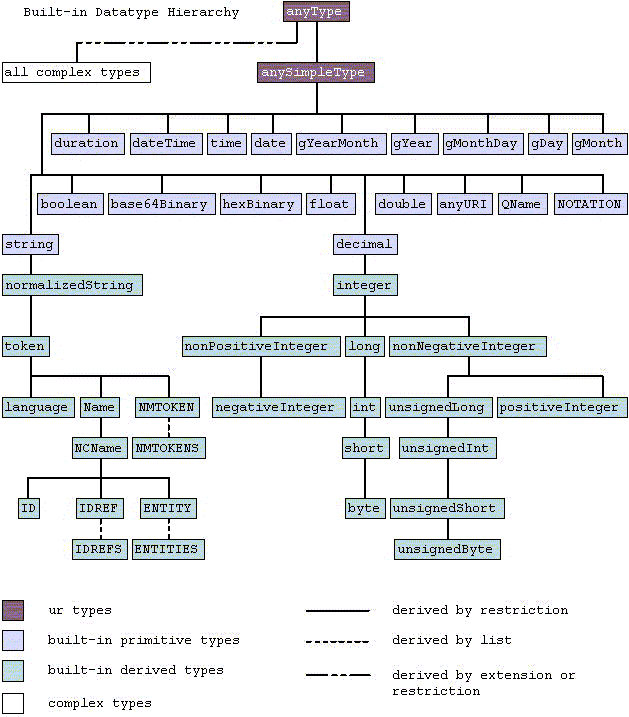
Each built-in datatype in this specification (both
·primitive· and
·derived·) can be uniquely addressed via a
URI Reference constructed as follows:
- the base URI is the URI of the XML Schema namespace
- the fragment identifier is the name of the datatype
For example, to address the int datatype, the URI is:
-
http://www.w3.org/2001/XMLSchema#int
Additionally, each facet definition element can be uniquely
addressed via a URI constructed as follows:
- the base URI is the URI of the XML Schema namespace
- the fragment identifier is the name of the facet
For example, to address the maxInclusive facet, the URI is:
-
http://www.w3.org/2001/XMLSchema#maxInclusive
Additionally, each facet usage in a built-in datatype definition
can be uniquely addressed via a URI constructed as follows:
- the base URI is the URI of the XML Schema namespace
- the fragment identifier is the name of the datatype, followed
by a period (".") followed by the name of the facet
For example, to address the usage of the maxInclusive facet in
the definition of int, the URI is:
-
http://www.w3.org/2001/XMLSchema#int.maxInclusive
3.1 Namespace considerations
The ·built-in· datatypes defined by this specification
are designed to be used with the XML Schema definition language as well as other
XML specifications.
To facilitate usage within the XML Schema definition language, the ·built-in·
datatypes in this specification have the namespace name:
- http://www.w3.org/2001/XMLSchema
To facilitate usage in specifications other than the XML Schema definition language,
such as those that do not want to know anything about aspects of the
XML Schema definition language other than the datatypes, each ·built-in·
datatype is also defined in the namespace whose URI is:
- http://www.w3.org/2001/XMLSchema-datatypes
This applies to both
·built-in· ·primitive· and
·built-in· ·derived· datatypes.
Each ·user-derived· datatype is also associated with a
unique namespace. However, ·user-derived· datatypes
do not come from the namespace defined by this specification; rather,
they come from the namespace of the schema in which they are defined
(see XML Representation of
Schemas in [XML Schema Part 1: Structures]).
3.2 Primitive datatypes
The ·primitive· datatypes defined by this specification
are described below. For each datatype, the
·value space· and ·lexical space·
are defined, ·constraining facet·s which apply
to the datatype are listed and any datatypes ·derived·
from this datatype are specified.
·primitive· datatypes can only be added by revisions
to this specification.
3.2.2 boolean
[Definition:] boolean has the
·value space· required to support the mathematical
concept of binary-valued logic: {true, false}.
3.2.2.1 Lexical representation
An instance of a datatype that is defined as ·boolean·
can have the following legal literals {true, false, 1, 0}.
3.2.2.2 Canonical representation
The canonical representation for boolean is the set of
literals {true, false}.
3.2.3 decimal
[Definition:] decimal
represents arbitrary precision decimal numbers.
The ·value space· of decimal
is the set of the values i × 10^-n,
where i and n are integers
such that n >= 0.
The ·order-relation· on decimal
is: x < y iff y - x is positive.
[Definition:]
The ·value space· of types derived from decimal
with a value for ·totalDigits· of p
is the set of values i × 10^-n, where
n and i are integers such that
p >= n >= 0 and the number of significant decimal digits
in i is less than or equal to p.
[Definition:]
The ·value space· of types derived from decimal
with a value for ·fractionDigits· of s
is the set of values i × 10^-n, where
i and n are integers such
that 0 <= n <= s.
NOTE:
All ·minimally conforming· processors ·must·
support decimal numbers with a minimum of 18 decimal digits (i.e., with a
·totalDigits· of 18). However,
·minimally conforming· processors ·may·
set an application-defined limit on the maximum number of decimal digits
they are prepared to support, in which case that application-defined
maximum number ·must· be clearly documented.
3.2.3.1 Lexical representation
decimal has a lexical representation
consisting of a finite-length sequence of decimal digits (#x30-#x39) separated
by a period as a decimal indicator. If ·totalDigits· is
specified, the number of digits must be less than or equal to
·totalDigits·.
If ·fractionDigits· is specified, the
number of digits following the decimal point must be less than or equal to
the ·fractionDigits·. An optional leading sign is allowed.
If the sign is omitted, "+" is assumed. Leading and trailing zeroes are optional.
If the fractional part is zero, the period and following zero(es) can
be omitted.
For example: -1.23, 12678967.543233, +100000.00, 210.
3.2.3.2 Canonical representation
The canonical representation for decimal is defined by
prohibiting certain options from the
Lexical representation (§3.2.3.1). Specifically, the preceding
optional "+" sign is prohibited. The decimal point is required. Leading and
trailing zeroes are prohibited subject to the following: there must be at least
one digit to the right and to the left of the decimal point which may be a zero.
3.2.4 float
[Definition:] float corresponds
to the IEEE single-precision 32-bit floating point type
[IEEE 754-1985]. The basic ·value space· of
float consists of the values
m × 2^e, where m
is an integer whose absolute value is less than
2^24, and e is an integer
between -149 and 104, inclusive. In addition to the basic
·value space· described above, the
·value space· of float also contains the
following special values: positive and negative zero,
positive and negative infinity and not-a-number.
The ·order-relation· on float
is: x < y iff y - x is positive.
Positive zero is greater than negative zero. Not-a-number equals itself and is
greater than all float values including positive infinity.
A literal in the ·lexical space· representing a
decimal number d maps to the normalized value
in the ·value space· of float that is
closest to d in the sense defined by
[Clinger, WD (1990)]; if d is
exactly halfway between two such values then the even value is chosen.
3.2.4.1 Lexical representation
float values have a lexical representation
consisting of a mantissa followed, optionally, by the character
"E" or "e", followed by an exponent. The exponent ·must·
be an integer. The mantissa must be a decimal number. The representations
for exponent and mantissa must follow the lexical rules for
integer and decimal. If the "E" or "e" and
the following exponent are omitted, an exponent value of 0 is assumed.
The special values positive and negative zero, positive
and negative infinity and not-a-number have lexical representations 0,
-0, INF, -INF and
NaN, respectively.
For example, -1E4, 1267.43233E12, 12.78e-2, 12 and INF
are all legal literals for float.
3.2.4.2 Canonical representation
The canonical representation for float is defined by
prohibiting certain options from the
Lexical representation (§3.2.4.1). Specifically, the exponent
must be indicated by "E". Leading zeroes and the preceding optional "+" sign
are prohibited in the exponent.
For the mantissa, the preceding optional "+" sign is prohibited
and the decimal point is required.
For the exponent, the preceding optional "+" sign is prohibited.
Leading and trailing zeroes are prohibited subject to the following:
number representations must
be normalized such that there is a single
digit to the left of the decimal point and at least a single digit to the
right of the decimal point.
3.2.5 double
[Definition:] The double
datatype corresponds to IEEE double-precision 64-bit floating point
type [IEEE 754-1985]. The basic ·value space·
of double consists of the values
m × 2^e, where m
is an integer whose absolute value is less than
2^53, and e is an
integer between -1075 and 970, inclusive. In addition to the basic
·value space· described above, the
·value space· of double also contains
the following special values: positive and negative zero,
positive and negative infinity and not-a-number.
The ·order-relation· on double
is: x < y iff y - x is positive.
Positive zero is greater than negative zero. Not-a-number equals itself and is
greater than all double values including positive infinity.
A literal in the ·lexical space· representing a
decimal number d maps to the normalized value
in the ·value space· of double that is
closest to d; if d is
exactly halfway between two such values then the even value is chosen.
This is the best approximation of d
([Clinger, WD (1990)], [Gay, DM (1990)]), which is more
accurate than the mapping required by [IEEE 754-1985].
3.2.5.1 Lexical representation
double values have a lexical representation
consisting of a mantissa followed, optionally, by the character "E" or
"e", followed by an exponent. The exponent ·must· be
an integer. The mantissa must be a decimal number. The representations
for exponent and mantissa must follow the lexical rules for
integer and decimal. If the "E" or "e"
and the following exponent are omitted, an exponent value of 0 is assumed.
The special values positive and negative zero, positive
and negative infinity and not-a-number have lexical representations 0,
-0, INF, -INF and
NaN, respectively.
For example, -1E4, 1267.43233E12, 12.78e-2, 12 and INF
are all legal literals for double.
3.2.5.2 Canonical representation
The canonical representation for double is defined by
prohibiting certain options from the
Lexical representation (§3.2.5.1). Specifically, the exponent
must be indicated by "E". Leading zeroes and the preceding optional "+" sign
are prohibited in the exponent.
For the mantissa, the preceding optional "+" sign is prohibited
and the decimal point is required.
For the exponent, the preceding optional "+" sign is prohibited.
Leading and trailing zeroes are prohibited subject to the following:
number representations must
be normalized such that there is a single
digit to the left of the decimal point and at least a single digit to the
right of the decimal point.
3.2.6 duration
[Definition:]
duration represents a duration of time.
The ·value space· of duration is
a six-dimensional space where the coordinates
designate the Gregorian year, month, day, hour, minute, and second components defined in
§ 5.5.3.2 of [ISO 8601],
respectively. These components are ordered
in their significance by their order of appearance i.e. as year, month, day,
hour, minute, and second.
3.2.6.1 Lexical representation
The lexical representation for duration is the
[ISO 8601] extended format PnYn
MnDTnH nMnS, where
nY represents the number of years, nM the
number of months, nD the number of days, 'T' is the
date/time separator, nH the number of hours,
nM the number of minutes and nS the
number of seconds. The number of seconds can include decimal digits
to arbitrary precision.
The values of the
Year, Month, Day, Hour and Minutes components are not restricted but
allow an arbitrary integer. Similarly, the value of the Seconds component
allows an arbitrary decimal. Thus, the lexical representation of
duration does not follow the alternative
format of § 5.5.3.2.1 of [ISO 8601].
An optional preceding minus sign ('-') is
allowed, to indicate a negative duration. If the sign is omitted a
positive duration is indicated. See also ISO 8601 Date and Time Formats (§D).
For example, to indicate a duration of 1 year, 2 months, 3 days, 10
hours, and 30 minutes, one would write: P1Y2M3DT10H30M.
One could also indicate a duration of minus 120 days as:
-P120D.
Reduced precision and truncated representations of this format are allowed
provided they conform to the following:
-
If the number of years, months, days, hours, minutes, or seconds in any
expression equals zero, the number and its corresponding designator ·may·
be omitted. However, at least one number and its designator ·must·
be present.
-
The seconds part ·may· have a decimal fraction.
-
The designator 'T' shall be absent if all of the time items are absent.
The designator 'P' must always be present.
For example, P1347Y, P1347M and P1Y2MT2H are all allowed;
P0Y1347M and P0Y1347M0D are allowed. P-1347M is not allowed although
-P1347M is allowed. P1Y2MT is not allowed.
3.2.6.2 Order relation on duration
In general, the ·order-relation· on duration
is a partial order since there is no determinate relationship between certain
durations such as one month (P1M) and 30 days (P30D).
The ·order-relation·
of two duration values x and
y is x < y iff s+x < s+y
for each qualified dateTime s
in the list below. These values for s cause the greatest deviations in the addition of
dateTimes and durations. Addition of durations to time instants is defined
in Adding durations to dateTimes (§E).
- 1696-09-01T00:00:00Z
- 1697-02-01T00:00:00Z
- 1903-03-01T00:00:00Z
- 1903-07-01T00:00:00Z
The following table shows the strongest relationship that can be determined
between example durations. The symbol <> means that the order relation is
indeterminate. Note that because of leap-seconds, a seconds field can vary
from 59 to 60. However, because of the way that addition is defined in
Adding durations to dateTimes (§E), they are still totally ordered.
| |
Relation |
| P1Y |
> P364D |
<> P365D |
|
<> P366D |
< P367D |
| P1M |
> P27D |
<> P28D |
<> P29D |
<> P30D |
<> P31D |
< P32D |
| P5M |
> P149D |
<> P150D |
<> P151D |
<> P152D |
<> P153D |
< P154D |
Implementations are free to optimize the computation of the ordering relationship. For example, the following table can be used to
compare durations of a small number of months against days.
| |
Months |
1 |
2 |
3 |
4 |
5 |
6 |
7 |
8 |
9 |
10 |
11 |
12 |
13 |
... |
| Days |
Minimum |
28 |
59 |
89 |
120 |
150 |
181 |
212 |
242 |
273 |
303 |
334 |
365 |
393 |
... |
| Maximum |
31 |
62 |
92 |
123 |
153 |
184 |
215 |
245 |
276 |
306 |
337 |
366 |
397 |
... |
3.2.6.4 Totally ordered durations
Certain derived datatypes of durations can be guaranteed have a total order. For
this, they must have fields from only one row in the list below and the time zone
must either be required or prohibited.
- year, month
- day, hour, minute, second
For example, a datatype could be defined to correspond to the
[SQL] datatype Year-Month interval that required a four digit
year field and a two digit month field but required all other fields to be unspecified. This datatype could be defined as below and would have a total order.
<simpleType name='SQL-Year-Month-Interval'>
    <restriction base='duration'>
      <pattern value='P\p{Nd}{4}Y\p{Nd}{2}M'/>
    </restriction>
</simpleType>
3.2.7 dateTime
[Definition:]
dateTime represents a specific instant of time. The
·value space· of dateTime is the space
of Combinations of date and time of day values as defined
in § 5.4 of [ISO 8601].
3.2.7.1 Lexical representation
A single lexical representation, which is a subset of the lexical
representations allowed by [ISO 8601], is allowed for
dateTime. This lexical representation is the
[ISO 8601] extended format CCYY-MM-DDThh:mm:ss
where "CC" represents the century, "YY" the year, "MM" the month and
"DD" the day, preceded by an optional leading "-" sign to indicate a
negative number. If the sign is omitted, "+" is assumed. The letter
"T" is the date/time separator and "hh", "mm", "ss" represent hour,
minute and second respectively. Additional digits can be used to
increase the precision of fractional seconds if desired i.e the format
ss.ss... with any number of digits after the decimal point is supported.
The fractional seconds part is optional; other parts of the
lexical form are not optional.
To accommodate
year values greater than 9999 additional digits can be added to the
left of this representation. Leading zeros are required if the year value
would otherwise have fewer than four digits; otherwise they are forbidden.
The year 0000 is prohibited.
The CCYY field must have at least four digits, the MM, DD, SS, hh, mm
and ss fields exactly two digits each (not counting fractional seconds);
leading zeroes must be used if the field would otherwise have too few digits.
This representation may be immediately followed by a "Z" to indicate
Coordinated Universal Time (UTC) or, to indicate the time zone, i.e. the
difference between the local time and Coordinated Universal Time,
immediately followed by a sign,
+ or -, followed by the difference from UTC represented as hh:mm (note:
the minutes part is required).
See ISO 8601 Date and Time Formats (§D) for details about legal values in the
various fields.
If the time zone is included, both hours and minutes must be present.
For example, to indicate 1:20 pm on May the 31st, 1999 for Eastern
Standard Time which is 5 hours behind Coordinated Universal Time (UTC), one
would write: 1999-05-31T13:20:00-05:00.
3.2.7.2 Canonical representation
The canonical representation for dateTime is defined
by prohibiting certain options from the
Lexical representation (§3.2.7.1).
Specifically, either the time zone must
be omitted or, if present, the time zone must be Coordinated Universal
Time (UTC) indicated by a "Z".
3.2.7.3 Order relation on dateTime
In general, the ·order-relation· on dateTime
is a partial order since there is no determinate relationship between certain
instants. For example, there is no determinate
ordering between
(a)
2000-01-20T12:00:00 and (b) 2000-01-20T12:00:00Z. Based on
timezones currently in use, (c) could vary from 2000-01-20T12:00:00+12:00 to
2000-01-20T12:00:00-13:00. It is, however, possible for this range to expand or
contract in the future, based on local laws. Because of this, the following
definition uses a somewhat broader range of indeterminate values: +14:00..-14:00.
The following definition uses the notation S[year] to represent the year
field of S, S[month] to represent the month field, and so on. The notation (Q
& "-14:00") means adding the timezone -14:00 to Q, where Q did not
already have a timezone. This is a logical explanation of the process. Actual
implementations are free to optimize as long as they produce the same results.
The ordering between two dateTimes P and Q is defined by the following
algorithm:
A.Normalize P and Q. That is, if there is a timezone present, but
it is not Z, convert it to Z using the addition operation defined in
Adding durations to dateTimes (§E)
- Thus 2000-03-04T23:00:00+03:00 normalizes to 2000-03-04T20:00:00Z
B. If P and Q either both have a time zone or both do not have a time
zone, compare P and Q field by field from the year field down to the
second field, and return a result as soon as it can be determined. That is:
- For each i in {year, month, day, hour, minute, second}
- If P[i] and Q[i] are both not specified, continue to the next i
- If P[i] is not specified and Q[i] is, or vice versa, stop and return
P <> Q
- If P[i] < Q[i], stop and return P < Q
- If P[i] > Q[i], stop and return P > Q
- Stop and return P = Q
C.Otherwise, if P contains a time zone and Q does not, compare
as follows:
- P < Q if P < (Q with time zone +14:00)
- P > Q if P > (Q with time zone -14:00)
- P <> Q otherwise, that is, if (Q with time zone +14:00) < P < (Q with time zone -14:00)
D. Otherwise, if P does not contain a time zone and Q does, compare
as follows:
- P < Q if (P with time zone -14:00) < Q.
- P > Q if (P with time zone +14:00) > Q.
- P <> Q otherwise, that is, if (P with time zone +14:00) < Q < (P with time zone -14:00)
Examples:
| Determinate |
Indeterminate |
| 2000-01-15T00:00:00 < 2000-02-15T00:00:00 |
2000-01-01T12:00:00 <>
1999-12-31T23:00:00Z |
| 2000-01-15T12:00:00 < 2000-01-16T12:00:00Z |
2000-01-16T12:00:00 <>
2000-01-16T12:00:00Z |
| |
2000-01-16T00:00:00 <> 2000-01-16T12:00:00Z |
3.2.7.4 Totally ordered dateTimes
Certain derived types from dateTime
can be guaranteed have a total order. To
do so, they must require that a specific set of fields are always specified, and
that remaining fields (if any) are always unspecified. For example, the date
datatype without time zone is defined to contain exactly year, month, and day.
Thus dates without time zone have a total order among themselves.
3.2.8 time
[Definition:] time
represents an instant of time that recurs every day. The
·value space· of time is the space
of time of day values as defined in § 5.3 of
[ISO 8601]. Specifically, it is a set of zero-duration daily
time instances.
Since the lexical representation allows an optional time zone
indicator, time values are partially ordered because it may
not be able to determine the order of two values one of which has a
time zone and the other does not. The order relation on
time values is the
Order relation on dateTime (§3.2.7.3) using an arbitrary date. See also
Adding durations to dateTimes (§E). Pairs of time values with or without time zone indicators are totally ordered.
3.2.8.1 Lexical representation
The lexical representation for time is the left
truncated lexical representation for dateTime:
hh:mm:ss.sss with optional following time zone indicator. For example,
to indicate 1:20 pm for Eastern Standard Time which is 5 hours behind
Coordinated Universal Time (UTC), one would write: 13:20:00-05:00. See also
ISO 8601 Date and Time Formats (§D).
3.2.8.2 Canonical representation
The canonical representation for time is defined
by prohibiting certain options from the
Lexical representation (§3.2.8.1). Specifically, either the time zone must
be omitted or, if present, the time zone must be Coordinated Universal
Time (UTC) indicated by a "Z".
Additionally, the canonical representation for midnight is 00:00:00.
3.2.9 date
[Definition:] date
represents a calendar date. The ·value space·
of date is the set of Gregorian calendar dates as defined
in § 5.2.1 of [ISO 8601]. Specifically,
it is a set of one-day long, non-periodic instances
e.g. lexical 1999-10-26 to represent the calendar date 1999-10-26, independent
of how many hours this day has.
Since the lexical representation allows an optional time zone
indicator, date values are partially ordered because it may
not be possible to unequivocally determine the order of two values one of which has a
time zone and the other does not. If
date values are considered as periods of time, the order relation
on date values is the order relation on their starting instants.
This is discussed in Order relation on dateTime (§3.2.7.3). See also
Adding durations to dateTimes (§E). Pairs of date values with or without time zone indicators are totally ordered.
3.2.9.1 Lexical representation
The lexical representation for date is the reduced (right
truncated) lexical representation for dateTime:
CCYY-MM-DD. No left truncation is allowed. An optional following time
zone qualifier is allowed as for dateTime. To
accommodate year values outside the range from 0001 to 9999, additional
digits can be added to the left of this representation and a preceding "-"
sign is allowed.
For example, to indicate May the 31st, 1999, one would write: 1999-05-31.
See also ISO 8601 Date and Time Formats (§D).
3.2.10 gYearMonth
[Definition:]
gYearMonth represents a
specific gregorian month in a specific gregorian year. The
·value space· of gYearMonth
is the set of Gregorian calendar months as defined in § 5.2.1 of
[ISO 8601]. Specifically, it is a set of one-month long,
non-periodic instances
e.g. 1999-10 to represent the whole month of 1999-10, independent of
how many days this month has.
Since the lexical representation allows an optional time zone
indicator, gYearMonth values are partially ordered because it may
not be possible to unequivocally determine the order of two values one of
which has a time zone and the other does not. If gYearMonth
values are considered as periods of time, the order relation on
gYearMonth values is the order relation on their starting instants.
This is discussed in Order relation on dateTime (§3.2.7.3). See also
Adding durations to dateTimes (§E). Pairs of gYearMonth
values with or without time zone indicators are totally ordered.
NOTE:
Because month/year combinations in one calendar only rarely correspond
to month/year combinations in other calendars, values of this type
are not, in general, convertible to simple values corresponding to month/year
combinations in other calendars. This type should therefore be used with caution
in contexts where conversion to other calendars is desired.
3.2.10.1 Lexical representation
The lexical representation for gYearMonth is the reduced
(right truncated) lexical representation for dateTime:
CCYY-MM. No left truncation is allowed. An optional following time
zone qualifier is allowed. To accommodate year values outside the range from 0001 to 9999, additional digits
can be added to the left of this representation and a preceding "-" sign is allowed.
For example, to indicate the month of May 1999, one would write: 1999-05.
See also ISO 8601 Date and Time Formats (§D).
3.2.11 gYear
[Definition:]
gYear represents a
gregorian calendar year. The ·value space· of
gYear is the set of Gregorian calendar years as defined in
§ 5.2.1 of [ISO 8601]. Specifically, it is a set of one-year
long, non-periodic instances
e.g. lexical 1999 to represent the whole year 1999, independent of
how many months and days this year has.
Since the lexical representation allows an optional time zone
indicator, gYear values are partially ordered because it may
not be possible to unequivocally determine the order of two values one of which has a
time zone and the other does not. If
gYear values are considered as periods of time, the order relation
on gYear values is the order relation on their starting instants.
This is discussed in Order relation on dateTime (§3.2.7.3). See also
Adding durations to dateTimes (§E). Pairs of gYear values with or without time zone indicators are totally ordered.
NOTE:
Because years in one calendar only rarely correspond to years
in other calendars, values of this type
are not, in general, convertible to simple values corresponding to years
in other calendars. This type should therefore be used with caution
in contexts where conversion to other calendars is desired.
3.2.11.1 Lexical representation
The lexical representation for gYear is the reduced (right
truncated) lexical representation for dateTime: CCYY.
No left truncation is allowed. An optional following time
zone qualifier is allowed as for dateTime. To
accommodate year values outside the range from 0001 to 9999, additional
digits can be added to the left of this representation and a preceding
"-" sign is allowed.
For example, to indicate 1999, one would write: 1999.
See also ISO 8601 Date and Time Formats (§D).
3.2.12 gMonthDay
[Definition:]
gMonthDay is a gregorian date that recurs, specifically a day of
the year such as the third of May. Arbitrary recurring dates are not
supported by this datatype. The ·value space· of
gMonthDay is the set of calendar
dates, as defined in § 3 of [ISO 8601]. Specifically,
it is a set of one-day long, annually periodic instances.
Since the lexical representation allows an optional time zone
indicator, gMonthDay values are partially ordered because it may
not be possible to unequivocally determine the order of two values one of which has a
time zone and the other does not. If
gMonthDay values are considered as periods of time, the order relation
on gMonthDay values is the order relation on their starting instants.
This is discussed in Order relation on dateTime (§3.2.7.3). See also
Adding durations to dateTimes (§E). Pairs of gMonthDay values with or without time zone indicators are totally ordered.
NOTE:
Because day/month combinations in one calendar only rarely correspond
to day/month combinations in other calendars, values of this type do not,
in general, have any straightforward or intuitive representation
in terms of most other calendars. This type should therefore be
used with caution in contexts where conversion to other calendars
is desired.
3.2.12.1 Lexical representation
The lexical representation for gMonthDay is the left
truncated lexical representation for date: --MM-DD.
An optional following time
zone qualifier is allowed as for date.
No preceding sign is allowed. No other formats are allowed. See also ISO 8601 Date and Time Formats (§D).
This datatype can be used to represent a specific day in a month.
To say, for example, that my birthday occurs on the 14th of September ever year.
3.2.13 gDay
[Definition:]
gDay is a gregorian day that recurs, specifically a day
of the month such as the 5th of the month. Arbitrary recurring days
are not supported by this datatype. The ·value space·
of gDay is the space of a set of calendar
dates as defined in § 3 of [ISO 8601]. Specifically,
it is a set of one-day long, monthly periodic instances.
This datatype can be used to represent a specific day of the month.
To say, for example, that I get my paycheck on the 15th of each month.
Since the lexical representation allows an optional time zone
indicator, gDay values are partially ordered because it may
not be possible to unequivocally determine the order of two values one of
which has a time zone and the other does not. If
gDay values are considered as periods of time, the order relation
on gDay values is the order relation on their starting instants.
This is discussed in Order relation on dateTime (§3.2.7.3). See also
Adding durations to dateTimes (§E). Pairs of gDay
values with or without time zone indicators are totally ordered.
NOTE:
Because days in one calendar only rarely correspond
to days in other calendars, values of this type do not,
in general, have any straightforward or intuitive representation
in terms of most other calendars. This type should therefore be
used with caution in contexts where conversion to other calendars
is desired.
3.2.13.1 Lexical representation
The lexical representation for gDay is the left
truncated lexical representation for date: ---DD .
An optional following time
zone qualifier is allowed as for date. No preceding sign is
allowed. No other formats are allowed. See also ISO 8601 Date and Time Formats (§D).
3.2.14 gMonth
[Definition:]
gMonth is a gregorian month that recurs every year.
The ·value space·
of gMonth is the space of a set of calendar
months as defined in § 3 of [ISO 8601]. Specifically,
it is a set of one-month long, yearly periodic instances.
This datatype can be used to represent a specific month.
To say, for example, that Thanksgiving falls in the month of November.
Since the lexical representation allows an optional time zone
indicator, gMonth values are partially ordered because it may
not be possible to unequivocally determine the order of two values one of which has a
time zone and the other does not. If
gMonth values are considered as periods of time, the order relation
on gMonth is the order relation on their starting instants.
This is discussed in Order relation on dateTime (§3.2.7.3). See also
Adding durations to dateTimes (§E). Pairs of gMonth
values with or without time zone indicators are totally ordered.
NOTE:
Because months in one calendar only rarely correspond
to months in other calendars, values of this type do not,
in general, have any straightforward or intuitive representation
in terms of most other calendars. This type should therefore be
used with caution in contexts where conversion to other calendars
is desired.
3.2.14.1 Lexical representation
The lexical representation for gMonth is the left
and right truncated lexical representation for date: --MM--.
An optional following time
zone qualifier is allowed as for date. No preceding sign is
allowed. No other formats are allowed. See also ISO 8601 Date and Time Formats (§D).
3.2.15 hexBinary
[Definition:]
hexBinary represents
arbitrary hex-encoded binary data. The ·value space· of
hexBinary is the set of finite-length sequences of binary
octets.
3.2.15.1 Lexical Representation
hexBinary has a lexical representation where
each binary octet is encoded as a character tuple, consisting of two
hexadecimal digits ([0-9a-fA-F]) representing the octet code. For example,
"0FB7" is a hex encoding for the 16-bit integer 4023
(whose binary representation is 111110110111).
3.2.15.2 Canonical Rrepresentation
The canonical representation for hexBinary is defined
by prohibiting certain options from the
Lexical Representation (§3.2.15.1). Specifically, the lower case
hexadecimal digits ([a-f]) are not allowed.
3.2.16 base64Binary
[Definition:]
base64Binary
represents Base64-encoded arbitrary binary data. The ·value space· of
base64Binary is the set of finite-length sequences of binary
octets. For base64Binary data the
entire binary stream is encoded using the Base64
Content-Transfer-Encoding defined in Section 6.8 of [RFC 2045].
3.2.17 anyURI
[Definition:]
anyURI represents a Uniform Resource Identifier Reference
(URI). An anyURI value can be absolute or relative, and may
have an optional fragment identifier (i.e., it may be a URI Reference). This
type should be used to specify the intention that the value fulfills
the role of a URI as defined by [RFC 2396], as amended by
[RFC 2732].
The mapping from anyURI values to URIs is as defined in
Section 5.4 Locator Attribute
of [XML Linking Language] (see also Section 8
Character Encoding in URI References
of [Character Model]). This means
that a wide range of internationalized resource identifiers can be specified
when an anyURI is called for, and still be understood as
URIs per [RFC 2396], as amended by [RFC 2732],
where appropriate to identify resources.
NOTE:
Each URI scheme imposes specialized syntax rules for URIs in
that scheme, including restrictions on the syntax of allowed fragement
identifiers. Because it is
impractical for processors to check that a value is a
context-appropriate URI reference, this specification follows the
lead of [RFC 2396] (as amended by [RFC 2732])
in this matter: such rules and restrictions are not part of type validity
and are not checked by ·minimally conforming· processors.
Thus in practice the above definition imposes only very modest obligations
on ·minimally conforming· processors.
3.2.17.1 Lexical representation
The ·lexical space· of anyURI is
finite-length character sequences which, when the algorithm defined in
Section 5.4 of [XML Linking Language] is applied to them, result in strings
which are legal URIs according to [RFC 2396], as amended by
[RFC 2732].
NOTE:
Spaces are, in principle, allowed in the ·lexical space·
of anyURI, however, their use is highly discouraged
(unless they are encoded by %20).
3.3 Derived datatypes
This section gives conceptual definitions for all
·built-in· ·derived· datatypes
defined by this specification. The XML representation used to define
·derived· datatypes (whether
·built-in· or ·user-derived·) is
given in section XML Representation of Simple Type Definition Schema Components (§4.1.2) and the complete
definitions of the ·built-in·
·derived· datatypes are provided in Appendix A
Schema for Datatype Definitions (normative) (§A).
3.3.1 normalizedString
[Definition:]
normalizedString
represents white space normalized strings.
The ·value space· of normalizedString is the
set of strings that do not
contain the carriage return (#xD), line feed (#xA) nor tab (#x9) characters.
The ·lexical space· of normalizedString is the
set of strings that do not
contain the carriage return (#xD) nor tab (#x9) characters.
The ·base type· of normalizedString is string.
3.3.1.2 Derived datatypes
The following ·built-in·
datatypes are ·derived· from
normalizedString:
3.3.2 token
[Definition:]
token
represents tokenized strings.
The ·value space· of token is the
set of strings that do not
contain the line feed (#xA) nor tab (#x9) characters, that have no
leading or trailing spaces (#x20) and that have no internal sequences
of two or more spaces.
The ·lexical space· of token is the
set of strings that do not
contain the line feed (#xA) nor tab (#x9) characters, that have no
leading or trailing spaces (#x20) and that have no internal sequences
of two or more spaces.
The ·base type· of token is normalizedString.
3.3.13 integer
[Definition:]
integer is
·derived· from decimal by fixing the
value of ·fractionDigits· to be 0. This results in the standard
mathematical concept of the integer numbers. The
·value space· of integer is the infinite
set {...,-2,-1,0,1,2,...}. The ·base type· of
integer is decimal.
3.3.13.1 Lexical representation
integer has a lexical representation consisting of a finite-length sequence
of decimal digits (#x30-#x39) with an optional leading sign. If the sign is omitted,
"+" is assumed. For example: -1, 0, 12678967543233, +100000.
3.3.13.2 Canonical representation
The canonical representation for integer is defined
by prohibiting certain options from the
Lexical representation (§3.3.13.1). Specifically, the preceding optional "+" sign is prohibited and leading zeroes are prohibited.
3.3.14 nonPositiveInteger
[Definition:]
nonPositiveInteger is ·derived· from
integer by setting the value of
·maxInclusive· to be 0. This results in the
standard mathematical concept of the non-positive integers.
The ·value space· of nonPositiveInteger
is the infinite set {...,-2,-1,0}. The ·base type·
of nonPositiveInteger is integer.
3.3.14.1 Lexical representation
nonPositiveInteger has a lexical representation consisting
of a negative sign ("-") followed by a finite-length
sequence of decimal digits (#x30-#x39). If the sequence of digits consists of all
zeros then the sign is optional.
For example: -1, 0, -12678967543233, -100000.
3.3.14.2 Canonical representation
The canonical representation for nonPositiveInteger is defined
by prohibiting certain options from the
Lexical representation (§3.3.14.1). Specifically, the
negative sign ("-") is required with the token "0" and leading zeroes are prohibited.
3.3.14.4 Derived datatypes
The following ·built-in·
datatypes are ·derived· from
nonPositiveInteger:
3.3.15 negativeInteger
[Definition:]
negativeInteger is ·derived· from
nonPositiveInteger by setting the value of
·maxInclusive· to be -1. This results in the
standard mathematical concept of the negative integers. The
·value space· of negativeInteger
is the infinite set {...,-2,-1}. The ·base type·
of negativeInteger is nonPositiveInteger.
3.3.15.1 Lexical representation
negativeInteger has a lexical representation consisting
of a negative sign ("-") followed by a finite-length
sequence of decimal digits (#x30-#x39). For example: -1, -12678967543233, -100000.
3.3.15.2 Canonical representation
The canonical representation for negativeInteger is defined
by prohibiting certain options from the
Lexical representation (§3.3.15.1). Specifically, leading zeroes are prohibited.
3.3.16 long
[Definition:]
long is
·derived· from integer by setting the
value of ·maxInclusive· to be 9223372036854775807
and ·minInclusive· to be -9223372036854775808.
The ·base type· of long is
integer.
3.3.16.1 Lexical representation
long has a lexical representation consisting
of an optional sign followed by a finite-length
sequence of decimal digits (#x30-#x39). If the sign is omitted, "+" is assumed.
For example: -1, 0,
12678967543233, +100000.
3.3.16.2 Canonical representation
The canonical representation for long is defined
by prohibiting certain options from the
Lexical representation (§3.3.16.1). Specifically, the
the optional "+" sign is prohibited and leading zeroes are prohibited.
3.3.17 int
[Definition:]
int
is ·derived· from long by setting the
value of ·maxInclusive· to be 2147483647 and
·minInclusive· to be -2147483648. The
·base type· of int is long.
3.3.17.1 Lexical representation
int has a lexical representation consisting
of an optional sign followed by a finite-length
sequence of decimal digits (#x30-#x39). If the sign is omitted, "+" is assumed.
For example: -1, 0,
126789675, +100000.
3.3.17.2 Canonical representation
The canonical representation for int is defined
by prohibiting certain options from the
Lexical representation (§3.3.17.1). Specifically, the
the optional "+" sign is prohibited and leading zeroes are prohibited.
3.3.18 short
[Definition:]
short is
·derived· from int by setting the
value of ·maxInclusive· to be 32767 and
·minInclusive· to be -32768. The
·base type· of short is
int.
3.3.18.1 Lexical representation
short has a lexical representation consisting
of an optional sign followed by a finite-length sequence of decimal
digits (#x30-#x39). If the sign is omitted, "+" is assumed.
For example: -1, 0, 12678, +10000.
3.3.18.2 Canonical representation
The canonical representation for short is defined
by prohibiting certain options from the
Lexical representation (§3.3.18.1). Specifically, the
the optional "+" sign is prohibited and leading zeroes are prohibited.
3.3.19 byte
[Definition:]
byte
is ·derived· from short
by setting the value of ·maxInclusive· to be 127
and ·minInclusive· to be -128.
The ·base type· of byte is
short.
3.3.19.1 Lexical representation
byte has a lexical representation consisting
of an optional sign followed by a finite-length
sequence of decimal digits (#x30-#x39). If the sign is omitted, "+" is assumed.
For example: -1, 0,
126, +100.
3.3.19.2 Canonical representation
The canonical representation for byte is defined
by prohibiting certain options from the
Lexical representation (§3.3.19.1). Specifically, the
the optional "+" sign is prohibited and leading zeroes are prohibited.
3.3.20 nonNegativeInteger
[Definition:]
nonNegativeInteger is ·derived· from
integer by setting the value of
·minInclusive· to be 0. This results in the
standard mathematical concept of the non-negative integers. The
·value space· of nonNegativeInteger
is the infinite set {0,1,2,...}. The ·base type· of
nonNegativeInteger is integer.
3.3.20.1 Lexical representation
nonNegativeInteger has a lexical representation consisting
of an optional sign followed by a finite-length
sequence of decimal digits (#x30-#x39). If the sign is omitted, "+" is assumed.
For example:
1, 0, 12678967543233, +100000.
3.3.20.2 Canonical representation
The canonical representation for nonNegativeInteger is defined
by prohibiting certain options from the
Lexical representation (§3.3.20.1). Specifically, the
the optional "+" sign is prohibited and leading zeroes are prohibited.
3.3.20.4 Derived datatypes
The following ·built-in·
datatypes are ·derived· from
nonNegativeInteger:
3.3.21 unsignedLong
[Definition:]
unsignedLong is ·derived· from
nonNegativeInteger by setting the value of
·maxInclusive· to be 18446744073709551615.
The ·base type· of unsignedLong is
nonNegativeInteger.
3.3.21.1 Lexical representation
unsignedLong has a lexical representation consisting
of a finite-length sequence of decimal digits (#x30-#x39).
For example: 0,
12678967543233, 100000.
3.3.21.2 Canonical representation
The canonical representation for unsignedLong is defined
by prohibiting certain options from the
Lexical representation (§3.3.21.1). Specifically,
leading zeroes are prohibited.
3.3.22 unsignedInt
[Definition:]
unsignedInt is ·derived· from
unsignedLong by setting the value of
·maxInclusive· to be 4294967295. The
·base type· of unsignedInt is
unsignedLong.
3.3.22.1 Lexical representation
unsignedInt has a lexical representation consisting
of a finite-length
sequence of decimal digits (#x30-#x39). For example: 0,
1267896754, 100000.
3.3.22.2 Canonical representation
The canonical representation for unsignedInt is defined
by prohibiting certain options from the
Lexical representation (§3.3.22.1). Specifically,
leading zeroes are prohibited.
3.3.23 unsignedShort
[Definition:]
unsignedShort is ·derived· from
unsignedInt by setting the value of
·maxInclusive· to be 65535. The
·base type· of unsignedShort is
unsignedInt.
3.3.23.1 Lexical representation
unsignedShort has a lexical representation consisting
of a finite-length
sequence of decimal digits (#x30-#x39).
For example: 0,
12678, 10000.
3.3.23.2 Canonical representation
The canonical representation for unsignedShort is defined
by prohibiting certain options from the
Lexical representation (§3.3.23.1). Specifically, the
leading zeroes are prohibited.
3.3.23.4 Derived datatypes
The following ·built-in·
datatypes are ·derived· from
unsignedShort:
3.3.24 unsignedByte
[Definition:]
unsignedByte is ·derived· from
unsignedShort by setting the value of
·maxInclusive· to be 255. The
·base type· of unsignedByte is
unsignedShort.
3.3.24.1 Lexical representation
unsignedByte has a lexical representation consisting
of a finite-length
sequence of decimal digits (#x30-#x39).
For example: 0,
126, 100.
3.3.24.2 Canonical representation
The canonical representation for unsignedByte is defined
by prohibiting certain options from the
Lexical representation (§3.3.24.1). Specifically,
leading zeroes are prohibited.
3.3.25 positiveInteger
[Definition:]
positiveInteger is ·derived· from
nonNegativeInteger by setting the value of
·minInclusive· to be 1. This results in the standard
mathematical concept of the positive integer numbers.
The ·value space· of positiveInteger
is the infinite set {1,2,...}. The ·base type· of
positiveInteger is nonNegativeInteger.
3.3.25.1 Lexical representation
positiveInteger has a lexical representation consisting
of an optional positive sign ("+") followed by a finite-length
sequence of decimal digits (#x30-#x39).
For example: 1, 12678967543233, +100000.
3.3.25.2 Canonical representation
The canonical representation for positiveInteger is defined
by prohibiting certain options from the
Lexical representation (§3.3.25.1). Specifically, the
optional "+" sign is prohibited and leading zeroes are prohibited.
A Schema for Datatype Definitions (normative)
<?xml version='1.0'?>
<!-- XML Schema schema for XML Schemas: Part 2: Datatypes -->
<!DOCTYPE xs:schema PUBLIC "-//W3C//DTD XMLSCHEMA 200102//EN"
"XMLSchema.dtd" [
<!--
keep this schema XML1.0 DTD valid
-->
<!ENTITY % schemaAttrs 'xmlns:hfp CDATA #IMPLIED'>
<!ELEMENT hfp:hasFacet EMPTY>
<!ATTLIST hfp:hasFacet
name NMTOKEN #REQUIRED>
<!ELEMENT hfp:hasProperty EMPTY>
<!ATTLIST hfp:hasProperty
name NMTOKEN #REQUIRED
value CDATA #REQUIRED>
<!--
Make sure that processors that do not read the external
subset will know about the various IDs we declare
-->
<!ATTLIST xs:simpleType id ID #IMPLIED>
<!ATTLIST xs:maxExclusive id ID #IMPLIED>
<!ATTLIST xs:minExclusive id ID #IMPLIED>
<!ATTLIST xs:maxInclusive id ID #IMPLIED>
<!ATTLIST xs:minInclusive id ID #IMPLIED>
<!ATTLIST xs:totalDigits id ID #IMPLIED>
<!ATTLIST xs:fractionDigits id ID #IMPLIED>
<!ATTLIST xs:length id ID #IMPLIED>
<!ATTLIST xs:minLength id ID #IMPLIED>
<!ATTLIST xs:maxLength id ID #IMPLIED>
<!ATTLIST xs:enumeration id ID #IMPLIED>
<!ATTLIST xs:pattern id ID #IMPLIED>
<!ATTLIST xs:appinfo id ID #IMPLIED>
<!ATTLIST xs:documentation id ID #IMPLIED>
<!ATTLIST xs:list id ID #IMPLIED>
<!ATTLIST xs:union id ID #IMPLIED>
]>
<xs:schema xmlns:xs="http://www.w3.org/2001/XMLSchema"
targetNamespace="http://www.w3.org/2001/XMLSchema"
version="Id: datatypes.xsd,v 1.52 2001/04/27 11:49:21 ht Exp "
xmlns:hfp="http://www.w3.org/2001/XMLSchema-hasFacetAndProperty"
elementFormDefault="qualified"
blockDefault="#all"
xml:lang="en">
<xs:annotation>
<xs:documentation source="http://www.w3.org/TR/2001/REC-xmlschema-2-20010502/datatypes">
The schema corresponding to this document is normative,
with respect to the syntactic constraints it expresses in the
XML Schema language. The documentation (within <documentation>
elements) below, is not normative, but rather highlights important
aspects of the W3C Recommendation of which this is a part
</xs:documentation>
</xs:annotation>
<xs:annotation>
<xs:documentation>
First the built-in primitive datatypes. These definitions are for
information only, the real built-in definitions are magic. Note in
particular that there is no type named 'anySimpleType'. The
primitives should really be derived from no type at all, and
anySimpleType should be derived as a union of all the primitives.
</xs:documentation>
<xs:documentation>
For each built-in datatype in this schema (both primitive and
derived) can be uniquely addressed via a URI constructed
as follows:
1) the base URI is the URI of the XML Schema namespace
2) the fragment identifier is the name of the datatype
For example, to address the int datatype, the URI is:
http://www.w3.org/2001/XMLSchema#int
Additionally, each facet definition element can be uniquely
addressed via a URI constructed as follows:
1) the base URI is the URI of the XML Schema namespace
2) the fragment identifier is the name of the facet
For example, to address the maxInclusive facet, the URI is:
http://www.w3.org/2001/XMLSchema#maxInclusive
Additionally, each facet usage in a built-in datatype definition
can be uniquely addressed via a URI constructed as follows:
1) the base URI is the URI of the XML Schema namespace
2) the fragment identifier is the name of the datatype, followed
by a period (".") followed by the name of the facet
For example, to address the usage of the maxInclusive facet in
the definition of int, the URI is:
http://www.w3.org/2001/XMLSchema#int.maxInclusive
</xs:documentation>
</xs:annotation>
<xs:simpleType name="string" id="string">
<xs:annotation>
<xs:appinfo>
<hfp:hasFacet name="length"/>
<hfp:hasFacet name="minLength"/>
<hfp:hasFacet name="maxLength"/>
<hfp:hasFacet name="pattern"/>
<hfp:hasFacet name="enumeration"/>
<hfp:hasFacet name="whiteSpace"/>
<hfp:hasProperty name="ordered" value="false"/>
<hfp:hasProperty name="bounded" value="false"/>
<hfp:hasProperty name="cardinality" value="countably infinite"/>
<hfp:hasProperty name="numeric" value="false"/>
</xs:appinfo>
<xs:documentation
source="http://www.w3.org/TR/xmlschema-2/#string"/>
</xs:annotation>
<xs:restriction base="xs:anySimpleType">
<xs:whiteSpace value="preserve" id="string.preserve"/>
</xs:restriction>
</xs:simpleType>
<xs:simpleType name="boolean" id="boolean">
<xs:annotation>
<xs:appinfo>
<hfp:hasFacet name="pattern"/>
<hfp:hasFacet name="whiteSpace"/>
<hfp:hasProperty name="ordered" value="false"/>
<hfp:hasProperty name="bounded" value="false"/>
<hfp:hasProperty name="cardinality" value="finite"/>
<hfp:hasProperty name="numeric" value="false"/>
</xs:appinfo>
<xs:documentation
source="http://www.w3.org/TR/xmlschema-2/#boolean"/>
</xs:annotation>
<xs:restriction base="xs:anySimpleType">
<xs:whiteSpace value="collapse" fixed="true"
id="boolean.whiteSpace"/>
</xs:restriction>
</xs:simpleType>
<xs:simpleType name="float" id="float">
<xs:annotation>
<xs:appinfo>
<hfp:hasFacet name="pattern"/>
<hfp:hasFacet name="enumeration"/>
<hfp:hasFacet name="whiteSpace"/>
<hfp:hasFacet name="maxInclusive"/>
<hfp:hasFacet name="maxExclusive"/>
<hfp:hasFacet name="minInclusive"/>
<hfp:hasFacet name="minExclusive"/>
<hfp:hasProperty name="ordered" value="total"/>
<hfp:hasProperty name="bounded" value="true"/>
<hfp:hasProperty name="cardinality" value="finite"/>
<hfp:hasProperty name="numeric" value="true"/>
</xs:appinfo>
<xs:documentation
source="http://www.w3.org/TR/xmlschema-2/#float"/>
</xs:annotation>
<xs:restriction base="xs:anySimpleType">
<xs:whiteSpace value="collapse" fixed="true"
id="float.whiteSpace"/>
</xs:restriction>
</xs:simpleType>
<xs:simpleType name="double" id="double">
<xs:annotation>
<xs:appinfo>
<hfp:hasFacet name="pattern"/>
<hfp:hasFacet name="enumeration"/>
<hfp:hasFacet name="whiteSpace"/>
<hfp:hasFacet name="maxInclusive"/>
<hfp:hasFacet name="maxExclusive"/>
<hfp:hasFacet name="minInclusive"/>
<hfp:hasFacet name="minExclusive"/>
<hfp:hasProperty name="ordered" value="total"/>
<hfp:hasProperty name="bounded" value="true"/>
<hfp:hasProperty name="cardinality" value="finite"/>
<hfp:hasProperty name="numeric" value="true"/>
</xs:appinfo>
<xs:documentation
source="http://www.w3.org/TR/xmlschema-2/#double"/>
</xs:annotation>
<xs:restriction base="xs:anySimpleType">
<xs:whiteSpace value="collapse" fixed="true"
id="double.whiteSpace"/>
</xs:restriction>
</xs:simpleType>
<xs:simpleType name="decimal" id="decimal">
<xs:annotation>
<xs:appinfo>
<hfp:hasFacet name="totalDigits"/>
<hfp:hasFacet name="fractionDigits"/>
<hfp:hasFacet name="pattern"/>
<hfp:hasFacet name="whiteSpace"/>
<hfp:hasFacet name="enumeration"/>
<hfp:hasFacet name="maxInclusive"/>
<hfp:hasFacet name="maxExclusive"/>
<hfp:hasFacet name="minInclusive"/>
<hfp:hasFacet name="minExclusive"/>
<hfp:hasProperty name="ordered" value="total"/>
<hfp:hasProperty name="bounded" value="false"/>
<hfp:hasProperty name="cardinality"
value="countably infinite"/>
<hfp:hasProperty name="numeric" value="true"/>
</xs:appinfo>
<xs:documentation
source="http://www.w3.org/TR/xmlschema-2/#decimal"/>
</xs:annotation>
<xs:restriction base="xs:anySimpleType">
<xs:whiteSpace value="collapse" fixed="true"
id="decimal.whiteSpace"/>
</xs:restriction>
</xs:simpleType>
<xs:simpleType name="duration" id="duration">
<xs:annotation>
<xs:appinfo>
<hfp:hasFacet name="pattern"/>
<hfp:hasFacet name="enumeration"/>
<hfp:hasFacet name="whiteSpace"/>
<hfp:hasFacet name="maxInclusive"/>
<hfp:hasFacet name="maxExclusive"/>
<hfp:hasFacet name="minInclusive"/>
<hfp:hasFacet name="minExclusive"/>
<hfp:hasProperty name="ordered" value="partial"/>
<hfp:hasProperty name="bounded" value="false"/>
<hfp:hasProperty name="cardinality"
value="countably infinite"/>
<hfp:hasProperty name="numeric" value="false"/>
</xs:appinfo>
<xs:documentation
source="http://www.w3.org/TR/xmlschema-2/#duration"/>
</xs:annotation>
<xs:restriction base="xs:anySimpleType">
<xs:whiteSpace value="collapse" fixed="true"
id="duration.whiteSpace"/>
</xs:restriction>
</xs:simpleType>
<xs:simpleType name="dateTime" id="dateTime">
<xs:annotation>
<xs:appinfo>
<hfp:hasFacet name="pattern"/>
<hfp:hasFacet name="enumeration"/>
<hfp:hasFacet name="whiteSpace"/>
<hfp:hasFacet name="maxInclusive"/>
<hfp:hasFacet name="maxExclusive"/>
<hfp:hasFacet name="minInclusive"/>
<hfp:hasFacet name="minExclusive"/>
<hfp:hasProperty name="ordered" value="partial"/>
<hfp:hasProperty name="bounded" value="false"/>
<hfp:hasProperty name="cardinality"
value="countably infinite"/>
<hfp:hasProperty name="numeric" value="false"/>
</xs:appinfo>
<xs:documentation
source="http://www.w3.org/TR/xmlschema-2/#dateTime"/>
</xs:annotation>
<xs:restriction base="xs:anySimpleType">
<xs:whiteSpace value="collapse" fixed="true"
id="dateTime.whiteSpace"/>
</xs:restriction>
</xs:simpleType>
<xs:simpleType name="time" id="time">
<xs:annotation>
<xs:appinfo>
<hfp:hasFacet name="pattern"/>
<hfp:hasFacet name="enumeration"/>
<hfp:hasFacet name="whiteSpace"/>
<hfp:hasFacet name="maxInclusive"/>
<hfp:hasFacet name="maxExclusive"/>
<hfp:hasFacet name="minInclusive"/>
<hfp:hasFacet name="minExclusive"/>
<hfp:hasProperty name="ordered" value="partial"/>
<hfp:hasProperty name="bounded" value="false"/>
<hfp:hasProperty name="cardinality"
value="countably infinite"/>
<hfp:hasProperty name="numeric" value="false"/>
</xs:appinfo>
<xs:documentation
source="http://www.w3.org/TR/xmlschema-2/#time"/>
</xs:annotation>
<xs:restriction base="xs:anySimpleType">
<xs:whiteSpace value="collapse" fixed="true"
id="time.whiteSpace"/>
</xs:restriction>
</xs:simpleType>
<xs:simpleType name="date" id="date">
<xs:annotation>
<xs:appinfo>
<hfp:hasFacet name="pattern"/>
<hfp:hasFacet name="enumeration"/>
<hfp:hasFacet name="whiteSpace"/>
<hfp:hasFacet name="maxInclusive"/>
<hfp:hasFacet name="maxExclusive"/>
<hfp:hasFacet name="minInclusive"/>
<hfp:hasFacet name="minExclusive"/>
<hfp:hasProperty name="ordered" value="partial"/>
<hfp:hasProperty name="bounded" value="false"/>
<hfp:hasProperty name="cardinality"
value="countably infinite"/>
<hfp:hasProperty name="numeric" value="false"/>
</xs:appinfo>
<xs:documentation
source="http://www.w3.org/TR/xmlschema-2/#date"/>
</xs:annotation>
<xs:restriction base="xs:anySimpleType">
<xs:whiteSpace value="collapse" fixed="true"
id="date.whiteSpace"/>
</xs:restriction>
</xs:simpleType>
<xs:simpleType name="gYearMonth" id="gYearMonth">
<xs:annotation>
<xs:appinfo>
<hfp:hasFacet name="pattern"/>
<hfp:hasFacet name="enumeration"/>
<hfp:hasFacet name="whiteSpace"/>
<hfp:hasFacet name="maxInclusive"/>
<hfp:hasFacet name="maxExclusive"/>
<hfp:hasFacet name="minInclusive"/>
<hfp:hasFacet name="minExclusive"/>
<hfp:hasProperty name="ordered" value="partial"/>
<hfp:hasProperty name="bounded" value="false"/>
<hfp:hasProperty name="cardinality"
value="countably infinite"/>
<hfp:hasProperty name="numeric" value="false"/>
</xs:appinfo>
<xs:documentation
source="http://www.w3.org/TR/xmlschema-2/#gYearMonth"/>
</xs:annotation>
<xs:restriction base="xs:anySimpleType">
<xs:whiteSpace value="collapse" fixed="true"
id="gYearMonth.whiteSpace"/>
</xs:restriction>
</xs:simpleType>
<xs:simpleType name="gYear" id="gYear">
<xs:annotation>
<xs:appinfo>
<hfp:hasFacet name="pattern"/>
<hfp:hasFacet name="enumeration"/>
<hfp:hasFacet name="whiteSpace"/>
<hfp:hasFacet name="maxInclusive"/>
<hfp:hasFacet name="maxExclusive"/>
<hfp:hasFacet name="minInclusive"/>
<hfp:hasFacet name="minExclusive"/>
<hfp:hasProperty name="ordered" value="partial"/>
<hfp:hasProperty name="bounded" value="false"/>
<hfp:hasProperty name="cardinality"
value="countably infinite"/>
<hfp:hasProperty name="numeric" value="false"/>
</xs:appinfo>
<xs:documentation
source="http://www.w3.org/TR/xmlschema-2/#gYear"/>
</xs:annotation>
<xs:restriction base="xs:anySimpleType">
<xs:whiteSpace value="collapse" fixed="true"
id="gYear.whiteSpace"/>
</xs:restriction>
</xs:simpleType>
<xs:simpleType name="gMonthDay" id="gMonthDay">
<xs:annotation>
<xs:appinfo>
<hfp:hasFacet name="pattern"/>
<hfp:hasFacet name="enumeration"/>
<hfp:hasFacet name="whiteSpace"/>
<hfp:hasFacet name="maxInclusive"/>
<hfp:hasFacet name="maxExclusive"/>
<hfp:hasFacet name="minInclusive"/>
<hfp:hasFacet name="minExclusive"/>
<hfp:hasProperty name="ordered" value="partial"/>
<hfp:hasProperty name="bounded" value="false"/>
<hfp:hasProperty name="cardinality"
value="countably infinite"/>
<hfp:hasProperty name="numeric" value="false"/>
</xs:appinfo>
<xs:documentation
source="http://www.w3.org/TR/xmlschema-2/#gMonthDay"/>
</xs:annotation>
<xs:restriction base="xs:anySimpleType">
<xs:whiteSpace value="collapse" fixed="true"
id="gMonthDay.whiteSpace"/>
</xs:restriction>
</xs:simpleType>
<xs:simpleType name="gDay" id="gDay">
<xs:annotation>
<xs:appinfo>
<hfp:hasFacet name="pattern"/>
<hfp:hasFacet name="enumeration"/>
<hfp:hasFacet name="whiteSpace"/>
<hfp:hasFacet name="maxInclusive"/>
<hfp:hasFacet name="maxExclusive"/>
<hfp:hasFacet name="minInclusive"/>
<hfp:hasFacet name="minExclusive"/>
<hfp:hasProperty name="ordered" value="partial"/>
<hfp:hasProperty name="bounded" value="false"/>
<hfp:hasProperty name="cardinality"
value="countably infinite"/>
<hfp:hasProperty name="numeric" value="false"/>
</xs:appinfo>
<xs:documentation
source="http://www.w3.org/TR/xmlschema-2/#gDay"/>
</xs:annotation>
<xs:restriction base="xs:anySimpleType">
<xs:whiteSpace value="collapse" fixed="true"
id="gDay.whiteSpace"/>
</xs:restriction>
</xs:simpleType>
<xs:simpleType name="gMonth" id="gMonth">
<xs:annotation>
<xs:appinfo>
<hfp:hasFacet name="pattern"/>
<hfp:hasFacet name="enumeration"/>
<hfp:hasFacet name="whiteSpace"/>
<hfp:hasFacet name="maxInclusive"/>
<hfp:hasFacet name="maxExclusive"/>
<hfp:hasFacet name="minInclusive"/>
<hfp:hasFacet name="minExclusive"/>
<hfp:hasProperty name="ordered" value="partial"/>
<hfp:hasProperty name="bounded" value="false"/>
<hfp:hasProperty name="cardinality"
value="countably infinite"/>
<hfp:hasProperty name="numeric" value="false"/>
</xs:appinfo>
<xs:documentation
source="http://www.w3.org/TR/xmlschema-2/#gMonth"/>
</xs:annotation>
<xs:restriction base="xs:anySimpleType">
<xs:whiteSpace value="collapse" fixed="true"
id="gMonth.whiteSpace"/>
</xs:restriction>
</xs:simpleType>
<xs:simpleType name="hexBinary" id="hexBinary">
<xs:annotation>
<xs:appinfo>
<hfp:hasFacet name="length"/>
<hfp:hasFacet name="minLength"/>
<hfp:hasFacet name="maxLength"/>
<hfp:hasFacet name="pattern"/>
<hfp:hasFacet name="enumeration"/>
<hfp:hasFacet name="whiteSpace"/>
<hfp:hasProperty name="ordered" value="false"/>
<hfp:hasProperty name="bounded" value="false"/>
<hfp:hasProperty name="cardinality"
value="countably infinite"/>
<hfp:hasProperty name="numeric" value="false"/>
</xs:appinfo>
<xs:documentation
source="http://www.w3.org/TR/xmlschema-2/#binary"/>
</xs:annotation>
<xs:restriction base="xs:anySimpleType">
<xs:whiteSpace value="collapse" fixed="true"
id="hexBinary.whiteSpace"/>
</xs:restriction>
</xs:simpleType>
<xs:simpleType name="base64Binary" id="base64Binary">
<xs:annotation>
<xs:appinfo>
<hfp:hasFacet name="length"/>
<hfp:hasFacet name="minLength"/>
<hfp:hasFacet name="maxLength"/>
<hfp:hasFacet name="pattern"/>
<hfp:hasFacet name="enumeration"/>
<hfp:hasFacet name="whiteSpace"/>
<hfp:hasProperty name="ordered" value="false"/>
<hfp:hasProperty name="bounded" value="false"/>
<hfp:hasProperty name="cardinality"
value="countably infinite"/>
<hfp:hasProperty name="numeric" value="false"/>
</xs:appinfo>
<xs:documentation
source="http://www.w3.org/TR/xmlschema-2/#base64Binary"/>
</xs:annotation>
<xs:restriction base="xs:anySimpleType">
<xs:whiteSpace value="collapse" fixed="true"
id="base64Binary.whiteSpace"/>
</xs:restriction>
</xs:simpleType>
<xs:simpleType name="anyURI" id="anyURI">
<xs:annotation>
<xs:appinfo>
<hfp:hasFacet name="length"/>
<hfp:hasFacet name="minLength"/>
<hfp:hasFacet name="maxLength"/>
<hfp:hasFacet name="pattern"/>
<hfp:hasFacet name="enumeration"/>
<hfp:hasFacet name="whiteSpace"/>
<hfp:hasProperty name="ordered" value="false"/>
<hfp:hasProperty name="bounded" value="false"/>
<hfp:hasProperty name="cardinality"
value="countably infinite"/>
<hfp:hasProperty name="numeric" value="false"/>
</xs:appinfo>
<xs:documentation
source="http://www.w3.org/TR/xmlschema-2/#anyURI"/>
</xs:annotation>
<xs:restriction base="xs:anySimpleType">
<xs:whiteSpace value="collapse" fixed="true"
id="anyURI.whiteSpace"/>
</xs:restriction>
</xs:simpleType>
<xs:simpleType name="QName" id="QName">
<xs:annotation>
<xs:appinfo>
<hfp:hasFacet name="length"/>
<hfp:hasFacet name="minLength"/>
<hfp:hasFacet name="maxLength"/>
<hfp:hasFacet name="pattern"/>
<hfp:hasFacet name="enumeration"/>
<hfp:hasFacet name="whiteSpace"/>
<hfp:hasProperty name="ordered" value="false"/>
<hfp:hasProperty name="bounded" value="false"/>
<hfp:hasProperty name="cardinality"
value="countably infinite"/>
<hfp:hasProperty name="numeric" value="false"/>
</xs:appinfo>
<xs:documentation
source="http://www.w3.org/TR/xmlschema-2/#QName"/>
</xs:annotation>
<xs:restriction base="xs:anySimpleType">
<xs:whiteSpace value="collapse" fixed="true"
id="QName.whiteSpace"/>
</xs:restriction>
</xs:simpleType>
<xs:simpleType name="NOTATION" id="NOTATION">
<xs:annotation>
<xs:appinfo>
<hfp:hasFacet name="length"/>
<hfp:hasFacet name="minLength"/>
<hfp:hasFacet name="maxLength"/>
<hfp:hasFacet name="pattern"/>
<hfp:hasFacet name="enumeration"/>
<hfp:hasFacet name="whiteSpace"/>
<hfp:hasProperty name="ordered" value="false"/>
<hfp:hasProperty name="bounded" value="false"/>
<hfp:hasProperty name="cardinality"
value="countably infinite"/>
<hfp:hasProperty name="numeric" value="false"/>
</xs:appinfo>
<xs:documentation
source="http://www.w3.org/TR/xmlschema-2/#NOTATION"/>
<xs:documentation>
NOTATION cannot be used directly in a schema; rather a type
must be derived from it by specifying at least one enumeration
facet whose value is the name of a NOTATION declared in the
schema.
</xs:documentation>
</xs:annotation>
<xs:restriction base="xs:anySimpleType">
<xs:whiteSpace value="collapse" fixed="true"
id="NOTATION.whiteSpace"/>
</xs:restriction>
</xs:simpleType>
<xs:annotation>
<xs:documentation>
Now the derived primitive types
</xs:documentation>
</xs:annotation>
<xs:simpleType name="normalizedString" id="normalizedString">
<xs:annotation>
<xs:documentation
source="http://www.w3.org/TR/xmlschema-2/#normalizedString"/>
</xs:annotation>
<xs:restriction base="xs:string">
<xs:whiteSpace value="replace"
id="normalizedString.whiteSpace"/>
</xs:restriction>
</xs:simpleType>
<xs:simpleType name="token" id="token">
<xs:annotation>
<xs:documentation
source="http://www.w3.org/TR/xmlschema-2/#token"/>
</xs:annotation>
<xs:restriction base="xs:normalizedString">
<xs:whiteSpace value="collapse" id="token.whiteSpace"/>
</xs:restriction>
</xs:simpleType>
<xs:simpleType name="language" id="language">
<xs:annotation>
<xs:documentation
source="http://www.w3.org/TR/xmlschema-2/#language"/>
</xs:annotation>
<xs:restriction base="xs:token">
<xs:pattern
value="([a-zA-Z]{2}|[iI]-[a-zA-Z]+|[xX]-[a-zA-Z]{1,8})(-[a-zA-Z]{1,8})*"
id="language.pattern">
<xs:annotation>
<xs:documentation
source="http://www.w3.org/TR/REC-xml#NT-LanguageID">
pattern specifies the content of section 2.12 of XML 1.0e2
and RFC 1766
</xs:documentation>
</xs:annotation>
</xs:pattern>
</xs:restriction>
</xs:simpleType>
<xs:simpleType name="IDREFS" id="IDREFS">
<xs:annotation>
<xs:appinfo>
<hfp:hasFacet name="length"/>
<hfp:hasFacet name="minLength"/>
<hfp:hasFacet name="maxLength"/>
<hfp:hasFacet name="enumeration"/>
<hfp:hasFacet name="whiteSpace"/>
<hfp:hasProperty name="ordered" value="false"/>
<hfp:hasProperty name="bounded" value="false"/>
<hfp:hasProperty name="cardinality"
value="countably infinite"/>
<hfp:hasProperty name="numeric" value="false"/>
</xs:appinfo>
<xs:documentation
source="http://www.w3.org/TR/xmlschema-2/#IDREFS"/>
</xs:annotation>
<xs:restriction>
<xs:simpleType>
<xs:list itemType="xs:IDREF"/>
</xs:simpleType>
<xs:minLength value="1" id="IDREFS.minLength"/>
</xs:restriction>
</xs:simpleType>
<xs:simpleType name="ENTITIES" id="ENTITIES">
<xs:annotation>
<xs:appinfo>
<hfp:hasFacet name="length"/>
<hfp:hasFacet name="minLength"/>
<hfp:hasFacet name="maxLength"/>
<hfp:hasFacet name="enumeration"/>
<hfp:hasFacet name="whiteSpace"/>
<hfp:hasProperty name="ordered" value="false"/>
<hfp:hasProperty name="bounded" value="false"/>
<hfp:hasProperty name="cardinality"
value="countably infinite"/>
<hfp:hasProperty name="numeric" value="false"/>
</xs:appinfo>
<xs:documentation
source="http://www.w3.org/TR/xmlschema-2/#ENTITIES"/>
</xs:annotation>
<xs:restriction>
<xs:simpleType>
<xs:list itemType="xs:ENTITY"/>
</xs:simpleType>
<xs:minLength value="1" id="ENTITIES.minLength"/>
</xs:restriction>
</xs:simpleType>
<xs:simpleType name="NMTOKEN" id="NMTOKEN">
<xs:annotation>
<xs:documentation
source="http://www.w3.org/TR/xmlschema-2/#NMTOKEN"/>
</xs:annotation>
<xs:restriction base="xs:token">
<xs:pattern value="\c+" id="NMTOKEN.pattern">
<xs:annotation>
<xs:documentation
source="http://www.w3.org/TR/REC-xml#NT-Nmtoken">
pattern matches production 7 from the XML spec
</xs:documentation>
</xs:annotation>
</xs:pattern>
</xs:restriction>
</xs:simpleType>
<xs:simpleType name="NMTOKENS" id="NMTOKENS">
<xs:annotation>
<xs:appinfo>
<hfp:hasFacet name="length"/>
<hfp:hasFacet name="minLength"/>
<hfp:hasFacet name="maxLength"/>
<hfp:hasFacet name="enumeration"/>
<hfp:hasFacet name="whiteSpace"/>
<hfp:hasProperty name="ordered" value="false"/>
<hfp:hasProperty name="bounded" value="false"/>
<hfp:hasProperty name="cardinality"
value="countably infinite"/>
<hfp:hasProperty name="numeric" value="false"/>
</xs:appinfo>
<xs:documentation
source="http://www.w3.org/TR/xmlschema-2/#NMTOKENS"/>
</xs:annotation>
<xs:restriction>
<xs:simpleType>
<xs:list itemType="xs:NMTOKEN"/>
</xs:simpleType>
<xs:minLength value="1" id="NMTOKENS.minLength"/>
</xs:restriction>
</xs:simpleType>
<xs:simpleType name="Name" id="Name">
<xs:annotation>
<xs:documentation
source="http://www.w3.org/TR/xmlschema-2/#Name"/>
</xs:annotation>
<xs:restriction base="xs:token">
<xs:pattern value="\i\c*" id="Name.pattern">
<xs:annotation>
<xs:documentation
source="http://www.w3.org/TR/REC-xml#NT-Name">
pattern matches production 5 from the XML spec
</xs:documentation>
</xs:annotation>
</xs:pattern>
</xs:restriction>
</xs:simpleType>
<xs:simpleType name="NCName" id="NCName">
<xs:annotation>
<xs:documentation
source="http://www.w3.org/TR/xmlschema-2/#NCName"/>
</xs:annotation>
<xs:restriction base="xs:Name">
<xs:pattern value="[\i-[:]][\c-[:]]*" id="NCName.pattern">
<xs:annotation>
<xs:documentation
source="http://www.w3.org/TR/REC-xml-names/#NT-NCName">
pattern matches production 4 from the Namespaces in XML spec
</xs:documentation>
</xs:annotation>
</xs:pattern>
</xs:restriction>
</xs:simpleType>
<xs:simpleType name="ID" id="ID">
<xs:annotation>
<xs:documentation
source="http://www.w3.org/TR/xmlschema-2/#ID"/>
</xs:annotation>
<xs:restriction base="xs:NCName"/>
</xs:simpleType>
<xs:simpleType name="IDREF" id="IDREF">
<xs:annotation>
<xs:documentation
source="http://www.w3.org/TR/xmlschema-2/#IDREF"/>
</xs:annotation>
<xs:restriction base="xs:NCName"/>
</xs:simpleType>
<xs:simpleType name="ENTITY" id="ENTITY">
<xs:annotation>
<xs:documentation
source="http://www.w3.org/TR/xmlschema-2/#ENTITY"/>
</xs:annotation>
<xs:restriction base="xs:NCName"/>
</xs:simpleType>
<xs:simpleType name="integer" id="integer">
<xs:annotation>
<xs:documentation
source="http://www.w3.org/TR/xmlschema-2/#integer"/>
</xs:annotation>
<xs:restriction base="xs:decimal">
<xs:fractionDigits value="0" fixed="true" id="integer.fractionDigits"/>
</xs:restriction>
</xs:simpleType>
<xs:simpleType name="nonPositiveInteger" id="nonPositiveInteger">
<xs:annotation>
<xs:documentation
source="http://www.w3.org/TR/xmlschema-2/#nonPositiveInteger"/>
</xs:annotation>
<xs:restriction base="xs:integer">
<xs:maxInclusive value="0" id="nonPositiveInteger.maxInclusive"/>
</xs:restriction>
</xs:simpleType>
<xs:simpleType name="negativeInteger" id="negativeInteger">
<xs:annotation>
<xs:documentation
source="http://www.w3.org/TR/xmlschema-2/#negativeInteger"/>
</xs:annotation>
<xs:restriction base="xs:nonPositiveInteger">
<xs:maxInclusive value="-1" id="negativeInteger.maxInclusive"/>
</xs:restriction>
</xs:simpleType>
<xs:simpleType name="long" id="long">
<xs:annotation>
<xs:appinfo>
<hfp:hasProperty name="bounded" value="true"/>
<hfp:hasProperty name="cardinality" value="finite"/>
</xs:appinfo>
<xs:documentation
source="http://www.w3.org/TR/xmlschema-2/#long"/>
</xs:annotation>
<xs:restriction base="xs:integer">
<xs:minInclusive value="-9223372036854775808" id="long.minInclusive"/>
<xs:maxInclusive value="9223372036854775807" id="long.maxInclusive"/>
</xs:restriction>
</xs:simpleType>
<xs:simpleType name="int" id="int">
<xs:annotation>
<xs:documentation
source="http://www.w3.org/TR/xmlschema-2/#int"/>
</xs:annotation>
<xs:restriction base="xs:long">
<xs:minInclusive value="-2147483648" id="int.minInclusive"/>
<xs:maxInclusive value="2147483647" id="int.maxInclusive"/>
</xs:restriction>
</xs:simpleType>
<xs:simpleType name="short" id="short">
<xs:annotation>
<xs:documentation
source="http://www.w3.org/TR/xmlschema-2/#short"/>
</xs:annotation>
<xs:restriction base="xs:int">
<xs:minInclusive value="-32768" id="short.minInclusive"/>
<xs:maxInclusive value="32767" id="short.maxInclusive"/>
</xs:restriction>
</xs:simpleType>
<xs:simpleType name="byte" id="byte">
<xs:annotation>
<xs:documentation
source="http://www.w3.org/TR/xmlschema-2/#byte"/>
</xs:annotation>
<xs:restriction base="xs:short">
<xs:minInclusive value="-128" id="byte.minInclusive"/>
<xs:maxInclusive value="127" id="byte.maxInclusive"/>
</xs:restriction>
</xs:simpleType>
<xs:simpleType name="nonNegativeInteger" id="nonNegativeInteger">
<xs:annotation>
<xs:documentation
source="http://www.w3.org/TR/xmlschema-2/#nonNegativeInteger"/>
</xs:annotation>
<xs:restriction base="xs:integer">
<xs:minInclusive value="0" id="nonNegativeInteger.minInclusive"/>
</xs:restriction>
</xs:simpleType>
<xs:simpleType name="unsignedLong" id="unsignedLong">
<xs:annotation>
<xs:appinfo>
<hfp:hasProperty name="bounded" value="true"/>
<hfp:hasProperty name="cardinality" value="finite"/>
</xs:appinfo>
<xs:documentation
source="http://www.w3.org/TR/xmlschema-2/#unsignedLong"/>
</xs:annotation>
<xs:restriction base="xs:nonNegativeInteger">
<xs:maxInclusive value="18446744073709551615"
id="unsignedLong.maxInclusive"/>
</xs:restriction>
</xs:simpleType>
<xs:simpleType name="unsignedInt" id="unsignedInt">
<xs:annotation>
<xs:documentation
source="http://www.w3.org/TR/xmlschema-2/#unsignedInt"/>
</xs:annotation>
<xs:restriction base="xs:unsignedLong">
<xs:maxInclusive value="4294967295"
id="unsignedInt.maxInclusive"/>
</xs:restriction>
</xs:simpleType>
<xs:simpleType name="unsignedShort" id="unsignedShort">
<xs:annotation>
<xs:documentation
source="http://www.w3.org/TR/xmlschema-2/#unsignedShort"/>
</xs:annotation>
<xs:restriction base="xs:unsignedInt">
<xs:maxInclusive value="65535"
id="unsignedShort.maxInclusive"/>
</xs:restriction>
</xs:simpleType>
<xs:simpleType name="unsignedByte" id="unsignedBtype">
<xs:annotation>
<xs:documentation
source="http://www.w3.org/TR/xmlschema-2/#unsignedByte"/>
</xs:annotation>
<xs:restriction base="xs:unsignedShort">
<xs:maxInclusive value="255" id="unsignedByte.maxInclusive"/>
</xs:restriction>
</xs:simpleType>
<xs:simpleType name="positiveInteger" id="positiveInteger">
<xs:annotation>
<xs:documentation
source="http://www.w3.org/TR/xmlschema-2/#positiveInteger"/>
</xs:annotation>
<xs:restriction base="xs:nonNegativeInteger">
<xs:minInclusive value="1" id="positiveInteger.minInclusive"/>
</xs:restriction>
</xs:simpleType>
<xs:simpleType name="derivationControl">
<xs:annotation>
<xs:documentation>
A utility type, not for public use</xs:documentation>
</xs:annotation>
<xs:restriction base="xs:NMTOKEN">
<xs:enumeration value="substitution"/>
<xs:enumeration value="extension"/>
<xs:enumeration value="restriction"/>
<xs:enumeration value="list"/>
<xs:enumeration value="union"/>
</xs:restriction>
</xs:simpleType>
<xs:group name="simpleDerivation">
<xs:choice>
<xs:element ref="xs:restriction"/>
<xs:element ref="xs:list"/>
<xs:element ref="xs:union"/>
</xs:choice>
</xs:group>
<xs:simpleType name="simpleDerivationSet">
<xs:annotation>
<xs:documentation>
#all or (possibly empty) subset of {restriction, union, list}
</xs:documentation>
<xs:documentation>
A utility type, not for public use</xs:documentation>
</xs:annotation>
<xs:union>
<xs:simpleType>
<xs:restriction base="xs:token">
<xs:enumeration value="#all"/>
</xs:restriction>
</xs:simpleType>
<xs:simpleType>
<xs:restriction base="xs:derivationControl">
<xs:enumeration value="list"/>
<xs:enumeration value="union"/>
<xs:enumeration value="restriction"/>
</xs:restriction>
</xs:simpleType>
</xs:union>
</xs:simpleType>
<xs:complexType name="simpleType" abstract="true">
<xs:complexContent>
<xs:extension base="xs:annotated">
<xs:group ref="xs:simpleDerivation"/>
<xs:attribute name="final" type="xs:simpleDerivationSet"/>
<xs:attribute name="name" type="xs:NCName">
<xs:annotation>
<xs:documentation>
Can be restricted to required or forbidden
</xs:documentation>
</xs:annotation>
</xs:attribute>
</xs:extension>
</xs:complexContent>
</xs:complexType>
<xs:complexType name="topLevelSimpleType">
<xs:complexContent>
<xs:restriction base="xs:simpleType">
<xs:sequence>
<xs:element ref="xs:annotation" minOccurs="0"/>
<xs:group ref="xs:simpleDerivation"/>
</xs:sequence>
<xs:attribute name="name" use="required"
type="xs:NCName">
<xs:annotation>
<xs:documentation>
Required at the top level
</xs:documentation>
</xs:annotation>
</xs:attribute>
</xs:restriction>
</xs:complexContent>
</xs:complexType>
<xs:complexType name="localSimpleType">
<xs:complexContent>
<xs:restriction base="xs:simpleType">
<xs:sequence>
<xs:element ref="xs:annotation" minOccurs="0"/>
<xs:group ref="xs:simpleDerivation"/>
</xs:sequence>
<xs:attribute name="name" use="prohibited">
<xs:annotation>
<xs:documentation>
Forbidden when nested
</xs:documentation>
</xs:annotation>
</xs:attribute>
<xs:attribute name="final" use="prohibited"/>
</xs:restriction>
</xs:complexContent>
</xs:complexType>
<xs:element name="simpleType" type="xs:topLevelSimpleType" id="simpleType">
<xs:annotation>
<xs:documentation
source="http://www.w3.org/TR/xmlschema-2/#element-simpleType"/>
</xs:annotation>
</xs:element>
<xs:group name="facets">
<xs:annotation>
<xs:documentation>
We should use a substitution group for facets, but
that's ruled out because it would allow users to
add their own, which we're not ready for yet.
</xs:documentation>
</xs:annotation>
<xs:choice>
<xs:element ref="xs:minExclusive"/>
<xs:element ref="xs:minInclusive"/>
<xs:element ref="xs:maxExclusive"/>
<xs:element ref="xs:maxInclusive"/>
<xs:element ref="xs:totalDigits"/>
<xs:element ref="xs:fractionDigits"/>
<xs:element ref="xs:length"/>
<xs:element ref="xs:minLength"/>
<xs:element ref="xs:maxLength"/>
<xs:element ref="xs:enumeration"/>
<xs:element ref="xs:whiteSpace"/>
<xs:element ref="xs:pattern"/>
</xs:choice>
</xs:group>
<xs:group name="simpleRestrictionModel">
<xs:sequence>
<xs:element name="simpleType" type="xs:localSimpleType" minOccurs="0"/>
<xs:group ref="xs:facets" minOccurs="0" maxOccurs="unbounded"/>
</xs:sequence>
</xs:group>
<xs:element name="restriction" id="restriction">
<xs:complexType>
<xs:annotation>
<xs:documentation
source="http://www.w3.org/TR/xmlschema-2/#element-restriction">
base attribute and simpleType child are mutually
exclusive, but one or other is required
</xs:documentation>
</xs:annotation>
<xs:complexContent>
<xs:extension base="xs:annotated">
<xs:group ref="xs:simpleRestrictionModel"/>
<xs:attribute name="base" type="xs:QName" use="optional"/>
</xs:extension>
</xs:complexContent>
</xs:complexType>
</xs:element>
<xs:element name="list" id="list">
<xs:complexType>
<xs:annotation>
<xs:documentation
source="http://www.w3.org/TR/xmlschema-2/#element-list">
itemType attribute and simpleType child are mutually
exclusive, but one or other is required
</xs:documentation>
</xs:annotation>
<xs:complexContent>
<xs:extension base="xs:annotated">
<xs:sequence>
<xs:element name="simpleType" type="xs:localSimpleType"
minOccurs="0"/>
</xs:sequence>
<xs:attribute name="itemType" type="xs:QName" use="optional"/>
</xs:extension>
</xs:complexContent>
</xs:complexType>
</xs:element>
<xs:element name="union" id="union">
<xs:complexType>
<xs:annotation>
<xs:documentation
source="http://www.w3.org/TR/xmlschema-2/#element-union">
memberTypes attribute must be non-empty or there must be
at least one simpleType child
</xs:documentation>
</xs:annotation>
<xs:complexContent>
<xs:extension base="xs:annotated">
<xs:sequence>
<xs:element name="simpleType" type="xs:localSimpleType"
minOccurs="0" maxOccurs="unbounded"/>
</xs:sequence>
<xs:attribute name="memberTypes" use="optional">
<xs:simpleType>
<xs:list itemType="xs:QName"/>
</xs:simpleType>
</xs:attribute>
</xs:extension>
</xs:complexContent>
</xs:complexType>
</xs:element>
<xs:complexType name="facet">
<xs:complexContent>
<xs:extension base="xs:annotated">
<xs:attribute name="value" use="required"/>
<xs:attribute name="fixed" type="xs:boolean" use="optional"
default="false"/>
</xs:extension>
</xs:complexContent>
</xs:complexType>
<xs:complexType name="noFixedFacet">
<xs:complexContent>
<xs:restriction base="xs:facet">
<xs:sequence>
<xs:element ref="xs:annotation" minOccurs="0"/>
</xs:sequence>
<xs:attribute name="fixed" use="prohibited"/>
</xs:restriction>
</xs:complexContent>
</xs:complexType>
<xs:element name="minExclusive" id="minExclusive" type="xs:facet">
<xs:annotation>
<xs:documentation
source="http://www.w3.org/TR/xmlschema-2/#element-minExclusive"/>
</xs:annotation>
</xs:element>
<xs:element name="minInclusive" id="minInclusive" type="xs:facet">
<xs:annotation>
<xs:documentation
source="http://www.w3.org/TR/xmlschema-2/#element-minInclusive"/>
</xs:annotation>
</xs:element>
<xs:element name="maxExclusive" id="maxExclusive" type="xs:facet">
<xs:annotation>
<xs:documentation
source="http://www.w3.org/TR/xmlschema-2/#element-maxExclusive"/>
</xs:annotation>
</xs:element>
<xs:element name="maxInclusive" id="maxInclusive" type="xs:facet">
<xs:annotation>
<xs:documentation
source="http://www.w3.org/TR/xmlschema-2/#element-maxInclusive"/>
</xs:annotation>
</xs:element>
<xs:complexType name="numFacet">
<xs:complexContent>
<xs:restriction base="xs:facet">
<xs:sequence>
<xs:element ref="xs:annotation" minOccurs="0"/>
</xs:sequence>
<xs:attribute name="value" type="xs:nonNegativeInteger" use="required"/>
</xs:restriction>
</xs:complexContent>
</xs:complexType>
<xs:element name="totalDigits" id="totalDigits">
<xs:annotation>
<xs:documentation
source="http://www.w3.org/TR/xmlschema-2/#element-totalDigits"/>
</xs:annotation>
<xs:complexType>
<xs:complexContent>
<xs:restriction base="xs:numFacet">
<xs:sequence>
<xs:element ref="xs:annotation" minOccurs="0"/>
</xs:sequence>
<xs:attribute name="value" type="xs:positiveInteger" use="required"/>
</xs:restriction>
</xs:complexContent>
</xs:complexType>
</xs:element>
<xs:element name="fractionDigits" id="fractionDigits" type="xs:numFacet">
<xs:annotation>
<xs:documentation
source="http://www.w3.org/TR/xmlschema-2/#element-fractionDigits"/>
</xs:annotation>
</xs:element>
<xs:element name="length" id="length" type="xs:numFacet">
<xs:annotation>
<xs:documentation
source="http://www.w3.org/TR/xmlschema-2/#element-length"/>
</xs:annotation>
</xs:element>
<xs:element name="minLength" id="minLength" type="xs:numFacet">
<xs:annotation>
<xs:documentation
source="http://www.w3.org/TR/xmlschema-2/#element-minLength"/>
</xs:annotation>
</xs:element>
<xs:element name="maxLength" id="maxLength" type="xs:numFacet">
<xs:annotation>
<xs:documentation
source="http://www.w3.org/TR/xmlschema-2/#element-maxLength"/>
</xs:annotation>
</xs:element>
<xs:element name="enumeration" id="enumeration" type="xs:noFixedFacet">
<xs:annotation>
<xs:documentation
source="http://www.w3.org/TR/xmlschema-2/#element-enumeration"/>
</xs:annotation>
</xs:element>
<xs:element name="whiteSpace" id="whiteSpace">
<xs:annotation>
<xs:documentation
source="http://www.w3.org/TR/xmlschema-2/#element-whiteSpace"/>
</xs:annotation>
<xs:complexType>
<xs:complexContent>
<xs:restriction base="xs:facet">
<xs:sequence>
<xs:element ref="xs:annotation" minOccurs="0"/>
</xs:sequence>
<xs:attribute name="value" use="required">
<xs:simpleType>
<xs:restriction base="xs:NMTOKEN">
<xs:enumeration value="preserve"/>
<xs:enumeration value="replace"/>
<xs:enumeration value="collapse"/>
</xs:restriction>
</xs:simpleType>
</xs:attribute>
</xs:restriction>
</xs:complexContent>
</xs:complexType>
</xs:element>
<xs:element name="pattern" id="pattern" type="xs:noFixedFacet">
<xs:annotation>
<xs:documentation
source="http://www.w3.org/TR/xmlschema-2/#element-pattern"/>
</xs:annotation>
</xs:element>
</xs:schema>
B DTD for Datatype Definitions (non-normative)
<!--
        DTD for XML Schemas: Part 2: Datatypes
        Id: datatypes.dtd,v 1.23 2001/03/16 17:36:30 ht Exp
        Note this DTD is NOT normative, or even definitive.
  -->

<!--
        This DTD cannot be used on its own, it is intended
        only for incorporation in XMLSchema.dtd, q.v.
  -->

<!-- Define all the element names, with optional prefix -->
<!ENTITY % simpleType "%p;simpleType">
<!ENTITY % restriction "%p;restriction">
<!ENTITY % list "%p;list">
<!ENTITY % union "%p;union">
<!ENTITY % maxExclusive "%p;maxExclusive">
<!ENTITY % minExclusive "%p;minExclusive">
<!ENTITY % maxInclusive "%p;maxInclusive">
<!ENTITY % minInclusive "%p;minInclusive">
<!ENTITY % totalDigits "%p;totalDigits">
<!ENTITY % fractionDigits "%p;fractionDigits">
<!ENTITY % length "%p;length">
<!ENTITY % minLength "%p;minLength">
<!ENTITY % maxLength "%p;maxLength">
<!ENTITY % enumeration "%p;enumeration">
<!ENTITY % whiteSpace "%p;whiteSpace">
<!ENTITY % pattern "%p;pattern">

<!--
        Customisation entities for the ATTLIST of each element
        type. Define one of these if your schema takes advantage
        of the anyAttribute='##other' in the schema for schemas
  -->

<!ENTITY % simpleTypeAttrs "">
<!ENTITY % restrictionAttrs "">
<!ENTITY % listAttrs "">
<!ENTITY % unionAttrs "">
<!ENTITY % maxExclusiveAttrs "">
<!ENTITY % minExclusiveAttrs "">
<!ENTITY % maxInclusiveAttrs "">
<!ENTITY % minInclusiveAttrs "">
<!ENTITY % totalDigitsAttrs "">
<!ENTITY % fractionDigitsAttrs "">
<!ENTITY % lengthAttrs "">
<!ENTITY % minLengthAttrs "">
<!ENTITY % maxLengthAttrs "">
<!ENTITY % enumerationAttrs "">
<!ENTITY % whiteSpaceAttrs "">
<!ENTITY % patternAttrs "">

<!-- Define some entities for informative use as attribute
        types -->
<!ENTITY % URIref "CDATA">
<!ENTITY % XPathExpr "CDATA">
<!ENTITY % QName "NMTOKEN">
<!ENTITY % QNames "NMTOKENS">
<!ENTITY % NCName "NMTOKEN">
<!ENTITY % nonNegativeInteger "NMTOKEN">
<!ENTITY % boolean "(true|false)">
<!ENTITY % simpleDerivationSet "CDATA">
<!--
        #all or space-separated list drawn from derivationChoice
  -->

<!--
        Note that the use of 'facet' below is less restrictive
        than is really intended:  There should in fact be no
        more than one of each of minInclusive, minExclusive,
        maxInclusive, maxExclusive, totalDigits, fractionDigits,
        length, maxLength, minLength within datatype,
        and the min- and max- variants of Inclusive and Exclusive
        are mutually exclusive. On the other hand,  pattern and
        enumeration may repeat.
  -->
<!ENTITY % minBound "(%minInclusive; | %minExclusive;)">
<!ENTITY % maxBound "(%maxInclusive; | %maxExclusive;)">
<!ENTITY % bounds "%minBound; | %maxBound;">
<!ENTITY % numeric "%totalDigits; | %fractionDigits;">
<!ENTITY % ordered "%bounds; | %numeric;">
<!ENTITY % unordered
   "%pattern; | %enumeration; | %whiteSpace; | %length; |
   %maxLength; | %minLength;">
<!ENTITY % facet "%ordered; | %unordered;">
<!ENTITY % facetAttr
        "value CDATA #REQUIRED
        id ID #IMPLIED">
<!ENTITY % fixedAttr "fixed %boolean; #IMPLIED">
<!ENTITY % facetModel "(%annotation;)?">
<!ELEMENT %simpleType;
        ((%annotation;)?, (%restriction; | %list; | %union;))>
<!ATTLIST %simpleType;
    name      %NCName; #IMPLIED
    final     %simpleDerivationSet; #IMPLIED
    id        ID       #IMPLIED
    %simpleTypeAttrs;>
<!-- name is required at top level -->
<!ELEMENT %restriction; ((%annotation;)?,
                         (%restriction1; |
                          ((%simpleType;)?,(%facet;)*)),
                         (%attrDecls;))>
<!ATTLIST %restriction;
    base      %QName;                  #IMPLIED
    id        ID       #IMPLIED
    %restrictionAttrs;>
<!--
        base and simpleType child are mutually exclusive,
        one is required.

        restriction is shared between simpleType and
        simpleContent and complexContent (in XMLSchema.xsd).
        restriction1 is for the latter cases, when this
        is restricting a complex type, as is attrDecls.
  -->
<!ELEMENT %list; ((%annotation;)?,(%simpleType;)?)>
<!ATTLIST %list;
    itemType      %QName;             #IMPLIED
    id        ID       #IMPLIED
    %listAttrs;>
<!--
        itemType and simpleType child are mutually exclusive,
        one is required
  -->
<!ELEMENT %union; ((%annotation;)?,(%simpleType;)*)>
<!ATTLIST %union;
    id            ID       #IMPLIED
    memberTypes   %QNames;            #IMPLIED
    %unionAttrs;>
<!--
        At least one item in memberTypes or one simpleType
        child is required
  -->

<!ELEMENT %maxExclusive; %facetModel;>
<!ATTLIST %maxExclusive;
        %facetAttr;
        %fixedAttr;
        %maxExclusiveAttrs;>
<!ELEMENT %minExclusive; %facetModel;>
<!ATTLIST %minExclusive;
        %facetAttr;
        %fixedAttr;
        %minExclusiveAttrs;>

<!ELEMENT %maxInclusive; %facetModel;>
<!ATTLIST %maxInclusive;
        %facetAttr;
        %fixedAttr;
        %maxInclusiveAttrs;>
<!ELEMENT %minInclusive; %facetModel;>
<!ATTLIST %minInclusive;
        %facetAttr;
        %fixedAttr;
        %minInclusiveAttrs;>

<!ELEMENT %totalDigits; %facetModel;>
<!ATTLIST %totalDigits;
        %facetAttr;
        %fixedAttr;
        %totalDigitsAttrs;>
<!ELEMENT %fractionDigits; %facetModel;>
<!ATTLIST %fractionDigits;
        %facetAttr;
        %fixedAttr;
        %fractionDigitsAttrs;>

<!ELEMENT %length; %facetModel;>
<!ATTLIST %length;
        %facetAttr;
        %fixedAttr;
        %lengthAttrs;>
<!ELEMENT %minLength; %facetModel;>
<!ATTLIST %minLength;
        %facetAttr;
        %fixedAttr;
        %minLengthAttrs;>
<!ELEMENT %maxLength; %facetModel;>
<!ATTLIST %maxLength;
        %facetAttr;
        %fixedAttr;
        %maxLengthAttrs;>

<!-- This one can be repeated -->
<!ELEMENT %enumeration; %facetModel;>
<!ATTLIST %enumeration;
        %facetAttr;
        %enumerationAttrs;>

<!ELEMENT %whiteSpace; %facetModel;>
<!ATTLIST %whiteSpace;
        %facetAttr;
        %fixedAttr;
        %whiteSpaceAttrs;>

<!-- This one can be repeated -->
<!ELEMENT %pattern; %facetModel;>
<!ATTLIST %pattern;
        %facetAttr;
        %patternAttrs;>
C Datatypes and Facets
C.1 Fundamental Facets
The following table shows the values of the fundamental facets
for each ·built-in· datatype.
D ISO 8601 Date and Time Formats
D.1 ISO 8601 Conventions
The ·primitive· datatypes
duration, dateTime, time,
date, gYearMonth, gMonthDay,
gDay, gMonth and gYear
use lexical formats inspired by
[ISO 8601]. This appendix provides more detail on the ISO
formats and discusses some deviations from them for the datatypes
defined in this specification.
[ISO 8601] "specifies the representation of dates in the
proleptic Gregorian calendar and times and representations of periods of time".
The proleptic Gregorian calendar includes dates prior to 1582 (the year it came
into use as an ecclesiastical calendar).
It should be pointed out that the datatypes described in this
specification do not cover all the types of data covered by
[ISO 8601], nor do they support all the lexical
representations for those types of data.
[ISO 8601] lexical formats are described using "pictures"
in which characters are used in place of digits. For the primitive datatypes
dateTime, time,
date, gYearMonth, gMonthDay,
gDay, gMonth and gYear.
these characters have the following meanings:
-
C -- represents a digit used in the thousands and hundreds components,
the "century" component, of the time element "year". Legal values are
from 0 to 9.
-
Y -- represents a digit used in the tens and units components of the time
element "year". Legal values are from 0 to 9.
-
M -- represents a digit used in the time element "month". The two
digits in a MM format can have values from 1 to 12.
-
D -- represents a digit used in the time element "day". The two digits
in a DD format can have values from 1 to 28 if the month value equals 2,
1 to 29 if the month value equals 2 and the year is a leap year, 1 to 30
if the month value equals 4, 6, 9 or 11, and 1 to 31 if the month value
equals 1, 3, 5, 7, 8, 10 or 12.
-
h -- represents a digit used in the time element "hour". The two digits
in a hh format can have values from 0 to 23.
-
m -- represents a digit used in the time element "minute". The two digits
in a mm format can have values from 0 to 59.
-
s -- represents a digit used in the time element "second". The two
digits in a ss format can have values from 0 to 60. In the formats
described in this specification the whole number of seconds ·may·
be followed by decimal seconds to an arbitrary level of precision.
This is represented in the picture by "ss.sss". A value of 60 or more is
allowed only in the case of leap seconds.
Strictly speaking, a value of
60 or more is not sensible unless the month and day could
represent March 31, June 30, September 30, or December 31 in UTC.
Because the leap second is added or subtracted as the last second of the day
in UTC time, the long (or short) minute could occur at other times in local
time. In cases where the leap second is used with an inappropriate month
and day it, and any fractional seconds, should considered as added or
subtracted from the following minute.
For all the information items indicated by the above characters, leading
zeros are required where indicated.
In addition to the above, certain characters are used as designators
and appear as themselves in lexical formats.
-
T -- is used as time designator to indicate the start of the
representation of the time of day in dateTime.
-
Z -- is used as time-zone designator, immediately (without a space)
following a data element expressing the time of day in Coordinated
Universal Time (UTC) in
dateTime, time,
date, gYearMonth, gMonthDay,
gDay, gMonth, and gYear.
In the lexical format for duration the following
characters are also used as designators and appear as themselves in
lexical formats:
-
P -- is used as the time duration designator, preceding a data element
representing a given duration of time.
-
Y -- follows the number of years in a time duration.
- M -- follows the number of months or minutes in a time duration.
- D -- follows the number of days in a time duration.
- H -- follows the number of hours in a time duration.
- S -- follows the number of seconds in a time duration.
The values of the
Year, Month, Day, Hour and Minutes components are not restricted but
allow an arbitrary integer. Similarly, the value of the Seconds component
allows an arbitrary decimal. Thus, the lexical format for
duration and datatypes derived from it
does not follow the alternative
format of § 5.5.3.2.1 of [ISO 8601].
D.2 Truncated and Reduced Formats
[ISO 8601] supports a variety of "truncated" formats in
which some of the characters on the left of specific formats, for example,
the
century, can be omitted.
Truncated formats are, in
general, not permitted for the datatypes defined in this specification
with three exceptions. The time datatype uses
a truncated format for dateTime
which represents an instant of time that recurs every day.
Similarly, the gMonthDay and gDay
datatypes use left-truncated formats for date.
The datatype gMonth uses a right and left truncated format for
date.
[ISO 8601] also supports a variety of "reduced" or right-truncated
formats in which some of the characters to the right of specific formats,
such as the
time specification, can be omitted. Right truncated formats are also, in
general,
not permitted for the datatypes defined in this specification
with the following exceptions:
right-truncated representations of dateTime are used as
lexical representations for date, gMonth,
gYear.
D.3 Deviations from ISO 8601 Formats
D.3.1 Sign Allowed
An optional minus sign is allowed immediately preceding, without a space,
the lexical representations for duration, dateTime,
date, gMonth, gYear.
D.3.2 No Year Zero
The year "0000" is an illegal year value.
E Adding durations to dateTimes
Given a dateTime S and a duration D, this
appendix specifies how to compute a dateTime E where E is the
end of the time period with start S and duration D i.e. E = S + D. Such
computations are used, for example, to determine whether a dateTime
is within a specific time period. This appendix also addresses the addition of
durations to the datatypes date,
gYearMonth, gYear, gDay and
gMonth, which can be viewed as a set of dateTimes.
In such cases, the addition is made to the first or starting
dateTime in the set.
This is a logical explanation of the process.
Actual implementations are free to optimize as long as they produce the same
results. The calculation uses the notation S[year] to represent the year
field of S, S[month] to represent the month field, and so on. It also depends on
the following functions:
-
fQuotient(a, b) = the greatest integer less than or equal to a/b
- fQuotient(-1,3) = -1
- fQuotient(0,3)...fQuotient(2,3) = 0
- fQuotient(3,3) = 1
- fQuotient(3.123,3) = 1
-
modulo(a, b) = a - fQuotient(a,b)*b
- modulo(-1,3) = 2
- modulo(0,3)...modulo(2,3) = 0...2
- modulo(3,3) = 0
- modulo(3.123,3) = 0.123
-
fQuotient(a, low, high) = fQuotient(a - low, high - low)
- fQuotient(0, 1, 13) = -1
- fQuotient(1, 1, 13) ... fQuotient(12, 1, 13) = 0
- fQuotient(13, 1, 13) = 1
- fQuotient(13.123, 1, 13) = 1
-
modulo(a, low, high) = modulo(a - low, high - low) + low
- modulo(0, 1, 13) = 12
- modulo(1, 1, 13) ... modulo(12, 1, 13) = 1...12
- modulo(13, 1, 13) = 1
- modulo(13.123, 1, 13) = 1.123
-
maximumDayInMonthFor(yearValue, monthValue) =
- M := modulo(monthValue, 1, 13)
- Y := yearValue + fQuotient(monthValue, 1, 13)
- Return a value based on M and Y:
| 31 |
M = January, March, May, July, August, October, or
December |
| 30 |
M = April, June, September, or November |
| 29 |
M = February AND (modulo(Y, 400) = 0 OR
(modulo(Y, 100) != 0) AND modulo(Y, 4) = 0) |
| 28 |
Otherwise |
E.1 Algorithm
Essentially, this calculation is equivalent to separating D into <year,month>
and <day,hour,minute,second> fields. The <year,month> is added to S.
If the day is out of range, it is pinned to be within range. Thus April
31 turns into April 30. Then the <day,hour,minute,second> is added. This
latter addition can cause the year and month to change.
Leap seconds are handled by the computation by treating them as overflows.
Essentially, a value of 60
seconds in S is treated as if it were a duration of 60 seconds added to S
(with a zero seconds field). All calculations
thereafter use 60 seconds per minute.
Thus the addition of either PT1M or PT60S to any dateTime will always
produce the same result. This is a special definition of addition which
is designed to match common practice, and -- most importantly -- be stable
over time.
A definition that attempted to take leap-seconds into account would need to
be constantly updated, and could not predict the results of future
implementation's additions. The decision to introduce a leap second in UTC
is the responsibility of the [International Earth Rotation Service (IERS)]. They make periodic
announcements as to when
leap seconds are to be added, but this is not known more than a year in
advance. For more information on leap seconds, see [U.S. Naval Observatory Time Service Department].
The following is the precise specification. These steps must be followed in
the same order. If a field in D is not specified, it is treated as if it were
zero. If a field in S is not specified, it is treated in the calculation as if
it were the minimum allowed value in that field, however, after the calculation
is concluded, the corresponding field in E is removed (set to unspecified).
-
Months (may be modified additionally below)
- temp := S[month] + D[month]
- E[month] := modulo(temp, 1, 13)
- carry := fQuotient(temp, 1, 13)
-
Years (may be modified additionally below)
- E[year] := S[year] + D[year] + carry
-
Zone
-
Seconds
- temp := S[second] + D[second]
- E[second] := modulo(temp, 60)
- carry := fQuotient(temp, 60)
-
Minutes
- temp := S[minute] + D[minute] + carry
- E[minute] := modulo(temp, 60)
- carry := fQuotient(temp, 60)
-
Hours
- temp := S[hour] + D[hour] + carry
- E[hour] := modulo(temp, 24)
- carry := fQuotient(temp, 24)
-
Days
- if S[day] > maximumDayInMonthFor(E[year], E[month])
- tempDays := maximumDayInMonthFor(E[year], E[month])
- else if S[day] < 1
- else
- E[day] := tempDays + D[day] + carry
-
START LOOP
-
IF E[day] < 1
- E[day] := E[day] + maximumDayInMonthFor(E[year], E[month] - 1)
- carry := -1
-
ELSE IF E[day] > maximumDayInMonthFor(E[year], E[month])
- E[day] := E[day] - maximumDayInMonthFor(E[year], E[month])
- carry := 1
-
ELSE EXIT LOOP
- temp := E[month] + carry
- E[month] := modulo(temp, 1, 13)
- E[year] := E[year] + fQuotient(temp, 1, 13)
-
GOTO START LOOP
Examples:
| dateTime |
duration |
result |
| 2000-01-12T12:13:14Z |
P1Y3M5DT7H10M3.3S |
2001-04-17T19:23:17.3Z |
| 2000-01 |
-P3M |
1999-10 |
| 2000-01-12 |
PT33H |
2000-01-13 |
E.2 Commutativity and Associativity
Time durations are added by simply adding each of their fields, respectively,
without overflow.
The order of addition of durations to instants is significant.
For example, there are cases where:
((dateTime + duration1) + duration2) != ((dateTime +
duration2) + duration1)
Example:
(2000-03-30 + P1D) + P1M = 2000-03-31 + P1M = 2001-04-30
(2000-03-30 + P1M) + P1D = 2000-04-30 + P1D = 2000-05-01
F Regular Expressions
A ·regular expression· R is a sequence of
characters that denote a set of strings L(R).
When used to constrain a ·lexical space·, a
regular expression R asserts that only strings
in L(R) are valid literals for values of that type.
[Definition:] A
regular expression is composed from zero or more
·branch·es, separated by | characters.
|
For all ·branch·es S, and for all
·regular expression·s T, valid
·regular expression·s R are:
|
Denoting the set of strings L(R) containing:
|
| (empty string) |
the set containing just the empty string
|
| S |
all strings in L(S) |
| S|T |
all strings in L(S) and
all strings in L(T) |
[Definition:]
A branch consists
of zero or more ·piece·s, concatenated together.
|
For all ·piece·s S, and for all
·branch·es T, valid
·branch·es R are:
|
Denoting the set of strings L(R) containing:
|
| S |
all strings in L(S) |
| ST |
all strings st with s in
L(S) and t in L(T) |
[Definition:]
A piece is an
·atom·, possibly followed by a
·quantifier·.
|
For all ·atom·s S and non-negative
integers n, m such that
n <= m, valid ·piece·s
R are:
|
Denoting the set of strings L(R) containing:
|
| S |
all strings in L(S) |
| S? |
the empty string, and all strings in
L(S). |
| S* |
All strings in L(S?) and all strings st
with s in L(S*)
and t in L(S). ( all concatenations
of zero or more strings from L(S) )
|
| S+ |
All strings st with s in L(S)
and t in L(S*). ( all concatenations
of one or more strings from L(S) )
|
| S{n,m} |
All strings st with s in L(S)
and t in L(S{n-1,m-1}). ( All
sequences of at least n, and at most m, strings from L(S) )
|
| S{n} |
All strings in L(S{n,n}). ( All
sequences of exactly n strings from L(S) )
|
| S{n,} |
All strings in L(S{n}S*) ( All
sequences of at least n, strings from L(S) )
|
| S{0,m} |
All strings st with s in L(S?)
and t in L(S{0,m-1}). ( All
sequences of at most m, strings from L(S) )
|
| S{0,0} |
The set containing only the empty string
|
NOTE:
The regular expression language in the Perl Programming Language
[Perl] does not include a quantifier of the form
S{,m), since it is logically equivalent to S{0,m}.
We have, therefore, left this logical possibility out of the regular
expression language defined by this specification. We welcome
further input from implementors and schema authors on this issue.
[Definition:]
A quantifier
is one of ?, *, +,
{n,m} or {n,}, which have the meanings
defined in the table above.
[Definition:]
An atom is either a
·normal character·, a ·character class·, or
a parenthesized ·regular expression·.
[Definition:]
A metacharacter
is either ., \, ?,
*, +, {, }
(, ), [ or ].
These characters have special meanings in ·regular expression·s,
but can be escaped to form ·atom·s that denote the
sets of strings containing only themselves, i.e., an escaped
·metacharacter· behaves like a ·normal character·.
[Definition:]
A
normal character is any XML character that is not a
metacharacter. In ·regular expression·s, a normal character is an
atom that denotes the singleton set of strings containing only itself.
| Normal Character |
[10] | Char | ::= | [^.\?*+()|#x5B#x5D] | |
|
Note that a ·normal character· can be represented either as
itself, or with a character
reference.
F.1 Character Classes
[Definition:]
A
character class is an ·atom·
R that identifies a set of characters
C(R). The set of strings L(R) denoted by a
character class R contains one single-character string
"c" for each character c in C(R).
A character class is either a ·character class escape· or a
·character class expression·.
[Definition:]
A
character class expression is a ·character group· surrounded
by [ and ] characters. For all character
groups G, [G] is a valid character class
expression, identifying the set of characters
C([G]) = C(G).
| Character Class Expression |
|
|
[Definition:]
A
character group is either a ·positive character group·,
a ·negative character group·, or a ·character class subtraction·.
[Definition:]
A positive character group consists of one or more
·character range·s or ·character class escape·s, concatenated
together. A positive character group identifies the set of
characters containing all of the characters in all of the sets identified
by its constituent ranges or escapes.
[Definition:]
A negative character group is a
·positive character group· preceded by the ^ character.
For all ·positive character group·s P, ^P
is a valid negative character group, and C(^P)
contains all XML characters that are not in C(P).
[Definition:]
A
character class subtraction is a ·character class expression·
subtracted from a ·positive character group· or
·negative character group·, using the - character.
| Character Class Subtraction |
|
|
For any ·positive character group· or
·negative character group· G, and any
·character class expression· C, G-C is a valid
·character class subtraction·, identifying the set of all characters in
C(G) that are not also in C(C).
[Definition:]
A
character range R identifies a set of
characters C(R) containing all XML characters with UCS
code points in a specified range.
A single XML character is a ·character range· that identifies
the set of characters containing only itself. All XML characters are valid
character ranges, except as follows:
A ·character range· ·may· also be written
in the form s-e, identifying the set that contains all XML characters
with UCS code points greater than or equal to the code point
of s, but not greater than the code point of e.
s-e is a valid character range iff:
NOTE:
The code point of a ·single character escape· is the code point of the
single character in the set of characters that it identifies.
F.1.1 Character Class Escapes
[Definition:]
A character class escape is a short sequence of characters
that identifies predefined character class. The valid character
class escapes are the ·single character escape·s, the
·multi-character escape·s, and the ·category escape·s (including
the ·block escape·s).
[Definition:]
A
single character escape identifies a set containing a only
one character -- usually because that character is difficult or
impossible to write directly into a ·regular expression·.
| Single Character Escape |
[24] | SingleCharEsc | ::= | '\' [nrt\|.?*+(){}#x2D#x5B#x5D#x5E] | |
|
|
The valid ·single character escape·s are:
|
Identifying the set of characters C(R) containing:
|
\n |
the newline character (#xA) |
\r |
the return character (#xD) |
\t |
the tab character (#x9) |
\\ |
\ |
\| |
| |
\. |
. |
\- |
- |
\^ |
^ |
\? |
? |
\* |
* |
\+ |
+ |
\{ |
{ |
\} |
} |
\( |
( |
\) |
) |
\[ |
[ |
\] |
] |
[Definition:]
[Unicode Database] specifies a number of possible
values for the "General Category" property
and provides mappings from code points to specific character properties.
The set containing all characters that have property X,
can be identified with a category escape \p{X}.
The complement of this set is specified with the
category escape \P{X}.
([\P{X}] = [^\p{X}]).
NOTE:
[Unicode Database] is subject to future revision. For example, the
mapping from code points to character properties might be updated.
All ·minimally conforming· processors ·must·
support the character properties defined in the version of [Unicode Database]
that is current at the time this specification became a W3C
Recommendation. However, implementors are encouraged to support the
character properties defined in any future version.
The following table specifies the recognized values of the
"General Category" property.
| Category |
Property |
Meaning |
| Letters |
L |
All Letters |
| Lu |
uppercase |
| Ll |
lowercase |
| Lt |
titlecase |
| Lm |
modifier |
| Lo |
other |
| |
| Marks |
M |
All Marks |
| Mn |
nonspacing |
| Mc |
spacing combining |
| Me |
enclosing |
| |
| Numbers |
N |
All Numbers |
| Nd |
decimal digit |
| Nl |
letter |
| No |
other |
| |
| Punctuation |
P |
All Punctuation |
| Pc |
connector |
| Pd |
dash |
| Ps |
open |
| Pe |
close |
| Pi |
initial quote
(may behave like Ps or Pe depending on usage) |
| Pf |
final quote
(may behave like Ps or Pe depending on usage) |
| Po |
other |
| |
| Separators |
Z |
All Separators |
| Zs |
space |
| Zl |
line |
| Zp |
paragraph |
| |
| Symbols |
S |
All Symbols |
| Sm |
math |
| Sc |
currency |
| Sk |
modifier |
| So |
other |
| |
| Other |
C |
All Others |
| Cc |
control |
| Cf |
format |
| Co |
private use |
| Cn |
not assigned |
| Categories |
[28] | IsCategory | ::= |
			Letters |
			Marks |
			Numbers |
			Punctuation |
			Separators |
			Symbols |
			Others
| |
[29] | Letters | ::= | 'L' [ultmo]? | |
[30] | Marks | ::= | 'M' [nce]? | |
[31] | Numbers | ::= | 'N' [dlo]? | |
[32] | Punctuation | ::= | 'P' [cdseifo]? | |
[33] | Separators | ::= | 'Z' [slp]? | |
[34] | Symbols | ::= | 'S' [mcko]? | |
[35] | Others | ::= | 'C' [cfon]? | |
|
NOTE:
The properties mentioned above exclude the Cs property.
The Cs property identifies "surrogate" characters, which do not
occur at the level of the "character abstraction" that XML instance documents
operate on.
[Definition:]
[Unicode Database] groups code points into a number of blocks
such as Basic Latin (i.e., ASCII), Latin-1 Supplement, Hangul Jamo,
CJK Compatibility, etc.
The set containing all characters that have block name X
(with all white space stripped out),
can be identified with a block escape \p{IsX}.
The complement of this set is specified with the
block escape \P{IsX}.
([\P{IsX}] = [^\p{IsX}]).
| Block Escape |
[36] | IsBlock | ::= | 'Is' [a-zA-Z0-9#x2D]+ | |
|
The following table specifies the recognized block names (for more
information, see the "Blocks.txt" file in [Unicode Database]).
| Start Code |
End Code |
Block Name |
|
Start Code |
End Code |
Block Name |
| #x0000 |
#x007F |
BasicLatin |
|
#x0080 |
#x00FF |
Latin-1Supplement |
| #x0100 |
#x017F |
LatinExtended-A |
|
#x0180 |
#x024F |
LatinExtended-B |
| #x0250 |
#x02AF |
IPAExtensions |
|
#x02B0 |
#x02FF |
SpacingModifierLetters |
| #x0300 |
#x036F |
CombiningDiacriticalMarks |
|
#x0370 |
#x03FF |
Greek |
| #x0400 |
#x04FF |
Cyrillic |
|
#x0530 |
#x058F |
Armenian |
| #x0590 |
#x05FF |
Hebrew |
|
#x0600 |
#x06FF |
Arabic |
| #x0700 |
#x074F |
Syriac |
|
#x0780 |
#x07BF |
Thaana |
| #x0900 |
#x097F |
Devanagari |
|
#x0980 |
#x09FF |
Bengali |
| #x0A00 |
#x0A7F |
Gurmukhi |
|
#x0A80 |
#x0AFF |
Gujarati |
| #x0B00 |
#x0B7F |
Oriya |
|
#x0B80 |
#x0BFF |
Tamil |
| #x0C00 |
#x0C7F |
Telugu |
|
#x0C80 |
#x0CFF |
Kannada |
| #x0D00 |
#x0D7F |
Malayalam |
|
#x0D80 |
#x0DFF |
Sinhala |
| #x0E00 |
#x0E7F |
Thai |
|
#x0E80 |
#x0EFF |
Lao |
| #x0F00 |
#x0FFF |
Tibetan |
|
#x1000 |
#x109F |
Myanmar |
| #x10A0 |
#x10FF |
Georgian |
|
#x1100 |
#x11FF |
HangulJamo |
| #x1200 |
#x137F |
Ethiopic |
|
#x13A0 |
#x13FF |
Cherokee |
| #x1400 |
#x167F |
UnifiedCanadianAboriginalSyllabics |
|
#x1680 |
#x169F |
Ogham |
| #x16A0 |
#x16FF |
Runic |
|
#x1780 |
#x17FF |
Khmer |
| #x1800 |
#x18AF |
Mongolian |
|
#x1E00 |
#x1EFF |
LatinExtendedAdditional |
| #x1F00 |
#x1FFF |
GreekExtended |
|
#x2000 |
#x206F |
GeneralPunctuation |
| #x2070 |
#x209F |
SuperscriptsandSubscripts |
|
#x20A0 |
#x20CF |
CurrencySymbols |
| #x20D0 |
#x20FF |
CombiningMarksforSymbols |
|
#x2100 |
#x214F |
LetterlikeSymbols |
| #x2150 |
#x218F |
NumberForms |
|
#x2190 |
#x21FF |
Arrows |
| #x2200 |
#x22FF |
MathematicalOperators |
|
#x2300 |
#x23FF |
MiscellaneousTechnical |
| #x2400 |
#x243F |
ControlPictures |
|
#x2440 |
#x245F |
OpticalCharacterRecognition |
| #x2460 |
#x24FF |
EnclosedAlphanumerics |
|
#x2500 |
#x257F |
BoxDrawing |
| #x2580 |
#x259F |
BlockElements |
|
#x25A0 |
#x25FF |
GeometricShapes |
| #x2600 |
#x26FF |
MiscellaneousSymbols |
|
#x2700 |
#x27BF |
Dingbats |
| #x2800 |
#x28FF |
BraillePatterns |
|
#x2E80 |
#x2EFF |
CJKRadicalsSupplement |
| #x2F00 |
#x2FDF |
KangxiRadicals |
|
#x2FF0 |
#x2FFF |
IdeographicDescriptionCharacters |
| #x3000 |
#x303F |
CJKSymbolsandPunctuation |
|
#x3040 |
#x309F |
Hiragana |
| #x30A0 |
#x30FF |
Katakana |
|
#x3100 |
#x312F |
Bopomofo |
| #x3130 |
#x318F |
HangulCompatibilityJamo |
|
#x3190 |
#x319F |
Kanbun |
| #x31A0 |
#x31BF |
BopomofoExtended |
|
#x3200 |
#x32FF |
EnclosedCJKLettersandMonths |
| #x3300 |
#x33FF |
CJKCompatibility |
|
#x3400 |
#x4DB5 |
CJKUnifiedIdeographsExtensionA |
| #x4E00 |
#x9FFF |
CJKUnifiedIdeographs |
|
#xA000 |
#xA48F |
YiSyllables |
| #xA490 |
#xA4CF |
YiRadicals |
|
#xAC00 |
#xD7A3 |
HangulSyllables |
| #xD800 |
#xDB7F |
HighSurrogates |
|
#xDB80 |
#xDBFF |
HighPrivateUseSurrogates |
| #xDC00 |
#xDFFF |
LowSurrogates |
|
#xE000 |
#xF8FF |
PrivateUse |
| #xF900 |
#xFAFF |
CJKCompatibilityIdeographs |
|
#xFB00 |
#xFB4F |
AlphabeticPresentationForms |
| #xFB50 |
#xFDFF |
ArabicPresentationForms-A |
|
#xFE20 |
#xFE2F |
CombiningHalfMarks |
| #xFE30 |
#xFE4F |
CJKCompatibilityForms |
|
#xFE50 |
#xFE6F |
SmallFormVariants |
| #xFE70 |
#xFEFE |
ArabicPresentationForms-B |
|
#xFEFF |
#xFEFF |
Specials |
| #xFF00 |
#xFFEF |
HalfwidthandFullwidthForms |
|
#xFFF0 |
#xFFFD |
Specials |
| #x10300 |
#x1032F |
OldItalic |
|
#x10330 |
#x1034F |
Gothic |
| #x10400 |
#x1044F |
Deseret |
|
#x1D000 |
#x1D0FF |
ByzantineMusicalSymbols |
| #x1D100 |
#x1D1FF |
MusicalSymbols |
|
#x1D400 |
#x1D7FF |
MathematicalAlphanumericSymbols |
| #x20000 |
#x2A6D6 |
CJKUnifiedIdeographsExtensionB |
|
#x2F800 |
#x2FA1F |
CJKCompatibilityIdeographsSupplement |
| #xE0000 |
#xE007F |
Tags |
|
#xF0000 |
#xFFFFD |
PrivateUse |
| #x100000 |
#x10FFFD |
PrivateUse |
|
|
|
|
NOTE:
[Unicode Database] is subject to future revision.
For example, the
grouping of code points into blocks might be updated.
All ·minimally conforming· processors ·must·
support the blocks defined in the version of [Unicode Database]
that is current at the time this specification became a W3C
Recommendation. However, implementors are encouraged to support the
blocks defined in any future version of the Unicode Standard.
For example, the ·block escape· for identifying the
ASCII characters is \p{IsBasicLatin}.
[Definition:]
A
multi-character escape provides a simple way to identify
a commonly used set of characters:
| Multi-Character Escape |
[37] | MultiCharEsc | ::= | '.' | ('\' [sSiIcCdDwW]) | |
|
| Character sequence |
Equivalent ·character class· |
| . |
[^\n\r] |
| \s |
[#x20\t\n\r] |
| \S |
[^\s] |
| \i |
the set of initial name characters, those
·match·ed by
Letter | '_' | ':' |
| \I |
[^\i] |
| \c |
the set of name characters, those
·match·ed by
NameChar |
| \C |
[^\c] |
| \d |
\p{Nd} |
| \D |
[^\d] |
| \w |
[#x0000-#x10FFFF]-[\p{P}\p{Z}\p{C}]
(all characters except the set of "punctuation",
"separator" and "other" characters)
|
| \W |
[^\w] |
NOTE:
The ·regular expression· language defined here does not
attempt to provide a general solution to "regular expressions" over
UCS character sequences. In particular, it does not easily provide
for matching sequences of base characters and combining marks.
The language is targeted at support of "Level 1" features as defined in
[Unicode Regular Expression Guidelines]. It is hoped that future versions of this
specification will provide support for "Level 2" features.
G Glossary (non-normative)
The listing below is for the benefit of readers of a printed version of this
document: it collects together all the definitions which appear in the
document above.
-
atomic
-
Atomic datatypes
are those having values which are regarded by this specification as
being indivisible.
-
base type
- Every
datatype that is ·derived· by restriction
is defined in terms of an existing datatype, referred to as its
base type. base types can be either
·primitive· or ·derived·.
-
bounded
- A datatype is bounded
if its ·value space· has either an
·inclusive upper bound· or an ·exclusive upper bound·
and either an ·inclusive lower bound· and an
·exclusive lower bound·.
-
built-in
-
Built-in
datatypes are those which are defined in this specification,
and can be either ·primitive· or
·derived·;
-
canonical lexical representation
- A canonical lexical representation
is a set of literals from among the valid set of literals
for a datatype such that there is a one-to-one mapping between literals
in the canonical lexical representation and
values in the ·value space·.
-
cardinality
- Every
·value space· has associated with it the concept of
cardinality. Some ·value space·s
are finite, some are countably infinite while still others could
conceivably be uncountably infinite (although no ·value space·
defined by this specification is uncountable infinite). A datatype is
said to have the cardinality of its
·value space·.
-
conformance to the XML Representation of Schemas
-
Processors which accept schemas in the form of XML documents as described
in XML Representation of Simple Type Definition Schema Components (§4.1.2) (and other relevant portions of
Datatype components (§4)) are additionally said to provide
conformance to the XML Representation of Schemas,
and ·must·, when processing schema documents, completely and
correctly implement all
·Schema Representation Constraint·s
in this specification, and ·must· adhere exactly to the
specifications in XML Representation of Simple Type Definition Schema Components (§4.1.2) (and other relevant portions of
Datatype components (§4)) for mapping
the contents of such
documents to schema components
for use in validation.
-
constraining facet
- A
constraining facet is an optional property that can be
applied to a datatype to constrain its ·value space·.
-
Constraint on Schemas
-
Constraint on Schemas
-
datatype
- In this specification,
a datatype is a 3-tuple, consisting of
a) a set of distinct values, called its ·value space·,
b) a set of lexical representations, called its
·lexical space·, and c) a set of ·facet·s
that characterize properties of the ·value space·,
individual values or lexical items.
-
derived
-
Derived
datatypes are those that are defined in terms of other datatypes.
-
error
-
error
-
exclusive lower bound
-
A value l in an ·ordered·
·value space· L
is said to be an exclusive lower bound of a
·value space· V
(where V is a subset of L)
if for all v in V,
l < v.
-
exclusive upper bound
-
A value u in an ·ordered·
·value space· U
is said to be an exclusive upper bound of a
·value space· V
(where V is a subset of U)
if for all v in V,
u > v.
-
facet
- A facet is a single
defining aspect of a ·value space·. Generally
speaking, each facet characterizes a ·value space·
along independent axes or dimensions.
-
for compatibility
-
for compatibility
-
fundamental facet
-
A fundamental facet is an abstract property which
serves to semantically characterize the values in a
·value space·.
-
inclusive lower bound
-
A value l in an ·ordered·
·value space· L
is said to be an inclusive lower bound of a
·value space· V
(where V is a subset of L)
if for all v in V,
l <= v.
-
inclusive upper bound
-
A value u in an ·ordered·
·value space· U
is said to be an inclusive upper bound of a
·value space· V
(where V is a subset of U)
if for all v in V,
u >= v.
-
itemType
-
The ·atomic· datatype that participates in the
definition of a ·list· datatype is known as the
itemType of that ·list· datatype.
-
lexical space
- A
lexical space is the set of valid literals
for a datatype.
-
list
-
List
datatypes are those having values each of which consists of a
finite-length (possibly empty) sequence of values of an
·atomic· datatype.
-
match
-
match
-
may
-
may
-
memberTypes
-
The datatypes that participate in the
definition of a ·union· datatype are known as the
memberTypes of that ·union· datatype.
-
minimally conforming
-
Minimally conforming processors ·must·
completely and correctly implement the ·Constraint on Schemas· and
·Validation Rule·
.
-
must
-
must
-
non-numeric
- A datatype whose values
are not ·numeric· is said to be
non-numeric.
-
numeric
- A datatype is said to be
numeric if its values are conceptually quantities (in some
mathematical number system).
-
ordered
- A
·value space·, and hence a datatype, is said to be
ordered if there exists an
·order-relation· defined for that
·value space·.
-
order-relation
- An
order relation on a ·value space·
is a mathematical relation that imposes a
·total order· or a ·partial order· on the
members of the ·value space·.
-
partial order
-
A partial order is an ·order-relation·
that is irreflexive, asymmetric and
transitive.
-
primitive
-
Primitive
datatypes are those that are not defined in terms of other datatypes;
they exist ab initio.
-
regular expression
- A
regular expression is composed from zero or more
·branch·es, separated by
| characters.
-
restriction
- A datatype is said to be
·derived· by restriction from another datatype
when values for zero or more ·constraining facet·s are specified
that serve to constrain its ·value space· and/or its
·lexical space· to a subset of those of its
·base type·.
-
Schema Representation Constraint
-
Schema Representation Constraint
-
total order
-
A total order is an ·partial order·
such that for no a and b
is it the case that a <> b.
-
union
-
Union
datatypes are those whose ·value space·s and
·lexical space·s are the union of
the ·value space·s and
·lexical space·s of one or more other datatypes.
-
user-derived
-
User-derived datatypes are those ·derived·
datatypes that are defined by individual schema designers.
-
Validation Rule
-
Validation Rule
-
value space
- A value
space is the set of values for a given datatype.
Each value in the value space of a datatype is denoted by
one or more literals in its ·lexical space·.
H References
H.2 Non-normative
-
Character Model
-
Martin J. Dürst and François Yergeau, eds.
Character Model for the World Wide Web. World Wide Web Consortium
Working Draft. 2001.
Available at:
http://www.w3.org/TR/2001/WD-charmod-20010126/
-
Gay, DM (1990)
-
David M. Gay. Correctly Rounded Binary-Decimal and
Decimal-Binary Conversions. AT&T Bell Laboratories Numerical
Analysis Manuscript 90-10, November 1990.
Available at:
http://cm.bell-labs.com/cm/cs/doc/90/4-10.ps.gz
-
HTML 4.01
-
World Wide Web Consortium. Hypertext Markup Language, version 4.01. Available at:
http://www.w3.org/TR/1999/REC-html401-19991224/
-
IETF INTERNET-DRAFT: IRIs
-
L. Masinter and M. Durst.
Internationalized Resource Identifiers
2001. Available at:
http://www.ietf.org/internet-drafts/draft-masinter-url-i18n-07.txt
-
International Earth Rotation Service (IERS)
-
International Earth Rotation Service (IERS).
See http://maia.usno.navy.mil
-
ISO 11404
-
ISO (International Organization for Standardization).
Language-independent Datatypes. See
http://www.iso.ch/cate/d19346.html
-
ISO 8601
-
ISO (International Organization for Standardization).
Representations of dates and times, 1988-06-15. Available at:
http://www.iso.ch/markete/8601.pdf
-
ISO 8601 Draft Revision
-
ISO (International Organization for Standardization).
Representations of dates and times, draft revision, 2000.
-
Perl
-
The Perl Programming Language. See
http://www.perl.com/pub/language/info/software.html
-
RDF Schema
-
World Wide Web Consortium. RDF Schema Specification.
Available at:
http://www.w3.org/TR/2000/CR-rdf-schema-20000327/
-
Ruby
-
World Wide Web Consortium. Ruby Annotation. Available at:
http://www.w3.org/TR/2001/WD-ruby-20010216/
-
SQL
-
ISO (International Organization for Standardization). ISO/IEC
9075-2:1999, Information technology --- Database languages ---
SQL --- Part 2: Foundation (SQL/Foundation).
[Geneva]: International Organization for Standardization, 1999.
See
http://www.iso.ch/cate/d26197.html
-
U.S. Naval Observatory Time Service Department
-
Information about Leap Seconds
Available at:
http://tycho.usno.navy.mil/leapsec.990505.html
-
Unicode Regular Expression Guidelines
-
Mark Davis. Unicode Regular Expression Guidelines, 1988.
Available at:
http://www.unicode.org/unicode/reports/tr18/
-
XML Schema Language: Part 2 Primer
-
World Wide Web Consortium. XML Schema Language: Part 2 Primer. Available at:
http://www.w3.org/TR/2001/REC-xmlschema-0-20010502/
-
XSL
-
World Wide Web Consortium.
Extensible Stylesheet Language (XSL).
Available at:
http://www.w3.org/TR/2000/CR-xsl-20001121/
I Acknowledgements (non-normative)
The following have contributed material to this draft:
- Asir S. Vedamuthu, webMethods, Inc
- Mark Davis, IBM
Co-editor Ashok Malhotra's work on this specification from March 1999 until
February 2001 was supported by IBM.
The editors acknowledge the members of the XML Schema Working Group, the members of other W3C Working Groups, and industry experts in other
forums who have contributed directly or indirectly to the process or content of
creating this document. The Working Group is particularly grateful to Lotus
Development Corp. and IBM for providing teleconferencing facilities.
The current members of the XML Schema Working Group are:
Jim Barnette, Defense Information Systems Agency (DISA); Paul V. Biron, Health Level Seven; Don Box, DevelopMentor; Allen Brown, Microsoft; Lee Buck, TIBCO Extensibility; Charles E. Campbell, Informix; Wayne Carr, Intel; Peter Chen, Bootstrap Alliance and LSU; David Cleary, Progress Software; Dan Connolly, W3C (staff contact); Ugo Corda, Xerox; Roger L. Costello, MITRE; Haavard Danielson, Progress Software; Josef Dietl, Mozquito Technologies; David Ezell, Hewlett-Packard Company; Alexander Falk, Altova GmbH; David Fallside, IBM; Dan Fox, Defense Logistics Information Service (DLIS); Matthew Fuchs, Commerce One; Andrew Goodchild, Distributed Systems Technology Centre (DSTC Pty Ltd); Paul Grosso, Arbortext, Inc; Martin Gudgin, DevelopMentor; Dave Hollander, Contivo, Inc (co-chair); Mary Holstege, Invited Expert; Jane Hunter, Distributed Systems Technology Centre (DSTC Pty Ltd); Rick Jelliffe, Academia Sinica; Simon Johnston, Rational Software; Bob Lojek, Mozquito Technologies; Ashok Malhotra, Microsoft; Lisa Martin, IBM; Noah Mendelsohn, Lotus Development Corporation; Adrian Michel, Commerce One; Alex Milowski, Invited Expert; Don Mullen, TIBCO Extensibility; Dave Peterson, Graphic Communications Association; Jonathan Robie, Software AG; Eric Sedlar, Oracle Corp.; C. M. Sperberg-McQueen, W3C (co-chair); Bob Streich, Calico Commerce; William K. Stumbo, Xerox; Henry S. Thompson, University of Edinburgh; Mark Tucker, Health Level Seven; Asir S. Vedamuthu, webMethods, Inc; Priscilla Walmsley, XMLSolutions; Norm Walsh, Sun Microsystems; Aki Yoshida, SAP AG; Kongyi Zhou, Oracle Corp.
The XML Schema Working Group has benefited in its work from the
participation and contributions of a number of people not currently
members of the Working Group, including
in particular those named below. Affiliations given are those current at
the time of their work with the WG.
Paula Angerstein, Vignette Corporation; David Beech, Oracle Corp.; Gabe Beged-Dov, Rogue Wave Software; Greg Bumgardner, Rogue Wave Software; Dean Burson, Lotus Development Corporation; Mike Cokus, MITRE; Andrew Eisenberg, Progress Software; Rob Ellman, Calico Commerce; George Feinberg, Object Design; Charles Frankston, Microsoft; Ernesto Guerrieri, Inso; Michael Hyman, Microsoft; Renato Iannella, Distributed Systems Technology Centre (DSTC Pty Ltd); Dianne Kennedy, Graphic Communications Association; Janet Koenig, Sun Microsystems; Setrag Khoshafian, Technology Deployment International (TDI); Ara Kullukian, Technology Deployment International (TDI); Andrew Layman, Microsoft; Dmitry Lenkov, Hewlett-Packard Company; John McCarthy, Lawrence Berkeley National Laboratory; Murata Makoto, Xerox; Eve Maler, Sun Microsystems; Murray Maloney, Muzmo Communication, acting for Commerce One; Chris Olds, Wall Data; Frank Olken, Lawrence Berkeley National Laboratory; Shriram Revankar, Xerox; Mark Reinhold, Sun Microsystems; John C. Schneider, MITRE; Lew Shannon, NCR; William Shea, Merrill Lynch; Ralph Swick, W3C; Tony Stewart, Rivcom; Matt Timmermans, Microstar; Jim Trezzo, Oracle Corp.; Steph Tryphonas, Microstar