本ドキュメントは、Media Content Metadata Japanese Community Group (MCM-JP CG) が収集した、さまざまな業界のメディアコンテンツメタデータ (以下、メディアメタ) の相互運用事例を記述する。
This document describes use cases of media content metadata interoperability across various industries, collected by the Media Content Metadata Japanese Community Group (MCM-JP CG).
These cases mainly include envisioned scenarios, prototyping and validation, and issues raised for discussion, providing reference information that contributes to cross-industry service development through improved interoperability of media content metadata.
本ドキュメントは、事例の詳細化や新たな事例の追加を行いながら、継続的に更新される。
This report is continuously updated with more detailed descriptions and additional use cases.
Media Content Metadata Japanese Community Group (以下、MCM-JP CG) のミッションは、メディアコンテンツメタデータの相互運用性を向上させ、さまざまな業界間でのメディアコンテンツ配信を促進することである。
The mission of the Media Content Metadata Japanese Community Group (MCM-JP CG) is to enhance the interoperability of media content metadata and to promote the distribution of media content across various industries.
For multiple businesses to collaborate and link their services, it is necessary to share common conventions for exchanging information between services, and to enable the mutual exchange of metadata handled by each service. However, there remains a challenge in that metadata formats and vocabularies used in each industry are often not sufficiently shared across industries, and are not well known to one another.
To address these challenges, in the MCM-JP CG, participants from various industries bring envisioned scenarios, and collaboratively investigate and share the relevant industry knowledge (such as metadata operation workflows, metadata vocabularies, and format specifications). Then, to examine the feasibility of these scenarios, the participants combine that knowledge and jointly conduct interoperability validation (図 Figure 1).
図 Figure 1MCM-JP CGの活動概要Overview of MCM-JP CG activities
This document describes the outcomes of the MCM-JP CG's activities, with the aim of serving as practical reference information for cross-industry service development across various industries.
Chapter 2 outlines the scope of the MCM-JP CG, and Chapter 3 introduces practical use cases of media content metadata interoperability from various industries.
Note that the listed authors in this report primarily represent contributors who provided and described individual case studies contributed to the MCM-JP CG.
本ドキュメントは、日本語を原文とし、英訳と併せて提供される。
This document was originally authored in Japanese, and is published bilingually in Japanese and English.
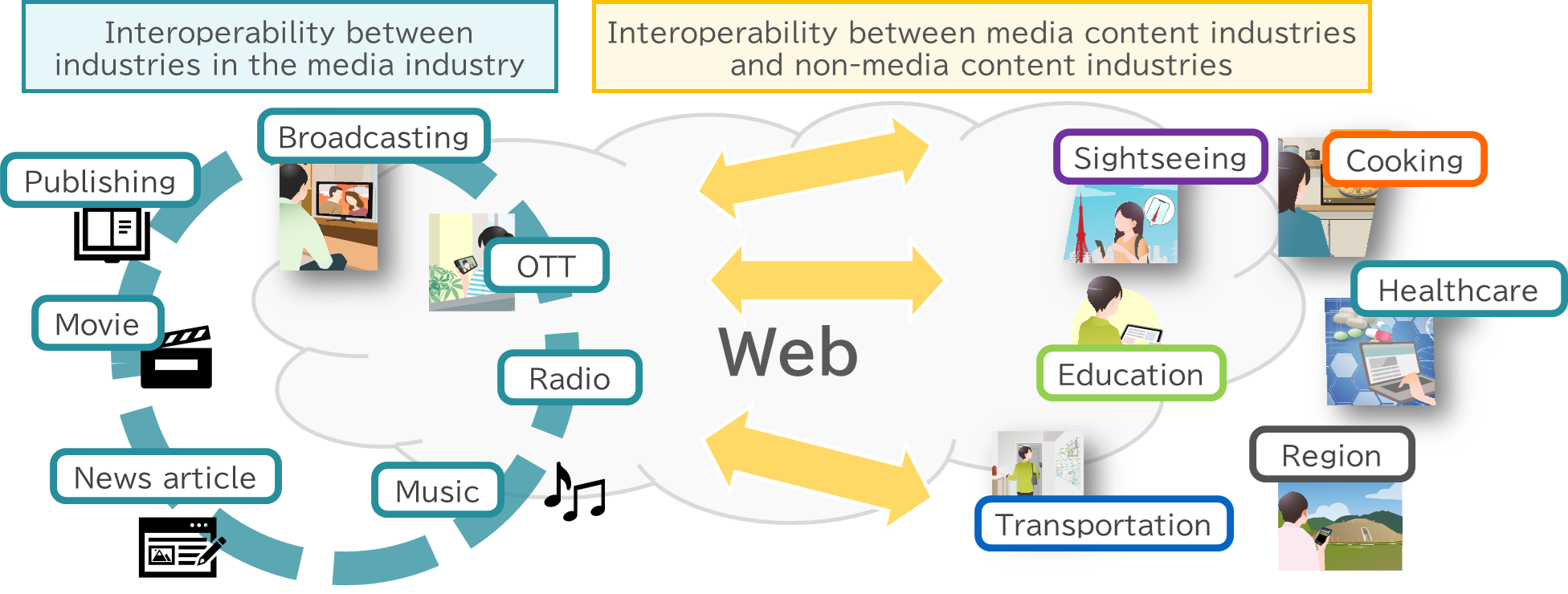
This group focuses on media content metadata defined and operated in each industry, and shares examples of data interoperability between different industries.
このグループは、データ相互運用性の2つの領域をスコープ対象とする:
This group targets two areas of data interoperability:
メディアコンテンツ業界間Between media content industries
メディアコンテンツ業界と非メディアコンテンツ業界間Between media content industries and non-media content industries
This document is intended to provide reference information based on existing technical specifications and does not define new technical specifications.
When sharing issues related to AI technologies, relevant use cases, and related technology trends regarding media content metadata, it is assumed that rights related to data (such as copyrights and neighboring rights) can be properly handled. Under this premise, the following are considered out of scope:
データの適切な取り扱いに関する新規のルールや定義を作成しない。No new rules or definitions regarding the proper handling of data will be created.
課題の解決手段の開発、提案を行わない。No development or proposal of solutions to the issues will be made.
既存の取り組みの評価を行わない。No evaluation of existing initiatives will be conducted.
3.
メディアメタの実践的な相互運用事例Practical Use Cases of Media Content Metadata Interoperability
This chapter presents existing operational case studies and experimental case studies
that contribute to improving the interoperability of media content metadata,
aiming to provide practical reference information for cross-industry service development.
These case studies are not intended to define new technical specifications or standards.
Building on existing metadata specifications and operations, they identify
opportunities for cross-industry collaboration and practical operational challenges.
They serve as reference examples for exploring areas of collaboration
that address common issues.
Note that each use case mainly deals with metadata written in Japanese.
In view of the limits of translation, the detailed descriptions are presented in the original Japanese only.
Seamlessly integrate broadcasting and publishing to build a user flow that enables mutual access to content on both sides, improving user experience and convenience, and contributing to the promotion of broadcast content viewing and published content sales.
Enhance the value of broadcast content metadata by enabling its use outside the broadcasting industry.
Uses data on products featured in TV programs together with portal site search data to detect early signs of potential hit products and alert retail buyers and field merchandisers.
Enhance the value of broadcast content metadata by enabling its use outside the broadcasting industry.
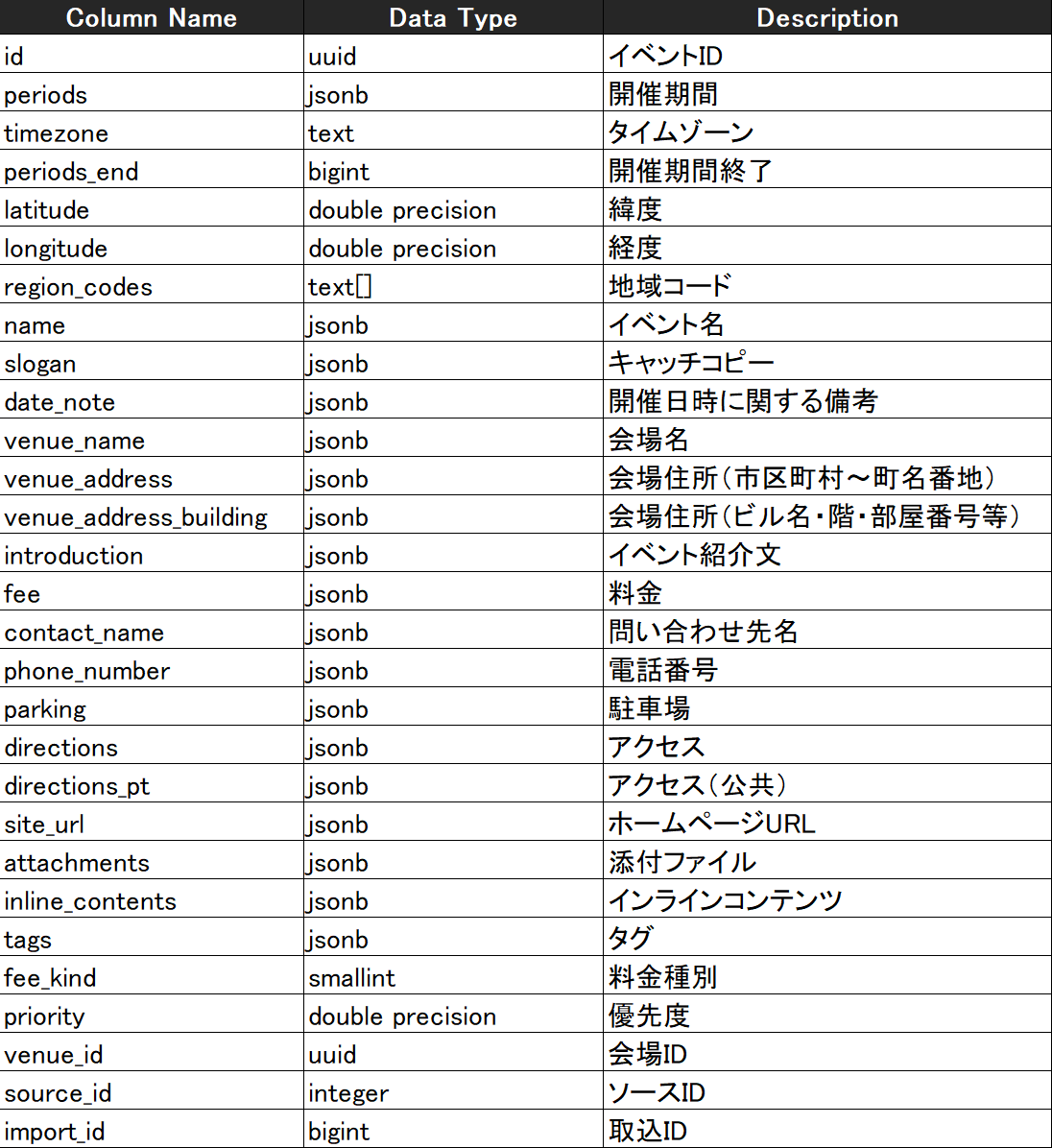
A service for discovering, or becoming aware of, TV programs alongside organized events (such as festivals and exhibitions). Within a map-based event search service, event information and TV program information are displayed together.
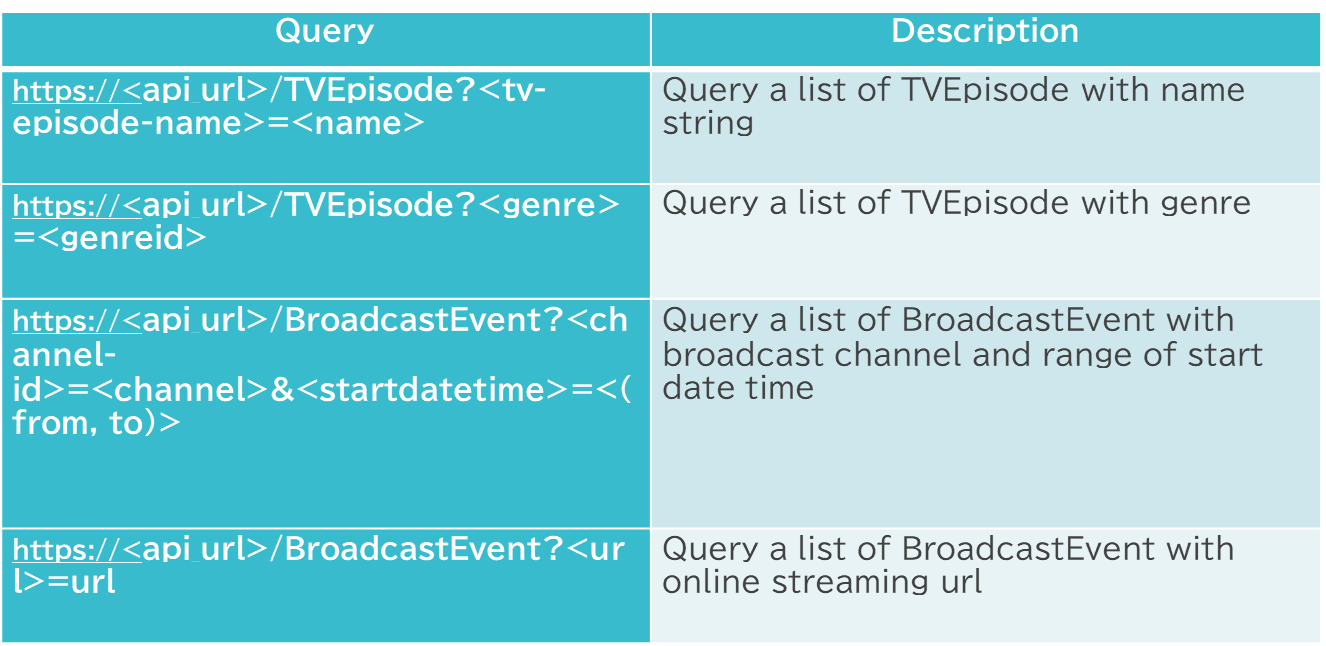
A user identifies a broadcast program from known information and views it via broadcast or on-demand distribution. The program is identified from broadcast log information (channel, broadcast time), and program information such as broadcast schedules and on-demand distribution details is retrieved.
3.10 車載インフォテインメントシステムにおける催事イベントと関連するテレビ番組・出版コンテンツのレコメンドRecommendation of TV Programs and Published Content Related to Events in In‑Vehicle Infotainment Systems
Recommends events, TV programs, and published content using current location and navigation destination information from in-vehicle infotainment systems.
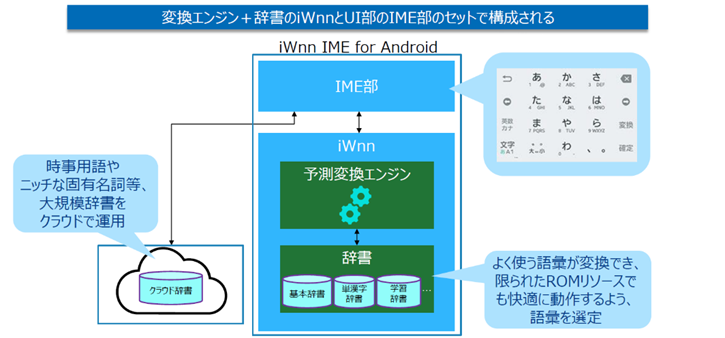
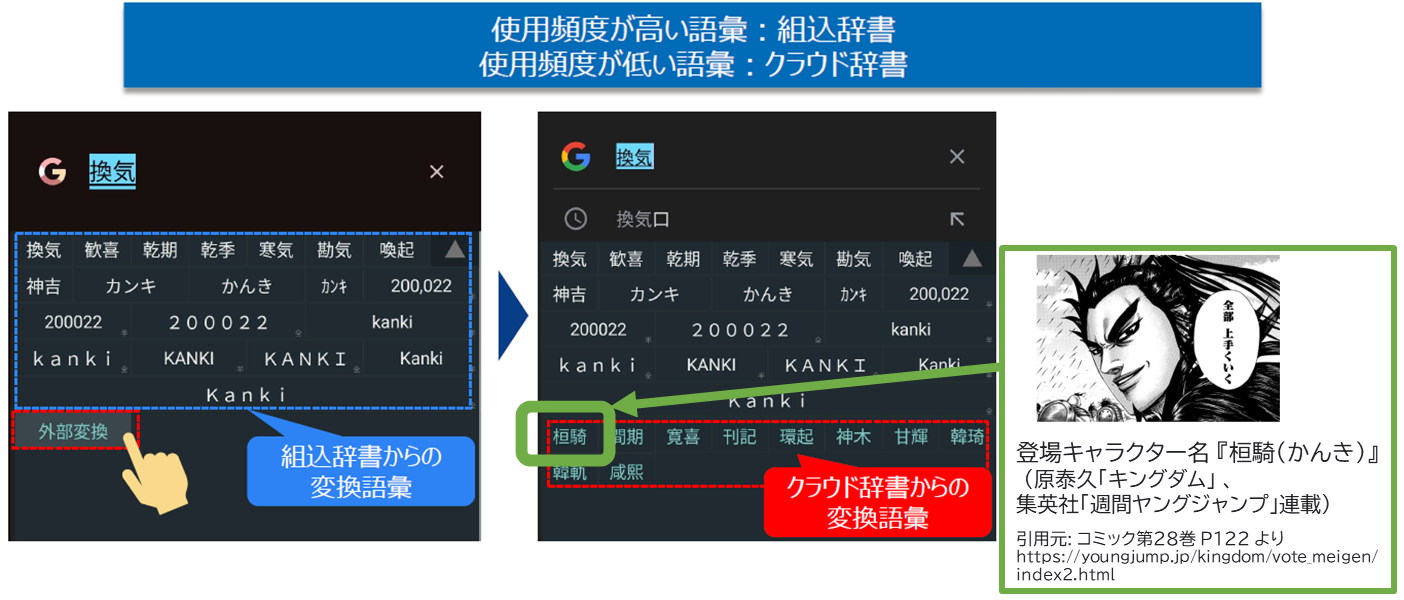
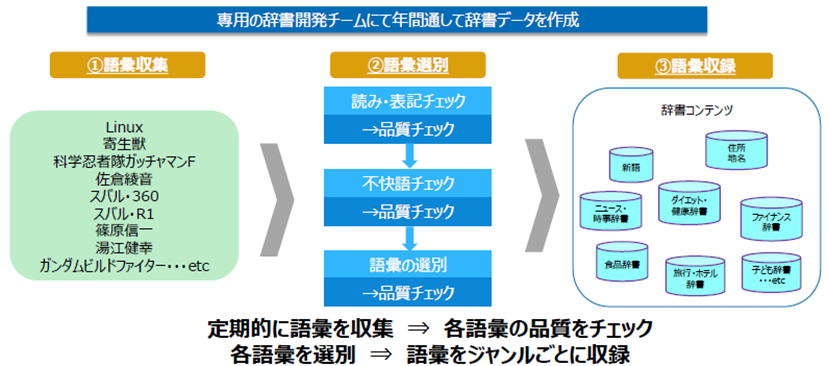
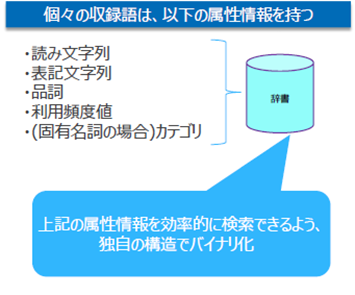
Proper nouns of published content (such as work titles and character names) that standard predictive text input cannot handle are registered into an IME (Input Method Editor) dictionary using information derived from bibliographic data. This enables predictive conversion and autocomplete input on smartphone IMEs.
Resolves notation inconsistencies in proper nouns (such as work titles and character names) entered on a work search page, thereby improving search accuracy. Title autocomplete input via a web-embedded IME is provided on a book search site.
A W3C Recommendation (August 22, 2024) of an RDF vocabulary designed to improve interoperability between data catalogs published on the Web [vocab-dcat-3]. It enables publishers to describe Dataset and DataService resources in Catalog instances using a standard model and vocabulary, making it easier to consume and aggregate metadata from multiple Catalog instances.
Web上の構造化データやメタデータの表現・交換のための軽量なLinked Dataフォーマット。JSON-LD 1.1[json-ld11] (2020年W3C勧告) は、W3C JSON-LD Working Groupによりメンテナンスされている。
A lightweight Linked Data format for representing and exchanging structured data and metadata on the Web. JSON-LD 1.1 [json-ld11], a 2020 W3C Recommendation, is maintained by the W3C JSON-LD Working Group.
Web上でリソースを記述するためのメタデータ用語の仕様 (2000年) [DCTERMS]。仕様には、当初のDublin Core Metadata Element
Set [DC11]の15個の用語に加え、数十個のProperty、Class、Datatype、およびVocabularyEncodingScheme(統制語彙識別のための統制語彙)の用語からなる拡張語彙が含まれている。定義はRDF-Turtle等。用語はURIでグローバルに識別され、アプリケーションに応じて、他の語彙のメタデータ用語と組み合わせて使用されることが想定されている。
A specification of metadata terms for describing resources on the Web (2000) [DCTERMS]. In addition to the original fifteen terms of the Dublin Core Metadata Element Set [DC11], it includes an extended vocabulary of dozens of Property, Class, Datatype, and VocabularyEncodingScheme terms (controlled vocabularies whose members identify resources from a controlled vocabulary). Definitions are provided in RDF-Turtle and other formats. Terms are globally identified by URIs and are intended to be combined with metadata terms from other vocabularies as appropriate to each application.
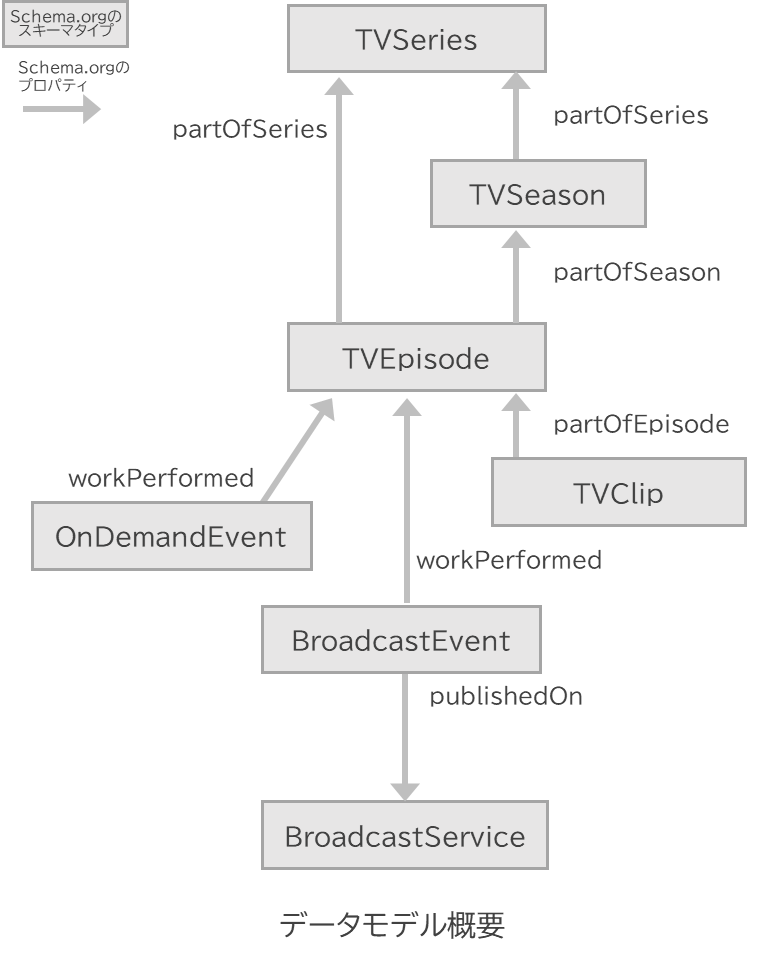
Schema.org is a data model (metadata vocabulary) specification developed as a schema for structured data on the Internet. As of March 2026, version 30.0 is available. Based on a data modeling approach derived from RDF Schema, its vocabulary includes Type, Property, and Enumeration. Definitions are provided in RDF-Turtle and other formats.
Schema.org also officially supports descriptions using JSON-LD [json-ld11].
4.5 European Broadcasting Union (EBU) - EBUCorePlus
メディア企業での活用を目的に、コンテンツの内容を表現・蓄積する知識グラフの構築ルールを規定するデータモデル=オントロジーの仕様 (2025年4月) [ebu-tech3397]。Web Ontology Language (OWL) を用いて規定されている。
A specification of an ontology (data model) that defines rules for building knowledge graphs representing and accumulating content for use in media enterprises (April 2025) [ebu-tech3397]. It is defined using the Web Ontology Language (OWL).
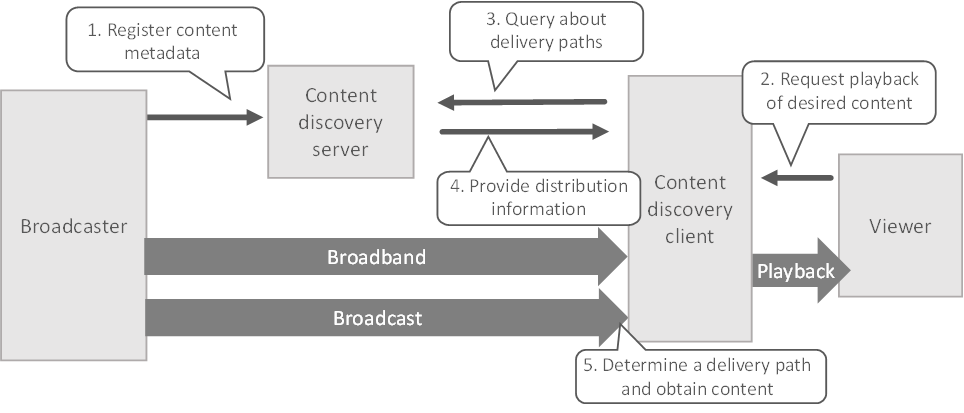
DVB-I [DVB-I] is a specification (February 2024) by DVB that defines mechanisms for discovering linear television services delivered over broadband or broadcast networks, and methods for retrieving programme metadata for those services. The content metadata is handled as XML documents based on the TV-Anytime schema [etsi-ts-102-822-3-1].
4.7 ARIB - Service Information for Digital Broadcasting (STD-B10 / TR-B14)
ARIB STD-B10 [arib-std-b10] (Ver. 5.14、2025年3月改訂) は、Association of Radio Industries and Businesses (ARIB) による日本のデジタル放送のサービス情報 (SI) を定める標準規格で、番組情報 (EPG) などのメタデータ伝送に用いられる。ARIB TR-B14 [arib-tr-b14] (Ver. 6.13、2026年4月改訂) は、地上デジタルテレビジョン放送の運用規定をまとめたARIB技術資料であり、SIの運用方法も含む。
ARIB STD-B10 [arib-std-b10] (Ver. 5.14, March 2025), by the Association of Radio Industries and Businesses (ARIB), defines Service Information (SI) for digital broadcasting in Japan, used for transmitting metadata such as electronic programme guides (EPG). ARIB TR-B14 [arib-tr-b14] (Ver. 6.13, April 2026) is an ARIB technical report on operational guidelines for digital terrestrial television broadcasting, including SI operational practices.
5.
謝辞Acknowledgements
本ドキュメントの作成にあたり、多くの示唆を与えていただいた方々に謝意を表する。
The following individuals provided feedback and advice during the development of this document (in no particular order).
The editor also acknowledges the support provided by W3C staff.