DRAFT Web Accessibility for Older Users

Editors Draft:
29 January 2009 [changelog]
Current draft; Previous draft (19 January 2009)
Status:
This document is an in-progress Editor's Draft.
Please send comments to public-comments-wai-age@w3.org (with public archive).

IMPORTANT: Instructions

The Notes section for each slide contains important information. Make sure you can read the Notes. On this slide, the notes start with "[NOTES SECTION: This is where the important information is ...]"

Copyright © 2008 W3C® (MIT, ERCIM, Keio)

Notes

[NOTES SECTION This is where the important information is: for each slide.]

Permission and Reference

If you plan to use this material for a presentation, please let us know by sending an email to wai-eo-editors@w3.org (a publicly-archived list), or if you do not want it public send it to wai@w3.org. Following your presentation, we would appreciate knowing how many people attended, what questions they had, and such. We also welcome your feedback and suggestions for the presentation.

The "Web Accessibility for Older Users" presentation material is copyright© W3C and licensed under the W3C Document License, with the exception of some of the images. Additionally, you are granted permission to create modifications or derivatives of the material.

All that means that you can copy, change, translate, distribute, and present the "Web Accessibility for Older Users" presentation material as long as you include the reference information below as source material:

Web Accessibility for Older Users, A.M.J. Arch, ed. W3C (MIT, ERCIM, Keio), January 2009. www.w3.org/WAI/WAI-AGE/@@@@

Images

Credits for the images and information, and permission to use any images, are included in the Notes section where the image or data first appears.

Note to presenters:

Web Accessibility for Older Users
Findings from the WAI-AGE Project

Last Updated 15 January 2009

Notes

Welcome!

Presentation Overview

Notes

Today I'll be talking about the WAI-AGE project that is looking at the requirements of older people using the Web.

The presentation will introduce the project, talk about the changing world-wide demographic situation, introduce some of the findings from a literature review, highlight some of the requirements of older users, and talk about the next steps for the project.

WAI-AGE Project
(WAI Ageing, Education and Harmonisation)

European Commission funded project focused on:


WAI-AGE Project information

Notes

The Web Accessibility Initiative: Ageing Education and Harmonisation (WAI-AGE) project is funded as a European Commission IST Specific Support Action with the goal of increasing accessibility of the Web for the elderly as well as for people with disabilities in European Union Member States.

The project is specifically intended to:

Much more information is available from the Project page at www.w3.org/WAI/WAI-AGE/

Lets first look at the motivations behind this project ... [next slide]

Looking forward

Forecast changes in world demographics

United Nations is expecting:


Source: UN World Population Prospects

Notes

The United Nations has forecast that "Globally, the number of persons aged 60 years or over is expected nearly to triple, increasing from 673 million in 2005 to 2 billion by 2050" while at the same time, the total population is only forecast to increase by 40%. They also state that "Today, about half of the oldest-old [those over 80 years] live in developing countries but that share is expected to reach 71 per cent in 2050". At the same time, they expect the working-age population to decline by 5%.

Note to presenters:
Several slides follow with specific country demographic forecasts for you to select from (you will probably just select a few)
The point to emphasise is that the population is getting older.

Note: The UN defines 'working-age' as 15-59 years

UN References:
http://www.un.org/esa/population/publications/wpp2006/WPP2006_Highlights_rev.pdf
http://www.un.org/esa/population/publications/wpp2006/wpp2006_ageing.pdf

European situation

Increasing older population :

EuroStat forecast:

Year
over 65 years
over 80 years
2010
17%
5%
2020
20%
6%
2030
24%
7%
2040
27%
9%
2050
29%
12%


Source: EuroStat (PDF)

Notes

In the European Union, the EU-27 group of countries are predicted to to have nearly 30% of its population over 64 years by 2050, up from 17% in 2010 to 20% in 2020, 24% in 2030, and 27% in 2040. the proportion of older-old (those over 80) will also increase - from 5% in 2010 to 12% in 2050.

Many countries will experience different changes from this - some are forecast to have greater proportions of older people, others to have lower proportions of their populations over 65 years. For example Ireland is forecast to grow from 11% in 2010 to just 24% in 2050, while Italy is forecast to grow from 23% in 2010 to 33% in 2050.

Note to presenters:
Several slides follow with specific country demographic forecasts for you to select from. You are not expected to show all the demographic slides provided.
You may like to contrast your own country with a low growth and/or a high growth country.

Reference:
http://epp.eurostat.ec.europa.eu/cache/ITY_OFFPUB/KS-SF-08-072/EN/KS-SF-08-072-EN.PDF (PDF)
Definitions:
"EU-27" represents the 27 countries that comprised the EU as at 1 January 2007

United Kingdom's ageing population
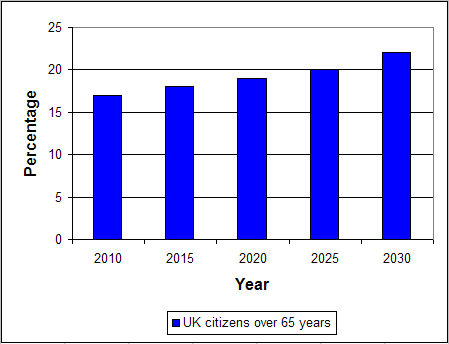
Graph of UKL population projections

Population over 50 years

Population over 65 years


Source: UK Office of National Statistics

Notes

This slide shows the ageing trend in the UK ... the number of people over 50 years will rise from 35% in 2010 to 38% in 2020 and 39% in 2030, while the population over 65 years will rise from 17% in 2010 to 19% in 2020 to 22% in 2030 (and by 2030, the UK is forecast to have 53,000 people over 100 years!)

While the proportion over 50 years is not forecast to grow as rapidly as the proportion over 65 years, it does represent people still in the workforce who may be starting to experience some age-related impairments such as vision and hearing decline (for instance the proportion of people with hearing loss increases sharply at around age 50, and 10% of UK blind and partially sighted people are in the 50-64 age group [76% are over 65 years]).

Note to presenters:
Don't forget to read the numbers out for those who may have low vision

UK Office of National Statistics:
http://www.statistics.gov.uk/statbase/Product.asp?vlnk=8519
http://www.statistics.gov.uk/downloads/theme_population/NPP-2006/wuk065y.xls
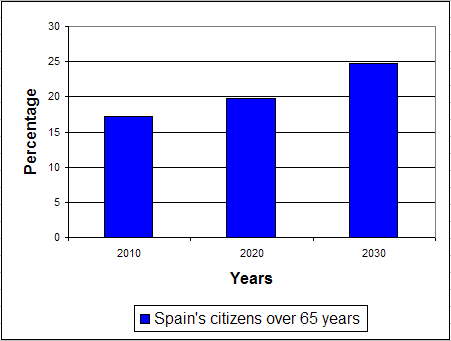
Spain's ageing population

Graph of Spains's population projections

Population over 65 years


Source: EuroStat (PDF)


Spain is forecast to experience similar ageing patterns to the EU average for the next decade, but will exceed the EU average by the 2050.

[read out the data]]

Source: EUROPE IN FIGURES — Eurostat yearbook 2006-07 (Chapter 1 - Population) PDF

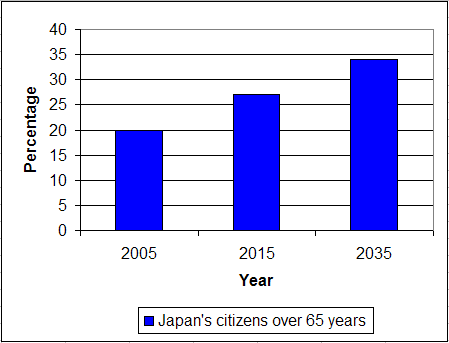
Japan's ageing population

Graph of Japan's population projections

Population over 65 years


Source: Reuters


Discuss the numbers and emphasise that in Japan it is currently 1 in 5 over 65; within 30 years it will be 1 in 3
Japan's proportion of people over 65 years is the highest in the world
, and the UN forecasts that "population of Japan is projected to remain the oldest in the world with a median age of 55 years in 2050."

At the same time, Japan's total population is expected to decline from around 127m people at present to less than 90m people by 2050.

Source:
Reuters, undated - http://www.reuters.com/news/globalcoverage/agingjapan
Reuters, 17 Sept 2007 - http://www.reuters.com/article/ousiv/idUST2888420070917
UN - http://www.un.org/esa/population/publications/wpp2006/wpp2006.htm

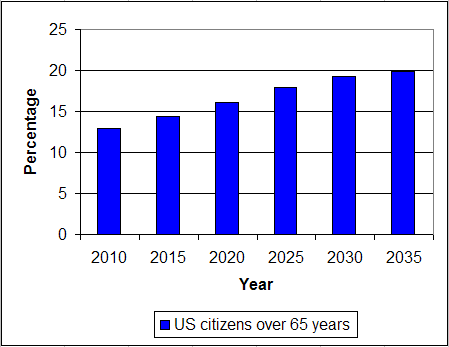
United States' ageing population

Graph of US population projections

Population over 65 years


Source: US Census


US projects are ... [read out numbers]

The United States is forecast to experience lower ageing patterns compared with the EU. For example, the US is forecast to have 16% of its population over 65 year of age in 2020, while Europe forecasts 21%.

[read out the data]

Source: US Population Projections (released 2008) - see Table 3

Australia's ageing population

Graph of Australia population projections

Population over 65 years


Source: ABS Population Projections


Australian projections are ... [read out numbers]

Australia is forecast to experience lower ageing patterns compared with the EU average. For example, Australia is forecast to only have 19% of its population over 65 year of age in 2026, while Europe forecasts 36% in 2025.

Source: ABS Australian Population Projections (2006 TO 2101) - Catalogue # 3222.0
http://www.abs.gov.au/AUSSTATS/abs@.nsf/DetailsPage/3222.02006%20to%202101?OpenDocument

Another country's ageing population

Population over 65 years

create a local slide if details are available

Note to presenters:
Forecasts for all EU countries are available from EUROPE IN FIGURES — Eurostat yearbook 2006-07 (Chapter 1 - Population) PDF
UN forecasts for most regions and countries are available from the UN's Population database
Local projections may be available from the national statistics organisation or Government department in your country

Europe's declining workforce

European old-age dependency ratio

This table highlights forecast differences across Europe in the population over 65
as a percentage of those aged 16-64 years.

Year
EU
(EU-25)
NL
(Netherlands)
AT
(Austria)
IT
(Italy)
2010 26% 22% 26% 31%
2030 40% 37% 41% 45%
2050 53% 49% 53% 66%


Source: EuroStat (PDF)

This table highlights the forecast differences across Europe over the next four decades in the old-age dependency ratio.

In 2005, most countries were close to the EU average of 1 person over 65 for every four of working age (1:4).

The EU average in 2010 will be 26%, forecast to rise to 40% in 2030 and 53% in 2050 (i.e. a change from 4 workers for every retiree to 2 workers for every retiree).
Some individual countries within the EU vary considerably from the average [read out the contrasting figures for Netherlands, Austria and Italy]

These forecast changes between 2010, 2030 and 2050 emphasises the need to support older people in the workplace (note that many EU countries are currently raising the retirement age) and in the community - an accessible Web contributes to this.

Note to presenters:
European presenters may like to extract the actual numbers for their own country from EuroStat and contrast with EU average (see also the Eurostat Yearbook [PDF])
This slide presents the data as a table - you may prefer to use the following slide which contains the same data graphed (don't use both).

Definitions:
"old age dependency ratio" is the ratio of the population aged 65 and over as a % of the working-age population
"working-age population" is defined by EuroStat as people between 16 and 64 years of age
"EU-25" represents the 25 countries that comprised the EU as at 1 May 2004

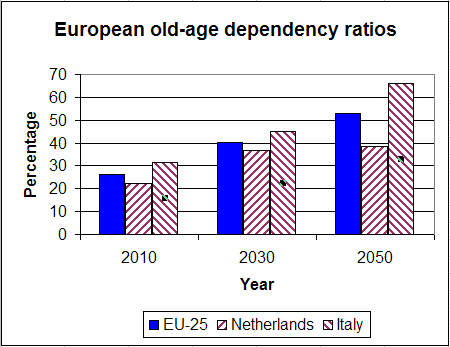
Europe's declining workforce

Graph of EU old-age dependency ratios projections for EU-25 average, Italy, and the Netherlands

Forecast differences across Europe in the population over 65 as a percentage of those aged 16-64 years.

Source: EuroStat (PDF)

This graph highlights the forecast differences in the old-age dependency ratio across Europe over the next four decades.

In 2005, most countries were close to the EU average of 1 person over 65 for every four of working age (1:4).

The EU average in 2010 will be 26%, forecast to rise to 40% in 2030 and 53% in 2050 (i.e. a change from 4 workers for every retiree to 2 workers for every retiree).
Some individual countries within the EU vary considerably from the average [read out the contrasting figures for Netherlands, Austria and Italy]

These forecast changes between 2010, 2030 and 2050 emphasises the need to support older people in the workplace (note that many EU countries are currently raising the retirement age) and in the community - an accessible Web contributes to this.

Note to presenters:
European presenters may like to extract the actual numbers for their own country from EuroStat and contrast with EU average (see also the Eurostat Yearbook [PDF])
This slide presents the data as a graph - you may prefer to use the previous slide which presents contains the data as a table (don't use both).

Definitions:
"old age dependency ratio" is the ratio of the population aged 65 and over as a % of the working-age population
"working-age population" is defined by EuroStat as people between 16 and 64 years of age
"EU-25" represents the 25 countries that comprised the EU as at 1 May 2004

Implications


At the same time, online participation is developing and expected in:

Notes

These previous statistics are leading in working ages being extended, and with that goes lifelong learning.

Furthermore, all forms of community participation are going online, and participation is expected and being encouraged ... [read list]

Older people are expected and wanting to participate, and are being encouraged and supported to do so if they aren't online already.

Ageing and Functional Impairments

Vision decline

Hearing loss

Motor skill diminishment

Cognitive limitations

Impairment often accompanies the ageing process - vision loss, hearing loss, motor skill diminishment, cognitive decline.

Vision decline often starts in a person's mid-40s. It affects 16% of people 65 to 74 years, but 46% of those over 85 years. In older people vision decline includes:

Hearing starts to decline at around 50 years, affecting 19% of people 61 to 80 years but 75% of people over 81 years.

Motor skill diminishment includes arthritis, with joint stiffening, and Parkinson's Disease, with associated hand trembling, making mouse use difficult or impossible for some. Arthritis is estimated to affect at least 50% of people over 65.

Cognitive impairment is also common. While Dementia affects part of the older population (1.4% of people 65-69 years increasing to 24% of people over 85 years), forms of mild cognitive impairment (or MCI) are much more common. MCI can result in:

Note to presenters:
For a short presentation, remove the bulleted lists and speak very briefly to the main areas of vision, hearing, motor skills, and cognition.
More detailed data is available from Web Accessibility for Older Users: A Literature Review

Understanding the needs

An extensive Literature Review was undertaken including literature which:

See "Web Accessibility for Older Users: A Literature Review" for details

Notes

To better understand the needs of the ageing population, the WAI-AGE Project undertook an extensive Literature Review. This review included a broad range of literature including scientific papers and popular articles. The range of literature reviewed included those that ... [read out the bulleted list]

Observations from the literature review

Notes

In reviewing the literature, the Project found that:

Accessibility requirements

Requirements overlap with those for people with disabilities:

WCAG 2.0 addresses these

Many of the requirements for making websites accessible to people with disabilities match the requirements of older users:

WCAG 2.0 addresses these requirements

See WAI Guidelines and Older Web Users: Findings from a Literature Review for details of coverage.

Usability improvements

Usability assists older people and people with disabilities:

WCAG 2.0 is also addressing more of these areas

Usability features also overlap with the requirements of people with disabilities

WCAG 2.0 covers more usability requirements than previously - this will assist older people and people with disabilities

See WAI Guidelines and Older Web Users: Findings from a Literature Review for details of coverage.

Other Observations from Literature

Some other observations were made from the literature:


Next steps for the project

Notes

The project has been interacting with WAI Working groups and providing some ideas for consideration in forthcoming guidelines or as techniques for existing guidelines.

One of the identified issues has been the duplication of work in this area and the potential for divergence. The propjet has found that older people and people with disabilities have a lot of requirements in common and we need to encourage the researchers, developers and community to work more closely together for an accessible web.

Much of the remainder of the project will concentrate on incorporating the requirements of older people into existing WAI documents and developing new documents to help promote the need for including older people as well as people with disabilities during the development of websites and web applications.

WAI working groups

The W3C Web Accessibility Initiative charters a number of working groups, the three working on guidelines are:

Other groups are involved in Evaluation Tools, Education and Outreach, and Research and Development

See www.w3.org/WAI/groups.html for participation details

Notes

WAI has Working Groups developing accessibility guidelines and related work, and Interest Groups providing a forum for discussing Web accessibility issues.

The Authoring tools working group develops guidelines, techniques, and supporting resources for Web "authoring tools" (the software that creates Web sites, including the content management systems, blogs, and social networking websites)

The User Agent working group develops guidelines, techniques, and supporting resources for Web "user agents" (including Web browsers and media players)

The Web Content (WCAG) working group develops guidelines, techniques, and supporting resources for Web "content" (the information in a Web site, including text, images, forms, sounds, and such, as well as the interactivity) and released WCAG 2.0 at the end of 2008.

These three sets of guidelines are crucial for the future of an accessible Web. Obviously the content is important, but that content has to be created appropriately, and anyone should be able to do this. And, the content has to be accessed, and the browser needs to be accessible and usable by all.

Other groups are involved in Evaluation Tools, Education and Outreach, and Research and Development - see the working groups website for details.

WAI documents for revision

Notes

Many existing WAI documents will benefit from having the needs of older users more explicitly considered:

New WAI documents planned

Notes

New resources are planned to build on the Project's findings and the benefits of WCAG 2.0:

Participate

You are invited to take part by:

Anyone interested in this topic is invited to:

Note to presenters:
Depending on your audience, you may not want to show the following 'research' slide, so just mention a couple of areas

Research needed

Some gaps that need to be investigated:

Some of the gaps in our understanding of the requirements of older people using the Web relate to:


Questions

Project Web site:


The WAI-AGE Project is supported by:

6th Framework Programme 2002 to 2006
Note to presenters:
Before asking for questions, please mention that the WAI-AGE Project is a European Commission IST Specific Support Action funded by Sixth Framework Programme.