[2]This document specifies protocols for
distributing and registering public keys, suitable for use in conjunction
with the W3C Recommendations for XML Signature [XML-SIG] and XML Encryption [XML-Enc]. The XML Key Management Specification (XKMS)
comprises two parts — the XML Key Information Service Specification
(X-KISS) and the XML Key Registration Service Specification (X-KRSS).
This section describes the status of this document at the time
of its publication. Other documents may supersede this document. A
list of current W3C publications and the latest revision of this
technical report can be found in the W3C technical reports index at
http://www.w3.org/TR/.
This document is a W3C
Recommendation. It has been reviewed by W3C Members and other interested
parties and has been endorsed by the Director. It is a stable document and
may be used as reference material or cited as a normative reference from
another document. W3C's role in making the Recommendation is to draw
attention to the specification and to promote its widespread deployment. This
enhances the functionality and interoperability of the Web.
This document has been produced by the XKMS Working Group (WG).
The English version of this specification is the only normative version. Translations
of this document may be available.
If you have any comments on this document, send them to www-xkms@w3.org, a mailing
list with a public archive. An errata
list for this edition is available.
This is Part 1 of the W3C Recommendation for the XML Key
Management Specification (XKMS Version 2.0). This document specifies
protocols for distributing and registering public keys, suitable for use in
conjunction with the proposed standard for XML Signature and XML Encryption. The XML Key Management Specification (XKMS) comprises
two services — the XML Key Information Service (X-KISS) and the XML Key
Registration Service Specification (X-KRSS). Part 2 of this
specification covers different protocol bindings with security
characteristics for XKMS. For background on this work, please see the XKMS Activity Statement.
This document is based on the XKMS
Version 2.0 Proposed Recommendation of 2 May 2005. Feedback received during
that review resulted in minor editorial changes. Evidence of interoperation
between at least two implementations of this specification are documented in
the Implementation
Report. Changes to this document since the Proposed Recommendation
version are detailed in Appendix
F.
This document was produced under the 24
January 2002 CPP as amended by the W3C Patent Policy
Transition Procedure. The Working Group maintains a public list of
patent disclosures relevant to this document; that page also
includes instructions for disclosing a patent. An individual who has
actual knowledge of a patent which the individual believes contains
Essential Claim(s) with respect to this specification should disclose
the information in accordance with section
6 of the W3C Patent Policy.
[8]This document specifies protocols for
distributing and registering public keys, suitable for use in conjunction
with the standard for XML Signatures [XML-SIG] defined
by the World Wide Web Consortium (W3C) and the Internet Engineering Task
Force (IETF) and companion standard for XML encryption [XML-ENC]. The XML Key Management Specification
(XKMS) comprises two parts -- the XML Key Information Service Specification
(X-KISS) and the XML Key Registration Service Specification (X-KRSS).
[9]These protocols do not require any particular
underlying public key infrastructure (such as X.509) but are designed to be
compatible with such infrastructures.
[10]This document defines the following service
specifications:
- XML Key Information Service
Specification:
- A protocol to support the delegation by an application to a service
of the processing of key information associated with an XML signature,
XML encryption, or other usage of the XML Signature [XML-SIG] <ds:KeyInfo>
element.
- XML Key Registration Service
Specification:
- A protocol to support the registration of a key pair by a key pair
holder, with the intent that the key pair subsequently be usable in
conjunction with the XML Key Information Service Specification or a
Public Key Infrastructure (PKI) such as [X.509][PKIX].
1.1 Editorial and Conformance
Conventions
[11]This specification uses XML Schemas [XML-schema] to describe the content model.
[12]The key words "MUST", "MUST NOT", "REQUIRED",
"SHALL", "SHALL NOT", "SHOULD", "SHOULD NOT", "RECOMMENDED", "MAY", and
"OPTIONAL" in this specification are to be interpreted as described in [RFC2119]:
[13]"they MUST only be used where it is actually
required for interoperation or to limit behavior which has potential for
causing harm (e.g., limiting retransmissions)"
[14]Consequently, we use these capitalized keywords
to unambiguously specify requirements over protocol and application features
and behavior that affect the interoperability and security of
implementations. These key words are not used (capitalized) to describe XML
grammar; schema definitions unambiguously describe such requirements and we
wish to reserve the prominence of these terms for the natural language
descriptions of protocols and features. For instance, an XML attribute might
be described as being "optional." Compliance with the XML-namespace
specification [XML-NS] is described as
"REQUIRED."
[17]The following terms are used within this
document with the particular meaning indicated below:
[18] Service
An application that provides computational or
informational resources on request. A service may be provided by several
physical servers operating as a unit.
[20] Client
An application that makes requests of a
service. The concept of 'client' is relative to a service request; an
application may have the role of client for some requests and service for
others.
[20a] Payload Security
Use of end-to-end security mechanisms, such as XML DSIG, not dependent
on the transport mechanism (HTTP, TLS, SOAP, ...).
[21]No provision is made for an explicit version
number in this syntax. If a future version is needed, it will use a different
namespace. The XML namespace [XML-ns] URI that MUST
be used by implementations of this (dated) specification is:
http://www.w3.org/2002/03/xkms#
[22]This namespace is also used as the prefix for
algorithm identifiers used by this specification. While applications MUST
support XML and XML namespaces, the use of internal entities [XML] or the "xkms" XML namespace prefix and
defaulting/scoping conventions are OPTIONAL; we use these facilities to
provide compact and readable examples.
[23]In this document, certain namespace prefixes
represent certain namespaces in the schema fragments (shown on a yellow
background) as follows:
| Prefix |
Specification |
Schema |
| xsi |
XML Schema |
http://www.w3.org/2001/XMLSchema |
| ds |
XML Signature |
http://www.w3.org/2000/09/xmldsig# |
| xenc |
XML Encryption |
http://www.w3.org/2001/04/xmlenc# |
| ec |
Exclusive Canonicalization |
http://www.w3.org/2001/10/xml-exc-c14n# |
| xkms |
XKMS |
http://www.w3.org/2002/03/xkms# |
[24]For clarity, some examples of XML are not
complete documents and namespace declarations may be omitted from XML
fragments.
[25]In all examples (shown on a light blue
background) and in the body of the text the default namespace refers to the
xkms namespace itself. This means that namespace prefixes are omitted for all
element and type names in the xkms
namespace.
[26]These namespaces are declared in the XKMS
schema as follows:
<?xml version="1.0"?>
<schema targetNamespace="http://www.w3.org/2002/03/xkms#"
      xmlns:xkms="http://www.w3.org/2002/03/xkms#"
      xmlns:ds="http://www.w3.org/2000/09/xmldsig#"
      xmlns:xenc="http://www.w3.org/2001/04/xmlenc#"
      xmlns="http://www.w3.org/2001/XMLSchema"
      elementFormDefault="qualified" attributeFormDefault="unqualified">
   <import namespace="http://www.w3.org/2000/09/xmldsig#"
         schemaLocation="xmldsig-core-schema.xsd"/>
   <import namespace="http://www.w3.org/2001/04/xmlenc#"
         schemaLocation="xenc-schema.xsd"/>
   <annotation>
      <documentation xml:lang="en">
         XML Schema for XKMS 2.0 Proposed Recommendation Candidate 2005
      </documentation>
   </annotation>
   <!-- /Namespace -->
...
   <!-- End Schema -->
</schema>
[27]Internet Protocol addresses and Domain Name
System names used in examples are purposely chosen to avoid confusion with
assigned addresses and names. All Internet Protocol Addresses are in the
reserved non-routable network 10.x.x.x. All DNS names are in the reserved
domain example.com.
[28]X-KISS allows a client to delegate part or all
of the tasks required to process XML Signature [XML-SIG] <ds:KeyInfo> elements to an XKMS service.
A key objective of the protocol design is to minimize the complexity of
applications using XML Signature [XML-SIG]. By
becoming a client of the XKMS service, the application is relieved of the
complexity and syntax of the underlying PKI used to establish trust
relationships, which may be based upon a different specification such as
X.509/PKIX, SPKI or PGP.
[29]By design, the XML Signature specification [XML-SIG] does not mandate use of a particular trust
policy. The signer of a document is not required to include any key
information but may include a <ds:KeyInfo>
element that specifies the key itself, a key name, X.509 certificate, a PGP
key identifier etc. Alternatively, a link may be provided to a location where
the full <ds:KeyInfo> information may be
found.
[30]The information provided by the signer may
therefore be insufficient by itself to perform cryptographic verification and
decide whether to trust the signing key, or the information may not be in a
format the client can use. For example:
- The key may be specified by a name only.
- The local trust policy of the client may require additional information
in order to trust the key.
- The key may be encoded in an X.509 certificate that the client cannot
parse.
[31]In the case of an encryption operation:
- The client may not know the public key of the recipient.
1.5
(Non-Normative)
[32]X-KRSS describes a protocol for registration
and subsequent management of public key information. A client of a conforming
service may request that the registration service bind information to a
public key. The information bound may include a name, an identifier or
extended attributes defined by the implementation.
[33]The key pair to which the information is bound
may be generated in advance by the client or on request generated by the
service. The Registration protocol may also be used for subsequent management
operations including recovery of the private key and reissue or revocation of
the key binding.
[34]The protocol provides for authentication of the
applicant and, in the case that the key pair is generated by the client,
Proof of Possession (POP) of the private key. A means of communicating the
private key to the client is provided in the case that the private key is
generated by the registration service.
[35]This document specifies means of registering
RSA and DSA keys and a framework for extending the protocol to support other
cryptographic algorithms such as Diffie-Hellman and Elliptic Curve
variants.
[36]The remainder of this document describes the
XML Key Information Service Specification and XML Key Registration Service
Specification.
- Section 2: Protocol Exchanges
- Features of the XKMS protocol that are common to the XKMS services
are described.
- Section 3: Message Syntax
- The common syntax elements shared by XKMS messages are described.
- Section 4: Key Information Service Specification Overview.
- The functional behavior of the X-KISS service is described.
- Section 5: Key Information Service Specification Message
Set.
- The semantics of the X-KISS protocol messages are defined.
- Section 6: Key Registration Service Specification Overview.
- The functional behavior of the X-KRSS service is described.
- Section 7: Key Registration Service Specification Message
Set.
- The semantics of the X-KRSS protocol messages is defined.
- Section 8: Cryptographic Algorithm Specific Parameters
- Parameters and data formats specific to the use of particular
cryptographic algorithms are defined.
- Section 9: Conformance
- Conformance criteria for compliant XKMS 2.0 applications are
specified.
- Section 10: Security Considerations
- Security considerations for implementation and deployment of XKMS are
described.
[37]XKMS protocol exchanges consist of a sequence
of either one or two request response pairs.
[38]XKMS protocol messages share a common format
that may be carried within a variety of protocols. A binding to the
SOAP [SOAP][XMLP] message
protocol is provided in Part II:
Protocol Bindings. It is recommended XKMS implementers support SOAP over
HTTP for interoperability purposes. XKMS is transport protocol agnostic
however and MAY be layered over any SOAP transport.
[39]Implementers MAY implement bindings to other
protocols at their option.
[40]No XKMS operations are idempotent, that is all
XKMS requests MAY cause a change of state.
[41] Part II of this specification
describes the XKMS Security Protocol bindings.
[42]The XKMS protocol consists of pairs of requests
and responses. The XKMS protocol binding allows for the case in which an
additional request/response round trip is required to support cases such as
pending responses and two-phase requests for replay attack protection.
[43]Each XKMS response message contains a MajorResult code that
determines whether the response is final or further processing is required.
The protocol is specified in the CSP formalism [CSP] as
follows:
- Final = { Success, VersionMismatch,
Sender, Receiver }
-
- Request ->
Result.Final
- |
- Request ->
Result.Pending->PendingNotification->Request->Result.Final
- |
- Request ->
Result.Represent->Request->Result.Final
[44]The following sections describe the message
protocol and the message processing steps taken by both parties in each of
the messages.
[45]The following processing steps are taken with
respect to all messages regardless of whether they are a request or a
response:
- Generation
- Id is set to a randomly generated unique
value
- Service is set to the value of the URI to
which the XKMS request is directed
Authentication Signature is generated (if required).
- Processing
- The value of Service is verified
The Authentication Signature value is verified (if required).
<?xml version="1.0" encoding="utf-8"?>
<MessageAbstractType Id="1noOYHt5Lx7xUuizWZLOMw=="
      Service="http://www.example.org/XKMS"
      xmlns="http://www.w3.org/2002/03/xkms#" />
[46]The XKMS specification defines three types of
request:
- X-KISS Request
- A Locate or Validate request as specified by the Key Information
Service Specification.
- X-KRSS Request
- A Register, Reissue, Revoke or Recover request as specified by the
Key Registration Service Specification.
- Compound Request
- A compound request consists of a set of one or more X-KISS or X-KRSS
requests.
[47]The XKMS protocol supports a number of protocol
options, including asynchronous processing, two-phase requests and compound
requests. The client specifies the protocol options it supports in relation
to a specific request through ResponseMechanism
elements in the request.
[48]The means by which the service specifies
protocol options which it accepts is outside the scope of this document. If
the mechanism used for this purpose uses URI based identifiers for this
purpose the following identifiers SHOULD be used:
- Asynchronous Processing
- http://www.w3.org/2002/03/xkms#Asynchronous
- Two-Phase Request Protocol
- http://www.w3.org/2002/03/xkms#Represent
- Compound Requests and Responses
- http://www.w3.org/2002/03/xkms#Compound
[49]All XKMS responses contain a Result code
comprised of a major and minor component. If a service applies a protocol
processing option the client is informed by means of the MajorResult code value of the
response.
[50]XKMS supports two processing modes, synchronous
processing and asynchronous processing.
- In synchronous processing the service responds to a request such
that it has satisfied its obligation and will issue no more responses
with respect to that request: a response code in the set Final
defined above is returned.
- In asynchronous processing the service will not complete the request
immediately and notifies that the request is not yet satisfied and
subsequent responses will be forthcoming: a response code that is not in
the set Final is returned in intermediate responses.
[51]A client MAY advise a service that it will
accept asynchronous processing of a request by specifying the ResponseMechanism value Pending. An XKMS service that receives a request that
specifies the ResponseMechanism value Pending MAY respond either synchronously or
asynchronously. If the service is to respond asynchronously it advises the
client that the response value will be returned asynchronously by specifying
the MajorResult code
Pending.
[52]An XKMS service MUST NOT return the MajorResult code Pending unless the ResponseMechanism value Pending was specified in the corresponding request. If
an XKMS service receives a request that cannot be processed synchronously and
the ResponseMechanism value Pending is not specified the MajorResult code Receiver and MinorResult code NotSynchronous are returned.
[53]Asynchronous processing MAY be used to allow
administrator intervention during the processing of a request. For example an
administrator might be required to verify and approve all X-KRSS Registration
requests before they are processed.
[54]Processing of a synchronous Request and
Response takes place as follows:
- Requestor generation of the Request Message
- Nonce and OriginalRequestId are not present
ResponseMechanism value Pending MAY be specified but the service will ignore it
- Service processing of the Request Message
- Verify that request meets service authorization policy
Process request to completion
- Service generation of the Response Message
- RequestId is set to the value of Id in the request message
- Nonce is not present
MajorResult is set to a Final result value
- Requestor processing of the Response Message
- The value of RequestId is verified
<?xml version="1.0" encoding="utf-8"?>
<LocateRequest Id="I6d995b8d05a9a2ce0573d29e32ab9441"
      Service="http://www.example.org/XKMS"
      xmlns="http://www.w3.org/2002/03/xkms#">
  <QueryKeyBinding />
</LocateRequest>
<?xml version="1.0" encoding="utf-8"?>
<LocateResult Id="I089b18dc1a520b26e2e6689dd3a5a820"
      Service=
      "http://www.example.org/XKMS"
      ResultMajor="http://www.w3.org/2002/03/xkms#Success"
      RequestId="I6d995b8d05a9a2ce0573d29e32ab9441"
      xmlns="http://www.w3.org/2002/03/xkms#" />
[55]Asynchronous processing consists of a sequence of request/response
pairs; an initial request which specifies the request values, zero or
more status requests and a pending request which obtains the result of
the operation. The client may issue status requests in order to poll
the status of an asynchronous operation independently of the use of
the notification mechanism indicated (by the client) in the initial
request.
2.5.1 Initial Request
[56]The initial request message is processed as
follows:
- Requestor generation of the Initial Request Message
- Nonce and OriginalRequestId are not present
ResponseMechanism value Pending MUST be specified
- Service processing of the Initial Request Message
- Schedule request for asynchronous processing
- Service generation of the Initial Response Message
- RequestId is set to the value Id in the initial request message
- Nonce is not present
- MajorResult is set to Pending
- Requestor processing of the Initial Response Message
- Register request as pending completion, poll processing status and/or wait for
notification
2.5.2 Status Request
[56a]The client may poll the status of the asynchronous operation as follows:
- Requestor generation of the Status Request Message
- The request element is StatusRequest
- OriginalRequestId is set to the value of
Id in the initial request message
ResponseId is set to value of Id in the initial response message
- Service processing of the Status Request Message
- Identify pending request using OriginalRequestId
and ResponseId.
- Service generation of the Status Response Message
- RequestId is set to the value of Id in the Status request message
- Nonce is not present
- Requestor processing of the Status Response Message
- For non-compound messages, the ResultMajor
attribute indicates the status of the operation. For compound
messages, the Success, Failure,
and Pending attributes further indicate the number of
inner requests that have the respective status.
2.5.3 Pending Request
[57] The client determines, through notification or polling, that the
requested operation has completed and requests the return of the
result values by issuing a PendingRequest message as follows:
- Requestor generation of the Pending Request Message
- The request element is PendingRequest
- OriginalRequestId is set to the value of
Id in the initial request message
ResponseId is set to value of Id in the initial response message
- Service processing of the Pending Request Message
- Match pending request to pending response
- Service generation of the Pending Response Message
- RequestId is set to the value of Id in the Pending request message
- Nonce is not present
- Requestor processing of the Pending Response Message
- If MajorResult is set to a non-final
value consider it to be failure
[58]The client MAY request the return of the result
values before processing has been completed. In this case the service
responds to the Pending Request with the MajorResult
code Pending.
<?xml version="1.0" encoding="utf-8"?>
<LocateRequest Id="I6227979ae4073f2b3b145db7a488ce16"
      Service="http://www.example.org/XKMS"
      xmlns="http://www.w3.org/2002/03/xkms#">
  <ResponseMechanism>http://www.w3.org/2002/03/xkms#Pending</ResponseMechanism>
  <PendingNotification Mechanism="urn:ietf:rfc:822"
      Identifier="mailto:alice@example.org">
  <QueryKeyBinding />
</LocateRequest>
<?xml version="1.0" encoding="utf-8"?>
<LocateResult Id="I98366e407a2a78dff79687dbdb4d974c"
      Service="http://www.example.org/XKMS"
      ResultMajor="http://www.w3.org/2002/03/xkms#Pending"
      RequestId="I6227979ae4073f2b3b145db7a488ce16"
      xmlns="http://www.w3.org/2002/03/xkms#" />
The XKMS service notifies the client about the completion of the
request processing using the notification mechanism specified in the
<PendingNotification> element.
2.5.4.4 Pending Request
<?xml version="1.0" encoding="utf-8"?>
<PendingRequest Id="I6045ff8b2eb204edb538be1fa22e340a"
      Service="http://www.example.org/XKMS"
      OriginalRequestId="I6227979ae4073f2b3b145db7a488ce16"
      ResponseId="I98366e407a2a78dff79687dbdb4d974c"
      xmlns="http://www.w3.org/2002/03/xkms#" />
<?xml version="1.0" encoding="utf-8"?>
<LocateResult Id="I4da52fc78e0391a11257d64926cd184c"
      Service="http://www.example.org/XKMS"
      ResultMajor="http://www.w3.org/2002/03/xkms#Success"
      RequestId="I6045ff8b2eb204edb538be1fa22e340a"
      xmlns="http://www.w3.org/2002/03/xkms#" />
[59]XKMS requests may employ a two-phase request
protocol to protect against a denial of service attack. The two-phase request
protocol allows the service to perform a lightweight authentication of the
source of an XKMS request, specifically the service determines that the
client is able to read messages sent to the purported source address.
Although this mechanism provides only a weak form of authentication it
prevents an attacker performing a Denial of Service attack by forcing the
service to perform a resource intensive form of authentication such as the
verification of a digital signature.
[60]The two-phase protocol consists of two phases
as follows:
[61]In the first phase the requestor presents the
request and the service responds the MajorResult
value Represent and presents a nonce.
[62]In the second phase the requestor represents
the original request together with the nonce.
[63]A client MAY advise a service that it supports
the two-phase request protocol by specifying the ResponseMechanism value Represent. An XKMS service advises the client that the
use of the two-phase request protocol is required by specifying the MajorResult code Represent.
[64]An XKMS service MUST NOT return the MajorResult code Represent unless the ResponseMechanism value Represent was specified in the corresponding request.
If an XKMS service requires the use of the two-phase request protocol and the
ResponseMechanism value Represent is not specified in the corresponding request
the MajorResult code
Sender and MinorResult code RepresentRequired are returned.
[65]The two-phase request protocol bears some
similarity to asynchronous request processing. Both mechanisms introduce an
extra protocol round trip but each serve different purposes. The purpose of
asynchronous processing is to allow a delay to be introduced between the
initial request and the return of the result. In the two-phase request
protocol however there is no delay between the first request and the first
response or between the first response and the second request. The purpose of
the two-phase request protocol is to allow a service to protect itself
against a denial of service attack by allowing the service to perform a
lightweight authentication of the source of the request.
[66]The service SHOULD verify that the nonce value
specified in a second phase request was recently generated by the service.
The service MAY verify that the nonce value has not been previously responded
to. The actual construction of the nonce value is outside the scope of this
specification and may be chosen as site specific circumstances dictate. The
techniques described in the section Construction of
Nonce Values describe a technique that reduces or avoids the need to
maintain server state in order to meet this requirement.
2.6.1 Processing Steps
[67]In the first phase of the two-phase protocol
the processing steps specified for the single phase case are performed with
the following exceptions:
- Requestor generation of the Phase 1 Request Message
- ResponseMechanism value Represent MUST be
specified
- Service processing of the Phase 1 Request Message
- Service decides to exercise option to require two-phase
processing
- Request is NOT processed
- Service generation of the Phase 1 Response Message
- RequestId is set to the value Id in the Phase 1 request message
- Nonce value is set in accordance with service
replay protection requirements
- MajorResult is set to Represent
- Requestor processing of the Phase 1 Response Message
- Proceed to phase 2
[68]In the Second phase of the two-phase protocol
the processing steps specified for the single phase case are performed with
the following exceptions:
- Requestor generation of the Phase 2 Request Message
- OriginalRequestId set to the value of
Id in the Phase 1 request message
Nonce value is set to the value of Nonce in the Phase 1 response message
- Service processing of the Phase 2 Request Message
- Verify value of Nonce
- Verify that request meets service authorization policy
Process request to completion
- Service generation of the Phase 2 Response Message
- RequestId is set to the value of Id in the Phase2 request message
- Nonce is not present
MajorResult is set to a Final result value
- Requestor processing of the Phase 2 Response Message
- If MajorResult set to a non-final value
consider to be failure
[69]Nonce values may be constructed in any manner
that the service chooses. It may be useful to construct the nonce so as to
permit the service to determine that they were generated by the server at a
specific time in a computationally efficient manner as follows.
[70]The nonce is constructed from the current time
at the service, a unique serial number and a secret key known only to the
service using a Message Authentication Code as follows
("+" indicates
concatenation):
[71] nonce = time + serial +
M ( time + serial , k )
[72]The service may limit the time interval in
which replay attacks are possible by rejecting nonce values that specify an
unacceptable time value or an incorrect MAC value.
[73]The service may prevent replay attacks
completely by tracking the serial numbers for which responses have already
been given, using the nonce time construction value to limit the interval
over which the serial number is tracked.
[74]The nonce value may be encrypted to avoid
leaking information such as the serial number value which might be of
interest to an attacker.
<?xml version="1.0" encoding="utf-8"?>
<LocateRequest Id="Ia1d6ca7a067fdd545f1a1396d2f26779"
      Service="http://www.example.org/XKMS"
      xmlns="http://www.w3.org/2002/03/xkms#">
  <ResponseMechanism>http://www.w3.org/2002/03/xkms#Represent</ResponseMechanism>
  <QueryKeyBinding />
</LocateRequest>
<?xml version="1.0" encoding="utf-8"?>
<LocateResult Id="Idbc77142059a3a51c9eccd2425d77757"
      Service="http://www.example.org/XKMS"
      Nonce="Rj2BoUZM7PisPX2ytSAAWA=="
      ResultMajor="http://www.w3.org/2002/03/xkms#Represent"
      RequestId="Ia1d6ca7a067fdd545f1a1396d2f26779"
      xmlns="http://www.w3.org/2002/03/xkms#" />
<?xml version="1.0" encoding="utf-8"?>
<LocateRequest Id="I47804adaec32e34afeecdb51f3e0f765"
      Service="http://www.example.org/XKMS"
      Nonce="Rj2BoUZM7PisPX2ytSAAWA=="
      OriginalRequestId="Ia1d6ca7a067fdd545f1a1396d2f26779"
      xmlns="http://www.w3.org/2002/03/xkms#">
  <QueryKeyBinding />
</LocateRequest>
<?xml version="1.0" encoding="utf-8"?>
<LocateResult Id="I3b0111d2232507a56444c1bc85409a94"
      Service="http://www.example.org/XKMS"
      ResultMajor="http://www.w3.org/2002/03/xkms#Success"
      RequestId="I47804adaec32e34afeecdb51f3e0f765"
      xmlns="http://www.w3.org/2002/03/xkms#" />
[75]The two-phase protocol may be combined with
Asynchronous Processing. In this case the operation will consist of three
round trips as follows:
- Initial Request / Phase 1
- Initial Request / Phase 2
- Pending Response
[76]Message processing is performed as described
above with the following exceptions.
- OriginalRequestId set to that value of
Id in Initial Request / Phase 1 in
both subsequent requests.
- Nonce value is set to the value of Nonce in Phase 1 response in both subsequent
requests.
[77]An XKMS service MAY support processing of
Compound Requests. A compound request permits multiple XKMS requests to be
made at the same time. A compound request consists of an outer request and
one or more inner requests. There is no ordering implicit in the inner
requests. The semantics of making a set of requests as a compound request are
exactly the same as if each individual request in the set had been made
separately and simultaneously.
[78]The response to a compound request is a
compound response. A compound response consists of an outer response and zero
or more inner responses. If the ResultMajor value
of the outer response is Success the compound
response SHOULD contain an inner response response element corresponding to
each inner request element of the compound request. If the the ResultMajor value of the outer response is not
Success the response MUST NOT contain any inner
responses. If a compound response has an outer ResultMajor value Success
but does not contain a response corresponding to an inner request, that inner request is assumed to have failed.
[79]An XKMS service MAY support the use of the two
phase protocol on the outer request of a compound response. The two-phase
protocol SHOULD NOT be used on an inner response. If an inner request
specifies the ResponseMechanism value Represent the value SHOULD be ignored.
[80]An XKMS service MAY support the use of
asynchronous processing in conjunction with a compound request. Asynchronous
processing MAY be performed on the compound request as a whole, on individual
inner requests or both.
[81]If asynchronous processing is to be performed
on the compound request as a whole the outer request specifies the ResponseMechanism value Pending. If the service decides to return an asynchronous
response a compound response is returned with a ResultMajor code of Pending. When the service has completed the processing, as determined through polling or notification, the client issues a PendingRequest message for
the outer request to which the service replies with a compound response
returning either the inner responses corresponding to the original inner
requests or an error report.
[82]If asynchronous processing is performed on the
individual inner requests each inner request for which an asynchronous
response is to be accepted specifies the ResponseMechanism value Pending. If the service decides to return an asynchronous
response to an inner request a compound response is returned with an outer
ResultMajor code of Success and an inner ResultMajor code of Pending
for the requests for which an asynchronous response is to be issued. A
service MAY return synchronous and asynchronous responses in a single
compound response.
[83]Since the semantics of a compound request are
exactly the same as if each inner request were made separately a client MAY
issue separate pending requests to obtain the results of the inner requests
of a previous compound request.
<?xml version="1.0" encoding="utf-8"?>
<CompoundRequest Id="I264f5da49b1ff367d4e7aef1f7a1df1a"
      Service="http://www.example.org/XKMS"
      xmlns="http://www.w3.org/2002/03/xkms#">
  <LocateRequest Id="I8c26be5f1b4dd228b43fb6eaee285faa"
        Service="http://www.example.org/XKMS">
    <RespondWith>http://www.w3.org/2002/03/xkms#KeyValue</RespondWith>
    <QueryKeyBinding>
      <KeyInfo xmlns="http://www.w3.org/2000/09/xmldsig#">
        <X509Data>
          <X509Certificate>
            MIICEDCCAX2gAwIBAgIQimXeUAxYJbJMady9vV1bLjAJBgUrDgMCHQUAMBIxEDA
            OBgNVBAMTB1Rlc3QgQ0EwHhcNMDMwODE1MDcwMDAwWhcNMDUwODE1MDY1OTU5Wj
            ArMSkwJwYDVQQDEyBBbGljZSBBYXJkdmFyayBPPUFsaWNlIENvcnAgQz1VUzCBn
            zANBgkqhkiG9w0BAQEFAAOBjQAwgYkCgYEA0nIsmR+aVW2egl5MIfOKy4HuMKkk
            9AZ/IQuDLVPlhzOfgngjVQCjr8uvmnqtNu8HBupui8LgGthO6U9D0CNT5mbmhIA
            ErRADUMIAFsi7LzBarUvNWTqYNEJmcHsAUZdrdcDrkNnG7SzbuJx+GDNiHKVDQg
            gPBLc1XagW20RMvokCAwEAAaNWMFQwDQYDVR0KBAYwBAMCBkAwQwYDVR0BBDwwO
            oAQAaVOkaVLLKoFmLN37pC8uqEUMBIxEDAOBgNVBAMTB1Rlc3QgQ0GCEC4MndUX
            jPG1TZxVKg+HutAwCQYFKw4DAh0FAAOBgQABU91ka7IlkXCfv4Zh2Ohwgg2yObt
            Y3+6C/BTFGrOEBJDy+DoxJ/NuBF18w3rrrR18xE6jNKYLCQb8zUGk4QOG5Y+HT/
            QTTFvWkiOLXcpTuhnOhXatr42FoYpDkjx2QWK+J5Q2l/Rgjgc/0ZV8U/kD8UuRk
            Xp4AZh7QsiX8AcO0w==
          </X509Certificate>
        </X509Data>
      </KeyInfo>
      <KeyUsage>http://www.w3.org/2002/03/xkms#Signature</KeyUsage>
    </QueryKeyBinding>
  </LocateRequest>
  <LocateRequest Id="If8e63d729384ad35498e7b65b3dc785e"
        Service="http://www.example.org/XKMS">
    <RespondWith>http://www.w3.org/2002/03/xkms#KeyName</RespondWith>
    <RespondWith>http://www.w3.org/2002/03/xkms#KeyValue</RespondWith>
    <RespondWith>http://www.w3.org/2002/03/xkms#X509Cert</RespondWith>
    <RespondWith>http://www.w3.org/2002/03/xkms#X509Chain</RespondWith>
    <RespondWith>http://www.w3.org/2002/03/xkms#PGPWeb</RespondWith>
    <RespondWith>http://www.w3.org/2002/03/xkms#PGP</RespondWith>
    <QueryKeyBinding>
      <KeyUsage>http://www.w3.org/2002/03/xkms#Encryption</KeyUsage>
      <UseKeyWith Application="urn:ietf:rfc:2440"
            Identifier="bob@example.com" />
      <UseKeyWith Application="urn:ietf:rfc:2633"
            Identifier="bob@example.com" />
    </QueryKeyBinding>
  </LocateRequest>
</CompoundRequest>
<?xml version="1.0" encoding="utf-8"?>
<CompoundResult Id="If2d286d4a542bd92989aa606d9f1a5ca"
      Service="http://www.example.org/XKMS"
      ResultMajor="http://www.w3.org/2002/03/xkms#Success"
      RequestId="I264f5da49b1ff367d4e7aef1f7a1df1a"
      xmlns="http://www.w3.org/2002/03/xkms#">
  <LocateResult Id="I69044d458e0bceef5f78c79c32fa9ddf"
        Service="http://www.example.org/XKMS"
        ResultMajor="http://www.w3.org/2002/03/xkms#Success"
        RequestId="I8c26be5f1b4dd228b43fb6eaee285faa">
    <UnverifiedKeyBinding Id="I8f7367375ac134872eab7acf42a8d1bd">
      <KeyInfo xmlns="http://www.w3.org/2000/09/xmldsig#">
        <KeyValue>
          <RSAKeyValue>
            <Modulus>
              0nIsmR+aVW2egl5MIfOKy4HuMKkk9AZ/IQuDLVPlhzOfgngjVQCjr8uvmnqtNu8HBupui8LgG
              thO6U9D0CNT5mbmhIAErRADUMIAFsi7LzBarUvNWTqYNEJmcHsAUZdrdcDrkNnG7SzbuJx+GD
              NiHKVDQggPBLc1XagW20RMvok=
            </Modulus>
            <Exponent>AQAB</Exponent>
          </RSAKeyValue>
        </KeyValue>
      </KeyInfo>
      <KeyUsage>http://www.w3.org/2002/03/xkms#Signature</KeyUsage>
      <KeyUsage>http://www.w3.org/2002/03/xkms#Encryption</KeyUsage>
      <KeyUsage>http://www.w3.org/2002/03/xkms#Exchange</KeyUsage>
      <UseKeyWith Application="urn:ietf:rfc:2633"
            Identifier="alice@example.com" />
    </UnverifiedKeyBinding>
  </LocateResult>
  <LocateResult Id="Ic3d02a8b1f63ba694a8fad11a74fb499"
        Service="http://www.example.org/XKMS"
        ResultMajor="http://www.w3.org/2002/03/xkms#Success"
        RequestId="If8e63d729384ad35498e7b65b3dc785e">
    <UnverifiedKeyBinding Id="I42604b6f40f46b74b5c30077100fe8e9">
      <KeyInfo xmlns="http://www.w3.org/2000/09/xmldsig#">
        <KeyValue>
          <RSAKeyValue>
            <Modulus>
              3FFtWUsvEajQt2SeSF+RvAxWdPPh5GSlQnp8SDvvqvCwE6PXcRWrIGmV7twNf2T
              UXCxYuztUUClMIy14B0Q+k1ej2nekmYL7+Ic3DDGVFVaYPoxaRY0Y2lV8tOreyn
              WegpFbITXc8V6Y02QfR5O7Pn1/10ElslaF/TF8MQGqYE8=
            </Modulus>
            <Exponent>AQAB</Exponent>
          </RSAKeyValue>
        </KeyValue>
        <X509Data>
          <X509Certificate>
            MIICCTCCAXagAwIBAgIQe0Sk4xr1VolGFFNMkCx07TAJBgUrDgMCHQUAMBIxEDA
            OBgNVBAMTB1Rlc3QgQ0EwHhcNMDMwODE1MDcwMDAwWhcNMDUwODE1MDY1OTU5Wj
            AkMSIwIAYDVQQDExlCb2IgQmFrZXIgTz1Cb2IgQ29ycCBDPVVTMIGfMA0GCSqGS
            Ib3DQEBAQUAA4GNADCBiQKBgQDcUW1ZSy8RqNC3ZJ5IX5G8DFZ08+HkZKVCenxI
            O++q8LATo9dxFasgaZXu3A1/ZNRcLFi7O1RQKUwjLXgHRD6TV6Pad6SZgvv4hzc
            MMZUVVpg+jFpFjRjaVXy06t7KdZ6CkVshNdzxXpjTZB9Hk7s+fX/XQSWyVoX9MX
            wxAapgTwIDAQABo1YwVDANBgNVHQoEBjAEAwIGQDBDBgNVHQEEPDA6gBABpU6Rp
            UssqgWYs3fukLy6oRQwEjEQMA4GA1UEAxMHVGVzdCBDQYIQLgyd1ReM8bVNnFUq
            D4e60DAJBgUrDgMCHQUAA4GBAF4jP1gGDbaq3rg/Vo3JY7EDNTp0HmwLiPMLmdn
            B3WTIGFcjS/jZFzRCbvKPeiPTZ6kRkGgydFOuCo5HMAxIks/LtnKFd/0qYT+AOD
            q/rCrwSx+F+Ro2rf9tPpja9o7gANqxs6Pm7f1QSPZO57bT/6afiVm7NdaCfjgMp
            hb+XNyn
          </X509Certificate>
          <X509Certificate>
            MIIB9zCCAWSgAwIBAgIQLgyd1ReM8bVNnFUqD4e60DAJBgUrDgMCHQUAMBIxEDA
            OBgNVBAMTB1Rlc3QgQ0EwHhcNMDMwODE1MDcwMDAwWhcNMTAwODE1MDcwMDAwWj
            ASMRAwDgYDVQQDEwdUZXN0IENBMIGfMA0GCSqGSIb3DQEBAQUAA4GNADCBiQKBg
            QCn23HHp+HtXpiyKVSDtdE3dO0r0oLB/H9sxUEkeXB8oMxwbhdcizWH92zrtm1V
            fVtxkfmwF14ZXoyDZHeZXuCOtAfz/mW6s2gmfD45TfFFVGksDGVRNK5XmKXA5sE
            C51RCvaxzGBdGDlCuVPqX7Cq3IcZpRU1IXbi5YzGwV7j6LwIDAQABo1YwVDANBg
            NVHQoEBjAEAwIHgDBDBgNVHQEEPDA6gBABpU6RpUssqgWYs3fukLy6oRQwEjEQM
            A4GA1UEAxMHVGVzdCBDQYIQLgyd1ReM8bVNnFUqD4e60DAJBgUrDgMCHQUAA4GB
            ABDYD4Fwx2dscu+BgYcZ+GoQQtCJkwJEXytb4zlNl7HLFKbXSw4m0blQquIsfsi
            QgFYAQBXSbu7aeUqqmSGHvILu3BGwVOKjxbHfcM4/MefuTtpOpCN40wy3YwwngD
            tHTaIqm8NwS966PE+W9f8kD70q5FNwf+GF/lX9qGc/x435
          </X509Certificate>
        </X509Data>
      </KeyInfo>
      <KeyUsage>http://www.w3.org/2002/03/xkms#Signature</KeyUsage>
      <KeyUsage>http://www.w3.org/2002/03/xkms#Encryption</KeyUsage>
      <KeyUsage>http://www.w3.org/2002/03/xkms#Exchange</KeyUsage>
      <UseKeyWith Application="urn:ietf:rfc:2633"
            Identifier="bob@example.com" />
    </UnverifiedKeyBinding>
  </LocateResult>
</CompoundResult>
[84]The security concerns that an XKMS service is
required to address are dependent on the specific service deployment. For
example a free XKMS Location service may not require controls for Request
Authentication or to prevent Request Replay attacks while a paid Validate
service might. The application of security enhancements is addressed in
Part II which describes
the application of the following security enhancements:
- Confidentiality
- Request Authentication
- Response Authentication
- Transitive Authentication
- Response Replay
- Request Substitution
- Request Replay
- Denial of Service
[85]The use of security enhancements is further
discussed in the section Security
Considerations below.
3 Message
Syntax
3.1 Message
Base
[86]The MessageAbstractType
abstract type is the type from which all XKMS message element types are
derived. The MessageAbstractType abstract type
contains the following element and attributes
- <ds:Signature> [Optional]
- An XML Signature [XML-SIG] in enveloped
mode. The scope of the signature is the entire request message (i.e.
the element derived from MessageAbstractType) and is specified using
a reference to the Id attribute specified in
the MessageAbstractType abstract type.
- <MessageExtension> [Any Number]
- An extension element derived from the MessageExtensionAbstractType.
- <OpaqueClientData> [Optional]
- A collection of data specified by the client
that is opaque to the service. An XKMS service SHOULD return the
value of the <OpaqueClientData> element
unmodified in a request in a response with status code Success.
- Id [Required]
- A unique identifier generated by the originator.
- Service [Required]
- The URI of the Web Service port to which the request is
addressed.
- Nonce [Optional]
- Cryptographically random data used to defend against replay
attack.
[87]The following schema defines the MessageAbstractType abstract type:
   <!-- MessageAbstractType -->
   <complexType name="MessageAbstractType" abstract="true">
      <sequence>
         <element ref="ds:Signature" minOccurs="0"/>
         <element ref="xkms:MessageExtension" minOccurs="0"
               maxOccurs="unbounded"/>
         <element ref="xkms:OpaqueClientData" minOccurs="0"/>
      </sequence>
      <attribute name="Id" type="ID" use="required"/>
      <attribute name="Service" type="anyURI" use="required"/>
      <attribute name="Nonce" type="base64Binary" use="optional"/>
   </complexType>
   <!-- /MessageAbstractType -->
[88]An XML Signature [XML-SIG] in enveloped mode. The scope of the signature
is the entire request message (i.e. the element derrived from
MessageAbstractType) and is specified using a reference to the Id attribute specified in the MessageAbstractType abstract type. The empty identifier ""
MUST NOT be used.
[89]Validation of XML Signatures MUST be done
independent of any ancestral XML context of the message. This may be
achieved by:
- Isolating the XKMS message from any 'wrapper' (eg. SOAP) before
validation, or;
- Specifying a canonicalization algorithm, such as Exclusive XML
Canonicalization, in <SignedInfo>:<CanonicalizationMethod> to exclude ancestral
XML context during the validation of the message.
[90]For interoperability purposes XKMS
implementations MUST support the use of Exclusive XML Canonicalization.
[91]The <ds:Signature> element is specified in the XML
Signature specification [XML-SIG].
[92]The <MessageExtension> element is an abstract element of
the abstract type MessageExtensionAbstractType. Implementations may define
subclasses of the MessageExtensionAbstractType to define message extension
elements that may be applied to any XKMS message.
[93]The following schema defines the MessageExtension element:
   <!-- MessageExtension -->
   <element name="MessageExtension" type="xkms:MessageExtensionAbstractType"
         abstract="true"/>
   <complexType name="MessageExtensionAbstractType" abstract="true"/>
   <!-- /MessageExtension -->
[94]The <OpaqueClientData> contains data specified by the
client that is opaque to the service. An XKMS service SHOULD return the value
of an <OpaqueClientData> element,
including its children, specified in a request unmodified in the
corresponding response.
[95]A client MAY use Opaque client data in
conjunction with asynchronous request processing to match a
response to the original request context. Opaque client data MAY
also be used in conjunction with synchronous request processing to provide
context information for purposes such as audit trail reconciliation.
[96]The following schema defines the OpaqueClientData element:
   <!-- OpaqueClientData -->
   <element name="OpaqueClientData" type="xkms:OpaqueClientDataType"/>
   <complexType name="OpaqueClientDataType">
      <sequence maxOccurs="unbounded">
         <element ref="xkms:OpaqueData" minOccurs="0"/>
      </sequence>
   </complexType>
   <element name="OpaqueData" type="base64Binary"/>
   <!-- /OpaqueClientData -->
3.2 Request
Message
[97]The RequestAbstractType
abstract type is the type from which all XKMS request element types are
derived. The RequestAbstractType abstract type
inherits the element and attributes of the MessageAbstractType abstract type and in addition contains
the following elements and attributes
- <ResponseMechanism> [Any
Number]
- Specifies the extended protocol mechanisms that the client supports
in connection with this request.
- <RespondWith> [Any
Number]
- Specifies the types of data the recipient requests to be sent in
the response.
- <PendingNotification> [Optional]
- Specifies a means by which the service may notify the requestor of
the completion of a pending response. If the <PendingNotification> element is present the
value Pending MUST be specified as a <ResponseMechanism> value.
- OriginalRequestId [Optional]
- Specifies the value Id of the first
request made in a multi-stage protocol such as the asynchronous
processing mechanism or the two-phase protocol.
- ResponseLimit [Optional]
- Specifies the maximum number of data items the requestor can accept
in the case that the schema specifies an unbounded number of
elements.
[98]The following schema defines the RequestAbstractType abstract type:
   <!-- RequestAbstractType -->
   <complexType name="RequestAbstractType" abstract="true">
      <complexContent>
         <extension base="xkms:MessageAbstractType">
            <sequence>
               <element ref="xkms:ResponseMechanism" minOccurs="0"
                     maxOccurs="unbounded"/>
               <element ref="xkms:RespondWith" minOccurs="0"
                     maxOccurs="unbounded"/>
               <element ref="xkms:PendingNotification" minOccurs="0"/>
            </sequence>
            <attribute name="OriginalRequestId" type="NCName"
                  use="optional"/>
            <attribute name="ResponseLimit" type="integer" use="optional"/>
         </extension>
      </complexContent>
   </complexType>
   <!-- /RequestAbstractType -->
[99]The <ResponseMechanism> element in the request specifies
one or more strings included in the request that specify extended protocol
mechanisms that the client supports in connection with a request.
[100] ResponseMechanismvalues are specified as anyURIs, the following identifiers are defined:
| anyURI Name |
Description |
| http://www.w3.org/2002/03/xkms#Pending |
The requestor is prepared to accept a
response that uses asynchronous processing, i.e. the service MAY
return the MajorResult code Pending |
| http://www.w3.org/2002/03/xkms#Represent |
The requestor is prepared to accept a
response that uses the two-phase protocol, i.e. the service MAY
return the MajorResult code Represent |
| http://www.w3.org/2002/03/xkms#RequestSignatureValue |
The requestor is prepared to accept a
response that carries a <RequestSignatureValue> element. |
[101]The following schema defines the <ResponseMechanism> element::
   <!-- ResponseMechanism -->
   <simpleType name="ResponseMechanismEnum">
      <restriction base="anyURI">
         <enumeration value="http://www.w3.org/2002/03/xkms#Pending"/>
         <enumeration value="http://www.w3.org/2002/03/xkms#Represent"/>
         <enumeration value="http://www.w3.org/2002/03/xkms#RequestSignatureValue"/>
      </restriction>
   </simpleType>
   <simpleType name="ResponseMechanismOpenEnum">
      <union memberTypes="xkms:ResponseMechanismEnum anyURI"/>
   </simpleType>
   <element name="ResponseMechanism" type="xkms:ResponseMechanismOpenEnum"/>
   <!-- /ResponseMechanism -->
[102]
The <RespondWith> element in a
request specifies one or more URI values that SHOULD resolve to data
elements provided in either the <ds:KeyInfo> element or private key
information defined in the section Cryptographic Algorithm Specific Parameters
below. The <RespondWith> element SHOULD
be included in requests of type LocateRequest,
ValidateRequest, RegisterRequest, ReissueRequest, RevokeRequest, and RecoverRequest. The XML Signature elements are
described here for convenience. The normative reference is the XML
Digital Signature Specification [XML-SIG].
[103]The Service SHOULD return any data elements that are resolvable
<RespondWith> URI values and that
are supported by the Service. The Service MAY return additional data
elements not requested. In particular, the service MAY return data
elements specified in the request with the response.
[104] RespondWith values
are specified as anyURIs,
the following identifiers are defined (all names under the first columnn are prefixed with URI http://www.w3.org/2002/03/xkms#):
anyURI Name
|
<ds:Keyinfo>
Element |
Description |
| KeyName |
<ds:KeyName> |
Key name |
| KeyValue |
<ds:KeyValue> |
Public key parameters |
| X509Cert |
<ds:X509Data> |
X509 Certificate v3 that authenticates
the specified key |
| X509Chain |
<ds:X509Data>* |
X509 Certificate v3 chain that
authenticates the specified key. Note that no ordering is implied in
the returned certificates. |
| X509CRL |
<ds:X509Data> |
X509 Certificate Revocation List v2 |
| RetrievalMethod |
<ds:RetrievalMethod> |
Retrieval Method data |
| PGP |
<ds:PGPData> |
PGP key signing data |
| PGPWeb |
<ds:PGPData>* |
Collection of PGP key signing data |
| SPKI |
<ds:SPKIData>* |
SPKI key signing |
| PrivateKey |
|
Request that the encrypted private key be
returned in the response. [Used in the X-KRSS protocol] |
[104a](In the above table, * stands for one or more.).
[105]For example, a client that has no X.509
processing capability might perform a Locate
operation to obtain the public key parameters and name information from a
<ds:Keyinfo> element that specifies only a
certificate. The RespondWith element values in this
case would be KeyName and KeyValue.
[106]The following schema defines the <RespondWith> element::
   <!-- RespondWith -->
    <simpleType name="RespondWithEnum">
         <restriction base="anyURI">
              <enumeration value="http://www.w3.org/2002/03/xkms#KeyName"/>
              <enumeration value="http://www.w3.org/2002/03/xkms#KeyValue"/>
              <enumeration value="http://www.w3.org/2002/03/xkms#X509Cert"/>
              <enumeration value="http://www.w3.org/2002/03/xkms#X509Chain"/>
              <enumeration value="http://www.w3.org/2002/03/xkms#X509CRL"/>
              <enumeration value="http://www.w3.org/2002/03/xkms#RetrievalMethod"/>
              <enumeration value="http://www.w3.org/2002/03/xkms#PGP"/>
              <enumeration value="http://www.w3.org/2002/03/xkms#PGPWeb"/>
              <enumeration value="http://www.w3.org/2002/03/xkms#SPKI"/>
              <enumeration value="http://www.w3.org/2002/03/xkms#PrivateKey"/>
         </restriction>
    </simpleType>
    <simpleType name="RespondWithOpenEnum">
         <union memberTypes="xkms:RespondWithEnum anyURI"/>
    </simpleType>
   <element name="RespondWith" type="xkms:RespondWithOpenEnum"/>
   <!-- /RespondWith -->
[107]The <PendingNotification> element is used to specify a
mechanism by means of which the service can inform a requestor that a pending
request has completed asynchronously.
[108]The <PendingNotification> element contains the following
attributes
- Mechanism [Required]
- A URI that specifies the protocol by which the notification MAY be
made.
- Identifier [Required]
- A URI that specifies the address to which the notification MAY be
made.
[109]The following mechanisms are defined:
| Protocol |
Mechanism |
Identifier |
Description |
| SMTP |
urn:ietf:rfc:822 |
mailto: |
Notification by email. The
content of the email is outside the scope of this specification |
| HTTP |
urn:ietf:rfc:2616 |
http:// |
Notification by HTTP. The
content of the request is outside the scope of this specification |
[110]The following schema defines the <PendingNotification> element and PendingNotificationType type:
   <!-- PendingNotification -->
   <element name="PendingNotification" type="xkms:PendingNotificationType"/>
   <complexType name="PendingNotificationType">
      <attribute name="Mechanism" type="anyURI" use="required"/>
      <attribute name="Identifier" type="anyURI" use="required"/>
   </complexType>
   <!-- /PendingNotification -->
[111]The PendingRequest
element is used to request the result of a previously presented request for
which the MajorResult
code Pending was
returned. The PendingRequest element inherits the element and
attributes of
RequestAbstractType and the following
attribute:
- ResponseId [Required]
- The value of the Id attribute sent in the
original response containing the MajorResult code Pending.
[112]If the value of ResponseId is unknown to the
service the result Sender.UnknownResponseId is
returned.
[112a]The RespondWith element
MUST NOT be present
inside a PendingRequest element.
[113]The following schema defines the PendingRequest element and PendingRequestType type:
   <!-- PendingRequest -->
   <element name="PendingRequest" type="xkms:PendingRequestType"/>
   <complexType name="PendingRequestType">
      <complexContent>
         <extension base="xkms:RequestAbstractType">
            <attribute name="ResponseId" type="NCName" use="required"/>
         </extension>
      </complexContent>
   </complexType>
   <!-- /PendingRequest -->
3.3 Response
Message
[114]The ResultType type is
the type from which all XKMS response element types are derived. The ResultType type inherits the element and attributes
of the MessageAbstractType abstract type and in
addition contains the following attributes
- <RequestSignatureValue> [Optional]
- The value of the ds:SignatureValue element of the corresponding
request.
- ResultMajor [Required]
- The most significant component of the result code.
- ResultMinor [Optional]
- The least significant component of the result code.
- RequestId [Optional]
- The unique identifier Id specified in the
request.
[115]If the MajorResult
value has the value Represent the Nonce attribute MUST be present and
MUST NOT be the empty string.
[116]The <Result>
element is returned in response to an XKMS request if and only if the service
cannot return a more specific result element that inherits from the ResultType. For example if a request is made for the status
of a pending request whose identifier is unknown to the service.
[117] Security Consideration: Care must be
taken when signing responses to ensure that the service does not provide a
signing oracle, that is sign messages whose content is guessable by an
attacker. Implementations MUST ensure that response messages contain a
sufficient quantity of unpredictable data such as a pseudo-randomly
chosen Id attribute. For more information see the
section Security Considerations.
[118]The following schema defines the <Result> element and
ResultType type:
<!-- ResultType -->
<element name="Result" type="xkms:ResultType"/>
     <simpleType name="ResultMajorEnum">
          <restriction base="anyURI">
               <enumeration value="http://www.w3.org/2002/03/xkms#Success"/>
               <enumeration value="http://www.w3.org/2002/03/xkms#VersionMismatch"/>
               <enumeration value="http://www.w3.org/2002/03/xkms#Sender"/>
               <enumeration value="http://www.w3.org/2002/03/xkms#Receiver"/>
               <enumeration value="http://www.w3.org/2002/03/xkms#Represent"/>
               <enumeration value="http://www.w3.org/2002/03/xkms#Pending"/>
          </restriction>
     </simpleType>
     <simpleType name="ResultMajorOpenEnum">
          <union memberTypes="xkms:ResultMajorEnum anyURI"/>
     </simpleType>
     <simpleType name="ResultMinorEnum">
          <restriction base="anyURI">
             <enumeration value="http://www.w3.org/2002/03/xkms#NoMatch"/>
             <enumeration value="http://www.w3.org/2002/03/xkms#TooManyResponses"/>
             <enumeration value="http://www.w3.org/2002/03/xkms#Incomplete"/>
             <enumeration value="http://www.w3.org/2002/03/xkms#Failure"/>
             <enumeration value="http://www.w3.org/2002/03/xkms#Refused"/>
             <enumeration value="http://www.w3.org/2002/03/xkms#NoAuthentication"/>
             <enumeration
                 value="http://www.w3.org/2002/03/xkms#MessageNotSupported"/>
             <enumeration value="http://www.w3.org/2002/03/xkms#UnknownResponseId"/>
             <enumeration value="http://www.w3.org/2002/03/xkms#RepresentRequired"/>
             <enumeration value="http://www.w3.org/2002/03/xkms#NotSynchronous"/>
             <enumeration
                 value="http://www.w3.org/2002/03/xkms#OptionalElementNotSupported"/>
             <enumeration
                 value="http://www.w3.org/2002/03/xkms#ProofOfPossessionRequired"/>
             <enumeration
                 value="http://www.w3.org/2002/03/xkms#TimeInstantNotSupported"/>
             <enumeration
                 value="http://www.w3.org/2002/03/xkms#TimeInstantOutOfRange"/>
          </restriction>
     </simpleType>
     <simpleType name="ResultMinorOpenEnum">
          <union memberTypes="xkms:ResultMinorEnum anyURI"/>
     </simpleType>
     <complexType name="ResultType">
        <complexContent>
          <extension base="xkms:MessageAbstractType">
             <sequence>
                 <element ref="xkms:RequestSignatureValue" minOccurs="0"/>
             </sequence>
             <attribute name="ResultMajor" type="xkms:ResultMajorOpenEnum"
                 use="required"/>
             <attribute name="ResultMinor" type="xkms:ResultMinorOpenEnum"
                 use="optional"/>
             <attribute name="RequestId" type="NCName" use="optional"/>
          </extension>
        </complexContent>
     </complexType>
<!-- /ResultType -->
[119]Result codes consist of a major code and an
optional minor code. The major and minor codes are expressed as XML
anyURI types.
This specification uses the notation ResultMajor.ResultMinor to specify a result code. For example
the result code Sender.NoMatch indicates a ResultMajor code of Sender and a
ResultMinor code of NoMatch.
[120]The following ResultMajor codes are defined (the anyURI name entries are all prefixed with http://www.w3.org/2002/03/xkms#):
anyURI
Name |
Final |
Description |
| Success |
Final |
The operation succeeded. |
| VersionMismatch |
Final |
The service does not support the protocol version
specified in the request. |
| Sender |
Final |
An error occurred that was due to the message sent by
the sender. |
| Receiver |
Final |
An error occurred at the receiver. |
| Represent |
Not Final |
The service has not acted on the request. In order for
the request to be acted upon the request MUST be represented with the
specified nonce in accordance with the two-phase protocol. |
| Pending |
Not Final |
The request has been accepted for processing and the
service will return the result asynchronously. |
[121]The ResultMajor codes
Success, VersionMismatch,
Sender and Receiver are
Final, that is the protocol has completed when the code is returned.
The ResultMajor codes Represent and Pending are Not
Final and indicate that further processing is necessary to receive the
result.
[122]The following ResultMinor codes are defined (the anyURI name entries are all prefixed with http://www.w3.org/2002/03/xkms#):
anyURI Name |
Possible Major Codes |
Description |
| NoMatch |
- |
Generic Description: No match
was found for the search prototype provided. |
| Success |
The result code Success.NoMatch indicates that the service is
authoritative for the search prototype specified and that the service
positively asserts that no matches exist. |
| Receiver |
The result code Receiver.NoMatch indicates that the service is not
authoritative for the search prototype provided. |
| TooManyResponses |
- |
Generic Description: The request
resulted in the number of responses that exceeded either the
ResponseLimit value specified in the request
or some other limit determined by the service. The service MAY either
return a subset of the possible responses or none at all. |
| Success |
The service has returned one or more
responses that represent a subset of the possible responses. |
| Receiver |
The service has returned no responses. |
| Incomplete |
Success |
Only part of the information requested
could be provided. |
| Failure |
- |
Generic Description: The service
attempted to perform the request but the operation failed for
unspecified reasons. |
| Sender |
The reason for failure is attributed to
the sender (e.g., the request failed schema validation). |
| Receiver |
The reason for failure is attributed to
the receiver (e.g., a database lookup failed). |
| Refused |
- |
Generic Description: The
operation was refused. The service did not attempt to perform the
request. |
| Sender |
The sender failed to provide sufficient
information to authenticate or authorize the request (e.g., payment
not supplied). |
| Receiver |
The receiver is currently refusing certain
requests for unspecified reasons. |
| NoAuthentication |
Sender |
The operation was refused because the
necessary authentication information was incorrect or missing. |
| MessageNotSupported |
Sender |
The receiver does not implement the
specified operation. |
| UnknownResponseId |
Sender |
The ResponseId for which pending status
was requested is unknown to the service. |
| RepresentRequired |
Sender |
The responder requires that the sender
offer the represent protocol option in order to process the
request. |
| NotSynchronous |
Receiver |
The receiver does not support synchronous
processing of this type of request. |
| OptionalElementNotSupported |
Receiver |
The receiver has refused the
operation because it does not support the OPTIONAL Element value
present in the request. |
| ProofOfPossessionRequired |
Sender |
The receiver has refused the
operation because it requires the sender to include
the ProofOfPossession element in the
request. |
| TimeInstantNotSupported |
Receiver |
The receiver has refused the
operation because it does not support
the TimeInstant element. |
| TimeInstantOutOfRange |
Sender |
The receiver has refused the
operation because the indicated time is outside the range that it
responds to. |
[123]The <RequestSignatureValue> element in a response
contains the value of the base64 encoded value from the <ds:SignatureValue> content within the <ds:Signature> block in the corresponding request. If
the response is signed this provides a cryptographic linkage between the
request and the response.
[124]A service SHOULD include the <RequestSignatureValue> element in a response if the
following conditions are satisfied and MUST NOT include the value
otherwise:
- The <ds:Signature> element was present in the corresponding
request,
- The service successfully verified the <ds:Signature> element in
the corresponding request, and
- The ResponseMechanism RequestSignatureValue
was specified.
[125]If the <RequestSignatureValue> element is present in a
response the requestor MUST reject the message if either:
- The corresponding request was not authenticated, or
- The content of the <ds:SignatureValue> element used in the
request does not match the content of the <RequestSignatureValue>
element in the response.
[126]The <RequestSignatureValue> element is of ds:SignatureValueType type specified in the XML Signature
specification [XML-SIG].
   <!-- RequestSignatureValue -->
   <element name="RequestSignatureValue" type="ds:SignatureValueType"/>
   <!-- /RequestSignatureValue -->
3.4 Compound
Requests
[127]The compound request mechanism allows multiple
requests and the corresponding responses to be sent in a single request
message. This allows considerable processing resources to be saved as a
single signature on the compound message may be used in place of multiple
signatures on the individual requests or responses. There are no constraints
on the type of request that may be made within a single compound request. A
compound request may contain multiple instances of the same type of request,
a mixture of different types of request or both.
[128]The <CompoundRequest> element is used to issue multiple
requests at the same time. The <CompoundRequest> element inherits the element and
attributes of
RequestAbstractType together with the
following elements in any order:
- <LocateRequest> [Any Number]
- An XKMS Locate Request
- <ValidateRequest> [Any Number]
- An XKMS Validate Request.
- <RegisterRequest> [Any Number]
- An XKMS Register Request.
- <ReissueRequest> [Any Number]
- An XKMS Reissue Request.
- <RecoverRequest> [Any Number]
- An XKMS Recover Request.
- <RevokeRequest> [Any Number]
- An XKMS Revoke Request.
[128a]The RespondWith element MUST NOT be a direct child of a CompoundRequest element. Each request that is encapsulated inside a CompoundRequest element may or may not have its own RespondWith element child.
[129]The following schema defines the <CompoundRequest> element and CompoundRequestType type:
   <!-- CompoundRequest -->
   <element name="CompoundRequest" type="xkms:CompoundRequestType"/>
   <complexType name="CompoundRequestType">
      <complexContent>
         <extension base="xkms:RequestAbstractType">
            <choice maxOccurs="unbounded">
               <element ref="xkms:LocateRequest"/>
               <element ref="xkms:ValidateRequest"/>
               <element ref="xkms:RegisterRequest"/>
               <element ref="xkms:ReissueRequest"/>
               <element ref="xkms:RecoverRequest"/>
               <element ref="xkms:RevokeRequest"/>
            </choice>
         </extension>
      </complexContent>
   </complexType>
   <!-- /CompoundRequest -->
[130]The <CompoundResult> element is used to respond to a
<CompoundRequest>. If the compound result has
the MajorResult value Success it contains multiple responses corresponding to
the multiple requests specified in the <CompoundRequest>. The <CompoundResult> element inherits the element and
attributes of ResultType together with the following
additional elements in any order:
- <LocateResult> [Any Number]
- An XKMS Locate Result.
- <ValidateResult> [Any Number]
- An XKMS Validate Result.
- <RegisterResult> [Any Number]
- An XKMS Register Result.
- <ReissueResult> [Any Number]
- An XKMS Reissue Result.
- <RecoverResult> [Any Number]
- An XKMS Recover Result.
- <RevokeResult> [Any Number]
- An XKMS Revoke Result.
[131]The following schema defines the <CompoundResult> element and CompoundResultType type:
   <!-- CompoundResult -->
   <element name="CompoundResult" type="xkms:CompoundResultType"/>
   <complexType name="CompoundResultType">
      <complexContent>
         <extension base="xkms:ResultType">
            <choice minOccurs="0" maxOccurs="unbounded">
               <element ref="xkms:LocateResult"/>
               <element ref="xkms:ValidateResult"/>
               <element ref="xkms:RegisterResult"/>
               <element ref="xkms:ReissueResult"/>
               <element ref="xkms:RecoverResult"/>
               <element ref="xkms:RevokeResult"/>
            </choice>
         </extension>
      </complexContent>
   </complexType>
   <!-- /CompoundResult -->
3.5 Status
Request
[132]The StatusRequest
element is used to request that the service return the status of a pending
request by means of a <StatusResult> element.
The StatusRequest element inherits the element and attributes
of PendingRequestType.
The RespondWith element MUST NOT be present
inside a StatusRequest element.
[133]The following schema defines the StatusRequest element and StatusRequestType type:
   <!-- StatusRequest -->
   <element name="StatusRequest" type="xkms:StatusRequestType"/>
   <complexType name="StatusRequestType">
      <complexContent>
         <extension base="xkms:PendingRequestType"/>
      </complexContent>
   </complexType>
   <!-- /StatusRequest -->
[134]The <StatusResult> element returns the status of a
pending request. In the case of a non-compound request, the status is indicated in the
ResultMajor attribute. For a compound request, the status
of each of the inner compound requests is indicated with three different optional
attributes, defined here below.
[134a]The StatusResultType inherits the element and attributes
of ResultType and contains the following
additional attributes for reporting the status of compound
requests:
- Success [Optional]
- In the case of a compound request the number of inner compound
operations that completed with status Success.
- Failure [Optional]
- In the case of a compound request the number of inner compound
operations that completed with status other than Success.
- Pending [Optional]
- In the case of a compound request the number of inner compound
operations that are still pending.
[135]The following schema defines the StatusResult element and StatusResultType type:
   <!-- StatusResult -->
   <element name="StatusResult" type="xkms:StatusResultType"/>
   <complexType name="StatusResultType">
      <complexContent>
         <extension base="xkms:ResultType">
            <attribute name="Success" type="integer" use="optional"/>
            <attribute name="Failure" type="integer" use="optional"/>
            <attribute name="Pending" type="integer" use="optional"/>
         </extension>
      </complexContent>
   </complexType>
   <!-- /StatusResult -->
[136]In the XML Signature Specification [XML-SIG], a signer may optionally include information
about his public signing key ("<ds:KeyInfo>")
within the signature block. This key information is designed to allow the
signer to communicate "hints" to a verifier about which public key to
select.
[137]Another important property of <ds:KeyInfo> is that it may or may not be
cryptographically bound to the signature itself. This allows the <ds:KeyInfo> to be substituted or supplemented
without "breaking" the digital signature.
[138]For example Alice signs a document and sends
it to Bob with a <ds:KeyInfo> element that
specifies only the signing key data. On receiving the message Bob retrieves
additional information required to validate the signature and adds this
information into the <ds:KeyInfo> element when
he passes the document on to Carol (see Figure 1 below).
[139] 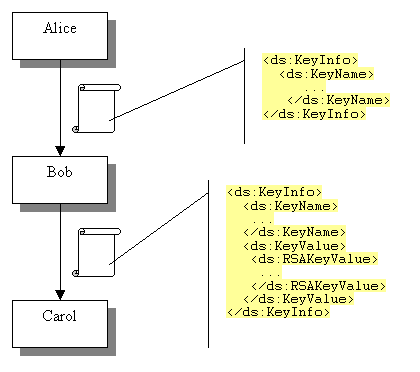
[140] Figure 1: Substitution of the <ds:KeyInfo> element as a message is passed amongst
processors
[141]The X-KISS Locate
service resolves a <ds:Keyinfo> element but
does NOT REQUIRE the service to make an assertion concerning the validity of
the binding between the data in the <ds:Keyinfo> element.
[142]The XKMS service MAY resolve the <ds:Keyinfo> element using local data or MAY relay
request to other servers. For example the XKMS service might resolve a <ds:RetrievalMethod> element (Figure 2) or act as a
gateway to an underlying PKI based on a non-XML syntax.
[143] 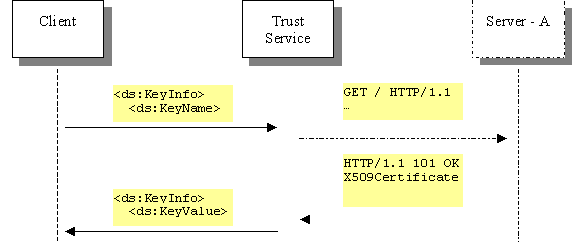
[144]Figure 2: Locate
Service Provides Name Resolution
[145]Both the request and/or the response MAY be
signed, to both authenticate the sender and protect the integrity of the data
being transmitted, using an XML Signature [XML-SIG].
[146]Alice wants to send an encrypted email to Bob
but does not know his encryption key. Alice can use both the S/MIME and PGP
secure email formats. Alice's client uses DNS to locate the XKMS service that
provides a Locate service for keys bound to the domain example.com
then sends an XKMS Locate request to the discovered
XKMS service for a key bound to bob@example.com
and the S/MIME or PGP protocol. The application
then verifies that the certificate obtained meets its trust criteria by
standard certificate validation to a trusted root.
[147]Request:
<?xml version="1.0" encoding="utf-8"?>
<LocateRequest xmlns:ds="http://www.w3.org/2000/09/xmldsig#"
      xmlns:xenc="http://www.w3.org/2001/04/xmlenc#"
      Id="I8fc9f97052a34073312b22a69b3843b6"
      Service="http://www.example.org/XKMS"
      xmlns="http://www.w3.org/2002/03/xkms#">
  <RespondWith>http://www.w3.org/2002/03/xkms#KeyName</RespondWith>
  <RespondWith>http://www.w3.org/2002/03/xkms#KeyValue</RespondWith>
  <RespondWith>http://www.w3.org/2002/03/xkms#X509Cert</RespondWith>
  <RespondWith>http://www.w3.org/2002/03/xkms#X509Chain</RespondWith>
  <RespondWith>http://www.w3.org/2002/03/xkms#PGPWeb</RespondWith>
  <RespondWith>http://www.w3.org/2002/03/xkms#PGP</RespondWith>
  <QueryKeyBinding>
    <KeyUsage>http://www.w3.org/2002/03/xkms#Encryption</KeyUsage>
    <UseKeyWith Application="urn:ietf:rfc:2440"
          Identifier="bob@example.com" />
    <UseKeyWith Application="urn:ietf:rfc:2633"
          Identifier="bob@example.com" />
  </QueryKeyBinding>
</LocateRequest>
[148]Response:
<?xml version="1.0" encoding="utf-8"?>
<LocateResult xmlns:ds="http://www.w3.org/2000/09/xmldsig#"
      xmlns:xenc="http://www.w3.org/2001/04/xmlenc#"
      Id="I8ce3809ab23500015cc27704b7eb0912"
      Service="http://www.example.org/XKMS"
      ResultMajor="http://www.w3.org/2002/03/xkms#Success"
      RequestId="I8fc9f97052a34073312b22a69b3843b6"
      xmlns="http://www.w3.org/2002/03/xkms#">
  <UnverifiedKeyBinding Id="I809ca03cf85b3cb466859694dbd0627d">
    <ds:KeyInfo>
      <ds:KeyValue>
        <ds:RSAKeyValue>
          <ds:Modulus>
            3FFtWUsvEajQt2SeSF+RvAxWdPPh5GSlQnp8SDvvqvCwE6PXcRWrIGmV7twNf2T
            UXCxYuztUUClMIy14B0Q+k1ej2nekmYL7+Ic3DDGVFVaYPoxaRY0Y2lV8tOreyn
            WegpFbITXc8V6Y02QfR5O7Pn1/10ElslaF/TF8MQGqYE8=
          </ds:Modulus>
          <ds:Exponent>AQAB</ds:Exponent>
        </ds:RSAKeyValue>
      </ds:KeyValue>
      <ds:X509Data>
        <ds:X509Certificate>
          MIICCTCCAXagAwIBAgIQe0Sk4xr1VolGFFNMkCx07TAJBgUrDgMCHQUAMBIxEDA
          OBgNVBAMTB1Rlc3QgQ0EwHhcNMDMwODE1MDcwMDAwWhcNMDUwODE1MDY1OTU5Wj
          AkMSIwIAYDVQQDExlCb2IgQmFrZXIgTz1Cb2IgQ29ycCBDPVVTMIGfMA0GCSqGS
          Ib3DQEBAQUAA4GNADCBiQKBgQDcUW1ZSy8RqNC3ZJ5IX5G8DFZ08+HkZKVCenxI
          O++q8LATo9dxFasgaZXu3A1/ZNRcLFi7O1RQKUwjLXgHRD6TV6Pad6SZgvv4hzc
          MMZUVVpg+jFpFjRjaVXy06t7KdZ6CkVshNdzxXpjTZB9Hk7s+fX/XQSWyVoX9MX
          wxAapgTwIDAQABo1YwVDANBgNVHQoEBjAEAwIGQDBDBgNVHQEEPDA6gBABpU6Rp
          UssqgWYs3fukLy6oRQwEjEQMA4GA1UEAxMHVGVzdCBDQYIQLgyd1ReM8bVNnFUq
          D4e60DAJBgUrDgMCHQUAA4GBAF4jP1gGDbaq3rg/Vo3JY7EDNTp0HmwLiPMLmdn
          B3WTIGFcjS/jZFzRCbvKPeiPTZ6kRkGgydFOuCo5HMAxIks/LtnKFd/0qYT+AOD
          q/rCrwSx+F+Ro2rf9tPpja9o7gANqxs6Pm7f1QSPZO57bT/6afiVm7NdaCfjgMp
          hb+XNyn
        </ds:X509Certificate>
        <ds:X509Certificate>
          MIIB9zCCAWSgAwIBAgIQLgyd1ReM8bVNnFUqD4e60DAJBgUrDgMCHQUAMBIxEDA
          OBgNVBAMTB1Rlc3QgQ0EwHhcNMDMwODE1MDcwMDAwWhcNMTAwODE1MDcwMDAwWj
          ASMRAwDgYDVQQDEwdUZXN0IENBMIGfMA0GCSqGSIb3DQEBAQUAA4GNADCBiQKBg
          QCn23HHp+HtXpiyKVSDtdE3dO0r0oLB/H9sxUEkeXB8oMxwbhdcizWH92zrtm1V
          fVtxkfmwF14ZXoyDZHeZXuCOtAfz/mW6s2gmfD45TfFFVGksDGVRNK5XmKXA5sE
          C51RCvaxzGBdGDlCuVPqX7Cq3IcZpRU1IXbi5YzGwV7j6LwIDAQABo1YwVDANBg
          NVHQoEBjAEAwIHgDBDBgNVHQEEPDA6gBABpU6RpUssqgWYs3fukLy6oRQwEjEQM
          A4GA1UEAxMHVGVzdCBDQYIQLgyd1ReM8bVNnFUqD4e60DAJBgUrDgMCHQUAA4GB
          ABDYD4Fwx2dscu+BgYcZ+GoQQtCJkwJEXytb4zlNl7HLFKbXSw4m0blQquIsfsi
          QgFYAQBXSbu7aeUqqmSGHvILu3BGwVOKjxbHfcM4/MefuTtpOpCN40wy3YwwngD
          tHTaIqm8NwS966PE+W9f8kD70q5FNwf+GF/lX9qGc/x435
        </ds:X509Certificate>
      </ds:X509Data>
    </ds:KeyInfo>
    <KeyUsage>http://www.w3.org/2002/03/xkms#Signature</KeyUsage>
    <KeyUsage>http://www.w3.org/2002/03/xkms#Encryption</KeyUsage>
    <KeyUsage>http://www.w3.org/2002/03/xkms#Exchange</KeyUsage>
    <UseKeyWith Application="urn:ietf:rfc:2633"
          Identifier="bob@example.com" />
  </UnverifiedKeyBinding>
</LocateResult>
[149]Bob receives the signed document from Alice
which specifies Alice's X.509v3 certificate but not the key value. Bob's
email client is not capable of processing X.509v3 certificates but can obtain
the key parameters from the XKMS service by means of the Locate service.
Bob's email client sends the <ds:Keyinfo>
element to the location service requesting that the
corresponding <KeyValue> element be returned.
[150]Request:
<?xml version="1.0" encoding="utf-8"?>
<LocateRequest xmlns:ds="http://www.w3.org/2000/09/xmldsig#"
      xmlns:xenc="http://www.w3.org/2001/04/xmlenc#"
      Id="I045c66f6c525a9bf3842ecd3466cd422"
      Service="http://www.example.org/XKMS"
      xmlns="http://www.w3.org/2002/03/xkms#">
  <RespondWith>http://www.w3.org/2002/03/xkms#KeyValue</RespondWith>
  <QueryKeyBinding>
    <ds:KeyInfo>
      <ds:X509Data>
        <ds:X509Certificate>
          MIICEDCCAX2gAwIBAgIQimXeUAxYJbJMady9vV1bLjAJBgUrDgMCHQUAMBIxEDA
          OBgNVBAMTB1Rlc3QgQ0EwHhcNMDMwODE1MDcwMDAwWhcNMDUwODE1MDY1OTU5Wj
          ArMSkwJwYDVQQDEyBBbGljZSBBYXJkdmFyayBPPUFsaWNlIENvcnAgQz1VUzCBn
          zANBgkqhkiG9w0BAQEFAAOBjQAwgYkCgYEA0nIsmR+aVW2egl5MIfOKy4HuMKkk
          9AZ/IQuDLVPlhzOfgngjVQCjr8uvmnqtNu8HBupui8LgGthO6U9D0CNT5mbmhIA
          ErRADUMIAFsi7LzBarUvNWTqYNEJmcHsAUZdrdcDrkNnG7SzbuJx+GDNiHKVDQg
          gPBLc1XagW20RMvokCAwEAAaNWMFQwDQYDVR0KBAYwBAMCBkAwQwYDVR0BBDwwO
          oAQAaVOkaVLLKoFmLN37pC8uqEUMBIxEDAOBgNVBAMTB1Rlc3QgQ0GCEC4MndUX
          jPG1TZxVKg+HutAwCQYFKw4DAh0FAAOBgQABU91ka7IlkXCfv4Zh2Ohwgg2yObt
          Y3+6C/BTFGrOEBJDy+DoxJ/NuBF18w3rrrR18xE6jNKYLCQb8zUGk4QOG5Y+HT/
          QTTFvWkiOLXcpTuhnOhXatr42FoYpDkjx2QWK+J5Q2l/Rgjgc/0ZV8U/kD8UuRk
          Xp4AZh7QsiX8AcO0w==
        </ds:X509Certificate>
      </ds:X509Data>
    </ds:KeyInfo>
    <KeyUsage>http://www.w3.org/2002/03/xkms#Signature</KeyUsage>
  </QueryKeyBinding>
</LocateRequest>
[151]The location service extracts the X.509v3
certificate from the <ds:Keyinfo> element and
returns the key values. The location service DOES NOT report the revocation
status or the trustworthiness of the certificate.
[152]Response:
<?xml version="1.0" encoding="utf-8"?>
<LocateResult xmlns:ds="http://www.w3.org/2000/09/xmldsig#"
      xmlns:xenc="http://www.w3.org/2001/04/xmlenc#"
      Id="I04cd4f17d0656413d744f55488369264"
      Service="http://www.example.org/XKMS"
      ResultMajor="http://www.w3.org/2002/03/xkms#Success"
      RequestId="I045c66f6c525a9bf3842ecd3466cd422"
      xmlns="http://www.w3.org/2002/03/xkms#">
  <UnverifiedKeyBinding Id="I012f61e1d7b7b9944fe8d954bcb2d946">
    <ds:KeyInfo>
      <ds:KeyValue>
        <ds:RSAKeyValue>
          <ds:Modulus>
            0nIsmR+aVW2egl5MIfOKy4HuMKkk9AZ/IQuDLVPlhzOfgngjVQCjr8uvmnqtNu8
            HBupui8LgGthO6U9D0CNT5mbmhIAErRADUMIAFsi7LzBarUvNWTqYNEJmcHsAUZ
            drdcDrkNnG7SzbuJx+GDNiHKVDQggPBLc1XagW20RMvok=
          </ds:Modulus>
          <ds:Exponent>AQAB</ds:Exponent>
        </ds:RSAKeyValue>
      </ds:KeyValue>
    </ds:KeyInfo>
    <KeyUsage>http://www.w3.org/2002/03/xkms#Signature</KeyUsage>
    <KeyUsage>http://www.w3.org/2002/03/xkms#Encryption</KeyUsage>
    <KeyUsage>http://www.w3.org/2002/03/xkms#Exchange</KeyUsage>
    <UseKeyWith Application="urn:ietf:rfc:2633"
          Identifier="alice@example.com" />
  </UnverifiedKeyBinding>
</LocateResult>
[153]The X-KISS Validate Service allows all that the
Locate Service does, and in addition, the client may obtain an assertion
specifying the status of the binding between the public key and other data,
for example a name or a set of extended attributes. Furthermore the service
represents that the status of each of the data elements returned is valid and
that all are bound to the same public key. The client sends to the XKMS
service a prototype containing some or all of the elements for which the
status of the key binding is required. If the information in the prototype is
incomplete, the XKMS service MAY obtain additional data required from an
underlying PKI Service. Once the validity of the key binding has been
determined the XKMS service returns the status result to the client (Figure
3).
[154] 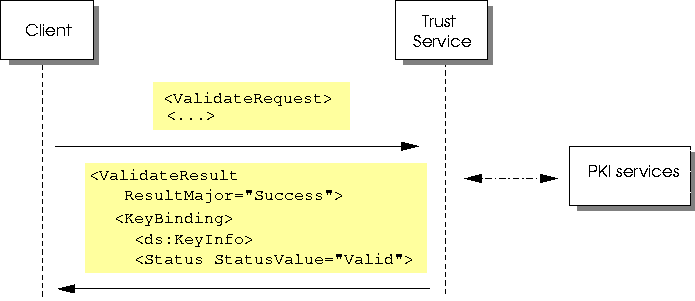
[155] Figure 3: Validate Service Provides Key
Validation
[156]Bob has received Alice's message and his email
client has verified the signature on the document against the public key in
the certificate supplied by Alice. It is not yet known whether the
certificate is considered trustworthy however. To determine this, Bob's email
client sends the certificate chain to an XKMS Validate service. The service
reports back that it has successfully determined that the key binding has a
trusted issuer and has not been revoked.
[157]Request:
<?xml version="1.0" encoding="utf-8"?>
<ValidateRequest xmlns:ds="http://www.w3.org/2000/09/xmldsig#"
      xmlns:xenc="http://www.w3.org/2001/04/xmlenc#"
      Id="Ie26380bfeb9d0c5bc526d5213a162d46"
      Service="http://www.example.org/XKMS"
      xmlns="http://www.w3.org/2002/03/xkms#">
  <RespondWith>http://www.w3.org/2002/03/xkms#X509Cert</RespondWith>
  <QueryKeyBinding>
    <ds:KeyInfo>
      <ds:X509Data>
        <ds:X509Certificate>
          MIICEDCCAX2gAwIBAgIQimXeUAxYJbJMady9vV1bLjAJBgUrDgMCHQUAMBIxEDA
          OBgNVBAMTB1Rlc3QgQ0EwHhcNMDMwODE1MDcwMDAwWhcNMDUwODE1MDY1OTU5Wj
          ArMSkwJwYDVQQDEyBBbGljZSBBYXJkdmFyayBPPUFsaWNlIENvcnAgQz1VUzCBn
          zANBgkqhkiG9w0BAQEFAAOBjQAwgYkCgYEA0nIsmR+aVW2egl5MIfOKy4HuMKkk
          9AZ/IQuDLVPlhzOfgngjVQCjr8uvmnqtNu8HBupui8LgGthO6U9D0CNT5mbmhIA
          ErRADUMIAFsi7LzBarUvNWTqYNEJmcHsAUZdrdcDrkNnG7SzbuJx+GDNiHKVDQg
          gPBLc1XagW20RMvokCAwEAAaNWMFQwDQYDVR0KBAYwBAMCBkAwQwYDVR0BBDwwO
          oAQAaVOkaVLLKoFmLN37pC8uqEUMBIxEDAOBgNVBAMTB1Rlc3QgQ0GCEC4MndUX
          jPG1TZxVKg+HutAwCQYFKw4DAh0FAAOBgQABU91ka7IlkXCfv4Zh2Ohwgg2yObt
          Y3+6C/BTFGrOEBJDy+DoxJ/NuBF18w3rrrR18xE6jNKYLCQb8zUGk4QOG5Y+HT/
          QTTFvWkiOLXcpTuhnOhXatr42FoYpDkjx2QWK+J5Q2l/Rgjgc/0ZV8U/kD8UuRk
          Xp4AZh7QsiX8AcO0w==
        </ds:X509Certificate>
        <ds:X509Certificate>
          MIIB9zCCAWSgAwIBAgIQLgyd1ReM8bVNnFUqD4e60DAJBgUrDgMCHQUAMBIxEDA
          OBgNVBAMTB1Rlc3QgQ0EwHhcNMDMwODE1MDcwMDAwWhcNMTAwODE1MDcwMDAwWj
          ASMRAwDgYDVQQDEwdUZXN0IENBMIGfMA0GCSqGSIb3DQEBAQUAA4GNADCBiQKBg
          QCn23HHp+HtXpiyKVSDtdE3dO0r0oLB/H9sxUEkeXB8oMxwbhdcizWH92zrtm1V
          fVtxkfmwF14ZXoyDZHeZXuCOtAfz/mW6s2gmfD45TfFFVGksDGVRNK5XmKXA5sE
          C51RCvaxzGBdGDlCuVPqX7Cq3IcZpRU1IXbi5YzGwV7j6LwIDAQABo1YwVDANBg
          NVHQoEBjAEAwIHgDBDBgNVHQEEPDA6gBABpU6RpUssqgWYs3fukLy6oRQwEjEQM
          A4GA1UEAxMHVGVzdCBDQYIQLgyd1ReM8bVNnFUqD4e60DAJBgUrDgMCHQUAA4GB
          ABDYD4Fwx2dscu+BgYcZ+GoQQtCJkwJEXytb4zlNl7HLFKbXSw4m0blQquIsfsi
          QgFYAQBXSbu7aeUqqmSGHvILu3BGwVOKjxbHfcM4/MefuTtpOpCN40wy3YwwngD
          tHTaIqm8NwS966PE+W9f8kD70q5FNwf+GF/lX9qGc/x435
        </ds:X509Certificate>
      </ds:X509Data>
    </ds:KeyInfo>
    <KeyUsage>http://www.w3.org/2002/03/xkms#Signature</KeyUsage>
    <UseKeyWith Application="urn:ietf:rfc:2633"
          Identifier="alice@example.com" />
  </QueryKeyBinding>
</ValidateRequest>
[158]Response:
<?xml version="1.0" encoding="utf-8"?>
<ValidateResult xmlns:ds="http://www.w3.org/2000/09/xmldsig#"
      xmlns:xenc="http://www.w3.org/2001/04/xmlenc#"
      Id="I34ef61b96f7db2250c229d37a17edfc0"
      Service="http://www.example.org/XKMS"
      ResultMajor="http://www.w3.org/2002/03/xkms#Success"
      RequestId="Ie26380bfeb9d0c5bc526d5213a162d46"
      xmlns="http://www.w3.org/2002/03/xkms#">
  <KeyBinding Id="Icf608e9e8b07468fde1b7ee5449fe831">
    <ds:KeyInfo>
      <ds:X509Data>
        <ds:X509Certificate>
          MIICEDCCAX2gAwIBAgIQimXeUAxYJbJMady9vV1bLjAJBgUrDgMCHQUAMBIxEDA
          OBgNVBAMTB1Rlc3QgQ0EwHhcNMDMwODE1MDcwMDAwWhcNMDUwODE1MDY1OTU5Wj
          ArMSkwJwYDVQQDEyBBbGljZSBBYXJkdmFyayBPPUFsaWNlIENvcnAgQz1VUzCBn
          zANBgkqhkiG9w0BAQEFAAOBjQAwgYkCgYEA0nIsmR+aVW2egl5MIfOKy4HuMKkk
          9AZ/IQuDLVPlhzOfgngjVQCjr8uvmnqtNu8HBupui8LgGthO6U9D0CNT5mbmhIA
          ErRADUMIAFsi7LzBarUvNWTqYNEJmcHsAUZdrdcDrkNnG7SzbuJx+GDNiHKVDQg
          gPBLc1XagW20RMvokCAwEAAaNWMFQwDQYDVR0KBAYwBAMCBkAwQwYDVR0BBDwwO
          oAQAaVOkaVLLKoFmLN37pC8uqEUMBIxEDAOBgNVBAMTB1Rlc3QgQ0GCEC4MndUX
          jPG1TZxVKg+HutAwCQYFKw4DAh0FAAOBgQABU91ka7IlkXCfv4Zh2Ohwgg2yObt
          Y3+6C/BTFGrOEBJDy+DoxJ/NuBF18w3rrrR18xE6jNKYLCQb8zUGk4QOG5Y+HT/
          QTTFvWkiOLXcpTuhnOhXatr42FoYpDkjx2QWK+J5Q2l/Rgjgc/0ZV8U/kD8UuRk
          Xp4AZh7QsiX8AcO0w==
        </ds:X509Certificate>
      </ds:X509Data>
    </ds:KeyInfo>
    <KeyUsage>http://www.w3.org/2002/03/xkms#Signature</KeyUsage>
    <KeyUsage>http://www.w3.org/2002/03/xkms#Encryption</KeyUsage>
    <KeyUsage>http://www.w3.org/2002/03/xkms#Exchange</KeyUsage>
    <UseKeyWith Application="urn:ietf:rfc:2633"
          Identifier="alice@example.com" />
    <Status StatusValue="http://www.w3.org/2002/03/xkms#Valid">
      <ValidReason>http://www.w3.org/2002/03/xkms#Signature</ValidReason>
      <ValidReason>http://www.w3.org/2002/03/xkms#IssuerTrust</ValidReason>
      <ValidReason>http://www.w3.org/2002/03/xkms#RevocationStatus</ValidReason>
      <ValidReason>http://www.w3.org/2002/03/xkms#ValidityInterval</ValidReason>
    </Status>
  </KeyBinding>
</ValidateResult>
[159]The Locate and Validate operations are both
used to obtain information about a public key from an XKMS Service. Locate
and Validate services are both expected to attempt to provide correct
information to the requestor. The Locate and Validate services differ in the
extent to which the service vouches for the trustworthiness the information
returned.
[160]A Location service SHOULD attempt to provide
only information which is trustworthy to the best of its knowledge but
does not provide any assurance that it will do so. Information obtained
from a Locate service SHOULD NOT be relied upon unless it is validated.
Validation may be achieved by forwarding the data to a Validate service or by
performing the necessary trust path verification locally.
[161]A Validation service undertakes to only return
information which has been positively validated by the XKMS Service as
meeting specific validation criteria. A client MAY rely on the information
returned by the service without further validation provided that the client
has a means to determine that the information returned is authentic and is
assured that the validation service applied the means of validation
appropriate to the circumstances.
[162]No single set of validation criteria are
appropriate to every circumstance. Applications involving financial
transactions are likely to require the application of very specific
validation criteria that ensure that certain contractual and/or regulatory
policies are enforced. The Locate service provides a key discovery function
that is neutral with respect to the validation criteria that the client
application may apply. The Validate service provides a key discovery and
validation function that produces a results which are each specific to a
single set of validation criteria.
[163]In many cases the key information which a
client requires is bound to some form of address specified by an Internet
protocol part of which consists of a DNS address. For example an email client
may require a trustworthy key to send an encrypted email to bob@example.com.
Unless an XKMS service which provides key information about keys bound to
email addresses in the domain example.com is known a priori, some means of
locating the correct XKMS service is required.
[164]Figure 5 shows an example of using the DNS SRV
record to perform discovery of XKMS services. The email client requests a key
for bob@example.com from a trusted Validate service. The Validate service
then queries the DNS to locate an XKMS service providing information on keys
bound to addresses in the zone example.com. The Validate service does not
have an established trust relationship with the example.com XKMS service and
so a Locate request is made to determine if any key information bound to
bob@example.com can be located. The Validate service then validates the
information received by such means as are appropriate (e.g., by verifying that
a certification chain may be constructed from a root of trust) and the
response returned to the email client.
[165] 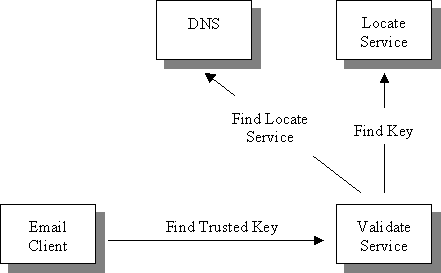
[166]Figure 5: Combined
use of Locate and Validate service
[167]Appendix B provides further information on the
use of the DNS SRV record.
[168]The protocol consists of pairs of messages,
with an application sending a request message to an XKMS service and the
service responding with another message.
[169]A key binding asserts a binding between
data elements that relate to a public key including the <ds:KeyName>, <ds:KeyValue> and <ds:X509Data> components contained in a <ds:KeyInfo> element. Furthermore, the Service
represents to the client accessing the service and to that client
alone that the binding between the data elements is valid under
whatever trust policy the service offers to that client.
[170]XKMS specifies four elements that specify key
bindings, all of which are derived from the KeyBindingAbstractType. These elements are:
- UnverifiedKeyBinding
- Specifies the parameters of a particular instance of a key binding
but not the status.
- KeyBinding
- Specifies the parameters of a particular instance of a key
binding.
- QueryKeyBinding
- A template used to specify one or more key bindings using query by
example.
- PrototypeKeyBinding
- A template used to specify the key binding parameters requested in
a registration request.
[171]An XKMS service MAY provide an interface to an
underlying PKI such as PKIX or PGP. This specification does not define how
XKMS operations interact with the underlying PKI. The XKMS key binding MAY be
bound to a data object such as a certificate or key signing in the
underlying PKI such that XKMS operations on the key binding result in a
corresponding change to the data structures in the underlying PKI and vice
versa. If for example the XKMS service provides a mapping to an underlying
PKIX/X.509 PKI the registration of a key binding would typically result in
the issue of a certificate, even if the client does not ask for the
certificate to be returned in the registration result. If the key binding
were subsequently revoked the corresponding certificate in the underlying PKI
would typically be revoked also.
[172]The KeyBindingAbstractType is the abstract type from which all
XKMS key binding element specifiers are derived. It contains the following
elements and attribute:
- Id [Optional]
- Identifier of the key binding.
- <ds:KeyInfo> [Optional]
- The public key information to which the key binding information is
bound.
- <KeyUsage> [0 to 3]
- The cryptographic key uses for which the key may be used.
- <UseKeyWith> [Any
Number]
- The applications with which the key may be used together with the
application specific subject identifier of the key holder for that
application.
[173]The Id identifier is defined to provide a
means by which the key binding may be signed using XML Signature. Clients
MUST NOT rely on the key binding identifier being either unique or stable. In
the case that an XKMS service is providing an interface to an underlying PKI,
clients MUST NOT rely on the service choosing key binding identifiers that
are either the same as or bear a systematic relationship to the serial
numbers or other identifiers of the corresponding credentials in the
underlying PKI.
[174]The following schema defines the KeyBindingAbstractType type:
   <!-- KeyBindingAbstractType-->
   <complexType name="KeyBindingAbstractType" abstract="true">
      <sequence>
         <element ref="ds:KeyInfo" minOccurs="0"/>
         <element ref="xkms:KeyUsage" minOccurs="0" maxOccurs="3"/>
         <element ref="xkms:UseKeyWith" minOccurs="0"
               maxOccurs="unbounded"/>
      </sequence>
      <attribute name="Id" type="ID" use="optional"/>
   </complexType>
   <!-- /KeyBindingAbstractType-->
[175]The <KeyUsage>
element specifies one or more intended uses of the key. If no <KeyUsage> is specified all uses are permitted. The
following key usages are defined:
- Encryption
- The key pair may be used for encryption and decryption.
- Signature
- The key pair may be used for signature and verification.
- Exchange
- The key pair may be used for key exchange.
[176]If a key usage is specified in a KeyBinding that the cryptographic algorithm associated
with the key does not support the element MUST be ignored. If a key usage is
specified in a QueryKeyBinding however the key
usage forms part of the criteria the service should attempt to match.
[177]For example if a KeyBinding specifies the key
usage Encryption for a Digital Signature Algorithm
key the relying application should ignore the key usage element. If however a
client makes a request that contains a QueryKeyBinding that specifies the key usage encryption
the service should not return a Digital Signature Algorithm key.
[178]The following schema defines the <KeyUsage> element:
   <!-- KeyUsage -->
   <simpleType name="KeyUsageEnum">
      <restriction base="anyURI">
         <enumeration value="http://www.w3.org/2002/03/xkms#Encryption"/>
         <enumeration value="http://www.w3.org/2002/03/xkms#Signature"/>
         <enumeration value="http://www.w3.org/2002/03/xkms#Exchange"/>
      </restriction>
   </simpleType>

   <element name="KeyUsage" type="xkms:KeyUsageEnum"/>
   <!-- /KeyUsage -->
[179]The <UseKeyWith> element specifies a subject identifier
and application identifier that determine a use of the key. The
interpretation of <UseKeyWith> depends on the
enclosing construct.
- QueryKeyBinding /
PrototypeKeyBinding
- A key binding is requested that meets the specified criteria. If the
service is unable to meet the criteria exactly 'best guess' is
acceptable.
- UnverifiedKeyBinding / KeyBinding
- The key may be used for the purpose specified (if unverified after
validation). If more than one <UseKeyWith> element
is specified then all are applicable
jointly and severally.
[180]The <UseKeyWith>
element contains the following attributes:
- Application
[Required]
- A URI that specifies the application protocol with which the key
may be used.
- Identifier
[Required]
- Specifies the subject to which the key corresponds within
the specified application protocol.
[181]Note that in some applications, in particular
X.509 an application identifier is not guaranteed to be globally unique. In
such circumstances the XKMS service is responsible for specifying rules to
unambiguously interpret identifiers.
[182]The following table lists application URIs for
common application protocols and the corresponding format for the identifier
information:
| Application |
Application URI |
Identifier |
Type |
| XKMS |
http://www.w3.org/2002/03/xkms# |
URL identifying SOAP role |
URI |
| XKMS/profile |
http://www.w3.org/2002/03/xkms#profile |
URL identifying SOAP role |
URI |
| S/MIME |
urn:ietf:rfc:2633 |
SMTP email address of subject |
RFC822 addr-spec |
| PGP |
urn:ietf:rfc:2440 |
SMTP email address of subject |
RFC822 addr-spec |
| TLS |
urn:ietf:rfc:2246 |
URI identifying certificate subject |
URI |
| TLS/HTTPS |
urn:ietf:rfc:2818 |
DNS address of http server |
DNS Address |
| TLS/SMTP |
urn:ietf:rfc:2487 |
DNS address of mail server |
DNS Address |
| IPSEC |
urn:ietf:rfc:2401 |
IP address of network resource |
IP Address |
| PKIX |
urn:ietf:rfc:2459 |
Certificate Subject Name |
X.509 Distinguished Name |
[183] The XKMS application URI is used to specify a
key binding that is used to secure an XKMS service. An XKMS service SHOULD
support discovery of the supported security profiles and corresponding key
bindings by means of a Locate operation that
specifies the XKMS application URI and the URL of the service role. Note that
as with any other Locate operation the credentials returned by this mechanism
SHOULD only be considered trustworthy if validated according to the trust
policy of the client.
[184] The primary use intended for <UseKeyWith> identifiers is to identify application
protocols. <UseKeyWith> URI identifiers MAY be
specified that represent key binding issuance and/or use policies instead of
or in addition to an application protocol. In this case the <UseKeyWith> element specifies that the key binding
complies with the specified policy. For example, applications handling XAdES
[XAdES] compliant signatures could define their own
<UseKeyWith> application values.
[185]In the case that a client follows a referral
model in which raw key binding information is obtained from a Locate service
then forwarded to a validate service the <UseKeyWith> elements in the query should in both
cases specify the uses for which the application intends to use the key.
Applications SHOULD NOT forward <UseKeyWith>
elements returned in a Locate result in a subsequent Validate query.
[186]The following table describes the formatting
for the specified types of identifier:
| Identifier Type |
Example |
Description |
| RFC822
addr-spec |
bob@example.com |
The addr-spec
fragment of an RFC 822 email address as used by SMTP |
| URI |
https://example.com/ |
A Uniform Resource
Identifier |
| DNS Address |
example.com |
An Internet DNS
address |
| IP
Address |
10.23.0.20 |
An IPv4 address in
decimal notation |
| 1080::8:800:200C:417A |
An IPv6 address in
RFC 2373 notation |
| X.509 Distinguished
Name |
C="UK"
O="CryptoGuys Ltd." CN="Bob" |
An X.509
Distinguished Name |
[187]The following schema defines the <UseKeyWith> element:
   <!-- UseKeyWith -->
   <element name="UseKeyWith" type="xkms:UseKeyWithType"/>
   <complexType name="UseKeyWithType">
      <attribute name="Application" type="anyURI" use="required"/>
      <attribute name="Identifier" type="string" use="required"/>
   </complexType>
   <!-- /UseKeyWith -->
[188]The <UnverifiedKeyBinding> element is derived from the
KeyBindingAbstractType. It describes a key binding
but makes no assertion regarding the status of the key binding.
[189]The <UnverifiedKeyBinding> element extends the KeyBindingAbstractType with the following additional
elements:
- <ValidityInterval> [Optional]
- The time interval for which the key
binding relationship is requested to be asserted.
[190]The following schema defines the <UnverifiedKeyBinding> element and UnverifiedKeyBindingType:
   <!-- UnverifiedKeyBinding -->
   <element name="UnverifiedKeyBinding"
         type="xkms:UnverifiedKeyBindingType"/>
   <complexType name="UnverifiedKeyBindingType">
      <complexContent>
         <extension base="xkms:KeyBindingAbstractType">
            <sequence>
               <element ref="xkms:ValidityInterval" minOccurs="0"/>
            </sequence>
         </extension>
      </complexContent>
   </complexType>
   <!-- /UnverifiedKeyBinding -->
[191]The <ValidityInterval> element specifies limits on the
validity of the key binding.
- NotBefore [Optional]
- Time instant at which the validity interval begins.
- NotOnOrAfter [Optional]
- Time instant at which the validity interval has ended.
[192]All dateTime values MUST fully specify the
date.
[193]The NotBefore and
NotOnOrAfter attributes are optional. If the NotBefore attribute is omitted the key binding is valid on
any date up to but excluding the date specified in the NotOnOrAfter attribute . If the NotOnOrAfter attribute is omitted the key binding is valid
from the NotBefore attribute with no expiry. If both
attributes are omitted the key binding is
valid at any time.
[194]In accordance with the XML Schema
Specifications, all time instances are interpreted in Universal Coordinated
Time unless they explicitly indicate a time zone.
[195]Implementations MUST NOT generate time
instances that specify leap seconds.
[196]For purposes of comparison, the time interval
NotBefore to NotOnOrAfter
begins at the earliest time instant compatible with the specification of
NotBefore and has ended at the
earliest time instant compatible with the specification of
NotOnOrAfter
[197]For example if the time interval specified is
dayT12:03:02 to dayT12:05:12 the times 12:03:02.00 and 12:05:11.9999 are
within the time interval. The time 12:05:12.0000 is
outside the time interval.
[198]The following schema defines the <ValidityInterval> element:
   <!-- ValidityInterval -->
   <element name="ValidityInterval" type="xkms:ValidityIntervalType"/>
   <complexType name="ValidityIntervalType">
      <attribute name="NotBefore" type="dateTime" use="optional"/>
      <attribute name="NotOnOrAfter" type="dateTime" use="optional"/>
   </complexType>
   <!-- /ValidityInterval -->
[199]The <KeyBinding>
element is derived from the UnverifiedKeyBindingType. It specifies a particular instance of a key binding
and its current status as known to the issuer of the key binding.
[200]The <KeyBinding>
element extends the UnverifiedKeyBindingType with the following additional elements:
- <Status> [Required]
- The status of the key binding instance.
[201]The following schema defines the <KeyBinding> element and KeyBindingType:
   <!-- KeyBinding -->
   <element name="KeyBinding" type="xkms:KeyBindingType"/>
   <complexType name="KeyBindingType">
      <complexContent>
         <extension base="xkms:UnverifiedKeyBindingType">
            <sequence>
               <element ref="xkms:Status"/>
            </sequence>
         </extension>
      </complexContent>
   </complexType>
   <!-- /KeyBinding -->
[202]The <Status>
element specifies the status of a <KeyBinding>
instance.
[203]The status value MAY be supplemented with
codes that state the status of specific aspects of the key binding status
that were validated.
[204]The <Status>
element contains the following elements and attribute:
- <ValidReason> [Any
Number]
- A status aspect that was evaluated and found to be Valid.
- <IndeterminateReason> [Any
Number]
- A status aspect that could not be evaluated or was evaluated and
returned an Indeterminate result.
- <InvalidReason> [Any
Number]
- A status aspect that was evaluated and found to be Invalid.
- StatusValue [Required]
- The key binding status.
[205]The enumerated type KeyBindingEnum is used to
indicate the key binding status. The following values are defined:
- Valid
- The key binding is definitively valid.
- Indeterminate
- The status of the key binding cannot be determined.
- Invalid
- The key binding is definitively invalid.
[206]If reason codes are specified StatusValue attribute MUST be consistent with the reason
codes specified as follows:
- If an <InvalidReason> code is present the
StatusValue attibute MUST have the value Invalid.
- If an <IndeterminateReason> code is
present the StatusValue attibute MUST have the
either the value Indeterminate or the value Invalid.
- If neither an <InvalidReason> nor an
<IndeterminateReason> code is present the
StatusValue attibute MAY have any defined value,
i.e. Valid, Indeterminate
or Invalid.
[206a]Note
that the X-KRSS {Revoke, Reissue, Recover} KeyBinding elements are all of type KeyBindingType, which requires a Status element (c.f. Section 7). In the case of Reissue, Revoke, and Recover requests, servers MAY ignore the Indeterminate <Status>
status value and Clients MAY set Indeterminate
as status value.
[207]The following schema defines the <Status> element and StatusType and AssertionType
types:
   <!-- Status -->
   <element name="Status" type="xkms:StatusType"/>
   <complexType name="StatusType">
      <sequence>
         <element ref="xkms:ValidReason" minOccurs="0"
               maxOccurs="unbounded"/>
         <element ref="xkms:IndeterminateReason" minOccurs="0"
               maxOccurs="unbounded"/>
         <element ref="xkms:InvalidReason" minOccurs="0"
               maxOccurs="unbounded"/>
      </sequence>

      <attribute name="StatusValue" type="xkms:KeyBindingEnum" use="required"/>
   </complexType>

   <simpleType name="KeyBindingEnum">
      <restriction base="anyURI">
         <enumeration value="http://www.w3.org/2002/03/xkms#Valid"/>
         <enumeration value="http://www.w3.org/2002/03/xkms#Invalid"/>
         <enumeration value="http://www.w3.org/2002/03/xkms#Indeterminate"/>
      </restriction>
   </simpleType>
   <!-- /Status -->
[208]The <ValidReason>, <InvalidReason> and<IndeterminateReason> elements are used to specify a
anyURI type that specifies
a reason for a particular key binding status.
[209]The status aspects are defined in the table
below. For convenience the equivalent X509 processing steps are given:
Reason
anyURI Type (prefixed with
http://www.w3.org/2002/03/xkms#) |
Description |
X.509 Equivalent |
| Valid |
Invalid |
| IssuerTrust |
The issuer of the information on which
the key binding is based is considered to be trustworthy by the XKMS
service |
Certificate path anchored by trusted root
successfully constructed |
Certificate path could not be constructed
to a trusted root |
| RevocationStatus |
The XKMS service has affirmatively
verified the status of the key binding with an authoritative
source |
Certificate status validated using CRL or
OCSP |
Certificate status returned revoked or
suspended. |
| ValidityInterval |
The requested time instant was within the
validity interval of the key binding |
The certificate chain was valid at the
requested time instant |
The requested time instant was before or
after the certificate chain validity interval |
| Signature |
Signature on signed data provided by the
client in the <Keyinfo> element was
successfully verified. |
Certificate Signature verified |
Certificate Signature verification
failed |
[210]The following schema defines the <ValidReason>, <InvalidReason> and<IndeterminateReason> elements:
   <!-- Reason -->
   <simpleType name="ReasonEnum">
       <restriction base="anyURI">
            <enumeration value="http://www.w3.org/2002/03/xkms#IssuerTrust"/>
            <enumeration value="http://www.w3.org/2002/03/xkms#RevocationStatus"/>
            <enumeration value="http://www.w3.org/2002/03/xkms#ValidityInterval"/>
            <enumeration value="http://www.w3.org/2002/03/xkms#Signature"/>
       </restriction>
    </simpleType>
    <simpleType name="ReasonOpenEnum">
       <union memberTypes="xkms:ReasonEnum anyURI"/>
   </simpleType>
   <element name="ValidReason" type="xkms:ReasonOpenEnum"/>
   <element name="InvalidReason" type="xkms:ReasonOpenEnum"/>
   <element name="IndeterminateReason" type="xkms:ReasonOpenEnum"/>
   <!-- /Reason -->
[211]The <QueryKeyBinding> element is derived from the KeyBindingAbstractType and is used to perform a query that
results in the return of one or more matching key bindings.
[212]A key binding matches the QueryKeyBinding if:
- The key binding contains all the <UseKeyWith> elements contained in the query,
and
- The key binding contains all the <KeyInfo> elements contained in the query.
[213]The <QueryKeyBinding> element extends the KeyBindingAbstractType with the following additional
elements:
- <TimeInstant> [Optional]
- The Time Instant for which the query is made. If no time instant is
specified the default is the time the request was made. A
Service that does not support
the TimeInstant element MUST return
a Receiver.TimeInstantNotSupported result.
Additionally, a Service that does support
the TimeInstant element may be
unable or unwilling to respond to requests indicating a time instant
that is outside a certain range. In such cases, the service MUST
return
a Sender.TimeInstantOutOfRange result.
[214]The following schema defines the <QueryKeyBinding> element and KeyBindingType:
   <!-- QueryKeyBinding -->
   <element name="QueryKeyBinding" type="xkms:QueryKeyBindingType"/>
   <complexType name="QueryKeyBindingType">
      <complexContent>
         <extension base="xkms:KeyBindingAbstractType">
            <sequence>
               <element ref="xkms:TimeInstant" minOccurs="0"/>
            </sequence>
         </extension>
      </complexContent>
   </complexType>
   <!-- /QueryKeyBinding -->
[215]The <TimeInstant> element specifies a specific instant in
time for which a key binding query is made. The <TimeInstant> element contains the following
attribute:
- Time [Required]
- Time instant to which a <QueryKeyBinding> relates.
[216]All dateTime values MUST fully specify the
date.
[217]The following schema defines the <TimeInstant> element:
   <!-- TimeInstant -->
   <element name="TimeInstant" type="xkms:TimeInstantType"/>
   <complexType name="TimeInstantType">
      <attribute name="Time" type="dateTime" use="required"/>
   </complexType>
   <!-- /TimeInstant -->
[218]The Locate service accepts as input a <QueryKeyBinding> element that specifies a key
binding and returns one or more <UnverifiedKeyBinding> elements that relate to the
same public key. The <UnverifiedKeyBinding>
elements returned are specified by the RespondWith
element in the request.
[219]The request message contains a <LocateRequest> element that contains the following
element.
- <QueryKeyBinding> [Required]
- The key binding query to be matched in the response.
[220] The following schema defines the <LocateRequest> element:
   <!-- LocateRequest -->
   <element name="LocateRequest" type="xkms:LocateRequestType"/>
   <complexType name="LocateRequestType">
      <complexContent>
         <extension base="xkms:RequestAbstractType">
            <sequence>
               <element ref="xkms:QueryKeyBinding"/>
            </sequence>
         </extension>
      </complexContent>
   </complexType>
   <!-- /LocateRequest -->
[221]The response message contains a <LocateResult> element
- <UnverifiedKeyBinding> [Any
Number]
- A sequence of <UnverifiedKeyBinding>
key binding that match the key binding query specified in
the corresponding request. If no results are found the sequence is
empty and the result code NoMatch is
returned. In some circumstances a Locate
operation MAY return multiple matching results.
[222] The following schema defines the <LocateResult> element:
   <!-- LocateResult -->
   <element name="LocateResult" type="xkms:LocateResultType"/>
   <complexType name="LocateResultType">
      <complexContent>
         <extension base="xkms:ResultType">
            <sequence>
               <element ref="xkms:UnverifiedKeyBinding" minOccurs="0"
                     maxOccurs="unbounded"/>
            </sequence>
         </extension>
      </complexContent>
   </complexType>
   <!-- /LocateResult -->
[223]The Validate service
allows the client to query the binding between a <ds:Keyinfo> element and other data such as an
identifier. The client supplies a prototype for the key binding requested.
The prototype may specify either a <ds:Keyinfo>
element or one or more <UseKeyWith> elements
or both. If the validate request is successful the server returns one
or more <KeyBinding> elements that meet the
criteria specified in the request.
[224]The validate request message contains a <ValidateRequest> element:
- <QueryKeyBinding> [Required]
- The key binding query to be matched in the response.
[225]The following schema defines the <ValidateRequest> element:
   <!-- ValidateRequest -->
   <element name="ValidateRequest" type="xkms:ValidateRequestType"/>
   <complexType name="ValidateRequestType">
      <complexContent>
         <extension base="xkms:RequestAbstractType">
            <sequence>
               <element ref="xkms:QueryKeyBinding"/>
            </sequence>
         </extension>
      </complexContent>
   </complexType>
   <!-- /ValidateRequest -->
[226]The validate response message contains a <ValidateResult> element:
- <Keybinding> [Any Number]
- A sequence of <KeyBinding> key
bindings that match the key binding query specified in the
corresponding request. If no results are found the sequence is empty
and the result code NoMatch is returned.
In some circumstances a Validate operation
MAY return multiple matching results.
[227]The following schema defines the <ValidateResult> element and the ValidateResultType type.
   <!-- ValidateResult -->
   <element name="ValidateResult" type="xkms:ValidateResultType"/>
   <complexType name="ValidateResultType">
      <complexContent>
         <extension base="xkms:ResultType">
            <sequence>
               <element ref="xkms:KeyBinding" minOccurs="0"
                     maxOccurs="unbounded"/>
            </sequence>
         </extension>
      </complexContent>
   </complexType>
   <!-- /ValidateResult -->
[228]The XML Key Registration Service Specification
permits management of information that is bound to a public key pair. The
X-KRSS service specification supports the following operations:
- Register
- Information is bound to a public key pair through a key binding.
- Reissue
- A previously registered key binding is reissued.
- Revoke
- A previously registered key binding is revoked.
- Recover
- The private key associated with a key binding is recovered.
[229]An XKMS service may offer all or none of these
services.
[230]The Register operation
does not in itself place any requirement on the registration service to
communicate that information to any other party. In most applications,
however, a registration service will provide key information to other Web
Services such as those described in the XKMS specification or a separate
underlying PKI such as PKIX.
[231]The Register operation
MAY be used in a mode where client requests are accepted by an intermediary
such as a Local Registration Authority (LRA) and forwarded to a Master
Registration Authority (MRA). This mode of operation is entirely transparent
to the client which acts as if the LRA is the only registration authority
involved. The construction of the proof-of-possession of the private key and
the authentication information is completely separate of the message
authentication signature. This allows verification by both the LRA and any
other registration authority that it is relayed to, even if the message
authentication signature has been replaced by the LRA.
[232]The Register request
is used to assert a binding of information to a public key pair. Generation
of the public key pair MAY be performed by either the client or the
Registration service.
[233]The Registration request message contains a
prototype of the requested key binding. The registration service MAY require
the client to provide additional information to authenticate the request. If
the public key pair is generated by the client, the service MAY require the
client to provide Proof of Possession of the private key.
[234]The prototype of the requested key binding may
contain only partial information, a key without a name or a name without a
key. In this case, the client is requesting that the registration service
provide the additional information required to complete the binding. All
information contained in the prototype of the requested key binding is
advisory to the service and MAY be ignored or overridden at the option of the
service.
[235]On receipt of a registration request, the
registration service verifies the authentication and POP information provided
(if any). If the registration service accepts the request a key binding is
registered. This key binding MAY include some, all or none of the information
provided by the prototype key binding and MAY include additional
information.
[236]The registration service MAY return part or
all of the registered key binding to the client.
[237] 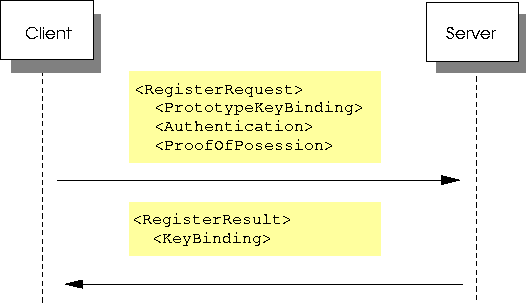
[238]Figure 5:
Registration of a Key Binding
[239]The choice of generation of the key pair at
the client or the service depends on the application and the type of key. In
the case of a key used for signing purposes it is generally undesirable for
any party apart from the key bearer to have access to the private key. Should
access to the private key be lost a new key may be issued without affecting
the validity of any of the signatures created using the old private key.
Accordingly it is usually preferable for such keys to be generated at the
client and not the server.
[240]In the case of a private key used exclusively
for certain types of encryption, the loss of access to the private key may
result in the loss of access to the stored data encrypted under the key. In
such circumstances it is generally desirable for some form of key recovery to
be employed. In such systems the key pair is typically generated at the
service and delivered to the client.
[241]A key used for both signing and encryption
might be generated at the client or the server depending on whether key
recovery is to be supported.
[242]Alice requests registration of an RSA key pair
for her email address Alice@example.com. Alice has
previously received from the XKMS service the code "024837" with which to
authenticate her request. Alice selects the pass phrase "Help I have revealed
my key" to authenticate herself should it be necessary to revoke the
registration at a later date.
[243]The X-KRSS request message contains the
following <RegisterRequest> element. Because
the registration request is for a client generated key the Authentication
element contains both a <ProofOfPossession>
element which demonstrates that the request is authorized by the holder of
the private key and a <KeyBindingAuthentication> element which
demonstrates that the request was made by a person who knows the
authentication code "024837".
<?xml version="1.0" encoding="utf-8"?>
<RegisterRequest xmlns:ds="http://www.w3.org/2000/09/xmldsig#"
   xmlns:xenc="http://www.w3.org/2001/04/xmlenc#"
   Id="I1494ac4351b7de5c174d455b7000e18f"
   Service="http://www.example.org/XKMS"
   xmlns="http://www.w3.org/2002/03/xkms#">
  <RespondWith>http://www.w3.org/2002/03/xkms#X509Cert</RespondWith>
  <RespondWith>http://www.w3.org/2002/03/xkms#X509Chain</RespondWith>
  <PrototypeKeyBinding Id="I269e655567dbae568591c0a06957529e">
    <ds:KeyInfo>
      <ds:KeyValue>
        <ds:RSAKeyValue>
          <ds:Modulus>
            0nIsmR+aVW2egl5MIfOKy4HuMKkk9AZ/IQuDLVPlhzOfgngjVQCjr8uvmnqtNu8
            HBupui8LgGthO6U9D0CNT5mbmhIAErRADUMIAFsi7LzBarUvNWTqYNEJmcHsAUZ
            drdcDrkNnG7SzbuJx+GDNiHKVDQggPBLc1XagW20RMvok=
          </ds:Modulus>
          <ds:Exponent>AQAB</ds:Exponent>
        </ds:RSAKeyValue>
      </ds:KeyValue>
    </ds:KeyInfo>
    <KeyUsage>http://www.w3.org/2002/03/xkms#Signature</KeyUsage>
    <KeyUsage>http://www.w3.org/2002/03/xkms#Encryption</KeyUsage>
    <KeyUsage>http://www.w3.org/2002/03/xkms#Exchange</KeyUsage>
    <UseKeyWith Application="urn:ietf:rfc:2459"
         Identifier='C="US" O="Alice Corp" CN="Alice Aardvark"' />
    <UseKeyWith Application="urn:ietf:rfc:2633"
         Identifier="alice@example.com" />
    <UseKeyWith Application="http://ca.example.com/cps/20030401/class3"
         Identifier="alice@example.com" />
    <RevocationCodeIdentifier>
      5AEAai06hFJEkuqyDyqNh8k/u3M=
    </RevocationCodeIdentifier>
  </PrototypeKeyBinding>
  <Authentication>
    <KeyBindingAuthentication>
      <Signature xmlns="http://www.w3.org/2000/09/xmldsig#">
        <SignedInfo>
          <CanonicalizationMethod
                  Algorithm="http://www.w3.org/2001/10/xml-exc-c14n#" />
          <SignatureMethod
                  Algorithm="http://www.w3.org/2000/09/xmldsig#hmac-sha1" />
          <Reference URI="#I269e655567dbae568591c0a06957529e">
            <Transforms>
              <Transform Algorithm="http://www.w3.org/2001/10/xml-exc-c14n#" />
            </Transforms>
            <DigestMethod Algorithm="http://www.w3.org/2000/09/xmldsig#sha1" />
            <DigestValue>WCbpkifxJ1zIJ+V6/knZgxRhR34=</DigestValue>
          </Reference>
        </SignedInfo>
        <SignatureValue>iJSKM+98hj5ae+btC2WjwBYP+/k=</SignatureValue>
      </Signature>
    </KeyBindingAuthentication>
  </Authentication>
  <ProofOfPossession>
    <Signature xmlns="http://www.w3.org/2000/09/xmldsig#">
      <SignedInfo>
        <CanonicalizationMethod
                Algorithm="http://www.w3.org/2001/10/xml-exc-c14n#" />
        <SignatureMethod Algorithm="http://www.w3.org/2000/09/xmldsig#rsa-sha1" />
        <Reference URI="#I269e655567dbae568591c0a06957529e">
          <Transforms>
            <Transform Algorithm="http://www.w3.org/2001/10/xml-exc-c14n#" />
          </Transforms>
          <DigestMethod Algorithm="http://www.w3.org/2000/09/xmldsig#sha1" />
          <DigestValue>WCbpkifxJ1zIJ+V6/knZgxRhR34=</DigestValue>
        </Reference>
      </SignedInfo>
      <SignatureValue>
        DcPw742vN120QNrCjCKw0jiCX3pUvbMeRkYjktZkn4nbgo1b7leXU0sJgXM2CY/
        oQugaRsgz18+qUzM0UX+jr1t1wtCMci5fjzVKZB63oZyKZ9+CJLcBCbirsgJAId
        +Pq9w4WiwKDf2AytsdXHlN5V1byQIkpfR1CypvBzQa1b4=
      </SignatureValue>
    </Signature>
  </ProofOfPossession>
</RegisterRequest>
[246]The service accepts the registration and
returns the following response:
<?xml version="1.0" encoding="utf-8"?>
<RegisterResult xmlns:ds="http://www.w3.org/2000/09/xmldsig#"
      xmlns:xenc="http://www.w3.org/2001/04/xmlenc#"
      Id="I92ed24772e43843b3d23020ad9ec9754"
      Service="http://www.example.org/XKMS"
      ResultMajor="http://www.w3.org/2002/03/xkms#Success"
      RequestId="I1494ac4351b7de5c174d455b7000e18f"
      xmlns="http://www.w3.org/2002/03/xkms#">
  <KeyBinding Id="Ia26450ebe93f62b3b3ab137fc6a61c36">
    <ds:KeyInfo>
      <ds:X509Data>
        <ds:X509Certificate>
          MIICEDCCAX2gAwIBAgIQimXeUAxYJbJMady9vV1bLjAJBgUrDgMCHQUAMBIxEDA
          OBgNVBAMTB1Rlc3QgQ0EwHhcNMDMwODE1MDcwMDAwWhcNMDUwODE1MDY1OTU5Wj
          ArMSkwJwYDVQQDEyBBbGljZSBBYXJkdmFyayBPPUFsaWNlIENvcnAgQz1VUzCBn
          zANBgkqhkiG9w0BAQEFAAOBjQAwgYkCgYEA0nIsmR+aVW2egl5MIfOKy4HuMKkk
          9AZ/IQuDLVPlhzOfgngjVQCjr8uvmnqtNu8HBupui8LgGthO6U9D0CNT5mbmhIA
          ErRADUMIAFsi7LzBarUvNWTqYNEJmcHsAUZdrdcDrkNnG7SzbuJx+GDNiHKVDQg
          gPBLc1XagW20RMvokCAwEAAaNWMFQwDQYDVR0KBAYwBAMCBkAwQwYDVR0BBDwwO
          oAQAaVOkaVLLKoFmLN37pC8uqEUMBIxEDAOBgNVBAMTB1Rlc3QgQ0GCEC4MndUX
          jPG1TZxVKg+HutAwCQYFKw4DAh0FAAOBgQABU91ka7IlkXCfv4Zh2Ohwgg2yObt
          Y3+6C/BTFGrOEBJDy+DoxJ/NuBF18w3rrrR18xE6jNKYLCQb8zUGk4QOG5Y+HT/
          QTTFvWkiOLXcpTuhnOhXatr42FoYpDkjx2QWK+J5Q2l/Rgjgc/0ZV8U/kD8UuRk
          Xp4AZh7QsiX8AcO0w==
        </ds:X509Certificate>
        <ds:X509Certificate>
          MIIB9zCCAWSgAwIBAgIQLgyd1ReM8bVNnFUqD4e60DAJBgUrDgMCHQUAMBIxEDA
          OBgNVBAMTB1Rlc3QgQ0EwHhcNMDMwODE1MDcwMDAwWhcNMTAwODE1MDcwMDAwWj
          ASMRAwDgYDVQQDEwdUZXN0IENBMIGfMA0GCSqGSIb3DQEBAQUAA4GNADCBiQKBg
          QCn23HHp+HtXpiyKVSDtdE3dO0r0oLB/H9sxUEkeXB8oMxwbhdcizWH92zrtm1V
          fVtxkfmwF14ZXoyDZHeZXuCOtAfz/mW6s2gmfD45TfFFVGksDGVRNK5XmKXA5sE
          C51RCvaxzGBdGDlCuVPqX7Cq3IcZpRU1IXbi5YzGwV7j6LwIDAQABo1YwVDANBg
          NVHQoEBjAEAwIHgDBDBgNVHQEEPDA6gBABpU6RpUssqgWYs3fukLy6oRQwEjEQM
          A4GA1UEAxMHVGVzdCBDQYIQLgyd1ReM8bVNnFUqD4e60DAJBgUrDgMCHQUAA4GB
          ABDYD4Fwx2dscu+BgYcZ+GoQQtCJkwJEXytb4zlNl7HLFKbXSw4m0blQquIsfsi
          QgFYAQBXSbu7aeUqqmSGHvILu3BGwVOKjxbHfcM4/MefuTtpOpCN40wy3YwwngD
          tHTaIqm8NwS966PE+W9f8kD70q5FNwf+GF/lX9qGc/x435
        </ds:X509Certificate>
      </ds:X509Data>
    </ds:KeyInfo>
    <KeyUsage>http://www.w3.org/2002/03/xkms#Signature</KeyUsage>
    <KeyUsage>http://www.w3.org/2002/03/xkms#Encryption</KeyUsage>
    <KeyUsage>http://www.w3.org/2002/03/xkms#Exchange</KeyUsage>
    <UseKeyWith Application="urn:ietf:rfc:2459" Identifier='C="US"
          O="Alice Corp" CN="Alice Aardvark"' />
    <UseKeyWith Application="urn:ietf:rfc:2633"
          Identifier="alice@example.com" />
    <UseKeyWith Application="http://ca.example.com/cps/20030401/class3"
          Identifier="alice@example.com" />
    <Status StatusValue="http://www.w3.org/2002/03/xkms#Valid">
      <ValidReason>http://www.w3.org/2002/03/xkms#Signature</ValidReason>
      <ValidReason>http://www.w3.org/2002/03/xkms#IssuerTrust</ValidReason>
      <ValidReason>http://www.w3.org/2002/03/xkms#RevocationStatus</ValidReason>
      <ValidReason>http://www.w3.org/2002/03/xkms#ValidityInterval</ValidReason>
    </Status>
  </KeyBinding>
</RegisterResult>
[247]The request for registration of a service
generated key pair omits the public key data and requests that private key
data be returned with the response.
[248]Bob requests a server generated key pair after
receiving the authentication code
3N9CJ-K4JKS-04JWF-0934J-SR09JW-IK4 through some
out-of-band mechanism. The request specifies only Encryption and Exchange key uses as
the key is to be escrowed for possible later recovery and the security policy
of the issuer does not allow escrow of signature keys.
[249]The server generates a public-private key pair
in response to the request, generates appropriate certifications, and returns
the result to the client. The result includes the private key value
encrypted using a key derived from the authentication code value as described
in Section 8.1; see also Appendix C.1.3. The client can decrypt the
private key by computing the decryption key from the authentication code
value in the same manner as the service.
[250]To avoid leaking the private key value to
unauthorized entities it is critical that the service and client protect the
authentication code value from disclosure. The service should not reuse
authentication code values nor should the key derived from an authentication
code be used to encrypt more than a single private key communication.
[251]The calculation of the authentication data and
encryption of the private key for this example is shown in Appendix C.
[252]The response includes both the public key data
and the encrypted private key:
<?xml version="1.0" encoding="utf-8"?>
<RegisterResult xmlns:ds="http://www.w3.org/2000/09/xmldsig#"
      xmlns:xenc="http://www.w3.org/2001/04/xmlenc#"
      Id="I2eb0b29bf38eeecfc5f099c8ca149f98"
      Service="http://www.example.org/XKMS"
      ResultMajor="http://www.w3.org/2002/03/xkms#Success"
      RequestId="I4e442fc461a83f320d7a3afb4f2454a9"
      xmlns="http://www.w3.org/2002/03/xkms#">
  <KeyBinding Id="Ia500663f4e4e578447407a38b9049c8b">
    <ds:KeyInfo>
      <ds:X509Data>
        <ds:X509Certificate>
          MIICCTCCAXagAwIBAgIQe0Sk4xr1VolGFFNMkCx07TAJBgUrDgMCHQUAMBIxEDA
          OBgNVBAMTB1Rlc3QgQ0EwHhcNMDMwODE1MDcwMDAwWhcNMDUwODE1MDY1OTU5Wj
          AkMSIwIAYDVQQDExlCb2IgQmFrZXIgTz1Cb2IgQ29ycCBDPVVTMIGfMA0GCSqGS
          Ib3DQEBAQUAA4GNADCBiQKBgQDcUW1ZSy8RqNC3ZJ5IX5G8DFZ08+HkZKVCenxI
          O++q8LATo9dxFasgaZXu3A1/ZNRcLFi7O1RQKUwjLXgHRD6TV6Pad6SZgvv4hzc
          MMZUVVpg+jFpFjRjaVXy06t7KdZ6CkVshNdzxXpjTZB9Hk7s+fX/XQSWyVoX9MX
          wxAapgTwIDAQABo1YwVDANBgNVHQoEBjAEAwIGQDBDBgNVHQEEPDA6gBABpU6Rp
          UssqgWYs3fukLy6oRQwEjEQMA4GA1UEAxMHVGVzdCBDQYIQLgyd1ReM8bVNnFUq
          D4e60DAJBgUrDgMCHQUAA4GBAF4jP1gGDbaq3rg/Vo3JY7EDNTp0HmwLiPMLmdn
          B3WTIGFcjS/jZFzRCbvKPeiPTZ6kRkGgydFOuCo5HMAxIks/LtnKFd/0qYT+AOD
          q/rCrwSx+F+Ro2rf9tPpja9o7gANqxs6Pm7f1QSPZO57bT/6afiVm7NdaCfjgMp
          hb+XNyn
        </ds:X509Certificate>
        <ds:X509Certificate>
          MIIB9zCCAWSgAwIBAgIQLgyd1ReM8bVNnFUqD4e60DAJBgUrDgMCHQUAMBIxEDA
          OBgNVBAMTB1Rlc3QgQ0EwHhcNMDMwODE1MDcwMDAwWhcNMTAwODE1MDcwMDAwWj
          ASMRAwDgYDVQQDEwdUZXN0IENBMIGfMA0GCSqGSIb3DQEBAQUAA4GNADCBiQKBg
          QCn23HHp+HtXpiyKVSDtdE3dO0r0oLB/H9sxUEkeXB8oMxwbhdcizWH92zrtm1V
          fVtxkfmwF14ZXoyDZHeZXuCOtAfz/mW6s2gmfD45TfFFVGksDGVRNK5XmKXA5sE
          C51RCvaxzGBdGDlCuVPqX7Cq3IcZpRU1IXbi5YzGwV7j6LwIDAQABo1YwVDANBg
          NVHQoEBjAEAwIHgDBDBgNVHQEEPDA6gBABpU6RpUssqgWYs3fukLy6oRQwEjEQM
          A4GA1UEAxMHVGVzdCBDQYIQLgyd1ReM8bVNnFUqD4e60DAJBgUrDgMCHQUAA4GB
          ABDYD4Fwx2dscu+BgYcZ+GoQQtCJkwJEXytb4zlNl7HLFKbXSw4m0blQquIsfsi
          QgFYAQBXSbu7aeUqqmSGHvILu3BGwVOKjxbHfcM4/MefuTtpOpCN40wy3YwwngD
          tHTaIqm8NwS966PE+W9f8kD70q5FNwf+GF/lX9qGc/x435
        </ds:X509Certificate>
      </ds:X509Data>
    </ds:KeyInfo>
    <KeyUsage>http://www.w3.org/2002/03/xkms#Encryption</KeyUsage>
    <KeyUsage>http://www.w3.org/2002/03/xkms#Exchange</KeyUsage>
    <UseKeyWith Application="urn:ietf:rfc:2459" Identifier='C="UK"
          O="Bob Corp" CN="Bob Baker"' />
    <UseKeyWith Application="urn:ietf:rfc:2633"
          Identifier="bob@example.com" />
    <Status StatusValue="http://www.w3.org/2002/03/xkms#Valid">
      <ValidReason>http://www.w3.org/2002/03/xkms#Signature</ValidReason>
      <ValidReason>http://www.w3.org/2002/03/xkms#IssuerTrust</ValidReason>
      <ValidReason>http://www.w3.org/2002/03/xkms#RevocationStatus</ValidReason>
      <ValidReason>http://www.w3.org/2002/03/xkms#ValidityInterval</ValidReason>
    </Status>
  </KeyBinding>
  <PrivateKey>
    <xenc:EncryptedData>
      <xenc:EncryptionMethod
            Algorithm="http://www.w3.org/2001/04/xmlenc#tripledes-cbc" />
      <xenc:CipherData>
        <xenc:CipherValue>
          Em6xEIvjjlqqeEVOdf9Fq2E6ycz5OZrUU3jw7fBMhiM8BciSC3qry7GAlvRFp/D
          iD5zZduSaDriD27HGOuWo1fLihgOcw5sw+G9nyhfxKo7IZ2DEss0DD5H3AAZnTW
          reTYwposEBiBcuea4nYwzVWYFsIcplPYsHnXg1cq7MtMfaSu1WA4P/tQLhM1mdO
          V6FHkEHdyL4FBaZbjfmkB1Z++Yb0OlOUTNCQLcNxDkF6lNM75sprB+2FtwG1u9x
          ZnFXwP0Yt5euwCKeBRFm8Sfsf67CTIjKQ0+l9b66l/W1VszBgq2hMgSi8w+qILw
          mFP7p4AhJJNaYlOXHbJAQL6dOe4jtyEkjhEfXXJAO8497Dat9JU5l4Aeb8Mw5BA
          KDBT8RKnQTHqRTQZ8h5FPTapD1Av3KllxrIwRJG155enFrVwlxm6mLD+z4WeAdn
          U5l9gUSaS13E0PlBApi98zDjILihycV1m90SzUNRIuSnw/8tV0ykS3uquDSmNAO
          5YX7UZtieFMyQ2U8XBNRYYftLaN6RfPCejtxXZxIsGtvxyzzL+Yf3bl595J+IOt
          n3M73bBvkdq3ACgOG0SCaETlTE5i60Trw19um+f7gAD4QKXawKw72gyQ70GccML
          Dh4mypfstCbXxCG5nntGAPkCqT/c+t0TdPc7VrtyFLB3ta9z9yiRkeKqvkVZpvb
          lQwykzDd3fgn9ds1liuy8RagrVO6Zczii9b7AQmQ9dekw+QDVkeS53xNTbByau/
          aYAjOjIu4Xb6QNPOrNfHYOLMwGuf19o5nAjZEadZU83QhJq/ofwv3EL7tVMlOpF
          K7n6Apk7cwmS4OtU71cbAVBMcAsh3KbfrHm0TCy67DEZLtdE9ksTekZMpDKXayQ
          uRI0nyKugmwOVvI6oxyMt9JHRiSJRfyYF6yQoyGHGyX8nLX5imG8WNxHBur7j9h
          rt8Nf9XRvXY2N9RRfpoDTexN/KZJIZJhDFsY5gsjs1xy0kZqushvZ+jeElGylXs
          U/CSXwu3fgeM4qTnMKvJvHl9K4KlDtjIyYIRlBt22n238ADjMLFgUWS4+lyoWZ+
          EJPzo0y9CIqb2uUNqp5cSAnb0v7s7gsq6yTqaB9fFSrV0oLH/I65Xoa7XW4mY06
          xgwshdC/HHCaTyP/OEgq5Iv2VZUlWTGp1KuEmfko6MaRB/JqMhjNupi1esYTpre
          JsBexGjBiCpPPieykC8ngC8GEWLRUyWPdDCybiM/CRFdCvgD5n/Js7nkNY0JGLf
          BY0cGnkrxv7e5+5S1Be33yWonJSs8QQ6+y4/V5vPe+5tH8++VFm6dZXtL/oOU0S
          DyHruc0yGmdu9GCibRcaU49rPLWbwSfg/g7mVibah2YBXkDDolW1U6pOpry9fHM
          kEODQrnoIvGZLaOZ8UQ7jnI92WOTySdxylFL2ZvEHadlUKKN2KtW4zs7nhcQ6Tf
          6gjYLNXX9ztkNgCKCZRzI4TXOM2khtPhxTv83rfV0hlx1mtRjlifDdbiWInrCW7
          7IPgMEIkEa1oXoKcYb1pUw+W9xzeTp4hTx16izBqC9aWNSYJrT1AvX/Xa+oY8F4
          p+YGGgOSvn9Cb2h1Va8YTb3ntqWaFSE+0/YyOHYgCIsaeYXV9YFN8A+fw
        </xenc:CipherValue>
      </xenc:CipherData>
    </xenc:EncryptedData>
  </PrivateKey>
</RegisterResult>
[253]A Registration service MAY permit clients to
reissue previously issued key bindings. A reissue request is similar to the
initial registration of a key.
[254]The principal reason a client would make a
Reissue request is to cause the registration service to generate new
credentials in the underlying PKI, e.g., X.509 Certificates.
[255]Alice requests reissue of her previously
issued RSA key pair for her email address.
[256]The X-KRSS request message contains the
following <ReissueRequest> element:
<?xml version="1.0" encoding="utf-8"?>
<ReissueRequest xmlns:ds="http://www.w3.org/2000/09/xmldsig#"
      xmlns:xenc="http://www.w3.org/2001/04/xmlenc#"
      Id="I3a682dfb94cc8e9b3b648026783a8094"
      Service="http://www.example.org/XKMS"
      xmlns="http://www.w3.org/2002/03/xkms#">
  <RespondWith>http://www.w3.org/2002/03/xkms#X509Cert</RespondWith>
  <RespondWith>http://www.w3.org/2002/03/xkms#X509Chain</RespondWith>
  <ReissueKeyBinding Id="I518fc89b03369bccec3d1ee9d985c436">
    <ds:KeyInfo>
      <ds:X509Data>
        <ds:X509Certificate>
          MIICEDCCAX2gAwIBAgIQimXeUAxYJbJMady9vV1bLjAJBgUrDgMCHQUAMBIxEDA
          OBgNVBAMTB1Rlc3QgQ0EwHhcNMDMwODE1MDcwMDAwWhcNMDUwODE1MDY1OTU5Wj
          ArMSkwJwYDVQQDEyBBbGljZSBBYXJkdmFyayBPPUFsaWNlIENvcnAgQz1VUzCBn
          zANBgkqhkiG9w0BAQEFAAOBjQAwgYkCgYEA0nIsmR+aVW2egl5MIfOKy4HuMKkk
          9AZ/IQuDLVPlhzOfgngjVQCjr8uvmnqtNu8HBupui8LgGthO6U9D0CNT5mbmhIA
          ErRADUMIAFsi7LzBarUvNWTqYNEJmcHsAUZdrdcDrkNnG7SzbuJx+GDNiHKVDQg
          gPBLc1XagW20RMvokCAwEAAaNWMFQwDQYDVR0KBAYwBAMCBkAwQwYDVR0BBDwwO
          oAQAaVOkaVLLKoFmLN37pC8uqEUMBIxEDAOBgNVBAMTB1Rlc3QgQ0GCEC4MndUX
          jPG1TZxVKg+HutAwCQYFKw4DAh0FAAOBgQABU91ka7IlkXCfv4Zh2Ohwgg2yObt
          Y3+6C/BTFGrOEBJDy+DoxJ/NuBF18w3rrrR18xE6jNKYLCQb8zUGk4QOG5Y+HT/
          QTTFvWkiOLXcpTuhnOhXatr42FoYpDkjx2QWK+J5Q2l/Rgjgc/0ZV8U/kD8UuRk
          Xp4AZh7QsiX8AcO0w==
        </ds:X509Certificate>
      </ds:X509Data>
    </ds:KeyInfo>
    <Status StatusValue="http://www.w3.org/2002/03/xkms#Valid" />
  </ReissueKeyBinding>
  <Authentication>
    <KeyBindingAuthentication>
      <Signature xmlns="http://www.w3.org/2000/09/xmldsig#">
        <SignedInfo>
          <CanonicalizationMethod
                Algorithm="http://www.w3.org/2001/10/xml-exc-c14n#" />
          <SignatureMethod
                Algorithm="http://www.w3.org/2000/09/xmldsig#hmac-sha1" />
          <Reference URI="#I518fc89b03369bccec3d1ee9d985c436">
            <Transforms>
              <Transform
                    Algorithm="http://www.w3.org/2001/10/xml-exc-c14n#">
                <ec:InclusiveNamespaces PrefixList="ds xenc #default"
                      xmlns:ec="http://www.w3.org/2001/10/xml-exc-c14n#" />
              </Transform>
            </Transforms>
            <DigestMethod Algorithm="http://www.w3.org/2000/09/xmldsig#sha1" />
            <DigestValue>qnhsUF9RMxxGydG/5KdJjWhtBFE=</DigestValue>
          </Reference>
        </SignedInfo>
        <SignatureValue>+gKw3b0qi9BaIqmN1gIyvj1UxRs=</SignatureValue>
      </Signature>
    </KeyBindingAuthentication>
  </Authentication>
  <ProofOfPossession>
    <Signature xmlns="http://www.w3.org/2000/09/xmldsig#">
      <SignedInfo>
        <CanonicalizationMethod
              Algorithm="http://www.w3.org/2001/10/xml-exc-c14n#" />
        <SignatureMethod
              Algorithm="http://www.w3.org/2000/09/xmldsig#rsa-sha1" />
        <Reference URI="#I518fc89b03369bccec3d1ee9d985c436">
          <Transforms>
            <Transform Algorithm="http://www.w3.org/2001/10/xml-exc-c14n#">
              <ec:InclusiveNamespaces PrefixList="ds xenc #default"
                    xmlns:ec="http://www.w3.org/2001/10/xml-exc-c14n#" />
            </Transform>
          </Transforms>
          <DigestMethod Algorithm="http://www.w3.org/2000/09/xmldsig#sha1"
                />
          <DigestValue>qnhsUF9RMxxGydG/5KdJjWhtBFE=</DigestValue>
        </Reference>
      </SignedInfo>
      <SignatureValue>
sP/RWAA7fnv86ZgwOlfxTwN05akxyf65rCw7rwXNkJmx0fxUNFJ+qKDqmIh2KyvFyBut6FredSXj
t3iDIXUKMmjA2/VPGEX8yyd71DbRqf9dXb2FzkvkKrCbYumlavbrChpEwiMUqk2rd5tjkFAZjYRA
tuURoFfmoOYY/M+mNUU=
      </SignatureValue>
    </Signature>
  </ProofOfPossession>
</ReissueRequest>
[257]The service accepts the registration and
returns the following response:
<?xml version="1.0" encoding="utf-8"?>
<ReissueResult xmlns:ds="http://www.w3.org/2000/09/xmldsig#"
      xmlns:xenc="http://www.w3.org/2001/04/xmlenc#"
      Id="I4f0f13b32e4f43f0c1b390b5186fa997"
      Service="http://www.example.org/XKMS"
      ResultMajor="http://www.w3.org/2002/03/xkms#Success"
      RequestId="I3a682dfb94cc8e9b3b648026783a8094"
      xmlns="http://www.w3.org/2002/03/xkms#">
  <KeyBinding Id="I9a894fff4149d2351c24241886e3900e">
    <ds:KeyInfo>
      <ds:X509Data>
        <ds:X509Certificate>
          MIICEDCCAX2gAwIBAgIQimXeUAxYJbJMady9vV1bLjAJBgUrDgMCHQUAMBIxEDA
          OBgNVBAMTB1Rlc3QgQ0EwHhcNMDMwODE1MDcwMDAwWhcNMDUwODE1MDY1OTU5Wj
          ArMSkwJwYDVQQDEyBBbGljZSBBYXJkdmFyayBPPUFsaWNlIENvcnAgQz1VUzCBn
          zANBgkqhkiG9w0BAQEFAAOBjQAwgYkCgYEA0nIsmR+aVW2egl5MIfOKy4HuMKkk
          9AZ/IQuDLVPlhzOfgngjVQCjr8uvmnqtNu8HBupui8LgGthO6U9D0CNT5mbmhIA
          ErRADUMIAFsi7LzBarUvNWTqYNEJmcHsAUZdrdcDrkNnG7SzbuJx+GDNiHKVDQg
          gPBLc1XagW20RMvokCAwEAAaNWMFQwDQYDVR0KBAYwBAMCBkAwQwYDVR0BBDwwO
          oAQAaVOkaVLLKoFmLN37pC8uqEUMBIxEDAOBgNVBAMTB1Rlc3QgQ0GCEC4MndUX
          jPG1TZxVKg+HutAwCQYFKw4DAh0FAAOBgQABU91ka7IlkXCfv4Zh2Ohwgg2yObt
          Y3+6C/BTFGrOEBJDy+DoxJ/NuBF18w3rrrR18xE6jNKYLCQb8zUGk4QOG5Y+HT/
          QTTFvWkiOLXcpTuhnOhXatr42FoYpDkjx2QWK+J5Q2l/Rgjgc/0ZV8U/kD8UuRk
          Xp4AZh7QsiX8AcO0w==
        </ds:X509Certificate>
        <ds:X509Certificate>
          MIIB9zCCAWSgAwIBAgIQLgyd1ReM8bVNnFUqD4e60DAJBgUrDgMCHQUAMBIxEDA
          OBgNVBAMTB1Rlc3QgQ0EwHhcNMDMwODE1MDcwMDAwWhcNMTAwODE1MDcwMDAwWj
          ASMRAwDgYDVQQDEwdUZXN0IENBMIGfMA0GCSqGSIb3DQEBAQUAA4GNADCBiQKBg
          QCn23HHp+HtXpiyKVSDtdE3dO0r0oLB/H9sxUEkeXB8oMxwbhdcizWH92zrtm1V
          fVtxkfmwF14ZXoyDZHeZXuCOtAfz/mW6s2gmfD45TfFFVGksDGVRNK5XmKXA5sE
          C51RCvaxzGBdGDlCuVPqX7Cq3IcZpRU1IXbi5YzGwV7j6LwIDAQABo1YwVDANBg
          NVHQoEBjAEAwIHgDBDBgNVHQEEPDA6gBABpU6RpUssqgWYs3fukLy6oRQwEjEQM
          A4GA1UEAxMHVGVzdCBDQYIQLgyd1ReM8bVNnFUqD4e60DAJBgUrDgMCHQUAA4GB
          ABDYD4Fwx2dscu+BgYcZ+GoQQtCJkwJEXytb4zlNl7HLFKbXSw4m0blQquIsfsi
          QgFYAQBXSbu7aeUqqmSGHvILu3BGwVOKjxbHfcM4/MefuTtpOpCN40wy3YwwngD
          tHTaIqm8NwS966PE+W9f8kD70q5FNwf+GF/lX9qGc/x435
        </ds:X509Certificate>
      </ds:X509Data>
    </ds:KeyInfo>
    <KeyUsage>http://www.w3.org/2002/03/xkms#Signature</KeyUsage>
    <KeyUsage>http://www.w3.org/2002/03/xkms#Encryption</KeyUsage>
    <KeyUsage>http://www.w3.org/2002/03/xkms#Exchange</KeyUsage>
    <UseKeyWith Application="urn:ietf:rfc:2633"
          Identifier="alice@example.com" />
    <Status StatusValue="http://www.w3.org/2002/03/xkms#Valid">
      <ValidReason>http://www.w3.org/2002/03/xkms#Signature</ValidReason>
      <ValidReason>http://www.w3.org/2002/03/xkms#IssuerTrust</ValidReason>
      <ValidReason>http://www.w3.org/2002/03/xkms#RevocationStatus</ValidReason>
      <ValidReason>http://www.w3.org/2002/03/xkms#ValidityInterval</ValidReason>
    </Status>
  </KeyBinding>
</ReissueResult>
[258]A Registration service MAY permit clients to
revoke previously issued key bindings. A revocation request need only contain
sufficient information to identify the key binding to be revoked and the
authority for the revocation request.
[259]If an XKMS key binding is bound to a data
object in an underlying PKI the revocation of the key binding SHOULD result
in the revocation of the underlying data object. For example if the XKMS key
binding is bound to an X.509 certificate the revocation of the key binding
SHOULD result in revocation of the underlying certificate.
[260]For some reason Alice requests the
registration service revoke the binding for her public key. Alice
authenticates herself using the pass phrase value established during
registration.
[261]The request message is:
<?xml version="1.0" encoding="utf-8"?>
<RevokeRequest xmlns:ds="http://www.w3.org/2000/09/xmldsig#"
      xmlns:xenc="http://www.w3.org/2001/04/xmlenc#"
      Id="I2aa2c2f37195c9c4364c55f15df68091"
      Service="http://www.example.org/XKMS"
      xmlns="http://www.w3.org/2002/03/xkms#">
  <RevokeKeyBinding Id="Ie91dfbf1c948d5cf142099676968caf1">
    <ds:KeyInfo>
      <ds:X509Data>
        <ds:X509Certificate>
          MIICEDCCAX2gAwIBAgIQimXeUAxYJbJMady9vV1bLjAJBgUrDgMCHQUAMBIxEDA
          OBgNVBAMTB1Rlc3QgQ0EwHhcNMDMwODE1MDcwMDAwWhcNMDUwODE1MDY1OTU5Wj
          ArMSkwJwYDVQQDEyBBbGljZSBBYXJkdmFyayBPPUFsaWNlIENvcnAgQz1VUzCBn
          zANBgkqhkiG9w0BAQEFAAOBjQAwgYkCgYEA0nIsmR+aVW2egl5MIfOKy4HuMKkk
          9AZ/IQuDLVPlhzOfgngjVQCjr8uvmnqtNu8HBupui8LgGthO6U9D0CNT5mbmhIA
          ErRADUMIAFsi7LzBarUvNWTqYNEJmcHsAUZdrdcDrkNnG7SzbuJx+GDNiHKVDQg
          gPBLc1XagW20RMvokCAwEAAaNWMFQwDQYDVR0KBAYwBAMCBkAwQwYDVR0BBDwwO
          oAQAaVOkaVLLKoFmLN37pC8uqEUMBIxEDAOBgNVBAMTB1Rlc3QgQ0GCEC4MndUX
          jPG1TZxVKg+HutAwCQYFKw4DAh0FAAOBgQABU91ka7IlkXCfv4Zh2Ohwgg2yObt
          Y3+6C/BTFGrOEBJDy+DoxJ/NuBF18w3rrrR18xE6jNKYLCQb8zUGk4QOG5Y+HT/
          QTTFvWkiOLXcpTuhnOhXatr42FoYpDkjx2QWK+J5Q2l/Rgjgc/0ZV8U/kD8UuRk
          Xp4AZh7QsiX8AcO0w==
        </ds:X509Certificate>
      </ds:X509Data>
    </ds:KeyInfo>
    <Status StatusValue="http://www.w3.org/2002/03/xkms#Indeterminate" />
  </RevokeKeyBinding>
  <RevocationCode>PHx8li2SUhrJv2e1DyeWbGbD6rs=</RevocationCode>
</RevokeRequest>
[262]The service responds that the key binding has
been revoked:
<?xml version="1.0" encoding="utf-8"?>
<RevokeResult xmlns:ds="http://www.w3.org/2000/09/xmldsig#"
      xmlns:xenc="http://www.w3.org/2001/04/xmlenc#"
      Id="I252433a097631dca9a2775493f39c7d7"
      Service="http://www.example.org/XKMS"
      ResultMajor="http://www.w3.org/2002/03/xkms#Success"
      RequestId="I2aa2c2f37195c9c4364c55f15df68091"
      xmlns="http://www.w3.org/2002/03/xkms#" />
[263]A Registration service MAY support key
recovery. For key recovery to be possible the private key to be recovered
MUST have been previously escrowed with the recovery service, for example by
means of the X-KRSS registration of a server generated key. A key recovery
request is similar to the initial registration of a key except that since the
registration service might not have a record of the key binding to be
recovered the result code NotFound MAY be
returned.
[264]The key recovery service is likely to require
time to respond to the recovery request. Clients supporting key recovery
SHOULD support asynchronous processing.
[265]The security policy of the issuer MAY consider
the key recovery process itself as an actual or potential compromise of the
recovered key and thus require the revocation of all associated key bindings,
particularly if the key recovery was requested by a third party such as the
supervisor of the key holder.
[266]Bob has forgotten the private key which he
obtained in the earlier registration example. He first contacts the
administrator of the key recovery service using an out-of-band authentication
procedure determined by site policy. The key recovery administrator issues to
Bob (using an out of band method) the key recovery authorization code "A8YUT VUHHU C9H29 8Y43U H9J3I 23". In this case the code is
read over the telephone and so it would be inconvenient to be required to
specify spacing between the code blocks or capitalization.
[267]The request parameters for the key recovery
are:
<?xml version="1.0" encoding="utf-8"?>
<RecoverRequest xmlns:ds="http://www.w3.org/2000/09/xmldsig#"
      xmlns:xenc="http://www.w3.org/2001/04/xmlenc#"
      Id="I66f40510c322d281602ce76b9eb04d7d"
      Service="http://www.example.org/XKMS"
      xmlns="http://www.w3.org/2002/03/xkms#">
  <RespondWith>http://www.w3.org/2002/03/xkms#PrivateKey</RespondWith>
  <RecoverKeyBinding Id="I29cb8ac8a2ad878f7be44edfe53ea77a">
    <ds:KeyInfo>
      <ds:KeyValue>
        <ds:RSAKeyValue>
          <ds:Modulus>
            3FFtWUsvEajQt2SeSF+RvAxWdPPh5GSlQnp8SDvvqvCwE6PXcRWrIGmV7twNf2T
            UXCxYuztUUClMIy14B0Q+k1ej2nekmYL7+Ic3DDGVFVaYPoxaRY0Y2lV8tOreyn
            WegpFbITXc8V6Y02QfR5O7Pn1/10ElslaF/TF8MQGqYE8=
          </ds:Modulus>
          <ds:Exponent>AQAB</ds:Exponent>
        </ds:RSAKeyValue>
      </ds:KeyValue>
    </ds:KeyInfo>
    <Status StatusValue="http://www.w3.org/2002/03/xkms#Indeterminate" />
  </RecoverKeyBinding>
  <Authentication>
    <KeyBindingAuthentication>
      <Signature xmlns="http://www.w3.org/2000/09/xmldsig#">
        <SignedInfo>
          <CanonicalizationMethod
                Algorithm="http://www.w3.org/2001/10/xml-exc-c14n#" />
          <SignatureMethod
                Algorithm="http://www.w3.org/2000/09/xmldsig#hmac-sha1" />
          <Reference URI="#I29cb8ac8a2ad878f7be44edfe53ea77a">
            <Transforms>
              <Transform
                    Algorithm="http://www.w3.org/2001/10/xml-exc-c14n#">
                <ec:InclusiveNamespaces PrefixList="ds xenc #default"
                      xmlns:ec="http://www.w3.org/2001/10/xml-exc-c14n#" />
              </Transform>
            </Transforms>
            <DigestMethod Algorithm="http://www.w3.org/2000/09/xmldsig#sha1" />
            <DigestValue>GfV3xa/OL6EQAoo5sFL/nHQJCeo=</DigestValue>
          </Reference>
        </SignedInfo>
        <SignatureValue>TtHM/i5L6ynzQHh2Xym8wnbjQ+w=</SignatureValue>
      </Signature>
    </KeyBindingAuthentication>
  </Authentication>
</RecoverRequest>
[268]The policy of this particular registration
service is to revoke a private key whenever key recovery is performed. A
registration service might adopt a revoke on recover policy for a number of
reasons which include concern that the recovery process might be considered
to have compromised the key in some way. The service returns the
revoked key binding and the private key parameters:
<?xml version="1.0" encoding="utf-8"?>
<RecoverResult xmlns:ds="http://www.w3.org/2000/09/xmldsig#"
      xmlns:xenc="http://www.w3.org/2001/04/xmlenc#"
      Id="Iacd24dbd4b3c79660f4d26aca7aaaea2"
      Service="http://www.example.org/XKMS"
      ResultMajor="http://www.w3.org/2002/03/xkms#Success"
      RequestId="I66f40510c322d281602ce76b9eb04d7d"
      xmlns="http://www.w3.org/2002/03/xkms#">
  <KeyBinding Id="I29cb8ac8a2ad878f7be44edfe53ea77a">
    <ds:KeyInfo>
      <ds:KeyValue>
        <ds:RSAKeyValue>
          <ds:Modulus>
            3FFtWUsvEajQt2SeSF+RvAxWdPPh5GSlQnp8SDvvqvCwE6PXcRWrIGmV7twNf2T
            UXCxYuztUUClMIy14B0Q+k1ej2nekmYL7+Ic3DDGVFVaYPoxaRY0Y2lV8tOreyn
            WegpFbITXc8V6Y02QfR5O7Pn1/10ElslaF/TF8MQGqYE8=
          </ds:Modulus>
          <ds:Exponent>AQAB</ds:Exponent>
        </ds:RSAKeyValue>
      </ds:KeyValue>
    </ds:KeyInfo>
    <Status StatusValue="http://www.w3.org/2002/03/xkms#Invalid">
      <InvalidReason>http://www.w3.org/2002/03/xkms#Signature</InvalidReason>
      <InvalidReason>http://www.w3.org/2002/03/xkms#IssuerTrust</InvalidReason>
      <InvalidReason>http://www.w3.org/2002/03/xkms#RevocationStatus</InvalidReason>
      <InvalidReason>http://www.w3.org/2002/03/xkms#ValidityInterval</InvalidReason>
    </Status>
  </KeyBinding>
  <PrivateKey>
    <xenc:EncryptedData Type="http://www.w3.org/2001/04/xmlenc#Content"
     	                MimeType="text/xml">
      <xenc:EncryptionMethod
            Algorithm="http://www.w3.org/2001/04/xmlenc#tripledes-cbc" />
      <xenc:CipherData>
        <xenc:CipherValue>
          DDSIEvW/tshnuCwCC+jX6y/srzMpt3qCIQ5zXmk/cHN4o/BItHsi9BJF85a3hnN
          C4/aFfPVJ3WgP6vIZNAUaDY2FbAJckWRgWhGku36p7DZTB14vmt5P5C1bXGU5ps
          CDw5Sbm+s/cFkReyfGk6khJTpbgQABPGIZBy2hiZMdSnu0eRgaVUXk9X5oPAhYU
          BjiQRq56ckHgEhkuwa+RiA+ybDNn/Ttjt5Uu5BjCONkOdeE8eJMlu0ykj99Vn7G
          NKUvt86bJsuwu5ZD1vSmVEwUAvHKV09UfVWfcKEINoj30t8Imj9naJ37oVRNPXl
          EKqZY9cxqzHiYEEhu0wxiTMiLbkEyh1DIcLNW78JXpWHRuRTrU5hgNzGEO1pKo7
          1uRT1/lArojeJGCJKAwQJvCDXU9zZSXVLzU/AqUshR3L0AoY8pJ/p+LbmlTh43E
          4TeT0iXNWkLz0mdgWdmwhhZtj8NcP/4auqfpv7+4NAP5OFVOEYJgE1I60F49K9m
          7FbNygiAczfN1YZwjc5lLoIXo75cXduxOZgTWN8ZnFKwrhG1IMhstrauywur6lr
          lyxZ1JXEj2aohE4Msa7HKx1LSzDi3dejtK3ZFRqnJcJ1bQ/liOA1IgonN0wvUaH
          DM9ibo2xUie2DfoSw3kWCDf0bcZEcV33UFNR3w8kOHgpSAwdHJi0pRyHdgfyd8w
          3NzvfCNy9AlrU2MbTdFF7hBxmgFK3fvaX7aEcgdqY17dqkiK75TAwzkVh5WkVjS
          WZGSiN49C8e4bY9zzq33lZwZabd5ts2Dvy3RuKc0hQj2rnCZcowXC+XJ7tVtMG+
          lNu1ykyeYmvR8VI5Ame5h1DFPjoFLAjkt/tUu2uZlqLYoSKvJU4FWNMAXRUge+f
          L3f35lObqwxPJN/LVJgvgGqoMt5hO+/uwgsb3nbR7rTHavPX2kS5LDAtW5xNcfF
          dJz8l+dDjlYBJMN8cgEKnNtHTcnVJ5NiFPsGIFv/3IGUZsiw7M4dff3GN6quv9A
          601e5rqG1ObMT6/7y7T0Z5IBXwiqs4HcdV+kyRfJwX1QpGat3nQsOZ59PTsIt5n
          oKSH0sB5AZmLJa1zgeOILJ574r+F6kD44R32NoLjqu0QL5IqfQ/0lQJuYhn0uEr
          FeZIn/lvjqzgf+rGPtgI5wtZ9Fv3qKrTPJOGM8atkzPkUtyJ8kR+WRhdAdFH9HM
          0PgyrSGjcCGgFIppsN1KJawrvcXokGRzF81cD/3pVaZC/ZIBtvp4DXM2JSLGoa1
          GpLuaIFUP5T/uxFf6MpW2v07bB/jqEZrcsB/ofmvv6RXD/gXrrw99iIiv0k2lyR
          sHDN5/syXglGGeskPvCUOZZ5oXrZruxER/IXKRnlsD+0wJ3JZCSuPy9wYmQk77F
          pynJ5//7w8UA2qWvkZ0B4rKXOgZYp2pCWaZIDknHJoY+VL7J3sQyAp7qlkQxSBj
          bhTEjSYXpHWA+Vj/TiH1ue7/ULlCKfDNvDaWFuEqGT/9H+xUJ5POfTDBhUh+Row
          rwCcfYe71B+pB/tylQEERKNpqqgu3TbNJZk5G8U9p41+PwJ0kw9EZnv+z8UEyFl
          qAZZxj64rTelurPUsiehBFwVwh2fATuMrW9fhGew11npVlF5k+WxE1Cz+
        </xenc:CipherValue>
      </xenc:CipherData>
    </xenc:EncryptedData>
  </PrivateKey>
</RecoverResult>
[269]The decrypted private key parameters are:
<?xml version="1.0" encoding="utf-8"?>
<RSAKeyPair xmlns:xsi="http://www.w3.org/2001/XMLSchema-instance"
      xmlns:xsd="http://www.w3.org/2001/XMLSchema"
      xmlns="http://www.w3.org/2002/03/xkms#">
  <Modulus>
    3FFtWUsvEajQt2SeSF+RvAxWdPPh5GSlQnp8SDvvqvCwE6PXcRWrIGmV7twNf2TUXCxYuztUU
    ClMIy14B0Q+k1ej2nekmYL7+Ic3DDGVFVaYPoxaRY0Y2lV8tOreynWegpFbITXc8V6Y02QfR5
    O7Pn1/10ElslaF/TF8MQGqYE8=
  </Modulus>
  <Exponent>AQAB</Exponent>
  <P>
    8dnXAObQvcKL0Rr/A+5Ufp1yJgLpH+uohFcJV2kUDCzv5VWKcN+LTq2mciKlnFbAQXKa5dNPO
    x4qi3An/4NSMQ==
  </P>
  <Q>
    6TUX4d9+enb/aLHtck39x7cPQWlKkNFFJAqXaaRScDhjf4d8b009uW/pu3O2BdIJPY8M/QnUR
    lqXGLqGGl26fw==
  </Q>
  <DP>
    LVEcMFcPlf72I+BjGGF4A6GM2gKBnDGUCfglD/Pohb+F0/sLTcsVV1DCd3B2h6zZqWnIDHhjy
    DgG0MnbNM1ugQ==
  </DP>
  <DQ>
    0DWm7PMtaQl1X3P8G2Gmgvjdlfj7qfAtWtBZ/ufG8oplyyab4oOD6FwSwlm82dV8iol9fy2Xa
    HjZDir6L/Ae4Q==
  </DQ>
  <InverseQ>
    sD2Vl/CCVTDbhhLwdfc4IQDBOh8xpBUV7PPM5LFGjiLetlfwaYi7Bp2ol8WF1MX88iCV2E3xO
    PCNfbMhvEB5dA==
  </InverseQ>
  <D>
    REUnMUhO6ZX6NxoCwkJ7El5wXAVGtlNJsnPqFygbeEjlBvD6TZx9TqnpP/8IX7WK6JUFWd9kn
    QJvCWeJjhbjnImSS/3xc+v+m4glnnebZbaghvfunbI++fQaNAFRVT1hLvEGknqC/7zsrUM04o
    gU7hP+XgdFTJ1QYGfGHl5c0IE=
  </D>
</RSAKeyPair>
[270]X-KRSS specifies a mechanism for
authenticating requests that is independent of any authentication mechanism
provided by the message security binding. By its nature the X-KRSS protocol
is required to support requests from parties who have yet to register their
credentials or who have impaired credentials which are to be revoked.
[271]An X-KRSS Service SHOULD ensure that all
requests are authentic and authorized.
[272] Authenticity: The request message
originated from the specified party.
[273] Integrity: The request message has
not been modified.
[274] Possession: If a public key is
specified in a registration request, proof that the request is authorized
by a party that has access to the corresponding private key.
[275]Registration services set their own
authentication policy. This specification defines an authentication mechanism
that employs a shared secret established out of band between the client and
the registration service.
[276]Services SHOULD require that clients
demonstrate Proof of Possession of the private key components of a public key
if a request is made to register a valid key binding bound to that public
key.
[277]Services SHOULD accept Proof of Possession of
the private key component of a public key to effect revocation of any key
binding bound to that key.
[277a]Clients and Responders MAY
use dsig:KeyName for HMAC validation.
Alternatively, they may use other Identity related
information derived from security binding, such as the Sender's IP
address.
[278]The protocol operations consist of a remote
procedure call that consists of a single request message sent by the client
to the registration service followed by a single response message sent by the
server to the client.
[279]A response message MAY contain multiple key
bindings if the operation resulted in the creation or a change in the status
of multiple key bindings. For example a Register operation might cause two
independent key bindings with different policy identifiers and validity
intervals to be established in two independent underlying PKIs. Revocation of
one such key binding might cause the revocation of other associated key
bindings.
[280]The <PrototypeKeyBinding> element is derived from the
KeyBindingAbstractType. It is used to specify the
values of elements that a client requests be present in the keybinding
resulting from a registration request.
[281]All fields in a <PrototypeKeyBinding> element are advisory and MAY be
ignored by the service. For example a client might request registration under
the policy identifier http://example.com/policy/high-security corresponding
to a high assurance issuance policy but the returned key binding might
specify the policy identifier http://example.com/policy/low-security
corresponding to a low assurance issuance policy instead.
[282]The <PrototypeKeyBinding> element extends the KeyBindingAbstractType with the following additional
elements:
- <ValidityInterval> [Optional]
- The suggested time interval for which the key binding relationship
is valid.
- <RevocationCodeIdentifier> [Optional]
- Specifies a value to be used to validate a RevocationCode value in a subsequent Revocation
request.
[283]The following schema defines the <PrototypeKeyBinding>element and PrototypeKeyBindingType:
   <!-- PrototypeKeyBinding -->
   <element name="PrototypeKeyBinding" type="xkms:PrototypeKeyBindingType"/>
   <complexType name="PrototypeKeyBindingType">
      <complexContent>
         <extension base="xkms:KeyBindingAbstractType">
            <sequence>
               <element ref="xkms:ValidityInterval" minOccurs="0"/>
               <element ref="xkms:RevocationCodeIdentifier" minOccurs="0"/>
            </sequence>
         </extension>
      </complexContent>
   </complexType>
   <!-- /PrototypeKeyBinding -->
[284]The <RevocationCodeIdentifier> element contains a MAC
output value encoded as a base64 string.
[285]The default MAC algorithm used is HMAC-SHA1.
Other MAC algorithms MAY be used provided that the client is advised that the
service accepts such algorithms by means of an out of band mechanism such as
a Web Service description or policy mechanism.
[286]On initial registration the <RevocationCodeIdentifier> value is obtained by first
performing the MAC calculation on the pass phrase value, then performing a
second MAC calculation on the result.
[287]To prove knowledge of the pass phrase in a
subsequent revocation request the <RevocationCode> value is obtained by performing the
MAC calculation on the pass phrase value.
[288]An advantage of employing the double MAC
calculation is that it ensures that an XKMS service does not place arbitrary
constraints on the length of or character set in which the pass phrase
is encoded.
[289]Details of the MAC output value calculation
are provided in the section Cryptographic Algorithm
Specific Parameters below.
[290]The following schema defines the <RevocationCodeIdentifier> element and the RevocationCodeIdentifierTypetype:
   <!-- RevocationCodeIdentifier -->
   <element name="RevocationCodeIdentifier"
         type="xkms:RevocationCodeIdentifierType"/>
   <simpleType name="RevocationCodeIdentifierType">
      <restriction base="base64Binary"/>
   </simpleType>
   <!-- /RevocationCodeIdentifier -->
[291]The <Authentication> element is used to authenticate the
key binding element within an X-KRSS request. This may be a <PrototypeKeyBinding>, <ReissueKeyBinding>, <RevokeKeyBinding> or <RecoverKeyBinding> element depending on the type of
request.
- <KeyBindingAuthentication>
[Optional]
- Authentication of the key binding by means of a signature using a
previously established key.
- <NotBoundAuthentication>
[Optional]
- Plaintext data used to authenticate the X-KRSS
request that is not bound to the key
binding.
- XKMS Responders do not have to support both of these optional
elements in a request message.
[292]The following schema defines the <Authentication> element:
   <!-- Authentication -->
   <element name="Authentication" type="xkms:AuthenticationType"/>
   <complexType name="AuthenticationType">
      <sequence>
         <element ref="xkms:KeyBindingAuthentication" minOccurs="0"/>
         <element ref="xkms:NotBoundAuthentication" minOccurs="0"/>
      </sequence>
   </complexType>
   <!-- /Authentication -->
[293]The <KeyBindingAuthentication> element contains an XML
Signature [XML-SIG] element that is used to
authenticate the request using a previously established key.
- <ds:Signature>
[Required]
- An XML Signature [XML-SIG] element that
contains a signature over the <KeyBinding> or <PrototypeKeyBinding> element.
[294]The XML signature [XML-SIG] is generated as a detached signature using the
Id attribute specified in KeyBindingAbstractType to
specify the signature scope.
[295]The following schema defines the <KeyBindingAuthentication> element:
   <!-- KeyBindingAuthentication -->
   <element name="KeyBindingAuthentication"
         type="xkms:KeyBindingAuthenticationType"/>
   <complexType name="KeyBindingAuthenticationType">
      <sequence>
         <element ref="ds:Signature"/>
      </sequence>
   </complexType>
   <!-- /KeyBindingAuthentication -->
[296]The <NotBoundAuthentication> contains
plaintext authentication data (e.g., limited use shared
secret) that is used to authenticate the request.
- Protocol
[Required]
- A URI specifying the authentication protocol used.
- Value [Required]
- The plaintext authentication data encoded in base64 format.
[297]The specification of protocol URIs is outside
the scope of this document.
[298]This element is provided to support
applications in which the authentication scheme requires the server to have
plaintext access to the authentication data. The authentication data is not
securely bound to the request and thus the element MUST NOT be employed
except in circumstances where the message or transport protocol provides
adequate protection of both confidentiality and integrity.
[299]The following schema defines the <NotBoundAuthentication> element:
   <!-- NotBoundAuthentication -->
   <element name="NotBoundAuthentication"
         type="xkms:NotBoundAuthenticationType"/>
   <complexType name="NotBoundAuthenticationType">
      <attribute name="Protocol" type="anyURI" use="required"/>
      <attribute name="Value" type="base64Binary" use="required"/>
   </complexType>
   <!-- /NotBoundAuthentication -->
[300]The <ProofOfPossession> element contains a XML Signature
[XML-SIG] element. The signature scope is the <PrototypeKeyBinding> using the public key that is to
be registered. The private key component of the public key contained within
the <PrototypeKeyBinding> is used to generate
the signature.
- <ds:Signature>
[Required]
- An XML Signature [XML-SIG] element that
contains a detached signature over the <PrototypeKeyBinding> element. The signing
key is the key identified by the ds:KeyInfo
element within the <PrototypeKeyBinding> element.
[301]The XML signature [XML-SIG] is generated as a detached signature using the
Id attribute specified in KeyBindingAbstractType to
specify the signature scope.
[302]The following schema defines the <ProofOfPossession> element:
   <!-- ProofOfPossession -->
   <element name="ProofOfPossession" type="xkms:ProofOfPossessionType"/>
   <complexType name="ProofOfPossessionType">
      <sequence>
         <element ref="ds:Signature"/>
      </sequence>
   </complexType>
   <!-- /ProofOfPossession -->
[303] The <PrivateKey> element contains the encrypted private key
parameters returned by the service in a response to a registration request
with server generated keys or a response to a successful recovery request.
- <xenc:EncryptedData>
[Required]
- The encrypted private key data. This element is as defined by
the XML Encryption Specification [XML-Enc].
The Type attribute SHOULD be present and, if present, MUST contain a
value of
http://www.w3.org/2001/04/xmlenc#Content. The
MimeType attribute, SHOULD be "text/xml".
[304]The following schema defines the <PrivateKey> element:
   <!-- PrivateKey -->
   <element name="PrivateKey" type="xkms:PrivateKeyType"/>
   <complexType name="PrivateKeyType">
      <sequence>
         <element ref="xenc:EncryptedData"/>
      </sequence>
   </complexType>
   <!-- /PrivateKey -->
[305] The <RevocationCode> element contains a MAC output value
encoded as a base64 string.
[306]The default MAC algorithm used is HMAC-SHA1.
Other MAC algorithms MAY be used provided that the client is advised that the
service accepts such algorithms by means of an out of band mechanism such as
a Web Service description or policy mechanism.
[307]On initial registration the <RevocationCodeIdentifier> value is obtained by first
performing the MAC calculation on the pass phrase value, then performing a
second MAC calculation on the result.
[308]To prove knowledge of the pass phrase in a
subsequent revocation request the <RevocationCode> value is obtained by performing the
MAC calculation on the pass phrase value.
[309]
Details of the MAC output value calculation are provided in the section Cryptographic Algorithm Specific Parameters
below.
[310]The following schema defines the <RevocationCode> element and the RevocationCodeType:
   <!-- RevocationCode -->
   <element name="RevocationCode" type="xkms:RevocationCodeType"/>
   <simpleType name="RevocationCodeType">
      <restriction base="base64Binary"/>
   </simpleType>
   <!-- /RevocationCode -->
[311]The register request message contains a <RegisterRequest> element that contains the following elements:
- <PrototypeKeyBinding>
[Required]
- Specifies elements that the client requests be registered.
- <Authentication>
[Required]
- Information that authenticates the request.
- <ProofOfPossesion>
[Optional]
- Proof of possession of the private key component of the key
binding. A Service that requires
the ProofOfPossession element MUST
return a
Sender.ProofOfPossessionRequired
result if the ProofOfPossession
element is not present in the request.
[312]The following schema defines the <RegisterRequest> element:
   <!-- RegisterRequest -->
   <element name="RegisterRequest" type="xkms:RegisterRequestType"/>
   <complexType name="RegisterRequestType">
      <complexContent>
         <extension base="xkms:RequestAbstractType">
            <sequence>
               <element ref="xkms:PrototypeKeyBinding"/>
               <element ref="xkms:Authentication"/>
               <element ref="xkms:ProofOfPossession" minOccurs="0"/>
            </sequence>
         </extension>
      </complexContent>
   </complexType>
   <!-- /RegisterRequest -->
[313]The register response message contains a <RegisterResult> element that contains the following elements:
- <KeyBinding>
[Any number]
- If present specifies the key binding that was registered by the
service.
- <PrivateKey>
[Optional]
- The values of the private key parameters of a private key generated
by the registration service.
[314]The following schema defines the <RegisterResult> element:
   <!-- RegisterResult -->
   <element name="RegisterResult" type="xkms:RegisterResultType"/>
   <complexType name="RegisterResultType">
      <complexContent>
         <extension base="xkms:ResultType">
            <sequence>
               <element ref="xkms:KeyBinding" minOccurs="0"
                     maxOccurs="unbounded"/>
               <element ref="xkms:PrivateKey" minOccurs="0"/>
            </sequence>
         </extension>
      </complexContent>
   </complexType>
   <!-- /RegisterResult -->
[315]The reissue request message contains a <ReissueRequest> element that contains the following elements:
- <ReissueKeyBinding>
[Required]
- Identifies the key binding to be reissued.
- <Authentication>
[Required]
- Information that authenticates the request.
- <ProofOfPossesion>
[Optional]
- Proof of possession of the private key component of the key
binding. A Service that requires
the ProofOfPossessionelement MUST
return a Sender.ProofOfPossessionRequired result if
the ProofOfPossession element is
not present in the request.
[316]The following schema defines the <ReissueRequest> and <ReissueKeyBinding>
elements:
   <!-- ReissueRequest -->
   <element name="ReissueRequest" type="xkms:ReissueRequestType"/>
   <complexType name="ReissueRequestType">
      <complexContent>
         <extension base="xkms:RequestAbstractType">
            <sequence>
               <element ref="xkms:ReissueKeyBinding"/>
               <element ref="xkms:Authentication"/>
               <element ref="xkms:ProofOfPossession" minOccurs="0"/>
            </sequence>
         </extension>
      </complexContent>
   </complexType>
   <element name="ReissueKeyBinding" type="xkms:KeyBindingType"/>
   <!-- /ReissueRequest -->
[317]The reissue response message contains a <ReissueResult> element that contains the following element:
- <KeyBinding> [Any
Number]
- If present specifies the key binding(s) that were reissued by the
service
[318] The following schema defines the <ReissueResult> element:
   <!-- ReissueResult -->
   <element name="ReissueResult" type="xkms:ReissueResultType"/>
   <complexType name="ReissueResultType">
      <complexContent>
         <extension base="xkms:ResultType">
            <sequence>
               <element ref="xkms:KeyBinding" minOccurs="0"
                     maxOccurs="unbounded"/>
            </sequence>
         </extension>
      </complexContent>
   </complexType>
   <!-- /ReissueResult -->
[319]The revoke request message contains a <RevokeRequest> element that contains the following elements:
- <RevokeKeyBinding>
[Required]
- Identifies the key binding to be revoked.
- <Authentication>
[Choice]
- Information that authenticates the request.
- <RevocationCode> [Choice]
- The revocation code value that generates the revocation code
identifier value specified during registration.
[320]The following schema defines the <RevokeRequest> and <RevokeKeyBinding>
elements:
   <!-- RevokeRequest -->
   <element name="RevokeRequest" type="xkms:RevokeRequestType"/>
   <complexType name="RevokeRequestType">
      <complexContent>
         <extension base="xkms:RequestAbstractType">
            <sequence>
               <element ref="xkms:RevokeKeyBinding"/>
               <choice>
                  <element ref="xkms:Authentication"/>
                  <element ref="xkms:RevocationCode"/>
               </choice>
            </sequence>
         </extension>
      </complexContent>
   </complexType>
   <element name="RevokeKeyBinding" type="xkms:KeyBindingType"/>
   <!-- /RevokeRequest -->
[321]The request message contains a <RevokeResult> element that contains the following element:
- <KeyBinding>
[Any Number]
- If present specifies the key binding that was revoked by the
service.
[322]The following schema defines the <RevokeResult>:
   <!-- RevokeResult -->
   <element name="RevokeResult" type="xkms:RevokeResultType"/>
   <complexType name="RevokeResultType">
      <complexContent>
         <extension base="xkms:ResultType">
            <sequence>
               <element ref="xkms:KeyBinding" minOccurs="0"
                     maxOccurs="unbounded"/>
            </sequence>
         </extension>
      </complexContent>
   </complexType>
   <!-- /RevokeResult -->
[323]The recover request message contains a <RecoverRequest> element that contains the following elements:
- <RecoverKeyBinding>
[Required]
- Identifies the key binding to be recovered.
- <Authentication>
[Required]
- Information that authenticates the request.
[324]The following schema defines the <RecoverRequest> and <RecoverKeyBinding>
elements:
   <!-- RecoverRequest -->
   <element name="RecoverRequest" type="xkms:RecoverRequestType"/>
   <complexType name="RecoverRequestType">
      <complexContent>
         <extension base="xkms:RequestAbstractType">
            <sequence>
               <element ref="xkms:RecoverKeyBinding"/>
               <element ref="xkms:Authentication"/>
            </sequence>
         </extension>
      </complexContent>
   </complexType>
   <element name="RecoverKeyBinding" type="xkms:KeyBindingType"/>
   <!-- /RecoverRequest -->
[325]The request message contains a <RecoverResult> element that contains the following
elements:
- <KeyBinding>
[Any Number]
- May be present to advertise a change to the status of the key
binding made as a result of the key recovery.
- <PrivateKey>
[Optional]
- The values of the private key parameters of the recovered private
key.
[326]The following schema defines the <RecoverResult> element:
   <!-- RecoverResult -->
   <element name="RecoverResult" type="xkms:RecoverResultType"/>
   <complexType name="RecoverResultType">
      <complexContent>
         <extension base="xkms:ResultType">
            <sequence>
               <element ref="xkms:KeyBinding" minOccurs="0"
                     maxOccurs="unbounded"/>
               <element ref="xkms:PrivateKey" minOccurs="0"/>
            </sequence>
         </extension>
      </complexContent>
   </complexType>
   <!-- /RecoverResult -->
[327]It is frequently necessary or desirable to use
a limited use shared secret for authentication (i.e. a one time use PIN or
pass phrase) to authenticate registration request messages. In particular a
private key cannot be used for authentication until the corresponding public
key has been registered.
[328]In addition it is desirable that private key
parameters generated or recovered by the registration service be returned
encrypted. It is convenient to use symmetric data for this purpose.
[329a] The symmetric key data MAY be binary data
(as from an authentication device) or as a human-readable value (numeric,
alphabetic, or both). When it is binary data, no transformation is needed;
the data can be used directly as input to the MAC function.
[329b] When the symmetric key data is
human-readable, it may be issued to a human user in the form of a text string
which may in some circumstances be read over a telephone line. It may be
randomly generated and represent an underlying numeric value, or may be a
password or phrase. In either case, it is often convenient to present the
value to the human user as a string of characters in a character set the
particular user understands. To limit the possibility of human error in
processing the symmetric key data, and to provide a canonical binary
representation, the string text must be compliant to the SASLprep stringprep
profile for user names and passwords,[SASLPREP].
[329c] The algorithm for canonicalizing a
string-text before feeding it to the MAC function is the following:
- Convert the input string to an Unicode encoding.
Removes the US-ASCII and ISO-LATIN-1 limitations! Let's a user type a
password phrase that s/he can remember with ease or that's easy to type
with his/her keyboard configuration.
- Verify that the input string is compliant to the SASLprep
stringprep profile for user names and passwords [SASLPREP]. Refuse the string otherwise.
This operation consists of mapping and normalizing the characters in the
string, and checking that it doesn't have any forbidden characters. In
particular, there's no folding of multiple spaces or of case. Punctuation
symbols are not removed either. Tabs are control characters and thus are
considered to be forbidden.
- Encode the result into UTF-8.
- Apply the MAC functions.
[330]Applications MUST ensure that the limited use
shared secret data contains sufficient entropy to prevent dictionary attacks.
For more details see the more detailed comment in the security considerations section of this
document.
[331]Keying material is derived from the shared
string using a MAC function.
[332]The default MAC algorithm used is HMAC-SHA1.
Other MAC algorithms MAY be used provided that the client is advised that the
service accepts such algorithms by means of an out of band mechanism such as
a Web Service description or policy mechanism.
[333]Different MAC keying values are used according
to the use of the symmetric key derived as follows:
| Value |
Application |
| 0x1 |
Authentication |
| 0x2 |
Encoding of RevocationCodeIdentifier - Pass 1 |
| 0x3 |
Encoding of RevocationCodeIdentifier - Pass 2 |
| 0x4 |
Encryption of PrivateKey data |
[334]If the output of the MAC function provides
more keying material than is required for a cryptographic operation (i.e.
encryption, MAC), the lowest significant bits are used.
[335]If the output of the MAC function provides
less keying material than is required additional keying material is obtained
as follows:
[336]block0 = MAC (converted, key)
[337]blockn+1 = MAC (converted, key
XOR blockn)
[338]output = block0 +
block1 ... blockn
[339]i.e. the first MAC output value is used to
supply the least significant bits of keying material. A second MAC output
value is then obtained by applying the MAC function to the converted string
again, this time the MAC keying value is obtained by XOR-ing the first output
with the previous keying value. This process may be repeated as many times as
necessary to produce a sufficient amount of keying material.
[340]The <PrivateKey>
element may contain the private key parameters for any public key encryption
algorithm. The parameters for the RSA algorithm are specified below.
[341]This specification does not specify private
key parameters for the DSA signature algorithm since the algorithm only
supports signature modes and so the application of server generated keys and
key recovery is of limited value.
[342]The <RSAKeyPair>
element specifies the public and private parameters of an RSA key pair. The
contents of the RSAKeyPair element are specified in [PKCS1]. The RSAKeyPair> element contains the following
parameters:
- <Modulus> (Required)
- The modulus.
- <Exponent> (Required)
- The public exponent.
- <P>
(Required)
- The first factor, a positive integer.
- <Q> (Required)
- The second factor, a positive integer.
- <DP> (Required)
- The first factor's CRT exponent, a positive integer.
- <DQ> (Required)
- The second factor's CRT exponent, a positive integer.
- <InverseQ> (Required)
- The (first) CRT coefficient, a positive integer.
- <D> (Required)
- The private exponent.
[343] The following schema defines the <RSAKeyPair> element:
   <!-- RSAKeyPair -->
   <element name="RSAKeyPair" type="xkms:RSAKeyPairType"/>
   <complexType name="RSAKeyPairType">
      <sequence>
         <element ref="xkms:Modulus"/>
         <element ref="xkms:Exponent"/>
         <element ref="xkms:P"/>
         <element ref="xkms:Q"/>
         <element ref="xkms:DP"/>
         <element ref="xkms:DQ"/>
         <element ref="xkms:InverseQ"/>
         <element ref="xkms:D"/>
      </sequence>
   </complexType>
   <element name="Modulus" type="ds:CryptoBinary"/>
   <element name="Exponent" type="ds:CryptoBinary"/>
   <element name="P" type="ds:CryptoBinary"/>
   <element name="Q" type="ds:CryptoBinary"/>
   <element name="DP" type="ds:CryptoBinary"/>
   <element name="DQ" type="ds:CryptoBinary"/>
   <element name="InverseQ" type="ds:CryptoBinary"/>
   <element name="D" type="ds:CryptoBinary"/>
   <!-- /RSAKeyPair -->
[344]The section describes features and operations
that XKMS applications whose support is either required or recommended to
ensure interoperability of XKMS services.
[345]As such the conformance requirements fall on
message recipients rather than message senders, although a sender SHOULD NOT
send a message unless it is known that it will be accepted by the
recipient.
[346]The following table specifies the conformance
requirements of XKMS as REQUIRED,. RECOMMENDED or OPTIONAL as follows:
[347]If support for
a feature is specified as REQUIRED a conforming XKMS implementation MUST
support the use of that feature in a message sent by another XKMS
implementation.
[348]If support for
a feature is specified as RECOMMENDED a conforming XKMS implementation
SHOULD support the use of that feature if used by another XKMS
implementation.
[349]If support for
a feature is specified as OPTIONAL, XKMS implementations SHOULD NOT send
messages requiring support for that feature.
[350]Some features are specified as REQUIRED* or
RECOMMENDED*. This signifies that the condition holds if another feature is
supported. For example an XKMS Locate service is not required to support XML
Signature. If however XML Signature is supported the use of Exclusive
Canonicalization MUST be supported.
[351]One feature is specified as RECOMMENDED +.
This signifies that even though this feature can only be used at the request
of the client it is strongly recommended that the client request use of this
feature since a service is likely to require it for the response to be
successful.
[352]Where a service supports a feature that is
advertised as OPTIONAL it is recommended that the service advertise this
feature by means of a Web Service description mechanism. For example an XKMS
service that supports the use of a transport encoding other than HTTP SHOULD
advertise that fact.
[352a] When a client request includes an
OPTIONAL element that is not supported by the Server, the server may
use ResultMajor=Receiver and
ResultMinor=OptionalElementNotSupported code.
In some cases, depending on the context, the server may use
the Failure or
MessageNotSupported ResultMinor
codes. In any of these cases, the client should check the server's supported
features, for example by reading a WSDL [WSDL] or metadata file. The resource
discovery mechanism is out of scope for this specification.
[353]Implementers should note that these
requirements may change in future versions of the XKMS specification. For
example it is likely that future versions of the XKMS specification will make
the then current version of the SOAP specification a requirement.
[354a]
XKMS operations
| Feature |
Operations |
Requirement Level |
Comments |
| Operation Support |
Locate |
RECOMMENDED |
Services SHOULD support retrieval of their
own credential by means of the Locate operation with the XKMS
protocol URI. |
| All |
One Operation REQUIRED |
A conforming XKMS service MUST support at
least one XKMS operation, that is there MUST be at least one possible
input that results in the result Success. |
| Compound |
OPTIONAL |
See note for Status operation support. |
| Status |
RECOMMENDED* |
Services SHOULD support status operations if
asynchronous processing and compound requests are also supported. |
| Operation Response |
All |
REQUIRED |
A conforming XKMS service MUST accept any
valid XKMS request sent to it and be capable of responding to the
request with a correctly formatted XKMS result. If a service does not
support an operation it MUST respond to all requests for a particular
operation with the result Sender.MessageNotSupported. |
[354b]
Response Mechanisms
| Feature |
Operations |
Requirement Level |
Comments |
| Synchronous Response |
All |
REQUIRED |
A conforming XKMS service MUST be capable of
returning an immediate response to any XKMS request. |
| Asynchronous Response
|
Register, Reissue, Recover |
RECOMMENDED+ |
Processing of certain X-KRSS operations may
require manual intervention by an operator in certain circumstances.
It is therefore recommended that clients support the use of
asynchronous processing with these operations unless it is known that
all requests will be serviced immediately. |
| Compound |
RECOMMENDED |
Services that support Compound Operations
SHOULD support compound requests. |
Locate, Validate,
Revoke |
OPTIONAL |
Services MAY support Asynchronous responses
be supported on these operations. |
Pending,
Status |
PROHIBITED |
A client MAY offer asynchronous processing
of Pending and Status operations however a service MUST NOT return a
pending response. |
| Two-Phase Request |
All |
RECOMMENDED+ |
Clients SHOULD support use of the two-phase
request protocol. The additional complexity of implementing the two
phase protocol is not high and allows a service to provide a response
even in cases where it is under a denial of service attack. |
[354c]
Protocol Encapsulation
| Feature |
Operations |
Requirement Level |
Comments |
| HTTP Transport |
All |
REQUIRED |
Services MUST support the use of HTTP
transport. |
| SOAP 1.2 Transport |
All |
REQUIRED |
Services MUST support the use of SOAP 1.2
encapsulation. |
| SOAP 1.1 Transport |
All |
RECOMMENDED |
Services MAY support the use of SOAP 1.1
encapsulation. |
[354d]
Security Bindings
| Feature |
Operations |
Requirement Level |
Comments |
| No Security Binding |
Locate |
REQUIRED |
An XKMS Service MUST be capable of supporting Locate operations without requiring any authentication or protocol security mechanisms. |
| [Others] |
RECOMMENDED |
|
| Payload Authentication Binding |
All |
RECOMMENDED |
If XML Signature is used, Exclusive
Canonicalization MUST be supported. |
| TLS Binding |
All |
RECOMMENDED |
|
[355]Implementations SHOULD consider the following
security issues.
[356]Implementations SHOULD ensure that replay of a
previous XKMS response is not possible.
[357]The precise mechanism by which replay attacks
are prevented is left to the implementation. For example generic mechanism
built into the object exchange protocol if specified MAY be used.
[358]A generally applicable means of preventing a
replay attack is to place a token in each message that demonstrates to the
recipient that the message is 'fresh', for example:
- A message origination time that the recipient verifies by checking that
it is sufficiently recent.
- A nonce, that is a piece of random data that was previously issued by
the user.
- A message serial number.
[359]XKMS Services SHOULD take measures to prevent
or mitigate denial of service attacks. In particular XKMS Services SHOULD NOT
perform an unlimited number of resource intensive operations unless the
request comes from an authenticated source. Potentially resource intensive
operations include:
- CPU intensive cryptographic operations, including signature
verification and key exchange.
- Resolution of URLs.
[360]Key recovery policy is left as an
implementation decision.
[361]Depending on the implementation and
application, a key recovery operation might involve an unacceptable loss of
confidence in the security of a private key component. This may lead to the
possibility of repudiation of a signed document or of accountability in the
case of an encrypted document.
[362]Services SHOULD carefully assess the extent to
which a recovery operation compromises a private key and apply sufficient
controls such as the revocation of the underlying key binding as
appropriate.
[363]If a limited use shared secret is used care
must be taken to ensure that the secret has sufficient entropy that the
probability of guessing by an attacker is tolerably low. Particular care must
be taken if a limited use shared secret is used to encrypt a service
generated private key since the transported private key might be subject to a
dictionary attack. Implementations should not re-use revocation codes
across different key bindings (regardless of the amount of entropy used when
generating them). Note that strong confidentiality protection of
RevocationCodeIdentifier and RevocationCode elements would also help against
this problem. Applications SHOULD enforce the following minimum entropy
values for the shared secret:
- Registration of Client Generated Key
- The shared secret SHOULD contain a minimum of 32 bits of entropy if
the service implements measures to prevent guessing of the shared
secret (which MAY include strong confidentiality protections for
revocation code identifiers and revocation codes, providing
safeguards against the dictionary attacks, and to protect against
attackers recognizing deliberate or accidental collisions of
revocation codes) and a minimum of 128 bits of entropy
otherwise.
- Registration of Service Generated Key
- The shared secret SHOULD have a minimum of 128 bits of entropy.
[364]Clients SHOULD NOT send confidential or
privacy sensitive data to an XKMS Service as Opaque Data unless it is
encrypted such that it is not disclosed to the service.
[365]Examples of confidential data include internal
program indices such as pointers which might permit a malicious party with
access to an XKMS service or its audit logs to perform an attack based on
knowledge of the internal state of the client.
[366]If a service supports the use of
authentication using the <NotBoundAuthentication> element, controls
MUST be employed to ensure the confidentiality of the authentication data and
to ensure that the <NotBoundAuthentication> is bound to the request.
[367]This MAY be a message level or transport level
protocol that protects both encryption and integrity such as
TLS [RFC-2246].
[368]XKMS services that provide signed responses
SHOULD ensure that the requestor cannot solicit a predicted response, thus
providing a signing oracle. Such a signing oracle might provide a direct
compromise for the key under a different protocol or allow a weakness in the
signature or digest algorithm employed to be exploited.
[369]Response messages should include at least as
much randomly chosen data as the output of the digest algorithm used to
create the signature. For example a message signed using RSA and SHA-1 should
contain at least 160 bits of random data.
[370]An XKMS service MAY solicit data which is
subject to privacy concerns. In certain circumstances management of such data
MAY be subject to government regulation, corporate policies or contractual
obligations. Deployments SHOULD consider whether the information they collect
is subject to such concerns and if necessary deploy a privacy notification
mechanism such as P3P [P3P].
[371]Implementations MUST ensure that in cases
where a private key is generated by the service, the information used to
encrypt the private key data is adequately protected. In particular if an
authentication pass phrase exchanged out of band is used to encrypt the
private key the implementation MUST ensure that the out of band communication
mechanism adequately protects the confidentiality of the pass phrase.
[372]It is recommended that implementations make
use of TLS or an in-band key exchange mechanism to protect the private key in
the case that the authentication pass phrase is disclosed.
[372a]Implementations supporting encryption of
Private Key Data MUST support Shared Secret. Use of Shared Secret is detailed
in section 8.1.
[373]In certain circumstances the length of an
encrypted response MAY reveal information that is useful to an attacker. For
example a short message might indicate that a request was refused.
Deployments SHOULD consider whether such disclosures might result in
compromise of confidential information.
[373a] The Implementation of XKMS MUST check for
a signature value reference in the to-be-signed data when using a Signed SOAP
message. Also, implementations MUST ensure that all the bytes in the XKMS messages,
e.g., from <LocateRequest> .... </LocateRequest>, be included in
hashing and in the resulting signature value of the message.
The collected schema is available here
[374]In many instances it is desirable to advertise
the existence of an XKMS service in some form of discovery protocol. This
appendix describes specific means of advertising the existence of XKMS
services in the Internet Domain Name Service (DNS).
[375]The provision of
an XKMS service that provides information on key information bound to DNS
addresses in a specified DNS zone MAY be advertised by means of the DNS SRV
record [RFC 2782]. An SRV record contains the
following data fields:
[376]_Service._Protocol.NameTTLClassSRVPriorityWeightPortTarget
- Service
- The symbolic name of the desired service, as defined in Assigned
Numbers [STD 2] or locally. An underscore (_) is prepended to the
service identifier to avoid collisions with DNS labels that occur in
nature.
- Protocol
- The symbolic name of the desired protocol, with an underscore (_)
prepended to prevent collisions with DNS labels that occur in
nature.
- Name
- The domain this RR refers to. The SRV RR is unique in that the name
one searches for is not this name.
- TTL
- Standard DNS meaning [RFC 1035].
- Class
- Standard DNS meaning [RFC 1035]. SRV records occur in the IN
Class.
- Priority
- The priority of this target host. A client MUST attempt to contact
the target host with the lowest-numbered priority it can reach; target
hosts with the same priority SHOULD be tried in an order defined by the
weight field.
- Weight
- A server selection mechanism. The weight field specifies a relative
weight for entries with the same priority. Larger weights SHOULD be
given a proportionately higher probability of being selected. The range
of this number is 0-65535.
- Port
- The port on this target host of this service. The range is 0-65535.
This is a 16 bit unsigned integer in network byte order. This is often
as specified in Assigned Numbers but need not be.
- Target
- The domain name of the target host. There MUST be one or more address
records for this name, the name MUST NOT be an alias (in the sense of
RFC 1034 or RFC 2181). Implementors are urged, but not required, to
return the address record(s) in the Additional Data section. Unless and
until permitted by future standards action, name compression is not to
be used for this field.
[377]The following service values are defined:
- _XKMS_XKISS_SOAP_HTTP
- An XKMS service supporting the X-KISS protocol in the SOAP binding
using HTTP as the application layer transport. The Protocol value for
this service is TCP.
- _XKMS_XKRSS_SOAP_HTTP
- An XKMS service supporting the X-KRSS protocol in the SOAP binding
using HTTP as the application layer transport. The Protocol value for
this service is TCP.
[378]The publication of an SRV record in a DNS zone
that advertises an XKMS service is an affirmative statement by the operator
of the zone that the XKMS service indicated MAY be queried for information
concerning key information bound to protocol addresses within that zone. The
publication of an SRV record does not imply any undertaking on the part of
the part of the publisher to ensure that the information provided by the XKMS
service is accurate or trustworthy. Relying parties MUST therefore establish
the trustworthiness of any information they may receive from an XKMS service
discovered by means of an SRV record by other means, for example by
forwarding the data to an XKMS Validate service.
[379]The following SRV record advertises an XKMS
X-KISS service on port 80 of border-xkms.example.com:
[380]_XKMS_XKISS_SOAP_HTTP._TCP.example.com - IN 0 1 80
border-xkms.example.com
[381]The following SRV record advertises three XKMS
X-KISS services, main1, main2 and backup. Clients should direct requests to
main1 and main2 with equal priority. The service backup should only be
accessed if neither main1 or main2 is available:
[382]_XKMS_XKISS_SOAP_HTTP._TCP.example.com - IN 0 50 80
main1.example.com
_XKMS_XKISS_SOAP_HTTP._TCP.example.com - IN 0 50 80 main2.example.com
_XKMS_XKISS_SOAP_HTTP._TCP.example.com - IN 1 1 80
backup.example.com
[383]For clarity the examples in the running text
omit certain details such as the message authentication signatures and SOAP
binding information. This section provides these messages in full
to facilitate interoperability testing.
[384]The calculation of the authentication values
used in the examples.
- Authentication Data
- 024837
- Converted Authentication Data
- [30][32][34][38][33][37]
- Key = HMAC-SHA1 (Converted Authentication Data, 0x1)
- [d6][cc][34][cb][83][fa][e2][99]
[3a][39][3a][a8][e7][de][9a][06] [c7][fa][2c][92]
- Authentication Data
- 3N9CJ-JK4JK-S04JF-W0934-JSR09-JWIK4
- Converted Authentication Data
- [33][4e][39][43][4a][2d][4a][4b]
[34][4a][4b][2d][53][30][34][4a] [46][2d][57][30][39][33][34][2d]
[4a][53][52][30][39][2d][4a][57] [49][4b][34]
- Key = HMAC-SHA1 (Converted Authentication Data, 0x1)
- [3f][9a][5d][33][62][96][78][87]
[eb][ce][55][37][b7][40][13][e8] [cd][40][b0][3f]
- Authentication Data
- 3N9CJ-K4JKS-04JWF-0934J-SR09JW-IK4
- Converted Authentication Data
- [33][4e][39][43][4a][2d][4b][34]
[4a][4b][53][2d][30][34][4a][57] [46][2d][30][39][33][34][4a][2d]
[53][52][30][39][4a][57][2d][49] [4b][34]
- First Block = HMAC-SHA1 (Converted Authentication Data, 0x4)
- [78][e8][bb][f5][32][d0][1d][ec]
[e3][8a][a9][d2][a4][a4][09][db] [ff][1a][26][5c]
- Key = First Block XOR 0x4
- [7c][e8][bb][f5][32][d0][1d][ec]
[e3][8a][a9][d2][a4][a4][09][db] [ff][1a][26][5c]
- Second Block = HMAC-SHA1 (Converted Authentication Data, Key)
- [db][ae][1b][95][7a][48][46][b7]
[f3][6e][36][ef][0b][44][62][d0] [fe][8a][9a][7b]
- Final Secret Key
- [78][e8][bb][f5][32][d0][1d][ec]
[e3][8a][a9][d2][a4][a4][09][db]
[ff][1a][26][5c][db][ae][1b][95]
[385]The secret key
is used to encrypt Bob's private key as follows:
- Initialization Vector
-
[12][6e][b1][10][8b][e3][8e][5a]
- PlainText
<?xml version="1.0"
      encoding="utf-8"?>

      <RSAKeyPair xmlns="http://www.w3.org/2002/03/xkms#"> ...
- Plain Text
-
[3c][3f][78][6d][6c][20][76][65] [72][73][69][6f][6e][3d][22][31]
[2e][30][22][20][65][6e][63][6f] [64][69][6e][67][3d][22][75][74]
[66][2d][38][22][3f][3e][0a][3c] [52][53][41][4b][65][79][50][61]
[69][72][20][78][6d][6c][6e][73] [3d][22][68][74][74][70][3a][2f]
[2f][77][77][77][2e][77][33][2e] [6f][72][67][2f][32][30][30][32]
[2f][30][33][2f][78][6b][6d][73] ...
[69][72][3e][ba][cb][c1][59][05]
- Cipher Text (with pre-pended Initialization Vector)
[12][6e][b1][10][8b][e3][8e][5a] [aa][78][45][4e][75][ff][45][ab]
[61][3a][c9][cc][f9][39][9a][d4] [53][78][f0][ed][f0][4c][86][23]
[3c][05][c8][92][0b][7a][ab][cb] [b1][80][96][f4][45][a7][f0][e2]
[0f][9c][d9][76][e4][9a][0e][b8] [83][db][b1][c6][3a][e5][a8][d5]
[f2][e2][86][03][9c][c3][9b][30] [f8][6f][67][ca][17][f1][2a][8e]
[c8][67][60][c4][b2][cd][03][0f] [91][f7][00][06][67][4d][6a][de]
...
[75][7d][60][53][7c][03][e7][f0]
- Authentication Data
- A8YUT vuhhu c9h29 8y43u h9j3i 23
- Converted Authentication Data
-
[41][38][59][55][54][20][76][75] [68][68][75][20][63][39][68][32]
[39][20][38][79][34][33][75][20]
[68][39][6a][33][69][20][32][33]
- Secret Key
[21][02][af][d9][e4][7a][88][0b] [57][d8][80][04][4b][9e][ef][11]
[77][b8][01][25][85][02][b7][4c]
[386]The calculation of the pass phrase values used
in the examples.
- Pass Phrase
- "Help I Have Revealed My Key"
- Converted Pass Phrase
-
[48][65][6c][70][20][49][20][48] [61][76][65][20][52][65][76][65]
[61][6c][65][64][20][4d][79][20] [4b][65][79]
- Pass Phrase Pass 1 HMAC-SHA1 (Converted Authentication Data,
0x2)
-
[1c][08][57][c9][54][58][c2][6f] [44][32][7e][fd][0e][f0][55][b0]
[8c][ad][5c][78]
- Pass Phrase Pass 2 = HMAC-SHA1 (Pass Phrase Pass 1 ,
0x3)
-
[e6][b4][4d][d9][c3][99][88][c9] [5c][88][9c][41][a9][a7][a5][ad]
[90][c2][cd][21]
- Base 64 Encoding of Pass Phrase
-
5rRN2cOZiMlciJxBqaelrZDCzSE=
- Pass Phrase
- "Have A Banana"
- Converted Pass Phrase
-
[48][61][76][65][20][41][20][42] [61][6e][61][6e][61]
- Pass Phrase Pass 1 = HMAC-SHA1 (Converted Authentication
Data, 0x2)
-
[2b][62][13][bd][55][9d][c7][99] [f1][4e][d0][24][7c][4c][60][af]
[42][0b][b1][76]
- Base 64 Encoding of Pass Phrase Stage 1
-
K2ITvVWdx5nxTtAkfExgr0ILsXY=
- Pass Phrase Pass 2 = HMAC-SHA1 (Pass Phrase Pass 1,
0x3)
-
[5b][57][bf][7b][13][63][65][23] [e9][52][e3][62][2e][35][95][e5]
[6b][a0][30][cc]
- Base 64 Encoding of Pass Phrase Stage 2
-
W1e/exNjZSPpUuNiLjWV5WugMMw=
C.3 Private
Key Parameters
[387]The parameters of the parties RSA key pairs
are as follows:
<?xml version="1.0" encoding="utf-8"?>
<RSAKeyPair xmlns:xsi="http://www.w3.org/2001/XMLSchema-instance"
      xmlns:xsd="http://www.w3.org/2001/XMLSchema"
      xmlns="http://www.w3.org/2002/03/xkms#">
  <Modulus>
    0nIsmR+aVW2egl5MIfOKy4HuMKkk9AZ/IQuDLVPlhzOfgngjVQCjr8uvmnqtNu8HBupui8LgG
    thO6U9D0CNT5mbmhIAErRADUMIAFsi7LzBarUvNWTqYNEJmcHsAUZdrdcDrkNnG7SzbuJx+GD
    NiHKVDQggPBLc1XagW20RMvok=
  </Modulus>
  <Exponent>AQAB</Exponent>
  <P>
    7p05u5P4BO+aXdyD/6n31a4Dk9kC4Tv5fMbE15/ioPii9JwPU2J29qhO1QEqvgNwxv67w4jrC
    025Yz5LXgjziw==
  </P>
  <Q>
    4ceKAtGgSJg8ddRxwz8OESXVOd1tlSHFu7Gqona3VxbrOONLZEbsnYA4dv4nI+pxl8PmUe5CP
    gggGElx30OIuw==
  </Q>
  <DP>
    ve9rEDQVfaBYCRTKAY2DGJT+hgZ881qxGjCCaXz8gdPIqts6m85KEcchkQ3vvvawI8aLIXdwW
    TwSMLxac8y+Rw==
  </DP>
  <DQ>
    jW/x3ggx76gmn+3hAl3a0xUvORukjTrl4snOyg2ylsUNv8prrTrc+WGcfbaDEHXKiTc4bnTiX
    He8m1pPEnz9Bw==
  </DQ>
  <InverseQ>
    yxCo+k0v8n80Qeo2QAGKiwltLF+1ObyZ1TQg4chISWdfLD+j1nIKIs1miELdszjO/szLWMx5k
    A3kOLi6jXsByw==
  </InverseQ>
  <D>
    aeLWu8jh75/zRGdL6T1QFatvfH5uwHXQW4EeZJ00/P0lghEOvgNPWPGkjpaxNtW39GvaaWoJN
    pilw9CFL2HHIVn1OVZyw5BDbotQty3lm66KL7qtrjqlqyPu5ARglGqTZIaRyP8LW6NAbkyxLP
    npADVfHJuEePmooCmHbTValP0=
  </D>
</RSAKeyPair>
<?xml version="1.0" encoding="utf-8"?>
<RSAKeyPair xmlns:xsi="http://www.w3.org/2001/XMLSchema-instance"
      xmlns:xsd="http://www.w3.org/2001/XMLSchema"
      xmlns="http://www.w3.org/2002/03/xkms#">
  <Modulus>
    3FFtWUsvEajQt2SeSF+RvAxWdPPh5GSlQnp8SDvvqvCwE6PXcRWrIGmV7twNf2TUXCxYuztUU
    ClMIy14B0Q+k1ej2nekmYL7+Ic3DDGVFVaYPoxaRY0Y2lV8tOreynWegpFbITXc8V6Y02QfR5
    O7Pn1/10ElslaF/TF8MQGqYE8=
  </Modulus>
  <Exponent>AQAB</Exponent>
  <P>
    8dnXAObQvcKL0Rr/A+5Ufp1yJgLpH+uohFcJV2kUDCzv5VWKcN+LTq2mciKlnFbAQXKa5dNPO
    x4qi3An/4NSMQ==
  </P>
  <Q>
    6TUX4d9+enb/aLHtck39x7cPQWlKkNFFJAqXaaRScDhjf4d8b009uW/pu3O2BdIJPY8M/QnUR
    lqXGLqGGl26fw==
  </Q>
  <DP>
    LVEcMFcPlf72I+BjGGF4A6GM2gKBnDGUCfglD/Pohb+F0/sLTcsVV1DCd3B2h6zZqWnIDHhjy
    DgG0MnbNM1ugQ==
  </DP>
  <DQ>
    0DWm7PMtaQl1X3P8G2Gmgvjdlfj7qfAtWtBZ/ufG8oplyyab4oOD6FwSwlm82dV8iol9fy2Xa
    HjZDir6L/Ae4Q==
  </DQ>
  <InverseQ>
    sD2Vl/CCVTDbhhLwdfc4IQDBOh8xpBUV7PPM5LFGjiLetlfwaYi7Bp2ol8WF1MX88iCV2E3xO
    PCNfbMhvEB5dA==
  </InverseQ>
  <D>
    REUnMUhO6ZX6NxoCwkJ7El5wXAVGtlNJsnPqFygbeEjlBvD6TZx9TqnpP/8IX7WK6JUFWd9kn
    QJvCWeJjhbjnImSS/3xc+v+m4glnnebZbaghvfunbI++fQaNAFRVT1hLvEGknqC/7zsrUM04o
    gU7hP+XgdFTJ1QYGfGHl5c0IE=
  </D>
</RSAKeyPair>
<?xml version="1.0" encoding="utf-8"?>
<RSAKeyPair xmlns:xsi="http://www.w3.org/2001/XMLSchema-instance"
      xmlns:xsd="http://www.w3.org/2001/XMLSchema"
      xmlns="http://www.w3.org/2002/03/xkms#">
  <Modulus>
    189VeX3+tAcwQPGMtYm8/CEKRfe6DtBFZ11SAREHhMIqf68/dsmbes0q0dnxWQcKfQtVDfp6R
    f0ulk5rZZ3j2vHHK9OFXMfaF+zJdATJ3KkXd5myjNf2clYWqKZp7K8/7Wo/qIiL8EsCT7yihR
    QvkYfYprFbF9GjKJPs4ng+zE8=
  </Modulus>
  <Exponent>AQAB</Exponent>
  <P>
    6+mJu5c75rQ2D0NjjZVgpzwHC2Rqcz+Dqs8E+f6yN2cYH5DTRKk08YGWSJanxwkNHCRSOC8KZ
    spLzmnVUyKavw==
  </P>
  <Q>
    6i+ZxJX3FDz8SwIvFEp+Vzu2C+N3USgOWGghrZuYzxKSoawpmIU0+22IVug1H3w0c7ae+5d35
    8O8APR+7v0CcQ==
  </Q>
  <DP>
    Wizzy/P8HqyF+YGd3THbNzGX07/3fMQrdTAay+CSiODsdKxsRVOUfDg3lNmZmlgYXch4cSdyB
    2aOYYFM3LFeiw==
  </DP>
  <DQ>
    0GAuiHeP9FgXfX6h+YIXTPN6lrV9k576tLtjTCCpJYe3JVgVYvsUG6xopjvUGQHhghy69c7fC
    EBn5smmsGw8YQ==
  </DQ>
  <InverseQ>
    phQH0GiKxdQnq7xj+5z69zLL6cI/53STn/XXZz9A/XRPUJecJxUguJHgbrKAI1aylLBZB0CfS
    +UVkIkoF/nP2g==
  </InverseQ>
  <D>
    ybPx+oRlO1QAqKJa1g2vgaNL28tGrbPBOnPBQlftRArJ998OnPKfi+4YWFyvs3reNbMSwubZw
    3J4SWlv/WDN5Ux2ozdqjl8DShZfhpeRhVIkygg8tDqqbkVmuzQyUbDR5NncMiEPX5errlrCyd
    wsc2OgUDHYXslORPsRFh/Fk6E=
  </D>
</RSAKeyPair>
[388][CSP] C. A.
R. Hoare, Communicating Sequential Processes, Prentice Hall, 1985, http://www.usingcsp.com/.
[389][P3P] L. Cranor, M. Langheinrich, M.
Marchiori, M. Presler-Marshall, J. Reagle, The Platform for
Privacy Preferences 1.0 (P3P1.0) Specification, W3C Recommendation 16
April 2002, http://www.w3.org/TR/2002/REC-P3P-20020416/.
[390][PKIX] R. Housley, W. Ford, W. Polk, D. Solo, Internet
X.509 Public Key Infrastructure Certificate and CRL Profile, IETF RFC 2459,
January 1999, http://www.ietf.org/rfc/rfc2459.txt.
[391][PKCS1]
B. Kaliski, PKCS #1: RSA Encryption Version 2.0, RSA Laboratories,
also IETF RFC 2437, October 1998. http://www.ietf.org/rfc/rfc2437.txt.
[392][RFC2119] S. Bradner, Key words for use in RFCs
to Indicate Requirement Levels, IETF RFC 2119, March 1997, http://www.ietf.org/rfc/rfc2119.txt.
[393][RFC2459] R. Housley, W. Ford, W. Polk, D. Solo,
Internet X.509 Public Key Infrastructure Certificate and CRL Profile,
IETF RFC 2459, January 1999. http://www.ietf.org/rfc/rfc2459.txt.
[394][RFC-2104] H. Krawczyk,, M. Bellare, and
R. Canetti, HMAC: Keyed Hashing for Message Authentication, IETF
RFC 2104, February 1997. http://www.ietf.org/rfc/rfc2104.txt.
[395][RFC-2246]
T. Dierks, C. Allen., The TLS Protocol Version, 1.0. IETF RFC
2246 January 1999. http://www.ietf.org/rfc/rfc2246.txt.
[396][RFC-2373]
R. Hinden, S. Deering,IP Version 6 Addressing Architecture, IETF
RFC 2373 July 1998., http://www.ietf.org/rfc/rfc2373.txt.
[397][RFC-2782] A. Gulbrandsen, P. Vixie, L. Esibov, A DNS
RR for specifying the location of services (DNS SRV). IETF RFC 2782,
February 2000. http://www.ietf.org/rfc/rfc2782.txt.
[397b][SASLPREP] K. D. Zeilenga,
SASLprep: Stringprep profile for user names and passwords, IETF RFC 4013, February 2005, http://www.ietf.org/rfc/rfc4013.txt.
[398][SOAP]
M. Gudgin, et al. SOAP Version 1.2 Part 1: Messaging Framework,
W3C Recommendation 24 June 2003, http://www.w3.org/TR/2003/REC-soap12-part1-20030624/.
[399][XMLP] XML
Protocol Working Group, http://www.w3.org/2000/xp/Group/.
[400][WSDL] R. Chinnici, M. Gudgin, J.-J. Moreau, J. Schlimmer, S. Weerawarana, Web Services Description Language (WSDL) Version 2.0 Part 1: Core Language, W3C Working Draft, 3 August, 2004, latest draft at http://www.w3.org/TR/wsdl20.
[401][X509] ITU-T Recommendation X.509 (1997 E):
Information Technology - Open Systems Interconnection - The Directory:
Authentication Framework, June 1997.
[402][XML] T. Bray, E. Maler, J. Paoli, C. M.
Sperberg-McQueen. Extensible Markup Language (XML) 1.0 (Second
Edition). W3C Recommendation. October 2000. http://www.w3.org/TR/2000/REC-xml-20001006.
[403][XML-SIG] D. Eastlake, J. R., D. Solo, M. Bartel,
J. Boyer , B. Fox , E. Simon. XML-Signature Syntax and Processing, W3C
Recommendation, 12 February 2002. http://www.w3.org/TR/xmldsig-core/.
[404][XML-SIG-XSD] XML Signature Schema available from http://www.w3.org/TR/xmldsig-core/xmldsig-core-schema.xsd.
[405][XML-Enc] D. Eastlake, J. Reagle, T.
Imamura, B. Dillaway, E. Simon, XML Encryption Syntax and
Processing, W3C Recommendation, 10 December 2002, http://www.w3.org/TR/xmlenc-core/.
[406][XML-NS] T. Bray, D. Hollander, A. Layman.
Namespaces in XML. W3C Recommendation. January 1999. http://www.w3.org/TR/1999/REC-xml-names-19990114.
[407][XML-Schema1] H. S. Thompson, D. Beech, M. Maloney,
N. Mendelsohn. XML Schema Part 1: Structures Second EditionW3C Recommendation 28 October 2004.
2001. http://www.w3.org/TR/xmlschema-1/.
[408][XML-Schema2] P. V. Biron, A. Malhotra, XML
Schema Part 2: Datatypes Second Edition; W3C Recommendation 28 October 2004. http://www.w3.org/TR/xmlschema-2/.
[409][XAdES]
J.C. Cruellas, G. Karlinger, K. Sankar XML Advanced Electronic
Signatures, W3C Note 20 February 2003. http://www.w3.org/TR/XAdES/.
[410]This specification is the work of the W3C XML Key Management
Working Group. The contributions of the following Working Group
members to this specification are gratefully acknowledged in
accordance with the contributor policies and the active WG
roster.
[411]Participants in the Working Group are (at the time of writing, and
by alphabetical order): Guillermo Alvaro Rey (Trinity College
Dublin), Stephen Farrell (Trinity College Dublin, Co-Chair),
José Kahan (W3C, staff contact), Berin Lautenbach (Apache
Software Foundation), Tommy Lindberg (Markup Security), Roland
Lockhart (Entrust, Inc.), Vamsi Motukuru (Oracle Corp.), Shivaram
Mysore (Co-Chair; Editor since 13 Apr 2004), Rich Salz (DataPower
Technology, Inc.), Yunhao Zhang (SQLData Systems).
[412]Previous participants
were (by alphabetical order): Daniel Ash (Identrus),
Blair Dillaway (Microsoft), Donald
Eastlake 3rd (Motorola), Yassir Elley (Sun Microsystems), Jeremy Epstein (webMethods),
Slava Galperin (Sun Microsystems), Phillip Hallam-Baker (VeriSign Inc, Editor until 13 Apr 2004),
Loren Hart (VeriSign Inc.), Mack Hicks (Bank of America), Merlin Hughes (Baltimore),
Frederick Hirsch (Nokia Mobile Phones), Mike Just (Treasury Board of Canada Secretariat),
Brian LaMacchia (Microsoft), Pradeep Lamsal,
Joseph Reagle (W3C, previous staff contact), Dave Remy (GeoTrust, Inc.), Peter
Rostin (RSA Security Inc.), Ed Simon (XMLsec Inc.)
[413]The authors also acknowledge
the extensive assistance provided in
the design stage of this specification by David Solo (CitiGroup) and
Barbara Fox (Microsoft), and the contributions of (by alphabetical
order) Dr. Paul Boisen (NSA), Alex Deacon, Dan Guinan, Marc Hayes,
Jeremy Epstein (webMethods), Andrew Layman (Microsoft), Mingliang Pei
(VeriSign).
[414]The people who have contributed to discussions
on www-xkms@w3.org are also gratefully acknowledged.
This appendix documents changes (other than very minor editorial changes)
from the Proposed Recommendation of
2 May 2005 that were made to accommodate the comments. Each entry contains:
- a change number
- a brief description and, where appropriate, what has been done about
it
- a link to the message causing the change (if the message is public)
None.
- Correction. Removed a definition of Web Service in Section 1.2 as it wass not used in the document and was not compatible with current usage. (337-phb)
- Correction. The UseKeyWith with application "urn:ietf:rdf:2459" examples in pp. 246 and 252 was not properly escaped. (342-ml)
- Correction. Made pp. 102 and 103 clearer by adding more RFC 2119 terminology,
substituting the term "strings" by "URI" and specifying which XKMS elements include
<RespondWith>. (344-ml)
- Correction. p. 218 ended with: "The
<UnverifiedKeyBinding> returned are specified by the Respond
element in the request.", but it should say "by the RespondWith
element in the request". (347-kj)