W3C

SOAP Version 1.2 Part 2: Adjuncts

W3C Working Draft 17 December 2001

This version:
http://www.w3.org/TR/2001/WD-soap12-part2-20011217/
Latest version:
http://www.w3.org/TR/soap12-part2/
Previous version:
http://www.w3.org/TR/2001/WD-soap12-part2-20011002/
Editors:
Martin Gudgin, DevelopMentor
Marc Hadley, Sun Microsystems
Jean-Jacques Moreau, Canon
Henrik Frystyk Nielsen, Microsoft

Abstract

SOAP version 1.2 is a lightweight protocol for exchange of information in a decentralized, distributed environment. It is an XML based protocol at the core of which is an envelope that defines a framework for describing what is in a message and how to process it and a transport binding framework for exchanging messages using an underlying protocol. Adjuncts to the envelope and binding framework include a set of encoding rules for expressing instances of application-defined data types and a convention for representing remote procedure calls and responses. Part 2 (this document) describes the RPC convention and encoding rules along with a concrete HTTP binding specification; the SOAP envelope and transport binding framework are described in Part 1[1].

Status of this Document

This section describes the status of this document at the time of its publication. Other documents may supersede this document. The latest status of this document series is maintained at the W3C.

This is the third W3C Working Draft of the SOAP Version 1.2 specification for review by W3C members and other interested parties. It has been produced by the XML Protocol Working Group (WG), which is part of the XML Protocol Activity.

The specification has been split into two documents: SOAP Version 1.2 Part 1: Messaging Framework which describes the SOAP envelope and the SOAP transport binding framework, and SOAP Version 1.2 Part 2: Adjuncts, which describes the SOAP encoding rules the SOAP RPC convention and a concrete HTTP binding specification.

For a detailed list of changes since the last publication of this document, refer to appendix D Part 2 Change Log. A list of open issues against this document can be found at http://www.w3.org/2000/xp/Group/xmlp-issues.

Comments on this document should be sent to xmlp-comments@w3.org (public archive[12]). It is inappropriate to send discussion emails to this address.

Discussion of this document takes place on the public xml-dist-app@w3.org mailing list[13] per the email communication rules in the XML Protocol Working Group Charter[14].

This is a public W3C Working Draft. It is a draft document and may be updated, replaced, or obsoleted by other documents at any time. It is inappropriate to use W3C Working Drafts as reference material or to cite them as other than "work in progress". A list of all W3C technical reports can be found at http://www.w3.org/TR/.

Table of Contents

1 Introduction
    1.1 Notational Conventions
    1.2 Examples of SOAP Messages
    1.3 SOAP Terminology
        1.3.1 Data Encoding Concepts
2 Relation to XML
3 The SOAP Data Model
4 SOAP Encoding
    4.1 Rules for Encoding Types in XML
    4.2 Simple Types
        4.2.1 Strings
        4.2.2 Enumerations
        4.2.3 Array of Bytes
    4.3 Polymorphic Accessor
    4.4 Compound Types
        4.4.1 Compound Values and References to Values
        4.4.2 Arrays
            4.4.2.1 PartiallyTransmitted Arrays
            4.4.2.2 SparseArrays
        4.4.3 Generic Compound Types
    4.5 Default Values
    4.6 SOAP root Attribute
5 Using SOAP for RPC
    5.1 RPC and SOAP Body
    5.2 RPC and SOAP Header
    5.3 RPC Faults
6 A Convention for Describing Features and Bindings
    6.1 Model and Properties
        6.1.1 Properties
        6.1.2 Property Scope
        6.1.3 Properties and Features
7 Transport Message Exchange Patterns
    7.1 Single-Request-Response TMEP
        7.1.1 Message Exchange Pattern Name
        7.1.2 Informal Description
        7.1.3 Formal Description
        7.1.4 Fault Handling
        7.1.5 Operation Through SOAP Intermediaries (Informal)
        7.1.6 Operation Through SOAP Intermediaries (Formal)
8 Default HTTP Binding
    8.1 Introduction
    8.2 Binding Name
    8.3 Supported Transport Message Exchange Patterns
    8.4 Message Exchange Operation
        8.4.1 Single Request-Response Exchanges
            8.4.1.1 Behaviour of Requesting SOAP Node
                8.4.1.1.1 Requesting State
                8.4.1.1.2 Waiting State
                8.4.1.1.3 Receiving State
                8.4.1.1.4 Success and Fail
            8.4.1.2 Behaviour of Responding SOAP Node
                8.4.1.2.1 Receiving
                8.4.1.2.2 Processing
                8.4.1.2.3 Responding
                8.4.1.2.4 Success and Fail
            8.4.1.3 Operation Through SOAP Intermediaries
    8.5 Features Expressed External to the Message Envelope
        8.5.1 SOAP Action
        8.5.2 Simple Authentication Feature
    8.6 SOAP HTTP Examples
9 References
    9.1 Normative References
    9.2 Informative References

Appendices

A Mapping Application Defined Name to XML Name
B SOAP Envelope Examples (Non-Normative)
    B.1 Sample Encoding of Call Requests
    B.2 Sample Encoding of Response
C Acknowledgements (Non-Normative)
D Part 2 Change Log (Non-Normative)
    D.1 SOAP Specification Changes
    D.2 XML Schema Changes


1 Introduction

SOAP version 1.2 provides a simple and lightweight mechanism for exchanging structured and typed information between peers in a decentralized, distributed environment using XML. SOAP does not itself define any application semantics such as a programming model or implementation specific semantics; rather it defines a simple mechanism for expressing application semantics by providing a modular packaging model and encoding mechanisms for encoding application defined data. This allows SOAP to be used in a large variety of systems ranging from messaging systems to remote procedure calls (RPC). In previous versions of this specification the SOAP name was an acronym. This is no longer the case.

Part 2 of the SOAP specification (this document) describes:

  1. The SOAP data model (3 The SOAP Data Model) defines the data model underlying the SOAP encoding and SOAP RPC representation.

  2. The SOAP encoding rules (4 SOAP Encoding) define a serialization mechanism that can be used to exchange instances of application-defined datatypes.

  3. The SOAP RPC representation (5 Using SOAP for RPC) defines a convention that can be used to represent remote procedure calls and responses.

  4. The SOAP HTTP binding (8 Default HTTP Binding defines a concrete instance of a binding to the HTTP protocol[2].

Part 1[1] of the SOAP specification describes the SOAP envelope (SOAP Envelope) and the SOAP binding framework (SOAP Transport Binding Framework).

1.1 Notational Conventions

The keywords "MUST", "MUST NOT", "REQUIRED", "SHALL", "SHALL NOT", "SHOULD", "SHOULD NOT", "RECOMMENDED", "MAY", and "OPTIONAL" in this document are to be interpreted as described in [3].

The namespace prefixes "env" and "enc" used in the prose sections of this document are associated with the SOAP namespace names "http://www.w3.org/2001/12/soap-envelope" and "http://www.w3.org/2001/12/soap-encoding" respectively.

The namespace prefixes "xs" and "xsi" used in the prose sections of this document are associated with the namespace names "http://www.w3.org/2001/XMLSchema" and "http://www.w3.org/2001/XMLSchema-instance" respectively, both of which are defined in the XML Schemas specification[4],[5].

Note that the choice of any namespace prefix is arbitrary and not semantically significant.

Namespace URIs of the general form "http://example.org/..." and "http://example.com/..." represent an application-dependent or context-dependent URI[6].

This specification uses the augmented Backus-Naur Form (BNF) as described in [2].

Editorial note: MJH20011029
This spec no longer uses ABNF (Issue 162). We need a reference for BNF instead

1.2 Examples of SOAP Messages

SOAP messages may be bound to different underlying protocols and used in a variety of message exchange patterns. The following two examples show SOAP used in connection with HTTP as the underlying protocol taking advantage of the request/response mechanism provided by HTTP (8 Default HTTP Binding).

The following example shows a sample SOAP/HTTP request. The SOAP/HTTP request contains a body element called GetLastTradePrice which takes a single parameter, the ticker symbol for a stock. Note that the GetLastTradePrice element is not defined by SOAP itself. The service's response to this request contains a single parameter, the price of the stock. The SOAP Envelope element is the top element of the XML document representing the SOAP message. XML namespaces are used to disambiguate SOAP identifiers from application specific identifiers.

Example: Sample SOAP Message embedded in an HTTP Request
POST /StockQuote HTTP/1.1
Host: www.example.org
Content-Type: application/soap; charset="utf-8"
Content-Length: nnnn
SOAPAction: "http://example.org/2001/06/quotes"

<?xml version="1.0" ?>
<env:Envelope xmlns:env="http://www.w3.org/2001/12/soap-envelope" >
 <env:Body>
  <m:GetLastTradePrice
        env:encodingStyle="http://www.w3.org/2001/12/soap-encoding"
        xmlns:m="http://example.org/2001/06/quotes">
    <symbol>DIS</symbol>
  </m:GetLastTradePrice>
 </env:Body>
</env:Envelope>

The following example shows the SOAP message sent by the StockQuote service in response to the request shown in the preceeding example.

Example: Sample SOAP Message embedded in an HTTP Response
HTTP/1.1 200 OK
Content-Type: application/soap; charset="utf-8"
Content-Length: nnnn

<?xml version="1.0" ?>
<env:Envelope xmlns:env="http://www.w3.org/2001/12/soap-envelope" >
 <env:Body>
  <m:GetLastTradePriceResponse
        env:encodingStyle="http://www.w3.org/2001/12/soap-encoding"
        xmlns:m="http://example.org/2001/06/quotes">
   <Price>34.5</Price>
  </m:GetLastTradePriceResponse>
 </env:Body>
</env:Envelope>

More examples are available in B SOAP Envelope Examples.

1.3 SOAP Terminology

1.3.1 Data Encoding Concepts

SOAP data model

A set of abstract constructs that can be used to describe common data types and link relationships in data.

SOAP data encoding

The syntactic representation of data described by the SOAP data model within one or more SOAP header blocks or SOAP body element in a SOAP message.

2 Relation to XML

All SOAP messages have an XML Information Set[10]

A SOAP node MUST ensure that all element information items and attribute information items in messages that it generates are correctly namespace qualified. A SOAP node MUST be able to process SOAP namespace information in messages that it receives. It MUST discard messages that have incorrect namespace information (see [1]SOAP Fault)

This document defines the following namespaces[7]:

A schema document for these namespace can be found by dereferencing the relevant namespace identifier.

A SOAP message MUST NOT contain a Document Type Declaration. On receipt of a SOAP message containing a Document Type Declaration, a SOAP receiver MUST generate a fault (see 4.4 SOAP Fault) with faultcode of "Client.DTD". A SOAP message SHOULD NOT contain processing instruction information items. A SOAP receiver MUST ignore processing instruction information items in SOAP messages it receives.

A SOAP message MUST NOT impose any XML schema processing (assessment and validation) requirement on the part of any receiving SOAP node. Therefore, SOAP REQUIRES that all attribute information items, whether specified in this specification or whether they belong to a foreign namespace be carried in the serialized SOAP envelope.

3 The SOAP Data Model

Editorial note: JJM20010914
Section 4 currently defines a data model in the form of a directed graph. Elements of the data model include struct, array, and id/href. In addition to the data model, section 4 includes a particular encoding of that model without clearly separating the two. The WG would like to clarify the relationship between the data model and the particular encoding by saying that the SOAP encoding is one of several potential encodings of the SOAP data model. This section is the placeholder for the description of the SOAP data model (see also section 3.5 in the XML Protocol WG Draft Requirements)

4 SOAP Encoding

Editorial note: JJM20010920
The Working Group is aware that the following section does not use the XML Infoset terminology used elsewhere in this specification, and most notably in Part 1. The WG expects to rewrite this section using the XML Infoset terminalogy at a later date.

The SOAP encoding style is based on a simple type system that is a generalization of the common features found in type systems in programming languages, databases and semi-structured data. A type either is a simple (scalar) type or is a compound type constructed as a composite of several parts, each with a type. This is described in more detail below.

This section defines rules for serialization of a graph of typed objects. It operates on two levels. First, given a schema in any notation consistent with the type system described, a schema for an XML grammar may be constructed. Second, given a type-system schema and a particular graph of values conforming to that schema, an XML instance may be constructed. In reverse, given an XML instance produced in accordance with these rules, and given also the original schema, a copy of the original value graph may be constructed.

The data serialized according to the rules defined in this section MAY contain references to data outside the serialization. When present, these references MUST be Uniform Resource Identifiers (see [6]).

The namespace identifier for the elements and attributes defined in this section is "http://www.w3.org/2001/12/soap-encoding". The encoding samples shown assume all namespace declarations are at a higher element level.

Use of the data model and encoding style described in this section is encouraged but not required; other data models and encodings can be used in conjunction with SOAP (see [1]SOAP Encoding Attribute).

4.1 Rules for Encoding Types in XML

XML allows very flexible encoding of data. SOAP defines a narrower set of rules for encoding. This section defines the encoding rules at a high level, and the next section describes the encoding rules for specific types when they require more detail. The encodings described in this section can be used in conjunction with the mapping of RPC calls and responses specified in 5 Using SOAP for RPC.

To describe encoding, the following terminology is used:

  1. A "value" is a string, the name of a measurement (number, date, enumeration, etc.) or a composite of several such primitive values. All values are of specific types.

  2. A "simple value" is one without named parts. Examples of simple values are particular strings, integers, enumerated values etc.

  3. A "compound value" is an aggregate of relations to other values. Examples of Compound Values are particular purchase orders, stock reports, street addresses, etc.

  4. Within a compound value, each related value is potentially distinguished by a role name, ordinal or both. This is called its "accessor." Examples of compound values include particular Purchase Orders, Stock Reports etc. Arrays are also compound values. It is possible to have compound values with several accessors each named the same, as for example, RDF does.

  5. An "array" is a compound value in which ordinal position serves as the only distinction among member values.

  6. A "struct" is a compound value in which accessor name is the only distinction among member values, and no accessor has the same name as any other.

  7. A "simple type" is a class of simple values. Examples of simple types are the classes called "string," "integer," enumeration classes, etc.

  8. A "compound type" is a class of compound values. An example of a compound type is the class of purchase order values sharing the same accessors (shipTo, totalCost, etc.) though with potentially different values (and perhaps further constrained by limits on certain values).

  9. Within a compound type, if an accessor has a name that is distinct within that type but is not distinct with respect to other types, that is, the name plus the type together are needed to make a unique identification, the name is called "locally scoped." If however the name is based in part on a Uniform Resource Identifier, directly or indirectly, such that the name alone is sufficient to uniquely identify the accessor irrespective of the type within which it appears, the name is called "universally scoped."

  10. Given the information in the schema relative to which a graph of values is serialized, it is possible to determine that some values can only be related by a single instance of an accessor. For others, it is not possible to make this determination. If only one accessor can reference it, a value is considered "single-reference". If referenced by more than one, actually or potentially, it is "multi-reference." Note that it is possible for a certain value to be considered "single-reference" relative to one schema and "multi-reference" relative to another.

SOAP Encoding uses unqualified attribute information items with a local name of id and a type of ID in the "http://www.w3.org/2001/XMLSchema" namespace to specify the unique identifier of an encoded element. SOAP Encoding uses unqualified attribute information items with a local name of href and a type of anyURI in the "http://www.w3.org/2001/XMLSchema" namespace to specify a reference possibly to elements specified by an ID per above, possibly to other (even external) resources, in a manner conforming to the XML Specification[8], XML Schema Specification[4],[5], and XML Linking Language Specification[9].

Although it is possible to use the xsi:type attribute such that a graph of values is self-describing both in its structure and the types of its values, the serialization rules permit that the types of values MAY be determinate only by reference to a schema. Such schemas MAY be in the notation described by "XML Schema Part 1: Structures" [4] and "XML Schema Part 2: Datatypes" [5] or MAY be in any other notation. Note also that, while the serialization rules apply to compound types other than arrays and structs, many schemas will contain only struct and array types.

The rules for serialization are as follows:

  1. All values are represented as element content.

  2. For each element containing a value, the type of the value MUST be represented by at least one of the following conditions: (a) the containing element instance contains an xsi:type attribute, (b) the containing element instance is itself contained within an element containing a (possibly defaulted) enc:arrayType attribute or (c) or the name of the element bears a definite relation to the type, that type then determinable from a schema.

  3. A simple value is represented as character data, that is, without any subelements. Every simple value must have a type that is either listed in the XML Schemas Specification, part 2[5] or whose source type is listed therein (see also 4.2 Simple Types).

  4. A Compound Value is encoded as a sequence of elements, each accessor represented by an embedded element whose name corresponds to the name of the accessor (see A Mapping Application Defined Name to XML Name). Accessors whose names are local to their containing types have unqualified element names; all others have qualified names (see also 4.4 Compound Types).

  5. A multi-reference simple or compound value is encoded as an element containing a local, unqualified attribute named id and of type "ID" per the XML Specification [8]. A referencing accessor to this value is an empty element having a local, unqualified attribute named href and of type "uri-reference" per the XML Schema Specification[5], with a href attribute value of a URI fragment identifier referencing the corresponding id.

  6. Strings and byte arrays are represented as multi-reference simple types, but special rules allow them to be represented efficiently for common cases (see also 4.2.1 Strings and 4.2.3 Array of Bytes ). An accessor to a string or byte-array value MAY have an attribute named id and of type "ID" per the XML Specification[8]. If so, all other accessors to the same value are encoded as empty elements having a local, unqualified attribute named href and of type "uri-reference" per the XML Schema Specification[5], with a href attribute value of a URI fragment identifier referencing the single element containing the value.

  7. It is permissible to encode several references to a value as though these were references to several distinct values, but only when from context it is known that the meaning of the XML instance is unaltered.

  8. Arrays are compound values (see also 4.4.2 Arrays). SOAP arrays are defined as having a type of "enc:Array" or a type derived there from.

    SOAP arrays have one or more dimensions (rank) whose members are distinguished by ordinal position. An array value is represented as a series of elements reflecting the array, with members appearing in ascending ordinal sequence. For multi-dimensional arrays the dimension on the right side varies most rapidly. Member elements may be named to reflect their type (see rule 2/>).

    SOAP arrays MUST contain a enc:arrayType attribute whose value specifies the type of the contained elements as well as the dimension(s) of the array. The value of the enc:arrayType attribute is defined as follows:

    Value of enc:arrayType
    [1]   arrayTypeValue   ::=   atype asize
    [2]   atype   ::=   QName rank*
    [3]   rank   ::=   '[' (',')* ']'
    [4]   asize   ::=   '[' length~ ']'
    [5]   length   ::=   nextDimension* Digit+
    [6]   nextDimension   ::=   Digit+ ','

    QName (see XML Namespaces 1.0) [7]

    Digit (see XML 1.0) [8]

    The "atype" construct is the type name of the contained elements expressed as a QName as would appear in the type attribute of an XML Schema element declaration and acts as a type constraint (meaning that all values of contained elements are asserted to conform to the indicated type; that is, the type cited in enc:arrayType must be the type or a supertype of every array member). In the case of arrays of arrays or "jagged arrays", the type component is encoded as the "innermost" type name followed by a rank construct for each level of nested arrays starting from 1. Multi-dimensional arrays are encoded using a comma for each dimension starting from 1.

    The "asize" construct contains a comma separated list of zero, one, or more integers indicating the lengths of each dimension of the array. A value of zero integers indicates that no particular quantity is asserted but that the size may be determined by inspection of the actual members.

    For example, an array with 5 members of type array of integers would have an arrayTypeValue value of "int[][5]" of which the atype value is "int[]" and the asize value is "[5]". Likewise, an array with 3 members of type two-dimensional arrays of integers would have an arrayTypeValue value of "int[,][3]" of which the atype value is "int[,]" and the asize value is "[3]".

    A SOAP array member MAY contain a enc:offset attribute indicating the offset position of that item in the enclosing array. This can be used to indicate the offset position of a partially represented array (see 4.4.2.1 PartiallyTransmitted Arrays). Likewise, an array member MAY contain a enc:position attribute indicating the position of that item in the enclosing array. This can be used to describe members of sparse arrays (see 4.4.2.2 SparseArrays). The value of the enc:offset and the enc:position attribute is defined as follows:

    Value of enc:offset and enc:position
    [7]   arrayPoint   ::=   "[" #length "]"

    with offsets and positions based at 0.

  9. A NULL value or a default value MAY be represented by omission of the accessor element. A NULL value MAY also be indicated by an accessor element containing the attribute xsi:nil with value "1 or true" or possibly other application-dependent attributes and values.

Note that rule 2 allows elements to have names which are not identical to the type of the contained value.

4.2 Simple Types

For simple types, SOAP adopts all the types found in the section "Built-in datatypes" of the "XML Schema Part 2: Datatypes" Specification[5], both the value and lexical spaces. Examples include:

Type Example
int 58502
float 314159265358979E+1
negativeInteger -32768
string Louis "Satchmo" Armstrong

The datatypes declared in the XML Schema specification may be used directly in element schemas. Types derived from these may also be used. For example, for the following schema:

Example: Schema with simple types
<?xml version="1.0" ?>
<xs:schema xmlns:xs="http://www.w3.org/2001/XMLSchema" >

  <xs:element name="age" type="xs:int" />
  <xs:element name="height" type="xs:float" />
  <xs:element name="displacement" type="xs:negativeInteger" />
  <xs:element name="color" >
    <xs:simpleType base="xsd:string">
      <xs:restriction base="xs:string">
        <xs:enumeration value="Green"/>
        <xs:enumeration value="Blue"/>
      </xs:restriction>
    </xs:simpleType>
  </xs:element>

</xs:schema>

the following elements would be valid instances:

Example: Message fragment corresponding to the preceding schema
<age>45</age>
<height>5.9</height>
<displacement>-450</displacement>
<color>Blue</color>

All simple values MUST be encoded as the content of elements whose type is either defined in "XML Schema Part 2: Datatypes" Specification[5], or is based on a type found there by using the mechanisms provided in the XML Schema specification.

If a simple value is encoded as an element whose name does not matter (such as a member of a heterogenous array) it is convenient to have an element declaration corresponding to the datatype. Because the "XML Schema Part 2: Datatypes" Specification[5] includes type definitions but does not include corresponding element declarations, the enc schema and namespace declares an element for every simple datatype. These MAY be used.

Example: Using elements declared in SOAP encoding schema
<enc:int xmlns:enc="http://www.w3.org/2001/12/soap-encoding" id="int1">45</enc:int>

4.2.1 Strings

The datatype "string" is defined in "XML Schema Part 2: Datatypes" Specification[5]. Note that this is not identical to the type called "string" in many database or programming languages, and in particular may forbid some characters those languages would permit. (Those values must be represented by using some datatype other than xsd:string.)

A string MAY be encoded as a single-reference or a multi-reference value.

The containing element of the string value MAY have an id attribute. Additional accessor elements MAY then have matching href attributes.

For example, two accessors to the same string could appear, as follows:

Example: Two accessors for the same string
<greeting id="String-0">Hello</greeting>
<salutation href="#String-0"/>

However, if the fact that both accessors reference the same instance of the string (or subtype of string) is immaterial, they may be encoded as two single-reference values as follows:

Example: Two accessors for the same string
<greeting>Hello</greeting>
<salutation>Hello</salutation>

Schema fragments for these examples could appear similar to the following:

Example: Schema for preceding example
<?xml version="1.0" ?>
<xs:schema xmlns:xs="http://www.w3.org/2001/XMLSchema"
           xmlns:enc="http://www.w3.org/2001/12/soap-encoding" >

  <xs:import namespace="http://www.w3.org/2001/12/soap-encoding" />

  <xs:element name="greeting" type="enc:string" />
  <xs:element name="salutation" type="enc:string" />

</xs:schema>

(In this example, the type enc:string is used as the element's type as a convenient way to declare an element whose datatype is "xsd:string" and which also allows id and href attributes. See the SOAP Encoding schema for the exact definition. Schemas MAY use these declarations from the SOAP Encoding schema but are not required to.)

4.2.2 Enumerations

The "XML Schema Part 2: Datatypes" Specification[5] defines a mechanism called "enumeration." The SOAP data model adopts this mechanism directly. However, because programming and other languages often define enumeration somewhat differently, the specification further describes how a value that is a member of an enumerated list of possible values is to be encoded. Specifically, it is encoded as the name of the value.

"Enumeration" as a concept indicates a set of distinct names. A specific enumeration is a specific list of distinct values appropriate to the base type. For example the set of color names ("Green", "Blue", "Brown") could be defined as an enumeration based on the string built-in type. The values ("1", "3", "5") are a possible enumeration based on integer, and so on. "XML Schema Part 2: Datatypes"[5] supports enumerations for all of the simple types except for boolean. The language of "XML Schema Part 1: Structures" Specification[4] can be used to define enumeration types. If a schema is generated from another notation in which no specific base type is applicable, use "string". In the following schema example "EyeColor" is defined as a string with the possible values of "Green", "Blue", or "Brown" enumerated, and instance data is shown accordingly.

Example: Schema with enumeration
<?xml version="1.0" ?>
<xs:schema xmlns:xs="http://www.w3.org/2001/XMLSchema"
                   xmlns:tns="http://example.org/2001/06/samples"
                   targetNamespace="http://example.org/2001/06/samples" >

  <xs:element name="EyeColor" type="tns:EyeColor" />
  <xs:simpleType name="EyeColor" >
    <xs:restriction base="xs:string" >
      <xs:enumeration value="Green" />
      <xs:enumeration value="Blue" />
      <xs:enumeration value="Brown" />
    </xs:restriction>
  </xs:simpleType>

</xs:schema>
Example: Message fragment corresponding to the preceding schema
<p:EyeColor xmlns:p="http://example.org/2001/06/samples" >Brown</p:EyeColor>

4.2.3 Array of Bytes

An array of bytes MAY be encoded as a single-reference or a multi-reference value. The rules for an array of bytes are similar to those for a string.

In particular, the containing element of the array of bytes value MAY have an id attribute. Additional accessor elements MAY then have matching href attributes.

The recommended representation of an opaque array of bytes is the 'base64' encoding defined in XML Schemas[4][5], which uses the base64 encoding algorithm defined in MIME[15]. However, the line length restrictions that normally apply to base64 data in MIME do not apply in SOAP. A "enc:base64" subtype is supplied for use with SOAP.

Example: Image with base64 encoding
<picture xmlns:xsi="http://www.w3.org/2001/XMLSchema-instance"
         xmlns:enc="http://www.w3.org/2001/12/soap-encoding"
         xsi:type="enc:base64" >
   aG93IG5vDyBicm73biBjb3cNCg==
</picture>

4.3 Polymorphic Accessor

Many languages allow accessors that can polymorphically access values of several types, each type being available at run time. A polymorphic accessor instance MUST contain an xsi:type attribute that describes the type of the actual value.

For example, a polymorphic accessor named "cost" with a value of type "xsd:float" would be encoded as follows:

Example: Polymorphic accessor
<cost xmlns:xsi="http://www.w3.org/2001/XMLSchema-instance"
      xmlns:xs="http://www.w3.org/2001/XMLSchema"
          xsi:type="xs:float">29.95</cost>

as contrasted with a cost accessor whose value's type is invariant, as follows:

Example: Accessor whose value type is invariant
<cost>29.95</cost>

4.4 Compound Types

SOAP defines types corresponding to the following structural patterns often found in programming languages:

Struct

A "struct" is a compound value in which accessor name is the only distinction among member values, and no accessor has the same name as any other.

Array

An "array" is a compound value in which ordinal position serves as the only distinction among member values.

SOAP also permits serialization of data that is neither a Struct nor an Array, for example data such as is found in a Directed-Labeled-Graph Data Model in which a single node has many distinct accessors, some of which occur more than once. SOAP serialization does not require that the underlying data model make an ordering distinction among accessors, but if such an order exists, the accessors MUST be encoded in that sequence.

4.4.1 Compound Values and References to Values

The members of a Compound Value are encoded as accessor elements. When accessors are distinguished by their name (as for example in a struct), the accessor name is used as the element name. Accessors whose names are local to their containing types have unqualified element names; all others have qualified names.

The following is an example of a struct of type "Book":

Example: Book structure
<e:Book xmlns:e="http://example.org/2001/06/books" >
   <author>Henry Ford</author>
   <preface>Prefactory text</preface>
   <intro>This is a book.</intro>
</e:Book>

And this is a schema fragment describing the above structure:

Example: Schema for Book structure
<xs:element name="Book"
            xmlns:xs='http://www.w3.org/2001/XMLSchema' >
  <xs:complexType>
    <xs:sequence>
      <xs:element name="author" type="xs:string" />
      <xs:element name="preface" type="xs:string" />
      <xs:element name="intro" type="xs:string" />
    </xs:sequence>
  </xs:complexType>
</xs:element>

Below is an example of a type with both simple and complex members. It shows two levels of referencing. Note that the href attribute of the Author accessor element is a reference to the value whose id attribute matches. A similar construction appears for the Address accessor element.

Example: Book with muli-reference addresses
<e:Book xmlns:e="http://example.org/2001/06/books" >
  <title>My Life and Work</title>
  <author href="#Person-1"/>
</e:Book>
<e:Person xmlns:e="http://example.org/2001/06/books"
          id="Person-1" >
  <name>Henry Ford</name>
  <address href="#Address-2"/>
</e:Person>
<e:Address xmlns:e="http://example.org/2001/06/books"
           id="Address-2" >
  <email>mailto:henryford@hotmail.com</email>
  <web>http://www.henryford.com</web>
</e:Address>

The form above is appropriate when the "Person" value and the "Address" value are multi-reference. If these were instead both single-reference, they SHOULD be embedded, as follows:

Example: Book with single-reference addresses
<e:Book xmlns:e="http://example.org/2001/06/books" >
   <title>My Life and Work</title>
   <author>
       <name>Henry Ford</name>
       <address>
          <email>mailto:henryford@hotmail.com</email>
          <web>http://www.henryford.com</web>
       </address>
   </author>
</e:Book>

If instead there existed a restriction that no two persons can have the same address in a given instance and that an address can be either a Street-address or an Electronic-address, a Book with two authors would be encoded as follows:

Example: Book with two authors having different addresses
<e:Book xmlns:e="http://example.org/2001/06/books" >
   <title>My Life and Work</title>
   <firstauthor href="#Person-1"/>
   <secondauthor href="#Person-2"/>
</e:Book>
<e:Person xmlns:e="http://example.org/2001/06/books"
          xmlns:xsi="http://www.w3.org/2001/XMLSchema-instance"
          id="Person-1" >
   <name>Henry Ford</name>
   <address xsi:type="e:ElectronicAddressType">
       <email>mailto:henryford@hotmail.com</email>
       <web>http://www.henryford.com</web>
   </address>
</e:Person>
<e:Person xmlns:e="http://example.org/2001/06/books"
          xmlns:xsi="http://www.w3.org/2001/XMLSchema-instance"
          id="Person-2">
   <name>Samuel Crowther</name>
   <address xsi:type="e:StreetAddressType">
       <street>Martin Luther King Rd</street>
       <city>Raleigh</city>
       <state>North Carolina</state>
   </address>
</e:Person>

Serializations can contain references to values not in the same resource:

Example: Book with external references
<e:Book xmlns:e="http://example.org/2001/06/books" >
   <title>Paradise Lost</title>
   <firstAuthor href="http://www.dartmouth.edu/~milton/" />
</e:Book>

And this is a schema fragment describing the above structures:

Example: Schema for preceding example
<?xml version="1.0" ?>
<xs:schema xmlns:xs="http://www.w3.org/2001/XMLSchema"
           xmlns:tns="http://example.org/2001/06/books"
                   targetNamespace="http://example.org/2001/06/books" >

  <xs:element name="Book" type="tns:BookType" />
  <xs:complexType name="BookType" >
    <xs:annotation>
          <xs:documentation>
            <info>
        Either the following group must occur or else the
        href attribute must appear, but not both.
                </info>
          </xs:documentation>
    </xs:annotation>
    <xs:sequence minOccurs="0" maxOccurs="1" >
      <xs:element name="title" type="xs:string" />
      <xs:element name="firstAuthor" type="tns:PersonType" />
      <xs:element name="secondAuthor" type="tns:PersonType" />
    </xs:sequence>
    <xs:attribute name="href" type="xs:anyURI" />
    <xs:attribute name="id" type="xs:ID" />
    <xs:anyAttribute namespace="##other" />
  </xs:complexType>

  <xs:element name="Person" type="tns:PersonType" />
  <xs:complexType name="PersonType" >
    <xs:annotation>
          <xs:documentation>
            <info>
        Either the following group must occur or else the
        href attribute must appear, but not both.
                </info>
          </xs:documentation>
        </xs:annotation>
    <xs:sequence minOccurs="0" maxOccurs="1" >
      <xs:element name="name" type="xs:string" />
      <xs:element name="address" type="tns:AddressType" />
    </xs:sequence>
    <xs:attribute name="href" type="xs:anyURI" />
    <xs:attribute name="id" type="xs:ID" />
    <xs:anyAttribute namespace="##other" />
  </xs:complexType>

  <xs:element name="Address" base="tns:AddressType" />
  <xs:complexType name="AddressType" abstract="true" >
    <xs:annotation>
          <xs:documentation>
            <info>
        Either one of the following sequences must occur or
                else the href attribute must appear, but not both.
                </info>
          </xs:documentation>
        </xs:annotation>
    <xs:choice>
          <xs:sequence minOccurs="0" maxOccurs="1" >
            <xs:element name="email" type="xs:string" />
                <xs:element name="web" type="xs:anyURI" />
          </xs:sequence>
          <xs:sequence minOccurs='0' maxOccurs='1' >
        <xs:element name="street" type="xs:string" />
        <xs:element name="city" type="xs:string" />
        <xs:element name="state" type="xs:string"/>
          </xs:sequence>
        </xs:choice>
    <xs:attribute name="href" type="xs:anyURI"/>
    <xs:attribute name="id" type="xs:ID"/>
    <xs:anyAttribute namespace="##other"/>
  </xs:complexType>

  <xs:complexType name="StreetAddressType">
    <xs:annotation>
          <xs:documentation>
            <info>
        Either the second sequence in the following group
                must occur or else the href attribute must appear,
                but not both.
                </info>
          </xs:documentation>
        </xs:annotation>
        <xs:complexContent>
          <xs:restriction base="tns:AddressType" >
            <xs:sequence>
              <xs:sequence minOccurs="0" maxOccurs="0" >
                <xs:element name="email" type="xs:string" />
                    <xs:element name="web" type="xs:anyURI" />
              </xs:sequence>
          <xs:sequence minOccurs="0" maxOccurs="1">
            <xs:element name="street" type="xs:string" />
            <xs:element name="city" type="xs:string" />
            <xs:element name="state" type="xs:string"/>
          </xs:sequence>
                </xs:sequence>
        <xs:attribute name="href" type="xs:anyURI"/>
        <xs:attribute name="id" type="xs:ID"/>
        <xs:anyAttribute namespace="##other"/>
          </xs:restriction>
        </xs:complexContent>
  </xs:complexType>

  <xs:complexType name="ElectronicAddressType">
    <xs:annotation>
          <xs:documentation>
            <info>
        Either the first sequence in the following group
                must occur or else the href attribute must appear,
                but not both.
                </info>
          </xs:documentation>
        </xs:annotation>
        <xs:complexContent>
          <xs:restriction base="tns:AddressType" >
            <xs:sequence>
          <xs:sequence minOccurs="0" maxOccurs="1">
            <xs:element name="email" type="xs:string" />
            <xs:element name="web" type="xs:anyURI" />
          </xs:sequence>
                  <xs:sequence minOccurs="0" maxOccurs="0">
            <xs:element name="street" type="xs:string" />
            <xs:element name="city" type="xs:string" />
            <xs:element name="state" type="xs:string"/>
          </xs:sequence>
                </xs:sequence>
            <xs:attribute name="href" type="xs:anyURI"/>
        <xs:attribute name="id" type="xs:ID"/>
        <xs:anyAttribute namespace="##other"/>
          </xs:restriction>
        </xs:complexContent>
  </xs:complexType>

</xs:schema>

4.4.2 Arrays

SOAP arrays are defined as having a type of enc:Array or a derived type having that type in its derivation hierarchy (see also rule 8 in 4.1 Rules for Encoding Types in XML). Such derived types would be restrictions of the enc:Array type and could be used to represent, for example, arrays limited to integers or arrays of some user-defined enumeration. Arrays are represented as element values, with no specific constraint on the name of the containing element (just as values generally do not constrain the name of their containing element). The elements which make up the array can themselves can be of any type, including nested arrays.

The representation of the value of an array is an ordered sequence of elements constituting the items of the array. Within an array value, element names are not significant for distinguishing accessors. Elements may have any name. In practice, elements will frequently be named so that their declaration in a schema suggests or determines their type. As with compound types generally, if the value of an item in the array is a single-reference value, the item contains its value. Otherwise, the item references its value via an href attribute.

The following example is a schema fragment and an array containing integer array members:

Example: Schema declaring an array of integers
<?xml version="1.0" ?>
<xs:schema xmlns:xs="http://www.w3.org/2001/XMLSchema"
           xmlns:enc="http://www.w3.org/2001/12/soap-encoding" >
  <xs:import namespace="http://www.w3.org/2001/12/soap-encoding" />
  <xs:element name="myFavoriteNumbers" type="enc:Array" />
</xs:schema>
Example: Array conforming to the preceding schema
<myFavoriteNumbers xmlns:xs="http://www.w3.org/2001/XMLSchema"
                   xmlns:enc="http://www.w3.org/2001/12/soap-encoding"
                   enc:arrayType="xs:int[2]" >
  <number>3</number>
  <number>4</number>
</myFavoriteNumbers>

In the preceding example, the array myFavoriteNumbers contains several members each of which is a value of type xs:int. This can be determined by inspection of the enc:arrayType attribute. Note that the enc:Array type allows both unqualified element names and qualified element names from any namespace. These convey no type information, so when used they must either have an xsi:type attribute or the containing element must have a enc:arrayType attribute. Naturally, types derived from enc:Array may declare local elements, with type information.

As previously noted, the enc schema contains declarations of elements with names corresponding to each simple type in the "XML Schema Part 2: Datatypes" Specification[5]. It also contains a declaration for Array . They are used in the following example:

Example: Using the enc:Array element
<enc:Array xmlns:enc="http://www.w3.org/2001/12/soap-encoding"
           xmlns:xs="http://www.w3.org/2001/XMLSchema"
           enc:ArrayType="xs:int[2]" >
  <enc:int>3</enc:int>
  <enc:int>4</enc:int>
</enc:Array>

Arrays can contain instances of any subtype of the specified arrayType. That is, the members may be of any type that is substitutable for the type specified in the arrayType attribute, according to whatever substitutability rules are expressed in the schema. So, for example, an array of integers can contain any type derived from integer (for example "int" or any user-defined derivation of integer). Similarly, an array of "address" might contain a restricted or extended type such as "internationalAddress". Because the supplied enc:Array type admits members of any type, arbitrary mixtures of types can be contained unless specifically limited by use of the arrayType attribute.

Types of member elements can be specified using the xsi:type attribute in the instance, or by declarations in the schema of the member elements, as the following two arrays demonstrate respectively:

Example: Array with elements of varying types
<enc:Array xmlns:enc="http://www.w3.org/2001/12/soap-encoding"
           xmlns:xs="http://www.w3.org/2001/XMLSchema"
                   xmlns:xsi="http://www.w3.org/2001/XMLSchema-instance"
           enc:arrayType="xs:anyType[4]">
   <thing xsi:type="xs:int">12345</thing>
   <thing xsi:type="xs:decimal">6.789</thing>
   <thing xsi:type="xs:string">
      Of Mans First Disobedience, and the Fruit
      Of that Forbidden Tree, whose mortal tast
      Brought Death into the World, and all our woe,
   </thing>
   <thing xsi:type="xs:anyURI">
      http://www.dartmouth.edu/~milton/reading_room/
   </thing>
</enc:Array>
Example: Array with elements of varying types
<enc:Array xmlns:xs="http://www.w3.org/2001/XMLSchema"
           xmlns:enc="http://www.w3.org/2001/12/soap-encoding"
           enc:arrayType="xs:anyType[4]" >
   <enc:int>12345</enc:int>
   <enc:decimal>6.789</enc:decimal>
   <enc:string>
      Of Mans First Disobedience, and the Fruit
      Of that Forbidden Tree, whose mortal tast
      Brought Death into the World, and all our woe,
   </enc:string>
   <enc:anyURI>
      http://www.dartmouth.edu/~milton/reading_room/
   </enc:anyURI >
</enc:Array>

Array values may be structs or other compound values. For example an array of "xyz:Order" structs :

Example: Arrays containing structs and other compound values
<enc:Array xmlns:enc="http://www.w3.org/2001/12/soap-encoding"
           xmlns:xyz="http://example.org/2001/06/Orders"
           enc:arrayType="xyz:Order[2]">
   <Order>
       <Product>Apple</Product>
       <Price>1.56</Price>
   </Order>
   <Order>
       <Product>Peach</Product>
       <Price>1.48</Price>
   </Order>
</enc:Array>

Arrays may have other arrays as member values. The following is an example of an array of two arrays, each of which is an array of strings.

Example: Array containing other arrays
<enc:Array xmlns:xs="http://www.w3.org/2001/XMLSchema"
           xmlns:enc="http://www.w3.org/2001/12/soap-encoding"
           enc:arrayType="xs:string[][2]" >
   <item href="#array-1"/>
   <item href="#array-2"/>
</enc:Array>
<enc:Array xmlns:xs="http://www.w3.org/2001/XMLSchema"
           xmlns:enc="http://www.w3.org/2001/12/soap-encoding"
           id="array-1"
           enc:arrayType="xs:string[3]">
   <item>r1c1</item>
   <item>r1c2</item>
   <item>r1c3</item>
</enc:Array>
<enc:Array xmlns:xs="http://www.w3.org/2001/XMLSchema"
           xmlns:enc="http://www.w3.org/2001/12/soap-encoding"
           id="array-2"
           enc:arrayType="xs:string[2]">
   <item>r2c1</item>
   <item>r2c2</item>
</enc:Array>

The element containing an array value does not need to be named "enc:Array". It may have any name, provided that the type of the element is either enc:Array or is derived from enc:Array by restriction. For example, the following is a fragment of a schema and a conforming instance array:

Example: Schema for an array
<?xml version="1.0" ?>
<xs:schema xmlns:xs="http://www.w3.org/2001/XMLSchema"
           xmlns:enc="http://www.w3.org/2001/12/soap-encoding"
           xmlns:tns="http://example.org/2001/06/numbers"
           targetNamespace="http://example.org/2001/06/numbers" >

  <xs:simpleType name="phoneNumberType" >
    <xs:restriction base="xs:string" />
  </xs:simpleType>

  <xs:element name="ArrayOfPhoneNumbers" type="tns:ArrayOfPhoneNumbersType" />

  <xs:complexType name="ArrayOfPhoneNumbersType" >
    <xs:complexContent>
      <xs:restriction base="enc:Array" >
            <xs:sequence>
          <xs:element name="phoneNumber" type="tns:phoneNumberType" maxOccurs="unbounded" />
            </xs:sequence>
        <xs:attributeGroup ref="enc:arrayAttributes" />
        <xs:attributeGroup ref="enc:commonAttributes" />
      </xs:restriction>
    </xs:complexContent>
  </xs:complexType>

</xs:schema>
Example: Array conforming to the preceding schema
<abc:ArrayOfPhoneNumbers xmlns:abc="http://example.org/2001/06/numbers"
                         xmlns:enc="http://www.w3.org/2001/12/soap-encoding"
                         enc:arrayType="abc:phoneNumberType[2]" >
   <phoneNumber>206-555-1212</phoneNumber>
   <phoneNumber>1-888-123-4567</phoneNumber>
</abc:ArrayOfPhoneNumbers>

Arrays may be multi-dimensional. In this case, more than one size will appear within the asize part of the arrayType attribute:

Example: Multi-dimensonal array
<enc:Array xmlns:xs="http://www.w3.org/2001/XMLSchema"
           xmlns:enc="http://www.w3.org/2001/12/soap-encoding"
           enc:arrayType="xs:string[2,3]" >
   <item>r1c1</item>
   <item>r1c2</item>
   <item>r1c3</item>
   <item>r2c1</item>
   <item>r2c2</item>
   <item>r2c3</item>
</enc:Array>

While the examples above have shown arrays encoded by reference, array values SHOULD appear embedded.

The following is an example of a schema fragment and an array of phone numbers embedded in a struct of type "Person" and accessed through the accessor "phoneNumbers":

Example: Schema fragment for array of phone numbers embedded in a struct
<?xml version="1.0" ?>
<xs:schema xmlns:xs="http://www.w3.org/2001/XMLSchema"
           xmlns:enc="http://www.w3.org/2001/12/soap-encoding"
           xmlns:tns="http://example.org/2001/06/numbers"
                   targetNamespace="http://example.org/2001/06/numbers" >

  <xs:import namespace="http://www.w3.org/2001/12/soap-encoding" />

  <xs:simpleType name="phoneNumberType" >
    <xs:restriction base="xs:string" />
  </xs:simpleType>


  <xs:element name="ArrayOfPhoneNumbers" type="tns:ArrayOfPhoneNumbersType" />

  <xs:complexType name="ArrayOfPhoneNumbersType" >
    <xs:complexContent>
      <xs:restriction base="enc:Array" >
            <xs:sequence>
          <xs:element name="phoneNumber" type="tns:phoneNumberType" maxOccurs="unbounded" />
            </xs:sequence>
        <xs:attributeGroup ref="enc:arrayAttributes" />
        <xs:attributeGroup ref="enc:commonAttributes" />
      </xs:restriction>
    </xs:complexContent>
  </xs:complexType>

  <xs:element name="Person">
    <xs:complexType>
          <xs:sequence>
        <xs:element name="name" type="xs:string" />
        <xs:element name="phoneNumbers" type="tns:ArrayOfPhoneNumbersType" />
      </xs:sequence>
    </xs:complexType>
  </xs:element>

</xs:schema>
Example: Array of phone numbers embedded in a struct conforming to the preceding schema
<def:Person xmlns:def="http://example.org/2001/06/numbers"
            xmlns:enc="http://www.w3.org/2001/12/soap-encoding" >
   <name>John Hancock</name>
   <phoneNumbers enc:arrayType="def:phoneNumber[2]">
       <phoneNumber>206-555-1212</phoneNumber>
       <phoneNumber>1-888-123-4567</phoneNumber>
   </phoneNumbers>
</def:Person>

Here is another example of a single-reference array value encoded as an embedded element whose containing element name is the accessor name:

Example: Single-reference array encoded as en embedded element
<xyz:PurchaseOrder xmlns:xyz="http://example.org/2001/06/Orders" >
   <CustomerName>Henry Ford</CustomerName>
   <ShipTo>
       <Street>5th Ave</Street>
       <City>New York</City>
       <State>NY</State>
       <Zip>10010</Zip>
   </ShipTo>
   <PurchaseLineItems xmlns:enc="http://www.w3.org/2001/12/soap-encoding"
                      enc:arrayType="xyz:Order[2]">
       <Order>
           <Product>Apple</Product>
           <Price>1.56</Price>
       </Order>
       <Order>
           <Product>Peach</Product>
           <Price>1.48</Price>
       </Order>
   </PurchaseLineItems>
</xyz:PurchaseOrder>
4.4.2.1 PartiallyTransmitted Arrays

SOAP provides support for partially transmitted arrays, known as "varying" arrays in some contexts[5]. A partially transmitted array indicates in an enc:offset attribute the zero-origin offset of the first element transmitted. If omitted, the offset is taken as zero.

The following is an example of an array of size five that transmits only the third and fourth element counting from zero:

Example: Array of size five that transmits only the third and fourth element
<enc:Array xmlns:enc="http://www.w3.org/2001/12/soap-encoding"
           xmlns:xs="http://www.w3.org/2001/XMLSchema"
           enc:arrayType="xs:string[6]"
           enc:offset="[3]" >
  <item>The fourth element</item>
  <item>The fifth element</item>
</enc:Array>
4.4.2.2 SparseArrays

SOAP provides support for sparse arrays. Each element representing a member value contains a enc:position attribute that indicates its position within the array. The following is an example of a sparse array of two-dimensional arrays of strings. The size is 4 but only position 2 is used:

Example: Sparse array
<enc:Array xmlns:enc="http://www.w3.org/2001/12/soap-encoding"
           xmlns:xs="http://www.w3.org/2001/XMLSchema"
           enc:arrayType="xs:string[,][4]" >
   <enc:Array href="#array-1" enc:position="[2]" />
</enc:Array>
<enc:Array id="array-1"
           enc:arrayType="xs:string[10,10]" >
   <item enc:position="[2,2]">Third row, third col</item>
   <item enc:position="[7,2]">Eighth row, third col</item>
</enc:Array>

If the only reference to "array-1" occurs in the enclosing array, this example could also have been encoded as follows:

Example: Alternative serialisation
<enc:Array xmlns:enc="http://www.w3.org/2001/12/soap-encoding"
           xmlns:xs="http://www.w3.org/2001/XMLSchema"
           enc:arrayType="xs:string[,][4]" >
  <enc:Array enc:position="[2]" enc:arrayType="xs:string[10,10]" >    <item enc:position="[2,2]">Third row, third col</item>
    <item enc:position="[7,2]">Eighth row, third col</item>
  </enc:Array>
</enc:Array>

4.4.3 Generic Compound Types

The encoding rules just cited are not limited to those cases where the accessor names are known in advance. If accessor names are known only by inspection of the immediate values to be encoded, the same rules apply, namely that the accessor is encoded as an element whose name matches the name of the accessor, and the accessor either contains or references its value. Accessors containing values whose types cannot be determined in advance MUST always contain an appropriate xsi:type attribute giving the type of the value.

Similarly, the rules cited are sufficient to allow serialization of compound types having a mixture of accessors distinguished by name and accessors distinguished by both name and ordinal position. (That is, having some accessors repeated.) This does not require that any schema actually contain such types, but rather says that if a type-model schema does have such types, a corresponding XML syntactic schema and instance may be generated.

Example: Generic compound types
<xyz:PurchaseOrder xmlns:xyz="http://example.org/2001/06/Orders" >
  <CustomerName>Henry Ford</CustomerName>
  <ShipTo>
    <Street>5th Ave</Street>
    <City>New York</City>
    <State>NY</State>
    <Zip>10010</Zip>
  </ShipTo>
  <PurchaseLineItems>
    <Order>
      <Product>Apple</Product>
      <Price>1.56</Price>
    </Order>
    <Order>
      <Product>Peach</Product>
      <Price>1.48</Price>
    </Order>
  </PurchaseLineItems>
</xyz:PurchaseOrder>

Similarly, it is valid to serialize a compound value that structurally resembles an array but is not of type (or subtype) enc:Array. For example:

Example: Compound value
<PurchaseLineItems>
    <Order>
        <Product>Apple</Product>
        <Price>1.56</Price>
    </Order>
    <Order>
        <Product>Peach</Product>
        <Price>1.48</Price>
    </Order>
</PurchaseLineItems>

4.5 Default Values

An omitted accessor element implies either a default value or that no value is known. The specifics depend on the accessor, method, and its context. For example, an omitted accessor typically implies a Null value for polymorphic accessors (with the exact meaning of Null accessor-dependent). Likewise, an omitted Boolean accessor typically implies either a False value or that no value is known, and an omitted numeric accessor typically implies either that the value is zero or that no value is known.

4.6 SOAP root Attribute

The SOAP root attribute can be used to label serialization roots that are not true roots of an object graph so that the object graph can be deserialized. The attribute can have one of two values, either "true" or "false". True roots of an object graph have the implied attribute value of "true". Serialization roots that are not true roots can be labeled as serialization roots with an attribute value of "true". An element can explicitly be labeled as not being a serialization root with a value of "false".

The SOAP root attribute MAY appear on any subelement within the SOAP Header and SOAP Body elements. The attribute does not have a default value.

The SOAP root attribute information item is of type boolean from the namespace "http://www.w3.org/2001/XMLSchema".

5 Using SOAP for RPC

Editorial note: JJM20010920
The Working Group is aware that the following section does not use the XML Infoset terminology used elsewhere in this specification, and most notably in Part 1. The WG expects to rewrite this section using the XML Infoset terminalogy at a later date.

One of the design goals of SOAP is to encapsulate remote procedure call functionality using the extensibility and flexibility of XML. This section defines a uniform representation of RPC invocations and responses.

Although it is anticipated that this representation is likely to be used in combination with the encoding style defined in 4 SOAP Encoding, other representations are possible. The SOAP encodingStyle attribute (see [1]SOAP Encoding Attribute) can be used to indicate the encoding style of the RPC invocation and/or the response using the representation described in this section.

Using SOAP for RPC is orthogonal to the SOAP protocol binding (see 8 Default HTTP Binding). In the case of using HTTP as the protocol binding, an RPC invocation maps naturally to an HTTP request and an RPC response maps to an HTTP response. However, using SOAP for RPC is not limited to the HTTP protocol binding.

To invoke an RPC, the following information is needed:

SOAP relies on the protocol binding to provide a mechanism for carrying the URI. For example, for HTTP the request URI indicates the resource that the invocation is being made against. Other than it be a valid URI, SOAP places no restriction on the form of an address (see RFC2396[6] for more information on URIs).

5.1 RPC and SOAP Body

RPC invocations and responses are both carried in the SOAP Body element (see [1]SOAP Body) using the following representation:

  • An RPC invocation is modeled as a struct.

  • The invocation is viewed as a single struct containing an accessor for each [in] or [in/out] parameter. The struct is both named and typed identically to the procedure or method name (see A Mapping Application Defined Name to XML Name).

  • Each [in] or [in/out] parameter is viewed as an accessor, with a name corresponding to the name of the parameter and type corresponding to the type of the parameter (see A Mapping Application Defined Name to XML Name). These appear in the same order as in the procedure or method signature.

  • An RPC response is modeled as a struct.

  • The response is viewed as a single struct containing an accessor for the return value and each [out] or [in/out] parameter. The return value accessor SHOULD be first, followed by the accessors for the parameters which SHOULD be in the same order as they appear in the procedure or method signature.

  • Each parameter accessor has a name corresponding to the name of the parameter (see A Mapping Application Defined Name to XML Name) and type corresponding to the type of the parameter. The name of the return value accessor is "result" and it is namespace-qualified with the namespace identifier "http://www.w3.org/2001/12/soap-rpc" The return value accessor MUST be present if the return value of the procedure is non-void. The return value accessor MUST NOT be present if the return value of the procedure is void.

  • Invocation faults are handled according to the rules in 5.3 RPC Faults. If a protocol binding adds additional rules for fault expression, those MUST also be followed.

As noted above, RPC invocation and response structs can be encoded according to the rules in 4 SOAP Encoding, or other encodings can be specified using the encodingStyle attribute (see [1]Encoding Attribute).

Applications MAY process invocations with missing parameters but also MAY return a fault.

Because a result indicates success and a fault indicates failure, it is an error for an RPC response to contain both a result and a fault.

5.2 RPC and SOAP Header

Additional information relevant to the encoding of an RPC invocation but not part of the formal procedure or method signature MAY be expressed in the RPC encoding. If so, it MUST be expressed as a header block.

An example of the use of a header block is the passing of a transaction ID along with a message. Since the transaction ID is not part of the signature and is typically held in an infrastructure component rather than application code, there is no direct way to pass the necessary information with the invocation. By adding a header block with a fixed name, the transaction manager on the receiving side can extract the transaction ID and use it without affecting the coding of remote procedure calls.

5.3 RPC Faults

The RPC representation introduces additional SOAP fault codes to those described in [1]Fault Codes. The namespace identifier for these SOAP faultcode element information item values is "http://www.w3.org/2001/12/soap-rpc" and the namespace prefix rpc: is used in this section to indicate association with this namespace.

Errors arising during RPC invocations are reported according to the following rules (in decreasing order of precedence):

  1. A soap-env:Server fault SHOULD be generated when the server cannot handle the message because of some temporary condition, e.g. when it is out of memory.

  2. A soap-env:DataEncodingUnknown fault SHOULD be generated when the arguments are encoded in a data encoding unknown to the server.

  3. An rpc:ProcedureNotPresent fault MUST be generated when the server cannot find the procedure specified.

  4. An rpc:BadArguments fault MUST be generated when the server cannot parse the arguments or when there is a mismatch between what the server expects and what the client has sent.

  5. Other faults arising in an extension or from the application SHOULD be generated as described in [1](SOAP Faults).

In all cases the values of the detail and faultstring element information items are implementation defined. They MAY be specified by some external document.

6 A Convention for Describing Features and Bindings

This section describes a convention involving properties and property values for describing Features (including MEPs) and Bindings. This convention is sufficient to describe the distributed states of Feature and Binding specifications as mandated by the Binding Framework (see SOAP Transport Binding Framework). This convention is used to describe a Single-Request-Response MEP 7.1 Single-Request-Response TMEP and an HTTP Binding 8 Default HTTP Binding elsewhere in this document. Along with the convention itself, an informal model is defined that describes how properties propagate through a SOAP system. Note that this model is intended to be illustrative only, and is not meant to imply any constraints on the structure or layering of any particular SOAP implementation.

6.1 Model and Properties

In general, a SOAP message is the information that one SOAP Node wishes to exchange with another SOAP Node according to a particular set of features, including a MEP. In addition, there may be information essential to exchanging a message that is not part of the message itself. Such information is sometimes called message meta-data. In the model, the message, any message meta-data, and the various information items that enable features are represented as abstractions called properties.

6.1.1 Properties

Under the convention, properties are represented as follows:

  • Properties are named with XML qualified names (QNames). For example, myNS:RetryCount where RetryCount is the name of the property, and myNS is a prefix mapped to a namespace.

  • Property values are typed, and the type of a property-value is defined by an XML Schema simple datatype in the specification which introduces the property. For example, the type of RetryCount is xsi:int.

6.1.2 Property Scope

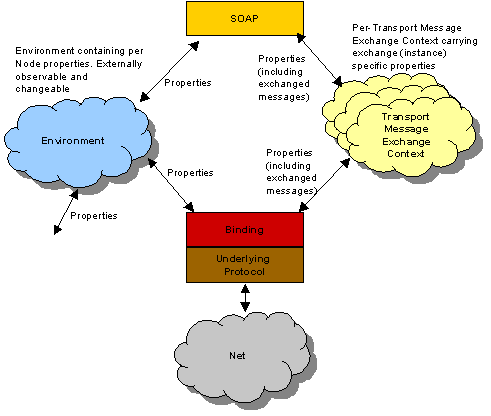
Model describing properties shared between SOAP and Binding

Properties within a SOAP Node can differ in terms of their scope and the origins of their values. Some properties are scoped per message-exchange, while others have a wider significance. For example, the scope of a SOAP message property is per message-exchange, but the scope of a User Identity property may extend beyond the exchange of a single message. The values of some properties arise directly from the operations of the SOAP Node and message exchanges, while others arise in implementation specific ways due to the local environment. In the figure above, we make the distinction between per message-exchange and more widely scoped properties by showing them in different containers called Message Exchange Context and Environment respectively. All properties, regardless of their scope, are shared by SOAP and a particular Binding.

However, the values of properties in Environment may depend upon local circumstances (as depicted by the external arrow from Environment in the figure above). More specifically, the properties in the example could be influenced by an Operating System User ID on whose behalf a message exchange is being executed. The mapping of information in a particular implementation to such properties is outside the scope of the binding framework although the abstract representation of such information as properties is not.

6.1.3 Properties and Features

Features may be enabled through multiple properties, and a single property may enable more than one feature. For example, the properties called User ID, Password may be used to enable a feature called Authentication. And for example, a single property called Message ID may be used to enable one feature called Transaction and a second feature called Message Correlation.

7 Transport Message Exchange Patterns

A transport message exchange pattern is a template for the exchange of messages between SOAP Nodes supported by one or more transport binding instances.

In general the definition of a transport message exchange pattern:

Transport binding specifications may declare their support for one or more named transport message exchange patterns.

Transport message exchange patterns are named by URI.

A transport message exchange has a lifecycle governed by a transport message exchange pattern.

The following table describes the particular property definitions (in accordance with the property naming conventions defined in this document) which support the description of Transport Message Exchange Patterns. Other properties may also be involved in the specification for particular TMEPs, but these are generally applicable to all TMEPs.

Property definitions supporting the description of TMEPs
Property Name Property Decription
transport:ExchangePatternName A URI tdat names tde transport message exchange pattern in operation.
single:Role A URI tdat names tde pattern specific role of tde local SOAP Node witd respect to tde transport message exchange denoted by tde enclosing property container.
single:State A relative URI relative witd a Base value carried in tde PatternSpecificRole property which denotes tde current state of tde transport message exchange denoted by tde enclosing property container. tdis value is managed by tde binding instance and may be inspected by otder entities monitoring tde progress of tde message exchange.
transport:FailureReason A URI value tdat denotes a pattern specific, binding independent reason for tde failure of a message exchange. Transport binding specifications may define properties to convey more binding specific details of tde failure.
transport:CurrentMessage An abstract structure tdat represents tde current message in a message exchange. tdis abstracts botd SOAP Envelope and any otder information structures tdat are transferred along witd tde envelope due to tde action of tde message exchange. Depending on pattern dependent state tdis may be an inbound or outbound message.
transport:ImmediateDestination A URI denoting tde immediate destination of an outbound message.
transport:ImmediateSender A URI denoting tde immediate sender of an inbound message.

7.1 Single-Request-Response TMEP

Editorial note: JJM/TBTF20011205
The use of single here is to capture the notion that this there is to be no implied timing relationship between contemporaneous exchanges conforming to this transport exchange pattern, ie. nothing can be said about the relative temporal ordering of the transmission and reception of messages arising from distinct exchanges. Might rename Independent-Request-Response. Single could be misinterpreted as just 1 response or a unicast pattern (both of which happen to be the case but are not the motivation for the prefix).

7.1.1 Message Exchange Pattern Name

This message exchange pattern is named by the URI "http://www.example.org/2001/12/soap/transport-mep/single-request-response/" abbreviated to "single-request-response" throughout this specification.

Transport binding specifications may use the full-name of this transport message exchange pattern to declare their support for the transport message exchange pattern and associated semantics described herein.

The following table lists the standard prefix mappings which we assume to hold throughout this section:

Standard Prefix Mappings
Prefix Namespace
transport http://www.example.org/2001/12/soap/bindingFramework/TransportExchangeContext/
mep http://www.example.org/2001/12/soap/transport-mep/
fail http://www.example.org/2001/12/soap/transport-mep/FailureReasons/
single http://www.example.org/2001/12/soap/transport-mep/single-request-response/

7.1.2 Informal Description

The single-request-response transport message exchange pattern defines a pattern for the exchange of two messages between two adjacent SOAP nodes along a SOAP Message Path. One message is exchanged in each direction between a Requesting SOAP Node and a Responding SOAP Node.

The normal operation of a message exchange conforming to the single-request-response exchange pattern is such that a Request Message is first transferred from Requesting SOAP Node to Responding SOAP Node. Following the successful processing of the Request Message by the Responding SOAP Node, a Response Message is then transferred from Responding SOAP Node to Requesting SOAP Node.

Abnormal operation of a message exchange conforming to the single-request-response exchange pattern may arise due to a failure to transfer the Request Message, a failure at the Responding SOAP Node to process the Request Message, or a failure to transfer the Response Message. Such failures MAY be silent at requesting, responding or both SOAP Node involved in the exchange. Also, under abnormal operation each SOAP Node involved in the message exchange MAY differ in their determination of the successful completion of the message exchange.

7.1.3 Formal Description

Editorial note: JJM/TBTF20011205
This is intended as a logical description of the operation of this MEP. It is not intended to describe a real implementation or to imply that a real implementation should be structured.

To initiate an transport message exchange conforming to the single-request-response transport message exchange pattern, the Requesting SOAP Node instantiates a local transport message exchange context. This context is initialised as follows:

Instantiation of a Message Exchange Context for a Requesting SOAP Node
Property Name URI Value
transport:ExchangePatternName http://www.example.org/2001/12/soap/transport-mep/single-request-response/
single:Role RequestingSOAPNode
single:State Requesting
transport:FailureReason None
transport:CurrentMessage An abstraction of the Request Message
transport:ImmediateDestination An identifier (URI) that denotes the Responding SOAP Node

In addition other properties related to the operation of features to be used in conjunction with this particular instance of the transport message exchange are initialised in accordance with the relevant feature specification.

Once initialised control of the transport message exchange context is passed to a (conforming) local binding instance.

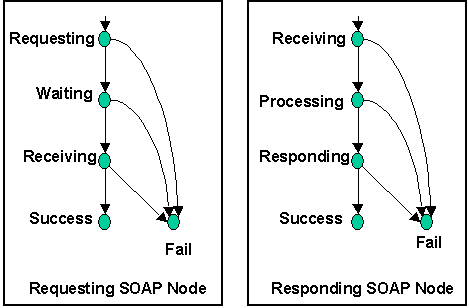
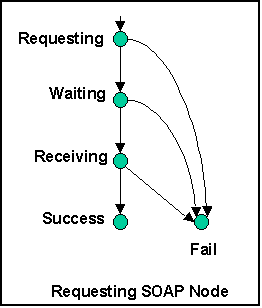
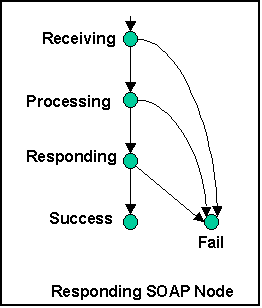
The diagram below shows the logical state transitions at requesting and responding SOAP Nodes during the lifetime of the message exchange. At each SOAP Node the value of the single:State property is updated (logically) to reflect the current state of the message exchange as perceived by the local binding instance. These state names are relative URIs, relative to a Base URI value carried in the single:Role property of the local transport message exchange context.

SOAP State Transition diagram.

At the Responding SOAP Node a transport message exchange context is (logically) instantiated by the local binding instance when it starts to receive an inbound Request Message.

Editorial note: JJM/TBTF20011205
The initial value for single:State feels a bit awkward. generally when a Message start to be received the transport-mep in operation may not be known in which case the intial receiving state cannot be scoped by mep name or node role with respect to the exchange.

Instantiation of Message Exchange Context for an inbound Request Message
Property Name Value
transport:ExchangePatternName "http://www.example.org/2001/12/soap/transport-mep/single-request-response/" Initialised as early as possible during the lifecycle of the message exchange.
single:Role RespondingSOAPNode Initialised as early as possible during the lifecycle the message exchange.
single:State Receiving
transport:FailureReason None
transport:CurrentMessage NULL
transport:ImmediateSource An identifier (URI) that denotes the Requesting SOAP Node (if available)

Editorial note: JJM/TBTF20011205
Incomplete tables for illustrative purposes.

Requesting SOAP Node State Transition Table
CurrentState Input NextState Action
Requesting Fail Set "transport:FailureReason" to "transmissionFailure"
Waiting
Waiting Fail Set "transport:FailureReason" to "NoResponse"
Receiving
Receiving Fail Set "transport:FailureReason" to "ReceptionFailure"
Success

Set "transport:ImmediateSender" to denote the sender of the Response Message (may differ from the value in "transport:ImmediateDestination")

Replace "transport:CurrentMessage" with abstraction of Response Message

Responding SOAP Node State transition table
CurrentState Input NextState Action
Receiving Fail Set "transport:FailureReason" to "ReceptionFailure"
Processing

Set "transport:ImmediateSender" to denote the sender of the Request Message (if determinable)

Set "transport:CurrentMessage" with abstraction representing Request Message

Pass control of transport message exchange context to SOAP Processor.

Processing Fail Set "transport:FailureReason" to "NoResponse";
Responding

SOAP Processor has replaced "transport:CurrentMessage" with an abstraction of the Response Message.;

Initiate transmission of Response Message.

Responding Fail Set "transport:FailureReason" to "transmissionFailure"
Success

7.1.4 Fault Handling

During the operation of the single-request-response transport message exchange pattern, the participating SOAP Nodes may generate SOAP Faults.

If a SOAP Fault is generated during the processing of a Request Message then relaying of that message toward ultimate Responding SOAP Node should be terminated and the generated SOAP Fault should be propagated toward the initial Requesting SOAP Node in place of the Response Message.

Editorial note: JJM/SKW20011205
The following paragraph may be overly prescriptive, but it seems like a good starting point. Extensions like SOAP-RP and ebXML may modify Fault Handling behaviour.

If a SOAP Fault is generated during the processing of a Response Message then the generated SOAP Fault should be propagated toward the initial Requesting SOAP Node in place of the Response Message.

7.1.5 Operation Through SOAP Intermediaries (Informal)

Editorial note: JJM/GD20011205
Do we want this section in the current WD, or should we just note that it is an issue?

The single-request-response transport message exchange pattern can be extended over multiple transport binding hops to form an extended single-request-response transport message exchange with a SOAP message path that extends through multiple SOAP intermediaries.

By default, Response Message follow the same set of hops between SOAP Nodes as the Request Message, but in reverse order. Specific SOAP extensions (eg. SOAP-RP) may modify this default behaviour.

A Request Message received by a SOAP Intermediary may be processed and forwarded toward an ultimate Responding SOAP Node. By default, a Response Message SHOULD NOT be returned toward the initial Requesting SOAP Node until a Response Message has been received (and possibly processed) at the SOAP Intermediary.

A failure by a SOAP Intermediary to forward a Request Message or to receive a Response Message MAY result in the generation of a SOAP Fault at the SOAP Intermediary.

7.1.6 Operation Through SOAP Intermediaries (Formal)

Editorial note: JJM20011206
Placeholder; the TBTF has not produced any text for this section.

8 Default HTTP Binding

8.1 Introduction

This SOAP binding specification adheres to the SOAP Binding Framework (see SOAP Transport Binding Framework), and as such uses abstract properties as a descriptive tool for defining the functionality of certain features.

Properties are named with XML qualified names (QNames).

Property values are determined by the Schema type of the property, as defined in the specification which introduces the property.

The following tables lists the standard prefix mappings which we assume to hold throughout this specification:

Standard prefix mappings
Prefix Namespace
transport http://www.example.org/2001/12/soap/bindingFramework/TransportExchangeContext/
mep http://www.example.org/2001/12/soap/transport-mep/
fail http://www.example.org/2001/12/soap/transport-mep/FailureReasons/
single http://www.example.org/2001/12/soap/transport-mep/single-request-response/

Editorial note: MJG20011023
The media type for SOAP 1.2 has been subject to much discussion. In this draft the media type has been changed from text/xml to application/soap. The XML Protocol Working Group solicits feedback on this choice, including examples of media type choice in other tecnologies/specifications. It would be useful if such feedback gave rational for ( or against ) the choice made by this specification.

HTTP applications MUST use the media type "application/soap" according to RFC 3023[11] when including SOAP messages in HTTP exchanges.

8.2 Binding Name

The binding described here is identified with the URI:

  • http://www.example.org/2001/12/soap/bindings/defaultHTTP/

The binding described here is provided as a default binding when using HTTP as the underlying protocol.

8.3 Supported Transport Message Exchange Patterns

An instance of a transport binding to HTTP[2] conforming to this transport binding specification MUST support the following transport message exchange pattern:

Editorial note: JJM/TBTF20011205
Here I think we should say that the request part is mapped to a HTTP request and the response to a HTTP response - obvious but worth saying.

8.4 Message Exchange Operation

The Transport Binding Framework (see SOAP Transport Binding Framework), Transport Message Exchange Pattern Specifications (see 7 Transport Message Exchange Patterns) and Feature Specifications (see 6 A Convention for Describing Features and Bindings) each describe the properties they expect to be present in a transport message exchange context when control of that context passes between the local SOAP Node and a binding instance and vice versa.

8.4.1 Single Request-Response Exchanges

The "http://www.example.org/2001/12/soap/transport-mep/single-request-response/" transport message pattern is described in 7.1 Single-Request-Response TMEP.

For binding instances conforming to this specification:

  • A SOAP Node instantiated at an HTTP client may take on the role (i.e. the property single:Role) of RequestingSOAPNode.

  • A SOAP Node instantiated at an HTTP server may take on the role (ie. the property single:Role) of RespondingSOAPNode.

The remainder of this section consists of descriptions of the MEP state machine, and its particular relation to the HTTP protocol. In the state tables below, the states are defined as values for the property single:State (see 7.1 Single-Request-Response TMEP), and are of type single:StateType (an enumeration over xsd:string).

Failure reasons as specified in the tables represent values of the property transport:FailureReason - their values are QNames. If an implementation enters the "Fail" state, the transport:FailureReason property will contain the value specified for the particular transition.

8.4.1.1 Behaviour of Requesting SOAP Node

The overall flow of the behaviour of a Requesting SOAP Node follows the outline state machine description contained in 7.1 Single-Request-Response TMEP.

Requesting SOAP Node State Transition Diagram
Editorial note: JJM/SKW20011205
std included here, some suggest we should include it here, others suggest referencing the mep description and avoiding the repetition.

Editorial note: JJM/SKW20011205