1. Introduction
SOAP Version 1.2 (SOAP) is a lightweight protocol intended for exchange of structured information between peers in a decentralized, distributed environment. The SOAP specification consists of two parts. Part 1 [1] defines the SOAP messaging framework. Part 2 (this document) defines a set of adjuncts that MAY be used with the SOAP messaging framework:
The SOAP Data Model represents application-defined data structures and values as a directed, edge-labeled graph of nodes (see 2. SOAP Data Model).
The SOAP Encoding defines a set of rules for encoding instances of data that conform to the SOAP Data Model for inclusion in SOAP messages (see 3. SOAP Encoding).
The SOAP RPC Representation defines a convention for how to use the SOAP Data Model for representing RPC calls and responses (see 4. SOAP RPC Representation).
A convention for describing features and bindings (see 5. A Convention for Describing Features and Bindings).
A request response message exchange pattern definition (see 6. SOAP-Supplied Message Exchange Patterns).
The SOAP HTTP Binding defines a binding of SOAP to HTTP [2] following the rules of the SOAP Protocol Binding Framework[1] (see 7. SOAP HTTP Binding).
Note:
In previous versions of this specification the SOAP name was an acronym. This is no longer the case.
1.1 Notational Conventions
The keywords "MUST", "MUST NOT", "REQUIRED", "SHALL", "SHALL NOT", "SHOULD", "SHOULD NOT", "RECOMMENDED", "MAY", and "OPTIONAL" in this document are to be interpreted as described in RFC2119 [3].
This specification uses a number of namespace prefixes throughout; they are listed in Table 1. Note that the choice of any namespace prefix is arbitrary and not semantically significant (see [10]).
| Prefix | Namespace | Notes |
|---|---|---|
| env | "http://www.w3.org/2001/12/soap-envelope" | Defined by Part 1 [1]. |
| enc | "http://www.w3.org/2001/12/soap-encoding" | A normative XML Schema [4], [5] document for the "http://www.w3.org/2001/12/soap-encoding" namespace can be found at http://www.w3.org/2001/12/soap- encoding. |
| xs | "http://www.w3.org/2001/XMLSchema" | Defined in the W3C XML Schema specification [4], [5]. |
| xsi | "http://www.w3.org/2001/XMLSchema-instance" | Defined in the W3C XML Schema specification [4], [5]. |
| context | "http://www.w3.org/2001/12/soap/bindingFramework/ExchangeContext/" | See 6.2 Request-Response Message Exchange Pattern. |
| mep | "http://www.w3.org/2001/12/soap/mep/" | See 6.2 Request-Response Message Exchange Pattern. |
| fail | "http://www.w3.org/2001/12/soap/mep/FailureReasons/" | See 6.2 Request-Response Message Exchange Pattern. |
| reqres | "http://www.w3.org/2001/12/soap/mep/request-response/" | See 6.2 Request-Response Message Exchange Pattern. |
Namespace names of the general form "http://example.org/..." and "http://example.com/..." represent application or context-dependent URIs [6].
This specification uses the Extended Backus-Naur Form (EBNF) as described in [8].
With the exception of examples and sections explicitly marked as "Non-Normative", all parts of this specification are normative.
2. SOAP Data Model
The SOAP Data Model represents application-defined data as a directed edge-labeled graph of nodes. Components of this graph are described in the following sections.
The purpose of the SOAP Data Model is to provide a mapping of non-XML based data to some wire representation. It is important to note that use of the SOAP Data Model, the accompanying SOAP Encoding (see 3. SOAP Encoding), and/or the SOAP RPC Representation (see 4. SOAP RPC Representation) is OPTIONAL. Applications which already model data in XML, for example using W3C XML Schema [4],[5], may not need to use the SOAP Data Model. Due to their optionality, it is NOT a requirement to implement the SOAP Data Model, the SOAP Encoding and/or the SOAP RPC Representation as part of a SOAP node.
2.1 Graph Edges
Edges in the graph are said to originate at a graph node and terminate at a graph node. An edge that originates at a graph node is known as an outbound edge with respect to that graph node. An edge that terminates at a graph node is known as an inbound edge with respect to that graph node. An edge MAY originate and terminate at the same graph node.
The outbound edges of a given graph node MAY be distinguished by label or by position, or both. Position is a total order on such edges; thus any outbound edge MAY be identified by position.
2.1.1 Edge labels
An edge label is an XML Schema Qualified Name (see XML Schema Part 2: Datatypes [5]). Two edge labels are equal if and only if both of the following are true:
Their local name values are the same.
Either of the following is true:
Their namespace name values are missing.
Their namespace name values are present and the same.
See 2.3 Values for uses of edge labels and position to distinguish the members of encoded values, and XML Schema Part 2: Datatypes [5] for more information about comparing XML qualified names.
2.2 Graph Nodes
A graph node is either a terminal graph node or a non-terminal graph node. A non-terminal graph node has one or more outbound edges. A terminal graph node has no outbound edges and an optional lexical value. Both types of graph node have an optional unique identifier of type ID in the namespace named "http://www.w3.org/2001/XMLSchema", (see XML Schema Part2: DataTypes [5]) and an optional type name of type QName in the namespace named "http://www.w3.org/2001/XMLSchema" (see XML Schema Part2: DataTypes [5]).
2.3 Values
A simple value is represented as a terminal graph node.
A compound value is represented as a non-terminal graph node as follows:
If the labels of a non-terminal graph node's outbound edges are not unique (i.e. they can be duplicated), the non-terminal graph node is known as a "generic". Outbound edges of a generic MAY be distinguished by label and/or position, according to the needs of the application.
A non-terminal graph node whose outbound edges are distinguished solely by their labels is known as a "struct". The outbound edges of a struct MUST be labeled with distinct names (see 2.1.1 Edge labels).
A non-terminal graph node whose outbound edges are distinguished solely by position is known as an "array". The outbound edges of an array MUST NOT be labelled.
| Editorial note | |
| The Working Group solicits feedback from implementors regarding the usefulness or otherwise of 'generics'. | |
3. SOAP Encoding
SOAP Encoding describes how to encode instances of data that conform to the data model described in 2. SOAP Data Model. This encoding MAY be used to transmit data in SOAP header blocks and/or SOAP bodies. Other data models, alternate encodings of the SOAP Data Model as well as unencoded data MAY also be used in SOAP messages (see [1]SOAP encodingStyle Attribute for specification of alternative encoding styles and see 4. SOAP RPC Representation for restrictions on data models and encodings used to represent SOAP Remote Procedure Calls).
The serialization rules defined in this section are
identified by the URI
"http://www.w3.org/2001/12/soap-encoding". SOAP
messages using this particular serialization SHOULD indicate
that fact by using the SOAP encodingStyle attribute
information item (see [1]SOAP
encodingStyle Attribute).
3.1 Rules for Encoding Graphs in XML
XML allows very flexible encoding of data. SOAP Encoding defines a narrower set of rules for encoding the graphs described in 2. SOAP Data Model. This section defines the encoding at a high level, and the subsequent sub-sections describe the encoding rules in more detail. The encodings described in this section can be used in conjunction with the mapping of RPC calls and responses specified in 4. SOAP RPC Representation.
The encodings are described below from the perspective of a de-serializer. In each case, the presence of an XML serialization is presumed, and the mapping to a corresponding graph is described.
More than one encoding is typically possible for a given graph. When serializing a graph for transmission inside a SOAP message any representation that deserializes to the identical graph MAY be used; when receiving an encoded SOAP message, all representations MUST be accepted.
3.1.1 Encoding graph edges and nodes
Each graph edge is encoded as an element information item and each element information item represents a graph edge. 3.1.3 Encoding compound values describes the relationship between edge labels and the local name and namespace name properties of such element information items.
The graph node at which an edge terminates is determined by examination of the serialized XML as follows:
If the element information item representing the edge does not have a
refattribute information item (see 3.1.5.2 ref Attribute Information Item) among its attributes then that element information item is said to represent a node in the graph and the edge terminates at that node.If the element information item representing the edge does have a
refattribute information item (see 3.1.5.2 ref Attribute Information Item) among its attributes, then the value of that attribute information item MUST be identical to the value of exactly oneidattribute information item ( see 3.1.5.1 id Attribute Information Item) in the same envelope. In this case the edge terminates at the graph node represented by the element information item on which theidattribute information item appears. That element information item MUST be in the scope of anencodingStyleattribute with a value of "http://www.w3.org/2001/12/soap-encoding".
All nodes in the graph are encoded as described in 1 above. Additional inbound edges for multi reference graph nodes are encoded as described in 2 above.
3.1.2 Encoding simple values
The "lexical value" of a terminal graph node (simple value) is the sequence of Unicode characters identified by the character information item children of the element information item representing that node.
3.1.3 Encoding compound values
An outbound edge of a graph node is encoded as an element information item child of the element information item that represents the node (see 3.1.1 Encoding graph edges and nodes). Particular rules apply depending on what kind of compound value the graph node represents. These rules are as follows:
For a graph edge which is distinguished by label ("struct" or "generic"), the namespace name and local name properties of the element information item together determine the value of the edge label.
For a graph edge which is distinguished by position ("array" or "generic"):
The ordinal position of the graph edge corresponds to the position of the element information item relative to its siblings
If outbound edges are distinguished only by position ("array") then the local name and namespace name properties of the element information item are not significant.
The following rules apply to the encoding of a graph node that represents an "array":
The element information item representing an array node MAY have among its attributes an
itemTypeattribute information item (see 3.1.4.1 itemType Attribute Information Item).The element information item representing an array node MAY have among its attributes an
arraySizeattribute information item (see 3.1.6 arraySize Attribute Information Item).
If a graph edge does not terminate in a graph node then it can either be omitted from the serialization or it can be encoded as an element information item with an xsi:nilattribute information item whose value is "true".
3.1.4 Computing the Type Name property
The type name property of a graph node is a {namespace name, local name} pair computed as follows:
If the element information item representing the graph node has an
xsi:typeattribute information item among its attributes then the type name property of the graph node is the value of thexsi:typeattribute information item.Note:
This attribute is of type QName in the namespace named "http://www.w3.org/2001/XMLSchema" (see XML Schema Part 2: Datatypes [5]); its value consists of the pair {namespace name, local name}. Neither the prefix used to construct the QName nor any information relating to any definition of the type is considered to be part of the value. The SOAP graph carries only the qualified name of the type.
Otherwise if the parent element information item of the element information item representing the graph node has a
soap:itemTypeattribute information item (see 3.1.4.1 itemType Attribute Information Item) among its attributes then the type name property of the graph node is the value of thesoap:itemTypeattribute information itemOtherwise the value of the type name property of the graph node is unspecified.
Note:
These rules define how the type name property of a graph node in a graph is computed from a serialized encoding. This specification does not mandate validation using any particular schema language or type system. Nor does it include built in types or provide any standardized faults to reflect value/type name conflicts.
However, nothing prohibits development of additional specifications to describe the use of SOAP with particular schema languages or type systems. Such additional specifications MAY mandate validation using particular schema language, and MAY specify faults to be generated should validation fail. Such additional specifications MAY specify augmentations to the deserialized graph based on information determined from such a validation. The use by SOAP of xsi:type is intended to facilitate integration with the W3C XML Schema language (see B. Using W3C XML Schema with SOAP Encoding). Other XML based schema languages, data schemas and programmatic type systems MAY be used but only to the extent that they are compatible with the serialization described in this specification.
3.1.4.1 itemType Attribute Information Item
The itemType attribute information item has
the following Infoset properties:
A local name of
itemType;A namespace name of "http://www.w3.org/2001/12/soap-encoding".
A specified property with a value of true.
The type of the itemType attribute
information item is QName in the
namespace named "http://www.w3.org/2001/XMLSchema".
The value of the itemType attribute
information item is used to compute the type name
property (see 3.1.4 Computing the Type Name property) of members of
an array.
3.1.5 Unique identifiers
3.1.5.1 id Attribute Information Item
The id attribute information item has
the following Infoset properties:
A local name of
id;A namespace name which is empty
A specified property with a value of "true".
The type of the id attribute
information item is ID in the namespace named
"http://www.w3.org/2001/XMLSchema".
The value of the id attribute information
item is a unique identifier that can be referred to by
a ref attribute information item
(see 3.1.5.2 ref Attribute Information Item).
3.1.5.2 ref Attribute Information Item
The ref attribute information item has
the following Infoset properties:
A local name of
ref;A namespace name which is empty
A specified property with a value of true.
The type of the ref attribute information
item is IDREF in the namespace named "http://www.w3.org/2001/XMLSchema".
The value of the ref attribute information
item is a reference to a unique identifier defined
by an id attribute information item
(see 3.1.5.1 id Attribute Information Item).
3.1.5.3 Constraints on id and ref attribute information items
The value of a ref attribute information item MUST also be
the value of exactly one id attribute information item.
A ref attribute information item and
an id attribute information item
MUST NOT appear on the same element information item.
3.1.6 arraySize Attribute Information Item
The arraySize attribute information item has
the following Infoset properties:
A local name of
arraySize;A namespace name of "http://www.w3.org/2001/12/soap-encoding".
A default value of "*"
The type of the arraySize attribute
information item is arraySize in the
namespace named "http://www.w3.org/2001/12/soap-encoding".
The value of the arraySize attribute information item MUST conform to the following EBNF grammer
| [1] | arraySizeValue | ::= | ("*" | concreteSize) nextConcreteSize* |
| [2] | nextConcreteSize | ::= | " " concreteSize |
| [3] | concreteSize | ::= | [0-9]+ |
The array's dimensions are represented by each item in the list of sizes (unspecified size in case of the asterisk). The number of items in the list represents the number of dimensions in the array. The asterisk, if present, MUST only appear in the first position in the list.
3.2 Decoding Faults
During deserialization a SOAP receiver:
SHOULD generate an
env:SenderSOAP fault with a subcode ofenc:MissingIDif the message violates the constraints onidandrefattribute information items (see 3.1.5.3 Constraints on id and ref attribute information items).MAY generate an
env:SenderSOAP fault with a subcode ofenc:UntypedValueif the type name property of an encoded graph node is unspecified.
4. SOAP RPC Representation
One of the design goals of SOAP is to encapsulate remote procedure call (RPC) functionality using the extensibility and flexibility of XML. This section defines a uniform representation of RPC requests and responses.
The SOAP encodingStyle attribute information item (see [1]SOAP encodingStyle Attribute) is used to indicate the encoding style of the RPC representation. The encoding thus specified must support "struct" and "array" compound value constructs defined in 2.3 Values. The encoding style defined in 3. SOAP Encoding supports such constructs and is therefore suitable for use with the SOAP RPC representation.
This SOAP RPC Representation is not predicated on any SOAP protocol binding. When SOAP is bound to HTTP, an RPC invocation maps naturally to an HTTP request and an RPC response maps to an HTTP response. (see 7. SOAP HTTP Binding). However, the SOAP RPC Representation is not limited only to the SOAP HTTP Binding.
To invoke an RPC, the following information is needed:
The binding-specific address of the target SOAP node
A procedure or method name
The identities and values of any arguments to be passed to the procedure or method
Optional header data
SOAP relies on the protocol binding to provide a mechanism for carrying the URI of the target SOAP node. For HTTP the request URI indicates the resource against which the invocation is being made. Other than requiring it to be a valid URI, SOAP places no restriction on the form of an address (see RFC2396 [6] for more information on URIs).
4.1 RPC and SOAP Body
RPC invocations and responses are both carried in the SOAP
Body element (see [1]SOAP Body)
using the following representation.
4.1.1 RPC Invocation
An RPC invocation is modeled as a struct where parameter access is by name or as an array where parameter access is by position.
The invocation is represented by a single struct or array containing an outbound edge for each [in] or [in/out] parameter. The struct is named identically to the procedure or method name (see A. Mapping Application Defined Names to XML Names).
Each outbound edge either has a label corresponding to the name of the parameter (see A. Mapping Application Defined Names to XML Names) or a position corresponding to the position of the parameter.
Applications MAY process invocations with missing parameters but also MAY fail to process the invocation and return a fault.
4.1.2 RPC Response
An RPC response is modeled as a struct where parameter access is by name or as an array where parameter access is by position.
The response is represented by a single struct or array containing an outbound edge for the return value and each [out] or [in/out] parameter. The return value outbound edge SHOULD be the first outbound edge.
Each outbound edge has a label corresponding to the name of the parameter (see A. Mapping Application Defined Names to XML Names) or a position corresponding to the position of the parameter. The label of the return value outbound edge is "result" and it is namespace-qualified with the namespace name "http://www.w3.org/2001/12/soap-rpc". The return value outbound edge MUST be present if the return value of the procedure is non-void. The return value outbound edge MUST NOT be present if the return value of the procedure is void.
Invocation faults are handled according to the rules in 4.3 RPC Faults. If a protocol binding adds additional rules for fault expression, those MUST also be followed.
An RPC response MUST NOT contain both a result and a fault, because a result indicates success and a fault indicates failure.
4.1.3 SOAP Encoding Restriction
When using SOAP encoding (see 3. SOAP Encoding) in
conjunction with the RPC convention described here, the SOAP
Body MUST contain only a single child element
information item, that child being the serialized RPC
invocation or response struct or array. I.e. when using the
SOAP encoding for serializing
RPC invocations and responses, the encoding is constrained
to produce a single tree of element information
items.
4.2 RPC and SOAP Header
Additional information relevant to the encoding of an RPC invocation but not part of the formal procedure or method signature MAY be expressed in a SOAP envelope carrying an RPC invocation or response. Such additional information MUST be expressed as SOAP header blocks.
4.3 RPC Faults
The SOAP RPC Representation introduces additional SOAP fault
subcode values to be used in conjunction with the fault codes
described in [1]SOAP Fault Codes. The
namespace name for these SOAP fault subcode values is
"http://www.w3.org/2001/12/soap-rpc" and the
namespace prefix rpc: is used in this section to
indicate association with this namespace. A schema document for
this namespace can be found at http://www.w3.org/2001/12/soap-rpc
.
Errors arising during RPC invocations are reported according to the following rules (in decreasing order of precedence):
A fault with a
Valueof "env:Receiver" forCodeSHOULD be generated when the receiver cannot handle the message because of some temporary condition, e.g. when it is out of memory.A fault with a
Valueof "env:DataEncodingUnknown" forCodeSHOULD be generated when the arguments are encoded in a data encoding unknown to the receiver.A fault with a
Valueof "env:Sender" forCodeand aValueof "rpc:ProcedureNotPresent" forSubcodeMUST be generated when the receiver does not support the procedure or method specified.A fault with a
Valueof "env:Sender" forCodeand aValueof "rpc:BadArguments" forSubcodeMUST be generated when the receiver cannot parse the arguments or when there is a mismatch between what the receiver expects and what the sender has sent.Other faults arising in an extension or from the application SHOULD be generated as described in [1]SOAP Fault Codes.
In all cases the values of the Detail and
Reason element information items
are implementation defined. Details of their use MAY be specified by an
external document.
5. A Convention for Describing Features and Bindings
This section describes a convention describing Features (including MEPs) and Bindings in terms of properties and property values. The convention is sufficient to describe the distributed states of Feature and Binding specifications as mandated by the Binding Framework (see [1]SOAP Protocol Binding Framework) and it is used to describe a Request-Response MEP 6.2 Request-Response Message Exchange Pattern and the SOAP HTTP Binding 7. SOAP HTTP Binding elsewhere in this document. Along with the convention itself, an informal model is defined that describes how properties propagate through a SOAP system. Note that this model is intended to be illustrative only, and is not meant to imply any constraints on the structure or layering of any particular SOAP implementation.
5.1 Model and Properties
In general, a SOAP message is the information that one SOAP node wishes to exchange with another SOAP node according to a particular set of features, including a MEP. In addition, there may be information essential to exchanging a message that is not part of the message itself. Such information is sometimes called message meta-data. In the model, the message, any message meta-data, and the various information items that enable features are represented as abstractions called properties.
5.1.1 Properties
Under the convention, properties are represented as follows:
Properties are named with XML qualified names (QNames). For example,
myNS:RetryCountwhereRetryCountis the name of the property, andmyNSis a prefix mapped to a namespace.Property values are typed, and the type of a property-value is defined by an XML Schema simple datatype in the specification which introduces the property. For example, the type of RetryCount is
xsi:int.
5.1.2 Property Scope
Properties within a SOAP node can differ in terms of their scope and the origins of their values. Some properties are scoped per message-exchange, while others have a wider significance. For example, the scope of a SOAP message property is per message-exchange, but the scope of a User Identity property may extend beyond the exchange of a single message. The values of some properties arise directly from the operations of the SOAP node and message exchanges, while others arise in implementation specific ways due to the local environment. As shown in the figure below, we make the distinction between per message-exchange and more widely scoped properties by assigning them to different containers called Message Exchange Context and Environment respectively. All properties, regardless of their scope, are shared by SOAP and a particular Binding.
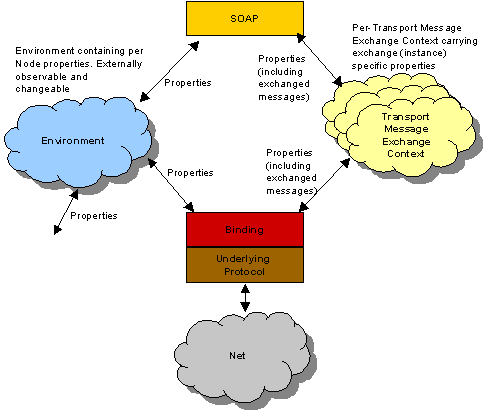
The values of properties in Environment may depend upon local circumstances (as depicted by the external arrow from Environment in the figure above). More specifically, the properties in the example could be influenced by an Operating System User ID on whose behalf a message exchange is being executed. The mapping of information in a particular implementation to such properties is outside the scope of the binding framework although the abstract representation of such information as properties is not.
5.1.3 Properties and Features
A feature may be expressed through multiple properties and a single property may enable more than one feature. For example, the properties called User ID and Password may be used to enable a feature called Authentication. As a second example, a single property called Message ID could be used to enable one feature called Transaction and a second feature called Message Correlation.
6. SOAP-Supplied Message Exchange Patterns
6.1 Property Conventions for Message Exchange Patterns
Table 2 describes the properties (in accordance with the property naming conventions defined in this document) that support the description of message exchange patterns (MEPs). Other properties may be involved in the specification of particular MEPs, but the properties in this table are generally applicable to all MEPs.
| Property Name | Property Description |
|---|---|
context:ExchangePatternName | A URI that names the MEP in operation. |
context:FailureReason | A URI value that denotes a pattern specific, binding independent reason for the failure of a message exchange. Underlying protocol binding specifications may define properties to convey more binding specific details of the failure. |
6.2 Request-Response Message Exchange Pattern
This section defines the message exchange pattern (MEP) called "Request-Response". The description is an abstract presentation of the operation of this MEP. It is not intended to describe a real implementation or to suggest how a real implementation should be structured.
6.2.1 Message Exchange Pattern Name
This message exchange pattern is identified by the URI:
"http://www.w3.org/2001/12/soap/mep/request-response/"
Protocol binding specifications may use this URI to declare their support for the MEP and its associated semantics.
6.2.2 Description
The Request-Response MEP defines a pattern for the exchange of two messages between two adjacent SOAP nodes along a SOAP message path. One message is exchanged in each direction between a requesting SOAP node and a responding SOAP node.
In the normal operation of a message exchange conforming to the Request-Response MEP, a request message is first transferred from the requesting SOAP node to the responding SOAP node. Following the successful processing of the request message by the responding SOAP node, a response message is transferred from the responding SOAP node to the requesting SOAP node.
Abnormal operation during a Request-Response message exchange may be caused by a failure to transfer the request message, a failure at the responding SOAP node to process the request message, or a failure to transfer the response message. Such failures MAY be silent at either or both of the requesting and responding SOAP nodes involved. Also, during abnormal operation each SOAP node involved in the message exchange MAY differ in its determination of the successful completion of the message exchange.
The scope of a Request-Response MEP is limited to the exchange of a request message and a response message between one requesting and one responding SOAP node. This pattern does not mandate any correlation between multiple requests nor specific timing for multiple requests. Implementations MAY choose to support multiple ongoing requests (and associated response processing) at the same time.
6.2.3 State Machine Description
The Request-Response MEP defines a set of properties described in Table 3.
| Property Name | Property Description |
|---|---|
reqres:Role | A URI denoting the pattern specific role of the local SOAP node participating in the message exchange. |
reqres:State | A URI denoting the current state of the message exchange. This value is managed by the binding instance and may be inspected by other entities monitoring the progress of the message exchange. |
reqres:OutboundMessage | An abstract structure that represents the current outbound message in the message exchange. This abstracts both SOAP Envelope and any other information structures that are transferred along with the envelope. |
reqres:InboundMessage | An abstract structure that represents the current inbound message in the message exchange. This abstracts both SOAP Envelope and any other information structures that are transferred along with the envelope. |
reqres:ImmediateDestination | A URI denoting the immediate destination of an outbound message. |
reqres:ImmediateSender | A URI denoting the immediate sender of an inbound message. |
To initiate a message exchange conforming to the Request-Response MEP, the requesting SOAP node instantiates a local message exchange context. Table 4 describes how the context is initialized.
| Property Name | Property Value |
|---|---|
context:ExchangePatternName | "http://www.w3.org/2001/12/soap/mep/request-response/" |
context:FailureReason | None |
reqres:Role | RequestingSOAPNode |
reqres:State | Init |
reqres:OutboundMessage | An abstraction of the request message |
reqres:ImmediateDestination | An identifier (URI) that denotes the responding SOAP node |
There may be other properties related to the operation of the message exchange context instance. Such properties are initialized according to their own feature specifications.
Once the message exchange context is initialized, control of the context is passed to a (conforming) local binding instance.
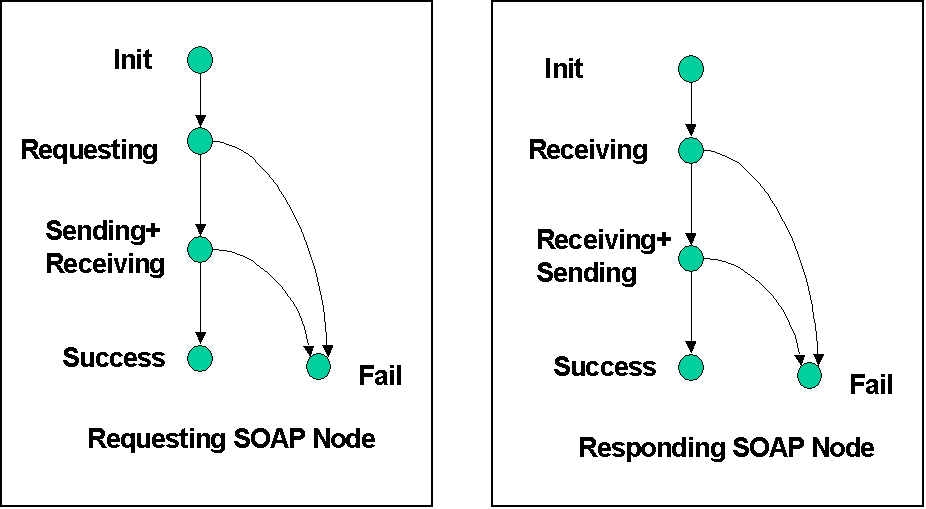
The diagram below shows the logical state transitions at
the requesting and responding SOAP nodes during the lifetime
of the message exchange. At each SOAP node, the local binding
instance updates (logically) the value of the
reqres:State property to
reflect the current state of the message exchange. The state names
are relative URIs, relative to a Base URI value carried in
the reqres:Role property of the local
message exchange context.
When the local binding instance at the responding SOAP node starts to receive an inbound request message, it (logically) instantiates a message exchange context. Table 5 describes the properties that the binding initializes as part of the context's instantiation.
| Property Name | Property Value |
|---|---|
context:ExchangePatternName | "http://www.w3.org/2001/12/soap/mep/request-response/" Initialized as early as possible during the life cycle of the message exchange. |
context:FailureReason | None |
reqres:Role | RespondingSOAPNode Initialized as early as possible during the life cycle the message exchange. |
reqres:State | Init |
When the requesting and responding SOAP nodes transition between states, the local binding instance (logically) updates a number of properties. Table 6 and Table 7 describe these updates for the requesting and the responding SOAP nodes, respectively.
| CurrentState | Transition Condition | NextState | Action |
|---|---|---|---|
| Init | Unconditional | Requesting | Initiate transmission of request message
abstracted in
reqres:OutboundMessage . |
| Requesting | Message transmission failure | Fail | Set
context:FailureReason to
"transmissionFailure" |
| Start receiving response message | Sending+Receiving | Set
reqres:ImmediateSender to denote the sender of the response message (may differ from the values in reqres:ImmediateDestination ).
Start making an abstraction of the response message available in reqres:InboundMessgae . | |
| Sending+Receiving | Message exchange failure | Fail | Set
context:FailureReason to
"exchangeFailure" |
| Completed sending request message. Completed receiving response message. | Success |
| CurrentState | Transition Condition | NextState | Action |
|---|---|---|---|
| Init | Start receiving request message | Receiving | Set
reqres:ImmediateSender to denote the sender of the request message (if determinable).
Start making an abstraction of the request message available in reqres:InboundMessgae .
Pass control of message exchange context to SOAP processor. |
| Receiving | Message reception failure | Fail | Set
context:FailureReason to
"receptionFailure". |
Start of response message available in reqres:OutboundMessage | Receiving+Sending | Initiate transmission of response message abstracted in reqres:OutboundMessage . | |
| Receiving+Sending | Message exchange failure | Fail | Set context:FailureReason to
"exchangeFailure". |
| Completed receiving request message. Completed sending response message. | Success |
Bindings that implement this MEP MAY provide for streaming of SOAP responses. That is, responding SOAP nodes MAY begin transmission of a SOAP response while a SOAP request is still being received and processed. When SOAP nodes implement bindings that support streaming, the following rules apply:
All the rules in [1]Binding Framework regarding streaming of individual SOAP messages MUST be obeyed for both request and response SOAP messages.
When using streaming SOAP bindings, requesting SOAP nodes MUST avoid deadlock by accepting and if necessary processing SOAP response information while the SOAP request is being transmitted.
Note:
Depending on the implementation used and the size of the messages involved, this rule MAY require that SOAP applications stream application-level response processing in parallel with request generation.
A requesting SOAP node MAY enter the
Failstate, and thus abort transmission of the outbound SOAP request, based on information contained in an incoming streamed SOAP response.
6.2.4 Fault Handling
During the operation of the Request-Response MEP, the participating SOAP nodes may generate SOAP faults.
If a SOAP fault is generated by the responding SOAP node
while it is in the Receiving state, the SOAP
fault is made available in reqres:OutboundMessage and the
state machine transitions to the Receiving+Sending state.
This MEP makes no claims about the disposition or handling of SOAP faults generated by the requesting SOAP node during any processing of the response message that follows the Success state in the requesting SOAP node's state transition table (see Table 6).
7. SOAP HTTP Binding
7.1 Introduction
The SOAP HTTP Binding provides a binding of SOAP to HTTP. The binding conforms to the SOAP Protocol Binding Framework (see [1]SOAP Protocol Binding Framework) and uses abstract properties as a descriptive tool for defining the functionality of certain features.
The SOAP Protocol Binding Framework (see [1]SOAP Protocol Binding Framework), the Message Exchange Pattern Specifications (see [1]SOAP Message Exchange Patterns) and Feature Specifications (see 5. A Convention for Describing Features and Bindings) each describe the properties they expect to be present in a message exchange context when control of that context passes between a local SOAP node and a binding instance.
Properties are named with XML qualified names. Property values are determined by the Schema type of the property, as defined in the specification which introduces the property.
Conforming implementations of this binding:
MUST be capable of sending and receiving messages serialized using media type "application/soap+xml" whose proper use and parameters are described in [12].
MAY send requests and responses using other media types providing that such media types provide for at least the transfer of SOAP XML Infoset.
MAY, when sending requests, provide an HTTP Accept header. This header:
SHOULD indicate an ability to accept at minimum "application/soap+xml".
MAY additionally indicate willingness to accept other media types that satisfy 2 above.
Note:
The SOAP HTTP Binding is optional and SOAP nodes are NOT required to implement it. The SOAP version 1.2 specification does not preclude specifications of other bindings to HTTP or bindings to other protocols. A SOAP node that correctly and completely implements the SOAP HTTP Binding may to be said to "conform to the SOAP 1.2 HTTP Binding."
7.2 Binding Name
The binding is identified with the URI:
"http://www.w3.org/2001/12/soap/bindings/HTTP/"
7.3 Supported Message Exchange Patterns
An implementation of the SOAP HTTP Binding MUST support the following message exchange pattern (MEP):
"http://www.w3.org/2001/12/soap/mep/request-response/" (see 6.2 Request-Response Message Exchange Pattern)
7.4 Request-Response MEP Operation
For binding instances conforming to this specification:
A SOAP node instantiated at an HTTP client may assume the role (i.e. the property
reqres:Role) of "RequestingSOAPNode".A SOAP node instantiated at an HTTP server may assume the role (ie. the property
reqres:Role) of "RespondingSOAPNode".
The remainder of this section describes the MEP state machine
and its relation to the HTTP protocol. In the state tables below,
the states are defined as values of the property reqres:State
(see 6.2 Request-Response Message Exchange Pattern), and are of type reqres:StateType
(an enumeration over xs:string ).
Failure reasons that are specified in the tables represent values of the property
context:FailureReason and their values are XML qualified names.
If an implementation enters the "Fail" state,
the context:FailureReason
property will contain the value specified for the particular transition.
7.4.1 Behavior of Requesting SOAP Node
The overall flow of the behavior of a requesting SOAP node follows the state machine description contained in 6.2 Request-Response Message Exchange Pattern. This binding supports streaming and, as a result, requesting SOAP nodes MUST avoid deadlock by accepting and if necessary processing SOAP response information while the SOAP request is being transmitted (see 6.2.3 State Machine Description). The following subsections describe each state in detail.
7.4.1.1 Init
Table 8 and Table 9 describe the requesting SOAP node's Init state and the values of the HTTP request fields.
| Statename | Init | ||
|---|---|---|---|
| Description | Formulate and start sending HTTP request (see next table) | ||
| Preconditions | See 6.2.3 State Machine Description | ||
| Postconditions | None | ||
| Transitions | Event/Condition | NextState | Failure Reason |
| Unconditional | Requesting | N/A | |
| Field | Value |
|---|---|
| HTTP Method | POST (the use of other HTTP methods is undefined in this binding). |
| Request URI | The value of the URI carried in the
reqres:ImmediateDestination property of the
message exchange context. |
| Content-Type header | The media type of the request body, see 7.1 Introduction for a description of permissible media types. |
| Accept header (optional) | List of media types that are acceptable in response to the request message. |
| Additional Headers | Generated in accordance with the rules for the binding specific expression of any optional features in use for this message exchange. |
| HTTP entity body | SOAP message serialized according to the rules for carrying SOAP messages in the media type given by the Content-Type header. Rules for carrying SOAP messages in media type "application/soap+xml" are given in [12]. |
7.4.1.2 Requesting
Table 10 describes the requesting SOAP node's Requesting state.
| Statename | Requesting | ||
|---|---|---|---|
| Description | Sending request message and waiting for start of response message. | ||
| Preconditions | None | ||
| Postconditions |
| ||
| Transitions | Event/Condition | NextState | Failure Reason |
| HTTP Response Status Line and HTTP Headers received | (see status code table below) | (see status code table below) | |
| Message exchange failure | Fail | "fail:transmissionFailure" | |
Table 11 details the transitions that take place when a requesting SOAP node reveives an HTTP status line and response headers.
| Status Code | Reason phrase | Significance/Action | NextState | |
|---|---|---|---|---|
| 2xx | Successful | |||
| 200 | OK | The response message follows in HTTP response entity body.
Start making an abstraction of the response message available in
| Sending+Receiving | |
| 202 | Accepted | The request message has
been received and processed. The entity body of the HTTP response MAY
contain a response message. Start making an abstraction of the response message available in | Sending+Receiving | |
| 204 | No Content | The request message has been received and processed. The HTTP response MUST NOT contain an entity body. The message exchange is regarded as having completed successfully. | Sending+Receiving | |
| Instantiated Property | Value | |||
reqres:InboundMessage | "Empty" SOAP Envelope. | |||
| 3xx | Redirection | The requested resource has
moved and the HTTP request SHOULD be retried using the URI carried in the
associated Location header as the new value for the
| Init | |
| 4xx | Client Error | |||
| 400 | Bad Request | Indicates a problem with the received HTTP request message. The problem may bea malformed XML in the request message envelope. This operation SHOULD NOT be repeated with the same message content. The message exchange is regarded as having completed unsuccessfully. | Fail | |
| Instantiated Property | Value | |||
context:FailureReason | "fail:BadRequest" | |||
| 401 | Unauthorized | Indicates that the HTTP request requires authorization. | Requesting | |
| Instantiated Property | Value | |||
context:FailureReason | "fail:AuthenticationFailure" | |||
| If the simple authentication feature is unavailable or the operation of simple authentication ultimately fails, then the message exchange is regarded as having completed unsuccessfully. | Fail | |||
| Instantiated Property | Value | |||
context:FailureReason | "fail:AuthenticationFailure" | |||
| 405 | Method not allowed | Indicates that the peer HTTP server does not support the requested HTTP method at the given request URI. The message exchange is regarded as having completed unsuccessfully. | Fail | |
| Instantiated Property | Value | |||
context:FailureReason | "fail:BindingMismatch" | |||
| 415 | Unsupported Media Type | Indicates that the peer HTTP server does not support Content-type used to encode the request message. The message exchange is regarded as having completed unsuccessfully. | Fail | |
| Instantiated Property | Value | |||
context:FailureReason | "fail:BindingMismatch" | |||
| 5xx | Server Error | |||
| 500 | Internal Server Error | Indicates that the response message contained in the following HTTP response entity body may contain an SOAP fault. Other internal server errors may be the cause of this status code. The local binding instance continues to receive the incoming message. | Sending+Receiving | |
| Instantiated Property | Value | |||
context:FailureReason | fail:ServerFault | |||
Note:
There may be elements in the HTTP infrastructure configured to modify HTTP response entity bodies for 4xx and 5xx status code responses. For example, some HTTP origin servers have such a feature as a configuration option. This behavior may interfere with the use of 4xx and 5xx status code responses carrying SOAP fault messages in HTTP and it is recommended that such behavior is disabled for resources accepting SOAP/HTTP requests. If the rewriting behavior cannot be disabled, SOAP/HTTP cannot be used in such configurations.
7.4.1.3 Sending+Receiving
Table 12 describes the requesting SOAP node's Sending+Receiving state.
| Statename | Sending+Receiving | ||
|---|---|---|---|
| Description | Completing the transmission of a request message and the reception of a response message. The response message is assumed to be a SOAP envelope serialized according the rules for carrying SOAP messages in the media type given in the Content-Type header. | ||
| Preconditions | None | ||
| Postconditions | On transitions to
Success, the property
reqres:InboundMessage is instantiated with the Infoset representation
of the serialized envelope in the response body. | ||
| Transitions | Event/Condition | NextState | Failure Reason |
| Request message transmission and response message reception completed and a well formed response message received | Success | N/A | |
| Reception Failure (broken connections etc.) | Fail | "fail:ReceptionFailure" | |
| Packaging Failure (including mismatched Content-Type) | Fail | "fail:PackagingFailure" | |
| Malformed response message, e.g. malformed XML, message contains a DTD, invalid SOAP Envelope | Fail | "fail:BadResponseMessage" | |
7.4.2 Behavior of Responding SOAP Node
The overall flow of the behavior of a requesting SOAP node follows the state machine description contained in 6.2 Request-Response Message Exchange Pattern. The following subsections describe each state in detail.
7.4.2.1 Init
Table 13 and Table 14 describe the responding SOAP node's Init state and the faults it generates respectively.
| Statename | Init | ||
|---|---|---|---|
| Description | Waiting for the start of an inbound request message | ||
| Preconditions | Reception of an HTTP POST request at an HTTP endpoint bound to the local SOAP node, see 6.2.3 State Machine Description. | ||
| Postconditions | See below | ||
| Transitions | Event/Condition | NextState | Action |
| Receive the beginning of an HTTP POST request containing well formed request message. | Receiving |
This change of state represents a transfer of control of the inbound message exchange context to the local SOAP node. | |
| Receive HTTP POST request containing malformed request message | Fail | The message is considered to have been intended for the local SOAP node. It is considered to be malformed becuase it is not well formed XML, contains a serialized DTD, and/or contains an invalid SOAP envelope. The local SOAP node generates a SOAP fault message in accordance with the following table and sends it in the corresponding HTTP response message, accompanied by a status code value appropriate to the particular fault. The message exchange context may be destroyed or considered not to have been created. | |
| Problem with Message | HTTP Status Code | HTTP Reason Phrase (informative) | SOAP Fault |
|---|---|---|---|
| Malformed Request Message | 400 | Bad request | None |
| Unsupported message encapsulation method | 415 | Unsupported Media | None |
7.4.2.2 Receiving
Table 15 describes the responding SOAP node's Receiving state.
| Statename | Receiving | ||
|---|---|---|---|
| Description | Continue receiving the request message and wait for the start of a response message to be available in the message exchange context. | ||
| Preconditions | None | ||
| Postconditions | See below | ||
| Transitions | Event/Condition | NextState | Action or Failure Reason |
The start of an abstraction of a response message
becomes available in reqres:OutboundMessage indicating
that the local SOAP processor has generating a response
message. | Receiving+Sending | Formulate and start sending the response message, reqres:OutboundMessage may contain a SOAP fault. | |
| Message reception failure | Fail | "fail:receptionFailure" | |
Table 16 and Table 17 describe the HTTP response headers generated by the responding SOAP node.
| Header | Value |
|---|---|
| Status line | Set according to the next table |
| Content-Type header | The media type of the response body, see 7.1 Introduction for a description of permissible media types. |
| Additional Headers | Generated in accordance with the rules for the binding specific expression of any optional features in use for this message exchange. |
| HTTP Entity Body | SOAP message serialized according to the rules for carrying SOAP
messages in the media type given by the Content-Type header. Rules
for carrying SOAP messages in application/soap+xml are
given in [12]. |
| SOAP Fault | HTTP Status Code | HTTP Reason Phrase (informative) |
|---|---|---|
| env:VersionMismatch | 500 | Internal server error |
| env:MustUnderstand | 500 | Internal server error |
| env:Sender | 400 | Bad request |
| env:Receiver | 500 | Internal server error |
7.4.2.3 Receiving+Sending
Table 18 describes the responding SOAP node's Responding state.
| Statename | Receiving+Sending | ||
|---|---|---|---|
| Description | Completing request message reception and response message transmission. | ||
| Preconditions | None | ||
| Postconditions | See below | ||
| Transitions | Event/Condition | NextState | Action or Failure Reason |
| Response message reception and request message transmission complete. | Success | ||
| Message exchange failure | Fail | "fail:exchangeFailure". | |
7.5 Security Considerations
The SOAP HTTP Binding (see 7. SOAP HTTP Binding) can be considered as an extension of the HTTP application protocol. As such, all of the security considerations identified and described in section 15 of the HTTP specification[2] apply to the SOAP HTTP Binding in addition to those described in [1] "Security Considerations". Implementors of the SOAP HTTP Binding should carefully review this material.
8. References
8.1 Normative References
- [1]
- W3C Working Draft "SOAP Version 1.2 Part 1: Messaging Framework", Martin Gudgin, Marc Hadley, Jean-Jacques Moreau, Henrik Frystyk Nielsen, @@@@2002 (See soap12-part1.html.)
- [2]
- IETF "RFC 2616: Hypertext Transfer Protocol -- HTTP/1.1", R. Fielding, J. Gettys, J. C. Mogul, H. Frystyk, T. Berners-Lee, January 1997. (See http://www.ietf.org/rfc/rfc2616.txt.)
- [3]
- IETF "RFC 2119: Key words for use in RFCs to Indicate Requirement Levels", S. Bradner, March 1997. (See http://www.ietf.org/rfc/rfc2119.txt.)
- [4]
- W3C Recommendation "XML Schema Part 1: Structures", Henry S. Thompson, David Beech, Murray Maloney, Noah Mendelsohn, 2 May 2001. (See http://www.w3.org/TR/2001/REC-xmlschema-1-20010502/.)
- [5]
- W3C Recommendation "XML Schema Part 2: Datatypes", Paul V. Biron, Ashok Malhotra, 2 May 2001. (See http://www.w3.org/TR/2001/REC-xmlschema-2-20010502/.)
- [6]
- IETF "RFC 2396: Uniform Resource Identifiers (URI): Generic Syntax", T. Berners-Lee, R. Fielding, L. Masinter, August 1998. (See http://www.ietf.org/rfc/rfc2396.txt.)
- [7]
- W3C Recommendation "Namespaces in XML", Tim Bray, Dave Hollander, Andrew Layman, 14 January 1999. (See http://www.w3.org/TR/1999/REC-xml-names-19990114/.)
- [8]
- W3C Recommendation "Extensible Markup Language (XML) 1.0 (Second Edition)", Tim Bray, Jean Paoli, C. M. Sperberg-McQueen, Eve Maler, 6 October 2000. (See http://www.w3.org/TR/2000/REC-xml-20001006.)
- [9]
- W3C Recommendation "XML Linking Language (XLink) Version 1.0", Steve DeRose, Eve Maler, David Orchard, 27 June 2001. (See http://www.w3.org/TR/2001/REC-xlink-20010627/.)
- [10]
- W3C Recommendation "XML Information Set", John Cowan, Richard Tobin, 24 October 2001. (See http://www.w3.org/TR/2001/REC-xml-infoset-20011024/.)
- [11]
- IETF "RFC 3023: XML Media Types", M. Murata, S. St. Laurent, D. Kohn, July 1998. (See http://www.ietf.org/rfc/rfc3023.txt.)
- [12]
- IETF "INTERNET DRAFT: The 'application/soap+xml' media type", M. Baker, M. Nottingham, January 14, 2002. (Work in progress). (See http://www.ietf.org/internet-drafts/draft-baker-soap-media-reg-00.txt.)
8.2 Informative References
- [13]
- XML Protocol Comments Archive (See http://lists.w3.org/Archives/Public/xmlp-comments/.)
- [14]
- XML Protocol Discussion Archive (See http://lists.w3.org/Archives/Public/xml-dist-app/.)
- [15]
- XML Protocol Charter (See http://www.w3.org/2000/09/XML-Protocol-Charter.)
- [16]
- IETF "RFC2045: Multipurpose Internet Mail Extensions (MIME) Part One: Format of Internet Message Bodies", N. Freed, N. Borenstein, November 1996. (See http://www.ietf.org/rfc/rfc2045.txt.)
- [17]
- IETF "RFC 2026: The Internet Standards Process -- Revision 3", section 4.2.3, S. Bradner, October 1996. (See http://www.ietf.org/rfc/rfc2026.txt.)