
This is a DRAFT article for the "WASP asks W3C" [WaW] being edited on the W3C QA Website before publication in its final location on the WASP site.
@@ WASP's intro and question here @@
As a markup language, XHTML 1.0 is very suitable for most purposes on the Web. Being fairly flexible, it provides a way to separate content from presentation and allows authors to include multimedia objects in their Web documents — XHTML 1.0 fits the needs of most Web authors. Most, of course, but not all.
XHTML 1.0 may be flexible, but it does not allow content managers to add their own elements to the language. Albeit reasonably simple, it is still too large and complicated for some very simple Web devices. In other words, XHTML 1.0 may have many advantages, but it would be even better if there was a mechanism to allow the creation of language subsets and the addition of extensions.
This is where the Modularization of XHTML enters the picture.
The Modularization of XHTML (or XHTML m12n, for short) is a framework defining basically two mechanisms:
The resulting languages, called conforming "XHTML Host Languages", are adapted to the particular needs of a specific task or client, but are still based on the familiar XHTML structure.
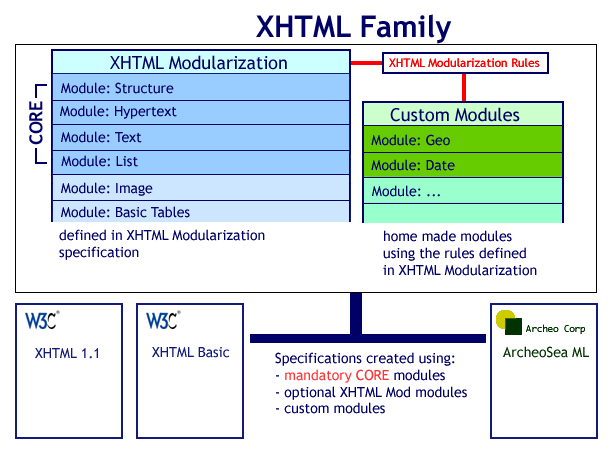
One significant example of XHTML Host Language is XHTML 1.1.
Created by splitting the mono-block XHTML 1.0 into logical groups of elements and attributes (such as "text", "lists", "image", "scripting"), making modules out of these groups and tying the whole back together, XHTML 1.1 is almost exactly similar in its use than XHTML 1.0.
The XHTML Modularization framework is not solely about re-creating XHTML 1.0 in a different form. There are quite a lot of other exciting uses for this framework, among them, the ability to:
define profiles based on XHTML (such as XHTML Basic, which is essentially a simple subset of XHTML 1.0 designed for mobile devices.)
create subsets of and extend XHTML for specific tasks, thus bringing one of the promises of XML to life by allowing the creation of semantically rich markup languages for specific content-management needs, which makes XHTML m12n especially beneficial for content providers.
Imagine, for instance, that a group wants to define a markup language specifically adapted to mathematics on the Web. The group can decide to use XML and create an XML namespace for the elements and attributes that are needed, or they can decide to make their work easily exportable and re-usable, and create a module according to the the XHTML m12n framework. You have just envisioned XHTML 1.1 plus MathML.
The Modularization of XHTML is mainly interesting and useful for three groups of people:
Web authors benefit from a new generation of consistent XML-based languages that are easy to get familiar with.
Creators of Web devices and agents, who benefit from the ability to define profiles, or use profiles more adapted to their product than the "vanilla" XHTML 1.1 or XHTML Basic. For example, the mobile Profile XHTML-MP was created by extending XHTML Basic.
Content providers, who now have the opportunity to create XML languages for their specific purposes; by using the XHTML m12n framework, they get the additional benefit of being able to re-use common parts, and in turn, producing re-usable components themselves.
The main interest of XHTML m12n for Web authors comes from the fact that Every XHTML language built according to the modularization framework has to include a set of required modules, therefore guaranteeing that all such languages share a common base. This means the learning curve for XHTML Basic, XHTML 1.1 plus MathML - or indeed, any other language belonging to the XHTML family - is smooth and easily surmountable.
Creation of new XHTML languages or modules is only necessary in very specific cases, so the general Web author does not need a very extensive knowledge of the module creation process, and can leave that to the creators of Web devices or specialized content providers.
It is, however, very interesting for a Web author to understand the basic principles of the modularization, in order to be able to use modules or languages designed by others.
@@ teaser for a yet-to-come WaW? @@
 Created Date: 2003-11-28 by olivier Thereaux