1 Introduction
This document sets out the structural part ↓(XML Schema: Structures)↓ of the ↓XML Schema definition language↓↑XML Schema Definition Language↑.
Chapter 2 presents a Conceptual Framework (§2) for ↓XML Schemas↓↑XSD↑, including an introduction to the
nature of ↓XML Schemas↓↑XSD schemas↑ and an introduction to the ↓XML Schema↓↑XSD↑
abstract data model, along with other terminology used throughout
this document.
Chapter 3, Schema Component Details (§3), specifies the precise
semantics of each component of the abstract model, the
representation of each component in XML, with reference to a DTD
and ↑an↑ ↓XML Schema↓↑XSD schema↑ for
an ↓XML Schema↓↑XSD↑ document type, along with a detailed mapping
between the elements and attribute vocabulary of this
representation and the components and properties of the abstract
model.
Chapter 4 presents Schemas and Namespaces: Access and Composition (§4), including the
connection between documents and schemas, the import, inclusion
and redefinition of declarations and definitions and the
foundations of schema-validity assessment.
Chapter 5 discusses Schemas and Schema-validity Assessment (§5), including the
overall approach to schema-validity assessment of documents, and
responsibilities of schema-aware processors.
The normative appendices include a Schema for ↓Schemas↓↑Schema Documents (Structures)↑ (normative) (§A) for the XML representation of
schemas and
References (normative) (§B).
The non-normative appendices include the DTD for Schemas (non-normative) (§L) and a Glossary (non-normative) (§K).
This document is primarily intended as a language definition
reference. As such, although it contains a few examples, it is
not primarily designed to serve as a motivating
introduction to the design and its features, or as a tutorial for
new users. Rather it presents a careful and fully explicit
definition of that design, suitable for guiding implementations.
For those in search of a step-by-step introduction to the design,
the non-normative [XML Schema: Primer]
is a much better starting point than this document.
↑
 1.1 Introduction to Version 1.1
The Working Group has three main goals for this version of W3C
XML Schema:
Significant improvements in simplicity of design and
clarity of exposition without loss of backward
or forward compatibility;
Provision of support for versioning of XML languages
defined using this
specification, including the XML vocabulary
specified here for use in schema documents.
Provision of support for
co-occurrence constraints, that is constraints which make the
presence of an attribute or element, or the values allowable
for it, depend on the value or presence of other attributes or
elements.
These goals are
in tension with one another. The Working Group's strategic guidelines
for changes between versions 1.0 and 1.1 can be summarized as follows:
Support
for versioning (acknowledging that this may be
slightly disruptive to the XML transfer syntax at the
margins)
Support for co-occurrence
constraints (which will certainly involve additions to the XML
transfer syntax, which will not be understood by 1.0
processors)
Bug fixes (unless in specific
cases we decide that the fix is too disruptive for a point
release)
Editorial changes
Design cleanup will possibly change behavior in edge
cases
Non-disruptive changes to type hierarchy
(to better support current and forthcoming international
standards and W3C recommendations)
Design cleanup will possibly change component structure
(changes to functionality restricted to edge cases)
No
significant changes in existing functionality
No changes
to XML transfer syntax except those required by version control
hooks, co-occurrence
constraints and bug fixes
The aim with regard
to compatibility is that
All schema documents conformant to version 1.0 of this
specification should also conform to version 1.1, and should
have the same validation behavior across 1.0 and 1.1 implementations
(except possibly in edge cases and in the details of the
resulting PSVI);
The vast majority of schema documents conformant to
version 1.1 of this specification should also conform to
version 1.0, leaving aside any incompatibilities arising from
support for versioning or
co-occurrence constraints, and when they are
conformant to version 1.0 (or are made conformant by the
removal of versioning information), should have the same
validation behavior
across 1.0 and 1.1 implementations (again except possibly in
edge cases and in the details of the resulting PSVI);
↑
 1.2 Purpose
The purpose of XML Schema↑ Definition Language↑: Structures is to define the nature of
↓XML schemas↓↑XSD schemas↑ and their component parts,
provide an inventory of XML markup constructs with which to
represent schemas, and define the application of schemas to XML
documents.
The purpose of an ↓XML Schema: Structures↓↑XSD↑ schema is to define and describe a
class of XML documents by using schema components to constrain
and document the meaning, usage and relationships of their
constituent parts: datatypes, elements and their content and
attributes and their values. Schemas ↓may↓↑can↑ also provide for
the specification of additional document information, such as
normalization and defaulting of attribute and element values.
Schemas have facilities for self-documentation. Thus, XML Schema↑ Definition Language↑: Structures can
be used to define, describe and catalogue XML vocabularies for
classes of XML documents.
Any application that consumes well-formed XML can use the
↓XML Schema: Structures↓ formalism ↑defined here↑ to express
syntactic, structural and value constraints applicable to its
document instances. The ↓XML Schema: Structures↓↑XSD↑ formalism allows a useful level of
constraint checking to be described and implemented for a wide
spectrum of XML applications. However, the language defined by
this specification does not attempt to provide all
the facilities that might be needed by ↓any application↓↑applications↑. Some applications
↓may↓↑will↑ require constraint capabilities not expressible in this
language, and so ↓may↓↑will↑ need to perform their own additional
validations.
↑
1.3 Namespaces and Language Identifiers
1.3.1 XSD Namespaces
1.3.1.1 The Schema Namespace (xs)
The XML representation of schema components uses a vocabulary
identified by the namespace name http://www.w3.org/2001/XMLSchema.
For brevity, the text and examples in this specification use
the prefix xs: to stand for this
namespace; in practice, any prefix can be used.
Note:
The namespace for schema documents is unchanged from version
1.0 of this specification, because any schema document valid
under the rules of version 1.0 has essentially the same
validation semantics under this specification as it did under
version 1.0 (Second Edition).
There are a few exceptions to this rule, involving errors in
version 1.0 of this specification which were not reparable by
errata and which have therefore been fixed only in this
version of this specification, not in version 1.0.
Note:
The data model used by
[XPath 2.0] and other
specifications, namely
[XDM], makes use of
type labels in the
XSD namespace (
untyped,
untypedAtomic) which are not defined in this
specification; see the
[XDM]
specification for details of those types.
Users of the namespaces defined here should be aware, as a
matter of namespace policy, that more names
in this namespace may be given
definitions in future versions of this or other
specifications.
1.3.1.2 The Schema Instance Namespace (xsi)
This specification defines
several attributes for direct use in any XML documents, as
described in Schema-Related Markup in Documents Being Validated (§2.6).
These attributes are in the namespace whose name is http://www.w3.org/2001/XMLSchema-instance.
For brevity, the text and examples in this specification use
the prefix xsi: to stand for this namespace; in
practice, any prefix can be used.
Users of the namespaces defined here should be aware, as a
matter of namespace policy, that more names
in this namespace may be given
definitions in future versions of this or other
specifications.
1.3.1.3 The Schema Versioning Namespace (vc)
The pre-processing of schema documents described in
Conditional inclusion (§4.2.1) uses
attributes in the namespace
http://www.w3.org/2007/XMLSchema-versioning.
For brevity, the text and examples in this specification use
the prefix vc: to stand for this
namespace; in practice, any prefix can be used.
Users of the namespaces defined here should be aware, as a
matter of namespace policy, that more names in this namespace
may be given definitions in future versions of this or other
specifications.
1.3.2 Namespaces with Special Status
Except as otherwise specified elsewhere in this specification,
if components are
·present· in a schema, or source
declarations are included in an XSD schema document, for
components in any of the following namespaces, then the
components, or the declarations,
should agree with the
descriptions given in the relevant specifications and with the
declarations given in any applicable XSD schema documents
maintained by the World Wide Web Consortium for these
namespaces. If they do not, the effect is
·implementation-dependent·
and not defined by this specification.
http://www.w3.org/XML/1998/namespace
http://www.w3.org/2001/XMLSchema
http://www.w3.org/2001/XMLSchema-instance
http://www.w3.org/2007/XMLSchema-versioning
Note: Depending on implementation details, some processors may
be able to process and use (for example) variant forms of the
schema for schema documents devised for specialized purposes;
if so, this specification does not forbid the use of such variant
components. Other processors, however, may find it
impossible to validate and use alternative components for
these namespaces; this specification does not require them
to do so. Users who have an interest in such specialized
processing should be aware of the attending interoperability
problems and should exercise caution.
This flexibility does not extend to the components described in
this specification or in
[XML Schema: Datatypes] as being
included in every schema, such as those for the primitive and
other built-in datatypes. Since those components are by
definition part of evey schema, it is not possible to have
different components with the same
expanded names present in
the schema without violating constraints defined elsewhere
against multiple components with the same
expanded names.
Components and source declarations must not specify
http://www.w3.org/2000/xmlns/ as their
target namespace. If they do, then the schema
and/or schema document is in ·error·.
Note: Any confusion in the use, structure, or meaning of this namespace
would have catastrophic effects on the interpretability of
this specification.
1.3.3 Conventional Namespace Bindings
Several namespace prefixes are conventionally used in this
document for notational convenience. The following bindings are
assumed.
html bound to
http://www.w3.org/1999/xhtml
my (in examples) bound to the target namespace
of the example schema document
rddl bound to
http://www.rddl.org/
vc bound to
http://www.w3.org/2007/XMLSchema-versioning (defined
in this and related specifications)
xhtml bound to
http://www.w3.org/1999/xhtml
xlink bound to
http://www.w3.org/1999/xlink
xs bound to http://www.w3.org/2001/XMLSchema
(defined in this and related specifications)
xsi bound to
http://www.w3.org/2001/XMLSchema-instance (defined in this and
related specifications)
xsl bound to
http://www.w3.org/1999/XSL/Transform
In practice, any prefix bound to the appropriate namespace
name may be used (unless otherwise specified by the definition
of the namespace in question, as for xml and
xmlns).
1.3.4 Schema Language Identifiers
Sometimes other specifications or Application Programming
Interfaces (APIs) need to refer to the XML Schema Definition Language in
general, sometimes they need to refer to a specific version of
the language. To make such references easy and enable consistent identifiers to be used, we provide the following
URIs to identify these
concepts.
http://www.w3.org/XML/XMLSchema
Identifies the XML Schema Definition Language in general, without referring
to a specific version of it.
http://www.w3.org/XML/XMLSchema/vX.Y
Identifies the language described in version X.Y of the XSD specification. URIs of this form refer to
a numbered version
of the language in general. They do not distinguish among different working drafts or
editions of that version. For example,
http://www.w3.org/XML/XMLSchema/v1.0 identifies
XSD version 1.0 and http://www.w3.org/XML/XMLSchema/v1.1 identifies
XSD version 1.1.
http://www.w3.org/XML/XMLSchema/vX.Y/Ne
Identifies the language described in the N-th edition of version X.Y of
the XSD specification. For example, http://www.w3.org/XML/XMLSchema/v1.0/2e
identifies the second edition of XSD version 1.0.
http://www.w3.org/XML/XMLSchema/vX.Y/Ne/yyyymmdd
Identifies the language described in the N-th edition of version
X.Y of
the XSD specification published on the particular date
yyyy-mm-dd. For example,
http://www.w3.org/XML/XMLSchema/v1.0/1e/20001024
identifies the language
defined in the XSD version 1.0 Candidate
Recommendation (CR) published on 24 October 2000, and
http://www.w3.org/XML/XMLSchema/v1.0/2e/20040318
identifies the language
defined in the XSD version 1.0 Second Edition Proposed
Edited Recommendation (PER)
published on 18 March 2004.
Please see XSD Language Identifiers (non-normative) (§O) for a
complete list of XML Schema Definition Language identifiers which exist to date.
↑
1.4 Dependencies on Other Specifications
The definition of XML Schema↑ Definition Language↑: Structures depends on the following
specifications:
[XML-Infoset],
[XML-Namespaces 1.1], ↓[XPath],↓ ↑[XPath 2.0],
↑and
[XML Schema: Datatypes].
See Required Information Set Items and Properties (normative) (§E) for a tabulation of the
information items and properties specified in [XML-Infoset] which this
specification requires as a precondition to schema-aware
processing.
↑
Conforming implementations of this specification may provide
either the 1.1-based datatypes or the 1.0-based datatypes, or
both. If both are supported, the choice of which datatypes to
use in a particular assessment episode should be under user
control.
↑
↑
Note:
It is a consequence of the
rule just given that implementations
may provide the heuristic of using the 1.1
datatypes if the input is labeled as XML 1.1, and the 1.0
datatypes if the input is labeled 1.0. It should be noted
however that the XML version number is not required to be
present in the input to an assessment episode, and in any case
the heuristic should be subject to override by users, to
support cases where users wish to accept XML 1.1 input but
validate it using the 1.0 datatypes, or accept XML 1.0 input and
validate it using the 1.1 datatypes.
↑
↑
Note:
Some users will perhaps wish to accept only XML 1.1 input, or
only XML 1.0 input. The rules
just given ensure that conforming implementations of this
specification which accept XML input may accept XML 1.0, XML
1.1, or both and may provide user control over which versions
of XML to accept.
↑
1.5 Documentation Conventions and Terminology
The section introduces the highlighting and typography as used
in this document to present technical material.
↑
Unless otherwise noted, the entire text of
this specification is normative. Exceptions include:
notes
sections explicitly marked non-normative
examples and their commentary
informal descriptions of the consequences of rules
formally and normatively stated elsewhere (such informal
descriptions are typically introduced by phrases like
"Informally, ..." or "It is a
consequence of ... that ...")
Explicit statements that some material is normative are not
to be taken as implying that material not so described
is non-normative
(other than that mentioned in the list just given).
↑
Special terms are defined at their point of introduction in the
text. For example [Definition:] a term is something used with a
special meaning. The definition is labeled as such
and the term it defines is displayed in boldface. The end of the
definition is not specially marked in the displayed or printed
text. Uses of defined terms are links to their definitions, set
off with middle dots, for instance ·term·.
Non-normative examples are set off in boxes and accompanied by
a brief explanation:
<schema targetNamespace="http://www.example.com/XMLSchema/1.0/mySchema">
And an explanation of the example.
The definition of each kind of schema component consists of a
list of its properties and their contents, followed by
descriptions of the semantics of the properties:
References to properties of schema components are links to the
relevant definition as exemplified above, set off with curly
braces, for instance
{example property}.
↑
For a given component C, an expression
of the form "C.{example property}"
denotes the (value of the) property
{example property} for component C.
The leading "C." (or more) is sometimes omitted,
if the identity of the component and any other omitted properties
is understood from the context.
This "dot operator" is left-associative, so
"C.{p1}.{p2}"
means the same as
"(C.{p1}) .
{p2}"
and denotes the value of property {p2}
within the component or ·property record· which itself
is the value of C's {p1} property.
White space on either side of the dot operator has no significance
and is used (rarely) solely for legibility.
↑
↑
For components C1 and C2, an expression
of the form "C1 . {example property 1} = C2 . {example property 2}"
means that C1 and C2 have the same value for the
property (or properties) in question. Similarly,
"C1 = C2" means that C1 and C2 are
identical, and "C1.{example property}
= C2" that C2 is the value of
C1.{example property}.
↑
The correspondence between an element information item which is
part of the XML representation of a schema and one or more schema
components is presented in a tableau which illustrates the
element information item(s) involved. This is followed by a
tabulation of the correspondence between properties of the
component and properties of the information item. Where context
↓may determine↓↑determines↑ which of several
different components ↓may
arise↓↑corresponds to the
source declaration↑, several tabulations, one per
context, are given. The property correspondences are normative,
as are the illustrations of the XML representation element
information items.
In the XML representation, bold-face attribute names (e.g.
count below) indicate a required attribute
information item, and the rest are optional. Where an attribute
information item has an enumerated type definition, the values
are shown separated by vertical bars, as for size
below; if there is a default value, it is shown following a
colon. Where an attribute information item has a built-in simple
type definition defined in [XML Schema: Datatypes], a hyperlink
to
its definition therein is given.
The allowed content of the information item is shown as a
grammar fragment, using the Kleene operators ?,
* and +. Each element name therein is
a hyperlink to its own illustration.
<example
count = integer
size = (large | medium | small) : medium>
Content: (all | any*)
</example>
Property
Representation
Description of what
the property corresponds to, e.g. the value of the
size [attribute]
References to elements in the text are links to the relevant
illustration as exemplified above, set off with angle brackets,
for instance <example>.
↑
Unless otherwise specified, references to attribute values
are references to the ·actual value· of the attribute information
item in question, not to its ·normalized value· or to other forms
or varieties of "value" associated with it.
For a given element information item E, expressions of the
form "E has att1 = V"
are short-hand for "there is an attribute information
item named att1 among the [attributes] of E and
its ·actual value·
is V."
If the identity of E is clear from context, expressions
of the form "att1 = V"
are sometimes used.
The form "att1 ≠ V" is also used
to specify that the ·actual value· of att1 is
not V.
↑
References to properties of information items as defined in
[XML-Infoset] are notated as links to the relevant
section thereof, set off with square brackets, for example
[children].
Properties which this specification defines for information
items are introduced as follows:
References to properties of information items defined in this
specification are notated as links to their introduction as
exemplified above, set off with square brackets, for example
[new property].
↑
The "dot operator" described above
for components and their properties is also used for information items
and their properties. For a given information item I, an expression
of the form "I . [new property]"
denotes the (value of the) property
[new property] for item I.
↑
↑
Lists of normative constraints are typically introduced with
phrase like
"all of the following are true" (or "... apply"),
"one of the following is true",
"at least one of the following is true",
"one or more of the following is true",
"the appropriate case among the following is true",
etc.
The phrase "one of the following is true"
is used in cases where the authors believe the items listed
to be mutually exclusive (so that the distinction between
"exactly one" and "one or more"
does not arise). If the items in such a list are not in fact
mutually exclusive, the phrase "one of the following"
should be interpreted as meaning "one or more of the
following".
The phrase "the appropriate case among the following"
is used only when the cases are thought by the authors to be
mutually exclusive; if the cases in such a list are not in fact
mutually exclusive, the first applicable case should be
taken. Once a case has been encountered with a true condition,
subsequent cases must not be tested.
↑
The following highlighting is used for non-normative commentary
in this document:
Note: General comments directed to all readers.
↓Following [XML 1.1], w↓↑W↑ithin normative prose in this
specification, the words may↓
and↓↑,
should↑↑,↑
must↑ and must not↑ are
defined as follows:
may
↓Conforming documents
and XML Schema-aware
processors↓↑Schemas,
schema documents, and processors↑ are
permitted to but need not behave as described.
↑
should
It is recommended that schemas,
schema documents,
and
processors behave as described, but there
can be valid reasons for them not to; it is important that the
full implications be understood and carefully weighed before
adopting behavior at variance with the recommendation.
↑
must
↓
Conforming documents and
XML Schema-aware processors are required to behave as
described; otherwise they are in error.
↓
↑
(Of schemas and
schema documents:)
Schemas and documents are required to behave as
described; otherwise they are in
·error·.
↑
↑
(Of
processors:)
Processors are
required to behave as described.
↑
↑
must not
Schemas,
schema documents, and processors
are forbidden to behave as
described; schemas and documents which nevertheless
do so are in
·error·.
↑
↑
A failure of a schema
or schema
document to conform to the rules of this
specification.
Except as otherwise specified,
processors
must distinguish error-free (conforming) schemas
and schema documents used in
·assessment· from those with errors;
if a schema used in
·assessment·
or a schema document used in constructing a schema
is in error,
processors
must report the fact;
if more than one is in error, it is
·implementation-dependent·
whether more than one is reported as being in error.
If one or more of the constraint codes given
in
Outcome Tabulations (normative) (§C) is applicable, it is
·implementation-dependent· how many of them, and which,
are reported.
Note: Failure of an XML document to be valid against a particular
schema is not (except for the special case of a schema
document consulted in the course of building a schema) in
itself a failure to conform to this specification and thus,
for purposes of this specification, not an error.
Note: Notwithstanding the fact that (as just noted) failure to be
schema-valid is not a violation of this specification and
thus not strictly speaking an error as defined here,
the names of the PSVI properties
[schema error code] (for attributes) and
[schema error code] (for elements) are retained for
compatibility with other versions of this specification, and
because in many applications of XSD, non-conforming
documents
are "in error" for
purposes of those applications.
↑
↑
A feature or construct defined in this specification
described as deprecated is retained in this
specification for compatibility with previous versions
of the specification, and but its use is not advisable and
schema authors should avoid its use if possible.
Deprecation has no effect on the conformance of schemas
or schema documents which use deprecated features.
Since deprecated features are part of the specification,
processors must support them, although some processors
may choose to issue warning messages when deprecated
features are encountered.
Features deprecated in this version of this specification
may be removed entirely in future versions, if any.
↑
↑
These definitions describe in terms
specific to this document the meanings assigned to these terms by
[IETF RFC 2119]. The specific wording follows
that of [XML 1.1].
↑
↑
Where these terms appear without special highlighting,
they are used in their ordinary senses and do not express conformance
requirements. Where these terms appear highlighted within
non-normative material (e.g. notes), they are recapitulating
rules normatively stated elsewhere.
↑
↓Note however that
this↓↑This↑
specification provides a ↓definition↓
↑further description↑
of error and of conformant
processors' responsibilities with respect to errors ↓(see↓↑in↑
Schemas and Schema-validity Assessment (§5)↓) which is
considerably more complex than that of [XML 1.1]↓.
2 Conceptual Framework
This chapter gives an overview of XML Schema↑ Definition Language↑: Structures at the level of its
abstract data model. Schema Component Details (§3) provides details
on this model, including a normative representation in XML for the
components of the model. Readers interested primarily in learning
to write schema documents ↓may wish to
first↓↑will find it most
useful first to↑ read [XML Schema: Primer] for a
tutorial introduction, and only then ↑to↑ consult the sub-sections of
Schema Component Details (§3) named XML Representation of
... for the details.
2.1 Overview of ↓XML Schema↓↑XSD↑
An ↓XML Schema↓↑XSD schema↑ ↓consists↓↑is
a set↑ of components such as type definitions and
element declarations. These can be used to assess the validity of
well-formed element and attribute information items (as defined
in [XML-Infoset]), and furthermore
↓may↓↑may↑
specify augmentations to those items and their descendants. This
augmentation makes explicit information ↓which may have been↓ implicit in the original
document, such as normalized and/or default values for attributes
and elements and the types of element and attribute information
items. ↑The input information set
can also be augmented with information about the validity of the
item, or about other properties described in this
specification.↑ [Definition:] We refer to the augmented infoset which
results from conformant processing as defined in this
specification as the post-schema-validation
infoset, or PSVI. ↑Conforming processors may provide
access to some or
all of the PSVI, as described in Subset of the Post-schema-validation Infoset (§D.1). The mechanisms by which
processors provide such
access to the PSVI are neither defined nor constrained by this
specification.↑
As it is used in this specification, the
term
schema-validity assessment has two aspects:
1
Determining local schema-validity, that is
whether an element or attribute information item satisfies
the constraints embodied in the relevant components of an
↓XML Schema↓↑XSD schema↑;2 Synthesizing an overall validation
outcome for the item, combining local schema-validity with
the results of schema-validity assessments of its
descendants, if any, and adding appropriate augmentations to
the infoset to record this
outcome.
Throughout this specification, [Definition:] the word valid and its derivatives are
used to refer to clause 1 above, the
determination of local schema-validity.
Throughout this specification, [Definition:] the word assessment is used to
refer to the overall process of local validation,
schema-validity assessment and infoset
augmentation.
↑
During
·assessment·, some or
all of the element and attribute information items in the input
document are associated with declarations and/or type
definitions; these declarations and type definitions are then
used in the
·assessment· of those items, in a
recursive process.
[Definition:] The declaration associated with an information
item, if any, and with respect to which its validity is ·assessed· in a given assessment episode
is said to govern the item, or to be its
governing element or attribute declaration.
Similarly the type definition with respect to which the
type-validity of an item is assessed is its
governing type definition.
↑
2.2 ↓XML Schema↓↑XSD↑ Abstract Data Model
This specification builds on [XML 1.1] and
[XML-Namespaces 1.1]. The concepts and definitions used
herein regarding XML are framed at the abstract level of
information
items as defined in [XML-Infoset]. By
definition, this use of the infoset provides a
priori guarantees of well-formedness
(as defined in [XML 1.1]) and namespace
conformance (as defined in [XML-Namespaces 1.1]) for all candidates for ·assessment· and for all
·schema documents·.
Just as [XML 1.1] and
[XML-Namespaces 1.1] can be described in terms of
information items, ↓XML Schemas↓↑XSD schemas↑ can be described in terms of
an abstract data model. In defining ↓XML Schemas↓↑schemas↑ in terms of
an abstract data model, this specification rigorously specifies
the information which must be available to a conforming
↓XML Schema↓↑XSD↑ processor. The abstract model for schemas is
conceptual only, and does not mandate any particular
implementation or representation of this information. To
facilitate interoperation and sharing of schema information, a
normative XML interchange format for schemas is provided.
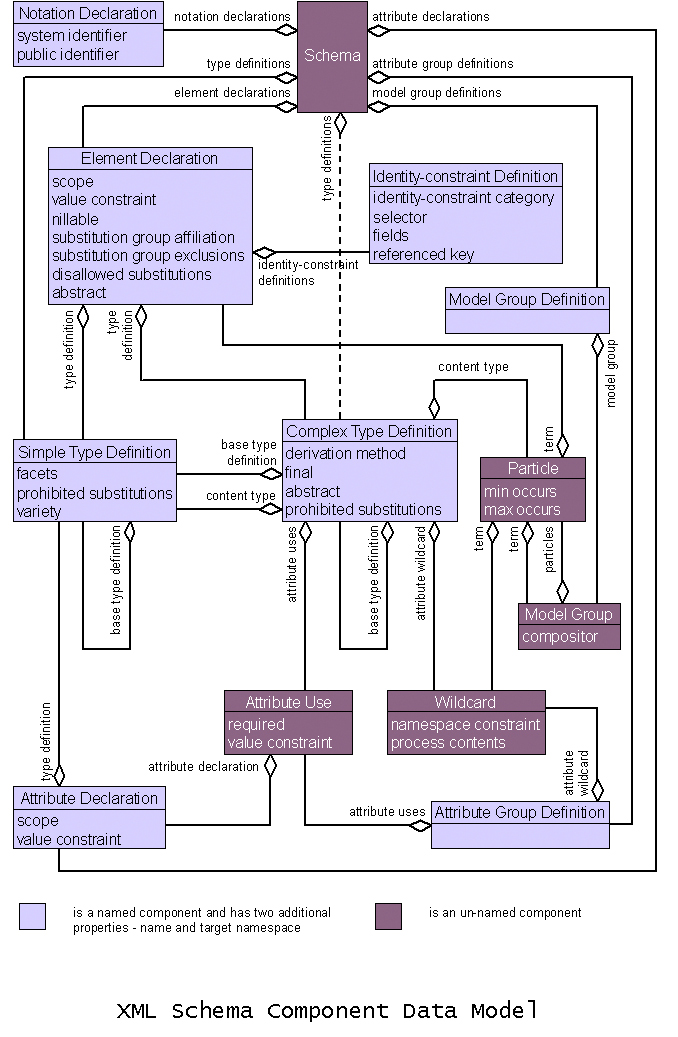
[Definition:] Schema
component is the generic term for the building blocks
that ↓comprise↓↑make up↑ the abstract data model
of the schema. ↓[Definition:] An XML Schema is a set
of ·schema components·↓↑[Definition:] An XSD schema is a set of ·schema components·↑. There are
↓13 kinds of component in all↓↑several kinds of schema component↑, falling
into three groups. The primary ↑schema↑ components, which may (type
definitions) or must (element and attribute declarations) have
names, are as follows:
Simple type definitions
Complex type definitions
Attribute declarations
Element declarations
The secondary ↑schema↑ components, ↓which must have names, ↓are as
follows:
Finally, the "helper" ↑schema↑ components provide small
parts of other ↑schema↑ components; they are ↓not independent of↓↑dependent on↑ their context:
Annotations
Model groups
Particles
Wildcards
Attribute Uses
↓
The
name [Definition:] Component covers all the different kinds of
component defined in this specification.
↓
↑
The
name [Definition:] Component covers all the different kinds of
schema component defined in this specification.
↑
During ·validation·, [Definition:] declaration
components are associated by (qualified) name to information items
being ·validated·.
On the other hand, [Definition:] definition components define internal
schema components that can be used in other schema
components.
[Definition:] Declarations
and definitions ↓may↓↑may↑ ↑and in
some cases must↑ have and be identified by
names, which are
NCNames as defined by [XML-Namespaces 1.1].
[Definition:] Several
kinds of component have a target namespace, which
is either ·absent· or a
namespace name, also as defined by [XML-Namespaces 1.1]. The ·target namespace· serves to identify
the namespace within which the association between the component
and its name exists.
↓In the case
of declarations, this in turn
determines the namespace name of, for example, the element
information items it may ·validate·.↓
Note: At the abstract level, there is no requirement that the
components of a schema share a
·target namespace·. Any schema for
use in
·assessment· of documents
containing names from more than one namespace will of necessity
include components with different
·target namespaces·. This contrasts
with the situation at the level of the XML representation of
components, in which each schema document contributes
definitions and declarations to a single target namespace.
·Validation·, defined in detail
in Schema Component Details (§3), is a relation between information
items and schema components. For example, an attribute
information item ↓may ·validate·↓↑is ·validated·↑
with respect to an attribute declaration, a list of element
information items ↓may ·validate·↓ with respect to a
content model, and so on. The following sections briefly
introduce the kinds of components in the schema abstract data
model, other major features of the abstract model, and how they
contribute to ·validation·.
2.2.1 Type Definition Components
The abstract model provides two kinds of type definition
component: simple and complex.
[Definition:] This specification
uses the phrase type definition in cases where no
distinction need be made between simple and complex
types.
Type definitions form a hierarchy with a single root. The
subsections below first describe characteristics of that
hierarchy, then provide an introduction to simple and complex
type definitions themselves.
2.2.1.1 Type Definition Hierarchy
[Definition:] Except for ↓a distinguished ·ur-type
definition·,↓ ↑·xs:anyType·,↑ every ·type definition· is, by construction,
either a ·restriction· or an
·extension· of some
other type definition. The graph of these relationships forms
a tree known as the Type Definition
Hierarchy.
[Definition:] ↓A↓↑The↑ type definition used as the basis
for an ·extension· or
·restriction· is
known as the base type definition of that
definition.
[Definition:] ↓A type
definition whose declarations or facets are in a one-to-one
relation with those of another specified type definition,
with each in turn restricting the possibilities of the one
it corresponds to,↓↑A
type defined with the same constraints as its ·base type definition·, or with more,↑ is
said to be a restriction. The ↓specific restrictions↓↑added constraints↑ might include narrowed
ranges or reduced alternatives. ↓Members of a type, A, whose definition is a
·restriction· of
the definition of another type, B, are always locally valid
against type B as well.↓↑Given two types A and B, if the definition of
A is a ·restriction· of the
definition of B, then members of type A are always locally
valid against type B as well.↑
[Definition:] A complex
type definition which allows element or attribute content in
addition to that allowed by another specified type definition
is said to be an extension.
↓
[Definition:] A distinguished complex type definition, the
ur-type definition, whose name is anyType in the
XML Schema namespace, is present in each ·XML Schema·,
serving as the root of the type definition hierarchy for that
schema.
↓
↑
[Definition:] A special complex type
definition, (referred to in earlier versions of this
specification as 'the ur-type definition') whose
name is anyType in the XSD namespace, is
present in each ·XSD schema·. The definition of
anyType serves as default
type definition for element declarations whose XML
representation does not specify one.
↑
↑
[Definition:] A special simple type
definition, whose name is error in the XSD
namespace, is also present in each ·XSD schema·. The
XSD error type
has no valid instances. It can be used in any place where
other types are normally used; in particular, it can be used
in conditional type assignment to cause elements which satisfy
certain conditions to be invalid.
↑
2.2.1.2 Simple Type Definition
A simple type definition is a set of constraints on strings
and information about the values they encode, applicable to the
·normalized value· of an attribute information item or of an element
information item with no element children. Informally, it
applies to the values of attributes and the text-only content
of elements.
Each simple type definition, whether built-in (that is,
defined in [XML Schema: Datatypes]) or user-defined, is a ·restriction· of ↓some particular simple↓↑its↑ ·base type definition·.
↓For the built-in primitive type
definitions, this is ↓↓[Definition:] the simple ur-type
definition, a special ·restriction· of the ·ur-type definition·, whose
name is anySimpleType in the XML Schema
namespace. The ·simple ur-type definition· is
considered to have an unconstrained lexical space, and a value
space consisting of the union of the value spaces of all the
built-in primitive datatypes and the set of all lists of all
members of the value spaces of all the
built-in primitive
datatypes.↓ ↑[Definition:] A
special ·restriction· of
·xs:anyType·, whose name is
anySimpleType in the
XSD namespace, is the root of the ·Type Definition Hierarchy· for all simple type
definitions. ·xs:anySimpleType· has a lexical space containing
all sequences of characters in the Universal Character
Set (UCS) and a value space containing all
atomic values
and all finite-length lists of
atomic values.
As with ·xs:anyType·, this
specification sometimes uses the qualified name
xs:anySimpleType to designate this type
definition.↑ ↑The
built-in list datatypes all have ·xs:anySimpleType· as their
·base type
definition·.↑
↑
[Definition:] There is a further special datatype
called anyAtomicType, a
·restriction· of
·xs:anySimpleType·, which is the ·base type definition·
of all the primitive
datatypes. This type definition is often referred
to simply as "xs:anyAtomicType".
It too is
considered to have an unconstrained lexical space. Its value
space consists of the union of the value spaces of all the
primitive datatypes.
↑
The mapping from lexical space to value space is unspecified
for items whose type definition is ↓the ·simple ur-type definition·↓↑·xs:anySimpleType·↑ ↑or ·xs:anyAtomicType·↑. Accordingly
this specification does not constrain processors'
behavio↓u↓r in areas
where this mapping is implicated, for example checking such
items against enumerations, constructing default attributes or
elements whose declared type definition is ↓the ·simple ur-type definition·↓↑·xs:anySimpleType·↑
↑or ·xs:anyAtomicType·↑,
checking identity constraints involving such items.
Note: The Working Group expects to return to this area in a future
version of this specification.
↓Simple types may also be
defined↓↑[XML Schema: Datatypes]
provides mechanisms for defining new simple type definitions
by ·restricting·
some primitive
or ordinary datatype. It also
provides mechanisms for constructing new simple type
definitions↑ whose members are lists of items
themselves constrained by some other simple type definition, or
whose membership is the union of the memberships of some other
simple type definitions. Such list and union simple type
definitions are also ·restrictions· of
↓the ·simple ur-type definition·↓↑·xs:anySimpleType·↑.
For detailed information on simple type definitions, see
Simple Type Definitions (§3.16) and [XML Schema: Datatypes]. The
latter also defines an extensive inventory of pre-defined
simple types.
2.2.1.3 Complex Type Definition
A complex type definition is a set of attribute declarations
and a content type, applicable to the [attributes] and
[children] of an element information item respectively. The
content type ↓may↓↑may↑ require the [children] to contain
neither element nor character information items (that is, to be
empty), ↑or↑ to be a
string which belongs to a particular simple type↑,↑ or to contain a sequence of
element information items which conforms to a particular model
group, with or without character information items as well.
A complex type which extends another does so by having
additional content model particles at the end of the other
definition's content model, or by having additional attribute
declarations, or both.
Note: ↓This↓↑For the most part, this↑
specification allows only appending, and not other kinds of
extensions. This decision simplifies application processing
required to cast instances from
derived to base type.
↑A special case allows the
extension of all-groups in ways that do not
guarantee that the new material occurs only at the end of
the content.↑ Future versions may allow more kinds
of extension, requiring more complex transformations to
effect casting.
For detailed information on complex type definitions, see Complex Type Definitions (§3.4).
2.2.2 Declaration Components
There are three kinds of declaration component: element, attribute,
and notation. Each is described in a section below. Also
included is a discussion of element substitution groups, which
is a feature provided in conjunction with element
declarations.
2.2.2.1 Element Declaration
An element declaration is an association of a name with a
type definition, either simple or complex, an (optional)
default value and a (possibly empty) set of identity-constraint
definitions. The association is either global or scoped to a
containing complex type definition. A top-level element
declaration with name 'A' is broadly comparable to a pair of
DTD declarations as follows, where the associated type
definition fills in the ellipses:
<!ELEMENT A . . .>
<!ATTLIST A . . .>
Element declarations contribute to ·validation· as part of model group
·validation·, when their defaults
and type components are checked against an element information
item with a matching name and namespace, and by triggering
identity-constraint definition ·validation·.
For detailed information on element declarations, see Element Declarations (§3.3).
2.2.2.2 Element Substitution Group
In XML↓ 1.0↓, the name
and content of an element must correspond exactly to the
element type referenced in the corresponding content model.
[Definition:] Through the new mechanism of element substitution
groups, ↓XML Schemas↓↑XSD↑ provides a more powerful model
supporting substitution of one named element for
another. Any top-level element declaration can serve
as the defining member, or head, for an element ↓substitution group↓↑·substitution group·↑.
Other top-level element declarations, regardless of target
namespace, can be designated as members of the ↓substitution group↓↑·substitution group·↑
headed by this element. In a suitably enabled content model, a
reference to the head ·validates·
not just the head itself, but elements corresponding to any
other member of the ↓substitution group↓↑·substitution group·↑ as well.
All such members must have type definitions which are
either the same as the head's type definition or ↓restrictions
or extensions of↓↑derived
from↑ it. Therefore, although the names of elements
can vary widely as new namespaces and members of the
↓substitution group↓↑·substitution group·↑ are defined, the content of member elements is
↓strictly limited according to↓↑constrained by↑ the type
definition of the
↓substitution group↓↑·substitution group·↑ head.
Note that element substitution groups are not represented as
separate components. They are specified in the property values
for element declarations (see
Element Declarations (§3.3)).
2.2.2.3 Attribute Declaration
An attribute declaration is an association between a name and
a simple type definition, together with occurrence information
and (optionally) a default value. The association is either
global, or local to its containing complex type definition.
Attribute declarations contribute to ·validation· as part of complex type
definition ·validation·, when
their occurrence, defaults and type components are checked
against an attribute information item with a matching name and
namespace.
For detailed information on attribute declarations, see
Attribute Declarations (§3.2).
2.2.2.4 Notation Declaration
A notation declaration is an association between a name and
an identifier for a notation. For an attribute ↑or element↑ information item to
be ·valid· with respect to a
NOTATION simple type definition, its value must
have been declared with a notation declaration.
For detailed information on notation declarations, see Notation Declarations (§3.14).
2.2.3 Model Group Components
The model group, particle, and wildcard components
contribute to the portion of a complex type definition that
controls an element information item's content.
2.2.3.1 Model Group
A model group is a constraint in the form of a grammar
fragment that applies to lists of element information items. It
consists of a list of particles, i.e. element declarations,
wildcards and model groups. There are three varieties of model
group:
Sequence (the element information items match the
particles in sequential order);
Conjunction (the element information items match the
particles, in any order);
Disjunction (the element information items match one
of the particles).
↑
Each model group denotes a set of
sequences of element information items. Regarding that set of
sequences as a language, the set of sequences recognized by a
group G may be written L(G). [Definition:] A model group G is said to accept
or recognize the members of L(G).
↑
For detailed information on model groups, see Model Groups (§3.8).
2.2.3.2 Particle
A particle is a term in the grammar for element content,
consisting of either an element declaration, a wildcard or a
model group, together with occurrence constraints.
Particles contribute to ·validation· as part of complex type
definition ·validation·, when
they allow anywhere from zero to many element information items
or sequences thereof, depending on their contents and
occurrence constraints.
[Definition:] A
particle can be used in a complex type definition to
constrain the ·validation· of
the [children] of an element information item; such a
particle is called a content model.
↑
Each content model, indeed each
particle and each term,
denotes a set of sequences of element information items. Regarding
that set of sequences as a language, the set of sequences recognized
by a particle P may be written L(P).
[Definition:] A particle P is said to
accept or recognize the members of
L(P). Similarly, a term T
accepts or recognizes the members
of L(T).
↑
↑
Note: The language accepted by a content model plays a role in determining
whether an element information item is locally valid or not: if the
appropriate content model does not accept the sequence of elements
among its children, then the element information item is not locally
valid. (Some additional constraints must
also be met: not every
sequence in
L(
P) is locally valid against
P. See
Principles of Validation against Groups (§3.8.4.2).)
No assumption is made, in the definition above,
that the items in the sequence are themselves valid; only the
expanded names of the items in the sequence are relevant in
determining whether the sequence is accepted by a particle.
Their validity does affect whether their parent is (recursively)
valid as well as locally valid.
↑
↑
If a sequence S is a member of L(P),
then it is necessarily possible to trace a path through the
·basic particles·
within P, with each item within S corresponding to a matching particle
within P. The sequence of particles within P corresponding to S
is called the ·path· of S in P.
↑
↑
Note: This
·path· has nothing to do with
XPath expressions.
When there may otherwise be danger of confusion, the
·path·
described here may be referred to as the
·match path· of
S
in
P.
↑
For detailed information on particles, see Particles (§3.9).
2.2.3.3 Attribute Use
An attribute use plays a role similar to that of a
particle, but for attribute declarations: an attribute
declaration within a complex type definition is embedded within
an attribute use, which specifies whether the declaration
requires or merely allows its attribute, and whether it has a
default or fixed value.
2.2.3.4 Wildcard
A wildcard is a special kind of particle which matches element
and attribute information items dependent on their namespace
name↑s↑↓,↓ ↓independently of↓↑and optionally on↑ their local names.
For detailed information on wildcards, see Wildcards (§3.10).
2.2.4 ↓Identity-constraint Definition↓↑Constraint↑ Components
2.2.4.1 ↑Identity-constraint Definition↑
An identity-constraint definition is an association between a name
and one of several varieties of identity-constraint related to
uniqueness and reference. All the varieties use ↓[XPath]↓↑[XPath 2.0]↑ expressions to pick out sets of information
items relative to particular target element information items
which are unique, or a key, or a ·valid· reference, within a specified
scope. An element information item is only ·valid· with respect to an element
declaration with identity-constraint definitions if those definitions
are all satisfied for all the descendants of that element
information item which they pick out.
For detailed information on identity-constraint definitions, see
Identity-constraint Definitions (§3.11).
↑
2.2.4.2 Type Alternative
A type-alternative component
(type alternative for short)
associates a type definition with a predicate.
Type alternatives are used in conditional
type assignment, in which the choice of ·governing type definition·
for elements governed by a particular element declaration
depends on properties of the document instance. An element
declaration may have a {type table} which contains a
sequence of type alternatives; the predicates on the alternatives
are tested, and when a predicate is satisfied, the type
definition paired with it is chosen as the element instance's
·governing type definition·.
Note: The provisions for conditional type assignment are inspired by,
but not identical to, those of
[SchemaPath].
For detailed information on Type Alternatives, see
Type Alternatives (§3.12).
↑
↑
2.2.4.3 Assertion
An assertion is a predicate associated with a type, which is
checked for each instance of the type. If an element or attribute information item
fails to satisfy an assertion associated with a given type,
then that information item is not locally ·valid·
with respect to that type.
For detailed information on Assertions, see Assertions (§3.13).
Editorial Note: Priority Feedback Request
Assertions are currently only allowed to be specified in
complex types. It may be deemed useful also to include
assertions in named model group definitions and/or attribute
groups, or even simple types. The XML Schema Working Group solicits input from
implementors and users of this specification on this question.
↑
2.2.5 Group Definition Components
There are two kinds of convenience definitions provided to
enable the re-use of pieces of complex type definitions: model
group definitions and attribute group definitions.
2.2.5.1 Model Group Definition
A model group definition is an association between a name and
a model group, enabling re-use of the same model group in
several complex type definitions.
For detailed information on model group definitions, see
Model Group Definitions (§3.7).
2.2.5.2 Attribute Group Definition
An attribute group definition is an association between a
name and a set of attribute declarations, enabling re-use of
the same set in several complex type definitions.
For detailed information on attribute group definitions, see
Attribute Group Definitions (§3.6).
2.2.6 Annotation Components
An annotation is information for human and/or mechanical
consumers. The interpretation of such information is not defined
in this specification.
For detailed information on annotations, see Annotations (§3.15).
2.3 Constraints and Validation Rules
The [XML 1.1] specification describes two kinds
of constraints on XML documents: well-formedness and
validity constraints. Informally, the
well-formedness constraints are those imposed by the definition
of XML itself (such as the rules for the use of the < and >
characters and the rules for proper nesting of elements), while
validity constraints are the further constraints on document
structure provided by a particular DTD.
The preceding section focused on ·validation·, that is the constraints on
information items which schema components supply. In fact
however this specification provides four different kinds of
normative statements about schema components, their
representations in XML and their contribution to the ·validation· of information items:
Schema Component Constraint
Schema Representation Constraint
Schema Information Set Contribution
The last of these, schema information set contributions, are
not as new as they might at first seem. XML↓ 1.0↓ validation augments the XML↓ 1.0↓ information set in similar
ways, for example by providing values for attributes not present
in instances, and by implicitly exploiting type information for
normalization or access. (As an example of the latter case,
consider the effect of NMTOKENS on attribute white
space, and the semantics of ID and
IDREF.) By including schema information set
contributions, this specification makes explicit some features
that XML↓ 1.0↓ ↓left↓↑leaves↑ implicit.
2.4 Conformance
↑
Within the context of this
specification, conformance can be claimed for schema
documents, for schemas,
and for
processors.
↑
↑
A
·schema document·
conforms to this specification if and only if
all of the following are true:
↑
↑
Note: While conformance of schema documents is a precondition for
the mapping from schema documents to schema components described
in this specification, conformance of the schema documents does
not guarantee that the result of that mapping will be a schema
that conforms to this specification. Some constraints (e.g. the
rule that there must be at most one top-level element
declaration with a particular
expanded name) can only be
checked in the context of the schema as a whole.
Because component correctness
depends in part upon the other components present, the
XML mapping rules defined in this specification do not always
map conforming schema documents into components that satisfy
all constraints. In some cases, the mapping will produce
components which violate constraints imposed at the component
level; in others, no component at all will be produced.
↑
↑
Note:
In this version of this specification, Schema Representation
Constraints concern only properties of the schema document which
can be checked in isolation. In version 1.0 of this
specification, some Schema Representation Constraints could not
be checked against the schema document in isolation, and so it
was not always possible to say, for a given schema document,
whether it satisfied the constraints or not.
↑
This specification describes three levels of conformance for
schema aware processors. The first is required of all processors.
Support for the other two will depend on the application
environments for which the processor is intended.
[Definition:] Minimally conforming processors must
completely and correctly implement the ·Schema Component Constraints·,
·Validation Rules·, and
·Schema Information Set
Contributions· contained in this
specification.
[Definition:] ·Minimally
conforming· processors which accept schemas
represented in the form of XML documents as described in
Layer 2: Schema Documents, Namespaces and Composition (§4.2) are additionally said to ↓provide conformance to the XML
Representation of Schemas↓↑be schema-document
aware↑. Such processors must, when
processing schema documents, completely and correctly implement
↑(or enforce)↑
all ·Schema Representation
Constraints· in this specification, and must adhere
exactly to the specifications in Schema Component Details (§3)
for mapping the contents of such documents to ·schema components· for use in ·validation· and ·assessment·.
Note: By separating the conformance requirements relating to the
concrete syntax of
↓XML Schema
documents↓↑·schema documents·↑, this specification
admits processors which use schemas stored in optimized binary
representations, dynamically created schemas represented as
programming language data structures, or implementations in
which particular schemas are compiled into executable code such
as C or Java. Such processors can be said to be
·minimally conforming·
but not necessarily
↓in ·conformance to the XML Representation of
Schemas·↓↑·schema-document aware·↑.
[Definition:] ↓Fully
conforming↓↑Web-aware↑ processors are
network-enabled processors which are not only both ·minimally conforming·
and ·↓in conformance to the XML Representation of
Schemas↓↑schema-document aware↑·, but
which additionally must be capable of accessing schema
documents from the World Wide Web ↓according to↓↑as described in↑ Representation of Schemas on the World Wide Web (§2.7) and How schema definitions are located on the Web (§4.3.2).
.
↑
Note: In version 1.0 of this specification the class of
·schema-document aware· processors was termed "conformant
to the XML Representation of Schemas". Similarly, the
class of
·Web-aware· processors was
called "fully conforming".
↑
Note: Although this specification provides just these three
standard levels of conformance, it is anticipated that other
conventions can be established in the future. For example, the
World Wide Web Consortium is considering conventions for
packaging on the Web a variety of resources relating to
individual documents and namespaces. Should such developments
lead to new conventions for representing schemas, or for
accessing them on the Web, new levels of conformance can be
established and named at that time. There is no need to modify
or republish this specification to define such additional levels
of conformance.
See Schemas and Namespaces: Access and Composition (§4) for a more detailed
explanation of the mechanisms supporting these levels of
conformance.
2.5 Names and Symbol Spaces
As discussed in ↓XML Schema↓↑XSD↑ Abstract Data Model (§2.2), most
schema components (↓may↓↑may↑) have ·names·. If all such names were
assigned from the same "pool", then it would be
impossible to have, for example, a simple type definition and an
element declaration both with the name "title" in a
given ·target namespace·.
Therefore [Definition:] this specification introduces the term symbol
space to denote a collection of names, each of which is
unique with respect to the others. ↓A symbol space is similar to the non-normative concept
of namespace partition introduced in [XML-Namespaces 1.1].↓
There is a single distinct symbol space within a given ·target namespace· for each kind of
definition and declaration component identified in ↓XML Schema↓↑XSD↑ Abstract Data Model (§2.2), except that within a target namespace,
simple type definitions and complex type definitions share a
symbol space. Within a given symbol space, names
↓are↓↑must be↑ unique, but
the same name may appear in more than one symbol space without
conflict. For example, the same name can appear in both a type
definition and an element declaration, without conflict or
necessary relation between the two.
Locally scoped attribute and element declarations are special
with regard to symbol spaces. Every complex type definition
defines its own local attribute and element declaration symbol
spaces, where these symbol spaces are distinct from each other
and from any of the other symbol spaces. So, for example, two
complex type definitions having the same target namespace can
contain a local attribute declaration for the unqualified name
"priority", or contain a local element declaration
for the name "address", without conflict or
necessary relation between the two.
2.6 Schema-Related Markup in Documents Being Validated
↓
The XML representation of schema
components uses a vocabulary identified by the namespace name
http://www.w3.org/2001/XMLSchema. For brevity, the text and examples in
this specification use the prefix xs: to stand for
this namespace; in practice, any prefix can be used.
↓
XML Schema↑ Definition Language↑: Structures ↓also↓ defines
several attributes for direct use in any XML documents. ↓These attributes are in a different
namespace, which has the namespace name
http://www.w3.org/2001/XMLSchema-instance. For brevity, the text and
examples in this specification use the prefix xsi:
to stand for this latter namespace; in practice, any prefix can
be used.↓↑These
attributes are in the schema instance namespace
(http://www.w3.org/2001/XMLSchema-instance) described in The Schema Instance Namespace (xsi) (§1.3.1.2) above.↑ All schema processors
↑must↑
have appropriate attribute declarations for these attributes
built in, see Attribute Declaration for the 'type' attribute (§3.2.7.1),
Attribute Declaration for the 'nil' attribute (§3.2.7.2), Attribute Declaration for the 'schemaLocation' attribute (§3.2.7.3) and
Attribute Declaration for the 'noNamespaceSchemaLocation' attribute (§3.2.7.4).
↑
Note: As described above (
Conventional Namespace Bindings (§1.3.3)), the
attributes described in this section are referred to in this
specification as "
xsi:type",
"
xsi:nil", etc. This is shorthand for
"an attribute information item whose
[namespace
name] is
http://www.w3.org/2001/XMLSchema-instance and whose
[local
name] is
type" (or
nil, etc.).
↑
↓
Users of the namespaces defined here should be aware, as a matter
of namespace policy, that more names may be defined in these
namespaces in future versions of this or other specifications.
↓
2.6.2 xsi:nil
XML Schema↑ Definition Language↑: Structures introduces a mechanism for signaling that an element
↓should↓↑must↑ be accepted as ·valid·
when it has no content despite a content type which does not
require or even necessarily allow empty content. An element
↓may be↓↑can be↑ ·valid·
without content if it has the attribute xsi:nil
with the value true. An element so labeled must
be empty, but can carry attributes if permitted by the
corresponding complex type.
2.6.3 xsi:schemaLocation, xsi:noNamespaceSchemaLocation
The xsi:schemaLocation and
xsi:noNamespaceSchemaLocation attributes can be
used in a document to provide hints as to the physical location
of schema documents which ↓may↓↑can↑ be used for ·assessment·. See How schema definitions are located on the Web (§4.3.2) for details on the use of these
attributes.
3 Schema Component Details
3.1 Introduction
The following sections provide full details on the composition
of all schema components, together with their XML representations
and their contributions to
·assessment·. Each section is devoted to a
single component, with separate subsections for
properties: their values and significance
XML representation and the mapping to properties
constraints on representation
validation rules
constraints on the components themselves
The sub-sections immediately below introduce conventions
and terminology used throughout the component sections.
3.1.1 Components and Properties
Components are defined in terms of their properties, and each
property in turn is defined by giving its range, that is the
values it ↓may↓↑may↑ have. This can be understood as defining a
schema as a labeled directed graph, where the root is a schema,
every other vertex is a schema component or a literal (string,
boolean, ↓number↓↑decimal↑) and every labeled edge is a property.
The graph is not acyclic: multiple copies of
components with the same name in the same ·symbol space· ↓may not↓↑must not↑ exist, so in some cases re-entrant
chains of properties ↓must↓↑will↑ exist. Equality of components for
the purposes of this specification is always defined as equality
of names (including target namespaces) within symbol spaces.
Note: A schema and its components as defined in this chapter are an
idealization of the information a schema-aware processor
requires: implementations are not constrained in how they
provide it. In particular, no implications about literal
embedding versus indirection follow from the use below of
language such as "properties . . . having . . .
components as values".
↑
Component properties are simply named
values. Most properties have either other components or
literals (that is, strings or booleans or enumerated keywords)
for values, but in a few cases, where more complex values are
involved, [Definition:] a property
value may itself be a collection of named values, which we call
a property record.
↑
[Definition:] Throughout this
specification, the term absent is used as a
distinguished property value denoting absence.↑ Again this should not be
interpreting as
constraining implementations, as for instance between using a
null value for such properties or not representing
them at all.↑
↑[Definition:]
A property value
which is not ·absent· is present.↑
Any property ↓not identified as
optional is required to be present↓↑not defined as optional is always
present↑; optional properties which are not present are
taken to have ·absent· as their
value. Any property identified as a having a set, subset or
list value ↓may↓↑might↑ have an empty value unless this is explicitly
ruled out: this is not the same as ·absent·. Any property value identified
as a superset or subset of some set
↓may↓↑might↑ be equal to that set,
unless a proper superset or subset is explicitly called for. By
'string' in Part 1 of this specification is meant a sequence of
ISO 10646 characters identified as legal XML
characters in [XML 1.1].
3.1.2 XML Representations of Components
The principal purpose of XML Schema↑ Definition Language↑: Structures is to define a set of schema
components that constrain the contents of instances and augment
the information sets thereof. Although no external
representation of schemas is required for this purpose, such
representations will obviously be widely used. To provide for
this in an appropriate and interoperable way, this specification
provides a normative XML representation for schemas which makes
provision for every kind of schema component. [Definition:] A document in this
form (i.e. a <schema> element information item)
is a schema document. For the schema
document as a whole, and its constituents, the sections below
define correspondences between element information items (with
declarations in
Schema for ↓Schemas↓↑Schema Documents (Structures)↑ (normative) (§A) and DTD for Schemas (non-normative) (§L)) and schema components. ↓All the↓↑The key↑ element information items in
the XML representation of a schema ↓must be↓↑are↑ in the ↓XML Schema↓↑XSD↑ namespace, that
is their [namespace
name] ↓must
be↓↑is↑
http://www.w3.org/2001/XMLSchema. Although a common way of creating
the XML Infosets which are or contain ·schema documents· will be
using an XML parser, this is not required: any mechanism which
constructs conformant infosets as defined in [XML-Infoset] is a possible starting
point.
Two aspects of the XML representations of components presented
in the following sections are constant across them all:
All of them allow attributes qualified with namespace names
other than the ↓XML Schema↓↑XSD↑ namespace itself: these appear as
annotations in the corresponding schema component;
All of them allow an
<annotation> as their
first child, for human-readable documentation and/or
machine-targeted information.
↑
A recurrent pattern in the XML
representation of schemas may also be mentioned here. In many
cases, the same element name (e.g. element or
attribute or attributeGroup), serves
both to define a particular schema component and to incorporate
it by reference. In the first case the name
attribute is required, in the second the ref
attribute is required. These
two usages are mutually exclusive, and sometimes also depend on
context.
↑
3.1.3 The Mapping between XML Representations and
Components
For each kind of schema component there is a corresponding
normative XML representation. The sections below describe the
correspondences between the properties of each kind of schema
component on the one hand and the properties of information
items in that XML representation on the other, together with
constraints on that representation above and beyond those
↓implicit↓↑expressed↑ in the
Schema for ↓Schemas↓↑Schema Documents (Structures)↑ (normative) (§A).
The language used is as if the correspondences were mappings
from XML representation to schema component, but the mapping in
the other direction, and therefore the correspondence in the
abstract, can always be constructed therefrom.
In discussing the mapping from XML representations to schema
components below, the value of a component property is often
determined by the value of an attribute information item, one of
the [attributes] of an element information item. Since schema
documents are constrained by the
Schema for ↓Schemas↓↑Schema Documents (Structures)↑ (normative) (§A), there is always a simple type
definition associated with any such attribute information item.
[Definition:] ↓
The phrase actual value is used to refer to the
member of the value space of the simple type definition associated
with an attribute information item which corresponds to its
·normalized value·↓↑With reference to any
string, interpreted as denoting
an instance of a given datatype, the term
actual value denotes the value to which the
lexical mapping of that datatype maps the string.
↑
↓.↓↑In the case of attributes in
schema documents, the string used as the
lexical representation is normally the ·normalized value· of the
attribute. The associated datatype is, unless otherwise specified,
the one identified in the declaration of the attribute, in the
schema for schema documents; in some cases (e.g. the
enumeration
facet, or fixed and default values
for elements and attributes) the associated datatype will
be a more specific one,
as specified in the appropriate
XML mapping rules. The ·actual value·↑
↓This↓
will often be a string, but ↓may↓↑can↑ also be an integer, a
boolean, a URI reference, etc. This term is also occasionally
used with respect to element or attribute information items in a
document being ·validated·.
Many properties are identified below as having other schema
components or sets of components as values. For the purposes of
exposition, the definitions in this section assume that (unless
the property is explicitly identified as optional) all such
values are in fact present. When schema components are
constructed from XML representations involving reference by name
to other components, this assumption ↓may↓↑will in some
cases↑ be violated if one or more references cannot be
↓resolved↓↑·resolved·↑. This specification addresses the matter of
missing components in a uniform manner, described in
Missing Sub-components (§5.3): no mention of handling missing
components will be found in the individual component
descriptions below.
Forward reference to named definitions and declarations
is allowed, both within and between
·schema documents·. By the time the component corresponding to
an XML representation which contains a forward reference is
actually needed for ·validation·↑,
it is possible that↑ an appropriately-named component
↓may↓↑will↑ have become available to discharge the reference: see
Schemas and Namespaces: Access and Composition (§4) for details.
3.1.4 White Space Normalization during Validation
Throughout this specification, [Definition:] the
initial value of some
attribute information item is the value of the
[normalized
value] property of that item. Similarly, the initial value of an element information item is the string composed of, in order, the
[character code] of each character information item in the [children] of that
element information item.
The above definition means that comments and processing instructions,
even in the midst of text, are ignored for all ·validation· purposes.
[Definition:] The
normalized value of an element or attribute
information item is an
·initial value· ↓whose white space, if any,↓↑which↑ has been normalized
according to the value of the
whiteSpace facet↓ of↓↑, and the values of any other pre-lexical facets, associated with↑ the simple type definition used
in its
·validation·↓:↓↑. The keywords for
whitespace normalization have the following meanings:↑
replace
All occurrences of #x9 (tab),
#xA (line feed) and #xD (carriage
return) are replaced with #x20
(space).
collapse
Subsequent to the replacements specified above under
replace, contiguous sequences of
#x20s are collapsed to a single
#x20, and initial and/or final
#x20s are deleted.
If the simple type definition used in an item's
·validation· is ↓the ·simple ur-type definition·↓↑·xs:anySimpleType·↑,
↑then ↑the
·normalized value· must be determined
as in the preserve case above.
There are three alternative validation rules which ↓may↓↑help↑ supply the necessary background for the
above: Attribute Locally Valid (§3.2.4.1) (clause 3), Element Locally Valid (Type) (§3.3.4.4) (clause 3.1.3) or Element Locally Valid (Complex Type) (§3.4.4.2) (clause 2.2).
These three levels of normalization correspond to the processing mandated
in XML↓ 1.0↓ for element content, CDATA attribute
content and tokenized
attributed content, respectively. See
Attribute Value Normalization
in [XML 1.1] for the precedent for replace and
collapse for attributes. Extending this processing to element
content is necessary to ensure ↓a↓
consistent ·validation·
semantics for simple types, regardless of whether they are applied to attributes
or elements. Performing it twice in the case of attributes whose
[normalized
value] has already been subject to replacement or collapse on the basis of
information in a DTD is necessary to ensure consistent treatment of attributes
regardless of the extent to which DTD-based information has been made use of
during infoset construction.
Note: Even when DTD-based information
has been appealed
to, and
Attribute Value
Normalization has taken place,
↓the
above definition of ·normalized value· may mean↓↑it
is possible that↑
further normalization
↓takes↓↑will
take↑ place, as for instance when character entity references
in attribute values result in white space characters other than spaces
in their
·initial value·s.
↑
Note: The values replace and
collapse may appear to provide a
convenient way to "unwrap" text (i.e. undo the effects of
pretty-printing and word-wrapping). In some cases, especially
highly constrained data consisting of lists of artificial tokens
such as part numbers or other identifiers, this appearance is
correct. For natural-language data, however, the whitespace
processing prescribed for these values is not only unreliable but
will systematically remove the information needed to perform
unwrapping correctly. For Asian scripts, for example, a correct
unwrapping process will replace line boundaries not with blanks but
with zero-width separators or nothing. In consequence, it is
normally unwise to use these values for natural-language data, or
for any data other than lists of highly constrained tokens.
↑
3.2 Attribute Declarations
Attribute declarations provide for:
<xs:attribute name="age" type="xs:positiveInteger" use="required"/>
The XML representation of an attribute declaration.
3.2.1 The Attribute Declaration Schema Component
The attribute declaration schema component has the following
properties:
{name}
An xs:NCName value. Required.
{target namespace}
An xs:anyURI value. Optional.
↓
{scope }
Optional.
Either global or a complex type definition.
↓
↑
{scope}
A
Scope property record. Required.
↑
↓
{value constraint }
Optional.
A pair consisting of a value and one of default, fixed.
↓
↑
{variety}
One of {global, local}. Required.
↑
↑
{variety}
One of {default, fixed}. Required.
↑
{lexical form}
A character string. Required.
↑
↑
The {name} property must match the
local part of the names of attributes being ·validated·.
The value of ↓the↓ ↑each↑ attribute ↑validated↑ must conform to the supplied
{type definition}.
A ↓non-·absent·↓↑·non-absent·↑
value of the {target namespace} property provides for ·validation· of namespace-qualified
attribute information items (which must be explicitly prefixed
in the character-level form of XML documents). ·Absent· values of
{target namespace} ·validate· unqualified (unprefixed)
items.
↓
A {scope} of global
identifies attribute declarations available for use in complex
type definitions throughout the schema. Locally scoped
declarations are available for use only within the complex type
definition identified by
the {scope}
property. This property is
·absent· in the case of
declarations within attribute group definitions: their scope
will be determined when they are used in the construction of
complex type definitions.
↓
↑The↑
{value constraint} ↑property↑ reproduces the functions of
XML↓ 1.0↓ default and
#FIXED attribute values. ↑A {variety} of
↑default specifies that the attribute is to
appear unconditionally in the ·post-schema-validation infoset·, with ↓the supplied value↓↑{value} and {lexical form}↑ used whenever the attribute is not
actually present; fixed indicates that the attribute
value if present must ↓equal the
supplied constraint value↓↑be equal to {value}↑, and if absent receives ↓the supplied value↓↑{value} and {lexical form}↑ as for default. Note that
it is values that are ↓supplied and/or ↓checked, not
strings↑,
and that the test is for equality, not identity↑.
See Annotations (§3.15) for information on the role of the
{annotations} property.
[XML-Infoset] distinguishes attributes with names such as xmlns or xmlns:xsl from
ordinary attributes, identifying them as [namespace attributes]. Accordingly, it is unnecessary and in fact not possible for
schemas to contain attribute declarations corresponding to such
namespace declarations, see xmlns Not Allowed (§3.2.6.3). No means is provided in
this specification to supply a
default value for a namespace declaration.
3.2.2 XML Representation of Attribute Declaration Schema
Components
The XML representation for an attribute declaration schema
component is an
<attribute> element information item. It specifies a
simple type definition for an attribute either by reference or
explicitly, and ↓may↓↑may↑ provide default information. The
correspondences between the properties of the information item and
properties of the component are ↓as follows:↓↑given in this section.↑
Attribute declarations can appear at the top level of a schema
document, or within complex type definitions, either as complete
(local) declarations, or by reference to top-level declarations,
or within attribute group definitions. For complete
declarations, top-level or local, the type
attribute is used when the declaration can use a built-in or
pre-declared simple type definition. Otherwise an anonymous
<simpleType> is provided inline. ↑When no simple type definition is
referenced or provided, the default is ·xs:anySimpleType·, which
imposes no constraints at all.↑
↓
The default when no simple type
definition is referenced or provided is the ·simple ur-type definition·, which
imposes no constraints at all.
↓
Editorial Note: Priority Feedback Request
Earlier versions of this specification did not
allow a targetNamespace attribute on attribute
declarations; it has been added in this version to make
restriction of complex types easier. The XML Schema Working Group
has designated the targetNamespace attribute
a ‘feature at risk’: it may be dropped from future
drafts of this specification if implementation or usage experience
shows that its costs outweigh its benefits.
The XML Schema Working Group solicits input from implementors and
users of this specification as to whether the addition of this
attribute is desirable and acceptable.
Attribute information items ·validated· by a top-level
declaration must be qualified with the
{target namespace} of that
declaration↓ (if this is ·absent·, the item must be
unqualified).↓↑. If the
{target namespace} is ·absent·, the item must be
unqualified.↑ Control over whether attribute
information items ·validated· by a local declaration must be
similarly qualified or not is provided by the form
[attribute], whose default is provided by the
attributeFormDefault [attribute] on the enclosing
<schema>, via its determination of
{target namespace}.
The names for top-level attribute declarations are in their
own ·symbol space·. The
names of locally-scoped attribute declarations reside in symbol
spaces local to the type definition which contains them.
↑
The following sections specify several
sets of XML mapping rules which apply in different
circumstances.
If the
<attribute> element information item
has
use='prohibited', then it does not map to,
or correspond to, any schema component at all.
↑
↑
3.2.2.1 Mapping Rules for Global Attribute Declarations
↑
If the <attribute> element information item has <schema> as its parent, the corresponding schema
component is as follows:
↑
3.2.2.2 Mapping Rules for Local Attribute Declarations
↑
↓otherwise if↓↑If↑
the <attribute> element information item has
<complexType> or <attributeGroup> as
an ancestor and the ref [attribute] is absent,
it ↓corresponds↓↑maps↑ ↑both to an attribute
declaration (see below) and↑
to an attribute use with properties as follows
(unless use='prohibited', in which case the item
corresponds to nothing at all):
Property
Representation
See the Attribute Declaration mapping
immediately below.
↑
The same annotations as the
{annotations} of
the Attribute Declaration. See below.
↑
Property
Representation
↑
The appropriate
case among the following:
2
If
targetNamespace is not present and
one of the following is true
2.1 form
= qualified
2.2
form is absent and the <schema> ancestor has
attributeFormDefault =
qualified
the
·actual value· of the
targetNamespace
[attribute] of the ancestor
<schema>
element information
item, or
·absent· if there
is none.
↑
↑
3.2.2.3 Mapping Rules for References to Top-level Attribute Declarations
↑
↓otherwise (↓↑If
↑the
<attribute> element information item has
<complexType> or <attributeGroup> as an
ancestor and the ref [attribute] is
present↓)↓, it
↓corresponds↓↑maps↑ to an attribute use with properties as follows
(unless use='prohibited', in which case the item
corresponds to nothing at all):
3.2.3 Constraints on XML Representations of Attribute Declarations
Schema Representation Constraint: Attribute Declaration Representation OKIn addition to the conditions imposed on
<attribute> element
information items by the schema for schema
↓s↓↑ documents↑,
all of the following
↓must be true↓↑also apply↑
:
1 default and fixed must not both be present.
2
If default and use are both present,
use must have the ·actual value· optional.3 If the item's parent is not
<schema>, then
all of the following
↓must↓↑must↑
be true:
3.1 One of ref or name ↓must be↓↑is↑ present, but not both.
3.2
If ref is present, then all of <simpleType>,
form and type ↓must be↓↑are↑ absent.4
↑The↑
type ↑attribute↑ and ↑a↑
<simpleType> ↑child element↑
must not both be present.5
↑
If
fixed and
use are both present,
use must not have the
·actual value· prohibited.
↑
6
↑
If the
targetNamespace attribute
is present then
all of the following
↓must↓↑must↑
be true:
6.1 The
name attribute
is present.
6.2 The
form attribute
is absent.
↑
3.2.4 Attribute Declaration Validation Rules
↑
3.2.4.1 Attribute Locally Valid
↑
↑
Informally, an attribute in an XML
instance is locally ·valid·
against an attribute declaration if and only if (a)
the name of the attribute matches
the name of the declaration, (b) after
whitespace normalization its ·normalized value· is locally valid
against the type declared for the attribute, and
(c) the
attribute obeys any relevant value constraint. Additionally,
for xsi:type, it is required that the type named
by the attribute be present in the schema.
A logical prerequisite for checking the local validity of an
attribute against an attribute declaration is that the attribute
declaration itself and the type definition it identifies
both be present in the schema.
↑
↑
A more formal statement
is given in the following constraint.
↑
Validation Rule: Attribute Locally ValidFor an attribute information item
↑A↑
to be locally
·valid·
with respect to an attribute declaration
↑D↑
all of the following
↓must↓↑must↑
be true:
↑
3.2.4.2 Governing Attribute Declaration and Governing Type Definition
↑
↑
3.2.4.3 Schema-Validity Assessment (Attribute)
↑
Validation Rule: Schema-Validity Assessment (Attribute)The schema-validity assessment of an attribute information item depends
on its
·validation· alone.
For an attribute information item's schema-validity to have been assessed
all of the following
↓must↓↑must↑
be true:
[Definition:] For
attribute↑ information item↑s,
there is no difference between assessment and strict
assessment, so ↓if the above holds,↓
the attribute information item has
been strictly assessed↑
if and only if its schema-validity has been assessed↑.
3.2.5 Attribute Declaration Information Set Contributions
↑
3.2.5.1 Assessment Outcome (Attribute)
↑
Schema Information Set Contribution: Assessment Outcome (Attribute)
↑
3.2.5.2 Validation Failure (Attribute)
↑
Schema Information Set Contribution: Validation Failure (Attribute)
↑
3.2.5.3 Attribute Declaration
↑
Schema Information Set Contribution: Attribute Declaration
↑
3.2.5.4 Attribute Validated by Type
↑
Schema Information Set Contribution: Attribute Validated by Type
↓
Furthermore, the item has one of the following
alternative sets of properties:
↓
↑
Note: The
[type definition type],
[type definition namespace],
[type definition name], and
[type definition anonymous] properties
are redundant with the
[type definition] property;
they are defined for the convenience of implementations
which wish to expose those specific properties
but not the entire type definition.
↑
The first (
·item isomorphic·)
alternative
above is provided for applications such as query
processors which need access to the full range of details about an
item's
·assessment·, for example the
type hierarchy; the second, for lighter-weight processors for whom
representing the significant parts of the type hierarchy as
information items might be a significant burden.
↑
If
all of the following are true:
2
One of the following is true:
then there is an additional property:
↑
↓
If the attribute information item was not
·strictly assessed·, then instead of the values specified above,
↓
3.2.6 Constraints on Attribute Declaration Schema Components
All attribute declarations (see Attribute Declarations (§3.2)) must satisfy the following constraints.
↑
3.2.6.1 Attribute Declaration Properties Correct
↑
Schema Component Constraint: Attribute Declaration Properties Correct
All of the following
↓must↓↑must↑
be true:
↑
Note: The use of
ID and related
types together with value constraints goes beyond what is possible with
XML DTDs, and
should be avoided if compatibility with DTDs is desired.
↑
↑
3.2.6.2 Simple Default Valid
↑
↑
Schema Component Constraint: Simple Default ValidFor a
Value Constraint
V
to be
a valid default with respect to a
Simple Type Definition
T
all of the following
must be true:
↑
↑
3.2.6.3 xmlns Not Allowed
↑
Schema Component Constraint: xmlns Not AllowedThe
{name} of an attribute declaration
must not match
xmlns.
Note: The
{name} of an attribute is an
·NCName·, which implicitly
prohibits attribute declarations of the form
xmlns:*.
Schema Component Constraint: xsi: Not AllowedThe
{target namespace} of an attribute declaration,
whether local or top-level,
must not match
http://www.w3.org/2001/XMLSchema-instance
(unless it is one of the four built-in declarations given in the next section).
Note: This reinforces the special status of these attributes, so that they not
only need not be declared to be allowed in instances, but
↑in consequence of the rule just given↑
↓must not↓↑must not↑ be declared.
↓It also removes any temptation to
experiment with supplying global or fixed values
for e.g. xsi:type or xsi:nil, which would be
seriously misleading, as they would have no effect.↓
↑
Note: It is legal for
Attribute Uses that
refer to
xsi: attributes to specify default or fixed value
constraints (e.g. in a component corresponding to a schema document construct
of the form
<xs:attribute ref="xsi:type" default="xs:integer"/>),
but the practice is not recommended; including such attribute uses will tend
to mislead readers of the schema document, because the attribute uses would
have no effect; see
Element Locally Valid (Complex Type) (§3.4.4.2) and
Attribute Default Value (§3.4.5.1) for details.
↑
3.2.7 Built-in Attribute Declarations
There are four attribute declarations present in every
schema by definition:
↑
The xsi:type attribute
is used to signal use of a type other than the declared type of
an element. See xsi:type (§2.6.1).
↑
http://www.w3.org/2001/XMLSchema-instance
The built-in
QName simple
type definition
↑
The xsi:nil attribute
is used to signal that an element's content is "nil"
(or "null"). See xsi:nil (§2.6.2).
↑
http://www.w3.org/2001/XMLSchema-instance
The built-in
boolean simple
type definition
↑
3.2.7.3 xsi:schemaLocation
↑
http://www.w3.org/2001/XMLSchema-instance
An anonymous simple type definition, as follows:
http://www.w3.org/2001/XMLSchema-instance
The built-in
anyURI simple
type definition
↑
3.2.7.4 xsi:noNamespaceSchemaLocation
↑
noNamespaceSchemaLocation
http://www.w3.org/2001/XMLSchema-instance
The built-in
anyURI simple
type definition
3.3 Element Declarations
Element declarations provide for:
<xs:element name="PurchaseOrder" type="PurchaseOrderType"/>

<xs:element name="gift">
 <xs:complexType>
  <xs:sequence>
   <xs:element name="birthday" type="xs:date"/>
   <xs:element ref="PurchaseOrder"/>
  </xs:sequence>
 </xs:complexType>
</xs:element>
XML representations of several different types of element declaration
3.3.1 The Element Declaration Schema Component
The element declaration schema component has the following
properties:
{name}
An xs:NCName value. Required.
{target namespace}
An xs:anyURI value. Optional.
↓
{scope }
Optional.
Either global or a complex type definition.
↓
↑
{scope}
A
Scope property record. Required.
↑
↓
{value constraint }
Optional.
A pair consisting of a value and one of default, fixed.
↓
{nillable}
An xs:boolean value. Required.
{identity-constraint definitions}
↓
{substitution group affiliation}
↓
↑
{substitution group affiliations}
↑
{substitution group exclusions}
A subset of {extension, restriction}.
↓
{disallowed substitutions }
A subset of {substitution, extension, restriction, list, union}.
↓
↑
{disallowed substitutions}
A subset of {substitution, extension, restriction}.
↑
{abstract}
An xs:boolean value. Required.
↑
{default type definition}
↑
↑
{variety}
One of {global, local}. Required.
↑
↑
{variety}
One of {default, fixed}. Required.
↑
{lexical form}
A character string. Required.
↑
↑
The {name} property must match the
local part of the names of element information items being
·validated·.
↓
A {scope} of global identifies element
declarations available for use in content models throughout the
schema. Locally scoped declarations are available for use only
within the complex
type identified by the
{scope} property. This property is ·absent· in the case of declarations
within named model groups: their scope will be determined when
they are used in the construction of complex type
definitions.
↓
A ↓non-·absent·↓↑·non-absent·↑
value of the {target namespace} property provides for ·validation· of namespace-qualified
element information items. ·Absent· values of
{target namespace} ·validate· unqualified items.
An element information item is ↓·valid· if it
satisfies↓↑normally
required to satisfy↑ the {type definition}. For such an
item, schema information set
contributions appropriate to the {type definition} are added to the
corresponding element information
item in the ·post-schema-validation infoset·. ↑ The type
definition against which an element information item is
validated (its
·governing type definition·) can be different from the
declared {type definition}. The {type table} property of an Element Declaration, which governs conditional type assignment, and
the xsi:type attribute of an element information item
(see xsi:type (§2.6.1)) can cause the ·governing type definition· and the
declared {type definition} to be different. ↑
If {nillable} is true, then
an element ↑with no text or element
content↑ ↓may↓↑can↑ ↓also↓ be ·valid·
↓if it
carries the namespace qualified attribute with [local
name] nil from namespace
http://www.w3.org/2001/XMLSchema-instance and value true
(see xsi:nil (§2.6.2)) even if it has no text or
element content↓ despite a ↓{content type}↓
↑{type definition}↑
which would otherwise require
content↑, if it carries the
attribute xsi:nil with the value
true (see xsi:nil (§2.6.2))↑.
Formal details of element ·validation· are described in
Element Locally Valid (Element) (§3.3.4.3).
↑
[Definition:] An
element information item
E is
nilled
with respect to some element declaration
D if and only if
all of the following are true:
If
E is said to be
·nilled· without the
identity of
D being clear from the context, then
D is assumed to
be
E's
·governing element declaration·.
↑
{value constraint} establishes a
default or fixed value for an element. If ↑a {value constraint}
with
{variety} =
↑default is ↓specified↓↑present↑, and if the element being ·validated· is
empty, then ↓the
canonical form of the supplied constraint
value becomes the [schema normalized value] of the ·validated· element in the
·post-schema-validation infoset·.↓ ↑the element is
treated as if
{value constraint}.{lexical form}
was
used as the content of the element.↑ If fixed
is specified, then the element's content must either be empty,
in which case fixed behaves as default, or its
value must ↓match↓↑be equal to↑
↓the↓
↓supplied constraint value↓↑{value constraint}.{value}↑.
Note: The provision of defaults for elements goes beyond what is
possible in XML
↓ 1.0↓ DTDs,
and does not exactly correspond to defaults for attributes. In
particular, an element with a non-empty
{value constraint} whose simple type definition includes the empty
string in its lexical space will nonetheless never receive that
value, because the
{value constraint} will override it.
{identity-constraint definitions} express
constraints establishing uniquenesses and reference
relationships among the values of related elements and
attributes. See Identity-constraint Definitions (§3.11).
Element declarations are potential members of the ↓substitution group↓↑·substitution groups·↑, if any, identified by
↓{substitution group affiliation}↓↑{substitution group affiliations}↑. Potential membership is transitive but not
symmetric; an element declaration is a potential member of any
group of which ↑any entry
in↑ its ↓{substitution group affiliation}↓↑{substitution group affiliations}↑ is a potential member. Actual
membership ↓may↓↑may↑ be blocked by the effects of {substitution group exclusions} or {disallowed substitutions}, see below.
An empty {substitution group exclusions} allows a declaration to be ↓nominated as↓↑named in↑ the ↓{substitution group affiliation}↓↑{substitution group affiliations}↑ of other
element declarations having the same ↑declared ↑{type definition} or
↓types↓↑some type↑ derived therefrom.
The explicit values of {substitution group exclusions}↑,
extension or restriction,↑
rule out element declarations having
types ↓which are extensions
or restrictions respectively of
{type definition}↓↑whose
derivation from {type definition} involves any
extension steps, or restriction steps,
respectively↑ .
↓If
both values are specified, then the declaration must not be nominated as the
{substitution group affiliation} of any other declaration.↓
The supplied values for {disallowed substitutions} determine whether an element declaration
appearing in a ·content
model· will be prevented from additionally ·validating· elements (a) with an
xsi:type (§2.6.1) that identifies an extension
or restriction of the type of the declared element,
and/or (b) from ·validating·
elements which are in the ↓substitution group↓↑·substitution group·↑ headed by the declared
element. If {disallowed substitutions}
is empty, then
all derived types and ↓substitution group↓↑·substitution group·↑ members are allowed.
Element declarations for which {abstract} is true can appear in content models
only when substitution is allowed; such declarations ↓may not↓↑must not↑ themselves ever be used to
·validate· element content.
See Annotations (§3.15) for information on the role
of the {annotations} property.
3.3.2 XML Representation of Element Declaration Schema Components
The XML representation for an element declaration schema
component is an <element> element information
item. It specifies a type definition for an element either by
reference or explicitly, and ↓may↓↑may↑ provide occurrence and
default information. The correspondences between the properties
of the information item and properties of the component(s) it
corresponds to are ↓as follows:↓↑given in this section.↑
Editorial Note: Priority Feedback Request
Earlier versions of this specification did not
allow a targetNamespace attribute on element
declarations; it has been added in this version to make
restriction of complex types easier. The XML Schema Working Group
has designated the targetNamespace attribute
a ‘feature at risk’: it may be dropped from future
drafts of this specification if implementation or usage experience
shows that its costs outweigh its benefits.
The XML Schema Working Group solicits input from implementors and
users of this specification as to whether the addition of this
attribute is desirable and acceptable.
<element> corresponds to an element declaration, and allows
the type definition of that declaration to be specified either by reference or
by explicit inclusion.
<element>s within <schema> produce
global element declarations; <element>s within <group> or <complexType> produce either particles which contain global element declarations (if there's a ref attribute) or local declarations (otherwise). For complete declarations, top-level or local, the type attribute is used when the declaration can use a
built-in or pre-declared type definition. Otherwise an
anonymous <simpleType> or <complexType> is provided inline.
Element information items ·validated· by a top-level
declaration must be qualified with the
{target namespace} of that
declaration↓ (if this is ·absent·,
the item must be unqualified).↓↑.
If the
{target namespace} is ·absent·,
the item must be unqualified.↑
Control over whether element information items ·validated· by a local declaration must be similarly qualified or not
is provided by the form [attribute], whose default is provided
by the elementFormDefault [attribute] on the enclosing <schema>, via its determination of {target namespace}.
As noted above the names for top-level element declarations are in a separate
·symbol space· from the symbol spaces for
the names of type definitions, so there can (but need
not be) a simple or complex type definition with the same name as a
top-level element. As with attribute names, the names of locally-scoped
element declarations with no {target namespace} reside in symbol spaces local to the type definition which contains
them.
Note that the above allows for two levels of defaulting for unspecified
type definitions. An <element> with no referenced or included type definition will
correspond to an element declaration which has
↓the
same type definition as the
head of its substitution group if it identifies
one,
↓
↑the
same type definition as the first
substitution-group head named in the
substitutionGroup [attribute], if present,↑
otherwise ↓the ·ur-type definition·↓↑·xs:anyType·↑.
This has the important consequence that the minimum valid element declaration,
that is, one with only a name attribute and no contents,
is also (nearly) the most general, validating any combination of text and
element content and allowing any attributes, and providing for recursive
validation where possible.
See below at XML Representation of Identity-constraint Definition Schema Components (§3.11.2) for <key>, <unique> and <keyref>.
↑
The following sections specify several
sets of XML mapping rules which apply in different circumstances.
If the
<element> element information item has
minOccurs=maxOccurs=0,
then it maps to no component at all.
Note: The
minOccurs and
maxOccurs
attributes are not allowed on top-level
<element> elements, so in valid schema
documents this will happen only when the
<element> element information item has
<complexType> or
<group> as an
ancestor.
↑
↑
3.3.2.1 Common Mapping Rules for Element Declarations
↑
Property
Representation
A set
consisting of the identity-constraint-definitions corresponding to
all the
<key>,
<unique> and
<keyref> element
information items in the
[children], if any, otherwise the
empty set.
A set
depending on the
·actual value· of the
block
[attribute], if present, otherwise on the
·actual value· of the
blockDefault [attribute] of the ancestor
<schema> element information item, if present,
otherwise on the empty string. Call this the
EBV (for effective block value). Then the
value of this property is
the appropriate
case among the following:
1 If the EBV is the empty string, then the empty set;
2 If the EBV is #all, then {extension,
restriction,
substitution};
3
otherwise a set with members drawn from the set
above, each being present or absent depending on whether
the
·actual value· (which is a list) contains an equivalently
named item.
Note: Although the
blockDefault [attribute] of
<schema> ↓may↓↑may↑ include values other than
extension,
restriction or
substitution, those values are ignored in the
determination of
{disallowed substitutions} for element
declarations (they
are used elsewhere).
↑
3.3.2.3 Mapping Rules for Local Element Declarations
↑
↓otherwise
if↓↑If↑
the <element> element information
item has
<complexType> or <group> as
an ancestor↑,↑
and the ref [attribute] is absent,
↑and it does not have
minOccurs=maxOccurs=0,↑
↓the
corresponding schema components are as follows (unless
minOccurs=maxOccurs=0, in which case the item
corresponds to no component at all):↓
↑then it maps both to a
Particle and to a local
Element Declaration which is the {term}
of that Particle. The Particle
is as follows:↑
Property
Representation
A (local) element declaration as
given below.
↑
The same annotations as the
{annotations} of the Element Declaration. See below.
↑
↓An↓↑The <element>
element also maps to an↑
element declaration↓ as in the
first case above, with the
exception of its {target namespace}
and {scope} properties, which are as
below:↓↑ using the
mapping rules given in
Common Mapping Rules for Element Declarations (§3.3.2.1), supplemented by those
below:↑
Property
Representation
↑
The appropriate
case among the following:
2
If
targetNamespace is not present and
one of the following is true
2.1
form
= qualified
2.2
form is absent and the <schema>
ancestor
has elementFormDefault =
qualified
the
·actual value· of the
targetNamespace [attribute]
of the ancestor
<schema> element
information item,
or
·absent· if there is
none.
↑
↑
3.3.2.4 References to Top-Level Element Declarations
↑
↓otherwise
(the↓↑If the↑
<element> element information
item has
<complexType> or <group> as an
ancestor↑,↑
and the ref [attribute] is
present↓)↓,
↑and it does not have
minOccurs=maxOccurs=0,↑
↓the corresponding
schema component is as follows (unless
minOccurs=maxOccurs=0, in which case the item
corresponds to no component at all):↓
↑then it maps to
a Particle as follows.↑
↑
3.3.2.5 Examples of Element Declarations
↑
<xs:element name="unconstrained"/>

<xs:element name="emptyElt">
 <xs:complexType>
  <xs:attribute ...>. . .</xs:attribute>
 </xs:complexType>
</xs:element>

<xs:element name="contextOne">
 <xs:complexType>
  <xs:sequence>
   <xs:element name="myLocalElement" type="myFirstType"/>
   <xs:element ref="globalElement"/>
  </xs:sequence>
 </xs:complexType>
</xs:element>

<xs:element name="contextTwo">
 <xs:complexType>
  <xs:sequence>
   <xs:element name="myLocalElement" type="mySecondType"/>
   <xs:element ref="globalElement"/>
  </xs:sequence>
 </xs:complexType>
</xs:element>
The first example above declares an element whose type, by default, is
↓the ·ur-type definition·↓↑·xs:anyType·↑
The second uses an embedded anonymous complex
type definition.
The last two examples illustrate the use of local element declarations. Instances of myLocalElement within
contextOne will be constrained by myFirstType,
while those within contextTwo will be constrained by
mySecondType.
Note: The possibility that differing attribute declarations and/or content models
would apply to elements with the same name in different contexts is an
extension beyond the expressive power of a DTD in XML↓ 1.0↓.
 <xs:complexType name="facet">
  <xs:complexContent>
   <xs:extension base="xs:annotated">
    <xs:attribute name="value" use="required"/>
   </xs:extension>
  </xs:complexContent>
 </xs:complexType>

 <xs:element name="facet" type="xs:facet" abstract="true"/>

 <xs:element name="encoding" substitutionGroup="xs:facet">
  <xs:complexType>
   <xs:complexContent>
    <xs:restriction base="xs:facet">
     <xs:sequence>
      <xs:element ref="annotation" minOccurs="0"/>
     </xs:sequence>
     <xs:attribute name="value" type="xs:encodings"/>
    </xs:restriction>
   </xs:complexContent>
  </xs:complexType>
 </xs:element>

 <xs:element name="period" substitutionGroup="xs:facet">
  <xs:complexType>
   <xs:complexContent>
    <xs:restriction base="xs:facet">
     <xs:sequence>
      <xs:element ref="annotation" minOccurs="0"/>
     </xs:sequence>
     <xs:attribute name="value" type="xs:duration"/>
    </xs:restriction>
   </xs:complexContent>
  </xs:complexType>
 </xs:element>

 <xs:complexType name="datatype">
  <xs:sequence>
   <xs:element ref="facet" minOccurs="0" maxOccurs="unbounded"/>
  </xs:sequence>
  <xs:attribute name="name" type="xs:NCName" use="optional"/>
  . . .
 </xs:complexType>
An example from a previous version of the schema for datatypes. The
facet type is defined
and the
facet element is declared to use it. The
facet element is abstract -- it's
only defined to stand as the head for a
↓substitution group↓↑·substitution group·↑. Two further
elements are declared, each a member of the
facet ↓substitution group↓↑·substitution group·↑. Finally a type is defined which refers to
facet, thereby
allowing
either period or
encoding (or
any other member of the group).
↑
The following example illustrates conditional type assignment
to an element, based on the value of one of the element's attributes.
Each instance of the message element will be
assigned either to type messageType or to a more
specific type derived from it.
The type messageType accepts any well-formed XML
or character sequence as content, and carries a kind
attribute which can be used to describe the kind or format of
the message. The value of kind is either one of a
few well known keywords or, failing that, any string.
<xs:complexType name="messageType" mixed="true">
 <xs:sequence>
  <xs:any processContents="skip" minOccurs="0" maxOccurs="unbounded"/>
 </xs:sequence>
 <xs:attribute name="kind">
  <xs:simpleType>
   <xs:union>
    <xs:simpleType>
     <xs:restriction base="xs:string">
      <xs:enumeration value="string"/>
      <xs:enumeration value="base64"/>
      <xs:enumeration value="binary"/>
      <xs:enumeration value="xml"/>
      <xs:enumeration value="XML"/>
     </xs:restriction>
    </xs:simpleType>
    <xs:simpleType>
     <xs:restriction base="xs:string"/>
    </xs:simpleType>
   </xs:union>
  </xs:simpleType>
 </xs:attribute>
 <xs:anyAttribute processContents="skip"/>
</xs:complexType>
Three restrictions of messageType are defined, each
corresponding to one of the three well-known formats:
messageTypeString for kind="string",
messageTypeBase64 for kind="base64"
and kind="binary", and
messageTypeXML for kind="xml" or
kind="XML".
<xs:complexType name="messageTypeString">
 <xs:simpleContent>
  <xs:restriction base="messageType">
   <xs:simpleType>
    <xs:restriction base="xs:string"/>
   </xs:simpleType>
  </xs:restriction>
 </xs:simpleContent>
</xs:complexType>

<xs:complexType name="messageTypeBase64">
 <xs:simpleContent>
  <xs:restriction base="messageType">
   <xs:simpleType>
    <xs:restriction base="xs:base64Binary"/>
   </xs:simpleType>
  </xs:restriction>
 </xs:simpleContent>
</xs:complexType>

<xs:complexType name="messageTypeXML">
 <xs:complexContent>
  <xs:restriction base="messageType">
   <xs:sequence>
    <xs:any processContents="strict"/>
   </xs:sequence>
  </xs:restriction>
 </xs:complexContent>
</xs:complexType>
The
message element itself uses
messageType both as its declared type and
as its default type, and uses
test attributes on its
<alternative> [children] to assign the appropriate
specialized message type to messages with the well known
values for the
kind attribute:
<xs:element name="message" type="messageType">
  <xs:alternative test="@kind='string'" type="messageTypeString"/>
  <xs:alternative test="@kind='base64'" type="messageTypeBase64"/>
  <xs:alternative test="@kind='binary'" type="messageTypeBase64"/>
  <xs:alternative test="@kind='xml'"    type="messageTypeXML"/>
  <xs:alternative test="@kind='XML'"    type="messageTypeXML"/>
</xs:element>
↑
3.3.3 Constraints on XML Representations of Element Declarations
Schema Representation Constraint: Element Declaration Representation OKIn addition to the conditions imposed on
<element> element
information items by the schema for schema
↓s↓↑ documents↑:
all of the following
↓must↓↑must↑
be true:
1 default and fixed
↓must not both be↓↑are not
both↑ present.
2 If the item's parent is not
<schema>, then
all of the following
↓must be↓↑are↑
true:
2.1 One of ref or name ↓must be↓↑is↑ present, but not both.
2.2
If ref is present, then all of <complexType>,
<simpleType>, <key>, <keyref>,
<unique>, nillable, default,
fixed, form, block and type
↓must be↓↑are↑ absent,
i.e. only minOccurs, maxOccurs, id
↑and <annotation>↑ are
allowed ↓in addition
to↓↑to appear together with↑
ref↓, along with <annotation>↓.4
↑
If
targetNamespace is present then
all of the following
↓must be↓↑are↑
true:
4.1
name is present.
4.2
form is not present.
↑
3.3.4 Element Declaration Validation Rules
↑
3.3.4.1 Selected and Instance-specified Type Definitions
↑
↑
[Definition:] An
instance-specified type definition
is a type definition associated with an element information
item in the following way:
1
Among the element's attribute information items is one
named xsi:type. ↑
↑
3.3.4.2 Type Override and Valid Substitutability
↑
↑
[Definition:] A type definition
S is
validly substitutable for another type
T,
subject to a
set of blocking keywords
K (typically drawn from the set
{
substitution,
extension,
restriction,
list,
union} used in
the
{disallowed substitutions} and
{prohibited substitutions} of
element declarations and type definitions), if and
only if either
or
or
↑
↑
[Definition:] If the set of keywords controlling whether
a type S is ·validly substitutable· for another type T is the
empty set, then S is said to be validly
substitutable for T without limitation
or absolutely. The phrase validly
substitutable, without mention of any set of blocking
keywords, means "validly substitutable without
limitation".
↑
↑
Sometimes one type S is
·validly substitutable· for another type T only if S is derived
from T by a chain of restrictions, or if T is a union type
and S a member type of the union. The concept of ·valid substitutability· is
appealed to often enough in such contexts that it is convenient
to define a term to cover this specific case. [Definition:] A type definition S is validly
substitutable as a restriction for another type T if
and only if S is ·validly substitutable· for T, subject to the
blocking keywords {extension, list,
union}.
↑
↑
3.3.4.3 Element Locally Valid (Element)
↑
↑
Informally, an element is locally valid
against an element declaration when:
The declaration is present in the schema
and the name of the element matches the name of the declaration.
The element is declared concrete (i.e. not abstract).
Any xsi:nil attribute on the element obeys the
rules. The element is allowed to have an xsi:nil
attribute only if the element is declared nillable, and
xsi:nil = 'true' is allowed only if the element
itself is empty. If the element declaration specifies a
fixed value for the element, xsi:nil='true'
will make the element invalid.
The element's content satisfies the appropriate constraints:
If the element is empty and the declaration specifies a
default value, the default is checked against the
appropriate type definitions.
Otherwise, the content of the element is checked against
the
·governing type definition·; additionally, if the element
declaration specifies a fixed value, the content is
checked against that value.
The element satisfies all the identity constraints specified
on the element declaration.
Additionally, on the
·validation root·, document-level
ID and IDREF constraints are checked.
↑
↑
The following validation rule gives
the normative formal definition of local validity of an element
against an element declaration.
↑
Validation Rule: Element Locally Valid (Element)For an element information item
↑E↑ to be locally
·valid· with respect to an element
declaration
↑D↑
all of the following
↓must↓↑must↑
be true:
3
↓
The appropriate
case among the following must be true:
3.2
If {nillable} is
true and there is such an attribute information
item and its
·actual value· is
true
,
then
all of the following must be true:
3.2.1
The element information item must have no character
or element information item [children].↓
↑
One of the following is true:
3.1
D.{nillable}
=
false,
and E has no
xsi:nil attribute.3.2
D.
{nillable}
=
true
and
one of the following is true
3.2.1
E has no xsi:nil
attribute information item.
3.2.2 E has xsi:nil = false.
3.2.3
E has
xsi:nil
=
true
(that is,
E is
·nilled·), and
all of the following are true:
3.2.3.1
E has no character or element
information item [children]. ↑
5 The appropriate
case among the following
↓must be↓↑is↑
true:
5.1
If ↓the declaration↓
↑D↑ has a
{value constraint},
↑and↑
↓the item↓
↑E↑ has neither
element nor character
[children]↑,↑ and
↓
clause 3.2 has not applied↓
↑E is not
·nilled· with respect to D↑
,
then
all of the following
↓must be↓↑are↑
true:
5.2
If ↓the declaration↓↑D↑ has no
{value constraint}↑,↑ or
↓the item↓↑E↑ has either element or
character
[children]↑,↑ or
↓clause 3.2 has applied↓↑E is
·nilled· with respect to D↑,
then all of the following
↓must be↓↑are↑
true:
5.2.2 If
↓there is a fixed {value constraint}↓↑D.{value constraint}.{variety} = fixed↑ and
↓clause 3.2
has not applied↓↑E
is not ·nilled· with respect to D↑,
↑then↑
all of the following
↓must be↓↑are↑
true:
5.2.2.1
↓The element
information item↓↑E↑ ↓must have↓↑has↑ no element
information item [children].5.2.2.2 The appropriate
case among the following
↓must be↓↑is↑
true:
↑
3.3.4.4 Element Locally Valid (Type)
↑
↑
Informally, local validity against a type requires first
that the type definition be present in the schema and not declared abstract.
For a simple type definition, the element must lack attributes
(except for namespace declarations and the special attributes
in the xsi namespace) and child elements, and must
be type-valid against that simple type definition.
For a complex type definition, the element must
be locally valid against that complex type definition.
Also, if the element has an xsi:type attribute,
then it is not locally valid against any type other than the
one named by that attribute.
↑
Validation Rule: Element Locally Valid (Type)For an element information item
↑E↑
to be locally
·valid· with respect to
a type definition
↑T↑
all of the following
↓must↓↑must↑
be true:
1
↓The type definition↓↑T↑ ↓must not be↓↑is not↑ ·absent·;2
↑
If
T is a complex type definition, then
T.
{abstract} =
false.
↑
3 The appropriate
case among the following
↓must be↓↑is↑
true:
3.1
If ↓the type definition↓↑T↑ is a simple type
definition,
then
all of the following
↓must be↓↑are↑
true:
3.1.1
↓The element
information item's [attributes]
must be empty↓↑E.[attributes]
is empty↑, ↓excepting those↓↑except for attributes↑ ↓whose [namespace
name] is identical to
http://www.w3.org/2001/XMLSchema-instance and whose
[local
name] is one of type,
nil, schemaLocation or
noNamespaceSchemaLocation↓↑named xsi:type,
xsi:nil,
xsi:schemaLocation, or
xsi:noNamespaceSchemaLocation↑.3.1.2
↓The element
information item↓↑E↑ ↓must have↓↑has↑ no element
information item [children].
↑
3.3.4.5 Validation Root Valid (ID/IDREF)
↑
↑
The following validation rule
specifies document-level ID/IDREF constraints checked on the
·validation root· if it is an element; this rule is not checked on other
elements. Informally, the requirement is that each ID
identifies a single element within the ·validation root·,
and that each IDREF value matches one ID.
↑
Validation Rule: Validation Root Valid (ID/IDREF)For an element information item
↑E↑
which is the
·validation root· to be
·valid·
all of the following
↓must↓↑must↑
be true:
Note: The first clause above applies when there is a reference to an undefined
ID. The second applies when there is a multiply-defined ID. They
are separated out to ensure that distinct error codes (see
Outcome Tabulations (normative) (§C)) are associated with these two
cases.
Note: Although this rule applies at the
·validation root·, in
practice processors, particularly streaming processors,
↓may↓↑will perhaps↑ wish to detect and signal the
clause
2 case as it arises.
Note: This reconstruction of
[XML 1.1]'s
ID/IDREF functionality is imperfect in that if
the
·validation root· is not the document element of an XML
document, the results will not necessarily be the same as
those a validating parser would give were the document to have
a DTD with equivalent declarations.
↑
3.3.4.6 Schema-Validity Assessment (Element)
↑
↑
This section gives the top-level rule
for
·assessment· of an element information item. Informally:
The element's attributes are to be
·assessed· recursively,
unless they match a
skip wildcard and are thus
·skipped·.
↑
Validation Rule: Schema-Validity Assessment (Element)The schema-validity assessment of an element information item
depends on its
·validation· and
the
·assessment· of its element
information item children and associated attribute information
items, if any.
↓So for an element information
item's schema-validity to be assessed↓ ↑
[Definition:] For the
schema-validity of an
element information item
E
to be
strictly assessed
all of the following
↓must↓↑must↑
be true:
1
One of the following
↓must be↓↑is↑
true:
1.1
All of the following
↓must be↓↑are↑
true:
1.2
All of the following
↓must be↓↑are↑
true:
2
For each of the attribute information items among
E.
[attributes],
the appropriate
case among the following
↓must be↓↑is↑
true:
2.2 otherwise
its schema-validity is not assessed.
3
For each of the element information items among its
[children],
the appropriate
case among the following
↓must be↓↑is↑
true:
↑
↓
[Definition:] If either case of
clause 1 above holds, the element information
item has been strictly assessed.
↓
↑Editorial Note: Priority Feedback Request↑
↑
In version 1.0 of this specification, the fallback to lax
validation described in the preceding paragraph was optional,
not required. The XML Schema Working Group solicits input from implementors and
users of this specification as to whether this change is
desirable and acceptable.
↑
3.3.5 Element Declaration Information Set Contributions
↑
3.3.5.1 Assessment Outcome (Element)
↑
Schema Information Set Contribution: Assessment Outcome (Element)
- [validation context]
- The nearest ancestor element
information item with a [schema information] property (or this element item
itself if it has such a property).
- [validity]
-
The appropriate case among the following:
1
If it was
·strictly assessed·,
then
the appropriate
case among the following:
1.1
If
all of the following are true:
1.1.1
One of the following is true:
1.1.2
Neither its [children] nor its [attributes]
contains an information item (element or attribute
respectively) whose [validity] is
invalid.;
1.2 otherwise invalid..
2 otherwise notKnown.
- [validation attempted]
-
The appropriate case among the following:
↑
3.3.5.2 Validation Failure (Element)
↑
Schema Information Set Contribution: Validation Failure (Element)
↑
3.3.5.3 Element Declaration
↑
Schema Information Set Contribution: Element Declaration
↑
3.3.5.4 Element Validated by Type
↑
Schema Information Set Contribution: Element Validated by Type
↓
Furthermore, the item has one of the
following alternative sets of properties:
↓
↑
Note: The [type definition
type], [type definition
namespace], [type
definition name], and [type definition anonymous]
properties are redundant with the [type definition] property; they are
defined for the convenience of implementations which wish to
expose those specific properties but not the entire type
definition.
↑
The first (
·item isomorphic·)
alternative above is provided for applications such as query
processors which need access to the full range of details about
an item's
·assessment·, for
example the type hierarchy; the second, for lighter-weight
processors for whom representing the significant parts of the
type hierarchy as information items might be a significant
burden.
↑
If
all of the following are true:
2
One of the following is true:
then there is an additional property:
↑
↑
3.3.5.5 Element Default Value
↑
Schema Information Set Contribution: Element Default Value
3.3.6 Constraints on Element Declaration Schema Components
All element declarations (see Element Declarations (§3.3)) must satisfy the following
constraint.
↑
3.3.6.1 Element Declaration Properties Correct
↑
Schema Component Constraint: Element Declaration Properties Correct
↑For
any element declaration E,↑
all of the following
↓must↓↑must↑
be true:
5
↓
Note: The use of
ID
as a type definition for elements goes beyond XML 1.0, and should be
avoided if backwards compatibility is desired.
↓
↑
3.3.6.2 Element Default Valid (Immediate)
↑
↓The following constraints↓
↑This and the following sections↑
define relations appealed to
elsewhere in this specification.
Schema Component Constraint: Element Default Valid (Immediate)For a
↓string↓↑Value Constraint↑
↑V↑
to be a
valid default with respect to a type definition
↑T↑
the appropriate
case among the following
↓must↓↑must↑
be true:
2
If ↓the type definition↓↑T↑ is a complex type definition
↓↓↑with {content type}.{variety}
≠ simple↑
,
then
all of the following
↓must be↓↑are↑
true:
2.2
↓
The appropriate
case among the following
↓must be↓↑is↑
true:
↓
↑
3.3.6.3 Substitution Group OK (Transitive)
↑
Schema Component Constraint: Substitution Group OK (Transitive)For an element declaration (call it
↓D↓↑M↑↑,
for member↑) to be
↓validly↓ substitutable
for another element declaration (call it
↓C↓↑H↑↑,
for head↑)
↓
subject to a blocking constraint (a subset of
{substitution, extension,
restriction}, the value of a {disallowed substitutions})↓
↑at least↑
one of the following
↓must↓↑must↑
be true:
1 ↓D↓↑M↑ and ↓C↓↑H↑ are the same element
declaration.
2
All of the following
↓must be↓↑are↑
true:
↑
3.3.6.4 Substitution Group
↑
↓
Schema Component Constraint: Substitution GroupDefine P, the potential substitution group for
HEAD, as follows:
1 The element declaration itself is in P;
HEAD's actual
·substitution group· is then the set
consisting of each member of
P such that
all of the following
↓must be↓↑are↑
true:
↓
3.4 Complex Type Definitions
Complex Type Definitions provide for:
Constraining element information item
[children] to be empty,
or to conform to a specified element-only or mixed content model, or else
constraining the character information item
[children] to conform to a
specified simple type definition.
-
↑
Constraining
elements and attributes to exist,
not to exist, or to have specified values, with
Assertion (§2.2.4.3)s.
↑
Limiting the ability to
derive additional types from a given complex type.
Controlling the permission to substitute, in an instance, elements of a
derived
type for elements declared in a content model to be of a given complex type.
<xs:complexType name="PurchaseOrderType">
  <xs:sequence>
   <xs:element name="shipTo" type="USAddress"/>
   <xs:element name="billTo" type="USAddress"/>
   <xs:element ref="comment" minOccurs="0"/>
   <xs:element name="items"  type="Items"/>
  </xs:sequence>
  <xs:attribute name="orderDate" type="xs:date"/>
 </xs:complexType>
The XML representation of a complex type definition.
3.4.1 The Complex Type Definition Schema Component
A complex type definition schema component has the following
properties:
{name}
An xs:NCName value. Optional.
{target namespace}
An xs:anyURI value. Optional.
↓
{final }
A subset of {substitution, extension, restriction, list, union}.
↓
↑
{final}
A subset of {extension, restriction}.
↑
{derivation method}
One of {extension, restriction}. Required.
{abstract}
An xs:boolean value. Required.
{prohibited substitutions}
A subset of {extension, restriction}.
↑
{variety}
One of {empty, simple, element-only, mixed}. Required.
↑
↑
{mode}
One of {interleave, suffix}. Required.
↑
Complex type definitions are identified by their {name} and {target namespace}. Except
for anonymous complex type definitions (those with no {name}), since
type definitions (i.e. both simple and complex type definitions taken together) must be uniquely identified within an ↓·XML Schema·↓↑·XSD schema·↑, no complex type definition can have the same name as another
simple or complex type definition. Complex type {name}s and {target namespace}s
are provided for reference from
instances (see xsi:type (§2.6.1)), and for use in the XML
representation of schema components
(specifically in <element>). See References to schema components across namespaces↑ (<import>)↑ (§4.2.5) for the use of component
identifiers when importing one schema into another.
As described in Type Definition Hierarchy (§2.2.1.1), each complex type is derived from a
{base type definition} which is itself either a Simple Type Definition (§2.2.1.2) or a Complex Type Definition (§2.2.1.3). {derivation method} specifies the means of derivation as either extension or restriction (see Type Definition Hierarchy (§2.2.1.1)).
A complex type with an empty specification for {final} can be used as a
{base type definition} for other types derived by either of
extension or restriction; the explicit values extension, and restriction prevent further
derivations by extension and restriction respectively. If all values are specified, then [Definition:] the complex type is said to be
final, because no
further derivations are possible. Finality is not
inherited, that is, a type definition derived by restriction from a type
definition which is final for extension is not itself, in the absence of any
explicit final attribute of its own, final for anything.
↑
The {context} property is only relevant for anonymous type
definitions, for which its value is the component in which this type
definition appears as the value of a property, e.g.
{type definition}.
↑
Complex types for which {abstract} is
true ↓must not be used as
the {type definition} for the ·validation·
of element information items↓↑have
no valid instances and thus cannot be used in the normal way as
the {type definition} for the ·validation·
of element information items (if for some reason an abstract
type is identified as the ·governing type definition· of an element
information item, the item will invariably be invalid)↑. It
follows that ↓they↓↑such
abstract types↑ must not be referenced from an
xsi:type (§2.6.1) attribute in an instance document. Abstract
complex types can be used as {base type definition}s, or even as
the ↑declared ↑{type definition}s of element declarations, provided in every
case a concrete derived type definition is used for ·validation·, either via xsi:type (§2.6.1) or the operation of a ↓substitution group↓↑·substitution group·↑.
{attribute uses} are a set of attribute uses. See Element Locally Valid (Complex Type) (§3.4.4.2)
and Attribute Locally Valid (§3.2.4.1) for details of attribute ·validation·.
↑
{assertions} constrain
elements and attributes
to exist, not to exist, or to
have specified values.
Though specified as a sequence, the order
among the assertions is not significant during assessment.
See Assertions (§3.13).
↑
See Annotations (§3.15) for information on the role of the
{annotations} property.
3.4.2 XML Representation of Complex Type Definition↑ Schema Component↑s
The XML representation for a complex type definition schema component is a
<complexType> element information item.
The XML representation for complex type definitions with a
↓simple type definition
↓{content type} ↑with {variety}
simple↑ is significantly different from that
of those with other {content type}s, and this is reflected in the presentation below,
which ↓displays first the elements
involved in the first case,
then those for the second. The property mapping is shown once
for each case↓↑describes
the mappings for the two cases in separate subsections.
Common mapping rules are factored out and given in
separate sections↑.
Note:
↓Careful consideration of the above
concrete syntax reveals↓↑It is
a consequence of the concrete syntax given above↑ that
a ↑top-level↑
type definition need consist of no more than a name, i.e. that
<complexType name="anyThing"/> is allowed.
↑
Note:
Aside from the simple coherence requirements outlined below, the requirement that type
definitions identified as restrictions actually
be
restrictions — that is, the requirement that they accept
as valid only a subset of the items which are accepted as valid
by their base type definition — is enforced in
Constraints on Complex Type Definition Schema Components (§3.4.6).
↑
↑
The following sections describe
different sets of mapping rules for complex types; some
are common to all or many source declarations, others
only in specific circumstances.
↑
↑
Where convenient, the mapping rules are
described exclusively in terms of the schema document's
information set. The mappings, however, depend not only upon
the source declaration but also upon the schema context. Some
mappings, that is, depend on the properties of other components
in the schema. In particular, several of the mapping rules
given in the following sections depend upon the {base type definition} having
been identified before they apply.
↑
↑
3.4.2.1 Common Mapping Rules for Complex Type Definitions
↑
Whichever
alternative for the content of <complexType> is
chosen, the following property mappings
apply↓:↓↑.
Except where otherwise specified, attributes and child
elements are to be sought among the [attributes] and
[children] of the <complexType> element.
↑
Property
Representation
A set
corresponding to the
·actual value· of the
block
[attribute], if present, otherwise
↓on↓↑to↑ the
·actual value· of the
blockDefault [attribute] of the ancestor
<schema> element information item, if present,
otherwise on the empty string. Call this the
EBV (for effective block value). Then the
value of this property is
the appropriate
case among the following:
1 If the EBV is the empty string, then the empty set;
2 If the EBV is #all, then {extension,
restriction};
3
otherwise a set with members drawn from the set
above, each being present or absent depending on whether
the
·actual value· (which is a list) contains an equivalently
named item.
Note: Although the
blockDefault [attribute] of
<schema> ↓may↓↑may↑ include values other than
restriction or
extension, those values
are ignored in the determination of
{prohibited substitutions} for complex type
definitions (they
are used elsewhere).
↑
A sequence whose members are
Assertions drawn from the following sources, in order:
↑
↓The annotations corresponding to the
<annotation> element information item in the
[children], if present, in the <simpleContent> and <complexContent>
[children], if present, and in their <restriction> and <extension> [children], if
present, otherwise ·absent·.↓ ↑ The ·annotation mapping· of the set of
elements containing the <complexType>, the <openContent>
[child], if present, the <attributeGroup>
[children], if present, the <simpleContent> and <complexContent>
[children], if present, and their <restriction> and <extension> [children], if present, and their <openContent> and <attributeGroup> [children], if present,
as defined in XML Representation of Annotation Schema Components (§3.15.2). ↑
↑
3.4.2.3 Mapping Rules for Complex Types with Complex Content
↑
When the
↓<complexContent>
alternative is chosen, the↓
↑<complexType>
element does not have a <simpleContent> child
element, then it maps to a complex type with complex
content. The↑
following elements are relevant (as are the
↑
<attribute>,↑
<attributeGroup>↑,↑
and <anyAttribute>
elements, not repeated here), and the additional property
mappings are as below↑, supplemented
by the mappings in
Common Mapping Rules for Complex Type Definitions (§3.4.2.1),
Mapping Rule for Attribute Uses Property (§3.4.2.4), and
Mapping Rule for Attribute Wildcard Property (§3.4.2.5)↑. Note that either
<restriction> or <extension> must
↓be chosen as↓↑appear in↑
the content of <complexContent>, but their
content
models are different in this case from the case above when they
occur as children of
<simpleContent>.
↓
The property
mappings below are also used in the case where the
third alternative (neither <simpleContent>
nor <complexContent>) is chosen. This case is
understood as shorthand for complex content restricting
the ·ur-type definition·, and the details of the mappings should
be modified as necessary.↓
<complexContent
id = ID
mixed = boolean
{any attributes with non-schema namespace . . .}>
Content: (annotation?, (restriction | extension))
</complexContent>
<restriction
base = QName
id = ID
{any attributes with non-schema namespace . . .}>
Content: (annotation?, openContent?, (group | all | choice | sequence)?, ((attribute | attributeGroup)*, anyAttribute?), assert*)
</restriction>
<extension
base = QName
id = ID
{any attributes with non-schema namespace . . .}>
Content: (annotation?, openContent?, ((group | all | choice | sequence)?, ((attribute | attributeGroup)*, anyAttribute?), assert*))
</extension>
↑
<openContent
id = ID
mode = (none | interleave | suffix) : interleave
{any attributes with non-schema namespace . . .}>
Content: (annotation?, any?)
</openContent>
↑
↑
3.4.2.3.1 Mapping Rules for Complex Types with Explicit Complex Content
↑
Property
Representation
If the
<restriction>
alternative is chosen, then
restriction, otherwise
(the
<extension> alternative is
chosen)
extension.
↓
A union of sets of attribute uses as
follows:
↓
↑
3.4.2.3.3 Mapping Rules for Content Type Property of Complex Content
↑
↑
Note: The mapping rule below refers here and there to elements
not necessarily present within a
<complexType>
source declaration. For purposes of evaluating tests like
"If the
abc attribute is present
on the
xyz element", if no
xyz
element information item is present, then no
abc attribute is present on the
(non-existent)
xyz element.
The mapping rule also refers to the value of the
{derivation method}
property, whose value is determined as specified in
the preceding sections.
↑
Property
Representation
1
[Definition:] Let the effective mixed be
the appropriate
case among the following:
2
↑
[Definition:] Let the explicit content be
the appropriate
case among the following:
2.1
If
at least
one of the following is true
then empty ↑
3
[Definition:] Let the effective content be
the appropriate
case among the following:
3.1
If
↓
one of the following is true
↓
the appropriate
case among the following:
3.1.4
If the
·effective
mixed· is
true,
then A particle whose properties are as
follows:
↓.↓
3.1.5 otherwise empty
4
↓Then the value of the property
is↓ ↑ [Definition:]
Let the explicit content type
be↑
the appropriate
case among the following:
5
↑
[Definition:]
Let the wildcard element be
the appropriate
case among the following:
↑
6
↑
Then the value of the property is
the appropriate
case among the following:
↑
↑
Note:
It is a consequence of clause
4.2 above that
when a type definition is extended, the same particles appear
in both the base type definition and the extension;
the particles are reused without being copied.
↑
↑
3.4.2.4 Mapping Rule for Attribute Uses Property
↑
↑
The rule also refers to the value of the
{derivation method}
property, which is described elsewhere.
↑
Property
Representation
↓A↓ ↑Then the value is a↑ union of sets of
attribute uses as follows
3
↑
The attribute uses "inherited" from the
{base type definition} T, as described by the appropriate
case among the following:
3.3 otherwise no attribute use
is inherited.
↑
Note:
The
only substantive function of the value
prohibited for the
use attribute of an
<attribute> is in
establishing the correspondence between a complex type defined
by restriction and its XML representation. It serves to
prevent inheritance of an identically named attribute use from
the
{base type definition}. Such an
<attribute> does not correspond to any component, and
hence there is no interaction with either explicit or
inherited wildcards in the operation of
Complex Type Definition Validation Rules (§3.4.4) or
Constraints on Complex Type Definition Schema Components (§3.4.6).
↑It is pointless, though not an
error, for the use attribute to have the value
prohibited in other contexts (e.g. in complex type
extensions or named model group definitions), in which cases
the <attribute> element is simply ignored, provided that
it does not violate other constraints in this
specification.↑
↑
3.4.2.5 Mapping Rule for Attribute Wildcard Property
↑
<anyAttribute
id = ID
namespace =
((##any | ##other) | List of
(anyURI | (##targetNamespace | ##local))
)
notNamespace = List of
(anyURI | (##targetNamespace | ##local))
notQName = List of
(QName | (##defined | ##definedSibling))
processContents = (lax | skip | strict) : strict
{any attributes with non-schema namespace . . .}>
Content: (annotation?)
</anyAttribute>
↑
Note: The following mapping rule
is the same for all complex type definitions.
The rule also refers to the value of the
{derivation method}
property, which is described elsewhere.
↑
Property
Representation
1
↓
[Definition:] Let the local wildcard be
defined as
the appropriate
case among the following:
↓
2
↓
[Definition:] Let the complete wildcard be
defined as
the appropriate
case among the following:
↓
4 The value is then determined by
the appropriate
case among the following:
4.2
If
↓the
<extension> alternative is chosen↓↑{derivation method} = extension↑
,
then
4.2.1
[Definition:] let the base wildcard be
defined as
the appropriate
case among the following:
4.2.2 The value is then determined by
the
↓appropriate↓↑first↑case among the following
↑ which applies↑:
↑
3.4.2.6 Examples of Complex Type Definitions
↑
↓
<xs:complexType name="length1">
 <xs:simpleContent>
  <xs:extension base="xs:nonNegativeInteger">
   <xs:attribute name="unit" type="xs:NMTOKEN"/>
  </xs:extension>
 </xs:simpleContent>
</xs:complexType>

<xs:element name="width" type="length1"/>

  <width unit="cm">25</width>

<xs:complexType name="length2">
 <xs:complexContent>
  <xs:restriction base="xs:anyType">
   <xs:sequence>
    <xs:element name="size" type="xs:nonNegativeInteger"/>
    <xs:element name="unit" type="xs:NMTOKEN"/>
   </xs:sequence>
  </xs:restriction>
 </xs:complexContent>
</xs:complexType>

<xs:element name="depth" type="length2"/>

  <depth>
   <size>25</size><unit>cm</unit>
  </depth>

<xs:complexType name="length3">
 <xs:sequence>
  <xs:element name="size" type="xs:nonNegativeInteger"/>
  <xs:element name="unit" type="xs:NMTOKEN"/>
 </xs:sequence>
</xs:complexType>
Three approaches to defining a type for length: one with
character data content constrained by reference to
a built-in datatype, and one attribute, the other two using two
elements. length3 is the abbreviated alternative to
length2: they correspond to identical type definition components.
↓
↑
The following declaration defines a type for specifications of length
by creating a complex type with simple content, with
xs:nonNegativeInteger as the type of the
content, and a unit attribute to give the
unit of measurement.
<xs:complexType name="length1">
 <xs:simpleContent>
  <xs:extension base="xs:nonNegativeInteger">
   <xs:attribute name="unit" type="xs:NMTOKEN"/>
  </xs:extension>
 </xs:simpleContent>
</xs:complexType>

<xs:element name="width" type="length1"/>
An instance using this type might look like this:
<width unit="cm">25</width>
A second approach to defining length
uses two elements, one for size and one for the unit of
measure. The definition of the type and the
declaration of the element might look like this:
<xs:complexType name="length2">
 <xs:complexContent>
  <xs:restriction base="xs:anyType">
   <xs:sequence>
    <xs:element name="size" type="xs:nonNegativeInteger"/>
    <xs:element name="unit" type="xs:NMTOKEN"/>
   </xs:sequence>
  </xs:restriction>
 </xs:complexContent>
</xs:complexType>

<xs:element name="depth" type="length2"/>
An instance using this method might look like this:
  <depth>
   <size>25</size><unit>cm</unit>
  </depth>
A third definition of type leaves the base type
implicit; at the component level, the following declaration
is equivalent to the preceding one.
<xs:complexType name="length3">
 <xs:sequence>
  <xs:element name="size" type="xs:nonNegativeInteger"/>
  <xs:element name="unit" type="xs:NMTOKEN"/>
 </xs:sequence>
</xs:complexType>
↑
<xs:complexType name="personName">
 <xs:sequence>
  <xs:element name="title" minOccurs="0"/>
  <xs:element name="forename" minOccurs="0" maxOccurs="unbounded"/>
  <xs:element name="surname"/>
 </xs:sequence>
</xs:complexType>

<xs:complexType name="extendedName">
 <xs:complexContent>
  <xs:extension base="personName">
   <xs:sequence>
    <xs:element name="generation" minOccurs="0"/>
   </xs:sequence>
  </xs:extension>
 </xs:complexContent>
</xs:complexType>

<xs:element name="addressee" type="extendedName"/>

  <addressee>
   <forename>Albert</forename>
   <forename>Arnold</forename>
   <surname>Gore</surname>
   <generation>Jr</generation>
  </addressee>
A type definition for personal names, and a definition
derived by
extension which adds a single element; an element declaration referencing the
derived definition, and a
·valid· instance thereof.
<xs:complexType name="simpleName">
 <xs:complexContent>
  <xs:restriction base="personName">
   <xs:sequence>
    <xs:element name="forename" minOccurs="1" maxOccurs="1"/>
    <xs:element name="surname"/>
   </xs:sequence>
  </xs:restriction>
 </xs:complexContent>
</xs:complexType>

<xs:element name="who" type="simpleName"/>

   <who>
    <forename>Bill</forename>
    <surname>Clinton</surname>
   </who>
A simplified type definition
derived from the base type from the previous example by restriction, eliminating
one optional
↓daughter↓↑child↑ and
fixing another to occur exactly once; an element declared by reference to it,
and a
·valid· instance thereof.
<xs:complexType name="paraType" mixed="true">
 <xs:choice minOccurs="0" maxOccurs="unbounded">
  <xs:element ref="emph"/>
  <xs:element ref="strong"/>
 </xs:choice>
 <xs:attribute name="version" type="xs:↓number↓↑decimal↑"/>
</xs:complexType>
A↑n↑↓ further↓ illustration of the abbreviated form, with the
mixed attribute appearing on complexType itself.
↑
<xs:complexType name="name">
  <xs:openContent>
    <xs:any namespace="##other" processContents="skip"/>
  </xs:openContent>
  <xs:sequence>
    <xs:element name="given" type="xs:string"/>
    <xs:element name="middle" type="xs:string" minOccurs="0"/>
    <xs:element name="family" type="xs:string"/>
  </xs:sequence>
</xs:complexType>
A complex type definition that
allows three explicitly declared child
elements, in the specified order (but not necessarily adjacent), and
furthermore allows additional elements of any name from any namespace other
than the target namespace to appear anywhere in the children.
↑
↑
To restrict away a local element declaration that
·competes· with
a wildcard, use a wildcard in the derived type that explicitly
disallows the element's
expanded name. For example:
<xs:complexType name="computer">
 <xs:all>
  <xs:element name="CPU" type="CPUType"/>
  <xs:element name="memory" type="memoryType"/>
  <xs:element name="monitor" type="monitorType"/>
  <xs:element name="speaker" type="speakerType"
              minOccurs="0"/>
  <!-- Any additional information about the computer -->
  <xs:any processContents="lax"
          minOccurs="0" maxOccurs="unbounded"/>
 </xs:all>
</xs:complexType>

<xs:complexType name="quietComputer">
 <xs:complexContent>
  <xs:restriction base="computer">
   <xs:all>
    <xs:element name="CPU" type="CPUType"/>
    <xs:element name="memory" type="memoryType"/>
    <xs:element name="monitor" type="monitorType"/>
    <!-- Any additional information about the computer -->
    <xs:any processContents="lax" notQName="speaker"
            minOccurs="0" maxOccurs="unbounded"/>
   </xs:all>
  </xs:restriction>
 </xs:complexContent>
</xs:complexType>
The restriction type
quietComputer has
a
lax wildcard, which
·matches· any element but one with the name
speaker.
Without the specification of the
notQName attribute,
the wildcard would
·match· elements named
speaker, as well. In that case, the restriction
would be valid only if there is a
top-level declaration for
speaker that also has type
speakerType or a type derived from it.
Otherwise, there would be instances locally valid against the restriction
quietComputer that are not locally valid against the base type
computer.
For example, if there is no notQName attribute on the wildcard and
no top-level declaration for speaker, then the following is allowed
by quietComputer, but not by computer:
<speaker xsi:type="xs:string"/>
↑
3.4.3 Constraints on XML Representations of Complex Type Definitions
Schema Representation Constraint: Complex Type Definition Representation OKIn addition to the conditions imposed on
<complexType> element information items by the schema for schema
↓s↓↑ documents↑,
all of the following
↓must be true↓↑also apply↑
:
2
If the
<simpleContent> alternative is chosen,
↓
↓↑the <simpleContent> element must not
have mixed = true.
↑
↓
all of the following
↓must↓↑must↑
be true:
↓
3.4.4 Complex Type Definition Validation Rules
↑
3.4.4.1 Context-determined Type and Context-determined Type Table
↑
↑
The attribute case is simpler and will be taken first.
↑
↑
The definition for elements is slightly
more complex.
↑
↑
3.4.4.2 Element Locally Valid (Complex Type)
↑
Validation Rule: Element Locally Valid (Complex Type)For an element information item
↑E↑
to be locally
·valid· with respect to a
complex type definition
↑T↑
all of the following
↓must↓↑must↑
be true:
3
For each attribute information item
↑A↑
in
↓the element
information item↓↑E↑↓'s ↓↑.↑[attributes]
excepting those
↓whose
[namespace
name] is identical to http://www.w3.org/2001/XMLSchema-instance and whose
[local
name] is one of type, nil,
schemaLocation or noNamespaceSchemaLocation↓↑named xsi:type, xsi:nil,
xsi:schemaLocation, or xsi:noNamespaceSchemaLocation
(see Built-in Attribute Declarations (§3.2.7))↑,
the appropriate
case among the following
↓must be↓↑is↑
true:
4
↑
Note: It is a consequence that each such
U will have
the matching attribute information item
·attributed to· it by
clause
3.1 above.
↑
5
↑
Note: When an
{attribute wildcard} is
present, this does
not introduce any ambiguity with
respect to how attribute information items for which an attribute use
is present amongst the
{attribute uses} whose name and target namespace match are
·assessed·. In such cases the attribute
use
always takes precedence, and the
·assessment· of such items stands or falls
entirely on the basis of the attribute use and its
{attribute declaration}. This follows from the details of
clause
3.
↑
↓
Note: When an
{attribute wildcard} is
present, this does
not introduce any ambiguity with
respect to how attribute information items for which an attribute use
is present amongst the
{attribute uses} whose name and target namespace match are
·assessed·. In such cases the attribute
use
always takes precedence, and the
·assessment· of such items stands or falls
entirely on the basis of the attribute use and its
{attribute declaration}. This follows from the details of
clause
3.
↓
↑
3.4.4.3 Element Sequence Locally Valid (Complex Content)
↑
↑
Validation Rule: Element Sequence Locally Valid (Complex Content)
For a sequence
S (possibly empty) of element information items
to be locally
·valid· with respect to a
Content Type CT,
the appropriate
case among the following
↓must↓↑must↑
be true:
2
If CT.
{open content}.
{mode} =
suffix
,
then
S can be represented as two subsequences
S1 and
S2 (either can be empty) such that
all of the following are true:
2.1
S = S1 + S2
2.3
If S2 is not empty, let E be the first element
in S2, then S1 + E does
not have a ·path· in
CT.{particle}
3
otherwise
(
CT.
{open content}.
{mode} =
interleave)
S
can be represented as two subsequences
S1 and
S2
(either can be empty) such that
all of the following are true:
3.3
For every element E in S2, let S3 be
the longest
prefix of S1 where members of S3 are before
E in S, then S3 + E does
not have a ·path· in
CT.{particle}
↑
↑
3.4.4.4 Attribution of Elements to Particles
↑
↑
[Definition:]
During ·validation· of an element
information item against its (complex) ·governing type definition·,
associations between element and attribute information items among the
[children] and [attributes] on the one hand, and attribute uses,
attribute wildcards, particles and open contents on the other, are
established. The element or attribute information item is
attributed to the corresponding component.
↑
↑
Note:
The above definition
makes sure that
·attribution· happens even when the
sequence of element information items is not
·locally valid· with respect to a
Content Type. For example, if a complex type definition has the
following content model:
   <xs:sequence>
     <xs:element name="a"/>
     <xs:element name="b"/>
     <xs:element name="c"/>
   </xs:sequence>
and an input sequence
<a/><b/><d/>
Then the element <a> is
·attributed· to the particle whose term is the
"a" element declaration. Similarly, <b> is
·attributed· to the "b"
particle.
↑
↑
3.4.4.5 Conditional Type Substitutable in Restriction
↑
↑
Validation Rule: Conditional Type Substitutable in RestrictionGiven an element information item
E and a complex type
T,
let
E and
T satisfy this constraint
if and only if
one of the following is true
2
TT and
TB both exist and at least
one of the following is true
2.3
T has {derivation method} extension,
and ST is identical to SB,
and E and B together satisfy this constraint.
Note: This constraint has (by clause
2.2) the effect of ensuring
that if
T is a restriction of
B, then any type
conditionally assigned to
E in the context of
T is a
restriction of the type which would be assigned to
E in the
context of
B.
↑
↑Editorial Note: Priority Feedback Request↑
↑
The constraint
Conditional Type Substitutable in Restriction (§3.4.4.5) above is
intended to ensure that the use of
Type Tables for
conditional type assignment does not violate the usual principles of
complex type restriction.
More specifically, if
T is a complex type definition derived from
its base type
B by restriction, then the rule seeks to ensure that
a type definition conditionally assigned by
T to some child element
is always derived by restriction from that assigned by
B to the same child.
The current design enforces this using a "run-time" rule: instead of
marking
T as invalid if it could possibly assign types incompatible
with those assigned by
B, the run-time rule accepts the schema as valid
if the usual constraints on the declared
{type definition}s are satisified,
without checking the details of the
{type table}s. Element instances are
then checked as part of validation, and any instances that would cause
T (or any type in
T's
{base type definition} chain) to assign the incompatible
types are made invalid with respect to
T.
This rule may prove hard to understand or implement. The Working Group is
uncertain whether the current design has made the right trade-off and
whether we should use a simpler but more restrictive rule. We solicit
input from implementors and users of this specification as to whether
the current run-time rule should be retained.
↑
3.4.5 Complex Type Definition Information Set Contributions
↑
3.4.5.1 Attribute Default Value
↑
Schema Information Set Contribution: Attribute Default Value↑
The element information item being assessed.
↑
↑
[Definition:] When
default values are supplied for attributes,
namespace fixup
may be required, to ensure that the
·post-schema-validation infoset· includes
the namespace bindings needed and maintains the consistency
of the namespace information in the infoset. To perform
namespace fixup on an element information item
E for
a namespace
N:
1
If the [in-scope namespaces] of E contains a binding for N, no
namespace fixup is needed; the properties of E
are not changed.5 Maintain the consistency of the information set by adjusting
the namespace bindings on the descendants of
E. This may
be done in either of two ways:
Add the binding of
P to
N to the
[in-scope namespaces] of all
descendants of
E, except where that binding is overridden
by another binding for
P.
If the
·namespace fixup· is occasioned by a defaulted attribute
with a non-absent target namespace, then (as noted above), the
[prefix] of the attribute information item supplied
in the
·post-schema-validation infoset· is set to
P.
↑
↑
3.4.5.2 Match Information
↑
↑
Schema Information Set Contribution: Match Information ↑
3.4.6 Constraints on Complex Type Definition Schema Components
All complex type definitions (see Complex Type Definitions (§3.4)) must satisfy the following constraints.
↑
3.4.6.1 Complex Type Definition Properties Correct
↑
Schema Component Constraint: Complex Type Definition Properties CorrectAll of the following
↓must↓↑must↑
be true:
↑
3.4.6.2 Derivation Valid (Extension)
↑
Schema Component Constraint: Derivation Valid (Extension)↓If the {derivation method} is
extension, ↓
↑For every complex type T with
{base type definition} B where
T.{derivation method}
= extension,↑
the appropriate
case among the following
↓must↓↑must↑
be true:
1
If ↓the {base type definition}↓↑B↑ is a complex type definition,
then
all of the following
↓must be↓↑are↑
true:
1.4
One of the following
↓must be↓↑is↑
true:
1.4.3
All of the following
↓must be↓↑are↑
true:
1.4.3.1
↓
The
{content type} of
the complex type definition itself
must
specify a
particle.
↓
1.4.3.2
One of the following
↓must be↓↑is↑
true:
1.4.3.2.2
All of the following
↓must be↓↑are↑
true:
1.4.3.2.2.3
↑
One
↑or more↑ of the following is true:
1.4.3.2.2.3.3
Both BOT and EOT
have
{mode}
suffix.
↑
1.5
It ↓must in principle
be↓↑is in principle↑
possible to derive ↓the complex type definition↓↑T↑ in two steps, the first
an extension and the second a restriction (possibly
vacuous), from that type definition among its ancestors
whose {base type definition}
is ↓the ·ur-type definition·↓↑·xs:anyType·↑.Note: This requirement ensures that
nothing removed by a restriction is subsequently added
back by an extension
↓. It is
trivial to check if the extension in question is the
only extension in its derivation, or if there are no
restrictions bar the first from
the ·ur-type definition·↓↑ in an incompatible way (for example,
with a conflicting type assignment or value
constraint)↑.
Constructing the intermediate type definition to
check this constraint is straightforward: simply
re-order the
derivation to put all the extension
steps first, then collapse them into a single
extension. If the resulting definition can be the
basis for a valid restriction to the desired
definition, the constraint is satisfied.
2
If ↓the {base type definition}↓↑B↑ is a simple type definition,
then
all of the following
↓must be↓↑are↑
true:
.
↑
3.4.6.3 Derivation Valid (Restriction, Complex)
↑
Schema Component Constraint: Derivation Valid (Restriction, Complex) ↑
Note: Valid
restriction involves both a subset relation on the set of
elements valid against T and those valid against B, and a derivation relation, explicit in the
type hierarchy, between the types assigned to attributes and
child elements by T and those assigned to the same
attributes and children by B.
↑
↑
The constraint just given,
like other constraints on schemas,
must be satisfied by every complex type T to which it
applies.
↑
↑
However, under certain conditions conforming processors
need not (although they may) detect some violations of this constraint.
If (1) the type definition being checked
has T . {content type} . {particle} . {term} . {compositor}
= all
and (2) an implementation is unable to determine
by examination of the schema in isolation
whether or not clause 5.4.3
is satisfied, then the implementation may
provisionally accept the derivation.
If any instance encountered in the ·assessment· episode
is valid against T but not against T.{base type definition},
then the derivation of T does not satisfy this
constraint, the schema does not conform to this
specification, and no ·assessment· can be performed
using that schema.
↑
↑
It is ·implementation-defined· whether a processor (a) always
detects violations of clause 5.4.3
by examination of the schema in isolation, (b)
detects them only when some element information item
in the input document is valid against T but not
against T.{base type definition}, or (c) sometimes detects
such violations by examination of the schema in isolation
and sometimes not. In the latter case, the circumstances
in which the processor does one or the other are
·implementation-dependent·.
↑
↑
3.4.6.4 Content Type Restricts (Complex Content)
↑
↑
Schema Component Constraint: Content type restricts (Complex Content)[Definition:] A
·default binding·
G (for general) subsumes another
·default binding·
S (for specific) if and only if
one of the following is true
1 G is skip.
2 G is lax
and S is not skip.
3 Both G and S are strict.
4
G and
S are both Element Declarations and
all of the following are true:
4.4 S disallows a superset of the substitutions that G does.
5
G and
S are both pairs of an
Attribute Declaration and a
Value Constraint (call them
GAD,
SAD,
GVC, and
SVC respectively) and
all of the following are true:
5.2
one
↑or more↑ of the following is true:
↑
Note: To restrict a complex type definition with a simple base type definition
to empty, use a simple type definition with a fixed value of
the empty string: this preserves the type information.
↑
3.4.6.5 Type Derivation OK (Complex)
↑
The following constraint defines a relation appealed to elsewhere
in this specification.
Schema Component Constraint: Type Derivation OK (Complex)For a complex type definition (call it
D, for
derived) to be validly
derived from a type definition (call this
B, for base)
↓given↓↑subject to↑
↑the blocking keywords in↑
a subset of {
extension,
restriction}
all of the following
↓must↓↑must↑
be true:
1
If B and D are not the same type
definition, then the {derivation method} of
D ↓must not be↓↑is not↑
in the subset.2
One
↑or more↑ of the following is true:
2.1
↓
B and D must be the same type
definition.
↓
2.3
All of the following
↓must be↓↑are↑
true:
2.3.2
The appropriate
case among the following
↓must be↓↑is↑
true:
2.3.2.1
If D↓'s ↓↑.↑{base type definition} is complex,
then it
↓must be↓↑is↑ validly
derived from
B
↓given↓↑subject to↑ the subset as defined by this constraint.
Note: This constraint is used to check that when someone uses a type in a
context where another type was expected (either via
xsi:type or
↓substitution groups↓↑·substitution groups·↑), that the type used is actually
derived from the expected
type, and that that
derivation does not involve a form of
derivation which was
ruled out by the expected type.
Note: The wording of clause
2.1 above appeals to a notion of component identity which
is only incompletely defined by this version of this specification.
In some cases, the wording of this specification does make clear the
rules for component identity. These cases include:
When they are both top-level components with the same component type,
namespace name, and local name;
When they are necessarily the same type definition (for example, when
the two type↓s↓
definitions in question are the type definitions associated with
two attribute or element declarations, which are discovered to be the same
declaration);
When they are the same by construction (for example, when an element's
type definition defaults to being the same type definition as that of its
substitution-group head or when a complex type definition inherits an attribute
declaration from its base type definition).
In other cases ↓two↓
↑it is possible
that↑ conforming implementations ↓may↓↑will↑
disagree as to whether components are identical.
↑
Note: When a complex type definition
S is said to be
"validly
derived" from a type definition
T,
without mention of any specific set of blocking keywords,
or with the explicit phrase "without limitation",
then what is meant is that
S is validly derived from
T, subject to the empty set of blocking keywords,
i.e. without any particular limitations.
↑
3.4.7 Built-in Complex Type Definition
There is a complex
type definition ↓nearly equivalent to the
·ur-type definition·↓↑for ·xs:anyType·↑ present in every schema
by definition. It has the following properties:
↑
http://www.w3.org/2001/XMLSchema
a wildcard with the following properties::
↑
↑
The outer particle of ·xs:anyType· contains a sequence with a single term:
↑
↑
a model group with
the following properties:
↑
↑
The inner particle of ·xs:anyType· contains a wildcard which matches any element:
↑
↑
a wildcard with the following properties:
↑
Note: This specification does not provide an inventory of built-in complex
type definitions for use in user schemas. A preliminary library of complex type
definitions is available which includes both mathematical (e.g.
rational) and utility (e.g.
array) type definitions.
In particular, there is a
text type definition which is recommended for use
as the type definition in element declarations intended for general text
content, as it makes sensible provision for various aspects of
internationalization. For more details, see the schema document for the type
library at its namespace name:
http://www.w3.org/2001/03/XMLSchema/TypeLibrary.xsd.
3.5 Attribute Uses
An attribute use is a utility component which controls the occurrence and
defaulting behavior of attribute declarations. It plays the same role for
attribute declarations in complex types that particles play for element declarations.
<xs:complexType>
 . . .
 <xs:attribute ref="xml:lang" use="required"/>
 <xs:attribute ref="xml:space" default="preserve"/>
 <xs:attribute name="version" type="xs:↓number↓↑decimal↑" fixed="1.0"/>
</xs:complexType>
XML representations which all involve attribute uses, illustrating some of
the possibilities for controlling occurrence.
3.5.1 The Attribute Use Schema Component
The attribute use schema component has the following properties:
{required}
An xs:boolean value. Required.
↓
{value constraint }
Optional.
A pair consisting of a value and one of default, fixed.
↓
↑
{variety}
One of {default, fixed}. Required.
↑
{lexical form}
A character string. Required.
↑
↑
{required} determines whether this use of an attribute
declaration requires an appropriate attribute information item to be present, or
merely allows it.
{attribute declaration} provides the attribute declaration itself,
which will in turn determine the simple type definition used.
{value constraint} allows for local
specification of a default or fixed value. This must be
consistent with that of the
{attribute declaration}, in that if
the {attribute declaration} specifies
a fixed value, the only allowed {value constraint} is the same fixed value↑, or a value equal to it↑.
3.5.3 Constraints on XML Representations of Attribute Uses
None as such.
3.5.4 Attribute Use Validation Rules
Validation Rule: Attribute Locally Valid (Use)
3.5.5 Attribute Use Information Set Contributions
None as such.
3.5.6 Constraints on Attribute Use Schema Components
All attribute uses (see Attribute Uses (§3.5)) must satisfy the following constraints.
Schema Component Constraint: Attribute Use CorrectAll of the following
↓must↓↑must↑
be true:
3.6 Attribute Group Definitions
A schema can name a group of attribute declarations so that they ↓may↓↑can↑ be incorporated as a
group into complex type definitions.
Attribute group definitions do not participate in ·validation· as such, but the
{attribute uses} and {attribute wildcard}
of one or
more complex type definitions ↓may↓↑may↑ be constructed in whole or part by reference
to an attribute group. Thus, attribute group definitions provide a
replacement for some uses of XML's
parameter entity facility.
Attribute group definitions are provided primarily for reference from the XML
representation of schema components
(see <complexType> and <attributeGroup>).
<xs:attributeGroup name="myAttrGroup">
    <xs:attribute . . ./>
    . . .
</xs:attributeGroup>

<xs:complexType name="myelement">
    . . .
    <xs:attributeGroup ref="myAttrGroup"/>
</xs:complexType>
XML representations for attribute group definitions. The effect is as if the attribute
declarations in the group were present in the type definition.
↑
The example above illustrates the pattern
mentioned in XML Representations of Components (§3.1.2): The same
element, in this case attributeGroup, serves both to
define and to incorporate by reference. In the first
attributeGroup element in the example, the
name attribute is required and the
ref attribute is forbidden; in the second the
ref attribute is required, the
name attribute is forbidden.
↑
3.6.2 XML Representation of Attribute Group Definition Schema Components
↑
3.6.2.1 XML Mapping Rule for Named Attribute Groups
↑
The XML representation for an attribute group definition
schema component is an <attributeGroup> element information item. It provides for naming a group of
attribute declarations and an attribute wildcard for use by
reference in the XML representation of complex type definitions
and other attribute group definitions. The correspondences between the
properties of the information item and properties of the
component it corresponds to are ↓as follows:↓↑given in this section.↑
When an <attributeGroup> appears as a ↓daughter↓↑child↑ of
<schema> or <redefine>, it corresponds to an
attribute group definition as below. When it appears as a
↓daughter↓↑child↑ of <complexType> or <attributeGroup>, it does
not correspond to any component as such.
↑
Circular reference is not disallowed. That is, it
is not an error if B, or some <attributeGroup>
element referred to by B (directly, or indirectly at some
remove) contains a reference to A. An <attributeGroup>
element involved in such a reference cycle maps to a
component whose {attribute uses}
and {attribute wildcard} properties
reflect all the <attribute> and <any>
elements contained in, or referred to (directly or indirectly)
by elements in the cycle.
↑
↓
The example above illustrates a pattern
which recurs in the XML representation of schemas: The same
element, in this case attributeGroup, serves both
to define and to incorporate by reference. In the first case
the name attribute is required, in the second the
ref attribute is required, and the element must
be empty. These two are mutually exclusive, and also
conditioned by context: the defining form, with a
name, must occur at the top level of a schema,
whereas the referring form, with a ref, must
occur within a complex type definition or an attribute group
definition.
↓
↑
3.6.2.2 Common Rules for Attribute Wildcards
↑
↑
The following mapping for attribute-wildcards forms part of the
XML mapping rules for different kinds of source declaration
(most prominently
<attributeGroup>). It can be
applied to any element which can have an
<anyAttribute>
element as a child, and produces as a result either a
Wildcard or the special value
·absent·.
The mapping depends on the concept of the
·local wildcard·:
[Definition:]
The
local wildcard of
an element information item
E
is the appropriate
case among the following:
↑
↑
The mapping is defined as follows:
3
The value is then determined by the appropriate
case among the following:
3.2
otherwise the appropriate
case among the following:
3.2.1
If L is
·non-absent·,
then a wildcard whose
properties are as follows:
3.2.2
otherwise (no
<anyAttribute> is
present)
a wildcard whose properties are as follows:
↑
3.6.3 Constraints on XML Representations of Attribute Group Definitions
Schema Representation Constraint: Attribute Group Definition Representation OK↓
In addition to the conditions imposed on
<attributeGroup> element
information items by the schema for schemas,
all of the following
↓must be true↓↑also apply↑
:
↓
3.6.4 Attribute Group Definition Validation Rules
None as such.
3.6.5 Attribute Group Definition Information Set
Contributions
None as such.
3.6.6 Constraints on Attribute Group Definition Schema Components
All attribute group definitions (see Attribute Group Definitions (§3.6)) must satisfy the following constraint.
Schema Component Constraint: Attribute Group Definition Properties CorrectAll of the following
↓must↓↑must↑
be true:
3.7 Model Group Definitions
A model group definition associates a name and optional annotations with
a Model Group.
By reference to the name, the entire model group can be incorporated by reference into
a {term}.
Model group definitions are provided
primarily for reference from the XML Representation of Complex Type Definition↑ Schema Component↑s (§3.4.2) (see <complexType>
and <group>). Thus, model group definitions provide a
replacement for some uses of XML's
parameter entity facility.
<xs:group name="myModelGroup">
 <xs:sequence>
  <xs:element ref="someThing"/>
  . . .
 </xs:sequence>
</xs:group>

<xs:complexType name="trivial">
 <xs:group ref="myModelGroup"/>
 <xs:attribute .../>
</xs:complexType>

<xs:complexType name="moreSo">
 <xs:choice>
  <xs:element ref="anotherThing"/>
  <xs:group ref="myModelGroup"/>
 </xs:choice>
 <xs:attribute .../>
</xs:complexType>
A minimal model group is defined and used by reference, first as the whole
content model, then as one alternative in a choice.
3.7.2 XML Representation of Model Group Definition Schema Components
The XML representation for a model group definition schema component is a
<group> element information item.
It provides for
naming a model group for use by reference in the XML representation of
complex type definitions and model groups. The correspondences between the
properties of the information item and
properties of the component it corresponds to are ↓as follows:↓↑given in this section.↑
If there is a
name [attribute] (in which case the item will
have <schema> or <redefine> as parent), then the item ↓corresponds↓↑maps↑
to a model group definition component with properties as
follows:
Otherwise,
↑if↑
the item ↓will have↓
↑has↑
a ref [attribute]↑
and does not have minOccurs=maxOccurs=0
↑, ↓in which
case it corresponds↓↑then
the <group> element maps↑
to a particle component with properties
as follows↓ (unless
minOccurs=maxOccurs=0, in which
case the item corresponds to no component at all)↓:
↑
Otherwise, the <group>
has minOccurs=maxOccurs=0, in which
case it maps to no component at all.
↑
The name of this section is slightly misleading, in that the
second, un-named, case above (with a ref and no
name) is not really a named model group at all, but
a reference to one. Also note that in the first (named) case
above no reference is made to minOccurs or
maxOccurs: this is because the schema for schema↓s↓↑ documents↑ does not
allow them on the child of <group> when it is
named. This in
turn is because the {min occurs} and
{max occurs} of the particles which
refer to the definition are what count.
3.7.3 Constraints on XML Representations of Model Group Definitions
↓
Schema Representation Constraint: Model Group Definition Representation OK ↓
3.7.4 Model Group Definition Validation Rules
None as such.
3.7.5 Model Group Definition Information Set Contributions
None as such.
3.7.6 Constraints on Model Group Definition Schema Components
All model group definitions (see Model Group Definitions (§3.7)) must satisfy the following constraint.
Schema Component Constraint: Model Group Definition Properties Correct
3.8 Model Groups
When the [children] of element information items are not constrained
to be empty or by reference to a simple type definition
(Simple Type Definitions (§3.16)), the sequence of element
information item [children] content ↓may↓↑may↑ be specified in
more detail with a model group. Because the {term}
property of a particle can be a
model group, and model groups contain particles, model groups can indirectly
contain other model groups; the grammar for ↓content model↓↑model group↑s
is therefore recursive.↑
[Definition:] A model group
directly contains the particles in the value of its
{particles} property.
[Definition:] A model group
indirectly contains the particles, groups, wildcards, and
element declarations which are ·contained·
by the particles it
·directly contains·.
[Definition:] A model group
contains the components which it either
·directly contains·
or ·indirectly contains·.↑
<xs:all>
 <xs:element ref="cats"/>
 <xs:element ref="dogs"/>
</xs:all>

<xs:sequence>
 <xs:choice>
  <xs:element ref="left"/>
  <xs:element ref="right"/>
 </xs:choice>
 <xs:element ref="landmark"/>
</xs:sequence>
XML representations for the three kinds of model group, the third nested
inside the second.
3.8.1 The Model Group Schema Component
The model group schema component has the following
properties:
{compositor}
One of {all, choice, sequence}. Required.
specifies a sequential (
sequence),
disjunctive (
choice) or conjunctive (
all) interpretation of
the
{particles}. This in turn
determines whether the element
information item
[children] ·validated· by the model group
must:
(
sequence) correspond, in order, to the specified
{particles};
(
choice) correspond
↓ed↓
to exactly one of the specified
{particles};
(
all)
↓contain all and only exactly zero or one of each
element↓↑correspond to the↑ specified
↓in↓ {particles}. The elements can occur in any
order.
↓In this case, to reduce implementation complexity, {particles} is restricted to contain local and top-level element
declarations only, with {min occurs}=0 or
1, {max occurs}=1.↓
When two or more particles contained directly or indirectly in the
{particles} of a model group have identically named
element declarations as their
{term}, the type definitions of those declarations must be the
same. By 'indirectly' is meant particles within the {particles}
of a group which is itself the {term} of a directly contained
particle, and so on recursively.
See Annotations (§3.15) for information on the role of the
{annotations} property.
3.8.2 XML Representation of Model Group Schema Components
The XML representation for a model group schema component is
either an
<all>, a <choice> or a <sequence>
element information item. The correspondences between the
properties of those information items and
properties of the component they correspond to are ↓as follows:↓↑given in this section.↑
Each of the
above items corresponds to a particle containing a model group,
with properties as follows (unless minOccurs=maxOccurs=0,
in which case the item corresponds to no component at all):
Property
Representation
A model group as given below:
↑
The same annotations as the
{annotations} of
the model group. See below.
↑
↑
The particle just described has a
Model Group as the value of its {term} property, as follows.
↑
Property
Representation
One of all,
choice, sequence depending on the element
information item.
3.8.3 Constraints on XML Representations of Model Groups
↓
Schema Representation Constraint: Model Group Representation OK ↓
3.8.4 Model Group Validation Rules
↑
In order to define the validation rules for model
groups clearly, it will be useful to define some basic terminology;
this is done in the next two sections, before the validation rules
themselves are formulated.
↑
↑
3.8.4.1 Language Recognition by Groups
Each model group M denotes a language
L(M), whose members are the sequences of element information items
·accepted· by M.
Within L(M) a smaller language V(M) can be
identified, which is of particular importance for schema-validity
assessment. The difference between the two languages is that
V(M) enforces some constraints which are ignored in the definition
of L(M).
Informally L(M) is the set of sequences which are accepted by a model
group if no account is taken of the schema component
constraint Unique Particle Attribution (§3.8.6.4) or the related provisions
in the validation rules which specify how to choose a unique ·path·
in a non-deterministic model group. By contrast, V(M) takes
account of those constraints and includes only the sequences which are
·locally valid· against M. For all model groups M, V(M) is a
subset of L(M). L(M) and related concepts are described in this
section; V(M) is described in the next section, Principles of Validation against Groups (§3.8.4.2).
[Definition:] When a sequence S of element information
items is checked against a model group M, the sequence of
·basic particles·
which the items of S match, in order, is a
path of S in M. For a given S and
M, the
path of S in
M is not necessarily unique.
Detailed rules for the matching, and thus for the construction of
paths, are given in Language Recognition by Groups (§3.8.4.1) and Principles of Validation against Particles (§3.9.4.1).
Not every sequence has a path in every model group, but every
sequence accepted by the model group does have a path.
[Definition:] For
a model group M and a sequence S in L(M), the path
of S in M is a complete path; prefixes of
complete paths which are themselves not complete paths
are incomplete paths.
For example, in the model group
   <xs:sequence>
    <xs:element name="a"/>
    <xs:element name="b"/>
    <xs:element name="c"/>
   </xs:sequence>
the sequences (<a/><b/><c/>)
and (<a/><b/>) have ·paths·
(the first a ·complete path· and the second
an ·incomplete path·),
but the sequences (<a/><b/><c/><d/>) and
(<a/><x/>) do not
have paths.
Note: It is possible, but unusual, for a model group to
have some paths which are neither complete paths, nor
prefixes of complete paths. For example, the model group
   <xs:sequence>
    <xs:element name="a"/>
    <xs:element name="b"/>
    <xs:choice/>
   </xs:sequence>
accepts no sequences because the empty
choice recognizes
no input sequences. But the sequences (
<a/>)
and (
<a/><b/>) have paths in the model group.
The definitions of L(M) and ·paths· in M, when M is a ·basic term· or
a ·basic particle·, are given in
Principles of Validation against Particles (§3.9.4.1). The definitions for groups are
given below.
3.8.4.1.1 Sequences
This section defines L(M), the set of
·paths· in M, and V(M), if M
is a sequence group.
If M is a Model Group,
and the {compositor} of M is sequence,
and the {particles} of M is the sequence P1, P2, ...,
Pn, then L(M) is the set of sequences S = S1 + S2 + ... +
Sn (taking "+" as the concatenation operator), where
Si is in L(Pi) for 0 < i ≤ n.
The sequence of sequences S1, S2, ..., Sn is a ·partition· of
S.
Less formally, when M is a sequence of P1, P2, ... Pn, then
L(M) is the set of sequences formed by taking one sequence which is
accepted by P1, then one accepted by P2, and so on, up through
Pn, and then concatenating them together in order.
[Definition:] A
partition of a sequence is a sequence of sub-sequences,
some or all of which may be empty, such that concatenating all
the sub-sequences yields the original sequence.
When
M is a sequence group
and
S is a sequence of input items, the set of
·paths· of
S
in
M is the set of all
paths
Q =
Q1 +
Q2 + ... +
Qj, where
By this definition, some sequences which do not satisfy the
entire model group nevertheless have
·paths· in a model group.
For example, given the model group
M
   <xs:sequence>
    <xs:element name="a"/>
    <xs:element name="b"/>
    <xs:element name="c"/>
   </xs:sequence>
where
n = 3,
j = 2, then
S1 is (
<a/>),
S2 is (
<b/>),
and
S has a
·path· in
M, even though
S is not in
L(
M). The
·path· has two items, first the
Particle
for the
a element, then the
Particle for the
b element.
When M is a sequence group,
the set V(M) (the set of sequences
·locally valid· against M) is the set of sequences S which
are in L(M) and which have a ·validation-path· in M.
Informally, V(M) contains those sequences which are
accepted by M and for which no element information item
is ever ·attributed to· a ·wildcard particle· if it can, in
context, instead be ·attributed to· an ·element particle·.
There will invariably be a ·partition· of S whose
members are ·locally valid· against {particles}
of M.
Note: There are model groups for which some members of
L(
M) are not in
V(
M). For example, if
M is
  <xs:sequence>
   <xs:any minOccurs="0"/>
   <xs:element name="a"/>
  </xs:sequence>
then the sequence (
<a/><a/>) is in
L(
M), but not
in
V(
M), because the validation rules require that the first
a be
·attributed to· the
·wildcard particle·.
In a
·validation-path· the initial
a will invariably be
·attributed to· the
·element particle·, and so no sequence
with an initial
a can be
·locally valid· against
this model group.
3.8.4.1.2 Choices
This section defines L(M), the set of
·paths· in M, and V(M), if M
is a choice group.
When the {compositor} of M is choice, and the {particles} of M is the sequence P1, P2, ..., Pn,
then
L(M) is
L(P1) ∪ L(P2) ∪ ... ∪ L(Pn),
and the set of ·paths· of S in P is the set
Q = Q1 ∪ Q2 ∪ ... ∪ Qn, where
Qi is the set of ·paths· of S in Pi, for
0 < i ≤ n.
Less formally, when M is a choice of P1, P2, ... Pn, then
L(M) contains any sequence accepted by any of the particles P1, P2, ... Pn,
and any ·path· of S in any of the particles P1, P2, ... Pn
is a ·path· of S in P.
The set V(M) (the set of sequences
·locally valid· against M) is the set of sequences S which
are in L(M) and which have a ·validation-path· in M.
In effect, this means that if one of the choices in M
·attributes· an initial element information item to
a ·wildcard particle·, and another ·attributes· the same
item to an ·element particle·, then the latter choice is used
for validation.
3.8.4.1.3 All-groups
This section defines L(M), the set of
·paths· in M, and V(M), if M
is an all-group.
When the {compositor} of M is all, and the {particles} of M is the sequence P1, P2, ..., Pn,
then
L(M) is the set of sequences
S = S1 × S2 × ... × Sn
(taking "×" as the interleave operator),
where
for 0 < i ≤ n, Si is in L(Pi).
The set of sequences
{S1, S2, ..., Sn} is a ·grouping· of S.
The set of ·paths· of S in P is
the set of all ·paths·
Q = Q1 × Q2 × ... × Qn,
where Qi is a ·path· of Si in Pi,
for 0 < i ≤ n.
Less formally, when M is an all-group of P1, P2, ... Pn, then
L(M) is the set of sequences formed by taking one sequence which
is accepted by P1,
then one accepted by P2,
and so on, up through Pn, and then interleaving them
together. Equivalently, L(M) is the set of sequences S
such that the set {S1, S2, ..., Sn} is a
·grouping· of S, and
for 0 < i ≤ n, Si is in L(Pi).
[Definition:] A
grouping of a sequence is a set of sub-sequences, some or
all of which may be empty, such that each member of the original
sequence appears once and only once in one of the sub-sequences and
all members of all sub-sequences are in the original
sequence.
For example, given the model group
M
  <xs:all>
   <xs:element name="a" minOccurs="0" maxOccurs="5">
   <xs:element name="b" minOccurs="1" maxOccurs="1">
   <xs:element name="c" minOccurs="0" maxOccurs="5">
   </xs:element>
  </xs:all>
and an input sequence
S <a/><b/><a/>
where
n = 3, then
S1 is (
<a/><a/>),
S2 is (
<b/>),
and the
·path· of
S in
M is the sequence containing first the
Particle
for the
a element, then the
Particle for the
b element, then once more the
Particle for the
a element.
The set V(M) (the set of sequences
·locally valid· against M) is the set of sequences S which
are in L(M) and which have a ·validation-path· in M.
In effect, this means that if one of the Particles in M
·attributes· an element information item to
a ·wildcard particle·, and a ·competing· Particle
·attributes· the same item to an ·element particle·, then the
·element particle· is used for validation.
Note: For example, if
M is
  <xs:all>
   <xs:any/>
   <xs:element name="a"/>
  </xs:all>
then
M accepts sequences of length two, containing
one
a element and one other element.
If the intention is not to allow the second
a,
use a wildcard that explicitly disallows it. That is,
  <xs:all>
   <xs:any notQName="a"/>
   <xs:element name="a"/>
  </xs:all>
Now the sequence (
<a/><a/>) is not
accepted by the particle.
3.8.4.1.4 Multiple Paths in Groups
It is possible for a given sequence of element information items
to have multiple ·paths· in a given model group M; this is
the case, for example, when M is ambiguous, as for example
  <xs:choice>
   <xs:sequence>
    <xs:element ref="my:a" maxOccurs="unbounded"/>
    <xs:element ref="my:b"/>
   </xs:sequence>
   <xs:sequence>
    <xs:element ref="my:a"/>
    <xs:element ref="my:b" maxOccurs="unbounded"/>
   </xs:sequence>
  </xs:choice>
which can match the sequence (<a/><b/>)
in more than one way.
It may also be the case with unambiguous model groups, if
they do not correspond to a deterministic
expression (as it is termed in [XML 1.1])
or a "1-unambiguous" expression, as it
is defined by [One-Unambiguous Regular Languages].
For example,
  <xs:sequence>
   <xs:element name="a" minOccurs="0"/>
   <xs:element name="a"/>
  </xs:sequence>
↑
↑
3.8.4.2 Principles of Validation against Groups
As noted above, each model group M denotes a
language L(M), whose members are sequences of element information
items. Each member of L(M) has one or more ·paths· in M, as do
other sequences of element information items.
By imposing conditions on ·paths· in a model group M
it is possible to identify a set of ·validation-paths· in M,
such that if M is a
model group which obeys the
Unique Particle Attribution (§3.8.6.4) constraint, then
any sequence S has at most one ·validation-path· in M.
The language V(M) can then be defined as the set of
sequences which have ·validation-paths· in M.
[Definition:] Two
Particles P1 and P2 contained in some Particle P
compete with each other if and only if some sequence S
of element information items has two ·paths· in P which are
identical except that one path has P1 as its last item and the other
has P2.
For example, in the content model
  <xs:sequence>
   <xs:element name="a"/>
   <xs:choice>
    <xs:element name="b"/>
    <xs:any/>
   </xs:choice>
  </xs:sequence>
the sequence (<a/><b/>) has two paths,
one (Q1) consisting of the Particle whose {term} is
the declaration for a followed by the
Particle whose {term} is
the declaration for b, and
a second (Q2) consisting of the Particle whose {term} is
the declaration for a followed by the
Particle whose {term} is
the wildcard. The sequences Q1 and Q2 are
identical except for their last items, and so the
two Particles which are the last items of Q1 and
Q2 are said to ·compete· with each other.
By contrast, in the content model
  <xs:choice>
   <xs:sequence>
    <xs:element name="a"/>
    <xs:element name="b"/>
   </xs:sequence>
   <xs:sequence>
    <xs:element name="c"/>
    <xs:any/>
   </xs:sequence>
  </xs:choice>
the
Particles for
b and the
wildcard do not
·compete·, because there is no
pair of
·paths· in
P which differ only in one
having the
·element particle· for
b and
the other having the
·wildcard particle·.
[Definition:] Two
(or more) ·paths· of a sequence S in a Particle P
are competing paths if and only if
they are identical except for their final items, which
differ.
[Definition:] For any sequence S of element
information items and any particle P, a ·path· of S in P
is a validation-path if and only if for each
prefix of the ·path· which ends with a ·wildcard particle·, the
corresponding prefix of S has no ·competing path· which
ends with an ·element particle·.
[Definition:] A sequence S of
element information items is locally valid against
a particle P if and only if
S has a ·validation-path· in P. The set of all such
sequences is written V(P).
↑
3.8.4.3 ↓Validation Rules↓↑Element Sequence Valid↑
↓
Validation Rule: Element Sequence Valid[Definition:] Define a
partition of a sequence as a sequence of sub-sequences, some or
all of which may be empty, such that concatenating all the sub-sequences yields
the original sequence.
For a sequence (possibly empty) of element information items to be
locally
·valid· with respect to
a model group
the appropriate
case among the following
↓must↓↑must↑
be true:
Nothing in the above should be understood as ruling out groups whose
{particles} is empty: although no sequence can be
·valid·
with respect to such a group whose
{compositor} is
choice, the empty sequence
is ·valid· with respect
to empty groups whose
{compositor} is
sequence or
all.
↓
↑
Validation Rule: Element Sequence ValidFor a sequence
S (possibly empty) of element information items to be
locally
·valid· with respect to
a model group
M,
S must be in
V(
M).
Note: It is possible to define groups whose
{particles}
is empty. When a
choice-group
M has an empty
{particles} property, then
L(
M) is the empty set.
When
M is a
sequence- or
all-group with an empty
{particles} property, then
L(
M) is the set containing the empty (zero-length) sequence.
↑
↓
Note: The above definition is implicitly non-deterministic, and should not be
taken as a
recipé
for implementations. Note in particular that when
{compositor} is
all, the
particles is restricted to a list
of local and top-level
element declarations
(see
Constraints on Model Group Schema Components (§3.8.6)). A
much simpler implementation is possible than would arise from a
literal interpretation of the definition above; informally, the
content is
·valid·
when
each declared element occurs exactly
once (or at most once, if
{min occurs} is
0),
and each
is
·valid· with respect to its
corresponding
declaration.
The elements can occur in arbitrary order.
↓
3.8.5 Model Group Information Set Contributions
None as such.
3.8.6 Constraints on Model Group Schema Components
All model groups (see Model Groups (§3.8)) must satisfy the following constraints.
↑
3.8.6.1 Model Group Correct
↑
Schema Component Constraint: Model Group CorrectAll of the following
↓must↓↑must↑
be true:
2
↓Circular groups are disallowed.↓↑There are no circular
groups.↑ That is, within the
{particles} of a group there
↓must not be at any depth a
particle↓↑is no
particle at any depth↑ whose
{term} is the group itself.
↑
3.8.6.2 All Group Limited
↑
Schema Component Constraint: All Group LimitedWhen a model group has
{compositor} all, then
all of the following
↓must↓↑must↑
be true:
1
It appears only as the value of one or both of the following properties:
↑
3.8.6.3 Element Declarations Consistent
↑
Schema Component Constraint: Element Declarations ConsistentIf the
{particles}
↑property↑ contains, either
directly, indirectly (that is, within the
{particles}
↑property↑ of a
contained model group, recursively)
↑,↑
or
·implicitly·↑,↑ two or more
↓element
declaration particles with the same {name} and
{target namespace}↓↑element
declarations with the same expanded name↑, then all their type
definitions
must be the same top-level definition, that is,
all of the following
↓must↓↑must↑
be true:
[Definition:] A list
of particles implicitly contains an element declaration if↑ and only if↑ a
member of the list contains that
element declaration in its ·substitution group·.
↑
3.8.6.4 Unique Particle Attribution
↑
Schema Component Constraint: Unique Particle Attribution↓
A content model
must be formed such that during
·validation· of an element information item
sequence, the particle component contained directly, indirectly or
·implicitly· therein with which
to attempt to
·validate· each item in
the sequence in turn can be uniquely determined without examining the
content or attributes of that item, and without any information about
the items in the remainder of the sequence.
↓
↓
Since this constraint is expressed at the component level, it
applies to content models whose origins (e.g. via type
derivation and
references to named model groups) are no longer evident. So particles at
different points in the content model are always distinct from one another,
even if they originated from the same named model group.
↓
↑
Since this constraint is expressed at the component level, it
applies to content models whose origins (e.g. via type
derivation and
references to named model groups) are no longer evident. So particles at
different points in the content model are always distinct from one another,
even if they originated from the same named model group.
↑
↑
3.8.6.5 Effective Total Range (all and sequence)
↑
The following constraints define relations appealed to elsewhere in this specification.
Schema Component Constraint: Effective Total Range (all and sequence)The effective total range of a particle
↑P↑
whose
{term} is a group
↑G↑
whose
{compositor} is
all or
sequence is a pair of minimum and maximum, as follows:
minimum
The product of
↓the particle↓↑P↑↓'s ↓↑.↑{min occurs} and the
sum of the
{min occurs} of every wildcard or element
declaration particle in
↓the group↓↑G↑↓'s ↓↑.↑{particles} and the minimum
part of the effective total range of each of the group particles in
↓the group↓↑G↑↓'s ↓↑.↑{particles} (or
0
if there are no
{particles}).
maximum
unbounded if the
{max occurs} of any wildcard or element
declaration particle in
↓the group↓↑G↑↓'s ↓↑.↑{particles} or the maximum
part of the effective total range of any of the group particles in
↓the group↓↑G↑↓'s ↓↑.↑{particles} is
unbounded,
or if any of those is non-zero
and
↓the {max occurs}
of the particle itself is unbounded↓↑P.{max occurs}
= unbounded↑,
otherwise the product of
↓the particle↓↑P↑↓'s ↓↑.↑{max occurs} and the
sum of the
{max occurs} of every wildcard or element
declaration particle in
↓the group↓↑G↑↓'s ↓↑.↑{particles} and the maximum
part of the effective total range of each of the group particles in
↓the group↓↑G↑↓'s ↓↑.↑{particles}
(or
0 if there are no
{particles}).
↑
3.8.6.6 Effective Total Range (choice)
↑
Schema Component Constraint: Effective Total Range (choice)The effective total range of a particle
↑P↑
whose
{term} is a group
↑G↑
whose
{compositor} is
choice is a pair of minimum and maximum, as follows:
minimum
The product of
↓the particle↓↑P↑↓'s ↓↑.↑{min occurs} and the
minimum of the
{min occurs} of every wildcard or element
declaration particle in
↓the group↓↑G↑↓'s ↓↑.↑{particles} and
the minimum part of the effective total range of each of the group particles
in
↓the group↓↑G↑↓'s ↓↑.↑{particles}
(or
0 if there are no
{particles}).
maximum
unbounded if the
{max occurs} of any wildcard or element
declaration particle in
↓the group↓↑G↑↓'s ↓↑.↑{particles} or the maximum
part of the effective total range of any of the group particles in
↓the group↓↑G↑↓'s ↓↑.↑{particles} is
unbounded,
or if any of those is non-zero and
↓the {max occurs} of the particle itself is unbounded↓↑P.{max occurs} = unbounded↑,
otherwise the product of
↓the particle↓↑P↑↓'s ↓↑.↑{max occurs} and the
maximum of the
{max occurs} of every wildcard or element
declaration particle in
↓the group↓↑G↑↓'s ↓↑.↑{particles} and the maximum
part of the effective total range of each of the group particles in
↓the group↓↑G↑↓'s ↓↑.↑{particles}
(or
0 if there are no
{particles}).
3.9 Particles
As described in Model Groups (§3.8), particles contribute
to the definition
of content models.
<xs:element ref="egg" minOccurs="12" maxOccurs="12"/>

<xs:group ref="omelette" minOccurs="0"/>

<xs:any maxOccurs="unbounded"/>
XML representations which all involve particles, illustrating some of
the possibilities for controlling occurrence.
3.9.1 The Particle Schema Component
The particle schema component has the following properties:
{min occurs}
An xs:nonNegativeInteger value. Required.
↓
{max occurs }
An xs:allNNI value. Required.
Either a non-negative integer or unbounded
↓
↑
{max occurs}
Either a positive integer or unbounded. Required.
↑
{term}
A
Term component. Required.
In general, multiple element
information item [children], possibly with intervening character [children] if the content type
is mixed, can be ·validated· with
respect to a single particle. When the {term} is an element
declaration or wildcard, {min occurs} determines the minimum number of such element [children] that can occur. The number of such children must be greater than or equal to {min occurs}. If {min occurs} is 0, then occurrence of such children is optional.
Again, when the {term} is an element
declaration or wildcard, the number of such element [children] must be less than or equal to any numeric specification of
{max occurs}; if {max occurs} is unbounded, then there is no
upper bound on the number of such children.
When the {term} is a model group, the permitted
occurrence range is determined by a combination of {min occurs} and {max occurs} and the occurrence ranges of the {term}'s {particles}.
3.9.3 Constraints on XML Representations of Particles
None as such.
3.9.4 Particle Validation Rules
↑
3.9.4.1 Principles of Validation against Particles
Every particle P ·recognizes· some language L(P).
When {min occurs} and {max occurs} of P are
both 1, L(P) is the language of P's {term},
as described in Validation of Basic Terms (§3.9.4.1.2). The
following section (Language Recognition for Repetitions (§3.9.4.1.1))
describes how more complicated counts are handled.
3.9.4.1.1 Language Recognition for Repetitions
When P.{min occurs} = P.{max occurs} = n,
and P.{term} = T,
then L(P) is the set of sequences S = S1 + S2 + ... + Sn such that Si is in L(T) for 0 < i ≤ n.
Less formally: L(P) is
the
set of sequences which have ·partitions· into n sub-sequences
for which each of the n subsequences
is in the language accepted by the {term} of P.
When P.{min occurs} = j
and P.{max occurs} = k,
and P.{term} = T,
then L(P) is the set of sequences S = S1, + S2 + ... + Sn, i.e. the
set of sequences which have ·partitions· into n sub-sequences
such that n ≥ j and n ≤ k (or k is unbounded)
and Si is in L(T) for 0 < i ≤ n.
When P.{min occurs} = 0,
then L(P) also includes the empty sequence.
If (1)
Particle P has
{min occurs} =
j,
{max occurs} =
k, and
{term} =
T,
and (2)
S is a sequence of element information items
such that
S =
S1 +
S2 + ... +
Sn (i.e.
S1,
S2, ...,
Sn is
a
·partition· of
S),
and (3)
n ≤
k (or
k is
unbounded),
and (4)
Si is in
L(
T) for 0 <
i <
n,
then:
If
T is a
·basic term·, then the (sole)
·path· of
S in
P
is a sequence of
n occurrences of
P.
Note:
Informally: the path of an input sequence
S in a
particle
P may go through the
·basic particles· in
P as many times as is allowed by
P.
{max occurs}.
If the path goes through
P more than once, each
time before the last one must correspond to a sequence
accepted by
P.
{term};
because the last
iteration in the path
may not be complete, it need not be accepted by the
{term}.
↑
3.9.4.2 ↓Validation Rules↓↑Element Sequence Locally Valid (Particle)↑
Validation Rule: Element Sequence Locally Valid (Particle)For a sequence (possibly empty) of element information items to be
locally
·valid· with respect to a
Particle
all of the following
↓must↓↑must↑
be true:
↑
3.9.4.3 Element Sequence Accepted (Particle)
↑
Validation Rule: Element Sequence Accepted (Particle)↑
For a sequence (possibly empty) of
element information items to be
accepted by a
Particle P,
↑
the appropriate
case among the following
↓must↓↑must↑
be true:
2
If ↓the ↓↑P.↑{term} is an
element declaration
↑ D↑,
then
all of the following
↓must be↓↑are↑
true:
2.1
The length of the sequence ↓must be↓↑is↑ greater than or
equal to ↓the↓↑P.↑{min occurs}.2.2
If ↑P.↑{max occurs} is a number,
↑then↑ the length of
the sequence ↓must be↓↑is↑ less than or equal to the
{max occurs}.2.3 For each element information item
↑E↑ in the sequence
one
↑or more↑ of the following is true:
↑
Note:
This clause is equivalent to requiring that the sequence
of length 1 containing
E is in
·L(D)·.
↑
↑
Note: The rule just given does not require that the
content model be deterministic. In practice, however,
most
non-determinism in content models is ruled out by the schema
component constraint
Unique Particle Attribution (§3.8.6.4).
Non-determinism can occur despite that constraint for
several reasons.
In some such cases,
some particular element information item may be accepted by either a
Wildcard or an
Element Declaration. In such situations,
the validation process defined in this specification matches the
element information item against the
Element Declaration, both in
identifying the
Element Declaration as the item's
·context-determined declaration·,
and in choosing alternative paths through a content model.
Other cases of non-determinism involve nested particles each of
which has
{max occurs} greater than 1,
where the input sequence can be partitioned in multiple ways.
In those cases, there is no fixed rule for eliminating the
non-determinism.
↑
Note: clause
1 and clause
2.3.3 do not
interact: an element information item validatable by a declaration
with a substitution group head
↓in a different namespace ↓is
not validatable by a wildcard which accepts the head's
↑(↑namespace
↑, name) pair↑ but not its own.
3.9.5 Particle Information Set Contributions
None as such.
3.9.6 Constraints on Particle Schema Components
All particles (see Particles (§3.9)) must satisfy the following constraints.
Schema Component Constraint: Particle CorrectAll of the following
↓must↓↑must↑
be true:
2 If
{max occurs} is not
unbounded, that is, it has a
numeric value, then
all of the following
↓must be↓↑are↑
true:
↑
3.9.6.2 Particle Valid (Extension)
↑
The following constraints define relations appealed to elsewhere in this specification.
Schema Component Constraint: Particle Valid (Extension)[Definition:] For a particle
(call it E, for extension) to be a valid extension of
another particle (call it B, for base)
one
↑or more↑ of the following is true:
1 They are the same particle.
2
↓
E's
{min occurs}=
{max occurs}=1 and its
{term} is a
sequence group whose
{particles}' first member is a
particle all of whose properties, recursively, are
identical to those of
B, with the exception of
{annotation}
properties.
↓
3
↑
All of the following
↓must be↓↑are↑
true:
3.2
Both E and B have all groups
as their {term}s.
↑
↓
The approach to defining a type by restricting another type definition
set out here is designed to ensure that types defined in this way are
guaranteed to be a subset of the type they restrict. This is accomplished by
requiring a clear mapping between the components of the base type definition and the
restricting type definition. Permissible mappings are set out below via a set
of recursive definitions, bottoming out in the obvious cases, e.g. where an
(restricted) element declaration corresponds to another (base) element
declaration with the same name and type but the same or wider range of occurrence.
↓
↓
Note: The structural correspondence approach to guaranteeing the subset
relation set out here is necessarily verbose, but has the advantage of being
checkable in a straightforward way. The working group solicits feedback on how
difficult this is in practice, and on whether other approaches are found to be viable.
↓
↓
Schema Component Constraint: Particle Valid (Restriction)[Definition:] For a particle (call it R, for restriction) to be a valid restriction of
another particle (call it B, for base)
one of the following
↓must↓↑must↑
be true:
1 They are the same particle.
2 depending on the kind of particle, per
the table below, with the qualifications that
all of the following
↓must be↓↑are↑
true:
2.2 Any pointless occurrences of
<sequence>,
<choice> or
<all> are ignored, where pointlessness is understood as follows:
One of the following
↓must be↓↑is↑
true:
2.2.2
All of the following
↓must be↓↑are↑
true:
2.2.2.2
One of the following
↓must be↓↑is↑
true:
One of the following
↓must be↓↑is↑
true:
One of the following
↓must be↓↑is↑
true:
2.2.2
All of the following
↓must be↓↑are↑
true:
2.2.2.2
One of the following
↓must be↓↑is↑
true:
↓
↓
Schema Component Constraint: Occurrence Range OKFor a particle's occurrence range to be a valid restriction of another's
occurrence range
all of the following
↓must↓↑must↑
be true:
2
one of the following
↓must be↓↑is↑
true:
2.2
Both {max occurs} are numbers, and the particle's is less than or equal to the
other's.
↓
↓
Schema Component Constraint: Particle Restriction OK (Elt:Elt -- NameAndTypeOK)For an element declaration particle to be a
·valid restriction· of another element declaration particle
all of the following
↓must↓↑must↑
be true:
3
One of the following
↓must be↓↑is↑
true:
3.1
Both B's declaration's {scope} and
R's declaration's {scope} are global.3.2
All of the following
↓must be↓↑are↑
true:
Note: The above constraint on
{type definition} means that in
deriving a type by restriction, any contained type definitions
must themselves be
explicitly
derived by restriction from the corresponding type definitions in the
base definition, or be one of the member types of a
corresponding union..
↓
↓
Schema Component Constraint: Particle Derivation OK (Elt:Any -- NSCompat)For an element declaration particle to be a
·valid restriction· of a wildcard particle
all of the following
↓must↓↑must↑
be true:
↓
↓
Schema Component Constraint: Particle Derivation OK (Elt:All/Choice/Sequence -- RecurseAsIfGroup) ↓
↓
Schema Component Constraint: Particle Derivation OK (Any:Any -- NSSubset)For a wildcard particle to be a
·valid restriction· of another wildcard particle
all of the following
↓must↓↑must↑
be true:
↓
↓
Schema Component Constraint: Particle Derivation OK (All/Choice/Sequence:Any -- NSRecurseCheckCardinality)For a group particle to be a
·valid restriction· of a wildcard particle
all of the following
↓must↓↑must↑
be true:
↓
↓
Schema Component Constraint: Particle Derivation OK (All:All,Sequence:Sequence -- Recurse)For an
all or
sequence group particle to be a
·valid restriction· of another group particle with the same
{compositor}
all of the following
↓must↓↑must↑
be true:
Note: Although the
·validation· semantics of an
all group does not
depend on the order of its particles,
derived all groups are required to
match the order of their base in order to simplify checking that the
derivation is OK.
[Definition:] A complete functional mapping is
order-preserving if each particle r in the domain R maps to a
particle b in the range B which follows (not necessarily
immediately) the particle in the range
B mapped to by the predecessor of r, if any, where
"predecessor" and "follows" are defined with respect
to the order of the lists which constitute R and B.
↓
↓
Schema Component Constraint: Particle Derivation OK (Choice:Choice -- RecurseLax)For a
choice group particle to be a
·valid restriction· of another
choice group particle
all of the following
↓must↓↑must↑
be true:
Note: Although the
·validation· semantics of a
choice group does not
depend on the order of its particles,
derived choice groups are
required to
match the order of their base in order to simplify checking that the
derivation is OK.
↓
↓
Schema Component Constraint: Particle Derivation OK (Sequence:All -- RecurseUnordered)For a
sequence group particle to be a
·valid restriction· of an
all group particle
all of the following
↓must↓↑must↑
be true:
2 There is a complete functional mapping from the particles in the
{particles} of
R to the particles in the
{particles} of
B such that
all of the following
↓must be↓↑are↑
true:
2.1
No particle in the {particles} of B is mapped
to by more than one of the particles in the
{particles} of R;
Note: Although this clause allows reordering, because of the limits on the
contents of all groups the checking process can still be deterministic.
↓
↓
Schema Component Constraint: Particle Derivation OK (Sequence:Choice -- MapAndSum)For a
sequence group particle to be a
·valid restriction· of a
choice group particle
all of the following
↓must↓↑must↑
be true:
2
The pair consisting of the product of the {min occurs} of R and the length of its {particles} and unbounded if {max occurs} is unbounded otherwise the product of the {max occurs} of R and the length of its {particles} is a valid
restriction of B's occurrence range as defined by Occurrence Range OK (§3.9.6).Note: This clause is in principle more restrictive than absolutely
necessary, but in practice will cover all the likely cases, and is much easier
to specify than the fully general version.
Note: This case allows the "unfolding" of iterated disjunctions
into sequences. It may be particularly useful when the disjunction is an
implicit one arising from the use of substitution groups.
↓
↑
3.9.6.3 Particle Emptiable
↑
Schema Component Constraint: Particle Emptiable[Definition:] For a particle to be
emptiable
one
↑or more↑ of the following is true:
3.10 Wildcards
In order to exploit the full potential for extensibility offered by XML
plus namespaces, more provision is needed than DTDs allow for targeted flexibility in content
models and attribute declarations. A wildcard provides for ·validation· of
attribute and element information items dependent on their namespace
name↑s↑↓,↓
↓but independently of↓↑and optionally on↑ their local name↑s↑.
<xs:any processContents="skip"/>

<xs:any namespace="##other" processContents="lax"/>

<xs:any namespace="http://www.w3.org/1999/XSL/Transform"↑
        xmlns:xsl="http://www.w3.org/1999/XSL/Transform"
        notQName="xsl:comment xsl:fallback"↑/>

<xs:any ↓n↓↑notN↑amespace="##targetNamespace"/>

<xs:anyAttribute namespace="http://www.w3.org/XML/1998/namespace"/>
XML representations of the four basic types of wildcard, plus one attribute wildcard.
3.10.1 The Wildcard Schema Component
The wildcard schema component has the following properties:
↓
{namespace constraint }
Required.
One of any; a pair of not and a namespace name or ·absent·; or a set whose members are either namespace names or ·absent·.
↓
{process contents}
One of {skip, strict, lax}. Required.
↑
{variety}
One of {any, enumeration, not}. Required.
{namespaces}
A set each of whose members is either an xs:anyURI value or
↑the distinguished value↑
·absent·. Required.
↑
{disallowed names}
A set each of whose members is either an xs:QName value or
the keyword defined
or the keyword sibling. Required.
↑
↑
{namespace constraint} provides for
·validation· of attribute and element items that:
(
↑{variety}
↑any) have any namespace or are not
namespace-qualified;
-
↓
(not and a namespace
name) are namespace-qualified with a namespace other than the
specified namespace name;
↓
-
↓
(
not and
·absent·) are
namespace-qualified;
↓
-
↑
(
{variety} not and
{namespaces} a set whose members are either namespace names or
·absent·) have any namespace
other than the specified namespaces and/or, if
·absent· is included in the set, are
namespace-qualified;
↑
(
↑{variety}
enumeration and {namespaces} ↑a set
whose members are either namespace names or
·absent·) have any of the specified
namespaces and/or, if
·absent· is included in the set, are
unqualified.
-
-
-
↑
(
{disallowed names} contains the keyword
sibling) have
any
expanded name other than those
matching the names of element or attribute declarations in
the containing complex type definition.
↑
{process contents} controls the impact on
·assessment·
of the information items allowed by wildcards, as follows:
strict
There
must be a top-level declaration for the item
available, or the item
must have an
xsi:type, and the
item
must be
·valid· as
appropriate.
skip
No constraints at all: the item must simply be well-formed XML.
lax
If the item has a uniquely
determined declaration available, it
must be
·valid· with respect to
that definition, that is,
·validate·
if you
can, don't worry if you can't.
See Annotations (§3.15) for information on the role of the
{annotations} property.
↑Editorial Note: Priority Feedback Request↑
↑
The keywords
defined and
sibling allow a kind of wildcard which matches only
elements not declared in the current schema or contained
within the current complex type,
respectively. They are
new in this version of this specification. The Working Group is
uncertain whether their value outweighs their
liabilities; we solicit input from implementors and users of
this specification as to whether they should be retained or not.
↑
3.10.2 XML Representation of Wildcard Schema Components
The XML representation for a wildcard schema component is an
<any> or <anyAttribute> element
information item. ↓The
correspondences between the properties
of an <any> information item and
properties of the components it corresponds to are as follows
(see <complexType> and <attributeGroup> for the correspondences for <anyAttribute>):↓
<any
id = ID
maxOccurs =
(nonNegativeInteger | unbounded)
: 1
minOccurs = nonNegativeInteger : 1
namespace =
((##any | ##other) | List of
(anyURI | (##targetNamespace | ##local))
)
notNamespace = List of
(anyURI | (##targetNamespace | ##local))
notQName = List of
(QName | (##defined | ##definedSibling))
processContents = (lax | skip | strict) : strict
{any attributes with non-schema namespace . . .}>
Content: (annotation?)
</any>
A↑n <any> information item
corresponds both to a wildcard component and to
a↑ particle containing ↓a↓↑that↑ wildcard↓,
with properties as follows↓
(unless minOccurs=maxOccurs=0, in which case the
item corresponds to no component at
all)↓:↓↑.
The mapping rules are given in the following two subsections.↑
↑
3.10.2.1 Mapping from <any> to a Particle
↑
↑
The mapping from an <any> information item to a particle
is as follows.
↑
Property
Representation
A wildcard as given
below:
↑
The same annotations as the
{annotations} of the wildcard. See below.
↑
↑
3.10.2.2 Mapping from <any> to a Wildcard Component
↑
↑
The mapping from an <any> information item to a wildcard component
is as follows. This mapping is also used for mapping
<anyAttribute> information items to wildcards,
although in some cases the result of the mapping is further
modified, as specified in the rules for
<attributeGroup> and
<complexType>.
↑
Property
Representation
↓Dependent on the ·actual value· of the
namespace [attribute]: if absent, then any, otherwise as follows:↓↓
otherwise
a set whose members
are namespace names corresponding to the space-delimited
substrings of the string, except
1
if one such substring is
##targetNamespace, the corresponding
member is the ·actual value· of the
targetNamespace [attribute] of the
<schema> ancestor
element information item if present, otherwise
·absent·.2
if one such substring is ##local, the
corresponding member is ·absent·.
↓
↑
the appropriate
case among the following:
1
If the
namespace [attribute] is
present,
then
the appropriate
case among the following:
1.1 If namespace
= "##any", then any;
1.2 If namespace
= "##other", then not;
1.3 otherwise enumeration;
2
If the
notNamespace [attribute]
is present,
then
not;
3 otherwise (neither namespace nor
notNamespace is present) any.
the appropriate
case among the following:
1 If neither namespace nor
notNamespace is present, then the empty set;
2 If
namespace = "##any", then the empty set;
3
If namespace
=
"##other",
then a set consisting of
·absent·
and, if the
targetNamespace [attribute] of
the
<schema> ancestor element
information item is present, its
·actual value·;
4
otherwise a set whose members are namespace
names corresponding to the space-delimited substrings of
the
·actual value· of the
namespace or
notNamespace [attribute] (whichever is
present), except
4.1
if one such substring is
##targetNamespace, the corresponding
member is the ·actual value· of the
targetNamespace [attribute] of the
<schema> ancestor
element information item if present, otherwise
·absent·;4.2
if one such substring is ##local, the
corresponding member is ·absent·.
If the
notQName [attribute] is
present, then a set whose members
correspond to the items in the
·actual value· of the
notQName [attribute],
as follows.
If the item is the token "##defined",
then the keyword defined is a member of the set.
If the item is the token "##definedSibling",
then the keyword sibling is a member of the set.
If the
notQName
[attribute] is not present, then
the empty set.
↑
Wildcards are subject to the same ambiguity constraints
(Unique Particle Attribution (§3.8.6.4)) as other content model
particles:
If an instance element could match↓
either an explicit particle and a wildcard, or↓ one
of two wildcards, within the content model of a type, that model
is in error.
3.10.3 Constraints on XML Representations of Wildcards
Schema Representation Constraint: Wildcard Representation OK
3.10.4 Wildcard Validation Rules
↑
3.10.4.1 Item Valid (Wildcard)
↑
Validation Rule: Item Valid (Wildcard)↓
When this constraint applies
the appropriate
case among the following
↓must↓↑must↑
be true:
↓
↑
[Definition:]
An element or attribute information item is skipped if it
is ·attributed· to a skip wildcard or if one of its ancestor
elements is.
↑
↑
3.10.4.2 Wildcard allows Expanded Name
↑
↑
Validation Rule: Wildcard allows Expanded NameFor an
expanded name E, i.e. a
(namespace name, local name) pair,
to be
·valid· with respect to a
namespace constraint
C
which appears as the value of
a
{namespace constraint} belonging to a wildcard
W,
all of the following
↓must↓↑must↑
be true:
3
If C.
{disallowed names} contains the
keyword
defined,
then both of the following are true:
3.1
If W is an element wildcard (i.e.,
W appears in a
content model),
then E does not
·resolve· to
an element declaration. (Informally, no such top-level element
is declared in the schema.)
3.2
If W is an attribute wildcard,
then E does not
·resolve· to
an attribute declaration.
4
If all of the following are true:
4.2
W is an element wildcard
4.3
The item having E as its name is an element information item (call it I)
4.4
I has a [parent]
P that is also an element information item
then
E does not
·match· any element declaration
·contained· in the content model of
T, whether
·directly·,
·indirectly·, or
·implicitly·.
Informally, the keyword sibling disallows any
element declared as a possible sibling of the wildcard W.
↑
↑
3.10.4.3 Wildcard allows Namespace Name
↑
Validation Rule: Wildcard allows Namespace NameFor a value
↑V↑
which is either a namespace name or
·absent· to be
·valid· with respect to
a
↓wildcard↓
↑namespace↑
constraint
↓↓
↑C↑ (the
value of a
{namespace constraint})
one of the following
↓must↓↑must↑
be true:
1
↓
The constraint must be any.
↓
2
↓
All of the following
↓must be↓↑are↑
true:
2.1
The constraint is a pair of not and a namespace name or
·absent· ([Definition:] call this the namespace test). ↓
3
↓
The constraint is a set, and the value is
identical to one of the members of the set.
↓
3.10.5 Wildcard Information Set Contributions
None as such.
3.10.6 Constraints on Wildcard Schema Components
↑
3.10.6.1 Wildcard Properties Correct
↑
All wildcards (see Wildcards (§3.10)) must satisfy
the following constraint.
Schema Component Constraint: Wildcard Properties CorrectAll of the following
↓must↓↑must↑
be true:
The following constraints define a relation appealed to
elsewhere in this specification.
Schema Component Constraint: Wildcard Subset↓
For a namespace constraint (call it
sub) to be an intensional subset of another namespace
constraint (call it super)
↓
↓
one of the following
↓must↓↑must↑
be true:
1 super must be any.
2
All of the following
↓must be↓↑are↑
true:
2.1
sub must be a pair of not and a value (a namespace name or
·absent·).2.2 super must be a pair of not and
the same
value.
3
All of the following
↓must be↓↑are↑
true:
3.1
sub must be a set whose members are
either namespace names or ·absent·.3.2
One of the following
↓must be↓↑is↑
true:
3.2.1 super must be the same set or a
superset thereof.
3.2.2
super must be a pair of not and a value (a namespace name or
·absent·) and
neither that value nor ·absent· must be in
sub's set{namespaces}. ↓
↑
And
all of the following
↓must↓↑must↑
be true:
↑
↑
3.10.6.3 Attribute Wildcard Union
↑
Schema Component Constraint: Attribute Wildcard Union↓
For a wildcard's
{namespace constraint} value to be the intensional
union of two other such values (call them
O1 and
O2),
↓
↓
it
must be as given by
the appropriate
case among the following:
1 If O1 and O2 are the same value, then that value
must be the value.
2 If either O1 or O2
is any, then any
must be the value.
3
If both
O1 and
O2
are sets of (namespace names
or
·absent·),
then the union of
those sets
must be the value.
4
If the two are
negations of different values (namespace names or
·absent·),
then a pair of
not and
·absent· must be the value.
5
If either
O1 or
O2
is a pair of
not and a namespace name
and the other is a set of
(namespace names or
·absent·) (call this set
S) ,
then
the appropriate
case among the following:
5.1
If the set
S includes both the negated namespace name and
·absent·,
then any must be the value.
5.2
If the set
S includes the negated namespace name but not
·absent·,
then a pair of
not and
·absent· must be the value.
5.3
If the set
S includes
·absent·
but not the negated namespace name,
then the union is not expressible.
5.4
If the set
S does not include either the negated namespace name or
·absent·,
then whichever of
O1 or
O2 is a pair of
not
and a namespace name
must be the value.
6
If either
O1 or
O2
is a pair of
not and
·absent· and
the other is a set of
(namespace names or
·absent·) (call this set
S),
then
the appropriate
case among the following:
6.1
If the set
S includes
·absent·,
then any
must be the value.
6.2
If the set
S does not include
·absent·,
then a pair
of
not and
·absent· must be the value.
↓
↑
The
{variety} and
{namespaces} of
O are consistent
with
O being the wildcard union of
O1 and
O2 if and
only if
one
↑or more↑ of the following is true:
↑
↑
Note: If a wildcard
union is inexpressible, any rule requiring
that one
Namespace Constraint be that union cannot be
satisfied.
↑
In the case where there are more than two
↓values↓↑Namespace Constraints to be combined↑, the
↓intensional↓↑wildcard↑
union is determined by identifying the
↓intensional↓↑wildcard↑ union of two
of
↓the values↓↑them↑ as above, then the
↓intensional↓↑wildcard↑ union of
↓that value↓↑the result↑ with
the third (providing the first union was expressible), and so on as required.
↑If some of the Namespace Constraints contain
defined in their {disallowed names},
then the union operation must be applied first to those who do not
contain
that
keyword,
to maximize the chance of expressibility.↑
↑
3.10.6.4 Attribute Wildcard Intersection
↑
Schema Component Constraint: Attribute Wildcard Intersection↓
For a wildcard's
{namespace constraint} value to be the intensional intersection of two other such values (call them
O1
and
O2),
↓
↓
it
must be as given by:
the appropriate
case among the following:
1 If O1 and O2 are the same value, then that value must be the
value.
2 If either O1 or O2 is any, then the other must be the
value.
3
If either
O1 or
O2 is a pair of
not and a value (a namespace
name or
·absent·) and the other is a set of (namespace names or
·absent·) (call this
set
S,
then that set, minus
the negated value if it was in the set, minus
·absent· if it was in the set,
must be the value .
4
If both
O1 and
O2 are sets of (namespace names or
·absent·),
then the intersection of those sets
must be the value.
5 If the two are negations
of different namespace
names, then the intersection is not expressible.
6
If the one is a negation
of a namespace
name and the other is a negation of
·absent·,
then the one which is the negation of a namespace name
must be the value.
↓
↑
The
{variety} and
{namespaces} of
O are consistent
with
O being the wildcard
intersection of
O1 and
O2 if and only if
↑
In the case where there are more than two
↓values↓↑Namespace Constraints to be combined↑, the
↓intensional↓↑wildcard↑
intersection is determined by identifying the
↓intensional↓↑wildcard↑ intersection of two
of
↓the values↓↑them↑ as above, then the
↓intensional↓↑wildcard↑ intersection of
↓that value↓↑the result↑ with
the third
↓ (providing the first intersection was expressible)↓, and so on as required.
3.11 Identity-constraint Definitions
Identity-constraint definition components provide for uniqueness and
reference constraints with respect to the contents of multiple elements and attributes.
<xs:key name="fullName">
 <xs:selector xpath=".//person"/>
 <xs:field xpath="forename"/>
 <xs:field xpath="surname"/>
</xs:key>

<xs:keyref name="personRef" refer="fullName">
 <xs:selector xpath=".//personPointer"/>
 <xs:field xpath="@first"/>
 <xs:field xpath="@last"/>
</xs:keyref>

<xs:unique name="nearlyID">
 <xs:selector xpath=".//*"/>
 <xs:field xpath="@id"/>
</xs:unique>
XML representations for the three kinds of identity-constraint definitions.
3.11.1 The Identity-constraint Definition Schema Component
The identity-constraint definition schema component has the following
properties:
{name}
An xs:NCName value. Required.
{target namespace}
An xs:anyURI value. Optional.
{identity-constraint category}
One of {key, keyref, unique}. Required.
↓
{selector }
A xpathExpr value. Required.
A restricted XPath (XML Path Language, James Clark
and Steve DeRose, eds., W3C, 16 November 1999.) expression.
↓
↓
{fields }
A sequence of xpathExpr values.
A non-empty list of restricted XPath expressions.
↓
Identity-constraint definitions are identified by their {name} and {target namespace};
↓Identity-constraint↓↑identity-constraint↑
definition identities must be unique within an ↓·XML Schema·↓↑·XSD schema·↑. See References to schema components across namespaces↑ (<import>)↑ (§4.2.5) for the use of component
identifiers when importing one schema into another.
These constraints are specified along side the specification of types for the
attributes and elements involved, i.e. something declared as of type integer
↓may↓↑can↑ also serve as a key. Each constraint declaration has a name, which exists in a
single symbol space for constraints. The
↓equality and
inequality↓↑equality and inequality↑
conditions
appealed to in checking these constraints apply to the
value↑s↑ of
the fields selected↑, not their
lexical representation↑, so that for example 3.0 and 3
would be conflicting keys if they were both
↓number↓↑decimal↑, but non-conflicting if
they were both strings, or one was a string and one a ↓number↓↑decimal↑.
↑When equality and
identity differ for the simple types involved, all three
forms of identity-constraint test for equality, not identity,
of values.↑
↓Values of
differing type can only be equal if one type is derived from the other, and the
value is in the value space of both.↓
Overall the augmentations to XML's ID/IDREF mechanism are:
Functioning as a part of an identity-constraint is in addition to, not instead of,
having a type;
Not just attribute values, but also element content and combinations
of values and content can be declared to be unique;
Identity-constraints are specified to hold within the scope of particular elements;
(Combinations of) attribute values and/or element content can be
declared to be keys, that is, not only unique, but always present and non-nillable;
The comparison between
keyref {fields} and
key or
unique {fields} is by value equality,
not by string equality.
{selector} specifies a restricted XPath
(↓[XPath]↓↑[XPath 2.0]↑) expression relative to
instances of the element being declared. This must identify a
↓node set of subordinate elements (i.e.↓
↑sequence of element nodes that are↑
contained within the declared element↓)↓
to which the constraint applies.
{fields} specifies XPath expressions relative to each
element selected by a {selector}.
↓This↓↑Each
XPath expression in the {fields} property↑
must identify
a single node (element or attribute)↑,↑
whose content or value, which must be
of a simple type, is used in the constraint. It is possible to specify an
ordered list of {fields}s, to cater to multi-field keys,
keyrefs, and uniqueness constraints.
In order to reduce the burden on implementers, in particular
implementers of streaming processors, only restricted subsets of XPath
expressions are allowed in {selector} and {fields}. The details are given in Constraints on Identity-constraint Definition Schema Components (§3.11.6).
Note: Provision for multi-field keys etc. goes beyond what is supported by xsl:key.
See Annotations (§3.15) for information on the role of the
{annotations} property.
3.11.2 XML Representation of Identity-constraint Definition Schema Components
The XML representation for an identity-constraint definition schema
component is either a <key>, a <keyref> or a <unique> element information
item. The correspondences between the properties of those
information items and properties of the component they
correspond to are as follows:
↑
If the ref [attribute] is absent,
the corresponding schema
component is as follows:
↑
Property
Representation
One of key,
keyref or
unique, depending on the item.
↓The
annotations corresponding to the <annotation> element
information item in the
[children], if present, and in the <selector> and
<field> [children], if present, otherwise
·absent·.↓
↑
The ·annotation mapping· of the set of elements containing the
<key>, <keyref>, or <unique> element,
whichever is present, and the <selector> and <field>
[children], if present,
as defined in XML Representation of Annotation Schema Components (§3.15.2).
↑
<xs:element name="vehicle">
 <xs:complexType>
  . . .
  <xs:attribute name="plateNumber" type="xs:integer"/>
  <xs:attribute name="state" type="twoLetterCode"/>
 </xs:complexType>
</xs:element>

<xs:element name="state">
 <xs:complexType>
  <xs:sequence>
   <xs:element name="code" type="twoLetterCode"/>
   <xs:element ref="vehicle" maxOccurs="unbounded"/>
   <xs:element ref="person" maxOccurs="unbounded"/>
  </xs:sequence>
 </xs:complexType>

 <xs:key name="reg"> <!-- vehicles are keyed by their plate within states -->
  <xs:selector xpath=".//vehicle"/>
  <xs:field xpath="@plateNumber"/>
 </xs:key>
</xs:element>

<xs:element name="root">
 <xs:complexType>
  <xs:sequence>
   . . .
   <xs:element ref="state" maxOccurs="unbounded"/>
   . . .
  </xs:sequence>
 </xs:complexType>

 <xs:key name="state"> <!-- states are keyed by their code -->
  <xs:selector xpath=".//state"/>
  <xs:field xpath="code"/>
 </xs:key>

 <xs:keyref name="vehicleState" refer="state">
  <!-- every vehicle refers to its state -->
  <xs:selector xpath=".//vehicle"/>
  <xs:field xpath="@state"/>
 </xs:keyref>

 <xs:key name="regKey"> <!-- vehicles are keyed by a pair of state and plate -->
  <xs:selector xpath=".//vehicle"/>
  <xs:field xpath="@state"/>
  <xs:field xpath="@plateNumber"/>
 </xs:key>

 <xs:keyref name="carRef" refer="regKey"> <!-- people's cars are a reference -->
  <xs:selector xpath=".//car"/>
  <xs:field xpath="@regState"/>
  <xs:field xpath="@regPlate"/>
 </xs:keyref>

</xs:element>

<xs:element name="person">
 <xs:complexType>
  <xs:sequence>
   . . .
   <xs:element name="car">
    <xs:complexType>
     <xs:attribute name="regState" type="twoLetterCode"/>
     <xs:attribute name="regPlate" type="xs:integer"/>
    </xs:complexType>
   </xs:element>
  </xs:sequence>
 </xs:complexType>
</xs:element>
A state element is defined, which
contains a code child and some vehicle and person
children. A vehicle in turn has a plateNumber attribute,
which is an integer, and a state attribute. State's
codes are a key for them within the document. Vehicle's
plateNumbers are a key for them within states, and
state and
plateNumber is asserted to be a key for
vehicle within the document as a whole. Furthermore, a person element has
an empty car child, with regState and
regPlate attributes, which are then asserted together to refer to
vehicles via the carRef constraint. The requirement
that a vehicle's state match its containing
state's code is not expressed here.
↑
<xs:element name="stateList">
 <xs:complexType>
  <xs:sequence>
   . . .
   <xs:element name="state" maxOccurs="unbounded">
    <xs:complexType>
     <xs:sequence>
      . . .
      <xs:element name="code" type="twoLetterCode"/>
      . . .
     </xs:sequence>
    </xs:complexType>
   </xs:element>
   . . .
  </xs:sequence>
 </xs:complexType>

 <xs:key ref="state"/> <!-- reuse the key constraint from the above example -->
</xs:element>
A list of state elements can appear as child elements
under stateList. A key constraint can be used to
ensure that there is no duplicate state code. We already
defined a key in the above example for the exact same purpose
(the key constraint is named "state"). We can reuse it
directly via the ref attribute on the key
element.
↑
3.11.3 Constraints on XML Representations of Identity-constraint Definitions
Schema Representation Constraint: Identity-constraint Definition Representation OK
3.11.4 Identity-constraint Definition Validation Rules
Validation Rule: Identity-constraint SatisfiedFor an element information item
↑E↑
to be locally
·valid· with respect to an identity-constraint
all of the following
↓must↓↑must↑
be true:
1
↑A data model instance is constructed
from the input information set, as described in [XDM].↑
The {selector}, with↑
the element node corresponding to ↑↓the element
information item↓↑E↑ as the
context node, evaluates to a ↓node-set (as defined in
[XPath]).↓
↑sequence of element nodes, as defined in
XPath Evaluation (§3.13.4.2).↑
[Definition:]
↓Call this the target node set.↓
↑The target node set is the
set of nodes in that sequence,
excluding
element nodes corresponding to element
information items that are
·skipped·.↑2
Each node in the ·target node set· is
either the context node
or an
element node among its descendants.3
For each node in the ·target node
set· all of the {fields}, with
that node as the context node, evaluates to
↓either an empty node-set or
a node-set with exactly one member, which
must have a simple type.
↓
↑a
sequence of nodes (as defined in
XPath Evaluation (§3.13.4.2)) that only contains
·skipped· nodes and at most one node whose ·governing·
type definition is either a simple type definition or a complex type
definition with {variety} simple.↑
[Definition:] Call the
sequence of the ↓type-determined values (as defined in [XML Schema: Datatypes]) of the [schema normalized
value]↓
↑[schema actual value]s↑
of the element and/or attribute information items in
those node-sets in order the key-sequence of the
node.↑
Note: The use of
[schema actual value] in the definition
of
·key sequence· above means that
default or
fixed value constraints
may play a part in
·key sequence·s.
↑
4
[Definition:] Call the subset of the ·target node set· for
which all the {fields} evaluate to a node-set
↓with exactly one member which↓
↑one of whose members↑
is an element or attribute node with a
↓simple type↓
↑·non-absent·
[schema actual value]↑
the qualified node set.
The appropriate
case among the following
↓must be↓↑is↑
true:
↓
Note: The use of
[schema normalized value] in the
definition of
·key sequence·
above means that
default or
fixed value
constraints may play a part in
·key
sequence·s.
↓
↑
Note:
For
unique identity constraints, the
·qualified node set· is
allowed to be different from the
·target node set·. That is, a
selected unique node may have fields that do not have corresponding
[schema actual value]s.
↑
Note: Because the validation of
keyref (see clause
4.3) depends on finding appropriate entries in a
element information item's
·node
table·, and
·node
tables· are assembled strictly recursively from the
node tables of descendants, only element information items
within the sub-tree rooted at the element information item
being
·validated· can be referenced successfully.
↑
For purposes of checking
identity-constraints, single atomic values are not distinguished
from lists with single items. An atomic value V and a list
L with a single item are treated as equal
, for
purposes of this specification, if V is equal
to the atomic value which is the single item of L.
↑
3.11.5 Identity-constraint Definition Information Set Contributions
Schema Information Set Contribution: Identity-constraint Table
↓
{key}
A sequence of keyItem values.
{node}
An Element information item. Required.
↓
Note: The complexity of the above arises from the fact that
keyref identity-constraints
↓may↓↑can↑ be defined on domains distinct from the
embedded domain of the identity-constraint they reference, or
↓the domains may be↓↑on domains which are↑ the
same but self-embedding at some depth. In either case the
·node
table· for the referenced identity-constraint needs to propagate upwards, with
conflict resolution.
3.11.6 Constraints on Identity-constraint Definition Schema Components
↑
3.11.6.1 Identity-constraint Definition Properties Correct
↑
All identity-constraint definitions (see Identity-constraint Definitions (§3.11)) must satisfy the
following constraint.
Schema Component Constraint: Identity-constraint Definition Properties CorrectAll of the following
↓must↓↑must↑
be true:
↑
3.11.6.2 Selector Value OK
↑
Schema Component Constraint: Selector Value OKAll of the following
↓must↓↑must↑
be true:
2
One
↑or more↑ of the following is true:
2.1 It
↑s
{expression}↑
↓must conform↓↑conforms↑ to the following extended BNF:
| Selector XPath expressions |
|
2.2
It↑s {expression}↑ ↓must be↓↑is↑ an XPath expression
involving the child axis whose abbreviated
form is as given above. For readability, whitespace
may be used in selector XPath
expressions even though not explicitly allowed by the grammar:
whitespace may be freely added
within patterns before or after any
token.
| Lexical productions |
| [5] | token | ::= | '.' | '/' | '//' | '|' | '@' | NameTest | | [6] | whitespace | ::= | S |
|
When tokenizing, the longest possible token is always returned.
Schema Component Constraint: Fields Value OKAll of the following
↓must↓↑must↑
be true:
2
↑For each member of the {fields}↑ one
↑or more↑ of the following is true:
2.1 It
↑s {expression}↑ ↓must conform↓↑conforms↑ to the extended BNF given
above for
Selector, with the following modification:
| Path in Field XPath expressions |
|
This production differs from the one above in allowing the final
step to match an attribute node.
2.2
It↑s {expression}↑ ↓must be↓↑is↑ an XPath expression involving the child and/or attribute axes whose abbreviated form is
as given above. For readability, whitespace
may be used in field XPath expressions even though not
explicitly allowed by the grammar:
whitespace may be freely added within patterns before or after any
token.
When tokenizing, the longest possible token is always returned.
↑
3.12 Type Alternatives
Type Alternative components provide associations between boolean
conditions (as XPath expressions) and Type Definitions.
They are used in conditional type assignment.
3.12.2 XML Representation of Type Alternative Schema Components
The XML representation for a type
alternative schema componentType Alternative is an
<alternative> element information item. The correspondences
between the properties of that information item and properties of the
component it corresponds to are as follows:
Each <alternative> element
maps to a Type Alternative component as follows.
3.12.3 Constraints on XML Representations of Type Alternatives
Schema Representation Constraint: Type
Alternative Representation OKIn addition to the conditions imposed
on
<alternative>
element information items by the schema for schema documents,
every
<alternative> element
must have
a
type
attribute, or a
complexType child element, or a
simpleType child element. No
<alternative>
element
may have more than one of these, and each
must have
at least one of these.
3.12.4 Type Alternative Validation Rules
Note:
As a consequence of the rules just given, the root node of the
[XDM] instance is necessarily constructed from
E;
the ancestors, siblings, children, and descendants of
E are
not represented in the data model instance, and they are thus
not accessible to the tests expressed in the
{test}s in the
{type table}. The element
E and its
[attributes] will be
represented in the data model instance by nodes labeled as
untyped. If the
{test} expressions being evaluated include
comparisons which require type information, then explicit casts
will sometimes be necessary.
3.12.5 Type Alternative Information Set Contributions
None.
3.12.6 Constraints on Type Alternative Schema Components
All type alternatives (see Type Alternatives (§3.12)) must
satisfy the following constraints.
Schema Component Constraint: Type Alternative Properties CorrectAll of the following
↓must↓↑must↑
be true:
A conforming processor
must accept and process any XPath expression
conforming to the "required subset" of
[XPath 2.0] defined
by the following grammar.
Note:
Any XPath expression valid according to
[XPath 2.0] may
appear in a conforming schema. Conforming processors
may but are not
required to support XPath expressions not belonging to the required
subset of XPath.
An XPath expression belongs to the required subset of XPath if and only
if
all of the following are true:
2
One or more of the following is true:
2.1
It conforms to the following extended BNF:
2.2
It is an XPath expression involving the attribute axis
whose abbreviated form is as given above.
Note:
For readability,
[XPath 2.0] allows whitespace to be
used between tokens in XPath expressions, even though this is not
explicitly shown in the grammar. For details of whitespace handling,
consult
[XPath 2.0].
4
Any explicit casts (i.e. any strings which match
the optional "cast as" QName in the
CastExpr production)
are casts to built-in datatypes.
Note:
Implementations
may choose to support a bigger subset of
[XPath 2.0].
Note: The rule given above for the construction of the data model
instance has as a consequence that even when implementations
support full
[XPath 2.0] expressions, it is not
possible to refer successfully to the children, siblings,
ancestors, etc. of the element whose type is being selected.
↑
↑
3.13 Assertions
Assertion components constrain the existence and values of related
elements and attributes.
<xs:assert test="@min le @max"/>
The XML representations for assertions.
The
<assert> element requires that the
value of the
min attribute be less than or equal to that of the
max attribute, and fails if that is not the case.
3.13.1 The Assertion Schema Component
The assertion schema component has the following properties:
{default namespace}
An xs:anyURI value. Optional.
{base URI}
An xs:anyURI value. Optional.
{prefix}
An xs:NCName value. Required.
{namespace}
An xs:anyURI value. Required.
The
{test} property
specifies an XPath
([XPath 2.0]) expression.
Conforming processors may implement all of [XPath 2.0]
or may restrict themselves to the subset described below.
Interoperability among all conforming implementations is best
achieved by restricting XPath expressions to the subset. In
the minimum subset:
To check an assertion,
an instance of the XPath 2.0 data
model ([XDM]) is constructed, in which the element
information item being ·assessed·
is the root element, and
elements and attributes are assigned types and values according to
XPath 2.0 data model construction rules, with some exceptions. See
Assertion Satisfied (§3.13.4.1) for details about how the data model is
constructed.
When evaluated against this data model
instance, {test} evaluates to either
true
or false (if any other value is returned, it's converted to
either true or false as if by a call to the XPath
fn:boolean function).
See Annotations (§3.15) for information on the role of
the {annotations} property.
3.13.2 XML Representation of Assertion Schema Components
The XML representation for an assertion schema component is
an <assert>
element information item.
The correspondences between the properties of
that information item and
properties of the component
it corresponds to are as follows:
<assert
id = ID
test = an XPath expression
xpathDefaultNamespace =
(anyURI | (##defaultNamespace | ##targetNamespace | ##local))
{any attributes with non-schema namespace . . .}>
Content: (annotation?)
</assert>
The <assert> element
maps to an Assertion component as follows.
Assertions, like identity constraints and conditional type
assignment, use [XPath 2.0] expressions.
The expression itself is recorded, together with relevant parts
of the context, in an XPath Expression property record.
The mapping is as described below; in each case, the XPath
expression itself is given in a designated attribute of
the appropriate "host element".
Property
Representation
Let
D be the
·actual value· of the
xpathDefaultNamespace [attribute], if
present on the host
element, otherwise that of the
xpathDefaultNamespace [attribute] of
the
<schema> ancestor. Then
the value is
the appropriate
case among the following:
1
If D is
##defaultNamespace,
then the appropriate
case among the following:
2
If D is
##targetNamespace,
then the appropriate
case among the following:
4 otherwise (D is an xs:anyURI
value) D.
<xs:complexType name="intRange">
 <xs:attribute name="min" type="xs:int"/>
 <xs:attribute name="max" type="xs:int"/>
 <xs:assert test="@min le @max"/>
</xs:complexType>
The value of the min attribute must be less than or equal to
that of the max attribute.
<xs:complexType name="arrayType">
 <xs:sequence>
  <xs:element name="entry" minOccurs="0" maxOccurs="unbounded"/>
 </xs:sequence>
 <xs:attribute name="length" type="xs:int"/>
 <xs:assert test="@length eq fn:count(./entry)"/>
</xs:complexType>
The value of the length attribute must be the same as
the number of occurrences of entry sub-elements.
3.13.3 Constraints on XML Representations of Assertions
None as such.
3.13.4 Assertion Validation Rules
3.13.4.1 Assertion Satisfied
Validation Rule: Assertion SatisfiedAn element information item
E is locally
·valid· with respect to an
assertion if
and only if the
{test}
evaluates to
true (see below) without raising
any
dynamic error
or
type
error.
Evaluation of
{test} is performed as defined
in
[XPath 2.0], with the following conditions:
1
A data model
instance (see
[XDM])
is constructed in the following way:
1.3
From the "partial" ·post-schema-validation infoset·, a data model
instance is constructed as described in [XDM].
The root node of the [XDM] instance is
constructed from E; the data model instance contains only
that node and nodes constructed from the [attributes],
[children], and descendants of E.Note: It is a consequence of this construction that attempts
to refer, in an assertion, to the siblings or ancestors of
E, or to any part of the input document outside of E
itself, will be unsuccessful.
2
The XPath expression
{test} is evaluated, following the rules
given in
XPath Evaluation (§3.13.4.2), with the
following
conditions and modifications:
2.1
The root node of the [XDM] instance
described in clause 1 serves as the context
node for evaluation of the XPath
expression.2.3
The variable "
$value" appears as a member
of the
variable values in
the
dynamic context. The
expanded QName of that member has no namespace URI and has
"
value" as the local name.
The
value of the member is determined by the appropriate
case among the following:
2.3.1
If
all of the following are true:
then
the
value is the
XDM representation of
E.
[schema actual value]
under the
{content type}
.
{simple type definition}
of
E's
·governing type definition·.
Note:
This clause provides type information to simple contents
of elements, to make type-aware comparisons and
operations possible without explicit casting in the
XPath expressions.
Note: For complex types with simple content, the element node
may be referred to as "
.", while
its content may be referred to as
"
$value". Since the element node,
as a consequence of clause
1.2, will normally have the type
annotation
anyType, its
atomized
value will be a single atomic value of type
untypedAtomic. By contrast,
$value will be a sequence of one or more
atomic values, whose types are the most specific
(narrowest) built-in types available.
3
The evaluation result
is converted to either true
or false as if by a call to the XPath
fn:boolean function.
3.13.4.2 XPath Evaluation
Validation Rule: XPath Evaluation Note: [XPath 2.0] does not currently require support
for the
precisionDecimal datatype,
but conforming XPath processors are allowed to support additional primitive
data types, including precisionDecimal.
For interoperability, it is recommended that XPath processors
intending to support precisionDecimal as an additional
primitive data type follow the recommendations in
[Impact of precisionDecimal]. If the XPath processor used to
evaluate XPath expressions supports precisionDecimal, then any
precisionDecimal values in the
·post-schema-validation infoset· should be labeled as
xs:precisionDecimal in the data model instance
and handled accordingly in XPath.
As a consequence of the above variability, it is possible
that XPath expressions that perform various kinds of type
introspections will produce different results when different
XPath processors are used. If the schema author wishes to
ensure interoperable results, such introspections will need to
be avoided.
3.13.5 Assertion Information Set Contributions
None as such.
3.13.6 Constraints on Assertion Schema Components
All assertions (see Assertions (§3.13)) must
satisfy the following constraints.
3.13.6.1 Assertion Properties Correct
Schema Component Constraint: Assertion Properties CorrectAll of the following
↓must↓↑must↑
be true:
2
The {test} satisfies the constraint
XPath Valid (§3.13.6.2),
with the static context
augmented so that the in-scope variables
is a set with a single member. The expanded QName of that
member has no namespace URI and has value as the local
name. The (static) type of the member is
anyAtomicType*.Note: The XDM type label anyAtomicType* simply says
that for static typing purposes the variable $value
will have a value consisting of a sequence of zero or more
atomic values.
3.13.6.2 XPath Valid
Schema Component Constraint: XPath ValidFor an
XPath Expression property record
X
to be valid,
all of the following
↓must↓↑must↑
be true:
2
X does not produce any
static
error, under the following conditions
(except as specified elsewhere):
↑
3.14 Notation Declarations
Notation declarations reconstruct XML↓ 1.0↓ NOTATION declarations.
<xs:notation name="jpeg" public="image/jpeg" system="viewer.exe">
The XML representation of a notation declaration.
3.14.1 The Notation Declaration Schema Component
The notation declaration schema component has the following
properties:
{name}
An xs:NCName value. Required.
{target namespace}
An xs:anyURI value. Optional.
Notation declarations do not participate in ·validation· as such. They are referenced in the
course of ·validating· strings as
members of the NOTATION simple type. ↑An element or attribute information item with
its ·governing· type definition or its
·actual member type definition·
derived from the NOTATION
simple type is ·valid· only if its
value was among the enumerations of such simple type.
As a consequence such a value is required to be the
{name}
of a notation declaration.↑
See Annotations (§3.15) for information on the role of the
{annotations} property.
3.14.2 XML Representation of Notation Declaration Schema Components
The XML representation for a notation declaration schema component is
a
<notation>
element information item. The correspondences between the
properties of that information item and
properties of the component it corresponds to are as follows:
<xs:notation name="jpeg"
             public="image/jpeg" system="viewer.exe" />

<xs:element name="picture">
 <xs:complexType>
  <xs:simpleContent>
   <xs:extension base="xs:hexBinary">
    <xs:attribute name="pictype">
     <xs:simpleType>
      <xs:restriction base="xs:NOTATION">
       <xs:enumeration value="jpeg"/>
       <xs:enumeration value="png"/>
       . . .
      </xs:restriction>
     </xs:simpleType>
    </xs:attribute>
   </xs:extension>
  </xs:simpleContent>
 </xs:complexType>
</xs:element>

<picture pictype="jpeg">...</picture>
3.14.3 Constraints on XML Representations of Notation Declarations
↓
Schema Representation Constraint: Notation Definition Representation OK ↓
3.14.4 Notation Declaration Validation Rules
None as such.
3.14.5 Notation Declaration Information Set Contributions
Schema Information Set Contribution: Validated with Notation
↓
or has a pair of
properties as follows:
↓
Note: For compatibility, only one such attribute ↓should↓↑should↑ appear
on any given element. If more than one such attribute
does appear, which one supplies the infoset property or
properties above is not defined.
↑
Note: Element as well as attribute information items may be
·valid· with respect to a
NOTATION, but only attribute
information items cause a notation declaration to appear in the
·post-schema-validation infoset· as a property of their parent.
↑
3.14.6 Constraints on Notation Declaration Schema Components
All notation declarations (see Notation Declarations (§3.14)) must satisfy the following
constraint.
Schema Component Constraint: Notation Declaration Correct
3.15 Annotations
Annotations provide for human- and machine-targeted annotations of
schema components.
<xs:simpleType fn:note="special">
  <xs:annotation>
   <xs:documentation>A type for experts only</xs:documentation>
   <xs:appinfo>
    <fn:specialHandling>checkForPrimes</fn:specialHandling>
   </xs:appinfo>
  </xs:annotation>
XML representations of three kinds of annotation.
3.15.1 The Annotation Schema Component
The annotation schema component has the following
properties:
{application information}
A sequence of Element information items.
{user information}
A sequence of Element information items.
↓
{attributes }
A sequence of Attribute information items.
↓
↑
{attributes}
A set of Attribute information items.
↑
{user information} is intended for human consumption,
{application information} for automatic processing. In both
cases, provision is made for an optional URI reference to supplement the local
information, as the value of the source attribute of the
respective element information items. ·validation· does not involve dereferencing these URIs, when present. In the case of {user information}, indication ↓should↓↑should↑ be given as to the identity of the (human) language used in the contents, using the xml:lang attribute.
{attributes} ensures that when schema authors take
advantage of the provision for adding attributes from namespaces other than the
↓XML Schema↓↑XSD↑ namespace to schema documents, they are available within the components
corresponding to the element items where such attributes appear.
Annotations do not participate in ·validation· as such. Provided an annotation
itself satisfies all relevant ·Schema
Component Constraints· it cannot affect the
·validation· of element information
items.
The name [Definition:] Annotated Component covers all the different kinds of component which may
have annotations.
3.15.2 XML Representation of Annotation Schema Components
Annotation of schemas and schema components, with material for human or
computer consumption, is provided for by allowing application information and
human information at the beginning of most major schema elements, and anywhere
at the top level of schemas. The XML representation for an annotation schema component is
an
<annotation>
element information item. The correspondences between the
properties of that information item and
properties of the component it corresponds to are as follows:
Property
Representation
A sequence of
the
<appinfo> element information items from
among the
[children], in order, if any, otherwise the empty
sequence.
A sequence of the
<documentation> element information items from
among the
[children], in order, if any, otherwise the empty
sequence.
A
↓sequence↓↑set↑ of attribute information items,
namely those allowed by the attribute wildcard in the type
definition for the
<annotation> item itself or
for the
enclosing items which correspond to the component within which
the annotation component is located.
The annotation component corresponding to the <annotation> element in the example above will have one
element item in each of its {user information} and {application information} and one attribute
item in its {attributes}.
↑
Virtually every kind of schema component defined in this specification
has an {annotations} property. When
the component is described in a schema document, the mapping from
the XML representation of the component to the Annotation
components in the appropriate {annotations}
property follows the rules described in the next paragraph.
↑
↑
[Definition:] The
annotation
mapping of a set of element information items
ES
is a sequence of annotations
AS, with the following properties:
1
For every <annotation> element information item among the
[children] of any element information item in ES, there
is a corresponding Annotation component in AS.
Note: As described above (earlier in this section),
the
{attributes} property of
each
Annotation component includes any attribute
information items on the parent (and possibly ancestors)
of the
<annotation>
element which have a
[namespace name]
different from the XSD namespace.
[Definition:] The annotation
mapping of a single element information item is the
·annotation mapping· of the singleton set containing that
element.
↑
↑
Note:
When the input set has more than one
member, the
Annotation components in the resulting sequence
do not record which element in the set they
correspond to. The attribute information items in the
{attributes} of any
Annotation
similarly do not indicate which element information item in the
schema document was their parent.
↑
3.15.3 Constraints on XML Representations of Annotations
↓
Schema Representation Constraint: Annotation Definition Representation OK ↓
3.15.4 Annotation Validation Rules
None as such.
3.15.6 Constraints on Annotation Schema Components
All annotations (see Annotations (§3.15)) must satisfy the following constraint.
Schema Component Constraint: Annotation Correct
3.16 Simple Type Definitions
Note: This section consists of a combination of
↓non-normative versions↓↑copies↑ of
normative material from
[XML Schema: Datatypes], for local cross-reference
purposes, and
↓ normative↓ material
↑unique to this specification, ↑relating to the interface between schema
components defined in this specification and the simple type definition component.
Simple type definitions provide for constraining character information item [children] of element and attribute
information items.
<xs:simpleType name="↓fahrenheit↓↑celsius↑WaterTemp">
 <xs:restriction base="xs:↓number↓↑decimal↑">
  <xs:fractionDigits value="2"/>
  <xs:minExclusive value="0.00"/>
  <xs:maxExclusive value="100.00"/>
 </xs:restriction>
</xs:simpleType>
The XML representation of a simple type definition.
3.16.1 ↓(non-normative) ↓The Simple Type Definition Schema Component
The simple type definition schema component has the following properties:
{name}
An xs:NCName value. Optional.
{target namespace}
An xs:anyURI value. Optional.
↓
{final }
A subset of {substitution, extension, restriction, list, union}.
↓
↑
{final}
A subset of {extension, restriction, list, union}.
↑
↓
{variety }
One of {atomic, list, union}. Required.
↓
↑
{primitive type definition}
↑
↑
{member type definitions}
↑
Simple types are identified by their {name} and {target namespace}. Except
for anonymous simple types (those with no {name}), since
type definitions (i.e. both simple and complex type definitions taken together) must be uniquely identified within an ↓·XML Schema·↓↑·XSD schema·↑, no simple type definition can have the same name as another
simple or complex type definition. Simple type {name}s and {target namespace}s
are provided for reference from
instances (see xsi:type (§2.6.1)), and for use in the XML
representation of schema components
(specifically in <element> and <attribute>). See References to schema components across namespaces↑ (<import>)↑ (§4.2.5) for the use of component
identifiers when importing one schema into another.
A simple type definition with an empty specification for {final} can be used as the
{base type definition} for other types derived by either of
extension or restriction, or as the {item type definition} in
the definition of a list, or in the {member type definitions} of
a union; the explicit values extension, restriction,
list and union prevent further
derivations by extension (to yield a complex type) and restriction (to yield a
simple type) and use in constructing lists and unions respectively.
{variety} determines whether the simple type corresponds to
an atomic, list or union type as defined by [XML Schema: Datatypes].
As described in Type Definition Hierarchy (§2.2.1.1), every simple type definition is
a ·restriction· of some other simple
type (the {base type definition}), which is ↓the ·simple ur-type definition·↓↑·xs:anySimpleType·↑ if and only if the type
definition in question is ↓one of the
built-in primitive
datatypes↓↓↓↑·xs:anyAtomicType·↑ or a list or
union type definition which is not itself derived by restriction from a
list or union respectively.
↑A type definition
has ·xs:anyAtomicType· as its {base type definition} if and only if it is one of the primitive datatypes.↑ Each
atomic type is ultimately a restriction of exactly one such
↓built-in↓ primitive datatype, which is its {primitive type definition}.
↑
The {facets} property
contains a set of constraining facets which are used to specify
constraints on the datatype described by the simple type definition.
For atomic definitions, these are restricted
to those appropriate for the corresponding {primitive type definition}. Therefore, the value space
and lexical space (i.e. what is ·validated· by any atomic simple
type) is determined by the pair ({primitive type definition}, {facets}).
↑
As specified in [XML Schema: Datatypes], list simple type definitions ·validate· space separated tokens, each of
which conforms to a specified simple type definition, the {item type definition}. The item type specified
must not itself be a list type, and must be one of the types identified in [XML Schema: Datatypes] as a
suitable item type for a list simple type. In this case the {facets}
apply to the list itself, and are restricted to those appropriate for lists.
A union simple type definition ·validates· strings which satisfy at
least one of its {member type definitions}. As in the case of
list, the {facets}
apply to the union itself, and are restricted to those appropriate for unions.
↓The ·simple ur-type definition·↓↑·xs:anySimpleType·↑ ↑or ·xs:anyAtomicType·
↑must not be named as the {base type definition} of any user-defined
atomic simple type definitions:
as ↓it has↓↑they allow↑ no constraining facets, this
would be incoherent.
See Annotations (§3.15) for information on the role of the
{annotations} property.
3.16.2 ↓(non-normative) ↓XML Representation of Simple Type Definition Schema Components
Note: This section reproduces a version of material from
[XML Schema: Datatypes], for
local cross-reference purposes.
↑
The <simpleType> element and its descendants
normally, when there are no errors, map to a
Simple Type Definition component. The case in which
an unknown facet is used in the definition of a simple type
definition is handled specially: the <simpleType>
in question is not in error, but it does not map to any component at all.
↑
↑
Note: The effect of the special handling of
unknown facets is to
ensure (1) that
·implementation-defined· facets which are not supported by
a particular implementation result in the types which depend upon them
not being present in the schema, and (2) that the presence of
references to
unknown facets in a schema document does not prevent
the rest of the schema document being processed and used.
↑
↑
The following subsections define one set of common mapping
rules for simple type definitions, and three specialized
sets of mapping rules for atomic, list, and union datatypes,
respectively.
↑
↑
3.16.2.1 Common mapping rules for Simple Type Definitions
↑
↑
The following rules apply to all
simple type definitions.
↑
Property
Representation
The appropriate
case among the following:
↑
A subset of
{restriction,
extension,
list,
union}, determined as follows.
[Definition:] Let
FS be
the ·actual value· of the
final [attribute],
if present, otherwise the ·actual value· of the
finalDefault [attribute] of the ancestor
schema element,
if present, otherwise the empty string. Then the property value is
the appropriate
case among the following:
1
If ·FS· is the empty string,
then the empty set;
2
If ·FS· is
"
#all",
then {restriction,
extension,
list,
union};
3
otherwise Consider
·FS· as
a space-separated list, and include
restriction if
"
restriction" is in that list, and similarly for
extension,
list and
union.
↑
↑
The appropriate
case among the following:
2
otherwise
the appropriate
case among the following:
2.4
otherwise (the parent element information item is
<restriction>),
the appropriate
case among the following:
↑
↑
The appropriate
case among the following:
2
If the
<restriction> alternative is chosen
and
the children of the
<restriction> element
include at least one element of which the processor has no
prior knowledge (i.e. not a
<simpleType> element,
an
<annotation> element, or an element
denoting a constraining facet known to and
supported by the processor),
then the
<simpleType> element
maps to no component at all (but is not in error solely on account of
the presence of the unknown element).
4 otherwise the empty set
↑
↑
3.16.2.2 Mapping Rules for Atomic Simple Type Definitions
↑
↓If↓↑The following rule applies if↑ the {variety} is atomic↓, the following additional property mappings also apply:↓
↑
3.16.2.3 Mapping Rules for Lists
↑
If the {variety} is list, the following additional
property ↓mappings also
apply↓↑mapping
applies↑:
Property
Representation
↓
The appropriate
case among the following:
↓
↑
The appropriate
case among the following:
↑
↑
3.16.2.4 Mapping Rules for Unions
↑
If the
{variety} is union, the following
additional property ↓mappings also
apply↓↑mapping applies↑:
Property
Representation
↓
The appropriate
case among the following:
↓
↑
The appropriate
case among the following:
↑
↑Editorial Note: Priority Feedback Request↑
↑
Note that the rule just given allows
unions to be members of other
unions. This is a change from version 1.0 of this specification,
which prohibited
unions in
{member type definitions} and replaced any reference to a
union M,
in the XML declaration of a second
union U, with the
members of
M. This had the unintended consequence that
that if
M had facets they were lost, and
U
erroneously accepted values not accepted by
M. In order to
correct this error, this version of this specification allows
unions
in
{member type definitions} and removes
the wording which replaced references to
unions with their members.
The XML Schema Working Group solicits input from implementors and
users of this specification as to whether this change is an acceptable
way of repairing the problem in version 1.0 of this specification, or
whether it would be preferable to allow
unions as members of other
unions only if they have an empty
{facets} property.
If such a change would make this
specification more (or less) attractive to users or implementors,
please let us know.
↑
3.16.3 Constraints on XML Representations of Simple Type Definitions
Schema Representation Constraint: Simple Type Definition Representation OKIn addition to the conditions imposed on
<simpleType> element information items by the schema for schema
↓s↓↑ documents↑,
all of the following
↓must↓↑must↑
be true:
5
↑
If the
<union> alternative is chosen, either it
has a non-empty
memberTypes [attribute] or it
has at least one
simpleType [child].
↑
6
↓
Circular union type definition is
disallowed. That is, if the
<union> alternative is chosen, there
must not be any entries in the
memberTypes
[attribute] at any depth
which resolve to the component corresponding to the
<simpleType>.
↓
7
3.16.4 Simple Type Definition Validation Rules
Validation Rule: String ValidFor a string
↑S↑
to be locally
·valid· with respect to a simple type definition
↑T↑
all of the following
↓must↓↑must↑
be true:
3 The appropriate
case among the following
↓must be↓↑is↑
true:
3.3 otherwise no further condition applies.
[Definition:] A string is a
declared entity name if↑ and only if↑ it is equal to the [name]
of some unparsed entity information item in the value of the [unparsedEntities]
property of the document information item at the root of the infoset
containing the element or attribute information item whose ·normalized value·
the string is.
3.16.5 Simple Type Definition Information Set
Contributions
None as such.
3.16.6 Constraints on Simple Type Definition Schema Components
↑
3.16.6.1 Simple Type Definition Properties Correct
↑
All simple type definitions↓
other than the ·simple
ur-type definition· and the built-in
primitive datatype
definitions (see Simple Type Definitions (§3.16))↓ must satisfy both
the following constraints.
Schema Component Constraint: Simple Type Definition Properties CorrectAll of the following
↓must↓↑must↑
be true:
4
↑
There is not
more than one member of
{facets}
of the same kind.
↑
5
↑
Each member of
{facets} is
supported by the processor.
↑
↑
Note: As specified normatively elsewhere, all conforming
processors
must support the facets defined by
[XML Schema: Datatypes]; support for additional facets is
·implementation-defined·.
If a schema document applies an
unknown facet,
the immediate result will be a violation of this constraint,
so that the simple type defined by means of that facet
will be excluded from the schema, and any references to it
will be treated as undischarged references.
↑
↑
3.16.6.2 Derivation Valid (Restriction, Simple)
↑
Schema Component Constraint: Derivation Valid (Restriction, Simple)
↑For any Simple Type Definition D whose
{base type definition} is some
Simple Type Definition B,↑
the appropriate
case among the following
↓must↓↑must↑
be true:
1
If ↓the {variety}
is↓↑D.{variety} = ↑
atomic,
then
all of the following
↓must be↓↑are↑
true:
1.3 For each facet in
↓the {facets}
↓↑D.{facets}↑
(call this
DF)
all of the following
↓must be↓↑are↑
true:
2
If ↓the {variety}
is list↓↑D.{variety}
= list↑,
then
all of the following
↓must be↓↑are↑
true:
2.2 The appropriate
case among the following
↓must be↓↑is↑
true:
2.2.2
otherwise
all of the following
↓must be↓↑are↑
true:
2.2.2.4
Only length, minLength, maxLength, whiteSpace,
pattern and enumeration facet components are allowed among
the {facets}.
The first case above will apply when a list is
↓derived↓↑constructed↑ by
specifying an item type, the second when
derived by restriction from another list.
3
If ↓the {variety}
↓↑D.{variety}↑
is
union,
then
all of the following
↓must be↓↑are↑
true:
3.2 The appropriate
case among the following
↓must be↓↑is↑
true:
3.2.2
otherwise
all of the following
↓must be↓↑are↑
true:
3.2.2.4
Only pattern and
enumeration facet components are allowed
among the {facets}.
The first case above will apply when a union is
↓derived↓↑constructed↑ by specifying one or more member types, the second
when
derived by restriction from another union.
3.3
↑
Note:
"Valid restriction" of facet values in the above constraint means that the
facet in question satisfies the constraints given separately in the
appropriate subsection of
Constraining Facets
in
[XML Schema: Datatypes], which describes that particular kind of facet.
↑
↑
3.16.6.3 Type Derivation OK (Simple)
↑
The following constraint defines relations appealed to elsewhere in
this specification.
Schema Component Constraint: Type Derivation OK (Simple)For a simple type definition (call it
D, for
derived) to be validly
derived from a type definition (call this
B, for base)
↓given a subset of↓↑subject to a set of blocking keywords
drawn from the set↑ {
extension,
restriction,
list,
union} (of which only
restriction is actually relevant
↑; call this set S↑)
one of the following
↓must↓↑must↑
be true:
1
They are the same type definition.2
All of the following
↓must be↓↑are↑
true:
2.2
One
↑or more↑ of the following is true:
2.2.4
↑
All of the following are true:
2.2.4.3
The {facets} property of B
and of any intervening
union datatypes is empty.Editorial Note: Priority Feedback Request
The requirement that B and any unions
intervening
between B and D have no constraining
facets is introduced in version 1.1 of this specification. Version
1.0 had no such restriction and thus allowed members of any union to be
treated for some purposes as if derived from the union. The rules of
1.0 also did not ensure that values accepted by the member would
also be datatype-valid with respect to the union, thus providing an
unintended loophole which allowed values to be accepted which ought
to have been invalid.
The XML Schema Working Group solicits input from implementors and
users of this specification as to whether the additional constraint
introduced here is an acceptable way of achieving the goal of closing
the loophole, or whether it is important that the loophole be closed
without excluding facet-based restrictions of unions from the
use of clause 2.2.4.
↑
Note: With respect to clause
1, see the Note on identity at
the end of
(§3.4.6.5) above.
↑
Note: When a simple type definition
S is said to be
"validly
derived" from a type definition
T,
without mention of any specific set of blocking keywords,
then what is meant is that
S is validly derived from
T, subject to the empty set of blocking keywords,
i.e. without any particular limitations.
↑
↑
Note: It is a consequence of clause
2.2.4 that
the constraint
(§3.16.6.2) can hold between
a
Simple Type Definition in the
transitive membership of a union type, and the union type,
even though neither is actually
derived from the other. The
slightly misleading terminology is retained for historical reasons
and for compatibility with version 1.0 of this specification.
↑
↑
3.16.6.4 Simple Type Restriction (Facets)
↑
Schema Component Constraint: Simple Type Restriction (Facets)For a simple type definition (call it
R) to restrict another simple type
definition (call it
B) with a
set of facets (call this
S)
all of the following
↓must↓↑must↑
be true:
1
The {variety} of R is the same as that of B.3
↓
The
{facets} of
R are the union of
S and the
{facets} of
B,
eliminating duplicates. To eliminate duplicates, when a facet of the
same kind occurs in both
S and the
{facets} of
B, the one
in the
{facets} of
B is not
included, with the exception of
enumeration and
pattern facets, for which
multiple occurrences with distinct values are allowed.
↓
Additional constraint(s)
↓may↓↑sometimes↑
apply depending on the kind of facet, see the appropriate sub-section
of
4.3 Constraining
Facets.
↑
[Definition:]
Given three sets of facets R, B, and S,
R constitutes a restriction of B
with respect to S if and only if
all of the following are true:
1
Every facet in S is in R.2
Every facet in B is in R,
unless
it is of the same kind as some
facet in S,
in which case it is not included in R.
3
Every facet in R is required by clause 1
or clause 2 above. ↑
3.16.7 Built-in Simple Type Definition↑s↑
3.16.7.2 xs:anyAtomicType
↑
'http://www.w3.org/2001/XMLSchema'
↑
↑
3.16.7.3 xs:error
A Simple Type Definition for ·xs:error· is present in every schema
by definition. It has the following properties:
'http://www.w3.org/2001/XMLSchema'
{extension, restriction,
list, union}
Note: The datatype
xs:error has no valid instances
(i.e. it has an empty value space and an empty lexical space).
This is a natural consequence of its construction: a value is
a value of a union type if and only if it is a value of at
least one member of the
{member type definitions} of the union. Since
xs:error has
no member type definitions, there can be no values which are
values of at least one of its member types. And since the value
space is empty, the lexical space is also empty.
The type
xs:error is expected to be used
mostly in conditional type assignment. Whenever it serves as the
·governing· type definition for an attribute or element information
item, that item will be invalid.
↑
3.16.7.4 Built-in primitive datatypes
Simple type definitions ↓for↓↑corresponding to↑ all the built-in
primitive datatypes, namely string, boolean,
float, double, ↓number↓↑decimal↑↑, precisionDecimal↑,
dateTime, duration, time,
date, gMonth, gMonthDay,
gDay, gYear, gYearMonth,
hexBinary, base64Binary,
anyURI↑,
QName and NOTATION↑ (see the
Primitive
Datatypes section of [XML Schema: Datatypes]) are present by
definition in
every schema↓. All are in the
XML Schema {target namespace}
(namespace name http://www.w3.org/2001/XMLSchema), have an
atomic {variety} with an
empty {facets} and the ·simple ur-type
definition· as their
{base type definition} and
themselves as {primitive type definition}.↓↑
as follows:↑
↑
'http://www.w3.org/2001/XMLSchema'
[this simple type
definition itself]
↑
↑
[Definition:]
A type about which a processor possesses prior knowledge, and
which the processor can support without any declaration of the
type being supplied by the user, is said to be automatically known
to the processor.
↑
↑
Note: By their nature, primitive types can be supported by a
processor only if
·automatically known· to that processor.
Types
·automatically known· to a processor, whether primitive or
derived, can be included automatically by that processor in
all schemas, but need not be. It is possible, for example,
for a processor to have built-in prior knowledge of a set of
primitive and derived types, but to include them in the schema
only when the relevant namespace is explicitly imported, or a
given run-time option is selected, or on some other
conditions; such conditions are not defined by this
specification.
↑
↑
Note: The definition of "
·automatically known·" is not
intended to prevent implementations from allowing users
to specify new primitive types.
If an implementation defines a mechanism by which users can
define or supply an implementation of a primitive type, then
when those mechanisms are successfully used, such user-supplied
types are
·automatically known· to the implementation, as that term is
used in this specification.
↑
3.17 Schemas as a Whole
A schema consists of a set of schema components.
<xs:schema
    xmlns:xs="http://www.w3.org/2001/XMLSchema"
    targetNamespace="http://www.example.com/example">
  . . .
</xs:schema>
The XML representation of the skeleton of a schema.
3.17.1 The Schema Itself
At the abstract level, the schema itself is just a container
for its components.
{attribute group definitions}
{model group definitions}
↑
{identity-constraint definitions}
↑
3.17.2 XML Representations of Schemas
A schema is represented in XML by one or more ·schema documents·, that is, one or more <schema> element information items. A ·schema document· contains representations for a collection of schema components, e.g. type definitions and element declarations, which have a common {target namespace}. A ·schema document· which has one or more <import> element information items corresponds to a schema with components with more than one {target namespace}, see Import Constraints and Semantics (§4.2.5.2).
↑
The <schema> element information item
maps to a Schema component as follows.
↑
Note that none of the attribute information items displayed above
correspond directly to properties of schemas. The blockDefault,
finalDefault, attributeFormDefault, elementFormDefault and targetNamespace attributes are appealed to in the sub-sections above, as they provide
global information applicable to many representation/component correspondences. The
other attributes (id and version) are for user
convenience, and this specification defines no semantics for them.
The definition of the schema abstract data model in ↓XML Schema↓↑XSD↑ Abstract Data Model (§2.2) makes clear that most components have a {target namespace}. Most components corresponding to representations within a given <schema> element information item will have a {target namespace} which corresponds to the targetNamespace attribute.
Since the empty string is not a legal namespace name, supplying
an empty string for targetNamespace is incoherent, and is not the same
as not specifying it at all. The appropriate form of schema document
corresponding to a ·schema· whose components have no
{target namespace} is one which has no
targetNamespace attribute specified at all.
Note: ↓The XML namespaces Recommendation↓↑[XML-Namespaces 1.1]↑
discusses only instance document syntax for
elements and attributes; it therefore provides no direct framework for managing
the names of type definitions, attribute group definitions, and so on.
Nevertheless, the specification applies the target namespace facility uniformly to all
schema components, i.e. not only declarations but also definitions have a
{target namespace}.
Although the example schema at the beginning of this section might be a complete XML document, <schema>
need not be the document element, but can appear within other documents.
Indeed there is no requirement that a schema correspond to a (text) document
at all: it could correspond to an element information item constructed 'by
hand', for instance via a DOM-conformant API.
Aside from <include> and <import>,
which do not correspond directly to any schema component at all, each
of the element information items which ↓may↓↑may↑ appear in the content
of <schema>
corresponds to a schema component, and all except <annotation> are
named. The sections below present each such item in turn, setting out
the components to which it ↓may↓
correspond↑s↑.
3.17.2.1 References to Schema Components
Reference to schema components from a schema document is managed in
a uniform way, whether the component corresponds to an element
information item from the same schema document or is imported
(References to schema components across namespaces↑ (<import>)↑ (§4.2.5)) from an external schema
(which ↓may↓↑may↑, but need not, correspond to an actual schema
document). The form of all such references is a ·QName·.
[Definition:] A QName is a
name with an optional namespace qualification, as defined in [XML-Namespaces 1.1]. When used in connection with the XML
representation of schema components or references to them, this refers
to the simple type QName
as defined in [XML Schema: Datatypes].
↑For brevity, the term ·QName·
is also used to refer to ·actual values· in the value space of the
QName simple type, which are
expanded names with a
[Definition:] local name
and a
[Definition:] namespace name.↑
[Definition:] An NCName is
a name with no colon, as defined in [XML-Namespaces 1.1]. When used in connection with the XML
representation of schema components in this specification, this refers
to the simple type NCName as defined in [XML Schema: Datatypes].
In each of the XML
representation expositions in the following sections, an attribute is shown as
having type QName if and only if it is
interpreted as referencing a schema component.
<xs:schema xmlns:xs="http://www.w3.org/2001/XMLSchema"
            xmlns:xhtml="http://www.w3.org/1999/xhtml"
            xmlns="http://www.example.com"
            targetNamespace="http://www.example.com">
  . . .

  <xs:element name="elem1" type="Address"/>

  <xs:element name="elem2" type="xhtml:blockquote"/>

  <xs:attribute name="attr1"
                type="xsl:quantity"/>
  . . .
</xs:schema>
The first of these is most probably a local reference, i.e. a reference
to a type
definition corresponding to a
<complexType> element information item
located elsewhere in the schema document, the other two refer to type
definitions from schemas for other namespaces and assume that their namespaces
have been declared for import. See
References to schema components across namespaces↑ (<import>)↑ (§4.2.5) for a discussion of importing.
3.17.2.2 References to Schema Components from Elsewhere
The names of schema components such as type definitions and element
declarations are not of type ID: they are not
unique within a schema, just within a symbol space. This means that simple
fragment identifiers will not always work to reference schema components from outside
the context of schema documents.
There is currently no provision in the definition of the interpretation
of fragment identifiers for the text/xml MIME type, which is the
MIME type for schemas, for referencing
schema components as such. However,
[XPointer] provides a mechanism which maps well onto the
notion of symbol spaces as it is reflected in the XML representation of schema components. A fragment identifier of the form
#xpointer(xs:schema/xs:element[@name="person"]) will uniquely identify
the representation of a top-level element declaration with name person, and similar fragment
identifiers can obviously be constructed for the other global symbol spaces.
Short-form fragment identifiers ↓may↓↑may↑ also be used in some cases, that is
when a DTD or ↓XML Schema↓↑XSD schema↑ is available for the schema in question, and the
provision of an id attribute for the representations of all primary and secondary schema
components, which is of type
ID, has been exploited.
It is a matter for applications to specify whether they interpret
document-level references of either of the above varieties as being to the relevant element information item (i.e. without
special recognition of the relation of schema documents to schema components) or as being to the
corresponding schema component.
3.17.3 Constraints on XML Representations of Schemas
↓
Schema Representation Constraint:
↓
↓
Schema Representation Constraint: QName InterpretationThe appropriate
case among the following
↓must↓↑must↑
be true:
2
otherwise (its
·normalized value· is unprefixed)
all of the following
↓must be↓↑are↑
true:
2.2 The appropriate
case among the following
↓must be↓↑is↑
true:
In the absence of the
[in-scope namespaces] property in the infoset for the schema document
in question, processors
must reconstruct equivalent information as
necessary, using the
[namespace attributes] of the containing element
information item and its ancestors.
↓
↓
[Definition:] Whenever
the word resolve in any form is used in this
chapter in connection with a ·QName· in a
schema document, the following definition QName resolution (Schema Document) (§3.17.6.2) should
be understood:
Schema Representation Constraint: QName resolution (Schema Document)For a
·QName·
to resolve to a schema component of a specified kind
all of the following
↓must↓↑must↑
be true:
1 That component is a member of the value of the appropriate
property of the schema which corresponds to the schema
document within which the
·QName·
appears, that is
the appropriate
case among the following
↓must be↓↑is↑
true:
1.1
If the kind specified is simple or complex type definition,
then the property is the
{type definitions}.
1.7 If , then
4 The appropriate
case among the following
↓must be↓↑is↑
true:
↓
3.17.4 Validation Rules for Schemas as a Whole
↓
As the discussion above at Schema Component Details (§3) makes clear,
at the level of schema components and ·validation·,
reference to components by name is normally not involved. In a
few cases, however, qualified names appearing in information items being
·validated· must be resolved to schema
components by such lookup. The following
constraint is appealed to in these cases.
↓
↓
Validation Rule: QName resolution (Instance)A
pair of a local name and a namespace name (or
·absent·)
resolve to a schema component of a
specified kind in the context of
·validation· by appeal to the
appropriate property of the schema being used for the
·assessment·.
Each such property indexes components by name. The property to use is
determined by the kind of component specified, that is,
the appropriate
case among the following
↓must↓↑must↑
be true:
1
If the kind specified is simple or complex type definition,
then the property is the
{type definitions}.
The component resolved to is the entry in the table whose
{name} matches the local name of the pair and whose
{target namespace} is identical to the namespace name of the pair.
↓
3.17.5 Schema Information Set Contributions
↑
3.17.5.1 Schema Information
↑
Schema Information Set Contribution: Schema InformationSchema components provide a wealth of information about the
basis of
·assessment·, which
↓may well be of relevance to↓↑can often be useful for↑ subsequent
processing. Reflecting component structure into a form suitable for
inclusion in the
·post-schema-validation infoset· is the way this specification provides for
making this information available.
Accordingly,
[Definition:] by an item isomorphic to a component is meant
an information item whose type is equivalent to the component's, with
one property per property of the component, with the same name, and
value either the same atomic value, or an information item
corresponding in the same way to its component value, recursively, as
necessary.
- [schema information]
- A
set of namespace schema information information
items, one for each namespace name which appears as the {target namespace} of any schema component in the
schema used for that assessment, and one for ·absent· if any schema component in the schema
had no {target namespace}. Each
namespace schema information information item has the
following properties and values:
The
[schema components] property is provided for
processors which wish to provide a single access point to the
components of the schema which was used during
·assessment·. Lightweight processors are free to leave it empty, but if it
is provided, it
must contain at a minimum all the top-level (i.e. named) components which actually figured in the
·assessment·, either directly or (because an anonymous component which figured is contained within) indirectly.
Schema Information Set Contribution: ID/IDREF Table
- [ID/IDREF table]
- A (possibly empty) set of
ID/IDREF binding information items, as specified below.
[Definition:] Let the
eligible item set be the set ↓of↓
consisting of every attribute or element
information item for which
all of the following are true:
3
↑
its
[schema actual value] is
not
·absent· and its
·governing· type definition
is the built-in simple type definition for
ID,
IDREF, or
IDREFS,
or a simple type definition
derived or
constructed
directly (in a single derivation step) or
indirectly (through one or more steps) from any
of these;
↑
4
↑
if it is an element information item, then it is not
·nilled·.
↑
Then there is one
ID/IDREF binding in the
[ID/IDREF table]
for every distinct string which is
of the following:
Each ID/IDREF binding has properties as follows:
- [id]
- The string identified above.
- [binding]
- A set consisting of every element information item for which
all of the following are true:
2
it has an attribute information item in
its [attributes] or an element information item in its [children]
↓which was ·validated· by the
built-in ID simple type definition or a type derived from it whose
[schema normalized value] is↓
↑whose ·actual value· is or contains↑
the [id] of
this ID/IDREF binding↑ and the
corresponding type definition is or is derived from
ID↑.
The net effect of the above is to have one entry for every string used as an
id, whether by declaration or by reference, associated with those elements, if
any, which actually purport to have that id. See
Validation Root Valid (ID/IDREF) (§3.3.4.5) above
for the validation rule which actually checks for errors here.
Note: The
ID/IDREF binding
information item, unlike most other aspects of this
specification, is essentially an internal bookkeeping mechanism. It is introduced to
support the definition of
Validation Root Valid (ID/IDREF) (§3.3.4.5) above.
↓Accordingly, conformant processors may, but are not required to,
expose it in the ·post-schema-validation infoset·.
In other words, the above constraint may be read as saying ·assessment· proceeds as if such an infoset item existed.↓
3.17.6 Constraints on Schemas as a Whole
↑
3.17.6.1 Schema Properties Correct
↑
All schemas (see Schemas as a Whole (§3.17)) must satisfy the following constraint.
Schema Component Constraint: Schema Properties CorrectAll of the following
↓must↓↑must↑
be true:
↑
3.17.6.2 QName resolution (Schema Document)
Schema Representation Constraint: QName resolution (Schema Document)For a
·QName·
to resolve to a schema component of a specified kind
all of the following
↓must↓↑must↑
be true:
1 That component is a member of the value of the appropriate
property of the schema which corresponds to the schema
document within which the
·QName·
appears, that is
the appropriate
case among the following
↓must be↓↑is↑
true:
1.1
If the kind specified is simple or complex type definition,
then the property is the
{type definitions}.
4 The appropriate
case among the following
↓must be↓↑is↑
true:
4.2
otherwise
the
·namespace name· of the
·QName· is
the same as
one of the following:
4.2.3
http://www.w3.org/2001/XMLSchema.
4.2.4
http://www.w3.org/2001/XMLSchema-instance.
↑
↑
3.17.6.3 QName resolution (Instance)
As the discussion above at Schema Component Details (§3) makes clear,
at the level of schema components and ·validation·,
reference to components by name is normally not involved. In a
few cases, however, qualified names appearing in information items being
·validated· must be resolved to schema
components by such lookup. The following
constraint is appealed to in these cases.
Validation Rule: QName resolution (Instance)A pair of a local name and a namespace name (or
·absent·)
resolve to a schema component of a specified kind in the context of
·validation· by appeal to the appropriate
property of the schema being used for the
·assessment·. Each such property indexes components by name. The property to use is determined by the kind of component specified, that is,
the appropriate
case among the following
↓must↓↑must↑
be true:
1
If the kind specified is simple or complex type definition,
then the property is the
{type definitions}.
The component resolved to is the entry in the table whose
{name} matches the local name of the pair and whose
{target namespace} is identical to the namespace name of the pair.
↑
↓
3.18 Auxiliary Components
{variety}
One of {global, local}. Required.
↓
4 Schemas and Namespaces: Access and Composition
This chapter defines the mechanisms by which this specification establishes the necessary
precondition for ·assessment·, namely access to
one or more schemas. This chapter also sets out in detail the relationship
between schemas and namespaces, as well as mechanisms for
modularization of schemas, including provision for incorporating definitions
and declarations from one schema in another, possibly with modifications.
Conformance (§2.4) describes three levels of conformance for schema
processors, and Schemas and Schema-validity Assessment (§5) provides a formal definition of
·assessment·. This section sets out
in detail the 3-layer architecture implied by the three conformance levels.
The layers
are:
The
·assessment· core, relating schema components and instance
information items;
Schema representation: the connections between XML
representations and schema components, including the
relationships between namespaces and schema components;
↓XML Schema↓↑XSD↑ web-interoperability guidelines: instance->schema and
schema->schema connections for the WWW.
Layer 1 specifies the manner in which a schema composed of schema components
can be applied to in the ·assessment· of an instance element information item. Layer 2 specifies the use of <schema>
elements in XML documents as the standard XML representation for
schema information in a broad range of computer systems and execution
environments. To support interoperation over the World Wide Web in particular,
layer 3 provides a set of conventions for schema reference on the
Web. Additional details on each of the three layers is provided in the sections below.
4.1 Layer 1: Summary of the Schema-validity Assessment Core
The fundamental purpose of the ·assessment· core is to define ·assessment· for a single
element information item and its descendants with respect to a
complex type
definition. All processors are required to implement this core predicate in a
manner which conforms exactly to this specification.
·↓a↓↑A↑ssessment· is defined with reference to
an ↓·XML Schema·↓↑·XSD schema·↑ (note not a
·schema document·)↓ which
consists of (at a minimum) the set of schema components (definitions
and declarations) required for that ·assessment·. This is not a
circular definition, but rather a post facto observation:
no element information item can be fully assessed unless all the
components required by any aspect of its (potentially recursive)
·assessment· are present in the schema↓.
As specified above, each schema component is associated directly or
indirectly with a target namespace, or explicitly with no namespace. In the case of multi-namespace documents,
components for more than one target namespace will co-exist in a schema.
Processors have the option to assemble (and perhaps to optimize or
pre-compile) the entire schema prior to the start of an
·assessment· episode, or to
gather the schema lazily as individual components are required. In all
cases it is required that:
Note: the
·assessment· core is defined in terms of schema components at the
abstract level, and no mention is made of the schema definition
syntax (i.e.
<schema>). Although many processors will acquire
schemas in this format, others
↓may↓↑may↑ operate on compiled representations, on a
programmatic representation as exposed in some programming language, etc.
The obligation of a schema-aware processor as far as the ·assessment·
core is concerned is to implement one or more of the options for ·assessment· given below in Assessing Schema-Validity (§5.2). Neither the
choice of element information item for that ·assessment·, nor which of the
means of initiating ·assessment· are used, is within the scope of this specification.
Although ·assessment· is defined recursively, it is also intended to be
implementable in streaming
processors. Such processors may choose to incrementally assemble the schema during
processing in response, for example, to encountering new namespaces.
The implication of the
invariants expressed above is that such incremental assembly must
result in an ·assessment·
outcome that is the
same as would
be given if ·assessment· was undertaken again
with the final, fully assembled schema.
4.2 Layer 2: Schema Documents, Namespaces and Composition
The sub-sections of Schema Component Details (§3) define an
XML representation for type definitions and element declarations and so on,
specifying their target namespace and collecting them into schema documents.
The two following sections relate to assembling a complete schema for ·assessment· from multiple sources. They should not be understood as a form of text substitution, but rather as providing mechanisms for distributed definition of schema components, with appropriate schema-specific semantics.
Note: The core
·assessment·
architecture requires that a complete schema with all the necessary
declarations and definitions be available. This
↓may↓↑will
sometimes↑ involve resolving both instance → schema and
schema
↑-document↑ → schema
references. As observed earlier in
Conformance (§2.4), the
precise mechanisms for resolving such references are expected to
evolve over time. In support of such evolution, this specification
observes the design principle that references from one schema document
to a schema use mechanisms that directly parallel those used to
reference a schema from an instance document.
Note: In the sections below, "schemaLocation" really belongs at layer 3.
For convenience, it is documented with the layer 2 mechanisms of import and
include, with which it is closely associated.
↑
4.2.1 Conditional inclusion
Whenever a conforming XSD processor reads a
·schema document· in order to include the components defined
in it in a schema, it first performs on the schema document
the pre-processing described in this section.
Every element in the ·schema document· is examined to
see whether any of
the attributes vc:minVersion,
vc:maxVersion,
vc:typeAvailable,
vc:typeUnavailable,
vc:facetAvailable, or
vc:facetUnavailable
appear among its [attribute]s.
Where they appear, the
attributes vc:minVersion
and vc:maxVersion are treated as if declared
with type xs:decimal, and their ·actual values· are compared to a decimal
value representing the version of XSD supported by the
processor (here represented as a variable V). For processors
conforming to this version of this specification, the value of
V is 1.1.
If V is less than the value of
vc:minVersion, or
if V is greater than or equal to the value of
vc:maxVersion,
then the element on which the attribute appears is
to be ignored, along with all its
attributes and
descendants.
Where they appear, the attributes vc:typeAvailable
and vc:typeUnavailable are treated as if declared
with type list of xs:QName, and the items in their
·actual values· are checked to see whether they name types
·automatically known· to the processor. The attributes
vc:facetAvailable and vc:facetUnavailable
are similarly typed, and checked to see if they name facets
supported by the processor.
If an element in a schema document has any of the following:
vc:facetAvailable =
F, where any item in the
·actual value· F is not the
expanded name of some facet
known to and supported by the processor
vc:facetUnavailable =
F, where any item in the
·actual value· F is the
expanded name of some facet known to and supported
by the processor
then the element on which the attribute appears is to be
ignored, along with all its attributes and descendants.
Note: It is expected that
vc:typeAvailable etc. will be
most useful in testing for
·implementation-defined· primitive datatypes
and facets, or for derived types for which the processor
supplies a definition automatically. The rules just given do
not, however, attempt to restrict their use to such tests. If
the
vc:typeAvailable attribute is used with the
expanded name
associated with one of the built-in primitive datatypes, the
datatype will (in a conforming processor) always be available,
so the test is unlikely to filter out any elements, ever, from
the schema document. But such a usage is not in itself an
error.
The pre-processing of a schema document S1 results
in a second schema document S2, identical to S1
except that all elements and
attributes in S1 which are to be ignored
are absent from S2. If the <schema>
element information item in S1 is to be ignored, then S2 is identical
to S1 except that any attributes other than targetNamespace,
vc:minVersion or vc:maxVersion are removed from its
[attributes], and its [children] is the empty sequence.
It is S2, not S1, which
is required to conform to this specification.
Note: If S1 contains no elements
or attributes to be ignored, then S1 and
S2 are identical.
Except where conditional-inclusion pre-processing is
explicitly mentioned, references to ·schema documents·
elsewhere in this specification invariably refer to
the result of the pre-processing step described here,
not to its input, which need not, and in the general
case will not, always conform to the rules for
schema documents laid out in this specification.
Suppose some future version of XSD (say, version 3.2)
introduces a new form of element declaration. A schema author
might wish to exploit that new form of declaration if
possible, but wish also to ensure that the schema
document can be handled successfully by a processor
written for XSD 1.1. In such a case, a schema document
of the following form would be handled correctly by a
conforming XSD 1.1 processor:
<xs:schema
  xmlns:xsd="http://www.w3.org/2001/XMLSchema"
  xmlns:vc="http://www.w3.org/2007/XMLSchema-versioning">

  <xs:element name="e" vc:minVersion="3.2">
    <!--* declaration suitable for 3.2
        * and later processors *-->
  </xs:element>
  <xs:element name="e"
    vc:minVersion="1.1"
    vc:maxVersion="3.2">
    <!--* declaration suitable for processors
        * supporting versions 1.1 through versions
        * up to (but not including) 3.2
        *-->
  </xs:element>
  ...
</xs:schema>
Even though the schema document as shown has two element
declarations for element
e and thus
violates clause
2 of constraint
Schema Properties Correct (§3.17.6.1), the pre-processing step
described in this section filters out the first element
declaration, making it possible for the resulting schema
document to be valid and to conform to this specification.
Note that the semantics of the vc:maxVersion attribute is
"exclusive". This makes it easier for schema authors to use this feature
without leaving gaps
in the numeric ranges used to select version numbers.
Suppose that a processor supports an ·implementation-defined· primitive
named xpath_expression in namespace
"http://example.org/extension_types",
and is presented with the following schema document:
<schema
 xmlns="http://www.w3.org/2001/XMLSchema"
 xmlns:vc="http://www.w3.org/2007/XMLSchema-versioning"
 xmlns:tns="http://example.org/extension_types"
 targetNamespace="http://example.org/extension_types" >

 <element vc:typeAvailable="tns:xpath_expression"
          name="e" type="tns:xpath_expression" />
 <element vc:typeUnavailable="tns:xpath_expression"
          name="e" type="string" />
</schema>
The effect of conditional inclusion is to include the
first declaration for e and omit the second, so
that the effective schema document, after pre-processing
for conditional inclusion, is:
<schema
 xmlns="http://www.w3.org/2001/XMLSchema"
 xmlns:vc="http://www.w3.org/2007/XMLSchema-versioning"
 xmlns:tns="http://example.org/extension_types"
 targetNamespace="http://example.org/extension_types" >

 <element vc:typeAvailable="tns:xpath_expression"
          name="e" type="tns:xpath_expression" />
</schema>
A processor which does not support type "tns:xpath_expression",
by contrast, will use the other declaration for e:
type in the namespace in question
<schema
 xmlns="http://www.w3.org/2001/XMLSchema"
 xmlns:vc="http://www.w3.org/2007/XMLSchema-versioning"
 xmlns:tns="http://example.org/extension_types"
 targetNamespace="http://example.org/extension_types" >

 <element vc:typeUnavailable="tns:xpath_expression"
          name="e" type="string" />
</schema>
Schema Representation Constraint: Conditional Inclusion Constraints
↑
4.2.2 Assembling a schema for a single target namespace from
multiple schema definition documents↑
(<include>)↑
Schema components for a single target namespace can be
assembled from several ·schema documents·, that is several
<schema>
element information items:
A <schema> information item may contain any
number of <include> elements. Their
schemaLocation attributes, consisting of a URI
reference, identify other ·schema documents·, that is <schema> information items.
The ↓·XML Schema·↓↑·XSD schema·↑ corresponding to <schema>
contains not only the components corresponding to its definition
and declaration [children], but also all the components of all
the ↓·XML Schemas·↓↑·XSD schemas·↑ corresponding to any
<include>d schema documents. Such included schema
documents must either (a) have the same
targetNamespace as the <include>ing
schema document, or (b) no targetNamespace at all,
in which case the <include>d schema document is converted to the <include>ing schema document's
targetNamespace.
Schema Representation Constraint: Inclusion Constraints and SemanticsIn addition to the conditions imposed on
<include> element
information items by the schema for schema
↓s↓↑ documents↑,
all of the following
↓must be true↓↑also apply↑
:
1
If the
·actual value· of the
schemaLocation
[attribute] successfully resolves
one
↑or more↑ of the following is true:
1.1
It resolves to (a fragment of) a resource which is an
XML document (of type application/xml or
text/xml with an XML declaration for
preference, but this is not required), which in turn
corresponds to a <schema> element
information item in a well-formed information set↓, which
in turn corresponds to a valid schema↓.1.2
It resolves to a <schema> element
information item in a well-formed information set↓, which
in turn corresponds to a valid schema↓.
In either case call the
<include>d
<schema> item
↓SII↓↑D2↑↓, the valid schema I↓ and the
<include>ing item's parent
<schema> item
↓SII’↓↑D1↑.
2
One of the following
↓must↓↑must↑
be true:
2.2
Neither ↓SII↓↑D2↑ nor ↓SII’↓↑D1↑ have a
targetNamespace [attribute].2.3
↓SII↓↑D2↑ has no
targetNamespace [attribute] (but ↓SII’↓↑D1↑
does). 3 The appropriate
case among the following
↓must↓↑must↑
be true:
3.1
If clause
2.1 or clause
2.2 above is satisfied,
then ↓the
schema corresponding to SII’ must include not only definitions or
declarations corresponding to the appropriate members of
its own [children], but also components identical to all
the ·schema components· of
I.↓↑
all of the following are true:
3.1.1
D2 corresponds to a conforming schema (call it S2).
3.1.2
The schema corresponding to D1 includes not only definitions or
declarations corresponding to the appropriate members of its own
[children], but also components identical to all the
·schema components· of S2.
↑
3.2
If clause
2.3 above is
satisfied,
then ↓the schema corresponding to the
<include>d item's parent <schema> must include not only
definitions or declarations corresponding to the
appropriate members of its own [children], but also
components identical to all the ·schema
components· of I, except that anywhere
the ·absent· target namespace
name would have appeared, the ·actual value· of the
targetNamespace [attribute] of SII’
is used. In particular, it
replaces ·absent· in the
following places:↓
↑
all of the following are true:
3.2.1
Let D2′ be a <schema> information item
identical
to D2 except that it has a targetNamespace
[attribute] whose value is the same as the ·actual value· of the
targetNamespace [attribute] of D1;
D2′ corresponds to a conforming schema (call it S2).
3.2.2
The schema corresponding to D1 includes not only definitions or
declarations corresponding to the appropriate members of its own
[children], but also components identical to all the
·schema components· of S2.
↑
↑
Note:
The above rule applies recursively. For example, if
A includes
B and
B includes
C, where
A has a
targetNamespace
[attribute], but neither
B nor
C does, then the effect is as if
A included
B' and
B' included
C', where
B' and
C' are identical to
B and
C respectively,
except that they both have a
targetNamespace [attribute] the same as
A's.
↑
↓
3.2.1 The {target
namespace} of named schema components, both at the top level
and (in the case of nested type definitions and nested attribute and
element declarations whose code
was qualified)
nested within definitions;
↓
↑
Note: In this case, it is
D2′, not
D2, which is required
by clause
3.2.1 to correspond to a conforming schema.
In particular, it is not an error for
D2 to
fail to satisfy
all of the constraints governing schema documents, while
it
is an error if
D2′ fails to satisfy them.
↑
↑
Note:
If
D2 imports the target namespace of
D1, then
the effect of clause
3.2 will be to
cause an error owing to the violation of clause
1 of
Import Constraints and Semantics (§4.2.5.2) (which forbids a schema document to
import its own target namespace). Other constraint
violations may also be brought about; caution is
advised.
↑
It is
not an error for the
·actual value· of the
schemaLocation [attribute] to fail to resolve
↓it all↓↑at all↑,
in which case
↓no corresponding inclusion is performed↓↑the corresponding inclusion must not be performed↑. It
is an error for it to resolve but the rest of clause 1
above to fail to be satisfied. Failure to resolve
↓may well↓↑is likely
to↑ cause less than complete
·assessment· outcomes, of course.
As discussed in
Missing Sub-components (§5.3),
·QName·s in XML representations
↓may↓↑will
sometimes↑ fail to
↓·resolve·↓↑·resolve·↑, rendering components incomplete
and unusable because of missing subcomponents. During schema
construction, implementations
must retain
·QName· values for such references, in case
an appropriately-named component becomes available to discharge the
reference by the time it is actually needed.
·Absent· target
·namespace
name·s of such as-yet unresolved reference
·QName·s in
<include>d
components
must also be converted if clause
3.2 is
satisfied.
Note: The above is carefully worded so that multiple
<include>ing of the same schema document will not constitute a violation of
clause
2 of
Schema Properties Correct (§3.17.6.1), but applications are
allowed, indeed encouraged, to avoid
<include>ing the same schema document more than once to forestall the necessity of establishing identity
component by component.
4.2.3 Including modified component definitions↑ (<redefine>)↑
↑
Note: The redefinition feature described in the remainder of this
section is
·deprecated· and may be removed from future versions of
this specification. Schema authors are encouraged to avoid its
use in cases where interoperability or compatibility with later
versions of this specification are important.
↑
↑Editorial Note: Priority Feedback Request↑
↑
The Working Group requests feedback from readers, schema
authors, implementors, and other users of this specification as
to the desirability of retaining, removing, deprecating, or not
deprecating the use of
<redefine>. Since the
<override> facility provides similar
functionality but does not require a restriction or extension
relation between the new and the old definitions of redefined
components, the Working Group is particularly interested in
learning whether users of this specification find that
requirement useful or not.
↑
In order to provide some support for evolution and versioning, it is
possible to incorporate components corresponding to a schema document
with modifications. The modifications have a pervasive impact,
that is, only the redefined components are used, even when referenced from
other incorporated components, whether redefined themselves or not.
A <schema> information item may contain any number of <redefine> elements. Their schemaLocation attributes, consisting of a URI reference, identify other ·schema documents·, that is <schema> information items.
The ↓·XML Schema·↓↑·XSD schema·↑ corresponding
to <schema> contains not only the components corresponding to its definition and declaration [children], but also
all the components of all the ↓·XML Schemas·↓↑·XSD schemas·↑ corresponding to any <redefine>d schema documents.
Such schema documents must either (a) have the same
targetNamespace as the <redefine>ing schema document, or
(b) no targetNamespace at all, in which case the <redefine>d schema document is converted to the <redefine>ing schema document's targetNamespace.
The definitions within the
<redefine> element itself are
restricted to be redefinitions of components from the
<redefine>d
schema document,
in terms of themselves. That is,
Not all the components of the
<redefine>d
schema document need be redefined.
This mechanism is intended to provide a declarative and modular approach to
schema modification, with functionality no different except in scope from what
would be achieved by wholesale text copying and redefinition by editing. In
particular redefining a type is not guaranteed to be side-effect free: it ↓may↓↑can↑
have unexpected impacts on other type definitions which are based
on the redefined one, even to the extent that some such definitions become
ill-formed.
Note: The pervasive impact of redefinition reinforces the need for
implementations to adopt some form of lazy or 'just-in-time' approach to
component construction, which is also called for in order to avoid
inappropriate dependencies on the order in which definitions and references appear in (collections of) schema documents.
v1.xsd:
 <xs:complexType name="personName">
  <xs:sequence>
   <xs:element name="title" minOccurs="0"/>
   <xs:element name="forename" minOccurs="0" maxOccurs="unbounded"/>
  </xs:sequence>
 </xs:complexType>

 <xs:element name="addressee" type="personName"/>

v2.xsd:
 <xs:redefine schemaLocation="v1.xsd">
  <xs:complexType name="personName">
   <xs:complexContent>
    <xs:extension base="personName">
     <xs:sequence>
      <xs:element name="generation" minOccurs="0"/>
     </xs:sequence>
    </xs:extension>
   </xs:complexContent>
  </xs:complexType>
 </xs:redefine>

 <xs:element name="author" type="personName"/>
The schema corresponding to v2.xsd has everything specified
by v1.xsd, with the personName type redefined, as
well as everything it specifies itself. According to
this schema, elements constrained
by the personName type ↓may↓↑may↑ end with a generation
element. This includes not only the author element, but also the
addressee element.
Schema Representation Constraint: Redefinition Constraints and SemanticsIn addition to the conditions imposed on
<redefine> element information items by the schema for schema
↓s↓↑ documents↑
all of the following
↓must be true↓↑also apply↑
:
2
If the
·actual value· of the
schemaLocation
[attribute] successfully resolves
one
↑or more↑ of the following is true:
2.1
it resolves to (a fragment of) a resource which is an
XML document (see clause 1.1↑ of Inclusion Constraints and Semantics (§4.2.2)↑), which in turn
corresponds to a <schema> element
information item in a well-formed information set↓, which in turn corresponds to
a valid schema↓.2.2
It resolves to a <schema> element
information item in a well-formed information set↓, which
in turn corresponds to a valid schema↓.
In either case call the
<redefine>d
<schema> item
↓SII↓↑D2↑↓, the valid schema I↓ and the
<redefine>ing item's parent
<schema>
item
↓SII’↓↑D1↑.
3
One of the following
↓must↓↑must↑
be true:
3.2
Neither ↓SII↓↑D2↑ nor ↓SII’↓↑D1↑ have a
targetNamespace [attribute].3.3
↓SII↓↑D2↑ has no
targetNamespace [attribute] (but ↓SII’↓↑D1↑
does). 4 The appropriate
case among the following
↓must↓↑must↑
be true:
4.1
If clause
3.1 or clause
3.2 above is satisfied,
then ↓the
schema corresponding to SII’ must include not only definitions or
declarations corresponding to the appropriate members of
its own [children], but also components identical to all
the ·schema components· of
I, with the exception of those explicitly redefined
(see Individual Component Redefinition (§4.2.3) below).↓
↑
4.1.1
D2 corresponds to a conforming schema (call it S2).
↑
↑
Note: In this case, it is
D2′ and not
D2, which is required
by clause
4.2.1 to correspond to a conforming schema.
In particular, it is not an error for
D2 to
fail to satisfy
all of the constraints governing schema documents, while
it
is an error if
D2′ fails to satisfy them.
↑
6 Within the
[children], for each
<group>
the appropriate
case among the following
↓must↓↑must↑
be true:
6.1
If it has a
<group> among its
contents at some level the
·actual value· of whose
ref [attribute] is the same as the
·actual value· of its own
name attribute plus
target namespace
↑
and that <group> does not have an <element>
ancestor↑,
then
all of the following
↓must be↓↑are↑
true:
6.1.1 It ↓must have↓↑has↑ exactly one such group.
6.2
If it has no such self-reference,
then
all of the following
↓must be↓↑are↑
true:
7 Within the
[children], for each
<attributeGroup>
the appropriate
case among the following
↓must↓↑must↑
be true:
7.2
If it has no such self-reference,
then
all of the following
↓must be↓↑are↑
true:
Schema Representation Constraint: Individual Component Redefinition1
The <simpleType> and <complexType>
[children] information items each
correspond to two components:1.1
One component which corresponds to the top-level definition item with
the same name in
the <redefine>d schema document, as defined in Schema Component Details (§3), except that its {name} is ·absent·↑ and its {context} is the redefining component, as defined in clause 1.2 below↑;1.2
One component which corresponds to the information item itself, as defined
in Schema Component Details (§3), except that its {base type definition} is
the component defined in clause 1.1 above.This pairing ensures the coherence constraints on type definitions
are respected, while at the same time achieving the desired effect, namely that
references to names of redefined components in both the
<redefine>ing and
<redefine>d schema documents
↓resolve↓↑·resolve·↑ to the redefined component
as specified in 1.2 above.
In all cases there
must be a top-level definition item of the appropriate name and kind in
the
<redefine>d schema document.
Note: The above is carefully worded so that multiple equivalent
<redefine>ing of the same schema document will not constitute a violation of
clause
2 of
Schema Properties Correct (§3.17.6.1), but applications are
allowed, indeed encouraged, to avoid
<redefine>ing the same
schema document in the same way more than once to forestall the necessity of
establishing identity component by component (although this will have to be
done for the individual redefinitions themselves).
↑
4.2.4 Overriding component definitions (<override>)
The <redefine> construct defined
in Including modified component definitions↑ (<redefine>)↑ (§4.2.3)
is useful in schema evolution and versioning,
when it is desirable to have some guaranteed restriction or extension
relation between the old component and the redefined component.
But there are occasions when the schema author simply wants to
replace old components with new ones without any constraint.
Also, existing XSD processors
have implemented conflicting and non-interoperable interpretations
of <redefine>, and the <redefine>
construct is ·deprecated·.
The <override> construct defined in this section
allows such unconstrained replacement.
A <schema> information item may contain any number of
<override> elements. Their schemaLocation
attributes, consisting of a URI reference, identify
("point to")
other ·schema documents·,
that is <schema> information items.
The ·XSD schema· corresponding to <schema> contains not
only the components corresponding to its definition and declaration
[children], but also all the components mapped to by the
(possibly modified) source declarations in any
overridden schema documents (after the
modifications described below). Overridden schema documents must
either (a) have the same targetNamespace as the
overriding schema document, or (b) no targetNamespace at all, in
which case the overridden schema document is converted to the overriding schema
document's targetNamespace.
The overriding schema document may override
any source declarations for ·named·
components which appear among the [children] of the
<schema>,
<redefine>, or
<override> elements in the overridden schema document.
Note: Source declarations not present in the overridden schema document
cannot be overridden, even if they are present in other schema documents
included by the overridden schema document. The same is true for
source declarations in redefined and overridden schema documents:
if schema document
D1 overrides schema document
D2, which
in turn includes a
<redefine> or
<override>
element pointing to schema document
D3,
only the source declarations present as
[children] of
the
<redefine> or
<override> in
D2
can be overridden in
D1, not the other contents of
D3.
The definitions within the <override> element itself are
not required to be similar in any way to
the
source declarations being
overridden. Not all the source declarations
of the overridden schema document need be
overridden.
As this mechanism is very similar to <redefine>, many similar
kinds of caution need to be taken in using <override>. Please
refer to Including modified component definitions↑ (<redefine>)↑ (§4.2.3) for details.
v1.xsd:
 <xs:complexType name="personName">
  <xs:sequence>
   <xs:element name="firstName"/>
   <xs:element name="lastName"/>
  </xs:sequence>
 </xs:complexType>

 <xs:element name="addressee" type="personName"/>

v2.xsd:
 <xs:override schemaLocation="v1.xsd">
  <xs:complexType name="personName">
   <xs:sequence>
    <xs:element name="givenName"/>
    <xs:element name="surname"/>
   </xs:sequence>
  </xs:complexType>
 </xs:override>

 <xs:element name="author" type="personName"/>
The schema corresponding to v1.xsd has a complex type named
personName children with a sequence of firstName
and lastName. The schema corresponding to v2.xsd
overrides personName, by providing a different sequence of
element children. All elements with the personName type are
now constrained to have the sequence of givenName and
surname. This includes not only the author
element, but also the addressee element.
Schema Representation Constraint: Override Constraints and SemanticsIn addition to the conditions imposed on
<override> element
information items by the schema for schema documents
all of the following
↓must be true↓↑also apply↑
:
2
If the
·actual value· of the
schemaLocation [attribute]
successfully resolves
one
↑or more↑ of the following is true:
2.2
It resolves to a <schema> element information item in a
well-formed information set.
In either case call the overridden
<schema> item
D2
and the overriding item's parent
<schema> item
D1.
3
One of the following
↓must↓↑must↑
be true:
3.2
Neither D2 nor D1 have a targetNamespace
[attribute].
3.3
D2 has no targetNamespace [attribute] (but D1
does).
4 The appropriate
case among the following
must be true:
4.1
If clause
3.1 or clause
3.2
above is satisfied,
then 4.1.1
Let D2′ be a <schema> information item obtained by
. Then
D2′ corresponds to a conforming schema (call it S2).
4.1.2
The <override> element in schema document D1
pointing to D2 is replaced by an
<include> element pointing to D2′
and the inclusion is handled as described in
Assembling a schema for a single target namespace from
multiple schema definition documents↑
(<include>)↑ (§4.2.2).
Note: It is not necessary to perform a literal replacement
of the
<override> element in
D1 with an
<include> element; any implementation technique
can be used as long as it produces the required result.
Note: One effect of the rule just given is that
the schema corresponding to
D1 includes not only definitions or
declarations corresponding to the appropriate members of its own
[children], but also components identical to all the
·schema components· of
S2.
Note: Another effect is that if schema document
A contains
a source declaration for a component
E, and schema document
B
overrides
A with its own declaration for
E,
and schema document
C in turn overrides
B with a
third declaration for
E, then
4.1.2.1
First, the override of B by C is handled. The
resulting schema document still contains an
<override> element referring to C,
but the declaration for E contained in it has
been replaced by that specified in C.4.1.2.2 Then, the override of A by (the modified version of) B
is handled.
4.1.2.3 The resulting version of A, containing
the declaration for E originally present in C,
is included by the modified version of B,
which is itself included by C.
4.1.2.4 The resulting schema contains
the version of E originally specified in
schema document C.
(The references to "first" and
"next" here refer to the logical precedence
of operations, not to a required order in which implementations
are required to perform particular tasks.)
4.2
If clause
3.3 above is satisfied,
then 4.2.1
Let D2′ be a <schema> information item obtained by
. Then
D2′ corresponds to a conforming schema (call it S2).
Note: The effect of applying the stylesheet in
Stylesheet for xs:override (§G.1)
is to make
D2′ identical to
D2 except that some elements in
D2 are replaced with those in
D1's
<override>
(call it
O1), as follows.
For each element information item
E2 in the
[children] of
D2's
<schema>,
<redefine>, or
<override> information item, the appropriate
case among the following is true:
2
If O1 has no such child,
then D2′ has an element identical to
E2 in the same
place as where
E2 is in
D2.
Implementations do not have to use
[XSLT 2.0]
transformation, as long as the same result is produced.
Note: It is D2′ and not D2, which is required to correspond to a
conforming schema. In particular, it is not an error for D2 to fail to
satisfy all of the constraints governing schema documents, while it
is an error if D2′ fails to satisfy them.
Note:
In
<redefine>, components are allowed or required to refer to
themselves. There is no similar special treatment in
<override>.
Overriding components are constructed as if the overridden components had never
existed.
Note:
The above is carefully worded so that multiple equivalent overrides of the
same schema document will not constitute a violation of clause
2
of
Schema Properties Correct (§3.17.6.1), but applications are allowed, indeed
encouraged, to avoid overriding the same schema document in the same way
more than once to forestall the necessity of establishing identity component
by component.
Note:
It is a consequence of the semantics of inclusion, as
defined in
Inclusion Constraints and Semantics (§4.2.2) (in particular
clause
3.1.2 and
clause
3.2.2);
redefinition, as defined in
Including modified component definitions↑ (<redefine>)↑ (§4.2.3);
import, as defined in
References to schema components across namespaces↑ (<import>)↑ (§4.2.5);
and overriding, as defined in this section,
that if the same schema document is both (a) included, imported, or
redefined, and (b) non-vacuously overridden, or if the same
schema document overridden twice in
different ways, then
the resulting schema will have duplicate and conflicting versions
of some components and will not be conforming,
just as if two different schema documents had been
included, with different declarations for the same
·named· components.
↑
4.2.5 References to schema components across namespaces↑ (<import>)↑
As described in ↓XML Schema↓↑XSD↑ Abstract Data Model (§2.2), every top-level schema component is associated with
a target namespace (or, explicitly, with none). ↑Furthermore,
each schema document carries on its <schema> element
at most one targetNamespace attribute associating that document
with a target namespace.↑ This section sets out
the ↓exact mechanism and syntax in the XML form of
schema definition by which a reference to a foreign component is made,
that is, a component with a different target namespace from
that of the referring component.↓
↑syntax and mechanisms by which references
may be made from within a ·schema document· to components not within that document's target
namespace. Also included within the same syntax is an optional
facility for suggesting the URI of a
·schema document· containing
definitions and declarations for components from the foreign
target namespace.↑
↑
Note:
Some users of version 1.0 of this specification have mistakenly
assumed that the
primary purpose of the
<import> is to cause retrieval of
a resource identified by the
schemaLocation attribute.
Although the function of
<import> is
unchanged in this version, the presentation below has been
reorganized to clarify the two separate purposes served by
<import>, namely
(1) to license references, within a schema document, to
components in the imported namespace, and (2) to provide information
about the location of schema documents for imported namespaces.
↑
↓
Two things are required: not only a means of
addressing such foreign components but also a signal to schema-aware
processors that a schema document contains such references:
↓
The <import> element information item identifies namespaces
used in external references, i.e. those whose
·QName· identifies them as coming from a
different namespace (or none) than the enclosing schema document's
targetNamespace.
4.2.5.1 Licensing References to Components Across Namespaces
↑
At least two conditions must be satisfied for a
reference to be made to a foreign component: there must be not only a
means of addressing such foreign components but also a signal to
schema-aware processors that a schema document contains such
references. Thus, the <import> element information item
identifies namespaces used in external component
references, i.e. those whose
·QName· identifies them as coming
from a namespace different from that of the enclosing schema
document's targetNamespace.
By contrast, a namespace used for other purposes in a schema document
need not be imported. There is no need, for example, to import the
namespace of a vocabulary such as HTML for use in schema <documentation> elements, unless that same namespace is also
used as the target namespace for component references.
↑
The ·actual value· of
↓its↓↑the↑
namespace
[attribute] indicates that the containing schema document may contain
qualified references to schema components in that namespace (via one or more
prefixes declared with namespace declarations in the normal way). If that
attribute is absent, then the import allows unqualified reference to components
with no target namespace.
Note that components to be imported need not be in the form of a
·schema document·↑ and
need not in particular be declared in the particular schema document identified
by a schemaLocation attribute↑; the processor
is free to access or construct components using means of its own
choosing↑, whether or not a schemaLocation
hint is provided↑.
The same namespace
↓may↓↑can↑ be used both for real work, and in the course of
defining schema components in terms of foreign
components
↓:↓↑.
The import in this example is necessary because there is a reference to the element
component html:p. If there were no component reference, then
the import would be unnecessary; no import is needed for use of a namespace
in a <documentation>
or similar schema document element or attribute name.↑
<schema xmlns="http://www.w3.org/2001/XMLSchema"
        xmlns:html="http://www.w3.org/1999/xhtml"
        targetNamespace="uri:mywork" xmlns:my="uri:mywork">

 <import namespace="http://www.w3.org/1999/xhtml"/>

 <annotation>
  <documentation>
   <html:p>[Some documentation for my schema]</html:p>
  </documentation>
 </annotation>

 . . .

 <complexType name="myType">
  <sequence>
   <element ref="html:p" minOccurs="0"/>
  </sequence>
  . . .
 </complexType>

 <element name="myElt" type="my:myType"/>
</schema>
↓The treatment of references as
·QNames· implies that since (with the exception of
the schema for schemas) the target namespace and the XML Schema namespace
differ, without massive redeclaration of the default namespace
either internal references to the names being defined in a schema document
or the schema declaration and definition elements themselves must
be explicitly qualified. ↓↑Since
component references are given as ·QNames·,
and since the default namespace declaration can
only be used for one of the target namespace and the XSD namespace
(which typically differ, except
in the case of the schema for schema documents),
either internal references to the names being defined in a schema document
or the schema declaration and definition elements themselves
will normally be explicitly qualified.↑
This example takes the first option — most other
examples in this specification have taken the second.
4.2.5.2 Providing Hints for Schema Document Locations
The ·actual value· of the schemaLocation↑ attribute↑, if present↑ on
an <import> element↑, gives a hint as to where a
serialization of a ·schema document· with declarations and definitions for ↓that↓↑the
imported↑ namespace (or none) ↓may↓↑can
possibly↑ be found. When no schemaLocation
[attribute] is present, the schema author is leaving the
identification of that schema to the instance, application or user,
via the mechanisms described below in Layer 3: Schema Document Access and Web-interoperability (§4.3). When a
schemaLocation ↑attribute↑ is present, it must contain a single URI
reference which the schema author warrants will resolve to a
serialization of a ·schema document· containing ↓the↓
component(s) in the
<import>ed namespace↓
referred to elsewhere in the containing schema document↓.
↑
Conformance profiles may further
restrict the use of the schemaLocation attribute. For example,
one profile might mandate that the hint be
honored by the schema software, perhaps calling for a
processor-dependent error should the URI fail to resolve,
or mandating that the hint agree with some expected URI value;
another profile might mandate that the hint not
be honored,
etc.
↑
Note: Since both the
namespace and
schemaLocation
[attribute] are optional, a bare
<import/> information item
is allowed. This simply allows unqualified reference to foreign
components with no target namespace without giving any hints as to where to find them.
Schema Representation Constraint: Import Constraints and SemanticsIn addition to the conditions imposed on
<import> element
information items by the schema for schema
↓s↓↑ documents↑
all of the following
↓must be true↓↑also apply↑
:
1
The appropriate
case among the following
↓must↓↑must↑
be true:
2
If the application schema reference strategy
↑ succeeds↑ using the
·actual value·s of
the
schemaLocation and
namespace
[attributes]↓, provides a referent, as defined
by Schema Document Location Strategy (§4.3.2),↓
one of the following
↓must↓↑must↑
be true:
2.1
The ↓referent↓↑result↑ is (a fragment of) a resource which is an XML document
(see clause 1.1), which in turn corresponds to a <schema>
element information item in a well-formed information set, which in turn
corresponds to a ↓valid schema↓↑conforming schema↑.2.2
The ↓referent↓↑result↑ is a <schema>
element information item in a well-formed information set, which in turn
corresponds to a ↓valid schema↓↑conforming schema↑.
In either case call the
<schema> item
↓SII↓↑D2↑ and the
↓valid schema↓↑conforming schema↑ ↓I↓↑S2↑.
3 If
↓SII↓↑D2↑ exists, that is, clause
2.1 or clause
2.2
above were satisfied, then the appropriate
case among the following
↓must↓↑must↑
be true:
It is
not an error for the application schema
↑ component↑ reference strategy to fail.
It
is an error for it to
↓
resolve↓↑ succeed↑ but
the rest of clause
2 above to
fail to be satisfied. Failure
↓ to find
a referent↓ ↓may
well↓↑is likely to↑ cause
less than complete
·assessment·
outcomes, of course.
Note: The above is carefully worded so that multiple
<import>ing of the same schema document will not constitute a
violation of
clause
2 of
Schema Properties Correct (§3.17.6.1), but
applications are allowed, indeed encouraged, to avoid
<import>ing the
same schema document more than once to forestall the necessity of
establishing identity component by component. Given that the
schemaLocation [attribute] is only a hint, it is open
to applications to ignore all but the first
<import> for
a given namespace, regardless of the
·actual value· of
schemaLocation, but such a strategy risks
missing useful information when new
schemaLocations are
offered.
4.3 Layer 3: Schema Document Access and Web-interoperability
Layers 1 and 2 provide a framework for ·assessment· and XML definition of schemas in a
broad variety of environments. Over time, ↑it is possible that↑ a range of standards and
conventions ↓may well↓↑will↑ evolve to support
interoperability of ↓XML Schema↓↑XSD↑ implementations on the World Wide Web.
Layer 3 defines the minimum level of function required of all
conformant processors operating on the Web: it is intended that, over
time, future standards (e.g. XML Packages) for interoperability on the
Web and in other environments can be introduced without the need to
republish this specification.
4.3.1 Standards for representation of schemas and retrieval of schema documents on the Web
For interoperability, serialized ·schema documents·, like all other Web
resources, ↓may↓↑should↑ be identified by URI and
retrieved using the standard mechanisms of the Web (e.g. http, https,
etc.) Such documents on the Web must be part of XML documents (see
clause 1.1), and are represented in the standard XML
schema definition form described by layer 2 (that is as
<schema> element information items).
Note: there will often be times when a schema document will be a
complete XML
↓ 1.0↓ document whose document element is
<schema>. There will be
other occasions in which
<schema> items will be contained in other
documents, perhaps referenced using fragment and/or XPointer notation.
Note: The variations among server software and web site administration policies
make it difficult to recommend any particular approach to retrieval requests
intended to retrieve serialized
·schema documents·. An
Accept header of
application/xml,
text/xml; q=0.9, */*
is perhaps a reasonable starting point.
4.3.2 How schema definitions are located on the Web
As described in Layer 1: Summary of the Schema-validity Assessment Core (§4.1), processors are responsible for providing the
schema components (definitions and declarations) needed for ·assessment·. This
section introduces a set of normative conventions to facilitate interoperability
for instance and schema documents retrieved and processed from the Web.
Processors on the Web are free to undertake
·assessment· against arbitrary
schemas in any of the ways set out in
Assessing Schema-Validity (§5.2). However, it
is useful to have a common convention for determining the schema to use. Accordingly, general-purpose schema-aware processors (i.e. those not
specialized to one or a fixed set of pre-determined schemas)
undertaking
·assessment· of a document on the web
must behave as follows:
unless directed otherwise by the user,
·assessment· is undertaken on the document
element information item of the specified document;
unless directed otherwise by the user, the
processor is required to construct a schema corresponding to a schema document
whose
targetNamespace is
identical to the
namespace name, if any, of the element information item on which
·assessment· is undertaken.
The composition of the complete
schema for use in ·assessment· is discussed in Layer 2: Schema Documents, Namespaces and Composition (§4.2) above.
The means used to locate appropriate schema document(s) are processor and
application dependent, subject to the following requirements:
The author of a document uses namespace declarations to
indicate the intended interpretation of names appearing therein;
↓there may or may not be↓↑it is possible but not guaranteed that↑
a schema ↑is↑ retrievable via
the namespace name. Accordingly whether a processor's default
behavior is or is not to attempt such dereferencing, it must always
provide for user-directed overriding of that default.
Note: Experience suggests that it is not in all cases safe or desirable from
a performance point of view to dereference namespace names as a matter of course. User community and/or
consumer/provider agreements may
establish circumstances in which such dereference is a sensible
default strategy: this specification allows but does not require particular communities to
establish and implement such conventions. Users are always free to supply namespace names as schema location information when dereferencing is desired: see below.
On the other hand, in case a document author (human or not) created a
document with a particular schema in view, and warrants that some or
all of the document conforms to that schema, the
schemaLocation and
noNamespaceSchemaLocation [attributes] (in the
↓XML Schema↓↑XSD↑ instance namespace,
that is,
http://www.w3.org/2001/XMLSchema-instance) (hereafter
xsi:schemaLocation and
xsi:noNamespaceSchemaLocation) are provided. The first records
the author's warrant with pairs of URI references (one for the namespace name, and
one for a hint as to the location of a schema document defining names for that
namespace name). The second similarly provides a URI reference as a hint as to
the location of a schema document with no
targetNamespace [attribute].
Unless directed otherwise, for example by the invoking application
or by command line option, processors
↓should↓↑should↑ attempt to dereference each schema document location URI in the
·actual value· of such
xsi:schemaLocation and
xsi:noNamespaceSchemaLocation [attributes]↓, see details below↓.
↑It is not an error for such
an attempt to fail, but failure may cause less than complete
·assessment· outcomes.↑↓xsi:schemaLocation and
xsi:noNamespaceSchemaLocation [attributes] can occur on any
element. However, it is an error if such an attribute occurs
after the first appearance of an element or attribute information
item within an
element information item initially ·validated· whose [namespace name] it addresses.↓ According to the rules of
Layer 1: Summary of the Schema-validity Assessment Core (§4.1), the corresponding schema
may be lazily assembled, but is otherwise
stable throughout
·assessment·. Although schema location attributes can occur
on any element, and can be processed incrementally as discovered, their effect
is essentially global to the
·assessment·. Definitions and declarations remain
in effect beyond the scope of the element on which the binding is declared.
Multiple schema bindings can be declared using a single
attribute. For example consider a stylesheet:
 <stylesheet xmlns="http://www.w3.org/1999/XSL/Transform"
            xmlns:html="http://www.w3.org/1999/xhtml"
            xmlns:xsi="http://www.w3.org/2001/XMLSchema-instance"
            xsi:schemaLocation="http://www.w3.org/1999/XSL/Transform
                                http://www.w3.org/1999/XSL/Transform.xsd
                                http://www.w3.org/1999/xhtml
                                http://www.w3.org/1999/xhtml.xsd">
The namespace names used in schemaLocation can, but need not
be identical to those actually qualifying the element within whose start tag
it is found or its other attributes. For example, as above, all
schema location information can be declared on the document element
of a document, if desired,
regardless of where the namespaces are actually used.
↓
Schema Representation Constraint: Schema Document Location StrategyGiven a namespace name (or none) and (optionally) a URI reference
from
xsi:schemaLocation or
xsi:noNamespaceSchemaLocation,
schema-aware processors
may implement any combination of the following
strategies, in any order:
1
Do nothing, for instance because a schema containing components for the
given namespace name is already known to be available, or because it
is known in advance that no efforts to locate schema documents will be successful
(for
example in embedded systems);
2
Based on the location URI,
identify an existing schema document,
either as a resource which is an XML document or a <schema> element
information item, in some local schema repository;
3
Based on the namespace name, identify an existing schema document,
either as a resource which is an XML document or a <schema> element
information item, in some local schema repository;
4
Attempt to resolve the location URI,
to locate a
resource on the web which is or contains or references a <schema> element;
5
Attempt to resolve the namespace name to locate such a resource.
Whenever possible configuration and/or invocation options for selecting and/or ordering
the implemented strategies should be provided.
↓
Improved or alternative conventions for Web interoperability can
be standardized in the future without reopening this specification. For
example, the W3C is currently considering initiatives to standardize the
packaging of resources relating to particular documents and/or namespaces: this
would be an addition to the mechanisms described here for layer 3. This
architecture also facilitates innovation at layer 2: for example, it would be
possible in the future to define an additional standard for the representation of
schema components which allowed e.g. type definitions to be specified piece by
piece, rather than all at once.
5 Schemas and Schema-validity Assessment
The architecture of schema-aware processing allows for a rich
characterization of XML documents: schema validity is not a binary
predicate.
This specification distinguishes between errors in schema
construction and structure, on the one hand, and schema validation
outcomes, on the other.
5.1 Errors in Schema Construction and Structure
Before ·assessment· can be
attempted, a schema is required. Special-purpose applications are
free to determine a schema for use in ·assessment· by whatever means are
appropriate, but general purpose processors ↓should↓↑should↑ implement
↓the strategy set out in Schema Document Location Strategy (§4.3.2)↓↑and document a strategy for assembling a schema,
exploiting at least some if not all of the non-hard-coded
methods outlined in
Terminology of schema construction
(§D.2)↑,
starting with the namespaces declared in the document whose
·assessment· is being undertaken,
and the ·actual value·s of the xsi:schemaLocation and
xsi:noNamespaceSchemaLocation [attributes]
thereof, if any, along with any other information about schema
identity or schema document location provided by users in
application-specific ways, if any.
It is an error if a schema and all the components which are the
value of any of its properties, recursively, fail to satisfy all
the relevant Constraints on Schemas set out in the last section
of each of the subsections of Schema Component Details (§3).
The three cases described above are the only types of error
which this specification defines. With respect to the processes
of the checking of schema structure and the construction of
schemas corresponding to schema documents, this specification
imposes no restrictions on processors ↓after an error is detected. However ·assessment· with respect to schema-like
entities which do not satisfy all the above
conditions is incoherent. Accordingly, conformant processors
must not attempt to undertake ·assessment· using such
non-schemas.↓↑ in the
presence of errors, beyond the
requirement that if there are errors in a schema, or in one
or more
schema documents used in constructing a schema, then a
conforming processor must report
the fact.
However, any further
operations performed in the
presence of errors are outside the scope of this specification
and are not ·schema-validity
assessment· as that term is defined here.↑
5.2 Assessing Schema-Validity
With a schema which satisfies the conditions expressed in Errors in Schema Construction and Structure (§5.1) above, the schema-validity of an
element↑ or attribute↑
information item ↑(the
·validation root·)↑ can be assessed. ↓Three↓↑Five↑
primary approaches to this are ↓possible:↓↑described
and given names here; conforming processors may but are not required
to provide interfaces so that they can be invoked in ways consistent
with any or all of these approaches.↑
↑type-driven validation↑
↑
Note: Top-level (named) types should be supported;
support for local types is optional.
↑
↑element-driven validation↑ ↑
Note: Top-level elements
should be supported; support for local elements is optional.
↑
↑
attribute-driven validation
↑
↑lax wildcard validation↑
The processor starts from
Schema-Validity Assessment (Element) (§3.3.4.6) with
no stipulated declaration or definition
↓, and either ·strict· or
·lax· assessment ensues, depending on
whether or not the element information and the schema determine either
an element declaration (by name) or a type definition (via
xsi:type) or not↓.
↑If the ·validation root· and the schema determine an
element declaration (by the name of the element), an attribute
declaration (by the name of the attribute), or a type definition (by
xsi:type), then ·strict
validation· is performed. If they do
not identify any declaration or definition, then
·lax validation
· is
performed.↑
↑
Note: The name for this method of
invocation reflects the fact that it is analogous to the validation of
an element information item which matches a lax
wildcard.
↑
↑
strict wildcard validation
The processor starts from
Schema-Validity Assessment (Element) (§3.3.4.6) with no
stipulated declaration or definition. If the
·validation root·
and the schema determine an element declaration (by the name of the element),
an attribute declaration (by the name of the attribute), or a
type definition (via
xsi:type), then
·strict· validation is
performed; if they do not identify any declaration or
definition, then no schema-validity assessment is performed.
Note: From the point of view of schema-validity assessment and the
resulting
·post-schema-validation infoset·, lax and strict wildcard validation
produce
the same result.
The distinction is provided in order to provide two different terms
to express the different expectations of the invoking process.
In typical cases strict wildcard validation will be
performed when the invoking process expects the
·validation root·
to be declared and valid and will otherwise
report an error to its environment. If the absence of
a declaration for the
·validation root· counts as a successful
outcome of validation, then it is preferable to use
lax wildcard
validation instead.
The name for this method of invocation
reflects the fact that it is analogous to the
validation of an element information item which matches a
strict wildcard.
↑
↑
Note: For type-, element-, and attribute-driven validation,
there is no requirement that the declaration or definition
identified by the user or application be a top-level
component of the schema. Mechanisms for referring to
other components are out of scope for this specification,
but see
[XML Schema: Component Designators].
↑
The outcome of ↓this effort, in any
case,↓↑schema-validity
assessment↑ will be manifest in the [validation attempted] and [validity] properties on the ↑·validation root·, and if the ·validation root·
is an↑ element information item ↓and↓↑then also
on↑ its [attributes] and [children], recursively, as
defined by Assessment Outcome (Element) (§3.3.5.1) and Assessment Outcome (Attribute) (§3.2.5.1). ↑There is no
requirement that input which is not schema-valid be rejected by an
application.↑ It is up to applications to decide what
constitutes a successful outcome↑ of
validation↑.
Note that every element and attribute information item
participating in the ·assessment· will
also have a [validation context]
property which refers back to the ↓element information item at which ·assessment· began↓↑·validation root·↑. ↓[Definition:] This item, that is the
element information item at which ·assessment· began, is called the
validation root↓.
Note: This specification does not reconstruct the XML
↓ 1.0↓ notion of
root in either schemas or instances. Equivalent
functionality is provided for at
·assessment·
invocation, via
↑element-driven validation↑ above.
Note: This specification has nothing normative to say about multiple
·assessment· episodes. It should
however be clear from the above that if a processor restarts
·assessment· with respect to a
·post-schema-validation infoset· some
·post-schema-validation infoset·
contributions from the previous
·assessment· ↓may↓↑are likely
to↑ be overwritten. Restarting
↓nonetheless may↓↑can
nonetheless↑ be useful, particularly at a node whose
[validation attempted] property is
none, in which case there are three obvious cases in which
additional useful information
↓may↓↑could↑
result:
·assessment· was not attempted
because a named definition or declaration was missing, but after
further effort the processor has retrieved it.
5.3 Missing Sub-components
At the beginning of Schema Component Details (§3), attention is drawn to the
fact that most kinds of schema components have properties which are described therein
as having other components, or sets of other components, as values, but that
when components are constructed on the basis of their correspondence with
element information items in schema documents, such properties usually
correspond to QNames, and the
·resolution· of such QNames ↓may↓↑can↑ fail, resulting in one or more values of or containing ·absent· where a component is mandated.
If at any time during ·assessment·, an element or attribute
information item is being ·validated· with respect to a component of
any kind any of whose properties has or contains such an ·absent· value,
the ·validation· is modified,
as following:
Because of the value specification for [validation attempted] in Assessment Outcome (Element) (§3.3.5.1), if this situation ever arises, the
document as a whole cannot show a [validation attempted]
of full.
↑
References in a Simple Type Definition to
unknown
datatypes, or to
unknown
constraining facets, make the
simple type definition unusable in ways similar to
having ·absent· property values. Often, such references will
result in component properties with ·absent· values, but
not necessarily. In either case they,
and likewise any types derived or constructed from them,
are handled in the same way as described above for components
with ·absent· property values.
↑
5.4 Responsibilities of Schema-aware Processors
Schema-aware processors are responsible for processing XML documents,
schemas and schema documents, as appropriate given the level of conformance
(as defined in Conformance (§2.4)) they support,
consistently with the conditions set out above.