

An SVG document fragment consists of any number of SVG elements contained within an 'svg' element.
An SVG document fragment can range from an empty fragment (i.e., no content inside of the 'svg' element), to a very simple SVG document fragment containing a single SVG graphics element such as a 'rect', to a complex, deeply nested collection of container elements and graphics elements.
An SVG document fragment can stand by itself as a self-contained file or resource, in which case the SVG document fragment is an SVG document, or it can be embedded inline as a fragment within a parent XML document.
The following example shows simple SVG content embedded inline as a fragment within a parent XML document. Note the use of XML namespaces to indicate that the 'svg' and 'ellipse' elements belong to the SVG namespace:
<?xml version="1.0" standalone="yes"?>
<parent xmlns="http://example.org"
       xmlns:svg="http://www.w3.org/2000/svg">
   <!-- parent contents here -->
   <svg:svg width="4cm" height="8cm" version="1.1">
      <svg:ellipse cx="2cm" cy="4cm" rx="2cm" ry="1cm" />
   </svg:svg>
   <!-- ... -->
</parent>
This example shows a slightly more complex (i.e., it contains multiple rectangles) stand-alone, self-contained SVG document:
<?xml version="1.0" standalone="no"?>
<!DOCTYPE svg PUBLIC "-//W3C//DTD SVG 1.1//EN"
  "http://www.w3.org/Graphics/SVG/1.1/DTD/svg11.dtd">
<svg width="5cm" height="4cm" version="1.1"
     xmlns="http://www.w3.org/2000/svg">
  <desc>Four separate rectangles
  </desc>
    <rect x="0.5cm" y="0.5cm" width="2cm" height="1cm"/>
    <rect x="0.5cm" y="2cm" width="1cm" height="1.5cm"/>
    <rect x="3cm" y="0.5cm" width="1.5cm" height="2cm"/>
    <rect x="3.5cm" y="3cm" width="1cm" height="0.5cm"/>

  <!-- Show outline of canvas using 'rect' element -->
  <rect x=".01cm" y=".01cm" width="4.98cm" height="3.98cm"
        fill="none" stroke="blue" stroke-width=".02cm" />

</svg>
View this example as SVG
(SVG-enabled browsers only)
'svg' elements can appear in the middle of SVG content. This is the mechanism by which SVG document fragments can be embedded within other SVG document fragments.
Another use for 'svg' elements within the middle of SVG content is to establish a new viewport. (See Establishing a new viewport.)
In all cases, for compliance with the "Namespaces in XML" Recommendation [XML-NS], an SVG namespace declaration must be provided so that all SVG elements are identified as belonging to the SVG namespace. The following are possible ways to provide a namespace declaration. An xmlns attribute without a namespace prefix could be specified on an 'svg' element, which means that SVG is the default namespace for all elements within the scope of the element with the xmlns attribute:
<svg xmlns="http://www.w3.org/2000/svg"...>
  <rect .../>
</svg>
If a namespace prefix is specified on the xmlns attribute (e.g.,
xmlns:svg="http://www.w3.org/2000/svg"), then the
corresponding namespace is not the default namespace, so an
explicit namespace prefix must be assigned to the elements:
<svg:svg xmlns:svg="http://www.w3.org/2000/svg"...>
  <svg:rect .../>
</svg:svg>
Namespace prefixes can be specified on ancestor elements (illustrated in the above example). For more information, refer to the "Namespaces in XML" Recommendation [XML-NS].
<!ENTITY % SVG.svg.element "INCLUDE" >
<![%SVG.svg.element;[
<!ENTITY % SVG.svg.content
    "( %SVG.Description.class; | %SVG.Animation.class; %SVG.Structure.class;
       %SVG.Conditional.class; %SVG.Image.class; %SVG.Style.class;
       %SVG.Shape.class; %SVG.Text.class; %SVG.Marker.class; %SVG.Profile.class;
       %SVG.Gradient.class; %SVG.Pattern.class; %SVG.Clip.class;
       %SVG.Mask.class; %SVG.Filter.class; %SVG.Cursor.class;
       %SVG.Hyperlink.class; %SVG.View.class; %SVG.Script.class;
       %SVG.Font.class; )*"
>
<!ELEMENT %SVG.svg.qname; %SVG.svg.content; >
<!-- end of SVG.svg.element -->]]>

<!ENTITY % SVG.svg.attlist "INCLUDE" >
<![%SVG.svg.attlist;[
<!ATTLIST %SVG.svg.qname;
    %SVG.xmlns.attrib;
    %SVG.Core.attrib;
    %SVG.Conditional.attrib;
    %SVG.Style.attrib;
    %SVG.Presentation.attrib;
    %SVG.DocumentEvents.attrib;
    %SVG.GraphicalEvents.attrib;
    %SVG.External.attrib;
    x %Coordinate.datatype; #IMPLIED
    y %Coordinate.datatype; #IMPLIED
    width %Length.datatype; #IMPLIED
    height %Length.datatype; #IMPLIED
    viewBox %ViewBoxSpec.datatype; #IMPLIED
    preserveAspectRatio %PreserveAspectRatioSpec.datatype; 'xMidYMid meet'
    zoomAndPan ( disable | magnify ) 'magnify'
    version %Number.datatype; #FIXED '1.1'
    baseProfile %Text.datatype; #IMPLIED
    contentScriptType %ContentType.datatype; 'text/ecmascript'
    contentStyleType %ContentType.datatype; 'text/css'
>
|
Attribute definitions:
If an SVG document is likely to be referenced as a component of another document, the author will often want to include a viewBox attribute on the outermost 'svg' element of the referenced document. This attribute provides a convenient way to design SVG documents to scale-to-fit into an arbitrary viewport.
The 'g' element is a container element for grouping together related graphics elements.
Grouping constructs, when used in conjunction with the 'desc' and 'title' elements, provide information about document structure and semantics. Documents that are rich in structure may be rendered graphically, as speech, or as braille, and thus promote accessibility.
A group of elements, as well as individual objects, can be given a name using the id attribute. Named groups are needed for several purposes such as animation and re-usable objects.
An example:
<?xml version="1.0" standalone="no"?>
<!DOCTYPE svg PUBLIC "-//W3C//DTD SVG 1.1//EN"
  "http://www.w3.org/Graphics/SVG/1.1/DTD/svg11.dtd">
<svg width="5cm" height="5cm" version="1.1"
     xmlns="http://www.w3.org/2000/svg">
  <desc>Two groups, each of two rectangles
  </desc>
  <g id="group1" fill="red" >
    <rect x="1cm" y="1cm" width="1cm" height="1cm" />
    <rect x="3cm" y="1cm" width="1cm" height="1cm" />
  </g>
  <g id="group2" fill="blue" >
    <rect x="1cm" y="3cm" width="1cm" height="1cm" />
    <rect x="3cm" y="3cm" width="1cm" height="1cm" />
  </g>

  <!-- Show outline of canvas using 'rect' element -->
  <rect x=".01cm" y=".01cm" width="4.98cm" height="4.98cm"
        fill="none" stroke="blue" stroke-width=".02cm" />

</svg>
View this example as SVG (SVG-enabled browsers only)
A 'g' element can contain other 'g' elements nested within it, to an arbitrary depth. Thus, the following is possible:
<?xml version="1.0" standalone="no"?>
<!DOCTYPE svg PUBLIC "-//W3C//DTD SVG 1.1//EN"
  "http://www.w3.org/Graphics/SVG/1.1/DTD/svg11.dtd">
<svg width="4in" height="3in" version="1.1"
     xmlns="http://www.w3.org/2000/svg">
  <desc>Groups can nest
  </desc>
  <g>
     <g>
       <g>
       </g>
     </g>
   </g>
</svg>
Any element that is not contained within a 'g' is treated (at least conceptually) as if it were in its own group.
<!ENTITY % SVG.g.element "INCLUDE" >
<![%SVG.g.element;[
<!ENTITY % SVG.g.content
    "( %SVG.Description.class; | %SVG.Animation.class; %SVG.Structure.class;
       %SVG.Conditional.class; %SVG.Image.class; %SVG.Style.class;
       %SVG.Shape.class; %SVG.Text.class; %SVG.Marker.class; %SVG.Profile.class;
       %SVG.Gradient.class; %SVG.Pattern.class; %SVG.Clip.class;
       %SVG.Mask.class; %SVG.Filter.class; %SVG.Cursor.class;
       %SVG.Hyperlink.class; %SVG.View.class; %SVG.Script.class;
       %SVG.Font.class; )*"
>
<!ELEMENT %SVG.g.qname; %SVG.g.content; >
<!-- end of SVG.g.element -->]]>

<!ENTITY % SVG.g.attlist "INCLUDE" >
<![%SVG.g.attlist;[
<!ATTLIST %SVG.g.qname;
    %SVG.Core.attrib;
    %SVG.Conditional.attrib;
    %SVG.Style.attrib;
    %SVG.Presentation.attrib;
    %SVG.GraphicalEvents.attrib;
    %SVG.External.attrib;
    transform %TransformList.datatype; #IMPLIED
>
|
SVG makes extensive use of URI references [URI] to other objects. For example, to fill a rectangle with a linear gradient, you first define a 'linearGradient' element and give it an ID, as in:
<linearGradient id="MyGradient">...</linearGradient>
You then reference the linear gradient as the value of the 'fill' property for the rectangle, as in:
<rect style="fill:url(#MyGradient)"/>
URI references are defined in either of the following forms:
<URI-reference> = [ <absoluteURI> | <relativeURI> ] [ "#" <elementID> ]    -or-
<URI-reference> = [ <absoluteURI> | <relativeURI> ] [ "#xpointer(id(" <elementID> "))" ]
where <elementID> is the ID of the referenced element.
(Note that the two forms above (i.e., #<elementID> and #xpointer(id(<elementID>))) are formulated in syntaxes compatible with "XML Pointer Language (XPointer)" [XPTR]. These two formulations of URI references are the only XPointer formulations that are required in SVG 1.0 user agents.)
SVG supports two types of URI references:
The following rules apply to the processing of URI references:
The following list describes the elements and properties that allow URI references and the valid target types for those references:
The following rules apply to the processing of invalid URI references:
It is recommended that, wherever possible, referenced elements be defined inside of a 'defs' element. Among the elements that are always referenced: 'altGlyphDef', 'clipPath', 'cursor', 'filter', 'linearGradient', 'marker', 'mask', 'pattern', 'radialGradient' and 'symbol'. Defining these elements inside of a 'defs' element promotes understandability of the SVG content and thus promotes accessibility.
A URI reference is specified within an href attribute in the XLink [XLINK] namespace. If the default prefix of 'xlink:' is used for attributes in the XLink namespace, then the attribute will be specified as xlink:href. The value of this attribute is a URI reference for the desired resource (or resource fragment).
The value of the href attribute must be a URI reference as defined in [RFC2396], or must result in a URI reference after the escaping procedure described below is applied. The procedure is applied when passing the URI reference to a URI resolver.
Some characters are disallowed in URI references, even if they are allowed in XML; the disallowed characters include all non-ASCII characters, plus the excluded characters listed in Section 2.4 of [RFC2396], except for the number sign (#) and percent sign (%) and the square bracket characters re-allowed in [RFC2732]. Disallowed characters must be escaped as follows:
Each disallowed character is converted to UTF-8 [RFC2279] as one or more bytes.
Any bytes corresponding to a disallowed character are
escaped with the URI escaping mechanism (that is, converted
to %HH, where HH is the hexadecimal
notation of the byte value).
The original character is replaced by the resulting character sequence.
Because it is impractical for any application to check that a value is a URI reference, this specification follows the lead of [RFC2396] in this matter and imposes no such conformance testing requirement on SVG applications.
If the URI reference is relative, its absolute version must be computed by the method of [XML-Base] before use.
For locators into XML resources, the format of the fragment identifier (if any) used within the URI reference is specified by the XPointer specification [XPTR].
Additional XLink attributes can be specified that provide supplemental information regarding the referenced resource. These additional attributes are included in the DTD in the following entities. The three entity definitions differ only in the value of xlink:show, which has the value other in the first two entities and the value embed in the third. The first two entity definitions are used in most element definitions which reference resources. The third entity definition is used by elements 'use', 'image' and 'feImage'.
<!ENTITY % SVG.XLink.extra.attrib "" > <!ENTITY % SVG.XLink.attrib "%XLINK.xmlns.attrib; %XLINK.pfx;type ( simple ) #FIXED 'simple' %XLINK.pfx;href %URI.datatype; #IMPLIED %XLINK.pfx;role %URI.datatype; #IMPLIED %XLINK.pfx;arcrole %URI.datatype; #IMPLIED %XLINK.pfx;title CDATA #IMPLIED %XLINK.pfx;show ( other ) 'other' %XLINK.pfx;actuate ( onLoad ) #FIXED 'onLoad' %SVG.XLink.extra.attrib;" > <!ENTITY % SVG.XLinkRequired.extra.attrib "" > <!ENTITY % SVG.XLinkRequired.attrib "%XLINK.xmlns.attrib; %XLINK.pfx;type ( simple ) #FIXED 'simple' %XLINK.pfx;href %URI.datatype; #REQUIRED %XLINK.pfx;role %URI.datatype; #IMPLIED %XLINK.pfx;arcrole %URI.datatype; #IMPLIED %XLINK.pfx;title CDATA #IMPLIED %XLINK.pfx;show ( other ) 'other' %XLINK.pfx;actuate ( onLoad ) #FIXED 'onLoad' %SVG.XLinkRequired.extra.attrib;" > <!ENTITY % SVG.XLinkEmbed.extra.attrib "" > <!ENTITY % SVG.XLinkEmbed.attrib "%XLINK.xmlns.attrib; %XLINK.pfx;type ( simple ) #FIXED 'simple' %XLINK.pfx;href %URI.datatype; #REQUIRED %XLINK.pfx;role %URI.datatype; #IMPLIED %XLINK.pfx;arcrole %URI.datatype; #IMPLIED %XLINK.pfx;title CDATA #IMPLIED %XLINK.pfx;show ( embed ) 'embed' %XLINK.pfx;actuate ( onLoad ) #FIXED 'onLoad' %SVG.XLinkEmbed.extra.attrib;" > <!ENTITY % SVG.XLinkReplace.extra.attrib "" > <!ENTITY % SVG.XLinkReplace.attrib "%XLINK.xmlns.attrib; %XLINK.pfx;type ( simple ) #FIXED 'simple' %XLINK.pfx;href %URI.datatype; #REQUIRED %XLINK.pfx;role %URI.datatype; #IMPLIED %XLINK.pfx;arcrole %URI.datatype; #IMPLIED %XLINK.pfx;title CDATA #IMPLIED %XLINK.pfx;show ( new | replace ) 'replace' %XLINK.pfx;actuate ( onRequest ) #FIXED 'onRequest' %SVG.XLinkReplace.extra.attrib;" > |
In all cases, for compliance with the "Namespaces in XML" Recommendation [XML-NS], an explicit XLink namespace declaration must be provided whenever one of the above XLink attributes is used within SVG content. One simple way to provide such an XLink namespace declaration is to include an xmlns attribute for the XLink namespace on the outermost 'svg' element for content that uses XLink attributes. For example:
<svg xmlns:xlink="http://www.w3.org/1999/xlink"...>
  <image xlink:href="foo.png" .../>
</svg>
The 'defs' element is a container element for referenced elements. For understandability and accessibility reasons, it is recommended that, whenever possible, referenced elements be defined inside of a 'defs'.
The content model for 'defs' is the same as for the 'g' element; thus, any element that can be a child of a 'g' can also be a child of a 'defs', and vice versa.
Elements that are descendants of a 'defs' are not rendered directly; they are prevented from becoming part of the rendering tree just as if the 'defs' element were a 'g' element and the 'display' property were set to none. Note, however, that the descendants of a 'defs' are always present in the source tree and thus can always be referenced by other elements; thus, the value of the 'display' property on the 'defs' element or any of its descendants does not prevent those elements from being referenced by other elements.
<!ENTITY % SVG.defs.element "INCLUDE" >
<![%SVG.defs.element;[
<!ENTITY % SVG.defs.content
    "( %SVG.Description.class; | %SVG.Animation.class; %SVG.Structure.class;
       %SVG.Conditional.class; %SVG.Image.class; %SVG.Style.class;
       %SVG.Shape.class; %SVG.Text.class; %SVG.Marker.class; %SVG.Profile.class;
       %SVG.Gradient.class; %SVG.Pattern.class; %SVG.Clip.class;
       %SVG.Mask.class; %SVG.Filter.class; %SVG.Cursor.class;
       %SVG.Hyperlink.class; %SVG.View.class; %SVG.Script.class;
       %SVG.Font.class; )*"
>
<!ELEMENT %SVG.defs.qname; %SVG.defs.content; >
<!-- end of SVG.defs.element -->]]>

<!ENTITY % SVG.defs.attlist "INCLUDE" >
<![%SVG.defs.attlist;[
<!ATTLIST %SVG.defs.qname;
    %SVG.Core.attrib;
    %SVG.Conditional.attrib;
    %SVG.Style.attrib;
    %SVG.Presentation.attrib;
    %SVG.GraphicalEvents.attrib;
    %SVG.External.attrib;
    transform %TransformList.datatype; #IMPLIED
>
|
To provide some SVG user agents with an opportunity to implement efficient implementations in streaming environments, creators of SVG content are encouraged to place all elements which are targets of local URI references within a 'defs' element which is a direct child of one of the ancestors of the referencing element. For example:
<?xml version="1.0" standalone="no"?>
<!DOCTYPE svg PUBLIC "-//W3C//DTD SVG 1.1//EN" "http://www.w3.org/Graphics/SVG/1.1/DTD/svg11.dtd">
<svg width="8cm" height="3cm"
     xmlns="http://www.w3.org/2000/svg">
  <desc>Local URI references within ancestor's 'defs' element.</desc>
  <defs>
    <linearGradient id="Gradient01">
      <stop offset="20%" stop-color="#39F" />
      <stop offset="90%" stop-color="#F3F" />
    </linearGradient>
  </defs>
  <rect x="1cm" y="1cm" width="6cm" height="1cm"
        fill="url(#Gradient01)"  />

  <!-- Show outline of canvas using 'rect' element -->
  <rect x=".01cm" y=".01cm" width="7.98cm" height="2.98cm"
        fill="none" stroke="blue" stroke-width=".02cm" />

</svg>
View
this example as SVG (SVG-enabled browsers only)
In the document above, the linear gradient is defined within a 'defs' element which is the direct child of the 'svg' element, which in turn is an ancestor of the 'rect' element which references the linear gradient. Thus, the above document conforms to the guideline.
Each container element or graphics element in an SVG drawing can supply a 'desc' and/or a 'title' description string where the description is text-only. When the current SVG document fragment is rendered as SVG on visual media, 'desc' and 'title' elements are not rendered as part of the graphics. User agents may, however, for example, display the 'title' element as a tooltip, as the pointing device moves over particular elements. Alternate presentations are possible, both visual and aural, which display the 'desc' and 'title' elements but do not display 'path' elements or other graphics elements. This is readily achieved by using a different (perhaps user) style sheet. For deep hierarchies, and for following 'use' element references, it is sometimes desirable to allow the user to control how deep they drill down into descriptive text.
<!ENTITY % SVG.desc.element "INCLUDE" > <![%SVG.desc.element;[ <!ENTITY % SVG.desc.content "( #PCDATA )" > <!ELEMENT %SVG.desc.qname; %SVG.desc.content; > <!-- end of SVG.desc.element -->]]> <!ENTITY % SVG.desc.attlist "INCLUDE" > <![%SVG.desc.attlist;[ <!ATTLIST %SVG.desc.qname; %SVG.Core.attrib; %SVG.Style.attrib; > |
<!ENTITY % SVG.title.element "INCLUDE" > <![%SVG.title.element;[ <!ENTITY % SVG.title.content "( #PCDATA )" > <!ELEMENT %SVG.title.qname; %SVG.title.content; > <!-- end of SVG.title.element -->]]> <!ENTITY % SVG.title.attlist "INCLUDE" > <![%SVG.title.attlist;[ <!ATTLIST %SVG.title.qname; %SVG.Core.attrib; %SVG.Style.attrib; > |
The following is an example. In typical operation, the SVG user agent would not render the 'desc' and 'title' elements but would render the remaining contents of the 'g' element.
<?xml version="1.0" standalone="no"?>
<!DOCTYPE svg SYSTEM "http://www.w3.org/Graphics/SVG/1.1/DTD/svg11.dtd">
<svg width="4in" height="3in" version="1.1"
     xmlns="http://www.w3.org/2000/svg">
<g>
  <title>
    Company sales by region
  </title>
  <desc>
    This is a bar chart which shows
    company sales by region.
  </desc>
  <!-- Bar chart defined as vector data -->
</g>
</svg>
Description and title elements can contain marked-up text from other namespaces. Here is an example:
<?xml version="1.0" standalone="yes"?>
<svg width="4in" height="3in" version="1.1"
 xmlns="http://www.w3.org/2000/svg">
   <desc xmlns:mydoc="http://example.org/mydoc">
      <mydoc:title>This is an example SVG file</mydoc:title>
      <mydoc:para>The global description uses markup from the
        <mydoc:emph>mydoc</mydoc:emph> namespace.</mydoc:para>
   </desc>
   <g>
   <!-- the picture goes here -->
   </g>
</svg>
Authors should always provide a 'title' child element to the outermost 'svg' element within a stand-alone SVG document. The 'title' child element to an 'svg' element serves the purposes of identifying the content of the given SVG document fragment. Since users often consult documents out of context, authors should provide context-rich titles. Thus, instead of a title such as "Introduction", which doesn’t provide much contextual background, authors should supply a title such as "Introduction to Medieval Bee-Keeping" instead. For reasons of accessibility, user agents should always make the content of the 'title' child element to the outermost 'svg' element available to users. The mechanism for doing so depends on the user agent (e.g., as a caption, spoken).
The DTD definitions of many of SVG's elements (particularly, container and text elements) place no restriction on the placement or number of the 'desc' and 'title' sub-elements. This flexibility is only present so that there will be a consistent content model for container elements, because some container elements in SVG allow for mixed content, and because the mixed content rules for XML [XML-MIXED] do not permit the desired restrictions. Representations of future versions of the SVG language might use more expressive representations than DTDs which allow for more restrictive mixed content rules. It is strongly recommended that at most one 'desc' and at most one 'title' element appear as a child of any particular element, and that these elements appear before any other child elements (except possibly 'metadata' elements) or character data content. If user agents need to choose among multiple 'desc' or 'title' elements for processing (e.g., to decide which string to use for a tooltip), the user agent shall choose the first one.
The 'symbol' element is used to define graphical template objects which can be instantiated by a 'use' element.
The use of 'symbol' elements for graphics that are used multiple times in the same document adds structure and semantics. Documents that are rich in structure may be rendered graphically, as speech, or as braille, and thus promote accessibility.
The key distinctions between a 'symbol' and a 'g' are:
Closely related to the
'symbol' element are the 'marker' and 'pattern' elements.
<!ENTITY % SVG.symbol.element "INCLUDE" >
<![%SVG.symbol.element;[
<!ENTITY % SVG.symbol.content
    "( %SVG.Description.class; | %SVG.Animation.class; %SVG.Structure.class;
       %SVG.Conditional.class; %SVG.Image.class; %SVG.Style.class;
       %SVG.Shape.class; %SVG.Text.class; %SVG.Marker.class; %SVG.Profile.class;
       %SVG.Gradient.class; %SVG.Pattern.class; %SVG.Clip.class;
       %SVG.Mask.class; %SVG.Filter.class; %SVG.Cursor.class;
       %SVG.Hyperlink.class; %SVG.View.class; %SVG.Script.class;
       %SVG.Font.class; )*"
>
<!ELEMENT %SVG.symbol.qname; %SVG.symbol.content; >
<!-- end of SVG.symbol.element -->]]>

<!ENTITY % SVG.symbol.attlist "INCLUDE" >
<![%SVG.symbol.attlist;[
<!ATTLIST %SVG.symbol.qname;
    %SVG.Core.attrib;
    %SVG.Style.attrib;
    %SVG.Presentation.attrib;
    %SVG.GraphicalEvents.attrib;
    %SVG.External.attrib;
    viewBox %ViewBoxSpec.datatype; #IMPLIED
    preserveAspectRatio %PreserveAspectRatioSpec.datatype; 'xMidYMid meet'
>
|
'symbol' elements are never rendered directly; their only usage is as something that can be referenced using the 'use' element. The 'display' property does not apply to the 'symbol' element; thus, 'symbol' elements are not directly rendered even if the 'display' property is set to a value other than none, and 'symbol' elements are available for referencing even when the 'display' property on the 'symbol' element or any of its ancestors is set to none.
Any 'svg', 'symbol', 'g', graphics element or other 'use' is potentially a template object that can be re-used (i.e., "instanced") in the SVG document via a 'use' element. The 'use' element references another element and indicates that the graphical contents of that element is included/drawn at that given point in the document.
Unlike 'image', the 'use' element cannot reference entire files.
The 'use' element has optional attributes x, y, width and height which are used to map the graphical contents of the referenced element onto a rectangular region within the current coordinate system.
The effect of a 'use' element is as if the contents of the referenced element were deeply cloned into a separate non-exposed DOM tree which had the 'use' element as its parent and all of the 'use' element's ancestors as its higher-level ancestors. Because the cloned DOM tree is non-exposed, the SVG Document Object Model (DOM) only contains the 'use' element and its attributes. The SVG DOM does not show the referenced element's contents as children of 'use' element.
For user agents that support Styling with CSS, the conceptual deep cloning of the referenced element into a non-exposed DOM tree also copies any property values resulting from the CSS cascade [CSS2-CASCADE] on the referenced element and its contents. CSS2 selectors can be applied to the original (i.e., referenced) elements because they are part of the formal document structure. CSS2 selectors cannot be applied to the (conceptually) cloned DOM tree because its contents are not part of the formal document structure.
Property inheritance, however, works as if the referenced element had been textually included as a deeply cloned child of the 'use' element. The referenced element inherits properties from the 'use' element and the 'use' element's ancestors. An instance of a referenced element does not inherit properties from the referenced element's original parents.
If event attributes are assigned to referenced elements, then the actual target for the event will be the SVGElementInstance object within the "instance tree" corresponding to the given referenced element.
The behavior of the 'visibility' property conforms to this model of property inheritance. Thus, specifying 'visibility:hidden' on a 'use' element does not guarantee that the referenced content will not be rendered. If the 'use' element specifies 'visibility:hidden' and the element it references specifies 'visibility:hidden' or 'visibility:inherit', then that one element will be hidden. However, if the referenced element instead specifies 'visibility:visible', then that element will be visible even if the 'use' element specifies 'visibility:hidden'.
Animations on a referenced element will cause the instances to also be animated.
A 'use' element has the same visual effect as if the 'use' element were replaced by the following generated content:
For user agents that support Styling with CSS, the generated 'g' element carries along with it the "cascaded" property values on the 'use' element which result from the CSS cascade [CSS2-CASCADE]. Additionally, the copy (deep clone) of the referenced resource carries along with it the "cascaded" property values resulting from the CSS cascade on the original (i.e., referenced) elements. Thus, the result of various CSS selectors in combination with the class and style attributes are, in effect, replaced by the functional equivalent of a style attribute in the generated content which conveys the "cascaded" property values.
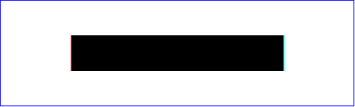
Example Use01 below has a simple 'use' on a 'rect'.
<?xml version="1.0" standalone="no"?>
<!DOCTYPE svg PUBLIC "-//W3C//DTD SVG 1.1//EN"
  "http://www.w3.org/Graphics/SVG/1.1/DTD/svg11.dtd">
<svg width="10cm" height="3cm" viewBox="0 0 100 30" version="1.1"
     xmlns="http://www.w3.org/2000/svg" xmlns:xlink="http://www.w3.org/1999/xlink">
  <desc>Example Use01 - Simple case of 'use' on a 'rect'</desc>
  <defs>
    <rect id="MyRect" width="60" height="10"/>
  </defs>
  <rect x=".1" y=".1" width="99.8" height="29.8"
        fill="none" stroke="blue" stroke-width=".2" />
  <use x="20" y="10" xlink:href="#MyRect" />
</svg>
|
|
View
this example as SVG (SVG-enabled browsers only)
The visual effect would be equivalent to the following document:
<?xml version="1.0" standalone="no"?>
<!DOCTYPE svg PUBLIC "-//W3C//DTD SVG 1.1//EN"
  "http://www.w3.org/Graphics/SVG/1.1/DTD/svg11.dtd">
<svg width="10cm" height="3cm" viewBox="0 0 100 30"
     xmlns="http://www.w3.org/2000/svg" version="1.1">
  <desc>Example Use01-GeneratedContent - Simple case of 'use' on a 'rect'</desc>
  <!-- 'defs' section left out -->

  <rect x=".1" y=".1" width="99.8" height="29.8"
        fill="none" stroke="blue" stroke-width=".2" />

  <!-- Start of generated content. Replaces 'use' -->
  <g transform="translate(20,10)">
    <rect width="60" height="10"/>
  </g>
  <!-- End of generated content -->

</svg>
View this
example as SVG (SVG-enabled browsers only)
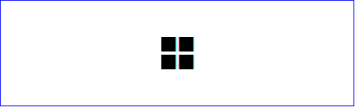
Example Use02 below has a 'use' on a 'symbol'.
<?xml version="1.0" standalone="no"?>
<!DOCTYPE svg PUBLIC "-//W3C//DTD SVG 1.1//EN"
  "http://www.w3.org/Graphics/SVG/1.1/DTD/svg11.dtd">
<svg width="10cm" height="3cm" viewBox="0 0 100 30" version="1.1"
     xmlns="http://www.w3.org/2000/svg" xmlns:xlink="http://www.w3.org/1999/xlink">
  <desc>Example Use02 - 'use' on a 'symbol'</desc>
  <defs>
    <symbol id="MySymbol" viewBox="0 0 20 20">
      <desc>MySymbol - four rectangles in a grid</desc>
      <rect x="1" y="1" width="8" height="8"/>
      <rect x="11" y="1" width="8" height="8"/>
      <rect x="1" y="11" width="8" height="8"/>
      <rect x="11" y="11" width="8" height="8"/>
    </symbol>
  </defs>
  <rect x=".1" y=".1" width="99.8" height="29.8"
        fill="none" stroke="blue" stroke-width=".2" />
  <use x="45" y="10" width="10" height="10"
       xlink:href="#MySymbol" />
</svg>
|
View
this example as SVG (SVG-enabled browsers only)
The visual effect would be equivalent to the following document:
<?xml version="1.0" standalone="no"?>
<!DOCTYPE svg PUBLIC "-//W3C//DTD SVG 1.1//EN"
  "http://www.w3.org/Graphics/SVG/1.1/DTD/svg11.dtd">
<svg width="10cm" height="3cm" viewBox="0 0 100 30"
     xmlns="http://www.w3.org/2000/svg" version="1.1">
  <desc>Example Use02-GeneratedContent - 'use' on a 'symbol'</desc>

  <!-- 'defs' section left out -->

  <rect x=".1" y=".1" width="99.8" height="29.8"
        fill="none" stroke="blue" stroke-width=".2" />

  <!-- Start of generated content. Replaces 'use' -->
  <g transform="translate(45, 10)" >
    <!-- Start of referenced 'symbol'. 'symbol' replaced by 'svg',
         with x,y,width,height=0,0,100%,100% -->
    <svg width="10" height="10"
         viewBox="0 0 20 20">
      <rect x="1" y="1" width="8" height="8"/>
      <rect x="11" y="1" width="8" height="8"/>
      <rect x="1" y="11" width="8" height="8"/>
      <rect x="11" y="11" width="8" height="8"/>
    </svg>
    <!-- End of referenced symbol -->
  </g>
  <!-- End of generated content -->

</svg>
View this
example as SVG (SVG-enabled browsers only)
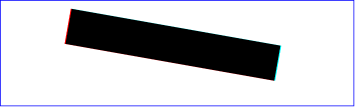
Example Use03 illustrates what happens when a 'use' has a transform attribute.
<?xml version="1.0" standalone="no"?>
<!DOCTYPE svg PUBLIC "-//W3C//DTD SVG 1.1//EN"
  "http://www.w3.org/Graphics/SVG/1.1/DTD/svg11.dtd">
<svg width="10cm" height="3cm" viewBox="0 0 100 30" version="1.1"
     xmlns="http://www.w3.org/2000/svg" xmlns:xlink="http://www.w3.org/1999/xlink">
  <desc>Example Use03 - 'use' with a 'transform' attribute</desc>
  <defs>
    <rect id="MyRect" x="0" y="0" width="60" height="10"/>
  </defs>
  <rect x=".1" y=".1" width="99.8" height="29.8"
        fill="none" stroke="blue" stroke-width=".2" />
  <use xlink:href="#MyRect"
       transform="translate(20,2.5) rotate(10)" />
</svg>
|
View
this example as SVG (SVG-enabled browsers only)
The visual effect would be equivalent to the following document:
<?xml version="1.0" standalone="no"?>
<!DOCTYPE svg PUBLIC "-//W3C//DTD SVG 1.1//EN"
  "http://www.w3.org/Graphics/SVG/1.1/DTD/svg11.dtd">
<svg width="10cm" height="3cm" viewBox="0 0 100 30"
     xmlns="http://www.w3.org/2000/svg" version="1.1">
  <desc>Example Use03-GeneratedContent - 'use' with a 'transform' attribute</desc>

  <!-- 'defs' section left out -->

  <rect x=".1" y=".1" width="99.8" height="29.8"
        fill="none" stroke="blue" stroke-width=".2" />

  <!-- Start of generated content. Replaces 'use' -->
  <g transform="translate(20,2.5) rotate(10)">
    <rect x="0" y="0" width="60" height="10"/>
  </g>
  <!-- End of generated content -->

</svg>
View this
example as SVG (SVG-enabled browsers only)
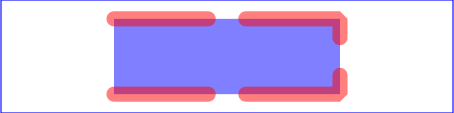
Example Use04 illustrates a 'use' element with various methods of applying CSS styling.
<?xml version="1.0" standalone="no"?>
<!DOCTYPE svg PUBLIC "-//W3C//DTD SVG 1.1//EN"
  "http://www.w3.org/Graphics/SVG/1.1/DTD/svg11.dtd">
<svg width="12cm" height="3cm" viewBox="0 0 1200 300" version="1.1"
     xmlns="http://www.w3.org/2000/svg" xmlns:xlink="http://www.w3.org/1999/xlink">
  <desc>Example Use04 - 'use' with CSS styling</desc>
  <defs style=" /* rule 9 */ stroke-miterlimit: 10" >
    <path id="MyPath" d="M300 50 L900 50 L900 250 L300 250"
                     class="MyPathClass"
                     style=" /* rule 10 */ stroke-dasharray:300,100" />
  </defs>
  <style type="text/css">
    <![CDATA[
      /* rule 1 */ #MyUse { fill: blue }
      /* rule 2 */ #MyPath { stroke: red }
      /* rule 3 */ use { fill-opacity: .5 }
      /* rule 4 */ path { stroke-opacity: .5 }
      /* rule 5 */ .MyUseClass { stroke-linecap: round }
      /* rule 6 */ .MyPathClass { stroke-linejoin: bevel }
      /* rule 7 */ use > path { shape-rendering: optimizeQuality }
      /* rule 8 */ g > path { visibility: hidden }
    ]]>
  </style>

  <rect x="0" y="0" width="1200" height="300"
         style="fill:none; stroke:blue; stroke-width:3"/>
  <g style=" /* rule 11 */ stroke-width:40">
    <use id="MyUse" xlink:href="#MyPath"
         class="MyUseClass"
         style="/* rule 12 */ stroke-dashoffset:50" />
  </g>
</svg>
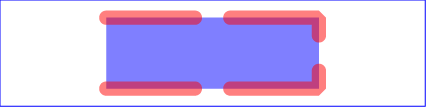
|
View
this example as SVG (SVG-enabled browsers only)
The visual effect would be equivalent to the following document. Observe that some of the style rules above apply to the generated content (i.e., rules 1-6, 10-12), whereas others do not (i.e., rules 7-9). The rules which do not affect the generated content are:
In the generated content below, the selectors that yield a match have been transferred into inline 'style' attributes for illustrative purposes.
<?xml version="1.0" standalone="no"?>
<!DOCTYPE svg PUBLIC "-//W3C//DTD SVG 1.1//EN"
  "http://www.w3.org/Graphics/SVG/1.1/DTD/svg11.dtd">
<svg width="12cm" height="3cm" viewBox="0 0 1200 300"
     xmlns="http://www.w3.org/2000/svg" version="1.1">
  <desc>Example Use04-GeneratedContent - 'use' with a 'transform' attribute</desc>

  <!-- 'style' and 'defs' sections left out -->

  <rect x="0" y="0" width="1200" height="300"
         style="fill:none; stroke:blue; stroke-width:3"/>
  <g style="/* rule 11 */ stroke-width:40">

    <!-- Start of generated content. Replaces 'use' -->
    <g style="/* rule 1 */ fill:blue;
                 /* rule 3 */ fill-opacity:.5;
                 /* rule 5 */ stroke-linecap:round;
                 /* rule 12 */ stroke-dashoffset:50" >
      <path d="M300 50 L900 50 L900 250 L300 250"
            style="/* rule 2 */ stroke:red;
                   /* rule 4 */ stroke-opacity:.5;
                   /* rule 6 */ stroke-linejoin: bevel;
                   /* rule 10 */ stroke-dasharray:300,100" />
    </g>
    <!-- End of generated content -->

  </g>
</svg>
View this
example as SVG (SVG-enabled browsers only)
When a 'use' references another element which is another 'use' or whose content contains a 'use' element, then the deep cloning approach described above is recursive.
<!ENTITY % SVG.use.element "INCLUDE" >
<![%SVG.use.element;[
<!ENTITY % SVG.use.content
    "(( %SVG.Description.class; )*, ( %SVG.Animation.class; )*)"
>
<!ELEMENT %SVG.use.qname; %SVG.use.content; >
<!-- end of SVG.use.element -->]]>

<!ENTITY % SVG.use.attlist "INCLUDE" >
<![%SVG.use.attlist;[
<!ATTLIST %SVG.use.qname;
    %SVG.Core.attrib;
    %SVG.Conditional.attrib;
    %SVG.Style.attrib;
    %SVG.Presentation.attrib;
    %SVG.GraphicalEvents.attrib;
    %SVG.XLinkEmbed.attrib;
    %SVG.External.attrib;
    x %Coordinate.datatype; #IMPLIED
    y %Coordinate.datatype; #IMPLIED
    width %Length.datatype; #IMPLIED
    height %Length.datatype; #IMPLIED
    transform %TransformList.datatype; #IMPLIED
>
|
Attribute definitions:
The 'image' element indicates that the contents of a complete file are to be rendered into a given rectangle within the current user coordinate system. The 'image' element can refer to raster image files such as PNG or JPEG or to files with MIME type of "image/svg+xml". Conforming SVG viewers need to support at least PNG, JPEG and SVG format files.
The result of processing an 'image' is always a four-channel RGBA result. When an 'image' element references a raster image file such as PNG or JPEG files which only has three channels (RGB), then the effect is as if the object were converted into a 4-channel RGBA image with the alpha channel uniformly set to 1. For a single-channel raster image, the effect is as if the object were converted into a 4-channel RGBA image, where the single channel from the referenced object is used to compute the three color channels and the alpha channel is uniformly set to 1.
An 'image' element establishes a new viewport for the referenced file as described in Establishing a new viewport. The bounds for the new viewport are defined by attributes x, y, width and height. The placement and scaling of the referenced image are controlled by the preserveAspectRatio attribute on the 'image' element.
If the value of the
preserveAspectRatio
attribute on the 'image'
element starts with 'defer' then the referenced content should
be examined to see if it contains a definition for
preserveAspectRatio, in the case of referenced SVG
content this would be the presence of the
preserveAspectRatio attribute on the root SVG
element. If the referenced content contains a definition for
preserveAspectRatio then it should be used as the
value of preserveAspectRatio (ignoring the
rest of the preserveAspectRatio attribute on
the image element). If the referenced content does not
contain a definition for
preserveAspectRatio then the
remainder of the preserveAspectRatio attribute on
the 'image' element should be
used as the value of the
preserveAspectRatio attribute.
Note that when an 'image' element references an SVG image, the processing rules described in the previous paragraph mean that the preserveAspectRatio attribute as well as the clip and overflow properties on the root element in the referenced SVG image are ignored (like the x, y, width and height attributes are ignored)."
Instead, the preserveAspectRatio attribute on the referencing 'image' element defines how the SVG image content is fitted into the viewport and the clip and overflow properties on the 'image' element define how the SVG image content is clipped (or not) relative to the viewport.
The value of the 'viewBox' attribute to use when
evaluating the preserveAspectRatio attribute is
defined by the referenced content. For content that clearly
identifies a viewBox (e.g. an SVG file with the 'viewBox' attribute on the
outermost svg element) that value should be used, for most
raster content (PNG, JPEG) the bounds of the image should be
used, where no value is readily available (e.g. an SVG file
with no 'viewBox' attribute on the
outermost 'svg' element) the
preserveAspectRatio attribute is ignored, and only
the translate due to the 'x' & 'y' attributes of the viewport is
used to display the content.
For example, if the image element referenced a PNG or JPEG and
preserveAspectRatio="xMinYMin
meet", then the aspect ratio of the raster would be
preserved (which means that the scale factor from image's
coordinates to current user space coordinates would be the same
for both X and Y), the raster would be sized as large as
possible while ensuring that the entire raster fits within the
viewport, and the top/left of the raster would be aligned with
the top/left of the viewport as defined by the attributes 'x', 'y', 'width' and 'height' on the 'image' element. If the value
of preserveAspectRatio was
'none' then aspect ratio of the image would not be preserved.
The image would be fitted such that the top/left corner of the
raster exactly aligns with coordinate (x,
y) and the bottom/right corner of
the raster exactly aligns with coordinate (x+width,y+height).
The resource referenced by the
'image' element represents a separate document which
generates its own parse tree and document object model (if the
resource is XML). Thus, there is no inheritance of properties
into the image.
Unlike
'use', the 'image'
element cannot reference elements within an SVG file.
<!ENTITY % SVG.image.element "INCLUDE" >
<![%SVG.image.element;[
<!ENTITY % SVG.image.content
    "(( %SVG.Description.class; )*, ( %SVG.Animation.class; )*)"
>
<!ELEMENT %SVG.image.qname; %SVG.image.content; >
<!-- end of SVG.image.element -->]]>

<!ENTITY % SVG.image.attlist "INCLUDE" >
<![%SVG.image.attlist;[
<!ATTLIST %SVG.image.qname;
    %SVG.Core.attrib;
    %SVG.Conditional.attrib;
    %SVG.Style.attrib;
    %SVG.Viewport.attrib;
    %SVG.Color.attrib;
    %SVG.Opacity.attrib;
    %SVG.Graphics.attrib;
    %SVG.Profile.attrib;
    %SVG.Clip.attrib;
    %SVG.Mask.attrib;
    %SVG.Filter.attrib;
    %SVG.GraphicalEvents.attrib;
    %SVG.Cursor.attrib;
    %SVG.XLinkEmbed.attrib;
    %SVG.External.attrib;
    x %Coordinate.datatype; #IMPLIED
    y %Coordinate.datatype; #IMPLIED
    width %Length.datatype; #REQUIRED
    height %Length.datatype; #REQUIRED
    preserveAspectRatio %PreserveAspectRatioSpec.datatype; 'xMidYMid meet'
    transform %TransformList.datatype; #IMPLIED
>
|
Attribute definitions:
An example:
<?xml version="1.0" standalone="no"?>
<!DOCTYPE svg PUBLIC "-//W3C//DTD SVG 1.1//EN"
  "http://www.w3.org/Graphics/SVG/1.1/DTD/svg11.dtd">
<svg width="4in" height="3in" version="1.1"
     xmlns="http://www.w3.org/2000/svg" xmlns:xlink="http://www.w3.org/1999/xlink">
  <desc>This graphic links to an external image
  </desc>
  <image x="200" y="200" width="100px" height="100px"
         xlink:href="myimage.png">
    <title>My image</title>
  </image>
</svg>
SVG contains a 'switch' element along with attributes requiredFeatures, requiredExtensions and systemLanguage to provide an ability to specify alternate viewing depending on the capabilities of a given user agent or the user's language.
<!ENTITY % SVG.Conditional.extra.attrib "" > <!ENTITY % SVG.Conditional.attrib "requiredFeatures %FeatureList.datatype; #IMPLIED requiredExtensions %ExtensionList.datatype; #IMPLIED systemLanguage %LanguageCodes.datatype; #IMPLIED %SVG.Conditional.extra.attrib;" > |
Attributes requiredFeatures, requiredExtensions and systemLanguage act as tests and return either true or false results. The 'switch' renders the first of its children for which all of these attributes test true. If the given attribute is not specified, then a true value is assumed.
Similar to the 'display' property, conditional processing attributes only affect the direct rendering of elements and do not prevent elements from being successfully referenced by other elements (such as via a 'use').
In consequence:
The 'switch' element evaluates the requiredFeatures, requiredExtensions and systemLanguage attributes on its direct child elements in order, and then processes and renders the first child for which these attributes evaluate to true. All others will be bypassed and therefore not rendered. If the child element is a container element such as a 'g', then the entire subtree is either processed/rendered or bypassed/not rendered.
Note that the values of properties 'display' and 'visibility' have no effect on 'switch' element processing. In particular, setting 'display' to none on a child of a 'switch' element has no effect on true/false testing associated with 'switch' element processing.
<!ENTITY % SVG.switch.element "INCLUDE" >
<![%SVG.switch.element;[
<!ENTITY % SVG.switch.content
    "(( %SVG.Description.class; )*, ( %SVG.svg.qname; | %SVG.g.qname;
      | %SVG.use.qname; | %SVG.text.qname; | %SVG.Animation.class;
        %SVG.Conditional.class; %SVG.Image.class; %SVG.Shape.class;
        %SVG.Hyperlink.class; %SVG.Extensibility.class; )*)"
>
<!ELEMENT %SVG.switch.qname; %SVG.switch.content; >
<!-- end of SVG.switch.element -->]]>

<!ENTITY % SVG.switch.attlist "INCLUDE" >
<![%SVG.switch.attlist;[
<!ATTLIST %SVG.switch.qname;
    %SVG.Core.attrib;
    %SVG.Conditional.attrib;
    %SVG.Style.attrib;
    %SVG.Presentation.attrib;
    %SVG.GraphicalEvents.attrib;
    %SVG.External.attrib;
    transform %TransformList.datatype; #IMPLIED
>
|
For more information and an example, see Embedding foreign object types.
Definition of requiredFeatures:
If the attribute is not present, then its implicit return value is "true". If a null string or empty string value is given to attribute requiredFeatures, the attribute returns "false".
requiredFeatures is often used in conjunction with the 'switch' element. If the requiredFeatures is used in other situations, then it represents a simple switch on the given element whether to render the element or not.
The requiredExtensions attribute defines a list of required language extensions. Language extensions are capabilities within a user agent that go beyond the feature set defined in this specification. Each extension is identified by a URI reference.
Definition of requiredExtensions:
If a given URI reference contains white space within itself, that white space must be escaped.
If the attribute is not present, then its implicit return value is "true". If a null string or empty string value is given to attribute requiredExtensions, the attribute returns "false".
requiredExtensions is often used in conjunction with the 'switch' element. If the requiredExtensions is used in other situations, then it represents a simple switch on the given element whether to render the element or not.
The URI names for the extension should include versioning information, such as "http://example.org/SVGExtensionXYZ/1.0", so that script writers can distinguish between different versions of a given extension.
The attribute value is a comma-separated list of language names as defined in [RFC3066].
Evaluates to "true" if one of the languages indicated by user preferences exactly equals one of the languages given in the value of this parameter, or if one of the languages indicated by user preferences exactly equals a prefix of one of the languages given in the value of this parameter such that the first tag character following the prefix is "-".
Evaluates to "false" otherwise.
Note: This use of a prefix matching rule does not imply that language tags are assigned to languages in such a way that it is always true that if a user understands a language with a certain tag, then this user will also understand all languages with tags for which this tag is a prefix.
The prefix rule simply allows the use of prefix tags if this is the case.
Implementation note: When making the choice of linguistic preference available to the user, implementers should take into account the fact that users are not familiar with the details of language matching as described above, and should provide appropriate guidance. As an example, users may assume that on selecting "en-gb", they will be served any kind of English document if British English is not available. The user interface for setting user preferences should guide the user to add "en" to get the best matching behavior.
Multiple languages MAY be listed for content that is intended for multiple audiences. For example, content that is presented simultaneously in the original Maori and English versions, would call for:
<text systemLanguage="mi, en"><!-- content
      goes here --></text>
However, just because multiple languages are present within the object on which the systemLanguage test attribute is placed, this does not mean that it is intended for multiple linguistic audiences. An example would be a beginner's language primer, such as "A First Lesson in Latin," which is clearly intended to be used by an English-literate audience. In this case, the systemLanguage test attribute should only include "en".
Authoring note: Authors should realize that if several alternative language objects are enclosed in a 'switch', and none of them matches, this may lead to situations where no content is displayed. It is thus recommended to include a "catch-all" choice at the end of such a 'switch' which is acceptable in all cases.
For the systemLanguage attribute: Animatable: no.
If the attribute is not present, then its implicit return value is "true". If a null string or empty string value is given to attribute systemLanguage, the attribute returns "false".
systemLanguage is often used in conjunction with the 'switch' element. If the systemLanguage is used in other situations, then it represents a simple switch on the given element whether to render the element or not.
The following list describes the applicability of the test attributes to the elements that do not directly produce rendering.
Documents often reference and use the contents of other files (and other Web resources) as part of their rendering. In some cases, authors want to specify that particular resources are required for a document to be considered correct.
Attribute externalResourcesRequired is available on all container elements and to all elements which potentially can reference external resources. It specifies whether referenced resources that are not part of the current document are required for proper rendering of the given container element or graphics element.
Attribute definition:
This attribute applies to all types of resource references, including style sheets, color profiles (see Color profile descriptions) and fonts specified by a URI reference using a 'font-face' element or a CSS @font-face specification. In particular, if an element sets externalResourcesRequired="true", then all style sheets must be available since any style sheet might affect the rendering of that element.
Attribute externalResourcesRequired is not inheritable (from a sense of attribute value inheritance), but if set on a container element, its value will apply to all elements within the container.
Because setting externalResourcesRequired="true" on a container element can have the effect of disabling progressive display of the contents of that container, tools that generate SVG content are cautioned against using simply setting externalResourcesRequired="true" on the outermost 'svg' element on a universal basis. Instead, it is better to specify externalResourcesRequired="true" on those particular graphics elements or container elements which specify need the availability of external resources in order to render properly.
For externalResourcesRequired: Animatable: no.
The id and xml:base attributes are available on all SVG elements:
Attribute definitions:
<!ENTITY % SVG.id.attrib "id ID #IMPLIED" > <!ENTITY % SVG.base.attrib "xml:base %URI.datatype; #IMPLIED" > <!ENTITY % SVG.lang.attrib "xml:lang %LanguageCode.datatype; #IMPLIED" > <!ENTITY % SVG.space.attrib "xml:space ( default | preserve ) #IMPLIED" > <!ENTITY % SVG.Core.extra.attrib "" > <!ENTITY % SVG.Core.attrib "%SVG.id.attrib; %SVG.base.attrib; %SVG.lang.attrib; %SVG.space.attrib; %SVG.Core.extra.attrib;" > |
Attribute definitions:
The Core Attribute Module defines the attribute set StdAttrs that is the core set of attributes that can be present on any element.
| Collection Name | Attributes in Collection |
|---|---|
| StdAttrs | id, xml:base, xml:lang, xml:space |
| Elements | Attributes | Content Model |
|---|---|---|
| svg | StdAttrs, TestAttrs, StyleAttrs, x, y, width, height, viewBox, preserveAspectRatio, zoomAndPan, version, baseProfile, contentScriptType, contentStyleType, ExternalResourcesRequiredAttrs, PresentationAttrsAll, GraphicsElementEvents, DocumentEvents | (DescriptionElements | StructureElements | GraphicalElements | ImageElements | ViewElements | ConditionalElements | HyperlinkingElements | TextElements | ScriptElements | StyleElements | MarkerElements | ClipElements | MaskElements | GradientElements | PatternElements | FilterElements | CursorElements | FontElements | AnimationElements | ColorElements)* |
| g | StdAttrs, TestAttrs, StyleAttrs, ExternalResourcesRequiredAttrs, PresentationAttrsAll, GraphicsElementEvents, transform | (DescriptionElements | StructureElements | GraphicalElements | ImageElements | ViewElements | ConditionalElements | HyperlinkingElements | TextElements | ScriptElements | StyleElements | MarkerElements | ClipElements | MaskElements | GradientElements | PatternElements | FilterElements | CursorElements | FontElements | AnimationElements | ColorElements)* |
| defs | StdAttrs, TestAttrs, StyleAttrs, ExternalResourcesRequiredAttrs, PresentationAttrsAll, GraphicsElementEvents, transform | (DescriptionElements | StructureElements | GraphicalElements | ImageElements | ViewElements | ConditionalElements | HyperlinkingElements | TextElements | ScriptElements | StyleElements | MarkerElements | ClipElements | MaskElements | GradientElements | PatternElements | FilterElements | CursorElements | FontElements | AnimationElements | ColorElements)* |
| desc | StdAttrs, StyleAttrs | (PCDATA)* |
| title | StdAttrs, StyleAttrs | (PCDATA)* |
| metadata | StdAttrs | (PCDATA)* |
| symbol | StdAttrs, StyleAttrs, ExternalResourcesRequiredAttrs, viewBox, preserveAspectRatio, PresentationAttrsAll, GraphicsElementEventAttrs | (DescriptionElements | StructureElements | GraphicalElements | ImageElements | ViewElements | ConditionalElements | HyperlinkingElements | TextElements | ScriptElements | StyleElements | MarkerElements | ClipElements | MaskElements | GradientElements | PatternElements | FilterElements | CursorElements | FontElements | AnimationElements | ColorElements)* |
| use | StdAttrs, StyleAttrs, TestAttrs, transform, x, y, width, height, xlink:href, XLinkRefAttrs, PresentationAttrsAll, GraphicsElementEventAttrs | (DescriptionElements | AnimationElements)* |
| Elements | Attributes | Content Model |
|---|---|---|
| svg | StdAttrs, TestAttrs, StyleAttrs, x, y, width, height, viewBox, preserveAspectRatio, zoomAndPan, version, baseProfile, contentScriptType, contentStyleType, ExternalResourcesRequiredAttrs, PresentationAttrsAll, GraphicsElementEvents, DocumentEvents | (DescriptionElements | StructureElements | GraphicalElements | ImageElements | ViewElements | ConditionalElements | HyperlinkingElements | TextElements | ScriptElements | StyleElements | MarkerElements | ClipElements | MaskElements | GradientElements | PatternElements | FilterElements | CursorElements | FontElements | AnimationElements | ColorElements)* |
| g | StdAttrs, TestAttrs, StyleAttrs, ExternalResourcesRequiredAttrs, PresentationAttrsAll, GraphicsElementEvents, transform | (DescriptionElements | StructureElements | GraphicalElements | ImageElements | ViewElements | ConditionalElements | HyperlinkingElements | TextElements | ScriptElements | StyleElements | MarkerElements | ClipElements | MaskElements | GradientElements | PatternElements | FilterElements | CursorElements | FontElements | AnimationElements | ColorElements)* |
| defs | StdAttrs, TestAttrs, StyleAttrs, ExternalResourcesRequiredAttrs, PresentationAttrsAll, GraphicsElementEvents, transform | (DescriptionElements | StructureElements | GraphicalElements | ImageElements | ViewElements | ConditionalElements | HyperlinkingElements | TextElements | ScriptElements | StyleElements | MarkerElements | ClipElements | MaskElements | GradientElements | PatternElements | FilterElements | CursorElements | FontElements | AnimationElements | ColorElements)* |
| desc | StdAttrs, StyleAttrs | (PCDATA)* |
| title | StdAttrs, StyleAttrs | (PCDATA)* |
| metadata | StdAttrs | (PCDATA)* |
| use | StdAttrs, StyleAttrs, TestAttrs, transform, x, y, width, height, xlink:href, XLinkRefAttrs, PresentationAttrsAll, GraphicsElementEventAttrs | (DescriptionElements | AnimationElements)* |
The Container Attribute Module defines the ContainerPresentationAttrs attribute set.
| Collection Name | Attributes in Collection |
|---|---|
| ContainerPresentationAttrs | enable-background |
| Elements | Attributes | Content Model |
|---|---|---|
| switch | StdAttrs, TestAttrs, ExternalResourcesRequiredAttrs, StyleAttrs, transform, PresentationAttrsAll, GraphicsElementsEventsAttrs | (DescriptionElements | GraphicalElements | TextElements | StructureElements | ImageElements | HyperlinkingElements | ExtensibilityElements | AnimationElements)* |
The Conditional Processing Module defines the ConditionalElements content set.
| Content Set Name | Elements in Content Set |
|---|---|
| ConditionalElements | switch |
The Conditional Processing Module defines the TestAttrs attribute set.
| Collection Name | Attributes in Collection |
|---|---|
| TestAttrs | requiredFeatures, requiredExtensions, systemLanguage, requiredFeatureList |
| Elements | Attributes | Content Model |
|---|---|---|
| image | StdAttrs, XLinkRefAttrs, TestAttrs, StyleAttrs, ExternalResourcesRequiredAttrs, GraphicsElementsEventsAttrs, preserveAspectRatio, ColorPresentationAttrs, OpacityPresentationAttrs, GraphicsPresentationAttrs, CursorPresentationAttrs, FilterPresentationAttrs, MaskPresentationAttrs, PointerEventsPresentationAttrs, ClipPresentationAttrs, ImagePresentationAttrs, ViewportPresentationAttrs, transform, x, y, width, height, xlink:href | (DescriptionElements | AnimationElements)* |
The Image Module defines the ImageElements content set.
| Content Set Name | Elements in Content Set |
|---|---|
| ImageElements | image |
The following interfaces are defined below: SVGDocument, SVGSVGElement, SVGGElement, SVGDefsElement, SVGDescElement, SVGTitleElement, SVGSymbolElement, SVGUseElement, SVGElementInstance, SVGElementInstanceList, SVGImageElement, SVGSwitchElement, GetSVGDocument.
When an 'svg' element is embedded inline as a component of a document from another namespace, such as when an 'svg' element is embedded inline within an XHTML document [XHTML], then an SVGDocument object will not exist; instead, the root object in the document object hierarchy will be a Document object of a different type, such as an HTMLDocument object.
However, an SVGDocument object will indeed exist when the root element of the XML document hierarchy is an 'svg' element, such as when viewing a stand-alone SVG file (i.e., a file with MIME type "image/svg+xml"). In this case, the SVGDocument object will be the root object of the document object model hierarchy.
In the case where an SVG document is embedded by reference, such as when an XHTML document has an 'object' element whose href attribute references an SVG document (i.e., a document whose MIME type is "image/svg+xml" and whose root element is thus an 'svg' element), there will exist two distinct DOM hierarchies. The first DOM hierarchy will be for the referencing document (e.g., an XHTML document). The second DOM hierarchy will be for the referenced SVG document. In this second DOM hierarchy, the root object of the document object model hierarchy is an SVGDocument object.
The SVGDocument interface contains a similar list of attributes and methods to the HTMLDocument interface described in the Document Object Model (HTML) Level 1 chapter of the [DOM1] specification.
interface SVGDocument :
                Document,
                events::DocumentEvent {

  readonly attribute DOMString    title;
  readonly attribute DOMString     referrer;
  readonly attribute DOMString      domain;
  readonly attribute DOMString      URL;
  readonly attribute SVGSVGElement rootElement;
};
A key interface definition is the SVGSVGElement interface, which is the interface that corresponds to the 'svg' element. This interface contains various miscellaneous commonly-used utility methods, such as matrix operations and the ability to control the time of redraw on visual rendering devices.
SVGSVGElement extends ViewCSS and DocumentCSS to provide access to the computed values of properties and the override style sheet as described in DOM2.
interface SVGSVGElement :
                SVGElement,
                SVGTests,
                SVGLangSpace,
                SVGExternalResourcesRequired,
                SVGStylable,
                SVGLocatable,
                SVGFitToViewBox,
                SVGZoomAndPan,
                events::EventTarget,
                events::DocumentEvent,
                css::ViewCSS,
                css::DocumentCSS {

  readonly attribute SVGAnimatedLength x;
  readonly attribute SVGAnimatedLength y;
  readonly attribute SVGAnimatedLength width;
  readonly attribute SVGAnimatedLength height;
           attribute DOMString         contentScriptType;
                       // raises DOMException on setting
           attribute DOMString         contentStyleType;
                       // raises DOMException on setting
  readonly attribute SVGRect           viewport;
  readonly attribute float pixelUnitToMillimeterX;
  readonly attribute float pixelUnitToMillimeterY;
  readonly attribute float screenPixelToMillimeterX;
  readonly attribute float screenPixelToMillimeterY;
           attribute boolean useCurrentView;
                       // raises DOMException on setting
  readonly attribute SVGViewSpec currentView;
           attribute float currentScale;
                       // raises DOMException on setting
  readonly attribute SVGPoint currentTranslate;

  unsigned long suspendRedraw ( in unsigned long max_wait_milliseconds );
  void          unsuspendRedraw ( in unsigned long suspend_handle_id )
                  raises( DOMException );
  void          unsuspendRedrawAll (  );
  void          forceRedraw (  );
  void          pauseAnimations (  );
  void          unpauseAnimations (  );
  boolean       animationsPaused (  );
  float         getCurrentTime (  );
  void          setCurrentTime ( in float seconds );
  NodeList      getIntersectionList ( in SVGRect rect, in SVGElement referenceElement );
  NodeList      getEnclosureList ( in SVGRect rect, in SVGElement referenceElement );
  boolean       checkIntersection ( in SVGElement element, in SVGRect rect );
  boolean       checkEnclosure ( in SVGElement element, in SVGRect rect );
  void          deselectAll (  );
  SVGNumber              createSVGNumber (  );
  SVGLength              createSVGLength (  );
  SVGAngle               createSVGAngle (  );
  SVGPoint               createSVGPoint (  );
  SVGMatrix              createSVGMatrix (  );
  SVGRect                createSVGRect (  );
  SVGTransform           createSVGTransform (  );
  SVGTransform     createSVGTransformFromMatrix ( in SVGMatrix matrix );
  Element         getElementById ( in DOMString elementId );
};
| DOMException |
NO_MODIFICATION_ALLOWED_ERR: Raised on an
attempt to change the value of a readonly
attribute.
|
| DOMException |
NO_MODIFICATION_ALLOWED_ERR: Raised on an
attempt to change the value of a readonly
attribute.
|
The position and size of the viewport (implicit or explicit) that corresponds to this 'svg' element. When the user agent is actually rendering the content, then the position and size values represent the actual values when rendering. The position and size values are unitless values in the coordinate system of the parent element. If no parent element exists (i.e., 'svg' element represents the root of the document tree), if this SVG document is embedded as part of another document (e.g., via the HTML 'object' element), then the position and size are unitless values in the coordinate system of the parent document. (If the parent uses CSS or XSL layout, then unitless values represent pixel units for the current CSS or XSL viewport, as described in the CSS2 specification.) If the parent element does not have a coordinate system, then the user agent should provide reasonable default values for this attribute.
The object itself and its contents are both readonly.
| DOMException |
NO_MODIFICATION_ALLOWED_ERR: Raised on an
attempt to change the value of a readonly
attribute.
|
The object itself and its contents are both readonly.
| DOMException |
NO_MODIFICATION_ALLOWED_ERR: Raised on an
attempt to change the value of a readonly
attribute.
|
| in unsigned long max_wait_milliseconds | The amount of time in milliseconds to hold off before redrawing the device. Values greater than 60 seconds will be truncated down to 60 seconds. |
| unsigned long | A number which acts as a unique identifier for the given suspendRedraw() call. This value must be passed as the parameter to the corresponding unsuspendRedraw() method call. |
| in unsigned long suspend_handle_id | A number which acts as a unique identifier for the desired suspendRedraw() call. The number supplied must be a value returned from a previous call to suspendRedraw() |
| DOMException |
This method will raise a DOMException with
value NOT_FOUND_ERR if an
invalid value (i.e., no such
suspend_handle_id is active) for
suspend_handle_id is provided.
|
| boolean | Boolean indicating whether this SVG document fragment is in a paused state. |
| float | The current time in seconds. |
| in float seconds | The new current time in seconds relative to the start time for the current SVG document fragment. |
| in SVGRect rect | The test rectangle. The values are in the initial coordinate system for the current 'svg' element. | |
| in SVGElement referenceElement | If not null, then only return elements whose drawing order has them below the given reference element. |
| NodeList | A list of Elements whose content intersects the supplied rectangle. |
| in SVGRect rect | The test rectangle. The values are in the initial coordinate system for the current 'svg' element. | |
| in SVGElement referenceElement | If not null, then only return elements whose drawing order has them below the given reference element. |
| NodeList | A list of Elements whose content is enclosed by the supplied rectangle. |
| in SVGElement element | The element on which to perform the given test. | |
| in SVGRect rect | The test rectangle. The values are in the initial coordinate system for the current 'svg' element. |
| boolean | True or false, depending on whether the given element intersects the supplied rectangle. |
| in SVGElement element | The element on which to perform the given test. | |
| in SVGRect rect | The test rectangle. The values are in the initial coordinate system for the current 'svg' element. |
| boolean | True or false, depending on whether the given element is enclosed by the supplied rectangle. |
| SVGNumber | An SVGNumber object. |
| SVGLength | An SVGLength object. |
| SVGAngle | An SVGAngle object. |
| SVGPoint | An SVGPoint object. |
| SVGMatrix | An SVGMatrix object. |
| SVGRect | An SVGRect object. |
| SVGTransform | An SVGTransform object. |
| in SVGMatrix matrix | The transform matrix. |
| SVGTransform | An SVGTransform object. |
| in DOMString elementId |
The unique id value for an element. |
| Element | The matching element. |
The SVGGElement interface corresponds to the 'g' element.
interface SVGGElement :
                SVGElement,
                SVGTests,
                SVGLangSpace,
                SVGExternalResourcesRequired,
                SVGStylable,
                SVGTransformable,
                events::EventTarget {};
The SVGDefsElement interface corresponds to the 'defs' element.
interface SVGDefsElement :
                SVGElement,
                SVGTests,
                SVGLangSpace,
                SVGExternalResourcesRequired,
                SVGStylable,
                SVGTransformable,
                events::EventTarget {};
The SVGDescElement interface corresponds to the 'desc' element.
interface SVGDescElement :
                SVGElement,
                SVGLangSpace,
                SVGStylable {};
The SVGTitleElement interface corresponds to the 'title' element.
interface SVGTitleElement :
                SVGElement,
                SVGLangSpace,
                SVGStylable {};
The SVGSymbolElement interface corresponds to the 'symbol' element.
interface SVGSymbolElement :
                SVGElement,
                SVGLangSpace,
                SVGExternalResourcesRequired,
                SVGStylable,
                SVGFitToViewBox,
                events::EventTarget {};
The SVGUseElement interface corresponds to the 'use' element.
interface SVGUseElement :
                SVGElement,
                SVGURIReference,
                SVGTests,
                SVGLangSpace,
                SVGExternalResourcesRequired,
                SVGStylable,
                SVGTransformable,
                events::EventTarget {

  readonly attribute SVGAnimatedLength   x;
  readonly attribute SVGAnimatedLength   y;
  readonly attribute SVGAnimatedLength   width;
  readonly attribute SVGAnimatedLength   height;
  readonly attribute SVGElementInstance instanceRoot;
  readonly attribute SVGElementInstance animatedInstanceRoot;
};
For each 'use' element, the SVG DOM maintains a shadow tree (the "instance tree") of objects of type SVGElementInstance. A SVGElementInstance represents a single node in the instance tree. The root object in the instance tree is pointed to by the instanceRoot attribute on the SVGUseElement object for the corresponding 'use' element.
If the 'use' element references a simple graphics element such as a 'rect', then there is only a single SVGElementInstance object, and the correspondingElement attribute on this SVGElementInstance object is the SVGRectElement that corresponds to the referenced 'rect' element.
If the 'use' element references a 'g' which contains two 'rect' elements, then the instance tree contains three SVGElementInstance objects, a root SVGElementInstance object whose correspondingElement is the SVGGElement object for the 'g', and then two child SVGElementInstance objects, each of which has its correspondingElement that is an SVGRectElement object.
If the referenced object is itself a 'use', or if there are 'use' subelements within the referenced object, the instance tree will contain recursive expansion of the indirect references to form a complete tree. For example, if a 'use' element references a 'g', and the 'g' itself contains a 'use', and that 'use' references a 'rect', then the instance tree for the original (outermost) 'use' will consist of a hierarchy of SVGElementInstance objects, as follows:
SVGElementInstance #1 (parentNode=null, firstChild=#2, correspondingElement is the 'g')
  SVGElementInstance #2 (parentNode=#1, firstChild=#3, correspondingElement is the other 'use')
    SVGElementInstance #3 (parentNode=#2, firstChild=null, corresponding Element is the 'rect')
interface SVGElementInstance : events::EventTarget {
  readonly attribute SVGElement correspondingElement;
  readonly attribute SVGUseElement correspondingUseElement;
  readonly attribute SVGElementInstance parentNode;
  readonly attribute SVGElementInstanceList childNodes;
  readonly attribute SVGElementInstance firstChild;
  readonly attribute SVGElementInstance lastChild;
  readonly attribute SVGElementInstance previousSibling;
  readonly attribute SVGElementInstance nextSibling;
};
The SVGElementInstanceList interface provides the abstraction of an ordered collection of SVGElementInstance objects, without defining or constraining how this collection is implemented.
interface SVGElementInstanceList {

  readonly attribute unsigned long length;

  SVGElementInstance item ( in unsigned long index );
};
Returns the indexth item in the collection. If index is greater than or equal to the number of nodes in the list, this returns null.
| in unsigned long index | Index into the collection. |
| SVGElementInstance | The SVGElementInstance object at the indexth position in the SVGElementInstanceList, or null if that is not a valid index. |
The SVGImageElement interface corresponds to the 'image' element.
interface SVGImageElement :
                SVGElement,
                SVGURIReference,
                SVGTests,
                SVGLangSpace,
                SVGExternalResourcesRequired,
                SVGStylable,
                SVGTransformable,
                events::EventTarget {

  readonly attribute SVGAnimatedLength x;
  readonly attribute SVGAnimatedLength y;
  readonly attribute SVGAnimatedLength width;
  readonly attribute SVGAnimatedLength height;
  readonly attribute SVGAnimatedPreserveAspectRatio preserveAspectRatio;
};
The SVGSwitchElement interface corresponds to the 'switch' element.
interface SVGSwitchElement :
                SVGElement,
                SVGTests,
                SVGLangSpace,
                SVGExternalResourcesRequired,
                SVGStylable,
                SVGTransformable,
                events::EventTarget {};
In the case where an SVG document is embedded by reference, such as when an XHTML document has an 'object' element whose href (or equivalent) attribute references an SVG document (i.e., a document whose MIME type is "image/svg+xml" and whose root element is thus an 'svg' element), the SVG user agent is required to implement the GetSVGDocument interface for the element which references the SVG document (e.g., the HTML 'object' or comparable referencing elements).
interface GetSVGDocument {

  SVGDocument getSVGDocument (  )
                  raises( DOMException );
};
Returns the SVGDocument object for the referenced SVG document.
| SVGDocument | The SVGDocument object for the referenced SVG document. |
| DOMException |
NOT_SUPPORTED_ERR: No SVGDocument object is
available.
|