Authoring Tool Accessibility Guidelines (ATAG) 2.0
Overview
May 2007 Update
Jan Richards
Interim Staff Contact & Editor, W3C/WAI AUWG
Adaptive Technology Resource Centre (ATRC), University
of Toronto
ATAG Overview and Status
ATAG 2.0 Has Two Parts
- Part A : Make the authoring tool user interface accessible
- Part B: Support the production of accessible content
ATAG Part A
- Follows a similar pattern to WCAG 2.0:
ATAG Part A (cont.)
- Part A requirements cover general software accessibility issues
- Part A also covers some issues that are specific to authoring tools
including:
- ability to change display settings without affecting the markup
being authored
- ability to navigate and edit using hierarchies intrinsic in some
kinds of content
- preview functions
- etc.
The Key Role of ATAG
- We can’t rely on the average author to implement WCAG on their
own because
- accessibility requirements can be complex to manage (e.g. keeping
navigation consistent)
- most authors are not (nor do they wish to be) accessibility
experts
- the delivery of Web content is becoming more complex
- and tools are being produced that hide many of the low-level
details of the final content
The Key Role of ATAG (cont.)
- The average author needs accessibility to be handled like their other
authoring constraints (spelling, grammar, syntax, etc.)
ATAG: Part B
- B.1.1 Support content types that enable the creation of content that is
accessible
- B.1.2 Ensure the authoring tool preserves accessibility information
- B.1.3 Ensure automatically generated content is accessible
- B.2.1 Prompt authors to create accessible content
- B.2.2 Assist authors in checking for accessibility problems
- B.2.3 Assist authors in repairing accessibility problems
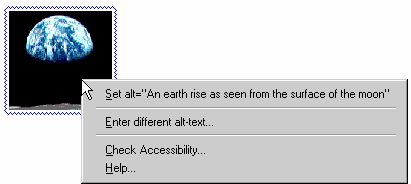
- B.2.4 Assist authors to manage, edit, and reuse equivalent alternatives
for non-text objects
- B.2.5 Assist authors to use accessible templates and other pre-authored
content
- B.2.6 Provide authors with a tutorial on the process of accessible
authoring
- B.3.1 Ensure the most accessible authoring action for achieving an
authoring outcome is given prominence
- B.3.2. Ensure sequential authoring processes integrate accessible
authoring practices
- B.3.3 Ensure features of the authoring tool supporting the production
of accessible content are available
- B.3.4 Ensure features of the authoring tool supporting the production
of accessible content are documented
- B.3.5 Ensure any authoring practices demonstrated in documentation are
accessible
- The levels are the same as for ATAG 1.0 (“A”,
“AA”, “AAA”)
- An “authoring tool” can be any combination of software
products, whether there is a formal relationship or not
- A conformance profile is required, which includes:
- The conformance level satisfied (e.g. Single-"A")
- The content types in question – a tool may conform to ATAG
2.0 for some output types but not for others
- The platform: OS or user agent (for Web-based tools)
- The “Web Content Accessibility Benchmark” document
interpreting a given standard (e.g. WCAG 2.0) for a given content
type (e.g. "HTML 4.01")
ATAG Conformance Model (cont.)
- ATAG 2.0 has special checkpoints related to checking, repair, etc. of
content that take their level indirectly from WCAG
- or optionally from other content accessibility
standards
- The Web Content Accessibility Benchmark Document mechanism helps to
facilitate this and ensure interoperability between accessibility
features of a tool
- e.g. between auto-generation and checking
- Because it must be public, it also helps outside observers gauge the
seriousness of the effort
Checking and Repair
- ATAG 2.0 requires only a manual level of built-in checking and repair
because:
- Major tools want to be able to conform without relying heavily on
secondary tools, but
- Most cutting-edge evaluation and repair expertise is concentrated
in secondary tools that have the freedom to specialize
Conclusion
- As the Web develops, the requirements for accessibility are becoming
increasingly difficult to meet by hand
- Author acceptance of these requirements will depend on the degree to
which authoring tools automate these tasks
- Knowledgeable customers should be asking for ATAG conforming tools to
help ensure WCAG conforming content
Thank You
- For more information, please visit: