Web Content Accessibility Guidelines 2.0
Shadi Abou-Zahra, W3C/WAI
Sophia-Antipolis, France
shadi@w3.org
Overview
- » W3C and WAI Guidelines
- WCAG 2.0 Structure
- WCAG 2.0 in Practice
- Changes from WCAG 1.0
- Questions
World Wide Web Consortium (W3C)
Leading the Web to Its Full Potential...
- International vendor-neutral consortium
- Evolution and interoperability of the Web:
for everyone, everywhere on every thing
- Operates from: MIT, ERCIM, and Keio
- Develops HTML, CSS XML, SVG, ...
Web Accessibility Initiative (WAI)
One of five domains of W3C:
- Accessibility support in W3C technologies
- Guidelines for implementing accessibility
- Methods for evaluating accessibility
- Conducting education and outreach
- Coordinating with research and development
WAI Guidelines
- Web Content Accessibility Guidelines (WCAG)
- Addresses the information in a Web site, including text, images, forms, sounds, and such.
- Authoring Tool Accessibility Guidelines (ATAG)
- Addresses software that creates Web sites.
- User Agent Accessibility Guidelines (UAAG)
- Addresses Web browsers and media players, and relates to assistive technologies.
Essential Components
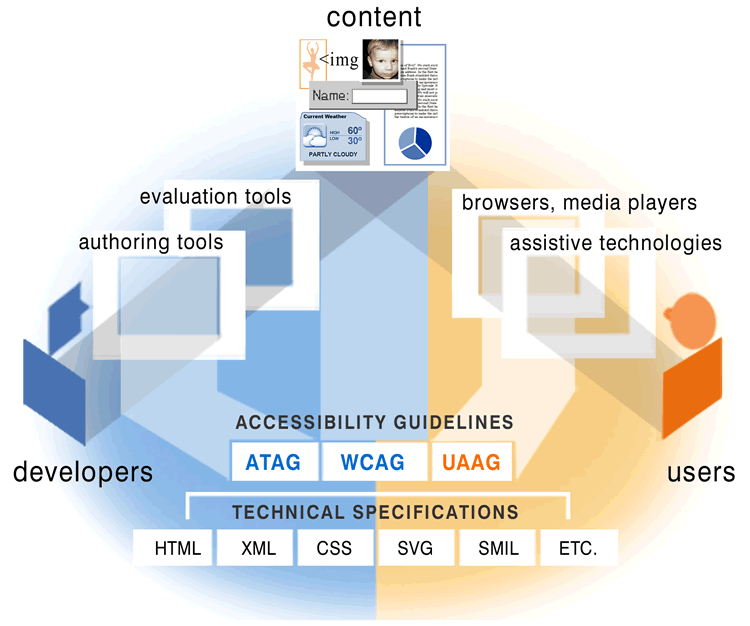
W3C Process
- 1. Working Draft
- Several iterations of development and public review
- 2. Last Call
- Group has completed development and seeks broad review
- 3. Candidate Recommendation
- Call for Implementation is announced
- 4. Proposed Recommendation
- W3C seeks endorsement by its membership
- 5. Recommendation
- Final stage of publication, the document is now operational
Advancing a Technical Report to Recommendation.
Overview
- W3C and WAI Guidelines
- » WCAG 2.0 Structure
- WCAG 2.0 in Practice
- Changes from WCAG 1.0
- Questions
Why WCAG 2.0?
- WCAG 1.0 published 5 May 1999 (happy birthday!)
- WCAG 1.0 is HTML and CSS centric
- WCAG 1.0 has assumptions about user agents
- WCAG 1.0 is sometimes ambigous or unclear
- The Web has evolved a lot since 1999
Good news: basic requirements of people with disabilities remained the same!
WCAG 2.0 Principles
The WCAG 2.0 Guidelines are organized around these four principles:
- Content must be perceivable
- Interface elements in the content must be operable
- Content and controls must be understandable
- Content should be robust enough to work with current and future Web technologies
WCAG 2.0 Structure
- Guidelines
- Under each principle there is a list of guidelines that address the principle
- Success Criteria
- Under each guideline there are success criteria used to evaluate conformance to this guideline
The principles, guidelines, and success criteria are technology-independent.
Success Criteria
The success criteria are testable statements grouped into three levels of conformance:
- Level 1
- Achieve a minimum level of accessibility, can reasonably be applied to all Web content.
- Level 2
- Achieve an enhanced level of accessibility, can reasonably be applied to all Web content.
- Level 3
- Achieve additional accessibility enhancements, can not necessarily be applied to all Web content.
Example #1
- Principle 1: Content must be perceivable
- Guideline 1.4: Make it easy to distinguish foreground information from its background
- Level 1 Success Criteria for Guideline 1.4
- (No level 1 success criteria for this guideline.)
- Level 2 Success Criteria for Guideline 1.4
- 1.4.1 Text or diagrams, and their background, have a luminosity contrast ratio of at least 5:1.
- 1.4.2 A mechanism is available to turn off background audio that plays automatically, without requiring the user to turn off all audio.
- Level 3 Success Criteria for Guideline 1.4
- 1.4.3 Text or diagrams, and their background, have a luminosity contrast ratio of at least 10:1.
- 1.4.4 Audio content does not contain background sounds, background sounds can be turned off, or background sounds are at least 20 decibels lower than the foreground audio content, with the exception of occasional sound effects.
Overview
- W3C and WAI Guidelines
- WCAG 2.0 Structure
- » WCAG 2.0 in Practice
- Changes from WCAG 1.0
- Questions
WCAG 2.0 Conformance
WCAG 2.0 conformance claims inlcude:
- Level: WCAG 2.0 conformance level (Level A, AA or AAA)
- Baseline: technologies tested (HTML, CSS, etc.)
- Scope: content tested (eg. list of URIs etc.)
- (Optional) user agents used for testing
- ...and many others such as date of the claim etc.
WCAG 2.0 Baselines
Draft: About Baselines and WCAG 2.0
- Set of technologies that an author assumes are supported and turned on in user agents and assistive technologies
- Web content meets WCAG 2.0 at the stated level of conformance if a user agent can support the technologies listed in the baseline
Note: the baseline does not include user agents, but the conformance claim could.
WCAG 2.0 Techniques
Working Draft: Techniques for WCAG 2.0
- Technology-specific techniques for meeting (or failing) success criteria
- Each Technique includes:
- Applicability
- User Agent and Assistive Technology Support Notes
- Description
- Examples
- Resources
- Related Techniques
- Tests
Understanding WCAG 2.0
Working Draft: Understanding WCAG 2.0
- Essential guide to learning and implementing WCAG 2.0
- Each section includes:
- Key terms
- Intent of the success criterion
- Techniques
- Benefits, how it helps people with disabilities
- Examples
- Related resources
WCAG 2.0 Checklist
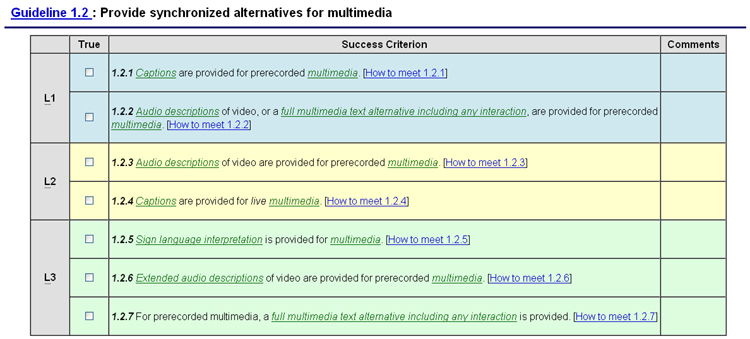
Overview
- W3C and WAI Guidelines
- WCAG 2.0 Structure
- WCAG 2.0 in Practice
- » Changes from WCAG 1.0
- Questions
Main Changes
- WCAG 2.0 is more technology-independent and more testable
- Most Web sites that conform to WCAG 1.0 should not require significant changes in order to conform to WCAG 2.0
- Comparison of WCAG 1.0 Checkpoints to WCAG 2.0 shows the relationship between WCAG 1.0 checkpoints and WCAG 2.0
Example #2
- WCAG 1.0 Checkpoint
- 2.2 Ensure that foreground and background color combinations provide sufficient contrast when viewed by someone having color deficits or when viewed on a black and white screen
- WCAG 2.0 Success Criteria
- 1.4.1 Text or diagrams, and their background, have a luminosity contrast ratio of at least 5:1
- 1.4.3 Text or diagrams, and their background, have a luminosity contrast ratio of at least 5:1
Understanding WCAG 2.0: examples of evaluation tools that implement the luminosity contrast ratio algorithm.
Example #3
- WCAG 1.0 Checkpoint
- 13.1 Clearly identify the target of each link
- WCAG 2.0 Success Criteria
- 2.4.4 Each link is programmatically associated with text from which its purpose can be determined.
- 2.4.8 The purpose of each link can be programmatically determined from the link
Understanding WCAG 2.0: "The intent of this success criterion is to help users understand the purpose of each link in the content, so they can decide whether they want to follow the link [...]"
Questions?
http://www.w3.org/People/shadi/Talks/2006/0505/wcag20/
http://www.w3.org/WAI/IG/
Shadi Abou-Zahra, W3C/WAI
http://www.w3.org/People/shadi/
shadi@w3.org