10.1 Duration, Date and Time Types
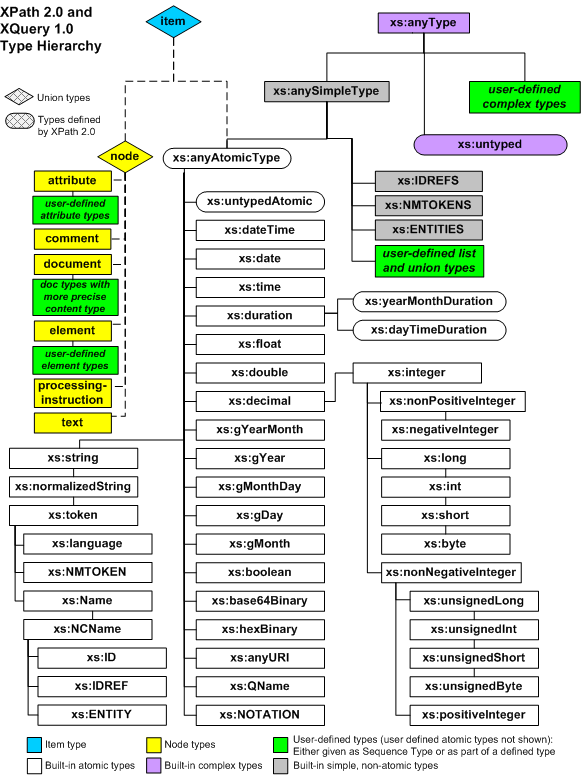
The operators described in this section are defined on the following date and
time types:
xs:dateTime
xs:date
xs:time
xs:gYearMonth
xs:gYear
xs:gMonthDay
xs:gMonth
xs:gDay
Note that only equality is defined on
xs:gYearMonth, xs:gYear,
xs:gMonthDay, xs:gMonth and xs:gDay values.
In addition, operators are defined on:
and on the 10.3 Two Totally Ordered Subtypes of Duration:
xs:yearMonthDuration
xs:dayTimeDuration
Note that no ordering relation is defined on xs:duration values.Two xs:duration values may however be compared for equality. Operations on durations (including equality comparison, casting to string, and extraction of components) all treat the duration as normalized. This means that the seconds and minutes components will always be less than 60, the hours component less than 24, and the months component less than 12. Thus, for example, a duration of 120 seconds always gives the same result as a duration of two minutes.
10.1.1 Limits and Precision
For a number of the above datatypes [XML Schema Part 2: Datatypes Second Edition] extends the basic
[ISO 8601] lexical representations, such as
YYYY-MM-DDThh:mm:ss.s for dateTime, by allowing a preceding minus sign, more
than four digits to represent the year field — no maximum is
specified — and an unlimited number of digits for fractional
seconds. Leap seconds are not supported.
All minimally conforming processors
·must· support positive year values with a minimum of 4 digits (i.e.,
YYYY) and a minimum fractional second precision of 1 millisecond or three
digits (i.e., s.sss). However, conforming processors
·may· set larger ·implementation-defined· limits
on the maximum number of digits they support in these two situations. Processors ·may· also choose to support the year 0000 and
years with negative values. The results of operations on dates that cross the year
0000 are ·implementation-defined·.
A processor that limits the number of digits in date and time datatype
representations may encounter overflow and underflow conditions when it
tries to execute the functions in 10.8 Arithmetic Operators on Durations, Dates and Times. In
these situations, the processor ·must· return P0M or PT0S in
case of duration underflow and 00:00:00 in case of time underflow.
It ·must· raise an error [err:FODT0001] in case of overflow.
The value spaces of the two totally ordered subtypes of
xs:duration described in 10.3 Two Totally Ordered Subtypes of Duration are
xs:integer months for xs:yearMonthDuration
and xs:decimal seconds for xs:dayTimeDuration. If
a processor limits the number of digits allowed in the representation of
xs:integer and xs:decimal then overflow and
underflow situations can arise when it tries to execute the functions in
10.6 Arithmetic Operators on Durations. In these situations the processor
·must· return zero in case of numeric underflow and P0M
or PT0S in case of duration underflow. It ·must· raise an
error [err:FODT0002] in case of overflow.
10.4 Comparison Operators on Duration, Date and Time Values
The following comparison operators are defined on the [XML Schema Part 2: Datatypes Second Edition]
date, time and duration datatypes. Each operator takes two operands of the same
type and returns an xs:boolean result. As discussed in [XML Schema Part 2: Datatypes Second Edition], the
order relation on xs:duration is
not a total order but, rather, a partial order. For this reason, only equality is defined on xs:duration. A full complement of comparison and
arithmetic functions are defined on the two subtypes of duration described in
10.3 Two Totally Ordered Subtypes of Duration which do have a total order.
[XML Schema Part 2: Datatypes Second Edition] also states that the
order relation on date and time datatypes is
not a total order but a partial order because these
datatypes may or may not have a timezone. This is handled as follows.
If either operand to a comparison function on date or time values does not have
an (explicit) timezone then, for the purpose of the operation, an implicit
timezone, provided by the dynamic context Section
C.2 Dynamic Context ComponentsXP, is assumed to be present as part of
the value. This creates a total order for all date and time values.
An xs:dateTime can be considered to consist of seven components:
year, month, day, hour, minute, second and timezone. For xs:dateTime six components: year, month, day, hour, minute and second are required and timezone is optional. For other date/time values, of the first six components, some are required and others must be absent or missing. Timezone is always optional. For example, for xs:date, the year, month and day components are required and hour, minute and second components must be absent; for xs:time the hour, minute and second components are required and year, month and day are missing; for xs:gDay, day is required and year, month, hour, minute and second are missing.
Values of the date/time datatypes xs:time, xs:gMonthDay, xs:gMonth, and xs:gDay, can be considered to represent a sequence of recurring time instants or time periods. An xs:time occurs every day. An xs:gMonth occurs every year. Comparison operators on these datatypes compare the starting instants of equivalent occurrences in the recurring series. These xs:dateTime values are calculated as described below.
Comparison operators on xs:date, xs:gYearMonth and xs:gYear compare their starting instants. These xs:dateTime values are calculated as described below.
The starting instant of an occurrence of a date/time value is an xs:dateTime calculated by filling in the missing components of the local value from a reference xs:dateTime. If the value filled in for a missing day component exceeds the maximum day value for the month, the last day of the month is used. Suppose, for example, that the reference xs:dateTime is 1972-12-31T00:00:00 and the xs:date value to be compared is 1993-03-31. Filling in the time components from the reference xs:dateTime we get 1993-03-31T00:00:00 which is the starting instant of that day. Similarly, if the xs:time value 12:30:00 is to be compared, we fill in the missing components from the reference xs:dateTime and we get 1972-12-31T12:30:00 which is the time on that day. For an xs:gYearMonth value of 1976-02 we fill in the missing components, adjust for the last day in the month and get 1976-02-29T00:00:00.
If the xs:time value written as
24:00:00 is to be compared, filling in the missing components gives 1972-12-31T00:00:00, because 24:00:00 is an alternative representation of 00:00:00 (the lexical value "24:00:00" is
converted to the time components {0,0,0} before the missing components are filled
in). This has the consequence that when ordering xs:time values,
24:00:00 is
considered to be earlier than 23:59:59. However, when ordering
xs:dateTime
values, a time component of 24:00:00 is considered equivalent to 00:00:00 on the
following day.
Note that the reference xs:dateTime does not have a timezone. The timezone component is never filled in from the reference xs:dateTime. In some cases, if the date/time value does not have a timezone, the implicit timezone from the dynamic context is used as the timezone.
Note:
This proposal uses the reference xs:dateTime 1972-12-31T00:00:00 in the description of the comparison operators. Implementations are allowed to use other reference xs:dateTime values as long as they yield the same results. The reference xs:dateTime used must meet the following constraints: when it is used to supply components into xs:gMonthDay values, the year must allow for February 29 and so must be a leap year; when it is used to supply missing components into xs:gDay values, the month must allow for 31 days. Different reference xs:dateTime values may be used for different operators.
10.4.1 op:yearMonthDuration-less-than
op:yearMonthDuration-less-than( | $arg1 | as xs:yearMonthDuration, |
$arg2 | as xs:yearMonthDuration) as xs:boolean |
Summary: Returns true if and only if $arg1 is less
than $arg2. Returns false otherwise.
This function backs up the "lt" and "le" operators on
xs:yearMonthDuration values.
10.4.2 op:yearMonthDuration-greater-than
op:yearMonthDuration-greater-than( | $arg1 | as xs:yearMonthDuration, |
$arg2 | as xs:yearMonthDuration) as xs:boolean |
Summary: Returns true if and only if $arg1 is
greater than $arg2. Returns false otherwise.
This function backs up the "gt" and "ge" operators on
xs:yearMonthDuration values.
10.4.3 op:dayTimeDuration-less-than
op:dayTimeDuration-less-than( | $arg1 | as xs:dayTimeDuration, |
$arg2 | as xs:dayTimeDuration) as xs:boolean |
Summary: Returns true if and only if $arg1 is less
than $arg2. Returns false otherwise.
This function backs up the "lt" and "le" operators on
xs:dayTimeDuration values.
10.4.4 op:dayTimeDuration-greater-than
op:dayTimeDuration-greater-than( | $arg1 | as xs:dayTimeDuration, |
$arg2 | as xs:dayTimeDuration) as xs:boolean |
Summary: Returns true if and only if $arg1 is
greater than $arg2. Returns false otherwise.
This function backs up the "gt" and "ge" operators on
xs:dayTimeDuration values.
10.4.5 op:duration-equal
op:duration-equal($arg1 as xs:duration, $arg2 as xs:duration) as xs:boolean
Summary:
Returns true if and only if the
xs:yearMonthDuration and the xs:dayTimeDuration
components of $arg1 and $arg2 compare equal respectively.
Returns false otherwise.
This function backs up the "eq" and "ne" operators on
xs:duration values.
Note that this function, like any other, may be applied to arguments that are derived from the types given in the function signature, including the two subtypes xs:dayTimeDuration and xs:yearMonthDuration. With the exception of the zero-length duration, no instance of xs:dayTimeDuration can ever be equal to an instance of xs:yearMonthDuration.
The semantics of this function are:
xs:yearMonthDuration($arg1) div xs:yearMonthDuration('P1M')  eq
xs:yearMonthDuration($arg2) div xs:yearMonthDuration('P1M')
    and
xs:dayTimeDuration($arg1) div xs:dayTimeDuration('PT1S')  eq
xs:dayTimeDuration($arg2) div xs:dayTimeDuration('PT1S')
that is, the function returns true if the months and seconds values of the two durations are equal.
10.4.5.1 Examples
op:duration-equal(xs:duration("P1Y"), xs:duration("P12M")) returns true.
op:duration-equal(xs:duration("PT24H"), xs:duration("P1D")) returns true.
op:duration-equal(xs:duration("P1Y"), xs:duration("P365D")) returns false.
op:duration-equal(xs:yearMonthDuration("P0Y"), xs:dayTimeDuration("PT0D")) returns true.
op:duration-equal(xs:yearMonthDuration("P1Y"), xs:dayTimeDuration("PT365D")) returns false.
op:duration-equal(xs:yearMonthDuration("P2Y"), xs:yearMonthDuration("P24M")) returns true.
op:duration-equal(xs:dayTimeDuration("PT10D"), xs:dayTimeDuration("PT240H")) returns true.
op:duration-equal(xs:duration("P2Y0M0DT0H0M0S"), xs:yearMonthDuration("P24M")) returns true.
op:duration-equal(xs:duration("P0Y0M10D"), xs:dayTimeDuration("PT240H")) returns true.
10.4.6 op:dateTime-equal
op:dateTime-equal($arg1 as xs:dateTime, $arg2 as xs:dateTime) as xs:boolean
Summary:
Returns true if and only if the value of
$arg1 is equal to the value of $arg2 according to the algorithm defined in section 3.2.7.4 of [XML Schema Part 2: Datatypes Second Edition] "Order relation on dateTime" for xs:dateTime values with timezones.
Returns false otherwise.
This function backs up the "eq", "ne", "le" and "ge" operators on
xs:dateTime values.
10.4.6.1 Examples
Assume that the dynamic context provides an implicit timezone value of -05:00.
op:dateTime-equal(xs:dateTime("2002-04-02T12:00:00-01:00"),
                                    xs:dateTime("2002-04-02T17:00:00+04:00"))
returns true.
op:dateTime-equal(xs:dateTime("2002-04-02T12:00:00"),
                                    xs:dateTime("2002-04-02T23:00:00+06:00"))
returns true.
op:dateTime-equal(xs:dateTime("2002-04-02T12:00:00"),
                                    xs:dateTime("2002-04-02T17:00:00"))
returns false.
op:dateTime-equal(xs:dateTime("2002-04-02T12:00:00"),
                                    xs:dateTime("2002-04-02T12:00:00"))
returns true.
op:dateTime-equal(xs:dateTime("2002-04-02T23:00:00-04:00"),
                                    xs:dateTime("2002-04-03T02:00:00-01:00"))
returns true.
op:dateTime-equal(xs:dateTime("1999-12-31T24:00:00"),
xs:dateTime("2000-01-01T00:00:00"))
returns true.
op:dateTime-equal(xs:dateTime("2005-04-04T24:00:00"),
xs:dateTime("2005-04-04T00:00:00"))
returns false.
10.4.7 op:dateTime-less-than
op:dateTime-less-than($arg1 as xs:dateTime, $arg2 as xs:dateTime) as xs:boolean
Summary: Returns true if and only if the value of
$arg1 is less than the value of $arg2 according to the algorithm defined in section 3.2.7.4 of [XML Schema Part 2: Datatypes Second Edition] "Order relation on dateTime" for xs:dateTime values with timezones.
Returns false otherwise.
This function backs up the "lt" and "le" operators on
xs:dateTime values.
10.4.8 op:dateTime-greater-than
op:dateTime-greater-than( | $arg1 | as xs:dateTime, |
$arg2 | as xs:dateTime) as xs:boolean |
Summary: Returns true if and only if the value of
$arg1 is greater than the value of $arg2 according to the algorithm defined in section 3.2.7.4 of [XML Schema Part 2: Datatypes Second Edition] "Order relation on dateTime" for xs:dateTime values with timezones.
Returns false otherwise.
This function backs up the "gt" and "ge" operators on
xs:dateTime values.
10.4.9 op:date-equal
op:date-equal($arg1 as xs:date, $arg2 as xs:date) as xs:boolean
Summary: Returns true if and only if the starting instant of
$arg1 is equal to starting instant of $arg2.
Returns false otherwise.
The starting instant of an xs:date is the xs:dateTime at time 00:00:00 on that date.
The two starting instants are compared using op:dateTime-equal.
This function backs up the "eq", "ne", "le" and "ge" operators on xs:date values.
10.4.9.1 Examples
op:date-equal(xs:date("2004-12-25Z"),
                                    xs:date("2004-12-25+07:00"))
returns false. The starting instants are xs:dateTime("2004-12-25T00:00:00Z") and xs:dateTime("2004-12-25T00:00:00+07:00"). These are normalized to xs:dateTime("2004-12-25T00:00:00Z") and xs:dateTime("2004-12-24T17:00:00Z").
op:date-equal(xs:date("2004-12-25-12:00"),
                                    xs:date("2004-12-26+12:00"))
returns true.
10.4.10 op:date-less-than
op:date-less-than($arg1 as xs:date, $arg2 as xs:date) as xs:boolean
Summary: Returns true if and only if the starting instant of
$arg1 is less than the starting instant of $arg2.
Returns false otherwise.
The starting instant of an xs:date is the xs:dateTime at time 00:00:00 on that date.
The two starting instants are compared using op:dateTime-less-than.
This function backs up the "lt" and "le" operators on xs:date values.
10.4.10.1 Examples
op:date-less-than(xs:date("2004-12-25Z"),
                                    xs:date("2004-12-25-05:00"))
returns true.
op:date-less-than(xs:date("2004-12-25-12:00"),
                                    xs:date("2004-12-26+12:00"))
returns false.
10.4.11 op:date-greater-than
op:date-greater-than($arg1 as xs:date, $arg2 as xs:date) as xs:boolean
Summary: Returns true if and only if the starting instant of
$arg1 is greater than the starting instant of $arg2. Returns false otherwise.
The starting instant of an xs:date is the xs:dateTime at time 00:00:00 on that date.
The two starting instants are compared using op:dateTime-greater-than.
This function backs up the "gt" and "ge" operators on xs:date values.
10.4.11.1 Examples
op:date-greater-than(xs:date("2004-12-25Z"),
                                    xs:date("2004-12-25+07:00"))
returns true.
op:date-greater-than(xs:date("2004-12-25-12:00"),
                                    xs:date("2004-12-26+12:00"))
returns false.
10.4.12 op:time-equal
op:time-equal($arg1 as xs:time, $arg2 as xs:time) as xs:boolean
Summary: Returns true if and only if the value of
$arg1 converted to an xs:dateTime using the date components from the reference xs:dateTime is equal to the value of $arg2 converted to an xs:dateTime using the date components from the same reference xs:dateTime.
Returns false otherwise.
The two xs:dateTime values are compared using op:dateTime-equal.
This function backs up the "eq", "ne", "le" and "ge" operators on xs:time values.
10.4.12.1 Examples
Assume that the date components from the reference xs:dateTime correspond to 1972-12-31.
op:time-equal(xs:time("08:00:00+09:00"),
                                    xs:time("17:00:00-06:00"))
returns false. The xs:dateTimes calculated using the reference date components are 1972-12-31T08:00:00+09:00 and 1972-12-31T17:00:00-06:00.
These normalize to 1972-12-30T23:00:00Z and 1972-12-31T23:00:00.
op:time-equal(xs:time("21:30:00+10:30"),
                                    xs:time("06:00:00-05:00"))
returns true.
op:time-equal(xs:time("24:00:00+01:00"), xs:time("00:00:00+01:00")) returns true.
This not the result one might expect. For xs:dateTime values, a time of 24:00:00 is equivalent to 00:00:00 on the following day. For xs:time, the normalization from 24:00:00 to 00:00:00 happens before the xs:time is converted into an xs:dateTime for the purpose of the equality comparison. For xs:time, any operation on 24:00:00 produces the same result as the same operation on 00:00:00 because these are two different lexical representations of the same value.
10.4.13 op:time-less-than
op:time-less-than($arg1 as xs:time, $arg2 as xs:time) as xs:boolean
Summary: Returns true if and only if the value of
$arg1 converted to an xs:dateTime using the date components from the reference xs:dateTime is less than the normalized value of $arg2 converted to an xs:dateTime using the date components from the same reference xs:dateTime.
Returns false otherwise.
The two xs:dateTime values are compared using op:dateTime-less-than.
This function backs up the "lt" and "le" operators on xs:time values.
10.4.13.1 Examples
Assume that the dynamic context provides an implicit timezone value of -05:00.
op:time-less-than(xs:time("12:00:00"),
                                    xs:time("23:00:00+06:00"))
returns false.
op:time-less-than(xs:time("11:00:00"),
                                    xs:time("17:00:00Z"))
returns true.
op:time-less-than(xs:time("23:59:59"), xs:time("24:00:00")) returns false.
10.4.14 op:time-greater-than
op:time-greater-than($arg1 as xs:time, $arg2 as xs:time) as xs:boolean
Summary: Returns true if and only if the value of
$arg1 converted to an xs:dateTime using the date components from the reference xs:dateTime is greater than the value of
$arg2 converted to an xs:dateTime using the date components from the same reference xs:dateTime. Returns false otherwise.
The two xs:dateTime values are compared using op:dateTime-greater-than.
This function backs up the "gt" and "ge" operators on xs:time values.
10.4.15 op:gYearMonth-equal
op:gYearMonth-equal( | $arg1 | as xs:gYearMonth, |
$arg2 | as xs:gYearMonth) as xs:boolean |
Summary: Returns true if and only if the xs:dateTimes representing the starting instants of $arg1 and $arg2 compare equal. The starting instants of $arg1 and $arg2 are calculated by adding the missing components of $arg1 and $arg2 from the xs:dateTime template xxxx-xx-ddT00:00:00 where dd represents the last day of the month component in $arg1 or $arg2. Returns false otherwise.
The two xs:dateTime values representing the starting instants of $arg1 and $arg2 are compared using op:dateTime-equal.
This function backs up the "eq" and "ne" operators on
xs:gYearMonth values.
10.4.15.1 Examples
Assume that the dynamic context provides an implicit timezone value of -05:00.
op:gYearMonth-equal(xs:gYearMonth("1976-02"),
                                    xs:gYearMonth("1976-03Z"))
returns false. The starting instants are 1972-02-29T00:00:00-05:00 and 1972-03-31T00:00:00Z, respectively.
op:gYearMonth-equal(xs:gYearMonth("1976-03"),
                                    xs:gYearMonth("1976-03Z"))
returns false.
10.4.16 op:gYear-equal
op:gYear-equal($arg1 as xs:gYear, $arg2 as xs:gYear) as xs:boolean
Summary: Returns true if and only if the xs:dateTimes representing the starting instants of $arg1 and $arg2 compare equal. The starting instants of $arg1 and $arg2 are calculated by adding the missing components of $arg1 and $arg2 from a xs:dateTime template such as xxxx-01-01T00:00:00. Returns false otherwise.
The two xs:dateTime values representing the starting instants of $arg1 and $arg2 are compared using op:dateTime-equal.
This function backs up the "eq" and "ne" operators on xs:gYear values.
10.4.16.1 Examples
Assume that the dynamic context provides an implicit timezone value of -05:00. Assume, also, that the xs:dateTime template is xxxx-01-01T00:00:00.
op:gYear-equal(xs:gYear("2005-12:00"),
                                    xs:gYear("2005+12:00"))
returns false. The starting instants are 2005-01-01T00:00:00-12:00 and 2005-01-01T00:00:00+12:00, respectively, and normalize to 2005-01-015T12:00:00Z and 2004-12-31T12:00:00Z.
op:gYear-equal(xs:gYear("1976-05:00"),
                                    xs:gYear("1976"))
returns true.
10.4.17 op:gMonthDay-equal
op:gMonthDay-equal($arg1 as xs:gMonthDay, $arg2 as xs:gMonthDay) as xs:boolean
Summary: Summary: Returns true if and only if the xs:dateTimes representing the starting instants of equivalent occurrences of $arg1 and $arg2 compare equal. The starting instants of equivalent occurrences of $arg1 and $arg2 are calculated by adding the missing components of $arg1 and $arg2 from an xs:dateTime template such as 1972-xx-xxT00:00:00. Returns false otherwise.
The two xs:dateTime values representing the starting instants of equivalent occurrences of $arg1 and $arg2 are compared using op:dateTime-equal.
This function backs up the "eq" and "ne" operators on
xs:gMonthDay values.
10.4.17.1 Examples
Assume that the dynamic context provides an implicit timezone value of -05:00. Assume, also, that the xs:dateTime template is 1976-xx-xxT00:00:00.
op:gMonthDay-equal(xs:gMonthDay("--12-25-14:00"),
                                    xs:gMonthDay("--12-26+10:00"))
returns true. The starting instants are 1976-12-25T00:00:00-14:00 and 1976-12-26T00:00:00+10:00, respectively, and normalize to 1976-12-25T14:00:00Z and 1976-12-25T14:00:00Z.
op:gMonthDay-equal(xs:gMonthDay("--12-25"),
                                    xs:gMonthDay("--12-26Z"))
returns false.
10.4.18 op:gMonth-equal
op:gMonth-equal($arg1 as xs:gMonth, $arg2 as xs:gMonth) as xs:boolean
Summary: Returns true if and only if the xs:dateTimes representing the starting instants of equivalent occurrences of $arg1 and $arg2 compare equal. The starting instants of equivalent occurrences of $arg1 and $arg2 are calculated by adding the missing components of $arg1 and $arg2 from an xs:dateTime template such as 1972-xx-ddT00:00:00 where dd represents the last day of the month component in $arg1 or $arg2. Returns false otherwise.
The two xs:dateTime values representing the starting instants of equivalent occurrences of $arg1 and $arg2 are compared using op:dateTime-equal.
This function backs up the "eq" and "ne" operators on xs:gMonth values.
10.4.18.1 Examples
Assume that the dynamic context provides an implicit timezone value of -05:00. Assume, also, that the xs:dateTime template is 1972-xx-29T00:00:00.
op:gMonth-equal(xs:gMonth("--12-14:00"),
                                    xs:gMonth("--12+10:00")
returns false. The starting instants are 1972-12-29T00:00:00-14:00 and 1972-12-29T00:00:00+10:00, respectively, and normalize to 1972-12-29T14:00:00Z and 1972-12-28T14:00:00Z.
op:gMonth-equal(xs:gMonth("--12"),
                                    xs:gMonth("--12Z"))
returns false.
10.4.19 op:gDay-equal
op:gDay-equal($arg1 as xs:gDay, $arg2 as xs:gDay) as xs:boolean
Summary: Returns true if and only if the xs:dateTimes representing the starting instants of equivalent occurrences of $arg1 and $arg2 compare equal. The starting instants of equivalent occurrences of $arg1 and $arg2 are calculated by adding the missing components of $arg1 and $arg2 from an xs:dateTime template such as 1972-12-xxT00:00:00. Returns false otherwise.
The two xs:dateTime values representing the starting instants of equivalent occurrences of $arg1 and $arg2 are compared using op:dateTime-equal.
This function backs up the "eq" and "ne" operators on xs:gDay values.
10.4.19.1 Examples
Assume that the dynamic context provides an implicit timezone value of -05:00. Assume, also, that the xs:dateTime template is 1976-12-xxT00:00:00.
op:gDay-equal(xs:gDay("---25-14:00"),
                                    xs:gDay("---25+10:00"))
returns false. The starting instants are 1972-12-25T00:00:00-14:00 and 1972-12-25T00:00:00+10:00, respectively, and normalize to 1972-12-25T14:00:00Z and 1972-12-24T14:00:00Z.
op:gDay-equal(xs:gDay("---12"),
                                    xs:gDay("---12Z"))
returns false.
10.5 Component Extraction Functions on Durations, Dates and Times
The duration, date and time datatypes may be considered to be composite datatypes
in that they contain distinct properties or components. The extraction functions specified
below extract a single component from a duration, date or time value. For
the date/time datatypes the local value is used.
For xs:duration and its subtypes, including the two subtypes xs:yearMonthDuration and xs:dayTimeDuration, the components are normalized: this means that the seconds and minutes components will always be less than 60, the hours component less than 24, and the months component less than 12.
10.5.1 fn:years-from-duration
fn:years-from-duration($arg as xs:duration?) as xs:integer?
Summary: Returns an xs:integer representing the years component
in the value of $arg. The result is obtained by casting $arg to an xs:yearMonthDuration (see 17.1.4 Casting to duration types) and then computing the years component as described in 10.3.1.3 Canonical representation.
The result may be negative.
If $arg is an xs:dayTimeDuration returns 0.
If $arg is the empty sequence, returns the empty sequence.
10.5.1.1 Examples
fn:years-from-duration(xs:yearMonthDuration("P20Y15M"))
returns 21.
fn:years-from-duration(xs:yearMonthDuration("-P15M"))
returns -1.
fn:years-from-duration(xs:dayTimeDuration("-P2DT15H"))
returns 0.
10.5.2 fn:months-from-duration
fn:months-from-duration($arg as xs:duration?) as xs:integer?
Summary: Returns an xs:integer representing the months component
in the value of $arg. The result is obtained by casting $arg to an xs:yearMonthDuration (see 17.1.4 Casting to duration types) and then computing the months component as described in 10.3.1.3 Canonical representation.
The result may be negative.
If $arg is an xs:dayTimeDuration returns 0.
If $arg is the empty sequence, returns the empty sequence.
10.5.2.1 Examples
fn:months-from-duration(xs:yearMonthDuration("P20Y15M"))
returns 3.
fn:months-from-duration(xs:yearMonthDuration("-P20Y18M"))
returns -6.
fn:months-from-duration(xs:dayTimeDuration("-P2DT15H0M0S"))
returns 0.
10.5.3 fn:days-from-duration
fn:days-from-duration($arg as xs:duration?) as xs:integer?
Summary: Returns an xs:integer representing the days component
in the value of $arg. The result is obtained by casting $arg to an xs:dayTimeDuration (see 17.1.4 Casting to duration types) and then computing the days component as described in 10.3.2.3 Canonical representation.
The result may be negative.
If $arg is an xs:yearMonthDuration returns 0.
If $arg is the empty sequence, returns the empty sequence.
10.5.3.1 Examples
fn:days-from-duration(xs:dayTimeDuration("P3DT10H"))
returns 3.
fn:days-from-duration(xs:dayTimeDuration("P3DT55H"))
returns 5.
fn:days-from-duration(xs:yearMonthDuration("P3Y5M"))
returns 0.
10.5.4 fn:hours-from-duration
fn:hours-from-duration($arg as xs:duration?) as xs:integer?
Summary: Returns an xs:integer representing the hours component
in the value of $arg. The result is obtained by casting $arg to an xs:dayTimeDuration (see 17.1.4 Casting to duration types) and then computing the hours component as described in 10.3.2.3 Canonical representation.
The result may be negative.
If $arg is an xs:yearMonthDuration returns 0.
If $arg is the empty sequence, returns the empty sequence.
10.5.4.1 Examples
fn:hours-from-duration(xs:dayTimeDuration("P3DT10H"))
returns 10.
fn:hours-from-duration(xs:dayTimeDuration("P3DT12H32M12S"))
returns 12.
fn:hours-from-duration(xs:dayTimeDuration("PT123H"))
returns 3.
fn:hours-from-duration(xs:dayTimeDuration("-P3DT10H"))
returns -10.
10.5.5 fn:minutes-from-duration
fn:minutes-from-duration($arg as xs:duration?) as xs:integer?
Summary: Returns an xs:integer representing the minutes component
in the value of $arg. The result is obtained by casting $arg to an xs:dayTimeDuration (see 17.1.4 Casting to duration types) and then computing the minutes component as described in 10.3.2.3 Canonical representation.
The result may be negative.
If $arg is an xs:yearMonthDuration returns 0.
If $arg is the empty sequence, returns the empty sequence.
10.5.6 fn:seconds-from-duration
fn:seconds-from-duration($arg as xs:duration?) as xs:decimal?
Summary: Returns an xs:decimal representing the seconds component
in the value of $arg. The result is obtained by casting $arg to an xs:dayTimeDuration (see 17.1.4 Casting to duration types) and then computing the seconds component as described in 10.3.2.3 Canonical representation.
The result may be negative.
If $arg is an xs:yearMonthDuration returns 0.
If $arg is the empty sequence, returns the empty sequence.
10.5.7 fn:year-from-dateTime
fn:year-from-dateTime($arg as xs:dateTime?) as xs:integer?
Summary: Returns an xs:integer representing the year component
in the localized value of $arg. The result may be negative.
If $arg is the empty sequence, returns the empty sequence.
10.5.7.1 Examples
fn:year-from-dateTime(xs:dateTime("1999-05-31T13:20:00-05:00"))
returns 1999.
fn:year-from-dateTime(xs:dateTime("1999-05-31T21:30:00-05:00"))
returns 1999.
fn:year-from-dateTime(xs:dateTime("1999-12-31T19:20:00"))
returns 1999.
fn:year-from-dateTime(xs:dateTime("1999-12-31T24:00:00"))
returns 2000.
10.5.8 fn:month-from-dateTime
fn:month-from-dateTime($arg as xs:dateTime?) as xs:integer?
Summary: Returns an xs:integer between 1 and 12, both inclusive,
representing the month component in the localized value of $arg.
If $arg is the empty sequence, returns the empty sequence.
10.5.8.1 Examples
fn:month-from-dateTime(xs:dateTime("1999-05-31T13:20:00-05:00"))
returns 5.
fn:month-from-dateTime(xs:dateTime("1999-12-31T19:20:00-05:00"))
returns 12.
fn:month-from-dateTime(fn:adjust-dateTime-to-timezone(xs:dateTime("1999-12-31T19:20:00-05:00"),
                                    xs:dayTimeDuration("PT0S")))
returns 1.
10.5.9 fn:day-from-dateTime
fn:day-from-dateTime($arg as xs:dateTime?) as xs:integer?
Summary: Returns an xs:integer between 1 and 31, both inclusive,
representing the day component in the localized value of $arg.
If $arg is the empty sequence, returns the empty sequence.
10.5.9.1 Examples
fn:day-from-dateTime(xs:dateTime("1999-05-31T13:20:00-05:00"))
returns 31.
fn:day-from-dateTime(xs:dateTime("1999-12-31T20:00:00-05:00"))
returns 31.
fn:day-from-dateTime(fn:adjust-dateTime-to-timezone(xs:dateTime("1999-12-31T19:20:00-05:00"),
                                    xs:dayTimeDuration("PT0S")))
returns 1.
10.5.10 fn:hours-from-dateTime
fn:hours-from-dateTime($arg as xs:dateTime?) as xs:integer?
Summary: Returns an xs:integer between 0 and 23, both inclusive,
representing the hours component in the localized value of $arg.
If $arg is the empty sequence, returns the empty sequence.
10.5.10.1 Examples
fn:hours-from-dateTime(xs:dateTime("1999-05-31T08:20:00-05:00"))
returns 8.
fn:hours-from-dateTime(xs:dateTime("1999-12-31T21:20:00-05:00"))
returns 21.
fn:hours-from-dateTime(fn:adjust-dateTime-to-timezone(xs:dateTime("1999-12-31T21:20:00-05:00"),
                                        xs:dayTimeDuration("PT0S")))
returns
2.
fn:hours-from-dateTime(xs:dateTime("1999-12-31T12:00:00"))
returns 12.
fn:hours-from-dateTime(xs:dateTime("1999-12-31T24:00:00"))
returns 0.
10.5.11 fn:minutes-from-dateTime
fn:minutes-from-dateTime($arg as xs:dateTime?) as xs:integer?
Summary: Returns an xs:integer value between 0 and 59, both
inclusive, representing the minute component in the localized value of $arg.
If $arg is the empty sequence, returns the empty sequence.
10.5.12 fn:seconds-from-dateTime
fn:seconds-from-dateTime($arg as xs:dateTime?) as xs:decimal?
Summary: Returns an xs:decimal value greater than or equal to zero and less than 60,
representing the seconds and fractional seconds in the
localized value of $arg.
If $arg is the empty sequence, returns the empty sequence.
10.5.13 fn:timezone-from-dateTime
fn:timezone-from-dateTime($arg as xs:dateTime?) as xs:dayTimeDuration?
Summary: Returns the timezone component of $arg if any. If
$arg has a timezone component, then the result is
an xs:dayTimeDuration that indicates deviation from UTC; its
value may range from +14:00 to -14:00 hours, both inclusive. Otherwise, the
result is the empty sequence.
If $arg is the empty sequence, returns the empty sequence.
10.5.13.1 Examples
fn:timezone-from-dateTime(xs:dateTime("1999-05-31T13:20:00-05:00"))
returns the xs:dayTimeDuration whose value is
-PT5H.
fn:timezone-from-dateTime(xs:dateTime("2000-06-12T13:20:00Z"))
returns the xs:dayTimeDuration whose value is
PT0S.
fn:timezone-from-dateTime(xs:dateTime("2004-08-27T00:00:00"))
returns ().
10.5.14 fn:year-from-date
fn:year-from-date($arg as xs:date?) as xs:integer?
Summary: Returns an xs:integer representing the year in the
localized value of $arg. The value may be negative.
If $arg is the empty sequence, returns the empty sequence.
10.5.15 fn:month-from-date
fn:month-from-date($arg as xs:date?) as xs:integer?
Summary: Returns an xs:integer between 1 and 12, both inclusive,
representing the month component in the localized value of
$arg.
If $arg is the empty sequence, returns the empty sequence.
10.5.16 fn:day-from-date
fn:day-from-date($arg as xs:date?) as xs:integer?
Summary: Returns an xs:integer between 1 and 31, both inclusive,
representing the day component in the localized value of $arg.
If $arg is the empty sequence, returns the empty sequence.
10.5.17 fn:timezone-from-date
fn:timezone-from-date($arg as xs:date?) as xs:dayTimeDuration?
Summary: Returns the timezone component of $arg if any. If
$arg has a timezone component, then the result is
an xs:dayTimeDuration that indicates deviation from UTC; its
value may range from +14:00 to -14:00 hours, both inclusive. Otherwise, the
result is the empty sequence.
If $arg is the empty sequence, returns the empty sequence.
10.5.18 fn:hours-from-time
fn:hours-from-time($arg as xs:time?) as xs:integer?
Summary: Returns an xs:integer between 0 and 23, both inclusive,
representing the value of the hours component in the localized value of $arg.
If $arg is the empty sequence, returns the empty sequence.
10.5.18.1 Examples
Assume that the dynamic context provides an implicit timezone value of -05:00.
fn:hours-from-time(xs:time("11:23:00")) returns
11.
fn:hours-from-time(xs:time("21:23:00")) returns
21.
fn:hours-from-time(xs:time("01:23:00+05:00"))
returns 1.
fn:hours-from-time(fn:adjust-time-to-timezone(xs:time("01:23:00+05:00"),
                                    xs:dayTimeDuration("PT0S")))
returns 20.
fn:hours-from-time(xs:time("24:00:00"))
returns 0.
10.5.19 fn:minutes-from-time
fn:minutes-from-time($arg as xs:time?) as xs:integer?
Summary: Returns an xs:integer value between 0 and 59, both
inclusive, representing the value of the minutes component in the localized
value of $arg.
If $arg is the empty sequence, returns the empty sequence.
10.5.20 fn:seconds-from-time
fn:seconds-from-time($arg as xs:time?) as xs:decimal?
Summary: Returns an xs:decimal value greater than or equal to zero and less than 60, representing the seconds and fractional seconds in the
localized value of $arg.
If $arg is the empty sequence, returns the empty sequence.
10.5.21 fn:timezone-from-time
fn:timezone-from-time($arg as xs:time?) as xs:dayTimeDuration?
Summary: Returns the timezone component of $arg if any. If
$arg has a timezone component, then the result is
an xs:dayTimeDuration that indicates deviation from UTC; its
value may range from +14:00 to -14:00 hours, both inclusive. Otherwise, the
result is the empty sequence.
If $arg is the empty sequence, returns the empty sequence.
10.6 Arithmetic Operators on Durations
10.6.1 op:add-yearMonthDurations
op:add-yearMonthDurations( | $arg1 | as xs:yearMonthDuration, |
$arg2 | as xs:yearMonthDuration) as xs:yearMonthDuration |
Summary: Returns the result of adding the value of $arg1 to the
value of $arg2. Backs up the "+" operator on
xs:yearMonthDuration values.
10.6.2 op:subtract-yearMonthDurations
op:subtract-yearMonthDurations( | $arg1 | as xs:yearMonthDuration, |
$arg2 | as xs:yearMonthDuration) as xs:yearMonthDuration |
Summary: Returns the result of subtracting the value of $arg2
from the value of $arg1. Backs up the "-" operator on
xs:yearMonthDuration values.
10.6.3 op:multiply-yearMonthDuration
op:multiply-yearMonthDuration( | $arg1 | as xs:yearMonthDuration, |
$arg2 | as xs:double) as xs:yearMonthDuration |
Summary: Returns the result of multiplying the value of $arg1 by
$arg2. The result is rounded to the nearest month. For a value
v, 0 <= v < 0.5 rounds to 0; 0.5
<= v < 1.0 rounds to 1.
If $arg2 is positive or negative zero, the result is a
zero-length duration. If $arg2 is positive or negative
infinity, the result overflows and is handled as discussed in 10.1.1 Limits and Precision. If $arg2 is
NaN an error is raised [err:FOCA0005]
Backs up the "*" operator on xs:yearMonthDuration values.
10.6.4 op:divide-yearMonthDuration
op:divide-yearMonthDuration( | $arg1 | as xs:yearMonthDuration, |
$arg2 | as xs:double) as xs:yearMonthDuration |
Summary: Returns the result of dividing the value of $arg1 by
$arg2. The result is rounded to the nearest month. For a value
v, 0 <= v < 0.5 rounds to 0; 0.5
<= v < 1.0 rounds to 1.
If $arg2 is positive or negative infinity, the result is a
zero-length duration. If $arg2 is positive or negative zero,
the result overflows and is handled as discussed in 10.1.1 Limits and Precision. If $arg2 is
NaN an error is raised [err:FOCA0005]
Backs up the "div" operator on xs:yearMonthDuration and numeric values.
10.6.5 op:divide-yearMonthDuration-by-yearMonthDuration
op:divide-yearMonthDuration-by-yearMonthDuration( | $arg1 | as xs:yearMonthDuration, |
$arg2 | as xs:yearMonthDuration) as xs:decimal |
Summary: Returns the result of dividing the value of $arg1
by $arg2. Since the values of both operands are integers, the
semantics of the division is identical to op:numeric-divide with
xs:integer operands.
Backs up the "div" operator on xs:yearMonthDuration values.
10.6.6 op:add-dayTimeDurations
op:add-dayTimeDurations( | $arg1 | as xs:dayTimeDuration, |
$arg2 | as xs:dayTimeDuration) as xs:dayTimeDuration |
Summary: Returns the result of adding the value of $arg1 to the
value of $arg2. Backs up the "+" operator on
xs:dayTimeDuration values.
10.6.7 op:subtract-dayTimeDurations
op:subtract-dayTimeDurations( | $arg1 | as xs:dayTimeDuration, |
$arg2 | as xs:dayTimeDuration) as xs:dayTimeDuration |
Summary: Returns the result of subtracting the value of $arg2
from the value of $arg1. Backs up the "-" operator on
xs:dayTimeDuration values.
10.6.8 op:multiply-dayTimeDuration
op:multiply-dayTimeDuration( | $arg1 | as xs:dayTimeDuration, |
$arg2 | as xs:double) as xs:dayTimeDuration |
Summary: Returns the result of multiplying the value of $arg1 by $arg2.
If $arg2 is positive or negative zero, the result is a
zero-length duration. If $arg2 is positive or negative
infinity, the result overflows and is handled as discussed in 10.1.1 Limits and Precision. If $arg2 is
NaN an error is raised [err:FOCA0005]
Backs up the "*" operator on xs:dayTimeDuration values.
10.6.9 op:divide-dayTimeDuration
op:divide-dayTimeDuration( | $arg1 | as xs:dayTimeDuration, |
$arg2 | as xs:double) as xs:dayTimeDuration |
Summary: Returns the result of dividing the value of $arg1 by
$arg2.
If $arg2 is positive or negative infinity, the result is a
zero-length duration. If $arg2 is positive or negative zero,
the result overflows and is handled as discussed in 10.1.1 Limits and Precision. If $arg2 is
NaN an error is raised [err:FOCA0005]
Backs up the "div" operator on xs:dayTimeDuration values.
10.6.10 op:divide-dayTimeDuration-by-dayTimeDuration
op:divide-dayTimeDuration-by-dayTimeDuration( | $arg1 | as xs:dayTimeDuration, |
$arg2 | as xs:dayTimeDuration) as xs:decimal |
Summary: Returns the result of dividing the value of $arg1
by $arg2. Since the values of both operands are decimals, the
semantics of the division is identical to op:numeric-divide with
xs:decimal operands.
Backs up the "div" operator on xs:dayTimeDuration values.
10.7 Timezone Adjustment Functions on Dates and Time Values
These functions adjust the timezone component of an xs:dateTime, xs:date or
xs:time value. The $timezone argument to these functions is defined as an xs:dayTimeDuration but must be a valid timezone value.
10.7.1 fn:adjust-dateTime-to-timezone
fn:adjust-dateTime-to-timezone($arg as xs:dateTime?) as xs:dateTime?
fn:adjust-dateTime-to-timezone( | $arg | as xs:dateTime?, |
$timezone | as xs:dayTimeDuration?) as xs:dateTime? |
Summary: Adjusts an xs:dateTime value to a specific timezone, or
to no timezone at all. If $timezone is the empty sequence,
returns an xs:dateTime without a timezone. Otherwise, returns
an xs:dateTime with a timezone.
If $timezone is not specified, then $timezone is
the value of the implicit timezone in the dynamic context.
If $arg is the empty sequence, then the result is the empty sequence.
A dynamic error is raised [err:FODT0003] if
$timezone is less than -PT14H or greater than PT14H or if does not contain an integral number of minutes.
If $arg does not have a timezone component and
$timezone is the empty sequence, then the result is $arg.
If $arg does not have a timezone component and
$timezone is not the empty sequence, then the result is
$arg with $timezone as the timezone component.
If $arg has a timezone component and $timezone is
the empty sequence, then the result is the localized value of
$arg without its timezone component.
If $arg has a timezone component and $timezone is
not the empty sequence, then the result is an xs:dateTime value
with a timezone component of $timezone that is equal to $arg.
10.7.1.1 Examples
Assume the dynamic context provides an implicit timezone of -05:00 (-PT5H0M).
let $tz := xs:dayTimeDuration("-PT10H")
fn:adjust-dateTime-to-timezone(xs:dateTime("2002-03-07T10:00:00"))
returns 2002-03-07T10:00:00-05:00
fn:adjust-dateTime-to-timezone(xs:dateTime("2002-03-07T10:00:00-07:00"))
returns 2002-03-07T12:00:00-05:00
fn:adjust-dateTime-to-timezone(xs:dateTime("2002-03-07T10:00:00"),
                                    $tz)
returns 2002-03-07T10:00:00-10:00
fn:adjust-dateTime-to-timezone(xs:dateTime("2002-03-07T10:00:00-07:00"),
                                    $tz)
returns 2002-03-07T07:00:00-10:00
fn:adjust-dateTime-to-timezone(xs:dateTime("2002-03-07T10:00:00-07:00"),
                                    xs:dayTimeDuration("PT10H"))
returns 2002-03-08T03:00:00+10:00
fn:adjust-dateTime-to-timezone(xs:dateTime("2002-03-07T00:00:00+01:00"),
                                    xs:dayTimeDuration("-PT8H"))
returns 2002-03-06T15:00:00-08:00
fn:adjust-dateTime-to-timezone(xs:dateTime("2002-03-07T10:00:00"),
                                    ())
returns 2002-03-07T10:00:00
fn:adjust-dateTime-to-timezone(xs:dateTime("2002-03-07T10:00:00-07:00"),
                                    ())
returns 2002-03-07T10:00:00
10.7.2 fn:adjust-date-to-timezone
fn:adjust-date-to-timezone($arg as xs:date?) as xs:date?
fn:adjust-date-to-timezone( | $arg | as xs:date?, |
$timezone | as xs:dayTimeDuration?) as xs:date? |
Summary: Adjusts an xs:date value to a specific timezone, or to
no timezone at all. If $timezone is the empty sequence, returns
an xs:date without a timezone. Otherwise, returns an
xs:date with a timezone. For purposes of timezone adjustment,
an xs:date is treated as an xs:dateTime with time 00:00:00.
If $timezone is not specified, then $timezone is
the value of the implicit timezone in the dynamic context.
If $arg is the empty sequence, then the result is the empty sequence.
A dynamic error is raised [err:FODT0003] if
$timezone is less than -PT14H or greater than PT14H or if does not contain an integral number of minutes.
If $arg does not have a timezone component and
$timezone is the empty sequence, then the result is the value
of $arg.
If $arg does not have a timezone component and
$timezone is not the empty sequence, then the result is
$arg with $timezone as the timezone component.
If $arg has a timezone component and $timezone is
the empty sequence, then the result is the localized value of
$arg without its timezone component.
If $arg has a timezone component and $timezone is
not the empty sequence, then:
Let $srcdt be an xs:dateTime value, with
00:00:00 for the time component and date and timezone
components that are the same as the date and timezone components of $arg.
Let $r be the result of evaluating
fn:adjust-dateTime-to-timezone($srcdt, $timezone)
The result of this function will be a date value that has date and
timezone components that are the same as the date and timezone
components of $r.
10.7.2.1 Examples
Assume the dynamic context provides an implicit timezone of -05:00 (-PT5H0M).
let $tz := xs:dayTimeDuration("-PT10H")
fn:adjust-date-to-timezone(xs:date("2002-03-07"))
returns 2002-03-07-05:00.
fn:adjust-date-to-timezone(xs:date("2002-03-07-07:00"))
returns 2002-03-07-05:00. $arg is
converted to the xs:dateTime
"2002-03-07T00:00:00-07:00". This is adjusted to the
implicit timezone, giving "2002-03-07T02:00:00-05:00".
fn:adjust-date-to-timezone(xs:date("2002-03-07"),
                                    $tz)
returns 2002-03-07-10:00.
fn:adjust-date-to-timezone(xs:date("2002-03-07-07:00"),
                                    $tz)
returns 2002-03-06-10:00.
$arg is converted to the xs:dateTime
"2002-03-07T00:00:00-07:00". This is adjusted to the
given timezone, giving "2002-03-06T21:00:00-10:00".
fn:adjust-date-to-timezone(xs:date("2002-03-07"),
                                    ())
returns 2002-03-07.
fn:adjust-date-to-timezone(xs:date("2002-03-07-07:00"),
                                    ())
returns 2002-03-07.
10.7.3 fn:adjust-time-to-timezone
fn:adjust-time-to-timezone($arg as xs:time?) as xs:time?
fn:adjust-time-to-timezone( | $arg | as xs:time?, |
$timezone | as xs:dayTimeDuration?) as xs:time? |
Summary: Adjusts an xs:time value to a specific timezone, or to
no timezone at all. If $timezone is the empty sequence, returns
an xs:time without a timezone. Otherwise, returns an
xs:time with a timezone.
If $timezone is not specified, then $timezone is
the value of the implicit timezone in the dynamic context.
If $arg is the empty sequence, then the result is the empty sequence.
A dynamic error is raised [err:FODT0003] if
$timezone is less than -PT14H or greater than PT14H or if does not contain an integral number of minutes.
If $arg does not have a timezone component and
$timezone is the empty sequence, then the result is $arg.
If $arg does not have a timezone component and
$timezone is not the empty sequence, then the result is
$arg with $timezone as the timezone component.
If $arg has a timezone component and $timezone is
the empty sequence, then the result is the localized value of
$arg without its timezone component.
If $arg has a timezone component and $timezone is
not the empty sequence, then:
Let $srcdt be an xs:dateTime value, with
an arbitrary date for the date component and time and timezone
components that are the same as the time and timezone components of $arg.
Let $r be the result of evaluating
fn:adjust-dateTime-to-timezone($srcdt, $timezone)
The result of this function will be a time value that has time and
timezone components that are the same as the time and timezone
components of $r.
10.7.3.1 Examples
Assume the dynamic context provides an implicit timezone of -05:00 (-PT5H0M).
let $tz := xs:dayTimeDuration("-PT10H")
fn:adjust-time-to-timezone(xs:time("10:00:00"))
returns 10:00:00-05:00
fn:adjust-time-to-timezone(xs:time("10:00:00-07:00"))
returns 12:00:00-05:00
fn:adjust-time-to-timezone(xs:time("10:00:00"),
                                    $tz)
returns 10:00:00-10:00
fn:adjust-time-to-timezone(xs:time("10:00:00-07:00"),
                                    $tz)
returns 07:00:00-10:00
fn:adjust-time-to-timezone(xs:time("10:00:00"), ())
returns 10:00:00
fn:adjust-time-to-timezone(xs:time("10:00:00-07:00"),
                                    ())
returns 10:00:00
fn:adjust-time-to-timezone(xs:time("10:00:00-07:00"),
                                    xs:dayTimeDuration("PT10H"))
returns 03:00:00+10:00
10.8 Arithmetic Operators on Durations, Dates and Times
These functions support adding or subtracting a duration value to or from an
xs:dateTime, an xs:date or an xs:time
value. Appendix E of [XML Schema Part 2: Datatypes Second Edition] describes an algorithm for
performing such operations.
10.8.1 op:subtract-dateTimes
op:subtract-dateTimes( | $arg1 | as xs:dateTime, |
$arg2 | as xs:dateTime) as xs:dayTimeDuration? |
Summary: Returns the xs:dayTimeDuration that corresponds to the
difference between the normalized value of $arg1 and the
normalized value of $arg2. If either $arg1
or $arg2 do not contain an explicit timezone then, for the
purpose of the operation, the implicit timezone provided by the dynamic
context (See Section
C.2 Dynamic Context ComponentsXP.) is assumed to be present as
part of the value.
If the normalized value of $arg1 precedes in time the normalized
value of $arg2, then the returned value is a negative duration.
Backs up the subtract, "-", operator on xs:dateTime values.
10.8.1.1 Examples
Assume that the dynamic context provides an implicit timezone value of -05:00.
10.8.2 op:subtract-dates
op:subtract-dates($arg1 as xs:date, $arg2 as xs:date) as xs:dayTimeDuration?
Summary: Returns the xs:dayTimeDuration that corresponds to the
difference between the starting instant of $arg1 and the
the starting instant of $arg2. If either $arg1
or $arg2 do not contain an explicit timezone then, for the
purpose of the operation, the implicit timezone provided by the dynamic
context (See Section
C.2 Dynamic Context ComponentsXP.) is assumed to be present as
part of the value.
The starting instant of an xs:date is the xs:dateTime at 00:00:00 on that date.
The result is the result of subtracting the two starting instants using
op:subtract-dateTimes.
If the starting instant of $arg1 precedes in time the starting instant of $arg2, then the returned value is a negative duration.
Backs up the subtract, "-", operator on xs:date values.
10.8.2.1 Examples
Assume that the dynamic context provides an implicit timezone value of Z. op:subtract-dates(xs:date("2000-10-30"), xs:date("1999-11-28")) returns an
xs:dayTimeDuration value corresponding to 337 days. The normalized values of the two starting instants are {2000, 10, 30, 0, 0, 0, PT0S} and {1999, 11, 28, 0, 0, 0, PT0S}.
If the dynamic context provides an implicit timezone value
of +05:00,
op:subtract-dates(xs:date("2000-10-30"),
                                    xs:date("1999-11-28Z"))
returns an
xs:dayTimeDuration value corresponding to 336 days and 19 hours. The normalized values of the two starting instants are {2000, 10, 29, 19, 0, 0, PT0S} and {1999, 11, 28, 0, 0, 0, PT0S}.
op:subtract-dates(xs:date("2000-10-15-05:00"),
                                    xs:date("2000-10-10+02:00"))
returns an
xs:dayTimeDuration value corresponding to lexical form "P5DT7H".
10.8.3 op:subtract-times
op:subtract-times($arg1 as xs:time, $arg2 as xs:time) as xs:dayTimeDuration
Summary: Returns the xs:dayTimeDuration that corresponds to the
difference between the value of $arg1 converted to an xs:dateTime using the date components from the reference xs:dateTime and the
value of $arg2 converted to an xs:dateTime using the date components from the same reference xs:dateTime . If either $arg1
or $arg2 do not contain an explicit timezone then, for the
purpose of the operation, the implicit timezone provided by the dynamic
context (See Section
C.2 Dynamic Context ComponentsXP.) is assumed to be present as
part of the value.
The result is the result of subtracting the two xs:dateTimes using
op:subtract-dateTimes.
If the value of $arg1 converted to an xs:dateTime using the date components from the reference xs:dateTime precedes in time the
value of $arg2 converted to an xs:dateTime using the date components from the same reference xs:dateTime , then the returned value is a negative duration.
Backs up the subtract, "-", operator on xs:time values.
10.8.3.1 Examples
Assume that the dynamic context provides an implicit timezone value of -05:00. Assume, also, that the date components of the reference xs:dateTime correspond to "1972-12-31".
op:subtract-times(xs:time("11:12:00Z"),
                                    xs:time("04:00:00"))
returns an
xs:dayTimeDuration value corresponding to 2 hours
and 12 minutes. This is obtained by subtracting from the xs:dateTime value {1972, 12, 31, 11, 12, 0, PT0S} the xs:dateTime value {1972, 12, 31, 9, 0, 0, PT0S}.
op:subtract-times(xs:time("11:00:00-05:00"),
                                    xs:time("21:30:00+05:30"))
returns a zero
xs:dayTimeDuration value corresponding to the lexical representation "PT0S". The two xs:dateTime values are {1972, 12, 31, 11, 0, 0, -PT5H} and {1972, 12, 31, 21, 30, 0, PT5H30M}.
These normalize to {1972, 12, 31, 16, 0, 0, PT0S} and {1972, 12, 31, 16, 0, 0, PT0S}.
op:subtract-times(xs:time("17:00:00-06:00"),
                                    xs:time("08:00:00+09:00"))
returns an
xs:dayTimeDuration value corresponding to one day or 24 hours. The two normalized xs:dateTime values are {1972, 12, 31, 23, 0, 0, PT0S} and {1972, 12, 30, 23, 0, 0, PT0S}.
op:subtract-times(xs:time("24:00:00"), xs:time("23:59:59")) returns an
xs:dayTimeDuration value corresponding to "-PT23H59M59S". The two normalized xs:dateTime values are {1972, 12, 31, 0, 0, 0, ()} and {1972, 12, 31, 23, 59, 59.0, ()}.
10.8.4 op:add-yearMonthDuration-to-dateTime
op:add-yearMonthDuration-to-dateTime( | $arg1 | as xs:dateTime, |
$arg2 | as xs:yearMonthDuration) as xs:dateTime |
Summary: Returns the xs:dateTime computed by adding
$arg2 to the value of $arg1 using the
algorithm described in Appendix E of [XML Schema Part 2: Datatypes Second Edition] disregarding the rule about leap seconds. If
$arg2 is negative, then the result xs:dateTime
precedes $arg1.
The result has the same timezone as $arg1. If $arg1
has no timezone, the result has no timezone.
This functions backs up the "+" operator on xs:dateTime and
xs:yearMonthDuration values.
10.8.5 op:add-dayTimeDuration-to-dateTime
op:add-dayTimeDuration-to-dateTime( | $arg1 | as xs:dateTime, |
$arg2 | as xs:dayTimeDuration) as xs:dateTime |
Summary: Returns the xs:dateTime computed by adding
$arg2 to the value of $arg1 using the
algorithm described in Appendix E of [XML Schema Part 2: Datatypes Second Edition] disregarding the rule about leap seconds. If
$arg2 is negative, then the result xs:dateTime
precedes $arg1.
The result has the same timezone as $arg1. If $arg1
has no timezone, the result has no timezone.
This functions backs up the "+" operator on xs:dateTime and
xs:dayTimeDuration values.
10.8.6 op:subtract-yearMonthDuration-from-dateTime
op:subtract-yearMonthDuration-from-dateTime( | $arg1 | as xs:dateTime, |
$arg2 | as xs:yearMonthDuration) as xs:dateTime |
Summary: Returns the xs:dateTime computed by negating
$arg2 and adding the result to the value of
$arg1 using the algorithm described in Appendix E of [XML Schema Part 2: Datatypes Second Edition] disregarding the rule about leap seconds. If $arg2 is negative, then the
xs:dateTime returned follows $arg1.
The result has the same timezone as $arg1. If $arg1
has no timezone, the result has no timezone.
This functions backs up the "-" operator on xs:dateTime and
xs:yearMonthDuration values.
10.8.7 op:subtract-dayTimeDuration-from-dateTime
op:subtract-dayTimeDuration-from-dateTime( | $arg1 | as xs:dateTime, |
$arg2 | as xs:dayTimeDuration) as xs:dateTime |
Summary: Returns the xs:dateTime computed by negating
$arg2 and adding the result to the value of
$arg1 using the algorithm described in Appendix E of [XML Schema Part 2: Datatypes Second Edition] disregarding the rule about leap seconds. If $arg2 is negative, then the
xs:dateTime returned follows $arg1.
The result has the same timezone as $arg1. If $arg1
has no timezone, the result has no timezone.
This functions backs up the "-" operator on xs:dateTime and
xs:dayTimeDuration values.
10.8.8 op:add-yearMonthDuration-to-date
op:add-yearMonthDuration-to-date( | $arg1 | as xs:date, |
$arg2 | as xs:yearMonthDuration) as xs:date |
Summary: Returns the xs:date computed by adding
$arg2 to the starting instant of $arg1 using the
algorithm described in Appendix E of [XML Schema Part 2: Datatypes Second Edition] and discarding the time components from the resulting xs:dateTime. If
$arg2 is negative, then the xs:date returned
precedes $arg1.
The starting instant of an xs:date is the xs:dateTime at time 00:00:00 on that date.
The result has the same timezone as $arg1. If $arg1
has no timezone, the result has no timezone.
This functions backs up the "+" operator on xs:date and
xs:yearMonthDuration values.
10.8.9 op:add-dayTimeDuration-to-date
op:add-dayTimeDuration-to-date( | $arg1 | as xs:date, |
$arg2 | as xs:dayTimeDuration) as xs:date |
Summary: Returns the xs:date computed by adding
$arg2 to the starting instant of $arg1 using the
algorithm described in Appendix E of [XML Schema Part 2: Datatypes Second Edition] and discarding the time components from the resulting xs:dateTime. If
$arg2 is negative, then the xs:date returned
precedes $arg1.
The starting instant of an xs:date is the xs:dateTime at time 00:00:00 on that date.
The result has the same timezone as $arg1. If $arg1
has no timezone, the result has no timezone.
This functions backs up the "+" operator on xs:date and
xs:dayTimeDuration values.
10.8.9.1 Examples
op:add-dayTimeDuration-to-date(xs:date("2004-10-30Z"),
                                    xs:dayTimeDuration("P2DT2H30M0S"))
returns the
xs:date November 1, 2004. The starting instant of the first argument is the xs:dateTime value {2004, 10, 30, 0, 0, 0, PT0S}. Adding the second argument to this, gives the xs:dateTime value {2004, 11, 1, 2, 30, 0, PT0S}. The time components are then discarded.
10.8.10 op:subtract-yearMonthDuration-from-date
op:subtract-yearMonthDuration-from-date( | $arg1 | as xs:date, |
$arg2 | as xs:yearMonthDuration) as xs:date |
Summary: Returns the xs:date computed by negating
$arg2 and adding the result to the starting instant of
$arg1 using the algorithm described in Appendix E of [XML Schema Part 2: Datatypes Second Edition] and discarding the time components from the resulting xs:dateTime. If $arg2 is positive, then the
xs:date returned precedes $arg1.
The starting instant of an xs:date is the xs:dateTime at 00:00:00 on that date.
The result has the same timezone as $arg1. If $arg1
has no timezone, the result has no timezone.
This functions backs up the "-" operator on xs:date and
xs:yearMonthDuration values.
10.8.10.1 Examples
op:subtract-yearMonthDuration-from-date(xs:date("2000-10-30"),
                                    xs:yearMonthDuration("P1Y2M"))
returns the
xs:date August 30, 1999.
op:subtract-yearMonthDuration-from-date(xs:date("2000-02-29Z"),
                                    xs:yearMonthDuration("P1Y"))
returns the
xs:date February 28,
1999 in timezone Z.
op:subtract-yearMonthDuration-from-date(xs:date("2000-10-31-05:00"),
                                    xs:yearMonthDuration("P1Y1M"))
returns the
xs:date September 30,
1999 in timezone -05:00.
10.8.11 op:subtract-dayTimeDuration-from-date
op:subtract-dayTimeDuration-from-date( | $arg1 | as xs:date, |
$arg2 | as xs:dayTimeDuration) as xs:date |
Summary: Returns the xs:date computed by negating
$arg2 and adding the result to the starting instant of
$arg1 using the algorithm described in Appendix E of [XML Schema Part 2: Datatypes Second Edition] and discarding the time components from the resulting xs:dateTime. If $arg2 is positive, then the
xs:date returned precedes $arg1.
The starting instant of an xs:date is the xs:dateTime at 00:00:00 on that date.
The result has the same timezone as $arg1. If $arg1
has no timezone, the result has no timezone.
This functions backs up the "-" operator on xs:date and
xs:dayTimeDuration values.
10.8.12 op:add-dayTimeDuration-to-time
op:add-dayTimeDuration-to-time( | $arg1 | as xs:time, |
$arg2 | as xs:dayTimeDuration) as xs:time |
Summary: First, the days component in the canonical lexical representation of
$arg2 is set to zero (0) and the value of the resulting
xs:dayTimeDuration is calculated. Alternatively, the value of $arg2
modulus 86,400 is used as the second argument. This value is added to the value of
$arg1 converted to an xs:dateTime using a reference date such as 1972-12-31 and the time components of the result returned. Note that the
xs:time returned may occur in a following or preceding day and
may be less than $arg1.
The result has the same timezone as $arg1. If $arg1
has no timezone, the result has no timezone.
This functions backs up the "+" operator on xs:time and
xs:dayTimeDuration values.
10.8.12.1 Examples
op:add-dayTimeDuration-to-time(xs:time("11:12:00"),
                                    xs:dayTimeDuration("P3DT1H15M"))
returns the
xs:time value corresponding to the lexical
representation "12:27:00".
op:add-dayTimeDuration-to-time(xs:time("23:12:00+03:00"),
                                    xs:dayTimeDuration("P1DT3H15M"))
returns the
xs:time value corresponding to the lexical
representation "02:27:00+03:00", i.e. {0, 0, 0, 2, 27, 0, PT3H}.
10.8.13 op:subtract-dayTimeDuration-from-time
op:subtract-dayTimeDuration-from-time( | $arg1 | as xs:time, |
$arg2 | as xs:dayTimeDuration) as xs:time |
Summary: The result is calculated by first setting the day component in the
canonical lexical representation of $arg2 to zero (0) and
calculating the value of the resulting xs:dayTimeDuration.
Alternatively, the value of $arg2 modulus 86,400 is used as the second argument. This
value is subtracted from the value of $arg1 converted to an xs:dateTime using a reference date such as 1972-12-31 and the time components of the
result are returned. Note that the xs:time returned may occur in
a preceding or following day and may be greater than $arg1.
The result has the same timezone as $arg1. If $arg1
has no timezone, the result has no timezone.
This functions backs up the "-" operator on xs:time and
xs:dayTimeDuration values.
10.8.13.1 Examples
op:subtract-dayTimeDuration-from-time(xs:time("11:12:00"),
                                    xs:dayTimeDuration("P3DT1H15M"))
returns an
xs:time value corresponding to the lexical
representation "09:57:00".
op:subtract-dayTimeDuration-from-time(xs:time("08:20:00-05:00"),
                                    xs:dayTimeDuration("P23DT10H10M"))
returns the
xs:time value corresponding to the lexical
representation "22:10:00-05:00" i.e. {0, 0, 0, 22, 10, 0, -PT5H}