EMMA: Extensible MultiModal Annotation
markup language
- This version:
- http://www.w3.org/TR/2007/CR-emma-20071211/
- Latest version:
- http://www.w3.org/TR/emma/
- Previous version:
- http://www.w3.org/TR/2007/WD-emma-20070409/
- Editor:
- Michael Johnston, AT&T
- Authors:
- Paolo Baggia, Loquendo
- Daniel C. Burnett, Nuance
- Jerry Carter, Nuance
- Deborah A. Dahl, Invited Expert
- Gerry McCobb, IBM
- Dave Raggett, W3C
Copyright © 2007 W3C® (MIT, ERCIM, Keio), All Rights Reserved. W3C liability, trademark and document use rules apply.
Abstract
The W3C Multimodal Interaction working group aims to develop
specifications to enable access to the Web using multimodal
interaction. This document is part of a set of specifications for
multimodal systems, and provides details of an XML markup language
for containing and annotating the interpretation of user input. Examples of
interpretation of user input are a transcription into words of a
raw signal, for instance derived from speech, pen or keystroke
input, a set of attribute/value pairs describing their meaning, or
a set of attribute/value pairs describing a gesture. The
interpretation of the user's input is expected to be generated by
signal interpretation processes, such as speech and ink
recognition, semantic interpreters, and other types of processors
for use by components that act on the user's inputs such as
interaction managers.
Status of this Document
This section describes the status of this document at the time
of its publication. Other documents may supersede this document. A
list of current W3C publications and the latest revision of this
technical report can be found in the W3C technical reports index at
http://www.w3.org/TR/.
This is the 11 December 2007 W3C Candidate Recommendation of "EMMA:
Extensible MultiModal Annotation markup language".
W3C publishes a technical report as a Candidate Recommendation to
indicate that the document is believed to be stable, and to encourage
implementation by the developer community.
This specification describes markup for representing
interpretations of user input (speech, keystrokes, pen input etc.)
together with annotations for confidence scores, timestamps, input
medium etc., and forms part of the proposals for the
W3C Multimodal Interaction
Framework.
This document has been produced as part of the
W3C Multimodal Interaction Activity,
following the procedures set out for the
W3C Process,
with the intention of advancing it along the W3C Recommendation track.
The authors of this document are members of the
W3C Multimodal Interaction Working Group.
This document was produced by a group operating under the 5 February
2004 W3C Patent Policy. W3C maintains a public list of
any patent disclosures made in connection with the deliverables of
the group; that page also includes instructions for disclosing a
patent. An individual who has actual knowledge of a patent which the
individual believes contains Essential
Claim(s) must disclose the information in accordance with section
6 of the W3C Patent Policy.
Publication as a Candidate Recommendation does not imply
endorsement by the W3C Membership. This is a draft document and may be
updated, replaced or obsoleted by other documents at any time. It is
inappropriate to cite this document as other than work in
progress.
Since the Second last call working draft in April 2007, a number of
clarifications and examples have been added to the text of the
specification in order to address detailed feedback on the Second last
call.
Changes from the previous Working Draft can be found in Appendix F.
Please check the Disposition of Comments
received during the Last Call period.
The entrance criteria to the Proposed Recommendation phase
require at least two independently developed interoperable
implementations of each required feature, and at least one or
two implementations of each optional feature depending on whether
the feature's conformance requirements have an impact on
interoperability.
Detailed implementation requirements and the invitation for
participation in the Implementation Report are provided in the
Implementation Report Plan.
We expect to meet all requirements of that report within the Candidate
Recommendation period closing 14 April 2008.
The Multimodal Interaction Working Group will advance EMMA to
Proposed Recommendation no sooner than 14 April 2008.
Several of the features in the current draft specification are
considered to be at risk of removal due to potential lack of
implementations.
-
The relative timestamp attributes are considered to
be at risk:
emma:time-ref-uri, emma:time-ref-anchor-point,
emma:offset-to-start (Section 4.2.10.2).
- The
emma:hook attribute is considered to be
at risk (Section 4.2.12,
Appendix C).
-
The container element
emma:group and associated
element emma:group-info are considered to be at risk (Section 3.3.2).
-
The container element
emma:sequence is considered
to be at risk (Section 3.3.3).
-
The elements and attributes associated with description of endpoints
are considered to be at risk (
emma:endpoint-info, emma:endpoint (Section 4.1.5).
-
emma:endpoint-role, emma:endpoint-address,
emma:port-type, emma:port-num,
emma:message-id, emma:service-name,
emma:endpoint-pair-ref, emma:endpoint-info-ref (Section 4.2.14)).
Your feedback is welcomed until 14 April 2008.
Please send feedback to the public mailing list:
www-multimodal@w3.org
(public
archives). See W3C mailing
list and archive usage guidelines.
Conventions of this Document
All sections in this specification are normative, unless otherwise indicated.
The informative parts of this specification are identified by "Informative" labels within sections.
The key words "MUST", "MUST NOT", "REQUIRED", "SHALL",
"SHALL NOT", "SHOULD", "SHOULD NOT", "RECOMMENDED", "MAY", and "OPTIONAL" in this
document are to be interpreted as described in [RFC2119].
Table of Contents
- 1. Introduction
- 2. Structure of EMMA documents
- 3. EMMA structural elements
- 4 EMMA annotations
- 4.1 EMMA annotation elements
- 4.2 EMMA annotation attributes
- 4.2.1 Tokens of input:
emma:tokens attribute
- 4.2.2 Reference to processing:
emma:process attribute
- 4.2.3 Lack of input:
emma:no-input attribute
- 4.2.4 Uninterpreted input:
emma:uninterpreted attribute
- 4.2.5 Human language of input:
emma:lang attribute
- 4.2.6 Reference to signal:
emma:signal and emma:signal-size attributes
- 4.2.7 Media type:
emma:media-type attribute
- 4.2.8 Confidence scores:
emma:confidence attribute
- 4.2.9 Input source:
emma:source attribute
- 4.2.10 Timestamps
- 4.2.11 Medium, mode, and function of user inputs:
emma:medium, emma:mode, emma:function, emma:verbal attributes
- 4.2.12 Composite multimodality:
emma:hook attribute
- 4.2.13 Cost:
emma:cost attribute
- 4.2.14 Endpoint properties:
emma:endpoint-role,
emma:endpoint-address, emma:port-type,
emma:port-num, emma:message-id,
emma:service-name, emma:endpoint-pair-ref attributes
- 4.2.15 Reference to
emma:grammar element: emma:grammar-ref attribute
- 4.2.16 Reference to
emma:model element: emma:model-ref attribute
- 4.2.17 Dialog turns:
emma:dialog-turn attribute
- 4.3 Scope of EMMA annotations
- 5.Conformance
- Appendices
1. Introduction
This section is Informative.
This document presents an XML specification for EMMA, an
Extensible MultiModal Annotation markup language, responding to the
requirements documented in Requirements for
EMMA [EMMA Requirements].
This markup language is intended for use by systems that provide
semantic interpretations for a variety of inputs, including but not
necessarily limited to, speech, natural language text, GUI and ink
input.
It is expected that this markup will be used primarily as a
standard data interchange format between the components of a
multimodal system; in particular, it will normally be automatically
generated by interpretation components to represent the semantics
of users' inputs, not directly authored by developers.
The language is focused on annotating single inputs from users, which may be either from a single mode or a composite input combining information from multiple modes, as opposed to information that might have been collected over multiple turns of a dialog. The language provides a set of elements and attributes that are focused on enabling annotations on user inputs and interpretations of those inputs.
An EMMA document can be considered to hold three types of
data:
-
instance data
Application-specific markup corresponding to input information
which is meaningful to the consumer of an EMMA document. Instances
are application-specific and built by input processors at runtime.
Given that utterances may be ambiguous with respect to input
values, an EMMA document may hold more than one instance.
-
data model
Constraints on structure and content of an instance. The data
model is typically pre-established by an application, and may be
implicit, that is, unspecified.
-
metadata
Annotations associated with the data contained in the instance.
Annotation values are added by input processors at runtime.
Given the assumptions above about the nature of data represented
in an EMMA document, the following general principles apply to the
design of EMMA:
- The main prescriptive content of the EMMA specification will
consist of metadata: EMMA will provide a means to express the
metadata annotations which require standardization. (Notice,
however, that such annotations may express the relationship among
all the types of data within an EMMA document.)
- The instance and its data model are assumed to be specified in
XML, but EMMA will remain agnostic to the XML format used to
express these. (The instance XML is assumed to be sufficiently
structured to enable the association of annotative data.)
-
The extensibility of EMMA lies in the ability for additional
kinds of metadata to be included in application specific
vocabularies. EMMA itself can be extended with application
and vendor specific annotations contained within the
emma:info element (Section 4.1.4).
The annotations of EMMA should be considered 'normative' in the
sense that if an EMMA component produces annotations as described
in Section 3 and Section 4, these annotations must be represented using the EMMA
syntax. The Multimodal Interaction Working Group may address in
later drafts the issues of modularization and profiling; that is,
which sets of annotations are to be supported by which classes of
EMMA component.
1.1 Uses of EMMA
The general purpose of EMMA is to represent information
automatically extracted from a user's input by an interpretation
component, where input is to be taken in the general sense of a
meaningful user input in any modality supported by the platform.
The reader should refer to the sample architecture in W3C Multimodal Interaction
Framework [MMI Framework], which shows EMMA conveying content between user
input modality components and an interaction manager.
Components that generate EMMA markup:
- Speech recognizers
- Handwriting recognizers
- Natural language understanding engines
- Other input media interpreters (e.g. DTMF, pointing,
keyboard)
- Multimodal integration component
Components that use EMMA include:
- Interaction manager
- Multimodal integration component
Although not a primary goal of EMMA, a platform may also choose
to use this general format as the basis of a general semantic
result that is carried along and filled out during each stage of
processing. In addition, future systems may also potentially make
use of this markup to convey abstract semantic content to be
rendered into natural language by a natural language generation
component.
1.2 Terminology
- anchor
point
- When referencing an input interval with
emma:time-ref-uri,
emma:time-ref-anchor-point allows you to specify whether the
referenced anchor is the start or end of the interval.
- annotation
- Information about the interpreted input, for example,
timestamps, confidence scores, links to raw input, etc.
- composite input
- An input formed from several pieces, often in different modes,
for example, a combination of speech and pen gesture, such
as saying "zoom in here" and circling a region on a map.
- confidence
- A numerical score describing the degree of certainty in
a particular interpretation of user input.
- data model
- For EMMA, a data model defines a set of constraints on
possible interpretations of user input.
- derivation
- Interpretations of user input are said to be derived
from that input, and higher level interpretations may be
derived from lower level ones. EMMA allows you to reference
the user input or interpretation a given interpretation was
derived from, see semantic interpretation.
- dialog
- For EMMA, dialog can be considered as a sequence of
interactions between the users and the application.
- endpoint
- In EMMA, this refers to a network location which is the
source or recipient of an EMMA document. It should be noted
that the usage of the term "endpoint" in this context is
different from the way that the term is used in speech
processing, where it refers to the end of a speech input.
- gestures
- In multimodal applications gestures are communicative acts
made by the user or application. An example is circling an area
on a map to indicate a region of interest. Users may be able to
gesture with a pen, keystrokes, hand movements or sound. Gestures
often form part of composite input. Application gestures
are typically animations and/or sound effects.
- grammar
- A set of rules that describe a sequence of tokens expected
in a given input. These can be used by speech and handwriting
recognizers to increase recognition accuracy.
- handwriting recognition
- The process of converting pen strokes into text.
- ink recognition
- This includes the recognition of handwriting and pen gestures.
- input cost
- In EMMA, this refers to a numerical measure indicating the
weight or processing cost associated with a user's input or part
of their input.
- input device
- The device proving a particular input, for example, a microphone,
a pen, a mouse, a camera, or a keyboard.
- input function
- In EMMA, this refers to the use a particular input is serving, for
example, as part of a recording or transcription, as part of a
dialog, or as a means to verify the user's identity.
- input medium
- Whether the input is acoustic, visual, or tactile, for instance,
a spoken utterance is an example of an aural input, a hand gesture
as seen by a camera is an example of a visual input, pointing with
a mouse or pen is an example of a tactile input.
- input mode
- This distinguishes a particular means of providing an input
within a general input medium, for example, speech, DTMF, ink,
key strokes, video, photograph, etc.
- input source
- This is the device that provided the input, for example a
particular microphone or camera. EMMA allows you to identify these
with a URI.
- input tokens
- In EMMA, this refers to a sequence of characters, words or
other discrete units of input.
- instance data
- A representation in XML of an interpretation of user input.
- interaction manager
- A processor that determines how an application interacts
with a user. This can be at multiple levels of abstraction, for
example, at a detailed level, determining what prompts to present
to the user and what actions to take in response to user input,
versus a higher level treatment in terms of goals and tasks for
achieving those goals. Interaction managers are frequently event
driven.
- interpretation
- In EMMA, an interpretation of user input refers to information
derived from the user input that is meaningful to the application.
- keystroke input
- Input provided by the user pressing on a sequence of keys
(buttons), such as a computer keyboard or keypad.
- lattice
- A set of nodes interconnected with directed arcs such
that by following an arc, you can never find yourself back
at a node you have already visited (i.e. a directed acyclic
graph). Lattices provide a flexible means to represent the
results of speech and handwriting recognition, in terms of
arcs representing words or character sequences. Different
arcs from the same node represent different local hypotheses
as to what the user said or wrote.
- metadata
- Information describing another set of data, for instance,
a library catalog card with information on the author,
title and location of a book. EMMA is designed to support
input processors in providing metadata for interpretations
of user input.
- multimodal integration
- The process of combining inputs from different modes
to create an interpretation of composite input.
This is also sometimes referred to as multimodal
fusion.
- multimodal interaction
- The means for a user to interact with an application
using more than one mode of interaction, for instance,
offering the user the choice of speaking or typing, or
in some cases, allowing the user to provide a composite
input involving multiple modes.
- natural language
understanding
- The process of interpreting text in terms that are
useful for an application.
- N-best list
- An N-best list is a list of the most likely hypotheses for
what the user actually said or wrote, where N stands for an
integral number such as 5 for the 5 most likely hypotheses.
- raw signal
- An uninterpreted input, such as an audio waveform captured
from a microphone.
- semantic interpretation
- A normalized representation of the meaning of a user input,
for instance, mapping the speech for "San Francisco" into the airport code "SFO".
- semantic processor
- In EMMA, this refers to systems that can derive interpretations
of user input, for instance, mapping the speech for "San Francisco" into the airport code "SFO".
- signal interpretation
- The process of mapping a discrete or continuous signal into
a symbolic representation that can be used by an application,
for instance, transforming the audio waveform corresponding to
someone saying "2005" into the number 2005.
- speech recognition
- The process of determining the textual transcription of a
piece of speech.
- speech synthesis
- The process of rendering a piece of text into the corresponding
speech, i.e. synthesizing speech from text.
- text to speech
- The process of rendering a piece of text into the corresponding
speech.
- time stamp
- The time that a particular input or part of an input began or
ended.
- URI: Uniform Resource Identifier
- A URI is a unifying syntax for the expression of names and
addresses of objects on the network as used in the World Wide Web. Within this specification, the term URI refers to a Universal Resource Identifier as defined in [RFC3986] and extended in [RFC3987] with the new name IRI. The term URI has been retained in preference to IRI to avoid introducing new names for concepts such as "Base URI" that are defined or referenced across the whole family of XML specifications. A URI is defined as any legal
anyURI primitive as defined in XML Schema Part 2: Datatypes Second Edition Section 3.2.17 [SCHEMA2].
- user input
- An input provided by a user as opposed to something generated automatically.
2. Structure of EMMA documents
This section is Informative.
As noted above, the main components of an interpreted user input
in EMMA are the instance data, an optional data model, and the
metadata annotations that may be applied to that input. The
realization of these components in EMMA is as follows:
- instance data is contained within an EMMA
interpretation
- the data model is optionally specified as an annotation
of that instance
- EMMA annotations may be applied at different levels of an EMMA
document.
An EMMA interpretation is the primary unit for holding
user input as interpreted by an EMMA processor. As will be seen
below, multiple interpretations of a single input are possible.
EMMA provides a simple structural syntax for the organization of
interpretations and instances, and an annotative syntax to apply
the annotation to the input data at different levels.
An outline of the structural syntax and annotations found in
EMMA documents is as follows. A fuller definition may be found in
the description of individual elements and attributes in Section 3 and Section 4.
- EMMA structural elements (Section 3)
- Root element: The root node of an EMMA document, the
emma:emma element,
holds EMMA version and namespace information, and
provides a container for one or more of the following
interpretation and container elements (Section 3.1)
- Interpretation element:
The
emma:interpretation element contains a given interpretation of
the input and holds application specific markup (Section 3.2)
- Container elements:
emma:one-of is a container
for one or more interpretation elements or container elements and
denotes that these are mutually exclusive interpretations (Section 3.3.1)emma:group is a general
container for one or more interpretation elements or container
elements. It can be associated with arbitrary grouping criteria (Section 3.3.2).emma:sequence is a
container for one or more interpretation elements or container
elements and denotes that these are sequential in time (Section 3.3.3).
- Lattice element: The
emma:lattice
element is used to contain a series of emma:arc and emma:node
elements that define a lattice of words, gestures, meanings or other symbols.
The emma:lattice element appears
within the emma:interpretation element (Section 3.4)
- Literal element: The
emma:literal
element is used as a wrapper when the application semantics is a string literal.
(Section 3.5)
- EMMA annotations (Section 4)
- EMMA annotation elements: These are EMMA annotations
such as
emma:derived-from, emma:endpoint-info, and
emma:info which are represented as elements so that they can occur
more than once within an element and can contain internal structure.
(Section 4.1)
- EMMA annotation attributes: These are EMMA
annotations such as
emma:start, emma:end ,
emma:confidence, and emma:tokens which are represented as attributes.
They can appear on emma:interpretation elements. Some can appear on
container elements, lattice elements, and elements in the application-specific markup.
(Section 4.2)
From the defined root node emma:emma the
structure of an EMMA document consists of a tree of EMMA container
elements (emma:one-of, emma:sequence,
emma:group) terminating in a number of interpretation
elements (emma:interpretation). The
emma:interpretation elements serve as wrappers for
either application namespace markup describing the interpretation
of the users input or an emma:lattice element or emma:literal element . A single
emma:interpretation may also appear directly under
the root node.
To illustrate this here is an example EMMA document
for input to a flight reservation application. In this example
there are two speech recognition results and
associated semantic representations of the input. The system
is uncertain whether the user meant "flights from Boston to Denver" or "flights from Austin to Denver". The annotations to be captured
are timestamps and confidence scores for the two inputs.
Example:
<emma:emma version="1.0"
    xmlns:emma="http://www.w3.org/2003/04/emma"
    xmlns:xsi="http://www.w3.org/2001/XMLSchema-instance"
    xsi:schemaLocation="http://www.w3.org/2003/04/emma
     http://www.w3.org/TR/2007/CR-emma-20071211/emma.xsd"
    xmlns="http://www.example.com/example">
  <emma:one-of id="r1" emma:start="1087995961542" emma:end="1087995963542"
     emma:medium="acoustic" emma:mode="voice">
    <emma:interpretation id="int1" emma:confidence="0.75"
    emma:tokens="flights from boston to denver">
      <origin>Boston</origin>
      <destination>Denver</destination>
    </emma:interpretation>

    <emma:interpretation id="int2" emma:confidence="0.68"
    emma:tokens="flights from austin to denver">
      <origin>Austin</origin>
      <destination>Denver</destination>
    </emma:interpretation>
  </emma:one-of>
</emma:emma>
Attributes on the root emma:emma element indicate the
version and namespace. The emma:emma element
contains an emma:one-of element which contains
a disjunctive list of possible interpretations of the input. The actual
semantic representation of each interpretation is within the application
namespace. In the example here the application specific semantics involves
elements origin and destination indicating the
origin and destination cities for looking up a flight. The timestamp is the
same for both interpretations and it is annotated using values in
milliseconds in the emma:start
and emma:end attributes on the emma:one-of.
The confidence scores and tokens associated with each of the inputs are annotated
using the EMMA annotation attributes emma:confidence
and emma:tokens
on each of the emma:interpretation elements.
2.1 Data model
An EMMA data model expresses the constraints on the structure
and content of instance data, for the purposes of validation. As
such, the data model may be considered as a particular kind of
annotation (although, unlike other EMMA annotations, it is not a
feature pertaining to a specific user input at a specific moment in
time, it is rather a static and, by its very definition,
application-specific structure). The specification of a data model in EMMA is
optional.
Since Web applications today use different formats to specify
data models, e.g. XML Schema Part 1: Structures Second Edition [XML Schema Structures],
XForms 1.0 (Second Edition) [XFORMS],
RELAX NG Specification [RELAX-NG], etc.,
EMMA itself is agnostic to the format of data model used.
Data model definition and reference is defined in Section 4.1.1.
2.2 EMMA namespace prefixes
An EMMA attribute is qualified with the EMMA namespace prefix if the attribute
can also be used as an in-line annotation on elements in the application's namespace.
Most of the EMMA annotation attributes in Section 4.2 are in this category. An EMMA attribute
is not qualified with the EMMA namespace prefix if the attribute only appears on an EMMA element. This rule ensures
consistent usage of the attributes across all examples.
Attributes from other namespaces are permissible on all EMMA elements. As an example xml:lang may be used to annotate the human language of character data content.
3. EMMA structural elements
This section defines elements in the EMMA namespace which
provide the structural syntax of EMMA documents.
3.1 Root element: emma:emma
| Annotation |
emma:emma |
| Definition |
The root element of an EMMA document. |
| Children |
The emma:emma element MUST immediately contain
a single emma:interpretation element or EMMA container element:
emma:one-of, emma:group, emma:sequence.
It MAY also contain an optional single emma:derivation element
and an optional single emma:info annotation element.
It MAY also contain multiple optional emma:grammar annotation elements,
emma:model annotation elements, and emma:endpoint-info annotation elements. |
| Attributes |
- Required:
version: the version of EMMA used for the
interpretation(s). Interpretations expressed using this
specification MUST use 1.0 for the value.- Namespace declaration for EMMA, see below.
- Optional:
- any other namespace declarations for application
specific namespaces.
|
| Applies to |
None |
The root element of an EMMA document is named emma:emma. It
holds a single emma:interpretation or EMMA container element (emma:one-of,
emma:sequence, emma:group). It MAY also contain a
single emma:derivation element containing earlier stages of the
processing of the input (See Section 4.1.2). It MAY also contain
an optional single annotation element: emma:info
and multiple optional emma:grammar, emma:model,
and emma:endpoint-info elements.
It MAY hold attributes for information pertaining to EMMA itself, along with
any namespaces which are declared for the entire document, and any
other EMMA annotative data. The emma:emma element and other elements and
attributes defined in this specification belong to the XML
namespace identified by the URI "http://www.w3.org/2003/04/emma". In the examples, the EMMA namespace is generally declared using the
attribute xmlns:emma on the root emma:emma element. EMMA processors MUST
support the full range of ways of declaring XML namespaces as
defined by the Namespaces in XML 1.1 (Second Edition) [XMLNS]. Application markup MAY be declared in an
explicit application namespace, or an undefined namespace
(equivalent to setting xmlns="").
For example:
<emma:emma version="1.0" xmlns:emma="http://www.w3.org/2003/04/emma">
    ....
</emma:emma>
or
<emma version="1.0" xmlns="http://www.w3.org/2003/04/emma">
    ....
</emma>
3.2 Interpretation element: emma:interpretation
| Annotation |
emma:interpretation |
| Definition |
The emma:interpretation element
acts as a wrapper for application instance data or lattices. |
| Children |
The emma:interpretation element MUST immediately contain either application
instance data, or a single emma:lattice element, or a single emma:literal element,
or in the case of uninterpreted input or no input emma:interpretation MUST be empty.
It MAY also contain multiple optional emma:derived-from
elements and an optional single emma:info element. |
| Attributes |
- Required: Attribute
id of type xsd:ID that uniquely identifies the interpretation within the EMMA document.
- Optional: The annotation attributes:
emma:tokens, emma:process, emma:no-input, emma:uninterpreted, emma:lang, emma:signal, emma:signal-size, emma:media-type, emma:confidence, emma:source, emma:start, emma:end, emma:time-ref-uri, emma:time-ref-anchor-point, emma:offset-to-start, emma:duration, emma:medium, emma:mode, emma:function, emma:verbal, emma:cost, emma:grammar-ref, emma:endpoint-info-ref, emma:model-ref, emma:dialog-turn.
|
| Applies to |
The emma:interpretation element is legal only as a child of emma:emma, emma:group, emma:one-of, emma:sequence, or emma:derivation. |
The emma:interpretation element holds a single
interpretation represented in application specific markup, or a single emma:lattice
element, or a single emma:literal element.
The emma:interpretation element MUST be empty if it is marked with emma:no-input="true" (Section 4.2.3). The emma:interpretation element MUST be empty if it has been annotated with emma:uninterpreted="true" (Section 4.2.4) or
emma:function="recording" (Section 4.2.11).
Attributes:
- id a REQUIRED
xsd:ID value that uniquely identifies the
interpretation within the EMMA document.
<emma:emma version="1.0" xmlns:emma="http://www.w3.org/2003/04/emma"
    xmlns:xsi="http://www.w3.org/2001/XMLSchema-instance"
    xsi:schemaLocation="http://www.w3.org/2003/04/emma
     http://www.w3.org/TR/2007/CR-emma-20071211/emma.xsd"
    xmlns="http://www.example.com/example">
  <emma:interpretation id="r1" emma:medium="acoustic" emma:mode="voice">
    ...
  </emma:interpretation>
</emma:emma>
While emma:medium and emma:mode are optional on emma:interpretation, note that all EMMA interpretations must be annotated for emma:medium and emma:mode,
so either these attributes must appear directly on emma:interpretation or they must appear
on an ancestor emma:one-of node or they must appear on an earlier stage of
the derivation listed in emma:derivation.
3.3 Container elements
3.3.1 emma:one-of element
| Annotation |
emma:one-of |
| Definition |
A container element indicating a disjunction among a collection of
mutually exclusive interpretations of the input. |
| Children |
The emma:one-of element MUST immediately contain
a collection of one or more emma:interpretation elements or container elements:
emma:one-of, emma:group, emma:sequence .
It MAY also contain multiple optional emma:derived-from
elements and an optional single emma:info element. |
| Attributes |
- Required:
- Attribute
id of type xsd:ID
- The attribute
disjunction-type MUST be present if
emma:one-of is embedded within
emma:one-of. The possible values of disjunction-type
are {recognition, understanding, multi-device, and multi-process}.
- Optional:
- On a single non-embedded
emma:one-of
the attribute disjunction-type is optional.
- The following annotation attributes are optional:
emma:tokens, emma:process,
emma:lang, emma:signal, emma:signal-size,
emma:media-type, emma:confidence,
emma:source, emma:start,
emma:end, emma:time-ref-uri,
emma:time-ref-anchor-point, emma:offset-to-start,
emma:duration, emma:medium, emma:mode,
emma:function, emma:verbal, emma:cost,
emma:grammar-ref, emma:endpoint-info-ref,
emma:model-ref, emma:dialog-turn.
|
|---|
| Applies to |
The emma:one-of element MAY only appear as a child of
emma:emma, emma:one-of, emma:group,
emma:sequence, or emma:derivation. |
The emma:one-of element acts as a
container for a collection of one or more interpretation (emma:interpretation) or container
elements (emma:one-of, emma:group,
emma:sequence), and denotes that these are mutually exclusive
interpretations.
An N-best list of choices in EMMA MUST be represented as
a set of emma:interpretation elements contained within an
emma:one-of element. For instance, a series of different
recognition results in speech recognition might be represented in this way.
<emma:emma version="1.0"
    xmlns:emma="http://www.w3.org/2003/04/emma"
    xmlns:xsi="http://www.w3.org/2001/XMLSchema-instance"
    xsi:schemaLocation="http://www.w3.org/2003/04/emma
     http://www.w3.org/TR/2007/CR-emma-20071211/emma.xsd"
    xmlns="http://www.example.com/example">
  <emma:one-of id="r1" emma:medium="acoustic" emma:mode="voice">
    <emma:interpretation id="int1">
      <origin>Boston</origin>
      <destination>Denver</destination>
      <date>03112003</date>
    </emma:interpretation>

    <emma:interpretation id="int2">
      <origin>Austin</origin>
      <destination>Denver</destination>
      <date>03112003</date>
    </emma:interpretation>
  </emma:one-of>
</emma:emma>
The function of the emma:one-of
element is to represent a disjunctive
list of possible interpretations of a user input. A disjunction of
possible interpretations of an input can be the result of different
kinds of processing or ambiguity. One source is multiple results
from a recognition technology such as speech or handwriting
recognition. Multiple results can also occur from parsing or
understanding natural language. Another possible source of ambiguity
is from the application of multiple different kinds of recognition or
understanding components to the same input signal. For example,
an single ink input signal might be processed by both
handwriting recognition and gesture recognition. Another is the
use of more than one recording device for the same input (multiple
microphones).
In order to make explicit these different kinds of multiple
interpretations and allow for concise statement of the annotations
associated with each, the emma:one-of element MAY
appear within another emma:one-of element.
If emma:one-of elements
are nested then they MUST indicate the kind of disjunction using the
attribute disjunction-type.
The values of disjunction-type
are {recognition, understanding, multi-device, and multi-process}.
For the most common use case, where there are multiple recognition
results and some of them have multiple interpretations, the top-level
emma:one-of is disjunction-type="recognition"
and the embedded emma:one-of
has the attribute disjunction-type="understanding".
As an example, in an interactive flight reservation application, recognition yielded
'Boston' or 'Austin' and each had a semantic interpretation as either the
assertion of city name or the specification of a flight query with the city as the
destination, this would be represented as follows in EMMA:
<emma:emma version="1.0"
    xmlns:emma="http://www.w3.org/2003/04/emma"
    xmlns:xsi="http://www.w3.org/2001/XMLSchema-instance"
    xsi:schemaLocation="http://www.w3.org/2003/04/emma
     http://www.w3.org/TR/2007/CR-emma-20071211/emma.xsd"
    xmlns="http://www.example.com/example">
  <emma:one-of disjunction-type="recognition"
      start="12457990" end="12457995"
      emma:medium="acoustic" emma:mode="voice">
     <emma:one-of disjunction-type="understanding"
         emma:tokens="boston">
       <emma:interpretation>
          <assert><city>boston</city></assert>
       </emma:interpretation>
       <emma:interpretation>
          <flight><dest><city>boston</city></dest></flight>
       </emma:interpretation>
     </emma:one-of>
     <emma:one-of disjunction-type="understanding"
         emma:tokens="austin">
       <emma:interpretation>
          <assert><city>austin</city></assert>
       </emma:interpretation>
       <emma:interpretation>
          <flight><dest><city>austin</city></dest></flight>
       </emma:interpretation>
     </emma:one-of>
  </emma:one-of>
</emma:emma>
EMMA MAY explicitly represent ambiguity resulting from different processes,
devices, or sources using embedded emma:one-of
and the disjunction-type attribute. Multiple different interpretations resulting
from different factors MAY also be listed within a single unstructured emma:one-of
though in this case it is more complex or impossible to uncover the sources of the ambiguity
if required by later stages of processing. If there is no embedding in emma:one-of,
then the disjunction-type attribute is not required. If the
disjunction-type attribute is missing then by default the source of
disjunction is unspecified.
The example case above could also be represented as:
<emma:emma version="1.0"
    xmlns:emma="http://www.w3.org/2003/04/emma"
    xmlns:xsi="http://www.w3.org/2001/XMLSchema-instance"
    xsi:schemaLocation="http://www.w3.org/2003/04/emma
     http://www.w3.org/TR/2007/CR-emma-20071211/emma.xsd"
    xmlns="http://www.example.com/example">
  <emma:one-of  start="12457990" end="12457995"
         emma:medium="acoustic" emma:mode="voice">
     <emma:interpretation emma:tokens="boston">
        <assert><city>boston</city></assert>
     </emma:interpretation>
     <emma:interpretation >
        <flight><dest><city>boston</city></dest></flight>
     </emma:interpretation>
     <emma:interpretation emma:tokens="austin">
        <assert><city>austin</city></assert>
     </emma:interpretation>
     <emma:interpretation emma:tokens="austin">
        <flight><dest><city>austin</city></dest></flight>
     </emma:interpretation>
  </emma:one-of>
</emma:emma>
But in this case information about which interpretations resulted from
speech recognition and which resulted from language understanding is
lost.
A list of emma:interpretation elements within an
emma:one-of MUST be sorted best-first by some measure of
quality. The quality measure is emma:confidence if
present, otherwise, the quality metric is platform-specific.
With embedded emma:one-of structures there is no
requirement for the confidence scores within different emma:one-of
to be on the same scale. For example, the scores assigned by handwriting
recognition might not be comparable to those assigned by gesture recognition.
Similarly, if multiple recognizers are used there is no guarantee that their
confidence scores will be comparable. For this reason the ordering requirement on
emma:interpretation within emma:one-of only applies
locally to sister emma:interpretation elements within each emma:one-of.
There is no requirement on the ordering of embedded emma:one-of elements
within a higher emma:one-of element.
While emma:medium and emma:mode are optional on emma:one-of, note that all EMMA interpretations must be annotated for emma:medium and emma:mode,
so either these annotations must appear directly on all of the contained emma:interpretation elements within the emma:one-of, or they must appear on the emma:one-of element itself, or
they must appear on an ancestor emma:one-of element, or they must appear on an earlier stage of
the derivation listed in emma:derivation.
3.3.2 emma:group element
| Annotation |
emma:group |
| Definition |
A container element indicating that a number of interpretations
of distinct user inputs are grouped according to some criteria. |
| Children |
The emma:group element MUST immediately contain
a collection of one or more emma:interpretation elements or container elements:
emma:one-of, emma:group, emma:sequence .
It MAY also contain an optional single emma:group-info element.
It MAY also contain multiple optional emma:derived-from
elements and an optional single emma:info element. |
| Attributes |
- Required: Attribute
id of type xsd:ID
- Optional: The annotation attributes:
emma:tokens, emma:process, emma:lang, emma:signal, emma:signal-size, emma:media-type, emma:confidence, emma:source, emma:start, emma:end, emma:time-ref-uri, emma:time-ref-anchor-point, emma:offset-to-start, emma:duration, emma:medium, emma:mode, emma:function, emma:verbal, emma:cost, emma:grammar-ref, emma:endpoint-info-ref, emma:model-ref, emma:dialog-turn.
|
|---|
| Applies to |
The emma:group element is legal only as a child of emma:emma, emma:one-of, emma:group,
emma:sequence, or emma:derivation. |
The
emma:group element is used to indicate that the contained
interpretations are from distinct user inputs that are related in some
manner. emma:group MUST NOT be used for containing
the multiple stages of processing of a single user input. Those MUST be
contained in the emma:derivation element instead (Section 4.1.2).
For groups of inputs in temporal order the more specialized container emma:sequence
MUST be used (Section 3.3.3). The following example shows three interpretations derived from the speech input "Move
this ambulance here" and the tactile input related to two
consecutive points on a map.
<emma:emma version="1.0"
    xmlns:emma="http://www.w3.org/2003/04/emma"
    xmlns:xsi="http://www.w3.org/2001/XMLSchema-instance"
    xsi:schemaLocation="http://www.w3.org/2003/04/emma
     http://www.w3.org/TR/2007/CR-emma-20071211/emma.xsd"
    xmlns="http://www.example.com/example">
  <emma:group id="grp"
      emma:start="1087995961542"
      emma:end="1087995964542">
    <emma:interpretation id="int1"
      emma:medium="acoustic" emma:mode="voice">
      <action>move</action>
      <object>ambulance</object>
      <destination>here</destination>
    </emma:interpretation>

    <emma:interpretation id="int2"
      emma:medium="tactile" emma:mode="ink">
      <x>0.253</x>
      <y>0.124</y>
    </emma:interpretation>

    <emma:interpretation id="int3"
      emma:medium="tactile" emma:mode="ink">
      <x>0.866</x>
      <y>0.724</y>
    </emma:interpretation>
  </emma:group>
</emma:emma>
The emma:one-of and emma:group containers MAY be
nested arbitrarily.
3.3.2.1 Indirect grouping criteria: emma:group-info element
| Annotation |
emma:group-info |
| Definition |
The emma:group-info element contains or references
criteria used in establishing the grouping of interpretations in an emma:group
element. |
| Children |
The emma:group-info element MUST either immediately contain inline instance
data specifying grouping criteria or have the attribute ref referencing
the criteria. |
| Attributes |
- Optional:
ref of type xsd:anyURI
referencing the grouping criteria; alternatively the criteria MAY
be provided inline as the content of the emma:group-info element.
|
|---|
| Applies to |
The emma:group-info element is legal only as a child of emma:group. |
Sometimes it may be convenient to indirectly associate a given
group with information, such as grouping criteria. The
emma:group-info element might be used to
make explicit the criteria by which members of a group are
associated.
In the following example, a group of two points is associated with
a description of grouping criteria based upon a sliding temporal
window of two seconds duration.
<emma:emma version="1.0"
    xmlns:emma="http://www.w3.org/2003/04/emma"
    xmlns:xsi="http://www.w3.org/2001/XMLSchema-instance"
    xsi:schemaLocation="http://www.w3.org/2003/04/emma
     http://www.w3.org/TR/2007/CR-emma-20071211/emma.xsd"
    xmlns="http://www.example.com/example"
    xmlns:ex="http://www.example.com/ns/group">
  <emma:group id="grp">
    <emma:group-info>
      <ex:mode>temporal</ex:mode>
      <ex:duration>2s</ex:duration>
    </emma:group-info>

    <emma:interpretation id="int1"
      emma:medium="tactile" emma:mode="ink">
      <x>0.253</x>
      <y>0.124</y>
    </emma:interpretation>

    <emma:interpretation id="int2"
      emma:medium="tactile" emma:mode="ink">
      <x>0.866</x>
      <y>0.724</y>
    </emma:interpretation>
  </emma:group>
</emma:emma>
You might also use emma:group-info to refer to a named
grouping criterion using external reference, for instance:
<emma:emma version="1.0"
    xmlns:emma="http://www.w3.org/2003/04/emma"
    xmlns:xsi="http://www.w3.org/2001/XMLSchema-instance"
    xsi:schemaLocation="http://www.w3.org/2003/04/emma
     http://www.w3.org/TR/2007/CR-emma-20071211/emma.xsd"
    xmlns="http://www.example.com/example"
    xmlns:ex="http://www.example.com/ns/group">
  <emma:group id="grp">
    <emma:group-info ref="http://www.example.com/criterion42"/>
    <emma:interpretation id="int1"
      emma:medium="tactile" emma:mode="ink">
      <x>0.253</x>
      <y>0.124</y>
    </emma:interpretation>

    <emma:interpretation id="int2"
      emma:medium="tactile" emma:mode="ink">
      <x>0.866</x>
      <y>0.724</y>
    </emma:interpretation>
  </emma:group>
</emma:emma>
3.3.3 emma:sequence element
| Annotation |
emma:sequence |
| Definition |
A container element indicating that a number of interpretations
of distinct user inputs are in temporal sequence. |
| Children |
The emma:sequence element MUST immediately contain
a collection of one or more emma:interpretation elements or container elements:
emma:one-of, emma:group, emma:sequence .
It MAY also contain multiple optional emma:derived-from
elements and an optional single emma:info element. |
| Attributes |
- Required: Attribute
id of type xsd:ID
- Optional: The annotation attributes:
emma:tokens, emma:process, emma:lang, emma:signal, emma:signal-size, emma:media-type, emma:confidence, emma:source, emma:start, emma:end, emma:time-ref-uri, emma:time-ref-anchor-point, emma:offset-to-start, emma:duration, emma:medium, emma:mode, emma:function, emma:verbal, emma:cost, emma:grammar-ref, emma:endpoint-info-ref, emma:model-ref, emma:dialog-turn.
|
|---|
| Applies to |
The emma:sequence element is legal only as a child of emma:emma, emma:one-of, emma:group, emma:sequence, or emma:derivation. |
The
emma:sequence element is used to indicate that the contained
interpretations are sequential in time, as in the following
example, which indicates that two points made with a pen are
in temporal order.
<emma:emma version="1.0"
    xmlns:emma="http://www.w3.org/2003/04/emma"
    xmlns:xsi="http://www.w3.org/2001/XMLSchema-instance"
    xsi:schemaLocation="http://www.w3.org/2003/04/emma
     http://www.w3.org/TR/2007/CR-emma-20071211/emma.xsd"
    xmlns="http://www.example.com/example">
  <emma:sequence id="seq1">
    <emma:interpretation id="int1"
        emma:medium="tactile" emma:mode="ink">
      <x>0.253</x>
      <y>0.124</y>
    </emma:interpretation>

    <emma:interpretation id="int2"
        emma:medium="tactile" emma:mode="ink">
      <x>0.866</x>
      <y>0.724</y>
    </emma:interpretation>
  </emma:sequence>
</emma:emma>
The emma:sequence container MAY be combined with
emma:one-of and emma:group in arbitrary nesting
structures. The order of children in the content of the emma:sequence
element corresponds to a sequence of interpretations. This
ordering does not imply any particular definition of sequentiality.
EMMA processors are expected therefore to use the emma:sequence element to hold
interpretations which are either strictly sequential in nature
(e.g. the end-time of an interpretation precedes the start-time of
its follower), or which overlap in some manner (e.g. the start-time
of a follower interpretation precedes the end-time of its
precedent). It is possible to use timestamps to provide fine grained
annotation for the sequence of interpretations that are sequential
in time (see Section 4.2.10).
In the following more complex example, a sequence of two pen gestures in
emma:sequence and a speech input in emma:interpretation
is contained in an emma:group.
<emma:emma version="1.0"
    xmlns:emma="http://www.w3.org/2003/04/emma"
    xmlns:xsi="http://www.w3.org/2001/XMLSchema-instance"
    xsi:schemaLocation="http://www.w3.org/2003/04/emma
     http://www.w3.org/TR/2007/CR-emma-20071211/emma.xsd"
    xmlns="http://www.example.com/example">
  <emma:group id="grp">
     <emma:interpretation id="int1" emma:medium="acoustic"
         emma:mode="voice">
       <action>move</action>
       <object>this-battleship</object>
       <destination>here</destination>
     </emma:interpretation>

     <emma:sequence id="seq1">
       <emma:interpretation id="int2" emma:medium="tactile"
           emma:mode="ink">
         <x>0.253</x>
         <y>0.124</y>
       </emma:interpretation>

     <emma:interpretation id="int3" emma:medium="tactile"
         emma:mode="ink">
       <x>0.866</x>
       <y>0.724</y>
     </emma:interpretation>
   </emma:sequence>
 </emma:group>
</emma:emma>
3.4 Lattice element
In addition to providing the ability to represent N-best lists
of interpretations using emma:one-of, EMMA also
provides the capability to represent lattices of words or other
symbols using the emma:lattice element. Lattices
provide a compact representation of large lists of possible
recognition results or interpretations for speech, pen, or
multimodal inputs.
In addition to providing a representation for lattice output
from speech recognition, another important use case for lattices is
for representation of the results of gesture and handwriting
recognition from a pen modality component. Lattices can also be
used to compactly represent multiple possible meaning
representations. Another use case for the lattice representation is
for associating confidence scores and other
annotations with individual words within a speech recognition
result string.
Lattices are compactly described by a list of transitions
between nodes. For each transition the start and end nodes MUST be defined, along with the label for the transition. Initial and
final nodes MUST also be indicated. The following figure
provides a graphical representation of a speech recognition lattice
which compactly represents eight different sequences of words.
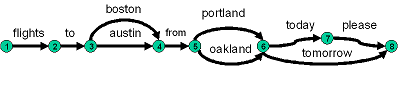
which expands to:
a. flights to boston from portland today please
b. flights to austin from portland today please
c. flights to boston from oakland today please
d. flights to austin from oakland today please
e. flights to boston from portland tomorrow
f. flights to austin from portland tomorrow
g. flights to boston from oakland tomorrow
h. flights to austin from oakland tomorrow
3.4.1 Lattice markup: emma:lattice, emma:arc, emma:node elements
| Annotation |
emma:lattice |
| Definition |
An element which encodes a lattice
representation of user input. |
| Children |
The emma:lattice element MUST immediately contain one or more emma:arc elements and zero or more emma:node elements. |
| Attributes |
- Required:
initial of type xsd:nonNegativeInteger
indicating the number of the initial node of the lattice.final contains a space-separated list of xsd:nonNegativeInteger indicating the numbers of the final nodes in the lattice.
- Optional:
emma:time-ref-uri, emma:time-ref-anchor-point.
|
| Applies to |
The emma:lattice element is legal only as a child of the emma:interpretation element. |
| Annotation |
emma:arc |
| Definition |
An element which encodes a transition between
two nodes in a lattice. The label associated with the arc in the lattice is
represented in the content of emma:arc. |
| Children |
The emma:arc
element MUST immediately contain either character data or a single application namespace element or
be empty, in the case of epsilon transitions.
It MAY contain an emma:info element containing application
or vendor specific annotations. |
| Attributes |
- Required:
from of type xsd:nonNegativeInteger
indicating the number of the starting node for the arc.to of type xsd:nonNegativeInteger
indicating the number of the ending node for the arc.
- Optional:
emma:start, emma:end, emma:offset-to-start, emma:duration, emma:confidence, emma:cost, emma:lang, emma:medium, emma:mode, emma:source.
|
| Applies to |
The emma:arc element is legal only as a child of the emma:lattice element. |
| Annotation |
emma:node |
| Definition |
An element which represents a node in the
lattice. The emma:node elements are not
required to describe a lattice but might be added to provide a
location for annotations on nodes in a lattice. There MUST be at most one emma:node specification for each numbered node
in the lattice. |
| Children |
An OPTIONAL emma:info element for application or vendor specific
annotations on the node. |
| Attributes |
- Required:
node-number of type xsd:nonNegativeInteger
indicating the node number in the lattice.
- Optional:
emma:confidence, emma:cost.
|
| Applies to |
The emma:node element is legal only as a child of the emma:lattice element. |
In EMMA, a lattice is represented using an element
emma:lattice, which has attributes
initial and final for indicating the
initial and final nodes of the lattice. For the lattice below, this
will be: <emma:lattice initial="1" final="8"/>. The nodes are numbered with integers. If
there is more than one distinct final node in the lattice the nodes
MUST be represented as a space separated list in the value of the
final attribute e.g. <emma:lattice
initial="1" final="9 10 23"/>. There MUST only be
one initial node in an EMMA lattice. Each transition in the lattice is
represented as an element emma:arc with attributes
from and to which indicate the nodes where
the transition starts and ends. The arc's label is represented as
the content of the emma:arc element and MUST be any
well-formed character or XML content. In the example here the
contents are words. Empty (epsilon) transitions in a lattice MUST
be represented in the emma:lattice representation as
emma:arc empty elements, e.g.
<emma:arc from="1" to="8"/>.
The example speech lattice above would be represented in EMMA
markup as follows:
<emma:emma version="1.0"
    xmlns:emma="http://www.w3.org/2003/04/emma"
    xmlns:xsi="http://www.w3.org/2001/XMLSchema-instance"
    xsi:schemaLocation="http://www.w3.org/2003/04/emma
     http://www.w3.org/TR/2007/CR-emma-20071211/emma.xsd"
    xmlns="http://www.example.com/example">
  <emma:interpretation id="interp1"
    emma:medium="acoustic" emma:mode="voice">
    <emma:lattice initial="1" final="8">
      <emma:arc from="1" to="2">flights</emma:arc>

      <emma:arc from="2" to="3">to</emma:arc>
      <emma:arc from="3" to="4">boston</emma:arc>
      <emma:arc from="3" to="4">austin</emma:arc>
      <emma:arc from="4" to="5">from</emma:arc>

      <emma:arc from="5" to="6">portland</emma:arc>
      <emma:arc from="5" to="6">oakland</emma:arc>
      <emma:arc from="6" to="7">today</emma:arc>
      <emma:arc from="7" to="8">please</emma:arc>

      <emma:arc from="6" to="8">tomorrow</emma:arc>
    </emma:lattice>
  </emma:interpretation>
</emma:emma>
Alternatively, if we wish to represent the same information as an
N-best list using emma:one-of, we would have the more
verbose representation:
<emma:emma version="1.0"
    xmlns:emma="http://www.w3.org/2003/04/emma"
    xmlns:xsi="http://www.w3.org/2001/XMLSchema-instance"
    xsi:schemaLocation="http://www.w3.org/2003/04/emma
     http://www.w3.org/TR/2007/CR-emma-20071211/emma.xsd"
    xmlns="http://www.example.com/example">
  <emma:one-of id="nbest1" emma:medium="acoustic" emma:mode="voice">
    <emma:interpretation id="interp1">
      <text>flights to boston from portland today please</text>
    </emma:interpretation>

    <emma:interpretationid="interp2">
      <text>flights to boston from portland tomorrow</text>
    </emma:interpretation>

    <emma:interpretation id="interp3">
      <text>flights to austin from portland today please</text>
    </emma:interpretation>

    <emma:interpretation id="interp4">
      <text>flights to austin from portland tomorrow</text>
    </emma:interpretation>

    <emma:interpretation id="interp5">
      <text>flights to boston from oakland today please</text>
    </emma:interpretation>

    <emma:interpretation id="interp6">
      <text>flights to boston from oakland tomorrow</text>
    </emma:interpretation>

    <emma:interpretation id="interp7">
      <text>flights to austin from oakland today please</text>
    </emma:interpretation>

    <emma:interpretation id="interp8">
      <text>flights to austin from oakland tomorrow</text>
    </emma:interpretation>
  </emma:one-of>
</emma:emma>
The lattice representation avoids the need to enumerate all of
the possible word sequences. Also, as detailed below, the
emma:lattice representation enables placement of
annotations on individual words in the input.
For use cases involving the representation of gesture/ink
lattices and use cases involving lattices of semantic
interpretations, EMMA allows for application namespace elements to
appear within emma:arc.
For example a sequence of two gestures, each of which is
recognized as either a line or a circle, might be represented as
follows:
<emma:emma version="1.0"
    xmlns:emma="http://www.w3.org/2003/04/emma"
    xmlns:xsi="http://www.w3.org/2001/XMLSchema-instance"
    xsi:schemaLocation="http://www.w3.org/2003/04/emma
     http://www.w3.org/TR/2007/CR-emma-20071211/emma.xsd"
    xmlns="http://www.example.com/example">
  <emma:interpretation id="interp1"
    emma:medium="acoustic" emma:mode="voice">
    <emma:lattice initial="1" final="3">
      <emma:arc from="1" to="2">
        <circle radius="100"/>
      </emma:arc>
      <emma:arc from="2" to="3">
        <line length="628"/>
      </emma:arc>
      <emma:arc from="1" to="2">
        <circle radius="200"/>
      </emma:arc>
      <emma:arc from="2" to="3">
        <line length="1256"/>
      </emma:arc>
    </emma:lattice>
  </emma:interpretation>
</emma:emma>
As an example of a lattice of semantic interpretations, in a
travel application where the source is either "Boston" or "Austin"and the destination is either "Newark" or "New York", the
possibilities might be represented in a lattice as follows:
<emma:emma version="1.0"
    xmlns:emma="http://www.w3.org/2003/04/emma"
    xmlns:xsi="http://www.w3.org/2001/XMLSchema-instance"
    xsi:schemaLocation="http://www.w3.org/2003/04/emma
     http://www.w3.org/TR/2007/CR-emma-20071211/emma.xsd"
    xmlns="http://www.example.com/example">
  <emma:interpretation id="interp1"
    emma:medium="acoustic" emma:mode="voice">
    <emma:lattice initial="1" final="3">
      <emma:arc from="1" to="2">
        <source city="boston"/>
      </emma:arc>
      <emma:arc from="2" to="3">
        <destination city="newark"/>
      </emma:arc>
      <emma:arc from="1" to="2">
        <source city="austin"/>
      </emma:arc>
      <emma:arc from="2" to="3">
        <destination city="new york"/>
      </emma:arc>
    </emma:lattice>
  </emma:interpretation>
</emma:emma>
The emma:arc element MAY contain either an application
namespace element or character data. It MUST NOT contain combinations
of application namespace elements and character data. However, an
emma:info element MAY appear within an emma:arc
element
alongside character data, in order to allow for the association of
vendor or application specific annotations on a single word or symbol in a
lattice.
So, in summary, there are four groupings of content that can
appear within emma:arc:
- Character Data e.g. a recognized word in a speech lattice.
- Character Data and a single
emma:info element
providing vendor or application specific annotations that apply to
the character data.
- An application namespace element e.g. the gesture and semantic interpretation
lattice examples above.
- An application namespace element and a single
emma:info element providing vendor or application
specific annotations that apply to the character data.
3.4.2 Annotations on lattices
The encoding of lattice arcs as XML elements
(emma:arc) enables arcs to be annotated with
metadata such as timestamps, costs, or confidence scores:
<emma:emma version="1.0"
    xmlns:emma="http://www.w3.org/2003/04/emma"
    xmlns:xsi="http://www.w3.org/2001/XMLSchema-instance"
    xsi:schemaLocation="http://www.w3.org/2003/04/emma
     http://www.w3.org/TR/2007/CR-emma-20071211/emma.xsd"
    xmlns="http://www.example.com/example">
  <emma:interpretation id="interp1"
    emma:medium="acoustic" emma:mode="voice">
    <emma:lattice initial="1" final="8">
      <emma:arc
       from="1"
       to="2"
       emma:start="1087995961542"
       emma:end="1087995962042"
       emma:cost="30">
         flights
      </emma:arc>

      <emma:arc
       from="2"
       to="3"
       emma:start="1087995962042"
       emma:end="1087995962542"
       emma:cost="20">
         to
      </emma:arc>

      <emma:arc
       from="3"
       to="4"
       emma:start="1087995962542"
       emma:end="1087995963042"
       emma:cost="50">
         boston
      </emma:arc>

      <emma:arc
       from="3"
       to="4"
       emma:start="1087995963042"
       emma:end="1087995963742"
       emma:cost="60">
         austin
      </emma:arc>
      ...
    </emma:lattice>
  </emma:interpretation>
</emma:emma>
The following EMMA attributes MAY be placed on
emma:arc elements: absolute timestamps
(emma:start, emma:end), relative timestamps (
emma:offset-to-start, emma:duration),
emma:confidence, emma:cost, the human language of the
input (emma:lang), emma:medium, emma:mode, and
emma:source. The use case for emma:medium,
emma:mode, and emma:source is for lattices which
contains content from different input modes. The
emma:arc element MAY also contain an
emma:info element for specification of vendor and
application specific annotations on the arc.
The timestamps that appear on emma:arc elements do not necessarily indicate the start and end of the arc itself. They MAY indicate the start and end of the signal corresponding to the label on the arc. As a result there is no requirement that the emma:end timestamp on an arc going into a node should be equivalent to the emma:start of all arcs going out of that node. Furthermore there is no guarantee that the left to right order of arcs in a lattice will correspond to the temporal order of the input signal. The lattice representation is an abstraction that represents a range of possible interpretations of a user's input and is not intended to necessarily be a representation of temporal order.
Costs are typically application and device dependent. There are
a variety of ways that individual arc costs might be combined to
produce costs for specific paths through the lattice. This
specification does not standardize the way for these costs to be
combined; it is up to the applications and devices to determine how
such derived costs would be computed and used.
For some lattice formats, it is also desirable to annotate the
nodes in the lattice themselves with information such as costs. For
example in speech recognition, costs might be placed on nodes as a
result of word penalties or redistribution of costs. For this
purpose EMMA also provides an emma:node element
which can host annotations such as emma:cost.
The emma:node element MUST have an attribute
node-number which indicates the number of the node.
There MUST be at most one emma:node specification for a
given numbered node in the lattice. In our example, if there was a
cost of 100 on the final state this could be represented as
follows:
<emma:emma version="1.0"
    xmlns:emma="http://www.w3.org/2003/04/emma"
    xmlns:xsi="http://www.w3.org/2001/XMLSchema-instance"
    xsi:schemaLocation="http://www.w3.org/2003/04/emma
     http://www.w3.org/TR/2007/CR-emma-20071211/emma.xsd"
    xmlns="http://www.example.com/example">
  <emma:interpretation id="interp1"
    emma:medium="acoustic" emma:mode="voice">
    <emma:lattice initial="1" final="8">
      <emma:arc
       from="1"
       to="2"
       emma:start="1087995961542"
       emma:end="1087995962042"
       emma:cost="30">
         flights
      </emma:arc>
      <emma:arc
       from="2"
       to="3"
       emma:start="1087995962042"
       emma:end="1087995962542"
       emma:cost="20">
         to
      </emma:arc>

      <emma:arc
       from="3"
       to="4"
       emma:start="1087995962542"
       emma:end="1087995963042"
       emma:cost="50">
         boston
      </emma:arc>
      <emma:arc
       from="3"
       to="4"
       emma:start="1087995963042"
       emma:end="1087995963742"
       emma:cost="60">
         austin
      </emma:arc>
        ...
      <emma:node node-number="8" emma:cost="100"/>
    </emma:lattice>
  </emma:interpretation>
</emma:emma>
3.4.3 Relative timestamps on lattices
The relative timestamp mechanism in EMMA is intended to provide
temporal information about arcs in a lattice in relative terms
using offsets in milliseconds. In order to do this the absolute
time MAY be specified on emma:interpretation; both emma:time-ref-uri and emma:time-ref-anchor-point
apply to emma:lattice and MAY be used there to set
the anchor point for offsets to the start of the absolute time
specified on emma:interpretation. The offset in
milliseconds to the beginning of each arc MAY then be indicated on
each emma:arc in the emma:offset-to-start
attribute.
<emma:emma version="1.0"
    xmlns:emma="http://www.w3.org/2003/04/emma"
    xmlns:xsi="http://www.w3.org/2001/XMLSchema-instance"
    xsi:schemaLocation="http://www.w3.org/2003/04/emma
     http://www.w3.org/TR/2007/CR-emma-20071211/emma.xsd"
    xmlns="http://www.example.com/example">

  <emma:interpretation id="interp1"
          emma:start="1087995961542" emma:end="1087995963042"
          emma:medium="acoustic" emma:mode="voice">
    <emma:lattice emma:time-ref-uri="#interp1"
        emma:time-ref-anchor-point="start"
        initial="1" final="4">
      <emma:arc
       from="1"
       to="2"
       emma:offset-to-start="0">
         flights
      </emma:arc>
      <emma:arc
       from="2"
       to="3"
       emma:offset-to-start="500">
         to
      </emma:arc>

      <emma:arc
       from="3"
       to="4"
       emma:offset-to-start="1000">
         boston
      </emma:arc>
    </emma:lattice>
  </emma:interpretation>
</emma:emma>
Note that the offset for the first emma:arc
MUST
always be zero since the EMMA attribute emma:offset-to-start
indicates the number of milliseconds from the anchor point to the
start of the piece of input associated with the
emma:arc, in this case the word "flights".
3.5 Literal semantics: emma:literal element
| Annotation |
emma:literal |
| Definition |
An element that contains string literal output. |
| Children |
String literal |
| Attributes |
None. |
| Applies to |
The emma:literal is a child of emma:interpretation. |
Certain EMMA processing components produce semantic results in the form of
string literals without any surrounding application namespace markup. These MUST be
placed with the EMMA element emma:literal within emma:interpretation.
For example, if a semantic interpreter simply returned "boston" this could be represented in EMMA
as:
<emma:emma version="1.0"
    xmlns:emma="http://www.w3.org/2003/04/emma"
    xmlns:xsi="http://www.w3.org/2001/XMLSchema-instance"
    xsi:schemaLocation="http://www.w3.org/2003/04/emma
     http://www.w3.org/TR/2007/CR-emma-20071211/emma.xsd"
    xmlns="http://www.example.com/example">
  <emma:interpretation id="r1"
     emma:medium="acoustic" emma:mode="voice">
    <emma:literal>boston</emma:literal>
  </emma:interpretation>
</emma:emma>
4. EMMA annotations
This section defines annotations in the EMMA namespace including
both attributes and elements. The values are specified in terms of
the data types defined by XML Schema Part 2: Datatypes Second Edition [XML Schema Datatypes].
4.1 EMMA annotation elements
4.1.1 Data model: emma:model element
| Annotation |
emma:model |
| Definition |
The emma:model either references or provides
inline the data model for the instance data. |
| Children |
If a ref attribute is not specified then this element
contains the data model inline. |
| Attributes |
- Required:
- Optional:
ref of type xsd:anyURI that references
the data model. Note that either an ref attribute or in-line data model (but not
both) MUST be specified.
|
| Applies to |
The emma:model element MAY appear only as a child of emma:emma. |
The data model that may be used to express constraints on the
structure and content of instance data is specified as one of the
annotations of the instance. Specifying the data model
is OPTIONAL,
in which case the data model can be said to be implicit. Typically
the data model is pre-established by the application.
The data model is specified with the emma:model
annotation defined as an element in the EMMA namespace. If the
data model for the contents of a emma:interpretation,
container elements, or application namespace element is to be specified in EMMA,
the attribute emma:model-ref MUST
be specified on the emma:interpretation,
container element, or application namespace element.
Note that since multiple emma:model elements
might be
specified under the emma:emma it is
possible to refer to multiple data models within a single EMMA document. For example, different
alternative interpretations under an emma:one-of
might have different data models. In this case, an emma:model-ref
attribute would appear on each emma:interpretation element
in the N-best list with its value being the id of the
emma:model element for that particular interpretation.
The data model is closely related to the interpretation data,
and is typically specified as the annotation related to the
emma:interpretation or emma:one-of elements.
<emma:emma version="1.0"
    xmlns:emma="http://www.w3.org/2003/04/emma"
    xmlns:xsi="http://www.w3.org/2001/XMLSchema-instance"
    xsi:schemaLocation="http://www.w3.org/2003/04/emma
     http://www.w3.org/TR/2007/CR-emma-20071211/emma.xsd"
    xmlns="http://www.example.com/example">
  <emma:model id="model1" ref="http://example.com/models/city.xml"/>
  <emma:interpretation id="int1" emma:model-ref="model1"
    emma:medium="acoustic" emma:mode="voice">
    <city> London </city>
    <country> UK </country>
  </emma:interpretation>
</emma:emma>
The emma:model annotation MAY reference any element or
attribute in the application instance data, as well as any EMMA
container element (emma:one-of, emma:group, or
emma:sequence).
The data model annotation MAY be used to either reference an
external data model with the ref attribute or provide a data
model as in-line content. Either a ref attribute or in-line data
model (but not both) MUST be specified.
4.1.2 Interpretation derivation: emma:derived-from element and emma:derivation element
| Annotation |
emma:derived-from |
| Definition |
An empty element which provides a reference to the interpretation which
the element it appears on was derived from. |
| Children |
None |
| Attributes |
- Required:
resource of type
xsd:anyURI that references the interpretation from which the
current interpretation is derived.
- Optional:
composite of type xsd:boolean that is
"true" if the derivation step combines multiple inputs and "false" if not.
If composite is not specified the value is "false" by default.
|
| Applies to |
The emma:derived-from element is legal only as a child of emma:interpretation, emma:one-of, emma:group, or emma:sequence. |
| Annotation |
emma:derivation |
| Definition |
An element which contains interpretation and container elements representing
earlier stages in the processing of the input. |
| Children |
One or more emma:interpretation, emma:one-of, emma:sequence, or emma:group elements. |
| Attributes |
None |
| Applies to |
The emma:derivation MAY appear only as a child of the emma:emma element. |
Instances of interpretations are in general derived from other
instances of interpretation in a process that goes from raw data to
increasingly refined representations of the input. The derivation
annotation is used to link any two interpretations that are related
by representing the source and the outcome of an interpretation
process. For instance, a speech recognition process can return the
following result in the form of raw text:
<emma:emma version="1.0"
    xmlns:emma="http://www.w3.org/2003/04/emma"
    xmlns:xsi="http://www.w3.org/2001/XMLSchema-instance"
    xsi:schemaLocation="http://www.w3.org/2003/04/emma
     http://www.w3.org/TR/2007/CR-emma-20071211/emma.xsd"
    xmlns="http://www.example.com/example">
  <emma:interpretation id="raw"
    emma:medium="acoustic" emma:mode="voice">
    <answer>From Boston to Denver tomorrow</answer>
  </emma:interpretation>

</emma:emma>
A first interpretation process will produce:
<emma:emma version="1.0"
    xmlns:emma="http://www.w3.org/2003/04/emma"
    xmlns:xsi="http://www.w3.org/2001/XMLSchema-instance"
    xsi:schemaLocation="http://www.w3.org/2003/04/emma
     http://www.w3.org/TR/2007/CR-emma-20071211/emma.xsd"
    xmlns="http://www.example.com/example">
  <emma:interpretation id="better"
    emma:medium="acoustic" emma:mode="voice">
    <origin>Boston</origin>
    <destination>Denver</destination>
    <date>tomorrow</date>
  </emma:interpretation>
</emma:emma>
A second interpretation process, aware of the current date, will
be able to produce a more refined instance, such as:
<emma:emma version="1.0"
    xmlns:emma="http://www.w3.org/2003/04/emma"
    xmlns:xsi="http://www.w3.org/2001/XMLSchema-instance"
    xsi:schemaLocation="http://www.w3.org/2003/04/emma
     http://www.w3.org/TR/2007/CR-emma-20071211/emma.xsd"
    xmlns="http://www.example.com/example">
  <emma:interpretation id="best"
    emma:medium="acoustic" emma:mode="voice">
    <origin>Boston</origin>
    <destination>Denver</destination>
    <date>20030315</date>
  </emma:interpretation>
</emma:emma>
The interaction manager might need to have access to the three
levels of interpretation. The emma:derived-from annotation element can be
used to establish a chain of derivation relationships as in the
following example:
<emma:emma version="1.0"
    xmlns:emma="http://www.w3.org/2003/04/emma"
    xmlns:xsi="http://www.w3.org/2001/XMLSchema-instance"
    xsi:schemaLocation="http://www.w3.org/2003/04/emma
     http://www.w3.org/TR/2007/CR-emma-20071211/emma.xsd"
    xmlns="http://www.example.com/example">
  <emma:derivation>
    <emma:interpretation id="raw"
      emma:medium="acoustic" emma:mode="voice">
      <answer>From Boston to Denver tomorrow</answer>
    </emma:interpretation>

    <emma:interpretation id="better">
      <emma:derived-from resource="#raw" composite="false"/>
      <origin>Boston</origin>
      <destination>Denver</destination>
      <date>tomorrow</date>
    </emma:interpretation>
  </emma:derivation>

  <emma:interpretation id="best">
    <emma:derived-from resource="#better" composite="false"/>
    <origin>Boston</origin>
    <destination>Denver</destination>
    <date>20030315</date>
  </emma:interpretation>
</emma:emma>
The emma:derivation element MAY be used as a container for representations of the
earlier stages in the interpretation of the input. The latest stage of processing MUST be a direct child of emma:emma.
The resource attribute on emma:derived-from is a URI which
can reference IDs in the current or other EMMA documents.
In addition to representing sequential derivations, the EMMA
emma:derived-from element can also be used to
capture composite derivations. Composite derivations involve
combination of inputs from different modes.
In order to indicate whether an emma:derived-from
element describes a sequential derivation step or a composite
derivation step, the emma:derived-from element has an attribute
composite which has a boolean value. A composite
emma:derived-from MUST be marked as
composite="true" while a sequential
emma:derived-from element is marked as composite="false".
If this attribute is not specified the value is false by default.
In the following
composite derivation example the user said "destination" using the voice mode and
circled Boston on a map using the ink mode:
<emma:emma version="1.0"
    xmlns:emma="http://www.w3.org/2003/04/emma"
    xmlns:xsi="http://www.w3.org/2001/XMLSchema-instance"
    xsi:schemaLocation="http://www.w3.org/2003/04/emma
     http://www.w3.org/TR/2007/CR-emma-20071211/emma.xsd"
    xmlns="http://www.example.com/example">
  <emma:derivation>
    <emma:interpretation id="voice1"
        emma:start="1087995961500"
        emma:end="1087995962542"
        emma:process="http://example.com/myasr.xml"
        emma:source="http://example.com/microphone/NC-61"
        emma:signal="http://example.com/signals/sg23.wav"
        emma:confidence="0.6"
        emma:medium="acoustic"
        emma:mode="voice"
        emma:function="dialog"
        emma:verbal="true"
        emma:lang="en-US"
        emma:tokens="destination">
      <rawinput>destination</rawinput>
    </emma:interpretation>

    <emma:interpretation id="ink1"
        emma:start="1087995961600"
        emma:end="1087995964000"
        emma:process="http://example.com/mygesturereco.xml"
        emma:source="http://example.com/pen/wacom123"
        emma:signal="http://example.com/signals/ink5.inkml"
        emma:confidence="0.5"
        emma:medium="tactile"
        emma:mode="ink"
        emma:function="dialog"
        emma:verbal="false">
      <rawinput>Boston</rawinput>
    </emma:interpretation>
  </emma:derivation>

  <emma:interpretation id="multimodal1"


      emma:confidence="0.3"
      emma:start="1087995961500"
      emma:end="1087995964000"
      emma:medium="acoustic tactile"
      emma:mode="voice ink"
      emma:function="dialog"
      emma:verbal="true"
      emma:lang="en-US"
      emma:tokens="destination">
    <emma:derived-from resource="#voice1" composite="true"
    <emma:derived-from resource="#ink1" composite="true"
    <destination>Boston</destination>
  </emma:interpretation>
</emma:emma>
In this example, annotations on the multimodal interpretation
indicate the process used for the integration and there are two
emma:derived-from elements, one pointing to the
speech and one pointing to the pen gesture.
The only constraints the EMMA specification places on the
annotations that appear on a composite input are that the emma:medium
attribute MUST contain the union of the emma:medium attributes on the combining
inputs, represented as a space delimited set of nmtokens as defined in Section 4.2.11, and that the
emma:mode attribute MUST contain the union of the emma:mode attributes on the combining
inputs, represented as a space delimited set of nmtokens as defined in Section 4.2.11. In the example above this meanings that the emma:medium
value is "acoustic tactile" and the emma:mode attribute is "voice ink". How all
other annotations are handled is author defined. In the following paragraph, informative examples on how specific
annotations might be handled are given.
With reference to the illustrative example above, this paragraph provides informative guidance
regarding the determination of annotations (beyond emma:medium and
emma:mode on a composite multimodal interpretation).
Generally the timestamp on a combined input should contain the intervals indicated by
the combining inputs. For the absolute timestamps emma:start and
emma:end this can be achieved by taking the earlier of the
emma:start values (emma:start="1087995961500"
in our example) and the later of the emma:end
values (emma:end="1087995964000" in the example). The determination of
relative timestamps for composite is more complex, informative guidance is given in
Section 4.2.10.4.
Generally speaking the emma:confidence value will be some
numerical combination of the confidence scores assigned to the combining inputs. In our
example, it is the result of multiplying the voice and ink confidence scores (0.3).
In other cases there may not be a confidence score for one of the combining inputs and the
author may choose to copy the confidence score from the input which does have one.
Generally, for emma:verbal, if either of the inputs has
the value true then the multimodal interpretation will
also be emma:verbal="true" as in the example.
In other words the annotation for the composite input is the result
of an inclusive OR of the boolean values of the annotations on the inputs.
If an annotation is only specified on one of the combining
inputs then it may in some cases be assumed to apply to the multimodal
interpretation of the composite input. In the example, emma:lang="en-US"
is only specified for the speech input, and this annotation appears on the composite
result also. Similarly in our example, only the voice has emma:tokens
and the author has chosen to annotate the combined input with the same
emma:tokens value. In this example, the emma:function
is the same on both combining input and the author has chosen to use the same
annotation on the composite interpretation.
In annotating derivations of the processing of the input, EMMA provides the
flexibility of both course-grained or fine-grained annotation of relations
among interpretations. For example, when relating two N-best lists, within
emma:one-of elements either there can be a single emma:derived-from
element under emma:one-of referring to the ID of the emma:one-of
for the earlier processing stage:
<emma:emma version="1.0"
    xmlns:emma="http://www.w3.org/2003/04/emma"
    xmlns:xsi="http://www.w3.org/2001/XMLSchema-instance"
    xsi:schemaLocation="http://www.w3.org/2003/04/emma
     http://www.w3.org/TR/2007/CR-emma-20071211/emma.xsd"
    xmlns="http://www.example.com/example">
  <emma:derivation>
    <emma:one-of id="nbest1"
      emma:medium="acoustic" emma:mode="voice">
      <emma:interpretation id="int1">
       <res>from boston to denver on march eleven two thousand three</res>
      </emma:interpretation>

      <emma:interpretation id="int2">
       <res>from austin to denver on march eleven two thousand three</res>
      </emma:interpretation>
  </emma:one-of>
</emma:derivation>

<emma:one-of id="nbest2">
  <emma:derived-from resource="#nbest1" composite="false"/>
  <emma:interpretation id="int1b">
    <origin>Boston</origin>
    <destination>Denver</destination>
    <date>03112003</date>
  </emma:interpretation>

  <emma:interpretation id="int2b">
    <origin>Austin</origin>
    <destination>Denver</destination>
    <date>03112003</date>
  </emma:interpretation>
</emma:one-of>

</emma:emma>
Or there can be a separate emma:derived-from element on each
emma:interpretation element referring to the specific
emma:interpretation element it was derived from.
<emma:emma version="1.0"
    xmlns:emma="http://www.w3.org/2003/04/emma"
    xmlns:xsi="http://www.w3.org/2001/XMLSchema-instance"
    xsi:schemaLocation="http://www.w3.org/2003/04/emma
     http://www.w3.org/TR/2007/CR-emma-20071211/emma.xsd"
    xmlns="http://www.example.com/example">
  <emma:one-of id="nbest2">
    <emma:interpretation id="int1b">
     <emma:derived-from resource="#int1" composite="false"/>
      <origin>Boston</origin>
      <destination>Denver</destination>
      <date>03112003</date>
    </emma:interpretation>

    <emma:interpretation id="int2b">
     <emma:derived-from resource="#int2" composite="false"/>
      <origin>Austin</origin>
      <destination>Denver</destination>
      <date>03112003</date>
    </emma:interpretation>
  </emma:one-of>
  <emma:derivation>
    <emma:one-of id="nbest1"
      emma:medium="acoustic" emma:mode="voice">
      <emma:interpretation id="int1">
       <res>from boston to denver on march eleven two thousand three</res>
      </emma:interpretation>

      <emma:interpretation id="int2">
       <res>from austin to denver on march eleven two thousand three</res>
      </emma:interpretation>
    </emma:one-of>
  </emma:derivation>
</emma:emma>
Section 4.3 provides further examples of the
use of emma:derived-from to represent
sequential derivations
and addresses the issue of the scope of EMMA annotations across
derivations of user input.
4.1.3 Reference to grammar used: emma:grammar element
| Annotation |
emma:grammar |
| Definition |
An element used to provide a reference to the grammar used in processing the input. |
| Children |
None |
| Attributes |
- Required:
ref of type xsd:anyURI that references
a grammar used in processing the input.id of type xsd:ID.
|
| Applies to |
The emma:grammar is legal only as a child of the emma:emma element. |
The grammar that was used to derive the EMMA result MAY be specified
with the emma:grammar annotation defined as an element in
the EMMA namespace.
Example:
<emma:emma version="1.0"
    xmlns:emma="http://www.w3.org/2003/04/emma"
    xmlns:xsi="http://www.w3.org/2001/XMLSchema-instance"
    xsi:schemaLocation="http://www.w3.org/2003/04/emma
     http://www.w3.org/TR/2007/CR-emma-20071211/emma.xsd"
    xmlns="http://www.example.com/example">
  <emma:grammar id="gram1" ref="someURI"/>
  <emma:grammar id="gram2" ref="anotherURI"/>
  <emma:one-of id="r1"
    emma:medium="acoustic" emma:mode="voice">
    <emma:interpretation id="int1" emma:grammar-ref="gram1">
      <origin>Boston</origin>
    </emma:interpretation>

    <emma:interpretation id="int2" emma:grammar-ref="gram1">
        <origin>Austin</origin>
    </emma:interpretation>

    <emma:interpretation id="int3" emma:grammar-ref="gram2">
        <command>help</command>
    </emma:interpretation>
  </emma:one-of>
</emma:emma>
The emma:grammar annotation is a child of
emma:emma.
4.1.4 Extensibility to application/vendor specific
annotations: emma:info element
| Annotation |
emma:info |
| Definition |
The emma:info element acts as a container for vendor and/or application specific
metadata regarding a user's input. |
| Children |
One of more elements in the application namespace providing
metadata about the input. |
| Attributes |
|
| Applies to |
The emma:info element is legal only as a child of
the EMMA elements emma:emma,
emma:interpretation, emma:group, emma:one-of,
emma:sequence, emma:arc, or emma:node. |
In Section 4.2, a series of attributes are
defined for representation of metadata about user inputs in a
standardized form. EMMA also provides an extensibility mechanism
for annotation of user inputs with vendor or application specific
metadata not covered by the standard set of EMMA annotations. The
element emma:info MUST be used as a container for
these annotations, UNLESS they are explicitly covered by emma:endpoint-info.
For example, if an input to a dialog system needed to be annotated with the number
that the call originated from, their state, some indication of the type of customer, and the
name of the service, these pieces of information could be
represented within emma:info as in the following
example:
<emma:emma version="1.0"
    xmlns:emma="http://www.w3.org/2003/04/emma"
    xmlns:xsi="http://www.w3.org/2001/XMLSchema-instance"
    xsi:schemaLocation="http://www.w3.org/2003/04/emma
     http://www.w3.org/TR/2007/CR-emma-20071211/emma.xsd"
    xmlns="http://www.example.com/example">
  <emma:info>
    <caller_id>
      <phone_number>2121234567</phone_number>
      <state>NY</state>
    </caller_id>

    <customer_type>residential</customer_type>
    <service_name>acme_travel_service</service_name>
  </emma:info>

  <emma:one-of id="r1" emma:start="1087995961542"
      emma:end="1087995963542"
      emma:medium="acoustic" emma:mode="voice">
    <emma:interpretation id="int1" emma:confidence="0.75">
      <origin>Boston</origin>
      <destination>Denver</destination>
      <date>03112003</date>
    </emma:interpretation>

    <emma:interpretation id="int2" emma:confidence="0.68">
      <origin>Austin</origin>
      <destination>Denver</destination>
      <date>03112003</date>
    </emma:interpretation>
  </emma:one-of>
</emma:emma>
It is important to have an EMMA container element for
application/vendor specific annotations since EMMA elements provide
a structure for representation of multiple possible interpretations
of the input. As a result it is cumbersome to state
application/vendor specific metadata as part of the application
data within each emma:interpretation. An element is
used rather than an attribute so that internal structure can be
given to the annotations within emma:info.
In addition to emma:emma,
emma:info MAY also appear as a child of other
structural elements such as emma:interpretation,
emma:info and so on. When emma:info
appears as a child of one of these elements the application/vendor
specific annotations contained within emma:info are
assumed to apply to all of the emma:interpretation
elements within the containing element. The semantics of
conflicting annotations in emma:info, for example
when different values are found within emma:emma and
emma:interpretation, are left to the developer of
the vendor/application specific annotations.
4.1.5 Endpoint reference: emma:endpoint-info element and emma:endpoint element
| Annotation |
emma:endpoint-info |
| Definition |
The emma:endpoint-info element acts as a container for all application specific
annotation regarding the communication environment. |
| Children |
One or more emma:endpoint elements. |
| Attributes |
|
| Applies to |
The emma:endpoint-info elements is legal only as a child of emma:emma. |
| Annotation |
emma:endpoint |
| Definition |
The element acts as a container for application specific endpoint information. |
| Children |
Elements in the application namespace providing metadata about the input. |
| Attributes |
- Required:
- Optional:
emma:endpoint-role, emma:endpoint-address, emma:message-id,
emma:port-num, emma:port-type, emma:endpoint-pair-ref,
emma:service-name, emma:media-type, emma:medium,
emma:mode.
|
| Applies to |
emma:endpoint-info |
In order to conduct multimodal interaction, there is a need in
EMMA to specify the properties of the endpoint that receives the
input which leads to the EMMA annotation. This allows
subsequent components to utilize the endpoint properties as well as
the annotated inputs to conduct meaningful multimodal interaction.
EMMA element emma:endpoint can be used for this
purpose. It can specify the endpoint properties based on a set of
common endpoint property attributes in EMMA, such as
emma:endpoint-address, emma:port-num, emma:port-type, etc. (Section 4.2.14).
Moreover, it provides an extensible annotation structure that
allows the inclusion of application and vendor specific endpoint
properties.
Note that the usage of the term "endpoint" in this
context is different from the way that the term is used in speech
processing, where it refers to the end of a speech input. As used
here, "endpoint" refers to a network location which is the source
or recipient of an EMMA document.
In multimodal interaction, multiple devices can be used and each
device can open multiple communication endpoints at the same time.
These endpoints are used to transmit and receive data, such as raw
input, EMMA documents, etc. The EMMA element
emma:endpoint provides a generic
representation of endpoint information which is relevant to
multimodal interaction. It allows the annotation to be
interoperable, and it eliminates the need for EMMA processors to
create their own specialized annotations for existing protocols,
potential protocols or yet undefined private protocols that they
may use.
Moreover, emma:endpoint-info provides a container
to hold all annotations regarding the endpoint information,
including emma:endpoint and other application and
vendor specific annotations that are related to the communication,
allowing the same communication environment to be referenced and
used in multiple interpretations.
Note that EMMA provides two locations (i.e.
emma:info and emma:endpoint-info) for specifying
vendor/application specific annotations. If the annotation is
specifically related to the description of the endpoint, then the
vendor/application specific annotation SHOULD be placed within
emma:endpoint-info, otherwise it SHOULD be placed within
emma:info.
The following example illustrates the annotation of endpoint
reference properties in EMMA.
<emma:emma version="1.0"
    xmlns:emma="http://www.w3.org/2003/04/emma"
    xmlns:xsi="http://www.w3.org/2001/XMLSchema-instance"
    xsi:schemaLocation="http://www.w3.org/2003/04/emma
     http://www.w3.org/TR/2007/CR-emma-20071211/emma.xsd"
    xmlns="http://www.example.com/example"
    xmlns:ex="http://www.example.com/emma/port">
  <emma:endpoint-info id="audio-channel-1">
    <emma:endpoint id="endpoint1"
        emma:endpoint-role="sink"
        emma:endpoint-address="135.61.71.103"
        emma:port-num="50204"
        emma:port-type="rtp"
        emma:endpoint-pair-ref="endpoint2"
        emma:media-type="audio/dsr-202212; rate:8000; maxptime:40"
        emma:service-name="travel"
        emma:mode="voice">
      <ex:app-protocol>SIP</ex:app-protocol>
    </emma:endpoint>

    <emma:endpoint id="endpoint2"
        emma:endpoint-role="source"
        emma:endpoint-address="136.62.72.104"
        emma:port-num="50204"
        emma:port-type="rtp"
        emma:endpoint-pair-ref="endpoint1"
        emma:media-type="audio/dsr-202212; rate:8000; maxptime:40"
        emma:service-name="travel"
        emma:mode="voice">
      <ex:app-protocol>SIP</ex:app-protocol>
    </emma:endpoint>
  </emma:endpoint-info>

  <emma:interpretation id="int1"
      emma:start="1087995961542" emma:end="1087995963542"
      emma:endpoint-info-ref="audio-channel-1"
      emma:medium="acoustic" emma:mode="voice">
    <destination>Chicago</destination>
  </emma:interpretation>
</emma:emma>
The ex:app-protocol is provided by the
application or the vendor specification. It specifies that the
application layer protocol used to establish the speech
transmission from the "source" port to the "sink" port is Session
Initiation Protocol (SIP). This is specific to SIP based VoIP
communication, in which the actual media transmission and the call
signaling that controls the communication sessions, are separated
and typically based on different protocols. In the above example,
the Real-time Transmission Protocol (RTP) is used in the media
transmission between the source port and the sink port.
4.2 EMMA annotation attributes
4.2.1 Tokens of input: emma:tokens attribute
| Annotation |
emma:tokens |
| Definition |
An attribute of type xsd:string holding a sequence of input
tokens. |
| Applies to |
emma:interpretation, emma:group, emma:one-of,
emma:sequence, and application instance data. |
The emma:tokens annotation holds a list of input tokens.
In the following description, the term tokens is used in the
computational and syntactic sense of units of input, and not
in the sense of XML tokens.
The value held in emma:tokens is the list of the tokens
of input as produced by the processor which generated the EMMA
document; there is no language associated with this value.
In the case where a grammar is used to constrain input,
the value will correspond to tokens as defined by the grammar. So
for an EMMA document produced by input to a SRGS grammar
[SRGS], the value of emma:tokens will be
the list of words and/or phrases that are defined as tokens in SRGS
(see Section 2.1
of [SRGS]). Items in the emma:tokens list are delimited by
white space and/or quotation marks for phrases containing white
space. For example:
emma:tokens="arriving at 'Liverpool Street'"
where the three tokens of input are arriving, at
and Liverpool Street.
The emma:tokens annotation MAY be applied not just to the lexical words and phrases of language but to any level of input processing.
Other examples of tokenization include phonemes, ink strokes,
gestures and any other discrete units of input at any level.
Examples:
<emma:emma version="1.0"
    xmlns:emma="http://www.w3.org/2003/04/emma"
    xmlns:xsi="http://www.w3.org/2001/XMLSchema-instance"
    xsi:schemaLocation="http://www.w3.org/2003/04/emma
     http://www.w3.org/TR/2007/CR-emma-20071211/emma.xsd"
    xmlns="http://www.example.com/example">
  <emma:interpretation id="int1"
      emma:tokens="From Cambridge to London tomorrow"
      emma:medium="acoustic" emma:mode="voice">
    <origin emma:tokens="From Cambridge">Cambridge</origin>
    <destination emma:tokens="to London">London</destination>
    <date emma:tokens="tomorrow">20030315</date>
  </emma:interpretation>
</emma:emma>
4.2.2 Reference to processing: emma:process attribute
| Annotation |
emma:process |
| Definition |
An attribute of type xsd:anyURI referencing the process used to
generate the interpretation. |
| Applies to |
emma:interpretation, emma:one-of, emma:group, emma:sequence |
A reference to the information concerning the processing that
was used for generating an interpretation MAY be made using the
emma:process attribute. For example:
<emma:emma version="1.0"
    xmlns:emma="http://www.w3.org/2003/04/emma"
    xmlns:xsi="http://www.w3.org/2001/XMLSchema-instance"
    xsi:schemaLocation="http://www.w3.org/2003/04/emma
     http://www.w3.org/TR/2007/CR-emma-20071211/emma.xsd"
    xmlns="http://www.example.com/example">
  <emma:derivation>
    <emma:interpretation id="raw"
      emma:medium="acoustic" emma:mode="voice">
      <answer>From Boston to Denver tomorrow</answer>
    </emma:interpretation>

    <emma:interpretation id="better"
        emma:process="http://example.com/mysemproc1.xml">
      <origin>Boston</origin>
      <destination>Denver</destination>
      <date>tomorrow</date>
      <emma:derived-from resource="#raw"/>
    </emma:interpretation>
  </emma:derivation>

  <emma:interpretation id="best"
      emma:process="http://example.com/mysemproc2.xml">
    <origin>Boston</origin>
    <destination>Denver</destination>
    <date>03152003</date>
    <emma:derived-from resource="#better"/>
  </emma:interpretation>
</emma:emma>
The process description document, referenced by the
emma:process annotation MAY include information on the
process itself, such as grammar, type of parser, etc. EMMA is not
normative about the format of the process description document.
4.2.3 Lack of input: emma:no-input attribute
| Annotation |
emma:no-input |
| Definition |
Attribute holding xsd:boolean value that is true if there was
no input. |
| Applies to |
emma:interpretation |
The case of lack of input MUST be annotated as follows:
<emma:emma version="1.0"
    xmlns:emma="http://www.w3.org/2003/04/emma"
    xmlns:xsi="http://www.w3.org/2001/XMLSchema-instance"
    xsi:schemaLocation="http://www.w3.org/2003/04/emma
     http://www.w3.org/TR/2007/CR-emma-20071211/emma.xsd"
    xmlns="http://www.example.com/example">
  <emma:interpretation id="int1" emma:no-input="true"
   emma:medium="acoustic" emma:mode="voice"/>
</emma:emma>
If the emma:interpretation is annotated with
emma:no-input="true" then the
emma:interpretation MUST be empty.
4.2.4 Uninterpreted input: emma:uninterpreted attribute
| Annotation |
emma:uninterpreted |
| Definition |
Attribute holding xsd:boolean value that is true if
no interpretation was produced in response to the input |
| Applies to |
emma:interpretation |
An emma:interpretation element representing input
for which no interpretation was produced MUST be annotated with emma:uninterpreted="true".
For example:
<emma:emma version="1.0"
    xmlns:emma="http://www.w3.org/2003/04/emma"
    xmlns:xsi="http://www.w3.org/2001/XMLSchema-instance"
    xsi:schemaLocation="http://www.w3.org/2003/04/emma
    http://www.w3.org/TR/2007/CR-emma-20071211/emma.xsd"
    xmlns="http://www.example.com/example">
  <emma:interpretation id="interp1" emma:uninterpreted="true"
   emma:medium="acoustic" emma:mode="voice"/>
</emma:emma>
The notation for uninterpreted input MAY refer to any possible
stage of interpretation processing, including raw transcriptions. For instance, no interpretation would be produced for stages performing pure signal capture such as audio recordings. Likewise, if a spoken input was recognized but cannot be parsed by a language understanding component, it can be tagged as emma:uninterpreted as in the following example:
<emma:emma version="1.0"
    xmlns:emma="http://www.w3.org/2003/04/emma"
    xmlns:xsi="http://www.w3.org/2001/XMLSchema-instance"
    xsi:schemaLocation="http://www.w3.org/2003/04/emma
     http://www.w3.org/TR/2007/CR-emma-20071211/emma.xsd"
    xmlns="http://www.example.com/example">
  <emma:interpretation id="understanding"
      emma:process="http://example.com/mynlu.xml"
      emma:uninterpreted="true"
      emma:tokens="From Cambridge to London tomorrow"
      emma:medium="acoustic" emma:mode="voice"/>
</emma:emma>
The emma:interpretation MUST be empty if the
emma:interpretation element is annotated with
emma:uninterpreted="true".
4.2.5 Human language of input: emma:lang attribute
| Annotation |
emma:lang |
| Definition |
An attribute of type xsd:language indicating the language for
the input. |
| Applies to |
emma:interpretation, emma:group, emma:one-of,
emma:sequence, and application instance data. |
The emma:lang annotation is used to indicate the human
language for the input that it annotates. The values of the
emma:lang
attribute are language identifiers as defined by
IETF Best Current Practice 47
[BCP47]. For
example, emma:lang="fr" denotes French, and
emma:lang="en-US" denotes US English. emma:lang
MAY be applied to any emma:interpretation element. Its
annotative scope follows the annotative scope of these elements.
Unlike the xml:lang attribute in XML, emma:lang
does not specify the language used by element contents or attribute values.
The following example shows the use of emma:lang for
annotating an input interpretation.
<emma:emma version="1.0"
    xmlns:emma="http://www.w3.org/2003/04/emma"
    xmlns:xsi="http://www.w3.org/2001/XMLSchema-instance"
    xsi:schemaLocation="http://www.w3.org/2003/04/emma
     http://www.w3.org/TR/2007/CR-emma-20071211/emma.xsd"
    xmlns="http://www.example.com/example">
  <emma:interpretation id="int1" emma:lang="fr"
    emma:medium="acoustic" emma:mode="voice">
    <answer>arretez</answer>
  </emma:interpretation>
</emma:emma>
Many kinds of input including some inputs made through pen, computer vision, and other kinds of sensors are inherently non-linguistic. Examples include drawing areas, arrows etc. using a pen and music input for tune recognition. If these non-linguistic inputs are annotated with emma:lang then they MUST be annotated as emma:lang="zxx". For example, pen input where a user circles an area on map display could be represented as follows where emma:lang="zxx" indicates that the ink input is not in any human language.
<emma:emma version="1.0"
    xmlns:emma="http://www.w3.org/2003/04/emma"
    xmlns:xsi="http://www.w3.org/2001/XMLSchema-instance"
    xsi:schemaLocation="http://www.w3.org/2003/04/emma
     http://www.w3.org/TR/2007/CR-emma-20071211/emma.xsd"
    xmlns="http://www.example.com/example">
  <emma:interpretation id="pen1"
      emma:medium="tactile"
      emma:mode="ink"
      emma:lang="zxx">
    <location>
      <type>area</type>
      <points>42.1345 -37.128 42.1346 -37.120 ... </points>
    </location>
  </emma:interpretation>
</emma:emma>
If inputs for which there is no information about whether the source input is in a particular human language, and if so which language, are annotated with emma:lang, then they MUST be annotated as emma:lang="". Furthermore, in cases where there is not explicit emma:lang annotation, and none is inherited from a higher element in the document, the default value for emma:lang is "" meaning that there is no information about whether the source input is in a language and if so which language.
The xml:lang and emma:lang attributes serve uniquely different and equally important purposes. The role of the xml:lang attribute in XML 1.0 is to indicate the language used for character data content in an XML element or document. In contrast, the emma:lang attribute is used to indicate the language employed by a user when entering an input. Critically, emma:lang annotates the language of the signal originating from the user rather than the specific tokens used at a particular stage of processing. This is most clearly illustrated through consideration of an example involving multiple stages of processing of a user input. Consider the following scenario: EMMA is being used to represent three stages in the processing of a spoken input to an system for ordering products. The user input is in Italian, after speech recognition, the user input is first translated into English, then a natural language understanding system converts the English translation into a product ID (which is not in any particular language). Since the input signal is a user speaking Italian, the emma:lang will be emma:lang="it" on all of these three stages of processing. The xml:lang attribute, in contrast, will initially be "it", after translation the xml:lang will be "en-US", and after language understanding it will be "zxx" since the product ID is non-linguistic content. The following are examples of EMMA documents corresponding to these three processing stages, abbreviated to show the critical attributes for discussion here. Note that <transcription>, <translation>, and <understanding> are application namespace attributes, not part of the EMMA markup.
<emma:emma version="1.0"
    xmlns:emma="http://www.w3.org/2003/04/emma"
    xmlns:xsi="http://www.w3.org/2001/XMLSchema-instance"
    xsi:schemaLocation="http://www.w3.org/2003/04/emma
     http://www.w3.org/TR/2007/CR-emma-20071211/emma.xsd"
    xmlns="http://www.example.com/example">
   <emma:interpretation emma:lang="it" emma:mode="voice" emma:medium="acoustic">
     <transcription xml:lang="it">condizionatore</transcription>
   </emma:interpretation>
</emma:emma>
<emma:emma version="1.0"
    xmlns:emma="http://www.w3.org/2003/04/emma"
    xmlns:xsi="http://www.w3.org/2001/XMLSchema-instance"
    xsi:schemaLocation="http://www.w3.org/2003/04/emma
    http://www.w3.org/TR/2007/CR-emma-20071211/emma.xsd"
    xmlns="http://www.example.com/example">
    <emma:interpretation emma:lang="it" emma:mode="voice" emma:medium="acoustic">
       <translation xml:lang="en-US">air conditioner</translation>
    </emma:interpretation>
</emma:emma>
<emma:emma version="1.0"
    xmlns:emma="http://www.w3.org/2003/04/emma"
    xmlns:xsi="http://www.w3.org/2001/XMLSchema-instance"
    xsi:schemaLocation="http://www.w3.org/2003/04/emma
    http://www.w3.org/TR/2007/CR-emma-20071211/emma.xsd"
    xmlns="http://www.example.com/example">
    <emma:interpretation emma:lang="it" emma:mode="voice" emma:medium="acoustic">
       <understanding xml:lang="zxx">id1456</understanding>
    </emma:interpretation>
</emma:emma>
In order to handle inputs involving multiple languages, such as through code switching,
the emma:lang tag MAY contain several language identifiers
separated by spaces.
<emma:emma version="1.0"
    xmlns:emma="http://www.w3.org/2003/04/emma"
    xmlns:xsi="http://www.w3.org/2001/XMLSchema-instance"
    xsi:schemaLocation="http://www.w3.org/2003/04/emma
     http://www.w3.org/TR/2007/CR-emma-20071211/emma.xsd"
    xmlns="http://www.example.com/example">
  <emma:interpretation id="int1"
      emma:tokens="please stop arretez s'il vous plait"
      emma:lang="en fr"
      emma:medium="acoustic" emma:mode="voice">
    <command> CANCEL </command>
  </emma:interpretation>
</emma:emma>
4.2.6 Reference to signal: emma:signal and emma:signal-size attributes
| Annotation |
emma:signal |
| Definition |
An attribute of type xsd:anyURI referencing the input
signal. |
| Applies to |
emma:interpretation, emma:one-of, emma:group, emma:sequence, and application instance data. |
| Annotation |
emma:signal-size |
| Definition |
An attribute of type xsd:nonNegativeInteger specifying the size in eight bit octets of the referenced source. |
| Applies to |
emma:interpretation, emma:one-of, emma:group, emma:sequence, and application instance data. |
A URI reference to the signal that originated the input
recognition process MAY be represented in EMMA using the
emma:signal annotation.
Here is an example where the reference to a speech signal is represented using the
emma:signal annotation
on the emma:interpretation element:
<emma:emma version="1.0"
    xmlns:emma="http://www.w3.org/2003/04/emma"
    xmlns:xsi="http://www.w3.org/2001/XMLSchema-instance"
    xsi:schemaLocation="http://www.w3.org/2003/04/emma
     http://www.w3.org/TR/2007/CR-emma-20071211/emma.xsd"
    xmlns="http://www.example.com/example">
  <emma:interpretation id="intp1"
      emma:signal="http://example.com/signals/sg23.bin"
      emma:medium="acoustic" emma:mode="voice">
    <origin>Boston</origin>
    <destination>Denver</destination>
    <date>03152003</date>
  </emma:interpretation>
</emma:emma>
The emma:signal-size annotation can be used
to declare the exact size of the associated signal in 8-bit octets.
An example of the use of an EMMA document to represent a
recording, with emma:signal-size indicating the
size is as follows:
<emma:emma version="1.0"
    xmlns:emma="http://www.w3.org/2003/04/emma"
    xmlns:xsi="http://www.w3.org/2001/XMLSchema-instance"
    xsi:schemaLocation="http://www.w3.org/2003/04/emma
     http://www.w3.org/TR/2007/CR-emma-20071211/emma.xsd"
    xmlns="http://www.example.com/example">
  <emma:interpretation id="intp1"
      emma:medium="acoustic"
      emma:mode="voice"
      emma:function="recording"
      emma:uninterpreted="true"
      emma:signal="http://example.com/signals/recording.mpg"
      emma:signal-size="82102"
      emma:duration="10000">
  </emma:interpretation>
</emma:emma>
4.2.7 Media type: emma:media-type attribute
| Annotation |
emma:media-type |
| Definition |
An attribute of type xsd:string holding the MIME type
associated with the signal's data format. |
| Applies to |
emma:interpretation, emma:one-of, emma:group, emma:sequence, emma:endpoint, and application instance data. |
The data format of the signal that originated the input MAY be
represented in EMMA using the emma:media-type annotation. An
initial set of MIME media types is defined by [RFC2046].
Here is an example where the media type for the ETSI ES 202 212
audio codec for Distributed Speech Recognition (DSR) is applied to
the emma:interpretation element. The example also specifies
an optional sampling rate of 8 kHz and maxptime of 40
milliseconds.
<emma:emma version="1.0"
    xmlns:emma="http://www.w3.org/2003/04/emma"
    xmlns:xsi="http://www.w3.org/2001/XMLSchema-instance"
    xsi:schemaLocation="http://www.w3.org/2003/04/emma
     http://www.w3.org/TR/2007/CR-emma-20071211/emma.xsd"
    xmlns="http://www.example.com/example">
  <emma:interpretation id="intp1"
        emma:signal="http://example.com/signals/signal.dsr"
        emma:media-type="audio/dsr-es202212; rate:8000; maxptime:40"
        emma:medium="acoustic" emma:mode="voice">
    <origin>Boston</origin>
    <destination>Denver</destination>
    <date>03152003</date>
  </emma:interpretation>
</emma:emma>
4.2.8 Confidence scores: emma:confidence attribute
| Annotation |
emma:confidence |
| Definition |
An attribute of type xsd:decimal in range 0.0 to 1.0,
indicating the processor's confidence in the result. |
| Applies to |
emma:interpretation, emma:one-of, emma:group,
emma:sequence, and application instance data. |
The confidence score in EMMA is used to indicate the quality of
the input, and if confidence is annotated on an input it MUST be given as the
value of emma:confidence.
The confidence score MUST be a number in the
range from 0.0 to 1.0 inclusive. A value of 0.0 indicates minimum
confidence, and a value of 1.0 indicates maximum confidence. Note
that emma:confidence represents not only the confidence of the speech recognizer, but rather the
confidence of the whatever processor was responsible for creating
the EMMA result, based on whatever evidence it has. For a natural
language interpretation, for example, this might include semantic
heuristics in addition to speech recognition scores. Moreover, the
confidence score values do not have to be interpreted as
probabilities. In fact confidence score values are
platform-dependent, since their computation is likely to differ
between platforms and different EMMA processors. Confidence scores
are annotated explicitly in EMMA in order to provide this
information to the subsequent processes for multimodal interaction.
The example below illustrates how confidence scores are annotated
in EMMA.
<emma:emma version="1.0"
    xmlns:emma="http://www.w3.org/2003/04/emma"
    xmlns:xsi="http://www.w3.org/2001/XMLSchema-instance"
    xsi:schemaLocation="http://www.w3.org/2003/04/emma
     http://www.w3.org/TR/2007/CR-emma-20071211/emma.xsd"
    xmlns="http://www.example.com/example">
  <emma:one-of id="nbest1"
    emma:medium="acoustic" emma:mode="voice">
    <emma:interpretation id="meaning1" emma:confidence="0.6">
      <location>Boston</location>
    </emma:interpretation>

    <emma:interpretation id="meaning2" emma:confidence="0.4">
      <location> Austin </location>
    </emma:interpretation>
  </emma:one-of>
</emma:emma>
In addition to its use as an attribute on the EMMA interpretation and container
elements, the emma:confidence attribute MAY also be used to
assign confidences to elements in instance data in the application
namespace. This can be seen in the following example, where the
<destination> and <origin> elements have
confidences.
<emma:emma version="1.0"
    xmlns:emma="http://www.w3.org/2003/04/emma"
    xmlns:xsi="http://www.w3.org/2001/XMLSchema-instance"
    xsi:schemaLocation="http://www.w3.org/2003/04/emma
     http://www.w3.org/TR/2007/CR-emma-20071211/emma.xsd"
    xmlns="http://www.example.com/example">
  <emma:interpretation id="meaning1" emma:confidence="0.6"
     emma:medium="acoustic" emma:mode="voice">
     <destination emma:confidence="0.8"> Boston</destination>
     <origin emma:confidence="0.6"> Austin </origin>
  </emma:interpretation>
</emma:emma>
Although in general instance data can be represented in XML
using a combination of elements and attributes in the application
namespace, EMMA does not provide a standard way to annotate
processors' confidences in attributes. Consequently, instance data
that is expected to be assigned confidences SHOULD be represented
using elements, as in the above example.
4.2.9 Input source: emma:source attribute
| Annotation |
emma:source |
| Definition |
An attribute of type xsd:anyURI referencing the source of
input. |
| Applies to |
emma:interpretation, emma:one-of, emma:group ,
emma:sequence, and application instance data. |
The source of an interpreted input MAY be represented in EMMA as
a URI resource using the emma:source annotation.
Here is an example that shows different input sources for
different input interpretations.
<emma:emma version="1.0"
    xmlns:emma="http://www.w3.org/2003/04/emma"
    xmlns:xsi="http://www.w3.org/2001/XMLSchema-instance"
    xsi:schemaLocation="http://www.w3.org/2003/04/emma
     http://www.w3.org/TR/2007/CR-emma-20071211/emma.xsd"
    xmlns="http://www.example.com/example"
    xmlns:myapp="http://www.example.com/myapp">
  <emma:one-of id="nbest1"
    emma:medium="acoustic" emma:mode="voice">
    <emma:interpretation id="intp1"
        emma:source="http://example.com/microphone/NC-61">
      <myapp:destination>Boston</myapp:destination>
    </emma:interpretation>

    <emma:interpretation id="intp2"
        emma:source="http://example.com/microphone/NC-4024">
      <myapp:destination>Austin</myapp:destination>
    </emma:interpretation>
  </emma:one-of>
</emma:emma>
4.2.10 Timestamps
The start and end times for input MAY be indicated using either
absolute timestamps or relative timestamps. Both are in
milliseconds for ease in processing timestamps.
Note that the ECMAScript Date object's getTime() function is a convenient way to determine the absolute time.
4.2.10.1 Absolute timestamps: emma:start, emma:end attributes
| Annotation |
emma:start, emma:end |
| Definition |
Attributes of type xsd:nonNegativeInteger indicating the absolute starting and ending times of
an input in terms of the number of milliseconds since 1 January
1970 00:00:00 GMT |
| Applies to |
emma:interpretation, emma:group,
emma:one-of, emma:sequence,
emma:arc,
and application instance data |
Here is an example of a timestamp for an absolute time.
<emma:emma version="1.0"
    xmlns:emma="http://www.w3.org/2003/04/emma"
    xmlns:xsi="http://www.w3.org/2001/XMLSchema-instance"
    xsi:schemaLocation="http://www.w3.org/2003/04/emma
     http://www.w3.org/TR/2007/CR-emma-20071211/emma.xsd"
    xmlns="http://www.example.com/example">
  <emma:interpretation id="int1"
       emma:start="1087995961542"
       emma:end="1087995963542"
       emma:medium="acoustic" emma:mode="voice">
    <destination>Chicago</destination>
  </emma:interpretation>
</emma:emma>
The emma:start and emma:end annotations on an
input MAY be identical, however the emma:end value MUST NOT be
less than the emma:start value.
4.2.10.2 Relative timestamps:
emma:time-ref-uri, emma:time-ref-anchor-point,
emma:offset-to-start attributes
| Annotation |
emma:time-ref-uri |
| Definition |
Attribute of type xsd:anyURI indicating the URI used to
anchor the relative timestamp. |
| Applies to |
emma:interpretation, emma:group,
emma:one-of, emma:sequence,
emma:lattice, and application instance data |
| Annotation |
emma:time-ref-anchor-point |
| Definition |
Attribute with a value of start or end, defaulting to
start. It indicates whether to measure the time from the start or
end of the interval designated with emma:time-ref-uri. |
| Applies to |
emma:interpretation, emma:group, emma:one-of, emma:sequence,
emma:lattice, and application instance data |
| Annotation |
emma:offset-to-start |
| Definition |
Attribute of type xsd:integer, defaulting to zero. It
specifies the offset in milliseconds for the start of input from
the anchor point designated with emma:time-ref-uri and
emma:time-ref-anchor-point |
| Applies to |
emma:interpretation, emma:group, emma:one-of, emma:sequence,
emma:arc, and application instance data |
Relative timestamps define the start of an input relative to the
start or end of a reference interval such as another input.
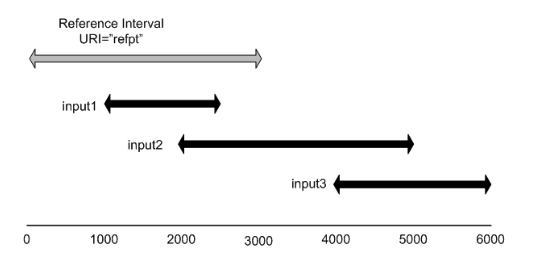
The reference interval is designated with
emma:time-ref-uri attribute. This MAY be combined with
emma:time-ref-anchor-point attribute to specify whether the anchor point is
the start or end of this interval. The start of an input relative
to this anchor point is then specified with
emma:offset-to-start attribute.
Here is an example where the referenced input is in the same document:
<emma:emma version="1.0"
    xmlns:emma="http://www.w3.org/2003/04/emma"
    xmlns:xsi="http://www.w3.org/2001/XMLSchema-instance"
    xsi:schemaLocation="http://www.w3.org/2003/04/emma
     http://www.w3.org/TR/2007/CR-emma-20071211/emma.xsd"
    xmlns="http://www.example.com/example">
  <emma:sequence>
    <emma:interpretation id="int1"
     emma:medium="acoustic" emma:mode="voice">
    <origin>Denver</origin>
    </emma:interpretation>
    <emma:interpretation id="int2"
        emma:medium="acoustic" emma:mode="voice"
        emma:time-ref-uri="#int1"
        emma:time-ref-anchor-point="start"
        emma:offset-to-start="5000">
    <destination>Chicago</destination>
    </emma:interpretation>
  </emma:sequence>
</emma:emma>
Note that the reference point refers to an input, but not
necessarily to a complete input. For example, if a speech
recognizer timestamps each word in an utterance, the anchor point
might refer to the timestamp for just one word.
The absolute and relative timestamps are not mutually exclusive;
that is, it is possible to have both relative and absolute
timestamp attributes on the same EMMA container element.
Timestamps of inputs collected by different devices will be
subject to variation if the times maintained by the devices are not
synchronized. This concern is outside of the scope of the EMMA
specification.
4.2.10.3 Duration of input: emma:duration attribute
| Annotation |
emma:duration |
| Definition |
Attribute of type xsd:nonNegativeInteger, defaulting to zero.
It specifies the duration of the input in milliseconds. |
| Applies to |
emma:interpretation, emma:group, emma:one-of, emma:sequence,
emma:arc, and application instance data |
The duration of an input in milliseconds MAY be specified with the emma:duration attribute.
The emma:duration attribute MAY be used either in combination with timestamps or
independently, for example in the annotation of speech corpora.
In the following example, the duration of the signal that gave rise to the
interpretation is indicated using emma:duration.
<emma:emma version="1.0"
    xmlns:emma="http://www.w3.org/2003/04/emma"
    xmlns:xsi="http://www.w3.org/2001/XMLSchema-instance"
    xsi:schemaLocation="http://www.w3.org/2003/04/emma
     http://www.w3.org/TR/2007/CR-emma-20071211/emma.xsd"
    xmlns="http://www.example.com/example">
    <emma:interpretation id="int1" emma:duration="2300"
        emma:medium="acoustic" emma:mode="voice">
    <origin>Denver</origin>
    </emma:interpretation>
</emma:emma>
4.2.10.4 Composite Input and Relative Timestamps
This section is informative.
The following table provides guidance on how to determine
the values of relative timestamps on a composite input.
Informative Guidance on Relative Timestamps in Composite Derivations
emma:time-ref-uri |
If the reference interval URI is the same for both inputs
then it should be the same for the composite input. If it is not
the same then relative timestamps will have to be resolved to
absolute timestamps in order to determine the combined timestamp.
. |
emma:time-ref-anchor-point |
If the anchor value is the same for both inputs
then it should be the same for the composite input. If it is not
the same then relative timestamps will have to be resolved to
absolute timestamps in order to determine the combined timestamp. |
emma:offset-to-start |
Given that the emma:time-ref-uri
and emma:time-ref-anchor-point are the
same for both combining inputs, then the
emma:offset-to-start for the combination
should be the lesser of the two. If they are not
the same then relative timestamps will have to be resolved to
absolute timestamps in order to determine the combined timestamp. |
emma:duration |
Given that the emma:time-ref-uri
and emma:time-ref-anchor-point are the
same for both combining inputs, then the emma:duration
is calculated as follows. Add together the emma:offset-to-start
and emma:duration for each of the inputs. Take whichever of
these is greater and subtract from it the lesser of the emma:offset-to-start
values in order to determine the combined duration.
If emma:time-ref-uri and emma:time-ref-anchor-point are not
the same then relative timestamps will have to be resolved to
absolute timestamps in order to determine the combined timestamp. |
4.2.11 Medium, mode, and function of user inputs:
emma:medium, emma:mode,
emma:function, emma:verbal attributes
| Annotation |
emma:medium |
| Definition |
An attribute of type xsd:nmtokens which contains a space delimited set of values from the set {acoustic, tactile, visual}. |
| Applies to |
emma:interpretation, emma:group, emma:one-of,
emma:sequence, emma:endpoint, and application instance data |
| Annotation |
emma:mode |
| Definition |
An attribute of type xsd:nmtokens which contains a space delimited set of values from an open set of values including: {voice, dtmf, ink, gui, keys, video, photograph, ...}. |
| Applies to |
emma:interpretation, emma:group, emma:one-of,
emma:sequence, emma:endpoint, and application instance data |
| Annotation |
emma:function |
| Definition |
An attribute of type xsd:string constrained to values in the
open set {recording, transcription, dialog, verification,
...}. |
| Applies to |
emma:interpretation, emma:group, emma:one-of,
emma:sequence, and application instance data |
| Annotation |
emma:verbal |
| Definition |
An attribute of type xsd:boolean. |
| Applies to |
emma:interpretation, emma:group, emma:one-of,
emma:sequence, and application instance data |
EMMA provides two properties for the annotation of input
modality. One indicating the broader medium or channel
(emma:medium) and another indicating the specific mode of
communication used on that channel (emma:mode). The input medium
is defined from the users perspective and indicates whether they
use their voice (acoustic), touch (tactile), or visual
appearance/motion (visual) as input. Tactile includes most
hand-on input device types such as pen, mouse, keyboard, and
touch screen. Visual is used for camera input.
emma:medium = space delimited sequence of values from the set:
            [acoustic|tactile|visual]
The mode property provides the ability to distinguish between
different modes of communication that may be within a particular
medium. For example, in the tactile medium, modes include
electronic ink (ink), and pointing and clicking on a graphical user
interface (gui).
emma:mode = space delimited sequence of values from the set:
            [voice|dtmf|ink|gui|keys|video|photograph| ... ]
The emma:medium classification is based on the boundary between
the user and the device that they use. For emma:medium="tactile"
the user physically touches the device in order to provide input.
For emma:medium="visual" the user's movement is captured by sensors
(cameras, infrared) resulting in an input to the system. In the case
where emma:medium="acoustic" the user provides input to the system
by producing an acoustic signal. Note then that DTMF input will be
classified as emma:medium="tactile" since in order to provide
DTMF input the user physically presses keys on a keypad.
While emma:medium and emma:mode are optional on specific elements such as emma:interpretation and emma:one-of, note that all EMMA interpretations must be annotated for emma:medium and emma:mode,
so either these attributes must appear directly on emma:interpretation or they must appear
on an ancestor emma:one-of node or they must appear on an earlier stage of
the derivation listed in emma:derivation.
Orthogonal to the mode, user inputs can also be classified with
respect to their communicative function. This enables a simpler
mode classification.
emma:function = [recording|transcription|dialog|verification| ... ]
For example, speech can be used for recording (e.g. voicemail),
transcription (e.g. dictation), dialog (e.g. interactive spoken
dialog systems), and verification (e.g. identifying users
through their voiceprints).
EMMA also supports an additional property emma:verbal which
distinguishes verbal use of an input mode from non-verbal. This MAY
be used to distinguish the use of electronic ink to convey
handwritten commands from the user of electronic ink for symbolic
gestures such as circles and arrows. Handwritten commands, such as
writing downtown in order to change a map display to show
the downtown are classified as verbal (emma:function="dialog" emma:verbal="true"). Pen
gestures (arrows, lines, circles, etc), such as circling a
building, are classified as non-verbal dialog (emma:function="dialog" emma:verbal="false"). The use of handwritten words to transcribe an
email message is classified as transcription
(emma:function="transcription" emma:verbal="true").
emma:verbal = [true|false]
Handwritten words and ink gestures are typically recognized
using different kinds of recognition components (handwriting
recognizer vs. gesture recognizer) and the verbal annotation will
be added by the recognition component which classifies the input.
The original input source, a pen in this case, will not be aware of
this difference. The input source identifier will tell you that the
input was from a pen of some kind but will not tell you if the mode
of input was handwriting (show downtown) or gesture (e.g.
circling an object or area).
Here is an example of the EMMA annotation for a pen input where
the user's ink is recognized as either a word ("Boston") or as an arrow:
<emma:emma version="1.0"
    xmlns:emma="http://www.w3.org/2003/04/emma"
    xmlns:xsi="http://www.w3.org/2001/XMLSchema-instance"
    xsi:schemaLocation="http://www.w3.org/2003/04/emma
     http://www.w3.org/TR/2007/CR-emma-20071211/emma.xsd"
    xmlns="http://www.example.com/example">
  <emma:one-of id="nbest1">
    <emma:interpretation id="interp1"
     emma:confidence="0.6"
     emma:medium="tactile"
     emma:mode="ink"
     emma:function="dialog"
     emma:verbal="true">
       <location>Boston</location>
    </emma:interpretation>

    <emma:interpretation id="interp2"
     emma:confidence="0.4"
     emma:medium="tactile"
     emma:mode="ink"
     emma:function="dialog"
     emma:verbal="false">
       <direction>45</direction>
    </emma:interpretation>
  </emma:one-of>
</emma:emma>
Here is an example of the EMMA annotation for a spoken command
which is recognized as either "Boston" or "Austin":
<emma:emma version="1.0"
    xmlns:emma="http://www.w3.org/2003/04/emma"
    xmlns:xsi="http://www.w3.org/2001/XMLSchema-instance"
    xsi:schemaLocation="http://www.w3.org/2003/04/emma
     http://www.w3.org/TR/2007/CR-emma-20071211/emma.xsd"
    xmlns="http://www.example.com/example">
  <emma:one-of>
    <emma:interpretation id="interp1"
     emma:confidence="0.6"
     emma:medium="acoustic"
     emma:mode="voice"
     emma:function="dialog"
     emma:verbal="true">
       <location>Boston</location>
    </emma:interpretation>

    <emma:interpretation id="interp2"
     emma:confidence="0.4"
     emma:medium="acoustic"
     emma:mode="voice"
     emma:function="dialog"
     emma:verbal="true">
       <location>Austin</location>
    </emma:interpretation>
  </emma:one-of>
</emma:emma>
The following table shows the relationship between the medium,
mode, and function properties and serves as an aid for classifying
inputs. For the dialog function it also shows some examples of the
classification of inputs as verbal vs. non-verbal.
| Medium |
Device |
Mode |
Function |
| recording |
dialog |
transcription |
verification |
| acoustic |
microphone |
voice |
audiofile (e.g. voicemail) |
spoken command / query / response (verbal = true) |
dictation |
speaker recognition |
| singing a note (verbal = false) |
| tactile |
keypad |
dtmf |
audiofile / character stream |
typed command / query / response (verbal = true) |
text entry (T9-tegic, word completion, or word
grammar) |
password / pin entry |
| command key "Press 9 for sales" (verbal = false) |
| keyboard |
dtmf |
character / key-code stream |
typed command / query / response (verbal = true) |
typing |
password / pin entry |
| command key "Press S for sales" (verbal = false) |
| pen |
ink |
trace, sketch |
handwritten command / query / response (verbal = true) |
handwritten text entry |
signature, handwriter recognition |
| gesture (e.g. circling building) (verbal = false) |
| gui |
N/A |
tapping on named button (verbal = true) |
soft keyboard |
password / pin entry |
| drag and drop, tapping on map (verbal = false) |
| mouse |
ink |
trace, sketch |
handwritten command / query / response (verbal = true) |
handwritten text entry |
N/A |
| gesture (e.g. circling building) (verbal = false) |
| gui |
N/A |
clicking named button (verbal = true) |
soft keyboard |
password / pin entry |
| drag and drop, clicking on map (verbal = false) |
| joystick |
ink |
trace,sketch |
gesture (e.g. circling building) (verbal = false) |
N/A |
N/A |
| gui |
N/A |
pointing, clicking button / menu (verbal = false) |
soft keyboard |
password / pin entry |
| visual |
page scanner |
photograph |
image |
handwritten command / query / response (verbal = true) |
optical character recognition, object/scene
recognition (markup, e.g. SVG) |
N/A |
| drawings and images (verbal = false) |
| still camera |
photograph |
image |
objects (verbal = false) |
visual object/scene recognition |
face id, retinal scan |
| video camera |
video |
movie |
sign language (verbal = true) |
audio/visual recognition |
face id, gait id, retinal scan |
| face / hand / arm / body gesture (e.g. pointing, facing)
(verbal = false) |
4.2.12 Composite multimodality:
emma:hook attribute
| Annotation |
emma:hook |
| Definition |
An attribute of type xsd:string constrained to values in the
open set {voice, dtmf, ink, gui, keys, video, photograph,
...} or the wildcard any |
| Applies to |
Application instance data |
The attribute emma:hook MAY be used to mark the elements in the
application semantics within an emma:interpretation which are expected to be
integrated with content from input in another mode to yield a complete
interpretation. The emma:mode to be
integrated at that point in the application semantics is indicated
as the value of the emma:hook attribute.
The possible values of emma:hook are the list of input modes that can be
values of emma:mode
(see Section 4.2.11).
In addition to these, the value of emma:hook can also be the
wildcard any indicating that the other content can come from
any source. The annotation emma:hook differs in semantics
from emma:mode as follows. Annotating an element in the
application semantics with emma:mode="ink" indicates that
that part of the semantics came from the ink mode.
Annotating an element in the application semantics with
emma:hook="ink" indicates that part of the semantics needs
to be integrated with content from the ink mode.
To illustrate the use of emma:hook consider an example
composite input in which the user says "zoom in here" in the speech
input mode while drawing an area on a graphical display in the ink
input mode. The fact that the location element
needs to come from the ink mode is indicated by
annotating this application namespace element using emma:hook
<emma:emma version="1.0"
    xmlns:emma="http://www.w3.org/2003/04/emma"
    xmlns:xsi="http://www.w3.org/2001/XMLSchema-instance"
    xsi:schemaLocation="http://www.w3.org/2003/04/emma
     http://www.w3.org/TR/2007/CR-emma-20071211/emma.xsd"
    xmlns="http://www.example.com/example">
  <emma:interpretation emma:medium="acoustic" emma:mode="voice">
    <command>
      <action>zoom</action>
      <location emma:hook="ink">
        <type>area</type>
      </location>
    </command>
  </emma:interpretation>
</emma:emma>
For more detailed explanation of this example see
Appendix C.
4.2.13 Cost: emma:cost attribute
| Annotation |
emma:cost |
| Definition |
An attribute of type xsd:decimal in range 0.0 to 10000000,
indicating the processor's cost or weight associated with an input
or part of an input. |
| Applies to |
emma:interpretation, emma:group,
emma:one-of, emma:sequence, emma:arc, emma:node, and application
instance data. |
The cost annotation in EMMA indicates the weight or
cost associated with an user's input or part of their input. The
most common use of emma:cost is for representing the costs
encoded on a lattice output from speech recognition or other
recognition or understanding processes. emma:cost MAY also
be used to indicate the total cost associated with particular
recognition results or semantic interpretations.
<emma:emma version="1.0"
    xmlns:emma="http://www.w3.org/2003/04/emma"
    xmlns:xsi="http://www.w3.org/2001/XMLSchema-instance"
    xsi:schemaLocation="http://www.w3.org/2003/04/emma
     http://www.w3.org/TR/2007/CR-emma-20071211/emma.xsd"
    xmlns="http://www.example.com/example">
  <emma:one-of emma:medium="acoustic" emma:mode="voice">
    <emma:interpretation id="meaning1" emma:cost="1600">
      <location>Boston</location>
    </emma:interpretation>

    <emma:interpretation id="meaning2" emma:cost="400">
      <location> Austin </location>
    </emma:interpretation>
  </emma:one-of>
</emma:emma>
4.2.14 Endpoint properties: emma:endpoint-role, emma:endpoint-address, emma:port-type, emma:port-num, emma:message-id, emma:service-name, emma:endpoint-pair-ref attributes
| Annotation |
emma:endpoint-role |
| Definition |
An attribute of type xsd:string constrained to values in the
set {source, sink, reply-to, router}. |
| Applies to |
emma:endpoint |
| Annotation |
emma:endpoint-address |
| Definition |
An attribute of type xsd:anyURI that uniquely specifies the
network address of the emma:endpoint. |
| Applies to |
emma:endpoint |
| Annotation |
emma:port-type |
| Definition |
An attribute of type xsd:QName that specifies the type of the
port. |
| Applies to |
emma:endpoint |
| Annotation |
emma:port-num |
| Definition |
An attribute of type xsd:nonNegativeInteger that specifies the
port number. |
| Applies to |
emma:endpoint |
| Annotation |
emma:message-id |
| Definition |
An attribute of type xsd:anyURI that specifies the message ID
associated with the data. |
| Applies to |
emma:endpoint |
| Annotation |
emma:service-name |
| Definition |
An attribute of type xsd:string that specifies the name of the
service. |
| Applies to |
emma:endpoint |
| Annotation |
emma:endpoint-pair-ref |
| Definition |
An attribute of type xsd:anyURI that specifies the pairing
between sink and source endpoints. |
| Applies to |
emma:endpoint |
| Annotation |
emma:endpoint-info-ref |
| Definition |
An attribute of type xsd:IDREF referring to the id attribute of
an emma:endpoint-info element. |
| Applies to |
emma:interpretation, emma:group,
emma:one-of, emma:sequence, and application instance data. |
The emma:endpoint-role attribute specifies the role
that the particular emma:endpoint performs in
multimodal interaction. The role value sink indicates that the
particular endpoint is the receiver of the input data. The role
value source indicates that the particular endpoint is the sender
of the input data. The role value reply-to indicates that the
particular emma:endpoint is the intended endpoint for the reply. The same emma:endpoint-address MAY
appear in multiple emma:endpoint elements,
provided that the same endpoint address is used to serve multiple
roles, e.g. sink, source, reply-to, router, etc., or associated
with multiple interpretations.
The emma:endpoint-address specifies the network address
of the emma:endpoint, and emma:port-type
specifies the port type of the emma:endpoint. The
emma:port-num annotates the port number of the endpoint
(e.g. the typical port number for an http endpoint is 80). The
emma:message-id annotates the message ID information
associated with the annotated input. This meta information is used
to establish and maintain the communication context for both
inbound processing and outbound operation. The service
specification of the emma:endpoint is annotated by
emma:service-name which contains the definition of the
service that the emma:endpoint performs. The matching
of the sink endpoint and its pairing source endpoint is
annotated by the emma:endpoint-pair-ref attribute. One sink
endpoint MAY link to multiple source endpoints through
emma:endpoint-pair-ref. Further bounding of the
emma:endpoint is possible by using the annotation
of emma:group (see Section 3.3.2).
The emma:endpoint-info-ref attribute associates the EMMA
result in the container element with an emma:endpoint-info
element.
The following example illustrates the use of these attributes
in multimodal interactions where multiple modalities are used.
<emma:emma version="1.0"
    xmlns:emma="http://www.w3.org/2003/04/emma"
    xmlns:xsi="http://www.w3.org/2001/XMLSchema-instance"
    xsi:schemaLocation="http://www.w3.org/2003/04/emma
     http://www.w3.org/TR/2007/CR-emma-20071211/emma.xsd"
    xmlns="http://www.example.com/example"
    xmlns: ex="http://www.example.com/emma/port">
  <emma:endpoint-info id="audio-channel-1" >
    <emma:endpoint id="endpoint1"
        emma:endpoint-role="sink"
        emma:endpoint-address="135.61.71.103"
        emma:port-num="50204"
        emma:port-type="rtp"
        emma:endpoint-pair-ref="endpoint2"
        emma:media-type="audio/dsr-202212; rate:8000; maxptime:40"
        emma:service-name="travel"
        emma:mode="voice">
      <ex:app-protocol>SIP</ex:app-protocol>
    </emma:endpoint>

    <emma:endpoint id="endpoint2" emma:endpoint-role="source"
        emma:endpoint-address="136.62.72.104"
        emma:port-num="50204"
        emma:port-type="rtp"
        emma:endpoint-pair-ref="endpoint1"
        emma:media-type="audio/dsr-202212; rate:8000; maxptime:40"
        emma:service-name="travel"
        emma:mode="voice">
      <ex:app-protocol>SIP</ex:app-protocol>
    </emma:endpoint>
  </emma:endpoint-info>

  <emma:endpoint-info id="ink-channel-1">
     <emma:endpoint id="endpoint3" emma:endpoint-role="sink"
         emma:endpoint-address="http://emma.example/sink"
         emma:endpoint-pair-ref="endpoint4"
         emma:port-num="80" emma:port-type="http"
         emma:message-id="uuid:2e5678"
         emma:service-name="travel"
         emma:mode="ink"/>
     <emma:endpoint id="endpoint4"
         emma:endpoint-role="source"
         emma:port-address="http://emma.example/source"
         emma:endpoint-pair-ref="endpoint3"
         emma:port-num="80"
         emma:port-type="http"
         emma:message-id="uuid:2e5678"
         emma:service-name="travel"
         emma:mode="ink"/>
  </emma:endpoint-info>

  <emma:group>
    <emma:interpretation id="int1" emma:start="1087995961542"
        emma:end="1087995963542"
        emma:endpoint-info-ref="audio-channel-1"
        emma:medium="acoustic" emma:mode="voice">
      <destination>Chicago</destination>
    </emma:interpretation>

    <emma:interpretation id="int2" emma:start="1087995961542"
        emma:end="1087995963542"
        emma:endpoint-info-ref="ink-channel-1"
        emma:medium="acoustic" emma:mode="voice">
      <location>
         <type>area</type>
         <points>34.13 -37.12 42.13 -37.12 ... </points>
      </location>
    </emma:interpretation>
  </emma:group>
</emma:emma>
4.2.15 Reference to emma:grammar element: emma:grammar-ref attribute
| Annotation |
emma:grammar-ref |
| Definition |
An attribute of type xsd:IDREF referring to the
id attribute of an emma:grammar
element. |
| Applies to |
emma:interpretation, emma:group,
emma:one-of, emma:sequence. |
The emma:grammar-ref annotation associates the EMMA
result in the container element with an
emma:grammar element.
Example:
<emma:emma version="1.0"
    xmlns:emma="http://www.w3.org/2003/04/emma"
    xmlns:xsi="http://www.w3.org/2001/XMLSchema-instance"
    xsi:schemaLocation="http://www.w3.org/2003/04/emma
     http://www.w3.org/TR/2007/CR-emma-20071211/emma.xsd"
    xmlns="http://www.example.com/example">
  <emma:grammar id="gram1" ref="someURI"/>

  <emma:grammar id="gram2" ref="anotherURI"/>

  <emma:one-of id="r1"
    emma:medium="acoustic" emma:mode="voice">
    <emma:interpretation id="int1" emma:grammar-ref="gram1">
      <origin>Boston</origin>
    </emma:interpretation>

    <emma:interpretation id="int2" emma:grammar-ref="gram1">
      <origin>Austin</origin>
    </emma:interpretation>

    <emma:interpretation id="int3" emma:grammar-ref="gram2">
      <command>help</command>
    </emma:interpretation>
  </emma:one-of>
</emma:emma>
4.2.16 Reference to emma:model element: emma:model-ref attribute
| Annotation |
emma:model-ref |
| Definition |
An attribute of type xsd:IDREF referring to the
id attribute of an emma:model
element. |
| Applies to |
emma:interpretation, emma:group,
emma:one-of, emma:sequence, and
application instance data. |
The emma:model-ref annotation associates the EMMA
result in the container element with an
emma:model element.
Example:
<emma:emma version="1.0"
    xmlns:emma="http://www.w3.org/2003/04/emma"
    xmlns:xsi="http://www.w3.org/2001/XMLSchema-instance"
    xsi:schemaLocation="http://www.w3.org/2003/04/emma
     http://www.w3.org/TR/2007/CR-emma-20071211/emma.xsd"
    xmlns="http://www.example.com/example">
  <emma:model id="model1" ref="someURI"/>

  <emma:model id="model2" ref="anotherURI"/>

  <emma:one-of id="r1"
    emma:medium="acoustic" emma:mode="voice">
    <emma:interpretation id="int1" emma:model-ref="model1">
      <origin>Boston</origin>
    </emma:interpretation>

    <emma:interpretation id="int2" emma:model-ref="model1">
      <origin>Austin</origin>
    </emma:interpretation>

    <emma:interpretation id="int3" emma:model-ref="model2">
      <command>help</command>
    </emma:interpretation>
  </emma:one-of>
</emma:emma>
4.2.17 Dialog turns: emma:dialog-turn attribute
| Annotation |
emma:dialog-turn |
| Definition |
An attribute of type xsd:string referring to the
dialog turn associated with a given container element. |
| Applies to |
emma:interpretation, emma:group,
emma:one-of, and emma:sequence. |
The emma:dialog-turn annotation associates the
EMMA result in the container element with a dialog turn. The
syntax and semantics of dialog turns is left open to suit
the needs of individual applications. For example, some applications
might use an integer value, where successive turns are represented by
successive integers. Other applications might combine
a name of a dialog participant with an integer value representing
the turn number for that participant. Ordering semantics for
comparison of emma:dialog-turn is deliberately
unspecified and left for applications to define.
Example:
<emma:emma version="1.0"
    emma="http://www.w3.org/2003/04/emma"
    xsi="http://www.w3.org/2001/XMLSchema-instance"
    xsi:schemaLocation="http://www.w3.org/2003/04/emma
     http://www.w3.org/TR/2007/CR-emma-20071211/emma.xsd"
    xmlns="http://www.example.com/example">
  <emma:interpretation id="int1" emma:dialog-turn="u8"
    emma:medium="acoustic" emma:mode="voice">
    <quantity>3</quantity>
  </emma:interpretation>
</emma:emma>
4.3 Scope of EMMA annotations
The emma:derived-from element (Section 4.1.2) can be used to capture both sequential
and composite derivations. This section concerns the scope of EMMA annotations across
sequential derivations of user input connected using the
emma:derived-from element (Section
4.1.2). Sequential derivations involve
processing steps that do not involve multimodal integration, such
as applying natural language understanding and then reference
resolution to a speech transcription.
EMMA derivations describe only single turns of
user input and are not intended to describe a sequence of dialog
turns.
For example, an EMMA document could
contain emma:interpretation elements for the
transcription, interpretation, and reference resolution of a speech
input, utilizing the id values: raw, better,
and best respectively:
<emma:emma version="1.0"
    xmlns:emma="http://www.w3.org/2003/04/emma"
    xmlns:xsi="http://www.w3.org/2001/XMLSchema-instance"
    xsi:schemaLocation="http://www.w3.org/2003/04/emma
     http://www.w3.org/TR/2007/CR-emma-20071211/emma.xsd"
    xmlns="http://www.example.com/example">
 <emma:derivation>
  <emma:interpretation id="raw"
      emma:process="http://example.com/myasr1.xml"
      emma:medium="acoustic" emma:mode="voice">
    <answer>From Boston to Denver tomorrow</answer>
  </emma:interpretation>

  <emma:interpretation id="better"
      emma:process="http://example.com/mynlu1.xml">
    <emma:derived-from resource="#raw" composite="false"/>
    <origin>Boston</origin>
    <destination>Denver</destination>
    <date>tomorrow</date>
  </emma:interpretation>
 </emma:derivation>

  <emma:interpretation id="best"
      emma:process="http://example.com/myrefresolution1.xml">
    <emma:derived-from resource="#better" composite="false"/>
    <origin>Boston</origin>
    <destination>Denver</destination>
    <date>03152003</date>
  </emma:interpretation>
</emma:emma>
Each member of the derivation chain is linked to the previous
one by a derived-from element (Section 4.1.2), which has an attribute
resource that provides a pointer to the
emma:interpretation from which it is derived. The
emma:process annotation (Section
4.2.2) provides a pointer to the process used for each stage
of the derivation.
The following EMMA example represents the same derivation as above
but with a more fully specified set of annotations:
<emma:emma version="1.0"
    xmlns:emma="http://www.w3.org/2003/04/emma"
    xmlns:xsi="http://www.w3.org/2001/XMLSchema-instance"
    xsi:schemaLocation="http://www.w3.org/2003/04/emma
     http://www.w3.org/TR/2007/CR-emma-20071211/emma.xsd"
    xmlns="http://www.example.com/example">
  <emma:derivation>
    <emma:interpretation id="raw"
        emma:process="http://example.com/myasr1.xml"
        emma:source="http://example.com/microphone/NC-61"
        emma:signal="http://example.com/signals/sg23.wav"
        emma:confidence="0.6"
        emma:medium="acoustic"
        emma:mode="voice"
        emma:function="dialog"
        emma:verbal="true"
        emma:tokens="from boston to denver tomorrow"
        emma:lang="en-US">
      <answer>From Boston to Denver tomorrow</answer>
    </emma:interpretation>

    <emma:interpretation id="better"
        emma:process="http://example.com/mynlu1.xml"
        emma:source="http://example.com/microphone/NC-61"
        emma:signal="http://example.com/signals/sg23.wav"
        emma:confidence="0.8"
        emma:medium="acoustic"
        emma:mode="voice"
        emma:function="dialog"
        emma:verbal="true"
        emma:tokens="from boston to denver tomorrow"
        emma:lang="en-US">
      <emma:derived-from resource="#raw" composite="false"/>
      <origin>Boston</origin>
      <destination>Denver</destination>
      <date>tomorrow</date>
    </emma:interpretation>
  </emma:derivation>

  <emma:interpretation id="best"
      emma:process="http://example.com/myrefresolution1.xml"
      emma:source="http://example.com/microphone/NC-61"
      emma:signal="http://example.com/signals/sg23.wav"
      emma:confidence="0.8"
      emma:medium="acoustic"
      emma:mode="voice"
      emma:function="dialog"
      emma:verbal="true"
      emma:tokens="from boston to denver tomorrow"
      emma:lang="en-US">
    <emma:derived-from resource="#better" composite="false"/>
    <origin>Boston</origin>
    <destination>Denver</destination>
    <date>03152003</date>
  </emma:interpretation>
</emma:emma>
EMMA annotations on earlier stages of the derivation often remain accurate at
later stages of the derivation. Although this can be
captured in EMMA by repeating the annotations on each
emma:interpretation within the derivation, as in the example
above, there are two disadvantages of this approach to annotation.
First, the repetition of annotations makes the resulting EMMA
documents significantly more verbose. Second, EMMA processors used
for intermediate tasks such as natural language understanding and
reference resolution will need to read in all of the annotations
and write them all out again.
EMMA overcomes these problems by assuming that annotations on
earlier stages of a derivation automatically apply to later stages
of the derivation unless a new value is specified. Later stages of
the derivation essentially inherit annotations from earlier stages
in the derivation. For example, if there was an emma:source
annotation on the transcription (raw) it would also apply to
the later stages of the derivation such as the result of natural
language understanding (better) or reference resolution
(best).
Because of the assumption in EMMA that annotations have scope
over later stages of a sequential derivation, the example EMMA
document above can be equivalently represented as follows:
<emma:emma version="1.0"
    xmlns:emma="http://www.w3.org/2003/04/emma"
    xmlns:xsi="http://www.w3.org/2001/XMLSchema-instance"
    xsi:schemaLocation="http://www.w3.org/2003/04/emma
     http://www.w3.org/TR/2007/CR-emma-20071211/emma.xsd"
    xmlns="http://www.example.com/example">
  <emma:derivation>
    <emma:interpretation id="raw"
        emma:process="http://example.com/myasr1.xml"
        emma:source="http://example.com/microphone/NC-61"
        emma:signal="http://example.com/signals/sg23.wav"
        emma:confidence="0.6"
        emma:medium="acoustic"
        emma:mode="voice"
        emma:function="dialog"
        emma:verbal="true"
        emma:tokens="from boston to denver tomorrow"
        emma:lang="en-US">
      <answer>From Boston to Denver tomorrow</answer>
    </emma:interpretation>

    <emma:interpretation id="better"
        emma:process="http://example.com/mynlu1.xml"
        emma:confidence="0.8">
      <emma:derived-from resource="#raw" composite="false"/>
      <origin>Boston</origin>
      <destination>Denver</destination>
      <date>tomorrow</date>
    </emma:interpretation>
  </emma:derivation>

  <emma:interpretation id="best"
      emma:process="http://example.com/myrefresolution1.xml">
    <emma:derived-from resource="#better" composite="false"/>
    <origin>Boston</origin>
    <destination>Denver</destination>
    <date>03152003</date>
  </emma:interpretation>
</emma:emma>
The fully specified derivation illustrated above is equivalent
to the reduced form derivation following it where only annotations
with new values are specified at each stage. These two EMMA
documents MUST yield the same result when processed by an EMMA
processor.
The emma:confidence annotation is respecified on the
better interpretation. This indicates the confidence score
for natural language understanding, whereas emma:confidence
on the raw interpretation indicates the speech recognition
confidence score.
In order to determine the full set of annotations that apply to
an emma:interpretation element an EMMA processor or
script needs to access the annotations directly on that element and
for any that are not specified follow the reference in the
resource attribute of the emma:derived-from
element to add in annotations from earlier stages of the
derivation.
The EMMA annotations break down into three groups with respect to
their scope in sequential derivations. One group of annotations
always holds true for all members of a sequential derivation. A
second group is always respecified on each stage of the
derivation. A third group may or may not be respecified.
Scope of Annotations in Sequential Derivations
| Classification |
Annotation |
| Applies to whole derivation |
emma:signal |
emma:signal-size |
emma:dialog-turn |
emma:source |
emma:medium |
emma:mode |
emma:function |
emma:verbal |
emma:lang |
emma:tokens |
emma:start |
emma:end |
emma:time-ref-uri |
emma:time-ref-anchor-point |
emma:offset-to-start |
emma:duration |
| Specified at each stage of derivation |
emma:derived-from |
emma:process |
| May be respecified |
emma:confidence |
emma:cost |
emma:grammar-ref |
emma:model-ref |
emma:no-input |
emma:uninterpreted |
One potential problem with this annotation scoping mechanism is
that earlier annotations could be lost if earlier stages of a
derivation were dropped in order to reduce message size. This
problem can be overcome by considering annotation scope at the
point where earlier derivation stages are discarded and populating
the final interpretation in the derivation with all of the
annotations which it could inherit. For example, if the raw
and better stages were dropped the resulting EMMA document
would be:
<emma:emma version="1.0"
    xmlns:emma="http://www.w3.org/2003/04/emma"
    xmlns:xsi="http://www.w3.org/2001/XMLSchema-instance"
    xsi:schemaLocation="http://www.w3.org/2003/04/emma
     http://www.w3.org/TR/2007/CR-emma-20071211/emma.xsd"
    xmlns="http://www.example.com/example">
  <emma:interpretation id="best"
      emma:start="1087995961542"
      emma:end="1087995963542"
      emma:process="http://example.com/myrefresolution1.xml"
      emma:source="http://example.com/microphone/NC-61"
      emma:signal="http://example.com/signals/sg23.wav"
      emma:confidence="0.8"
      emma:medium="acoustic"
      emma:mode="voice"
      emma:function="dialog"
      emma:verbal="true"
      emma:tokens="from boston to denver tomorrow"
      emma:lang="en-US">
    <emma:derived-from resource="#better" composite="false"/>
    <origin>Boston</origin>
    <destination>Denver</destination>
    <date>03152003</date>
  </emma:interpretation>
</emma:emma>
Annotations on an emma:one-of element are assumed to apply to all of the container
elements within the emma:one-of.
If emma:one-of appears with another emma:one-of
then annotations on the parent emma:one-of are assumed to apply to the
children of the child emma:one-of.
Annotations on emma:group or emma:sequence do not apply
to their child elements.
5. Conformance
The contents of this section are normative.
5.1 Conforming EMMA Documents
A document is a Conforming EMMA Document if it meets both the
following conditions:
- It is a well-formed XML document [XML] conforming
to Namespaces in XML [XMLNS].
- It adheres to the specification described in this document (EMMA
Specification) including the constraints expressed in the Schema (see Appendix A) and having an XML Prolog and root element as
specified in Section 3.1.
The EMMA specification and these conformance criteria provide no
designated size limits on any aspect of EMMA documents. There are
no maximum values on the number of elements, the amount of character
data, or the number of characters in attribute values.
Within this specification, the term URI refers to a Universal Resource Identifier as defined in [RFC3986] and extended in [RFC3987] with the new name IRI. The term URI has been retained in preference to IRI to avoid introducing new names for concepts such as "Base URI" that are defined or referenced across the whole family of XML specifications.
5.2 Using EMMA with other Namespaces
The EMMA namespace is intended to be used with other XML namespaces
as per the Namespaces in XML Recommendation [XMLNS]. Future work by
W3C is expected to address ways to specify conformance for documents
involving multiple namespaces.
5.3 Conforming EMMA Processors
A EMMA processor is a program that can process and/or
generate Conforming EMMA documents.
In a Conforming EMMA Processor, the XML parser MUST be able to parse
and process all XML constructs defined by XML 1.1 [XML] and
Namespaces in XML [XMLNS]. It is not required that a
Conforming EMMA Processor uses a validating XML parser.
A Conforming EMMA Processor MUST correctly understand and apply the
semantics of each markup element or attribute as described by this document.
There is, however, no conformance requirement with respect to
performance characteristics of the EMMA Processor. For instance,
no statement is required regarding the accuracy, speed or other
characteristics of output produced by the processor. No statement
is made regarding the size of input that a EMMA Processor is required to support.
Appendices
Appendix A. XML and RELAX NG schemata
This section is Normative.
This section defines the formal syntax for EMMA documents in
terms of a normative XML Schema.
There are both an XML Schema and
RELAX NG Schema for the EMMA markup.
The latest version of the XML Schema for EMMA is available at http://www.w3.org/TR/emma/emma.xsd and the RELAX NG Schema can be found at
http://www.w3.org/TR/emma/emma.rng.
For stability it is RECOMMENDED that you use the dated URI available at
http://www.w3.org/TR/2007/CR-emma-20071211/emma.xsd
and
http://www.w3.org/TR/2007/CR-emma-20071211/emma.rng.
Appendix B. MIME type
This section is Normative.
This appendix registers a new MIME media type,
"application/emma+xml".
- MIME media type name:
-
application
- MIME subtype name:
-
emma+xml
- Required parameters:
-
None.
- Optional parameters:
-
charset-
This parameter has identical semantics to the
charset parameter of the
application/xml media type as specified in
[RFC3023] or its successor.
- Encoding considerations:
-
By virtue of EMMA content being XML, it has the same
considerations when sent as "application/emma+xml"as does XML.
See RFC 3023 (or its successor), section 3.2.
- Security considerations:
-
Several features of EMMA require dereferencing arbitrary URIs.
Implementers are advised to heed the security issues of [RFC3986]
section 7.
In addition, because of the extensibility features for EMMA,
it is possible that "application/emma+xml" will
describe content that has security implications beyond those
described here. However, if the processor follows only the
normative semantics of this specification, this content will be
ignored. Only in the case where the processor recognizes and
processes the additional content, or where further processing of
that content is dispatched to other processors, would security
issues potentially arise. And in that case, they would fall
outside the domain of this registration document.
- Interoperability considerations:
-
This specification describes processing semantics that dictate
the required behavior for dealing with, among other
things, unrecognized elements.
Because EMMA is extensible, conformant
"application/emma+xml" processors MAY expect that
content received is well-formed XML, but processors SHOULD NOT assume
that the content is valid EMMA or expect to recognize all of the elements and attributes in the document.
- Published specification:
-
This media type registration is for EMMA documents as
described by this specification.
- Additional information:
-
- Magic number(s):
-
There is no single initial octet sequence that is always
present in EMMA documents.
- File extension(s):
-
EMMA documents are most often identified with the
extensions ".emma".
- Macintosh File Type Code(s):
-
TEXT
- Person & email address to contact for further
information:
-
Kazuyuki Ashimura, <ashimura@w3.org>.
- Intended usage:
-
COMMON
- Author/Change controller:
-
The EMMA specification is a work product of the World Wide
Web Consortium's Multimodal Interaction Working Group. The W3C
has change control over these specifications.
Appendix C. emma:hook and SRGS
This section is Informative.
One of the most powerful aspects of multimodal interfaces is
their ability to provide support for user inputs which are
distributed over the available input modes. These composite
inputs are contributions made by the user within a single turn
which have component parts in different modes. For example, the
user might say "zoom in here" in the speech mode while drawing an
area on a graphical display in the ink mode. One of the central
motivating factors for this kind of input is that different kinds
of communicative content are best suited to different input modes.
In the example of a user drawing an area on a map and saying "zoom
in here", the zoom command is easiest to provide in speech but the
spatial information, the specific area, is easier to provide in
ink.
Enabling composite multimodality is critical in ensuring that
multimodal systems support more natural and effective interaction
for users. In order to support composite inputs, a multimodal
architecture must provide some kind of multimodal integration
mechanism. In the W3C
Multimodal Interaction Framework [MMI Framework],
multimodal integration can be
handled by an integration component which follows the application
of speech understanding and other kinds of interpretation
procedures for individual modes.
Given the broad range of different techniques being employed for
multimodal integration and the extent to which this is an ongoing
research problem, standardization of the specific method or
algorithm used for multimodal integration is not appropriate at
this time. In order to facilitate the development and
inter-operation of different multimodal integration mechanisms EMMA
provides markup language enabling application independent
specification of elements in the application markup where content
from another mode needs to be integrated. These representation
'hooks' can then be used by different kinds of multimodal
integration components and algorithms to drive the process of
multimodal integration. In the processing of a composite multimodal
input, the result of applying a mode-specific interpretation
component to each of the individual modes will be EMMA markup
describing the possible interpretation of that input.
One way to build an EMMA representation of a spoken input such
as "zoom in here" is to use grammar rules in the W3C Speech
Recognition Grammar Specification [SRGS]
using the Semantic Interpretation [SISR] tags to
build the application semantics with the emma:hook
attribute. In this approach [ECMAScript] is specified in order to build up an object representing the semantics. The resulting
ECMAScript object is then translated to XML.
For our example case of "zoom in here". The following SRGS
rule could be used. The Semantic Interpretation for Speech Recognition specification [SISR] provides a reserved
property _nsprefix for indicating the namespace to be used
with an attribute.
<rule id="zoom">
  zoom in here
  <tag>
    $.command = new Object();
    $.command.action = "zoom";
    $.command.location = new Object();
    $.command.location._attributes = new Object();
    $.command.location._attributes.hook = new Object();
    $.command.location._attributes.hook._nsprefix = "emma";
    $.command.location._attributes.hook._value = "ink";
    $.command.location.type = "area";
  </tag>
</rule>
Application of this rule will result in the following ECMAScript
object being built.
command: {
      action: "zoom"
      location: {
        _attributes: {
           hook: {
             _nsprefix: "emma"
             _value: "ink"
             }
           }
        type: "area"
      }
}
SI processing in an XML environment would generate the following
document:
<command>
  <action>zoom</action>
  <location emma:hook="ink">
     <type>area</type>
  </location>
</command>
This XML fragment might then appear within an EMMA document as
follows:
<emma:emma version="1.0"
    xmlns:emma="http://www.w3.org/2003/04/emma"
    xmlns:xsi="http://www.w3.org/2001/XMLSchema-instance"
    xsi:schemaLocation="http://www.w3.org/2003/04/emma
     http://www.w3.org/TR/2007/CR-emma-20071211/emma.xsd"
    xmlns="http://www.example.com/example">
  <emma:interpretation id="voice1"
      emma:medium="acoustic"
      emma:mode="voice">
    <command>
      <action>zoom</action>
      <location emma:hook="ink">
         <type>area</type>
      </location>
    </command>
  </emma:interpretation>
</emma:emma>
The emma:hook annotation indicates that this speech input
needs to be combined with ink input such as the following:
<emma:emma version="1.0"
    xmlns:emma="http://www.w3.org/2003/04/emma"
    xmlns:xsi="http://www.w3.org/2001/XMLSchema-instance"
    xsi:schemaLocation="http://www.w3.org/2003/04/emma
     http://www.w3.org/TR/2007/CR-emma-20071211/emma.xsd"
    xmlns="http://www.example.com/example">
  <emma:interpretation id="pen1"
      emma:medium="tactile"
      emma:mode="ink">
    <location>
      <type>area</type>
      <points>42.1345 -37.128 42.1346 -37.120 ... </points>
    </location>
  </emma:interpretation>
</emma:emma>
This representation could be generated by a pen modality
component performing gesture recognition and interpretation. The
input to the component would be an Ink Markup Language
specification [INKML] of the ink
trace and the output would be the EMMA document above.
The combination will result in the following EMMA document for the combined
speech and pen multimodal input.
<emma:emma version="1.0"
    xmlns:emma="http://www.w3.org/2003/04/emma"
    xmlns:xsi="http://www.w3.org/2001/XMLSchema-instance"
    xsi:schemaLocation="http://www.w3.org/2003/04/emma
     http://www.w3.org/TR/2007/CR-emma-20071211/emma.xsd"
    xmlns="http://www.example.com/example">
  <emma:interpretation
      emma:medium="acoustic tactile"
      emma:mode="voice ink"
      emma:process="http://example.com/myintegrator.xml">
    <emma:derived-from resource="http://example.com/voice1.emma/#voice1" composite="true"/>
    <emma:derived-from resource="http://example.com/pen1.emma/#pen1" composite="true"/>
    <command>
       <action>zoom</action>
       <location>
         <type>area</type>
         <points>42.1345 -37.128 42.1346 -37.120 ... </points>
        </location>
     </command>
  </emma:interpretation>
</emma:emma>
There are two components to the process of integrating these two
pieces of semantic markup. The first is to ensure that the two are
compatible; that is, that no semantic constraints are
violated. The second is to fuse the content from the two sources.
In our example, the <type>area</type> element is
intended to indicate that this speech command requires integration
with an area gesture rather than, for example, a line gesture,
which would have the subelement <type>line</type>. This
constraint needs to be enforced by whatever mechanism is
responsible for multimodal integration.
Many different techniques could be used for achieving this
integration of the semantic interpretation of the pen input, a
<location> element, with the corresponding <location>
element in the speech. The
emma:hook simply serves to indicate the
existence of this relationship.
One way to achieve both the compatibility checking and fusion of
content from the two modes is to use a well-defined general purpose
matching mechanism such as unification.
Graph unification [Graph unification]
is a mathematical operation defined over directed acylic graphs which captures both
of the components of integration in a single operation: the
applications of the semantic constraints and the fusing of content.
One possible semantics for the emma:hook markup indicates
that content from the required mode needs to be unified with that
position in the application semantics. In order to unify, two
elements must not have any conflicting values for subelements or
attributes. This procedure can be defined recursively so that
elements within the subelements must also not clash and so on. The
result of unification is the union of all of the elements and
attributes of the two elements that are being unified.
In addition to the unification operation, in the resulting
emma:interpretation the emma:hook attribute
needs to be removed and the emma:mode attribute changed to
the list of the modes of the individual
inputs , e.g. "voice ink".
Instead of the unification operation, for a specific application
semantics, integration could be achieved using some other algorithm
or script. The benefit of using the unification semantics for
emma:hook is that it provides a general purpose mechanism
for checking the compatibility of elements and fusing them,
whatever the specific elements are in the application specific
semantic representation.
The benefit of using the emma:hook annotation for authors
is that it provides an application independent method for
indicating where integration with content from another mode is
required. If a general purpose integration mechanism is used, such
as the unification approach described above, authors should be able
to use the same integration mechanism for a range of different
applications without having to change the integration rules or
logic. For each application the speech grammar rules [SRGS] need to
assign emma:hook to the appropriate elements in the semantic
representation of the speech. The general purpose multimodal
integration mechanism will use the emma:hook annotations in
order to determine where to add in content from other modes.
Another benefit of the emma:hook mechanism is that it
facilitates interoperability among different multimodal integration
components, so long as they are all general purpose and utilize
emma:hook in order to determine where to integrate
content.
The following provides a more detailed example of the use of the
emma:hook annotation. In this example, spoken input is
combined with two ink gestures. The semantic
representation assigned to the spoken input "send this file to
this" indicates two locations where content is required from ink
input using emma:hook="ink":
<emma:emma version="1.0"
    xmlns:emma="http://www.w3.org/2003/04/emma"
    xmlns:xsi="http://www.w3.org/2001/XMLSchema-instance"
    xsi:schemaLocation="http://www.w3.org/2003/04/emma
     http://www.w3.org/TR/2007/CR-emma-20071211/emma.xsd"
    xmlns="http://www.example.com/example">
  <emma:interpretation id="voice2"
      emma:medium="acoustic"
      emma:mode="voice"
      emma:tokens="send this file to this"
      emma:start="1087995961500"
      emma:end="1087995963542">
    <command>
      <action>send</action>
        <arg1>
          <object emma:hook="ink">
            <type>file</type>
            <number>1</number>
          </object>
        </arg1>
       <arg2>
         <object emma:hook="ink">
           <number>1</number>
         </object>
       </arg2>
    </command>
  </emma:interpretation>
</emma:emma>
The user gesturing on the two locations on the display can be
represented using emma:sequence:
<emma:emma version="1.0"
    xmlns:emma="http://www.w3.org/2003/04/emma"
    xmlns:xsi="http://www.w3.org/2001/XMLSchema-instance"
    xsi:schemaLocation="http://www.w3.org/2003/04/emma
     http://www.w3.org/TR/2007/CR-emma-20071211/emma.xsd"
    xmlns="http://www.example.com/example">
  <emma:sequence id="ink2">
    <emma:interpretation emma:start="1087995960500"
      emma:end="1087995960900"
      emma:medium="tactile"
      emma:mode="ink">
      <object>
       <type>file</type>
       <number>1</number>
       <id>test.pdf</id>
      <object>
    </emma:interpretation>
    <emma:interpretation emma:start="1087995961000"
      emma:end="1087995961100"
      emma:medium="tactile"
      emma:mode="ink">
      <object>
        <type>printer</type>
        <number>1</number>
        <id>lpt1</id>
      <object>
    </emma:interpretation>
  </emma:sequence>
</emma:emma>
A general purpose unification-based multimodal integration
algorithm could use the emma:hook annotation as follows. It
identifies the elements marked with emma:hook in document
order. For each of those in turn, it attempts to unify the element
with the corresponding element in order in the
emma:sequence. Since none of the subelements
conflict, the unification goes through and as a result, we have the
following EMMA for the composite result:
<emma:emma version="1.0"
    xmlns:emma="http://www.w3.org/2003/04/emma"
    xmlns:xsi="http://www.w3.org/2001/XMLSchema-instance"
    xsi:schemaLocation="http://www.w3.org/2003/04/emma
     http://www.w3.org/TR/2007/CR-emma-20071211/emma.xsd"
    xmlns="http://www.example.com/example">
<emma:interpretation id="multimodal2"
      emma:medium="acoustic tactile"
      emma:mode="voice ink"
      emma:tokens="send this file to this"
      emma:process="http://example.com/myintegration.xml"
      emma:start="1087995960500"
      emma:end="1087995963542">
  <emma:derived-from resource="http://example.com/voice2.emma/#voice2" composite="true"/>
  <emma:derived-from resource="http://example.com/ink2.emma/#ink2" composite="true"/>
  <command>
   <action>send</action>
    <arg1>
     <object>
       <type>file</type>
       <number>1</number>
        <id>test.pdf</id>
     </object>
    </arg1>
    <arg2>
     <object>
       <type>printer</type>
        <number>1</number>
       <id>lpt1</id>
     </object>
    </arg2>
  </command>
</emma:interpretation>
</emma:emma>
Appendix D. EMMA event interface
This section is Informative.
The W3C Document Object Model [DOM] defines
platform and language neutral interfaces that gives programs and
scripts the means to dynamically access and update the content,
structure and style of documents. DOM Events define a generic
event system which allows registration of event handlers,
describes event flow through a tree structure, and provides basic
contextual information for each event.
This section of the EMMA specification extends the DOM Event
interface for use with events that describe interpreted user
input in terms of a DOM Node for an EMMA document.
// File: emma.idl

#ifndef _EMMA_IDL_
#define _EMMA_IDL_

#include "dom.idl"#include "views.idl"#include "events.idl"
#pragma prefix "dom.w3c.org"module emma
{
  typedef dom::DOMString DOMString;
  typedef dom::Node Node;

  interface EMMAEvent : events::UIEvent {
    readonly attribute dom::Node  node;
    void               initEMMAEvent(in DOMString typeArg,
                                   in boolean canBubbleArg,
                                   in boolean cancelableArg,
                                   in Node node);
  };
};

#endif // _EMMA_IDL_
Appendix E. References
E.1 Normative references
- BCP47
- A. Phillips and M. Davis, editors. Tags for the Identification of Languages, IETF, September 2006.
- RFC3023
- M. Murata et al., editors. XML Media Types. IETF RFC 3023, January 2001.
- RFC2046
- N. Freed and N. Borenstein, editors.
Multipurpose Internet Mail Extensions (MIME) Part Two: Media Types. IETF RFC 2046, November 1996.
- RFC2119
- S. Bradner, editor.
Key words for use in RFCs to Indicate Requirement Levels,
IETF RFC 2119, March 1997.
- RFC3986
- T. Berners-Lee et al., editors. Uniform Resource Identifier (URI): Generic Syntax. IETF RFC 3986, January 2005.
- RFC3987
- M. Duerst and M. Suignard, editors. Internationalized Resource Identifiers (IRIs). IETF RFC 3987, January 2005.
- XML
- Tim Bray et al.,
editors. Extensible Markup
Language (XML) 1.1. World Wide Web Consortium, W3C Recommendation,
2004.
- XMLNS
- Tim Bray et al.,
editors. Namespaces in
XML 1.1, World Wide Web Consortium, W3C Recommendation, 2006.
- XML Schema Structures
- Henry S. Thompson et al., editors. XML Schema Part 1:
Structures Second Edition, World Wide Web Consortium, W3C Recommendation, 2004.
- XML Schema Datatypes
- Paul V. Biron and Ashok Malhotra, editors.
XML Schema Part 2: Datatypes Second Edition,
World Wide Web Consortium, W3C Recommendation, 2004.
E.2 Informative references
- DOM
- Document Object
Model, World Wide Web Consortium, 2005.
- ECMAScript
-
ECMAScript
- INKML
- Yi-Min Chee, Max Froumentin, Stephen M. Watt, editors. Ink Markup
Language (InkML), World Wide Web Consortium, W3C Working Draft, 2006.
- SISR
- Luc Van Tichelen and Dave Burke, editors. Semantic
Interpretation for Speech Recognition, World Wide Web Consortium, W3C Proposed Recommendation, 2007.
- SRGS
- Andrew Hunt, Scott McGlashan, editors. Speech Recognition Grammar
Specification Version 1.0, World Wide Web Consortium, W3C Recommendation, 2004.
- XFORMS
- John M. Boyer et al., editors. XForms 1.0 (Second Edition),
World Wide Web Consortium, W3C Recommendation, 2006.
- RELAX-NG
- James Clark and Makoto Murata, editors. RELAX NG Specification, OASIS, Committee Specification, 2001.
- EMMA Requirements
- Stephane H. Maes and Stephen Potter, editors. Requirements for EMMA, World
Wide Web Consortium, W3C Note, 2003.
- Graph Unification
- Bob Carpenter. The Logic of Typed Feature
Structures, Cambridge Tracts in Theoretical Computer Science
32, Cambridge University Press, 1992.
- Kevin Knight. Unification: A Multidisciplinary
Survey, ACM Computing Surveys, 21(1), 1989.
- Michael Johnston. Unification-based Multimodal Parsing, Proceedings of Association for Computational Linguistics, pp. 624-630, 1998.
- MMI Framework
- James A. Larson, T.V. Raman and Dave Raggett, editors. W3C Multimodal Interaction
Framework, World Wide Web Consortium, W3C Note, 2003.
- MMI Requirements
- Stephane H. Maes and Vijay Saraswat, editors. Multimodal Interaction
Requirements, World Wide Web Consortium, W3C Note, 2003.
Appendix F. Changes since last draft
This section is Informative.
Since the publication of the Second last call working draft the EMMA specification has undergone a number of editorial changes and corrections and incorporates clarificatory text made in response to detailed feedback from the Internationalization working group and others.
- Added text to Section 4.2.5 clarifying the distinction between
emma:lang and xml:lang
- Added text to Section 4.2.5 exemplifying the use of
emma:lang="zxx" for non-linguistic input
- Added text to Section 4.2.5 exemplifying the use of
emma:lang="" for inputs for which the language is unknown
- Added text to Section 3.4.2 clarifying the semantics of timestamps on
emma:arc
- Fixed error of having timestamp attributes on
emma:node in Section 3.4
- Added clarification on URI and IRI to Section 1.2 and
Section 5.1
- Clarified wording into introduction Section 1
Appendix G. Acknowledgements
This section is Informative.
The editors would like to recognize the contributions of the
current and former members of the W3C Multimodal Interaction Group
(listed in alphabetical order). Their current affiliations at time of
publication are given:
- Kazuyuki Ashimura, W3C
- Patrizio Bergallo, Loquendo
- Wu Chou, Avaya
- Max Froumentin, Joost
- Katriina Halonen, Nokia
- Jin Liu, T-Systems
- Roberto Pieraccini, Speechcycle
- Stephen Potter, Microsoft
- Massimo Romanelli, DFKI
- Yuan Shao, Canon