

Uncertainty Reasoning for the World Wide Web
W3C Incubator Group Report 31 March 2008
- This version:
- http://www.w3.org/2005/Incubator/urw3/XGR-urw3-20080331/
- Latest version:
- http://www.w3.org/2005/Incubator/urw3/XGR-urw3/
- Editors:
- Kenneth J. Laskey, MITRE
- Kathryn B. Laskey,
George Mason University
- Paulo C. G. Costa, George
Mason University
- Mieczyslaw M.
Kokar, Northeastern University
- Trevor Martin,
University of Bristol
- Thomas
Lukasiewicz, Oxford University
- Contributors:
- See Acknowledgments.
Copyright
© 2008 W3C® (MIT, ERCIM,
Keio), All Rights Reserved. W3C liability,
trademark
and document
use rules apply.
Abstract
This is the report of the W3C Uncertainty Reasoning for the World Wide Web
Incubator Group (URW3-XG) as specified in the Deliverables section of its charter.
In this report we present requirements for better defining the challenge
of reasoning with and representing uncertain information available through
the World Wide Web and related WWW technologies.
Specifically the report:
- identifies and describes situations on the scale of the World Wide Web
for which uncertainty reasoning would significantly increase the
potential for extracting useful information,
- identifies methodologies that can be applied to these situations and
the fundamentals of a standardized representation that could serve as the
basis for information exchange necessary for these methodologies to be
effectively used,
- includes a set of use cases illustrating conditions under which
uncertainty reasoning is important,
- provides an overview and discusses the applicability to the World Wide
Web of prominent uncertainty reasoning techniques and the information
that needs to be represented for effective uncertainty reasoning to be
possible,
- includes a bibliography of work relevant to the challenge of developing
standardized representations for uncertainty and exploiting them in
Web-based services and applications.
The report identifies various areas which require further investigation
and debate.
Status of this document
This section describes the status of this document at the time of its
publication. Other documents may supersede this document. A list of Final Incubator Group
Reports is available. See also the W3C
technical reports index at http://www.w3.org/TR/.
This document was developed by the W3C
Uncertainty Reasoning for the World Wide Web Incubator Group. It
represents the consensus view of the group, in particular the editors of this
document and those listed in the acknowledgments, on the
issues regarding the representation of uncertainty for the World Wide Web.
Publication of this document by W3C as part of the W3C Incubator Activity indicates
no endorsement of its content by W3C, nor that W3C has, is, or will be
allocating any resources to the issues addressed by it. Participation in
Incubator Groups and publication of Incubator Group Reports at the W3C site
are benefits of W3C
Membership.
Incubator Groups have as a goal to
produce work that can be implemented on a Royalty Free basis, as defined in
the W3C Patent Policy. Participants in this Incubator Group have made no
statements about whether they will offer licenses according to the licensing
requirements of the W3C Patent Policy for portions of this Incubator
Group Report that are subsequently incorporated in a W3C Recommendation.
1. Introduction
1.1 The Problem of Uncertainty Representation and
Reasoning
The World Wide Web community envisions effortless interaction between
humans and computers, seamless interoperability and information exchange
among web applications, and rapid and accurate identification and invocation
of appropriate Web services. As work with semantics and services grows more
ambitious, there is increasing appreciation of the need for principled
approaches to representing and reasoning under uncertainty. In this Report,
the term "uncertainty" is intended to encompass a variety of aspects of
imperfect knowledge, including incompleteness, inconclusiveness, vagueness,
ambiguity, and others. The term "uncertainty reasoning" is meant to denote
the full range of methods designed for representing and reasoning with
knowledge when Boolean truth values are unknown, unknowable, or inapplicable.
Commonly applied approaches to uncertainty reasoning include probability
theory, fuzzy logic, Dempster-Shafer theory, and numerous other
methodologies.
To illustrate, consider a few web-relevant reasoning challenges that could
be addressed by reasoning under uncertainty.
- Automated agents are used to exchange Web information that in many
cases is not perfect. Thus, a standardized format for representing
uncertainty would allow agents receiving imperfect information to
interpret it in the same way as was intended by the sending agents.
- Much information on the World Wide Web is likely to be uncertain.
Examples include weather forecasts or gambling odds. Canonical methods
for representing and integrating such information are necessary for
communicating it in a seamless fashion.
- Web information is also often incorrect or only partially correct,
raising issues related to trust or credibility. Uncertainty
representation and reasoning helps to resolve tension amongst information
sources having different confidence and trust levels.
- The Semantic Web vision relies on numerous distinct but conceptually
overlapping ontologies that co-exist and interoperate. It is likely that
in such scenarios ontology mapping will benefit from the ability to
represent degrees of membership and/or likelihoods of membership in
categories of a target ontology, given information about class membership
in the source ontology.
- Dynamic composability of Web Services will require runtime
identification of processing and data resources and resolution of policy
objectives. Uncertainty reasoning techniques may be necessary to resolve
situations in which existing information is not definitive.
- Information extracted from large information networks such as the World
Wide Web is typically incomplete. The ability to exploit partial
information is very useful for identifying sources of service or
information. For example, that an online service deals with greeting
cards may be evidence that it also sells stationery. It is clear that
search effectiveness could be improved by appropriate use of technologies
for handling uncertainty.
Uncertainty is an intrinsic feature of many of the required tasks, and a
full realization of the World Wide Web as a source of processable data and
services demands formalisms capable of representing and reasoning under
uncertainty. Although it is possible to use semantic markup languages such as
OWL to represent qualitative and quantitative information about uncertainty,
there is no established foundation for doing so. Therefore, each developer
must come up with his/her own set of constructs for representing uncertainty.
This is a major liability in an environment so dependent on interoperability
among systems and applications.
Apart from the interoperability issues caused by proprietary uncertainty
representations, there are ancillary issues such as how to balance
representational power vs. simplicity of uncertainty representations, which
uncertainty representation technique(s) addresses uses such as the examples
listed above, how to ensure the consistency of representational formalisms
and ontologies, etc. None of these issues can be addressed in a principled
way by current Web standards.
1.2 The Incubator Group Activity (XG)
Given the current state of the overall subject of uncertainty
representation and reasoning for the WWW, it became clear that the best
approach would be to create an Incubator group, which provides an opportunity
to share perspectives on the topic with all the advantages already cited in
the W3C's Incubator
Activity. Once the group was launched, the group's Charter were posted
with all the details regarding the group's assignments, rules, and
deliverables. Among the instructions, URW3-XG members were reminded that
membership conditions include patent disclosure obligations as set out in Section
6 of the W3C Patent Policy and of their goal to produce work that can be
implemented on a Royalty Free basis, as defined in the W3C Patent Policy.
2. Intent and Process
2.1 Scope of the URW3-XG
As stated in the URW3-XG's Charter, the objectives of the group were
twofold:
- To identify and describe situations on the scale of the World Wide Web
for which uncertainty reasoning would significantly increase the
potential for extracting useful information; and,
- To identify methodologies that can be applied to these situations and
the fundamentals of a standardized representation that could serve as the
basis for information exchange necessary for these methodologies to be
effectively used.
For the first objective, the URW3-XG has compiled a set of use case
descriptions to expand on the examples noted above, and solicited and further
developed other examples of the kinds of information management challenges
that would benefit (and if available, have already benefited) most from
mechanisms for reasoning under uncertainty.
For the second objective, the URW3-XG has identified methodologies that
may be applied to address the use cases developed under the first objective
and that show promise as candidate solutions for uncertainty reasoning on the
scale of the World Wide Web. The combination of use cases and associated
methodologies was examined to determine the most commonly required
information and also the information that, while not common, may be
especially important in particular situations.
The results of this one-year work pursuing the above objectives are listed
below, in a total of 16 use cases, some of them including comprehensive
information and details on how uncertainty would help to address issues that
cannot be properly addressed with current deterministic approaches.
It is our expectation that the URW3-XG would recommend those aspects that
are considered most important to be included in a standard representation of
vagueness and uncertainty. The information below was written in a way of
avoiding any connotation that this group advocates the choice of any one
uncertainty methodology over others. Instead, we complied with our directives
of seeking to identify the type of information that would need to be saved as
part of a general resource description and transmitted to a reasoning engine
for useful processing. The recommended set does not include all identified
information or address every use case in the initial collection. Instead, the
entire use case collection below provides a basis for discussing whether the
recommended set is sufficient to advocate further actions along the W3C
Recommendation Track, either as a separate Recommendation or as part of other
related work.
Finally, our scope did not include recommending a single methodology but
to investigate whether standard representations of uncertainty can be
identified that will support requirements across a wide spectrum of reasoning
approaches.
2.2 Process
To achieve the objectives cited above, the XG group was chartered,
eventually comprising 25 participants from North and South America, Europe,
and Australia and spread through a range of time zones spanning 18 hours. It
conducted over 20 telecons, with an average duration between 90 and 120
minutes, plus partial face-to-face meetings held at the 5th ISWC (Busan -
Korea) and the SUM conference in College Park, Maryland USA. The telecons
were supported by the W3C resources (e.g. telecon bridge, IRC, RSSAgent, etc)
and its results and action items were all catalogued in online Minutes. Every
telecon also had an agenda with items to be discussed, the first always being
to approve the last telecon's minutes.
Most of the issues being discussed were posted in the group's website in
the form of wiki pages, which were updated as new information became
available and conclusions were drawn. Three months before the group's
scheduled end, a draft of this report was posted in wiki format to enable
participants to actively contribute to the material included here.
This Report is the major deliverable of the URW3-XG and describes the work
done by the XG, identifies the elements of uncertainty that need to be
represented to support reasoning under uncertainty for the World Wide Web,
and includes a set of use cases illustrating conditions under which
uncertainty reasoning is important. Along with the use cases (Section 5), this report also includes the Uncertainty
Ontology (Section 3) that was developed
during the discussions within our work, an overview of the applicability to
the World Wide Web of numerous uncertainty reasoning techniques and the
information that needs to be represented for effective uncertainty reasoning
to be possible (Section 4), and a discussion on the
benefits of standardization of uncertainty representation to the WWW and the
Semantic Web (Section 6). Finally, it includes a Reference List of work relevant to the challenge of
developing standardized representations for uncertainty and exploiting them
in Web-based services and applications.
3. Uncertainty Ontology
A simple ontology was developed to demonstrate some basic functionality of
exchanging uncertain information. In addition, this ontology was used to
classify the use cases developed by this group with the intent of obtaining a
relatively complete coverage of the functionalities related to uncertainty
reasoning about information available on the World Wide Web.
While this ontology served the purpose of focusing discussion of the use
cases allowing us to show examples of annotation of uncertainty, it should be
clear that this ontology is just a first iteration in a larger process. We
recommend that an effort to develop a more complete ontology for annotating
uncertainty should be undertaken following this XG activity.
A short description of the ontology is presented below. First, the top
level of the ontology is shown. Then the classes in the ontology are
described. And finally the relations among the classes are discussed.
The Uncertainty Ontology can be downloaded as an OWL file.
3.1 Classes of the Uncertainty Ontology
The top level of the ontology is presented below.
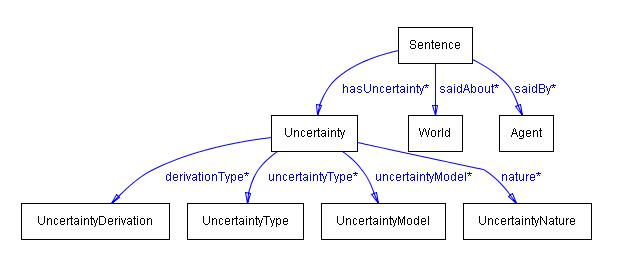
OBS: The * means that the multiplicity constraint on the given
property has not been specified, i.e., the property can have zero or more
values for a given instance of the domain of the property.
3.1.1 Sentence
An expression in some logical language that evaluates to a truth-value
(formula, axiom, assertion). It is then assumed that information will be
presented in the form of sentences. So the uncertainty will be associated
with sentences.
3.1.2 World
This represents the world about which the Sentence is said.
3.1.3 Agent
This is the class representing whoever makes the statement. It can be
either a human or a computer agent (machine).
3.1.4 Uncertainty
A statement about the uncertainty associated with the sentence.
3.1.5 Uncertainty Nature
This captures the information about the nature of the uncertainty, i.e.,
whether the uncertainty is inherent in the phenomenon expressed by the
sentence, or it is the result of lack of knowledge of the agent.
Aleatory - the uncertainty comes from the world;
uncertainty is an inherent property of the world.
Epistemic - the uncertainty is due to the agent whose
knowledge is limited.
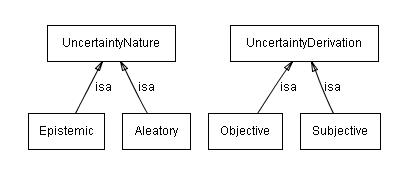
3.1.6 Uncertainty Derivation
Objective - derived in a formal way, repeatable
derivation process.
Subjective - subjective judgement, possibly a guess.
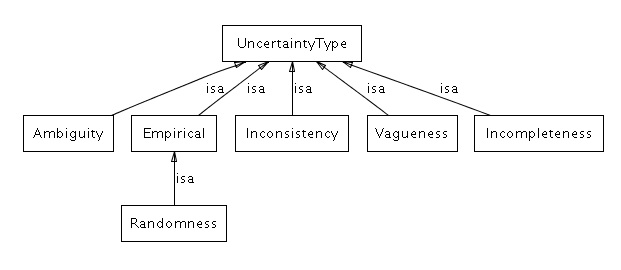
3.1.7 Uncertainty Type
Ambiguity - The referents of terms in a sentence about
the world are not clearly specified and therefore it cannot be determined
whether the sentence is satisfied, see also http://en.wikipedia.org/wiki/Ambiguity.
Empirical - a sentence about a world (an event) is either
satisfied or not satisfied in each world, but it is not known in which worlds
it is satisfied; this can be resolved by obtaining additional information
(e.g., an experiment).
Randomness - sentence is an instance of a class for which
there is a statistical law governing whether instances are satisfied.
Vagueness - there is not a precise correspondence between
terms in the sentence and referents in the world, see also http://en.wikipedia.org/wiki/Vagueness.
Inconsistency - there is no world that would satisfy the
statement.
Incompleteness - information about the world is
incomplete, some information is missing.
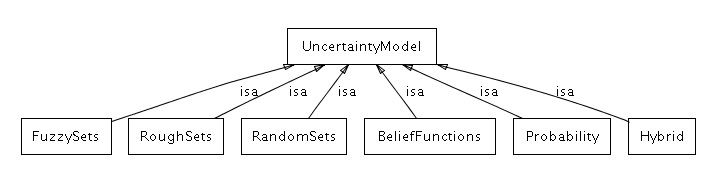
3.1.8 UncertaintyModel
This class contains information on the mathematical theories for the
uncertainty types. The specific types of theories include, but are not
limited to, the following:
- Probability.
- Fuzzy Sets.
- Belief Functions.
- Random Sets.
- Rough Sets.
- Combination of Several Models (Hybrid), e.g., Fuzzy
Sets and Probability.
3.2 Properties of the Uncertainty ontology
hasUncertainty - sentence S has uncertainty U.
saidAbout - sentence S is said about world W.
saidBy - sentence S was said by agent A.
nature - uncertainty U has nature S (either aleatory or
epistemic (lack of knowledge)).
uncertaintyType - uncertainty U is of type T.
uncertaintyModel - uncertainty U is modeled using the
mathematical theory M.
derivationType - uncertainty U was obtained by derivation
of type D.
4. Most Commonly Used Approaches to Uncertainty for the
WWW
4.1 Probability Theory
Probability theory provides a mathematically sound representation language
and formal calculus for rational degrees of belief, which gives different
agents the freedom to have different beliefs about a given hypothesis. This
provides a compelling framework for representing uncertain, imperfect
knowledge that can come from diverse agents. Not surprisingly, there are many
distinct approaches using probability for the Semantic Web. This section
briefly mentions the most commonly used approaches to probability for the
Semantic Web. Appendix C brings a more detailed view
of the subject.
4.1.1 Bayesian Networks (BNs)
Bayesian networks are a powerful graphical language for representing
probabilistic relationships among large numbers of uncertain hypotheses. They
have been applied to a wide variety of problems including medical diagnosis,
classification systems, multi-sensor fusion, and legal analysis for trials.
However, Bayesian networks are insufficiently expressive to cope with many
real-world reasoning challenges found in the WWW. For example, a standard
Bayesian network can represent the relationship between the type of an
object, the object’s features, and sensor reports that provide
information about the features, but cannot cope with reports from a large
number of sensors reporting on an unknown number of objects, with uncertain
associations of reports to objects. Section C.1.1 brings a detailed
explanation of BNs within the context of the WWW.
4.1.2 Probabilistic Extensions to Description
Logics.
Most of the probabilistic extensions aimed at the ontology engineering
domain are based on description logics (DLs), which Baader and Nutt (2003, page 47) define as a family of knowledge
representation formalisms that represent the knowledge of an application
domain (the “world”) by first defining the relevant concepts and
roles of the domain (its terminology), which represent classes of
objects/individuals and binary relations between such classes, respectively,
and then using these concepts and roles to specify properties of
objects/individuals occurring in the domain (the world description).
There are several probabilistic extensions of description logics in the
literature and some existing systems as well (e.g. Pronto),
which can be classified according to the generalized description logics, the
supported forms of probabilistic knowledge, and the underlying probabilistic
reasoning formalism. These are covered in section C.1.2 in the appendices.
4.1.3 First-Order Probabilistic Approaches
In recent years, a number of languages have appeared that extend the
expressiveness of probabilistic graphical models in various ways. This trend
reflects the need for probabilistic tools with more representational power to
meet the demands of real world problems, and is consistent with the need for
Semantic Web representational schemes compatible with incomplete, uncertain
knowledge. A clear candidate logic to fulfill this requirement for extended
expressivity is first-order logic (FOL), which according to Sowa (2000, page 41) “has enough expressive power to
define all of mathematics, every digital computer that has ever been built,
and the semantics of every version of logic, including itself.”
However, systems based on classical first-order logic lack a theoretically
principled, widely accepted, logically coherent methodology for reasoning
under uncertainty. Below are some of the approaches addressing this issue.
A workable solution for the Semantic Web requires a general-purpose
formalism that gives ontology designers a range of options to balance
tractability against expressiveness. Current research on SW formalisms using
first-order probabilistic logics is still in its infancy, and generally lacks
a complete set of publicly available tools. Examples include PR-OWL (Costa, 2005), which is an upper ontology for building
probabilistic ontologies based on MEBN logic, and KEEPER (Pool and Aiken, 2004), an OWL-based interface for the relational
probabilistic toolset Quiddity*Suite, developed by IET, Inc. A more detailed
account of first-order probabilistic approaches is conveyed in section C.1.3
of the appendices.
4.2 Fuzzy Logic
In contrast to probabilistic formalisms, which allow for representing and
processing degrees of uncertainty about ambiguous pieces of information,
fuzzy formalisms allow for representing and processing degrees of truth about
vague (or imprecise) pieces of information. It is important to point out that
vague statements are truth-functional, that is, the degree of truth of a
vague complex statement (which is constructed from elementary vague
statements via logical operators) can be calculated from the degrees of truth
of its constituents, while uncertain complex statements are generally not a
function of the degrees of uncertainty of their constituents (Dubois and
Prade, 1994).
Vagueness abounds especially in multimedia information processing and
retrieval. Another typical application domain for vagueness and thus fuzzy
formalisms are natural language interfaces to the Web. Furthermore, fuzzy
formalisms have also been successfully applied in ontology mapping,
information retrieval, and e-commerce negotiation tasks. Section C.2 of the
appendices dwells on the subject at a greater level of detail.
4.2.1 Fuzzy Propositional Logics
Rather than being restricted to a binary truth value among false and true,
vague propositions may also have a truth value strictly between false and
true. One often assumes the unit interval [0, 1] as the set of all possible
truth values, where 0 and 1 represent the ordinary binary truth values false
and true, respectively. For example, the vague proposition “John is
tall” may be more or less true, and it is thus associated with a truth
value in [0, 1], depending on the body height of John.
4.2.2 Fuzzy Description Logics and Ontology Languages
In fuzzy description logics and ontology languages, concept assertions,
role assertions, concept inclusions, and role inclusions have a degree of
truth rather than a binary truth value. Semantically, this extension is
essentially obtained by
- generalizing binary first-order interpretations to fuzzy first-order
interpretations and
- interpreting all the logical operators by a corresponding combination
function.
Syntactically, as in the fuzzy propositional case, one then also allows
for formulas that restrict the truth values of concept assertions, role
assertions, concept inclusions, and role inclusions. Some important new
ingredients of fuzzy description logics are often also fuzzy concrete
domains, which include fuzzy predicates on concrete domains, and fuzzy
modifiers (such as “very” or “slightly”), which are
unary operators that change the membership functions of fuzzy concepts.
4.3 Belief Functions
Belief functions are closely related to probabilities. Beliefs in a
hypothesis is calculated as the sum of the masses of all sets it encloses. A
belief function differs from a Bayesian probability model in that one does
not condition on those parts of the evidence for which no probabilities are
specified. This ability to explicitly model the degree of ignorance makes the
theory very appealing and has been applied in areas such as inconsistency
handling in OWL ontologies (Nikolov et
al., 2007) and ontology mapping (e.g. Yaghlane and Laamari, 2007).
5. Use Cases
The Subsections below provide a brief description of the use case
scenarions that have been studied by the incubator group and that corroborate
its conclusions and recommendations. Detailed descriptions of all use cases
can be found in Appendix A.
5.1 Discovery
Service oriented architecture (SOA) assumes a world of distributed
resources which are accessible across a network. It is assumed that
catalogues will exist for different classes of resources, such as SOA
services, and the user will be able to search these catalogs for a desired
item. Note, a class of items will be described using a list of relevant
properties and items belonging to that class will be described by assigning
values to these properties. For discovery to occur, there must be some
alignment of or mediation between the list of properties used by those
populating the catalogue and those searching it. There must also be some
alignment of or mediation between the nonnumeric values assigned to the
properties, both in describing items for the catalogue and defining the
search criteria.
Uncertainty occurring in this use case includes the following:
5.2 Wine Sweetness
Wine domain is a very attracting domain both for experts and non experts.
The main reason of its attractiveness is given by:
- The high number of properties that qualify a wine or a set of
wines.
- The fuzziness of the properties values for characterizing a wine as
belonging to a certain category.
The “Wine Sweetness” use case focuses on a particular wine
property that is the wine sweetness. The goal is to present a particular
unknown wine’s sweetness to the user, according to his/her personal and
possibly vague sweetness criteria. This is done by considering a knowledge
base of reference that could have a finer/coarser classification, or it could
use a terminology that is different from the one adopted by the user.
Furthermore, even when the same terminology is used, the interpretation of
a vague classification label (such as “dry”) may differ between
the creator of the knowledge base and the user who queries the knowledge
base.
Uncertainty occurring in this use case includes the following:
5.3 Belief Fusion and Opinion Pooling
A typical situation for web users is the need to aggregate information
from multiple sources on the web. Issues related to uncertainty arise in such
a situation in case the set of information acquired from multiple sources
about the same fact is inconsistent (UncAnn - UncertaintyType: Inconsistency), or - more generally - in
case that multiple information sources attribute different grades of belief
(for example uncertain or mutually inconsistent beliefs) to the same
statement (UncAnn - UncertaintyNature: Epistemic). If the user is not able to
decide in favor of a single alternative (due to insufficient trust in the
respective information sources, which can be seen as the default situation on
the web), the aggregated statement resulting from the fusion of multiple
statements is typically uncertain (UncAnn - UncertaintyNature: Epistemic, or if the types of
uncertainty in this situation can vary. e.g., we could have UncAnn - UncertaintyType:
Empirical).
A similar situation can be observed when a single information artifact on
the web (e.g., a knowledge base, an ontology, a product rating, meta data, or
even an ordinary web page) shall be created from multiple possibly
contradictory information sources (e.g., expert opinions, existing
ontologies, product recommendations, meta data, web pages...). The result
needs to reflect and weight multiple input information appropriately, which
typically yields uncertainty in case of heterogeneous input information.
There are several approaches to belief fusion. Examples for belief
aggregation operators which can yield uncertain results are logarithmic and
linear pools (LogOP, LinOP), and Bayesian Network Aggregation. One possible
criterion for a successful fusion is the minimization of the divergence of
the resulting probability distribution from the input probability
distributions.
5.4 Ontology Based Reasoning and Retrieval from
Large-Scale Databases
Consider a production company which has a knowledge base that consists of
videos and images about persons (which usually are actors or models), TV
spots, advertisements, etc. This company wants to publish its content on the
Web so that advertisement or other production companies can use this
knowledge base to look for either video footage like films, TV spots, etc or
for persons to be employed for advertisements (casting). Each entry in the
knowledge base contains a photo or a video, and some specific information
like body and face characteristics, age or profession-like characteristic, in
the case of persons, or video annotations in the case of spots or sceneries.
The casting company has created a user interface for inserting the
information of persons as instances of a predefined ontology or for
performing semantic annotation of its multimedia content. It also provides a
query engine to perform ontology-based search for its content through the
web. A user can query the knowledge base providing information like the name,
the height, the type of the hair (e.g. good quality, perfect, punk), the body
(e.g. slim, athletic, plump), age range (e.g. 30s, 50s, MiddleAged), and
more, in the case of persons, or information like the place the video spot is
taking place (indoors vs. outdoors), the time of day (morning, afternoon,
night), the landscape it depicts (mountain, sea), a sky being cloudy or not,
a sea being wavy or not, and many more.
The knowledge engineer of the application has identified that applying a
classical (Boolean) knowledge based system in the above scenario is very
problematic due to the nature of the knowledge and information. For example,
an attempt to assign a Boolean meaning to concepts like "30s", "MiddleAged",
"Teen", "Kid", "Slim", "Tall", ... would lead to intuitive paradoxes. On the
other hand, it is also very difficult to define other more expressive
concepts, like the concept "StudentLooks" in terms of the already problematic
concepts "Teen" and "Kid". Similarly, a sky being cloudy or wavy or time
being morning or afternoon is also a matter of degree.
His solution to the problem is to use fuzzy ontologies where the
membership of an individual (person) or image object to a Concept is
annotated with a degree of membership. So one is able to classify "model1" as
Tall, Thin, MiddleAged, to degrees 0.6, 0.9, 0.7, respectively, depending on
the model's actual height, weight and age. Then, one is able to infer that
"model1" is StudentLooking or AccademicLooking to specific degrees according
to the definition of the concepts in the ontology and the interpretation of
them according to the theory of fuzzy ontologies. Interestingly, the
developed system also provides a easy and natural way to provide end-users
with rankings in the query results which is not easily supported by Booelan
models, or even more to allow end-users specify preferences and weights over
the atoms (ingredients) of their queries, thus allowing for far more
expressivity.
5.5 SOA Execution Context
As defined in the OASIS Reference Model for Service Oriented Architecture
(SOA-RM), the execution context of a service interaction is the set of
infrastructure elements, process entities, policy assertions and agreements
that are identified as part of an instantiated service interaction, and thus
forms a path between those with needs and those with capabilities.
As discussed in SOA-RM, the service description (and a corresponding
description associated with the service consumer and its needs) contains
information that can include preferred protocols, semantics, policies and
other conditions and assumptions that describe how a service can and may be
used. The participants (providers, consumers, and any third parties) must
agree and acknowledge a consistent set of agreements in order to have a
successful service interaction, i.e. realizing the described real world
effects. The execution context is the collection of this consistent set of
agreements.
Uncertainty occurring in this use case includes the following:
- Service consumer may have insufficient information about provider's
capabilities and associated requirements to ascertain whether service
provider can meet needs at acceptable cost. (UncAnn
- UncertaintyNature: Epistemic; UncAnn - UncertaintyType: could be
Ambiguity or Vagueness)
- Service provider may have insufficient information about consumer's
need to know whether the functionality it provides can meet that need.
(UncAnn - UncertaintyNature:
Epistemic; UncAnn - UncertaintyType: could be Ambiguity or Vagueness)
5.6 Recommendation
Recommender systems form a rapidly growing category of web-based system. A
recommender system takes input from a user in the form of a query or an
exemplar of the kind of item the user seeks, and returns recommendations for
information or products. For example, the user might input a list of keywords
and the system would return a list of recommended books, articles and/or web
sites. The user might input one or a few movies, and the system might return
a list of suggested movies for the user to view. Many e-commerce sites employ
recommending systems to suggest products that customers might want to
purchase. Another well-known example for this use case is the search for web
pages using a search engine.
This use case discusses uncertainties that typically occur in the context
of recommender systems or recommendations generated using other technical
means (e.g., agents). The main scenario is as follows: A single or multiple
recommendation searcher(s) express(es) her/their preferences in a machine
readable format. A recommender system then combines a set of recommendations
(obtained by a number of agents or other recommender systems) into an
aggregated recommendation and ranking. For example, a user might input a
movie, and the system would form its recommendation by aggregating
recommendations provided by consumers who have seen the movie.
In this scenario uncertainty can occur for several reasons:
- The set of recommendations obtained from multiple agents might be
inconsistent.
- A recommendation possibly matches the preference(s) of the
recommendation searcher only imperfectly.
- A recommender system might have obtained its recommendation using
statistical means (e.g., using collaborative filtering).
- An agent or a recommender system might have a low confidence in its
recommendation, i.e., it is uncertain whether its recommendation actually
matches the preference.
- The preferences provided by a recommendation searcher can be uncertain
or inconsistent, e.g., because a user might not be able to express his
preferences in sufficient detail.
- Sometimes a single recommendation shall reflect multiple preferences
provided by multiple recommendation searchers (e.g., if a group of users
seeks a single recommendation which reflects the preferences of all group
members as well as possible). Uncertainty arises e.g. in case these input
preferences are inconsistent.
In order to enable formal inference to be carried out on the set of
recommendations, the semantics of recommendation needs to be cleanly defined
and an appropriate formal framework for the representation of recommendations
is required. Also, an ability is needed to express preferences, scales and
rankings in a formal way.
The motivating situation is a user (or a web service) that wants a web
scale overview of available information – e.g. overview of all car
selling shops or online shops selling notebooks. The advantage would be a
possibility of comparison of different market offers. Another application is
competitor tracking system.
Main problem is the size of data and the fact that these data are mainly
designed for human consumption.
Solution are extraction and annotation tools. There are many annotation
tools linked on the SW Annotation
& Authoring Website, mainly using a proprietary uncertainty
representations (or built in uncertainty handling). Here uncertainty
annotation of results would be especially helpful.
Assume that a user is looking for notebooks and we would like to provide a
machine support for his/her search. A typical statement which is a subject of
uncertainty assignment in this use case is: (UncAnn -
Sentence) An html coded web page with URL contains
informations, which according to an ontology o1 (UncAnn
- World: DomainOntology) about notebooks can be
expressed by a RDF triple (ntb1, O1:has_priceProperty, 20000). The agent
producing this statement is (UncAnn - Agent: MachineAgent) especially an induction agent (UncAnn - Agent:
MachineAgent:InductiveAgent). For extensions of concepts see a finer grained version of Uncertainty Ontology.
Uncertainty nature of this statement isUncAnn - UncertaintyNature: Epistemic:MachineEpistemic),
uncertainty type is usually (UncAnn - UncertaintyType: Empirical:Randomness). Instances used for
training an extraction tool (UncAnn - World:DomainOntology:Instances) are web pages, the
uncertainty model is usually complicated (mixture of html structure, regular
expressions, annotation ontology and similarity measures) and combination of
several models, typically (UncAnn - UncertaintyModel:CombinationOfSeveralModels:ProbabilityAndFuzzySetsCombinationModels)
. Depending on this the evidence for this uncertainty statement (UncAnn - World:DomainOntology:Instances:Evidence) are precision and
recall on this training set.
Suppose we have a car selling web site offering cars and we would like to
buy a car. Descriptions of the cars are stored in databases and we have some
ontology encoding information about the domain. Now, suppose that preferably
we would like to pay around €11000 and the car should have fewer than
15000 km on the odometer. Also, if there are leather seats then I would like
to have air conditioning, the color is preferably blue, and the car is not
old.
Of course, most of our constraints, e.g. on price and kilometers, aren't
crisp as we may still accept e.g.~a car's cost of €11200 and with an
odometer reading of 16000km. Hence, these constraints are rather vague
(fuzzy) (we may model this by means of so-called fuzzy membership functions).
We may also give some preference weight to my requirements.
On the other hand, the seller may offer a discount on the car's catalogue
price, but the bigger the discount the less satisfied he is. For instance,
related to the sale of a Mazda3, the seller may consider optimal to sell
above €15000, but can go down to €13500 to a lesser degree of
satisfaction.
For each car, there will be an optimal price it can be sold, which
maximises the product of the buyer's degree of satisfaction and the seller's
degree of satisfaction. This is the so-called NASH equilibrium of the
matching. Each car gets an optimal degree of buyer/seller degree of
satisfaction.
From the buyer perspective, he asks for the TOP-k cars and their optimal
price, ranked by the optimal degree of satisfaction.
From the seller perspective, he may ask for the TOP-k buyer's for a given
car and their optimal price, ranked by the optimal degree of satisfaction.
5.9 A Chain from the Web to the User
To get information from the web to the user we have to use a chain of
tools – typically web crawling, web data extraction, middleware
transformation, user querying and delivering answer. There are several use
cases dealing with particular problems of uncertainty along such a chain.
Usually there is a middleware connecting those.
The problem is, how does uncertainty evolve along such a chain.
Our understanding of this is to view the whole chain of models, methods
and tools from web to the user and especially handling uncertainty
combination along this (UncAnn - UncertaintyModel: could be a combination of several
models).
5.10 Appointment Making
This use case was inspired by the 2001 Scientific American article, The Semantic Web, by Berners-Lee, Hendler and
Lassila. The article describes a scenario in which Lucy and her brother Pete
must schedule their mother for a sequence of visits to a physical therapist.
They agree to share the chauffeuring, and Lucy tasks her Semantic Web agent
to set up the appointments:
Lucy instructed her Semantic Web agent through her handheld Web
browser. The agent promptly retrieved information about Mom's prescribed
treatment from the doctor's agent, looked up several lists of providers,
and checked for the ones in-plan for Mom's insurance within a 20-mile
radius of her home and with a rating of excellent or very good on trusted
rating services. It then began trying to find a match between available
appointment times (supplied by the agents of individual providers through
their Web sites) and Pete's and Lucy's busy schedules.
It is clear that many uncertainties arise in handling this classic use
case for the Semantic Web use case. For example, both the provider's and the
consumer's schedules may be uncertain, and in traffic-clogged metropolitan
areas, the amount of time it takes to get from the consumer's location to the
place where the service is rendered may be highly uncertain.
5.11 User Preference Modeling for top-k Answers
This is in a sense a generalization of some aspects of Discovery use case.
Given a populated catalogue by some extraction tool (see use case about
extraction) of items and a user’s criteria and/or multicriterial
utility function for item potentially listed in the catalogue retrieve best,
top-k matches.
Usually, the main problem is to learn user preferences. This can be done
either by implicit information collection (system tracks user behavior, click
streams, …) or by explicit information collection (system poses
questions, user answers). Sometimes a recommender system finds similar users
(UncAnn - UncertaintyModel:SimilarityModels). Another problem is
effective retrieval of search results ordered by these preferences (usually
top-k answers suffice).
As result of any data mining procedure, results of such user preference
mining will be uncertain.
Typical sentence which is a subject of uncertainty assignment is: (UncAnn - Sentence) User1 prefers
most item1 (list of of top-k most preferred items for User1 consists of
item1, ..., itemk).
There are models using partially ordered sets to represent preferences.
Different ad hoc ranking approaches are used. Possible model is UncAnn - UncertaintyModel: FuzzySets
or UncAnn - UncertaintyModel:
PreferenceModels.
Suppose we want to device ontology mediated multimedia information
retrieval system, which combines logic-based retrieval with multimedia
feature-based similarity retrieval. An ontology layer may be used to define
(in terms of semantic web like language) the relevant abstract concepts and
relations of the application domain, while a content-based multimedia
retrieval system is used for feature-based retrieval. We ask to make queries
such as
- Find top-k ranked video passages made by Umberto whose title is about
'tour'.
- Find top-k ranked images similar to a given one, which is about an
animal.
5.13 Buying Speakers
The main point of this use case is to show that in some cases one needs to
combine different kinds of uncertainty. In this particular use case two types
of uncertainty are considered: Randomness and Vagueness.
The scenario includes a customer who is interested in purchasing a set of
speakers, but the question is (1) whether to go to a store today or wait
until tomorrow to buy speakers, (2) which speakers to buy and (3) at which
store. Customer is interested in two speaker features: wattage and price.
Customer has a valuation formula that combines the likelihood of availability
of speakers on a particular day in a particular store, as well as the two
features. The features of wattage and price are fuzzy. Optionally, Customer
gets the formulas from CustomerService, an ontology based Web service that
collects information about products, stores, statistics, evaluations.
It is assumed that there is known probability distribution on the
availability of particular speaker type in particular stores on a particular
day in the future. Also it is assumed that both the customer's agent and the
consumer service agent share the same Uncertainty Ontology. The customer's
agent issues a query (a sentence) using terms from the Uncertainty Ontology: Sentence. It is a complex sentence
consisting of three basic sentences. One related to the availability, one to
the wattage and one to the price of speakers. Each of these sub-sentences
will have uncertainty Uncertainty associated with
it. The uncertainty type related to the availability of particular speaker
type in the stores is of type UncAnn - UncertaintyType: Empirical. The uncertainty nature is UncAnn - UncertaintyNature:
Aleatory. The uncertainty model is UncAnn - UncertaintyModel: Probability. The customer has (or obtains
from CustomerService) definitions of features of wattage and price in terms
of fuzzy membership functions. For wattage, Customer has three such
functions: weak, medium and strong. These are of "trapezoid shaped"
membership functions. Similarly, for price Customer has three such membership
functions: cheap, reasonable and expensive.
In the end, the customer gets necessary information about the availability
and types of speakers from stores. This information is sufficient for the
customer to compute the required metric and to make the decision on which
speakers to buy, where and when.
5.14 Healthcare and Life Sciences
The entire Healthcare and Life Sciences spectrum involves the creation and
manipulation of uncertain information and knowledge. A collection of use
cases are presented characterized by a simple taxonomy.
5.14.1 Hypothesis Uncertainty
Some examples of Uncertainty in the context of Hypothesis Generation and
Validation are enumerated below:
- Mutations in the alpha synuclein could cause Parkinsons
Disease.
- Hypotheses of relationships based on statistical analysis of microarray
data associated with p-values, confidence intervals, etc.
- Gene Ontology Evidence codes in support of a particular GO annotation
of a gene.
- Evidence classes in the OBO Evidence Ontology.
5.14.2 Interpretation/Classification Uncertainty
- Some examples of Uncertainty in the context of interpreting and
classifying different types of information are enumerated below:
- The patient has elevated cholesterol based on his reading of X
mg/dl.
- Given the same set of symptoms, Doctor X and Y come up with diagnosis
of mild and severe disease respectively
- True/False Positive/Negative rates of patient classifications and
diagnoses.
- Use of measures such as Precision, Recall, PPV, NPV, etc.
5.14.3 Prediction-oriented Uncertainty
Some examples of Uncertainty in the context of predicting some phenomena
based on currently available information are enumerated below:
- A person with the BRCA1 gene has a disposition towards Breast
Cancer with 70% probability in the future
5.14.4 Belief oriented uncertainty
Some examples of Uncertainty in the context of believing (or not
believing) certain hypotheses and theories are enumerated below.
- It is believed to the best of our knowledge that a particular gene is
not implicated in a particular disease.
- Associated non-monotonicity with the above, i.e., if more knowledge is
available, the statement could be proven false.
5.14.5 Data Source based Uncertainty
Some examples of Uncertainty in the context of trusting various data
sources are enumerated below.
- Samples from the same patient are analyzed by different labs. Lab 1
results show an 80% probability of Disease 1, whereas Lab2 shows a 90%
probability for the same.
- If the Cleveland Clinic says that Avandia is bad for Diabetes, the
statement has a higher value of certainty as opposed to an individual Dr.
X.
5.14.6 Data Uncertainty
Some examples that illustrate the inherent uncertainty of the data
generated in the Healthcare and Life Sciences are enumerated below.
- Approximate location of a clinical feature, e.g, tumor in spatial
location in the human body as captured in radiological image or any other
digital artifact.
- Data inconsistency and incompletenes encountered in Healthcare and Drug
Databases.
- Data uncertainty introduced due to sampling errors, sampling rates,
etc).
- Data uncertainty introduced due to the limitations (least count error?)
of the device measuring patient characteristics (e.g., temperature).
- Data uncertainty introduced due to limitation of instruments used to
collect experimental data, e.g., micro-arrays.
6. Benefits of Standardization
6.1 Where use cases imply standardization benefits
We can consider the use cases above as processes in which a consumer of
information makes a request to a provider (or multiple providers) of
web-accessible information or services, and receives a response (or multiple
responses).
The use cases illustrate several examples where uncertainty arises during
this interaction and there are a number of topics that are common across use
cases. Specifically, we can sub-divide into three areas - the
producer’s specification of what can be provided, the consumer’s
request (description of what is wanted) and the result. Taking these in
turn:
6.1.1 Uncertainty in Provider's Specification
This relates primarily to the provider’s descriptors (i.e.
properties used to describe the topic / item / service provided) and the
values assigned to these descriptors. Such values may be based on perception
rather than measurement (for example, a picture of someone with an
‘athletic physique”), or on overlapping categories where an item
can belong to multiple categories at different membership levels (e.g. a film
could belong strongly to the genre ‘comedy’ and weakly to the
genre ‘adventure’).
Additional uncertainty may arise where the provider makes assertions
related to the use of the information or service provided. Standardization
could assist (for example) in determining intersection with similar
assertions by the consumer, e.g. privacy policies.
6.1.2 Uncertainty in Consumer's Request
The provider has to deal with cases of incomplete and/or inconsistent
information in the request from a consumer. Further uncertainty may arise
where a request is based partly on submitted data and partly on background
information, such as known consumer preferences or history.
As above, further uncertainty may arise where the consumer makes
assertions related to the use of the information provided in the request.
6.1.3 Result Returned to Consumer
The consumer may have to deal with uncertainty in the result from a single
provider or in results from multiple providers. In the first case, the most
obvious possibility is that the result is incomplete or inconsistent in some
way. Inconsistency is not a binary state - in many cases, a small
inconsistency in a result may not affect the usefulness of the answer. It is
however an area in which standardization of uncertainty could aid uniform
handling of results. Similarly, incompleteness in a result may not affect its
usefulness.
Further uncertainty may arise from use of the provider’s use of
consumer preferences, the process of finding responses to a partially matched
request, etc. Inconsistency is possible from a single provider but is more
likely where results are aggregated from multiple providers. In cases where a
consumer is dealing with more than one provider, these problems are
multiplied because different providers may have different interpretations of
descriptors and values, or even different sets of descriptors, as well as
different approaches to processing requests, variation in use of consumer
preferences, different historical data on a particular consumer, etc. Clearly
standardization would clarify the uncertainty in this process to the benefit
of both producers and consumers.
Underlying these aspects are the fundamental questions that motivate
standardization - how do the different parties assess uncertainty, and can
these assessments be meaningfully combined, particularly when they are
derived from different methodologies. The work of this XG is not to develop
or even identify many of the mechanisms that these use cases imply are needed
to process uncertainty. The current effort intends to identify the types of
information that are likely to be valuable for such processing to occur and
to provide guidance to those who would develop the syntax to convey this
information in a machine-processible way.
6.2 Goals of Standardization
The challenges related to uncertainty reasoning on the scale of the World
Wide Web have been introduced in Section 1, and the goal of standardization
would be to enable the understanding and processing needed for consistent use
of available information when uncertainty is present. Many applications which
generate data for the web already handle uncertainty in some form. For
example, information retrieval systems may rank pages in terms of
“relevance” on a scale of 0-100, weather forecasts are frequently
qualified (e.g. 30% chance of showers), product finders return lists which
are ordered according to the quality of match with a user’s
requirements. These applications implicitly or explicitly define and handle
uncertainty, and communicate it to the user. Standardization is not necessary
for these individual applications which handle uncertainty internally in a
(hopefully) consistent manner.
However, as soon as an application incorporates externally produced
uncertain data, there is a need to standardize the representation of the
characterization of the uncertainty. The notion of interoperability - being
able to access and process data from any web source - is fundamental to a web
of distributed information, and cannot be achieved unless all sources conform
to common standards. As argued in the introduction, much of the available
data on the web is subject to uncertainty - so that without standardization
of uncertainty, applications using this information are either (i) inaccurate
or (ii) have to make assumptions that enable them to ignore uncertainty.
Neither of these options is likely to lead to practical, accurate reasoning
about real-world data, except in a limited set of cases.
The aim of uncertainty standardization for the World Wide Web should be
- to enable mark-up of a web-based information source so that the nature
of any associated uncertainty is clear - whether the uncertainty is a
product of the inference process, is inherent in the stored facts or is
due to limited knowledge of the information provider
- to permit the definition of extensions to the uncertainty framework
The availability of an uncertainty mark-up language for annotating web
data would make it possible to (semi)automate and manage the trustworthiness
of the information on the Web. Indeed, there are many cases in which the same
data can have different reliability depending on: the source from which they
are generated, the context in which they are produced, the time in which they
are made available. Currently, such information generally cannot be managed
simply because there are no way for knowing the associated uncertainty. With
the availability of uncertainty mark-up annotation, such information can be
properly treated for the first time.
6.3 Aspects of Uncertainty Reasoning for Potential
Standardization
Many approaches to uncertainty use a numerical scale (e.g. from 0 to 1 or
0 to 100) but interpret and process these values in different ways. It is not
necessary for every implemented system to interpret and process every form of
uncertainty. The aim should be for common understanding and interpretation of
the core forms, and the ability to extend the framework as necessary. For
example, if data is published with probabilities attached, any other
application would be able to perform specified operations on those
probabilities and know that the results were meaningful.
In summary, the following aspects must be considered:
- semantics - any standarization proposal should have a semantics related
to the model-theoretic semantics of OWL.
- extensibility - the standard should support uncertainty models listed
above (section 3) but should not restrict the expression of uncertainty
to these models.
- expressibility / ease of use.
As such, we conclude the following as guidelines when
considering possible standards development efforts related to uncertainty:
- We see no single approach to uncertainty reasoning that will solve all
problems, so a standard must support current and, to the extent we
currently understand, future uncertainty reasoning methodologies.
- A standard must provide a means to clearly identify the context under
which provided uncertainty information was generated and, possibly, the
intended use of the information.
- A standard must provide the means to convey uncertainty information
needed to support any methodology.
7. Conclusions and Recommendations
According to the URW3-XG's Charter.
The objectives of the group are twofold:
- To identify and describe situations on the scale of the World Wide Web
for which uncertainty reasoning would significantly increase the
potential for extracting useful information.
- To identify methodologies that can be applied to these situations and
the fundamentals of a standardized representation that could serve as the
basis for information exchange necessary for these methodologies to be
effectively used.
To motivate our debate, we have studied several use cases in which
uncertainty would play a significant role. In all of those cases, we assumed
the need of an unified model of uncertainty annotation of web resources and
the need of those annotations to be done automatically, due to the size of
the web. We also found that in order to address the situations presented
here, an ontology on uncertainty is needed, so deductive engines would be
able to use uncertainty information properly and third party users would
understand the annotated resources. In all use cases we studied, a successful
end would mean to have automatic processing of web resources with greater
accuracy, while a failed end would just leave the web as it is today.
7.1 Conclusions Relating to UncertaintyOntology
In automated Web data processing, we often face situations where Boolean
truth values are unknown, unknowable, or inapplicable. Our conclusions follow
the UncertaintyOntology as described above but also imply that a finer
grained version of UncertaintyOntology might be useful. Such an extension
could provide a means to visualize a possible evolution of upper level
UncertaintyOntology and to emphasize uncertainty issues connected to machine
processing (lot of situations are perfectly certain when considering human
consumption of web resources). In the current discussion, we focus especially
on finer classification of Machine Agents (UncAnnAgent: MachineAgent) and uncertainty caused by lack of
knowledge of a machine agent (UncAnn UncertaintyNature:Epistemic:MachineEpistemic).
- Information extracted from large information networks such as the World
Wide Web is typically incomplete (UncAnnUncertaintyType:Incompleteness). The ability to exploit
partial information is very useful for identifying sources of service or
information. For example, that an online service deals with greeting
cards may be evidence that it also sells stationery. It is clear that
search effectiveness could be improved by appropriate use of technologies
for handling uncertainty.
- Much information on the World Wide Web is likely to be uncertain. In
some cases this is an inherent property of the world (UncAnn UncertaintyNature:Aleatory). Nevertheless, it is a
difference, whether this world is the physical world, or living, society
or business. Examples include weather forecasts (UncAnn UncertaintyNature:Aleatory:PhysicalWorldAleatory),
gambling odds or stock exchange (UncAnnUncertaintyNature:Aleatory:BusinessWorldAleatory).
Canonical methods for representing and integrating such information are
necessary for communicating it in a seamless fashion.
- Web information is also often incorrect or only partially correct,
raising issues related to trust or credibility (UncAnn UncertaintyNature: Trust,
UncertaintyType:Lie). Uncertainty representation and
reasoning helps to resolve tension amongst information sources having
different confidence and trust levels (this is one of few cases where
even a human agent has problems with processing information).
- The Semantic Web vision implies that numerous distinct but conceptually
overlapping ontologies will co-exist and interoperate (UncAnn UncertaintyNature:Epistemic:MachineEpistemic). It is
likely that in such scenarios ontology mapping will benefit from the
ability to represent degrees of membership and/or likelihoods of
membership in categories of a target ontology, given information about
class membership in the source ontology.
- Dynamic composability of Web Services will require runtime
identification of processing and data resources and resolution of policy
objectives. Uncertainty reasoning techniques may be necessary to resolve
situations in which existing information is not definitive (UncAnn UncertaintyNature:Epistemic:MachineEpistemic).
We recommend aspects that are considered most important to be included in
a standard representation of uncertainty : Extensions of UncertaintyOntology
which prove to be useful in annotation of web resources in order to improve
their machine processing.
7.2 Conclusions Relating to Kinds of Uncertainty
The use cases demonstrate that there are two very different kinds of
uncertainty that we need to consider in standardization.
- Uncertainty inherent in the data.
- Uncertainty reasoning for the processing and presentation of
information
- using uncertainty reasoning to draw conclusions; or
- uncertainty inherent in semantic processing, vagueness, ontology
mapping, terminology mismapping.
Each of (a) and (b) represent different standardization motivations and
requirements.
In the first case, the standardization should be done at the
representation level. When sharing information that has an inherent level of
uncertainty, it is useful to have a single syntactical system so that people
can identify and process this information quickly. These kinds of use case
may require something like uncertain extensions to OWL (i.e., probabilistic,
fuzzy, belief function, random set, rough set, and hybrid uncertain
extensions to OWL; see Section 3.1.8). For example, as
for probabilistic uncertainty, we may want to be able to pass on information
that Study X shows that people with property Y have an X% increased
likelihood of this disease, or that the probability of a four of a kind given
pocket Aces and an Ace in the flop is 0.043. This simply requires a standard
syntax.
But many of the use cases we've considered involve uncertainty reasoning
on the part of the tools used to access and share web information, not the
information itself. For example, if a web service uses uncertainty reasoning
to find and rank hotel rooms for me, the uncertain information would not
reside on the web. In such situations the role of standardization is
different and the motivation may be less clear. After all, if the hotel room
information is useful and rankings are roughly accurate, many users will be
unconcerned with the reasoning process or the uncertainties attached to the
rankings. So, here, we'd want to use standardization for a different purpose.
It would be used to represent meta-information about the reasoning models and
assumptions. And it would also play a different role, e.g., developing trust
models, finding compatible web services. However, it could also require a
very extensive representation task. Standardization questions here include
determining how to represent this information, how detailed it would be,
where it would reside.
7.3 Specific Recommendations for Standardization
It is acknowledged that while uncertainty is pervasive in both normal life
and its reflections on the Web, it is not always necessary to characterize
this uncertainty. However, there are significant instances where knowledge of
uncertainties could be used to positively support decision making, and it is
with such instances in mind that the URW3-XG makes the following
recommendations:
- Whereas we have demonstrated use cases for which uncertainty can have a
significant effect on the conclusions that can be drawn from viewing and
processing information available on the World Wide Web, we believe a
principled means for expressing uncertainty will increase the usefulness
of Web-based information and believe a standard way of representing that
information should be developed.
- Whereas the different use cases appear to lend themselves to different
uncertainty formalisms, the standard representation should provide a
means to unambiguously identify the formalism providing the context for
assigning other uncertainty characteristics and values.
- Whereas different uncertainty formalisms assign values to properties
specifically related to the underlying meaning and processing of these
values, the representation should support defining different standard
properties for each formalism without requiring changes to the
representation itself.
- Whereas consistent understanding and processing must be enabled both
within and across uncertainty formalisms, adjunct specification should be
developed for the most commonly used uncertainty formalisms, as discussed
in Section 4 and Appendix
C. Such adjunct specifications would not be intended to prescribe an
exclusive set of relevant formalisms but merely those found most useful
at that time, with the ability to expand the set as circumstances might
indicate to be prudent.
- Whereas uncertainty can be present anywhere, the representation should
support associating uncertainty with any property or value expressible
across the Web.
The recommendations point to the desirability of having a means to
annotate information with relevant uncertainty information. The mechanism
could be similar to that specified under Semantic Annotations for WSDL and
XML Schema(SAWSDL),
where the annotation approach is described as follows:
The specification defines how semantic annotation is accomplished using
references to semantic models, e.g. ontologies. Semantic Annotations for WSDL
and XML Schema (SAWSDL) does not specify a language for representing the
semantic models. Instead it provides mechanisms by which concepts from the
semantic models, typically defined outside the WSDL document, can be
referenced from within WSDL and XML Schema components using annotations.
In the realm of uncertainty representation, we would specify uncertainty
models and uncertainty annotations rather than SAWSDL's semantic
counterparts. For such uncertainty annotations, a possible standard would
need to support both inherent uncertainty in the data and uncertainty
connected to results of processing that data, but at this point it is unclear
whether there is a need for separate portions of the syntax for each data and
processing uncertainty or whether a single syntax would be able to cover the
entire range.
In addition, a question that remains with this approach but one which is
outside the scope of the URW3-XG is whether existing languages (e.g. OWL,
RDFS, RIF) are sufficiently expressive to support the necessary annotations.
If so, the development of such annotations might merely require work on a
more complete uncertainty ontology and possibly rules; otherwise, the
expressiveness of existing languages might need to be extended. As an example
of the latter, it might be advisable to develop a probabilistic extension to
OWL (e.g. PR-OWL) or a Fuzzy-OWL format or profiles associated with the type
of uncertainty to be represented. Further work is required to investigate the
adequacy of the existing languages against the compiled use cases.
An eventual goal in continuing the current work would be to define a
format to represent uncertainty in an agreed upon way to enable reliable
communications for situations such as the compiled use cases. The work of the
URW3-XG has made a significant contribution in defining the problem space and
identifying continuing work. These questions will likely be the subject of
discussion at a proposed 4th Uncertainty Reasoning for the Semantic Web
(URSW) workshop at ISWC 2008,
and just as the 2nd URSW workshop
decided to pursue the question of uncertainty representation through what
became the URW3-XG, a proposal for continued work may be an output of the 2008 URSW workshop.
8. Acknowledgements
The editors acknowledge significant contributions from the following
persons (in alphabetical order):
- Fernando Bobillo,
University of Granada.
- Anne Cregan, NationalICT
Australia/University of New
South Wales
- Claudia d'Amato,
Department of Computer Science - University of Bari.
- Nicola
Fanizzi, Department of Computer
Science - University of Bari.
- Francis Fung, IET/Eduworks.
- Vipul Kashyap,
Partners HealthCare System, Inc.
- Sebastian
Kruk, DERI Galway.
- Eric Monk, McDonald Bradley, Inc.
- Matthias Nickles,
University of
Bath.
- Jeff Pan, University
of Aberdeen.
- Michael Pool, Convera, Inc.
- Pavel Smrz, Brno
University of Technology.
- Giorgos Stamou, Image,
Video and Multimedia Systems Lab (IVML-NTUA).
- Giorgos Stoilos,
Image, Video and Multimedia Systems Lab (IVML-NTUA).
- Umberto Straccia,
CNR - Consiglio Nazionale delle Ricerche.
- Edward
Thomas, University of Aberdeen, Computing Science.
- Miroslav Vacura, Prague University of Economics.
- Peter Vojtas, Charles University
Prague.
Reference List
This is a collection of references that were added by XG members. Their
intent was to collect a set of references for various methodologies and to
"investigate proposed and implemented methodologies that may be applied to
address the use cases developed under the first objective and that show
promise as candidate solutions for uncertainty reasoning on the scale of the
World Wide Web. The combination of use cases and associated methodologies
would be examined to determine the most commonly required information and
also that information that while not common may be especially important in
select situations."
The list is by no means exhaustive and should be merely regarded as a set
of recommended reading for people interested in the subject of uncertainty
representation and reasoning in general.
Agarwal, S.; and Lamparter, S. (2005) sMART
- A Semantic Matchmaking Portal for Electronic Markets. Proceedings of the
7th International IEEE Conference on E-Commerce Technology. Munich, Germany,
2005.
Baader, F.; and
Nutt, W. (2003). Basic Description Logics. In Baader, F., Calvanese, D.,
McGuiness, D., Nardi, D., & Patel-Schneider, P. (Eds.), The Description
Logics Handbook: Theory, Implementation and Applications. 1st edition,
chapter 2, pp. 47-100. Cambridge, UK: Cambridge University Press.
Bangsø,
O., & Wuillemin, P.-H. (2000) Object Oriented Bayesian Networks: A
Framework for Topdown Specification of Large Bayesian Networks and Repetitive
Structures. Technical Report No. CIT-87.2-00-obphw1. Department of Computer
Science, Aalborg University, Aalborg, Denmark.
Bednarek, D.;
Obdrzalek, D.; Yaghob, J.; and Zavoral, F. (2005) Data Integration Using Data
Pile Structure, in Advances in Databases and Information Systems,
Springer-Verlag, 2005, ISBN 3 540 42555 1, pp. 178-188.
Berners-Lee, T.; and Fischetti, M.
(2000). Weaving the Web: The Original Design and Ultimate Destiny of the
World Wide Web by its Inventor. 1st edition. New York, NY, USA: HarperCollins
Publishers.
Berners-Lee, T.;
Hendler, J.; and Lassila, O. (2001) The Semantic Web, Scientific American
(pp. 29-37).
Bonatti, P.; and Tettamanzi, A. (2006) Some
Complexity Results on Fuzzy Description Logics. In Di Gesu, V., Masulli,
F.,& Petrosino, A. (Eds.), Fuzzy Logic and Applications, Vol. 2955 of
LNCS, pp. 19-24. Springer.
Brachman, R. J. (1977).
What's in a Concept: Structural Foundations for Semantic Networks.
International Journal of Man-Machine Studies, 9(2), 127-152.
Buntine, W. L. (1994) Learning
with Graphical Models. Technical Report No. FIA-94-03. NASA Ames Research
Center, Artificial Intelligence Research Branch.
Calì, Andrea; Lukasiewicz,
Thomas; Predoiu, Livia; and Stuckenschmidt, Heiner (2008) Tightly Integrated
Probabilistic Description Logic Programs for Representing Ontology Mappings.
Proceedings of the 5th International Symposium on Foundations of Information
and Knowledge Systems (FoIKS 2008).
Calvanese, D.; and De Giacomo, G. (2003).
Expressive Description Logics. In Baader, F., Calvanese, D., McGuiness, D.,
Nardi, D., & Patel-Schneider, P. (Eds.), The Description Logics Handbook:
Theory, Implementation and Applications. 1st edition, chapter 5, pp. 184-225.
Cambridge, UK: Cambridge University Press.
Carvalho, R. N.;
Santos, L. L.; Ladeira, M.; and Costa, P. C. G. (2007) A
Tool for Plausible Reasoning in the Semantic Web using MEBN. In
Proceedings of the Seventh International Conference on Intelligent Systems
Design and Applications (ISDA 2007). Mourele, L.; Nedjah, N.; Kacprzyk, J.;
and Abraham, A. (eds.); pp. 381-386. October 22-24, 2007, Rio de Janeiro,
Brazil.
Charniak, E. (1991). Bayesian
Networks without Tears. AI Magazine, 12, 50-63.
Clemen, R. (1996). Making Hard
Decisions. CA, Brooks/Cole.
Codd, E. F. (1970). A Relational
Model for Large Shared Data Banks. Communications of the ACM, 13(6),
377-387.
Costa, P. C. G. (2005). Bayesian Semantics for the Semantic
Web. Doctoral Dissertation. Department of Systems Engineering and
Operations Research. 2005, George Mason University: Fairfax, VA, USA. p.
312.
Costa, P. C. G.;
and Laskey, K. B. (2006). PR-OWL: A Framework for Probabilistic Ontologies.
In Proceedings of the International Conference on Formal Ontology in
Information Systems (FOIS 2006). November 9-11, 2006, Baltimore, MD, USA.
Costa, P. C. G.; Laskey, K.
B.; Laskey, K. J.; and Pool, M. (2005). Proceedings
of the First Workshop on Uncertainty Reasoning for the Semantic Web (URSW
2005). Nov 7, 2005, Galway, Ireland.
Costa, P. C. G., Fung, F.,
Laskey, K. B., Laskey, K. J., & Pool, M. (2006).Proceedings
of the Second Workshop on Uncertainty Reasoning for the Semantic Web
(URSW 2006). Nov 5, 2006, Athens, GA, USA.
Costa, P. C.G.; Ladeira,
M.; Carvalho, R. N.; Laskey, K. B.; Santos, L. L.; and Matsumoto, S. (2008) A
First-Order Bayesian Tool for Probabilistic Ontologies. To appear at the 21st
International Florida Artificial Intelligence Research Society Conference (FLAIRS-21). May 15-17, 2008, Coconut
Grove, Florida, USA.
D'Amato, C.; Fanizzi,
N.; and Esposito F. (2006) Analogical Reasoning in Description Logics. In Proceedings
of the Second Workshop on Uncertainty Reasoning for the Semantic Web.
Athens, Georgia (USA), November, 5-9, 2006.
Damasio, C., Pan, J.,
Stoilos, G., & Straccia, U. (2006). An
Approach to Representing Uncertainty Rules in RuleML. In Proceedings of
the 2nd International Conference on Rules and Rule Markup Languages for the
Semantic Web (RuleML-06). IEEE Computer Society. Available at
Ding, Z. (2005). BayesOWL: A
Probabilistic Framework for Semantic Web. Doctoral dissertation. Computer
Science and Electrical Engineering. 2005, University of Maryland, Baltimore
County: Baltimore, MD, USA. p. 168.
Ding, Z., & Peng,
Y. (2004). A Probabilistic Extension to Ontology Language OWL. In Proceedings
of the 37th Annual Hawaii International Conference on System Sciences
(HICSS'04). Jan, 5-8, 2004. Big Island, Hawaii, USA.
Dubois, D.; and
Prade, H. (1994) Can We Enforce Full Compositionality in Uncertainty Calculi?
Proceedings AAAI-1994, pp. 149-154. AAAI Press.
Eckhardt, A.;
Horváth, T.; Maruščák, D.; Novotný, R.; and Vojtáš, P. (2007) Uncertainty
Issues in Automating Process Connecting Web and User. In Proceedings
of the Third Workshop on Uncertainty Reasoning for the Semantic Web
(URSW- 2007). November 12, Busan, Korea.
Enderton, H. B. (2001) A
Mathematical Introduction to Logic. 2nd Edition. Harcourt Academic
Press
Fagin, R.; Lotem, A.; and
Naor, M. (2003) Optimal Aggregation Algorithms for Middleware. In J. Computer
and System Sciences 66 (2003), pp. 614-656.
Frege, G. (1879). Begriffsschrift,
1879, translated in Jean van Heijenoort, ed., From Frege to Gödel,
Cambridge, MA: Harvard University Press, 1967.
Fukushige, Y. (2004).
Representing Probabilistic Knowledge in the Semantic Web, W3C Workshop on
Semantic Web for Life Sciences. Cambridge, MA, USA.
Jousselme, A. L.;
Maupin, P.; and Bosse, E. (2003). Uncertainty in a Situation Analysis
Perspective. In Proceedings of the Sixth International Conference of
Information Fusion, vol. 2, pages 1207-1214. July 8-11, 2003, Cairns,
Queensland, Australia.
Getoor, L.; Friedman, N.;
Koller, D.; and Pfeffer, A. (2001). Learning Probabilistic Relational Models.
New York, NY, USA: Springer-Verlag.
Getoor, L.; Koller, D.;
Taskar, B.; and Friedman, N. (2000). Learning Probabilistic Relational Models
with Structural Uncertainty. Paper presented at the ICML-2000 Workshop on
Attribute-Value and Relational Learning:Crossing the Boundaries. Stanford,
CA, USA.
Gilks, W.; Thomas, A.; and
Spiegelhalter, D. J. (1994). A Language and Program for Complex Bayesian
Modeling. The Statistician, 43, 169-178.
Giugno, R.; and Lukasiewicz, T. (2002)
P-SHOQ(D): A Probabilistic Extension of SHOQ(D) for Probabilistic Ontologies
in the Semantic Web. Proceedings of the 8th European Conference on Logics in
Artificial Intelligence (JELIA 2002). Extended version: Lukasiewicz, Thomas
(2007) Expressive Probabilistic Description Logics, Artificial Intelligence,
172(6-7), 852-883, April 2008.
Gu, T.; Pung, H. K.; and Zhang,
D. Q. (2004) A Bayesian Approach for Dealing with Uncertainty Contexts, in
Second International Conference on Pervasive Computing. 2004. Vienna,
Austria: Austrian Computer Society.
Gurský, P.; Horváth,
T.; Jirásek, J.; Krajči, S.; Novotný, R.; Vaneková, V.; and Vojtáš, P.
(2007) Knowledge Processing for Web Search – An Integrated Model, In:
C. Badica and M. Paprzycki (eds.) Proceedings of the 1st International
Symposium on Intelligent and Distributed Computing (IDC 2007), Studies in
Computational Intelligence (vol. 78), Springer, 2007, pp: 95-104.
Gurský, P.; Horváth,
T.; Jirásek, J.; Krajči, S.; Novotný, R.; Vaneková, V.; and Vojtáš, P.
(2007) Web Search with Variable User Model. In Datakon 2007, L. Popelinsky
and O. Vyborny eds. Masarykova Univerzita, 111-121.
Hájek, P. (1998). Metamathematics
of Fuzzy Logic. Kluwer.
Hájek, P. (2005). Making Fuzzy
Description Logics More Expressive. Fuzzy Sets and Systems, 154(1), 1-15.
Hájek, P. (2006). What Does
Mathematical Fuzzy Logic Offer to Description Logic? In Sanchez, E. (Ed.),
Capturing Intelligence: Fuzzy Logic and the Semantic Web. Elsevier.
Heckerman, D.;
Mamdani, A.; and Wellman, M. P. (1995). Real-World Applications of Bayesian
Networks. Communications of the ACM, 38(3), 24-68.
Heckerman, D.;
Meek, C.; and Koller, D. (2004) Probabilistic Models for Relational Data.
Technical Report MSR-TR-2004-30, Microsoft Corporation, March 2004. Redmond,
WA, USA.
Heinsohn, J. (1994)
Probabilistic Description Logics. Paper presented at the Tenth Conference on
Uncertainty in Artificial Intelligence (UAI-94), Jul 29-31.Seattle, WA,
USA.
Hölldobler, S.;
Khang, T. D.; and Störr, H.-P. (2002) A Fuzzy Description Logic with Hedges
as Concept Modifiers. In Proceedings InTech/VJFuzzy-2002, pp. 25-34.
Hölldobler, S.;
Nga, N. H.; and Khang, T. D. (2005) The Fuzzy Description Logic
ALCflh. In Proceeedings DL-2005.
Horridge, M.;
Knublauch, H.; Rector, A.; Stevens, R.; and Wroedn, S. (2004) A
Practical Guide to Building OWL Ontologies using the Protégé-OWL Plugin and
CO-ODE Tools. The University of Manchester.
Horrocks, I. (2002) DAML+OIL:
A Reasonable Web Ontology Language. Keynote talk at the WES/CAiSE Conference.
Toronto, Canada.
Horrocks,
I.; and Sattler, U. (2001) Ontology Reasoning in the SHOQ(D) Description
Logic. In Proceedings of the Seventeenth International Joint Conference on
Artificial Intelligence (IJCAI 2001), Aug 4-10. Seattle, WA, USA.
Horvath, T.; and
Vojtas, P. (2006) Ordinal Classification with Monotonicity Constraints. In
ICDM 2006, LNAI 4065, Springer, 2006, p. 217-225.
Jaeger, M. (1994) Probabilistic
Reasoning in Terminological Logics. Paper presented at the Fourth
International Conference on Principles of Knowledge Representation and
Reasoning (KR94), May 24-27. Bonn, Germany.
Jaeger, M. (1997) Relational
Bayesian Networks. Paper presented at the 13th Annual Conference on
Uncertainty in Artificial Intelligence (UAI-97), August 1-3, Providence, RI,
USA.
Jaeger, M. (2006) Probabilistic
Role Models and the Guarded Fragment. In Proceedings IPMU-2004, pp.
235–242. Extended version in Int. J. Uncertain. Fuzz., 14(1),
43–60, 2006.
Koller, D.; Levy, A. Y.;
and Pfeffer, A. (1997) P-CLASSIC: A Tractable Probabilistic Description
Logic. Paper presented at the Fourteenth National Conference on Artificial
Intelligence (AAAI-97), July 27-31. Providence, RI, USA.
Koller, D.;
and Pfeffer, A. (1997) Object-Oriented Bayesian Networks. Paper presented at
the Thirteenth Conference on Uncertainty in Artificial Intelligence (UAI-97).
San Francisco, CA, USA.
Kolmogorov, A. N. (1960)
Foundations of the Theory of Probability. 2nd edition. New York, NY, USA:
Chelsea Publishing Co. Originally published in 1933.
Langseth,
H.; and Nielsen, T. (2003) Fusion of Domain Knowledge with Data for
Structured Learning in Object-Oriented Domains. Journal of Machine Learning
Research, Special Issue on the Fusion of Domain Knowledge with Data for
Decision Support, vol. 4, pp. 339-368, July 2003.
Laskey, K.B. (2007) MEBN: A
Language for First-Order Bayesian Knowledge Bases. Artificial
Intelligence, 172(2-3), 2007.
Laskey, K. B.;
and Costa P. C. G. (2005). Of Klingons and Starships: Bayesian Logic for the
23rd Century, in Uncertainty in Artificial Intelligence: Proceedings of the
Twenty-first Conference. 2005, AUAI Press: Edinburgh, Scotland.
Laskey, K.
B.; and Mahoney, S. M. (1997). Network Fragments: Representing Knowledge for
Constructing Probabilistic Models. In Proceedings of the Thirteenth
Conference on Uncertainty in Artificial Intelligence (UAI-97), August, 1997.
Providence, RI, USA.
Liu, B. (2005) WWW-2005
Tutorial: Web Content Mining. Presented at the Fourteenth International
World Wide Web Conference (WWW-2005), May 10-14, 2005, Chiba, Japan.
Li, Y.; Xu, B.; Lu, J.; and Kang,
D. (2006) Discrete Tableau Algorithms for SHI. In Proceeedings
DL-2006.
Li, Y.; Xu, B.; Lu, J.; Kang,
D.; and Wang, P. (2005a) Extended Fuzzy Description Logic ALCN. In
Proceedings KES-2005, Vol. 3684 of LNCS, pp. 896-902. Springer.
Li, Y.; Xu, B.; Lu, J.; Kang,
D.; and Wang, P. (2005b). A Family of Extended Fuzzy Description Logics. In
Proceedings COMPSAC-2005, pp. 221-226. IEEE Computer Society.
Lloyd, J.; and Ng, K.S
(2008) Probabilistic Reasoning in a Classical Logic. In Journal
of Applied Logic.
Lukasiewicz, T. (2002).
Probabilistic Default Reasoning with Conditional Constraints. Ann. Math.
Artif. Intell., 34(1-3), 35-88, 2002.
Lukasiewicz, T. (2005).
Probabilistic Description Logic Programs. In Proceedings ECSQARU 2005,
Barcelona, Spain, July 2005. Vol. 3571 of LNCS, pp. 737-749. Springer.
Extended version:International Journal of Approximate Reasoning 45(2),
288-307, 2007.
Lukasiewicz, T. (2006).
Fuzzy Description Logic Programs under the Answer Set Semantics for the
Semantic Web. In Proceedings of the 2nd International Conference on Rules and
Rule Markup Languages for the Semantic Web (RuleML-06), pp. 89-96. IEEE
Computer Society. Extended version: Fundamenta Informaticae 82, 1-22,
2008.
Lukasiewicz, T. (2007)
Tractable Probabilistic Description Logic Programs. Proceedings of the 1st
International Conference on Scalable Uncertainty Management (SUM 2007).
Lukasiewicz, T. (2008).
Expressive Probabilistic Description Logics. Artificial Intelligence,
172(6-7), 852-883.
Lukasiewicz, T.; and Schellhase, J.
(2006) Variable-Strength Conditional Preferences for Ranking Objects in
Ontologies. Proceedings of the 3rd European Semantic Web Conference (ESWC
2006). Extended version: Variable-Strength Conditional Preferences for
Ranking Objects in Ontologies. Journal of Web Semantics, 5(3), 180-194,
September 2007.
Lukasiewicz, T.; and Straccia, U.
(2007a) Description Logic Programs under Probabilistic Uncertainty and Fuzzy
Vagueness. In Proceedings ECSQARU 2007, Hammamet, Tunisia, October/November
2007. Vol. 4724 of LNCS, pp. 187-198. Springer.
Lukasiewicz, T.; and Straccia, U.
(2007b) Top-k Retrieval in Description Logic Programs Under Vagueness for the
Semantic Web. Proceedings of the 1st International Conference on Scalable
Uncertainty Management (SUM 2007).
Lukasiewicz, T.; and Straccia, U.
(2007c) Tightly Integrated Fuzzy Description Logic Programs Under the Answer
Set Semantics for the Semantic Web. Proceedings of the 1st International
Conference on Web Reasoning and Rule Systems (RR 2007).
Minsky, M. L. (1975). Framework
for Representing Knowledge. In The Psychology of Computer Vision. P. H.
Winston (Eds.), pp. 211-277. New York, NY: McGraw-Hill.
Mitra, P.; Noy, N. F.; and
Jaiswal, A. R. (2004) OMEN: A Probabilistic Ontology Mapping Tool. Workshop
on Meaning Coordination and Negotiation at the Third International Conference
on the Semantic Web (ISWC-2004), November, 2004. Hisroshima, Japan.
Mitra, P.; Noy, N.; and
Jaiswal, A. R. (2005) Ontology Mapping Discovery with Uncertainty. Presented
at the Fourth International Semantic Web Conference (ISWC 2004). November,
7th 2005, Galway, Ireland.
Morgan, M.
G.; and M. Henrion (1990) Uncertainty: A Guide to Dealing with Uncertainty in
Quantitative Risk and Policy Analysis. New York, Cambridge University
Press.
Neapolitan, R. E. (1990)
Probabilistic Reasoning in Expert Systems: Theory and Algorithms. New York,
NY, USA: John Wiley and Sons,Inc.
Neapolitan, R. E. (2003)
Learning Bayesian Networks. New York, NY, USA: Prentice Hall.
Nickles, M. (2007)Social
Acquisition of Ontologies from Communication Processes. Applied Ontology,
2007.
Nikolov, A.; Uren, V.;
Motta, E.; and de Roeck, A. (2007) Using the Dempster-Shafer Theory of
Evidence to Resolve ABox Inconsistencies. In Proceedings
of the 3rd Workshop on Uncertainty Represention for the Semantic Web
(URSW 2007). November 12, 2007. Busan, Korea.
Pan, R.; Ding, Z.; Yu, Y.; and
Peng, Y. (2005). A Bayesian Approach to Ontology Mapping. In Proceedings of
the Fourth International Semantic Web Conference (ISWC-2005), November, 2005.
Galway, Ireland.
Pan, J. Z.; Stoilos, G.;
Stamou, G.; Tzouvaras, V.; and Horrocks, I. (2006). f-SWRL: A Fuzzy
Extension of SWRL. In Data Semantics, special issue on Emergent
Semantics, Volume 4090/2006: 28-46.
Pan, J. Z.; Stamou, G.;
Stoilos, G.; and Thomas, E. (2008) Scalable
Querying Services over Fuzzy Ontologies. To Appear 17th International
World-Wide-Web Conference (WWW 2008), Beijin, 2008.
Parsons, S. (1996). Current
Approaches to Handling Imperfect Information in Data Acknowledgement Bases.
In IEEE Transactions on Knowledge and Data Engineering, vol. 8, issue 3, June
1996, pages 353-372. Los Alamitos, CA, USA: IEEE Computer Society.
Pearl, J. (1988). Probabilistic
Reasoning in Intelligent Systems: Networks of Plausible Inference. San Mateo,
CA, USA: Morgan Kaufmann Publishers.
Peng, Y.; Ding, Z.; Pan, R.;
Yu, Y.; Kulvatunyou, B.; Izevic, N.; Jones, A.; and Cho, H. (2007). A
Probabilistic Framework for Semantic Similarity and Ontology Mapping. In
Proceedings of the 2007 Industrial Engineering Research Conference (IERC),
May, 2007. Nashville, TN, USA.
Peirce, C. S. (1885) On the
Algebra of Logic. American Journal of Mathematics, 7:180-202.
Pfeffer, A. (2001) IBAL: A
Probabilistic Rational Programming Language International. In Proceedings of
the Seventeenth International Joint Conference on Artificial Intelligence
(IJCAI-2001), August 4-10, vol. 1, pp. 733-740. Seattle, WA, USA.
Pfeffer, A.; Koller,
D.; Milch, B.; and Takusagawa, K. T. (1999) SPOOK: A System for Probabilistic
Object-Oriented Knowledge Representation. In Proceedings of the Fifteenth
Conference on Uncertainty in Artificial Intelligence, pp. 541-550, July 30
– August 1. Stockholm, Sweden
Pool, M.; and Aikin,
J. (2004). KEEPER and Protégé: An Elicitation Environment for Bayesian
Inference Tools. Paper presented at the Workshop on Protégé and Reasoning
held at the Seventh International Protégé Conference, July 6 – 9.
Bethesda, MD, USA.
Ragone, A.; Straccia, U.;
Di Noia, T.; Di Sciascio, E; and Donini, F. M. (2007) Vague Knowledge Bases
for Matchmaking in P2P E-Marketplaces. In Proceedings of the Fourth European
Semantic Web Conference (ESWC-07). pp. 414-428.
Ramsey, F. P. (1931) The
Foundations of Mathematics and other Logical Essays. London, UK: Kegan Paul,
Trench, Trubner & Co.
Richardson, M.;
Agrawal, R.; and Domingos, P. (2003) Trust
Management for the Semantic Web. Proceedings of the Second International
Semantic Web Conference, 2003.
Sanchez, D.; and Tettamanzi, A. (2004)
Generalizing Quantification in Fuzzy Description Logics. In Proceedings 8th
Fuzzy Days in Dortmund.
Sanchez, D.; and Tettamanzi, A. (2006).
Fuzzy Quantification in Fuzzy Description Logics. In Sanchez, E. (Ed.),
Capturing Intelligence: Fuzzy Logic and the Semantic Web. Elsevier.
Sanchez, E. (2006) Fuzzy
Logic and the Semantic Web. 1st edition, April 3, 2006. Oxford, UK:
Elsevier Science.
Schmidt-Schauß, M.; and Smolka, G.
(1991) Attributive Concept Descriptions with Complements. Artificial
Intelligence, 48(1), 1-26.
Schum, D. (1994). Evidential
Foundations of Probabilistic Reasoning. New York, Wiley.
Spiegelhalter, D. J.; Thomas, A.; and Best, N.
(1996) Computation on Graphical Models. Bayesian Statistics, 5,
407-425.
Sowa, J. F. (2000). Knowledge
Representation: Logical, Philosophical, and Computational Foundations.
Pacific Grove, CA, USA: Brooks/Cole.
Stoilos, G.; Stamou,
G.; Tzouvaras, V.; Pan, J. Z.; and Horrocks, I. (2005a). Fuzzy OWL:
Uncertainty and the Semantic Web. In Proceedings of the International
Workshop on OWL: Experience and Directions (OWL-ED2005).
Stoilos, G.; Stamou,
G. B.; Tzouvaras, V.; Pan, J. Z.; and Horrocks, I. (2005b). The Fuzzy
Description Logic f-SHIN. In Proceedings
of the First Workshop on Uncertainty Reasoning for the Semantic Web
(URSW-2005), pp. 67-76.
Stoilos, G.; Stamou,
G.; Tzouvaras, V.; Pan, J. Z.; and Horrock, I. (2005) A Fuzzy Description
Logic for Multimedia Knowledge Representation. In Proceedings of the
International Workshop on Multimedia and the Semantic Web.
Stoilos, G.; Straccia,
U.; Stamou, G.; and Pan, J. Z. (2006) General Concept Inclusions in Fuzzy
Description Logics. In Proceedings ECAI-2006, pp. 457-61. IOS Press.
Stoilos, G.; Simou, N.; Stamou,
G.; and Kollias, S. (2006) Uncertainty and
the Semantic Web. IEEE Intelligent Systems, 21(5), p. 84-87, 2006.
Stoilos, G.; Stamou,
G.; Pan J. Z.; Tzouvaras, V.; and Horrocks, I. (2007) Reasoning with
Very Expressive Fuzzy Description Logics, Journal of Artificial
Intelligence Research, 30(8), p. 273-320.
Stoll, R. P. (1963) Set Theory
and Logic. Dover Publications Inc.
Straccia, U. (1998) A Fuzzy
Description Logic. In Proceedings AAAI-1998, pp. 594-599. AAAI Press/MIT
Press.
Straccia, U. (2001) Reasoning
within Fuzzy Description Logics. J. Artif. Intell. Res., 14, 137-166.
Straccia, U. (2004)
Transforming Fuzzy Description Logics into Classical Description Logics. In
Proceedings JELIA-2004, Vol. 3229 of LNCS, pp. 385-399. Springer.
Straccia, U. (2005a)
Description Logics with Fuzzy Concrete Domains. In Proceedings UAI-2005, pp.
559-567. AUAI Press.
Straccia, U. (2005b) Fuzzy
ALC with Fuzzy Concrete Domains. In Proceeedings DL-2005, pp.
96-103.
Straccia, U. (2005c)
Towards a Fuzzy Description Logic for the Semantic Web. In Proceedings of the
Second European Semantic Web Conference, ESWC 2005.
Straccia, U. (2007) Towards
Vague Query Answering in Logic Programming for Logic-based Information
Retrieval. In Proceedings of the World Congress of the International Fuzzy
Systems Association (IFSA-07). Cancun, Mexico.
Straccia,
U.; and Visco, G. (2007) DLMedia: an Ontology Mediated Multimedia Information
Retrieval System. InProceedings
of the International Workshop on Description Logics (DL-07). Insbruck,
Austria.
Tresp, C.; and
Molitor, R. (1998) A Description Logic for Vague Knowledge. In Proceedings
ECAI-1998, pp. 361-365. J. Wiley & Sons.
Viegas
Damasio, C.; Pan, J. Z.; Stoilos, G.; and Straccia, U. (2007) Representing
Uncertainty in RuleML. To Appear in Fundamenta Informaticae.
Vojtas, P. (2007)
EL Description Logic with Aggregation of User Preference Concepts.
M. Duzi et al. Eds. Information modelling and Knowledge Bases XVIII, pp.
154-165. Amsterdam: IOS Press.
Vojtas
P.; and Vomlelova, M. (2006) On Models of Comparison of Multiple Monotone
Classifications. In Proceedings of the IPMU'2006, B. Bouchon-Meunier and R.
R. Yager eds., pp. 1236-1243. Paris: Editions EDK.
Yaghlane, B.
B.; and Laamari, N. (2007) OWL-CM : OWL Combining Matcher Based on Belief
Functions Theory. In Proceedings of the 2nd International Workshop on
Ontology Matching (OM-2007). November 11, 2007. Busan, Korea.
Yaghob, J.;
and Zavoral, F. (2006) Semantic Web Infrastructure using Data Pile. In WI
IATW 06, IEEE Los Alamitos, ISBN 0 7695 2749 3, 2006, pp.630-633.
Yang, Y.; and
Calmet, J. (2005) OntoBayes:
An Ontology-Driven Uncertainty Model. Presented at the International
Conference on Intelligent Agents, Web Technologies and Internet Commerce
(IAWTIC2005). Vienna, Austria.
Yen, J. (1991) Generalizing Term
Subsumption Languages to Fuzzy Logic. In Proceedings IJCAI-1991, pp. 472-177.
Morgan Kaufmann.
Yelland, P. M. (2000) An
Alternative Combination of Bayesian Networks and Description Logics. In
Proceedings KR-2000, pp. 225–234. Morgan Kaufmann.
Appendix A: Use Cases
A.1. Use case 1: Discovery
A.1.1. Purpose and Goals
Given a populated catalogue of items and a user’s criteria for a
particular item potentially listed in the catalogue, identify the best
match.
A.1.2 Assumptions and Preconditions
- The catalogue has been populated using a property set and property
values that have a machine processable representation of the vocabulary
used
- A similar machine processable representation exists for the vocabulary
used to state the search criteria.
A.1.3 Required Resources
- Catalogue populated by independent entities whose native descriptions
may not directly align with the catalogue property and value
vocabularies. Catalogue entries may be collected from other catalogues.
Catalogue may also contain entries for multiple items, each with its own
property vocabulary.
- Description of catalogue property and value vocabularies.
- Description of user property and value vocabularies.
A.1.4 Successful End
The user finds an item sufficiently close to their search criteria and is
not hampered by vocabulary differences with those who populated the
catalogue.
A.1.5 Failed End
The user does not find an item sufficiently close to their search criteria
but has an explanation of how the criteria was not met, e.g. there were no
screws of the length needed.
A.1.6 Main Scenario
- User specifies item of interest, e.g. looking for a MP3 player.
- System identifies item class and returns form with list of properties
used to describe item. (If system does not recognize exact class
requested, uncertainty in whether system identifies most appropriate
class. UncAnn - UncertaintyNature: Epistemic; UncAnn - UncertaintyType:
Vagueness)
- User provides target search values for properties of interest (e.g.,
hard drive size, impact resistance, price). System may also support
indicating relative importance of search properties chosen.
(Uncertainty in whether user understands semantics of properties, whether
catalogue entry provider entered values consistent with property
semantics intended by system, assumed by user. UncAnn - UncertaintyNature:
Epistemic; UncAnn - UncertaintyType: Vagueness)
- System returns ranked list of item instances, e.g. different models of
MP3 players from different producers.
(Uncertainty in whether user understands semantics of target values, e.g.
"high impact resistance" vs. "5g impact". UncAnn -
UncertaintyNature: Epistemic; UncAnn - UncertaintyType:
Empiricial)
A.1.7 Additional Background Information or References
Service oriented architecture (SOA) assumes a world of distributed
resources which are accessible across a network. It is assumed that
catalogues will exist for different classes of resources, such as SOA
services, and the user will be able to search these catalogues for a desired
item. Note, a class of items will be described using a list of relevant
properties and items belonging to that class will be described by assigning
values to these properties. For discovery to occur, there must be some
alignment of or mediation between the list of properties used by those
populating the catalogue and those searching it. There must also be some
alignment of or mediation between the nonnumeric values assigned to the
properties, both in describing items for the catalogue and defining the
search criteria.
A.1.8 General Issues and Relevance to Uncertainty
- Terminology mismatches (UncAnn - UncertaintyNature: Epistemic; UncAnn - UncertaintyType:
Vagueness): User wants a specific item, but his terminology may make it
difficult for the system to find the class of items the user intends.
Example:
Storage drawer on a cooking stove is missing a part that allows the drawer
to easily roll in and out, but it is not clear what that part is called.
Limitations of deterministic representation:
No obvious, well-defined, commonly agreed upon name for part.
Possible Approach(es):
Fuzzy set
Given the class of items, the user may not unambiguously understand the
meaning of the properties by which the class is described. Ambiguity on
properties of items (UncAnn - UncertaintyNature: Epistemic; UncAnn
- UncertaintyType: Vagueness)
Example:
The missing drawer part appears to have a screw as part of it, but it is
not clear whether the screw size is part of the part description. If size is
one of the descriptive properties, it is unknown whether the screw size is in
English or metric units.
Limitations of deterministic representation:
Description is usually related to context in identifying what is
important as a descriptive property.
Possible Approach(es):
Probability to decide whether property is appropriate for context, what
units manufacturer would use.
Given a set of properties of interest to the user, there is uncertainty in
trading off the user’s target property values against those of items in
the catalogue. Value Assessment (UncAnn - UncertaintyNature: Epistemic; UncAnn
- UncertaintyType: Empirical)
Example:
User is a 42 years old male, graphical designer, who wants a notebook with
properties hasDisplaySize="15", hasWeight="lessThan5Pounds",
hasBluetooth="true", hasBatteryAutonogy="?Between2and3Hours", and
hasColor="Black". Catalogue doesn't have an item that fulfills all five, but
has one notebook that meets 4 and two that meet 3 of the user requirements.
Instead of presenting a "no item found", the system needs to return a
prioritized list. Not necessarily the item with 4 positive requirements will
be the best option for the customer.
Limitations of deterministic representation:
A typical catalogue system based on deterministic representation and
reasoning might use rules to sort out items that did not completely meet a
request. However, most real life catalogue systems will have to deal with a
high number of properties and customer profiles, making the use of rules a
sub-optimal approach (i.e. cases not predicted by the rules will default to
a configuration that might not be ideal).
Possible Approach(es):
A probabilistic ontology can be used to estimate the preference of a
given property given a user profile, based on statistical and anecdotal
data. Multiattribute utility could be used to rank the items according to
the user's preferences as estimated by the system. In this example, the
result would be a prioritized list built upon the historical preferences of
customers with that specific profile.
A.2. Use case 2: Wine Sweetness
A.2.1 Purpose and Goals
Given a set of knowledge bases containing information about wine, present
a user with an approximate classification (according to his/her personal, and
possibly vague criteria) of a particular unknown wine’s sweetness.
A.2.2 Assumptions and Preconditions
- To simplify matters, we might assume that a wine’s sweetness is
only determined by its sugar content (and not, e.g., its acidity).
- The user is a wine expert that has defined unambiguous classification
criteria for evaluating a wine’s sweetness. As a particular
example, he may provide the system with mappings (fuzzy sets) dry,
offdry, and sweet from the universe of sugar percentages [0,100] to the
unit interval [0,1], where for example dry(p)=0.4 means that he would
consider a wine with a sugar percentage of p, dry to degree 0.4.
- There are a number of wines (w1, w2, …, wm) that the system
knows the classification of, and a particular target wine w that the user
would like to classify.
- The system has no information about how the classifications of wines
asserted by the various knowledge bases were obtained.
A.2.3 Required Resources
- Any number of knowledge bases (possibly) containing information about
w1, …, wm and w.
- Definitions for every classification label the user maintains.
- Sugar content of w1, …, wm (but not of w).
A.2.4 Successful End
The user is given (an approximation of) the sweetness classification of
wine w, e.g. (an interval containing) the degree to which w is dry, off-dry
or sweet.
A.2.5 Failed End
The classification of w cannot be obtained (e.g., it can only be
established that the degree to which w is dry is in [0,1]).
A.2.6 Main Scenario
- User specifies classification labels and their definitions, and
provides target wine’s name w.
- System queries the available knowledge bases for w, using the
information about w1, …, wn ,and combines the results.
- System returns approximation of wine’s classification according
to user’s labels.
A.2.7 Additional Background Information or References
NIL
A.2.8 General Issues and Relevance to Uncertainty
Some relevant variations for this Use Case include:
- Wine advice for novices: the user knows nothing about wines. However,
he has recently tasted the wines w1, w2, …, wm, and still recalls
which of these he taught of as very dry, dry, rather dry, rather sweet,
sweet, and very sweet. As he is eager to learn more about wines, he wants
to buy a number of very dry white wines that satisfy some additional
criteria (e.g. cheap German wines). The system should provide the user
with (a ranking of) names of wines that satisfy these criteria. To obtain
a set of wines that would be considered dry by the user, the system can
make use of the user's perception of w1, w2, …, wm. Again, we
assume that the system has no information about the criteria that were
used to obtain the knowledge bases.
- In general, the use case can apply to any set of objects characterized
by a vague property the definition of which can differ from user to
user
In addition, it is interesting to note that knowledge bases may use a
finer/coarser classification, or a different terminology, than the user. (UncAnn - UncertaintyNature:
Epistemic; UncAnn - UncertaintyType: Vagueness; UncAnn -
UncertaintyDerivation: Subjective)
Even when using the same terminology, the interpretation of a vague
classification label (like “dry”) may differ between the creator
of the knowledge base and the user who queries the knowledge base. (UncAnn - UncertaintyNature:
Epistemic; UncAnn - UncertaintyType: Vagueness; UncAnn -
UncertaintyDerivation: Subjective)
In some knowledge bases, the classification may be based on perception
rather than on actual measurement (for instance, of the sugar content). (UncAnn - UncertaintyNature:
Epistemic; UncAnn - UncertaintyType: Vagueness; UncAnn -
UncertaintyDerivation: Subjective)
The information in various knowledge bases may be conflicting (for
instance, because of differing, or erroneous, perceptions). (UncAnn - UncertaintyNature:
Epistemic; UncAnn - UncertaintyType: Inconsistency; UncAnn
- UncertaintyDerivation: Objective)
A.3. Use case 3: Belief fusion / Opinion pooling
A.3.1 Purpose and Goals
If a single information artifact (e.g., a knowledge base, an ontology, or
a product rating on the web) shall be created from multiple possibly
contradictory information sources (e.g., expert opinions, existing
ontologies, or product recommendations), the user (e.g., the knowledge
engineer) applies a fusion operator in order to yield possibly uncertain
fused beliefs from multiple input beliefs provided by the information
sources.
A.3.2 Assumptions and Preconditions
For the most basic version of this use case, the only assumption is that
the user is able to retrieve information from multiple sources on the Web.
For more complex versions, a technical infrastructure for the aggregation of
distributed information sources needs to exist (e.g., a distributed knowledge
or data base, a news aggregator...).
A.3.3 Required Resources
- An adequate collection of the relevant input information (opinions,
ratings, source ontologies...)
- Optionally: Information provenance identifiers in order to distinguish
the information contributions. Resources could be meta-data (provenance
annotations), URIs, social networks, or contexts.
A.3.4 Successful End
The user managed to create a single, coherent merger of the contributions
such that the merger i) is in a format which supports the representation of
uncertainty, ii) is consistent, and iii) reflects the support (belief grades)
provided by each information source for each contained statement
appropriately.
A.3.5 Failed End
\neg Successful End
A.3.6 Main Scenario
- The user identifies information sources she considers to be
relevant.
- Inconsistencies and other disparities are identified, preferably
automatically
- The system applies a belief aggregation operator, calculating possibly
uncertain fused beliefs from the input beliefs.
- The result is represented in some appropriate formal web language
(e.g., one of the existing probabilistic enhancements of OWL).
A.3.7 Additional Background Information or References
Uncertainty approaches to belief fusion and opinion pooling (sometimes
also called probability aggregation) are researched in AI since quite a long
time, although no consensus regarding the "best" approach exists.
Similar approaches, although partly on a different epistemic level, exist
in research communities such as sensor fusion and database integration.
A related area is the theory of social choice, especially judgement
aggregation, and that of computational trust for the assessment of those
knowledge sources which shall be aggregated. The latter issue is dealt with
in Richardson et al. (2003).
Instance-based learning and particularly similarity-based learning could
also be used for coping with the presented knowledge fusion problem. An
example is presented in d'Amato et al. (2006).
An approach which relates the problem of belief fusion with Context
Ontologies and provenance annotation on the Web can be found in Nickles (2007).
A.3.8 General Issues and Relevance to Uncertainty
This use case is especially relevant wrt. uncertainty in case the set of
information acquired from multiple sources about the same fact is
inconsistent (UncAnn - UncertaintyNature: Epistemic; UncAnn
- UncertaintyType: Inconsistency) , or (more generally)
if multiple information sources attribute multiple and mutually different
grades of belief to the same statement. If the user does not want to decide
in favor of a single alternative, and wants the merger to weight all input
beliefs adequately (instead of discarding some of them), the single statement
resulting from the fusion of multiple statements will be uncertain (UncAnn - UncertaintyNature:
Epistemic; UncAnn - UncertaintyType: Empirical usually, but might also depend on
the uncertainty type of the input statements.)
It might be reasonable to consider in addition factors such as the
trustability of the information contributors at aggregation.
Examples for belief aggregation operators which can yield uncertain
results are logarithmic and linear pools (LogOP, LinOP), and Bayesian Network
Aggregation. One possible criterion for a successful fusion is the
minimization of the divergence of the resulting probability distribution from
the input probability distributions.
In order to yield an uncertain fusion result it is of course not necessary
that any of the input statements which shall be fused is already uncertain
itself. One important issue that it is open is how to adapt this essentially
"probabilistic use case" for the use of fuzzy logic (if possible).
A.4. Use case 4: Ontology Based Reasoning and Retrieval
from Large-Scale Databases
A.4.1. Purpose and Goals
Given a large company database which involved a high degree of vague and
imprecise data, make the content available on the Semantic Web for ontology
based querying.
A.4.2 Assumptions and Preconditions
A database containing a huge amount of vague data and a method to produce
fuzzy assertions (knowledge) based on the original numerical database
values.
A.4.3 Required Resources
- A large-scale database containing videos of persons with information
about their characteristics and videos with semantic annotations.
- An ontology for performing knowledge-based semantic access to the
database content.
- A high-performance and scalable fuzzy reasoning system for performing
reasoning over the large-scale database.
A.4.4 Successful End
The user can efficiently and effectively find a set of models, spot or
other footage without having to browse through the entire collection and try
to identify with his own criteria the best matching for him. The successful
accomplishment can dramatically improve the productivity of production
companies or other related companies having databases with data of such
nature.
A.4.5 Failed End
The users have to browse through the entire collection of images or videos
with merely no help by the system and try to match the viewed content with
the search criteria they have in their mind.
A.4.6 Main Scenario
The data are fuzzified according to metrics defined by the knowledge
engineer expert of the specific application. Then, an ontology is created to
enable ontology-based content retrieval. Finally, users can use the system
and issue queries to the system. The system performs fuzzy reasoning with the
data and provides the user with a ranked set of recommendations.
A.4.7 Additional Background Information or References
The specific use case scenario comes from a real world industrial
application, which already has such a footage database: Production company
database: CINEGRAM S.A. The use case
can be coped and has been tested with several fast and scalable fuzzy
reasoning systems:
ONTOSEARCH2
(see also http://dipper.csd.abdn.ac.uk/OntoSearch/about.jsp)
which is a tractable DL reasoner based on the DL DL-Lite. Currently it also
supports fuzzy DL-Lite. Since ONTOSEARCH2 is based on DL-Lite it is able to
cope with millions and even billions of fuzzy data and perform expressive
fuzzy querying over such data, and
Expressive Fuzzy DL reasoning engine: FiRE (see
also http://www.image.ece.ntua.gr/~nsimou/)
is a very expressive fuzzy DL reasoner based on Fuzzy-SHIN. It also supports
storing and querying fuzzy knowledge over the Sesame triple-store platform
additionally supporting expressive fuzzy querying over hundreds of thousands
of data. Sesame provides the ability to query over hundreds of thousands of
fuzzy data.
A.4.8 General Issues and Relevance to Uncertainty
Vague Concepts and information (UncAnn - UncertaintyNature: Aleatory; UncAnn
- UncertaintyType: Vagueness) User wants a recommendation
of videos, images or models, but the current non semantic, low level
information in the database.
Example: User wants all tall and thin models that have a Student looks.
The database contains the height (in cms), weights (in kgs) and age of each
models. There are two cases here.
1) In absence of an ontology that defined concepts Tall, Thin and Student
the user has to define these concepts in terms of height, weight etc in his
query. In other words he has to issue a query like the following:
“Get me all x, where Model(x) and (either (Female(x),
Height(x)>175cm and Weight(x)<60kg) or Male(x), Height(x)>185cm
and Weight(x)<87kg, and age(x) between 18 and 23.”
2) In the presence of an ontology the ontology engineer has defined
concepts tall, thin and Student by using similar definitions as above, i.e.
he has defined someone above 185km as Tall.
Obviously a model that satisfies all but the weight condition is missed;
similarly if all but the age restrictions are satisfies. This is
counterintuitive since still these persons might qualify according to the
user needs
A.5. Use case 5: SOA Execution Context
A.5.1. Purpose and Goals
Establish the set of conditions that ensures a prospective consumer of a
SOA service has identified the appropriate service to address its needs and
to ensure for a possible provider of a SOA service that the consumer is
authorized to use the service. In addition, the consumer and provider must
agree on specifics of message exchange and the semantics of the exchanged
messages, both message type and content..
A.5.2 Assumptions and Preconditions
- The service provider has made visible a description of the
functionality that results from interacting with the service.
- Both consumer and provider have made visible descriptions of their
assumptions, technical and business requirements, and policies under
which an interaction can proceed.
A.5.3 Required Resources
- Service descriptions created and made visible to consumer.
- Provider and consumer reference functionality, technical conditions,
policies, etc. that have descriptions which are visible to each
other.
- Mechanisms exist to facilitate matching alternatives in functionality,
technical conditions, policies, etc.
A.5.4 Successful End
The service consumer is satisfied that the service provides the required
results (i.e. real world effects) and the consumer and provider have aligned
their assumptions, technical and business requirements, and policies so that
use of the service may proceed.
A.5.5 Failed End
The service interaction will not proceed but in the best case the consumer
and provider have sufficient information to know what broke down in
establishing the execution context.
A.5.6 Main Scenario
- Consumer compiles or otherwise accesses a list of services whose
descriptions indicate certain business functionality. (Uncertainty in
whether list is complete, whether list is appropriate as match to desired
need UncAnn - UncertaintyNature: Epistemic; UncAnn - UncertaintyType: could be
Ambiguity or Vagueness)
- Consumer compares described functionality of each service against
his/her needs. (Uncertainty as to whether description is complete enough,
i.e. has covered sufficient aspects of consumer needs; are semantics
aligned so terms mean same thing or consumer knows correspondence when
terms different. UncAnn - UncertaintyNature: Epistemic; UncAnn - UncertaintyType: could be
Ambiguity or Vagueness)
- Consumer takes subset for which functionality match is most promising
and compares other assumptions, technical and business requirements, and
policies. For example, consumer may have policy that if s/he provides
contact information, the service provider must not use the information
for a purpose other than this interaction. (Uncertainty same as for step
2. UncAnn - UncertaintyNature: Epistemic; UncAnn - UncertaintyType: could be
Ambiguity or Vagueness)
- Consumer engages with provider to resolve any disconnects. Either
consumer or provider may decide to proceed even if not satisfied that all
disconnects are completely resolved. (Uncertainty in that consumer and
provider may not have complete understanding of resolutions, e.g. a
number of circumstances are covered in resolutions and one party not sure
how all the permutations work but does not feel further delay is
justified in to work more details. UncAnn - UncertaintyNature: Epistemic; UncAnn - UncertaintyType: could be
Ambiguity or Vagueness)
- Service used and interaction completed. (Uncertainty as to whether
consumer needs have been satisfied. UncAnn - UncertaintyNature: Epistemic; UncAnn - UncertaintyType: could be
Ambiguity or Vagueness)
A.5.7 Additional Background Information or References
As defined in the OASIS Reference Model for Service Oriented Architecture
(SOA-RM), the execution context of a service interaction is the set of
infrastructure elements, process entities, policy assertions and agreements
that are identified as part of an instantiated service interaction, and thus
forms a path between those with needs and those with capabilities.
As discussed in SOA-RM, the service description (and a corresponding
description associated with the service consumer and its needs) contains
information that can include preferred protocols, semantics, policies and
other conditions and assumptions that describe how a service can and may be
used. The participants (providers, consumers, and any third parties) must
agree and acknowledge a consistent set of agreements in order to have a
successful service interaction, i.e. realizing the described real world
effects. The execution context is the collection of this consistent set of
agreements.
A.5.8 General Issues and Relevance to Uncertainty
Service consumer may have insufficient information about provider's
capabilities and associated requirements to ascertain whether service
provider can meet needs at acceptable cost. (UncAnn -
UncertaintyNature: Epistemic; UncAnn - UncertaintyType: could be
Ambiguity or Vagueness)
Example:
The provider requires address and email information but does not specify
privacy policy to let consumer know whether information will be used for
other purposes, such as marketing lists. The consumer needs to decide whether
to supply the information or terminate the interaction.
Limitations of deterministic representation:
No matter how much information is supplied by the provider, it is always
possible there will be some additional information that the consumer would
like (or needs) to have.
Possible Approach(es):
Bayesian decision theory for user assistant to create probabilistic
expectation of provider intent and recommend to consumer whether to provide
information based on previous provider information and consumer
preferences.
Service provider may have insufficient information about consumer's need
to know whether the functionality it provides can meet that need. (UncAnn - UncertaintyNature:
Epistemic; UncAnn - UncertaintyType: could be Ambiguity or Vagueness)
Example:
The consumer initiates a transaction but does not specify whether they are
interested in a detailed log of the exchange or just a confirmation of the
final results. The provider executes a different process to capture the
detailed log and provides the detailed log for an extra fee. The provider
could capture the detailed log and offer it at the end for a premium fee, but
there is some cost to the provider in capturing the detailed log.
Limitations of deterministic representation:
A simple standard default does not allow the provider to generate
additional income from consumers who decide on the detailed log at the
end.
Possible Approach(es):
Bayesian decision theory to estimate likelihood based on knowledge of
consumer, e.g. categorization based on collected information about consumer.
Provider will choose course of action to maximize expected financial
return.
A.6. Use case 6: Recommendation
A.6.1 Purpose and Goals
Develop an ability to express a set of recommendations by a number of
agents and an ability to express an aggregated recommendation and ranking
such that formal inference can be carried out on the set of recommendations.
Also, an ability to express preferences and scales in a formal way.
A.6.2 Assumptions and Preconditions
- Searchers and recommenders have expressed their preferences and scales
in machine readable form.
- The catalogue has been populated using a property set and property
values that have a machine processable representation of the vocabulary
used.
- A similar machine processable representation exists for the vocabulary
used to state the search criteria.
A.6.3 Required Resources
- Standardized ontologies for preferences, scales, voters.
- Formal language for the representation of uncertain/fuzzy single and
aggregated recommendations.
A.6.4 Successful End
Having obtained an aggregated recommendation and ranking such that formal
inference can be carried out on the set of recommendations
A.6.5 Failed End
\neg Successful End
A.6.6 Main Scenario
A single or multiple recommendation searcher(s) express(es) her/their
preferences in a machine readable format. A recommender system then combines
a set of recommendations (obtained by a number of agents or other recommender
systems) into an aggregated recommendation and ranking. For example, a user
might input a movie, and the system would form its recommendation by
aggregating recommendations provided by consumers who have seen the movie.
A.6.7 Additional Background Information or References
This use case is closely related to the research on collaboration-based
recommender systems. Information about this research area can be found for
example at http://www.deitel.com/ResourceCenters/Web20/RecommenderSystems/RecommenderSystemsandCollaborativeFiltering/tabid/1318/Default.aspx
A.6.8 General Issues and Relevance to Uncertainty
Various agents may have different scales, and more important: different
preferences and different confidence levels. A set of recommendations or a
set of preferences may be inconsistent.
In detail, the following issues relate this use case to uncertainty:
- the set of recommendations obtained from multiple agents might be
inconsistent.
- a recommendation possibly matches the preference(s) of the
recommendation searcher only imperfectly.
- a recommender system might have obtained its recommendation using
statistical means (e.g., using collaborative filtering).
- an agent or a recommender system might have a low confidence in its
recommendation, i.e., it is uncertain whether its recommendation actually
matches the preference.
- the preferences provided by a recommendation searcher can be uncertain
or inconsistent, e.g., because a user might not be able to express his
preferences in sufficient detailedness.
- sometimes a single recommendation shall reflect multiple preferences
provided by multiple recommendation searchers (e.g., if a group of users
seeks for a single recommendation which reflects the preferences of all group
members as good as possible). Uncertainty arises e.g. in case these input
preferences are inconsistent.
A.7 Use Case 7: Extraction-Annotation
A.7.1 - Purpose/Goals
The motivating situation is a user (or a web service) that wants a web
scale overview of available information – e.g. overview over all car
selling shops. The advantage would be a possibility of comparison of
different market offers. Another application is competitor tracking
system.
Main problem is the size of data and the fact that these data are mainly
designed for human consumption.
Many of our use cases assume that e.g. "web resources has been populated
using a property set and property values that have a machine processable
representation of the vocabulary used". On the other side, the W3C activity
Gleaning Resource Descriptions from Dialects of Languages (GRDDL) introduces markup based on
existing standards for declaring that an XML document includes data
compatible with the Resource Description Framework (RDF) and for linking to
algorithms (typically represented in XSLT), for extracting this data from the
document (e.g. products in an e-shop).
Our approach tries to generalize this to arbitrary HTML, XHTML sources and
extending "Dialects of languages" to semi-structured html pages and also to
dominantly text pages (e.g. accident reports). Main goal is to do this
"gleaning" (also web content mining, extraction) automatically for a large
number of resources. Task is easy for humans, nevertheless humans can not
process a large number of pages. Task is difficult for machines, nevertheless
machines can process large number of resources. The main trick is to find a
trade-off between amount of human assistance (especially in training and
ontology creation) and automation. Second issue is domain dependence. One can
easily write a script extracting RDF triples from a single page. The goal is
to extract data from pages never visited. Third dimension of the problem is
"machine difficulty" of the resource. Some pages (e.g. generated from a
database) are easier for machine extraction than other dominantly textual.
Our task is: given such a resource and an ontology extract data contained
in this resource (to obtain an instance of some ontology parts, typically
instances of a class and some properties of that class) and annotate the
original resource (wrt given ontology).
A.7.2 - Assumptions/Preconditions
- Arbitrary web shop page, e.g. http://notebook.cz/notebooky/Acer
- Data structure, ontology, containing attributes of notebooks
- Special part of extraction ontology supporting extraction - e.g.
typical values, ranges of values, regular expressions, ... Here owl:oneOf
could be extended to owlExtension:Usualy_One_Of and extension of
possibilities defining data
Types, e.g.
o1:ntb_memory owlExtension:usualy_has_range 128MB..8GB
o1:ntb_disk owlExtension:usualy_has_range 20GB..500GB.
A.7.3 - Required Resources
as above
A.7.4 - Successful End
We will be able to extract RDF data from pages which are plain (both
structured, textual) HTML files wrt a given ontology and annotate the
original page with RDFa. Moreover the result should be machine understandable
and an input for further processing - see Discovery use case.
A.7.5 - Failed End
Lot of pages will be not machine processable, lot of information will be
practically unachievable for a human.
A.7.6 - Main Scenario
First type of scenario, is describing the process of extraction and
annotation (details above or in links), e.g
- Classify different web resources - some are easy for extraction (simple
tables), some more difficult (non correct html pages with non
regularities in the tag tree) up to dominantly text content.
- Specify whether we are training a wrapper for a specific page which is
often changed or for a wide spectrum of pages.
- Specif methods and uncertainty issues.
- And so on.
Or we can understand this scenario as sequences needed for inclusion to
final report, then this scenario has following steps
- today form of the use case
- design formally a core of an extraction ontology
- connect it to the Uncertainty
Ontology
and/or
Pr-OWL ontology
and/or
Task_oriented_uncertainty_ontology http://www.w3.org/2005/Incubator/urw3/wiki/Discussion
A.7.7 - Additional background information or
references
Papers on data extraction see e.g. Liu (2005).
A.7.8 - General Issues and Relevance to Uncertainty
Solution are extraction and annotation tools. There are many annotation
tools linked on http://annotation.semanticweb.org/annotationtool_view,
mainly using a proprietary uncertainty representations (or built in
uncertainty handling). One of main tasks of this XG is to provide
fundamentals of a standardized representation of uncertainty that could serve
as the basis for information exchange. Here uncertainty annotation of results
would be especially helpful.
In what follows we use acquaintance from uncertainty issues in experiments
with web content mining as described in Eckhardt et al. (2007) (see also the presentation
slides) .
In what follows we present issues and relevance to uncertainty which are
specific for this use case and we annotate them (UncAnn) with reference to Uncertainty Ontology and extensions to
classes and properties described in a fine-grained version of Uncertainty
Ontology.
Assume that a user is looking for notebooks and we would like to provide a
machine support for his/her search. A typical statement which is a subject of
uncertainty assignment in this use case is: (UncAnn
Sentence)An html coded web page with URL contains informations, which
according to an ontology o1 (UncAnn World: DomainOntology) about notebooks can be expressed by
a RDF triple (ntb1, O1:has_priceProperty, 20000). The agent producing this
statement is (UncAnn Agent:
MachineAgent) especially an induction agent (UncAnn Agent:MachineAgent:InductiveAgent).
Uncertainty nature of this statement is (UncAnn - UncertaintyNature:Epistemic:MachineEpistemic), uncertainty
type is usualy (UncAnn - UncertaintyType:Empirical:Randomness). Instances used for
training an extraction tool (UncAnn - World:DomainOntology:Instances) are web pages, the
uncertainty model is usually complicated (mixture of html structure, regular
expressions, annotation ontology and similarity measures) and combination of
several models, typically (UncAnn - UncertaintyModel:CombinationOfSeveralModels:ProbabilityAndFuzzySetsCombinationModels)
. Depending on this the evidence for this uncertainty statement (UncAnn - World:DomainOntology:Instances:Evidence) are precision and
recall on this training set.
The goal of this use case is to find out which models of uncertainty and
vagueness are appropriate. Especially it is clear that a more detailed
ontology is needed (containing information supporting successful automatic
extraction - it is not a human uncertainty, it is a machine uncertainty). One
can expect that the system is learning/improving during usage and the
extraction ontology is extended.
Extraction form textual pages need another type of knowledge, e.g.
transforming a sentence to a (Subject Verb Object) tree (full, partial).
A.8. Use case 8: Soft Shopping Agent
A.8.1 Purpose and Goals
Suppose we have a car selling web site offering cars and we would like to
buy a car. Descriptions of the cars are stored in databases and we have some
ontology encoding information about the domain. Now, suppose that preferably
we would like to pay around €11000 and the car should have fewer than
15000 km on the odometer. Also, if there are leather seats then I would like
to have air conditioning, the color is preferably blue, and the car is is not
old.
Of course, most of our constraints, e.g. on price and kilometers, aren't
crisp as we may still accept e.g.~a car's cost of €11200 and with an
odometer reading of 16000km. Hence, these constraints are rather vague
(fuzzy) (we may model this by means of so-called fuzzy memebr functions). We
may also give some preference weight to my requirements.
On the other hand, the seller may offer a discount on the car's catalogue
price, but the bigger the discout the less satisfied he is. For instance,
related to the e.g a sold Mazda3, the seller may consider optimal to sell
above €15000, but can go down to €13500 to a lesser degree of
satisfaction.
For each car, there will be an optimal price it can be sold, which
maximises the product of the buyer's degree of satisfaction and the seller's
degree of satisfaction. This is the so-called NASH equilibrium of the
matching. Each car gets an optimal degree of buyer/seller degree of
satisfaction.
From the buyer perspective, he asks for the TOP-k cars and their optimal
price, ranked the optimal degree of sadisfaction.
From the seller perspective, he may ask for the TOP-k buyers for a given
car and their optimal price, ranked the optimal degree of sadisfaction.
A.8.2 Assumptions and Preconditions
A data source containing requests and items to be sold.
A.8.3 Required Resources
A database, an ontology and a top-k reasoner.
A.8.4 Successful End
The players can efficiently and effectively find top-k results
A.8.5 Failed End
The players have to browse the data.
A.8.6 Main Scenario
- Buyer is looking for a product satisfying vague constraints on a web
site.
- The systems returns the top-k answers, which are Pareto optimal with
respect to the submitted constraints.
A.8.7 Additional Background Information or References
A.8.8 General Issues and Relevance to Uncertainty
Matchmaking in eCommerce with soft constraints is about vague reasoning.
The uncertainty type is vagueness(UncAnn - UncertaintyType:Vagueness), as matchings are found only to
some degree. The possible model is based on mathematical fuzzy logic(UncAnn - UncertaintyModel:Fuzzy
Sets). An optimization and reasoning procedure is involved (UncAnn - Agent:Machine:Machine
Deduction - optimizing finding top-k answers on the web). One important issue
that remains open is Large scale Top-k retrieval algorithms for Semantic Web
languages
A.9 Use Case 9: A Chain from the Web to the User
A.9.1 - Purpose/Goals
To get information from the web to the user we have to use a chain of
tools – typically web crawling, web data extraction, middleware
transformation, user querying and delivering answer. There are several use
cases dealing with particular problems of uncertainty along such a chain,
e.g. Extraction-Annotation and User_prefference_modelling_for_top-k_answers.
Usually there is a middleware connecting those.
The problem is, how does uncertainty evolve along such a chain.
A.9.2 - Assumptions/Preconditions
- The above problem has many variants, depending on the type of web
resource, type of user.
- The problem depends also on size of data needed to process.
A.9.3 - Required Resources
- Some already running examples where proprietary uncertainty
representations can be helpful for understanding the whole problem.
- Human annotated examples, to verify training and experimenting new
models.
A.9.4 - Successful End
Extend web standards in such a way that the whole chain from the Web to
the user is covered by uncertainty application in a unified way and
reusable
A.9.5 - Failed End
There will be only proprietary orchestrations of web services
A.9.6 - Main Scenario
- Solve problems of particular part of the chain
- Try to integrate models, methods and tools
A.9.7 - Additional background information or
references
An experimental chain of tools is described (more focused on user side of
chain) is described in Gurský et al. (2007).
See also http://nazou.fiit.stuba.sk
for more experiments on a chain of tools
A.9.8 - General Issues and Relevance to Uncertainty
In what follows we present issues and relevance to uncertainty which are
specific for this use case and we annotate them (UncAnn) with reference to Uncertainty Ontology
(UncertaintyOntology) and extensions to classes and properties described in
Fine grained version of Uncertainty Ontology.
In what follows we use acquaintance from uncertainty issues in experiments
with a chain connecting web and user as described in Eckhardt et al.
(2007) (see also the presentation
slides)
Our understanding of this is to view the whole chain of models, methods
and tools from web to the user and especially handling uncertainty
combination along this (UncAnn - UncertaintyModel: CombinationOfSeveralModels). First
experiments with such a chain are described in ''Web Search with variable
user model''
First there is the Web. Only a few resources are annotated (tagged or made
understandable to a computer). Some of them are structured in html tables
(meaning less or difficult to understand). Many pages contain information in
natural language and are designed for human consumption. This is typically
difficult to understand for machines (UncAnn - UncertaintyNature:Epistemic:MachineEpistemic).
When (at least a candidate) set of resources was allocated, we face a
decision, download and what ?(a snippet or whole source code). Are there
uncertainty problems in Wrappers, Crawlers, Search engines (see e.g. L.
Galambos ''Egothor - Java search engine'').
Some middleware between user and indexed resources has to care for
matching and uncertainty too (see,e.g. ''Semantic Web Infrastructure using
Data Pile'' and Data Integration Using Data Pile Structure'').
How to model users is another problem with many uncertainty problems,
especially from the point of combination of different models, e.g. UncAnn - UncertaintyModel:
Probability and UncAnn - UncertaintyModel: PreferenceModels. Considering the whole
chain maybe can help us to understand different sorts of uncertainty in a
context of an integrated Web application
A.10 Use Case 10: Making an Appointment
A.10.1 - Purpose/Goals
Schedule an interaction with a provider of a business service (e.g.,
doctor, lawyer, etc.), taking into account geographic proximity, schedule
constraints of consumer(s), schedule constraints of provider, and possibly
other constraints.
A.10.2 - Assumptions/Preconditions
- Consumer(s) need capability provided by provider(s)
- Provider(s) can provide service requested by consumer(s).
- A means exists to represent constraints and preferences
- Times available
- Travel distance
- Information about whether provider is an acceptable match with
consumer
- Example in the medical domain is consumer’s insurance carrier and
list of carriers accepted from provider;
- In general, there may be an approved and/or recommended list of
providers from which consumer wishes to choose.
A.10.3 - Required Resources
- List of providers of service consumer wishes to access
- Includes characteristics such as whether provider is on one or more
lists of preferred provider
- Includes geographic information
- Includes office hours
- Includes other constraints on accessibility
- Calendar of consumer
- Schedule of provider and openings
- Uncertainty Ontology
A.10.4 - Successful End
Consumer is given one or more recommended times when provider is available
for scheduling. Consumer selects among these. Agreed-upon time is entered
into consumer’s calendar and scheduled with provider.
A.10.5 - Failed End
No provider is found who meets consumer’s constraints and is
available at times consumer can make.
A.10.6 - Main Scenario
- Consumer enters system and requests to make an appointment
- System asks which type of appointment is desired (if multiple types are
supported) and requests specifics on request:
- Consumer’s geographic location (home and work)
- Preferred list of providers (if any – this can be a reference
such as “providers accepted by xxx insurance company” or
“providers recommended by publication yyy”
- Consumer enters requested information.
- System requests information on consumer’s goals and preferences
(preferred times; preferred travel time)
- Consumer enters requested information
- System matches consumer’s information against provider’s
list
- Example - For each provider under consideration, system calls a
service that estimates probability distribution on travel times from
consumer's workplace to provider's location at time of appointment.
System rejects all provider/appointment time combinations for which
there is greater than 10% probability that driving time is greater
than 30 minutes. (UncAnn - UncertaintyNature: Aleatory; UncAnn - UncertaintyType:
Empirical; UncAnn - UncertaintyModel: Probability)
- System presents consumer with a list of providers and appointment times
- Example - Result includes graphic of a timeline, with a bar
indicating 10th, 50th and 90th percentiles on driving time from
consumer's workplace to provider's location at time of
appointment.
- Consumer selects one of the options
A.10.7 - Additional background information or
references
This use case was inspired by the article Berners-Lee, T., Hendler, J.,
& Lassila, O. (2001). The Semantic Web,
Scientific American (pp. 29-37).
A.10.8 - General Issues and Relevance to Uncertainty
Example:
Consumer must attend a meeting which will be held either Wednesday or
Thursday morning, but the time has not yet been finalized. Consumer would
prefer not to schedule the appointment at these times, but wants an
appointment within a week.
Limitations of deterministic representation:
No way to indicate tentative or uncertain availability.
Possible approaches
Qualitative probability - time slots are tagged as definitely
available, probably available, possibly available, and unavailable.
Multiattribute utility - likelihood of having to reschedule is traded
off against desirability of time slot.
Example:
Consumer must drive from work to the appointment, and must make sure
she allows sufficient time for the trip.
Limitations of deterministic representation:
The driving time varies considerably with traffic and weather, and a
deterministic representation does not take this into account.
Possible approaches:
Probability theory and statistics on traffic in the region can be
used to estimate typical driving time at the time of day of the
appointment. On day of appointment, the probability distribution can be
updated to take account current weather and traffic conditions. The
appointment making system could use a probabilistic ontology to
interchange information with a traffic forecasting service.
A.11 Use Case 11: User Preference Modeling for top-k
Answers
A.11.1 - Purpose/Goals
This is in a sense a generalization of some aspects of Discovery use case.
Given a populated catalogue by some extraction tool (see use case about
extraction) of items and a user’s criteria and/or multicriterial
utility function for item potentially listed in the catalogue retrieve best,
top-k matches.
A.11.2 - Assumptions/Preconditions
- Similarly as in Discovery - The catalogue has been populated using a
property set and property values that have a machine processable
representation of the vocabulary used
- We have data extracted and annotated
A.11.3 - Required Resources
- Populated catalogue
- user preference model and instances for single user
A.11.4 - Successful End
User gets answer fitting to his/her preferences He/she gets answers fast,
because retrieving top-k is understood without computing all answers.
A.11.5 - Failed End
There is a danger in uncertainty methods - namely combinatorial explosion
- namely, replacing two valued Boolean model can lead to the point that
everything is relevant in some nonzero degree.
A.11.6 - Main Scenario
- Buyer queries the web for a product
- He / she realizes that to search all web resources is very time
consuming
- Consulting a web services providing overview information is a good
choice
- He has to follow instructions which web service uses to learn his / her
preferences or the system uses implicit learning (learning from click
stream)
A.11.7 - Additional background information or
references
Efficient algorithms for top-k answering where studied in Fagin et
al. (2003), learning user preferences from
explicit information is described in Horvath et al. (2006). In Vojtas et al. (2007), it is shown that these models can be
described in description logic and hence compatible with web modeling
standards.
A.11.8 - General Issues and Relevance to Uncertainty
In what follows we present issues and relevance to uncertainty which are
specific for this use case and we annotate them (UncAnn) with reference to Uncertainty Ontology
(UncertaintyOntology) and extensions to classes and properties described in
Fine grained version of Uncertainty Ontology.
As result of any data mining procedure, results of such user preference
mining will be uncertain.
Typical sentence which is a subject of uncertainty assignment is: (UncAnn - Sentence) User1 prefers most item1 (list of of
top-k most preferred items for User1 consists of item1, ..., itemk).
This statement can be made by the user himself or by another human (UncAnn - Agent: HumanAgent). For the
semantic web, more interesting case is the statement made by (UncAnn - Agent: MachineAgent). The
statement can be produced by a combination of an inductive procedure (UncAnn - Agent: MachineAgent:InductiveAgent - mining user preferences) and a
deductive procedure (UncAnn - Agent:MachineAgent: DeductiveAgent -
optimizing finding top-k answers on the web).
Uncertainty assigned to the above statement has typically (UncAnn - UncertaintyNature:Epistemic:MachineEpistemic)
User's preference is in no case Boolean (yes-no), typical (UncAnn - UncertaintyType:Vagueness) is
about vagueness, which arises when the boundaries of meaning of user
objective are indistinct.
There are models using partially ordered sets to represent preferences.
Different ad hoc ranking approaches are used. Possible model is UncAnn - UncertaintyModel: FuzzySets
or UncAnn - UncertaintyModel:
PreferenceModels. To make these uncertainty annotations usable for other
machine agents a fine grained specification of UncAnn -
World:DomainOntology:Instances and or UncAnn - World:DomainOntology:Evidence has to be made to support
agents decision how to proceed with this information.
Efficient algorithms for top-k answering where studied in Fagin et al.,
''Making Optimal aggregation algorithms for middleware '', learning user
preferences from explicit information is described in ''Ordinal
Classification with Monotonicity Constraints''. In ''EL description logic
with aggregation of user preference concepts'' it is shown that these models
can be described in description logic and hence compatible with web modeling
standards.
We have developed and inductive method learning user preference from given
evaluation of a sample of objects (see reference list)
We recommend aspects that are considered most important to be included in
a standard representation of vagueness and uncertainty: a concept of truth
value as a comparative notion of relevance / preference
A.12. Use case 12: Ontology Mediated Information
Retrieval
A.12.1 Purpose and Goals
Suppose we want to device ontology mediated multimedia information
retrieval system, which combines logic-based retrieval with multimedia
feature-based similarity retrieval. An ontology layer may be used to define
(in terms of semantic web like language) the relevant abstract concepts and
relations of the application domain, while a content-based multimedia
retrieval system is used for feature-based retrieval. We ask to make queries
such as
- Find top-k ranked video passages made by Umberto whose title is about
'tour' - Find top-k ranked images similar to a given one, which is about an
animal
A.12.2 Assumptions and Preconditions
A data source containing the multimedia data and an ontology
A.12.3 Required Resources
A data source containing the multimedia data and an ontology, a top-k
reasoner logical reasoner and a multimedia information retrieval system
A.12.4 Successful End
The players can efficiently and effectively find top-k results
A.12.5 Failed End
The players have to browse the data.
A.12.6 Main Scenario
- User is looking for a web pages satisfying his/her information need,
expressed over a controlled language provide by an ontology
- The systems returns the top-k most relevant answers
A.12.7 Additional Background Information or
References
Further information can be found in Straccia (2007) and Straccia and Visco (2007).
Basic System reference:
* DLMedia, a fuzzy DLR-Lite top-k reasoner with a built-in top-k
multimedia retrieval engine (http://gaia.isti.cnr.it/~straccia/software/DLMedia/DLMedia.html)
A.12.8 General Issues and Relevance to Uncertainty
The notion of "Relevance" in Multimedia Information Retrieval can be
formalized as a vague relation among information need and multimedia object.
The uncertainty type is vagueness(UncAnn - UncertaintyType:Vagueness), as matchings are found only to
some degree. The possible model is based on mathematical fuzzy logic (UncAnn - UncertaintyModel:Fuzzy
Sets). A reasoning procedure is also involved (UncAnn -
Agent:Machine:Machine Deduction - optimizing finding
top-k answers on the web).
A.13 Use Case 13: Buying Speakers
A.13.1 - Purpose/Goals
Customer needs to make a decision on (1) whether to go to a store today or
wait until tomorrow to buy speakers, (2) which speakers to buy and (3) at
which store. Customer is interested in two speaker features: wattage and
price. Customer has a valuation formula that combines the likelihood of
availability of speakers on a particular day in a particular store, as well
as the two features. The features of wattage and price are fuzzy. Optionally,
Customer gets the formulas from CustomerService, a Web based service that
collects information about products, stores, statistics, evaluations.
A.13.2 - Assumptions/Preconditions
- Customer either relies on the definitions provided by CustomerService
or is knowledgeable in both probability and fuzzy sets.
- Stores provide information to CustomerService. CustomerService keeps
information on both probabilistic models and fuzzy models.
- Customer has the capability of either obtaining or defining a
combination function for combining probabilistic information with
fuzzy.
A.13.3 - Required Resources
- Data collected by CustomerService on the availability of items, which
in turn depends on restocking and rate of selling.
- Ontology of uncertainty that covers both probability and fuzziness.
A.13.4 - Successful End
Customer gets necessary information about the availability and types of
speakers from stores. This information is sufficient for customer to compute
the required metric.
A.13.5 - Failed End
Customer does not get necessary information and thus needs to go to
multiple stores, wasting in this way a lot of time.
A.13.6 - Main Scenario
- Customer formulates query about availability of speakers in the stores
within some radius.
- Customer sends the query to the CustomerService.
- CustomerService replies with information about the availability of
speakers. CustomerService cannot say for sure whether a given type of
speaker will be available in a store tomorrow or not. It all depends on
delivery and rate of sell. Thus CustomerService provides the customer
only with probabilistic information.
- Since part of the query involves requests that cannot be answered in
crisp terms (vagueness), CustomerService annotates its replies with fuzzy
numbers.
- CustomerService uses the uncertainty annotated information to compute a
metric.
- Customer uses the resulting values of the metric for particular stores
and for particular types of speaker to decide whether to buy speakers,
what type and which store.
A.13.7 - Additional background information or
references
This use case was inspired by Agarwal and Lamparter (2005).
A.13.8 - General Issues and Relevance to Uncertainty
- There is known probability distribution on the availability of
particular speaker type in particular stores on a particular day in the
future. Say there are two stores (not too close to each other) and the
probability that speakers of type X will be available in stores A and B
tomorrow are Pr(X, A)=0.4 and Pr(X, B)=0.6. The probabilities for all
types of speakers are represented in the same way.
- The uncertainty annotation process (UncAnn)
was used.
- The agent issues a query (a sentence): Sentence. It is a complex
sentence consisting of three basic sentences. One related to the
availability, one to the wattage and one to the price of
speakers.
- Each of these sub-sentences will have uncertainty Uncertainty
associated with it.
- The uncertainty type related to the availability of particular
speaker type in the stores is of type UncAnn -
UncertaintyType: Empirical.
- The uncertainty nature is UncAnn - UncertaintyNature: Aleatory.
- The uncertainty model is UncAnn - UncertaintyModel: Probability.
- The customer has (or obtains from CustomerService) definitions of
features of wattage and price in terms of fuzzy membership functions. For
wattage, Customer has three such functions: weak, medium and strong.
These are of "trapezoid shaped" membership functions. Similarly, for
price Customer has three such membership functions: cheap, reasonable and
expensive.
- The valuation has three possible outcomes, all are expressed as fuzzy
membership functions: bad, fair, good and super.
- Customer knows the probabilistic information, since the probabilities
are provided by CustomerService. CustomerService uses the Uncertainty
Ontology for this purpose.
- Customer has (or selects) fuzzy definitions of the features of wattage
and price. Again, the six membership functions that define these features
are annotated with the Uncertainty Ontology.
- Customer has (or uses one suggested by CustomerService) a combination
function that computes the decision, d, based upon those types of input.
This function can be modified by each customer, however the stores need
to give input to CustomerService - the probabilities and the (crisp)
values of wattage and price for their products. The features are
fuzzified by the customer's client software. Customer uses the
Uncertainty Ontology to annotate the fuzziness of particular
preferences.
The process being followed by the XG is to propose use cases illustrating
different aspects of uncertainty and in parallel to develop an ontology of
these uncertainty aspects so we have sme clarity about the domain we are
trying to describe. The ontology being developed is UncertaintyOntology.
As a step to bring these portions of the work program together, we are
adding annotations to the use cases indicating what types of uncertainty, as
defined by UncertaintyOntology, we see
illustrated by various parts of the use case.
The UncAnn prefix enables users unfamiliar with the
process to access this explanation.
Appendix C: Bayesian and Fuzzy Approaches
This Appendix was heavily based on material extracted from the chapter
"Uncertainty Representation and Reasoning in the Semantic Web" of the book
"Semantic Web Engineering in the Knowledge Society," edited by Miltiatis
Lytras and Jorge Cardoso. Copyright 2008, IGI Global, www.igi.pub.com. Used
with permission of the publisher.
C.1 Bayesian Models
Bayesian probability provides a mathematically sound representation
language and formal calculus for rational degrees of belief, which gives
different agents the freedom to have different beliefs about a given
hypothesis. This provides a compelling framework for representing uncertain,
imperfect knowledge that can come from diverse agents. Not surprisingly,
there are many distinct approaches using Bayesian probability for the
Semantic Web.
Bayesian knowledge representation and reasoning systems have their formal
basis in the axioms of probability theory (e.g., Ramsey, 1931; Kolmogorov, 1960/1933). Probability theory allows propositions
to be assigned truth-values in the range from zero, meaning certain
falsehood, to one, meaning certain truth. Values intermediate between zero
and one reflect degrees of likelihood of a proposition that may be either
true or false. Bayes Rule, a theorem that can be derived from the
axioms of probability theory, provides a method of updating the probability
of a proposition when information is acquired about a related proposition.
The standard format of Bayes rule is:
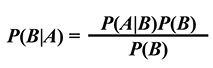
On the right side of the formula, P(A) is called
the prior probability of A, and represents our
belief in event A before obtaining information on
event B. Likewise, P(B)
is called the prior probability of B. There is also
P(A|B), which is the likelihood of event
A given that event B has
happened. On the left side of the formula there
isP(B|A), which is the posterior probability of
B, and represents our new belief in event
B after applying Bayes rule with the information
collected from event A. Bayes rule provides the
formal basis for the active and rapidly evolving field of Bayesian
probability and statistics. In the Bayesian view, inference is a problem of
belief dynamics. Bayes rule provides a principled methodology for belief
change in the light of new information.
C.1.1 Bayesian Networks (BNs)
BNs provide a means of parsimoniously expressing joint probability
distributions over many interrelated hypotheses. A Bayesian network consists
of a directed acyclic graph (DAG) and a set of local distributions. Each node
in the graph represents a random variable. A random variable denotes an
attribute, feature, or set of hypotheses about which we may be uncertain.
Each random variable has a set of mutually exclusive and collectively
exhaustive possible values. That is, exactly one of the possible values is or
will be the actual value, and we are uncertain about which one it is. The
graph represents direct qualitative dependence relationships; the local
distributions represent quantitative information about the strength of those
dependencies. The graph and the local distributions together represent a
joint probability distribution over the random variables denoted by the nodes
of the graph.
Bayesian networks have been successfully applied to create consistent
probabilistic representations of uncertain knowledge in diverse fields.
Heckerman et al. (1995) provide a
detailed list of recent applications of Bayesian Networks. The prospective
reader will also find comprehensive coverage of Bayesian Networks in a large
and growing literature on this subject, such as Pearl (1988), Neapolitan (1990, 2003), and others. Figure 1
shows an example of a BN representing part of a highly simplified ontology
for wines and pizzas.
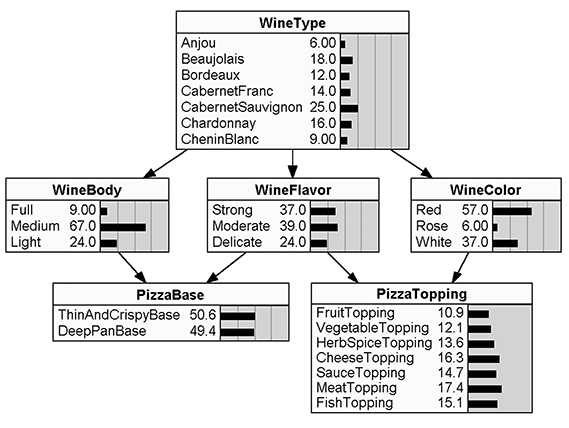
Figure 1 – A BN for Pizzas and Wines
In this toy example, we assume that domain knowledge about gastronomy was
gathered from sources such as statistical data collected among restaurants
and expertise from sommeliers and pizzaiolos. Moreover, the resulting
ontology also considered imperfect knowledge to establish a probability
distribution among features of the pizzas ordered by customers (i.e. type of
base and topping) and characteristics of the wines ordered to accompany the
pizzas.
Consider a customer who enters a restaurant and requests a pizza with
cheese topping and a thin and crispy base. Using the probability distribution
stored in the BN of Figure 1, the waiter can apply Bayes rule to infer the
best type of wine to offer the customer given his pizza preferences the body
of statistical and expert information previously linking features of pizza to
wines. Such computation would be difficult when there are very many features.
Bayesian networks provide a parsimonious way to express the joint
distribution and a computationally efficient way to implement Bayes rule.
This inferential process is shown in Figure 2, where evidence (i.e., the
customer’s order) was entered in the BN and its result points to
Beaujolais as the most likely wine the customer would order, followed by
Cabernet Sauvignon, and so on.
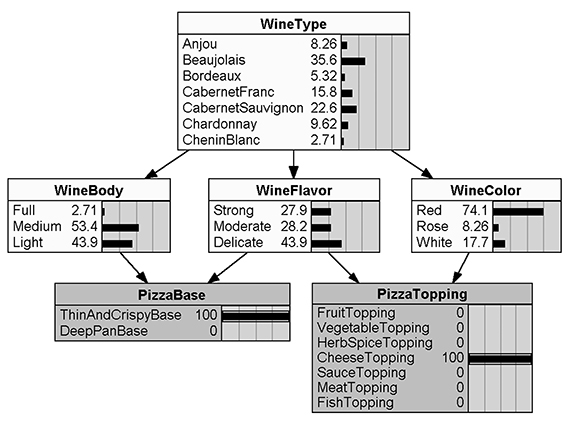
Figure 2 – BN after entering evidence
Although this is just a toy example, it is useful to show how incomplete
information about a domain can be used to improve decisions. In an ontology
without uncertainty, there would not be enough information for a logical
reasoner to infer a good choice of wine to offer the customer, and the
decision would have to be made without optimal use of all the information
available.
As Bayesian networks have grown in popularity, their shortcomings in
expressiveness for many real-world applications have become increasingly
apparent. More specifically, Bayesian Networks assume a simple
attribute-value representation – that is, each problem instance
involves reasoning about the same fixed number of attributes, with only the
evidence values changing from problem instance to problem instance. In the
pizza and wine example, the PizzaTopping random variable conveys general
information about the class of pizza toppings (i.e., types of toppings for a
given pizza and how it is related to preferences over wine flavor and color),
but the BN in Figures 1 and 2 is valid for pizzas with only one topping. To
deal with more elaborate pizzas, it is necessary to build specific BNs for
each configuration, each one with a distinct probability distribution. Figure
3 depicts a BN for a 3- topping pizza with a specific customer preference
displayed. Also, the information conveyed by the BNs (i.e., for 1-topping,
2-toppings, etc.) relates to the class of pizza toppings, and not to specific
instances of those classes. Therefore, the BN in Figure 3 cannot be used for
a situation in which the costumer asks for two 3-topping pizzas. This type of
representation is inadequate for many problems of practical importance.
Similarly, these BNs cannot be used to reason about a situation in which a
customer orders several bottles of wine that may be of different varieties.
Many domains require reasoning about varying numbers of related entities of
different types, where the numbers, types, and relationships among entities
usually cannot be specified in advance and may have uncertainty in their own
definitions.
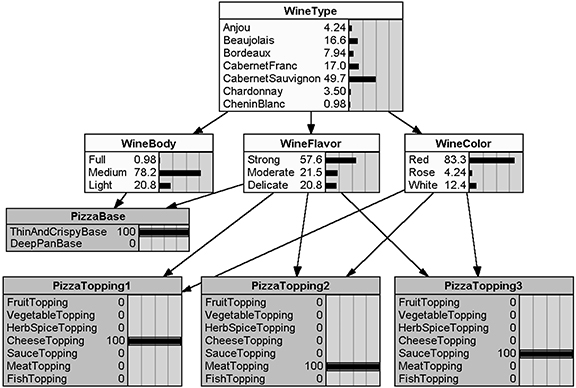
Figure 3 – A BN for the 3-topping pizza configuration with evidence
In spite of their limitations, BNs have been used in specific applications
for the SW where the limitations on expressivity can be overcome by clever
knowledge engineering workarounds. One example is BayesOWL (Ding and Peng, 2004; Ding, 2005), which
augments OWL semantics to allow probabilistic information to be represented
via additional markups. The result is a probabilistic annotated ontology that
could then be translated to a Bayesian network. Such a translation is based
on a set of translation rules that rely on the probabilistic information
attached to individual concepts and properties within the annotated ontology.
After successfully achieving the translation, the resulting Bayesian network
will be associated with a joint probability distribution over the application
domain. Although a full translation of an ontology to a standard BN is
impossible given the limitations of the latter in terms of expressivity, the
scheme can be successfully used to tackle specific problems involving
uncertainty.
Also focusing on Bayesian extensions geared towards the Semantic Web is
the work of Gu et al. (2004), which takes
an approach similar to that of BayesOWL. A related effort is the set of RDF
extensions being developed by Yoshio Fukushige (2004). Generally speaking, SW approaches that rely
on BNs will have to compensate for their lack of expressiveness by
specializing in a specific type of problem, such as the BN-focused approaches
for solving the ontology mapping problem (e.g., Mitra et al., 2004; and Pan et al., 2005; Peng et al., 2007).
C.1.2 Probabilistic Extensions to Description Logics.
Most of the probabilistic extensions aimed at the ontology engineering
domain are based on description logics (DLs), which Baader and Nutt (2003, page 47) define as a family of knowledge
representation formalisms that represent the knowledge of an application
domain (the “world”) by first defining the relevant concepts and
roles of the domain (its terminology), which represent classes of
objects/individuals and binary relations between such classes, respectively,
and then using these concepts and roles to specify properties of
objects/individuals occurring in the domain (the world description).
Description logics divide a knowledge base into two components: a
terminological box, or T-Box, and the assertional box, or A-Box. The first
introduces the terminology (i.e., the vocabulary) of an application domain,
while the latter contains assertions about instances of the concepts defined
in the T-Box. Description logics are a subset of first-order logic (FOL) that
provide a very good combination of decidability and expressiveness. In fact,
an important desired property of description logics is the decidability of
their reasoning tasks. Description logics are also the basis of the web
ontology language OWL, whose sublanguages OWL Lite and OWL DL correspond to
the expressive description logicsSHIF(D) and
SHOIN(D), respectively.
There are several probabilistic extensions of description logics in the
literature, which can be classified according to the generalized description
logics, the supported forms of probabilistic knowledge, and the underlying
probabilistic reasoning formalism.
Heinsohn (1994) presents a probabilistic
extension of the description logic ALC (a member of the
AL-languages (Schmidt-Schauß and Smolka, 1991) obtained by including the full
existential quantification and the union constructors to the basic
AL (attributive language), which allows to represent terminological
probabilistic knowledge about concepts and roles, and which is essentially
based on probabilistic reasoning in probabilistic logics. Heinsohn, however,
does not allow for assertional knowledge about concept and role instances.
Jaeger (1994) proposes another probabilistic
extension of the description logic ALC, which allows for
terminological and assertional probabilistic knowledge about concepts and
roles and about concept instances, respectively, but does not support
assertional probabilistic knowledge about role instances (but he mentions a
possible extension in this direction). The uncertain reasoning formalism in
Jaeger (1994) is essentially based on probabilistic
reasoning in probabilistic logics, as the one in Heinsohn (1994), but coupled with cross-entropy minimization
to combine terminological probabilistic knowledge with assertional
probabilistic knowledge. Jaeger’s recent work (2006) focuses on interpreting probabilistic concept
subsumption and probabilistic role quantification through statistical
sampling distributions, and develops a probabilistic version of the guarded
fragment of first-order logic.
The work by Koller et al. (1997)
gives a probabilistic generalization of the CLASSIC description logic, called
P-CLASSIC. In short, each probabilistic component is associated with a set P
of p-classes, and each p-class C in set P is represented using a Bayesian
network. Like Heinsohn’s work (1994), the
work by Koller et al. (1997) allows
for terminological probabilistic knowledge about concepts and roles, but does
not support assertional probabilistic knowledge about instances of concepts
and roles. However, differently from Heinsohn (1994), it is based on inference in Bayesian networks
as underlying probabilistic reasoning formalism. Closely related work by
Yelland (2000) combines a restricted description
logic close to FL with Bayesian networks. It also allows for
terminological probabilistic knowledge about concepts and roles, but does not
support assertional knowledge about instances of concepts and roles.
Another description logic with a probabilistic extension is
SHOQ(D) (Horrocks and Sattler, 2001). SHOQ(D)
is the basis of DAML+OIL (Horrocks, 2002), the
language that came from merging two ontology languages being developed in the
US (DAML) and Europe (OIL) and has been superseded by OWL. Its probabilistic
extension is called P-SHOQ(D) (Giugno and
Lukasiewicz, 2002) (see also
(Lukasiewicz, 2008)) and allows for expressing
both terminological probabilistic knowledge about concepts and roles, as well
as assertional probabilistic knowledge about instances of concepts and roles.
P-SHOQ(D) is based on probabilistic lexicographic
entailment from probabilistic default reasoning (Lukasiewicz, 2002) as underlying probabilistic reasoning
formalism, which treats terminological and assertional probabilistic
knowledge in a semantically very appealing way as probabilistic knowledge
about random and concrete instances, respectively.
Description logics are highly effective and efficient for the
classification and subsump-tion problems that they were designed to address.
However, their ability to represent and reason about other commonly occurring
kinds of knowledge is limited. One restrictive aspect of DL languages is
their limited ability to represent constraints on the instances that can
participate in a relationship. As an example, a probabilistic DL version of
the toy example in Figures 1 to 3 would allow us to instantiate (say) three
pizzas. However, suppose we want to express that for a given pizza to be
compatible with another pizza in a specific type of situation (e.g., a given
mixture of toppings for distinct pizzas), it is mandatory that the two
individuals of class pizza involved in the situation are not the same. In
DLs, making sure that the two instances of class pizza are different in a
specific situation is only possible if we actually instantiate/specify the
tangible individuals involved in that situation. Indeed, stating that two
“fillers” (i.e., the actual individuals of class Pizza that will
“fill the spaces” of concept pizza in our statement) are not
equal without specifying their respective values would require constructs
such as negation and equality role-value-maps, which cannot
be expressed in description logics. While equality and role-value-maps
provide additional useful means to specify structural properties of concepts,
their inclusion makes the logic undecidable (Calvanese and De Giacomo, 2003, page 223).
C.1.3 First-Order Probabilistic Approaches
In recent years, a number of languages have appeared that extend the
expressiveness of probabilistic graphical models in various ways. This trend
reflects the need for probabilistic tools with more representational power to
meet the demands of real world problems, and goes to the encounter of the
needs for Semantic Web representational schemes compatible with incomplete,
uncertain knowledge. A clear candidate logic to fulfill this requirement for
extended expressivity is first-order logic (FOL), which according to Sowa (2000, page 41) “has enough expressive power to
define all of mathematics, every digital computer that has ever been built,
and the semantics of every version of logic, including itself.”
FOL was invented independently by Frege and Pierce in the late nineteenth
century (Frege, 1879/1967; Pierce, 1885) and is by far the most commonly used, studied,
and implemented logical system. A theory in first-order logic assigns
definite truth-values only to sentences that have the same truth-value
(either true or false) in all interpretations of the theory. The most that
can be said about any other sentence is that its truth-value is
indeterminate. A logical system is complete if all valid sentences
can be proven and negation complete if for every sentence, either
the sentence or its negation can be proven. Kurt Gödel proved both that
first-order logic is complete, and that no consistent logical system strong
enough to axiomatize arithmetic can be negation complete (cf. Stoll, 1963; Enderton, 2001).
However, systems based on classical first-order logic lack a theoretically
principled, widely accepted, logically coherent methodology for reasoning
under uncertainty. Below are some of the approaches addressing this issue.
Object-Oriented Bayesian Networks (Koller and Pfeffer, 1997; Bangsø and Wuillemin, 2000; Langseth and Nielsen, 2003) represent entities as instances of
object classes with class-specific attributes and probability distributions.
Probabilistic Relational Models (PRM) (Pfefferet al., 1999; Getooret al., 2000; Getooret al., 2001; Pfeffer, 2001)
integrate the relational data model (Codd, 1970) and
Bayesian networks. PRMs extend standard Bayesian Networks to handle multiple
entity types and relationships among them, providing a consistent
representation for probabilities over a relational database. PRMs cannot
express arbitrary quantified first-order sentences and do not support
recursion. Although PRMs augmented with DBNs can support limited forms of
recursion, they still do not support general recursive definitions. Jaeger
(1997) extends relational probabilistic models to
allow recursion, but it is limited to finitely many random variables. Plates
(Buntine, 1994; Gilkset al., 1994; Spiegelhalteret al., 1996) represent parameterized statistical
models as complex Bayesian networks with repeated components.
DAPER (Heckermanet al., 2004)
combines the entity-relational model with DAG models to express probabilistic
knowledge about structured entities and their relationships. Any model
constructed in Plates or PRM can be represented by DAPER. Thus, DAPER is a
unifying language for expressing relational probabilistic knowledge. DAPER
expresses probabilistic models over finite databases, and cannot represent
arbitrary first-order sentences involving quantifiers. Therefore, like other
languages discussed above, DAPER does not achieve full first-order
representational power.
MEBN (Laskey and Mahoney, 1997; Laskey
and Costa, 2005; Laskey, 2007) represents the world as consisting of entities
that have attributes and are related to other entities. Knowledge about the
attributes of entities and their relationships to each other is represented
as a collection of MEBN fragments (MFrags) organized into MEBN Theories
(MTheories). An MFrag represents a conditional probability distribution for
instances of its resident random variables given their parents in the
fragment graph and the context nodes. An MTheory is a set of MFrags that
collectively satisfies consistency constraints ensuring the existence of a
unique joint probability distribution over instances of the random variables
represented in each of the MFrags within the set. MEBN semantics integrates
the standard model-theoretic semantics of classical first-order logic with
random variables as formalized in mathematical statistics.
Although the above approaches are promising where applicable, a workable
solution for the Semantic Web requires a general-purpose formalism that gives
ontology designers a range of options to balance tractability against
expressiveness. Current research on SW formalisms using first-order
probabilistic logics is still in its infancy, and generally lack a complete
set of publicly available tools. Examples include PR-OWL (Costa, 2005), which is an upper ontology for building
probabilistic ontologies based on MEBN logic, and KEEPER (Pool and Aiken, 2004), an OWL-based interface for the relational
probabilistic toolset Quiddity*Suite, developed by IET, Inc. Their constructs
are similar in spirit and provide an expressive method for representing
uncertainty in OWL ontologies. Costa (2005) gives a
definition for Probabilistic Ontologies, develops rules for constructing
PR-OWL ontologies in a manner that can be translated into Quiddity*Suite, and
describes how to perform the translation. Carvalho et al. (2007) and Costa et. al. (2008) present an open source, Java-based,
PR-OWL/MEBN GUI and reasoner package, UnBBayes-MEBN, that
greatly facilitates the process of building probabilistic ontologies and
reasoning with them.
As an illustration of the expressiveness of a first-order probabilistic
logic, Figure 4 presents a graphical depiction of the MFrags for the wine and
pizza toy example (1). It conveys both the structural
relationships (implied by the arcs) among the nodes and the numerical
probabilities (embedded in the probability distributions and not depicted in
the figure). The MFrags depicted in Figure 4 form a consistent set that
allows to reason probabilistically about a domain and can be stored in an OWL
file using the classes and properties defined in the PR-OWL upper ontology.
The MFrags can be used to instantiate situation specific Bayesian networks to
answer queries about the domain of application being modeled. In other words,
a PR-OWL probabilistic ontology consists of both deterministic and
probabilistic information about the domain of discussion (e.g., wines and
pizzas), stored in an OWL file that can be used for answering specific
queries for any configuration of the instances given the evidence at hand.
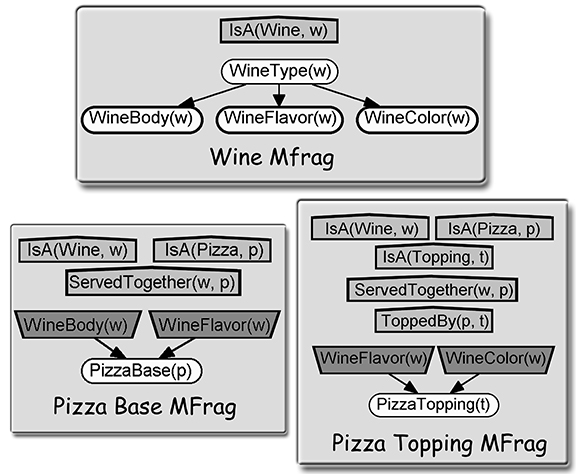
Figure 4 – MFrags representing the wine and pizza example (2)
In particular, the toy ontology of Figure 4 can be applied to reason about
situations involving any number of pizzas with any number of toppings on
each, accompanied by any number of bottles of wine, and including any
possible interactions among specific instances of those. Figure 5 illustrates
this concept, depicting a situation in which evidence a customer has ordered
one thin and crispy pizza with three toppings (cheese, meat, and sauce) and
is planning to order one bottle of wine. The BN represents the response to a
request to suggest a good wine to go with the pizzas.
In MEBN syntax (3), the knowledge base is augmented
by an instance of pizza (!P0), three instances of topping types
(!T0, !T1, !T2), and an instance of wine
(!W0). To answer the query on the wine suggestion, a probabilistic
reasoner will use the evidence available to build a Situation Specific
Bayesian Network (SSBN). This example was constructed to yield the same BN as
Figure 3. This illustrates the point that the MFrags in Figure 4 have
captured all information that is needed to build SSBNs for any specific
configuration of pizzas and wines for this toy example.
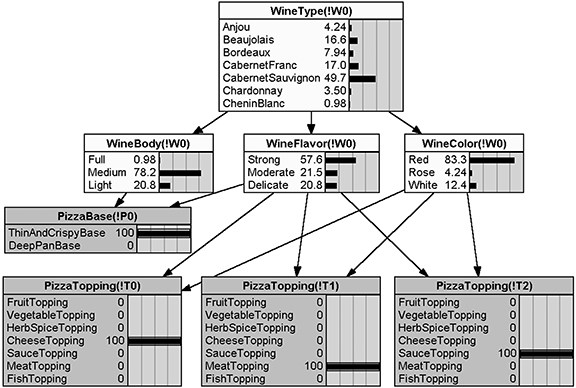
Figure 5 – SSBN constructed from the MFrags of Figure 4
Clearly, this example is oversimplified, but it suffices to illustrate how
PR-OWL can be used to build a probabilistic ontology combining legacy
ontologies of pizzas and wines. This example illustrates the use of an
expressive probabilistic language to capture knowledge that cannot be
expressed with standard Bayesian networks. Probabilistic ontologies are an
increasingly important topic in forums devoted to best practices in systems
development. Given the nature of the domain knowledge embedded in their
systems, system developers in general would profit most from the advantages
of being able to convey such knowledge with a principled treatment for
uncertainty.
(2) The pentagon nodes are context nodes,
representing constraints that must be satisfied for the distributions in the
MFrag to apply. The trapezoid nodes are input nodes, whose probability
distribution is defined outside the MFrag. The oval nodes are resident nodes,
whose distributions are defined in the MFrag.
(3) In MEBN, RVs take arguments that refer
to entities in the domain of application. An interpretation of the theory
uses entity identifiers as labels to refer to entities in the domain. Entity
identifiers are written either as numerals or as alphanumeric strings
beginning with an exclamation point, e.g., !M3,48723.
C.2 Fuzzy Logic Models
In contrast to probabilistic formalisms, which allow for representing and
processing degrees of uncertainty about ambiguous pieces of information,
fuzzy formalisms allow for representing and processing degrees of truth about
vague (or imprecise) pieces of information. The following examples illustrate
the difference between degrees of uncertainty and degrees of truth.
Consider the statement “it will be blue sky tomorrow”. This
statement is uncertain, that is, it is either true or false, depending on the
weather conditions of tomorrow, but we generally do not have a complete
knowledge about whether it will be blue sky tomorrow or not. In probabilistic
formalisms, we thus assume a set of possible worlds, each of which is
associated with a probability. Intuitively, we are uncertain about which
possible world is the right one. In each world, we only allow for binary
truth-values, and thus in each world the statement “it will be blue sky
tomorrow” is either true or false. This way, we can quantify our
ignorance about whether it will be blue sky tomorrow or not. For example, we
may say that the probability that it will be blue sky tomorrow is 0.7, which
means that the probabilities of all worlds in which it will be blue sky
tomorrow sum up to 0.7.
Consider next the statement “John is tall.” This statement is
vague, that is, it is more or less true, depending on the body height of
John, but we are unable to say whether this statement is completely true or
false due to the involvement of the vague concept “tall,” which
does not have a precise definition. In fuzzy formalisms, we assume fuzzy
interpretations, which directly generalize binary interpretations by mapping
elementary vague propositions into a truth value space between false and
true. For example, we may say that John is tall with the degree of truth 0.7,
which intuitively means that John is relatively tall but not completely
tall.
It is also important to point out that vague statements are
truth-functional, that is, the degree of truth of a vague complex statement
(which is constructed from elementary vague statements via logical operators)
can be calculated from the degrees of truth of its constituents, while
uncertain complex statements are generally not a function of the degrees of
uncertainty of their constituents (Dubois and Prade, 1994).
Vagueness abounds especially in multimedia information processing and
retrieval. An-other typical application domain for vagueness and thus fuzzy
formalisms are natural language interfaces to the Web. Furthermore, fuzzy
formalisms have also been successfully applied in ontology mapping,
information retrieval, and e-commerce negotiation tasks.
C.2.1 Fuzzy Propositional Logics
Rather than being restricted to a binary truth value among false and true,
vague propositions may also have a truth value strictly between false and
true. One often assumes the unit interval [0, 1] as the set of all possible
truth values, where 0 and 1 represent the ordinary binary truth values false
and true, respectively. For example, the vague proposition “John is
tall” may be more or less true, and it is thus associated with a truth
value in [0, 1], depending on the body height of John.
To combine and modify the truth values in [0, 1], one assumes combination
functions, namely, conjunction, disjunction, implication, and negation
functions, denoted ⊗, ⊕, ⊳, and ⊖, respectively, which are
functions ⊗, ⊕, ⊳: [0, 1] × [0, 1] → [0, 1] and ⊖: [0,
1] → [0, 1] that generalize the ordinary logical operators ∧, ∨,
→, and ¬, respectively, to the set of truth values [0, 1]. As usual, we
assume that the combination functions have some natural algebraic properties,
namely, the properties shown in Tables 1 and 2. Note that in Table 1,
Tautology and Contradiction follow from Identity, Commutativity, and
Monotonicity. Note also that conjunction and disjunction functions (with the
properties shown in Table 1) are also called triangular norms and triangular
co-norms (Hájek, 1998), respectively. The
combination functions of some well-known fuzzy logics are shown in Table
3.
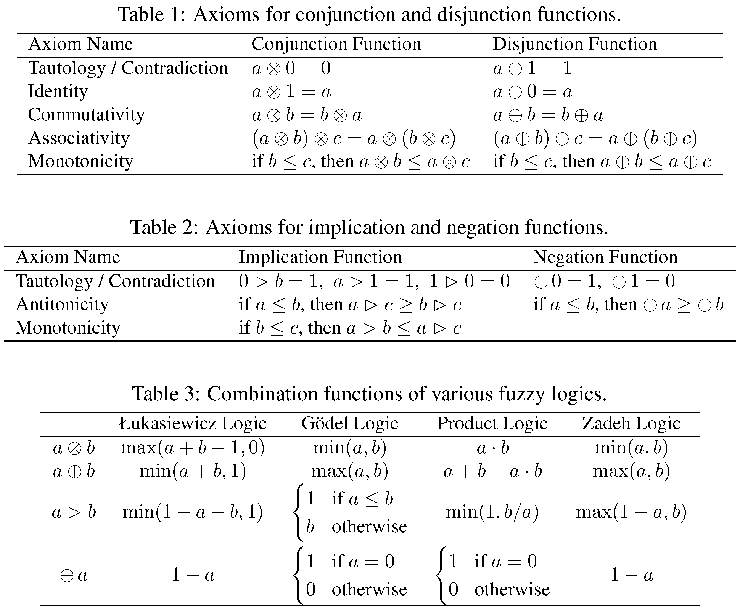
More formally, a fuzzy (propositional) interpretation I maps each
elementary vague proposition p into the set of truth values [0,1], and is
then extended inductively to all (complex) vague propositions (which are
constructed from the elementary vague propositions by using the binary and
unary logical operators ∧, ∨, →, and ¬) as follows (where
⊗, ⊕, ⊳, and ⊖ are conjunction, disjunction, implication,
and negation functions, respectively, as described above):
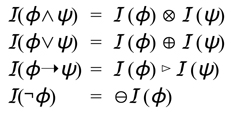
A fuzzy (propositional) knowledge base consists of a finite set
of fuzzy formulas, which have one of the forms φ ≥ l, φ ≤ l, φ >
l, or φ < l, where φ is a vague proposition, and l is a truth value from
[0,1]. Such statements express that φ has a degree of truth of at least, at
most, greater than, and lower than l, respectively. For example, tall_John
≥ 0.6 says that tall_John has a degree of truth of at least 0.6. Any such
fuzzy knowledge base represents a set of fuzzy interpretations, which can be
used to define the notions of satisfiability, logical consequence, and tight
logical consequence, as usual. Here, it is important to point out the
difference to Bayesian networks: rather than encoding one single probability
distribution (over a set of binary interpretations), fuzzy knowledge bases
encode a set of fuzzy interpretations.
C.2.2 Fuzzy Description Logics and Ontology Languages
In fuzzy description logics and ontology lan guages, concept assertions,
role assertions, concept inclusions, and role inclusions have a degree of
truth rather than a binary truth value. Semantically, this extension is
essentially obtained by (i) generalizing binary first-order interpretations
to fuzzy first-order interpretations and (ii) interpreting all the logical
operators by a corresponding combination function. Syntactically, as in the
fuzzy propositional case, one then also allows for formulas that restrict the
truth values of concept assertions, role assertions, concept inclusions, and
role inclusions. Some important new ingredients of fuzzy description logics
are often also fuzzy concrete domains, which include fuzzy predicates on
concrete domains, and fuzzy modifiers (such as “very” or
“slightly”), which are unary operators that change the membership
functions of fuzzy concepts.
As a fictional example, an online shop may use a fuzzy description logic
knowledge base to classify and characterize its products. For example,
suppose (1) textbooks are books, (2) PCs and laptops are mutually exclusive
electronic products, (3) books and electronic products are mutually exclusive
products, (4) PCs have a price, a memory size, and a processor speed, (5) pc1
is a PC with the price 1300€, the memory size 3 GB, and the processor
speed 4 GHz, (6) pc2 is a PC with the price 500€, the memory size 1 GB,
and the processor speed 2 GHz, (7) pc3 is a PC with the price 900€, the
memory size 2 GB, and the processor speed 3 GHz, (8) ibm, acer, and hp are
the producers of pc1, pc2, and pc3, respectively. These relationships are
expressed by the following description logic knowledge base:
(1) Textbook ⊑ Book;
(2) PC ⊔ Laptop ⊑ Electronics; PC ⊑ ¬Laptop;
(3) Book ⊔ Electronics ⊑ Product; Book ⊑ ¬Electronics;
(4) PC ⊑ ∃hasPrice.Integer ⊓ ∃hasMemorySize.Integer ⊓
∃hasProcessorSpeed.Integer;
(5) (PC ⊓ ∃hasPrice.1300 ⊓ ∃hasMemorySize.3 ⊓
∃hasProcessorSpeed.4)(pc1);
(6) (PC ⊓ ∃hasPrice.500 ⊓ ∃hasMemorySize.1 ⊓
∃hasProcessorSpeed.2)(pc2);
(7) (PC ⊓ ∃hasPrice.900 ⊓ ∃hasMemorySize.2 ⊓
∃hasProcessorSpeed.3)(pc3);
(8) produces(ibm, pc1); produces(acer, pc2); produces(hp, pc3).
The notions “expensive PCs”, “PCs having a large
memory”, and “PCs having a fast processor” can then be
defined as fuzzy concepts by adding the following three fuzzy concept
definitions:
ExpensivePC ≡ PC ⊓ ∃hasPrice.PCExpensive,
LargeMemoryPC ≡ PC ⊓ ∃hasMemorySize.MemoryLarge,
FastProcessorPC ≡ PC ⊓ ∃hasProcessorSpeed.ProcessorFast.
Here, PCExpensive, MemoryLarge, and ProcessorFast are fuzzy unary datatype
predicates, which are defined by PCExpensive(x) = rs(x; 600, 1200),
MemoryLarge(x) = rs(x; 1, 3), and ProcessorFast(x) = rs(x; 2, 4),
respectively, where rs(x; a, b) is the so-called right-shoulder function (see
Figure 6). Informally, as for the fuzzy concept “expensive PCs”,
every PC costing at least 1200€ (resp., at most 600€) is definitely
expensive (resp., not expensive), while every PC costing between 600€
and 1200€ is expensive to some degree between 0 and 1.
Similarly, the notions “costs at most about 1000€” and
“has a memory size of around 2 GB” in a buyer’s request can
be expressed through the following fuzzy concepts C and D, respectively:
C ≡ ∃hasPrice.LeqAbout1000 and D ≡
∃hasMemorySize.Around2.
where LeqAbout1000 = ls(500, 1500) and Around2 = tri(1.5, 2, 2.5) (see
Figure 6).
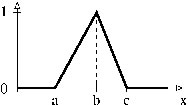
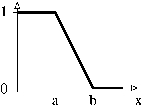
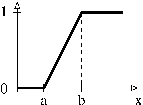
Figure 6 – (a) triangular function tri(x; a, b, c), (b) left-shoulder
function ls(x; a, b), and (c) right-shoulder function rs(x; a, b)
The literature contains many different approaches to fuzzy extensions of
description logics and ontology languages. They can be roughly classified
according to (a) the description logics or the ontology languages that they
generalize, (b) the fuzzy constructs that they allow, (c) the fuzzy logics
that they are based on, and (d) their reasoning algorithms. Below we
summarize some of the main approaches.
The earliest works is due to Yen (1991), who proposes
a fuzzy extension of a quite restricted sublanguage of ALC. Yen considers
fuzzy terminological knowledge
(without terminological axioms that are true with some degree in [0,1]),
along with fuzzy modifiers, but no fuzzy assertional knowledge, and he uses
Zadeh Logic as underlying fuzzy logic. Yen’s work also includes a
reasoning algorithm, which allows for testing crisp subsumptions. Tresp and
Molitor’s work (1998) presents a
more general fuzzy extension of ALC. Like Yen's work, it also includes fuzzy
terminological knowledge (without terminological axioms that are true with
some degree in [0,1]), along with a special form of fuzzy modifiers, but no
fuzzy assertional knowledge, and it is based on Zadeh Logic. The reasoning
algorithm of Tresp and Molitor’s work is a tableaux calculus for
computing subsumption degrees.
Another important fuzzy extension of ALC is due to Straccia (1998, 2001), who allows
for both fuzzy termino logical and fuzzy assertional knowledge, but not for
fuzzy modifiers, and again assumes Zadeh Logic as underlying fuzzy logic.
Straccia’s work also includes a tableaux calculus for deciding logical
consequences and computing tight logical consequences. Hölldobler et
al. (2002, 2005) extend Straccia's fuzzy ALC with fuzzy
modifiers of the form fm(x) = xβ, where β > 0, and present a sound and
complete reasoning algorithm for the graded subsumption problem.
Straccia (2004) shows how reasoning in fuzzy
ALC under Zadeh Logic can be reduced to reasoning in classical ALC. This idea
has also been explored by Li et al. (2005a, 2005b).
Approaches towards more expressive fuzzy description logics include the
works by Sanchez and Tettamanzi (2004, 2006), who consider the description
logic ALCQ. They introduce the new notion of fuzzy quantifiers. As underlying
fuzzy logic, they also assume Zadeh Logic. Their reasoning algorithm
calculates the satisfiability interval for a fuzzy concept. Straccia (2005c) defines the semantics of a fuzzy extension
of SHOIN(D), which is the description logic that stands behind OWL DL.
Stoilos et al. (2005a) use this
semantics to define a fuzzy extension of the OWL language, and also propose a
translation of fuzzy OWL to fuzzy SHOIN.
Other works include the one by Hájek (2005, 2006), who considers ALC under arbitrary t-norms and
proposes especially a reasoning algorithm for testing crisp subsumptions.
Bonatti and Tettamanzi (2006) provide
some complexity results for reasoning in fuzzy description logics.
Straccia (2005a, 2005b) presented a calculus for ALC(D), which
workswhenever the connectives, the fuzzy mod ifiers, and the concrete fuzzy
predicates are representable as bounded mixed integer linear programs. For
example, Łukasiewicz logic satisfies these conditions. The method has been
extended to fuzzy SHIF(D), which isthe description logic standing behind OWL
Lite, and a reasoner (called fuzzyDL) supporting Zadeh, Łukasiewicz, and
classical semantics has been implemented and is available from Straccia's web page.
Towards reasoning in fuzzy SHOIN(D), Stoilos et al. (2007) show results pro viding a tableaux calculus
for fuzzy SHIN without fuzzy general concept inclusions and under the Zadeh
semantics. Stoilos et al. (2006) provide a generalization thereof
that additionally allows for fuzzy general con cept inclusions. In closely
related work, Li et al. (2006) provide a tableaux calculus for fuzzy SHI with
fuzzy general concept inclusions.
Some reasoners for fuzzy description logics and ontology languages are
listed as follows: (1) fuzzyDL,
a fuzzy OWL-Lite reasoner with a full fledged mixed integer programming
environment; (2) DLMedia,
a fuzzy DLR-Lite reasoner with a built-in top-k database retrieval engine;
(3) FiRE, which has grown out of the algorithm of SHIN (Stoilos et al., 2006); and (4) the ONTOSEARCH2
platform, which is a known DL-Lite reasoner, and which supports reasoning and
querying over fuzzy DL-Lite (Pan et al., 2008).