Common Web Language
W3C Incubator Group Report 31 March 2008
- This version:
- http://www.w3.org/2005/Incubator/cwl/XGR-cwl-20080331/
- Latest version:
- http://www.w3.org/2005/Incubator/cwl/XGR-cwl/
- Previous version:
- This is the first public report.
- Editor:
- Hiroshi Uchida
- Authors:
- Hiroshi Uchida, Institute of Semantic Computing
- Toshio Yokoi, Institute of Semantic Computing
- Meiying Zhu, Institute of Semantic Computing
- Nobuo Saito, Keio University
- Vahan Avetisyan, UNL Armenian Language Centery
- Contributors:
- Hiroshi Yasuhara, Institute of Semantic Computing
- Also see Acknowledgements
Copyright
© 2008 W3C® (MIT, ERCIM,
Keio), All Rights Reserved. W3C liability,
trademark
and document
use rules apply.
Abstract
This is a report of the W3C Common Web Language Incubator Group
(CWL-XG) as specified in the Deliverrables of its charter.
In this report we define the Common Web Language (CWL)
Specifications and introduce various forms of representation of CWL
and its platform to work with CWL.
Specifically the report:
- defines, the CWL Archtecture,
- presents the CWL specification,
- discusses the merit to have various forms of
representation,
- describes, how to use CWL using CWL platform
- proposes, the use for CWL for multilingualism of web.
Status of This Document
This section describes the status of this document at the time
of its publication. Other documents may supersede this
document. A list of Final
Incubator Group Reports is available. See also the W3C technical reports index
at http://www.w3.org/TR/.
This document was developed by the W3C Common Web Language
Incubator Group, part of the W3C Incubator
Activity.
Publication of this document by W3C as part of the W3C Incubator
Activity indicates no endorsement of its content by W3C, nor that
W3C has, is, or will be allocating any resources to the issues
addressed by it. Participation in Incubator Groups and publication of
Incubator Group Reports at the W3C site are benefits of W3C Membership.
Incubator Groups have as a goal
to produce work that can be implemented on a Royalty Free basis, as
defined in the W3C Patent Policy. Participants in this Incubator
Group have made no statements about whether they will offer licenses
according to the licensing
requirements of the W3C Patent Policy for portions of this
Incubator Group Report that are subsequently incorporated in a W3C
Recommendation.
1. Introduction
The CWL, a common web language for humans and computers, must solve
the following two big problems exist in the present web world. One is
the language barriers in the web, and another is lacking of machine
understandability for the contents in the web.
- Language barrier:
- Currently almost all web pages are written in English. It is
convenient for English speaking people but it is not for
non-English speaking people, and those people are the majority
in the world. Those people cannot get information easily,
because it is not written in their mother tongue. Recently
machine translation facilities are equipped in the web, but it
is not the solutions. Machine translation has a problem of
quality and coverage of languages.
- Machine Understandability:
- HTML tags give information on structure of web documents, but
they do not give semantic information on each words nor
sentences in documents. It means HTM tags information is
insufficient to intellectually utilize contents of web pages.
The RDF and OWL have a framework to give semantic information
but they do not have standard vocabulary to describe web
contents.
1.1 Objective of CWL
Objectives of CWL is for exchanging information through the web and
also for enabling computers to process information semantically. The
CWL allows people to describe contents and meta-data of web pages
written in natural languages and also allows realizing a language
barrier free world in the web and it will also enable computers to
extract semantic information and knowledge from web pages
accurately.
1.2 Requirement for CWL
The requirements for CWL to achieve the above objectives are the
followings.
- To be independent from any natural languages and shall enable
users to develop conversion systems between CWL and each natural
language easily.
- Different from natural languages, CWL is a unambiguous formal
language playing the same role of natural languages for
humans.
- Concepts included in any natural language can be the vocaburary
of CWL.
- Surface structure and semantic structure of original document
must be expressed in CWL.
2. CWL Architecture
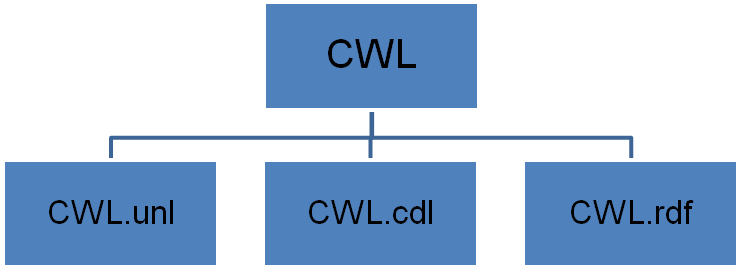
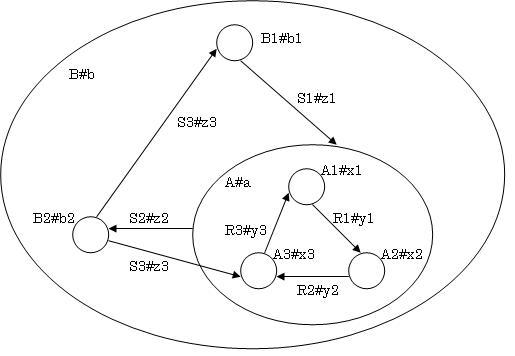
The CWL is a graph language of semantic hyper directed graph, a
node represents a concept, an arc represents a relation between nodes
and a node can be annotated by attributes. This CWL can be expressed
in three languages UNL, CDL and RDF/OWL. The same information in CWL
can be described in each language but in different manner. The CWL.unl
is a language based on UNL. The CWL.cdl is a language based on the
CDL. The CWL.rdf is a language based on RDF/OWL.
Three different types of representations of CWL allow different way
of treatment of the same information described. The CWL.unl is for
multilingualism, The CWL.cdl has compatibility with semantic computing
systems for semantic computing, The CWL.rdf is for working with
various data navigation and aggregation systems (like SPARQL).
Compatibility among expressions in UNL (CWL.unl), CDL (CWL.cdl),
and RDF is guaranteed. Followings are the expression of each
representation for the sentence `I purchased a computer
yesterday.'.
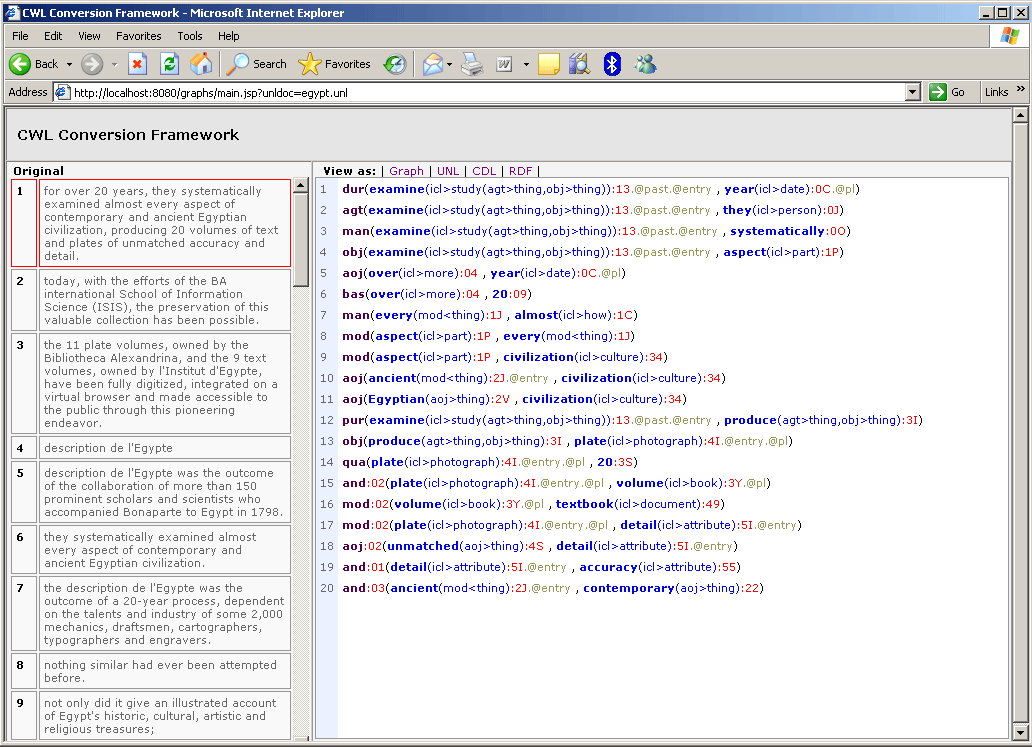
- CWL.unl expression
-
{unl} //Table Form of UNL expression
agt(purchase(icl>buy(agt>person,obj>thing)).@entry.@past), I)
obj(purchase(icl>buy(agt>person,obj>thing)).@entry.@past),computer(icl>machine))
tim(purchase(icl>buy(agt>person,obj>thing)).@entry.@pst), yesterday(icl>day))
{/unl}
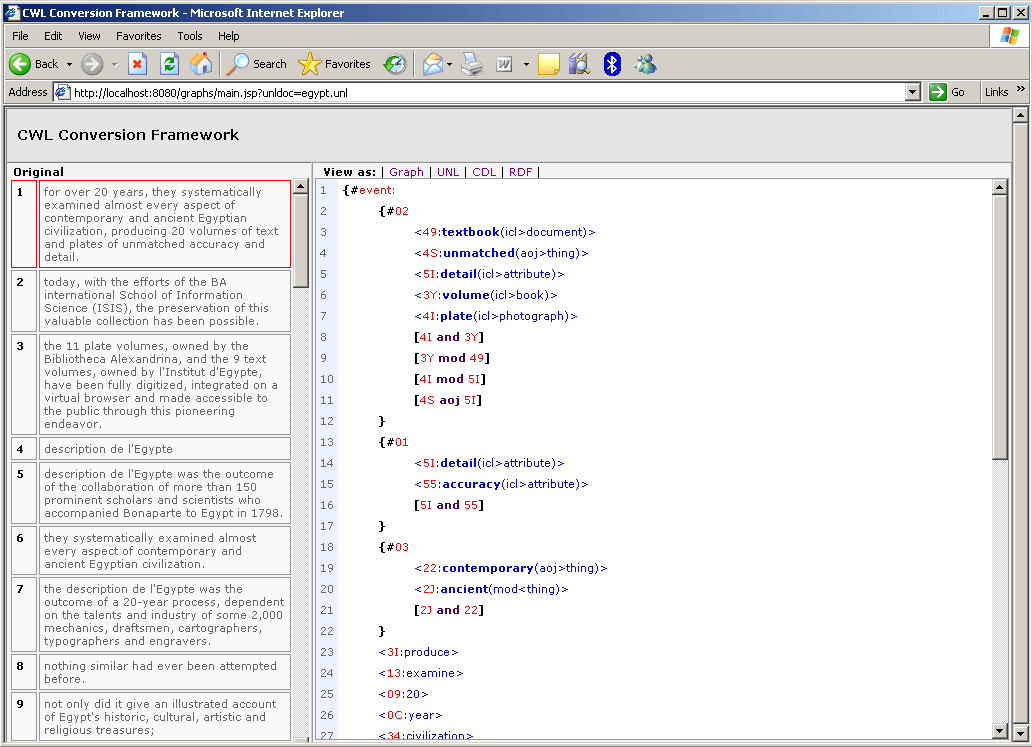
- CWL.cdl expression
-
{#S Situation;
  {#A Event tmp='past';
    {#A1 purchase (icl>buy(agt>person,obj>thing) ;}
    {#A2 I ral='def';}
    {#A3 computer(icl>machine) ral='def';}
    {#A4 yesterday(icl>day) ral='def';}
    [#A1 cdd.nl#agt #A2]
    [#A1 cdd.nl#obj #A3]
    [#A1 cdd.nl#tim #A4]
  }
}
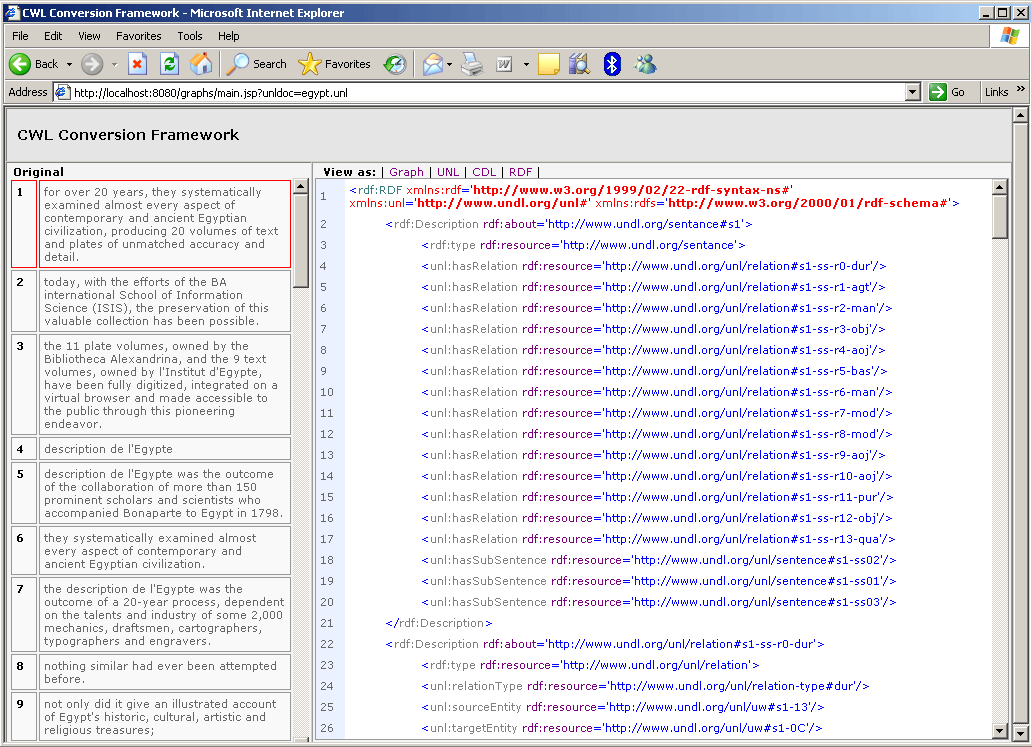
- CWL.rdf expression
-
RDF// N-Triples representation: Subject Property Object"."
#S rdf:type Situation.
#A rdf:type Event.
#S hasComplexEntity #A.
#A hasElementalEntity #A1.
#A hasElementalEntity #A2.
#A hasElementalEntity #A3.
#A hasElementalEntity #A4.
#A1 rdf:type purchase(icl>buy(agt>person,obj>thing).
#A2 I rdf:type I.
#A2 I ral 'def'.
#A3 rdf:type computer(icl>machine).
#A3 ral 'def'.
#A4 rdf:type yesterday(icl>day).
#A4 ral 'def'.
#A1 agt #A2.
#A1 obj #A3.
#A1 tim #A4.
#A tmp 'past'.
2.1 CWL
The CWL is designed to be used to describe meta-data and contents
of web pages for breaking language barriers and enable computers to
process web information semantically. The CWL is a graph language of
extended semantic hyper directed graph, a node represents a concept,
an arc represents a relation between nodes and a node can be annotated
by attributes. Every node including nodes in hyper nodes can have
relation with any other nodes.
A concept can be expressed in any kind of a morpheme, a word, a
phrase, a clause or a sentence of any language and a Universal Word
developed by the UNDL Foundation. A concept (character strings)
express the meaning/concept that a a morpheme, a word, a phrase, a
clause or a sentence can express in each language.
The meaning of a concept in CWL depend on the context. It means the
meaning of a concept in CWL is restricted by relations with other
concepts linked with arcs going in and out.
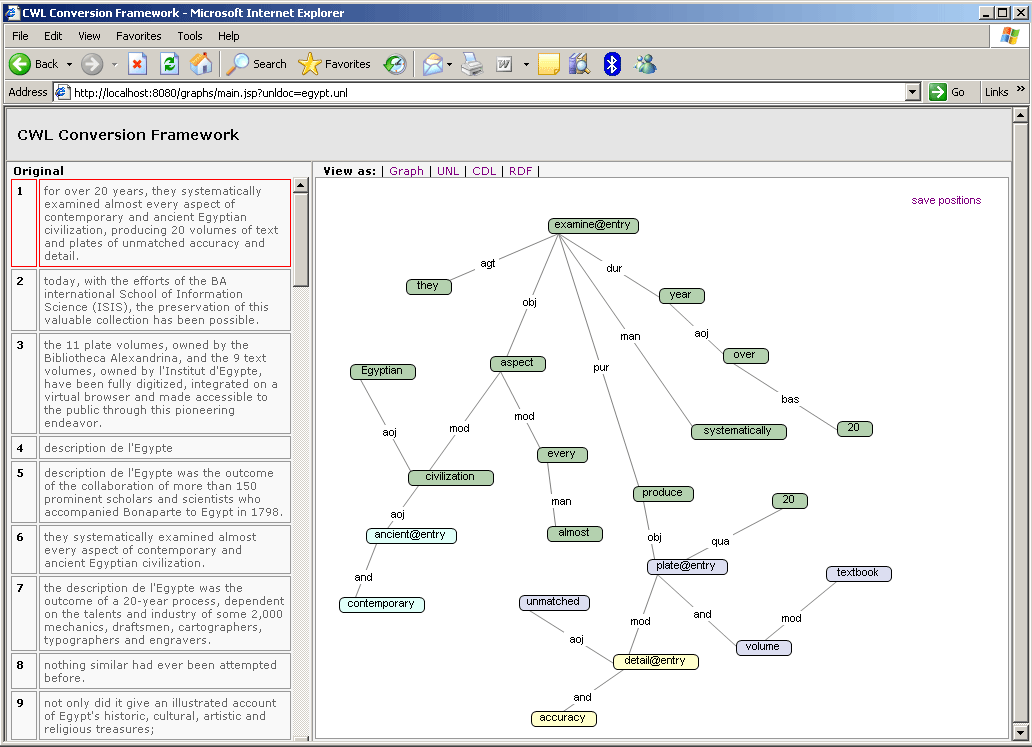
The following is a CWL.unl graph representation for the sentence
`Long ago, in the city of Babylon, people begun to build a huge tower,
which seemed about to reach the heavens.'
begin.entry.past-- tim->long ago
    --plc->city.def
    --agt->people.def
    --obj->build.past--obj-> tower<- aoj--huge<- seem.past
                     --obj->reach.bigin.soon--obj->tower
                     --gol->heaven.def.pl
Compatibility among expressions in UNL (CWL.unl), CDL (CWL.cdl),
and RDF is guaranteed. Followings are the expression of each
representation for the sentence `I purchased a computer
yesterday.'.
{cwl.unl}
tim(begin.@entry.@past,long ago)
mod(city.@def,Babylon)
plc(begin.@entry.@past,city.@def)
agt(begin.@entry.@past,people.@def)
obj(begin.@entry.@past,build.@past)
agt(build,people.@def)
obj(build,tower)
aoj(huge,tower)
aoj(seem.@past,tower)
obj(seem.@past,reach.@begin.@soon)
obj(reach.@begin.@soon,tower)
gol(reach.@begin.@soon,heaven.@def.@pl)
{/cwl.unl}
Relations constitute syntax of the CWL. They expresses objectivity
together with UWs by describing how concepts(UW) constitutes a
sentence related each other. We adopt the relation set of the UNL
relation set for the basis of the relation set of CWL. Psudo relations
will be added as the need arises.
There are 41 relations, such as "agt", "aoj", "bas", "ben", "cag",
"cao", "cnt", "cob", "con", "coo", "dur", "equ", "fmt", "frm", "gol",
"icl", "ins", "int", "iof", "man", "met", "mod", "nam", "nxt", "obj",
"or", "per", "plc", "plf", "plt", "pof", "pos", "ptn", "pur", "qua",
"ref", "rsn", "scn", "seq", "shd", "src", "tim", "tmf", "tmt", "to",
and "via".
Attributes describe mainly subjectivity. We also adopt the
attribute set of the UNL attribute set as a basis of the attribute set
of the CWL. Attributes will be added as the need arises. Attributes
are categorized into following 7 groups.at this moment.
- Times with respect to the writer
- @past, @present, @future
- Writer's view on aspects of event
- @begin, @complete, @continue, @custom, @end, @experience,
@progress, @repeat, @state
- Writer's view of emphasis, focus and topic
- @contrast, @emphasis, @entry, @qfocus, @theme, @title,
@topic
- Writer's attitudes
- @affirmative, @confirmation, @exclamation, @humility,
@imperative, @interrogative, @invitation, @polite, @request,
@respect, @vocative
- Writer's feelings and judgments
- @ability, @get-benefit, @give-benefit, @conclusion,
@consequence, @sufficient, @consent, @dissent, @grant,
@grant-not, @although, @discontented, @expectation, @wish,
@insistence, @intention, @want, @will, @need, @obligation,
@obligation-not, @should, @unavoidable, @certain, @inevitable,
@may, @possible, @probable, @rare, @unreal, @admire, @blame,
@contempt, @regret, @surprised, @troublesome
- Writer's view of reference
- @generic, @def, @indef, @not, @ordinal
- Describing logical characters and properties of concepts
- @transitive, @symmetric, @identifiable, @disjointed
- Modifying attribute on aspect
- @just, @soon, @yet, @not
- Attribute for Convention
- @passive, @pl, @angle_bracket, @brace,
@double_parenthesis,@double_quote, @parenthesis, @single_quote,
@square_bracket
2.1.1 Vocabulary of CWL
A concept can be expressed in any kind of a morpheme, a word, a
phrase, a clause or a sentence of any language and a Universal Word
developed by the UNDL Foundation. A concept (character strings)
express the meaning/concept that a morpheme, a word, a phrase, a
clause or a sentence can express in each language.
The CWL vocaburary is defined as the CWL ontology. Every concept
must be defined in the CWL ontroly. The CWL ontology gives the
linguistic knowledge of the CWL. The following hierarchy of concepts
is a part of the top ontology.
concept
    nominal copncept
        thing
            abstract thing
                attribute
                    quality
                    feature
                event
                    action
                        mental action
                        physical action
                        process
                    phenomenon
                        mental phenomenon
                        physical phenomenon
                        change
                        process
                information
                    statement
                    description
                quantity
                rule
                state*
                    condition
                    mental state
                    physical state
                    situation
                way
                    arrangement
                    behavior
                    manner
                    method
            attributive thing
                group
                    group(icl>volitional thing)
                    set
            concrete thing
                living thing
                    human
                    animal
                    plant
                natural world
                substance
                ...
            functional thing
                facilities
                symbol
                tool
                ...
            volitional thing
                animal
                group
                human
                ...
            place
                area
                relative place
                ...
            time
                period
                ...
    predicative concept
        do
            act
            express
                state
            get
                obtain
            give
                provide
            make
                produce
            take
            change
            move
            put
            mentally do
            physically do
            do(agt>thing)
            do(agt>thing,obj>thing)
            ...
            treat
            deal
            perform
        occur
            become
            happen
                change
                move
                mentally happen
                physically happen
                ...
            occur(obj>thing)
            occur(gol>thing,obj>thing)
            ...
        be
            be(aoj>thing,obj>thing)
            be(aoj>thing)
            ...
    attributive concept
        (qua<thing)    :quantifier
        (mod<thing)    :modifier
        ...
    adverbial concept
        (qua>quantifier)
        (man<predicative concept)
            how
The CWL ontology also defineds every possible relations between
concepts.
2.1.2 Relations
There are many factors to be considered in choosing an inventory of
relations between concepts. Different factors taken into account in
choosing the relations lead to different sets of the relations. We
aopt the relation set of the UNL. The UNL relations are selected
basically according to the following principles:
Principles of Relation
- PRINCIPLE 1 : NECESSARY CONDITION
- When a concept has relations between more than one other
concepts, each relation label should be set so as to be able to
identify each relation on the premise that there is enough
knowledge about the concept of each concept expressed.
- PRINCIPLE 2 : SUFFICIENT CONDITION
- When there are relations between concepts, each relation label
should be set so as to be able to understand the role of each
concept only by referring to the relation label.
Relation
    predicative relation
        agt(agent)
        aoj(thing with attribute)
          cag(co-agent)
          cao(co-thing with attribute)
          ptn(partner)
          ben(beneficiary)
          cob(affected co-thing)
          obj(affected thing)
          opl(affected place)
          ins(instrument)
          met(method or means)
          man(manner)
          plc(place)
          plf(initial place)
          plt(final place)
          scn(scene)
          gol(goal, final state)
          src(source, initial state)
          via(intermediate place or state)
          dur(duration)
          tim(time)
          tmf(initial time)
          tmt(final time)
    inter-concept relation
          and(conjunction)
          or(disjunction, alternative)
          fmt(range/from-to)
          frm(origin)
          to(destination)
          equ(equivalent)
          icl(included/a kind of)
          iof(an instance of)
    inter-event relation
        con(condition)
          coo(co-occurrence)
          pur(purpose or objective)
          rsn(reason)
          seq(sequence)
    qualification relation
          bas(basis for expressing a standard)
          cnt(content, namely)
          man(manner)
          mod(modification)
          nam(name)
          per(proportion, rate or distribution)
          pof(part-of)
          pos(possessor)
          qua(quantity)
Definitions of Relations
The following are the relations defined according to the above
principles. A relation label is represented as strings of 3 characters
or less
(1) agt (agent)
Agt defines a thing (an agent) in focus that initiates
an action. It can be a relation between:
do--agt->thing
action--agt->thing
An agent initiate an action indicated by "do" or "action" and is
thought of as having a direct role in making the action happen.
Examples and readings
| break--agt->John |
John breaks … |
| translate--agt->computer |
computer translates … |
| run--agt->car |
car runs … |
| destroy--explosion |
explosion destroys … |
(2) and (conjunction)
And defines a partner to have conjunctive relation. It
can be a relation between:
and(concept, concept)
A conjunction is defined as the relation between a concept, and
another concept.
Examples and readings
| quickly--and->easily |
… easily and quickly |
| dance--and->sing |
… singing and dancing |
| Mary--and->John |
… John and Mary |
(3) aoj (thing with attribute)
Aoj defines a thing that is in a state or has an
attribute. It can be a relation between:
be--aoj->thing
thing--aoj->thing
Examples and readings
| red--aoj->leaf |
… leaf is red. |
| available--aoj->information |
This information is available for … |
| nice--aoj->ski |
Skiiing is nice. |
| teacher-->aoj->John |
John is a teacher. |
| I<-aoj--have--obj->pen |
I have a pen. |
| know--aoj->John |
John knows … |
(4) bas (standard (basis) of comparison)
Bas defines a thing used as the basis (standard) of
comparison. It can be a relation between:
be--bas->thing
do--bas-> thing
how--bas->thing
Examples and readings
| more--bas->7 |
more than seven. |
| more--bas->Jack |
Betty weighs more than Jack (does). |
| beautiful--man->more--bas->rose |
A tulip is more beautiful than a rose |
| (quiet(aoj>thing)--man->more--bas->shy)--aoj->John |
John is more quiet than shy. |
| prefer--bas->(liveing--plc->city) |
Many people prefer living in the country to living in a city |
(5)ben (beneficiary)
Ben defines an indirectly related beneficiary or victim
of an event or state. It can be a relation between:
predicative concept--ben->thing
Examples and readings
| give-->ben->country |
To give one's life for one's country. |
| good--ben->John |
It is good for John to … |
(6) cag (co-agent)
Cag defines a thing not in focus that initiates an
implicit event that is done in parallel. It can be a relation
between:
do--cag->thing
Examples and readings
| walk--cag->John |
To walk with John |
| live--cag->aunt |
To live with … aunt |
(7) cao (co-thing with attribute)
Cao defines a thing not in focus that is in a parallel
state. It can be a relation between:
be--cao->thing
thing--cao->thing
Examples and readings
| exist--cao->you |
… be with you |
(8) cnt (content)
Cnt defines or show the content of a concept. It can be
a relation between:
concept--cnt->concept
Examples and readings
| Internet--cnt->amalgamation |
The Internet: an amalgamation |
| language generator--cnt->"deconverter" |
a language generator "deconverter"… |
| risk--cnt->(losing--obj->money |
the risk of losing money |
(9) cob (affected co-thing)
Cob defines a thing that is directly affected by an
implicit event done in parallel or an implicit state in parallel.
predicative concept--cob->thing
Examples and readings
| die--cob->Mary |
… dead with Mary |
| John<-obj--njure--cob->friend.pl--pos->he |
John was injured in the accident with his friends |
(10) con (condition)
Con defines a non-focused event or state that conditions
a focused event or state.
predicative concept--con->concept
Examples and readings
| you<-aoj--tired--con->go |
If you are tired, we will go straight home. |
(11) coo (co-occurrence)
Coo defines a co-occurrent event or state for a focused
event or state.
predicative concept--coo->predicative concept
Examples and readings
| cry--coo->run |
… was crying while running |
| red--coo->hot |
… is red while … is hot |
(12) dur (duration)
Dur defines a period of time during which an event
occurs or a state exists.
predicative concept--dur->predicative concept
predicative concept--dur->event
predicative concept--dur->period
predicative concept--dur->state
Examples and readings
| work--work->hour--qua->9 |
… work nine hours (a day) |
| talk--dur->meeting |
… talk … during meeting |
| come--dur->absence |
… come during (my) absence |
(13) equ (equivalent)
Equ defines an equivalent concept.
concept--equ->concept
Examples and readings
| deconverter--equ->generator |
the deconverter (a language generator) |
(14) fmt (range: from-to)
Fmt defines a range between two things.
thing--fmt->thing
Examples and readings
| z--fmt->a |
the alphabets from a to z |
| New York--fmt->Osaka |
the distance from Osaka to New York |
| Friday--fmt->Monday |
the weekdays from Monday to Friday |
(15) frm (origin)
Frm defines an initial state of a thing or a thing
initially associated with the focused thing.
thing--frm->thing
thing->frm->be
Examples and readings
| visitor--frm->Japan |
a visitor from Japan |
(16) gol (goal: final state)
Gol defines a final state of object or a thing finally
associated with the object of an event.
be--gol->thing
do--gol->thing
do--gol->be
occur--gol->thing
occur--gol->be
Examples and readings
| change--gol->red |
the lights changed from green to red |
| deposit--gol->account |
millions were deposited in a Swiss bank account |
(17) icl (included/a kind of)
Icl defines an upper concept or a more general concept.
concept--icl->concept
Examples and readings
| mammal--icl->animal |
a mammal is a (kind of) animal |
(18) ins (instrument)
Ins defines an instrument to carry out an event.
do--ins->concrete thing
Examples and readings
| look--ins->telescope |
look at stars through [with] a telescope |
| write--ins->pencil |
write [draw] with a pencil |
| cut--ins->scissors |
He cut the string with a pair of scissors |
(19) int(intersection)
Int defines an intersection between concepts. a partner
to take an intersection
concept--int->concept
(20) iof (an instance of)
Iof defines a class concept that an instance belongs to.
concept--iof->concept
Examples and readings
| Tokyo--iof->city in Japan |
Tokyo is a city in Japan |
(21) man (manner)
Man defines a way to carry out an event or the
characteristics of a state.
predicative concept--man->how
Examples and readings
| move--man->quickly |
move quickly |
| visit--man->often |
I often visit him. |
| beautiful--man->very |
it is very beautiful. |
(22) met (method or means)
Met defines a means to carry out an event.
do--met->abstract thing
do--met->do
Examples and readings
| solve--met->dynamics |
… solve … with dynamics |
| solve--met->algorithm |
… solve … using … algorithm |
| separate--met->cut |
… separate … by cutting … |
(23) mod (modification)
Mod defines a thing that restricts a focused thing.
thing--mod->thing
thing--mod->attributive concept
Examples and readings
| story--mod->whole |
the whole story |
| plan--mod->master |
a master plan |
| part--mod->main |
the main part |
(24) nam (name)
Nam defines a name of a thing.
thing--nam->thing
Examples and readings
| tower--nam->Tokyo |
Tokyo tower |
(25) obj (affected thing)
Obj defines a thing in focus that is directly affected
by an event or state.
predicative concept--obj->thing
Examples and readings
| move--obj>table |
the table moved. |
| melt--obj->sugar |
the sugar melts into … |
| cure--obj->patient |
to cure the patient. |
| have--obj->pen |
I have a pen. |
(26) opl (object place)
Opl defines a place in focus affected by an event.
do--opl->thing
occur--opl->thing
Examples and readings
| pat--opl->shoulder |
… pat … on shoulder |
| cut--opl->middle |
… cut … in middle |
(27) or (disjunction)
Or defines a disjunctive relation between two
concepts.
concept--or->concept
Examples and readings
| leave--or->stay |
Will you stay or leave? |
| blue--or->red |
Is it red or blue? |
| Jack--or->John |
Who is going to do it, John or Jack? |
(28) per (proportion, rate or distribution)
Per defines a basis or unit of proportion, rate or
distribution.
thing--per->thing
Examples and readings
| 8<-qua--hour--per->day |
eitgh hours a day |
| 2<-qua--time--per->week |
… twice a week |
(29) plc (place)
Plc defines a place where an event occurs, or a state
that is true, or a thing that exists.
predicative concept--plc->place
thing--plc->place
Examples and readings
| cook--plc->kitchen |
… cook … in the kitchen |
| sit--plc->beside |
… sit beside me |
| cool--plc->here |
It's cool here. |
(30) plf (initial place)
Plf defines a place where an event begins or a state
that becomes true.
predicative concept--plf->thing
Examples and readings
| travel--plf->Tokyo |
travelling from Tokyo |
| deep--plf->there |
The sea is deep from there to here. |
(31)plt (final place)
Plt defines a place where an event ends or a state that
becomes false.
predicative concept--plt->thing
Examples and readings
| travel--plt->Boston |
to travel to Boston |
| deep--plt->here |
The sea is deep from there to here |
(32) pof (part-of)
Pof defines a concept of which a focused thing is a
part.
thing--pof->thing
Examples and readings
| preamble--pof->document |
the preamble of a document |
| initial--pof--machine translation |
the initials of Machine Translation |
(33) pos (possessor)
Pos defines the possessor of a thing.
thing--pos->volitional thing
Examples and readings
| dog--pos->John |
John's dog |
| book--pos->I |
my book |
(34) ptn (partner)
Ptn defines an indispensable non-focused initiator of an
action
do--ptn->thing
Examples and readings
| compete--ptn->John |
… compete with John |
| share--ptn->poor |
… share … with the poor |
| collaborate--ptn->he |
… collaborate with him … |
(35) pur (purpose or objective)
Pur defines the purpose or objective of an agent of an
event or a purpose of a thing that exists.
do--pur->do
do--pur->thing
thing--pur->concept
Examples and readings
| come--pur->see |
… come to see you |
| work--pur->money |
… work for money |
| budget--pur->research |
our budget for research |
(36) qua (quantity)
Qua defines the quantity of a thing or unit.
thing--qua->quantity
Examples and readings
| coffee--qua->cup--qua->cup--qua->2 |
Two cups of coffee |
| kilogram--qua->many |
many kilograms |
| dog--qua->2 |
two dogs |
(37) rsn (reason)
Rsn defines a reason why an event or a state happens.
predicative concept--rsn->predicative concept
predicative concept--rsn->thing
Examples and readings
| go.not--rsn->rain |
… didn't go because of the rain |
| start--rsn->(Mary<-agt--arrive) |
They can start because Mary arrived. |
| city<-aoj--known--rsn->beauty |
a city known for its beauty |
(38) scn (scene)
Scn defines a scene where an event occurs, or state is
true, or a thing exists.
predicative concept--scn->thing
thing--scn->thing
Examples and readings
| win--scn->contest |
… win a prize in a contest |
| appear--scn->program |
… appear on a TV program |
| play--scn->movie |
… play in movie |
(39) seq (sequence)
Seq defines a prior event or state of a focused event or
state.
predicative concept--seq->predicative concept
Examples and readings
| leap--seq->look |
Look before you leap. |
| red--seq->green |
It was green and then red. |
| take off-->seq->come in |
She came in and took her coat off. |
(40) src (source: initial state)
Src defines the initial state of an object or thing
initially associated with the object of an event.
do--src->thing
do--src->be
occur--src->thing
occur--src->be
Examples and readings
| change--src->red |
The lights changed from green to red. |
| withdraw--src->stove |
I quickly withdrew my hand from the stove. |
(41) tim (time)
Tim defines the time an event occurs or a state is
true.
predicative concept--tim->time
thing--tim->time
Examples and readings
| leave--tim->Tuesday |
… leave on Tuesday |
| do--tim->o'clock |
… do … at … o'clock |
| start--tim->come |
Let's start when … come |
(42) tmf (initial time)
Tmf
defines the time an event starts or a state becomes true.
predicative concept--tmf->time
thing--tmf->time
Examples and readings
| work--tmf->morning |
… work from morning to [till] night |
| change--tmf->live |
… has changed … since I have lived here. |
(43)tmt (final time)
Tmt defines a time an event ends or a state becomes
false.
predicative concept--tmt->time
thing--tmt->time
Examples and readings
| work--tmt->night |
… work from moning to [till] night |
| full--tmt->tomorrow |
… be full till tomorrow |
(44) to (destination)
To defines a final state of a thing or a final thing
(destination) associated with the focused thing.
thing--to->thing
Examples and readings
| train--to->London |
a train for London |
| letter--to--you |
a letter to you |
(45) via (intermediate place or state)
Via defines an intermediate place or state of an
event.
do--via->thing
occur--via->thing
Examples and readings
| go--via->New York |
… go … via New York |
| bike--via->Alps |
… bike … through the Alps |
| drive--via->tunnel |
… drive … by way of the tunnel |
2.1.3 Attributes
Attributes are mainly for the purpose to describe the subjectivity
information of sentences. We adopt the attributes set of the UNL. They
show what is said from the speaker's point of view: how the speaker
views what is said. This includes phenomena technically called
"speech acts", "propositional attitudes", "truth values",
etc. Attributes are also used to express the range of concepts such as
the concept indicate generic type of concept and so forth. This time,
we newly introduce attributes to express logical expressions in order
to strengthen the expressibility of the CWL.
Relations and concepts are used to describe the objectivity
information of sentences. Attributes modify concepts including hyper
node (compound concepts) to indicate subjectivity information such as
about how the speaker views these states-of-affairs and his attitudes
toward them and to indicate the property of the concepts.
Attributes are divided into the following groups:
- Describing logic characters / properties of concepts
- Times with respect to the speaker
- Speaker's view on aspects of event
- Speaker's view of reference to concepts
- Speaker's view of emphasis, focus and topic
- Speaker's attitudes
- Speaker's feelings and judgments
Attribute:
    attribute of concept
        attribute of nominal concept
        attribute of predicative concept
            aspect (view on aspects of event)
                begin          :beginning of an event or a state
                complete       :finishing/completion of a (whole) event
                continue       :continuation of an event
                custom         :customary or repetitious action
                end            :end/termination of an event or a state
                experience     :experience
                progress       :an event is in progress
                repeat         :repetition of an event
                state          :final state or the existence of the
                                object on which an action has been taken
            time (with respect to speaker)
                past           :happened in the past
                present        :happening at present
                future         :will happen in future
            view of emphasis, focus and topic
                contrast       :contrasted concept
                emphasis       :emphasized concept
                entry          :entry or main UW of a sentence or a scope
                qfocus         :focused concept of a question
                theme          :instantiates an object from a different class
                title          :title
                topic          :topic
            attitudes(modality)
                affirmative    :affirmation
                confirmation   :confirmation
                exclamation    :exclamation
                humility       :in a humility manner
                imperative     :imperative
                interrogative  :interrogation
                invitation     :inducement
                polite         :polite way
                request        :request
                respect        :respectful way
                vocative       :vocative
            feelings and judgments
                ability        :ability, capability of doing something
                get-benefit    :speaker's feeling of receiving
                                benefits through the fact or result of
                                something (to be) done by somebody else
                give-benefit   :speaker's feeling of giving benefits
                                by doing something for somebody else
                conclusion     :logical conclusion due to a certain condition
                consequence    :logical consequence
                sufficient     :sufficient condition
                consent        :consent feeling of the speaker about something
                dissent        :dissent feeling of the speaker about something
                grant          :to give/get consent/permission to do something
                grant-not      :not to give consent to do something
                although       :something follows against [contrary
                                to] or beyond expectation
                discontented   :discontented feeling of the speaker
                                about something
                expectation    :expectation of something
                wish           :wishful feeling, to wish something is
                                true or has happened
                insistence     :strong determination to do something
                intention      :intention about something or to do something
                want           :desire to do something
                will           :determination to do something
                need           :necessity to do something
                obligation     :obligation to do something according
                                to (quasi-) law, contract, or …
                obligation-not :obligation not to do something, forbid
                                to do something according to (quasi-)
                                law, contract or …
                should         :to do something as a matter of course
                unavoidable    :unavoidable feeling of the speaker
                                about doing something
                certain        :certainty that something is true or happens
                inevitable     :logical inevitability that something
                                is true or happens
                may            :practical possibility that something
                                is true or happens
                possible       :logical possibility that something is
                                true or happens
                probable       :(practical) probability that something
                                is true or happens
                rare           :rare logical possibility that
                                something is true or happens
                unreal         :unreality that something is true or happens
                admire         :admiring feeling about something
                blame          :blameful feeling about something
                contempt       :contemptuous feeling about something
                regret         :regretful feeling about something
                surprised      :surprised feeling about something
                troublesome    :troublesome feeling about occurrence
                                of something
            logicality
                transitive     :has transitivity
                symmetric      :has symmetricity
                identifiable   :can identify the subject
                disjointed     :all element concept have no common
                                instance all connected concept do not
                                share instances
            view of reference
                generic        :generic concept
                def            :already referred
                indef          :non-specific class
                not            :complement set
                ordinal        :ordinal number
            modifying attribute on aspect
                just           :expresses an event or a state that has
                                just begun or ended/completed
                soon           :expresses an event or a state that is
                                about to begin or end/completed
                yet            :expresses an event or a state that has
                                not yet started or ended/completed,
                                together with not
2.1.3.1 Time with respect to the Speaker
Where does the speaker situate his description in time, taking his
moment of speaking as a point of reference? A time before he spoke?
After? At approximately the same time? This is the information that
defines "narrative time" as past, present or future. These
Attributes are attached to the main predicate.
Although in many languages this information is signaled by tense
markings on verbs, the concept is not tense, but "time with respect
to the speaker:. The clearest example is the simple present tense in
English, which is not interpreted as the present time, but as
"independently of specific times".
Consider the example:
The earth is round.
This sentence is true in the past, present and future,
independently of the speaker's time, so although the tense is
"present" it is not interpreted as the present time.
| past |
happened in the past |
ex) It was snowing yesterday |
| present |
happening at present |
ex) It is raining hard. |
| future |
will happen in future |
ex) He will arrive tomorrow |
2.1.3.2 The Speaker's View of Aspect
A speaker can emphasize or focus on part of an event or treat it as
a whole unit. This is closely linked to how the speaker places the
event in time. These Attributes are attached to the main
predicate.
The speaker can focus on the beginning "begin" of the event,
looking forward to it "begin.soon", or backward to it
"begin.just".
He can also focus on the end "end" or completion "complete" of the
event, looking forward to it "end.soon" or "complete.soon", or
backward to it "end.just" or "complete.just".
He can focus on the middle "progress" or continuation "continue" of
the event.
The speaker can choose to focus on the lasting effects or final
state of the event "state" or on the event as a repeating unit
"repeat", experience "experience" or custom "custom".
He can also focus on the incompleteness or the fact that it has not
yet happened, by using "yet".
| begin |
beginning of an event or a state |
ex) It began to work again. |
| complete |
finishing/completion of a (whole) event. |
ex) I've looked through the script.
look.entry.complete |
| continue |
continuation of an event |
ex) He went on talking.
talk.continue.past |
| custom |
customary or repetitious action |
ex) I used to visit [I would often go] there when I was a
boy.
visit.end.present |
| end |
end/termination of an event or a state |
ex) I have done it.
do.end.present |
| experience |
experience |
ex) Have you ever visited Japan?
visit.experience.interrogation
ex) I have been there.
visit.exterience |
| progress |
an event is in progress |
ex) I am working now.
work.progress.present |
| repeat |
repetition of an event |
ex) It is so windy that the tree branches are knocking against
the roof.
knock.entry.present.repeat |
| state |
final state or the existence of the object on which an action
has been taken |
ex) It is broken.
break.state |
These attributes are used to modify the attributes above, to
express a variety of aspects of natural languages.
| just |
Expresses an event or a state that has just begun or
ended/completed |
ex) He has just come.
come.complete.just |
| soon |
Expresses an event or a state that is about to begin or
end/completed |
ex) The train is about to leave.
leave.begin.soon |
| yet |
Expresses an event or a state that has not yet started or
ended/completed, together with "not". |
ex) I have not yet done it.
do.complete.not.yet |
2.1.3.3 Reference to the range of a concept
Whether an expression refers to a single individual, a small group
or a whole set is often not clear. The expression "the lion" is not
sufficiently explicit for us to know whether the speaker means "one
particular lion" or "all lions". Consider the following
examples:
The lion is a feline mammal.
The lion is eating an antelope.
In the first example, it seems reasonable to suppose that the
speaker understood "the lion" as "all lions", whereas in the
second example as "one particular lion".
The following Attributes are used to make explicit what the
speaker's view of reference seems to be.
| generic |
generic concept |
ex) The dog is a faithful animal. |
| def |
already referred |
ex) the book you lost |
| indef |
non-specific class |
ex) There is a book on the desk. |
| not |
complement set |
ex) Don't be late! |
| ordinal |
ordinal number |
ex) the 2nd door |
These attributes are usually attached to UWs that denote
things.
2.1.3.4 The Speaker's View of Emphasis, Focus and Topic
The speaker can choose to focus or emphasize parts of a sentence to
show how important he thinks they are in the situation described.
This is often related to sentence structure.
| contrast |
Contrasted UW |
For instance, "but" in the examples below is used to
introduce a word or phrase that contrasts with what was said
before.
ex) It wasn't the red one but the blue one.
ex) He's poor but happy. |
| emphasis |
Emphasized UW |
ex) I do like it. |
| entry |
Entry or main UW of a sentence or a scope |
ex) He promised (entry of the sentence) that he would
come (entry of the scope) |
| qfocus |
Focused UW of a question |
ex) Are you painting the bathroom blue?
To this question, the answer will be `No, I'm painting the
LIVING-ROOM blue' |
| theme |
Instantiates an object from a different class |
|
| title |
Title |
|
| topic |
Topic |
ex) He("topic") was killed by her.
ex) The girl("topic") was given a doll.
ex) This doll("topic") was given to the girl. |
One concept marked with "entry" is essential for each CWL
expression or in a compound concept.
2.1.3.5 The Speaker's Attitudes
The speaker can also express, directly or indirectly, what his
attitudes or emotions are towards what is being said or whom it is
being said to. This includes respect and politeness towards the
listener and surprise toward what is being said.
| affirmative |
Affirmation |
| confirmation |
Confirmation
ex) You won't say that, will you?
ex) It's red, isn't it?
ex) Then you won't come, right? |
| exclamation |
Feeling of exclamation
ex) kirei na! (`How beautiful (it is)!' in Japanese)
ex) Oh, look out! |
| humility |
In a humility manner to express something
ex) That is quite impossible for the likes of
me.@humility. |
| imperative |
Imperative
ex) Get up!
ex) You will please leave the room. |
| interrogative |
Interrogation
ex) Who is it? |
| invitation |
Inducement to do something
ex) Will / Won't you have some tea?
ex) Let's go, shall we? |
| polite |
Polite way to express something
ex) Could you (please)...
ex) If you could … I would … |
| request |
Request
ex) Please don't forget… |
| respect |
Respectful feeling. In many cases, some special words are
used.
ex) o taku (`(your) house' in Japanese)
ex) Good morning, sir. |
| vocative |
Vocative
ex) Boys, be ambitious! |
2.1.3.6 The Speaker's Feelings, Judgement and Viewpoint
These attributes express the speaker's feelings or how the speaker
views or judges what is said.
This sort of subjective information is very much dependent on the
type of language. It should be possible to express every kind of
subjective information from all languages. Thus, the development of
the attributes is open to the developers of each language, who can
introduce a new attribute when no current attribute expresses its
meaning. The new attribute must be also introduced in the same
way.
The following attributes are used to clarify the speaker's
viewpoint information.
- Ability
| ability |
Ability, capability of doing something
ex) The child can 't walk yet.
ex) He can speak English but he can't write it
very well. |
- Beneficialty
| get-benefit |
Speaker's feeling of receiving benefits through the fact or
result of something (to be) done by somebody else
ex) I'll have my secretary type the letter.
*In Japanese the auxiliary verb of `~te morau' is used to
express the getting benefits feeling. For instance it is
frequently used in a sentence in the sense of `to have
somebody do something' in Japanese. |
| give-benefit |
Speaker's feeling of giving benefits by doing something for
somebody else
ex) Be kind to old people.
*In Japanese the auxiliary verb of `~te ageru' is used to
express the giving benefits feeling. For instance it is
frequently used in a sentence in the sense of `Be kind to old
people' in Japanese. |
- Conclusion
| conclusion |
Logical conclusion due to a certain condition
ex) He is her husband; she is his wife. |
| consequence |
Logical consequence
ex) He was angry, wherefore I left him alone. |
- Condition
| sufficient |
Sufficient condition
ex) only have to |
- Consent and dissent
| consent |
Consent feeling of the speaker about something |
| dissent |
Dissent feeling of the speaker about something
ex) But that's not true. |
| grant |
To give/get consent/permission to do something
ex) Can I smoke in here?
ex) You may borrow my car if you like. |
| grant-not |
Not to give consent to do something
ex) You {mustn't/are not allowed to/may not} borrow my
car. |
- Expectation
| although |
Something follows against [contrary to] or beyond
expectation
ex) Although he didn't speak, I felt a certain warmth
in his manner. |
| discontented |
Discontented feeling of the speaker about something
ex) (I'll tip you 10 pence.) But that's not
enough! |
| expectation |
Expectation of something
ex) Children ought to be able to read by the age of 7.
ex) If you leave now, you should get there by five
o'clock. |
| wish |
Wishful feeling, to wish something is true or has
happened
ex) If only I could remember his name! (~I do wish I
could remember his name!)
ex) You might have just let me know. |
- Intention
| insistence |
Strong determination to do something
ex) He will do it, whatever you say. |
| intention |
Intention about something or to do something
ex) He shall get this money. (Speaker's intention)
ex) We shall let you know our decision. |
| want |
Desire to do something
ex) I want to go France. |
| will |
Determination to do something
ex) I'll write as soon as I can.
ex) We won't stay longer than two hours. |
- Necessity and obligation
| need |
Necessity to do something
ex) You need to finish this work today.
ex) I must be going now.
ex) I always have to work hard. |
| obligation |
Obligation to do something according to (quasi-) law,
contract, or …
ex) The vendor shall maintain the equipment in good
repair.
ex) You must come by nine. |
| obligation-not |
Obligation not to do something, forbid to do something
according to (quasi-) law, contract or …
ex) Cars must not park in front of the entrance.
ex) No smoking |
| should |
To do something as a matter of course
ex) You should do as he says.
ex) You ought to start at once. |
| unavoidable |
Unavoidable feeling of the speaker about doing something
ex) I could not help speaking the truth. |
- Possibility
| certain |
Certainty that something is true or happens
ex) If Peter had the money, he would have bought a
car.
ex) They should be home by now. |
| inevitable |
Logical inevitability that something is true or happens
ex) All living things must die. |
| may |
Practical possibility that something is true or happens
ex) It may be true.
ex) It could be. |
| possible |
Logical possibility that something is true or happens
ex) Anybody can make mistakes.
ex) If Peter had the money, he would buy a car. |
| probable |
(Practical) probability that something is true or happens
ex) That would be his mother.
ex) He must be lying. |
| rare |
Rare logical possibility that something is true or happens
ex) If such a thing should happen, what shall we do?
ex) If I should fail, I will [would] try again. |
| unreal |
Unreality that something is true or happens
ex) If we had enough money, we could buy a car.
ex) If Peter had the money, he could buy a car. |
- Emotion
| admire |
Admiring feeling of the speaker about something |
| blame |
Blameful feeling of the speaker about something
ex) A sailor, and afraid of the sea! |
| contempt |
Contemptuous feeling of the speaker about something
ex) You never could do it
*In Japanese the postpositional particles of `nado',
`nanka' or `nante' as in `kimi nado niha..' can be used
to express the contemptuous feeling of the speaker about the
target, mainly in a negative sentence |
| regret |
Regretful feeling of the speaker about something
ex) It's a pity that he should miss such a golden
opportunity. |
| surprised |
Surprised feeling of the speaker about something
ex) (He has succeeded!) But that's great! |
| troublesome |
Troublesome feeling of the speaker about the occurrence of
something
ex) My house was [I had my house] broken into.@troublesome
yesterday.
*There is a troublesome feeling of the speaker when using a
passive form of the verb in this case in Japanese. |
2.1.3.7 Convention
Typical CWL structures can be expressed by attributes to avoid the
complexity of enconverting and deconverting. What marks are used for
enclosing a word or phrase can also be expressed by attributes. The
attributes for indicating enclosure must be attached to the scope node
of the enclosed phrase if it consists of a (set of) binary relation(s)
of CWL.
| passive |
passive form |
ex) Being bitten.@passive by a dog ... |
| pl |
more than one |
ex) children: child(icl>young person).@pl |
| angle_bracket |
< > are used |
|
| brace |
{ } are used |
|
| double_parenthesis |
(( )) are used |
|
| double_quote |
" " are used |
|
| parenthesis |
( ) are used |
|
| single_quote |
' ' are used |
|
| square_bracket |
[ ] are used |
|
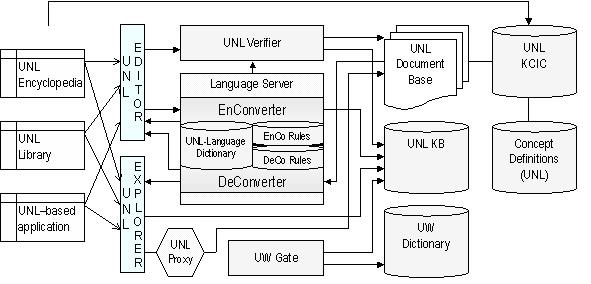
As we do not have any system for CWL at this moment, we need to use
the UNL system for input CWL and output what is expressed in CWL in
natural languages. We basically use the UNL system as a platform of
CWL.
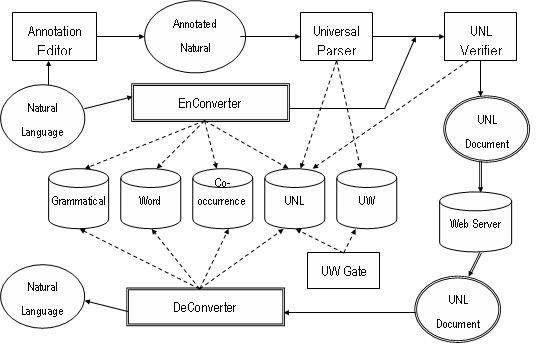
The CWL platform consists of CWL Editor, CWL converter and the UNL
System consisting of Enconverter (which convert natural languages into
UNL), Deconverter (which convert UNL into natural languages).
Since compatibility of the three types of expression of CWL.unl,
CWL.cdl, CWL.rdf, The UNL system together with conversion system allow
people to make web pages in CWL.unl, CWL.cdl, CWL.rdf and also allow
people to see those web pages in their mother tongues.
Beside the UNL system, we provided conversion system (CWL
converter) among CWL.unl, CWL.cdl and CWL.rdf. And also we provide
necessary vocabulary for CWL based on the UNLKB which provides
semantic background of Universal Words of UNL. Knowledge on words (CWL
ontology) of each language is stored in UNLKB (CWL.unl), CDD.nl
(CWL.cdl) and OWL (CWL.rdf).
3. CWL.unl
The UNL is an acronym for `Universal Networking Language'.
The CWL.unl is a prepsentation of CWL in UNL. The UNL including UNLKB
and UWs was developed under United Nations University / Institutes of
Advanced Sturdy in 1996, and research and development were transferred
to the UNDL Foundation in 2001.(http://www.undl.org/unlsys/uw/unlkb.htm)
3.1 UNL
The UNL expresses information or knowledge in the form of semantic
network with hyper-node. UNL semantic network is made up of a set of
binary relations, each binary relation is composed of a relation and
two UWs that hold the relation. A binary relation of UNL is expressed
in the following format:
<relation> ( <uw1>, <uw2> )
In <relation>, one of the relations defined in the UNL
Specifications is described. In <uw1> and <uw2>, the two
UWs that have the relation given by <relation> are
described. Semantic network of UNL expression is a directed graph by
means of the binary relations with direction. The three elements of
each binary relation have the following interrelationship:
<uw1> – <relation> → <uw2>
Such a binary relation is interpreted as that:
the UW given in <uw2> plays the role indicated by the relation
given in <relation> held by the UW given in <uw1>; whereas
the UW given in <uw1> holds the relation given in
<relation> with the UW given in <uw2>.
A UNL expression is a hyper semantic network. That is, each node of
the graph, <uw1> and <uw2> of a binary relation, can be
replaced with a semantic network. Such a node consists of a semantic
network of a UNL expression and is called a `scope'. A scope can be
connected with other UWs or scopes. The UNL expressions in a scope is
distinguished from others by assigning an ID to the <relations>
of the set of binary relations that belong to the scope.
The general description format of binary relations for a hyper-node
of UNL expression is the following:
<relation> : <scope-id> ( <node1>, <node2> )
Where,
- <scope-id> is the ID for distinguishing a scope.
- <scope-id> is not necessary to specify when a binary
relation does not belong to any scope.
- <node1> and <node2> can be a UW or a <scope
node>.
- A <scope node> is given in the format of
`:<scope-id>'.
3.1.1 UNL Document
UNL expressions are provided in the format of UNL documents. A UNL
document is a text file that includes the original sentences, UNL
document tags, UNL expressions and etc.
A UNL document is enclosed with tags `[D:<dinf>]' and
`[/D]'. Within these tags, each paragraph is enclosed with a pair of
tags `[P:<p_num>]' and `[/P]', and each sentence is enclosed
with a pair of tags `[S:<s_num>]' and `[/S]'. Inside a sentence,
the source text is enclosed with `{org:<l_tag>}' and `{/org}',
its UNL expression is enclosed with `{unl:<uinf>}' and
`{/unl}'. Sentences of target languages can also be stored in the UNL
document. Each target sentence is enclosed with a pair of language
tags `{<l_tag>}' and `{</l_tag>}' following the UNL
expression of each sentence.
Description format of a UNL document is the following:
| <UNL Document> |
::= "[D:" <dinf> "]"
{"[P:" <paragraph number> "]"
{"[S:" <sentence number> "]"
<sentence>
"[/S]"}
...
"[/P]" }
...
"[/D]" |
| <dinf> |
::= <document name> "," <author name> [ ","
<document ID> "," <date> "," <email address>
] |
| <document name> |
::= "dn=" <character string> |
| <author name> |
::= "on=" <character string> |
| <document ID> |
::= "did=" <character string> |
| <date> |
::= "dt=" <character string> |
| <email address> |
::= "mid=" <character string> |
| <sentence> |
::= "{org:" <l-tag> [ "=" <code> ] "}"
<source sentence>
"{/org}"
"{unl" [ ":" <uinf> ] "}"
<UNL expression>
"{/unl}"
{ "{" <l-tag> [ "=" <code> ] [ ":" <sinf>
"]" "}"
<target sentence>
"{/" <l-tag> "}" }
...
/* whole information that necessary for a sentence */ |
| <l-tag> |
::= "ab" | "cn" | "de" | "el" | "es" | "fr" | "id" | "hd" |
"it" | "jp" | "lv" | "mg" | "pg" | "ru" | "sh" | "th";
/* language codes : language tags */ |
| <code> |
::= <character code name> |
| <character code name> |
::= <character string> |
| <source snetence> |
::= <character string> |
| <target sentence> |
::= <character string> |
| <uinf> |
::= <system name> "," <post-editor name> ","
<reliability> [ "," <date> "," <email address>
] |
| <sinf> |
::= <system name> "," <post-editor name> ","
<reliability> [ "," <date "," <email address>
] |
| <system name> |
::= "sn=" <character string> |
| <post-editor name> |
::= "pn=" <character string> |
| <reliability> |
::= "rel=" <a number> |
| <paragraph number> |
::= <a number> |
| <sentence number> |
::= <a number> |
The tags used in a UNL document are the following:
| [D:<dinf>] |
indicates the Beginning of a document and the necessary
information about the document |
| [/D] |
indicates the End of a document |
| [P:<p_num>] |
indicates the Beginning of a paragraph |
| [/P] |
indicates the End of a paragraph |
| [S:<s_num>] |
indicates the Beginning of a sentence and the sentence
number |
| [/S] |
indicates the End of a sentence |
| {org:<l_tag>=<code>} |
indicates the Beginning of an original/source sentence,
language and character code, "=<code>" can be
omitted. |
| {/org} |
indicates the End of an original sentence |
| {unl:<uinf>} |
indicates the Beginning of the UNL expressions of a sentence
and necessary information, `:<uinf>' can be
omitted. |
| {/unl} |
indicates the End of the UNL expressions of a sentence |
| {<l_tag>} |
indicates the Beginning of a target sentence of the language
indicated by <l_tag> |
| {/<l_tag>} |
indicates the End of a target sentence of the language
indicated by <l_tag> |
See the following section about <UNL expression>.
3.1.2 UNL Expression
A UNL expression of a sentence is identified with the following
tags: {unl} and {/unl}.
Any component, such as a word, phrase and, of course, a sentence of
a natural language can be represented with UNL expressions. A UNL
expression therefore consists of a UW or a (set of) binary
relation(s). In UNL documents, a UNL expression for a sentence is
enclosed by the tags {unl} and {/unl} inside [S] and [/S]. If a UNL
expression consists of a UW, this UW should be enclosed further by the
tags [W] and [/W]. If necessary, the whole sentence can also be
expressed as a scope. In this case, the Compound UW-ID of the scope
should be enclosed by [W] and [/W].
There are two forms for expressing UNL expressions, one is the
table form and the other is the list form. The table form is made up
of a set of binary relations, and each binary relation is expressed by
connecting the two related UWs directly. And the list form is divided
into two parts: a list of UWs corresponding IDs and a list of binary
relations described by the IDs. The table form of a UNL expression is
more readable than the list form, but the list form of a UNL
expression is more compact than the table form. These two forms are
convertible with each other.
3.1.2.1 The table form of UNL expression
- A UNL expression consists of a set of binary relations:
{unl}
<binary relation>
...
{/unl}
- A UNL expression consists of a UW:
{unl}
[W]
<UW><attribute list>
[/W]
{/unl}
- A UNL expression consists of a scope:
{unl}
[W]
":" <compound UW-ID><attribute list>
[/W]
<binary relation>
...
{/unl}
Each tag and binary relation should end with a return code:
`0x0a'.
Syntax of binary relation
Description format of a binary relation of the table form is the
following:
| <binary relation> |
::= <relation> [":"<compound UW-ID>] "("
{{ <UW1> [":" <UW-ID1>]} | { ":"
<compound UW-ID1> }}[<attribute list>]
","
{{<UW2> [":" <UW-ID2>]} | { ":"
<compound UW-ID2> }}[<attribute list>]
")" |
| <relation> |
::= a relation label, defined in `Chapter 2 Relations' |
| <UW> |
::= a UW, see `Chapter 3 Universal Words' |
| <attribute list> |
::= { `.' <attribute>} … |
| <attribute> |
::= an attribute, see `Chapter 4 Attributes' |
| <UW-ID> |
::= two alphanumeric characters of '0' - '9' and 'A' - 'Z' |
| <compound UW-ID> |
::= two digits of `00' - `99'. `00' must be used for the
main sentence and can be ommited. |
Compound UW-ID
A UNL expression can include more than one scope. Compound UW-IDs
are for identifying each concept specified by compound UWs (scopes) in
a UNL expression. A scope is a group of binary relations that can be
referred to as a UW by indicating its compound UW-ID in the format of
`:<Compound UW-ID>'. A node described in this way in the UNL
expression network that refers to a scope is called a `Scope
Node'. For details about the scope please refer to `3.2 Compound
UWs'.
UW-ID
UW-IDs are for identifying each concept specified by UWs in a UNL
expression. If a UW appears in a UNL expression more than once and
means different concepts (things or events), a unique UW-ID must be
given to each concept of the UWs.
The following shows an example of UNL expressions of the sentence
`I can hear a dog barking outside':
{unl}
agt(hear(icl>perceive(agt>person,obj>thing)).@entry,    I)
obj(hear(icl>perceive(agt>person,obj>thing)).@entry,    :01)
agt:01(bark(agt>dog).@entry,    dog(icl>canine))
plc:01(bark(agt>dog).@entry,    outside(icl>place))
{/unl}
In above UNL expression, `agt', `obj' and
`plc' are relation labels, `I',
`bark(agt>dog)', `dog(icl>canine)',
`hear(icl>perceive(agt>person,obj>thing))' and
`outside(icl>place)' are UWs. `a dog barking outside' is
expressed by a scope, and `01' is given as the compound UW-ID
to the scope. `:01' appears in the position of a UW is the scope node
to refer to the scope. Binary relations indicated by the Compound
UW-ID define the contents of the scope.
3.1.2.2 The list form of UNL expression
The list form of a UNL expression consists of a set of UWs and a
set of encoded binary relations (expressed by UW-IDs) of a
sentence. In case a whole sentence is treated as a scope, the Compound
UW-ID of the scope for the sentence can be included in the UW list
between [W] and [/W].
{unl}
[W]
{<UW> | {`:'<compound UW-ID>}}[<attribute list>]":" <UW-ID>
…
[/W]
[R]
<binary relation by UW-IDs>
…
[/R]
{/unl}
The tags used above have the following meanings.
| [W] |
indicates the Beginning of the UW list. |
| [/W] |
indicates the End of the UW list. |
| [R] |
indicate the Beginning of the encoded binary relations. |
| [/R] |
indicates the End of the encoded binary relations. |
Each tag, encoded binary relation and UW should end with a return
code: `0x0a'.
UW List
UWs of a UNL expression must be listed between [W] and [/W] with
different (unique) UW-IDs for different concepts. This means that the
same UW expression but expressing different concepts (instances) must
be given different UW-IDs. A scope must be defined again in the UW
list.
Syntax of an encoded binary relation
| <binary relation by UW-IDs> |
:= <UW-ID1><relation>[`:'<Compound
UW-ID>]<UW-ID2> |
| <UW-ID> |
:= two alphanumeric characters of `0' – `9' and `A'
– `Z' |
| <Compound UW-ID> |
:= two digits of `00' – `99' |
For instance, the following shows an example of the list form of a
UNL expression of the sentence `I can hear a dog barking outside'.
{unl}
[W]
I:01
hear(icl>perceive(agt>person,obj>thing)).@entry:02
dog(icl>canine):03
bark(agt>dog).@entry:04
outside(icl>place):05
:01:06
[/W]
[R]
02aoj01
02obj06
04agt:0103
04plc:0105
[/R]
{/unl}
In the above example, between [W] and [/W], UWs 'I',
'hear(icl>perceive(agt>thing,obj>thing))',
'dog(icl>canine)', 'bark(agt>dog),' 'outside(icl>place)' and
the scope node `:01' are given a UW-ID from 01 to 06 respectively.
Between [R] and [/R], binary relations are described using the
UW-IDs defined in the UW list. For example, `02obj06' in the second
line shows that the concept identified by UW-ID 06 is the 'obj' of the
concept identified by UW-ID 02. UW-ID 06 means the concept of scope
01, and UW-ID 02 means the concept of
'hear(icl>perceive(agt>thing,obj>thing))'.
Binary relations `04agt:0103' and `04plc:0105' express the UNL
expression of scope 01. This is indicated by the CompoundUW-ID `01'
described following the relations 'agt' and 'plc'.
qua [":"<Compound UW-ID>] "(" {<UW1>|":" <Compound
UW-ID>} "," {<UW2>|":"<Compound UW-ID>} ")"
3.4.1 UWs
3.4.1.1 Syntax of UW
A UW is made up of a character string (an English-language word)
followed by a list of constraints. The meaning and function of each of
these parts is described in the next section, on Interpretation.
The following is the syntax of description of UWs:
| <UW> |
::= <headword> [<constraint list>] |
| <headword> |
::= <character>… |
| <constraint list> |
::= "(" <constraint> [ "," <constraint>]…
")" |
| <constraint> |
::= <relation label> { `>' | `<' } <UW>
[ <constraint list>] |
<relation label> { `>' | `<' } <UW>
[ <constraint list>]
[ { `>' | `<' } <UW> [<constraint list>] ]
… |
| <relation label> |
::= "agt" | "and" | "aoj" | "obj" | "icl" | ... |
| <character> |
::= "A" | ... | "Z" | "a" | ... | "z" | 0 | 1 | 2 | ... | 9 |
"_" | " " | "#" | "!" | "$" | "%" | "=" | "^" | "~" | "|" | "@"
| "+" | "-" | "<" | ">" | "?" |
3.4.1.2 Interpretation
Headword
The headword is an English word/compound word/phrase/sentence that
is interpreted as a label for a set of concepts: the set made up of
all the concepts that may correspond to that in English. A Basic UW
(with no restrictions or constraint list) denotes this set. Each
Restricted UW denotes a subset of this set that is defined by its
constraint list. Extra UWs denote new sets of concepts that do not
have English-language labels.
Thus, the headword serves to organize concepts and make it easier
to remember which is which.
Constraints or Restrictions
The constraint list restricts the interpretation of a UW to
a subset or to a specific concept included within the Basic UW, thus
the term `Restricted UWs'. The Basic UW `drink', without a constraint
list, includes the concepts of `putting liquids in the mouth',
`liquids that are put in the mouth', `liquids with alcohol', `absorb'
and others. The Restricted UW 'drink(agt>thing,obj>liquid)'
denotes the subset of these concepts that includes `putting liquids in
the mouth', which in turn corresponds to verbs such as `drink',
`gulp', `chug' and `slurp' in English.
A restriction of a UW is made up of a pair of a relation and a
pre-defined UW (or part expression of a pre-defined UW) that holds the
relation with this UW. If more than one restrictions are necessary, a
comma `,' should be used between restrictions. A Restricted UW
is defined through a Master Definition (for details please refer to UW
Manual). In a Master Definition, full expressions of pre-defined UWs
must be described in the restrictions, whereas as for a UW, if and
only if the uniqueness can be kept, part of the pre-defined UWs (its
headword or part restrictions) can be used in the restrictions.
Relation labels used in the constraint list must be defined in the UNL
specifications and should be sorted in alphabetical order if more than
one restrictions are used.
In order to define the meaning of a UW more accurately, for
instance, a subset concept of UW is always defined under an upper UW
that has the closest but more general meaning. This is implemented by
linking the UW to be defined with the upper UW using 'icl'
relation. For example, UW
'provide(icl>give(agt>thing,gol>thing,obj>thing))' is
defined as a subset concept of UW
'give(agt>thing,gol>thing,obj>thing)'. However if the
headword of the upper UW is either of `be', `do', `occur' and `uw',
such a headword is not necessary to remain in the restrictions of
lower UWs as the each set of restrictions of these upper UWs is set
enough to restrict their lower UWs. For example, from Master
Definition 'drink({icl>do(}agt>thing,obj>liquid{)})' a UW
'drink(agt>thing,obj>liquid)' and a binary relation
'icl(drink(agt>thing,obj>liquid),
do(agt>thing,obj>liquid))' are generated. The part related to
the headword `do' is removed from its lower UW expression and the
binary relation that will be described in the UNLKB shows that
'drink(agt>thing,obj>liquid)' is a subset concept of
'do(agt>thing,obj>liquid)'. For details of description of
UW please refer to UW manual.
3.4.1.3 Types of UW
A UW is a character string and most of the UWs are basically made
up of an English expression with restrictions. A UW can express
various levels' concepts depending on the restrictions and can be used
to express a more specific or particular concept or an instance by
giving attributes and IDs or restrictions from other UNL
expressions. The UWs are divided into four types:
- Basic UWs, which are bare headwords with no constraint list, for
example:
go
take
house
state
- Restricted UWs, which are headwords with a constraint list, for
example:
state(icl>express(agt>thing,gol>person,obj>thing))
state(icl>country)
state(icl>region)
state(icl>abstract thing)
state(icl>government)
- Extra UWs, which are a special type of Restricted UW, for
example:
ikebana(icl>flower arrangement)
samba(icl>dance)
souffle(icl>food)
- Temporary UWs, which are not necessary to define, for
example:
1234
xyz
Basic UWs
Basic UWs are character strings that correspond to English
words. Such a basic UW denotes all the concepts that may correspond to
those in English. However a basic UW is not used if the English
expression is ambiguous. Such a basic UW is usually used as the
headwords of Restricted UWs for its various specific concepts. A
basic UW is used if the English expression has no ambiguity.
Restricted UWs
Restricted UWs are by far the most important. A Restricted UW is
made up of a headword (English expression) with restrictions. It is
necessary when the English expression of headword has broader sense
(more meanings) than the concept aimed to define. The restrictions
restrict the range of the concept that an English expression
represents. Each Restricted UW made from an English expression
represents a more specific or particular concept, or a subset of the
concepts of the English expression.
For example, following are the Restricted UWs made from the English
word `state':
- state((icl>express(agt>thing,gol>person,obj>thing))
is a more specific concept that denotes an action in which
humans express something.
- state(icl>country) is a more specific sense of `state'
that denotes a country.
- state(icl>region) is a more specific sense of `state'
that denotes a region of a country.
- state(icl>abstract thing) is a more specific sense of
`state' that denotes a kind of condition that persons or things
are in. This UW is defined as a more general concept that can be
referred to when defining other synonymous UWs, such as
`situation' or `condition'.
- state(icl>government) is a more specific sense of
`state' that denotes a kind of government.
The information in parentheses is the constraint list and it
describes some conceptual restrictions; this is why they are called
Restricted UWs. Informally, the restrictions mean `restrict your
attention to this particular sense of the word'.
Extra UWs
Extra UWs denote concepts that are not found in English and
therefore have to be introduced as extra categories. Foreign-language
words are used as headwords using English (Alphabetical)
characters.
For example, following are the examples of Extra UWs:
- ikebana(icl>flower arrangement) is `a kind of flower
arrangement' for the meaning of `something you do with
flowers',
- samba(icl>dance) is `a kind of dance', and
- souffle(icl>food) is `a kind of food'.
To the extent that these concepts exist for English speakers, they
are expressed with foreign-language loanwords and do not always appear
in English dictionaries. So they simply have to be added to be able to
use these specific concepts in the UNL system. The restrictions give
the idea of what kind of concept is associated with these Extra UWs
and the constraints provide the binary relations between this concept
and other, more general, concepts already defined. Needless to say, an
Extra UW is also defined through a Master Definition, and a
pre-defined UW or its part expression must be used in the restrictions
of an Extra UW.
Temporary UWs
A number or an address of email that has to be used as it is not
necessary to define. They can appear in a UNL document and are treated
as temporary UWs.
ex) 1234
    xyz
3.4.2 Compound UWs : Scopes
Compound UWs are a set of binary relations that are grouped
together to express a complex concept. A sentence itself is considered
as a compound UW. Compound UWs denote complex concepts that are to be
interpreted/understood as a whole so that one can talk about their
parts all at the same time. A compound UW is expressed by a scope in
UNL expressions. A scope makes it possible when a compound UW is
necessary to be connected with other UWs.
Consider the following example:
[Women who wear big hats in movie theaters] should be asked [to
leave].
The part of the sentence within square brackets is what should be
asked. Only when they are grouped together and considered as a whole
unit can the correct interpretation be obtained.
Attributes can be attached to them to express negation, speaker
attitudes, etc., which are usually interpreted as modifying the main
UW (attached with @entry) and its coordinate UWs within the compound
UW (scope).
3.4.2.1 The way to define a Compound UW
A Compound UW is defined by placing a Compound UW-ID immediately
after the Relation Label in all of the binary relations that are to be
grouped together. Thus, in the example below, `:01' indicates all of
the elements that are to be grouped together to define Compound UW
number 01.
agt:01(wear(aoj>thing,obj>hat), woman(icl>person).@pl)
obj:01(wear(aoj>thing,obj>hat), hat(icl>wear))
aoj:01(big(aoj>thing), hat(icl>wear))
plc:01(wear(aoj>thing,obj>hat), theater(icl>facilities))
mod:01(theater(icl>facilities), movie(icl>art))
agt:01(leave(agt>thing,obj>place).@entry, woman(icl>person).@pl)
After this group has been defined, wherever the Compound UW-ID is,
for instance `01' in the above example, it can be used to cite the
Compound UW. The way to cite a Compound UW is explained in the next
section.
A Compound UW is considered as a sentence or sub-sentence, so in
the definition of a Compound UW one entry node marked by @entry is
necessary.
3.4.2.2 The way to cite a (Compound) UW
Once defined, a Compound UW can be cited or referred to by simply
using the Compound UW-ID as an UW. The method is to indicate the
Compound UW-ID following a colon `:'. The reference to a Compound UW
is also called a Scope Node. The Scope Node has the following
syntax:
| <Scope Node> |
::= ":" <Compound-ID> [ <Attribute List> ] |
| <Compound-ID> |
::= two digits of a number "01"–"99", except "00" |
| <Attribute List> |
::= { `.' <Attribute> } … |
| <Attribute> |
::= `@entry' | `@may' | `@past' | … |
| <Node> |
::= <UW> [`:' <Compound-ID> |
<Sentence-ID>]… [ <Attribute List> ] |
| <Compound-ID> |
::= two digits of a number "01"–"99", except "00" |
| <Attribute List> |
::= { `.' <Attribute> } … |
| <Attribute> |
::= `@entry' | `@may' | `@past' | … |
To complete the UNL expression of `[Women who wear big hats in
movie theaters] should be asked [to leave]', the following are
necessary:
obj(ask(agt>thing,gol>person,obj>uw).@should.@entry, :01)
gol(ask(agt>thing,gol>person,obj>uw).@should.@entry, woman(icl>person).@pl.@topic)
'obj(ask(agt>thing,gol>person,obj>uw).@should.@entry,
:01)' shows that Scope 01 is the obj of `ask'.
':01' shows the scope node. It is interpreted as the whole set of
binary relations defined above. It means that `:01' should be
understood as comprising all of these binary relations. Compound
UWs can be cited within other Compound UWs.
3.5 UNL Knowledge Base (UNLKB)
The UNLKB is a semantic network comprising every directed binary
relation between UWs. All the binary relations of the UNL KB are in
the following format: 'relation(UW1, UW2)=c', where 'c' is the degree
of certainty, which has the value 0 (impossible) or 1 to 128
(certain). This binary relation means `UW1 takes UW2 as the relation
in certainty value c', or `UW2 plays the role specified by relation
for UW1 in certainty value c'.
The UNLKB Defines Concepts of UWs
The UNLKB provides concepts and UW of the concepts. A UW (Universal
Word) is a label for a concept. Concepts labelled by UWs are defined
by describing the set of possible relations that each concept can have
with other concepts. Definitions of possible relations with
other concepts describe behaviours of concepts in terms of other
concepts. This behaviour is the property of a concept in the sense
that the descriptions of behaviour characterize the concept and
provide enough information to understand the semantic structure of the
sentence.
The UNLKB Provides Linguistic Knowledge of Concepts
The behaviour of a concept is considered as linguistic knowledge on
the concept. This knowledge is used to provide semantic structure of
sentences of natural languages. For example, an `author' is a
`person', which can take various actions that a person can take such
as a person can writes something and something can be a book, and so
forth. This level of knowledge is necessary to provide semantic
background of natural language sentences. Further knowledge, for
example real world knowledge and so forth, will be established based
on this linguistic knowledge using the UWs.
UW System
In the UNL KB, all UWs are linked with each other through
'icl',(subclass) 'iof'(element/instance), or 'equ' relations. 'Icl'
links a UW of a subclass concept to a super-class concept UW; 'iof'
links a UW expressing an instance to a UW of a class concept; The UWs
related to each other through 'icl', 'iof' and 'equ' relations make up
a hierarchy of UWs. This hierarchy of UWs is the UW system. This UW
system allows having multiple super-class concepts. Accordingly, the
UW system is a lattice type of network.
The hierarchy of the UW system is constructed by taking the
property inheritance and replacement by super-class concept mechanisms
into consideration. In UW system, lower UWs inherit the properties of
upper UWs; and upper UWs can replace lower UWs to convey a more
general sense in the specific context of the lower UWs. All these
inheritance and replacement are carried out through the relations
'icl', 'iof' and 'equ'.
In the UNL KB, all possible relations, such as 'agt', 'obj', etc,
that an UW can have with others are defined for each. Every possible
relation is defined between the two most general UWs of the two
categories (of lower UWs) that can have the relation. Utilizing the
property inheritance mechanism of the UW system possible relations of
lower concepts are deductively inferred and this inference mechanism
can reduce the number or binary relations.
Replacement of lower UWs by upper UWs can cause problems by
introducing ambiguities if the upper UWs are not close in meaning to
the lower UWs. To avoid this, the upper UWs must be the closest UWs
among all of the more general UWs . In other word, every UW must be
positioned under the closest upper UWs.
The UNLKB defines the syntax and semantics of the language UNL. In
the UNL System, UNLKB is used in sentence analysis for disambiguation
and in sentence generation for finding more general concepts when
encountering unknown concept to the language. The UNLKB also is used
to verify UNL expressions since it provide syntax and semantics of
UNL.
4. CWL.cdl
The CWL.cdl is a representation of CWL in CDL.nl. The CDL.nl is
appropriate for logical treatment of contents together with
information in multimedia. The UNL is appropriate for communication
beyond language barriers. RDF/OWL is appropriate for dealing with meta
data of web pages and has already many applications actually
working.
Design Principles
Concept Description Language (CDL) is a language that describes a
wide variety of representation media and content, as well as
conceptualization of their meaning, in a common format. CDL is a
simple extension of the basic principles of XML and is able to inherit
stored data tagged with XML.
In contrast to XML, which annotates the document structure
(syntactic structure) of content, CDL describes the concept structure
(semantic structure) of content. This paper begins with the
characteristics of CDL compared to those of XML.
Specifications design for XML is summarized as follows.
- Tags (document tags) are embedded into content and annotate the
document structure. There is basically one type of tag.
- The document structure model has a nesting tree structure.
- Tag definitions are attached to annotated content and are
mutually referred by name space function.
- There is style sheet that converts tagged document structure
into visual presentation which is easy to understand for
humans.
The followings are the key concepts of the CDL specification.
- Labels (concept labels) are used to describe the concept
structure separate from content. Labels are divided largely into
entity concept labels and relation concept labels.
- The concept structure model is a hyper network structure.
- Label definitions are compiled in CDD (concept definition
dictionary) separate from all content targeted for
description. The semantic relations between concepts described
with labels and the internal structure of the concepts are
defined in the CDD. The CDD represents the ontology of the
concepts.
- There is a grounding mechanism that converts the concept
structure into content that is easy to understand for
humans.
It is possible to set up partially a mechanism compliant to CDL for
XML. This mechanism is realized by RDF/OWL in the Semantic Web. The
following are its key characteristics in RDF/OWL specifications
design.
- `Properties' are described.
- The properties (meta data) of the resources (including content)
are described. Description is in the form of a set of triples,
each of which consists of subject (resource), property and
property value, in frame-like nesting format.
- Vocabulary for description is organized in ontology. The
framework for describing ontology is the RDF Schema, and OWL is
the language for describing definitions.
In comparison, the following are the key CDL specifications.
- `Structures' are described.
- The concept structure of the entire content is described. The
network format consisting of node and arc, each of which is
entity concept and the relation concept (and its degenerate form
of attribute and attribute value) is created. Furthermore,
complex concept type (hyper node and hyper arc) and elemental
concept type are created for each concept.
- Vocabulary for description is organized in the CDDs. The
framework for describing vocabulary definitions (ontology) and
meta vocabulary to be described are defined a priori in the CDD
of CDL.core. The CDD is the concept ontology with Entity,
Relation and Attribute as top-level concepts, and the CDD itself
is a complex entity.
In contrast to RDF/OWL which was designed in bottom-up design from
XML for metadata description, CDL was designed in top-down approach
from the basic perspective on concept structure for the purpose of
content concept description. For this reason, CDL is consistent,
simple and clear in specifications. In CDL implementation, RDF/OWL
implementation specifications and XML implementation specifications
are prepared.
In CDL, CDL.xxx for various representation media and the various
content formats have to be set up, based on CDL.core, which provides
the meta-concepts for describing concept definitions. The respective
concept vocabularies are defined in their corresponding CDD
(CDD.xxx). For natural language media, concept shared with natural
language is defined as CDD.nl. Concepts necessary for the
conceptualization of meanings representing terms, phrases, sentences
and text in natural language are defined. CDLs corresponding to each
language, such as Japanese, English, and Chinese, are created as
CDL.jpn, CDL.eng, CDL.chi, etc., and CDDs defining concepts for each
language are prepared. Furthermore, CDD corresponding to everyday
language, CDD for specialized areas and communities, and CDD for
controlled language, etc., are created to prepare CDL that corresponds
to a variety of language usage.
In addition, CDLs can also be made for mathematical equations,
programming languages, video image, music sound, etc., in the form of
CDL.math, CDL.prog, CDL.movie, CDL.music, etc. CDDs therefore consist
of concepts inherent to each representation media and concepts
borrowed from natural language.
In CDL, maintaining continuity with XML is important. This is
because the document structure (syntactic structure) serves as a guide
for the concept structure (semantic structure) and it is necessary to
appropriately preserve the huge amount of content that is
XML-tagged. The schemes prepared for appropriate coordination between
CDL and XML are following. There are two schemes.
- Integration of description and annotation
The description function is able to include annotation
function. CDL is capable of continuous adaptation from
annotation to description, such as all annotation, partly
annotation and partly description, and all description.
- Implementation specifications on XML
In addition to implementation specifications on RDF/OWL,
implementation specifications directly on XML will be
investigated.
4.1 CDL.core
4.1.1 Model and Syntax Specifications
Model and Syntax determine how concepts or conceptualization are to
be modeled and what kind of data format or grammar will be set up to
express the model. In order words, it determines the common form of
expression for all CDL family languages. Therefore, CDL.core follows
this notation format.
First, the basic categories for the model of conceptualization are
determined as follows.
Concept
    Entity
        ElementalEntity
        ComplexEntity
    Relation
        ElementalRelation
        ComplexRelation
    Attribute
Concepts and concept descriptions are modeled in the following
network structure, namely:
- Entities that are to make up the concepts become nodes, and the
relations between entities become arcs in the network
structure.
- The nodes and arcs are elemental concepts without structure
(ElementalEntity and ElementalRelation) or complex concepts with
structure (ComplexEntity and ComplexRelation). Complex concepts
correspond to hyper-nodes or hyper-arcs, creating a congestion
model for concept structures.
- Complex concepts classify two types of model for
conceptualization in accordance with how relations are
connected. In other words, if a relation is connected with the
complex concept as a whole, the model determines the whole as a
single concept. If a relation is connected with a concept inside
the complex concept, the model determines the concept as a
concept modified by the complex concept.
- Attribute-value pairs are added to the concept description to
create model for localized property descriptions of the
concept. An attribute is a degenerated Element Relation, and its
value is a degenerated Element Entity.
Text Notation
As method for network structure notation for concepts, graph
notation with diagram and text notation with symbolic text are made
available. Text notation syntax, specifically basic syntax, is shown
below. The following four meta symbols are used to describe
grammar.
| `::=' |
Left side is defined as right side |
| `|' |
Selection `or' |
| `Symbol' |
Meta symbol (Non-terminal symbol) |
| `…' |
Repetition zero or more times |
ConceptDescription ::= EntityDescription

EntityDescription ::= ElementalEntityDescription | ComplexEntityDescription
ElementalEntityDescription ::=
    {RealizationLabel  DefinitionLabel  AttributeValuePair… ;}
ComplexEntityDescription ::=
    {RealizationLabel  DefinitionLabel  AttributeValuePair… ;
        EntityDescription… RelationDescription… Arc…}

RelationDescription ::=
    ElementalRelationDescription | CompexRelationDescription
ElementalRelationDescription ::=
    {RealizationLabel  DefinitionLabel  AttributeValuePair… ;}
CompexRelationDescription ::=
    {RealizationLabel  DefinitionLabel  AttributeValuePair… ;}
        From To EntityDescription…EntityDescription… Arc…}

AttributeValuePair ::= Attribute =Value
Arc ::= [EntityRealizationLabel-from RelationRealizationLabel EntityRealizationLabel-to]

RealizationLabel ::= #ArbitraryCharacterString
DefinitionLabel ::= DefinitionLabelDefinedInCDD
Attribute ::= AttributeDefinedInCDD
Value ::= ValueDefinedInCDD
In both entity and relation, concept description is unified, simple
and clear. The difference between elemental concept and complex
concept is whether there is a structure description after the
delimiter (;). The ComplexRelationDescription includes special
ElementalEntity (From and To) to match the inside and the outside of
an arc.The reason of the use of "{" and "}" is to perceive element set
in structure description as bag (set). Therefore, concept description
in structure description will be identified uniquely with realization
label. Scope can be set on the realization label according to nested
structure of concept description. The scope on the realization lablel
is set in open scope and closed scope modes. Open scope is
default. Description examples hereafter are shown in open scope. The
arcs are in triples with direction from left to right.
There are elemental concept description and complex concept
description in concept description. One definition is used in various
realizations. Concept description requires localized Attribute-Value
pair. These are easy to understand for entity concept but require
explanation for relation concept. To understand the explanation, the
description in the next and subsequent chapters is necessary.
However, it will be summarized below.
- Complex Relation: Relation concept including RDF/OWL is not
intended to have structure. However, any relation does not
necessarily remain primitive or uniform, and various levels of
relations are used. In such a case, a scheme to describe macro
relation with micro relation is extremely useful. For example,
description of <employer> and <employee> relation with
internal structure describing "someone employs someone" and "someone
is employed by someone" is useful.
- Usefulness of Attribute-Value pair in relation concept: A scheme
Attribute-Value pair that describes the modality of relation
completeness (necessity or possibility, variety such as whether it is
established constantly or what time), relationship with subrelations
(that is whether all subrelations are established or some part of
subrelations are established), and the certainty factors of relations
(at what percentage is establishment possible), etc., will be
extremely useful.
- Meaning of realization of relation concept: For a relation concept
with the same name to be used in a variety of locations as concept
with different Attribute-Value pairs, a scheme for various
realizations of the relation concept is necessary.
In definition of the DefinitionLabel (RealizationLabel in Schema)
or RealizationLabel, it is necessary only to specify an arbitrary
character string. In reality, notation for complex structure label
will be specified in each CDD. For instance, the following complex
structure can be expected for Japanese vocabulary concept.
DictionaryID–Notation–Reading–PolysemyDiscrimination–Date&TimeOfEntry
Graph Notation
Graph notation is a method of expressing a directed graph with
entity realization as node and relation realization as arc. Complex
Entities are represented as hyper nodes, and Complex Relations in
hyper arc. This is illustrated as following figure. Here, ED, ER, RD,
and RR mean EntityDefinitionLabel,
EntityRealizationLabel,
RelationDefinitionLabel , and RelationRealization
Label respectively. Attribute-ValuePair is
omitted. It can be described as a graph in which
Attribute is an arc and Value is a
node. Also,
(Attribute=Value•••)can be
added after the Realization Label.
The relation that connects ED* and RD* with
ER* and RR* respectively is a realizationOf or a
typeOf. When the graph notations of these parts are degenerated, it is
simplified as follows.
Visual Notation
Various visual notation methods are available to make text notation
clearer. Visual notation methods shown here are typical examples, and
other shortcuts can be created for each case.
- (1) Arc
There are shortcuts for arcs and arc groups. The notation
[EntityRealizationLabel-from RelationRealizationLabel EntityRealizationLabel-to]
is represented as
[E1 R E2]
in the following explanation.
- (1-1)
[E1 R E2] ⇒ [E1–R→E2] or [E2⇐R–E1] or E1–R→E2 or E2⇐R–E1
However, this notation applies for use of UTF-8. When limited to
ASCII code, "-" "->" are used for "–" and "→"
- (1-2)
When EntityRealizationLabel-from is common,
[E0  R1  E1]  ⇒  [E0–R1→E1 E0–R2→E2 ••• E0–Rn→En] or
[E0  R2  E2]      [E0–R1→E1 R2→E2 ••• Rn→En] or
    … E0–R1→E1 R2→E2 … Rn→En
[E0  Rn  En]
- (1-3)
When an EntityRealizationLabel-to of an arc is
equal to an EntityRealizationLabel-from of another
arc,
[E0  R1  E1] ⇒ [E0–R1→E1 E1–R2→E2 … En-1–Rn→En] or
[E1  R2  E2]      [E0–R1→E1–R2→E2 … →En-1–Rn→En] or
  …        E0–R1→E1–R2→E2 … →En-1–Rn→En
[En-1  Rn  En]
- (2) Substitution concept description for realization label
inside an arc
This is a shortcut for substituting concept description of a
realization label for the same realization label inside an
arc. If the same realization label is used in two places,
substitution is possible only for one realization
label. Substitution is possible only between concept description
and arc in the same scope.
- (3) Abbreviation of concept description
Abbreviation method of adding realization labels to concept
definition labels as suffixes is created. In an element entity
description,
{RealizationLabel DefinitionsLabel Attribute-ValuePair… ;}
can be written as
DefinitionLabel RealizationLabel(Attribute-ValuePair…)
In a complex entity description,
{RealizationLabel DefinitionLabel Attribute-ValuePair… ;EntityDescription… RelationDescription… Arc…}
can be written as
DefinitionLabel RealizationLabel(Attribute-Value…){EntityDescription… RelationDescription… Arc…}
(Example)
{#1 Concept a1=v1 a2=v2 a3=v3; ………. }
⇒Concept#1(a1=v1 a2=v2 a3=v3){ ………. }
{#1 Concept a1=v1 a2=v2 a3=v3;}
⇒Concept#1(a1=v1 a2=v2 a3=v3)
{#1 Concept;}
⇒Concept#1
In an elemental relation description,
{RealizationLabel DefinitionsLabel Attribute-ValuePair… ;}
⇒DefinitionLabel RealizationLabel(Attribute-ValuePair…)
In a complex relation description,
{RealizationLabel DefinitionLabel Attribute-ValuePair… ; From To
                EntityDescription… RelationDescription… Arc…}
⇒DefinitionLabel RealizationLabel(Attribute-ValuePair…)
            {From To EntityDescription… RelationDescription… Arc…}
Examples of CDL Description
Examples of graph notation, text notation and visual notation are
shown here.
[Example 1]
- Graph notation:
- Text notation:
{#a A;
{#x1 A1;}{#x2 A2;}{#x3 A3;}
{#y1 R1;}{#y2 R2;}{#y3 R3;}
[#x1 #y1 #x2]
[#x2 #y2 #x3]
[#x3 #y3 #x1]}
- Visual notation:
When (1-3) is applied,
{#a A;
{#x1 A1;}{#x2 A2;}{#x3 A3;}
{#y1 R1;}{#y2 R2;}{#y3 R3;}
[#x1–#y1→#x2–#y2→#x3–#y3→#x1]}
When (2) is applied,
{#a A;
  {#x1 A1;}–{#y1 R1;}→{#x2 A2;}–{#y2 R2;}→{#x3 A3;}–{#y3 R3;}→#x1}
When (3) is applied,
A#a{A1#x1–R1#y1→A2#x2–R2#y2→A3#x3–R3#y3→#x1}
[Example 2]
- Graph notation:
- Text notation:
{#b B;
  {#b1 B1;}
  {#a A;
    {#x1 A1;}{#x2 A2;}{#x3 A3;}
    {#y1 R1;}{#y2 R2;}{#y3 R3;}
    [#x1 #y1 #x2]
    [#x2 #y2 #x3]
    [#x3 #y3 #x1]}
  {#b2 B2;}
  {#z1 S1;}{#z2 S2;}{#z3 S3;}
  [#b1 #z1 #a]
  [#a #z2 #b2]
  [#b2 #z3 #b1]
  [#b2 #z3 #x3]}
- Visual notation:
When (1), (2) and (3) are applied,
B#b {B1#b1–S1#z1→A#a{A1#x1–R1#y1→A2#x2–R2#y2→A3#x3–R3#y3→#x1}–S2#z2→B2#b2–S3#z3→#b1, #b2–#z3→#x3}
Extended Model and Syntax
The form of concept description in 2.1 is the basic form. That is
to use conceptual definitions in CDD for realizations in concept
description. The following explains the special realization forms and
the concept description forms without concept definitions which are
classified as Extended Model and Syntax.
(1) Concept in which content itself includes meaning (Textual
Concept)
This indicates a concept in which the content itself includes
meaning, where the definition label of the concept is expressed by the
content (content skeleton) itself. It defines the expression of a
concept that is recalled when a standard audience reads, listens to or
sees the content. Here, a piece of text in natural language will be
used as a typical example of content.
A concept recalled when a standard audience whose mother tongue is
the language used in the text description reads text is
expressed as text surrounded by "<" and ">".
{RealizationLabel <Text> Attribute-ValuePair… ;}
The corresponding visual notation is shown below. However,
Attribute-ValuePair is omitted.
⇒ <RealizationLabel; Text>
or
⇒ <Text>RealizationLabel
If RealizationLabel is Nil(`#'only)
⇒ <Text>
(Example)
{#1 <concept description>;}
  ⇒<#1;concept description>  or  <concept description>#1
{# <concept description>;}
  ⇒<concept description>
[Note]
Here, the role or function of the textual concept was explained by
placing text in the definition label of the concept
description. Another alternative in explanation is to place the text
in the structure description of a complex concept. With this method, a
nested structure of textual concepts can be created. Specifically, a
textual concept is shown as a complex entity as follows.
{RealizationLabel TextConcept Attribute-ValuePair… ; <Text>}
(2) Content surface notation as concept (Literal Concept)
A surface notation of the content itself can be regarded a
concept. Here, text in natural language (text piece) will be used as a
typical example of content.
Text with surrounded by ' and ' expresses the literal
concept.
{RealizationLabel 'Text ' Attribute-ValuePair… ;}
Corresponding visual notation is shown below. However,
Attribute-ValuePair is omitted.
⇒ 'RealizationLabel;Text '
or
⇒ 'Text 'RealizationLabel
If RealizationLabel is Nil(`#'only)
⇒ 'Text'
(Example)
{#a 'Concept description language';}
  ⇒ '#a;Concept description language' or 'Concept description language'#a
{# 'Concept description language';}
  ⇒ 'Concept description language'
(3) Temporary concept (or anonymous concept)
This concept is used temporarily only for description of
realization. DefinitionLabel is made identical to
RealizationLabel in order to express a concept on a
temporary basis. It is very often used to express complex concepts in
temporary as follows,
{RealizationLabel RealizationLabel Attribute-ValuePair… ;
                    EntityDescription… RelationDescription… Arc…}
The corresponding visual notation is shown below. However,
Attribute-ValuePair is omitted.
⇒ {RealizationLabel ; EntityDescription… RelationDescription… Arc…}
or
⇒ {EntityDescription… RelationDescription… Arc…}RealizationLabel
If RealizationLabel is Nil(`#'only)
⇒ {EntityDescription… RelationDescription… Arc…}
(Example)
{#a #a; ………. }
  ⇒{#a; ………. } or { ………. }#a
{# #; ………. }
  ⇒{ ………. }
(4) Concept with only one realization (Proper Concept)
This expresses concept that has only one realization of concept
definition. Most proper nouns and relation concepts correspond to
this. Definition label itself becomes the realization label to express
that it is a unique concept.
{RealizationLabel DefinitionLabel Attribute-ValuePair… ;}
The corresponding visual notation is shown below. However,
Attribute-ValuePair is omitted.
⇒ DefinitionLabel
(Example)
{Tokyo_Station Tokyo_Station;}
  ⇒Tokyo_Station
{Mt_Fuji Mt_Fuji;}
  ⇒Mt_Fuji
{John John;}
  ⇒John
(5) Concept in which the realization notation itself is the
primary concept definition (Identifier Concept)
This concept has a realization notation and a definition that match
each other. This concept applies to numbers and other identifiers. The
definition label has # removed from the RealizationLabel
in order to express the identifier concept.
{RealizationLabel RealizationLabelWithout# Attribute-ValuePair… ;}
The corresponding visual notation is shown below. However,
Attribute-ValuePair is omitted.
⇒ RealizationLabelWithout#
(Example)
{#256 256;}
  ⇒256
{#ISBN9-876-54321-0 ISBN9-876-54321-0;}
  ⇒ISBN9-876-54321-0
Concept Definition and Realization
Concept description is divided largely into concept definition
description (Definition or Concept Definition) and concept realization
description (Realization or Concept Realization). Definition
description is called concept schema because of the description
framework, and realization may be called instantiation.
In the object-oriented approach in programming languages, etc., the
terms Class Definition and Instantiation are commonly used. In CDL,
the word Realization is used instead of Instantiation. Instantiation
yields an example Instance that satisfies a Definition. In the
object-oriented approach, Instance is used as a single, independent
case. In Concept Description under CDL, Realizations are not used
independently and used in a variety of cases, with various roles given
in Concept Description. They may be, for instance, as generic,
unspecified, or specified conceptual examples. In order to express
such uses appropriately, the term Realization is used. However, in
terms of the basic scheme of implementation, Realization stemming from
Definition roughly corresponds to Instanciation.
Concept definition descriptions are compiled in CDD (Concept
Definition Dictionary). CDD directly reflects the respective
conceptualization model. And, all CDDs are detailed from common
conceptualization model to their conceptualization models. In other
words, all CDD.xxx corresponding to CDL.xxx share the following
top-level concept hierarchies.
Concept
    Entity
        ElementalEntity
        ComplexEntity
    Relation
        ElementalRelation
        ComplexRelation
    Attribute
The relation between Concept Definition and Concept Realization is
illustrated as follows.
(Example)
An example of Definition and Realization follows. Please note that
this shows the structure only, and some details have been omitted. The
following is an example of Realization of the Concept Description
corresponding to the English-language example in Appendix 1, Example 1
shown as Text Concept. For the sake of simplification, the definition
labels of the concept (#buy, #report, #computer, etc.) are shown in
the heading only. In practice, a scheme for identifying multiple
definitions is necessary for definition labels in case there are
multiple meanings.
<John reported to Alice that he bought a computer yesterday>
- Definition:
Concept
    Entity
        ElementalEntity
            NominalEntity
                {#computer Schema type='ElementalEntity'  …; …}
                {#John Schema type='ElementalEntity'  …; …}
                {#Alice Schema type='ElementalEntity'  …; …}
                {#yesterday Schema type='ElementalEntity'  …; …}
            VerbalEntity
                {#buy Schema type='ElementalEntity'  …; …}
                {#report Schema type='ElementalEntity'  …; …}
        ComplexEntity
            {#Event Schema type='complexEntity'  …; …}
    Relation
        ElementalRelation
            {#agt Schema type='ElementalRelation'  …; …}
            {#obj Schema type='ElementalRelation'  …; …}
            {#cnt Schema type='ElementalRelation'  …; …}
            {#seq Schema type='ElementalRelation'  …; …}
        ComplexRelation
    Attribute
        {#AttributeOfEvent Schema type='Attribute'  …; …}
        {#AttributeOfNominalEntity Schema type='Attribute'  …; …}
- Realization:
{#A Event temporality='past';
  {#agt agt} {#obj obj} {#tim tim} {#cnt cnt} {#seq seq}
    {#B Event temporality='past';
      {#b1 buy;}
      {#b2 computer realizationMode='def';}
      {#b3 yesterday realizationMode='def';}
      [#b1 #agt John] [#b1 #obj #b2] [#b1 #tim #b3]}
    {John John;}
    {#a1 report realizationMode='def';}
    {Alice Alice;}
    [#a1 #agt John] [#a1 #obj Alice] [#a1 #cnt #B] [#A #seq #B]}
There are cases of multiple CDDs used for a single Realization
Description. An example is illustrated below.
(Example)
Three CDDs, namely CDD.nl, CDD.eng and CDD.jpn, are used for the
Realization Description in this example. In the Realization
Rescription, CDD.nl is used as the principal dictionary. Concept
labels other those taken from the principal dictionary have dictionary
identifiers attached as prefixes. The prefix is
"DictionaryIdentifier:"
The following is an example of Realization of the Concept
Description in Appendix 1, Example 1 shown as Text Concept employing
the English and Japanese examples.
<<John reported to Alice that he bought a computer
yesterday>>
- Definition:
[CDD.nl]
Concept.nl
    Entity
        ElementalEntity
        ComplexEntity
            {#Event Schema type='ComplexEntity'  …; …}
    Relation
        ElementalRelation
            {#agt Schema type='ElementalRelation'  …; …}
            {#obj Schema type='ElementalRelation'  …; …}
            {#tim Schema type='ElementalRelation'  …; …}
            {#cnt Schema type='ElementalRelation'  …; …}
            {#seq Schema type='ElementalRelation'  …; …}
        ComplexRelation
    Attribute
        {#AttributeOfEvent Schema type='Attribute'  …; …}
        {#AttributeOfNominalEntity Schema type='Attribute'  …; …}
[CDD.eng]
Concept.eng
    Entity
        ElementalEntity
            NominalEntity
                {#computer Schema type='ElementalEntity'  …; …}
                {#John Schema type='ElementalEntity'  …; …}
                {#Alice Schema type='ElementalEntity'  …; …}
                {#yesterday Schema type='ElementalEntity'  …; …}
            VerbalEntity
                {#buy Schema type='ElementalEntity'  …; …}
                {#report Schema type='ElementalEntity'  …; …}
        ComplexEntity
    Relation
        ElementalRelation
        ComplexRelation
    Attribute
- Realization:
{#; {#agt agt} {#obj obj} {#tim tim} {#cnt cnt} {#seq seq}
  {#A1 Event temporality='past';
    {#B1 Event temporality='past';
      {#b11 CDD.eng:buy;}
      {#b12 CDD.eng:computer realizationMode='def';}
      {#b13 CDD.eng:yesterday realizationMode ='def';}
      [#b11 #agt CDD.eng:John] [#b11 #obj #b12] [#b11 #tim #b13]}
    {CDD.eng:John CDD.eng:John;}
    {#a11 CDD.eng:report realizationMode='def';}
    {CDD.eng:Alice CDD.eng:Alice;}
    [#a11 #agt CDD.eng:John] [#a11 #obj CDD.eng:Alice] [#a11 #cnt #B1] [#A1 #seq #B1]}
Schema Specifications
This chapter establishes schema and other meta-concepts to make up
language specifications for describing concept definitions. In other
words, this comprises the meta-language specifications to describe the
content of CDDs for all CDL family languages (CDLs). Meta-vocabularies
and meta-sentence structures in the meta-language specifications are
defined in the CDD.core which is a concept definition dictionary for
CDL.core. CDD.core definition is assumed to be a priori and have no
higher meta level definition. The relation between CDD.core and
CDD.xxx is that CDD.xxx is a Realization Description from the
Definition Description by CDD.core.
The relation between CDD.core and CDD.xxx is shown in more detail
as follows.
Basically, all concepts in CDD.xxx (Entity, Relation and Attribute)
are realized as Entity in CDL.core. In other words, everything becomes
entity concept (objects). CDL.core words, that is Entities, Relations
and Attributes in CDL.core, are used to express Concept Definition
Description for all CDL.xxx concepts as entities. The sentence
pattern for the description is the Schema. It is the ComplexEntity of
CDLs.core.
The meta description mechanism for CDD Schema is organized as
follows.
- Definition description in CDD.core
{#Schema Schema … ; … }
- Definition description in CDD.xxx: Realization description with
Schema of CDL.core
{#DefinitionLabel Schema … ; … }
- Realization description with CDL.xxx
{#RealizationLabel DefinitionLabel … ; … }
CDD.core
The CDD of CDLs.core (CDD.core) is as follows. These meta concepts
are explained in subsequent sections.
Concept.core
    Entity
        ElementalEntity
            QuoteExpression
            QuoteCategory
            FromComplexRelation
            ToComplexRelation
        ComplexEntity
            ConceptDefinitionDictionary
            Schema
            Constraint
            Arcs
            Structure
            Example
            Explanation
    Relation
        ElementalRelation
            union
            intersection
            complement
            attribute
            value
            default
            relationFrom
            relationTo
            subConceptOf
                subEntityOf
                subRelationOf
                subAttributeOf
        ComplexRelation
    Attribute
The Definition Description for the concept definition dictionary
CDD.xxx is ConceptDefinitionDictionary, and the complex
entities for CDD.xxx are the Schema. Complex concepts
such as Structure and Constraint are elements of
Schema. Furthermore, QuoteExpression and
QuoteCategory are elements of Structure and
Constraint.
Quotation
For Definition Description of Schema, reference of other Schema
that have been already defined is necessary. This reference is not
reference by Schema Realization but by Quotation as is. Two forms are
created in quotation. One is Quotation of object as Expression and the
other is Quotation of object as Category. Also, the quotation itself
is an Entity.
Expression quote
In this form, an object is quoted as an expression. The quotation
can be replaced with the quoted schema. The current approach to
quotation is to quote the schema in question as is. Eventually, it
will be necessary to replace some parts of the schema in a
quotation. In other words, part of the quoted schema must be replaced
in the quotation, using expressions that are suited for each
quotation. For this purpose, it is necessary to have a function
designating the location of schema description for replacement and a
function for instructing what kind of replacement should be at the
location.
QuoteExpression ::= {RealizationLabel QuoteExpression
                                         type=TypeOfQuotedSchema
                                         schema=DefinitionLabelOfQuotedSchema
                                         mode=QuotationMode
                                         usage=UsageManner
                                         minCardinality= MinimumCardinality
                                         maxCardinality= MaximumCardinality ;}

TypeOfQuotedSchema::= 'entity' | 'relation' | 'attribute' (Default: 'entity')
DefinitionLabelOfQuotedSchema::=DefinitionLabel
QuotationMode::= 'aConcept' | 'theConcept' (Default: 'aConcept')
UsageManner::='surely' | 'possibly'  (Default: 'surely')
MinimumCardinality::=Number  (Default:1)
MaximumCardinality::=Number | 'any'  (Default:1)
Number::= 0 | 1 | 2 | 3 | 4 | 5 | …………
                          However, MinimumCardinality ≤ MaximumCardinality
type specifies the type of quoted schema
realization. schema specifies the concept label of quoted
schema realization. mode specifies the scope of concept from
which the quote derives. In other words,
- It specifies the concept indicated by the quote or the concept
to which the concept indicated by the quote can be traced
('aConcept').
- (2) It specifies that the quote is a quote of the concept
indicated ('theConcept').
usage specifies whether the quote is used without fail
('surely') or might not be used ('possibly'). Frequency of quote is
specified by minimum cardinality (minCardinality) and maximum
cardinality (maxCardinality). If the MinimumCardinality and Maximum
Cardinality have the same quoted number, the quotation occurrs as the
quoted number. Maximum cardinality can be made arbitrary range
('any').
[Note]
There is another approach in defining quote
expressions. DefinitionLabelOfQuotedSchema can be placed
in a QuoteExpression. In order to indicate it is quote expression, the
double quotation is prefixed to the
QuotedSchemaDefinitionLabel. The definition form is as
follows.
QuoteExpression ::= {RealizationLabel  "DefinitionLabelOfQuotedSchema
                                       type=TypeOfQuotedSchema
                                       mode=QuotationMode
                                       usage=UsageManner
                                       minCardinality=MinimumCardinality
                                       maxCardinality=MaximumCardinality ;}
(Example)
Quotation of #Event schema
{#e1 QuoteExpression type='entity' schema=#Event usage='possibly' minCardinality="0"
    maxCardinality='any' ;}
When visual notation shortcut is used,
⇒"#Event#e1(usage='possibly' minCardinality="0" maxCardinality='any')
or
⇒"Event#e1(usage='possibly' minCardinality="0" maxCardinality='any')
[Visual notation]
Using the shortcut in concept description indicated in 2.3 (3), a
quote expression will be shown as follows in visual notation.
{RealizationLabel QuoteExpression
                  type=TypeOfQuotedSchema
                  schema=DefinitionLabelOfQuotedSchema
                  mode=QuotationMode
                  usage=UsageManner
                  minCardinality=MinimumCardinality
                  maxCardinality=MaximumCardinality ;}
⇒QuoteExpression RealizationLabel (type=QuotedSchemaType
                                    schema=DefinitionLabelOfQuotedSchema
                                    mode=QuotationMode
                                    usage=UsageManner
                                    minCardinality=MinimumCardinality
                                    maxCardinality=MaximumCardinality)
Furthermore, the following shortcut for abbreviation is
defined.
⇒"DefinitionLabelOfQuotedSchema RealizationLabel (type=QuotedSchemaType
                                                   mode=QuotationMode
                                                   usage=UsageManner
                                                   minCardinality=MinimumCardinality
                                                   maxCardinality=MaximumCardinality)
Category quotation
In this form, the object is quoted as a category. A category
expressed by the quoted schema, that is, a set, is quoted. Set
operations union, intersecton, and complement can be applied on the
quoted category.
QuoteCategory ::=
    {RealizationLabel QuoteCategory schema= DefinitionLabelOfQuotedSchema;} |
    {RealizationLabel QuoteCategory; QuoteCategory-a QuoteCategory-b
        [RealizationLabel-a union RealizationLabel-b]} |
    {RealizationLabel QuoteCategory; QuoteCategory-a QuoteCategory-b
        [RealizationLabel-a intersection RealizationLabel-b]} |
    {RealizationLabel QuoteCategory; QuoteCategory-a QuoteCategory-b
        [RealizationLabel-a complement RealizationLabel-b]}

DefinitionLabelOfQuotedSchema::=DefinitionLabel
schema specifies the concept label of the quoted schema
realization. Three relation concepts are provided for operators
between category sets. They are operator for union of category sets
(union), operator for identifying common sets (intersection), and
operator for complementing sets (complement).
[Note]
There is another approach for defining category
expressions. QuoteCategory can be replaced by
DefinitionLabelOfQuotedSchema. In order to indicate it
is a quote category, the ? is prefixed to the
DefinitionLabelOfQuotedSchema. The definition form is
as follows.
QuoteCategory ::=
    {RealizationLabel  ? DefinitionLabelOfQuotedSchema;} |
    {RealizationLabel ; QuoteCategory-a QuoteCategory-b
        [RealizationLabel-a union RealizationLabel-b]} |
    {RealizationLabel ; QuoteCategory-a QuoteCategory-b
        [RealizationLabel-a intersection RealizationLabel-b]} |
    {RealizationLabel ; QuoteCategory-a QuoteCategory-b
        [RealizationLabel-a complement RealizationLabel-b]}
[Visual notation]
Using the shortcut in concept description indicated in 2.3 (3),
quote category will be shown as follows in visual notation. However,
this case does not include set operations.
{RealizationLabel QuoteCategory
    schema=DefinitionLabelOfQuotedSchema;}
⇒QuoteCategoryRealizationLabel (schema= DefinitionLabelOfQuotedSchema)
Furthermore, the following shortcut for abbreviation is
defined.
⇒? DefinitionLabelOfQuotedSchema RealizationLabel
If category does not rely on Realization,
⇒? DefinitionLabelOfQuotedSchema
(Example)
In the animals that fly, a category defined as the union of birds
(excluding penguins and ostritches) and bats is shown in the following
category quote.
{#3 QuoteCategory; {#2 QuoteCategory; {#1QuoteCategory; [?penguin union ?ostrich]}
                        [?bird complement #1]}
                     [#2 union ?bat]}
Furthermore, this can be abbribiated as:
⇒?{[?{[?bird complement ?{[?penguin union ?ostrich]}]}union ?bat]}
or
⇒{[{[?bird complement {[?penguin union ?ostrich]}]}union ?bat]}
Constraint
If a concept for definition is a component of a complex concept,
Constraint is a complex entity used for defining structural
restrictions of the component in the complex concept. Constraint is a
necessary condition, not a sufficient condition.
Constraint ::= {RealizationLabel Constraint at=WhereConstraintIsToBeSatisfied;
                                 QuoteCategory…
                                 EntityArc… }

EntityArc ::= {RealizationLabel Arcs ; Arc… }

WhereConstraintIsToBeSatisfied;::= ComplexConceptLabel
Arc ::= [Label-1 relationFrom Label-2][Label-2 relationTo Label-3]
Label-1 ::= RealizationLabelForQuoteCategoryOfEntity
Label-2 ::= RealizationLabelForQuoteCategoryOfRelation
Label-3 ::= RealizationLabelForQuoteCategoryOfEntity
`at=' specifies the location of a complex concept where the target
object(component of the complex concept) satisfies this
constraint. The complex concept can be an Entity in some cases or
Relation in other cases. Constraint is described with multiple
QuoteCategorys and EntityArcs. EntityArc
specifies Arc as entity. Arcs in ComplexEntity
describes Conditions that must be satisfied by pairs of
QuoteCategorys. If multiple EntityArcs are present, at
least one of the constraints specified by the EntityArcs should
be satisfied. If multiple Arcs are described in the
EntityArc, all of the constraints specified by these arcs must
be satisfied.
Constraint on an Entity is described by enumerating
to what Entitys this Entity must be connected and to
what Relations. Constraint on a Relation is
described by enumerating to what Entitys this Relation
must be connected.
(Example)
In the following, Constraint on a complex event #Event are
described. `Specifically, what can be "agt (agent)" of "fly" is the
set in which "penguin" and "ostrich" have been removed from "bird",
and "bat" has been added. And, the possible "plc (place)" for "fly" is
"sky."'
Description of Constraint is shown below in the form as it is.
{#c Constraint at=#Event;
  {#1 QuoteCategory schema=#penguin;}
  {#2 QuoteCategory schema=#ostrich;}
  {#3 QuoteCategory schema=#bird;}
  {#4 QuoteCategory schema=#bat;}
  {#5 QuoteCategory schema=#sky;}
  {#6 QuoteCategory schema=#fly;}
  {#7 QuoteCategory schema=#agt;}
  {#8 QuoteCategory schema=#plc;}
  {#i QuoteCategory; [#1 union #2]}
  {#j QuoteCategory; [#3 complement #i]}
  {#k QuoteCategory; [#j union #4]}
  {#a Arcs; [#6-relationFrom->#7][#7-relationTo->#k]
            [#6-relationFrom->#8][#8-relationTo->#5]}}
Visual notation is used for simplification as follows.
{#c Constraint at=#Event;
  {#a Arcs; [?fly-relationFrom->?agt-relationTo->
                 ?{[?{[?bird complement ?{[?penguin union ?ostrich]}]}union ?bat]}]
               [?fly-relationFrom->?plc-relationTo->?sky]}}
(Example)
Constraint that satisfies the Relation "agt (agent)" is
described as follows. `Namely, whether "agt(agent)" represents
Relation between VerbalEntity "Do" and "NominalEntity" or Relation
between NominalEntity "Action" and "NominalEntity."'
Description of Constraint is shown below in the form as it is.
{#c Constraint at=#Event;
  {#1 QuoteCategory schema=#agt;}
  {#2 QuoteCategory schema=#Do;}
  {#3 QuoteCategory schema=#NominalEntity;}
  {#4 QuoteCategory schema=#Action;}
  {#5 QuoteCategory schema=#NominalEntity;}
  {#a Arcs; [#2-relationFrom->#1][#1-relationTo->#3]}
  {#b Arcs; [#4-relationFrom->#1][#1-relationTo->#5]}}
Visual notation is used for simplification as follows.
{#c Constraint at=#Event;
  {#a Arcs; [?Do-relationFrom->?agt-relationTo->?NominalEntity]}
  {#b Arcs; [?Action-relationFrom->?agt-relationTo->?NominalEntity]}}
Structure
Structure is a complex entity used to define the structure
of complex concepts. This structure description is a necessary
condition, not a sufficient condition.
Structure ::= {RealizationLabel Structure type=TypeOfComplexConcept;
                                QuoteExpressionOrLocalConceptDefinition…
                                EntityArc… }

TypeOfComplexConcept; ::= 'entity' | 'relation' | 'attribute'  (Default: 'entity')
QuoteExpressionOrLocalConceptDefinition::= QuoteExpression | LocalConceptDefinition
`type=' specifies whether the structure definition is for a complex
entity ('entity'), a complex relation ('relation') or an attribute
('attribute'). Entities and relations making up the complex cocept are
enumerated. Enumeration may be in expression quote or local definition
description. Local definition description is as shown in section 2.5
and is a concept definition description that does not employ
CDD. Condition of the Structure that must satisfy entities and
relations enumerated is described in the multiple EntityArcs.
The aforementioned Structure definition and Constraint definition
are available in basic definition function only in CDL.coer
Specifications Version 1. Definition function will be extended
with attention to implementation method.
(1) Structure definition of complex entity
{RealizationLabel Structure type='entity';
                  QuoteExpressionOrLocalConceptDefinition…
                  EntityArc… }
(Example)
Structure definition of single event (corresponds to simple
sentence)
{#s Structure type='entity';
  {#1 QuoteExpression
      schema=#VerbalEntity;}
  {#2 QuoteExpression
      schema=#NominalEntity minCardinality="1" maxCardinality='any' ;}
  {#3 QuoteExpression
      type='relation' schema=#CaseRelation minCardinality="1" maxCardinality='any';}
  {#a Arcs; [#1-relationFrom->#3][#3-relationTo->#2]}}
Simplifying with visual notation
{#s Structure type='entity';
  "VerbalEntity#1
  "NominalEntity#2(minCardinality="1" maxCardinality='any')
  "CaseRelation#3(type='relation' minCardinality="1" maxCardinality='any')
  {#a Arcs; [#1-relationFrom->#3-relationTo->#2]}}
(2) Structure definition for complex relation
{RealizationLabel Structure type='relation';
                  QuoteExpressionOrLocalConceptDefinition…
                  FromConceptQuote
                  ToConceptQuote
                  EntityArc… }

FromConceptQuote::=
    {RealizationLabel QuoteExpression schema=#FromComplexRelation;}
ToConceptQuote::=
    {RealizationLabel QuoteExpression schema=#ToComplexRelation;}
(Example)
This example defines the "Employer" relation as a complex
relation.
{#s Structure type='relation';
  {#1 QuoteExpression schema=#employ;}
  {#2 QuoteExpression schema=#ToComplexRelation;}
  {#3 QuoteExpression schema=#FromComplexRelation;}
  {#4 QuoteExpression type='relation' schema=#agt;}
  {#5 QuoteExpression type='relation' schema=#obj;}
  {#a Arcs; [#1-relationFrom->#4][#4-relationTo->#2]
  [#1-relationFrom->#5][#5-relationTo->#3]}}
Simplifying with visual notation
{#s Structure type='relation';
  "employ#1
  "ToComplexRelation#2
  "FromComplexRelation#3
  "agt#4(type='relation')
  "obj#5(type='relation')
  {#a Arcs; [#1-relationFrom->#4][#4-relationTo->#2]
            [#1-relationFrom->#5][#5-relationTo->#3]}}
(3) Structural definition of attribute
{Realization label Structure type='attribute';
                   QuoteExpressionOrLocalConceptDefinition…
                   EntityArc… }
EntityArc ::= {RealizationLabel Arcs ; Arc… }
Arc ::= [Label-1 attribute Label-2][Label-2 value Label-3]
            [Label-2 default Label-3]
Label-1 ::= RealizationLabelForQuoteExpressionOfEntity
Label-2 ::= RealizationLabelForQuoteExpressionOfRelation
Label-3 ::= RealizationLabelForQuoteExpressionOfEntity
This structural definition assumes that set of attribute-value
pairs is a degenerate complex concept. In
QuoteExpressionOrLocalConceptDefinition which specifies
structure elements, only local definition description is used. Three
Relations (attribute, value, default) are used for entity arcs.
(Example)
This example defines Structure description for Event attributes
(temporality, aspectuality and aspectModify).
{#s Structure type='attribute'
  {temporality temporality;}
  {#temporalityValue; 'past' 'present' 'future' 'permanent'}
  {aspectuality aspectuality;}
  {#aspectualityValue; 'begin' 'complete' 'continue' 'custom' 'end'
    'experience' 'progress' 'repeat' 'state' 'unspec'}
  {aspectModify aspectModify;}
  {#aspectModifyValue; 'just' 'soon' 'yet' 'unspec'}
  {#a Arcs;
    [#Event-attribute->temporality]
    [temporality-value->#temporalityValue]
    [temporality-default->'present']
    [#Event-attribute->aspectuality]
    [aspectuality-value-># aspectualityValue]
    [aspectuality-default->'unspec']
    [#Event-attribute->aspectModify]
    [aspectMody-value-># aspectModifyValue]
    [aspectModify-default->'unspec']}}
When simplified in visual notation,
⇒{#s Structure type='attribute'
  {#a Arcs;
    [#Event-attribute->temporality]
    [temporality-value->{'past' 'present' 'future' 'permanent'}]
    [temporality-default->'present']
    [#Event-attribute->aspectuality]
    [aspectuality-value->{'begin' 'complete' 'continue' 'custom'
      'end' 'experience' 'progress' 'repeat' 'state' 'unspec'}]
    [aspectuality-default->'unspec']
    [#Event-attribute->aspectModify]
    [aspectMody-value->{'just' 'soon' 'yet' 'unspec'}]
    [aspectModify-default->'unspec']}}
Schema
A Schema is a complex entity used in concept definition
description. The definition is described by the Structure and the
Constraint which were explained above sections.
Schema ::= {#DefinitionLabel Schema type=TypeOfConcept;
                                         AttributeDefinition
                                         Structure
                                         Constraint
                                         Explanation
                                         Examples
                                         Arc…}
TypeOfConcept ::= 'ElementalEntity' | 'complexEntity' | 'ElementalRelation' |
                  'complexRelation' | 'attribute'
                  (Default: 'ElementalEntity')
AttributeDefinition ::= QuoteExpressionOfAttributeTypeSchema |
                        StructureOfAttributeDefinition
The Schema type (type) specifies the type of concept in a
definition description. The structure of definition consists of
Attribute Definition, Structure, Constraint, Explanation, Examples,
and an arbitrary number of Arcs. The Attribute Definition describes
the attribute-value set belonged to the concept to be defined. The
Structure describes the structure of the complex concept, if the type
of the concept to be defined is a complex one. The Constraint
describes the constraint in the structure of a complex concept if the
concept to be defined is a component of the complex concept. The
Explanation and the Example are secondary information for the Schema
and omitted here. The Arcs describe the semantic relation with other
concepts as arc information. Also, the Element Relations that
constitute Relation are embedded in the Arcs. The following
explanation will be limited to the description of a relation
corresponding to subConceptOf.
(1) Elemental Entity Type Schema
{#DefinitionLabel Schema type='ElementalEntity';
                         AttributeDefinition
                         Constraint
                         Arc…}

Arc ::= [#DefinitionLabel subEntityOf #DefinitionLabelOfSuperiorConcept]
(Example)
This is a definition for NominalEntity. The Attribute Definition
uses an Attribute type Schema (the Example 1 in the following (5)) as
a quoted expression, and the Constraints must be satisfied such as the
NominalEntity is connected to ?VerbalEntity and ?caseRelation in the
complex entity (Event) and must be described as subConcept of
#ElementalEntity.
(#NominalEntity Schema type='elemntalEntity';
  "AttributeOfNominalEntity#s
  {#c1 Constraint at=#Event;
  {#a1 Arcs; [?VerbalEntity-relationFrom->?caseRelation
     -relationTo->#NominalEntity]}}
  [#NominalEntity subEntityOf #ElementalEntity]}
(2) Complex entity type schema
{#DefinitionLabel Schema type= 'complexEntity';
                         AttributeDefinition
                         StructureDefinitionOfComplexEntity
                         Constraint
                         Arc…}

Arc ::= [#DefinitionLabel subEntityOf #DefinitionLabelOfSuperiorConcept]
(Example)
A definition of a single event (Event) is used as an
example. Attribute is described by quoting the attribute-type schema
definition (the Example 2 in the following (5)).
{#Event Schema type= 'complexEntity';
  "AttributeOfEvent#q
  {#s1 Structure type='entity';
    "VerbalEntity#1
    "NominalEntity#2(minCardinality="1" maxCardinality='any')
    "caseRelation#3(type='relation' minCardinality="1" maxCardinality='any')
    {#a1 Arcs; ["VerbalEntity#1-relationFrom->"caseRelation#3
      -relationTo->?NominalEntity#2]}}
  {#c1 Consraint at=#Situation;
    {#a2 Arcs; [#Event-relationFrom->?interEventRelation
      -relationTo->?Event]}
    {#a3 Arcs; [?Event -relationFrom->?interEventRelation
      -relationTo->#Event]}}
  [#Event subEntityOf #ComplexEntity]}
(3)Elemental Relation Type Schema
{#DefinitionLabel Schema type='ElementalRelation';
                         AttributeDefinition
                         Constraint
                         Arc…}

Arc ::= [#DefinitionLabel subRelationOf #DefinitionLabelOfSuperiorConcept]
(Example)
This defines agt (agent) which is a case-relation. It is assumed
not to have Attribute Definition. In Constraint, relation between
either ?Do and ?NominalEntity or ?Action and ?NominalEntity must be
satisfied.
{#agt Schema type='ElementalRelation';
  {#c Constraint at=#Event;
    {#a Arcs; [?Do-relationFrom->#agt-relationTo->?NominalEntity]}
    {#b Arcs; [?Action-relationFrom->#agt-relationTo->?NominalEntity]}}
  [#agt subRelationOf #caseRelation]}
(4) Complex Relation Type Schema
{#DefinitionLabel Schema type='complexRelation';
                         AttributeDefinition
                         StructureDefinitionOfComplexRelation
                         Constraint
                         Arc…}

Arc ::= [#DefinitionLabel subRelationOf #DefinitionLabelOfSuperiorConcept]
(Example)
The definition describes the complex relation based on the action
"employ" in the relationship between "employer" and "employee", both
of which are assumed to have no Attribute Definitions. First, there is
a definition of `employer'. The higher-level concept of agentActor is
assumed.
{#employer Schema type='complexRelation';
  {#s Structure type='relation';
    "employ#1
    "ToComplexRelation#2
    "FromComplexRelation#3
    "agt#4(type='relation')
    "obj#5(type='relation')
    {#a Arcs;
      [#1-relationFrom->#4-relationTo->#2]
      [#1-relationFrom->#5-relationTo->#3]}}
  {#c Constraint at=#Event;
    {#a Arcs; [?Human#6->#employer-relationTo->?Human#7]}}
  [#employer subRelationOf #agentActor]}
Next, the concept of `employee' is defined. The higher-level
concept of objectActor is assumed.
{#employee Schema type='complexRelation';
  {#s Structure type='relation';
    "employ#1
    "ToComplexRelation#2
    "FromComplexRelation#3
    "agt#4(type='relation')
    "obj#5(type='relation')
    {#a Arcs;
      [#1-relationFrom->#4-relationTo->#3]
      [#1-relationFrom->#5-relationTo->#2]}}
  {#c Constraint at=#Event;
    {#a Arcs; [?Human#6->#employee-relationTo->?Human#7]}}
  [#employee subRelationOf #objectActor]}
(5)Attribute Type Schema
{#DefinitionLabel Schema type= 'attribute';
                         StructureDefinitionOfAttribute
                         Arc…}

Arc ::= [#DefinitionLabel subAttributeOf #DefinitionLabelOfSuperiorConcept]
[Example 1]
This defines an attribute-value pair for NominalEntity. For the
attribute `realizationMode', a value set `realizationModeValue' and a
default value 'def' are defined.
{#AttributeOfNominalEntity Schema type= 'attribute';
  {#s Structure type='attribute'
    realizationMode
    { 'generic' 'def' 'indef' }#realizationModeValue
    {#a1 Arcs;
      [#NominalEntity-attribute-> realizationMode]
      [realizationMode-value-># realizationModeValue]
      [realizationMode-default->'def']}}}
  [#AttributeOfNominalEntity subAttributeOf #AttributeOfElementalEntity]}
[Example 2]
This defines AttributeOfEvent that is an attribute-value pair for
Event.
{#AttributeOfEvent Schema type= 'attribute';
  {#s Structure type='attribute'
    {#a Arcs;
      [#Event-attribute->temporality]
      [temporality-value->{'past' 'present' 'future' 'permanent'}]
      [temporality-default->'present']
      [#Event-attribute->aspectuality]
      [aspectuality-value->{'begin' 'complete' 'continue' 'custom'
         'end' 'experience' 'progress' 'repeat' 'state' 'unspec'}]
      [aspectuality-default->'unspec']
      [#Event-attribute->aspectModify]
      [aspectModify-value->{'just' 'soon' 'yet' 'unspec'}]
      [aspectModify-default->'unspec']}}}
  [#AttributeOfEvent subAttributeOf #AttributeOfComplexEntity]}
Concept Definition Dictionary(CDD)
Concept definition dictionary (CDD) is one of the largest complex
entities. It provides CDL with concept set. Concept definitions are
described as realization of Schema of CDL.core and concept hierarchies
are described as Arc of subconceptOf.
ConceptDefinitionDictionary::= {#DefinitionLabel ConceptDefinitionDictionary type='complexEntity';
        AttributeDefinition
        RealizationofConcept…
        Schema…
        Arc…}
{#CDD.xxx ConceptDefinitionDictionary Attribute-value…;
  {#Concept Concept}
  {#Entity Entity}
  {#ElementalEntity ElementalEntity}
  {#ComplexEntity ComplexEntity}
  {#Relation Relation}
  {#ElementalRelation ElementalRelation}
  {#ComplexRelation ComplexRelation}
  {#Attribute Attribute}
  RealizationOfElementalEntityTypeSchema…
  RealizationOfComplexEntityTypeSchema…
  RealizationOfElementalRelationTypeSchema…
  RealizationOfComplexRelationTypeSchema…
  RealizationOfAttributeTypeSchema…
  [#Entity subConceptOf #Concept]
  [#Relation subConceptOf #Concept]
  [#Attribute subConceptOf #Concept]
  [#ElementalEntity subConceptOf #Entity]
  [#ComplexEntity subConceptOf #Entity]
  [#ElementalRelation subConceptOf #Relation]
  [#ComplexRelation subConceptOf #Relation]
  LabelOfRealizationOfElementalEntityTypeSchema subEntityOf #ElementalEntity]…
  [LabelOf RealizationOfComplexEntityTypeSchema subEntityOf #ComplexEntity]…
  [LabelOf RealizationOfElementalRelationTypeSchema
             subRelationOf #ElementalRelation]…
  [LabelOf RealizationOfComplexRelationTypeSchema
             subRelationOf #ComplexRelation]…
  [LabelOf RealizationOfAttributeTypeSchema subAttributeOf #Attribute]…
  [Label-e1 subEntityOf Label-e2]…
  [Label-r1 subRelationOf Label-r2]…
  [Label-a1 subAttributeOf Label-a2]…}
Inheritance Mechanism for Concept Hierarchy
A concept definition consists of content described as realization
of the schema and content inherited from higher-level concepts linked
in hierarchical relations of concepts. What higher-level concept
definitions are inherited and how, as well as how definition content
specifies realization content, is specified with these inheritance
mechanisms.
First is the single inheritance mechanism from a higher-level
concept. This inheritance mechanism is specified by the inheritance
mechanism for attributes, structure and constraints.
- Inheritance mechanism for attributes: Inheritance mechanism for
attribute types schema, that is, the inheritance mechanism for
structure definitions of attributes.
- Inheritance mechanism for structures: A structure definition
consists of constituent elements of the structure, enumerations
of the elements and constraints between the elements. Among the
elements, those that have replaced elements in higher-level
concepts and those that have been added newly will take
priority, and all others will inherit elements of higher-level
concepts. Constraints follow the inheritance mechanism for
constraint definitions.
- Inheritance mechanism for constraints: Constraints are defined
by inheritance mechanism based on entity arcs as units. In other
words, constraints that have replaced entity arcs in a
higher-level concept with identifiers for entity arc realization
labels, as well as those that have been added newly, will take
priority. All others will inherit entity arcs of higher-level
concepts.
Next is a multiple inheritance mechanism for multiple higher-level
concepts. Multiple inheritances require inheritance of multiple
properties as logical sum. In other words, elements constituting
structure definition will be inherited as sum set, and constraints
will be inherited in enumeration form as sum set of entity arc.
Basic Operations on CDD
Basic operations on CDD and schema are defined. Here, operations
are described in predicate form. However, these operations can be
described as complex entities. SchemaPattern is realization schema
including variables. With this SchemaPattern description capability,
additional operations for schema search, verification, decomposition
and synthesis are made available. The basic operations are as
follows.
- Create CDD:
- CreateCDD(CDDDeclaration, NewCDD)
- Merge CDD:
- MergeCDD(CDD1, CDD2, MergedCDD)
- Deleate CDD:
- DeleteCDD(CDD)
- Add schema:
- AddSchema(CDD, RealizedSchema, UpdatedCDD)
- Delete schema:
- DeleteSchema(CDD, SchemaDefLabel, UpdatedCDD)
- Search schema:
- SearchSchema(CDD, SchemaPattern, SchemaDefLabels)
- Verify schema:
- VerifySchema(CDD, RealizedSchemaOrSchemaPattern)
- Decompose schema:
- DecomposeSchema(RealizedSchema, SchemaPattern)
- Compose schema:
- ComposeSchema(SchemaPattern, RealizedSchema)
4.2 CDL.nl
The CDL.nl is an artificial language designed to describe every
information written in natural languages. CDL.nl is a language
independent from any natural languages and provides the frame of
language dependent concept description language for natural language
so called CDL language family such as CDL.eng (CDL for English),
CDL.jpn (CDL for Japanese), CDL.chn (CDL for Chinese), etc.
For that purpose CDL.nl has a top-ontology to be common to every
CDL language family even they are language dependent. This top
ontology provides a semantic background for CDL language family and
enables computers to process information written in CDL language
family semantically.
CDL.nl expresses a meaning of a text written in natural languages
in the form of hyper semantic graph. In CDL.nl hyper graph, a node
represent a concept expressed as a document, a sentence, a clause, a
phrase, a word or a morpheme and an arc represent a relation between
concepts.
CDL.nl describes objectivity of a sentence and subjectivity of a
sentence separately. Objectivity is described set of concept pair
with relation, and subjectivity is described by attributes attached to
concepts.
The CDL (Concept Description Language) is a language proposed by ISeC for Semantic Computing (SeC)
R&D. CDL is fundamental language within SeC (Semantic Computing)
framework.
CDL describes semantic/conceptual structure of contents (resources)
by CDL Model & Syntax. It provide basic data structure common to
all CDL.*
The following is the basic data structure of CDL.core.
Basic data structure
| `{' `}' |
Concept defined in the CDL |
| `<' `>' |
Concept which is imagined by the symbol. |
{ Instance_Label Concept_Label Attribute_Value_Pair… :
                 Concept…
                 Arch… }

Arch:= [node1   node2   node3]
The following is a example of CDL.nl expression for the sentence `I
recieved a report that a computer was purchased yesterday.'.
{#A event:
  {#B event:
    <#11:yesterday>
    <#12:computer>
    <#13:purchased>
    [#13 tim #11] [#13 obj #12]
  }
  <#2:report>
  <#3:received>
  <#4:I>
  [#2 cnt #B]  [#3 obj #2]  [#3 rec #4]
}
4.1.1 CDD.nl
A language is a system consists of syntax and vocabulary. Each word
of a language expresses a concept or a relation among sentential
elements. A concept has a semantic background which is clear to users
of a language.
It is necessary for CDL.nl to have vocabulary with semantic
background to be a language to describe something. The Concept
Definition Dictionary for Natural Languages (CDD.nl) provides the
vocabulary of CDL.nl and semantic background of each concept.
The top ontology of CDL.nl is developed based on the UNLKB
(Knowledge Base of Universal Networking Language). We employ UWs
(Universal Words of UNL) as vocabulary of CDL.nl. The UNL including
UNLKB and UWs is developed under United Nations University /
Institutes of Advanced Sturdy from 1996, and research and development
were transferred to the UNDL Foundation in 2001. Whole UW set is
defined at http://www.undl.org/unlsys/uw/unlkb.htm.
4.1.2 Simple Syntax
The simple syntax for CDL.nl is introduced for readability,
writeability and understandability. It is introduced to describe
meaning of texts in a compact and simple way. In this document, the
simple syntax is used for showing examples of CDL.nl expressions
(CDL.nl graphs) together with those of CDL.core.
Simple Syntax of a CDL.nl graph
A CDL.nl graph expresses a (compound) concept, a compound concept
is composed by a set of directed binary relations, and each binary
relation is made up of a relation and two concepts. Concepts that
construct a CDL.nl graph can also be CDL.nl graphs. Basic components
of a CDL.nl graph are names of concepts, relations and attributes. For
names of concepts see 3 Entities, relations are described in 4
Relations, and attributes are described in 5 Attributes.
Simple Syntax
The simple syntax is specified here by means of extended BNF. In
the description of simple syntax, terminals are quoted, and
non-terminals are bold and not quoted. Alternatives are separated by
vertical bars (|). Components that can be omitted are enclosed with
square brackets ([…]). Components that can occur any times are
enclosed with braces ({…}). Repetition of a component is
followed by three dots (…). White spaces should be ignored
(except the case mentioned below in note 2).
| Concept |
=:: { ConceptLabel | CompoundConcept } ':' ConceptID ':'
Attributes |
| CompoundConcept |
=:: '{' Concept1 Relation Concept2
[ [ ',' ] Relation Concept2 ] …
[';' Concept1 Relation Concept2 ] …
'}' |
| Relation |
=:: { '<' | '>' } RelationLabel |
| RelationLabel |
=:: 'agt' | 'and' | … |
| ConceptLabel |
=:: a literal expression (must be in double quotes) |
a label of concept defined in CDD.nl |
an UW |
| ConceptID |
=:: any two characters of '0' – '9', 'a' – 'z',
and 'A' – 'Z' |
| Attributes |
=:: Attribute [ '.' Attribute ] … |
| Attribute |
=:: 'entry' | 'topic' | 'past' | … |
Notes:
- When ConceptLabel is a literal expression, ConceptID can be
omitted.
- A space (or more) is necessary between Relation and Concept (1
or 2) in each binary expression of CompoundConcept.
- Direction '>' of Relation is the default.
- Repetition of a concept (ConceptLabel or CompoundConcept) is
available by simply indicating the ConceptID only of the
Concept, as in `:0A'. The concept must appear somewhere within
the same CDL.nl graph and is provided a unique
ConceptID. Attributes can be omitted in a repetition
description.
- The main concept of a compound concept must be given the
attribute 'entry'.
- Language type (attribute) of ConceptLabel must be indicated,
except for the names of entities defined in CDD.nl. A language
type can be indicated in the entity (concept) description as the
value of attribute lang as lang="en", and/or in Attributes field
of the simple syntax. Language types are 'en', 'ja', 'uw', 'zh',
etc. For details see section 5.8 Describing language types of
concept names.
Meaning of the simple syntax
This section describes the functions of delimiters and uses of the
simple syntax for various meanings. Delimiters used in the simple
syntax are braces ({…}), commas (,), semicolons (;) and dots
(.). The delimiters describe the structure of a CDL.nl expression
(graph); Components provide meaningful information of the CDL.nl
expression.
- { and } define a compound concept. This means that any compound
concept must start with '{' and end with '}'.
In each compound concept, a concept must be attached with
attribute 'entry' and the concept is the main in the compound
concept.
For example { red:01:entry >aoj apple:02 } means
`an apple is red', whereas { red:01 >aoj
apple:02:entry } means `a red apple'.
- A comma (,) introduces a pair of a relation and a concept, to
connect the relation to the concept on the opposite side of the
previous relation.
For example, `I came yesterday' can be expressed as:
{ come:01:entry.past  >agt  I:02 ,
                      >tim  yesterday:03 }
This CDL.nl expression means that two relation 'agt' and 'tim'
emerge from 'come:01:entry.past'.
- A chain of concepts can be described simply by repeating
relations and concepts.
For example, `the vase bought yesterday is broken' can be
expressed as:
{ yesterday:01 <tim buy:02:past >obj vase:03:def <aoj broken:04:entry }
- A semicolon (;) introduces a new binary relation in a compound
concept.
Using semicolons, for example, `the vase bought yesterday is
broken' can be expressed as:
{ buy:01:past  >tim  yesterday:02;
  buy:01:past  >obj  vase:03:def;
  broken:04:entry  >aoj  vase:03:def
}
- Repetition of a concept within a sentence (CDL.nl graph) can be
done by simply indicating the ID of the concept.
Using the function of repetition of concept, for example, `the
vase bought yesterday is broken' can be expressed as:
{ buy:01:past  >tim  yesterday:02 ;
  :01          >obj   vase:03:def ;
  broken:04:entry  >aoj  :03
}
':01' in the second binary relation and ':03' in the third are
repetition descriptions, they are meant the concepts of
'buy:01:past' and 'vase:03:def' respectively.
For this purpose, IDs of concepts no matter what types (a single
or compound concept) the concepts are or where they are (inside
or outside a compound concept) must be given uniquely within a
CDL.nl graph. The uniqueness of ID guarantees the repetition
description meaningful. Repetition description is also available
about a concept inside a compound concept from the outside, and
vice versa.
- A compound concept should be also given a unique ID and can be
referred to using the ID.
For example, `I like sweet oranges and apples' can be expressed
as:
{ { orange:01  <and  apple:02:entry }:03  <aoj  sweet:04 ;
  like:05:entry  >obj  :03 , >agt  I:06
}
':03' placed in the second binary relation means the compound
concept { orange:01 <and apple:02:entry }.
- A dot (.) separates two attributes.
Examples
The sentence below enclosed with {org} and {/org} is the original
text from the article `Tsunamis: causes, consequences, prediction and
response' from EOLSS. <cdl>…</cdl> shows the
CDL.nl expression in simple syntax.
In the example of CDL.nl expression, 'uw' was attached at the end
to indicate that all ConceptLabels of the CDL.nl expression are UWs
(Universal Words) of UNL.
<cdl:>
{
present:0D:entry  >agt   article:05:topic;
:0D  >obj  essential:0Q:def.pl;
:0Q  >mod  event:1E:indef;
induce(icl>cause:1X:may  >obj  :1E;
:1E  > mod  tsunami:16;
:1X  >agt
        {
        decomposition:5P:entry.def  >or  fall:5D;
        :5P  >plc  shelf:6R:def;
        :5P  >obj  hydrate:6C:indef;
        hydrate:6C:indef  >mod  gas:68;
        :5D  >or  disturbance:4O;
        cosmic:51  >aoj  :5D;
        :5D  >obj  body:58;
        :4O  >or  eruption:42;
        :4O  >mod  atmospheric:4C;
        :42  >or  landslide:38:indef;
        :42  >mod  volcan3U;
        :3U  >mod  underwater:3J;
        :38  >or  earthquake:2K:indef;
        :38  >mod  submarine:2Y;
        :2K  >mod  bottom:2D;
        }:01;
:05  >mod  this:00;
}::uw
</cdl>
Cross-reference of concepts
Cross-reference between concepts is described using relation
'ref'. 'ref' links a concept that is considered to be a referent, with
another concept that is considered to be the referee. The syntax is
the following:
ReferentConcept >ref RefereeConcept
or
RefereeConcept <ref ReferentConcept
Where,
- ReferentConcept is a concept that refers to RefereeConcept,
and
- RefereeConcept is a concept that ReferentConcept refers to.
Reference description must be described in the CDL.nl where
ReferentConcept is included. If the referee is in the same CDL.nl
graph, the Concept of the referee is simply used in the reference
description. If a concept in other sentence (CDL.nl graph) is referred
to, the SentenceID (and the ParagraphID) must be attached. A sentence
or a paragraph can be referred to using SentenceID and ParagraphID
respectively.
Simple syntax of ReferentConcept is the following:
| ReferentConcept |
=:: Concept |
Simple syntax of RefereeConcept is the following:
| RefereeConcept |
=:: ParagraphID |
SentenceID |
Concept [ ':' SentenceID [ ':' ParagraphID ]] |
where,
| ParagraphID |
=:: { 'P' } ParagraphNumber |
| SentenceID |
=:: { 'S' } SentenceNumber |
| ParagraphNumber |
=:: a number expressed by '0' – '9' |
| SentenceNumber |
=:: a number expressed by '0' – '9' |
Syntax of a CDL.nl document
| CDL.nl document |
=:: '<cdl:' DocumentInfomation '>'
{
'<P:' ParagraphNumber '>'
{
'<S:' SentenceNumber '>'
SentenceConcept
'</S>'
}…
'</P>'
}…
'</cdl>' |
| SentenceConcept |
=:: Concept |
Comments:
'<S:number>' and '</S>' should be possible to omit if
there is a way to describe SentenceNumber instead, however.
Concepts
A concept of CDL.nl can be a class concept, an instance, a single
concept or a compound concept, and is allowed to be expressed by a
literal expression of a natural language such as a word, a phrase or a
sentence, a name of an class concept defined in CDD,nl such as
`nominal concept', `predicative concept', etc.. Whole set of UWs of
UNL are defined at www.undl.org/unlsys/uw/unlkb.htm.
In this document, the term of concept label is used to express an
expression of concept of CDL.nl.
Concept labels can be modified (restricted) by attributes in order
to express various concepts. For example, `book':01:def.en means some
specific book that mentioned before, where `book' expresses a class
concept.
Concepts are connected to each other by relations to make up CDL.nl
graphs of compound concepts. A CDL.nl graph can also be connected with
other (compound) concepts.
5. CWL.rdf
The Resource Description Framework (RDF) is a language for
representing information about resources in the World Wide Web. It is
particularly intended for representing metadata about Web resources,
such as the title, author, and modification date of a Web page,
copyright and licensing information about a Web document, or the
availability schedule for some shared resource. However, by
generalizing the concept of a "Web resource", RDF can also be used to
represent information about things that can be identified on the Web,
even when they cannot be directly retrieved on the Web. Examples
include information about items available from on-line shopping
facilities (e.g., information about specifications, prices, and
availability), or the description of a Web user's preferences for
information delivery.
RDF is intended for situations in which this information needs to
be processed by applications, rather than being only displayed to
people. RDF provides a common framework for expressing this
information so it can be exchanged between applications without loss
of meaning. Since it is a common framework, application designers can
leverage the availability of common RDF parsers and processing
tools. The ability to exchange information between different
applications means that the information may be made available to
applications other than those for which it was originally
created.
RDF is based on the idea of identifying things using Web
identifiers (called Uniform Resource Identifiers, or URIs), and
describing resources in terms of simple properties and property
values. This enables RDF to represent simple statements about
resources as a graph of nodes and arcs representing the resources, and
their properties and values.
RDF provides possibility to define graphs which are mostly meant
for representation of key properties of information resources. This
structure can also be used for representation od other kind of
information, such as semantic structure of the sentence. CWL.rdf is
using RDF sinthax to represent conceptual network (graph) of the
sentence.
5.1 RDF Graph Structure
CWL.rdf introduces 3 basic resource types:
- http://www.undl.org/unl/uw
- http://www.undl.org/unl/relation
- http://www.undl.org/unl/sentence
This resource type stands for the definition of the concepts
(nodes) present in the graph of the sentence.
Below is an example of a concept definition using CWL.rdf:
<rdf:Description rdf:about='http://www.undl.org/unl/uw#s1-2D'>
    <rdf:type rdf:resource='http://www.undl.org/unl/uw'/>
    <unl:headWord>scientist</unl:headWord>
    <unl:id>2D</unl:id>
    <unl:entityReferenceString><![CDATA[(icl>scholar)]]></unl:entityReferenceString>
    <unl:hasAttribute rdf:resource='http://www.undl.org/unl/attribute#@pl'/>
</rdf:Description>
It consists of following properties:
- unl:headword – A string indicating the concept in
English.
- unl:id – an identifier that guarantee uniqueness of
the concept in the sentence scope.
- unl:entityReferenceString – a string value
indicating the references to the UNL Knowledge Base
- unl:hasAttribute – a reference to predefined UNL
attribute
This resource type stands for the definition of the relations
(arches) present in the graph of the sentence.
Below is an example of a relation definition using
CWL.rdf:
<rdf:Description rdf:about='http://www.undl.org/unl/relation#s1-ss-r4-and'>
    <rdf:type rdf:resource='http://www.undl.org/unl/relation'/>
    <unl:relationType rdf:resource='http://www.undl.org/unl/relation-type#and'/>
    <unl:sourceEntity rdf:resource='http://www.undl.org/unl/uw#s1-5S'/>
    <unl:targetEntity rdf:resource='http://www.undl.org/unl/uw#s1-33'/>
</rdf:Description>
It consists of following properties:
- unl:relationType – a reference to a predefined
relation type.
- unl:sourceEntity – a reference to a concept
resource, which correspond to the source node of the arch
arrow.
- unl:targetEntity – a reference to a
concept resource, which correspond to the target node of the
arch arrow.
This resource type stands for the definition of the sentence.
Below is an example of a sentence definition using CWL.rdf:
<rdf:Description rdf:about='http://www.undl.org/sentence#s1'>
    <rdf:type rdf:resource='http://www.undl.org/unl/sentence'/>
    <unl:hasRelation rdf:resource='http://www.undl.org/unl/relation#s1-ss-r0-obj'/>
    <unl:hasRelation rdf:resource='http://www.undl.org/unl/relation#s1-ss-r1-man'/>
    <unl:hasRelation rdf:resource='http://www.undl.org/unl/relation#s1-ss-r2-tim'/>
    <unl:hasRelation rdf:resource='http://www.undl.org/unl/relation#s1-ss-r3-aoj'/>
</rdf:Description>
It consists of following properties:
- unl:hasRelation – a reference to a relation.
As we do not have conversion system between natural languages and
CWL, we use the UNL system for input CWL and output what is expressed
in CWL in natural languages. In that sense, the UNL system is the
infrastructure of CWL platform.
The CWL platform consists of CWL Editor, CWL converter and the UNL
System consisting of Enconverter (which convert natural languages into
UNL), Deconverter (which convert UNL into natural languages).
Since compatibility of the three types of expression of CWL.unl,
CWL.cdl, CWL.rdf, The UNL system together with conversion system allow
people to make web pages in CWL.unl, CWL.cdl, CWL.rdf and also allow
people to see those web pages in their mother tongues.
Beside the UNL system, we provided conversion system (CWL
converter) among CWL.unl, CWL.cdl and CWL.rdf. And also we provide
necessary vocabulary for CWL based on the UNLKB which provides
semantic background of Universal Words of UNL. Knowledge on words
(CWL ontology) of each language is stored in UNLKB (CWL.unl), CDD.nl
(CWL.cdl) and OWL (CWL.rdf).
6.1 CWL Editor
The CWL editor is used to input CWL using natural languages and
display CWL in natural languages. The CWL Editor has the following
functions.
- Narural languge conversion into CWL by Word Selection Based
Analysis.
- HTML file handler
- Graphcal representation of CWL
- Conversion among CWL graph, CWL.unl, CWL.cdl,
CWL.rdf
- Natural language generation from CWL
The CWL Editor Is a web based IDE, which provides basic
functionality for the modification and validation of the inserted
code. The following technologies and Programming Languages were
used:
- Java – serverside processing, parsing.
- JSP/Servlet – Web rendering
- JavaScript/DHTML – clientside processing and
rendering
- Ajax – server inquiries and data submition.
- VML(Vector Markup Language) – graphical rendering of
the parsed object graph.
6.2 CWL System
The UNL System consists of three major components: language
resources, software for processing the language resources, and tools
and systems for maintaining and operating the language processing
software or language resources. Language resources are divided into
language dependent part and language independent part. Linguistic
knowledge on concepts that universal to every language is considered
language independent and to be stored in the common database UNLKB.
Language dependent resources like word dictionaries and rules, as well
as the software for language processing, are stored in each language
server. Language servers are connected in the Internet through
UNL. Supporting tools for producing UNL documents can be used in a
local PC. Such supporting tools function with consulting language
servers through the Internet. Verification of UNL documents can be
carried out through the Internet or in a local PC. The tool (UW Gate)
for search or maintenance of the common database UNLKB functions
through the Internet.
The structure of the UNL System
In figure 4, the highlited parts show the components of the UNL
System. White parts show applications and their UNL database based on
the UNL System.
Each component of figure 4 is explained below, from the upper
right:
- UNLKCIC stores information of Key Concept in Context
(KCIC) about UNL documents. The KCIC is made for every binary
relation of UNL documents. This information is used when
searching for related UNL expressions of a UNL
expression. Through UNLKCC, each UWs in the UNLKB is linked to
the instance of it, then world knowledge on UNL is described as
relations between other UWs.
- Concept Definitions are the collection of definitions of
UWs. Definitions are provided by sentences and are expressed in
UNL (document). Definitions (semantics/meaning) of concepts
provide the knowledge of the concepts in connection with other
concepts that can specify the concepts. This knowledge is
indispensable for reasoning in information retrieval, etc.
- UNL Documents mean the documents in which UNL expression
is described for each sentence of natural language. A UNL
document can be made of a plain text file or an UNL-embedded
html file. A UNL Document base is a collection of UNL Document
files. UNL documents are for the purpose to provide information
in UNL.
- The UNLKB is explained in previous section 2.1.
- UW Dictionary provides the interface between UWs and
words of natural languages.
- The UNL Verifier verifies whether a UNL expression is
correct syntactically, lexically and semantically. The syntax
check of a UNL expression is carried out against the UNL
Specifications. In lexical check, whether all UWs of a UNL
expression are defined in the UNLKB are checked. In semantic
check, whether each binary relation of a UNL expression is
defined as possible is certified with consulting the UNL
KB.
- UNL Language Servers (LSs) are located in the Internet to
carry out the conversions between natural languages and UNL
expressions. Each LS contains an EnConverter and a DeConverter
of a language. EnConverter converts natural language sentences
to UNL expressions. DeConverter convert UNL expressions to
natural language sentences.
- The UW Gate is tool for people to access the UNLKB and
the UW dictionary through the Internet. The use of the UW gate
is authorized to the UNL Society members in three levels. First,
every member of the UNL Society is allowed to search the UNLKB
and UW dictionary for necessary information. Second, members
that belong to a particular language group are allowed to modify
the links between the language and UWs. Third, members that have
mastered how to define UWs are allowed to register new UWs to
the UNLKB.
- The UNL Proxy Server functions to communicate with
language servers. It functions as a filter to check whether a
web page that a user required is written in UNL or not. If UNL
expressions are included in the web page, it communicates with
an appropriate language server in the Internet for deconverting
the UNL expressions into desired language sentences and provides
the Internet browser with the results to display.
- The UNL Editor is a tool helps to produce UNL
documents. It includes an EnConverter and a DeConverter. Each of
them can be selected according to language. EnConverter converts
natural language sentence into UNL expressions. Whereas
DeConverter provides generated results as feedback for checking
the correctness of UNL expressions.
- The UNL Explorer provides the basis of knowledge
infrastructure. The UNL Explorer manages UNLKB, UNLKCIC and UNL
Documents provide the knowledge on UWs. The UNL Explorer has two
types of function. For human, the UNL Explorer allows users or
developers to view or to develop the UNL Knowledge System such
as the UNL Encyclopaedia. For computers, it provides information
or knowledge on UWs.
- The UNL Explorer uses UNLKB for navigating information stored in
UNL database. It has two windows: the hierarchy of UWs (UW
System) of UNLKB is shown in the left window. UWs of the UNLKB
are keys for information stored in UNL database. Information on
UWs is shown in the right window through navigation through the
UW System. Information on UWs is described in UNL documents. All
UWs used in the UNL documents are included in the left window of
UNLKB and are keys for further information.
- The UNL Explorer allows users to search for information using
UWs or words of natural languages. It shows the information in
UNL or a desired natural language by accessing UNL Language
Servers. It also provides functions for developers to add
information to or modify information of the UNL database in
their native languages.
- Information about a UW is stored in a file. Location of the file
is linked with the UW. This architecture of the UNL Knowledge
System allows its development to be carried out by a wide range
of developers from different languages and cultures. Such a
database can provide a wealth of up-to-date information on
various aspects of information and knowledge from all over the
world.
Mechanism of conversion of UNL expressions
Figure 5 shows the mechanism how a UNL document is made and how a
UNL document is converted into natural languages in the UNL
system. The EnConverter and DeConverter are the core software in the
UNL system. The EnConverter converts natural language sentences into
UNL expressions. The Universal Parser (UP) is a specialized version of
th3.e EnConverter. It generates UNL expressions from annotated
sentences using the UW dictionary only. All UNL expressions are
verified by the UNL verifier. The DeConverter converts UNL expressions
to natural language sentences.
6.3 CWL Converter (Conversion among CWL.cdl, CWL.unl, CWL.rdf)
The CWL Conversion Framework serves as a tool for conversions among
CWL.unl, CWL.cdl and CWL.rdf. It is implemented as a web application
written using Java/JSP, DHTML/Ajax and VML.
6.3.1 Application Flow
The basic flow of the conversion considers:
- Parsing of input document
- Building of object graph, where nodes correspond to entities and
arches correspond to relations/predicates.
- Generation of various views (CWL graph, CWL.unl, CWL.cdl, CWL.rdf)
All basic functionality is implemented as a Java library which can
be reused for various applications.
6.3.2 View Rendering
Object graphs can be rendered in different ways but in general they
reflect the same relational network from the input document.
CWL (Graph) View
The default is a graphical view where the sentence from natural
language is presented as a graph (see Picture 1). Nodes of the graph
contain Universal Words from UNL KB corresponding to the entities
building the natural language sentence.
Arches of the graph correspond to the relations among the
entities. The direction of the relation can be seen by clicking on any
node. In that case you will see incoming relations colored as red
lines and outgoing relations will remain black. Full versions of
Universal Words can be seen by double-clicking on the nodes, otherwise
only headwords are shown by default. The rendering is done using VML
(Vector Markup Language). Nodes of the graph are dragable, thus each
user can customize the look for his convenience. After dragging the
nodes, the overall positions of the nodes can be saved by clicking
corresponding link in upper right corner of rendering area.
Sub sentences of the sentence are rendered using different colors
for nodes. All sub sentences have root entry marked with `@entry'
string after headword. Same refers to the root entry of the sentence
itself.
CWL.unl View
The UNL View renders the graph as a sequence of UNL relations (see
Picture 2). The code is highlighted accordingly. The sequence of the
relations considers main sentence relations first and sub sentence
relations afterwards.
CWL.cdl View
The CDL View renders the graph as sequences of entries and
relations (see Picture 3).
At first the entity sequences appear where UWs from UNL KB are
being used. After which there relations among listed entities are
rendered. Similar structure is being used for sub sentences. The code
is highlighted accordingly.
CWL.rdf View
The RDF View renders the graph as an RDF document where
Sentences(sub sentences), Relations and Entities (Universal Words) are
defined as objects using `<rdf:description>' tags (see Picture
4). Corresponding namespaces and unique URIs are being generated and
referenced. The code is highlighted accordingly.
Many applications that process multimedia assets make use of some
form of metadata that describe the multimedia content. The goals of
this document are to explain the advantages of using Semantic Web
languages and technologies for the creation, storage, manipulation,
interchange and processing of image metadata. In addition, it provides
guidelines for Semantic Web-based image annotation, illustrated by use
cases. Relevant RDF and OWL vocabularies are discussed, along with a
short overview of publicly available tools.
7. CWL and Web
7.1 How CWL is useful for Web Community
There are several roles of CWL which contribute to more intelligent
web handling. The following is some examples of these directions.
- intelligent web searching
The future web search mechanism will be based on the semantics
of web contents, and in that case they should be written in more
intelligent and well defined. In order to do it, it is desirable
for users to make use of some kind of intelligent description
language. CDL might be one of this kind of web description
languages.
- intelligent ontology development
Semantic web is based on the elaborated definition of ontology,
and OWL is a language of the ontology based on the RDF. It is
possible to make more fundamental definition through the use of
CDL, a base language for human concept definition.
XML, a common base language for Web technology, and there are
several kinds of XML extension for specific application fields
like XBRL for business report language for financial report
development. In order to really use of these kinds of XML
extension, it is necessary to prepare the taxonomy for each of
the application fields. This mechanism is very similar to the
ontology development in semantic web technology.
CWL starts from CDL, a common base language for human concept,
and it is very useful to use CWL or its derivatives to develop
elaborated ontology and taxonomy.
- web pages translation
Web pages and contents are written in natural languages like
Japanese, English and so on. There are several translation
engine for web pages from one natural language into
another. CDL.unl is used to translate UN documents into several
natural languages, and CWL.unl is also useful like CDL.unl.
Reference
- Hiroshi Uchida, Meiying Zhu, Tarcisio G. Della Senta: UNIVERSAL
NETWORKING LANGUAGE, UNDL Foundation, 2005
Acknowledgments
The editor would like to thank to Prof. Ishizuka and other members
of the XG for their corporation and feedback for the development of
CWL.
$Id: Overview.html,v 1.52 2008/04/15 16:06:41 ijacobs Exp $