[2] This document specifies protocols for distributing and registering public
keys, suitable for use in conjunction with the proposed standard for XML
Signature [XML-SIG] and XML Encryption [XML-Enc]. The XML Key Management
Specification (XKMS) comprises two parts — the XML Key Information
Service Specification (X-KISS) and the XML Key Registration Service
Specification (X-KRSS).
[3] This is a Last Call for the "XML Key Management Specification" as agreed
[TBD: Add link to decision from Chair] to by the XKMS Working Group (Activity Statement). The
Last Call review period ends in 5 weeks on 23 May 2003.
[4] Please send comments to the editor (<pbaker@verisign.com>) and cc: the
working group mailing list www-xkms@w3.org (archive)
[5] The Working Group will try to use a new namespace when changes
in its syntax or processing are substantive. However, this namespace might be
reused (prior to reaching Candidate Recommendation) by subsequent drafts in
such a way as to cause instances using the namespace to become invalid or to
change in meaning or affect the operation of existing software. Requests for
a more stringent level of namespace stability should be made to the Working
Group.
[6] Publication of this document does not imply endorsement by the W3C
membership. This is a draft document and may be updated, replaced or
obsoleted by other documents at any time. It is inappropriate to cite a W3C
Working Draft as anything other than a "work in progress." A list of current
W3C working drafts can be found at http://www.w3.org/TR/.
[7] Patent disclosures relevant to this specification may be found on the
Working Group's patent
disclosure page in conformance with W3C policy.
XML Key Management Specification (XKMS)
Version 2.0
W3C Working Draft
4th August
2003
Abstract
Status of this
document
Table Of Contents
1 Introduction
1.1 Editorial and Conformance
Conventions
1.2 Acknowledgments
1.3 Definition of Terms
1.4 Versions Namespaces and Identifiers
1.5 Key Information Service Overview
(Non-Normative)
1.6 Key Registration Service Overview
(Non-Normative)
1.7 Structure of this document
2 Protocol Exchanges
2.1 All Messages
2.2 Request Types
2.3 Responses
2.4 Synchronous and Asynchronous
Processing
2.5 Asynchronous Processing
2.6 Two Phase Request Protocol
2.7 Two Phase Protocol with
Asynchronous Processing
2.8 Compound Requests and Responses
2.9 Security Binding
3 Message Syntax
3.1 Message Base
3.2 Request Message
3.3 Response Messages
3.4 Compound Requests
3.5 Status Request
4 Key Information Service Description
4.1 XKISS Locate Service
4.2 XKISS: Validate Service
4.3 Using Locate and Validate
5 Key Information Service Message
Set
5.1 Key Binding Specification
5.2 Locate Service
5.3 Validate Service
6 Key Registration Service Description
6.1 Registration
6.2 Reissue
6.3 Revocation
6.4 Key Recovery
6.5 Request Authentication
7 Key Registration Service Message
Set
7.1 Common Elements
7.2 Register
7.3 Reissue
7.4 Revoke
7.5 Recover
8 Cryptographic Algorithm
Specific Parameters
8.1 Use of Limited-Use Shared Secret Data
8.2 Private Key Parameters
9 Conformance
10 Security Considerations
10.1 Replay Attacks
10.2 Denial of Service
10.3 Recovery Policy
10.4 Security of Limited Use Shared Secret
10.5 Confidentiality of Opaque Client
Data
10.6 Security of Not Bound
Authentication Data
10.7 Signature Oracle
10.8 Privacy
10.9 Security of the Private Key
10.10 Message Length Disclosure
Vulnerabilities
Appendix A Schemas
A.1 XKMS Schema
Appendix B Service Location
Configuration
B.1 Domain Name Service (DNS)
Appendix C
Sample Protocol Exchanges
C.1 Authentication Computation
C.2 Pass Phrase Computation
C.3 Private Key Parameters
Appendix D References
[8] This document specifies protocols for distributing and registering public
keys, suitable for use in conjunction with the standard for XML Signatures
[XML-SIG] defined by the World Wide Web Consortium (W3C) and the Internet
Engineering Task Force (IETF) and companion standard for XML encryption
[XML-ENC]. The XML Key Management Specification (XKMS) comprises two
parts -- the XML Key Information Service Specification (X-KISS) and the XML Key
Registration Service Specification (X-KRSS).
[9] These protocols do not require any particular underlying public key
infrastructure (such as X.509) but are designed to be compatible with such
infrastructures.
[10] This document defines the following service specifications:
-
XML Key Information Service Specification:
- A protocol to support the delegation by an application to a service of the
processing of key information associated with an XML signature, XML
encryption, or other usage of the XML Signature [XML-SIG]<ds:KeyInfo> element.
-
XML Key Registration Service Specification:
- A protocol to support the registration of a key pair by a key pair holder,
with the intent that the key pair subsequently be usable in conjunction with
the XML Key Information Service Specification or a Public Key Infrastructure
(PKI) such as [X.509][PKIX].
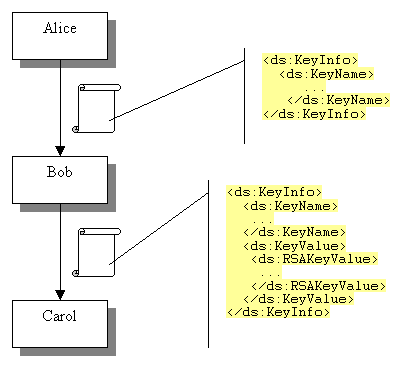
1.1
Editorial and Conformance
Conventions
[11] This specification uses XML Schemas [XML-schema]
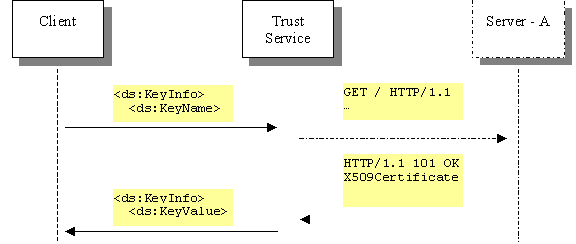
to describe the content model.
[12] The key words "MUST", "MUST NOT", "REQUIRED", "SHALL", "SHALL NOT", "SHOULD",
"SHOULD NOT", "RECOMMENDED", "MAY", and "OPTIONAL" in this specification are to
be interpreted as described in
RFC2119
[KEYWORDS]:
[13] "they MUST only be used where it is actually required for interoperation or
to limit behavior which has potential for causing harm (e.g., limiting
retransmissions)"
[14] Consequently, we use these capitalized keywords to unambiguously specify
requirements over protocol and application features and behavior that affect the
interoperability and security of implementations. These key words are not used
(capitalized) to describe XML grammar; schema definitions unambiguously describe
such requirements and we wish to reserve the prominence of these terms for the
natural language descriptions of protocols and features. For instance, an XML
attribute might be described as being "optional." Compliance with the
XML-namespace specification [XML-NS]
is described as "REQUIRED."
[15] The contributions of the following Working Group members to this
specification are gratefully acknowledged in accordance with the
contributor policies
and the active
WG roster.
- Daniel Ash, Identrus
- Blair Dillaway, Microsoft
- Donald Eastlake 3rd, Motorola
- Yassir Elley, Sun Microsystems
- Jeremy Epstein, webMethods
- Stephen Farrell, Baltimore (Co-Chair)
- Phillip Hallam-Baker, VeriSign Inc. (Editor)
- Loren Hart, VeriSign Inc.
- Mack Hicks, Bank of America
- Merlin Hughes, Baltimore
- Frederick Hirsch, Nokia Mobile Phones
- Mike Just, Treasury Board of Canada Secretariat
- Brian LaMacchia, Microsoft
- Pradeep Lamsal
- Shivaram Mysore, Sun Microsystems (Co-Chair)
- Joseph Reagle, W3C
- Dave Remy, GeoTrust, Inc.
- Peter Rostin, RSA Security Inc.
- Ed Simon, XMLsec Inc.
- Slava Galperin, Sun Microsystems
[16] The authors also acknowledge the extensive assistance provided in the design
stage of this specification by David Solo (CitiGroup), and the contributions of
Jeremy Epstein, (webMethods), Andrew Layman (Microsoft), Dr Paul Boisen
(NSA), Dan Guinan, Marc Hayes, Alex Deacon, Mingliang Pei (VeriSign).
[17] The following terms are used within this document with the particular meaning
indicated below:
[18]
Service
An application that provides computational or informational resources
on request. A service may be provided by several physical servers operating as
a unit.
[19]
Web service
A service that is accessible by means of messages sent using standard
web protocols, notations and naming conventions
[20]
Client
An application that makes requests of a service. The concept of
'client' is relative to a service request; an application may have the role of
client for some requests and service for others.
[21] No provision is made for an explicit version number in this syntax. If a
future version is needed, it will use a different namespace. The XML namespace
[XML-ns] URI that MUST be used by implementations of
this (dated) specification is:
http://www.w3.org/2002/03/xkms#
[22] This namespace is also used as the prefix for algorithm identifiers used by
this specification. While applications MUST support XML and XML namespaces,
the use of internal entities [XML] or the "xkms" XML
namespace prefix and defaulting/scoping conventions are OPTIONAL; we use these
facilities to provide compact and readable examples.
[23] In this document, certain namespace prefixes represent certain namespaces
in the schema fragments (shown on a yellow background) as follows:
| Prefix |
Specification |
Schema |
| |
XML Schema |
http://www.w3.org/2001/XMLSchema |
| ds |
XML Signature |
http://www.w3.org/2000/09/xmldsig# |
| xenc |
XML Encryption |
http://www.w3.org/2001/04/xmlenc# |
| xkms |
XKMS |
http://www.w3.org/2002/03/xkms# |
[24] For clarity, some examples of XML are not complete documents and namespace
declarations may be omitted from XML fragments.
[25] In all examples (shown on a light blue background) and in the body of the
text the default namespace refers to the xkms namespace itself. This means
that namespace prefixes are omitted for all element names, type names and
QNames in the xkms namespace. For example the QName
xkms:Success is referred to using the local name part
Success alone.
[26] These namespaces are declared in the XKMS schema as follows:
<?xml version="1.0"?>
<schema targetNamespace="http://www.w3.org/2002/03/xkms#"
      xmlns="http://www.w3.org/2001/XMLSchema"
      xmlns:xenc="http://www.w3.org/2001/04/xmlenc#"
      xmlns:ds="http://www.w3.org/2000/09/xmldsig#"
      xmlns:xkms="http://www.w3.org/2002/03/xkms#"
      elementFormDefault="qualified" attributeFormDefault="unqualified">
   <import namespace="http://www.w3.org/2000/09/xmldsig#"
         schemaLocation="xmldsig-core-schema.xsd"/>
   <import namespace="http://www.w3.org/2001/04/xmlenc#"
         schemaLocation="xenc-schema.xsd"/>
   <annotation>
      <documentation xml:lang="en">
              XML Schema for XKMS 2.0 Last Call Candidate 2003
      </documentation>
   </annotation>
   <!-- /Namespace -->
...
   <!-- End Schema -->
</schema>
[27] Internet Protocol addresses and Domain Name System names used in examples are
purposely chosen to avoid confusion with assigned addresses and names. All
Internet Protocol Addresses are in the reserved non-routable network 10.x.x.x.
All DNS names are in the reserved domain example.com.
[28] X-KISS allows a client to delegate part or all of the tasks required to
process XML Signature [XML-SIG]
<ds:KeyInfo>
elements to an XKMS service. A key objective of the protocol design is to
minimize the complexity of applications using XML Signature
[XML-SIG]. By becoming a client of the XKMS service, the application is
relieved of the complexity and syntax of the underlying PKI used to establish
trust relationships, which may be based upon a different specification such as
X.509/PKIX, SPKI or PGP.
[29] By design, the XML Signature specification [XML-SIG]
does not mandate use of a particular trust policy. The signer of a document is
not required to include any key information but may include a
<ds:KeyInfo>
element that specifies the key itself, a key name, X.509 certificate, a PGP key
identifier etc. Alternatively, a link may be provided to a location where the
full <ds:KeyInfo> information may be found.
[30] The information provided by the signer may therefore be insufficient by
itself to perform cryptographic verification and decide whether to trust the
signing key, or the information may not be in a format the client can use. For
example:
- The key may be specified by a name only.
- The local trust policy of the client may require additional information in
order to trust the key.
- The key may be encoded in an X.509 certificate that the client cannot
parse.
[31] In the case of an encryption operation:
- The client may not know the public key of the recipient.
[32] X-KRSS describes a protocol for registration and subsequent management of
public key information. A client of a conforming service may request that the
registration service bind information to a public key. The information bound may
include a name, an identifier or extended attributes defined by the
implementation.
[33] The key pair to which the information is bound may be generated in advance by
the client or on request generated by the service. The Registration protocol may
also be used for subsequent management operations including recovery of the
private key and reissue or revocation of the key binding.
[34] The protocol provides for authentication of the applicant and, in the case
that the key pair is generated by the client, Proof of Possession (POP) of the
private key. A means of communicating the private key to the client is provided
in the case that the private key is generated by the registration service.
[35] This document specifies means of registering RSA and DSA keys and a framework
for extending the protocol to support other cryptographic algorithms such as
Diffie-Hellman and Elliptic Curve variants.
[36] The remainder of this document describes the XML Key Information Service
Specification and XML Key Registration Service Specification.
-
Section 2: Protocol Exchanges
- Features of the XKMS protocol that are common to the XKMS services are described
-
Section 3: Message Syntax
- The common syntax elements shared by XKMS messages are described
- Section 4: Key Information Service Specification Overview.
- The functional behavior of the X-KISS service is described.
-
Section 5: Key Information Service Specification Message Set.
- The semantics of the X-KISS protocol messages are defined.
-
Section 6: Key Registration Service Specification Overview.
- The functional behavior of the X-KRSS service is described.
-
Section 7: Key Registration Service Specification Message Set.
- The semantics of the X-KRSS protocol messages is defined.
-
Section 8: Cryptographic Algorithm Specific Parameters
- Parameters and data formats specific to the use of particular
cryptographic algorithms are defined.
-
Section 9: Conformance
- Conformance criteria for compliant XKMS 2.0 applications are specified.
- Section 10: Security Considerations
- Security considerations for implementation and deployment of XKMS are
described
[37] XKMS protocol exchanges consist of a sequence of either one or two request
response pairs.
[38] XKMS protocol messages share a common format that may be carried within a
variety of protocols. A binding to the SOAP [SOAP][XMLP]
message protocol is provided in Part II: Protocol Bindings. It is recommended
XKMS implementers support SOAP over HTTP for interoperability purposes. XKMS is
transport protocol agnostic however and MAY be layered over any SOAP transport.
[39] Implementers MAY implement bindings to other protocols at their option.
[40] No XKMS operations are idempotent, that is all XKMS requests MAY cause a
change of state.
[41]
Part II of this specification describes the
XKMS Security Protocol bindings.
[42] The XKMS protocol consists of pairs of requests and responses. The XKMS
protocol binding allows for the case in which an additional request/response
round trip is required to support cases such as pending responses and 2 phase
requests for replay attack protection.
[43] Each XKMS response message contains a
MajorResult
code that determines whether the response is final or further processing is
required. The protocol is specified in the CSP formalism [CSP]
as follows:
-
Final = { Success, VersionMismatch,
Sender, Receiver }
-
-
Request
→
Result.Final
- |
-
Request
→
Result.Pending→PendingNotification→Request→Result.Final
- |
-
Request
→
Result.Represent→Request→Result.Final
[44] The following sections describe the message protocol and the message
processing steps taken by both parties in each of the message
[45] The following processing steps are taken with respect to all messages
regardless of whether they are a request or a response:
- Generation
-
ID is set to a randomly generated unique value
-
Service is set to the value of the URI to which
the XKMS request is directed
Authentication Signature is generated (if required).
- Processing
- The value of Service is verified
The Authentication Signature value is verified (if required)
<?xml version="1.0" encoding="utf-8"?>
<MessageAbstractType Id="1noOYHt5Lx7xUuizWZLOMw=="
      Service="http://test.xmltrustcenter.org/XKMS"
      xmlns="http://www.w3.org/2002/03/xkms#" />
[46] The XKMS specification defines three types of request:
- X-KISS Request
- A Locate or Validate request as specified by the Key Information Service
Specification
- X-KRSS Request
- A Register, Reissue, Revoke or Recover request as specified by the Key
Registration Service Specification
- Compound Request
- A compound request consists of a set of one or more X-KISS or X-KRSS
requests.
[47] The XKMS protocol supports a number of protocol options, including
asynchronous processing, two-phase requests and compound requests. The client
specifies the protocol options it supports in relation to a specific request
through ResponseMechanism
elements in the request.
[48] The means by which the service specifies protocol options which it accepts is
outside the scope of this document. If the mechanism used for this purpose uses
URI based identifiers for this purpose the following identifiers SHOULD be used:
- Asynchronous Processing
- http://www.w3.org/2002/03/xkms#Asynchronous
- Two Phase Request Protocol
- http://www.w3.org/2002/03/xkms#Represent
- Compound Requests and Responses
- http://www.w3.org/2002/03/xkms#Compound
[49] All XKMS responses contain a Result code comprised of a major and minor
component. If a service applies a protocol processing option the client is
informed by means of the MajorResult
code value of the response.
[50] XKMS supports two processing modes, synchronous processing and asynchronous
processing.
- In synchronous processing the service responds to a request such
that it has satisfied its obligation and will issue no more responses with
respect to that request: a response code in the set Final defined
above is returned.
- In asynchronous processing the service will not complete the request
immediately and notifies that the request is not yet satisfied and
subsequent responses will be forthcoming: a response code that is not in the
set Final is returned in intermediate responses.
[51] A client MAY advise a service that it will accept asynchronous processing of
a request by specifying the ResponseMechanism value
Pending. An XKMS service that receives a request that specifies the
ResponseMechanism value
Pending MAY respond either synchronously or asynchronously. If the
service is to respond asynchronously it advises the client that the response value
will be returned asynchronously by specifying the
MajorResult
code Pending.
[52] An XKMS service MUST NOT return the
MajorResult
code Pending unless the
ResponseMechanism
value Pending was specified in the
corresponding request. If an XKMS service receives a request that cannot be
processed synchronously and the ResponseMechanism
value Pending is not specified the MajorResult
code Receiver and MinorResult
code NotSynchronous are returned.
[53] Asynchronous processing MAY be used to allow administrator intervention
during the processing of a request. For example an administrator might be
required to verify and approve all XKRSS Registration requests before they are
processed.
[54] Processing of a synchronous Request and Response takes place as follows:
- Requestor generation of the Request Message
-
Nonce and
OriginalRequestID are not present
ResponseMechanism values Represent
and/or Pending
MAY be specified
- Service processing of the Request Message
-
Verify that request meets service authorization policy
Process request to completion
- Service generation of the Response Message
-
RequestID is set to the value of
Id
in the request message
-
Nonce is not present
MajorResult is set to a Final result value.
- Requestor processing of the Response Message
-
The value of RequestID is verified
<?xml version="1.0" encoding="utf-8"?>
<LocateRequest Id="I057aebd1d5a217aaeb5382ae2255762e"
      Service="http://test.xmltrustcenter.org/XKMS"
      xmlns="http://www.w3.org/2002/03/xkms#">
  <QueryKeyBinding />
</LocateRequest>
<?xml version="1.0" encoding="utf-8"?>
<LocateResult Id="I22921e0a971e5b77e18df10d765426f2"
      Service="http://test.xmltrustcenter.org/XKMS" ResultMajor="Success"
      RequestId="#I057aebd1d5a217aaeb5382ae2255762e"
      xmlns="http://www.w3.org/2002/03/xkms#" />
[55] Asynchronous processing consists of a sequence of two request/response pairs,
an initial request which specifies the request values and a pending request
which obtains the result of the operation.
2.5.1 Initial Request
[56] The initial request message is processed as follows:
- Requestor generation of the Initial Request Message
-
Nonce and
OriginalRequestID are not present
ResponseMechanism value Pending
MUST be specified
- Service processing of the Initial Request Message
-
Schedule request for asynchronous processing
- Service generation of the Initial Response Message
-
RequestID is set to the value
Id
in the initial request message
-
Nonce is not present
-
MajorResult is set to Pending
- Requestor processing of the Initial Response Message
-
Register request as pending completion, wait for notification.
2.5.2 Pending Request
[57] On notification the client requests the return of the result values by
issuing a PendingRequest message as follows:
- Requestor generation of the Pending Request Message
- The request element is PendingRequest
-
OriginalRequestID is set to the value of
Id
in the initial request message
ResponseID is set to value of
Id
in the initial response message
- Service processing of the Pending Request Message
-
Match pending request to pending response
- Service generation of the Pending Response Message
-
RequestID is set to the value of
Id
in the Pending request message
-
Nonce is not present
-
ResponseID is set to a randomly generated unique
value
- Requestor processing of the Pending Response Message
-
If MajorResult is set to a non-final
value consider it to be failure
[58] The client MAY request the return of the result values before processing
has been completed. In this case the service responds to the Pending Request
with the MajorResult code Pending.
<?xml version="1.0" encoding="utf-8"?>
<LocateRequest Id="Iafc99372c44971799919a28e60a839dc"
      Service="http://test.xmltrustcenter.org/XKMS"
      xmlns="http://www.w3.org/2002/03/xkms#">
  <ResponseMechanism>Pending</ResponseMechanism>
  <QueryKeyBinding />
</LocateRequest>
<?xml version="1.0" encoding="utf-8"?>
<LocateResult Id="Iae4eddb4a79c022a61affa1d1cf5b8d1"
      Service="http://test.xmltrustcenter.org/XKMS" ResultMajor="Pending"
      RequestId="#Iafc99372c44971799919a28e60a839dc"
      xmlns="http://www.w3.org/2002/03/xkms#" />
<?xml version="1.0" encoding="utf-8"?>
<Result xmlns:ds="http://www.w3.org/2000/09/xmldsig#"
      xmlns:xenc="http://www.w3.org/2001/04/xmlenc#"
      xmlns="http://www.w3.org/2002/03/xkms#"/>
2.5.3.4 Pending Request
<?xml version="1.0" encoding="utf-8"?>
<PendingRequest Id="I7d16f3c478266de4585cf4a145affb15"
      Service="http://test.xmltrustcenter.org/XKMS"
      OriginalRequestId="#Iafc99372c44971799919a28e60a839dc"
      xmlns="http://www.w3.org/2002/03/xkms#" />
<?xml version="1.0" encoding="utf-8"?>
<LocateResult Id="I7c1b5ceef4ba6746feaf52487a74e031"
      Service="http://test.xmltrustcenter.org/XKMS" ResultMajor="Success"
      RequestId="#I7d16f3c478266de4585cf4a145affb15"
      xmlns="http://www.w3.org/2002/03/xkms#" />
[59] XKMS requests may employ a two phase request protocol to protect against a
denial of service attack. The two phase request protocol allows the service to
perform a lightweight authentication of the source of an XKMS request,
specifically the service determines that the client is able to read messages
sent to the purported source address. Although this mechanism provides only a
weak form of authentication it prevents an attacker performing a Denial of
Service attack by forcing the service to perform a resource intensive form of
authentication such as the verification of a digital signature.
[60] The two-phase protocol consists of two phases as follows:
[61] In the first phase the requestor presents the request and the service
responds the MajorResult value
Represent
and presents a nonce.
[62] In the second phase the requestor represents the original request together
with the nonce.
[63] A client MAY advise a service that it supports the two phase request protocol
by specifying the ResponseMechanism value
Represent. An XKMS service advises the client that the use of the two
phase request protocol is required by specifying the
MajorResult
code Represent.
[64] An XKMS service MUST NOT return the
MajorResult
code Represent unless the
ResponseMechanism
value Represent was specified in the corresponding
request. If an XKMS service requires the use of the Two Phase Request protocol
and the ResponseMechanism value
Represent
is not specified in the corresponding request the MajorResult
code Sender and MinorResult
codeRepresentRequiredare returned.
[65] The Two Phase request protocol bears some similarity to asynchronous request
processing. Both mechanisms introduce an extra protocol round trip but each
serve different purposes. The purpose of asynchronous processing is to allow a
delay to be introduced between the initial request and the return of the result.
In the two phase request protocol however there is no delay between the first
request and the first response or between the first response and the second
request. The purpose of the two phase request protocol is to allow a service to
protect itself against a denial of service attack by allowing the service to
perform a lightweight authentication of the source of the request.
[66] The service SHOULD verify that the nonce value specified in a second phase
request was recently generated by the service. The service MAY verify that the
nonce value has not been previously responded to. The actual construction of the
nonce value is outside the scope of this specification and may be chosen as site
specific circumstances dictate. The techniques described in the section
Construction of Nonce Values describe a technique that reduces or avoids the
need to maintain server state in order to meet this requirement.
2.6.1 Processing Steps
[67] In the first phase of the two phase protocol the processing steps specified
for the single phase case are performed with the following exceptions:
- Requestor generation of the Phase 1 Request Message
-
ResponseMechanism value Represent
MUST be specified
- Service processing of the Phase 1 Request Message
-
Service decides to exercise option to require Two Phase Processing
-
Request is NOT processed
- Service generation of the Phase 1 Response Message
-
RequestID is set to the value
Id
in the Phase 1 request message
-
Nonce value is set in accordance with service
replay protection requirements
-
MajorResult is set to Represent
- Requestor processing of the Phase 1 Response Message
-
Proceed to phase 2
[68] In the Second phase of the two phase protocol the processing steps specified
for the single phase case are performed with the following exceptions:
- Requestor generation of the Phase 2 Request Message
-
OriginalRequestID set to the value of
Id
in the Phase 1 request message
Nonce value is set to the value of
Nonce
in the Phase 1 response message
- Service processing of the Phase 2 Request Message
-
Verify value of Nonce
-
Verify that request meets service authorization policy
Process request to completion
- Service generation of the Phase 2 Response Message
-
RequestID is set to the value of
Id
in the Phase2 request message
-
Nonce is not present
MajorResult is set to a Final result value
- Requestor processing of the Phase 2 Response Message
-
If MajorResult set to a non-final value
consider to be failure
[69] Nonce values may be constructed in any manner that the service chooses. It
may be useful to construct the nonce so as to permit the service to determine that
they were generated by the server at a specific time in a computationally
efficient manner as follows.
[70] The nonce is constructed from the current time at the service, a unique
serial number and a secret key known only to the service using a Message
Authentication Code as follows:
[71]
nonce = time + serial + M ( time +
serial , k )
[72] The service may limit the time interval in which replay attacks are possible
by rejecting nonce values that specify an unacceptable time value or an
incorrect MAC value.
[73] The service may prevent replay attacks completely by tracking the serial
numbers for which responses have already been given, using the nonce time
construction value to limit the interval over which the serial number is
tracked.
[74] The nonce value may be encrypted to avoid leaking information such as the
serial number value which might be of interest to an attacker.
<?xml version="1.0" encoding="utf-8"?>
<LocateRequest Id="I1c52d3b1b0bfa6ab5d0a5a95b8855405"
      Service="http://test.xmltrustcenter.org/XKMS"
      xmlns="http://www.w3.org/2002/03/xkms#">
  <ResponseMechanism>Represent</ResponseMechanism>
  <QueryKeyBinding />
</LocateRequest>
<?xml version="1.0" encoding="utf-8"?>
<LocateResult Id="I189757537058dfbc924e3b52fda3b2d1"
      Service="http://test.xmltrustcenter.org/XKMS"
      Nonce="l7Y8sQ7DQFaq8bcSy0/wTA==" ResultMajor="Represent"
      RequestId="#I1c52d3b1b0bfa6ab5d0a5a95b8855405"
      xmlns="http://www.w3.org/2002/03/xkms#" />
<?xml version="1.0" encoding="utf-8"?>
<LocateRequest Id="I87fc7ad7c245db9d9cb9fe1a8c937c85"
      Service="http://test.xmltrustcenter.org/XKMS"
      Nonce="l7Y8sQ7DQFaq8bcSy0/wTA=="
      OriginalRequestId="#I1c52d3b1b0bfa6ab5d0a5a95b8855405"
      xmlns="http://www.w3.org/2002/03/xkms#">
  <QueryKeyBinding />
</LocateRequest>
<?xml version="1.0" encoding="utf-8"?>
<LocateResult Id="I5981cc47b8fd0637db5455249f19a3de"
      Service="http://test.xmltrustcenter.org/XKMS" ResultMajor="Success"
      RequestId="#I87fc7ad7c245db9d9cb9fe1a8c937c85"
      xmlns="http://www.w3.org/2002/03/xkms#" />
[75] The Two Phase Protocol may be combined with Asynchronous Processing. In this
case the operation will consist of three round trips as follows:
- Initial Request / Phase 1
- Initial Request / Phase 2
- Pending Response
[76] Message processing is performed as described above with the following
exceptions.
-
OriginalRequestID set to that value of
Id
in Initial Request / Phase 1 in both subsequent requests.
-
Nonce value is set to the value of
Nonce
in Phase 1 response in both subsequent requests.
[77] An XKMS service MAY support processing of Compound Requests. A compound request
permits multiple XKMS requests to be made at the same time. A compound request
consists of an outer request and one or more inner requests. There is no
ordering implicit in the inner requests. The semantics of making a set of
requests as a compound request are exactly the same as if each individual
request in the set had been made separately and simultaneously.
[78] The response to a compound request is a compound response. A compound
response consists of an outer response and zero or more inner responses. If the
ResultMajor
value of the outer response is Success the compound
response SHOULD contain an inner response response element corresponding to each
inner request element of the compound request. If the the
ResultMajor value of the outer response is not
Success
the response MUST NOT contain any inner responses. If a compound response has an
outer ResultMajor value Success
but does not contain a response corresponding to an inner request the
ResultMajor
value failure is assumed for that inner request.
[79] An XKMS service MAY support the use of the two phase protocol on the outer
request of a compound response. The two phase protocol SHOULD NOT be used on an
inner response. If an inner request specifies the
ResponseMechanism
value Represent the value SHOULD be ignored.
[80] An XKMS service MAY support the use of asynchronous processing in conjunction
with a compound request. Asynchronous processing MAY be performed on the
compound request as a whole, on individual inner requests or both.
[81] If asynchronous processing is to be performed on the compound request as a
whole the outer request specifies the ResponseMechanism
value Pending. If the service decides to return
an asynchronous response a compound response is returned with a ResultMajor code
of Pending. After the appropriate notification has taken
place the client issues a PendingRequest message for
the outer request to which the service replies with a compound response
returning either the inner responses corresponding to the original inner
requests or an error report.
[82] If asynchronous processing is performed on the individual inner requests each
inner request for which an asynchronous response is to be accepted specifies the
ResponseMechanism value Pending. If the
service decides to return an asynchronous response to an inner request a
compound response is returned with an outer ResultMajor
code of Success and and inner
ResultMajor
code of Pending for the requests for which an
asynchronous response is to be issued. A service MAY return synchronous and
asynchronous responses in a single compound response.
[83] Since the semantics of a compound request are exactly the same as if each
inner request were made separately a client MAY issue separate pending requests
to obtain the results of the inner requests of a previous compound request.
Alternatively a client MAY issue a compound request containing multiple inner
pending requests corresponding to requests which were originally made
independently.
<?xml version="1.0" encoding="utf-8"?>
<CompoundRequest Id="I177c3e9e8b072a0c3a1ef283e6c379d6"
      Service="http://test.xmltrustcenter.org/XKMS"
      xmlns="http://www.w3.org/2002/03/xkms#">
  <LocateRequest Id="I48c98378370667d484a2ebf17fef8d3e"
        Service="http://test.xmltrustcenter.org/XKMS">
    <RespondWith>KeyValue</RespondWith>
    <QueryKeyBinding>
      <KeyInfo xmlns="http://www.w3.org/2000/09/xmldsig#">
        <X509Data>
          <X509Certificate>MIICAjCCAW+gAwIBAgIQlzQovIEbLLhMa8K5MR/juzAJBgUrDg
                MCHQUAMBIxEDAOBgNVBAMTB1Rl
c3QgQ0EwHhcNMDIwNjEzMjEzMzQxWhcNMzkxMjMxMjM1OTU5WjAsMSowKAYDVQQGEyFVUyBPPUFs
aWNlIENvcnAgQ049QWxpY2UgQWFyZHZhcmswgZ8wDQYJKoZIhvcNAQEBBQADgY0AMIGJAoGBAMoy
4c9+NoNJvJUnV8pqPByGb4FOJcU0VktbGJpO2imiQx+EJsCt27z/pVUDrexTyctCWbeqR5a40JCQ
mvNmRUfg2d81HXyA+iYPl4L6nUlHbkLjrhPPtMDSd5YHjyvnCN454+Hr0paA1MJXKuw8ZMkjGYsr
4fSYpPELOH5PDJEBAgMBAAGjRzBFMEMGA1UdAQQ8MDqAEEVr1g8cxzEkdMX4GAlD6TahFDASMRAw
DgYDVQQDEwdUZXN0IENBghBysVHEiNFiiE2lxWvmJYeSMAkGBSsOAwIdBQADgYEAKp+RKhDMIVIb
ooSNcoIeV/wVew1bPVkEDOUwmhAdRXUA94uRifiFfmp9GoN08Jkurx/gF18RFB/7oLrVY+cpzRoC
ipcnAnmh0hGY8FNFmhyKU1tFhVFdFXB5QUglkmkRntNkOmcb8O87xO0XktmvNzcJDes9PMNxrVtC
hzjaFAE=</X509Certificate>
        </X509Data>
      </KeyInfo>
      <KeyUsage>Signature</KeyUsage>
    </QueryKeyBinding>
  </LocateRequest>
  <LocateRequest Id="Ia021defa6657d1ee87cb7d6d4b0e860b"
        Service="http://test.xmltrustcenter.org/XKMS">
    <RespondWith>KeyName</RespondWith>
    <RespondWith>KeyValue</RespondWith>
    <RespondWith>X509Cert</RespondWith>
    <RespondWith>X509Chain</RespondWith>
    <RespondWith>PGPWeb</RespondWith>
    <RespondWith>PGP</RespondWith>
    <QueryKeyBinding>
      <KeyUsage>Encryption</KeyUsage>
      <UseKeyWith Application="urn:ietf:rfc:2440"
            Identifier="bob@bobcorp.test" />
      <UseKeyWith Application="urn:ietf:rfc:2633"
            Identifier="bob@bobcorp.test" />
    </QueryKeyBinding>
  </LocateRequest>
</CompoundRequest>
<?xml version="1.0" encoding="utf-8"?>
<CompoundResult Id="I126a0ffdece8a7af49e2f8bdc1922a47"
      Service="http://test.xmltrustcenter.org/XKMS" ResultMajor="Success"
      RequestId="#I177c3e9e8b072a0c3a1ef283e6c379d6"
      xmlns="http://www.w3.org/2002/03/xkms#">
  <LocateResult Id="I01f8a31124525004089453b949ea5190"
        Service="http://test.xmltrustcenter.org/XKMS" ResultMajor="Success"
        RequestId="#I48c98378370667d484a2ebf17fef8d3e">
    <UnverifiedKeyBinding Id="Ic61421530ba29a9bd86d8fe1bd15e1a3">
      <KeyInfo xmlns="http://www.w3.org/2000/09/xmldsig#">
        <KeyValue>
          <RSAKeyValue>
            <Modulus>zvbTdKsTprGAKJdgi7ulDR0eQBptLv/SJNIh3uVmPBObZFsLbqPwo5ny
                  LOkzWlEHNbShPMRp1qFr
AfF13LMmeohNYfCXTHLqH1MaMOm+BhXABHB9rUKaGoOBjQPHCBtHbfMGQYjznGTpfCdTrUgq8VNl
qM2Ph9XWMcc7qbjNHw8=</Modulus>
            <Exponent>AQAB</Exponent>
          </RSAKeyValue>
        </KeyValue>
      </KeyInfo>
      <KeyUsage>Signature</KeyUsage>
      <KeyUsage>Encryption</KeyUsage>
      <KeyUsage>Exchange</KeyUsage>
      <UseKeyWith Application="urn:ietf:rfc:2633"
            Identifier="alice@alicecorp.test" />
    </UnverifiedKeyBinding>
  </LocateResult>
  <LocateResult Id="I98abfd54acaa007f22a6cc2f1c8b6dff"
        Service="http://test.xmltrustcenter.org/XKMS" ResultMajor="Success"
        RequestId="#Ia021defa6657d1ee87cb7d6d4b0e860b">
    <UnverifiedKeyBinding Id="I812706fe8692ecd74eba96658c268b65">
      <KeyInfo xmlns="http://www.w3.org/2000/09/xmldsig#">
        <KeyValue>
          <RSAKeyValue>
            <Modulus>4i0BEhQ8Jc4tjwZYbvtMyYfBrIGOMx34K4Cdo2pAzoGnV679FLmGHWnQ
                  y2cSj39hf5D1mIaPyD3j
/33TdfglTaaKqp7IPf6ei754fOuI/r1HpX7uqsw+j9LC4Z7GnG3yoY/eBJOZ8TRwMnx+MkwmopXP
VLvhMWRyiUOcO3SEkTE=</Modulus>
            <Exponent>AQAB</Exponent>
          </RSAKeyValue>
        </KeyValue>
        <X509Data>
          <X509Certificate>MIIB+zCCAWigAwIBAgIQhzf6GHdFobRCYrjlFTCekjAJBgUrDg
                MCHQUAMBIxEDAOBgNVBAMTB1Rl
c3QgQ0EwHhcNMDIwNjEzMjEzMzQyWhcNMzkxMjMxMjM1OTU5WjAlMSMwIQYDVQQGExpVUyBPPUJv
YiBDb3JwIENOPUJvYiBCYWtlcjCBnzANBgkqhkiG9w0BAQEFAAOBjQAwgYkCgYEAtw2qGqYbO0aK
eZFb0Z3verx3Cp+KS94LiHG09D1DdgTd48FZaB5eXa4U3mLax2/Fsg/cxGZkXJur0YylS8QvRuX+
9STQgiFTO277sHFfRMvtFsuQ56ovrQWH/KoGQZssMUIqO2aN2cbMQJST3a2HZuxqPQ1rwXxHrEoA
XHZv3ysCAwEAAaNHMEUwQwYDVR0BBDwwOoAQRWvWDxzHMSR0xfgYCUPpNqEUMBIxEDAOBgNVBAMT
B1Rlc3QgQ0GCEHKxUcSI0WKITaXFa+Ylh5IwCQYFKw4DAh0FAAOBgQCieDKjvNCo7MPsgUwHydki
d4KnulcuBbZet87lcIA7ReH1qEK4s0p49po2UM69eWG7hfv8LW2Ga8HiEexTwLDFBvH2g7f09xI/
vYgPw4qhJfWoZuY/HWHUzZIRSoggipndVfdvUkmsFSx1rR4FMu0mYBjq79OkYsmwISQlaXejUg==<
      /X509Certificate>
          <X509Certificate>MIIB9zCCAWSgAwIBAgIQcrFRxIjRYohNpcVr5iWHkjAJBgUrDg
                MCHQUAMBIxEDAOBgNVBAMTB1Rl
c3QgQ0EwHhcNMDIwNjEzMjEzMzQxWhcNMzkxMjMxMjM1OTU5WjASMRAwDgYDVQQDEwdUZXN0IENB
MIGfMA0GCSqGSIb3DQEBAQUAA4GNADCBiQKBgQDPF33VmCmSSFufPnu0JdFaKsPHsx0ee+OYedhM
xVh3LXMkMNC++JWDva7H+E9o+uj7dt5cwxHSePsyxPx3Vq+AbEZOsYxGxXgf4OuGb8ONBv3B5c8h
raOg24c5hjFS6tfNzoiatLVKHeOmPnifhkBI8h8LD7dLHsHfKUrVNwIJNQIDAQABo1YwVDANBgNV
HQoEBjAEAwIHgDBDBgNVHQEEPDA6gBBFa9YPHMcxJHTF+BgJQ+k2oRQwEjEQMA4GA1UEAxMHVGVz
dCBDQYIQcrFRxIjRYohNpcVr5iWHkjAJBgUrDgMCHQUAA4GBAAynWUPRSbabAEuX0Z8kKN/C2GoE
uULW73QxX6Q0PHAatRM6G9ZnzU+ce3lELgOj0Usw/xC9Y+2FMgj68rIas+DId5JMMj+SIZEUV1vP
PTEiEQ16Gxz9piUQoFljhI22hEl8ki0hIJlFGnki+K9dhv/7trMrfKSSHAPIDQZuz01P</X509Cer
      tificate>
        </X509Data>
      </KeyInfo>
      <KeyUsage>Signature</KeyUsage>
      <KeyUsage>Encryption</KeyUsage>
      <KeyUsage>Exchange</KeyUsage>
      <UseKeyWith Application="urn:ietf:rfc:2633"
            Identifier="bob@bobcorp.test" />
    </UnverifiedKeyBinding>
  </LocateResult>
</CompoundResult>
[84] The security concerns that an XKMS service is required to address are
dependent on the specific service deployment. For example a free XKMS Location
service may not require controls for Request Authentication or to prevent
Request Replay attacks while a paid Validate service might. The application of
security enhancements is addressed in Part II
which describes the application of the following security enhancements:
- Confidentiality
- Request Authentication
- Response Authentication
- Transitive Authentication
- Response Replay
- Request Substitution
- Request Replay
- Denial of Service
[85] The use of security enhancements is further discussed in the section
Security Considerations below.
3 Message Syntax
3.1 Message Base
[86] The MessageAbstractType abstract type is the type
from which all XKMS message element types are derived. The
MessageAbstractType
abstract type contains the following element and attributes
-
<ds:Signature>
[Optional]
- An XML Signature [XML-SIG] in enveloped mode. The
scope of the signature is the entire request message (i.e. the element
derived from MessageAbstractType) and is specified using a reference to the
Id attribute specified in the MessageAbstractType
abstract type.
-
<MessageExtension> [Any Number]
- An extension element derived from the
MessageExtensionAbstractType.
-
<OpaqueClientData> [Optional]
- Data specified by the client that is opaque to the service. An XKMS
service SHOULD return the value of the <OpaqueClientData>
element unmodified in a request in a response with status code Success.
-
Id [Required]
- A unique identifier generated by the originator.
-
Service
[Required]
- The URI of the Web Service port to which the request is addressed
-
Nonce
[Optional]
- Cryptographically random data used to defend against replay attack.
[87] The following schema defines the MessageAbstractType
abstract type:
   <!-- MessageAbstractType -->
   <complexType name="MessageAbstractType" abstract="true">
      <sequence>
         <element ref="ds:Signature" minOccurs="0"/>
         <element ref="xkms:MessageExtension" minOccurs="0"
               maxOccurs="unbounded"/>
         <element ref="xkms:OpaqueClientData" minOccurs="0"/>
      </sequence>
      <attribute name="Id" type="ID" use="required"/>
      <attribute name="Service" type="anyURI" use="required"/>
      <attribute name="Nonce" type="base64Binary" use="optional"/>
   </complexType>
   <!-- /MessageAbstractType -->
[88] An XML Signature [XML-SIG] in enveloped mode. The
scope of the signature is the entire request message (i.e. the element
derrived from MessageAbstractType) and is specified using a reference to
the Id attribute specified in the
MessageAbstractType
abstract type. The empty identifier "" MUST NOT be used.
[89] Validation of XML Signatures MUST be done independent of any ancestral XML
context of the message. This may be achieved by:
- Isolating the XKMS message from any 'wrapper' (eg. SOAP) before
validation, or;
- Specifying a canonicalization algorithm, such as Exclusive XML
Canonicalization, in <SignedInfo>:<CanonicalizationMethod>
to exclude ancestral XML context during the validation of the message.
[90] For interoperability purposes XKMS implementations MUST support the use of
Exclusive XML Canonicalization.
[91] The <ds:Signature> element is specified in the XML
Signature specification [XML-SIG].
[92] The <MessageExtension> element is an abstract element
of the abstract type MessageExtensionAbstractType. Implementations may define
subclasses of the MessageExtensionAbstractType to define message extension
elements that may be applied to any XKMS message.
[93] The following schema defines the MessageExtension
element:
   <!-- MessageExtension -->
   <element name="MessageExtension" type="xkms:MessageExtensionAbstractType"
         abstract="true"/>
   <complexType name="MessageExtensionAbstractType" abstract="true"/>
   <!-- /MessageExtension -->
[94] The <OpaqueClientData> contains data specified by the
client that is opaque to the service. An XKMS service SHOULD return the value of
an <OpaqueClientData> element specified in a request
unmodified in the corresponding response.
[95] A client MAY use Opaque client data in conjunction with asynchronous request
processing to match a responses to the original request context. Opaque client
data MAY also be used in conjunction with synchronous request processing to
provide context information for purposes such as audit trail reconciliation.
[96] The following schema defines the OpaqueClientData
element:
   <!-- OpaqueClientData -->
   <element name="OpaqueClientData" type="xkms:OpaqueClientDataType"/>
   <complexType name="OpaqueClientDataType">
      <sequence maxOccurs="unbounded">
         <element ref="xkms:OpaqueData" minOccurs="0"/>
      </sequence>
   </complexType>
   <element name="OpaqueData" type="base64Binary"/>
   <!-- /OpaqueClientData -->
3.2 Request Message
[97] The RequestAbstractType abstract type is the type
from which all XKMS request element types are derived. The
RequestAbstractType
abstract type inherits the element and attributes of the
MessageAbstractType
abstract type and in addition contains the following attributes
-
<ResponseMechanism>
[Any Number]
- Specifies the extended protocol mechanisms that the client supports in
connection with this request.
-
<RespondWith>
[Any Number]
- Specifies the types of data the recipient requests to be sent in the
response.
-
<PendingNotification>
[Optional]
- Specifies a means by which the service may notify the requestor of the
completion of a pending response. If the
<PendingNotification>
element is present the value Pending MUST be
specified as a <ResponseMechanism> value.
-
OriginalRequestID [Optional]
- Specifies the value Id of the first request
made in a multi-stage protocol such as the asynchronous processing mechanism
or Two Phase protocol.
-
ResponseLimit [Optional]
- Specifies the maximum number of data items the requestor can accept in
the case that the schema specifies an unbounded number of elements.
[98] The following schema defines the RequestAbstractType
abstract type:
   <!-- RequestAbstractType -->
   <complexType name="RequestAbstractType" abstract="true">
      <complexContent>
         <extension base="xkms:MessageAbstractType">
            <sequence>
               <element ref="xkms:ResponseMechanism" minOccurs="0"
                     maxOccurs="unbounded"/>
               <element ref="xkms:RespondWith" minOccurs="0"
                     maxOccurs="unbounded"/>
               <element ref="xkms:PendingNotification" minOccurs="0"/>
            </sequence>
            <attribute name="OriginalRequestId" type="anyURI"
                  use="optional"/>
            <attribute name="ResponseLimit" type="integer" use="optional"/>
         </extension>
      </complexContent>
   </complexType>
   <!-- /RequestAbstractType -->
[99] The <ResponseMechanism> element in the request
specifies one or more strings included in the request that specify extended
protocol mechanisms that the client supports in connection with a request.
[100]
ResponseMechanism values are specified as QNames, the
following identifiers are defined:
| QName Local Name |
Description
|
|
Pending
|
The requestor is prepared to accept a
response that uses asynchronous processing, i.e. the service MAY return
the MajorResult
code Pending |
|
Represent
|
The requestor is prepared to accept a
response that uses the two phase protocol, i.e. the service MAY return
the
MajorResult code Represent |
|
RequestSignatureValue
|
The requestor is prepared to accept a
response that carries a <RequestSignatureValue>
element. |
[101] The following schema defines the <ResponseMechanism>
element::
   <!-- ResponseMechanism -->
   <element name="ResponseMechanism" type="QName"/>
   <!-- /ResponseMechanism -->
[102] The <RespondWith> element in the request specifies
one or more strings included in the request that specify data elements to be
provided in the <ds:Keyinfo> element of the response.
Each string is a single identifier corresponding to a sub-element of the XML
Signature Specification [XML-SIG]
<ds:Keyinfo>
element or the private key information defined in the section
Cryptographic Algorithm Specific Parameters below. The XML Signature
elements are described here for convenience. The normative reference is the
specification [XML-SIG].
[103] The Service SHOULD return a requested data element if it is available. The
Service MAY return additional data elements that were not requested. In
particular, the service MAY return data elements specified in the request with
the response.
[104]
RespondWith values are specified as QNames, the
following identifiers are defined:
| QName Local Name |
<ds:Keyinfo>
Element
|
Description
|
|
KeyName
|
<ds:KeyName>
|
Key name |
|
KeyValue
|
<ds:KeyValue>
|
Public key parameters |
|
X509Cert
|
<ds:X509Data>
|
X509 Certificate v3 that authenticates the
specified key |
|
X509Chain
|
<ds:X509Data>*
|
X509 Certificate v3 chain that
authenticates the specified key. Note that no ordering is implied in the
returned certificatesa. |
|
X509CRL
|
<ds:X509Data>
|
X509 Certificate Revocation List v2 |
|
OCSP
|
<ds:X509Data>
|
PKIX OCSP token that validates an X509v3
certificate that authenticates the key |
|
RetrievalMethod
|
<ds:RetrievalMethod>
|
Retrieval Method data |
|
PGP
|
<ds:PGPData>
|
PGP key signing data |
|
PGPWeb
|
<ds:PGPData>*
|
Collection of PGP key signing data |
|
SPKI
|
<ds:SPKIData>*
|
SPKI key signing |
|
PrivateKey
|
|
Request that the encrypted private key be
returned in the response. [Used in the X-KRSS protocol] |
[105] For example, a client that has no X.509 processing capability might perform a
Locate operation to obtain the public key parameters and
name information from a <ds:Keyinfo> element that
specifies only a certificate. The RespondWith element
values in this case would be KeyName and
KeyValue.
[106] The following schema defines the <RespondWith>
element::
   <!-- RespondWith -->
   <element name="RespondWith" type="QName"/>
   <!-- /RespondWith -->
[107] The <PendingNotification> element is used to specify
a mechanism by means of which the service can inform a requestor that a pending
request has completed asynchronously.
[108] The <PendingNotification> element contains the
following attributes
-
Mechanism [Required]
- A URI that specifies the protocol by which the notification MAY be made
-
Identifier [Required]
- A URI that specifies the address to which the notification MAY be made
[109] The following mechanisms are defined:
| Protocol |
URI |
Identifier |
Description |
| SMTP |
urn:ietf:rfc:822 |
mailto: |
Notification by email. The
content of the email is outside the scope of this specification |
| HTTP |
urn:ietf:rfc:2616 |
http:// |
Notification by HTTP. The
content of the request is outside the scope of this specification |
[110] The following schema defines the <PendingNotification>
element and PendingNotificationType type:
   <!-- PendingNotification -->
   <element name="PendingNotification" type="xkms:PendingNotificationType"/>
   <complexType name="PendingNotificationType">
      <attribute name="Mechanism" type="anyURI" use="required"/>
      <attribute name="Identifier" type="anyURI" use="required"/>
   </complexType>
   <!-- /PendingNotification -->
[111] The PendingRequest element is used to request the
result of a previously presented request for which the
MajorResult
code Pending was returned.
The PendingRequest
element inherits the element and attributes of
AbstractRequestType
and the following attribute:
-
ResponseID [Optional]
- The value of the Id attribute sent in the
original response containing the
MajorResult
code Pending.
[112] If the value of ResponseID is unknown to the service the result
Sender.UnknownResponseId
is returned.
[113] The following schema defines the PendingRequest
element and PendingRequestType type:
   <!-- PendingRequest -->
   <element name="PendingRequest" type="xkms:PendingRequestType"/>
   <complexType name="PendingRequestType">
      <complexContent>
         <extension base="xkms:RequestAbstractType">
            <attribute name="ResponseId" type="anyURI" use="optional"/>
         </extension>
      </complexContent>
   </complexType>
   <!-- /PendingRequest -->
3.3 Response Messages
[114] The ResultType type is the type from which all XKMS
response element types are derived. The
ResultType type inherits the element and attributes of the
MessageAbstractType
abstract type and in addition contains the following attributes
-
<RequestSignatureValue>
[Optional]
- The value of the ds:SignatureValue element of the corresponding request.
-
ResultMajor
[Required]
- The most significant component of the result code
-
ResultMinor
[Optional]
- The least significant component of the result code
-
RequestId [Optional]
- The unique identifier Id specified in the
request
[115] If the MajorResult value has the value
Represent
the nonce attribute MUST be present and MUST NOT be the
empty string.
[116] The <Result> element is returned in response to an XKMS request if and only
if the service cannot return a more specific result element that inherits from
the
ResultType. For example if a request is
made for the status of a pending request whose identifier is unknown to the
service.
[117]
Security Consideration: Care must be taken when signing responses to
ensure that the service does not provide a signing oracle, that is sign messages
whose content is guessable by an attacker. Implementations MUST ensure that
response messages contain a sufficient quantity of unpredictable data such
as a pseudo-randomly chosen Id attribute. For more
information see the section Security
Considerations.
[118] The following schema defines the
<Result> element and
ResultTypetype:
   <!-- ResultType -->
   <element name="Result" type="xkms:ResultType"/>
   <complexType name="ResultType">
      <complexContent>
         <extension base="xkms:MessageAbstractType">
            <sequence>
               <element ref="xkms:RequestSignatureValue" minOccurs="0"/>
            </sequence>
            <attribute name="ResultMajor" type="QName" use="required"/>
            <attribute name="ResultMinor" type="QName" use="optional"/>
            <attribute name="RequestId" type="anyURI" use="optional"/>
         </extension>
      </complexContent>
   </complexType>
   <!-- /ResultType -->
[119] Result codes consist of a major code and an optional minor code. The major
and minor codes are expressed as XML qualified names. This specification uses
the notation ResultMajor.ResultMinor to
specify a result code. For example the result code
Sender.NoMatch
indicates a ResultMajor code of Sender
and a ResultMinor code of NoMatch.
[120] The following ResultMajor codes are defined:
| QName Local Name |
Final |
Description |
|
Success
|
Final |
The operation succeeded. |
|
VersionMismatch
|
Final |
The service does not support the protocol version
specified in the request. |
|
Sender
|
Final |
An error occurred that was due to the message sent by the
sender. |
|
Receiver
|
Final |
An error occurred at the receiver. |
|
Represent
|
Not Final |
The service has not acted on the request. In order for
the request to be acted upon the request MUST be represented with the
specified nonce in accordance with the two phase protocol |
|
Pending
|
Not Final |
The request has been accepted for processing and the
service will return the result asynchronously |
[121] The ResultMajor codes Success,
VersionMismatch, Sender
and Receiver are Final, that is the protocol has
completed when the code is returned. The ResultMajor
codes Represent and Pending
are Not Final and indicate that further processing is necessary to
receive the result.
[122] The following ResultMinor codes are defined:
| QName Local Name |
Possible Major Codes |
Description |
|
NoMatch
|
|
No match was found for the search prototype
provided. |
|
Success
|
The result code
Success.NoMatch
indicates that the service is authoritative for the search prototype
specified and that the service positively asserts that no matches exist. |
|
Receiver
|
The result code
Receiver.NoMatch
indicates that the service is not authoritative for the search prototype
provided. |
|
TooManyResponses
|
|
The request resulted in the number of
responses that exceeded either the ResponseLimit
value specified in the request or some other limit determined by the
service. The service MAY either return a subset of the possible responses
or none at all. |
|
Success
|
The service has returned one or more
responses that represent a subset of the possible responses. |
|
Receiver
|
The service has returned no responses. |
|
Incomplete
|
Success
|
Only part of the information requested could
be provided. |
|
Failure
|
|
The service attempted to perform the request
but the operation failed for unspecified reasons. |
|
Sender
|
The reason for failure is attributed to the
sender (e.g. the request failed schema validation). |
|
Receiver
|
The reason for failure is attributed to the
receiver (e.g. a database lookup failed). |
|
Refused
|
|
The operation was refused. The service did
not attempt to perform the request. |
|
Sender
|
The sender failed to provide sufficient
information to authenticate or authorize the request (e.g. payment not
supplied) |
|
Receiver
|
The receiver is currently refusing certain
requests for unspecified reasons. |
|
NoAuthentication
|
Sender
|
The operation was refused because the
necessary authentication information was incorrect or missing. |
|
MessageNotSupported
|
Sender
|
The receiver does not implement the specified
operation. |
|
UnknownResponseId
|
Sender
|
The ResponseId for which pending status was
requested is unknown to the service. |
|
RepresentRequired
|
Sender
|
The responder requires that the sender offer
the represent protocol option in order to process the request. |
|
NotSynchronous
|
Receiver
|
The receiver does not support synchronous
processing of this type of request |
[123] The <RequestSignatureValue> element in a response
contains the value of the base64 encoded value from the <ds:SignatureValue>
content within the <ds:Signature> block in the corresponding request.
If the response is signed this
provides a cryptographic linkage between the request and the response.
[124] A service SHOULD include the <RequestSignatureValue>
element in a response if the following conditions are satisfied and MUST NOT
include the value otherwise:
- The <ds:Signature> element was present in the corresponding request
- The service successfully verified the <ds:Signature> element in the
corresponding request, and
- The ResponseMechanism RequestSignatureValue was specified.
[125] If the <RequestSignatureValue> element is present in
a response the requestor MUST reject the message if either:
- The corresponding request was not authenticated, or:
- The value ds:Signature/ds:SignatureValue in the request does not match
the value RequestSignatureValue in the response.
[126] The <RequestSignatureValue> element is of
ds:SignatureValueType type specified in the XML
Signature specification [XML-SIG].
3.4 Compound Requests
[127] The compound request mechanism allows multiple requests and the
corresponding responses to be sent in a single request message. This allows
considerable processing resources to be saved as a single signature on the
compound message may be used in place of multiple signatures on the individual
requests or responses. There are no constraints on the type of request that
may be made within a single compound request. A compound request may contain
multiple instances of the same type of request, a mixture of different types
of request or both.
   <!-- RequestSignatureValue -->
   <element name="RequestSignatureValue" type="ds:SignatureValueType"/>
   <!-- /RequestSignatureValue -->
[128] The <CompoundRequest> element is used to issue
multiple requests at the same time. The <CompoundRequest>
element inherits the element and attributes of
AbstractRequestType
together with the following elements in any order:
-
<LocateRequest> [AnyNumber]
- An XKMS Locate Request
-
<ValidateRequest> [AnyNumber]
- An XKMS Validate Request
-
<RegisterRequest> [AnyNumber]
- An XKMS Register Request
-
<ReissueRequest> [AnyNumber]
- An XKMS Reissue Request
-
<RecoverRequest> [AnyNumber]
- An XKMS Recover Request
-
<RevokeRequest> [AnyNumber]
- An XKMS Revoke Request
[129] The following schema defines the <CompoundRequest>
element and CompoundRequestType type:
   <!-- CompoundRequest -->
   <element name="CompoundRequest" type="xkms:CompoundRequestType"/>
   <complexType name="CompoundRequestType">
      <complexContent>
         <extension base="xkms:RequestAbstractType">
            <choice maxOccurs="unbounded">
               <element ref="xkms:LocateRequest"/>
               <element ref="xkms:ValidateRequest"/>
               <element ref="xkms:RegisterRequest"/>
               <element ref="xkms:ReissueRequest"/>
               <element ref="xkms:RecoverRequest"/>
               <element ref="xkms:RevokeRequest"/>
            </choice>
         </extension>
      </complexContent>
   </complexType>
   <!-- /CompoundRequest -->
[130] The <CompoundResult> element is used to respond to a
<CompoundRequest>. If the compound result has the
MajorResult value Success
it contains multiple responses corresponding to the multiple requests specified
in the <CompoundRequest>. The
<CompoundResult>
element inherits the element and attributes of ResultType
together with the following additional elements in any order:
-
<LocateResult> [AnyNumber]
- An XKMS Locate Result
-
<ValidateResult> [AnyNumber]
- An XKMS Validate Result
-
<RegisterResult> [AnyNumber]
- An XKMS Register Result
-
<ReissueResult> [AnyNumber]
- An XKMS Reissue Result
-
<RecoverResult> [AnyNumber]
- An XKMS Recover Result
-
<RevokeResult> [AnyNumber]
- An XKMS Revoke Result
[131] The following schema defines the <CompoundResult>
element and CompoundResultType type:
   <!-- CompoundResult -->
   <element name="CompoundResult" type="xkms:CompoundResultType"/>
   <complexType name="CompoundResultType">
      <complexContent>
         <extension base="xkms:ResultType">
            <choice minOccurs="0" maxOccurs="unbounded">
               <element ref="xkms:LocateResult"/>
               <element ref="xkms:ValidateResult"/>
               <element ref="xkms:RegisterResult"/>
               <element ref="xkms:ReissueResult"/>
               <element ref="xkms:RecoverResult"/>
               <element ref="xkms:RevokeResult"/>
            </choice>
         </extension>
      </complexContent>
   </complexType>
   <!-- /CompoundResult -->
3.5 Status Request
[132] The StatusRequest element is used to request that the
service return the status of a pending request by means of a
<StatusResult>
element. The StatusRequest
element inherits the element and attributes of
PendingRequestType.
-
ResponseID [Optional]
- The value of the Id attribute sent in the
original response containing the
MajorResult
code Pending.
[133] The following schema defines the StatusRequest
element and StatusRequestType type:
   <!-- StatusRequest -->
   <element name="StatusRequest" type="xkms:StatusRequestType"/>
   <complexType name="StatusRequestType">
      <complexContent>
         <extension base="xkms:PendingRequestType"/>
      </complexContent>
   </complexType>
   <!-- /StatusRequest -->
[134] The <StatusResult> element returns the status of a
pending request. The StatusResultType inherits the
element and attributes of
ResultType
and contains the following additional attributes:
-
Success [Optional]
- In the case of a compound request the number of inner compound
operations that completed with status Success.
-
Failed [Optional]
- In the case of a compound request the number of inner compound
operations that completed with status other than Success.
-
Pending
[Optional]
- In the case of a compound request the number of inner compound
operations that are still pending.
[135] The following schema defines the StatusResult
element and StatusResultType type:
   <!-- StatusResult -->
   <element name="StatusResult" type="xkms:StatusResultType"/>
   <complexType name="StatusResultType">
      <complexContent>
         <extension base="xkms:ResultType">
            <attribute name="Success" type="integer" use="optional"/>
            <attribute name="Failure" type="integer" use="optional"/>
            <attribute name="Pending" type="integer" use="optional"/>
         </extension>
      </complexContent>
   </complexType>
   <!-- /StatusResult -->
[136] In the XML Signature Specification [XML-SIG], a signer
may optionally include information about his public signing key ("<ds:KeyInfo>")
within the signature block. This key information is designed to allow the signer
to communicate "hints" to a verifier about which public key to select.
[137] Another important property of <ds:KeyInfo> is that it
may or may not be cryptographically bound to the signature itself. This
allows the <ds:KeyInfo> to be substituted or
supplemented without "breaking" the digital signature.
[138] For example Alice signs a document and sends it to Bob with a
<ds:KeyInfo>
element that specifies only the signing key data. On receiving the message Bob
retrieves additional information required to validate the signature and adds
this information into the <ds:KeyInfo> element when he
passes the document on to Carol (see Figure 1 below).
[139]
[140]
Figure 1: Substitution of the
<ds:KeyInfo>
element as a message is passed amongst processors
[141] The XKISS Locate service resolves a
<ds:Keyinfo>
element but does NOT REQUIRE the service to make an assertion concerning the
validity of the binding between the data in the <ds:Keyinfo>
element.
[142] The XKMS service MAY resolve the <ds:Keyinfo>
element using local data or MAY relay request to other servers. For example the
XKMS service might resolve a <ds:RetrievalMethod>
element (Figure 2) or act as a gateway to an underlying PKI based on a non-XML
syntax.
[143]
[144] Figure 2: Locate Service Provides Name Resolution
[145] Both the request and/or the response MAY be signed, to both authenticate the
sender and protect the integrity of the data being transmitted, using an XML
Signature [XML-SIG].
[146] Alice wants to send an encrypted email to Bob but does not know his
encryption key. Alice can use both the S/MIME and PGP secure email formats.
Alice's client uses DNS to locate the XKMS service that provides a Locate
service for keys bound to the domain example.com then sends an XKMS Locate
request to the discovered XKMS service for a key bound to bob@example.com and
the S/MIME or PGP protocol. The application then verifies that the certificate
obtained meets its trust criteria by standard certificate validation to a
trusted root.
[147] Request:
<?xml version="1.0" encoding="utf-8"?>
<LocateRequest xmlns:ds="http://www.w3.org/2000/09/xmldsig#"
      xmlns:xenc="http://www.w3.org/2001/04/xmlenc#"
      Id="I377b8a72ab3ded95db51a82658818dcb"
      Service="http://test.xmltrustcenter.org/XKMS"
      xmlns="http://www.w3.org/2002/03/xkms#">
  <RespondWith>KeyName</RespondWith>
  <RespondWith>KeyValue</RespondWith>
  <RespondWith>X509Cert</RespondWith>
  <RespondWith>X509Chain</RespondWith>
  <RespondWith>PGPWeb</RespondWith>
  <RespondWith>PGP</RespondWith>
  <QueryKeyBinding>
    <KeyUsage>Encryption</KeyUsage>
    <UseKeyWith Application="urn:ietf:rfc:2440"
          Identifier="bob@bobcorp.test" />
    <UseKeyWith Application="urn:ietf:rfc:2633"
          Identifier="bob@bobcorp.test" />
  </QueryKeyBinding>
</LocateRequest>
[148] Response:
<?xml version="1.0" encoding="utf-8"?>
<LocateResult xmlns:ds="http://www.w3.org/2000/09/xmldsig#"
      xmlns:xenc="http://www.w3.org/2001/04/xmlenc#"
      Id="I9fb34aaccc81dad870e8891ff7be2718"
      Service="http://test.xmltrustcenter.org/XKMS" ResultMajor="Success"
      RequestId="#I377b8a72ab3ded95db51a82658818dcb"
      xmlns="http://www.w3.org/2002/03/xkms#">
  <UnverifiedKeyBinding Id="I30273cfc39ed90243e7ccc707976c3e7">
    <ds:KeyInfo>
      <ds:KeyValue>
        <ds:RSAKeyValue>
          <ds:Modulus>4i0BEhQ8Jc4tjwZYbvtMyYfBrIGOMx34K4Cdo2pAzoGnV679FLmGHWn
                Qy2cSj39hf5D1mIaPyD3j
/33TdfglTaaKqp7IPf6ei754fOuI/r1HpX7uqsw+j9LC4Z7GnG3yoY/eBJOZ8TRwMnx+MkwmopXP
VLvhMWRyiUOcO3SEkTE=</ds:Modulus>
          <ds:Exponent>AQAB</ds:Exponent>
        </ds:RSAKeyValue>
      </ds:KeyValue>
      <ds:X509Data>
        <ds:X509Certificate>MIIB+zCCAWigAwIBAgIQhzf6GHdFobRCYrjlFTCekjAJBgUrD
              gMCHQUAMBIxEDAOBgNVBAMTB1Rl
c3QgQ0EwHhcNMDIwNjEzMjEzMzQyWhcNMzkxMjMxMjM1OTU5WjAlMSMwIQYDVQQGExpVUyBPPUJv
YiBDb3JwIENOPUJvYiBCYWtlcjCBnzANBgkqhkiG9w0BAQEFAAOBjQAwgYkCgYEAtw2qGqYbO0aK
eZFb0Z3verx3Cp+KS94LiHG09D1DdgTd48FZaB5eXa4U3mLax2/Fsg/cxGZkXJur0YylS8QvRuX+
9STQgiFTO277sHFfRMvtFsuQ56ovrQWH/KoGQZssMUIqO2aN2cbMQJST3a2HZuxqPQ1rwXxHrEoA
XHZv3ysCAwEAAaNHMEUwQwYDVR0BBDwwOoAQRWvWDxzHMSR0xfgYCUPpNqEUMBIxEDAOBgNVBAMT
B1Rlc3QgQ0GCEHKxUcSI0WKITaXFa+Ylh5IwCQYFKw4DAh0FAAOBgQCieDKjvNCo7MPsgUwHydki
d4KnulcuBbZet87lcIA7ReH1qEK4s0p49po2UM69eWG7hfv8LW2Ga8HiEexTwLDFBvH2g7f09xI/
vYgPw4qhJfWoZuY/HWHUzZIRSoggipndVfdvUkmsFSx1rR4FMu0mYBjq79OkYsmwISQlaXejUg==<
      /ds:X509Certificate>
        <ds:X509Certificate>MIIB9zCCAWSgAwIBAgIQcrFRxIjRYohNpcVr5iWHkjAJBgUrD
              gMCHQUAMBIxEDAOBgNVBAMTB1Rl
c3QgQ0EwHhcNMDIwNjEzMjEzMzQxWhcNMzkxMjMxMjM1OTU5WjASMRAwDgYDVQQDEwdUZXN0IENB
MIGfMA0GCSqGSIb3DQEBAQUAA4GNADCBiQKBgQDPF33VmCmSSFufPnu0JdFaKsPHsx0ee+OYedhM
xVh3LXMkMNC++JWDva7H+E9o+uj7dt5cwxHSePsyxPx3Vq+AbEZOsYxGxXgf4OuGb8ONBv3B5c8h
raOg24c5hjFS6tfNzoiatLVKHeOmPnifhkBI8h8LD7dLHsHfKUrVNwIJNQIDAQABo1YwVDANBgNV
HQoEBjAEAwIHgDBDBgNVHQEEPDA6gBBFa9YPHMcxJHTF+BgJQ+k2oRQwEjEQMA4GA1UEAxMHVGVz
dCBDQYIQcrFRxIjRYohNpcVr5iWHkjAJBgUrDgMCHQUAA4GBAAynWUPRSbabAEuX0Z8kKN/C2GoE
uULW73QxX6Q0PHAatRM6G9ZnzU+ce3lELgOj0Usw/xC9Y+2FMgj68rIas+DId5JMMj+SIZEUV1vP
PTEiEQ16Gxz9piUQoFljhI22hEl8ki0hIJlFGnki+K9dhv/7trMrfKSSHAPIDQZuz01P</ds:X509
      Certificate>
      </ds:X509Data>
    </ds:KeyInfo>
    <KeyUsage>Signature</KeyUsage>
    <KeyUsage>Encryption</KeyUsage>
    <KeyUsage>Exchange</KeyUsage>
    <UseKeyWith Application="urn:ietf:rfc:2633"
          Identifier="bob@bobcorp.test" />
  </UnverifiedKeyBinding>
</LocateResult>
[149] Bob receives the signed document from Alice which specifies Alice's X.509v3
certificate but not the key value. Bob's email client is not capable of
processing X.509v3 certificates but can obtain the key parameters from the XKMS
service by means of the Locate service. Bob's email client sends the
<ds:Keyinfo> element to the location service requesting that the
<KeyName> and
<KeyValue> elements be returned.
[150] Request:
<?xml version="1.0" encoding="utf-8"?>
<LocateRequest xmlns:ds="http://www.w3.org/2000/09/xmldsig#"
      xmlns:xenc="http://www.w3.org/2001/04/xmlenc#"
      Id="I3916668a044e2eab5e3429243cc6bc1e"
      Service="http://test.xmltrustcenter.org/XKMS"
      xmlns="http://www.w3.org/2002/03/xkms#">
  <RespondWith>KeyValue</RespondWith>
  <QueryKeyBinding>
    <ds:KeyInfo>
      <ds:X509Data>
        <ds:X509Certificate>MIICAjCCAW+gAwIBAgIQlzQovIEbLLhMa8K5MR/juzAJBgUrD
              gMCHQUAMBIxEDAOBgNVBAMTB1Rl
c3QgQ0EwHhcNMDIwNjEzMjEzMzQxWhcNMzkxMjMxMjM1OTU5WjAsMSowKAYDVQQGEyFVUyBPPUFs
aWNlIENvcnAgQ049QWxpY2UgQWFyZHZhcmswgZ8wDQYJKoZIhvcNAQEBBQADgY0AMIGJAoGBAMoy
4c9+NoNJvJUnV8pqPByGb4FOJcU0VktbGJpO2imiQx+EJsCt27z/pVUDrexTyctCWbeqR5a40JCQ
mvNmRUfg2d81HXyA+iYPl4L6nUlHbkLjrhPPtMDSd5YHjyvnCN454+Hr0paA1MJXKuw8ZMkjGYsr
4fSYpPELOH5PDJEBAgMBAAGjRzBFMEMGA1UdAQQ8MDqAEEVr1g8cxzEkdMX4GAlD6TahFDASMRAw
DgYDVQQDEwdUZXN0IENBghBysVHEiNFiiE2lxWvmJYeSMAkGBSsOAwIdBQADgYEAKp+RKhDMIVIb
ooSNcoIeV/wVew1bPVkEDOUwmhAdRXUA94uRifiFfmp9GoN08Jkurx/gF18RFB/7oLrVY+cpzRoC
ipcnAnmh0hGY8FNFmhyKU1tFhVFdFXB5QUglkmkRntNkOmcb8O87xO0XktmvNzcJDes9PMNxrVtC
hzjaFAE=</ds:X509Certificate>
      </ds:X509Data>
    </ds:KeyInfo>
    <KeyUsage>Signature</KeyUsage>
  </QueryKeyBinding>
</LocateRequest>
[151] The location service extracts the X.509v3 certificate from the
<ds:Keyinfo>
element and returns the key values. The location service DOES NOT report the
revocation status or the trustworthiness of the certificate..
[152] Response:
<?xml version="1.0" encoding="utf-8"?>
<LocateResult xmlns:ds="http://www.w3.org/2000/09/xmldsig#"
      xmlns:xenc="http://www.w3.org/2001/04/xmlenc#"
      Id="Ic7a6d30bc222701ee698054451ba1fec"
      Service="http://test.xmltrustcenter.org/XKMS" ResultMajor="Success"
      RequestId="#I3916668a044e2eab5e3429243cc6bc1e"
      xmlns="http://www.w3.org/2002/03/xkms#">
  <UnverifiedKeyBinding Id="Ife8df1fee2653bb981f96e8f98d10091">
    <ds:KeyInfo>
      <ds:KeyValue>
        <ds:RSAKeyValue>
          <ds:Modulus>zvbTdKsTprGAKJdgi7ulDR0eQBptLv/SJNIh3uVmPBObZFsLbqPwo5n
                yLOkzWlEHNbShPMRp1qFr
AfF13LMmeohNYfCXTHLqH1MaMOm+BhXABHB9rUKaGoOBjQPHCBtHbfMGQYjznGTpfCdTrUgq8VNl
qM2Ph9XWMcc7qbjNHw8=</ds:Modulus>
          <ds:Exponent>AQAB</ds:Exponent>
        </ds:RSAKeyValue>
      </ds:KeyValue>
    </ds:KeyInfo>
    <KeyUsage>Signature</KeyUsage>
    <KeyUsage>Encryption</KeyUsage>
    <KeyUsage>Exchange</KeyUsage>
    <UseKeyWith Application="urn:ietf:rfc:2633"
          Identifier="alice@alicecorp.test" />
  </UnverifiedKeyBinding>
</LocateResult>
[153] The XKISS Validate Service allows all that the Locate Service does, and in
addition, the client may obtain an assertion specifying the status of the
binding between the public key and other data, for example a name or a set of
extended attributes. Furthermore the service represents that the status of each
of the data elements returned is valid and that all are bound to the same public
key. The client sends to the XKMS service a prototype containing some or all of
the elements for which the status of the key binding is required. If the
information in the prototype is incomplete, the XKMS service MAY obtain
additional data required from an underlying PKI Service. Once the validity of
the key binding has been determined the XKMS service returns the status result
to the client (Figure 3).
[154]
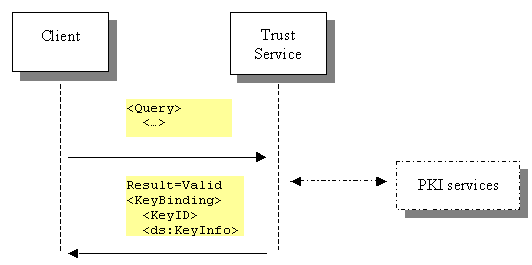
[155]
Figure 3: Validate
Service Provides Key Validation
[156] Bob has received Alice's message and his email client has verified the
signature on the document against the public key in the certificate supplied by
Alice. It is not yet known whether the certificate is considered trustworthy
however. To determine this, Bob's email client sends the certificate chain to an
XKMS Validate service. The service reports back that it has successfully
determined that the key binding has a trusted issuer and has not been revoked.
[157] Request:
<?xml version="1.0" encoding="utf-8"?>
<ValidateRequest xmlns:ds="http://www.w3.org/2000/09/xmldsig#"
      xmlns:xenc="http://www.w3.org/2001/04/xmlenc#"
      Id="I547c52f2cec769b7e89d5f519cd817a6"
      Service="http://test.xmltrustcenter.org/XKMS"
      xmlns="http://www.w3.org/2002/03/xkms#">
  <RespondWith>X509Cert</RespondWith>
  <QueryKeyBinding>
    <ds:KeyInfo>
      <ds:X509Data>
        <ds:X509Certificate>MIICAjCCAW+gAwIBAgIQlzQovIEbLLhMa8K5MR/juzAJBgUrD
              gMCHQUAMBIxEDAOBgNVBAMTB1Rl
c3QgQ0EwHhcNMDIwNjEzMjEzMzQxWhcNMzkxMjMxMjM1OTU5WjAsMSowKAYDVQQGEyFVUyBPPUFs
aWNlIENvcnAgQ049QWxpY2UgQWFyZHZhcmswgZ8wDQYJKoZIhvcNAQEBBQADgY0AMIGJAoGBAMoy
4c9+NoNJvJUnV8pqPByGb4FOJcU0VktbGJpO2imiQx+EJsCt27z/pVUDrexTyctCWbeqR5a40JCQ
mvNmRUfg2d81HXyA+iYPl4L6nUlHbkLjrhPPtMDSd5YHjyvnCN454+Hr0paA1MJXKuw8ZMkjGYsr
4fSYpPELOH5PDJEBAgMBAAGjRzBFMEMGA1UdAQQ8MDqAEEVr1g8cxzEkdMX4GAlD6TahFDASMRAw
DgYDVQQDEwdUZXN0IENBghBysVHEiNFiiE2lxWvmJYeSMAkGBSsOAwIdBQADgYEAKp+RKhDMIVIb
ooSNcoIeV/wVew1bPVkEDOUwmhAdRXUA94uRifiFfmp9GoN08Jkurx/gF18RFB/7oLrVY+cpzRoC
ipcnAnmh0hGY8FNFmhyKU1tFhVFdFXB5QUglkmkRntNkOmcb8O87xO0XktmvNzcJDes9PMNxrVtC
hzjaFAE=</ds:X509Certificate>
        <ds:X509Certificate>MIIB9zCCAWSgAwIBAgIQcrFRxIjRYohNpcVr5iWHkjAJBgUrD
              gMCHQUAMBIxEDAOBgNVBAMTB1Rl
c3QgQ0EwHhcNMDIwNjEzMjEzMzQxWhcNMzkxMjMxMjM1OTU5WjASMRAwDgYDVQQDEwdUZXN0IENB
MIGfMA0GCSqGSIb3DQEBAQUAA4GNADCBiQKBgQDPF33VmCmSSFufPnu0JdFaKsPHsx0ee+OYedhM
xVh3LXMkMNC++JWDva7H+E9o+uj7dt5cwxHSePsyxPx3Vq+AbEZOsYxGxXgf4OuGb8ONBv3B5c8h
raOg24c5hjFS6tfNzoiatLVKHeOmPnifhkBI8h8LD7dLHsHfKUrVNwIJNQIDAQABo1YwVDANBgNV
HQoEBjAEAwIHgDBDBgNVHQEEPDA6gBBFa9YPHMcxJHTF+BgJQ+k2oRQwEjEQMA4GA1UEAxMHVGVz
dCBDQYIQcrFRxIjRYohNpcVr5iWHkjAJBgUrDgMCHQUAA4GBAAynWUPRSbabAEuX0Z8kKN/C2GoE
uULW73QxX6Q0PHAatRM6G9ZnzU+ce3lELgOj0Usw/xC9Y+2FMgj68rIas+DId5JMMj+SIZEUV1vP
PTEiEQ16Gxz9piUQoFljhI22hEl8ki0hIJlFGnki+K9dhv/7trMrfKSSHAPIDQZuz01P</ds:X509
      Certificate>
      </ds:X509Data>
    </ds:KeyInfo>
    <KeyUsage>Signature</KeyUsage>
    <UseKeyWith Application="urn:ietf:rfc:2633"
          Identifier="alice@alicecorp.test" />
  </QueryKeyBinding>
</ValidateRequest>
[158] Response:
<?xml version="1.0" encoding="utf-8"?>
<ValidateResult xmlns:ds="http://www.w3.org/2000/09/xmldsig#"
      xmlns:xenc="http://www.w3.org/2001/04/xmlenc#"
      Id="I6ffe42a7957bfb78b100d8c8ca28914c"
      Service="http://test.xmltrustcenter.org/XKMS" ResultMajor="Success"
      RequestId="#I547c52f2cec769b7e89d5f519cd817a6"
      xmlns="http://www.w3.org/2002/03/xkms#">
  <KeyBinding Id="I2151c79f4382060f9bf21d63883b8e66">
    <ds:KeyInfo>
      <ds:X509Data>
        <ds:X509Certificate>MIICAjCCAW+gAwIBAgIQlzQovIEbLLhMa8K5MR/juzAJBgUrD
              gMCHQUAMBIxEDAOBgNVBAMTB1Rl
c3QgQ0EwHhcNMDIwNjEzMjEzMzQxWhcNMzkxMjMxMjM1OTU5WjAsMSowKAYDVQQGEyFVUyBPPUFs
aWNlIENvcnAgQ049QWxpY2UgQWFyZHZhcmswgZ8wDQYJKoZIhvcNAQEBBQADgY0AMIGJAoGBAMoy
4c9+NoNJvJUnV8pqPByGb4FOJcU0VktbGJpO2imiQx+EJsCt27z/pVUDrexTyctCWbeqR5a40JCQ
mvNmRUfg2d81HXyA+iYPl4L6nUlHbkLjrhPPtMDSd5YHjyvnCN454+Hr0paA1MJXKuw8ZMkjGYsr
4fSYpPELOH5PDJEBAgMBAAGjRzBFMEMGA1UdAQQ8MDqAEEVr1g8cxzEkdMX4GAlD6TahFDASMRAw
DgYDVQQDEwdUZXN0IENBghBysVHEiNFiiE2lxWvmJYeSMAkGBSsOAwIdBQADgYEAKp+RKhDMIVIb
ooSNcoIeV/wVew1bPVkEDOUwmhAdRXUA94uRifiFfmp9GoN08Jkurx/gF18RFB/7oLrVY+cpzRoC
ipcnAnmh0hGY8FNFmhyKU1tFhVFdFXB5QUglkmkRntNkOmcb8O87xO0XktmvNzcJDes9PMNxrVtC
hzjaFAE=</ds:X509Certificate>
      </ds:X509Data>
    </ds:KeyInfo>
    <KeyUsage>Signature</KeyUsage>
    <KeyUsage>Encryption</KeyUsage>
    <KeyUsage>Exchange</KeyUsage>
    <UseKeyWith Application="urn:ietf:rfc:2633"
          Identifier="alice@alicecorp.test" />
    <Status StatusValue="Valid">
      <ValidReason>Signature</ValidReason>
      <ValidReason>IssuerTrust</ValidReason>
      <ValidReason>RevocationStatus</ValidReason>
      <ValidReason>ValidityInterval</ValidReason>
    </Status>
  </KeyBinding>
</ValidateResult>
[159] The Locate and Validate operations are both used to obtain information about
a public key from an XKMS Service. Locate and Validate services are both
expected to attempt to provide correct information to the requestor. The Locate
and Validate services differ in the extent to which the service vouches for the
trustworthiness the information returned.
[160] A Location service SHOULD attempt to provide only information which is
trustworthy to the best of its knowledge but does not provide any assurance
that it will do so. Information obtained from a Locate service SHOULD NOT be
relied upon unless it is validated. Validation may be achieved by forwarding the
data to a Validate service or by performing the necessary trust path
verification locally.
[161] A Validation service undertakes to only return information which has been
positively validated by the XKMS Service as meeting specific validation
criteria. A client MAY rely on the information returned by the service without
further validation provided that the client has a means to determine that the
information returned is authentic and is assured that the validation service applied
the means of validation appropriate to the circumstances.
[162] No single set of validation criteria are appropriate to every circumstance.
Applications involving financial transactions are likely to require the
application of very specific validation criteria that ensure that certain
contractual and/or regulatory policies are enforced. The Locate service provides
a key discovery function that is neutral with respect to the validation criteria
that the client application may apply. The Validate service provides a key
discovery and validation function that produces a results which are each
specific to a single set of validation criteria.
[163] In many cases the key information which a client requires is
bound to some form of address specified by an Internet protocol part of which
consists of a DNS address. For example an email client may require a trustworthy
key to send an encrypted email to bob@example.com. Unless an XKMS service which
provides key information about keys bound to email addresses in the domain
example.com is known a priori, some means of locating the correct XKMS service
is required.
[164] Figure 5 shows an example of using the DNS SRV record to perform
discovery of XKMS services. The email client requests a key for bob@example.com
from a trusted Validate service. The Validate service then queries the DNS to
locate an XKMS service providing information on keys bound to addresses in the
zone example.com. The Validate service does not have an established trust
relationship with the example.com XKMS service and so a Locate request is made
to determine if any key information bound to bob@example.com can be located. The
Validate service then validates the information received by such means as are
appropriate (e.g. by verifying that a certification chain may be constructed
from a root of trust) and the response returned to the email client.
[165]
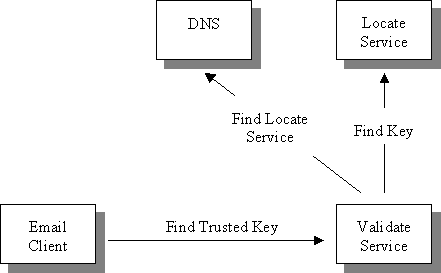
[166] Figure 5: Combined use of Locate and Validate
service
[167] Appendix B provides further information on the use of the DNS
SRV record.
[168] The protocol consists of pairs of messages, with an application sending a
request message to an XKMS service and the service responding with another
message.
[169] A key binding asserts a binding between data elements that relate to a
public key including the <ds:KeyName>,
<ds:KeyValue> and <ds:X509Data>
components contained in a <ds:KeyInfo> element.
Furthermore, the Service represents to the client accessing the service and
to that client alone that the binding between the data elements is valid
under whatever trust policy the service offers to that client.
[170] XKMS specifies four elements that specify key bindings, all of which are
derived from the KeyBindingAbstractType. These elements
are:
- UnverifiedKeyBinding
- Specifies the parameters of a particular instance of a key binding but
not the status.
- KeyBinding
- Specifies the parameters of a particular instance of a key binding
- QueryKeyBinding
- A template used to specify one or more key bindings using query by
example.
- PrototypeKeyBinding
- A template used to specify the key binding parameters requested in a
registration request.
[171] An XKMS service MAY provide an interface to an underlying PKI such as PKIX
or PGP. This specification does not define how XKMS operations interact with
the underlying PKI. The XKMS key binding MAY be bound to a data object
such as a certificate or key signing in the underlying PKI such that XKMS
operations on the key binding result in a corresponding change to the data
structures in the underlying PKI and vice versa. If for example the XKMS
service provides a mapping to an underlying PKIX/X.509 PKI the registration of
a key binding would typically result in the issue of a certificate, even if
the client does not ask for the certificate to be returned in the registration
result. If the key binding were subsequently revoked the corresponding
certificate in the underlying PKI would typically be revoked also.
[172] The KeyBindingAbstractType is the abstract type from
which all XKMS key binding element specifiers are derived. It contains the
following elements and attribute:
-
Id
[Optional]
- Identifier of the key binding.
-
<ds:KeyInfo>
[Optional]
- The public key information to which the key binding information is bound
-
<KeyUsage>
[0 to 3]
- The cryptographic key uses for which the key may be used
-
<UseKeyWith>
[Any Number]
- The applications with which the key may be used together with the
application specific subject identifier of the key holder for that
application
[173] The Id identifier is defined to provide a means by which the key binding may
be signed using XML Signature. Clients MUST NOT rely on the key binding
identifier being either unique or stable. In the case that an XKMS service is
providing an interface to an underlying PKI, clients MUST NOT rely on the
service choosing key binding identifiers that are either the same as or bear a
systematic relationship to the serial numbers or other identifiers of the
corresponding credentials in the underlying PKI.
[174] The following schema defines the KeyBindingAbstractType
type:
   <!-- KeyBindingAbstractType-->
   <complexType name="KeyBindingAbstractType" abstract="true">
      <sequence>
         <element ref="ds:KeyInfo" minOccurs="0"/>
         <element ref="xkms:KeyUsage" minOccurs="0" maxOccurs="3"/>
         <element ref="xkms:UseKeyWith" minOccurs="0"
               maxOccurs="unbounded"/>
      </sequence>
      <attribute name="Id" type="ID" use="optional"/>
   </complexType>
   <!-- /KeyBindingAbstractType-->
[175] The <KeyUsage> element specifies one or more intended
uses of the key. If no <KeyUsage> is specified all uses
are permitted. The following key usages are defined:
-
Encryption
- The key pair may be used for encryption and decryption
-
Signature
- The key pair may be used for signature and verification
-
Exchange
- The key pair may be used for key exchange
[176] If a key usage is specified in a KeyBinding that
the cryptographic algorithm associated with the key does not support the element
MUST be ignored. If a key usage is specified in a
QueryKeyBinding
however the key usage forms part of the criteria the service should attempt to
match.
[177] For example if a KeyBinding specifies the key usage
Encryption
for a Digital Signature Algorithm key the relying application should ignore the
key usage element. If however a client makes a request that contains a
QueryKeyBinding
that specifies the key usage encryption the service should not return a Digital
Signature Algorithm key.
[178] The following schema defines the <KeyUsage>
element:
   <!-- KeyUsage -->
   <element name="KeyUsage" type="xkms:KeyUsageType"/>
   <simpleType name="KeyUsageType">
      <restriction base="QName">
         <enumeration value="xkms:Encryption"/>
         <enumeration value="xkms:Signature"/>
         <enumeration value="xkms:Exchange"/>
      </restriction>
   </simpleType>
   <!-- /KeyUsage -->
[179] The <UseKeyWith> element specifies a
subject identifier and application identifier that determine a use of the key.
The interpretation of <UseKeyWith>
depends on the enclosing construct.
- QueryKeyBinding / TemplateKeyBinding
-
A key binding is requested that meets the specified criteria. If the service
is unable to meet the criteria exactly 'best guess' is acceptable.
- UnverifiedKeyBinding / KeyBinding
-
The key may be used for the purpose specified (if unverified after
validation). If more than one use key with is specified then all are
applicable jointly and severally
[180] The <UseKeyWith> element contains the
following attributes:
-
Application
[Required]
-
A URI that specifies the application protocol with which the key may be used
-
-
Identifier
[Required]
-
Specifies the subject to which the key corresponds within the specified
application protocol.
[181] Note that in some applications, in particular X.509 an application
identifier is not guaranteed to be globally unique. In such circumstances the
XKMS service is responsible for specifying rules to unambiguously interpret
identifiers.
[182] The following table lists application URIs for common application
protocols and
the corresponding format for the identifier information:
|
Application |
Application URI |
Identifier |
Type |
| XKMS |
http://www.w3.org/2002/03/xkms# |
URL identifying SOAP role |
URI |
| XKMS/profile |
http://www.w3.org/2002/03/xkms#profile |
URL identifying SOAP role |
URI |
| S/MIME |
urn:ietf:rfc:2633 |
SMTP email address of subject |
RFC822 addr-spec |
| PGP |
urn:ietf:rfc:2440 |
SMTP email address of subject |
RFC822 addr-spec |
| TLS |
urn:ietf:rfc:2246 |
URI identifying certificate subject |
URI |
| TLS/HTTPS |
urn:ietf:rfc:2818 |
DNS address of http server |
DNS Address |
| TLS/SMTP |
urn:ietf:rfc:2487 |
DNS address of mail server |
DNS Address |
| IPSEC |
urn:ietf:rfc:2401 |
IP address of network resource |
IP Address |
| PKIX |
urn:ietf:rfc:2459 |
Certificate Subject Name |
X.509 Distinguished Name |
[183] The XKMS application URI is used to specify a key binding that is
used to secure an XKMS service. An XKMS service SHOULD support discovery of the
supported security profiles and corresponding key bindings by means of a
Locate
operation that specifies the XKMS application URI and the URL of the service
role. Note that as with any other Locate operation the credentials returned by
this mechanism SHOULD only be considered trustworthy if validated according to
the trust policy of the client.
[184] The primary use intended for <UseKeyWith>
identifiers is to identify application protocols. <UseKeyWith>
URI identifiers MAY be specified that represent key binding issuance and/or use
policies instead of or in addition to an application protocol. In this case the
<UseKeyWith>
element specifies that the key binding complies with the specified policy.
[185] In the case that a client follows a referral model in which raw key
binding information is obtained from a Locate service then forwarded to a
validate service the <UseKeyWith> elements in the query
should in both cases specify the uses for which the application intends to use
the key. Applications SHOULD NOT forward <UseKeyWith>
elements returned in a Locate result in a subsequent Validate query.
[186] The following table describes the formatting for the specified
types of identifier:
|
Identifier Type |
Example |
Description |
|
RFC822 addr-spec |
bob@example.com |
The addr-spec fragment of an RFC 822 email address as used by SMTP |
|
URI |
https://example.com/ |
A Uniform Resource Identifier |
|
DNS Address |
example.com |
An Internet DNS address |
|
IP Address |
10.23.0.20 |
An IPv4 address in decimal notation |
|
1080::8:800:200C:417A |
An IPv6 address in RFC 2373 notation |
|
X.509 Distinguished Name |
C="UK" O="CryptoGuys Ltd." CN="Bob" |
An X.509 Distinguished Name |
[187] The following schema defines the <UseKeyWith>
element:
   <!-- UseKeyWith -->
   <element name="UseKeyWith" type="xkms:UseKeyWithType"/>
   <complexType name="UseKeyWithType">
      <attribute name="Application" type="anyURI" use="required"/>
      <attribute name="Identifier" type="string" use="required"/>
   </complexType>
   <!-- /UseKeyWith -->
[188] The <UnverifiedKeyBinding> element is derived from
the KeyBindingAbstractType. It describes a key binding
but makes no assertion regarding the status of the key binding.
[189] The <UnverifiedKeyBinding> element extends the
KeyBindingAbstractType
with the following additional elements:
-
<ValidityInterval>
[Optional]
- The time interval in which the key binding relationship is asserted
[190] The following schema defines the <UnverifiedKeyBinding>
element and UnverifiedKeyBindingType:
   <!-- UnverifiedKeyBinding -->
   <element name="UnverifiedKeyBinding"
         type="xkms:UnverifiedKeyBindingType"/>
   <complexType name="UnverifiedKeyBindingType">
      <complexContent>
         <extension base="xkms:KeyBindingAbstractType">
            <sequence>
               <element ref="xkms:ValidityInterval" minOccurs="0"/>
            </sequence>
         </extension>
      </complexContent>
   </complexType>
   <!-- /UnverifiedKeyBinding -->
[191] The <ValidityInterval> element specifies limits on
the validity of the key binding.
-
NotBefore
[Optional]
- Time instant at which the validity interval begins
-
NotOnOrAfter
[Optional]
- Time instant at which the validity interval has ended
[192] All dateTime values MUST fully specify the date.
[193] The NotBefore and NotOnOrAfter
attributes are optional. If the NotBefore attribute is
omitted the key binding is valid on any date up to but excluding the date
specified in the NotOnOrAfter attribute . If the
NotOnOrAfter
attribute is omitted the key binding is valid from the
NotBefore
attribute with no expiry. If both elements are omitted the key binding is valid
at any time.
[194] In accordance with the XML Schema Specifications, all time instances are
interpreted in Universal Coordinated Time unless they explicitly indicate a time
zone.
[195] Implementations MUST NOT generate time instances that specify leap seconds.
[196] For purposes of comparison, the time interval NotBefore
to NotOnOrAfter begins at the earliest time instant
compatible with the specification of NotBefore and
has ended at the earliest time instant compatible with the
specification of NotOnOrAfter
[197] For example if the time interval specified is dayT12:03:02
to dayT12:05:12 the times
12:03:02.00
and 12:05:11.9999 are within the time interval. The time
12:05:12.0000 is outside the time interval.
[198] The following schema defines the <ValidityInterval>
element:
   <!-- ValidityInterval -->
   <element name="ValidityInterval" type="xkms:ValidityIntervalType"/>
   <complexType name="ValidityIntervalType">
      <attribute name="NotBefore" type="dateTime" use="optional"/>
      <attribute name="NotOnOrAfter" type="dateTime" use="optional"/>
   </complexType>
   <!-- /ValidityInterval -->
[199] The <KeyBinding> element is derived from the
UnverifiedKeyBindingType. It specifies a
particular instance of a key binding and its current status as known to the
issuer of the key binding.
[200] The <KeyBinding> element extends the
UnverifiedKeyBindingType
with the following additional elements:
-
<Status> [Required]
- The status of the key binding instance.
[201] The following schema defines the <KeyBinding>
element and KeyBindingType:
   <!-- KeyBinding -->
   <element name="KeyBinding" type="xkms:KeyBindingType"/>
   <complexType name="KeyBindingType">
      <complexContent>
         <extension base="xkms:UnverifiedKeyBindingType">
            <sequence>
               <element ref="xkms:Status"/>
            </sequence>
         </extension>
      </complexContent>
   </complexType>
   <!-- /KeyBinding -->
[202] The <status> element specifies the status of a
<KeyBinding> instance.
[203] The status value MAY be supplemented with codes that state the status of
specific aspects of the key binding status that were validated.
[204] The <Status> element contains the following elements
and attribute:
-
<ValidReason>
[Any Number]
- A status aspect that was evaluated and found to be Valid.
-
<IndeterminateReason>
[Any Number]
- A status aspect that could not be evaluated or was evaluated and
returned an Indeterminate result.
-
<InvalidReason>
[Any Number]
- A status aspect that was evaluated and found to be Invalid.
-
StatusValue [Required]
- The key binding status
[205] The enumerated type
AssertionStatus
is used to indicate the key binding status. The following values are defined:
-
Valid
- The key binding is definitively valid.
-
Indeterminate
- The status of the key binding cannot be determined.
-
Invalid
- The key binding is definitively invalid.
[206] If reason codes are specified StatusValue
attribute MUST be consistent with the reason codes specified as follows:
- If an <InvalidReason> code is present the
StatusValue
attibute MUST have the value Invalid
- If an <IndeterminateReason> code is present the
StatusValue attibute MUST have the either the value
Indeterminate or the value Invalid.
- If neither an <InvalidReason> nor an
<IndeterminateReason>
code is present the StatusValue attibute MAY have
any defined value, i.e. Valid,
Indeterminate
or Invalid.
[207] The following schema defines the <Status>
element and StatusType and
AssertionType
types:
   <!-- Status -->
   <element name="Status" type="xkms:StatusType"/>
   <complexType name="StatusType">
      <sequence>
         <element ref="xkms:ValidReason" minOccurs="0"
               maxOccurs="unbounded"/>
         <element ref="xkms:IndeterminateReason" minOccurs="0"
               maxOccurs="unbounded"/>
         <element ref="xkms:InvalidReason" minOccurs="0"
               maxOccurs="unbounded"/>
      </sequence>
      <attribute name="StatusValue" type="xkms:KeyBindingStatus"
            use="required"/>
   </complexType>
   <simpleType name="KeyBindingStatus">
      <restriction base="QName">
         <enumeration value="xkms:Valid"/>
         <enumeration value="xkms:Invalid"/>
         <enumeration value="xkms:Indeterminate"/>
      </restriction>
   </simpleType>
   <!-- /Status -->
[208] The <ValidReason>, <InvalidReason>
and<IndeterminateReason> elements are used to specify a
QName that specifies a reason for a particular key binding status.
[209] The status aspects are defined in the table below. For convenience the
equivalent X509 processing steps are given:
|
Reason QName Local Name |
Description |
X.509 Equivalent |
| Valid |
Invalid |
|
IssuerTrust
|
The issuer of the information on which the key binding is based is
considered to be trustworthy by the XKMS service. |
Certificate path anchored by trusted root successfully constructed |
Certificate path could not be constructed
to a trusted root |
|
RevocationStatus
|
The XKMS service has affirmatively verified the status of the key
binding with an authoritative source |
Certificate status validated using CRL or OCSP |
Certificate status returned revoked or
suspended. |
|
ValidityInterval
|
The requested time instant was within the validity interval of the key
binding |
The certificate chain was valid at the requested time instant. |
The requested time instant was before or
after the certificate chain validity interval |
|
Signature
|
Signature on signed data provided by the client in the
<Keyinfo>
element was successfully verified. |
Certificate Signature verified |
Certificate Signature verification failed |
[210] The following schema defines the <ValidReason>,
<InvalidReason> and<IndeterminateReason>
elements:
   <!-- Reason -->
   <element name="ValidReason" type="QName"/>
   <element name="InvalidReason" type="QName"/>
   <element name="IndeterminateReason" type="QName"/>
   <!-- /Reason -->
[211] The <QueryKeyBinding> element is derived from the
KeyBindingAbstractType and is used to perform a query that results in the
return of one or more matching key bindings.
[212] A key binding matches the QueryKeyBinding if:
- The key binding contains all the <UseKeyWith>
elements contained in the query, and
- The key binding contains all the <KeyInfo>
elements contained in the query
[213] The <QueryKeyBinding> element extends the
KeyBindingAbstractType
with the following additional elements:
-
<TimeInstant>
[Optional]
- The Time Instant for which the query is made. If no time instant is
specified the default is the time the request was made.
[214] The following schema defines the <QueryKeyBinding>
element and KeyBindingType:
   <!-- QueryKeyBinding -->
   <element name="QueryKeyBinding" type="xkms:QueryKeyBindingType"/>
   <complexType name="QueryKeyBindingType">
      <complexContent>
         <extension base="xkms:KeyBindingAbstractType">
            <sequence>
               <element ref="xkms:TimeInstant" minOccurs="0"/>
            </sequence>
         </extension>
      </complexContent>
   </complexType>
   <!-- /QueryKeyBinding -->
[215] The <TimeInstant> element specifies a specific
instant in time for which a key binding query is made. The
<TimeInstant>
element contains the following attribute:
-
Time
[Required]
- Time instant to which a <QueryKeyBinding> relates.
[216] All dateTime values MUST fully specify the date.
[217] The following schema defines the <TimeInstant>
element:
   <!-- TimeInstant -->
   <element name="TimeInstant" type="xkms:TimeInstantType"/>
   <complexType name="TimeInstantType">
      <attribute name="Time" type="dateTime" use="required"/>
   </complexType>
   <!-- /TimeInstant -->
[218] The Locate service accepts as input a <QueryKeyBinding>
element that specifies a key binding and returns one or more
<UnverifiedKeyBinding>
elements that relate to the same public key. The <UnverifiedKeyBinding>
elements returned are specified by the Respond element
in the request.
[219] The request message contains a <LocateRequest>
element that contains the following element.
-
<QueryKeyBinding>
[Required]
- The key binding query to be matched in the response
[220] The following schema defines the <LocateRequest>
element:
   <!-- LocateRequest -->
   <element name="LocateRequest" type="xkms:LocateRequestType"/>
   <complexType name="LocateRequestType">
      <complexContent>
         <extension base="xkms:RequestAbstractType">
            <sequence>
               <element ref="xkms:QueryKeyBinding"/>
            </sequence>
         </extension>
      </complexContent>
   </complexType>
   <!-- /LocateRequest -->
[221] The response message contains a <LocateResult>
element
-
<UnverifiedKeyBinding>
[Any Number]
- A sequence of <UnverifiedKeyBinding> key binding
that matche the key binding query specified in the corresponding request. If
no results are found the sequence is empty and the
<ResultCode>NoMatch
returned. In some circumstances a Locate operation
MAY return multiple matching results.
[222] The following schema defines the <LocateResult>
element:
   <!-- LocateResult -->
   <element name="LocateResult" type="xkms:LocateResultType"/>
   <complexType name="LocateResultType">
      <complexContent>
         <extension base="xkms:ResultType">
            <sequence>
               <element ref="xkms:UnverifiedKeyBinding" minOccurs="0"
                     maxOccurs="unbounded"/>
            </sequence>
         </extension>
      </complexContent>
   </complexType>
   <!-- /LocateResult -->
[223] The Validate service allows the client to query the
binding between a <ds:Keyinfo> element and other data
such as an identifier. The client supplies a prototype for the key binding
requested. The prototype may specify either a <ds:Keyinfo>
element or one or more <UseKeyWith> elements or
both. If the validate request is successful the server returns one or more <KeyBinding>
elements that meet the criteria specified in the request.
[224] The validate request message contains a <ValidateRequest>
element:
-
<QueryKeyBinding>
[Required]
- The key binding query to be matched in the response.
[225] The following schema defines the <ValidateRequest>
element:
   <!-- ValidateRequest -->
   <element name="ValidateRequest" type="xkms:ValidateRequestType"/>
   <complexType name="ValidateRequestType">
      <complexContent>
         <extension base="xkms:RequestAbstractType">
            <sequence>
               <element ref="xkms:QueryKeyBinding"/>
            </sequence>
         </extension>
      </complexContent>
   </complexType>
   <!-- /ValidateRequest -->
[226] The validate response message contains a <ValidateResult>
element:
-
<Keybinding>
[Any
Number]
- A sequence of <KeyBinding> key bindings that
match the key binding query specified in the corresponding request. If no
results are found the sequence is empty and the
<ResultCode>NoMatch
returned. In some circumstances a Validate
operation MAY return multiple matching results.
[227] The following schema defines the <ValidateResult>
element and the ValidateResultType type.
   <!-- ValidateResult -->
   <element name="ValidateResult" type="xkms:ValidateResultType"/>
   <complexType name="ValidateResultType">
      <complexContent>
         <extension base="xkms:ResultType">
            <sequence>
               <element ref="xkms:KeyBinding" minOccurs="0"
                     maxOccurs="unbounded"/>
            </sequence>
         </extension>
      </complexContent>
   </complexType>
   <!-- /ValidateResult -->
[228] The XML Key Registration Service Specification permits management of
information that is bound to a public key pair. The XKRSS service specification
supports the following operations:
-
Register
- Information is bound to a public key pair through a key binding
-
Reissue
- A previously registered key binding is reissued.
-
Revoke
- A previously registered key binding is revoked.
-
Recover
- The private key associated with a key binding is recovered.
[229] An XKMS service may offer all or none of these services.
[230] The Register operation does not in itself place any
requirement on the registration service to communicate that information to any
other party. In most applications, however, a registration service will provide
key information to other Web Services such as those described in the XKMS
specification or a separate underlying PKI such as PKIX.
[231] The Register operation MAY be used in a mode where
client requests are accepted by an intermediary such as a Local Registration
Authority (LRA) and forwarded to a Master Registration Authority (MRA). This
mode of operation is entirely transparent to the client which acts as if the LRA
is the only registration authority involved. The construction of the
proof-of-possession of the private key and the authentication information is
complete separate of the message authentication signature. This allows
verification by both the LRA and any other registration authority that it is
relayed to, even if the message authentication signature has been replaced by
the LRA.
[232] The Register request is used to assert a binding of
information to a public key pair. Generation of the public key pair MAY be
performed by either the client or the Registration service.
[233] The Registration request message contains a prototype of the requested key
binding. The registration service MAY require the client to provide additional
information to authenticate the request. If the public key pair is generated by
the client, the service MAY require the client to provide Proof of Possession of
the private key.
[234] The prototype of the requested key binding may contain only partial
information, a key without a name or a name without a key. In this case, the
client is requesting that the registration service provide the additional
information required to complete the binding. All information contained in the
prototype of the requested key binding is advisory to the service and MAY be
ignored or overridden at the option of the service.
[235] On receipt of a registration request, the registration service verifies the
authentication and POP information provided (if any). If the registration
service accepts the request a key binding is registered. This key binding MAY
include some, all or none of the information provided by the prototype key
binding and MAY include additional information.
[236] The registration service MAY return part or all of the registered key binding
to the client.
[237]
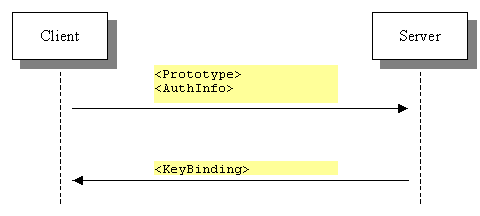
[238] Figure 5: Registration of a Key Binding
[239] The choice of generation of the key pair at the client or the service depends
on the application and the type of key. In the case of a key used for signing
purposes it is generally undesirable for any party apart from the key bearer to
have access to the private key. Should access to the private key be lost a new key
may be issued without affecting the validity of any of the signatures created
using the old private key. Accordingly it is usually preferable for such keys to
be generated at the client and not the server.
[240] In the case of a private key used exclusively for certain types of
encryption, the loss of access to the private key may result in the loss of
access to the stored data encrypted under the key. In such circumstances it is
generally desirable for some form of key recovery to be employed. In such
systems the key pair is typically generated at the service and delivered to the
client.
[241] A key used for both signing and encryption might be generated at the client
or the server depending on whether key recovery is to be supported.
[242] Alice requests registration of an RSA key pair for her email address
Alice@example.com. Alice has previously received from the XKMS service
the code "024837" with which to authenticate her request. Alice selects the pass
phrase "Help I have revealed my key" to authenticate herself should it be
necessary to revoke the registration at a later date.
[243] The X-KRSS request message contains the following
<RegisterRequest>
element: Because the registration request is for a client generated key the
Authentication element contains both a <ProofOfPossession>
element which demonstrates that the request is authorized by the holder of the
private key and a <KeyBindingAuthentication> element which demonstrates that the
request was made by a person who knows the authentication code "024837".
<?xml version="1.0" encoding="utf-8"?>
<RegisterRequest xmlns:ds="http://www.w3.org/2000/09/xmldsig#"
xmlns:xenc="http://www.w3.org/2001/04/xmlenc#"
Id="Ia42fc7279b804c60228a889cb70ec827"
Service="http://test.xmltrustcenter.org/XKMS"
xmlns="http://www.w3.org/2002/03/xkms#">
<RespondWith>X509Cert</RespondWith>
<RespondWith>X509Chain</RespondWith>
<PrototypeKeyBinding Id="Id20c2ddbf98245c0bc42c5c257188457">
<ds:KeyInfo>
<ds:KeyValue>
<ds:RSAKeyValue>
<ds:Modulus>zvbTdKsTprGAKJdgi7ulDR0eQBptLv/SJNIh3uVmPBObZFsLbqPwo5n
yLOkzWlEHNbShPMRp1qFr
AfF13LMmeohNYfCXTHLqH1MaMOm+BhXABHB9rUKaGoOBjQPHCBtHbfMGQYjznGTpfCdTrUgq8VNl
qM2Ph9XWMcc7qbjNHw8=</ds:Modulus>
<ds:Exponent>AQAB</ds:Exponent>
</ds:RSAKeyValue>
</ds:KeyValue>
</ds:KeyInfo>
<KeyUsage>Signature</KeyUsage>
<KeyUsage>Encryption</KeyUsage>
<KeyUsage>Exchange</KeyUsage>
<UseKeyWith Application="urn:ietf:rfc:2459" Identifier="C="US"
O="Alice Corp" CN="Alice Aardvark"" />
<UseKeyWith Application="urn:ietf:rfc:2633"
Identifier="alice@alicecorp.test" />
<UseKeyWith Application="http://ca.example.com/cps/20030401/class3"
Identifier="alice@alicecorp.test" />
</PrototypeKeyBinding>
<Authentication>
<KeyBindingAuthentication>
<ds:Signature>
<ds:SignedInfo>
<ds:CanonicalizationMethod
Algorithm="http://www.w3.org/TR/2001/REC-xml-c14n-20010315"
/>
<ds:SignatureMethod
Algorithm="http://www.w3.org/2000/09/xmldsig#hmac-sha1" />
<ds:Reference URI="#Id20c2ddbf98245c0bc42c5c257188457">
<ds:DigestMethod
Algorithm="http://www.w3.org/2000/09/xmldsig#sha1" />
<ds:DigestValue>lWwBEDOGiCqc8qoTnsEXXsBndCE=</ds:DigestValue>
</ds:Reference>
</ds:SignedInfo>
<ds:SignatureValue>ieZDAvwGDE+bjGJxPOzUkWRGAz0=</ds:SignatureValue>
</ds:Signature>
</KeyBindingAuthentication>
</Authentication>
<ProofOfPossession>
<ds:Signature>
<ds:SignedInfo>
<ds:CanonicalizationMethod
Algorithm="http://www.w3.org/TR/2001/REC-xml-c14n-20010315" />
<ds:SignatureMethod
Algorithm="http://www.w3.org/2000/09/xmldsig#rsa-sha1" />
<ds:Reference URI="#Id20c2ddbf98245c0bc42c5c257188457">
<ds:DigestMethod
Algorithm="http://www.w3.org/2000/09/xmldsig#sha1" />
<ds:DigestValue>lWwBEDOGiCqc8qoTnsEXXsBndCE=</ds:DigestValue>
</ds:Reference>
</ds:SignedInfo>
<ds:SignatureValue>gVTJqntVWtui8Te0sU1Pcp/bAawEF4K+2xv5WTGxcogaaYNEE1S6
tGTSfHcszD49kkRxa8L8BbQi
tdd+osUFBUxZkvaGrWzQLSGTD7z+pZ/OmpLioO/RrM2U4/1Ll6NoYS5X1E6Tzj2QAUE0vNe/4FfG
hQjo6n2iC184FMPDhKc=</ds:SignatureValue>
</ds:Signature>
</ProofOfPossession>
</RegisterRequest>
[246] The service accepts the registration and returns the following response:
<?xml version="1.0" encoding="utf-8"?>
<RegisterResult xmlns:ds="http://www.w3.org/2000/09/xmldsig#"
xmlns:xenc="http://www.w3.org/2001/04/xmlenc#"
Id="I7b4adf7334a038a0b11eb96ff87b227d"
Service="http://test.xmltrustcenter.org/XKMS" ResultMajor="Success"
RequestId="#Ia42fc7279b804c60228a889cb70ec827"
xmlns="http://www.w3.org/2002/03/xkms#">
<KeyBinding Id="Ia5444b101506556d6ab3cdf740e902ca">
<ds:KeyInfo>
<ds:X509Data>
<ds:X509Certificate>MIICAjCCAW+gAwIBAgIQlzQovIEbLLhMa8K5MR/juzAJBgUrD
gMCHQUAMBIxEDAOBgNVBAMTB1Rl
c3QgQ0EwHhcNMDIwNjEzMjEzMzQxWhcNMzkxMjMxMjM1OTU5WjAsMSowKAYDVQQGEyFVUyBPPUFs
aWNlIENvcnAgQ049QWxpY2UgQWFyZHZhcmswgZ8wDQYJKoZIhvcNAQEBBQADgY0AMIGJAoGBAMoy
4c9+NoNJvJUnV8pqPByGb4FOJcU0VktbGJpO2imiQx+EJsCt27z/pVUDrexTyctCWbeqR5a40JCQ
mvNmRUfg2d81HXyA+iYPl4L6nUlHbkLjrhPPtMDSd5YHjyvnCN454+Hr0paA1MJXKuw8ZMkjGYsr
4fSYpPELOH5PDJEBAgMBAAGjRzBFMEMGA1UdAQQ8MDqAEEVr1g8cxzEkdMX4GAlD6TahFDASMRAw
DgYDVQQDEwdUZXN0IENBghBysVHEiNFiiE2lxWvmJYeSMAkGBSsOAwIdBQADgYEAKp+RKhDMIVIb
ooSNcoIeV/wVew1bPVkEDOUwmhAdRXUA94uRifiFfmp9GoN08Jkurx/gF18RFB/7oLrVY+cpzRoC
ipcnAnmh0hGY8FNFmhyKU1tFhVFdFXB5QUglkmkRntNkOmcb8O87xO0XktmvNzcJDes9PMNxrVtC
hzjaFAE=</ds:X509Certificate>
<ds:X509Certificate>MIIB9zCCAWSgAwIBAgIQcrFRxIjRYohNpcVr5iWHkjAJBgUrD
gMCHQUAMBIxEDAOBgNVBAMTB1Rl
c3QgQ0EwHhcNMDIwNjEzMjEzMzQxWhcNMzkxMjMxMjM1OTU5WjASMRAwDgYDVQQDEwdUZXN0IENB
MIGfMA0GCSqGSIb3DQEBAQUAA4GNADCBiQKBgQDPF33VmCmSSFufPnu0JdFaKsPHsx0ee+OYedhM
xVh3LXMkMNC++JWDva7H+E9o+uj7dt5cwxHSePsyxPx3Vq+AbEZOsYxGxXgf4OuGb8ONBv3B5c8h
raOg24c5hjFS6tfNzoiatLVKHeOmPnifhkBI8h8LD7dLHsHfKUrVNwIJNQIDAQABo1YwVDANBgNV
HQoEBjAEAwIHgDBDBgNVHQEEPDA6gBBFa9YPHMcxJHTF+BgJQ+k2oRQwEjEQMA4GA1UEAxMHVGVz
dCBDQYIQcrFRxIjRYohNpcVr5iWHkjAJBgUrDgMCHQUAA4GBAAynWUPRSbabAEuX0Z8kKN/C2GoE
uULW73QxX6Q0PHAatRM6G9ZnzU+ce3lELgOj0Usw/xC9Y+2FMgj68rIas+DId5JMMj+SIZEUV1vP
PTEiEQ16Gxz9piUQoFljhI22hEl8ki0hIJlFGnki+K9dhv/7trMrfKSSHAPIDQZuz01P</ds:X509
Certificate>
</ds:X509Data>
</ds:KeyInfo>
<KeyUsage>Signature</KeyUsage>
<KeyUsage>Encryption</KeyUsage>
<KeyUsage>Exchange</KeyUsage>
<UseKeyWith Application="urn:ietf:rfc:2459" Identifier="C="US"
O="Alice Corp" CN="Alice Aardvark"" />
<UseKeyWith Application="urn:ietf:rfc:2633"
Identifier="alice@alicecorp.test" />
<UseKeyWith Application="http://ca.example.com/cps/20030401/class3"
Identifier="alice@alicecorp.test" />
<Status StatusValue="Valid">
<ValidReason>Signature</ValidReason>
<ValidReason>IssuerTrust</ValidReason>
<ValidReason>RevocationStatus</ValidReason>
<ValidReason>ValidityInterval</ValidReason>
</Status>
</KeyBinding>
</RegisterResult>
[247] The request for registration of a service generated key pair omits the public
key data and requests that private key data be returned with the response.
[248] Bob requests a server generated key pair after receiving the authentication
code 3n9cj-jk4jk-s04jf-20934-jsr09-jwik4 through some out-of-band mechanism.
The request specifies only Encryption and
Exchange key uses as the key is to be
escrowed for possible later recovery and the security policy of the issuer does
not allow escrow of signature keys.
[249] The server generates a public-private key pair in response to the request,
generates appropriate certifications, and returns the result to the client.
The result includes the private key value encrypted using a key derived from the
authentication code value as described in Section 8.1; see also Appendix C.1.3. The client can
decrypt the private key by computing the decryption key from the authentication
code value in the same manner as the service.
[250] To avoid leaking the private key value to unauthorized entities it is
critical that the service and client protect the authentication code value from
disclosure. The service should not reuse authentication code values nor
should the key derived from an authentication code be used to encrypt more than
a single private key communication.
[251] The calculation of the authentication data and encryption of the private key
for this example is shown in Appendix C.
[252] The response includes both the public key data and the encrypted private key:
<?xml version="1.0" encoding="utf-8"?>
<RegisterResult xmlns:ds="http://www.w3.org/2000/09/xmldsig#"
xmlns:xenc="http://www.w3.org/2001/04/xmlenc#"
Id="Iff94d7f0c9fb9addcba2e7d454ff7114"
Service="http://test.xmltrustcenter.org/XKMS" ResultMajor="Success"
RequestId="#I7b4b8df9e58d4dd9b663070e81103c2f"
xmlns="http://www.w3.org/2002/03/xkms#">
<KeyBinding Id="I71bf014ca377fe970fca88109c650dff">
<ds:KeyInfo>
<ds:X509Data>
<ds:X509Certificate>MIIB+zCCAWigAwIBAgIQhzf6GHdFobRCYrjlFTCekjAJBgUrD
gMCHQUAMBIxEDAOBgNVBAMTB1Rl
c3QgQ0EwHhcNMDIwNjEzMjEzMzQyWhcNMzkxMjMxMjM1OTU5WjAlMSMwIQYDVQQGExpVUyBPPUJv
YiBDb3JwIENOPUJvYiBCYWtlcjCBnzANBgkqhkiG9w0BAQEFAAOBjQAwgYkCgYEAtw2qGqYbO0aK
eZFb0Z3verx3Cp+KS94LiHG09D1DdgTd48FZaB5eXa4U3mLax2/Fsg/cxGZkXJur0YylS8QvRuX+
9STQgiFTO277sHFfRMvtFsuQ56ovrQWH/KoGQZssMUIqO2aN2cbMQJST3a2HZuxqPQ1rwXxHrEoA
XHZv3ysCAwEAAaNHMEUwQwYDVR0BBDwwOoAQRWvWDxzHMSR0xfgYCUPpNqEUMBIxEDAOBgNVBAMT
B1Rlc3QgQ0GCEHKxUcSI0WKITaXFa+Ylh5IwCQYFKw4DAh0FAAOBgQCieDKjvNCo7MPsgUwHydki
d4KnulcuBbZet87lcIA7ReH1qEK4s0p49po2UM69eWG7hfv8LW2Ga8HiEexTwLDFBvH2g7f09xI/
vYgPw4qhJfWoZuY/HWHUzZIRSoggipndVfdvUkmsFSx1rR4FMu0mYBjq79OkYsmwISQlaXejUg==<
/ds:X509Certificate>
<ds:X509Certificate>MIIB9zCCAWSgAwIBAgIQcrFRxIjRYohNpcVr5iWHkjAJBgUrD
gMCHQUAMBIxEDAOBgNVBAMTB1Rl
c3QgQ0EwHhcNMDIwNjEzMjEzMzQxWhcNMzkxMjMxMjM1OTU5WjASMRAwDgYDVQQDEwdUZXN0IENB
MIGfMA0GCSqGSIb3DQEBAQUAA4GNADCBiQKBgQDPF33VmCmSSFufPnu0JdFaKsPHsx0ee+OYedhM
xVh3LXMkMNC++JWDva7H+E9o+uj7dt5cwxHSePsyxPx3Vq+AbEZOsYxGxXgf4OuGb8ONBv3B5c8h
raOg24c5hjFS6tfNzoiatLVKHeOmPnifhkBI8h8LD7dLHsHfKUrVNwIJNQIDAQABo1YwVDANBgNV
HQoEBjAEAwIHgDBDBgNVHQEEPDA6gBBFa9YPHMcxJHTF+BgJQ+k2oRQwEjEQMA4GA1UEAxMHVGVz
dCBDQYIQcrFRxIjRYohNpcVr5iWHkjAJBgUrDgMCHQUAA4GBAAynWUPRSbabAEuX0Z8kKN/C2GoE
uULW73QxX6Q0PHAatRM6G9ZnzU+ce3lELgOj0Usw/xC9Y+2FMgj68rIas+DId5JMMj+SIZEUV1vP
PTEiEQ16Gxz9piUQoFljhI22hEl8ki0hIJlFGnki+K9dhv/7trMrfKSSHAPIDQZuz01P</ds:X509
Certificate>
</ds:X509Data>
</ds:KeyInfo>
<KeyUsage>Encryption</KeyUsage>
<KeyUsage>Exchange</KeyUsage>
<UseKeyWith Application="urn:ietf:rfc:2459" Identifier="C="UK"
O="Bob Corp" CN="Bob Baker"" />
<UseKeyWith Application="urn:ietf:rfc:2633"
Identifier="bob@bobcorp.test" />
<Status StatusValue="Valid">
<ValidReason>Signature</ValidReason>
<ValidReason>IssuerTrust</ValidReason>
<ValidReason>RevocationStatus</ValidReason>
<ValidReason>ValidityInterval</ValidReason>
</Status>
</KeyBinding>
<PrivateKey>
<xenc:EncryptedData>
<xenc:EncryptionMethod
Algorithm="http://www.w3.org/2001/04/xmlenc#tripledes-cbc" />
<xenc:CipherData>
<xenc:CipherValue>Hnp23IfB9Vpt5f4A6392Lqk3+h+Y999rJhpiexi+xXEWokE1ntr
0Z4q4u36hRy0PPmAUSs8JbFdE
U+G+zxvH4CLbr8wL4MMWvidEZJhMbEyQE3Z8FmQmbysboFGUpqx1327fTAqhCRW1MHtMiWk1O9Si
otHY2UpTPnJ8Wud6wSGlNemwSQCc5F3AhDo0ptXidHH1SsyRyqrDCpgmUstRkUCrExZP7S5sWBCd
RuHsYB+OPwPdhEhmVcs2FECXGl/0gL872Y/YHhzwIzfqNgV663LvKBnJWLYgQb8wDM3QIIEi5YoF
HJKhrQn8WMJrQ+84UWHAldQS5AMnIbI7ObK+WzXxnlZy6Mh+zbqRB3KnqRvSiLMjpooWJv/z4obx
JZP9/1q4WF6w1zpV8jWsASCp6HKZ+PF6bhpJ9ZnVLsRvYUaQpx0Qe8eNvS1p1pRRlH7XJJZEfOff
85u8JzlJH10IP2Ayu8WLGktTjgr1qAwjhhc8NVOGtRyEB6xERr2sAKuKjXE9I72ILzHRgtKCgPqO
ILrDz1BVYnJy3oFpCud2gYDsKPgS/2qNkUgOI6beW+oYiSUbPUvyJyVnS4D6xhPH0FRTu6Fs5Q/U
R/jk+YQKAoAY6YkfJe3VhqlFB091ALcV/FsuRM1r+Iy1mqg0E5QtRpzTEVceebIFspEB628qaCIk
Mmw+j8h+9kksDzW2aZieA+fxFsS/OLGuCy6cqh+H8LxSFSpCflWxWTcBEfPNGnfPDRTn7f7kBaat
Tas1olPQZmoJ3iT3vvhpVkr9aEun0LkQ06+XApQKlhYjMgYCTMCnjEF4HhepIZS73LpiAvQM/LmV
U4HO91skUcWYBluH0h+jSm5RfsjAFldpoc0bWwCEDUHeq/K9+PEDxZeN3NQXrx8Qn6nDcKNRH7nc
LmAg/LMm6B/hMJ67WHDzqfuU6TtnkN4uv+qFgX4MXOgTKIyB9BVEgAkEUOxhsCixCd9u4wT9lT3L
guTLuFSc4oJYJfYSd5dMAOJjrHj7GSByB1pkP9RWYowKIWGW07cBnQ4p02QuUWbWoE4k0+M2Ugzu
aqJkuzmVS9MLxCNX13NjSp0nLJ5Ko+98/9rjmn/c/OoSOeDmzuOmi8zxZnp/jS/mUnaOcwGr/aA1
kkbO5fGOnJmMTKMNKi+Xnu5lZKpWpAGf079Ie8vPrYaGKCupoCowUeRDurfzDyVZNE6hy1SjvceF
/RADIKh15A+GODPXr0VRuMs38q8ZwCYmJWaBZtyBroHBxTJmqOIcNxtINCn2ojO3LjmyYKz1cJHP
DVkd210pdHWp1zjy0M2VaHSA1t9Wr5lT8c20gNqmI6AqBdirUc1Ka15Ktj2pMvDSe2RycKnkXgJ7
IgYrTyXe/BHquAeADOkFRn7ZJi3RxHDSW7B+kZ5JXubnHy8PiV8=</xenc:CipherValue>
</xenc:CipherData>
</xenc:EncryptedData>
</PrivateKey>
</RegisterResult>
[253] A Registration service MAY permit clients to reissue previously issued key
bindings. A reissue request is similar to the initial
registration of a key.
[254] The principal reason a client would make a Reissue request is to cause the
registration service to generate new credentials in the underlying PKI, e.g.
X.509 Certificates.
[255] Alice requests reissue of her previously issued RSA key pair for her email
address.
[256] The X-KRSS request message contains the following
<ReissueRequest>
element:
<?xml version="1.0" encoding="utf-8"?>
<ReissueRequest xmlns:ds="http://www.w3.org/2000/09/xmldsig#"
      xmlns:xenc="http://www.w3.org/2001/04/xmlenc#"
      Id="Id04df168fa39bc0ff305e1c6a870c1b5"
      Service="http://test.xmltrustcenter.org/XKMS"
      xmlns="http://www.w3.org/2002/03/xkms#">
  <RespondWith>X509Cert</RespondWith>
  <RespondWith>X509Chain</RespondWith>
  <ReissueKeyBinding Id="I71beee5727fdf5109bf02c641c14bb41">
    <ds:KeyInfo>
      <ds:X509Data>
        <ds:X509Certificate>MIICAjCCAW+gAwIBAgIQlzQovIEbLLhMa8K5MR/juzAJBgUrD
              gMCHQUAMBIxEDAOBgNVBAMTB1Rl
c3QgQ0EwHhcNMDIwNjEzMjEzMzQxWhcNMzkxMjMxMjM1OTU5WjAsMSowKAYDVQQGEyFVUyBPPUFs
aWNlIENvcnAgQ049QWxpY2UgQWFyZHZhcmswgZ8wDQYJKoZIhvcNAQEBBQADgY0AMIGJAoGBAMoy
4c9+NoNJvJUnV8pqPByGb4FOJcU0VktbGJpO2imiQx+EJsCt27z/pVUDrexTyctCWbeqR5a40JCQ
mvNmRUfg2d81HXyA+iYPl4L6nUlHbkLjrhPPtMDSd5YHjyvnCN454+Hr0paA1MJXKuw8ZMkjGYsr
4fSYpPELOH5PDJEBAgMBAAGjRzBFMEMGA1UdAQQ8MDqAEEVr1g8cxzEkdMX4GAlD6TahFDASMRAw
DgYDVQQDEwdUZXN0IENBghBysVHEiNFiiE2lxWvmJYeSMAkGBSsOAwIdBQADgYEAKp+RKhDMIVIb
ooSNcoIeV/wVew1bPVkEDOUwmhAdRXUA94uRifiFfmp9GoN08Jkurx/gF18RFB/7oLrVY+cpzRoC
ipcnAnmh0hGY8FNFmhyKU1tFhVFdFXB5QUglkmkRntNkOmcb8O87xO0XktmvNzcJDes9PMNxrVtC
hzjaFAE=</ds:X509Certificate>
      </ds:X509Data>
    </ds:KeyInfo>
    <Status StatusValue="Valid" />
  </ReissueKeyBinding>
  <Authentication>
    <KeyBindingAuthentication>
      <ds:Signature>
        <ds:SignedInfo>
          <ds:CanonicalizationMethod
                Algorithm="http://www.w3.org/TR/2001/REC-xml-c14n-20010315"
                />
          <ds:SignatureMethod
                Algorithm="http://www.w3.org/2000/09/xmldsig#hmac-sha1" />
          <ds:Reference URI="#I71beee5727fdf5109bf02c641c14bb41">
            <ds:DigestMethod
                  Algorithm="http://www.w3.org/2000/09/xmldsig#sha1" />
            <ds:DigestValue>brSfvfNLCIIJH7G16qLUTYhVhhQ=</ds:DigestValue>
          </ds:Reference>
        </ds:SignedInfo>
        <ds:SignatureValue>4h1qvGkY9lW8n4FWy+bEZqW2muM=</ds:SignatureValue>
      </ds:Signature>
    </KeyBindingAuthentication>
  </Authentication>
  <ProofOfPossession>
    <ds:Signature>
      <ds:SignedInfo>
        <ds:CanonicalizationMethod
              Algorithm="http://www.w3.org/TR/2001/REC-xml-c14n-20010315" />
        <ds:SignatureMethod
              Algorithm="http://www.w3.org/2000/09/xmldsig#rsa-sha1" />
        <ds:Reference URI="#I71beee5727fdf5109bf02c641c14bb41">
          <ds:DigestMethod
                Algorithm="http://www.w3.org/2000/09/xmldsig#sha1" />
          <ds:DigestValue>brSfvfNLCIIJH7G16qLUTYhVhhQ=</ds:DigestValue>
        </ds:Reference>
      </ds:SignedInfo>
      <ds:SignatureValue>tOdrKTsr5mKS68DrACqAPLa46qjNL79CuFw9OpxJuyyiEXRloakT
            JqB99aSqTJwgbRL0k8+tyM9m
WVKYz8heLkxHRDTK6PjwlwUCfW3zCSW/0WztfXgKIw/7KXM2c/nrQVefpwI3rCuQiQlGnJhMIuJU
zYBel90P1BWYPHr+6hE=</ds:SignatureValue>
    </ds:Signature>
  </ProofOfPossession>
</ReissueRequest>
[257] The service accepts the registration and returns the following response:
<?xml version="1.0" encoding="utf-8"?>
<ReissueResult xmlns:ds="http://www.w3.org/2000/09/xmldsig#"
      xmlns:xenc="http://www.w3.org/2001/04/xmlenc#"
      Id="Ie26ed5a30c83e6e461e21ff0a3ed6675"
      Service="http://test.xmltrustcenter.org/XKMS" ResultMajor="Success"
      RequestId="#Id04df168fa39bc0ff305e1c6a870c1b5"
      xmlns="http://www.w3.org/2002/03/xkms#">
  <KeyBinding Id="I6f400022524a7a7ec6d5edce52a3f67f">
    <ds:KeyInfo>
      <ds:X509Data>
        <ds:X509Certificate>MIICAjCCAW+gAwIBAgIQlzQovIEbLLhMa8K5MR/juzAJBgUrD
              gMCHQUAMBIxEDAOBgNVBAMTB1Rl
c3QgQ0EwHhcNMDIwNjEzMjEzMzQxWhcNMzkxMjMxMjM1OTU5WjAsMSowKAYDVQQGEyFVUyBPPUFs
aWNlIENvcnAgQ049QWxpY2UgQWFyZHZhcmswgZ8wDQYJKoZIhvcNAQEBBQADgY0AMIGJAoGBAMoy
4c9+NoNJvJUnV8pqPByGb4FOJcU0VktbGJpO2imiQx+EJsCt27z/pVUDrexTyctCWbeqR5a40JCQ
mvNmRUfg2d81HXyA+iYPl4L6nUlHbkLjrhPPtMDSd5YHjyvnCN454+Hr0paA1MJXKuw8ZMkjGYsr
4fSYpPELOH5PDJEBAgMBAAGjRzBFMEMGA1UdAQQ8MDqAEEVr1g8cxzEkdMX4GAlD6TahFDASMRAw
DgYDVQQDEwdUZXN0IENBghBysVHEiNFiiE2lxWvmJYeSMAkGBSsOAwIdBQADgYEAKp+RKhDMIVIb
ooSNcoIeV/wVew1bPVkEDOUwmhAdRXUA94uRifiFfmp9GoN08Jkurx/gF18RFB/7oLrVY+cpzRoC
ipcnAnmh0hGY8FNFmhyKU1tFhVFdFXB5QUglkmkRntNkOmcb8O87xO0XktmvNzcJDes9PMNxrVtC
hzjaFAE=</ds:X509Certificate>
        <ds:X509Certificate>MIIB9zCCAWSgAwIBAgIQcrFRxIjRYohNpcVr5iWHkjAJBgUrD
              gMCHQUAMBIxEDAOBgNVBAMTB1Rl
c3QgQ0EwHhcNMDIwNjEzMjEzMzQxWhcNMzkxMjMxMjM1OTU5WjASMRAwDgYDVQQDEwdUZXN0IENB
MIGfMA0GCSqGSIb3DQEBAQUAA4GNADCBiQKBgQDPF33VmCmSSFufPnu0JdFaKsPHsx0ee+OYedhM
xVh3LXMkMNC++JWDva7H+E9o+uj7dt5cwxHSePsyxPx3Vq+AbEZOsYxGxXgf4OuGb8ONBv3B5c8h
raOg24c5hjFS6tfNzoiatLVKHeOmPnifhkBI8h8LD7dLHsHfKUrVNwIJNQIDAQABo1YwVDANBgNV
HQoEBjAEAwIHgDBDBgNVHQEEPDA6gBBFa9YPHMcxJHTF+BgJQ+k2oRQwEjEQMA4GA1UEAxMHVGVz
dCBDQYIQcrFRxIjRYohNpcVr5iWHkjAJBgUrDgMCHQUAA4GBAAynWUPRSbabAEuX0Z8kKN/C2GoE
uULW73QxX6Q0PHAatRM6G9ZnzU+ce3lELgOj0Usw/xC9Y+2FMgj68rIas+DId5JMMj+SIZEUV1vP
PTEiEQ16Gxz9piUQoFljhI22hEl8ki0hIJlFGnki+K9dhv/7trMrfKSSHAPIDQZuz01P</ds:X509
      Certificate>
      </ds:X509Data>
    </ds:KeyInfo>
    <KeyUsage>Signature</KeyUsage>
    <KeyUsage>Encryption</KeyUsage>
    <KeyUsage>Exchange</KeyUsage>
    <UseKeyWith Application="urn:ietf:rfc:2633"
          Identifier="alice@alicecorp.test" />
    <Status StatusValue="Valid">
      <ValidReason>Signature</ValidReason>
      <ValidReason>IssuerTrust</ValidReason>
      <ValidReason>RevocationStatus</ValidReason>
      <ValidReason>ValidityInterval</ValidReason>
    </Status>
  </KeyBinding>
</ReissueResult>
[258] A Registration service MAY permit clients to revoke previously issued key
bindings. A revocation request need only contain sufficient information to
identify the key binding to be revoked and the authority for the revocation
request.
[259] If an XKMS key binding is bound to a data object in an underlying PKI the
revocation of the key binding SHOULD result in the revocation of the underlying
data object. For example if the XKMS key binding is bound to an X.509
certificate the revocation of the key binding SHOULD result in revocation of the
underlying certificate.
[260] For some reason Alice requests the registration service revoke the binding
for her public key. Alice authenticates herself using the pass phrase value
established during registration.
[261] The request message is:
<?xml version="1.0" encoding="utf-8"?>
<RevokeRequest xmlns:ds="http://www.w3.org/2000/09/xmldsig#"
      xmlns:xenc="http://www.w3.org/2001/04/xmlenc#"
      Id="I19f3b42ae22d471898c2deccee44e18f"
      Service="http://test.xmltrustcenter.org/XKMS"
      xmlns="http://www.w3.org/2002/03/xkms#">
  <RevokeKeyBinding Id="Ie77c89d96023b8204a756e224c312dbd">
    <ds:KeyInfo>
      <ds:X509Data>
        <ds:X509Certificate>MIICAjCCAW+gAwIBAgIQlzQovIEbLLhMa8K5MR/juzAJBgUrD
              gMCHQUAMBIxEDAOBgNVBAMTB1Rl
c3QgQ0EwHhcNMDIwNjEzMjEzMzQxWhcNMzkxMjMxMjM1OTU5WjAsMSowKAYDVQQGEyFVUyBPPUFs
aWNlIENvcnAgQ049QWxpY2UgQWFyZHZhcmswgZ8wDQYJKoZIhvcNAQEBBQADgY0AMIGJAoGBAMoy
4c9+NoNJvJUnV8pqPByGb4FOJcU0VktbGJpO2imiQx+EJsCt27z/pVUDrexTyctCWbeqR5a40JCQ
mvNmRUfg2d81HXyA+iYPl4L6nUlHbkLjrhPPtMDSd5YHjyvnCN454+Hr0paA1MJXKuw8ZMkjGYsr
4fSYpPELOH5PDJEBAgMBAAGjRzBFMEMGA1UdAQQ8MDqAEEVr1g8cxzEkdMX4GAlD6TahFDASMRAw
DgYDVQQDEwdUZXN0IENBghBysVHEiNFiiE2lxWvmJYeSMAkGBSsOAwIdBQADgYEAKp+RKhDMIVIb
ooSNcoIeV/wVew1bPVkEDOUwmhAdRXUA94uRifiFfmp9GoN08Jkurx/gF18RFB/7oLrVY+cpzRoC
ipcnAnmh0hGY8FNFmhyKU1tFhVFdFXB5QUglkmkRntNkOmcb8O87xO0XktmvNzcJDes9PMNxrVtC
hzjaFAE=</ds:X509Certificate>
      </ds:X509Data>
    </ds:KeyInfo>
    <Status StatusValue="Indeterminate" />
  </RevokeKeyBinding>
  <RevocationCode>PHx8li2SUhrJv2e1DyeWbGbD6rs=</RevocationCode>
</RevokeRequest>
[262] The service responds that the key binding has been revoked:
<?xml version="1.0" encoding="utf-8"?>
<RevokeResult xmlns:ds="http://www.w3.org/2000/09/xmldsig#"
      xmlns:xenc="http://www.w3.org/2001/04/xmlenc#"
      Id="I54ff5e9ec15b9423140320ec09004e80"
      Service="http://test.xmltrustcenter.org/XKMS" ResultMajor="Success"
      RequestId="#I19f3b42ae22d471898c2deccee44e18f"
      xmlns="http://www.w3.org/2002/03/xkms#" />
[263] A Registration service MAY support key recovery. For key recovery to be
possible the private key to be recovered MUST have been previously escrowed with
the recovery service, for example by means of the XKRSS registration of a server
generated key. A key recovery request is similar to the initial
registration of a key except that since the registration service might not have
a record of the key binding to be recovered the result code
NotFound
MAY be returned.
[264] The key recovery service is likely to require time to respond to the recovery
request. Clients supporting key recovery SHOULD support asynchronous processing.
[265] The security policy of the issuer MAY consider the key recovery process
itself as an actual or potential compromise of the recovered key and thus
require the revocation of all associated key bindings, particularly if the key
recovery was requested by a third party such as the supervisor of the key
holder.
[266] Bob has forgotten the private key which he obtained in the earlier
registration example. He first contacts the administrator of the key recovery
service using an out-of-band authentication procedure determined by site policy.
The key recovery administrator issues to Bob (using an out of band method) the
key recovery authorization code "A8YUT VUHHU C9H29 8Y43U H9J3I
23". In this case the code is read over the telephone and so it would be
inconvenient to be required to specify spacing between the code blocks or
capitalization.
[267] The request parameters for the key recovery are:
<?xml version="1.0" encoding="utf-8"?>
<RecoverRequest xmlns:ds="http://www.w3.org/2000/09/xmldsig#"
      xmlns:xenc="http://www.w3.org/2001/04/xmlenc#"
      Id="I724cf5a6774c026fb4a4d971628afe96"
      Service="http://test.xmltrustcenter.org/XKMS"
      xmlns="http://www.w3.org/2002/03/xkms#">
  <RespondWith>PrivateKey</RespondWith>
  <RecoverKeyBinding Id="Iebd2e3f44a63fdb31f4d0df99d57bb27">
    <ds:KeyInfo>
      <ds:KeyValue>
        <ds:RSAKeyValue>
          <ds:Modulus>4i0BEhQ8Jc4tjwZYbvtMyYfBrIGOMx34K4Cdo2pAzoGnV679FLmGHWn
                Qy2cSj39hf5D1mIaPyD3j
/33TdfglTaaKqp7IPf6ei754fOuI/r1HpX7uqsw+j9LC4Z7GnG3yoY/eBJOZ8TRwMnx+MkwmopXP
VLvhMWRyiUOcO3SEkTE=</ds:Modulus>
          <ds:Exponent>AQAB</ds:Exponent>
        </ds:RSAKeyValue>
      </ds:KeyValue>
    </ds:KeyInfo>
    <Status StatusValue="Indeterminate" />
  </RecoverKeyBinding>
  <Authentication>
    <KeyBindingAuthentication>
      <ds:Signature>
        <ds:SignedInfo>
          <ds:CanonicalizationMethod
                Algorithm="http://www.w3.org/TR/2001/REC-xml-c14n-20010315"
                />
          <ds:SignatureMethod
                Algorithm="http://www.w3.org/2000/09/xmldsig#hmac-sha1" />
          <ds:Reference URI="#Iebd2e3f44a63fdb31f4d0df99d57bb27">
            <ds:DigestMethod
                  Algorithm="http://www.w3.org/2000/09/xmldsig#sha1" />
            <ds:DigestValue>5PGEXWFqzMMZ+jzhE/0srmmmMb4=</ds:DigestValue>
          </ds:Reference>
        </ds:SignedInfo>
        <ds:SignatureValue>fXNbbdrIphvlNDoV3zuZC71t8XM=</ds:SignatureValue>
      </ds:Signature>
    </KeyBindingAuthentication>
  </Authentication>
</RecoverRequest>
[268] The policy of this particular registration service is to revoke a private key
whenever key recovery is performed. A registration service might adopt a revoke
on recover policy for a number of reasons which include concern that the
recovery process might be considered to have compromised the key in some way.
The service returns the revoked key binding and the private key parameters:
<?xml version="1.0" encoding="utf-8"?>
<RecoverResult xmlns:ds="http://www.w3.org/2000/09/xmldsig#"
      xmlns:xenc="http://www.w3.org/2001/04/xmlenc#"
      Id="Ibecd3657e1da22faebc7366e6524a9f4"
      Service="http://test.xmltrustcenter.org/XKMS" ResultMajor="Success"
      RequestId="#I724cf5a6774c026fb4a4d971628afe96"
      xmlns="http://www.w3.org/2002/03/xkms#">
  <KeyBinding Id="Iebd2e3f44a63fdb31f4d0df99d57bb27">
    <ds:KeyInfo>
      <ds:KeyValue>
        <ds:RSAKeyValue>
          <ds:Modulus>4i0BEhQ8Jc4tjwZYbvtMyYfBrIGOMx34K4Cdo2pAzoGnV679FLmGHWn
                Qy2cSj39hf5D1mIaPyD3j
/33TdfglTaaKqp7IPf6ei754fOuI/r1HpX7uqsw+j9LC4Z7GnG3yoY/eBJOZ8TRwMnx+MkwmopXP
VLvhMWRyiUOcO3SEkTE=</ds:Modulus>
          <ds:Exponent>AQAB</ds:Exponent>
        </ds:RSAKeyValue>
      </ds:KeyValue>
    </ds:KeyInfo>
    <Status StatusValue="Invalid">
      <InvalidReason>Signature</InvalidReason>
      <InvalidReason>IssuerTrust</InvalidReason>
      <InvalidReason>RevocationStatus</InvalidReason>
      <InvalidReason>ValidityInterval</InvalidReason>
    </Status>
  </KeyBinding>
  <PrivateKey>
    <xenc:EncryptedData>
      <xenc:EncryptionMethod
            Algorithm="http://www.w3.org/2001/04/xmlenc#tripledes-cbc" />
      <xenc:CipherData>
        <xenc:CipherValue>hcq+ZmNCyjbotxsLUwR7EyKqwxw2hvoLVJDBiE2ToHAG9x3d5G5
              byhD0CvAumVUY1FIPurlEsU7Y
F0rgjo0BmycWyccDz8n9r8BYEkdZ0vM5YCmrw1NMCwlXVROHeXvToyq1PPAbcC4Ub9Gds6z2Z3Az
1um9UHR+kMgbHug/zai3BtSm+sIWRqx37WNQw6OSanlsk1N2K5PbKvkV1p5ajEmKiAqGiRZ3VzWJ
AyWAqHGgMcR8ZNPRlGA+Jnr5SoiUkxSzlyLVii8VDLUpfEfAkJyIoxfYdgfUHj8lAzs/vEQc1zV8
SMI0OAOQ+t405fkoVgtusnehY7ExwpyxGdGmN95dNLSliW7uPpbaQ14HvSJbmt/jvQnXmY5uDT4i
V2MM1gTqe95hrB6M5LN4SYk+hUyFoPnKWOdyc6sfIFNIf+d2UMAvj+ZZ/SbC4SBzJA91cTX9jW79
c9HXCBQn0XgKGJsRA4As3hETeqXyahyVi2yYESyYwMHq+F8wWh9yqSPxBKAbGbt7FuBkyWaaYcR7
DnagoJren08tO7z1y3VIezfg+y0N0WyVDsDXD3qizXepfDzG4HPkAnml/2QRfKRkyRDtzlEwHEUC
lNlU3UfoGDf35vHEB4iZkaajDlTLSH9tgvJNuiurJaypX4/wjeHce+j1n9qVDS4PUh1qZ0C4cf+O
6iCJbxC4iYHLgZM+QgxNPu9vzFDpVaBfxZAl8jWVRw38tbPXVXFsj52IxAr1G8emOM5NOHgqSkPB
KwDQj7I2leWkxgE+9//29I+Dfbe5qu490ST2VVsY6lCTzDpV7kUFfXo3q3qC0E1N9KjYncEheKY7
Gnr5LBw+fkMwBlo84kTo4e8MaK/EYQpc9tHEh/ZQ60jbDlomEwg0cKdxdmroG43Cvffoi8b6LRqz
MVDqyRVAh3cmKxY/kwrWGfmcz87Z2r4v0hg1ihXdW8w92xCcOOYrg+28MzA5J080a4Y9povi4/MZ
RKBF4BZ9vfp0Nn+4PzqXIhANIclAQegbf4oQmtQkmkU5o+/fBZ0cpCXa9yvdS5espHLXakM03B2o
dM7w/Q0lwQAJl+TcLXVaWhNRZdqtYO7comjpfesez0w7B59khJFWtjOUmDr68h/uG8KOQAL7roAN
VpixczelnEs3hGOGz9dYhIswQTjlajuK8imu3YC4zomoP1ph8qS+oQP7whOY3YwC4Wpwn6gHm+5s
De6MZCSd/HANOIISkwqHtt7HBuOoCl2W3j+DeWfjyoJl8XHHoPgQ8/DejUH/Yic1QodFgQRHWSEW
U1j8RWYUDXseA3Wll8D9eKpyenFoaTacy5/BHW6p1Jt4Y69RcfWeQFqP5T53VJPsqa6aQwyXR5VG
euErvZnqJadzsd29QdfwuUbv+/1hXWWO5oRKQdnOY9p+VXZ5PTU=</xenc:CipherValue>
      </xenc:CipherData>
    </xenc:EncryptedData>
  </PrivateKey>
</RecoverResult>
[269] The decrypted private key parameters are:
<?xml version="1.0" encoding="utf-8"?>
<RSAKeyValue xmlns:xsd="http://www.w3.org/2001/XMLSchema"
      xmlns:xsi="http://www.w3.org/2001/XMLSchema-instance"
      xmlns="http://www.w3.org/2002/03/xkms#">
  <Modulus>4i0BEhQ8Jc4tjwZYbvtMyYfBrIGOMx34K4Cdo2pAzoGnV679FLmGHWnQy2cSj39hf5
        D1mIaPyD3j
/33TdfglTaaKqp7IPf6ei754fOuI/r1HpX7uqsw+j9LC4Z7GnG3yoY/eBJOZ8TRwMnx+MkwmopXP
VLvhMWRyiUOcO3SEkTE=</Modulus>
  <Exponent>AQAB</Exponent>
  <P>9bfMM0ZkTd/bs9Vy9vGSdaOZ2qQh/0JVbpAMXSd0AEtPj8m28ZaGW+8wQ4OdOEmouNPDkhm6
        O7HC
TJ3IY18Phw==</P>
  <Q>66PdfVufWHWghfUMVg3SypsiFWYCWIlgzl0AyZfUpRufjAMXpkpJckNh5qBAEikEPEsY7p3D
        vISV
TDqHeh/Xhw==</Q>
  <DP>rZ5v768GQqwxThE9CVXJ2ct+c6nTx8w0F0o7Ijs1UNvl3MB3vp5QU3dfj+TYWyRYzjf7ESm
        SmIlS
s9Ys+GH70w==</DP>
  <DQ>HvCEG3qVQIspSY10UjQ8cifOYNrlAfT/xfjGKrIJ1Kf82ehqCYaFgEBCsYJnBztld/kwS9x
        hH/aU
l86zjSBzLw==</DQ>
  <InverseQ>FBpix6rKRUOlpddbREtNXGjiyvLK+jWu+pSCiTSpaQQkVuNH9dSRVqhbZi5ctYFuV
        QISjfW4lap9
pLKX5vCw/g==</InverseQ>
  <D>ystjbFxsWdF2FAmyfUAh54kr5Ir9f2PdwtO9hGqe1Qp3iy1BirWWRQU9y0MN51BlkUXej/YH
        MZoc
tlaRpfLrLfcNYB4odKP4Tku+3eqqoc70kMYorU34NJQeeDVvDHaCm21qiSa9Je9QTlHI4PN38kM0
N3mEuHXRuw7MQI7W62k=</D>
</RSAKeyValue>
[270] X-KRSS specifies a mechanism for authenticating requests that is independent
of any authentication mechanism provided by the message security binding. By its
nature the X-KRSS protocol is required to support requests from parties who have
yet to register their credentials or who have impaired credentials which are to
be revoked.
[271] An X-KRSS Service SHOULD ensure that all requests are authentic and
authorized.
[272]
Authenticity: The request message originated from the specified
party.
[273]
Integrity: The request message has not been modified.
[274]
Possession: If a public key is specified in a registration request,
proof that the request is authorized by a party that has access to the
corresponding private key.
[275] Registration services set their own authentication policy. This specification
defines an authentication mechanism that employs a shared secret established out
of band between the client and the registration service.
[276] Services SHOULD require that clients demonstrate Proof of Possession of the
private key components of a public key if a request is made to register a valid
key binding bound to that public key.
[277] Services SHOULD accept Proof of Possession of the private key component of a
public key to effect revocation of any key binding bound to that key.
[278] The protocol operations consist of a remote procedure call that consists of a
single request message sent by the client to the registration service followed
by a single response message sent by the server to the client.
[279] A response message MAY contain multiple key bindings if the operation
resulted in the creation or a change in the status of multiple key bindings. For
example a Register operation might cause two independent key bindings with
different policy identifiers and validity intervals to be established in two
independent underlying PKIs. Revocation of one such key binding might cause the
revocation of other associated key bindings.
[280] The <PrototypeKeyBinding> element is derived from the
KeyBindingAbstractType. It is used to specify the values of elements that
a client requests be present in the keybinding resulting from a registration
request.
[281] All fields in a <PrototypeKeyBinding> element are
advisory and MAY be ignored by the service. For example a client might request
registration under the policy identifier http://example.com/policy/high-security
corresponding to a high assurance issuance policy but the returned key binding
might specify the policy identifier http://example.com/policy/low-security
corresponding to a low assurance issuance policy instead.
[282] The <PrototypeKeyBinding> element extends the
KeyBindingAbstractType
with the following additional elements:
-
<ValidityInterval>
[Optional]
- The suggested time interval for which the key binding relationship is
valid.
-
<RevocationCodeIdentifier>
[Optional]
- Specifies a value to be used to validate a
RevocationCode
value in a subsequent Revocation request
[283] The following schema defines the <PrototypeKeyBinding>
element and PrototypeKeyBindingType:
   <!-- PrototypeKeyBinding -->
   <element name="PrototypeKeyBinding" type="xkms:PrototypeKeyBindingType"/>
   <complexType name="PrototypeKeyBindingType">
      <complexContent>
         <extension base="xkms:KeyBindingAbstractType">
            <sequence>
               <element ref="xkms:ValidityInterval" minOccurs="0"/>
               <element ref="xkms:RevocationCodeIdentifier" minOccurs="0"/>
            </sequence>
         </extension>
      </complexContent>
   </complexType>
   <!-- /PrototypeKeyBinding -->
[284] The <RevocationCodeIdentifier> element contains a MAC
output value encoded as a base64 string.
[285] The default MAC algorithm used is HMAC-SHA1. Other MAC algorithms MAY be used
provided that the client is advised that the service accepts such algorithms by
means of an out of band mechanism such as a Web Service description or policy
mechanism.
[286] On initial registration the <RevocationCodeIdentifier>
value is obtained by first performing the MAC calculation on the pass phrase
value, then performing a second MAC calculation on the result.
[287] To prove knowledge of the pass phrase in a subsequent revocation request the
<RevocationCode>
value is obtained by performing the MAC calculation on the pass phrase value.
[288] The double MAC calculation ensures that the
<RevocationCode>
value may be sent as plaintext without the risk of disclosing a value which
might have been used by the end-user as a password in another context. A second
advantage of employing the double MAC calculation is that it ensures XKMS
service does not place arbitrary constraints on the length of or character set
in which the pass phrase is encoded.
[289] Details of the MAC output value calculation are provided in the section
Cryptographic Algorithm Specific Parameters below.
[290] The following schema defines the <RevocationCodeIdentifier>
element and the RevocationCodeIdentifierTypetype:
   <!-- RevocationCodeIdentifier -->
   <element name="RevocationCodeIdentifier"
         type="xkms:RevocationCodeIdentifierType"/>
   <simpleType name="RevocationCodeIdentifierType">
      <restriction base="base64Binary"/>
   </simpleType>
   <!-- /RevocationCodeIdentifier -->
[291] The <Authentication> element is used to
authenticate the key binding element within an XKRSS request. This may be a
<PrototypeKeyBinding>,
<ReissueKeyBinding>, <RevokeKeyBinding> or
<RecoverKeyBinding> element depending on the type of request.
-
<KeyBindingAuthentication>
[Optional]
- Authentication of the key binding by means of a signature using a
previously established key.
-
<NotBoundAuthentication>
[Optional]
- Plaintext data used to authenticate the registration request that is not
bound to the key binding.
[292] The following schema defines the
<Authentication>
element:
   <!-- Authentication -->
   <element name="Authentication" type="xkms:AuthenticationType"/>
   <complexType name="AuthenticationType">
      <sequence>
         <element ref="xkms:KeyBindingAuthentication" minOccurs="0"/>
         <element ref="xkms:NotBoundAuthentication" minOccurs="0"/>
      </sequence>
   </complexType>
   <!-- /Authentication -->
[293] The
<KeyBindingAuthentication> element: contains a XML Signature
[XML-SIG] element that is used to authenticate the request using a
previously established key.
-
<ds:Signature>
[Required]
- An XML Signature [XML-SIG] element that contains
a signature over the <KeyBinding> or <PrototypeKeyBinding>
element.
[294] The XML signature [XML-SIG] is
generated as a detached signature using the Id attribute specified in
KeyBindingAbstractType to specify the signature scope.
[295] The
following schema defines the <KeyBindingAuthentication>
element:
   <!-- KeyBindingAuthentication -->
   <element name="KeyBindingAuthentication"
         type="xkms:KeyBindingAuthenticationType"/>
   <complexType name="KeyBindingAuthenticationType">
      <sequence>
         <element ref="ds:Signature"/>
      </sequence>
   </complexType>
   <!-- /KeyBindingAuthentication -->
[296] The
<NotBoundAuthentication> contains a plaintext limited use shared secret
that is used to authenticate the request.
-
Protocol
[Required]
- A URI specifying the authentication protocol used
-
Value [Required]
- The plaintext limited use shared secret data encoded in base64 format.
[297] The specification of protocol URIs is outside the scope
of this document.
[298] This element is provided to
support applications in which the authentication scheme requires the server to
have plaintext access to the authentication data. The authentication data is
not securely bound to the request and thus the element MUST NOT be employed
except in circumstances where the message or transport protocol provides
adequate protection of both confidentiality and integrity.
[299] The following
schema defines the <NotBoundAuthentication>
element:
   <!-- NotBoundAuthentication -->
   <element name="NotBoundAuthentication"
         type="xkms:NotBoundAuthenticationType"/>
   <complexType name="NotBoundAuthenticationType">
      <attribute name="Protocol" type="anyURI" use="required"/>
      <attribute name="Value" type="base64Binary" use="required"/>
   </complexType>
   <!-- /NotBoundAuthentication -->
[300] The <ProofOfPossession>
element contains a XML Signature [XML-SIG] element. The
signature scope is the <PrototypeKeyBinding>
using the public key that is to be registered. The private key component of
the public key contained within the <PrototypeKeyBinding>
is used to generate the signature.
-
<ds:Signature>
[Required]
- An XML Signature [XML-SIG] element that contains
a detached signature over the <PrototypeKeyBinding>
element. The signing key is the key identified by the
ds:KeyInfo
element within the <PrototypeKeyBinding> element.
[301] The XML signature [XML-SIG] is
generated as a detached signature using the Id attribute specified in
KeyBindingAbstractType to specify the signature scope.
[302] The
following schema defines the <ProofOfPossession>
element:
   <!-- ProofOfPossession -->
   <element name="ProofOfPossession" type="xkms:ProofOfPossessionType"/>
   <complexType name="ProofOfPossessionType">
      <sequence>
         <element ref="ds:Signature"/>
      </sequence>
   </complexType>
   <!-- /ProofOfPossession -->
[303]
The <PrivateKey>
element contains the encrypted private key parameters returned by the service
in a response to a registration request with server generated keys or a
response to a successful recovery request.
-
<xenc:EncryptedData>
[Required]
- The encrypted private key data
[304] The following schema defines the <PrivateKey>
element:
   <!-- PrivateKey -->
   <element name="PrivateKey" type="xkms:PrivateKeyType"/>
   <complexType name="PrivateKeyType">
      <sequence>
         <element ref="xenc:EncryptedData"/>
      </sequence>
   </complexType>
   <!-- /PrivateKey -->
[305]
The <RevocationCode> element contains a MAC output
value encoded as a base64 string.
[306] The default MAC algorithm used is
HMAC-SHA1. Other MAC algorithms MAY be used provided that the client is
advised that the service accepts such algorithms by means of an out of band
mechanism such as a Web Service description or policy mechanism.
[307] On
initial registration the <RevocationCodeIdentifier>
value is obtained by first performing the MAC calculation on the pass phrase
value, then performing a second MAC calculation on the result.
[308] To prove
knowledge of the pass phrase in a subsequent revocation request the
<RevocationCode>
value is obtained by performing the MAC calculation on the pass phrase value.
[309]
Details of the MAC output value calculation are provided in the section
Cryptographic Algorithm Specific Parameters below.
[310] The following
schema defines the <RevocationCode>
element and the RevocationCodeType:
   <!-- RevocationCode -->
   <element name="RevocationCode" type="xkms:RevocationCodeType"/>
   <simpleType name="RevocationCodeType">
      <restriction base="base64Binary"/>
   </simpleType>
   <!-- /RevocationCode -->
[311] The register
request message contains a <RegisterRequest>
element that contains the following elements:
-
<PrototypeKeyBinding>
[Required]
- Specifies elements that the client requests be registered.
-
<Authentication>
[Required]
- Information that authenticates the request.
-
<ProofOfPossesion>
[Optional]
- Proof of possession of the private key component of the key binding.
[312] The following schema defines the <RegisterRequest>
element:
   <!-- RegisterRequest -->
   <element name="RegisterRequest" type="xkms:RegisterRequestType"/>
   <complexType name="RegisterRequestType">
      <complexContent>
         <extension base="xkms:RequestAbstractType">
            <sequence>
               <element ref="xkms:PrototypeKeyBinding"/>
               <element ref="xkms:Authentication"/>
               <element ref="xkms:ProofOfPossession" minOccurs="0"/>
            </sequence>
         </extension>
      </complexContent>
   </complexType>
   <!-- /RegisterRequest -->
[313] The register response message contains a
<RegisterResult>
element that contains the following elements:
-
<KeyBinding>
[Any
number]
- If present specifies the key binding that was registered by the service
-
<PrivateKey>
[Optional]
- The values of the private key parameters of a private key generated by
the registration service
[314] The following schema defines the <RegisterResult>
element:
   <!-- RegisterResult -->
   <element name="RegisterResult" type="xkms:RegisterResultType"/>
   <complexType name="RegisterResultType">
      <complexContent>
         <extension base="xkms:ResultType">
            <sequence>
               <element ref="xkms:KeyBinding" minOccurs="0"
                     maxOccurs="unbounded"/>
               <element ref="xkms:PrivateKey" minOccurs="0"/>
            </sequence>
         </extension>
      </complexContent>
   </complexType>
   <!-- /RegisterResult -->
[315] The reissue
request message contains a <ReissueRequest>
element that contains the following elements:
-
<ReissueKeyBinding>
[Required]
- Identifies the key binding to be reissued
-
<Authentication>
[Required]
- Information that authenticates the request.
-
<ProofOfPossesion>
[Optional]
- Proof of possession of the private key component of the key binding.
[316] The following schema defines the <ReissueRequest>
and <ReissueKeyBinding> elements:
   <!-- ReissueRequest -->
   <element name="ReissueRequest" type="xkms:ReissueRequestType"/>
   <complexType name="ReissueRequestType">
      <complexContent>
         <extension base="xkms:RequestAbstractType">
            <sequence>
               <element ref="xkms:ReissueKeyBinding"/>
               <element ref="xkms:Authentication"/>
               <element ref="xkms:ProofOfPossession" minOccurs="0"/>
            </sequence>
         </extension>
      </complexContent>
   </complexType>
   <element name="ReissueKeyBinding" type="xkms:KeyBindingType"/>
   <!-- /ReissueRequest -->
[317] The reissue response message contains a
<ReissueResult>
element that contains the following element:
-
<KeyBinding>
[Any Number]
- If present specifies the key binding(s) that were reissued by the
service
[318] The following schema defines the <ReissueResult>
element:
   <!-- ReissueResult -->
   <element name="ReissueResult" type="xkms:ReissueResultType"/>
   <complexType name="ReissueResultType">
      <complexContent>
         <extension base="xkms:ResultType">
            <sequence>
               <element ref="xkms:KeyBinding" minOccurs="0"
                     maxOccurs="unbounded"/>
            </sequence>
         </extension>
      </complexContent>
   </complexType>
   <!-- /ReissueResult -->
[319] The revoke request
message contains a <RevokeRequest>
element that contains the following elements:
-
<RevokeKeyBinding> [Required]
- Identifies the key binding to be revoked.
-
<Authentication>
[Choice]
- Information that authenticates the request.
- <RevocationCode> [Choice]
- The revocation code value that generates the revocation code identifier
value specified during registration
-
[320] The following schema defines the <RevokeRequest>
and <RevokeKeyBinding>
elements:
   <!-- RevokeRequest -->
   <element name="RevokeRequest" type="xkms:RevokeRequestType"/>
   <complexType name="RevokeRequestType">
      <complexContent>
         <extension base="xkms:RequestAbstractType">
            <sequence>
               <element ref="xkms:RevokeKeyBinding"/>
               <choice>
                  <element ref="xkms:Authentication"/>
                  <element ref="xkms:RevocationCode"/>
               </choice>
            </sequence>
         </extension>
      </complexContent>
   </complexType>
   <element name="RevokeKeyBinding" type="xkms:KeyBindingType"/>
   <!-- /RevokeRequest -->
[321] The request message contains a
<RevokeResult>
element that contains the following element:
-
<KeyBinding>
[Any Number]
- If present specifies the key binding that was revoked by the service
[322] The following schema defines the <RevokeResult>:
   <!-- RevokeResult -->
   <element name="RevokeResult" type="xkms:RevokeResultType"/>
   <complexType name="RevokeResultType">
      <complexContent>
         <extension base="xkms:ResultType">
            <sequence>
               <element ref="xkms:KeyBinding" minOccurs="0"
                     maxOccurs="unbounded"/>
            </sequence>
         </extension>
      </complexContent>
   </complexType>
   <!-- /RevokeResult -->
[323] The recover
request message contains a <RecoverRequest>
element that contains the following elements:
-
<RecoverKeyBinding> [Required]
- Identifies the key binding to be recovered.
-
<Authentication>
[Required]
- Information that authenticates the request.
[324] The following schema defines the <RecoverRequest>
and <RecoverKeyBinding>
elements:
   <!-- RecoverRequest -->
   <element name="RecoverRequest" type="xkms:RecoverRequestType"/>
   <complexType name="RecoverRequestType">
      <complexContent>
         <extension base="xkms:RequestAbstractType">
            <sequence>
               <element ref="xkms:RecoverKeyBinding"/>
               <element ref="xkms:Authentication"/>
            </sequence>
         </extension>
      </complexContent>
   </complexType>
   <element name="RecoverKeyBinding" type="xkms:KeyBindingType"/>
   <!-- /RecoverRequest -->
[325] The request message contains a <RecoverResult>
element that contains the following elements:
-
<KeyBinding> [Any
Number]
- May be present to advertise a change to the status of the key binding
made as a result of the key recovery.
-
<PrivateKey>
[Optional]
- The values of the private key parameters of the recovered private key
[326] The following schema defines the <RecoverResult>
element:
   <!-- RecoverResult -->
   <element name="RecoverResult" type="xkms:RecoverResultType"/>
   <complexType name="RecoverResultType">
      <complexContent>
         <extension base="xkms:ResultType">
            <sequence>
               <element ref="xkms:KeyBinding" minOccurs="0"
                     maxOccurs="unbounded"/>
               <element ref="xkms:PrivateKey" minOccurs="0"/>
            </sequence>
         </extension>
      </complexContent>
   </complexType>
   <!-- /RecoverResult -->
[327] It is frequently necessary or desirable to use a limited use shared secret
for authentication (i.e. a one time use PIN or pass phrase) to authenticate
registration request messages. In particular a private key cannot be used for
authentication until the corresponding public key has been registered.
[328] In addition it is desirable that private key parameters generated or
recovered by the registration service be returned encrypted. It is convenient to
use symmetric data for this purpose.
[329] Since human users are the most demanding in terms of interface requirements
the handling of symmetric key data is designed for the needs of clients
supporting human users directly. Symmetric keying data is typically issued to a
human user in the form of a text string which may in some circumstances be read
over a telephone line. The authentication data itself MAY be randomly generated
and represent an underlying numeric value, or MAY be a password or phrase. In
either case it is most convenient to present the value to the human user as a
string of characters in a character set the particular user understands.
- All shared string values are encoded as XML
- All space and control characters are removed.
- All upper case characters in the Latin-1 alphabet (A-Z) are converted to
lower case.
- No other characters, including accented characters are converted
[330] Applications MUST ensure that the limited use shared secret data contains
sufficient entropy to prevent dictionary attacks. For more details see the
more detailed comment in the security
considerations section of this document.
[331] Keying material is derived from the shared string using a MAC function.
[332] The default MAC algorithm used is HMAC-SHA1. Other MAC algorithms MAY be used
provided that the client is advised that the service accepts such algorithms by
means of an out of band mechanism such as a Web Service description or policy
mechanism.
[333] Different MAC keying values are used according to the use of the symmetric
key derived as follows:
| Value |
Application |
| 0x1 |
Authentication |
| 0x2 |
Encoding of
RevocationCodeIdentifier
- Pass 1 |
| 0x3 |
Encoding of
RevocationCodeIdentifier
- Pass 2 |
| 0x4 |
Encryption of PrivateKey
data |
[334] If the output of the MAC function provides more keying material than is
required for a cryptographic operation (i.e. encryption, MAC), the lowest
significant bits are used.
[335] If the output of the MAC function provides less keying material than is
required additional keying material is obtained as follows:
[336] block0 = MAC (converted, key)
[337] blockn+1 = MAC (converted, key XOR blockn)
[338] output = block0 + block1 ... blockn
[339] i.e. the first MAC output value is used to supply the least significant bits
of keying material. A second MAC output value is then obtained by applying the
MAC function to the converted string again, this time the MAC keying value is
obtained by XOR-ing the first output with the previous keying value. This
process may be repeated as many times as necessary to produce a sufficient
amount of keying material.
[340] The <PrivateKey> element may contain the private key
parameters for any public key encryption algorithm. The parameters for the RSA
algorithm are specified below.
[341] This specification does not specify private key parameters for the DSA
signature algorithm since the algorithm only supports signature modes and so the
application of server generated keys and key recovery is of limited value.
[342] The <RSAKeyPair> element specifies the public and
private parameters of an RSA key pair. The contents of the RSAKeyPair element
are specified in [PKCS1]. The RSAKeyPair>
element contains the following parameters:
-
<Modulus>
(Required)
- The modulus
-
<Exponent>
(Required)
- The public exponent
-
<P>
(Required)
- The first factor, a positive integer
-
<Q>
(Required)
- The second factor, a positive integer
-
<DP>
(Required)
- The first factor's CRT exponent, a positive integer
-
<DQ>
(Required)
- The second factor's CRT exponent, a positive integer
-
<InverseQ>
(Required)
- The (first) CRT coefficient, a positive integer
-
<D>
(Required)
- The private exponent
[343] The following schema defines the <RSAKeyPair>
element:
   <!-- RSAKeyPair -->
   <element name="RSAKeyValue" type="xkms:RSAKeyValueType"/>
   <complexType name="RSAKeyValueType">
      <sequence>
         <element ref="xkms:Modulus"/>
         <element ref="xkms:Exponent"/>
         <element ref="xkms:P"/>
         <element ref="xkms:Q"/>
         <element ref="xkms:DP"/>
         <element ref="xkms:DQ"/>
         <element ref="xkms:InverseQ"/>
         <element ref="xkms:D"/>
      </sequence>
   </complexType>
   <element name="Modulus" type="ds:CryptoBinary"/>
   <element name="Exponent" type="ds:CryptoBinary"/>
   <element name="P" type="ds:CryptoBinary"/>
   <element name="Q" type="ds:CryptoBinary"/>
   <element name="DP" type="ds:CryptoBinary"/>
   <element name="DQ" type="ds:CryptoBinary"/>
   <element name="InverseQ" type="ds:CryptoBinary"/>
   <element name="D" type="ds:CryptoBinary"/>
   <!-- /RSAKeyPair -->
[344] The section describes features and operations that XKMS
applications whose support is either required or recommended to ensure
interoperability of XKMS services.
[345] As such the conformance requirements fall on message recipients
rather than message senders, although a sender SHOULD NOT send a message unless
it is known that it will be accepted by the recipient.
[346] The following table specifies the conformance requirements of XKMS
as REQUIRED,. RECOMMENDED or OPTIONAL as follows:
-
[347] If support for a feature is specified as REQUIRED a conforming
XKMS implementation MUST support the use of that feature in a message sent
by another XKMS implementation.
-
[348] If support for a feature is specified as RECOMMENDED a
conforming XKMS implementation SHOULD support the use of that feature if
used by another XKMS implementation.
-
[349] If support for a feature is specified as OPTIONAL, XKMS
implementations SHOULD NOT send messages requiring support for that feature.
[350] Some features as specified as REQUIRED* or RECOMMENDED*. This
signifies that the condition holds if another feature is supported. For example
an XKMS Locate service is not required to support XML Signature. If however XML
Signature is supported the use of Exclusive Canonicalization MUST be supported.
[351] One feature is specified as RECOMMENDED +. This signifies that even
though this feature can only be used at the request of the client it is strongly
recommended that the client request use of this feature since a service is
likely to require it for the response to be successful.
[352] Where a service supports a feature that is advertised as OPTIONAL
it is recommended that the service advertise this feature by means of a Web
Service description mechanism. For example an XKMS service that supports the use
of a transport encoding other than HTTP SHOULD advertise that fact.
[353] Implementers should note that these requirements may change in
future versions of the XKMS specification. For example it is likely that future
versions of the XKMS specification will make the then current version of the
SOAP specification a requirement.
|
Feature |
Operations |
Requirement Level |
Comments |
|
Operation Support |
Locate |
RECOMMENDED |
Services SHOULD support retrieval of their own credential by means of the
Locate operation with the XKMS protocol URI. |
|
All |
One Operation REQUIRED |
A conforming XKMS service MUST support at least one XKMS operation, that
is there MUST be at least one possible input that results in the result
Success. |
|
Compound |
OPTIONAL |
See note for Status operation support. |
|
Status |
RECOMMENDED* |
Services SHOULD support status operations if asynchronous processing
and compound requests are also supported |
|
Operation Response |
All |
REQUIRED |
A conforming XKMS service MUST accept any valid XKMS request sent to it
and be capable of responding to the request with a correctly formatted
XKMS result. If a service does not support an operation it MUST respond to
all requests for a particular operation with the result
Sender.MessageNotSupported. |
|
Response Mechanisms
|
|
Feature |
Operations |
Requirement Level |
Comments |
|
Synchronous Response |
All |
REQUIRED |
A conforming XKMS service MUST be capable of returning an immediate
response to any XKMS request. |
|
Asynchronous Response [354] |
Register, Reissue, Recover |
RECOMMENDED+ |
Processing of certain XKRSS operations may require manual intervention by
an operator in certain circumstances. It is therefore recommended that
clients support the use of asynchronous processing with these operations
unless it is known that all requests will be serviced immediately. |
|
Compound |
RECOMMENDED |
Services that support Compound Operations SHOULD support compound requests |
Locate, Validate,
Revoke |
OPTIONAL |
Services MAY support Asynchronous responses be supported on these
operations |
Pending,
Status |
PROHIBITED |
A client MAY offer asynchronous processing of Pending and Status
operations however a service MUST NOT return a pending response. |
|
Two-Phase Request |
All |
RECOMMENDED+ |
Clients SHOULD support use of the two phase request protocol. The
additional complexity of implementing the two phase protocol is not high
and allows a service to provide a response even in cases where it is under
a denial of service attack. |
|
Protocol Encapsulation
|
|
Feature |
Operations |
Requirement Level |
Comments |
|
HTTP Transport |
All |
REQUIRED |
Services MUST support the use of HTTP transport |
|
SOAP 1.1 Transport |
All |
REQUIRED |
Services MUST support the use of SOAP 1.1 encapsulation |
|
SOAP 1.2 Transport |
All |
RECOMMENDED |
Services SHOULD support the use of SOAP 1.2 encapsulation |
|
Security Enhancements
|
|
Feature |
Operations |
Requirement Level |
Comments |
|
No Security |
Locate |
REQUIRED |
|
|
[Others] |
RECOMMENDED |
|
|
Payload Authentication I |
All |
RECOMMENDED |
|
|
Payload Authentication II |
All |
RECOMMENDED |
|
|
TLS Binding I |
All |
RECOMMENDED |
|
|
TLS Binding II |
All |
RECOMMENDED |
|
|
TLS Binding III |
All |
RECOMMENDED |
|
|
Exclusive Canonicalization |
All |
REQUIRED* |
If XML Signature is used, Exclusive Canonicalization MUST be supported. |
[355] Implementations SHOULD consider the following security issues.
[356] Implementations SHOULD ensure that replay of a previous XKMS response is not
possible.
[357] The precise mechanism by which replay attacks are prevented is left to the
implementation. For example generic mechanism built into the object exchange
protocol if specified MAY be used.
[358] A generally applicable means of preventing a replay attack is to place a
token in each message that demonstrates to the recipient that the message is
'fresh', for example:
- A message origination time that the recipient verifies by checking that it
is sufficiently recent.
- A nonce, that is a piece of random data that was previously issued by the
user.
- A message serial number
[359] XKMS Services SHOULD take measures to prevent or mitigate denial of service
attacks. In particular XKMS Services SHOULD NOT perform an unlimited number of
resource intensive operations unless the request comes from an authenticated
source. Potentially resource intensive operations include:
- CPU intensive cryptographic operations, including signature verification
and key exchange.
- Resolution of URLs.
[360] Key recovery policy is left as an implementation decision.
[361] Depending on the implementation and application, a key recovery operation
might involve an unacceptable loss of confidence in the security of a private
key component. This may lead to the possibility of repudiation of a signed
document or of accountability in the case of an encrypted document.
[362] Services SHOULD carefully assess the extent to which a recovery operation
compromises a private key and apply sufficient controls such as the revocation
of the underlying key binding as appropriate.
[363] If a limited use shared secret is used care must be taken to ensure that the
secret has sufficient entropy that the probability of guessing by an attacker is
tolerably low. Particular care must be taken if a limited use shared secret is
used to encrypt a service generated private key since the transported private
key might be subject to a dictionary attack. Applications SHOULD enforce the
following minimum entropy values for the shared secret:
- Registration of Client Generated Key
- The shared secret SHOULD contain a minimum of 32 bits of entropy if the
service implements measures to prevent guessing of the shared secret and a
minimum of 128 bits of entropy otherwise.
- Registration of Service Generated Key
- The shared secret SHOULD have a minimum of 128 bits of entropy
[364] Clients SHOULD NOT send confidential or privacy sensitive data to an XKMS Service as Opaque Data unless it is encrypted such that it is not disclosed to
the service.
[365] Examples of confidential data include internal program indices such as
pointers which might permit a malicious party with access to an XKMS service or
its audit logs to perform an attack based on knowledge of the internal state of
the client.
[366] If a service supports the use of authentication using the
<NotBoundAuthentication> element, controls MUST be employed to ensure the
confidentiality of the authentication data and to ensure that the
<NotBoundAuthentication> is bound to the request.
[367] This MAY be a message level or transport level protocol that protects both
encryption and integrity such as TLS [RFC-2246]. Note that merely
encrypting the shared secret does not provide adequate security since the
<PassPhraseAuth> element is not cryptographically bound
to the message.
[368] XKMS services that provide signed responses SHOULD ensure that the requestor
cannot solicit a predicted response, thus providing a signing oracle. Such a
signing oracle might provide a direct compromise for the key under a different
protocol or allow a weakness in the signature or digest algorithm employed to be
exploited.
[369] Response messages should include at least as much randomly chosen data as the
output of the digest algorithm used to create the signature. For example a
message signed using RSA and SHA-1 should contain at least 160 bits of random
data.
[370] An XKMS service MAY solicit data which is subject to privacy concerns. In
certain circumstances management of such data MAY be subject to government
regulation, corporate policies or contractual obligations. Deployments SHOULD
consider whether the information they collect is subject to such concerns and if
necessary deploy a privacy notification mechanism such as P3P
[P3P].
[371] Implementations MUST ensure that in cases where a private key is generated by
the service, the information used to encrypt the private key data is adequately
protected. In particular if an authentication pass phrase exchanged out of band
is used to encrypt the private key the implementation MUST ensure that the out
of band communication mechanism adequately protects the confidentiality of the
pass phrase.
[372] It is recommended that implementations make use of TLS or an in-band key
exchange mechanism to protect the private key in the case that the
authentication pass phrase is disclosed.
[373] In certain circumstances the length of an encrypted response MAY reveal
information that is useful to an attacker. For example a short message might
indicate that a request was refused. Deployments SHOULD consider whether such
disclosures might result in compromise of confidential information.
The collected schema is available at [TBS add link to schema here]
[374] In many instances it is desirable to advertise the existence of an XKMS
service in some form of discovery protocol. This appendix describes specific
means of advertising the existence of XKMS services in the Internet Domain Name
Service (DNS).
[375] The provision of an XKMS service that provides information
on key information bound to DNS addresses in a specified DNS zone MAY be
advertised by means of the DNS SRV record [RFC 2782]. An
SRV record contains the following data fields:
[376] _Service._Protocol.NameTTLClassSRVPriorityWeightPort
Target
- Service
- The symbolic name of the desired service, as defined in Assigned Numbers
[STD 2] or locally. An underscore (_) is prepended to the service
identifier to avoid collisions with DNS labels that occur in nature.
- Protocol
- The symbolic name of the desired protocol, with an underscore (_)
prepended to prevent collisions with DNS labels that occur in nature.
- Name
- The domain this RR refers to. The SRV RR is unique in that the name one
searches for is not this name.
- TTL
- Standard DNS meaning [RFC 1035].
- Class
- Standard DNS meaning [RFC 1035]. SRV records occur in the IN Class.
- Priority
- The priority of this target host. A client MUST attempt to contact the
target host with the lowest-numbered priority it can reach; target hosts with
the same priority SHOULD be tried in an order defined by the weight field.
- Weight
- A server selection mechanism. The weight field specifies a relative weight
for entries with the same priority. Larger weights SHOULD be given a
proportionately higher probability of being selected. The range of this number
is 0-65535.
- Port
- The port on this target host of this service. The range is 0-65535. This
is a 16 bit unsigned integer in network byte order. This is often as specified
in Assigned Numbers but need not be.
- Target
- The domain name of the target host. There MUST be one or more address
records for this name, the name MUST NOT be an alias (in the sense of RFC 1034
or RFC 2181). Implementors are urged, but not required, to return the address
record(s) in the Additional Data section. Unless and until permitted by future
standards action, name compression is not to be used for this field.
[377] The following service values are defined:
- _XKMS_XKISS_SOAP_HTTP
- An XKMS service supporting the XKISS protocol in the SOAP binding using
HTTP as the application layer transport. The Protocol value for this service
is TCP.
- _XKMS_XKRSS_SOAP_HTTP
- An XKMS service supporting the XKRSS protocol in the SOAP binding using
HTTP as the application layer transport. The Protocol value for this service
is TCP.
[378] The publication of an SRV record in a DNS zone that advertises an XKMS
service is an affirmative statement by the operator of the zone that the XKMS
service indicated MAY be queried for information concerning key information
bound to protocol addresses within that zone. The publication of an SRV record
does not imply any undertaking on the part of the part of the publisher to
ensure that the information provided by the XKMS service is accurate or
trustworthy. Relying parties MUST therefore establish the trustworthiness of any
information they may receive from an XKMS service discovered by means of an SRV
record by other means, for example by forwarding the data to an XKMS Validate
service.
[379] The following SRV record advertises an XKMS XKISS service on port 80 of
border-xkms.example.com:
[380] _XKMS_XKISS_SOAP_HTTP._TCP.example.com - IN 0 1 80
border-xkms.example.com
[381] The following SRV record advertises three XKMS XKISS services, main1, main2
and backup. Clients should direct requests to main1 and main2 with equal
priority. The service backup should only be accessed if neither main1 or main2
is available:
[382] _XKMS_XKISS_SOAP_HTTP._TCP.example.com - IN 0 50 80
main1.example.com
_XKMS_XKISS_SOAP_HTTP._TCP.example.com - IN 0 50 80 main2.example.com
_XKMS_XKISS_SOAP_HTTP._TCP.example.com - IN 1 1 80 backup.example.com
[383] For clarity the examples in the running text omit certain details such as the
message authentication signatures and SOAP binding information. This section
provides theses messages in full to facilitate interoperability testing.
[384] The calculation of the authentication values used in the examples.
- Authentication Data
- 024837
- Converted Authentication Data
- [30][32][34][38][33][37]
- Key = HMAC-SHA1 (Converted Authentication Data, 0x1)
- [d6][cc][34][cb][83][fa][e2][99]
[3a][39][3a][a8][e7][de][9a][06] [c7][fa][2c][92]
- Authentication Data
- 3N9CJ-JK4JK-S04JF-W0934-JSR09-JWIK4
- Converted Authentication Data
- [33][6e][39][63][6a][6b][34][6a]
[6b][73][30][34][6a][66][77][30] [39][33][34][6a][73][72][30][39]
[6a][77][69][6b][34]
- Key = HMAC-SHA1 (Converted Authentication Data, 0x1)
- [2d][7d][34][d5][ba][69][6b][f3]
[ea][c7][9f][fe][6d][b5][e7][e7] [99][46][a0][e3]
- Authentication Data
- 3N9CJ-K4JKS-04JWF-0934J-SR09JW-IK4
- Converted Authentication Data
-
[33][6e][39][63][6a][6b][34][6a][6b][73][30][34][6a][66][77][30][39][33][34][6a][73][72][30][39][6a][77][69][6b][34]
- First Block = HMAC-SHA1 (Converted Authentication Data, 0x4)
-
[82][6d][b2][12][44][89][22][a0][ef][83][da][23][d6][f1][ec][9a][03][03][5a][3e]
- Key = First Block XOR 0x4
-
[86][6d][b2][12][44][89][22][a0][ef][83][da][23][d6][f1][ec][9a][03][03][5a][3e]
- Second Block = HMAC-SHA1 (Converted Authentication Data, Key)
-
[6c][15][9b][39][ab][df][15][d4][7a][c6][1c][02][64][66][0d][ea][c5][62][4c][b3]
- Final Private Key
- [82][6d][b2][12][44][89][22][a0]
[ef][83][da][23][d6][f1][ec][9a] [03][03][5a][3e][6c][15][9b][39]
[385] The private key is used to encrypt Bob's private key as follows:
- Initialization Vector
- [1e][7a][76][dc][87][c1][f5][5a]
- PlainText
- <?xml version="1.0" encoding="utf-16"?>
<RSAKeyPair xmlns="http://www.w3.org/2002/03/xkms#"> ...
- Plain Text
- [3c][3f][78][6d][6c][20][76][65]
[72][73][69][6f][6e][3d][22][31] [2e][30][22][20][65][6e][63][6f]
[64][69][6e][67][3d][22][75][74] [66][2d][31][36][22][3f][3e][0d]
[0a][3c][52][53][41][4b][65][79] [50][61][69][72][20][78][6d][6c]
[6e][73][3d][22][68][74][74][70] [3a][2f][2f][77][77][77][2e][77]
[33][2e][6f][72][67][2f][32][30] [30][32][2f][30][33][2f][78][6b] ...
[69][72][3e][05][05][05][05][05] - Cipher Text (with pre-pended Initialization Vector)
- [1e][7a][76][dc][87][c1][f5][5a]
[6d][e5][fe][00][eb][7f][76][2e] [a9][37][fa][1f][98][f7][df][6b]
[26][1a][62][7b][18][be][c5][71] [16][a2][41][35][9e][da][f4][67]
[8a][b8][bb][7e][a1][47][2d][0f] [3e][60][14][4a][cf][09][6c][57]
[45][56][2c][31][3e][12][63][e2] [79][79][9e][6c][16][f1][b6][64]
[6f][42][a3][1b][fa][cb][7a][a6] [97][21][b1][94][c1][86][b6][e2]
[55][5e][23][3b][c8][42][16][09]
- ...
[23][b2][59][cb][5d][32][1d][48]
- Authentication Data
- A8YUT vuhhu c9h29 8y43u h9j3i 23
- Converted Authentication Data
- [61][38][79][75][74][76][75][68]
[68][75][63][39][68][32][39][38] [79][34][33][75][68][39][6a][33] [69][32][33]
- Private Key
- [91][8c][67][d8][bc][16][78][86]
[dd][6d][39][19][91][c4][49][6f] [14][e2][61][33][8a][4a][d5][be]
[386] The calculation of the pass phrase values used in the examples.
- Pass Phrase
- "Help I Have Revealed My Key"
- Converted Pass Phrase
-
[68][65][6c][70][69][68][61][76][65][72][65][76][65][61][6c][65][64][6d][79][6b][65][79]
- Pass Phrase Pass 1 HMAC-SHA1 (Converted Authentication Data, 0x1)
-
[3c][7c][7c][96][2d][92][52][1a][c9][bf][67][b5][0f][27][96][6c][66][c3][ea][bb]
- Pass Phrase Pass 2 = HMAC-SHA1 (Pass Phrase Pass 1 , 0x2)
-
[e4][01][00][6a][2d][3a][84][52][44][92][ea][b2][0f][2a][8d][87][c9][3f][bb][73]
- Base 64 Encoding of Pass Phrase
- 5AEAai06hFJEkuqyDyqNh8k/u3M=
- Pass Phrase
- "Have A Banana"
- Converted Pass Phrase
- [68][61][76][65][61][62][61][6e][61][6e][61]
- Pass Phrase Pass 1 = HMAC-SHA1 (Converted Authentication Data, 0x1)
-
[f0][66][22][54][af][33][04][3e][44][d2][af][51][ab][66][3f][19][c8][b4][66][9a]
- Base 64 Encoding of Pass Phrase Stage 1
- PHx8li2SUhrJv2e1DyeWbGbD6rs=
- Pass Phrase Pass 2 = HMAC-SHA1 (Pass Phrase Pass 1 , 0x2)
-
[60][37][64][79][9e][a9][e6][e7][97][9e][f9][ce][3f][22][39][53][bf][8f][d9][0a]
- Base 64 Encoding of Pass Phrase Stage 2
- YDdkeZ6p5ueXnvnOPyI5U7+P2Qo=
C.3 Private Key Parameters
[387] The parameters of the parties RSA key pairs are as follows:
<?xml version="1.0" encoding="utf-8"?>
<RSAKeyValue xmlns:xsd="http://www.w3.org/2001/XMLSchema"
      xmlns:xsi="http://www.w3.org/2001/XMLSchema-instance"
      xmlns="http://www.w3.org/2002/03/xkms#">
  <Modulus>zvbTdKsTprGAKJdgi7ulDR0eQBptLv/SJNIh3uVmPBObZFsLbqPwo5nyLOkzWlEHNb
        ShPMRp1qFr
AfF13LMmeohNYfCXTHLqH1MaMOm+BhXABHB9rUKaGoOBjQPHCBtHbfMGQYjznGTpfCdTrUgq8VNl
qM2Ph9XWMcc7qbjNHw8=</Modulus>
  <Exponent>AQAB</Exponent>
  <P>+6Tn14NSh6SAKPFYwM90SyPpaLUlKrXlkHYK+kz4NhwL0gWFs47wNEMqt3jst2dbMWXGvaS/
        wGhf
83Z1OiSE7Q==</P>
  <Q>0ovuzCkVfkcLegWTiHU1N7y012ZEMXO1/9at+t/91u5uKvdmV7hW+A9TDfo8Np8lkKxAp7yg
        NXPB
/LxdjY3Qaw==</Q>
  <DP>Yx9e74ZcAPAsR3Rh6HkPLvXzX/pSrJM/3PqScmvVLcM4aL8iHkuElKGMdv7cB5Zf1oJnmZY
        Griyu
9wDHRmLSNQ==</DP>
  <DQ>UlpNgymmsIfVY1r/A+bkc/KpwX7MuZMK4xDzaCdowELucHvoWfNOgSRtVhBEsRC6vsXBXFq
        ZR48J
l3OOHCoWFQ==</DQ>
  <InverseQ>cixn+N0gEnHqH843NjJyYBQd6vMWZNYlVGFAbLHAYrOSds2LUZglRbiTfRnOOjadK
        rTOu3na75Mk
s8rp0hKuZA==</InverseQ>
  <D>oMqalfWjmsoka2TQGT97h6irq9ncIbuWpAytS+Klft8sxtcFFrw/ZJthzwqOXwi8tTjUW8Wt
        BJb7
79KMYx68MOdG7eKgSz9yuYMKo3KZVxa0gUvtzBroI3kH/ggqIwT0zgTEU6sDjGIezRt1tt3hmaMO
ekPaOBiGym+h6nv+9+E=</D>
</RSAKeyValue>
<?xml version="1.0" encoding="utf-8"?>
<RSAKeyValue xmlns:xsd="http://www.w3.org/2001/XMLSchema"
      xmlns:xsi="http://www.w3.org/2001/XMLSchema-instance"
      xmlns="http://www.w3.org/2002/03/xkms#">
  <Modulus>4i0BEhQ8Jc4tjwZYbvtMyYfBrIGOMx34K4Cdo2pAzoGnV679FLmGHWnQy2cSj39hf5
        D1mIaPyD3j
/33TdfglTaaKqp7IPf6ei754fOuI/r1HpX7uqsw+j9LC4Z7GnG3yoY/eBJOZ8TRwMnx+MkwmopXP
VLvhMWRyiUOcO3SEkTE=</Modulus>
  <Exponent>AQAB</Exponent>
  <P>9bfMM0ZkTd/bs9Vy9vGSdaOZ2qQh/0JVbpAMXSd0AEtPj8m28ZaGW+8wQ4OdOEmouNPDkhm6
        O7HC
TJ3IY18Phw==</P>
  <Q>66PdfVufWHWghfUMVg3SypsiFWYCWIlgzl0AyZfUpRufjAMXpkpJckNh5qBAEikEPEsY7p3D
        vISV
TDqHeh/Xhw==</Q>
  <DP>rZ5v768GQqwxThE9CVXJ2ct+c6nTx8w0F0o7Ijs1UNvl3MB3vp5QU3dfj+TYWyRYzjf7ESm
        SmIlS
s9Ys+GH70w==</DP>
  <DQ>HvCEG3qVQIspSY10UjQ8cifOYNrlAfT/xfjGKrIJ1Kf82ehqCYaFgEBCsYJnBztld/kwS9x
        hH/aU
l86zjSBzLw==</DQ>
  <InverseQ>FBpix6rKRUOlpddbREtNXGjiyvLK+jWu+pSCiTSpaQQkVuNH9dSRVqhbZi5ctYFuV
        QISjfW4lap9
pLKX5vCw/g==</InverseQ>
  <D>ystjbFxsWdF2FAmyfUAh54kr5Ir9f2PdwtO9hGqe1Qp3iy1BirWWRQU9y0MN51BlkUXej/YH
        MZoc
tlaRpfLrLfcNYB4odKP4Tku+3eqqoc70kMYorU34NJQeeDVvDHaCm21qiSa9Je9QTlHI4PN38kM0
N3mEuHXRuw7MQI7W62k=</D>
</RSAKeyValue>
<?xml version="1.0" encoding="utf-8"?>
<RSAKeyValue xmlns:xsd="http://www.w3.org/2001/XMLSchema"
      xmlns:xsi="http://www.w3.org/2001/XMLSchema-instance"
      xmlns="http://www.w3.org/2002/03/xkms#">
  <Modulus>wqmaAkC8cZi/KSAO/T9ICP+Blf2MRL66/rgj+c0hqgOrXnkOpDYXQXRWl1RG2DIcRO
        H2KWZPgP2H
JlRc2xiF8dZvahoNCZTsQdqrgmo9hdNFxm65RHQsnUdcUfw24ojP4hGQaBzCAkGt8f0/7W9wg2p/
2fiCGe4gM1Wzixssd2c=</Modulus>
  <Exponent>AQAB</Exponent>
  <P>+59K7Ed5qVT6310U4UZi1tec4Bu/2Gwbq9X/4cIZAeX00Ia8PY9SiFrCvCdYzEUi65iCXr0/
        w8N3
iQUQtjtlSw==</P>
  <Q>xgydSIsBjcJe/XUQovNKE94JaU5GvYmewKs2E3vF8R8UnrjB1tDlF3w5m+44rP6o2LmO8W5h
        RrKV
QO8jJvWQ1Q==</Q>
  <DP>TUaDfQMKcx2dGkH86p5yNmbrT8xV48J30RMczZmNko6r2+q1HvbIMwYkriIrXDiTW+VvjGb
        0kUuT
h2od0sl09w==</DP>
  <DQ>hfNmNfh+toiugrM4612tzr4wk170DaIVE685RfhDKxCge7HuuQJU0Iue005OWwNq5BqtCbJ
        kbNLA
jEix99nDeQ==</DQ>
  <InverseQ>aq9qMcPcVj0QJ9kgOu1aF1l2dfuXDlsC+Nm96AQY3H+C9whSjqtePys3GSEC6dfZF
        9utSsJ2L63u
Pf3UY4DCFA==</InverseQ>
  <D>ESpJdVdmBpJUkPjNuZEh9gEp2SMRgmJbNOjh6z4mcMqACwWbv+kxJclvdUquMJRCn+RZA4+N
        BS/W
AhBAW+WOsfvyvXqMLk+h3Y8p4qI5xp/DTcJceXUl2902owMOZD2KNI4jmm+AyBB7Vw/oa1GK4era
cK4/acuRjnKWPcgubFk=</D>
</RSAKeyValue>
[388] [P3P] Lorrie Cranor, Marc
Langheinrich, Massimo Marchiori, Martin Presler-Marshall, Joseph Reagle, The
Platform for Privacy Preferences 1.0 (P3P1.0) Specification, W3C
Recommendation 16 April 2002,
http://www.w3.org/TR/2002/REC-P3P-20020416/
[389] [PKIX] R. Housley, W. Ford, W.
Polk, D. Solo, Internet X.509 Public Key Infrastructure Certificate and CRL
Profile, IETF RFC 2459, January 1999,
http://www.ietf.org/rfc/rfc2459.txt
[390] [PKCS1] Kaliski, B.,
PKCS #1: RSA Encryption Version 2.0, RSA Laboratories, also IETF RFC 2437,
October 1998.
http://www.ietf.org/rfc/rfc2437.txt.
[391] [RFC2459] R. Housley, W. Ford, W.
Polk, D. Solo, Internet X.509 Public Key Infrastructure Certificate and CRL
Profile, IETF RFC 2459, January 1999.
http://www.ietf.org/rfc/rfc2459.txt
[392] [RFC-2104]
Krawczyk, H., Bellare, M. and R. Canetti, HMAC: Keyed Hashing for Message
Authentication, IETF RFC 2104, February 1997.
http://www.ietf.org/rfc/rfc2104.txt
[393] [RFC-2246] T. Dierks, C.
Allen., The TLS Protocol Version, 1.0. IETF RFC 2246 January 1999.
http://www.ietf.org/rfc/rfc2246.txt
[394] [RFC-2373]
R. Hinden, S. Deering, IP Version 6 Addressing Architecture, IETF
RFC 2373 July 1998.,
http://www.ietf.org/rfc/rfc2373.txt
[395] [RFC-2782]A. Gulbrandsen, P.
Vixie, L. Esibov, A DNS RR for specifying the location of services (DNS SRV),
IETF RFC 2782, February 2000,
http://www.ietf.org/rfc/rfc2782.txt
[396] [SOAP] D. Box, D Ehnebuske,
G. Kakivaya, A. Layman, N. Mendelsohn, H. Frystyk Nielsen, S Thatte, D. Winer.
Simple Object Access Protocol (SOAP) 1.1, W3C Note 08 May 2000,
http://www.w3.org/TR/SOAP/
[397] [XMLP] XML Protocol Working Group,
http://www.w3.org/2000/xp/Group/
[398] [WSSL] E. Christensen, F.
Curbera, G. Meredith, S. Weerawarana, Web Services Description Language
(WSDL) 1.0 September 25, 2000,
http://msdn.microsoft.com/xml/general/wsdl.asp
[399] [X509] ITU-T Recommendation X.509
(1997 E): Information Technology - Open Systems Interconnection - The
Directory: Authentication Framework, June 1997.
[400] [XML] T. Bray, E.
Maler, J. Paoli, C. M. Sperberg-McQueen. Extensible Markup Language (XML)
1.0 (Second Edition). W3C Recommendation. October 2000.
http://www.w3.org/TR/2000/REC-xml-20001006
[401] [XML-SIG] D.
Eastlake, J. R., D. Solo, M. Bartel, J. Boyer , B. Fox , E. Simon.
XML-Signature Syntax and Processing, World Wide Web Consortium.
http://www.w3.org/TR/xmldsig-core/
[402] [XML-SIG-XSD]
XML Signature Schema available from
http://www.w3.org/TR/xmldsig-core/xmldsig-core-schema.xsd
[403] [XML-Enc] Donald
Eastlake, Joseph Reagle, Takeshi Imamura, Blair Dillaway, Ed Simon, XML
Encryption Syntax and Processing, World Wide Web Consortium,
http://www.w3.org/TR/xmlenc-core/
[404] [XML-ns] T. Bray,
D. Hollander, A. Layman. Namespaces in XML. W3C Recommendation. January
1999.
http://www.w3.org/TR/1999/REC-xml-names-19990114
[405] [XML-Schema1]
H. S. Thompson, D. Beech, M. Maloney, N. Mendelsohn. XML Schema Part 1:
Structures, W3C Working Draft 22 September 2000,
http://www.w3.org/TR/2000/WD-xmlschema-1-20000922/, latest draft at
http://www.w3.org/TR/xmlschema-1/
[406] [XML-Schema2]
P. V. Biron, A. Malhotra, XML Schema Part 2: Datatypes; W3C Working Draft
22 September 2000,
http://www.w3.org/TR/2000/WD-xmlschema-2-20000922/, latest draft at
http://www.w3.org/TR/xmlschema-2/