
June 1999 Volume 8 Number 6

This Months Meeting is Field Day
Field Day, the ARRL’s annual emergency preparedness drill is coming up the 26th and 27th of June. We will be operating from the field at the Groton Middle School again this year. The plan is to run two stations, (Class 2A) one on HF and one on 6 meters or HF, as conditions allow. We plan to use CT logging software to keep track of everything. As we have in the past, we plan to start setting up after the breakfast "meeting", around 9:30 AM on Saturday the 26th. Operation starts at 2PM Saturday and runs through 2PM Sunday.
We have many of the material resources lined up already, but we still need help with the following:
Anyone wishing to volunteer for these tasks should contact Craig N1ABY at 978-433-0910 or E-mail
n1aby@arrl.net
A sign-up list will be on the front table at the meeting for those wanting sign up to operate or help with setup or take down. See you there!
New Section Manager for EMA
The Eastern Massachusetts Section has a new section manager. Joel Magid, WU1F, of Groton replaces Larry Ober, W1MW, who stepped down due to personal and business schedule conflicts. The change was effective June 2. Joel is a member of NARC and has been at NVARC meetings.
The May Meeting
Last month’s meeting was a tour of the large Radio Telescope at the Haystack Observatory. We met at Haystack and had a quick meeting in the conference room where we collected. Ralph delivered the Treasurers report. The current status of the NVARC sniffer project was updated. Volunteers were solicited for road cleanup, the Parker Classic Road Race, and the NMRHS May Madness Road Race. The NVARC FoxBox was being put out regularly now although there was still some work to do to complete the DTMF modifications. A certificate was awarded to David VE6DXX for finding the fox after traveling all the way from Edmonton, Alberta Canada. Rosemary VE6/G0NDB (Davids XYL) was also there and was actually the first to find the fox. A certificate will be hand carried and presented to her to make up for the oversight. We then toured the control room and the inside of the dome that houses the large dish antenna. The antenna is thirty-three meters across and has a surface area of about one third of an acre. Our host described some of the activities this telescope had been used for. He also discussed projects that it is currently active in. After the tour of the large telescope we toured a small unit that is being developed for use at schools.
Kudo’s to NVARC
Every once in a while I get concerned that the same people always seem to be doing the club work and supporting club activities. But two recent events have pointed out just what a great group this is for supporting the kinds of activities I think we should be doing. Recently there were calls for support of public service activities at two area clubs for events in their area where no one responded. These were perfectly good events, one a race and the other a Civil Defense type exercise. Comparing that to my recent call up (I did have to make phone calls) for the Parker Road Race and the Adopt-A-Highway cleanup I am quite impressed. For almost every phone call I made I got one volunteer. I only asked people to work one or the other. I got nine volunteers for the cleanup and eleven for the road race with only myself as a dupe. That’s a great turnout for two activities happening on the same day. While I still think the same people turn out every time it is now obvious that the "same" people is most everyone!! Thanks to everyone who helps support our club activities, it’s what sets us apart from the "do nothing" clubs.
Stan KD1LE
Field Day
 We have approval to run Field Day from the Groton schools. We just need to identify the spot so they can turn off the sprinkler system.
10 Meters Two Elements $20
An effective 10 meter beam that is simple to build and doesn’t break the budget.
The other day I was talking to an old friend on 10 meters. He was lamenting how his present random wire antenna didn’t seem to work as well as a two element beam he had used on ten meters several sun spot cycles ago. So with a little more encouragement from him, I undertook the task of designing a two element beam. After a little thought I decided to try for a simple design that didn’t take a lot of work and could be built out of readily available materials for low cost. I also wanted a "No Adjustment" design as part of the "Keep It Simple" approach.
A check of what is available at the local building supply store, suggested using PVC drain pipe for the boom and copper water pipe for the elements. The light weight copper water pipe in 1/2 inch diameter size sells for about one-third the price of Aluminum tubing at mail order prices, which does not include the cost of shipping. It is reasonably rigid, and certainly a good conductor. It is not light weight, but for the lengths involved in the ten meter antenna it seemed like a reasonable material. It is easily spliced by either soldering or by using a coupling and screws. The schedule 40 2 inch PVC pipe is quite strong and easily worked with hand tools. And also not very expensive. I sometimes get strange looks when I am evaluating materials in the hardware store, but I like building amateur equipment out of common building materials. So now I had some suggested materials, and all I needed was a design.
Stagger Power is born
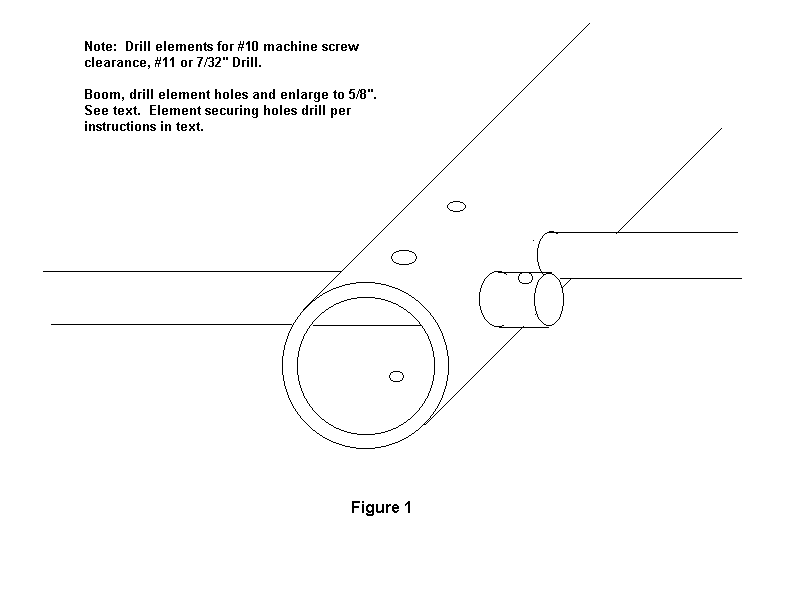
I wanted to use a split driven element for the feed, but some of the physical arrangements didn’t seem attractive. I considered some of the feed methods that use continuous elements, but rejected them for one reason or another. Off setting or staggering the two halves of the driven element was certainly unorthodox. I could see problems of unequal coupling between the two halves of the driven element and the reflector. The differences in spacing seem small so I decided to proceed with a paper design and a computer analysis. To support the two halves of the driven element I proposed mounting the two halves through the offset, more from convenience than science. See Figure 1 for details.
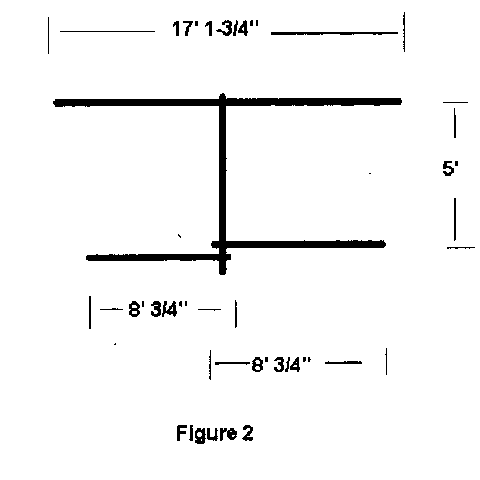
The computer analysis showed that this offset of the two halves of the element did not have a significant effect on the performance. One side effect of the proposed construction, was that the use of a non-conducting boom meant that it was not necessary to model the element to boom mounting. This would eliminate one possible source of errors in the analysis process. The antenna design was optimized, not for maximum gain, or Front to Back (F/B), or SWR bandwidth, but for a weighted average of all three. The idea being that this would provide a design that was not sensitive to small variations in construction or the environment of the antenna. The completed design was built using materials from the local discount building supply warehouse, and the cost was well below the twenty-dollar goal. The listed price for four 10 ft. lengths of 1/2 inch copper water pipe (the OD is really 5/8") and a 10 ft. length of schedule 40 2" PVC pipe (the OD is 2.4") is $16.18 (Your mileage may vary). The complete details of the antenna are shown in figure 2.
Construction Details
The reflector is made by splicing two pieces of copper pipe together. I chose to splice the two 10 foot lengths together and then cut the piece to length. You may chose to drill the #10 clearance hole in the element first. This hole is 8’ 6-7/8" from one end. If you drill the hole first, be sure you then cut the proper end off when you cut the element to length. I spliced the two pieces together by soldering using a standard plumbing coupling and a propane torch. Drilling and using sheet metal screws in the coupling is probably satisfactory. If you are soldering, remember to clean the pipe and coupling well. When soldering, Cleanliness is next to Godliness. Use a rosin flux and lots of heat so the solder flows into the joint. It isn’t necessary that the connection be water tight, but you don’t want it falling down either. To help in the alignment of the two pieces, I supported one piece between two supports. The second piece was slipped into the coupling at one end and supported on the other end. I shimmed the end and moved it back and forth till I could see through the two pipes, then heated it with a propane torch and flowed solder into the joints. After cooling, I cut the element to length with a tubing cutter, but a hack saw is fine. You should now have a 17’ 1-3/4’ reflector element with a #10 clearance hole in the center.
The two driven elements are simpler. They are each cut 8’ 3/4" long from 10’ lengths of tubing. A #10 clearance hole is drilled 1/2" from one end of each element. This is for attaching the feed line. A second #10 clearance hole is drilled 2-3/16" from the same end of the elements. This hole is for attaching the element to the boom that will be described next.
During the design phase I evaluated four different element spacings. I originally wanted the spacing narrower, just to keep the antenna smaller, but decided on a larger 5 ft spacing in the end. This requires a 5’ 6" length of the schedule 40 "2 inch" PVC drain pipe. Once cut to length, you need to drill 12 holes in the boom. The element mounting holes are 5/8" in diameter. This is the most difficult part of the construction. I didn’t have a 5/8 inch drill so I drilled the largest hole I could and then enlarged the hole with a reamer and round file. Work slowly and carefully so that the three sets of holes are in the same plane so the antenna elements will be parallel when mounted in the holes. A drill press and a vice are handy for this operation. If you don’t have this available I suggest clamping the boom to a flat surface and carefully aligning the drill each time. After drilling the element mounting holes drill the clearance hole for the head of the element securing bolt. One half inch should be adequate. Do not drill the #10 clearance hole in the bottom of the boom yet. Slide the three elements into place and align the holes in the elements with the center of the boom. Now using the #10 clearance hole drill, drill the hole in the bottom by passing the drill through the head clearance hole in the boom and through the clearance hole in the element and then drilling the clearance hole in the bottom of the boom. When the hole is drilled the Stainless Steel #10 machine screw is placed down through the hole in the top of the boom and through the element and the hole in the bottom of the boom. A flat washer, split washer and nut secure the element in place. Repeat this procedure for the remaining two elements.
Once the elements are secured you are ready to attach the feed line. I suggest that you attach a pigtail of coax to the antenna. This pigtail is what ever length fits your planned installation, but it is necessary to add about six extra feet to this length for the balun. The coax impedance should be 50 ohms as this is the design impedance value. RG 58, RG 8X or RG 213 are possible cables. Coax cable losses are starting to become significant at 28 MHz so I recommend a good cable. If you plan to run more that 100 watts you probably want to stick to the larger cables. Strip back the coax and separate the center conductor and shield. Trim the leads to length and attach a #10 solder lug. These lugs are fastened to the ends of the driven elements with #10 Stainless Steel or brass hardware. Run the coax along the top of the boom for several inches past the inside driven element and secure with plastic electrical tape. Then wrap 8 close spaced turns around the boom to form a balun. Then run the coax along the top of the boom again and secure with more electrical tape. The coax then is connected to the shack in what ever manner is appropriate after the antenna is mounted in place. There are no adjustments to make. Or possible.
The antenna is mounted to the mast with what ever type of gusset plate arrangement fits your installation. I used a couple of pieces of angle iron bolted to the boom and secured to the mast with U bolts. The antenna was placed on a piece of pipe 20 feet long and tipped up into position with the help of Stan and Ralph. A set of three guy wires hold it in place. Rotation is via the Armstrong method. The match is very acceptable over the 10 meter band. A graph of the measured SWR is included.
I took the opportunity to use a dxpedition in the Indian Ocean to compare signals between the three element tribander at 50 ft and the two element antenna at 20 feet. The two element seems to compare quite favorable. I also pointed the back of the antenna at the signal and looked at the front to back and that also seem to agree with the computer modeling. I have included Azimuth and Elevation of the computer modeled pattern.
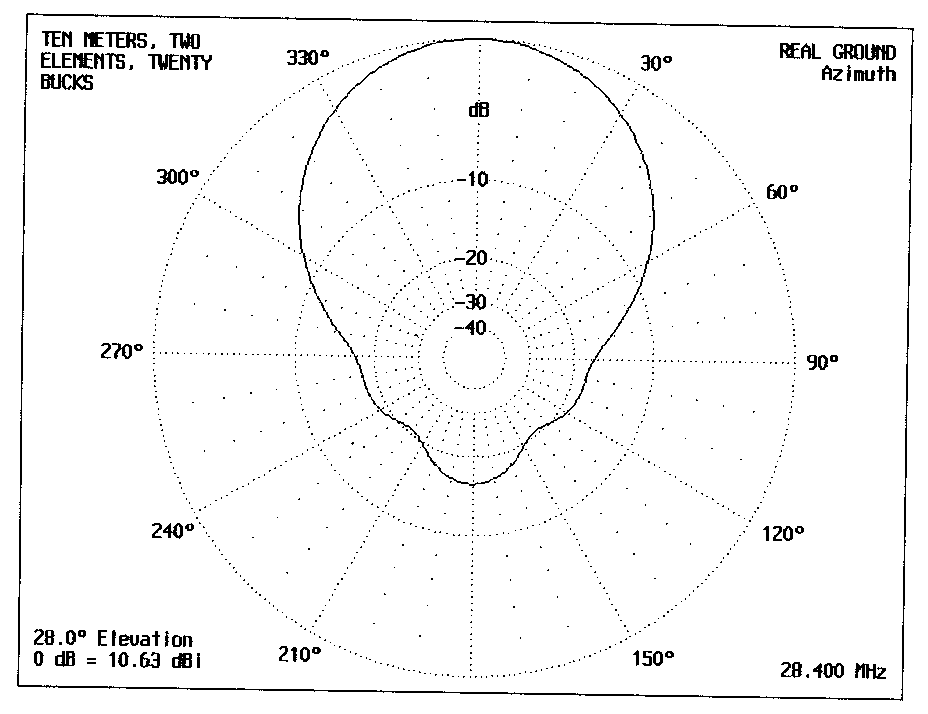
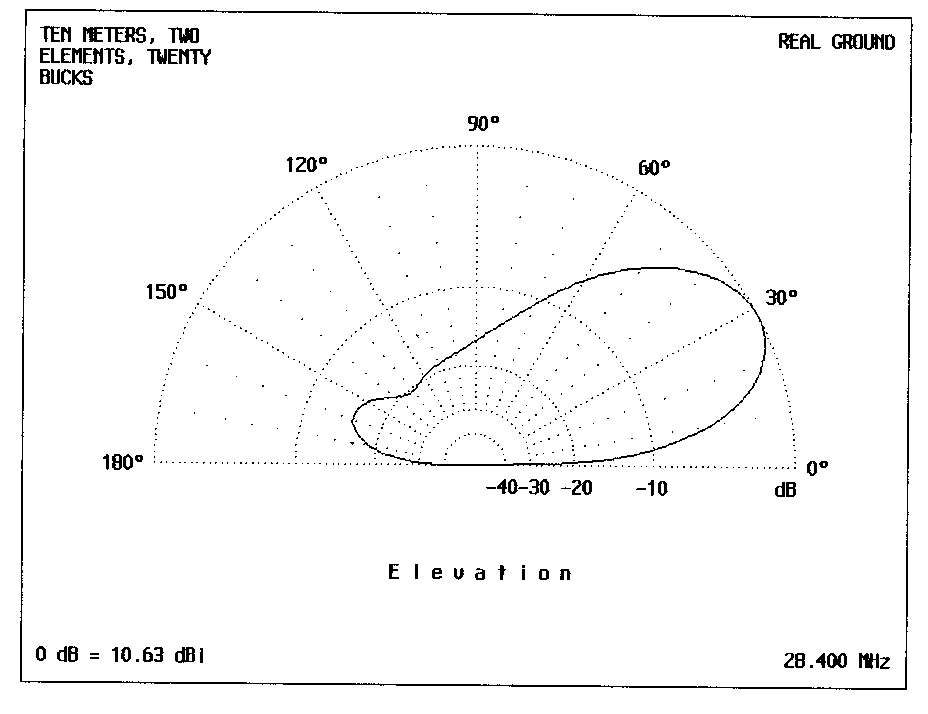
Although the solar flux has been down and conditions poor the last few weeks things are coming to life again on the higher bands. Predictions are still being made that the cycle will peak at record levels, so now is the time to think about starting those antenna projects so you will be ready. This antenna may be just what you need to have an edge over the dipole and vertical or what ever you have been using. And I am so pleased with how this antenna has come out, that I am thinking of a possible 3-element version, and a dual band 10 and 6 meter antenna.
Stay Tuned. 73 Bob W1XP
NVARC FoxBox/Fox Hunts
The FoxBox has been out in several locations since we started out last month. It spent several weeks on Lunenburg conservation land on the Lunenburg/Fitchburg line. We announced the first weeks as a Lunenburg location and the last ones naming the particular site so that people who are only trying "on foot" hunting could participate. The following hunters found the fox and some found it at every location. The local hunters were Barry W1HFN, Charlie WN1E, Ralph KD1SM, Stan KD1LE, Gordon N1MGO, Karen KA1JVU, Bob W1XP. The DX fox hunters were David VE6DXX and Rosemary VE6/G0DNP.
This past weekend the DTMF addition to the FoxBox was completed.
On the Saturday May 31 Ralph and Stan were the first to find the MMRA live fox (they were also the first to find the MMRA FoxBox) so there will be a hunt on the 145.45 Fitchburg machine in the near future.
Public Service (PSLIST)
Listing public events at which Amateur Radio communications is providing a public service and for which additional volunteers from the Amateur Community are needed and welcome. Please contact the person listed to identify how you may serve and what equipment you may need to bring.
Jun 26-27 Boston MA Multiple Sclerosis Bike Tour
John N1PYN 508-588-3250
n1pyn@aol.com
Jul 1-4 Fitchburg MA Fitchburg Longsjo Classic
Ralph KD1SM 978-582-7351
kd1sm@arrl.net
Jul 4 Freeport ME LL Bean 10K Fun Run
Bryce K1GAX 207-799-1116 K!GAX@juno.com
Jul 24 Gloucestr MA Blackburn Challengr Keith N1HLK 781-631-2877
n1hlk@nsradio.org
Jul 25 Harvard MA Harvard Bike Race
Stan KD1LE 978-433-5090 kd1le@amsat.org
Sep 06 Gloucestr MA YMCA Run Eric KA1NCF 617-559-0466
ka1ncf@nsradio.org
Sep 18 Marblehed MA Cycle 4 Life Keith N1HLK 781-631-2877
n1hlk@nsradio.org
Oct 3 Falmouth ME Maine Marathon
Bryce K1GAX 207-799-1116 k1gax@juno.com
Public Service and Other Activities
Since the last meeting we provided communications for the May Madness Road Race which was a fundraiser for the North Middlesex Schools Scholarship Fund. Thanks to Ralph KD1SM, Don N1NWE, Dave N1MNX, Pat N1VAW, Greg N1VAV, Bob W1XP, and Stan KD1LE for their help.
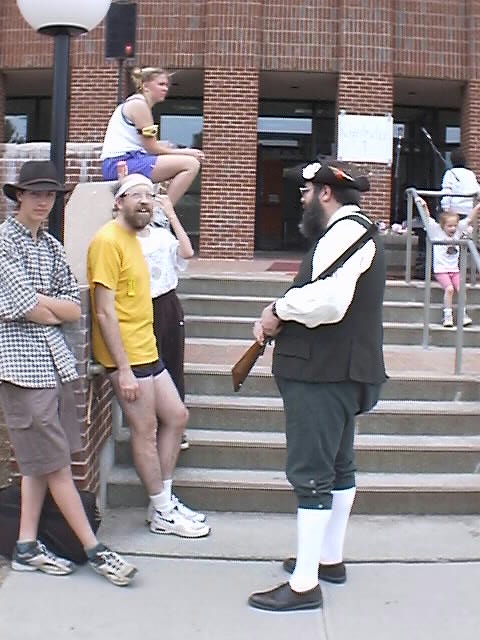
On May 23rd we provided communications for the Parker Classic Road Race on Devens for the Parker Charter School. Above is Gordy WA9WTK talking with the ceremonial race starter after he had run the five-mile race. Below is Stan KD1LE who coordinated the volunteers and acted as net control for the event. Photo’s by KD!SM.
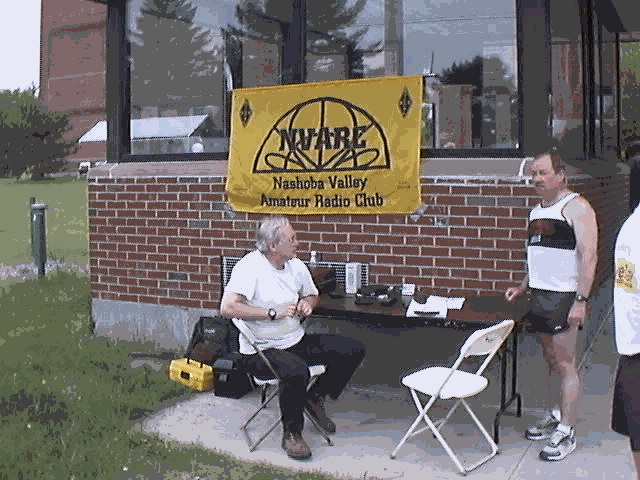
The following people supported the event; K1JHC Tom, KA1VOU, Wolf, KD1SM Ralph, KD1LE Stan, W1DEA Jesse, KE1EC Herm, N1QDZ Joseph, N1NWE Don, N1PBL Lynda, N1ABY Craig, Dave N1MNX.
On May 23rd we also completed our May road cleanup. Thanks to Dan N1LLG, Ben KB1FJ, Rod WA1TAC, Stan KD1LE, Jim AA1PO, Jeremy KB1AWE, Erik W1ZBT, and Den KD2S for helping out.
Coming up we have been asked to support the Pepperell 4th of July Parade. The parade is Saturday July 2nd at noon. We provide communications to help get everyone properly staged prior to the parade. Once the parade is completely underway we are done. For anyone interested there will be a "Block Dance" on the Town Field Friday night with a live swing band and activities and a DJ Saturday leading up to the fireworks
We have also been asked to provide health and safety communications along the route of the Pepperell Road Race Friday July 1st. The race starts at 6 PM.
Coming up in July also are the bike races in Fitchburg and Harvard.
From the ARRL Newsletter
MORSE DEBATE MAKES PAGE 1 OF WALL STREET JOURNAL
Hams checking the prestigious Wall Street Journal for the latest business news and stock quotes June 2 also found some Amateur Radio news—smack in the middle of page 1 and above the fold. A story by Staff Reporter Lee Gomes headlined "TO HAM OPERATORS, MORSE CODE TEST IS LIKE LATIN EXAM; Does It Keep the Barbarians At Bay, or Is It Fueling The Decline of a Culture?" discusses the current code versus no-code debate in Amateur Radio.
"Morse Code is a dying language in the Digital Age, but it’s still required reading for amateur radio buffs," Gomes’ story begins. His report outlines the broad strokes of the controversy and the impending FCC streamlining that is expected to address future Morse code requirements for amateurs. It also quotes the FCC’s Bill Cross, W3TN, as "the FCC’s lead staff person on the question," and reports that the FCC "is contemplating relaxing the Morse Code requirement."
Gomes cites Bruce Perens, K6BP, of No Code International, who—in Gomes words—considers Morse code "an antiquated technology" and "a turnoff for young people." "Perens is in the minority," Gomes asserts. "Most licensees don’t want any change in the requirement—especially since they have already passed the test themselves."
Taking the opposite viewpoint in Gomes’ article is Nancy Kott, WZ8C, of FISTS, which Gomes describes as a "militant pro-Morse group." Gomes says Kott "all but accuses the no-coders of taking bribes from ham radio makers" and claims they want the code requirements dropped to attract more hams and sell more equipment.
 Gomes reports that FISTS members fear a lot of bad, on-air behavior "without the screening provided by the Morse Code requirement." Perens, Gomes says, is not concerned about a "post-Morse ham world inhabited by barbarians." Perens points out for the article that applicants still will have to pass "rigorous tests" to get a ticket. Besides, Gomes quotes Perens as saying, "The riffraff have no reason to leave the Internet."
The article is silent on the issue of ITU regulations requiring a demonstration of Morse proficiency for HF operation and on the fact that a codeless class of Amateur Radio license already exists. And, at one point it refers to Morse code as "dits and duhs."
In the course of researching his article, Gomes contacted the ARRL for background information. The complete article is available via the Web for a fee to registered users of the Wall Street Journal’s interactive page,
http://www.wsj.com.
HURRICANE WATCH NET TO PREPARE FOR 1999 SEASON
The National Hurricane Center in Miami, Florida, is inviting amateurs to participate in a communication preparedness exercise this coming weekend to kick off the 1999 hurricane season.
Amateurs are asked to check into the Hurricane Watch Net on 14.325 MHz on Saturday, June 5, 1999, 1800-2000 UTC. Stations are requested to provide a real-time report of their current weather conditions, including wind speed, wind direction, and barometric pressure. Measured conditions are preferred, but estimated wind speeds are acceptable.
These reports will be forwarded to W4EHW at the National Hurricane Center. W4EHW will be on frequency. Stations do not need to continue monitoring the net once their reports have been forwarded to the National Hurricane Center.
The manager of the Hurricane Watch Net Manager is Jerry Herman, N3BDW.
HAMS WRAP UP OKLAHOMA TORNADO DUTY
Hams in Oklahoma stood down at mid-month following several days of volunteering to provide emergency communication after severe tornadoes devastated entire communities May 3. The Oklahoma storms left dozens dead, hundreds injured, and thousands homeless. Meteorologists now say the worst tornadoes were F5 storms packing record-breaking winds of 318 mph!
"It’s like a nuclear bomb went off," said ARRL Public Information Coordinator Tom Webb, WA9AFM. Webb was among the hams assisting Red Cross teams with damage assessment following the storm.
Hams got initial word of the tornadoes to the National Weather Service. "The first reports of tornado development came to our forecast office through ham radio," said Dennis McCarthy, KC5EVH, the meteorologist in charge of the NWS Forecast Office in Norman, Oklahoma.
The Salvation Army’s Frank McCollum, N5FM, coordinated Amateur Radio activities on behalf of his organization. McCollum, who also organized the Salvation Army’s Amateur Radio efforts in the wake of the Oklahoma City federal building bombing, said that ham radio remained "critical" until cellular telephone service was restored. Ham volunteers subsequently were assigned to handle transport for meals. Some even volunteered to load and unload trucks and delivery vehicles. "We did good!" McCollum exulted.
Jim Volner, WA1VIB, reports that hams aided volunteers using heavy equipment to remove storm debris in the heavily damaged village of Bridge Creek, 20 miles south of Oklahoma City. "I was very proud to be part of the situation where ham radio operators and the community all came together to provide a vital service," said Volner, a New Hampshire State Police retiree. By mid-May, Oklahoma Section Manager Charlie Calhoun, K5TTT, reported that Amateur Radio efforts were officially wrapped up. "Many times we think of those who helped after the incident, but I would also like to thank the weather spotters who helped warn on this storm" Calhoun said, "If it were not for them, we could have lost many more lives." For more Oklahoma tornado information and photos, visit
http://www.hamsnet.net/kc5trr/oklahoma_disaster.htm
FCC’S HOLLINGSWORTH QUESTIONS LIBERTY NET
The FCC has asked a net control station of the Liberty Net on 3950 kHz to justify the net’s use of Amateur Radio frequencies. Via Certified Mail May 7 to Extra class licensee Victor A. Misek, W1WCR, FCC Legal Adviser Riley Hollingsworth said monitoring on May 1 indicated that Misek’s station and members of the group for which he was acting as net control "began transmitting on top of existing Amateur communications that were already in progress." Hollingsworth said that such operation "is considered deliberate interference and cannot be tolerated on the Amateur frequencies."
Hollingsworth also pointed out that Congress has authorized the FCC to seek information to enable it to determine the qualifications of a licensee or applicant. "We are so far unable to determine how the transmissions of this group meet the standards of, or contribute to the purposes of, the allocation of frequencies for the Amateur Radio Service," Hollingsworth wrote.
Hollingsworth alluded to The Liberty Net in comments during an FCC forum at the Dayton Hamvention, openly questioning the behavior of net participants. "I don’t get the connection yet" between what Liberty Net participants do on the air and the basis and purpose of Amateur Radio, he said.
In his letter to Misek, Hollingsworth suggested The Liberty Net explore operation on the Internet or seek a low-power FM broadcast grant if that service is authorized. Hollingsworth reminded Misek that Part 97 "prohibits communications on the Amateur frequencies that, on a regular basis, ‘could reasonably be furnished alternatively through other services.’" He also pointed out that Part 97 prohibits broadcasting. Hollingsworth invited Misek to contact him to discuss the matter.
AGREEMENT NEAR FOR PHASE 3D LAUNCH
The long-awaited Phase 3D Amateur Radio satellite could be launched into space as early as this fall. A statement from Phase 3D Project Leader and AMSAT-DL President Karl Meinzer, DJ4ZC, delivered during the Dayton Hamvention revealed that AMSAT is "in the final phase of working out the details of an agreement" to launch Phase 3D.
Meinzer's remarks were read during the AMSAT forum by AMSAT-NA President Keith Baker, KB1SF.
Meinzer said that since an opportunity to fly Phase 3D aboard the last Ariane 5 test flight fell through last summer, the Phase 3D launch team has been seeking a replacement launch. "We have been patiently negotiating with a number of different launch agencies, and it looks now that this work is starting to pay off." He said he's optimistic that a launch contract can be finalized soon.
Phase 3D would remain "a standby passenger," Meinzer's statement said. AMSAT officials declined to identify the launch agency or vehicle. Meinzer's statement said Phase 3D could fly as early as October but stressed that the date is very tentative and depends on successfully working out the remaining contract details.
"It's mostly technical issues," Baker told the ARRL. He emphasized during the AMSAT forum that things are still tentative at this point. "The October date is the opening of a window that will stretch into the future," he said.
Phase 3D Integration Lab Manager Lou McFadin, W5DID, told the gathering that the spacecraft "is essentially complete." Additional integration and
vibration testing will be completed this spring and summer. For more information, visit http://www.amsat.org.
FCC SETS ASIDE MULTIPLE CLUB STATION GRANTS
The FCC has set aside 14 recently granted club station call signs and 12 recently granted club vanity call signs held by an individual trustee. The FCC's Riley Hollingsworth, K4ZDH, took the action May 11 in a letter to Motoaki Uotome, W9BO, of Honolulu, Hawaii. Uotome is the trustee for 35 club station call signs in various cities in the continental US as well as in Hawaii, the Marianas, Guam, and Alaska.
The action in the Uotome case is the first of several Hollingsworth said he expects to take, and it could have implications for other holders of multiple club station call signs. "They'd better have legitimate clubs or they're coming back to us," Hollingsworth told the ARRL. "We're getting a lot of complaints that people are scarfing up these call signs."
Hollingsworth said the FCC is not concerned about a single club station call sign used by a club or a DX or contesting group, but he emphasized that the FCC will not tolerate abuse of the system. He indicated similar letters soon would go out to other licensees who serve as trustees for multiple club station call signs.
Hollingsworth told Uotome that the FCC was setting aside 14 call signs granted within the last 30 days "pursuant to Sec 1.113 of the Commission's rules." In addition, Hollingsworth said the FCC was setting aside 12 vanity call signs issued to Uotome in the last 30 days.
Several club station call signs granted for more than 30 days will remain in the FCC database for now, but Hollingsworth asked Uotome to "provide justification within 30 days as to the need for each of these call signs."
Hollingsworth said that he wants to know names, addresses, and telephone numbers of club members, meeting times and dates within the past year, proposed meeting times and locations within the coming year, and copies of minutes, if any, taken at meetings within the last three months.
Hollingsworth said the FCC intends to cancel all of the listed call signs if Uotome does not "satisfactorily respond" to his inquiry within 30 days. He also warned that any willful misrepresentation or deliberate omission in replying would lead to revocation of Uotome's Amateur Radio license.
$The June Treasurer’s Report $

In May we received $48.00 in dues and paid out $23.72 for newsletter copying. The FoxFinder project expended $20.50 of its advance, leaving a net income to the Club general fund of $3.78. In addition we received income of $443.51 from additional sales of the donated equipment from previous months and a donation of $125 again this year from the Squannacook River Runners, sponsors of the Groton Road Race. These donations are placed in the Community Fund for future community service projects.
Current fund balances:
General Fund: $557.56
Community Fund: $1434.43
Y'all have a great summer. If you want to renew your ARRL membership through the Club during the summer, you can get your paperwork to me by any of the following means (in order of preference):
a - come to breakfast at Tiny's restaurant in Ayer at 0800 on Saturdays, b - mail everything to the Club PO Box (900, Pepperell), or c - call me on 442.900 and make arrangements to rendezvous somewhere.
73,Ralph KD1SM
Flea Markets
For those that like to plan ahead for the Summer.
June
20 MIT Electronics Research Society
July
10 Pen-Bay ARC, Union ME
18 MIT Electronics Research Society
31 NE Antique RC, Nashua NH
August
14 Piscataquis ARC, St. Albans ME
14 Burlington ARC, Charlotte VT
15 Northern Berkshire ARC, Adams MA
15 MIT Electronics Research Society
28 MARC Gardner MA
29 East V-UF Enfield CT
September
1 AARA Windsor ME
12 MassARA S. Dartmouth MA
18 Genesis ARS, Marshfield MA
18 RIFMRS Forestdale RI
18 Bagley ARC Lincoln ME
19 Candlewood ARA, Newtown CT
19 MIT Electronics Research Society
25,26 Lancaster NH
26 FARA Framingham MA
October
8,9 HossTraders Rochester NH
PO Box # 900
Pepperell Mass 01463-0900
Pres.: Erik Piip KA1RV
V Pres.: Den Connors KD2S
Secretary: Ian Norrish NZ1B
Treasurer: Ralph Swick KD1SM
Editor: Stan Pozerski KD1LE
PIO: Jon Kinney N1JGA
Board Members
Wolfgang Seidlich KA1VOU 1997
Earl Russell 1998
Bob Reif 1999
Meetings are held on the 3rd Thursday of the month - 7:30 p.m. - Pepperell Community Ctr. Talk-in 146.490 simplex
442.90 + 100Hz Repeater
This newsletter is published monthly. Submissions, corrections and inquiries should be directed to the newsletter editor. Articles and graphics in most IBM-PC formats are OK. You can leave items on PEPMBX, at Packet
address: KD1LE@N1FT.NH orpozerski@net1plus.com