[maybe all examples would be better in parallel with the text itself]
@@@@
News as hypertext
Internet news articles have been around for many years, and have been one of the wonders of the Internet. Although it has not always been used to advantage, news articles contain lots of useful pointer information, to their news groups, their authors, and articles to which they specifically refer. This is all ripe for representation as hypertext.
Background: Internet news
Internet news articles are distributed by a "flooding" method. Every computer passes a new message on to all its neighbours who don't have it already. The articles can, like hot gossip, start anywhere, and will go everywhere. Each article is allocated, by its author, to one or more "news groups". A news group is one of a carefully maintained set of subject headings, a little like a library classification system. In this scheme, comp.sys.mac means "Computing: Specific computer systems: The Macintosh", and "soc.culture.indian" means "Society: Culture: Indian culture" (@@ real group?)
[pic]
Example: A news article as hypertext.
The History of the Web
Preconditions
Toward the end of the twentieth century, a number of ideas and technologies matured to the point at which a while new world was born. The world was the world of networked information, at once an abstract space for Man's ideas and an opportunity to make concrete the dreams of knowledge handling with computers which had been frustrated since computers had been invented.
It would have been possible to write all the programs which are needed for a world-wide web thirty years ago. Indeed, most of the ideas were thought of around this time. However, for the web to work, computing technology had to advance to the point where, firstly, most of the people in a work group would have a computer and, secondly, that all those computers would be connected together by a network.
One technology which had been around for some time but whose maturity signalled the start of the information revolution was the development of graphical user interfaces which real people could use fairly intuitively. The idea of "windows" on the screen, and the imaging of familiar objects such as desk tops and filing cabinets onto the screen opened computing very many more people. Automatic teller machines educated anyone with a bank account in the use of menus and a keyboard.
Just as the computer literacy was becoming sufficient for groups to start abandoning paper mail for electronic mail, so the Internet was reaching out to the point where computer literate people could be connected together more intimately and effectively to share their knowledge.
A second component technology essential for the web was the deployment of computer networks to the extent that, within certain privileged communities of people (such as, for example, scientists in the western world) a significant proportion of people had access to a computer which was connected to the "Internet", a vast conglomeration of interconnected computer networks. Whereas communication had been a question of dialling up another computer using a telephone line, or sending an "electronic mail" message for delivery in some unspecified time via a series of computer sorting offices, now small packets of information could be sent from one end of the world to the other with little prior arrangements and a delay of a few tenths of a second.
It is important to realise the difference between having a computer connected to the Internet and a computer which is connected in other ways. (See the "How to" section) The essential aspect of the Internet is that small packets may be sent from any computer to any other computer very quickly. By small, I mean a few hundred characters, and by quickly, I mean to the other side of the world and back within a second. Other networks apart from the Internet can do this but none have grown with such staggering speed to global proportions. Before these "packet switched wide-area networks" were available, computers had to communicate by dialling each other up, or over a dedicated cable between two specific computers. Messages were larger and longer, being stored on disk for some time before it was convenient to send them on.
Fig. A packet switched network allows two computers A and B to communicate as though they had an instant direct connection.
Another practical facility which has boosted the networked information world is that disk space became sufficiently cheap for interested system managers to keep fairly large quantities of information on their machines, and provide it to the world. In the beginnings of the web, much of the data has been picked up from one source or other, chopped about into a usable form, and left on a server somewhere. Examples of this are the "hacker's dictionary" which has surfaced as hypertext in a number of forms, and various out of copyright works, such as old dictionaries and Roget's Thesaurus. This created a body of information sufficiently large and diverse to indicate what could be done. Soon the serious information followed.
Conception
The fact that the web first appeared at CERN, the European Particle Physics Laboratory, is not surprising in the light of these factors. The smaller the particles which physicists investigate, the larger the accelerators they have to build. In order to afford the accelerator and the detectors, groups combine from all over the world. The physicists form a widely dispersed computer-literate group. They also happen to have good networking facilities between their institutes for the exchange of physics data. The particle physics community therefore formed an ideal substrate for the growth of the web.
Fred Brooks, in "The Mythical Man Month", suggests that systems end up with a similar structure to the organizations which design them (rather as dogs seem to some times look like their owners!). CERN's mixture of people from many different institutes was echoed by a diversity in the programming languages, styles of design, and brands of hardware which were in use. Most of the subsystems had been designed by physicists rather than software engineers, giving a wealth of ingenious, if unconventional, techniques.
Of the (aproximately) 10,000 people in the CERN phonebook, only around 3,000 are actually salaried CERN staff. [@@ check] Many of the others have a desk at CERN and also one in their home institute, and they visit every now and again. This makes it imposible for anyone to make global decisions on types of hardware and software to be used. People bring with them machines and customs from their home universities. You just have to do your best to accomodate them. This had already led to a lot of work on mail and file interchange between different types of computer system and different networks.
When I first arrived at CERN in 1980 as a consultant, I found its structure fascinating. I wrote a small rather simple hypertext program ("Enquire") with which to note down all the dependencies between people, programs, and hardware. It was a bit like a card index, but with links between cards. It ran on a plain 24x80 terminal. The links had meanings like "A is part of B", or "A made B". The idea was that when one had put in everything one knew, one could trace through implications, answering questions such as "If I remove this module, what stops working?"
A surprising fact was that Enquire only needed a dozen or so different link relationships.
|
RelationshipInverse relationship |
|
|
made |
was made by |
|
includes |
is part of |
|
uses |
is used by |
|
describes |
is described by |
The links were bidirectional, in that having added it once, the reverse link automatically showed up. The relationships applied not, of course, to the cards, but to the people, things, documents and groups described by the cards.
I kept the program with me (rewriting it once) as I found its associative model seemed to match my need. It was a useful tool, but never got very far with the tracing and analysis engine.
When I later came back to CERN as a fellow, I worked on real-time systems. I developed a general tool for making distributed systems (real time remote procedure call). That project, as later W3, was developped and supported by people who needed it rather than by the limited CERN staff. These people came and went, and often worked away from CERN. I used Enquire to keep track of the modules, the users, the documents and everything I needed to note down about the project. I pretty soon realised that most of the coordination of the project boiled down to keeping this information up to date, and keeping everyone aware of changes. At the same time I realised that I spent another considerable part of my time trying to find out similar details of other people’s systems.
There was clearly a need for something like Enquire but accessable to everyone. I wanted it to scale so that if two people started to use it independently, and later started to work together, they could start linking together their information without making any other changes. This was the concept of the web.
Germination
Looking around CERN, it was clear that if I needed the web, then others, especially the experimental teams, must be desparate for it. In 1989, CERN was in a lull between two large pushes: one the LEP (Large Elecron Positron) accelerator was running and the LHC (Lage Hadron Collider) was a few years off. I suggested an as yet unnamed hypertext project and, after a year of writing memos and proposals which largely fell on stony ground, my boss at the time, Mike Sendall, said (more or less) "why not?".
At the same time, NeXT Inc was producing the first NeXT cubes, which provided an ideal prototyping platform. Again, Mike Sendall suggested we pick one up. When you are trying out the user interface to a hypertext system, the last thing you want is to be involved in great depth with details of writing characters onto screens, font metrics, and window exposure events. The NeXTStep programming environment came with a multifont editable text object which could be fairly simply converted into a hypertext object. The prototype was working as a browser after about a month, and as an editor after another month. This takes us to Christmas 1990. (For comparison, most of the X browsers took around year to be developed. More recently, Omni corp. decided to put together a new W3 browser "OmniWeb" using NeXTStep, and starting from scratch it likewise took them them a month.)
Efficient though it was as a development platform, the NeXT was not installed in any quantity, so any real use needed versions for the PC, Mac, X workstations, and "dumb" terminals. However, to attract any resources I also needed a good visible reason to be doing this at CERN.
CERN had seen many in-house documentation systems rise and fall. It would clearly be a mistake to design the ultimate system and then hawk it around suitable users. No one wiould put any information into it, simply because no one else uses it. Similarly, no one will look into it for data because there isn’t any. The hope was that once the ball was rolling, increasing data would bring a wider user base, which would in turn encourage new information, but an empty system had no appeal for anyone.
Fortunately there was a way to bootstrap the web by making gateways into existing systems. Making gateways into virtual worlds is still a very interesting and useful technique in its own right, but at that stage it was the seed of the web’s existence. The first target data was the CERN phone book, a database sitting on the ageing mainframe and whose maintainer, Bernd Pollermann, was charged with providing to users on their favorite systems. Bernd helped set the old VM machine up as a server to a simple hypertext version of the data. Nicola Pellow, a visiting student, tackled the client side by providing the line mode interface. This was so basic in its assuptions about the terminal type so that no one could claim that there was no client interface available on their system. Unlike the NeXTStep application, the line mode browser (never given any other name) could not edit hypertext: it could only read . It was good enough for the phone book and for the hypertext documentation which we generated for the project. Robert Cailliau, a great enthisiast for accessable no-nonsense technology, joined me and looked at providing a program for his favorite, the Macintosh.
So this was the way the the web was first presented at CERN: as a rather simple user interface which allowed one to look up (mainly) telephone numbers. It was to be two years before it would shed that image. Accepted as a rather quirky information system by people who didn’t see why a simple ad hoc program for getting the phone numbers wouldn’t have done just as well, the W3 may have stayed confined to that role, had it not been for the Internet.
Propagation
When the basic server and the NeXTStep and line-mode clients were available, I made them available by FTP and mentioned this rather limited software on a usenet newsgroup, alt.hypertext. There was not much to show (unless you had a NeXT), but the great thing about usenet is that there are so many bright and weird people out there, that if you put any idea the right way and in the right place, the chances are fairly high that somone to whom it makes sense will pick it up. The project started getting feedback from people who saw it as a rather simple version of Hypercard(TM), an over complex information system, a frustratingly inconsistent database, or an idea which appealed to some latent excitement about how things could be. From then on, interested people on the Internet provided the feedback, the stimulation, the ideas, source code contributions, and the moral support which it would have been hard to find locally. The people of the internet built the web.
Just as W3 "rescued" the CERN phone book from the prison of a mainframe, Louise Addis, the librarian at the Stanford Linear Accelerator (SLAC) saw it as a godsend for their rather sophisticated but mainframe-bound library system. Under Louise’s encourgement, SLAC became a model site, using interesting W3 techniques, and providing information of real value to physicists.
The next year or two required a certain amount of selling of the idea of the web to the High Energy Physics (HEP) community. Even given that, Robert and I were taunted with the fact that W3’s use in CERN itself was very low. We trod a fine line between dedicating our resources to local user support but neglecting the project as a whole, and pursuing the web’s goal of an interactive seamless information world but being balled out for producing nothing useful.
The Graphic User Interfaces bloom
At conferences on networking, hypertext, and software for HEP, we would point out that we really needed clients for the PC, Macintosh, and X, and that these would make useful student projects. At CERN, I was under a lot of pressure to make an X client. In the end, our strategy of finding volunteers paid off. Marc Andreessen, a student at the University of Illinois at Urbana Champain (UIUC) decided to pck up the X client as his project. Working with Eric Bina at UIUC’s National Center for Supercomputer Applications, Marc put in the work of three men, driven by a vision of what could be done and nourished by large quantities of expresso. The result was "Mosaic", an X application which one could pick up and execute, and which would give an immediate point and click access to the web. NCSA soon started other projects to get the PCs running Windows and Macintoshes onto the web. In September 1993, Mosaic was available on all three platforms. The vision of W3 as a rather crude line mode program was gone, and the world started to know W3 as Mosaic.
While Marc is rightly credited with having broght W3 out into the light, in fact many others produced equally exciting, if not so easy to install nor well deployed, programs. Pei Wei’s "Viola" at Berkeley rivalled "Erwise" from a team of students in Helsinki for the prize as the first X browser, both very crediable programs. "Midas" from Tony Johnson at the Standford Liner Accelerator Laboratory (SLAC) was a later product which is currently in use in SLAC and collaborating labs as an alternative to Mosaic, with a similarly user-friendly interface, and a different set of features.
Proliferation
There are a number of ways to measure the growth of the web, none of them definitive. The earliest figures available to us was the load on our server at CERN, expressed in documents fetched per day. For two years, this showed a steady exponential increase, doubling faster than every four months -- in fact, each time I counted the log for a month, it was roughly 10 times the size of the same month last year. This server, info.cern.ch, held mainly information about the web itself, so the rise in interest in it may have been an indicator of future developments.
If the total use of the web can be expressed as the usage of a average server multiplied by the number of servers, then some statistics on the number of server would clearly be useful. However, one of the factors enabling the growth was the lack of mandatory central registy of servers. Though we do keep an optional list of servers, I do not unfortunately have acuurate history of it. Here are a few points we noted down:
[@@ table]
Occasionally I would run a program which would trace two levels of links down from each registered server. The program would typically find just as many unregistered servers as there were registered servers.
@@@
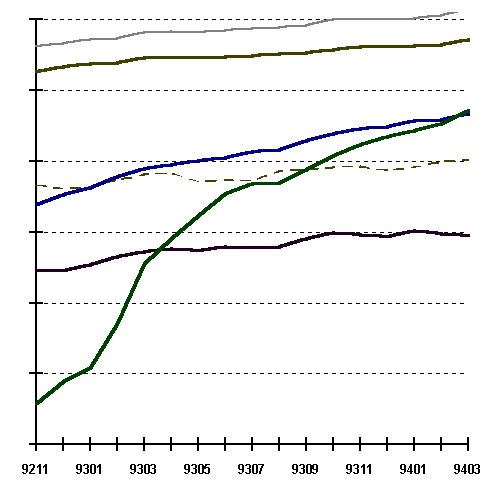
When the global traffic began to become significant, another interesting figure was the port 80 TCP traffic across the NSF backbone. Merit Inc keep such statistics by sampling the traffic through routers. Port 80 is the port number for HTTP servers. Not all servers run on this port, and of course WWW clinets also use other protocols, but the port 80 traffic is some indication of the growth of the web. Rising from 0.1% of the total traffic in March 1993 to 1.0% in September and 2.5% in December, the web was growing at a rate unprecedented even in Internet circles.
Figure. ...@@@
As @@@ put it in an article in March 1994, <quote>.
Attitudes to information
In this chapter we look at how W3 fits in to the world and people. This is not a complete study of the social implications of the web, but in a mixture of guesswork about the future and personal belief about how the world could be, it points to some of the questions which the we, by its existence, raises about computers, information and society. It is written wih no expertese in sociology, only an observation of users and their attitudes.
Initially, the web spread as a way of disseminating information from information centers, and computing support groups. Some of the incentives which led people to grow, or not to grow, the web are mentioned in the boxes.
Why do people put things on the web?
As a service. Providing information is part of most jobs. If the service is provided to compuer-litterate people, the web makes it easy for both provider and consumer.
To save time. Once something is on the web, it takes not extra effort to apread it around. Some people put informationon the web to save having constantly to answer the same questions on the telephone.
As a disclaimer. There is some information which, once public, releives one of a responsability. People like to make it clear what they do and do not stand for, answer for, promise or support.
To be heard. The web, like internet news, can be a soapbox. It allows people to express themselves to whoever wans to hear.
As advertisement. The web can be used subtley or (now that policy on use of the Internet has largeley relaxed) for advertising.
The process of publication, the making public of information, used to be laborious. As the typesetting and printing cost time and effort, it was natural to review what was going to be published. Material did not get published accidentally. All material was, by default, hidden from anyone apart from the industrial spy.
The web changes this, in that making information public is as easy as making it private. This allows us to review our preconceptions about information. Why should it still be private by default? We all cringe when we think or our private letters and wild plans getting into the wrong hands, but most times we have little to gain from hiding information.
There is a distinction between freedom of information and free information. By freedon of information we mean the right to publish, and the right to know. The concept ignores the cost of this communication. In practice "freely available" information -- that is, information available to anyone, may not in practice be free at all. Anyone can get a copy of any ISO International Standard -- at a price. Free information costs someone somewhere something. The fact that Internet Standards are "free" relies on many organisations contributing disk space and network links, and provides no subsidy to the working groups who create them. The big difference that the Internet and the Web have made is that the cost can be reduced to little more than it that of maintaining one’s own copy of the data.
The developers of the WWW software at CERN took the stance that all information should be public by default. (Of course personal information is not public, and the project was not the subject of commercial competition, which made it easier). The result seems to have paid off, in that people from all over who were interested in the project have been able to find out how it really ticks for themselves. These people have helped spread the word about the project, and many have been able to contribute to or support it in some way. This isn't to say that we provided high quality information: just, what there was, anyone could have.
WWW was created partly with the need to help communication in very large design projects. How many times did I hear people at CERN ask, "NASA must have had these problems when building the space shuttle: I wonder what they did?". Maybe next time one will be able to have a superficial look around the project, and see what sort of problems they had.
Openness is a cultural thing. It varies from country to country, from organisation to organisation. It is learned in an atmosphere of trust, and forgotten quickly when information becomes a weapon with which to harm. Where it is, people feel good. There are fewer misunderstandings, and the wealth of available information makes a rich world for the curious.
As most of the information on the web is public, it is interesting to look at forces for and against public data. However, it is quite possible to use the web for private information, as will be discussed later.
On the other side of the coin are the reasons for keeping one’s information to one’s self.
Error! Cannot open file.The box presents these reasons in a negative light. There are positive reasons too. One is of course are security. As computer system managers have found in the fight against network intruders, even when information is not of a confidential nature itself, someone with free access to large quantities of it can sometimes deduce dangerous information in unexpected ways. Hence "need to know"policies.
There is an argument that society is composed of a large body of law-abiding but passive people, and a small number of law-breaking and active people. The criminals have much more interest in uncovering sensitive information for their criminal (for example terrorist) aims than have the general public. The argument seems to then run that making information available will therefore create more risk from the small criminal sector than give benefit to the large law-abiding sector. Pessemistic perhaps, but a little time spent putting oneself into the criminal’s place and wondering how one could exploit the new information might sometimes be worthwhile.
Attitudes to he freedom of information on the net vary widely, which is not surprising when you look at the diversity of the goals of those who pay for it to be produced. When taxpayers are paying for it, it is hard to argue that they should not have access to it. Government departments are therefore prime candidates for openness in information. One perhaps naïve point of view is that government information should be available unless specified otherwise. (..recent US acts, open government...). The web is a good test of availability. Whilst it is eminently possible to "hide" something on the web, that is, make it available in a very obscure way, the fact that computers can be used to search for new information makes it more difficult to be devious. The networking equivalent of posting a redevelopment notice on the back of a tree in the middle of a forest will be more difficult, if a program exists to search all the backs of all the trees overnight.
(Who will tell the people quotes)
There are also of course organisations committed by their mandate to publicise their findings. For them, the web comes as a relief, as it allows them to fullfil this purpose without prohibitive cost.
One of the appeals of the Internet community is the way levels its users. It is partly the equal access which each user has: as few systems are in place to reliably "authenticate" (prove the identity of) a remote user, everyone is treated alike. There is a certain anonymity of a user name, and also a history of development independent of those political structures which give status in business and academia.
The Web can bring equality in the same way, by allowing anyone access to information. It becomes less important whether the local library is well endowed, or whether one studies in an a university town: anyone with network access can in principle find the same information
However, just as the web can bring equality among the network-connected, so it can divide the network-connected from the disconnected [Depending on your vernacular, the "branchés" from the "non branchés", the "wired" from the "tired"]. Where will this division come? We can assume that terminals of some sort will be come as common as the Minitel terminal in France. In that case, those excluded will be those whose poverty or isolation precludes even a telephone, and those whose education level does not allow them to cope with using the system.
To help people cope, providers of information must ensure that their presentation is straightforward. If they do not, then we may have large parts of the web which are just as difficult to understand as are laws, or international standards, for example, today. Whilst a business will be forced to get the presentation right by the guillotine of commercial failure hanging over its head, a government department will not.
As with publishing today, there is a great market for third parties who will (for a price) present clear interpretations of obscure public documents. This third party activity goes much beyond this, and is discussed more fully in section xxxx.
The Economic Enabler
(elsewhere-- under comercial developments?)
The first commercial interest in the Web was from companies interested in making money from selling software, hardware and services to web users. The second, and more significant, interest is from companies interested in making money by selling information itself.
While these are both important, a yet more interesting exconomic impact is of the of the business which is eased, and opened up, by the web as a form of communication. The conventional information industry will only be one sector to benefit from the web, and eventually a relatively small sector. There are many businesses, from travel agents and banking to dating services, which one might not think of as information industry, but which can be mostly carried out using information. Other businesses involving materials and people still benefit from the existsence of the web.
Whatever one’s field, it is easy to regard it as central to the operation of business, and information is no exception, as much of marketting, buying, selling, hirng and planning involves principally the collection, analysis and redistribution of information.
Common worries: Drinking from a fire hose, inability to determine reliability of sources, etc. Finding things. Misuse of log information and privacy.
This is one expression of the fear of the abundance of data on the web. However, as we have seen, the information does not pour out at one, it just sits there waiting to be read. The analogy of "stemming the flood" does not really apply. The problem is most often that information is either not there, or if there it has not been put (linked to) the place you would have expected it to be. The secondary result of this is that one spends one's time reading all sorts of garbage just in the hope of finding what one is looking for. This is when the real frustration comes in. In fact, at the moment, the web is very sparse. It contains great details in certain areas, and then in other areas it contains nothing at all. If one jumps into it with a specific real problem -- to find a discussion group on the work of E.M.Forster, or a map of the battle of Hastings, or even the London Underground, the chances are quite slim that it is there at all. And there is never a way to be absolutely sure that it is not.
This is a real problem. The solutions we have to date involve real effort by real people in making a clear useful web. The web does not do this automatically. We hope, though, that it will allow human beings to do it much more efficiently.
The source and status of documents
One effect of the arrival of laser printers was that anyone with a personal computer could make a memo, a newsletter or a book which looked just as smart as the "real thing". Idle thoughts and which notes which were once dashed off on a torn-off page of spiral bound note paper could be sent around instantly with the look and feel of a formal government announcement. This removed some information: the information carried in the feel of the paper, the amount of care taken in the typesetting, or the carelessness of the handwriting. This was important information about the status of the document. Nowadays my desk is heaped with identical white sheet and I actually have to read them to decide how serious they are, and even then it sometimes it isn't clear.
Electronic messages and documents have the same problem. Usenet news articles have used various conventions to help. The smiley faces on their sides made up out of punctuation are attempts to replace the facial expression which one misses in electronic mail messages.
:-) :-( ;-) :-} :-(( 8^)
Fig. Smileys representing a smile, a frown, a wink, a wry smile, a deep frown, and a frown wearing spectacles. Tilt your head to the left to see them.
You might notice in electronic mail messages other ways of presenting the status of messages: when i want to be informal i sometimes use lower case i's and sign myself with just a "t". When I want to be more formal I might fully justify the text and even check the spelling.
When you come across a document on the web it is difficult to know its source and status. Perhaps we should introduce icons, or background colors, for documents to deliberately convey status sich a notes, drafts, official documents.
[Anecdote icon] J Recently CERN received a request for a server to be put into the list of servers under the name of a large university. We complied, noting that the server had, as advertised, all sorts of useful information about the university and the neighborhood. Pretty soon we received a request to register another server for the same university, "and please put this one in the list above the other one". An attempt to clear this up led to a heated exchange of mail rising to a fairly exantled level in the university. One party of whom felt they had a far superior server, while the other maintained that their server was officially mandated by the university. We solved the problem in the end with separate pointers to the "University" and "University Underground" servers and honor was satisfied. This underlines the necessity to make it quite clear who speaks for and has authorised information.
Hopefully, a system of "approval" links described above will allow a general solution to this problem, while leaving a suitable way of representing this to the user up to the human interface specialists.