HTML5 and beyond
Cambridge, MA
W3C Offices
Agenda
- Interaction Domain
- Ecosystem
- HTML 5.0
- Beyond HTML5
- Test the Web Forward
Interaction
Interaction
Shape the Web's user interface
- Languages and formats: HTML, CSS, SVG, PNG, MathML, WOFF, Web IDL
- APIs: Sockets, Workers, File, Notification, Timing, DOM, Streams, Storage, XHR, Pointer Lock, Web Driver, …
- Internationalization and multilingual: reviews, ITS, Encoding
- Video & Audio: HTML, Web Audio, MIDI, Media Streaming, Encryption, Media Fragments, Annotations, Captioning, media requirements (with WAI PF)
- Graphics: PNG, SVG, HTML/canvas, 2DContext, CSS
- Styling: a lot of CSS, SVG, WOFF
- Network: XHR, Sockets, Streams, Media Source, Timing, Beacon
- Offline: HTML/appcache, Storage, Indexed DB, Manifest, Service Workers, File
- Device: Pointer Events, Pointer Lock, Input Methods, Screen Orientation, Fullscreen, Gamepad, UI Events
- Performance: Timing, Resource Priority, High Resolution Time, Visibility, Error Logging
- Not yet looking at Gaming
Growing ecosystem
Approach
- In parallel with completing HTML5, considerable focus has been on making the Open Web Platform (OWP) the platform for app development
- Two opportunity areas
- App writers for the Open Web
- Major focus on closing the gap with native platform
- The OWP as a platform for industries
- Engaging with industry verticals to customize platform for their needs
- Create the environment for a larger set of developers
Target industries
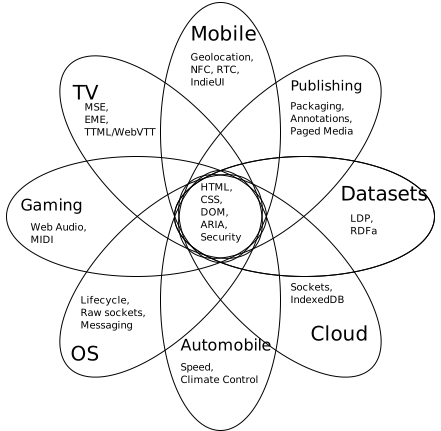
- Mobile: Web and Mobile Interest Group
- Entertainment: Web and TV Interest Group
- Digitial Publishing: Digital Publishing Interest Group
- Automotive: Automotive Business Group
- Retail, Finance: Web Payments Workshop
- Factory automation, Government, Medical devices: Web of Things Workshop
HTML 5.0
HTML History: Plan 2014
- 2007: W3C created the HTML Working Group; partnership with WHATWG
- 2012: Editor is changed and plan is created to guarantee 2014 timeline
- Plan 2014:
- Deliver HTML5.0 by 2014Q4 and HTML5.1 by 2016Q4
- Use CR exit criteria to focus testing effort
- Use modularity to manage size/complexity and to reduce social conflict
Results
- Editors for HTML and DOM, including incorporation of editing changes from the WHATWG to avoid divergence as much as possible
- Closed the remaining 250 issues around HTML5
- Resolved HTML accessibility issues and differences
- Develop and review tests for HTML5 to ensure proper coverage
Results- HTML Test Suite
- Testing framework
- Full feature coverage of HTML 5.0
- ~97,000 tests for HTML5, large parts contributed by Opera, Mozilla, and Intel
- ~94,000 tests have at least 2 implementations
- ~3.2% of tests don't have 2 implementations
Most are exception type mismatch rather than interoperability issues - For details, see HTML results
HTML5.0 Schedule
- Last Call Working Draft: June 17, 2014
- End of review LC period: July 15, 2014
- Recommendation: 2014@4
…assuming we stay on track
Beyond HTML5
Making HTML more agile
- W3C Process is being revised to improve agility
- HTML Working Group has a new Work Mode, to match the Web Applications Working Group mode of operations
- public-html@w3.org is open to everyone
- Faster release of HTML Recommendations: HTML 5.1 in Q42015?
Extensions specifications
- Encouraging new ideas through extensions
- Image description, Media Source, EME, JSON form, Form HTTP, responsive images, 2D Context, (main, ruby)
- Other W3C Working Groups are also extending HTML: Web Performance, Web Applications Security, Device API/WebRTC, I18n Tag Set, Web Applications, WAI Protocol and Formats
- See also Extensions specifications wiki
Future enhancements
- Continue to push innovation through extensions, with possible reintegration later on (e.g. Resource Priorities, Responsive Images)
- Continue the integration of Web Components (HTML Imports)
- Rich Editing
- Better frames and forms
- Continue improving HTML accessibility
- Better integration of HTML and ES6 (including Promises)
Extensions
- Responsive Design:
- Image adaptation:
<img srcsetand<picture> - Network congestion:
<img lazyload>
- Image adaptation:
- Accessibility:
- Image Description:
<img longdesc
- Image Description:
- HTTP forms:
- JSON submission:
<form enctype='application/json'>
- JSON submission:
- Media:
- Streaming:
mediaBuffer.appendStream(stream) - Protection:
video.setMediaKeys(key)
- Streaming:
- Security:
- Content Integrity:
<script integrity="ni:///sha-256
- Content Integrity:
Extensible Web
Web Components
- Templates: define chunks of markup that are inert but can be activated by script
- Custom Elements: define elements, with new tag names and new script interfaces.
- Shadow DOM: Encapsulates DOM subtrees for more reliable composition
- Imports: defines how templates and custom elements are packaged and loaded
Rich Editing
- Editing on the Web is still a challenge
- Diverse tools and approach: wikis, markdowns, etc.
- HTML5 content editable feature is far from enough
- Interest is growing in solving the issue: Microsoft, Apple, Google
- Approach:
- Core enablling function as low level standards
- Allow rich authoring tools to be developed on top
- Need to ensure that accessibility and internationalization are addressed
Better sandboxes frames
for advertizers
- Enhancement to allow finer controls, i.e., ability to restrict
- Individual plugins (Sandbox)
- Allow / Deny access to a given IFRAME via JavaScript
- Downloads
- Alternate navigation
HTML Accessibility
- ARIA 1.1
- Full transcript
- Media Descriptions
- Date UI widgets
- Input type numeric
- …
Closing the gap
Offline support
- Manifest: metadata associated with a web application
- Packaging: Streamable Package Format
- Service Workers: persistently cache resources and handle all resource requests for an application
Extensible Web Summit:
Future of HTML and Web Applications
- September 11, in Berlin (next to JSConf EU)
- W3C workshop but using unconference style (no position papers or detailed agenda)
- Focus the discussion on future of HTML, in particular Rich Editing, in coordination with Web Applications Group and TAG
Test the Web Forward
- Foster the crowd sourcing effort
- It's a community effort: working groups, web developers at large
- Encourage individuals to contribute and review tests