1
Introduction
For many years, organizations have
being
The past few years have seen the Extensible Markup Language
(XML) and the Web Services framework developing as the de facto
choices for describing interoperable data and platform neutral
business interfaces, enabling more open business transactions to be
developed.
Web Services are a key component of the emerging, loosely
coupled, Web-based computing architecture. A Web Service is an
autonomous, standards-based component whose public interfaces are
defined and described using XML. Other systems may interact with a
Web Service in a manner prescribed by its definition, using XML
based messages conveyed by Internet protocols.
The Web Services specifications offer a communication bridge
between the heterogeneous computational environments used to
develop and host applications. The future of E-Business
applications requires the ability to perform long-lived,
peer-to-peer collaborations between the participating services,
within or across the trusted domains of an organization.
The Web Service architecture stack targeted for integrating
interacting applications consists of the following components:
-
SOAP: defines the basic formatting of a message and the
basic delivery options independent of programming language,
operating system, or platform. A SOAP compliant Web Service knows
how to send and receive SOAP-based messages
-
WSDL
-
Registry: allows publishing the availability of a Web
Service and its discovery from service requesters using
sophisticated searching
mechanims
-
Security layer: ensures that exchanged information are
not modified or forged in a verifiable manner and that
parties
-
Reliable Messaging layer: provides exactly-once and
guaranteed delivery of information exchanged between
parties
-
Context, Coordination and Transaction layer: defines
interoperable mechanisms for propagating context of long-lived
business transactions and enables
parties
-
Business Process Languages layer: describes the
execution logic of Web Services based applications by defining
their control flows (such as conditional, sequential, parallel and
exceptional execution) and prescribing the rules for consistently
managing their non-observable data
-
Choreography layer: describes collaborations of
parties
The Web Services Choreography specification is aimed at the
composition of interoperable collaborations between any type of
party
1.1 Notational Conventions
The keywords "MUST", "MUST NOT", "REQUIRED", "SHALL", "SHALL
NOT", "SHOULD", "SHOULD NOT", "RECOMMENDED", "MAY", and "OPTIONAL"
in this document are to be interpreted as described in RFC-2119
[RFC2119].
The following namespace prefixes are used throughout this
document:
Prefixes and
Namespaces used
in this
specification
| Prefix |
Namespace URI |
Definition |
| wsdl |
http://www.w3.org/2004/08/wsdl |
WSDL 2.0 namespace for WSDL framework. |
| cdl |
http://www.w3.org/2004/12/ws-chor/cdl |
WSCDL namespace for Choreography Description Language. |
| xsi |
http://www.w3.org/2001/XMLSchema-instance |
Instance namespace as defined by XSD [XMLSchemaP1]. |
| xsd |
http://www.w3.org/2001/XMLSchema |
Schema namespace as defined by XSD [XMLSchemaP2]. |
| tns |
(various) |
The "this namespace" (tns) prefix is used as a convention to
refer to the current document. |
| rns |
(various) |
A namespace
prefix used
to refer to
an (example
and fictitious)
WSDL interface
specification. |
| (other) |
(various) |
All other namespace prefixes are
samples"http://example.com" |
This specification uses an informal syntax to describe
the XML grammar of a WS-CDL document:
-
The syntax appears as an XML instance, but the values indicate
the data types instead of values.
-
Characters are appended to elements and attributes as follows:
"?" (0 or 1), "*" (0 or more), "+" (1 or more).
-
Elements names ending in ". . ." (such as
<element../><element..>)
-
Grammar in bold has not been introduced earlier in the document,
or is of particular interest in an example.
-
<---->
-
The XML namespace prefixes (defined above) are used to indicate
the namespace of the element being defined.
-
Examples starting with
<?xml
An XSD is provided as a formal definition of WS-CDL grammar (see
Section 11).
Where there
is any
discrepancy between
the text of
this specification,
the fragments
of informal
schema and
the full
formal schema
in the
appendix then
it is an
error in the
specification. Should
such an error
come to light
please notify
W3C. While
awaiting resolution,
the text
takes priority
over the
formal schema
in the
appendix, which
takes priority
over the
informal schema
fragments.
1.2
Purpose of theChoreographyDescriptionLanguage
Business or other activities that involve different
organizations or independent processes are engaged in a
collaborative fashion to achieve a common business goal, such as
Order Fulfillment.
For the collaboration to work successfully, the rules of
engagement between all the interacting
partiesparties
The WebServicesChoreographyparty
Using the WebServicesChoreographypartiesparty
The advantage of a contract based on a global viewpoint as
opposed to anyone
In real-world scenarios, corporate entities are often unwilling
to delegate control of their business processes to their
integration partners. Choreography offers a means by which the
rules of participation within a collaboration can be clearly
defined and agreed to, jointly. Each entity may then implement its
portion of the
ChoreographyCDLinCDL
The figure below demonstrates a possible usage of
theChoreographyDescriptionLanguage.Figure1:IntegratingWebServicesbasedapplicationsusingWS-CDL
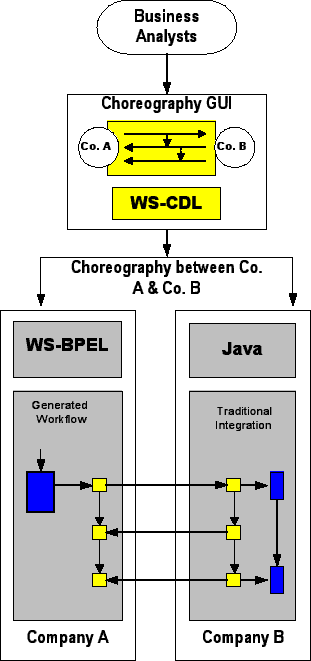
In Figure 1, Company A and Company B wish to integrate their Web
Services based applications. The respective business analysts at
both companies agree upon the services involved in the
collaboration, their interactions, and their common ordering and
constraint rules under which the interactions occur. They then
generate a ChoreographyDescriptionLanguageChoreography
-
Company "A" relies on a WS-BPEL [WSBPEL]
solution to implement its own part of the
Choreography
-
Company "B", having greater legacy driven integration needs,
relies on a J2EE [J2EE] solution incorporating
Java and Enterprise Java Bean Components or a .NET [C#S] solution incorporating C# to implement its own
part of the
Choreography
Similarly, a
Choreography
1.3 Goals
The primary goal of aChoreographyDescriptionLanguage
More specifically, the goals of the
ChoreographyDescriptionLanguage
-
Reusability. The same
Choreographyparties
-
Cooperation. Choreographies define the sequence of
exchanging messages between two (or more) independent
parties
-
Multi-Party Collaboration. Choreographies can be
defined involving any number of
parties
-
Semantics. Choreographies can include human-readable
documentation and semantics for all the components in the
Choreography
-
Composability. Existing
ChoreographiesChoreographies
-
Modularity. Choreographies can be defined using an
"inclusion" facility that allows a
ChoreographyChoreographies
-
Information Driven Collaboration. Choreographies
describe how
parties
-
Information Alignment. Choreographies allow the
partiesChoreographies
-
Exception Handling. Choreographies can define how
exceptional or unusual conditions that occur while the
Choreography
-
Transactionality. The processes or
partiesChoreography
-
Specification Composability. This specification
willand
1.4 Relationship with XML and
WSDL
The WS-CDL specification depends on the following
specifications: XML 1.0 [XML], XML-Namespaces
[XMLNS], XML-Schema 1.0 [XMLSchemaP1], [XMLSchemaP2] and
XPointer[Action:addreferences]
1.5 Relationship
with Business Process Languages
AChoreographyDescriptionLanguage
AChoreographyDescriptionLanguagepartyEachparty,adheringtoaChoreographyDescriptionLanguagecollaborationrepresentation,couldbeimplemented
Each participant,
adhering to a
WS-CDL collaboration
representation, could
be implemented using completely
different mechanisms such as:
-
Applications, whose implementation is based on executable
business process languages [XLANG], [WSFL], [WSBPEL], [BPML], [XPDL]
-
Applications, whose implementation is based on general purpose
programming languages [JLS], [C#S]
-
Or human controlled software agents
1.6 Time
Assumptions
Clock synchronization is unspecified in the WS-CDL technical
specification and is considered design-specific. In specific
environments between involved
parties,partiesparties,
2ChoreographyDescriptionLanguageModelThissectionintroduces
In the WebServicesChoreographyDescriptionLanguage(WS-CDL)model.2.1
4 Collaborating
Parties
The WSDL specification [WSDL20] describes
the functionality of a service provided by a
partypartypartyparties,multi-party
A WS-CDL document describes how a
partypartyparties.
The RoleTypesParticipantTypesRelationshipTypesChannelTypesthecouplingoftheparties.2.3.1RoleTypesARoleTypeenumeratestheobservablebehavior
The typeRef
complex type
definitions used
in participantTypes
,
relationshipTypes,
and channelTypes
are different
for each.
They are type
definitions for
different local
elements even
though they
have the same
tag name. The
text in the
following sections
describes the
different attributes
and child
elements of
each.
4.1
RoleType
A roleType
enumerates potential
observable behavior a
partyexhibitscollaboratewithotherparties.exampleRoleTypeRoleType
The syntax of the roleType construct is:
<roleType name="ncname">name="ncname"interface="qname"?
The attribute name is used forspecifyingroleType element declared within a
ChoreographyPackage.
Within the roleType element,
thebehavior
element specifies a subset of the observable behavior a
partyRoleTypebehavior elements. The attribute
name within the behavior element is used
forspecifyingbehavior element declared within a
roleType element.
The behavior element defines an OPTIONAL
interface attribute, which identifies a WSDL interface
type. A behavior without an interface
describes a RoleType
2.3.2RelationshipTypes
A RelationshipTypeRoleTypesBehaviors,betweentwopartiesthemcollaboratesuccessfully.exampleRelationshipTypesBuyerSeller
-
A "Purchasing" RelationshipType,
-
A "Customer Management" RelationshipTypeSupplier
Although RelationshipTypesRoleTypes,ChoreographiesRoleTypesexampleShipperSupplierSupplier'sRelationshipTypesRelationshipTypes
-
A "Logistics Provider" RelationshipTypeSupplierShipper,
-
A "Goods Delivery" RelationshipTypeBuyerShipper
The syntax of the relationshipType construct is:
<relationshipType name="ncname"><roletype="qname"ncname"?<roletype="qname"ncname"?
The attribute name is used forspecifyingrelationshipType element declared within a
ChoreographyPackage.
A relationshipType element MUST have exactly two
RoleTypesRoleTypetyperoletypeRef attribute
of the
roleType element
MUST reference
the name of
a roleType.
Within each
rolebehavior identifies
the commitment of a
partyRoleType.behavior attribute is missing then all the behaviors
belonging to this RoleTypeparty.2.3.3ParticipantTypesAParticipantTypeidentifiesasetofRoleTypesthatMUSTbeimplementedbysamelogicalentityororganization.Itspurposegroup
4.3
ParticipantType
A participantType
groups together
thethesameorganization.
The syntax of the participantType construct is:
<participantType name="ncname"><roletype="qname"
The attribute name is used forspecifyingparticipantType element declared within a
ChoreographyPackage.
Within the participantType element, one or more
roleRoleTypesParticipantType.RoleTypetyperoletypeRef attribute
of the
roleType element
MUST reference
the name of
a roleType. A specific
RoleTypeparticipantType
element.
An example is givenRoleTypeRelationshipTypeParticipantTypeRoleTypeRelationshipType:
<roleType name="Buyer">
. . .
</roleType>
<roleType name="SellerForBuyer">
<behavior name="sellerForBuyer" interface="rns:sellerForBuyerPT"/>
</roleType>
<roleType name="SellerForShipper">
<behavior name="sellerForShipper" interface="rns:sellerForShipperPT"/>
</roleType>
<roleType name="Shipper">
. . .
</roleType>
<relationshipType name="Buyer-Seller">
<roletype="tns:Buyer"<roletype="tns:SellerForBuyer"<roletype="tns:SellerForShipper"<roletype="tns:Shipper"<roletype="tns:SellerForBuyer"<roletype="tns:SellerForShipper"
2.3.4ChannelTypes
A
Channelpartiesexchangedbetweencollaboratingparties.ChannelinformationpartiesChannelsInteractionChoreography.BuyerChannelBuyertheChannelSellerShipper.ShipperBuyerChannelBuyer.
A ChannelTypeRoleTypereferenceparty,thenintoparty.
A ChannelTypespecifytheinstanceidentityofanentityimplementingbehavior(s)aparty,beingtargetaninformationexchange.AChannelTypeMAYdescribeparties,
One or more
Channel(s)partyChannelType
-
Restrict the number of times aChannelChannelType
-
Restrict the type of information exchange that can be performed
when using aChannelChannelType
-
Restrict the ChannelType(s)aChannelChannelType
-
Enforce that a passed
Channelalwaysdistinct
The syntax of the channelType construct is:
<channelType name="ncname"usage="once"|"unlimited"?channel="qname"<roletype="qname"behavior="ncname"?name="qname"/><identity>name="qname"/>+</identity>?
The attribute name is used forspecifyingchannelType element declared within a
ChoreographyPackage.
The OPTIONAL attribute usage is used to
restrictnumberoftimesaChannelChannelTypeOPTIONALattributeactionisusedtorestrictthetypeofinformationexchangeperformedwhenusing
-
"once" -
Once means
that a
ChannelChannelType.Thetypeofinformationexchangeperformedcouldeitherarequest-respondexchange,arequestexchange,respondexchange.Thedefaultforattributesetto"request".TheOPTIONALelementpassingdescribesChannelType(s)Channel(s)arepassed,fromonepartyanother,whenusinganinformationexchangeonaChannelChannelType.TheOPTIONALattributeactionwithinthepassingelementdefinesif
-
"distinct" (default
usage mode) -
Distinct means
that a Channelwill
-
"shared" -
Shared means
that a
channel instance
of this
channelType can
be used
multiple times
by multiple
participantTypes within
multiple interactions.
When a
channel instance
of this
channelType is
passed, the
participantType passing
the channel
instance MUST
NOT relinquish
control. In
this mode, a
participantType MUST
NOT specify
two or more
concurrent interactions
for the same
channel instance
with the same
operation name.
The OPTIONAL
attribute action
is used to
restrict the
type of
information exchange
that can be
performed when
using a
channel instance
of this
channelType. The
type of
information exchange
performed could
either be a
request-respond exchange,
a request
exchange, or
a respond
exchange. The
default value
for this
attribute is
"request".
The OPTIONAL
element passing
describes the
channelTypes of
the channel
instances that
are passed from
one participant
to another
when using an
information exchange
on a channel
instance of
this channelType.
The OPTIONAL
attribute action
within the
passing element,
defines when
a channel
instance MUST
be passed,
either during a request exchange, during a
response exchange or both. The default value for
this attribute is settopassing
element"true"Channeldistinct.passing is
missingChannelTypeinformationChannelsChannelType.
The element
roleRoleTypeparty,targetintoparty.roleType
element. The "QName"
value of the
typeRef attribute
of the
roleType element
MUST reference the
name of a
roleType defined
in the
choreography package.
Within the
roleType element,
the OPTIONAL
attribute behavior
identifies a
specific observable
behavior, belonging
to the
roleType that is
usedfordescribingbehavior attribute
is missing,
then any one
of the
behavior types
belonging to
this roleType
MAY be the
target of an
information exchange.
The element
reference is used
to specify
the type of a
party,thenintoparty.referencepartyTokenname attribute of the token element
within the reference element.
The OPTIONAL elementidentity
elements MAY be used to
associate a
unique identity for
identifyingananentityimplementingbehaviorofapartyandforidentifyingalogicalconversationbetweenparties.andthedifferentconversationsaredistinguishedTokensasname attribute of the token element
within the identity element. ThefollowingruleappliesforChannelType:ormoreChannelTypesSHOULDpointtoRoleTypesthatMUSTbeimplementedbythesamelogicalentityororganization,thenthespecifiedRoleTypesMUSTbelongtothesameParticipantType.Inaddition,theChannelTypesMUSTchannelType
elements, and
they have the same
numberTokenswithinformationTypesspecifiedinorder
The examplebelowshowsusage
attribute, which
defines the
definitionChannelType"RetailerChannel"thatrealizesapointcollaborationwithaRetailer.ChannelTypeidentifies
-
"primary" -
The 'primary'
usage classification
means that the
RoleTypeofRetaileras
An example
for using
this attribute
is shown
below.
<channelType name="OrderChannel">
  …
  <identity usage="primary">
    <token name="OrderId" />
  </identity>
</channelType>
This means
that all
messages (requests
and responses)
exchanged on
this "OrderChannel"
must contain
the 'OrderId'
field.
-
"alternate" -
The 'alternate'
usage classification
means that an
alternative identity
for a
channelType instance
can be
established. The
alternate identity
can be
initialized based
on any
message within
the channel
instance's conversation
(i.e. it does
not have to
be the
first). If it
is not the
first message,
then the
message must
also contain
either the
channel instance's
primary key,
or another
previously initialized
alternate identity,
to bind the
identity to
the channel
instance. Once
the alternate
identity has
been bound to
the channel
instance, subsequent
messages that
only contain
that alternate
identity will
be correlated
to the
channel instance.
An example
for using
this attribute
is shown
below.
<channelType name="OrderChannel">
  …
  <identity usage="primary">
    <token name="OrderId" />
  </identity>
  <identity usage="alternate">
    <token name="TxnId" />
  </identity>
</channelType>
In this
example, an
"OrderChannel" channel
instance will
be identified
initially by
the value of
the 'OrderId'
field. However,
at some point
in the
conversation, a
message will
be exchanged
containing the
'TxnId' field.
Once this
message has
occurred, subsequent
messages on
this channel
instance can
be correlated
based on
either the
primary 'OrderId'
field, or the
alternate 'TxnId'
field.
-
"derived" -
The 'derived'
usage classification
means that
the identity
will be
derived from
a message
sent on the
current channel
instance (conversation),
but it does
not directly
determine the
identity of
that current
channel instance.
Subsequently another
channel instance
(of the same
or different
channelType) will
reference this
identity value
in its
'primary' identity
field, and
that will
cause the
referencing channel
instance to
become correlated
with the
current channel
instance in
the same
choreography instance.
An example
for using
this attribute
is shown
below.
<channelType name="OrderChannel">
  …
  <identity usage="primary">
    <token name="OrderId" />
  </identity>
  <identity usage="derived">
    <token name="DeliveryId" />
  </identity>
</channelType>

<channelType name="DeliveryChannel">
  …
  <identity usage="primary">
    <token name="DeliveryId" />
  </identity>
</channelType>
In this
example, the
'OrderId' identifies
the "OrderChannel"
channel instance,
and at some
point during
its conversation
it will
exchange a
message that
contains the
'DeliveryId' information.
Although this
identity is
not relevant
from the
perspective of
the "OrderChannel",
it can
subsequently be
used to
determine the
identity of
the "DeliveryChannel"
channel instance,
and consequently
bind the
"DeliveryChannel" instance
to the same
choreography instance
as the
original "OrderChannel"
channel instance.
-
"association" -
The 'association'
usage classification
means that
this channel
instance is
correlated to
a previous
channel instance
identity, and
therefore is
associated with
the same
choreography instance
as the
previous channel
instance. An
identity with
this classification
is not used
to determine
the identity
of the
current channel
instance, only
to establish
the association
with a
previous channel
instance within
the same
choreography instance.
The identity
can either
relate to
another identity
definition (in
another channelType)
that has a
usage classification
of 'primary'/'alternate',
or that has
the "Retailer".informationforlocatingtheRetailerisspecifiedreferenceelement,whereastheofaprocessimplementingRetailerisidentified
An example for
correlationpurposestheidentityelement.TheelementpassingallowsonlyaChannelof"ConsumerChannel"TypetobepassedinarequestinformationexchangethroughaChannelof"RetailerChannel"Type.
<channelType name="RetailerChannel"><passingchannel="ConsumerChannel"action="request"<roletype="tns:Retailer"behavior="retailerForConsumer"/><reference>name="tns:retailerRef"/></reference><identity>name="tns:purchaseOrderID"/>
2.4
5
Information Driven Collaborations
PartiesChoreographyparties.
Variables capture information about objects in the
Choreography,RolesVariable.VariablesTokensInformationTypesVariableToken
2.4.1InformationTypesInformationTypes
InformationTypes describe the type of
information used within a
Choreography.Choreographyreferencing
The syntax of the informationType construct is:
<informationType name="ncname"type="qname"?|element="qname"?exceptionType="true"|"false"?
The attribute name is used forspecifyingChoreographyPackage.
The OPTIONAL attributes type and
element describe the type of information used within a
Choreographytype ofinformationisexclusivelyoneoftheaforementioned.WhentheOPTIONALattributeexceptionTypeissetto"true",thisInformationTypeisanExceptionTypeMAYmaptoaWSDLfaulttype.WhentheattributeexceptionTypeissetto"false",thisinformationtypeMUSTNOTmaptoaWSDLfaulttype.Thedefaultforthisattributeissetto"false".IncaseofWSDL2.0,theattributewithintheinformationTypereferstoauniqueWSDL2.0faultnamewhentheattributeexceptionTypeissetto"true".
The examples below show some possible usages of the
informationType construct.
Example1:
Example2:
Example 3: The informationType "intType" refers to the XML Schema type "xsd:int"

   <informationType name="intType" type="xsd:int"/>
Example4:TheinformationType"OutOfStockExceptionType"isoftypeExceptionTypeandreferstotheWSDL2.0faultname"cwns:OutOfStockExceptionType"<informationTypename="OutOfStockExceptionType"type="cwns:OutOfStockExceptionType"exceptionType="true"/>2.4.2
Variables capture information about objects in a
Choreography
-
Information ExchangeCapturingVariables,whichinformation"Order"is:
- Used to populate the content of a message to be sent,
before or at
the occurrence
of message-has-been-sent-event
or
- Populated as a result of a
messagereceived
-
State CapturingVariables,whichRoleexampleBuyerSeller,BuyerVariable"OrderSent"messagewasbySeller,SellerVariable"OrderReceived".NotethattheVariableBuyeradifferentVariabletoSellerChannelCapturingVariables.Forexample,a
-
Channel Variablecouldas;URL
-
Exception capturing
variables contain
information about
a caused
exception
The value of Variables:Are
-
Is available to
RolesChoreography,VariablescontainexampleVariableisOrderChoreographyRolesChoreography
-
Can be made available as a result of an
InteractionInformationExchangeCapturingVariablesare
- An information
exchange capturing
variable is populated and
becomeRolesInteraction
- State
CapturingVariables,Roleexchanged,arerecorded
-
Can be created or changed and made available locally at a
RoleTheyInformationExchange,StateChannelCapturingVariables.exampleSellerorderamountanOrderChoreography.Roles
-
Can be used to determine the decisions and actions to be taken
within a ChoreographyCanbeusedtocauseExceptionsatoneormorepartiesinaChoreographyDefined
-
That is
defined at different
RolesParticipantRolesVariables
If an
uninitialized variable
is used in
any action,
except for a
blocking workunit
or if used
in the WS-CDL
function
isVariableAvailable
, then the
result of the
action is
undefined.
The variableDefinitions construct is used for defining
one or more VariablesChoreography.
The syntax of the variableDefinitions construct is:
<variableDefinitions>
<variable name="ncname"informationType="qname"?|channelType="qname"?qname"?
A VariableinformationType specifies either
InformationExchangeCapturingVariablesorStateCapturingVariables.AVariabledefinedusingtheattributeinformationTypespecifiesExceptionCapturingVariableswhenthereferencedtypehastheattributeexceptionTypesetto"true".VariablechannelType specifies
ChannelCapturingVariables.informationType and
channelType
are
The OPTIONAL attribute mutable , when set to
"false", specifies that the
Variablecannot
The OPTIONAL attribute silent , when set to "true"
specifies that there SHOULD NOT be any activity used for creating
or changing this
VariableChoreography.Variableparty
The OPTIONAL attribute
free,VariableChoreographyChoreography,Variables
-
The type (as specified by the informationType or
the channelType attributes) of a free
VariableVariableChoreography
-
The attributes silent and mutable of a
free Variablesilent and mutable
of the VariableChoreography
-
A perform activity MUST bind a free
VariableanChoreographyVariableChoreography
The OPTIONAL attribute free , when set to "false"
specifies that aVariableChoreography.free attribute is "false".
The OPTIONAL attribute roleTypes is used to specify
an XML-Schema list of one or more RoleType(s)partyVariableVariableRoleTypeVariableRoleTypesRelationshipTypesChoreographyVariableexampleChoreography"C1"RelationshipType"R"Roles"Role1","Role2",VariableChoreography"C1"roleTypes
attribute means it is defined at both
"Role1""Role2".
The attribute name is used forspecifyingVariablevariableDefinitions element. In those cases
where the visibility of a
VariableRoleRoleVariableRoleTyperoleTypes . In those cases where the
VariableRolesChoreographyRolesVariableRoleTypesroleTypes .
2.4.3
Expressions can be used within WS-CDL to
obtainexistinginformationandto
Generic expressions and literals can be used
forpopulatingaVariable.querystrings.
The language used in WS-CDL for specifying expressions and
queryis
WS-CDL defines a set
of XPath functionextensionsasdescribedinthefollowingsection.functionextensions"http://www.w3.org/2004/12/ws-chor/cdl".
2.4.3.1
There are several functions that the WS-CDL specification
supplies as XPATH
-
xsd:time getCurrentTime(xsd:QName
roleName)fortheRoleroleName(forexampleRoleit,s
-
xsd:date getCurrentDate(xsd:QName
roleName)fortheRoleroleName(forexampleRoleit,s
-
xsd:dateTime getCurrentDateTime(xsd:QName
roleName)fortheRoleroleName(forexampleRoleit,sxsd:boolean
-
xsd:Boolean hasDurationPassed(xsd:duration
elapsedTime, xsd:QName
roleName)if,WorkUnitblock attribute set to "true" or in a complete
condition of a
ChoreographycallerfortheRoleroleNameChoreographyxsd:boolean
-
xsd:Boolean
hasDeadlinePassed(xsd:dateTime deadlineTime, xsd:QName
roleName)if,WorkUnitblock attribute set to "true" or in a complete
condition of a
ChoreographyRoleroleNamewereChoreographyxsd:stringcreateNewID()ReturnsanewgloballyuniquevalueofXML-Schema'string'type.
-
xsd:any getVariable(xsd:string varName, xsd:string part,
xsd:string documentPath, xsd:QName
roleName?)VariableVariableVariableVariableRoleroleNameRole
-
xsd:booleanroleName)VariableRoleroleNameReturns"false"otherwise.
-
xsd:boolean variablesAligned(xsd:string varName,
xsd:string withVarName, xsd:QName
relationshipName)RelationshiprelationshipNameVariableRoleRelationshipVariableRoleRelationship.
-
xsd:any getChannelReference(xsd:string
varName) Returns the reference information of the
VariableVariableChannelType.
-
xsd:any getChannelIdentity(xsd:string varName)
Returns the identity information of the
Variable
-
xsd:Boolean
globalizedTrigger(xsd:string
expression1, xsd:string
roleTypeName1, xsd:string
expression2, xsd:string
roleTypeName2, .
. .)
Combines expressions
that are
defined at
different roleTypes.
Thus expression1
is defined in
terms of
variables at
role1, expression2
is defined in
terms of
variables at
role2, and so
on. The
globalizedTrigger function
is evaluated
at each
roleType and
becomes "true"
at a roleType
if, and only
if, the
expression evaluated
at that
roleType evaluates
to "true".
-
xsd:boolean
hasExceptionOccurred(xsd:QName
exceptionType)
Returns "true"
if an
exception of
the type
identified by
the parameter
exceptionType has
occurred. Otherwise
it returns
"false".
-
xsd:boolean
hasChoreographyCompleted(xsd:string
choreoName, xsd:string
choreoInstanceId?) Returns
true if the
performed choreography
associated with
the parameter
'choreoName' and
OPTIONAL
choreoInstanceId has
a status of
completed (whether
successfully or
not). If
choreoInstanceId is
not specified,
the function
will evaluate
whether all
performed choreographies,
with the
supplied name,
have completed.
If the named
choreography has
not been
performed, prior
to this
function being
called, it
will return
false.
-
xsd:string
getChoreographyStatus(xsd:string
choreoName, xsd:string
choreoInstanceId?) Returns
the current
status associated with
namevarNameTheVariableChannelType.xsd:booleanglobalizedTrigger(xsd:stringexpression,xsd:stringroleName,xsd:stringexpression2,xsd:stringroleName2,...)CombinesexpressionsincludeVariablesaredefinedatdifferentRoles.OnlyoneexpressiondefinedperRolename.xsd:booleancdl:hasExceptionOccurred(xsd:stringexceptionType)Returns"true"ifanExceptionExceptionTypeidentifiedbyparameterexceptionTypeoccurred.Otherwiseitreturns"false".2.4.4TokensA
5.4 Token
and TokenLocator
A token is an alias
for a piece of data in a
VariableChoreography.VariablesVariablesTokens
All Tokens"counter"an
Tokens reference a document fragment within a
ChoreographydefinitionandLocatorsthem.Choreographytypes,string,XPATH.InsteadChoreography
The syntax of the token construct is:
<token name="ncname"informationType="qname"
The attribute name is used forspecifyingtoken element declared within a
ChoreographyPackage.
The attribute informationType identifies the type
of the document fragment.
The syntax of the tokenLocator construct is:
<tokenLocator tokenName="qname"informationType="qname"part="ncname"?
The attribute tokenName identifies the name of the
Tokenassociatedwith.
The attribute informationType identifies the type
of the document on which the query is performed to locate the
Token.
The OPTIONAL attribute part defines the document
part on which the query is performed to locate the
Token.
The attribute query defines the query string that
is used to select a document fragment within a document or a
document part.
The example below shows that the
TokenTokenLocatorsToken
<token name="purchaseOrderID" informationType="xsd:int"/>

<tokenLocator tokenName="tns:purchaseOrderID" informationType="purchaseOrder"
                query="/PO/OrderId"/>
<tokenLocator tokenName="tns:purchaseOrderID" informationType="purchaseOrderAck"
                query="/POAck/OrderId"/>
2.4.5ChoreographiesA
A choreography
defines re-usable common
rules,exhangedmessagesparties.
A ChoreographyChoreographyPackageChoreographyChoreographies.ChoreographyPackageMAYexactlyChoreography,Choreography.TherootChoreographyistheonlytop-levelChoreographythatisenabledbydefault.
The re-usable behavior encapsulated within a
ChoreographyenclosingChoreography,ChoreographyChoreography
-
LocallyChoreographyGlobally
-
globally - a separate top-level,
non-root
ChoreographyChoreographyPackageChoreographies
AChoreography
A ChoreographyRelationshipType,ChoreographypartiesRelationshipTypesChoreography,multi-party
A ChoreographyVariables.VariableChoreographyChoreographyChoreographiesup-toVariablere-definedanVariable,ChoreographyVisibilityHorizonVariable.
A ChoreographyChoreographyChoreography.
A ChoreographyChoreographytheactualChoreography
A ChoreographycanrecoverfromexceptionalconditionsbydefiningoneExceptionBlock,whichbedefinedaspartoftheChoreographyexceptional
An enclosed
ChoreographyFinalizerBlock(s)Choreography.
A ChoreographyCoordinationRolesChoreographyChoreographyException,ChoreographyFinalizerBlock(s)RolesFinalizerBlock
The Choreography-Notation is used to define a
Choreography
<choreography name="ncname"type="qname"name="ncname">name="ncname">WorkUnit-Notation
The attribute name is used forspecifyingchoreography element declared within a
ChoreographyPackage.
The OPTIONAL complete attribute
allowsChoreographyChoreographyLife-line
The OPTIONAL isolation attribute specifies when a
VariableChoreography,ChoreographyChoreographies.setto
-
When isolation is set to "false", the
VariableChoreographies
-
When isolation is set to "true", changes to the
VariableChoreographiesChoreographycompleted
An isolated
choreography MUST
NOT directly
or indirectly
perform another
isolated choreography.
If a
choreography has
its isolation
attribute set
to "true",
then any and
all enclosed
choreographies MUST
assume this
isolation value.
The OPTIONAL coordination attribute specifies
whether ChoreographyCoordinationsetto
-
When the coordination attribute is set to "true",
ChoreographyCoordinationCoordinationRolesChoreographyended
-
When the coordination attribute is set to "false",
the ChoreographyCoordinationprotocol,andsinceapplyInteractions
The relationship element within the
choreography element enumerates the
RelationshipsChoreography
The OPTIONAL variableDefinitions element enumerates
the VariablesChoreography.
The OPTIONAL root element marks a top-level
ChoreographyChoreographyChoreographyPackage.
The OPTIONAL Choreography-Notation within the
choreography element defines the
LocallyChoreographiesChoreography.
The OPTIONAL exceptionBlock element defines the
ExceptionBlockChoreographyExceptionWorkUnit(s)name is used
forspecifyingExceptionBlock
The OPTIONAL finalizerBlock element defines a
FinalizerBlockChoreography.ChoreographyFinalizerBlocks.FinalizerBlockFinalizerWorkUnitaWorkUnit-NotationChoreographyFinalizerBlocks,name attribute within the
finalizerBlock element.
2.4.6WorkUnits
A WorkUnitcanprescribeactualChoreography.WorkUnitparties.WorkUnitChoreographiesaction,forexampleChoreographyWorkUnitWorkUnit
-
A "Change Order" WorkUnitreceived
-
An "Order Delivery Error" WorkUnitWorkUniterror
The guard condition of a WorkUnit,VariableWorkUnit's
A WorkUnitcompletes
A WorkUnit
The WorkUnit-Notation is used to define a
WorkUnit
<workunit name="ncname"
The attribute name is used forspecifyingWorkUnitChoreographyPackage.
The Activity-Notation specifies the enclosed actions within a
WorkUnit.
The OPTIONAL attribute guard specifies the guard
condition of a WorkUnit.
The OPTIONAL attribute repeat specifies the
repetition condition of a WorkUnit.
The OPTIONAL attribute block specifies whether the
WorkUnitVariablesExceptionWorkUnits.setto
The
-
When a guard condition is not specified then the
WorkUnit
-
One or more WorkUnits
-
When a repetition condition is not specified then the
WorkUnitWorkUnit
-
One or more
VariablesXPATH2.4.3.1
-
The WS-CDL function getVariable is used in the
guard or repetition condition to obtain the
informationVariable
-
When the WS-CDL function isVariableAvailable is
used in the guard or repetition condition, it means that the
WorkUnitVariableRoleVariableRole,block attribute being "false" or "true"
respectively
-
When the WS-CDL function variablesAligned is used
in the guard or repetition condition, it means that the
WorkUnitInteractionRoles,block attribute being "false" or "true" respectively.
The VariablesInteractionRolesInteraction.variablesAligned WS-CDL function is used in a
guard or repetition condition, then the
RelationshipTypevariablesAligned MUST be the subset of the
RelationshipTypeChoreography
-
Variables defined at different
RolesRolefullfilledglobalizedTrigger WS-CDL
function MUST be used in a guard condition or repetition condition
in this case. Variables defined at the same
RoleXPATH
-
If the attribute block is set to "true" and one or
more required
Variable(s)WorkUnitVariableWorkUnitWorkUnitVariableWorkUnitWorkUnit
-
If the attribute block is set to "false", then the
guard condition or repetition condition assumes that the
VariableVariableWorkUnitWorkUnitWorkUnitWorkUnitVariableWorkUnitWorkUnit
The examples below demonstrate some usages of a
WorkUnit:
a. Example of a WorkUnit
In the following WorkUnit,RolewaitsVariablebecomeRole.
<workunit name="POProcess"
guard="cdl:isVariableAvailable(cdl:getVariable("POAcknowledgement"),"","","tns:Customer")"
b. Example of a WorkUnit
In the following WorkUnit,VariableRoleVariable
<workunit name="StockCheck"
guard="cdl:getVariable("StockQuantity","","/Product/Qty","tns:Retailer")
c. Example of a WorkUnit
In this example the
followingWorkUnit,theguardconditionforanalignmentInteractiontohappenbetweenRoleRole:
<roleType name="Customer">
. . .
</roleType>
<roleType name="Retailer">
. . .
</roleType>
<relationshipType name="Customer-Retailer-Relationship">
<roletype="tns:Customer"<roletype="tns:Retailer"guard="cdl:variablesAligned("PurchaseOrderAtBuyer","PurchaseOrderAtSeller","tns:Customer-Retailer-Relationship")"
2.4.7
A ChoreographyChoreographies.parties,
Distinct instances
of a
top-level or
enclosed choreography,
if they are
ever performed
in a
temporarily overlapped
fashion, MUST
NOT interfere
with each
other in
their involved
communication actions.
In other
words, given
a choreography
description, interactions
belonging to
one of its
instances MUST
be logically,
and hence
operationally, distinguishable
from those in
another.
A ChoreographyInteraction,ChoreographyInitiatorExceptionBlockChoreographyparties.
Two or more
InteractionsChoreographyInitiators,InteractionInteractions
A ChoreographyInitiatorInteractionChoreographyChoreography.ChoreographyInitiatorInteraction
A ChoreographyState,completesunsuccessfully,ExceptionChoreographyExceptionBlockisenabled,present.causesChoreography
The unsuccessfully completed Choreography,entersExceptionBlock,ExceptionBlockChoreographyExceptionisChoreography.
A ChoreographyState,completesExceptionBlockFinalizerBlocksChoreography
Alternatively, a ChoreographycompletesChoreographyRolesChoreography.ChoreographyChoreographyareChoreographyChoreographyChoreographieswillChoreographythatsincecompleted
A Choreography,State,FinalizerBlocksChoreography.
A Choreography,FinalzerBlock(s)FinalizerBlock(s)FinalizerBlockChoreographyChoreography.ChoreographyFinalzerBlock(s)ChoreographyFinalizerBlock(s)Choreography.ChoreographyChoreographiesFinalizerBlocks
2.4.8
A ChoreographyAnExceptioniscausedintheChoreographywhenanExceptionVariableispopulatedinanInteractionactivitywiththeattributecauseExceptionsetto"true".AnExceptionMUSTbepropagatedtoallpartiesintheChoreographyusingexplicitlymodeled,ExceptionCausingInteractionswhentheChoreographyisnotcoordinated.ThiscausestheChoreographytoentertheExceptionstateanditsExceptionBlocktobeenabled,ifspecified.errors
-
Interaction Failures,example
-
Protocol BasedExchange,example
-
Security failures
,exampleMessage
-
Timeout errors ,exampleInteraction
-
Validation Errors,example
-
Application "failures",example"goodsordered"'out
Tohandletheseandother"errors"separateExceptionWorkUnitsinExceptionBlockChoreography,ExceptionOneormoreExceptionWorkUnit(s)MAYbedefinedwithintheExceptionBlockofaChoreography.ExceptionWorkUnitExceptionBlockChoreography.
An ExceptionWorkUnitExceptioninformationonExceptionTypesorExceptionVariables.ExceptionWorkUnitDefaultExceptionWorkUnitException.ExceptionBlockChoreographyDefaultExceptionWorkUnit.ExceptionWorkUnitblock
attribute to "false" and MUST NOT define a repetition
condition.
Exception WorkUnitsareExceptionBlockChoreographyExceptionWorkUnitsChoreographyExceptionsoccuringChoreographies.
Within the ExceptionBlockChoreographyExceptionWorkUnit
The rules for matching an
Exception
-
When an ExceptionWorkUnitisanExceptionVariablewithExceptionTypethatparameterispopulatedusinganExceptionCausingInteractionactivity
-
If an ExceptionExceptionWorkUnit,WorkUnitExceptionWorkUnitsWorkUnitsExceptionBlock
-
If none of the guard
condition(s)DefaultExceptionWorkUnit
-
If an ExceptionExceptionWorkUnitChoreographyExceptionExceptionExceptionWorkUnitChoreography
-
If an ExceptionChoreography,ChoreographyFinalizerBlock(s)actions,includingenclosedChoreographies,ChoreographyExceptionWorkUnit
The actions within the ExceptionWorkUnitVariableVisibilityHorizonChoreography
The actions of an ExceptionWorkUnitException.Exception
2.4.9
After a
ChoreographyFinalizerBlock(s)Choreography.ChoreographyanyFinalizerBlocksspecifiedintheChoreography
If more than one FinalizerBlocksareChoreography,name
attributes. However, at most one FinalizerBlockChoreographyExceptionChoreography.FinalizerBlock(s)
FinalizerBlocks MAY implement whatever actions
are appropriate for the particular
Choreography.
-
A single FinalizerBlockChoreography
-
Two FinalizerBlocks,
-
One "undo" FinalizerBlockalongwithaFinalizerBlocktosignalthat"undo"FinalizerBlocknolongerabletobethatis,Choreographyisnow
The actions within the FinalizerWorkUnitVariableVisibilityHorizonChoreographyChoreographyVariablesChoreographyVariablesChoreography.
The actions of a FinalizerWorkUnittheprevioussection.2.4.10
5.10 Choreography
Coordination
Choreography
CoordinationRolesChoreographyRolesChoreographyException,ChoreographyFinalizerBlocksRolesFinalizerBlockInteractionChoreographyInteractionCoordinatedChoreographyAlignmentInteractions,CoordinatedChoreographyInteractionspartiesRelationshipRolesChoreography
Choreographies defined as requiring coordination must
beingCoordinationChoreographyCoordinationChoreographyCoordinationprotocol,andapplyInteractions.
The implications of ChoreographyCoordinationChoreographiesChoreographies:
-
An enclosed
ChoreographyFinalizerBlock(s).RolesChoreographyException,andifChoreographyFinalizerBlock(s)RolesFinalizerBlock
-
A root
ChoreographycannotFinalizerBlock(s).RolesChoreographyException
-
In both cases, all
RolesChoreographyExceptionRolesExceptionExceptionChoreography,CoordinationExceptionRolesException
An exception
MUST be
propagated to
all participants
in the
choreography using
explicitly modeled,
exception causing
interactions when
the choreography
is not
coordinated. This
MUST cause
the choreography
to enter the
exception state,
and its
exceptionBlock, if
specified, MUST
be enabled.
The two examples below show two usages of
CoordinatedChoreographies.
Example 1: Coordinated credit authorization without FinalizerBlock(s):exceptionType="true"/>choreographyFinalizerBlock(s)-->"creditDeniedType"/>fromRole="tns:Superior"toRole="Inferior"/>variable="tns:creditRequest"/>variable="tns:creditRequest"/>variable="tns:creditAuthorized"/>variable="tns:creditAuthorized"/>variable="tns:creditDenied"causeException="true"/>variable="tns:creditDenied"causeException="true"/>fromRole="tns:Responder"toRole="CreditRequestor"/>
Example 2: Coordinated credit authorization with FinalizerBlock(s):exceptionType="true"/>choreographyFinalizerBlock(s)fromRole="tns:Superior"toRole="Inferior"/>causeException="true"/>causeException="true"/>FinalizerBlock(s)fromRole="tns:Responder"toRole="CreditRequestor"/>FinalizerBlock(s)fromRole="tns:CreditRequestor"toRole="CreditResponder"/>fromRole="tns:CreditRequestor"toRole="CreditResponder"/>
2.5
Activities arethelowestlevelcomponentsoftheChoreography,usedtoactualworkperformed.
-
An OrderingStructureActivitiesOrderingStructuresspecifyactivitiestheChoreography
-
A WorkUnit-Notation -
which is used
to guard
and/or provide
a means of
repetition of
those activities
enclosed within
the workunit
-
A BasicActivitythatperformsactualwork.BasicActivity
- An
InteractionActivityparties
- A
PerformActivityChoreography
- An
AssignActivityRole,VariableVariable
- A
SilentActionActivitypartyaction(s)MUSTbe
- A
NoActionActivityparty
- A
FinalizeActivityFinalizerBlockChoreographyChoreography
2.5.1
AnStructure
6.1.1
Sequence
The sequence ordering structure contains one or more
Activity-Notations. When the sequence activity is enabled, the
sequence element restricts
The syntax of this construct is:
<sequence>
    Activity-Notation+
</sequence>
2.5.1.2
The parallel ordering structure contains one or more
Activity-Notationcompletes
The syntax of this construct is:
<parallel>
    Activity-Notation+
</parallel>
2.5.1.3
The choice ordering structure enables specifying that
only one of two or more activities (as defined by two or more
Activity-Notations) SHOULD be performed.
When two or more activities are specified in a
choice element, only one activity is selected and the
other activities are disabled. If the choice has
WorkUnitsWorkUnitWorkUnitsthe
The syntax of this construct is:
<choice>
    Activity-Notation+
</choice>
In the example below, choice element has two
Interactions,InteractionsRelationshipfromRolestoRolesInteraction
<choice>
  <interaction name=""processGoodCredit"
       channelVariable="goodCredit-channel" operation="doCredit">
      ...
  </interaction>

  <interaction name=""processBadCredit"
       channelVariable="badCredit-channel" operation="doBadCredit">
      ...
  </interaction>
<choice>
2.5.2
An
InteractionChoreography,whichparties
An InteractionChoreographycomposition,wheremultipleInteractionsChoreography,
An InteractionRolesInteractionmessage,Channel,RoleInteraction,thatreceivesthemessage.RoleRole.
An Interaction
-
The ChannelCapturingVariablethatspecifiestheinterfaceandotherdatadescribeRole
-
The
Operation
-
The FromRoleToRole
-
The InformationTypeChannelType
-
The InformationExchangeCapturingVariablesFromRoleToRole
-
A list of potential observableinformationchangescanoccurandmayneedtobealignedattheFromRoleandtheToRole,Interaction2.5.2.1
6.2.1
Interaction Based Information Alignment
In some
Choreographiesthat,InteractionRolesChoreographyInteraction,RoleMAYStateCapturingVariablesStateCapturingVariablesRole.InteractionRoleMAYInformationExchangeCapturingVariablesRole.
For example, after an
InteractionBuyerSeller
-
State CapturingVariables,BuyerSeller,"Sent"Buyer"Received"Seller,
-
Information ExchangeCapturingVariablesVariablesBuyerSellerInformationTypes
In WS-CDL, an AlignmentInteractionused,partiesInteractionpartiestime,fashionVariablepartiesVariablepartyknowpartymessageotherwayaround,thepartyknowpartypartyindependentlyparty2.5.2.2
6.2.2 Interaction
Life-line
An Interactioncompletesexchange(s)
An Interactioncompletes
-
An application signals an error condition during the management
of a request or within a
party
-
Thetimeout,identifyingthetimeframewithinwhichanInteractionMUSTcomplete,Interaction
-
Othertypeserrors,ProtocolBasedExchangeSecurityDocumentValidation
2.5.2.3
The syntax of the interaction construct is:
<interaction name="ncname"channelVariable="qname"operation="ncname"relationshipType="qname"fromRole="qname"toRole="qname"name="ncname"informationType="qname"?|channelType="qname"?ncname"?causeException="true"|"false"?ncname"?causeException="true"|"false"?fromRoleRecordReference="listncname"?toRoleRecordReference="listncname"?name="ncname"causeException="true"|"false"?expression="Xpath-expression"?
The attribute name is used forspecifyingInteractionChoreography.
The channelVariable attribute specifies the
ChannelVariablecontainingofaparty,beingInteraction,whichintoparty.ChannelVariableInteractionRolesInteractionoccurs.ChannelVariableChoreography
-
Including a protocol header, such as a SOAP header or
-
Using the actual value of data within a message, for example the
"Order Number" of the
OrderChannel
The operation attribute specifies the name of the
operation that is associated with this
Interaction.rolebehavior elements of the ChannelTypeofChannelVariableInteraction.
The OPTIONAL align
attribute"true"AlignmentInteractionInteractionfromRoletoRoleTypeRef
elements. In
other words,
after each
alignment interaction
both participants
act on the
basis of
their shared
understanding for
the messages
exchanged and the
toRole.
AnInteractionactivitycanbemarkedasaChoreographyInitiatorwheninitiate attribute is set to
"true".
Within the participate element, the
relationshipType attribute specifies the
RelationshipTypeInteractioninfromRoletoRoleRoleTypesRoleTypetoRoleRoleTyperoleChannelTypeofChannelVariableinteractionactivity.
The OPTIONAL exchange element allows information to
be exchanged during an
Interaction.name is used forspecifying
Within the exchange element, the OPTIONAL
faultName
attribute is
used to
identify this
exchange element
as a fault
exchange with
the specified
name. If the
faultName
attribute is
specified, then
it will be
used to
identify the
specific fault
within the
context of
the operation.
If the
operation is
defined using
WSDL, this
MUST occur in
the following
way:
-
For WSDL1.1,
the LocalPart
of the
"QName" will
be used to
match the
name of a
fault declared
within the
operation. If
a prefix is
specified, it
must match
the namespace
associated with
the operation.
If a WSDL1.1
operation has
more than one
fault reference
with the same
LocalPart as
the name
specified in
the faultName
attribute, this
will be
considered an
error
-
For WSDL2,
the fully
qualified "QName"
will be used
to match the
fault declaration.
If only the
LocalPart of
the "QName"
is specified,
then the
match will
initially be
performed using
the targetNamespace
to qualify
the LocalPart.
If a fault
declaration is
still not
found, then
the LocalPart
will be
matched against
the LocalPart
of the 'ref'
attribute of
each fault
reference defined
for the
operation. If
a WSDL2
operation has
more than one
fault reference
with the same
LocalPart as
the name
specified in
the faultName
attribute, this
will be
considered an
error
Within the
exchange element,
the OPTIONAL attributes
informationType and channelType identify
the InformationTypeChannelTypeRolesInteraction.informationType and
channelType
areChoreography
Within the exchange element, the attribute
action specifies the direction of the information
exchanged in the
Interaction:
-
When the action attribute is set to "request", then
the information exchange happens
fromRoletoRole
-
When the action attribute is set to "respond", then
the information exchange happens from
toRolefromRole
Within the exchange element, the send
element shows that information is sent from a
Rolereceive element shows that information is received at
a RoleInteraction:
-
The send and the receive elements MUST
only use the WS-CDL function getVariable within the
variable attribute
-
The OPTIONAL
Variablessend and receive elements MUST
be of type as described in the informationType or
channelType attributes
-
When the action element is set to "request", then
the Variablesend element using the
variable attribute MUST be defined at the
fromRoleVariablereceive element using the
variable attribute MUST be defined at the
toRole
-
When the action element is set to "respond", then
the Variablesend element using the
variable attribute MUST be defined at the
toRoleVariablereceive element using the
variable attribute MUST be defined at
fromRole
-
The Variablereceive element MUST
notsilent set to "true"
-
Within the send or the receive
element(s)exchange element, the recordReference
attribute contains an XML-Schema list of references to
record
element(s)Interaction.record element MAY be referenced from different
send or the receive
element(s)Interaction
-
Within the send or the receive
element(s)causeException attribute
whensetto"true",ExceptionRoles.informationTypeexchangeelementofExceptionType.Thedefaultforthisattributeis"false"
-
The request exchange MUST NOT have the
faultName or
causeException attributesetto"true"
-
When two or more respond exchanges are
specified,onerespondexchangeMAYbeofnormalinformationTypeandallothersofExceptionType.Thereis
-
If the align attribute is set to "false" for the
Interaction,
- Request exchange completes successfully for the requesting
RoleVariablesend element and the Request exchange
completes successfully for the accepting
RoleVariablereceive element
- Response exchange completes successfully for the accepting
RoleVariablesend element and the Response exchange
completes successfully for the requesting
RoleVariablereceive element
-
If the align attribute is set to "true" for the
Interaction,Interactioncompletessuccessfully
- A Request exchange completes successfully once both the
requesting
RoleVariableRoleVariablereceive element
- A Response exchange completes successfully once both the
accepting
RoleVariableRoleVariablereceive element
Within the OPTIONAL timeout element, the
time-to-complete attribute identifies the timeframe
within which an
InteractioninitiatedInteractiontime-to-complete
has been
exceeded, a
time-to-complete
timeout occurs
after the
interaction was
initiated, but
before it
completed. The time-to-complete
SHOULD be of XML-Schema duration type when conveying the timeframe
and SHOULD be of XML-Schema dateTime type when conveying the
deadline. ThefromRoleRecordReferencerecord
element(s)InteractionwillfromRoleThetoRoleRecordReferencerecord
element(s)InteractionwilltoRole
The OPTIONAL elementRole,VariablesVariablename is used
forspecifyingrecord
element within an
Interaction.record element, the source and
target elements specify these recordings of
information happening at the send and receive ends of the
Interaction:
-
When the action element is set to "request", then
the recording(s)source and the
target elements MUST occur at the
fromRoletoRole
-
When the action element is set to "response", then
the recording(s)source and the
target elements MUST occur at the
toRolefromRole
Within the record element, the when
attribute specifies if a recording happens before or after
asend"before""after"aRolewhen attribute is set to "timeout", the
record element specifies the recording to be performed
when a timeout occurs. If two or more record elements
have the same value in their when attribute and are
referenced within the recordReference attribute of a
send or a receive element, then they are
performed in the order in which they are specified.
The following rules apply for the information recordings when
using the record element:
-
The source MUST define either a variable attribute
or an expression attribute
- When the source defines an
expression attribute,
it MUST contain expressions, as defined in Section
2.4.3.Variable
- When the source defines a
Variable,Variable
-
When the source defines a
Variable,VariableRolevariable is defined it MUST use only the
WS-CDL function getVariable .
The variable
specified within
this function
is associated
with a
specific roleType
as described
in Section
5.2
-
The target Variablesilent set to
"true"
-
One or more record elements MAY be specified and
performed at one or both the
RolesInteraction
-
A record element MUST NOT be specified in the
absence of an exchange element or a timeout element
that reference it
-
TheattributecauseExceptionMAYbesetto"true"inarecordelementifthetargetVariableisanExceptionVariablecauseException is setto"true"record element, then
an exception
MAY be caused
at the corresponding RolegetsintoExceptionstate
-
When two or more record elements are specified for
the same RoleInteractiontargetVariablesofExceptionType,causeException
attributes set
to indicate
that an
exception should
be caused,
then one of the Exceptionrecordingsoccur.AnExceptionrecordinghascondition,Exceptionoccurs
-
If the align attribute is set to "false" for the
Interaction,Rolerecord element makes available
the creation or change of the information specified within the
record element immediately after the successful
completion of each record
-
If the align attribute is set to "true" for the
Interaction,
- Both
Rolesknowrecord element only at the successful completion of
the Interaction
- If there are two or more
record elements specified
within an
Interaction,InteractVariablestarget attribute will be affected
The example below shows a complete
ChoreographyInteractionRoleTypeRoleTypeChannel
-
The message "purchaseOrder" is sent from the "Consumer" to the
"Retailer" as a request message
-
The message "purchaseOrderAck" is sent from the "Retailer" to
the "Consumer" as a response message
-
The Variable
-
The InteractionTokenidentity element of the
Channel.identity element is used to identify the business
process of the "Retailer"
-
The request message "purchaseOrder" contains the identity of the
"Retailer" business process as specified in the tokenLocator for
"purchaseOrder" message
-
The response message "purchaseOrderAck" contains the identity of
the "Consumer" business process as specified in the tokenLocator
for "purchaseOrderAck" message
-
The "consumer-channel" is sent as a part of "purchaseOrder"
InteractionRole.align attribute was set to "true" for this
Interaction,VariableVariablerecord element
-
The exchange "badPurchaseOrderAckException" specifies that an
Exception"badPOAckType"ExceptionTypeparties
<?xml version="1.0" encoding="UTF-8"?>
<package xmlns="http://www.w3.org/2004/12/ws-chor/cdl"targetNamespace="http://www.oracle.com/ashwini/sample"xmlns:tns=http://www.oracle.com/ashwini/sample"exceptionType="true"/>interface="tns:ConsumerRetailerPT"/>interface="tns:ConsumerWarehousePT"/>interface="tns:RetailerConsumerPT"/><roletype="tns:Consumer"<roletype="tns:Retailer"<roletype="tns:Consumer"/><roletype="tns:Retailer"name="ConsumerRetailerChoreography"root="true">silent="true"roleTypes="tns:Consumer"/><variablename="badPurchaseOrderAck"informationType="tns:badPOAckType"roleTypes="tns:Retailer"silent="true"align="true"initiate="true">fromRole="tns:Consumer"toRole="tns:Retailer"/>variable="cdl:getVariable("tns:purchaseOrder","","")"variable="cdl:getVariable("tns:purchaseOrder","","")"variable="cdl:getVariable("tns:purchaseOrderAck","","")"variable="cdl:getVariable("tns:purchaseOrderAck","","")"variable="cdl:getVariable(,tns:badPurchaseOrderAck,,,,,,,)"causeException="true"variable="cdl:getVariable("tns:badPurchaseOrderAck","","")"causeException="true"variable="cdl:getVariable("tns:purchaseOrder,"","PO/CustomerRef")"/>variable="cdl:getVariable("tns:consumer-channel","","")"/>
2.5.3
The perform activity realizes the
"compositionChoreographies",whereasChoreographiesresultsinthecreationofChoreographies.exampleChoreographies
-
A "Request for Quote" ("RFQ")
ChoreographyRoleRoleRole
-
An "Order Placement"
Choreography,RoleandRole
One could then create a new "Quote and Order"
ChoreographyChoreographyChoreography,Choreography.ChoreographyoutofChoreographies.ChoreographiesChoreographiesChoreographies
The perform activity enables a
ChoreographyChoreographyChoreography.Choreography,ChoreographyPackage,Choreography.
The syntax of the perform construct is:
<perform choreographyName="qname"name="ncname">role="qname"/>role="qname"/>
Within the perform element, the
choreographyName attribute references the name of the
Choreography
The OPTIONAL choreographyInstanceId attribute
defines an identifier for this performance of the
ChoreographychoreographyName attribute. If the
performed
ChoreographyChoreography,choreographyInstanceId attribute is OPTIONAL.
Otherwise it MUST be specified and the value MUST be different for
each performance. This is a dynamic requirement. For example, if a
single perform element appears in a
WorkUnitChoreographyInstanceId
The OPTIONAL block
attribute is
used to
indicate whether
the performing
choreography should
wait for the
performed choreography
to complete
before the
perform activity
completes:
If the
block attribute
is set to
"true", then
the perform
activity MUST
wait for the
performed choreography
to complete
If the
block attribute
is set to
"false", then
the perform
activity MUST
complete immediately
following the
enablement of
the performed
choreography, which
may cause the
performed choreography
to be active
concurrently with
other activities
following the
perform activity
The default
value for the
block attribute
is "true".
For the
purpose of
clarity, any
non-blocking performed
enclosed choreographies
that have not
completed prior
to the end
of the
performing choreography,
are considered
to be
successfully completed
upon the
completion of
the performing
choreography.
The OPTIONAL
Choreography-Notation within the perform element
defines a LocallyChoreographychoreographyName attribute within the
perform element MUST match the attribute
name within the choreography element of
the Choreography-Notation.
The OPTIONAL bind element within the perform
element enables information in the performing
ChoreographyChoreographybind element, the attribute
name is used forspecifyingbind element
declared within this perform activity. Within the bind
element, the
roleRolesChoreographyChoreography.
The variable attribute within the
this element specifies that a
VariableChoreographyVariablefree
element in the performed
Choreography.
The following rules apply:
-
The ChoreographyLocallyChoreographyChoreographyGloballyChoreography.ChoreographiesChoreographyPackage
-
The RoleTypesbind element MUST be carried out by the same
party,ParticipantType
-
The variable attribute within this
element and free element MUST define only the WS-CDL
function getVariable
-
The free Variablesfree element MUST have the
attribute free set to "true" in their definition
within the performed
Choreography
-
There MUST notChoreographiesChoreographyChoreographyChoreography
The example below shows a
ChoreographyChoreographyGloballyChoreographyVariableVariableChoreographyVariableChoreographyVariables
<choreography name="PurchaseChoreography">
...
<variableDefinitions>
<variable name="purchaseOrderAtRetailer"
informationType="purchaseOrder" role="tns:Retailer"/>variable="cdl:getVariable("tns:purchaseOrderAtRetailer","","")"role="tns:Retailer"/>variable="cdl:getVariable("tns:purchaseOrder","","")"role="tns:Retailer"/>role="tns:Retailer"
2.5.4
The Assign activity is used to create or change, and
then make available within one
Role,VariablesVariable
The assign activity MAY also be used to cause an
ExceptionRole.
The syntax of the assign construct is:
<assign roleType="qname">name="ncname"causeException="true"|"false"?variable="XPath-expression"?|expression="Xpath-expression"?
The copy element within the assign
element creates or changes, at the
RoleroleType attribute, the
Variabletarget element using the
Variablesource element at the same
Role.copy element, the attribute name is used
forspecifyingcopy element
declared within this assign activity.
The following rules apply to assignment:
-
The source MUST define either a variable attribute
or an expression attribute
- When the source defines an
expression attribute,
it MUST contain expressions,2.4.3.Variable
- When the source defines a
Variable,Variable
- When the source defines a
Variable,VariableRole
-
When the attribute variable is defined it MUST use
only the WS-CDL function getVariable
-
The target Variablesilent set to
"true"
-
When two or more copy elements belong to the same
assign element, then they are performed in the order
in which they are defined
-
If there are two or more copy elements specified
within an assign, then all copy operations MUST complete
successfully for the assign to complete successfully. Otherwise,
none of the Variablestarget attribute will be affected
-
TheOPTIONALattributecauseExceptionMAYbesetto"true"inacopyelementifthetargetVariableisanExceptionVariable.Thedefaultforthisattributeis"false"copy element MAY have the OPTIONAL
attribute causeException setto"true"
-
When the attribute causeException is
setto"true"copy element, then
an exception
SHOULD be
caused at the
RoleroleType getsintotheExceptionstatecompletedcauseException
attribute will
identify the
exception that
SHOULD be
caused
The examples below show some possible usages of
assign.
Example 1:
<assign roleType="tns:Retailer">
<copy name="copyAddressInfo">
<source variable="cdl:getVariable("PurchaseOrderMsg","","/PO/CustomerAddress")"variable="cdl:getVariable("CustomerAddress","","")"
Example 2:
<assign roleType="tns:Retailer">
<copy name="copyPriceInfo">
 <source expression="(10+237)/34" />
 <target variable="cdl:getVariable("ProductPrice","","","tns:Retailer")"
Example 3:
<assign roleType="tns:Customer">
<copy name="copyLiteral">
 <source expression="HelloWorld"variable="cdl:getVariable("VarName","","","tns:Customer")"
2.5.5
The SilentActionpartyparties,buyerpartyChoreography
The syntax of the silentaction
<silentAction roleType="qname?
The OPTIONAL attribute roleType is used to specify
the partysilentactionRoleType,RoleTypesRelationshipsChoreography
2.5.6
The NoActionparty
   <exceptionBlock name="handleTimeoutException">
     <workunit  name="handleTimeoutException" >
                <noAction>
     </workunit>
  </exceptionBlock>
The syntax of the noaction
<noAction roleType="qname?
The OPTIONAL attribute roleType is used to specify
the partyRoleType,RoleTypesRelationshipsChoreography
2.5.7
The finalize activity is used to enable a specific
FinalizerBlockChoreographies,Choreographies
A ChoreographyChoreographiesFinalizerBlock(s)ChoreographyChoreographyFinalizerBlock(s)ChoreographyExceptionBlockFinalizerBlocks.
For a single performed
ChoreographyFinalizerBlock(s)ExceptionChoreography.
The syntax of the finalize construct is:
<finalize name="ncname"?><finalizerReferencechoreographyName="ncname"finalizerName="ncname"?
</finalizerReference>+</finalize>name is used forspecifyingfinalize element declared within a
ChoreographyPackage.EachfinalizerReferenceelement
The finalize
activity enables a FinalizerBlockofanimmediatelyenclosedChoreography.Withinafinalizeelement,eachfinalizerReferenceMUSTrefertoadifferentperformedChoreographyinstance.WithinthefinalizerReferenceelement,the
The choreographyName attribute
identifies the
ChoreographychoreographyName attribute of the
perform construct.
WithinthefinalizerReferenceelement,thechoreographyInstanceId attribute identifies the
performed
ChoreographychoreographyInstanceId attribute of the perform
construct. The choreographyInstanceId attribute MAY be
omitted if the contract logic of the performing
ChoreographyChoreographychoreographyName attribute could
have been performed when the finalize activity is enabled. If more
than one instance of the
ChoreographychoregraphyName attribute could have
been performed, then the
choreographyInstanceId attribute MUST be present.
WithinthefinalizerReferenceelement,thefinalizerName indicates which
FinalizerBlockChoreographyonlyFinalizerBlock,finalizerName attribute isOPTIONAL.
In the example below,
ChoreographyChoreographyChoreography
<choreography name="CreditDecider">
<!-- only a snippet is shown here -->
<parallel>
<perform name="creditForA"
choreographyName="CoordinatedCreditAuthorization"
choreographyInstance="creditForA">choreographyInstance="creditForB">Aguard="cdl:getVariable(,Chosen,,,,,Broker,)=,A,"<finalize><finalizerReferencechoreographyInstanceId="creditForA"<finalizerReferencechoreographyInstanceId="creditForB"</finalize>guard="cdl:getVariable(,Chosen,,,,,Broker,)=,B,"<finalize><finalizerReferencechoreographyInstanceId="creditForB"<finalizerReferencechoreographyInstanceId="creditForA"</finalize>guard="cdl:getVariable(,Chosen,,,,,Broker,)=,0,"<finalize><finalizerReferencechoreographyInstanceId="creditForA"<finalizerReferencechoreographyInstanceId="creditForB"</finalize>
9
Acknowledgments
This document has been produced by the members of the Web
Services Choreography Working Group. The chairs of this Working
Group are Martin Chapman (Oracle Corporation) and Steve Ross-Talbot
(EnigmatecCorporation).(webMethods,Inc.),(EnigmatecJimHendler(UniversityofMaryland(MindLab)),NickolasYutakaKudou(Hitachi,Ltd.),BijanParsia(UniversityofMaryland(MindLab)),YokoSeki(Hitachi,Ltd.),PrasadYendluri(webMethods,Inc.),DanielAustin(SunMicrosystems,Inc.),UgoCorda(SeeBeyondTechnologyCorporation),DuncanJohnston-Watt(EnigmatecCorporation),Inc.),Ltd.),