<?xml version="1.0" encoding="utf-8"?>

<rdf:RDF
  xmlns:rdf="http://www.w3.org/1999/02/22-rdf-syntax-ns#"
  xmlns:dc="http://purl.org/dc/elements/1.1/"
  xmlns:sy="http://purl.org/rss/1.0/modules/syndication/"
  xmlns:admin="http://webns.net/mvcb/"
  xmlns:cc="http://web.resource.org/cc/"
  xmlns="http://purl.org/rss/1.0/">

<channel rdf:about="http://www.w3.org/QA/">
<title>W3C Q&amp;A Weblog</title>
<link>http://www.w3.org/QA/</link>
<description></description>
<dc:language>en</dc:language>
<dc:creator>W3C QA Team</dc:creator>

<dc:date>2008-05-15T02:50:00+00:00</dc:date>
<admin:generatorAgent rdf:resource="http://www.movabletype.org/?v=4.1" />


<items>
<rdf:Seq>
<rdf:li rdf:resource="http://www.w3.org/QA/2008/05/web-accessibility-older-users.html" />

<rdf:li rdf:resource="http://www.w3.org/QA/2008/05/using-svg-for-whiteboard.html" />

<rdf:li rdf:resource="http://www.w3.org/QA/2008/05/bbc-sharing-linked-data.html" />

<rdf:li rdf:resource="http://www.w3.org/QA/2008/05/better-web-access-to-government.html" />

<rdf:li rdf:resource="http://www.w3.org/QA/2008/05/syntax_for_aria_costbenefit_an.html" />

<rdf:li rdf:resource="http://www.w3.org/QA/2008/05/utf8-web-growth.html" />

<rdf:li rdf:resource="http://www.w3.org/QA/2008/05/canvas-text-and-cjk.html" />

<rdf:li rdf:resource="http://www.w3.org/QA/2008/05/using_rdfa_to_add_information.html" />

<rdf:li rdf:resource="http://www.w3.org/QA/2008/05/web-typography.html" />

<rdf:li rdf:resource="http://www.w3.org/QA/2008/05/w3c-process-perception.html" />

<rdf:li rdf:resource="http://www.w3.org/QA/2008/04/wcag20_cr_april2008.html" />

<rdf:li rdf:resource="http://www.w3.org/QA/2008/04/font-dead-style-global.html" />

<rdf:li rdf:resource="http://www.w3.org/QA/2008/04/alt-authoring-practices.html" />

<rdf:li rdf:resource="http://www.w3.org/QA/2008/04/is_your_mobile_browser_ready_f.html" />

<rdf:li rdf:resource="http://www.w3.org/QA/2008/04/proposed_activity_for_video_on.html" />
</rdf:Seq>
</items>

</channel>


<item rdf:about="http://www.w3.org/QA/2008/05/web-accessibility-older-users.html">
<title>My Arms Are WAI Too Short</title>
<link>http://www.w3.org/QA/2008/05/web-accessibility-older-users.html</link>
<description>        <![CDATA[<p>ok. The title is a bit of a stretching. WAI stands for <a href="http://www.w3.org/WAI/">Web Accessibility Initiative</a>. My arms are really becoming too short. I love reading. I have 1h30 of commuting in the morning by train and bus, and the same in the evening. I love this precious time in the train that I use for reading. For the last 6 months, I have an issue. I need to put my book farther and farther from me to have a comfortable reading. Yeah! you can say it, I'm getting old. sigh…</p>

<p>The <a href="http://www.w3.org/WAI/WAI-AGE/">WAI-AGE</a> project has just published a document explaining the needs of older people with Web accessibility needs due to ageing. There is a lot of information in this report.</p>

<p>Depending on the organizations, an older adult is a person who is 50+, 60+ years old. They are <strong>not</strong> technophobes. Far to be, I know a few older adult persons in my friends, who spend almost more time than me on the Web, searching for information of any kind. </p>

<p><a href="http://www.w3.org/TR/2008/WD-wai-age-literature-20080514/">Web Accessibility for Older Users: A Literature Review</a> is a very good read, easy to understand.</p>
]]>
        
</description>
<dc:subject>Accessibility</dc:subject>
<dc:creator>Karl Dubost</dc:creator>
<dc:language>en</dc:language>
<dc:date>2008-05-15T02:50:00+00:00</dc:date>
</item>


<item rdf:about="http://www.w3.org/QA/2008/05/using-svg-for-whiteboard.html">
<title>SVG + XMPP = whiteboard</title>
<link>http://www.w3.org/QA/2008/05/using-svg-for-whiteboard.html</link>
<description>        <![CDATA[<p>A whiteboard is an online shared space where two (or more) distant persons can edit the same document in real time. It creates an instant social interaction around a document. </p>

<p>I have spotted on <a href="http://ferris-free-news.blogspot.com/2008/05/may-12-daily-compliance-messaging-news.html">Ferris</a> at least two projects which are (or in the process of) using a combination of <a href="http://www.w3.org/Graphics/SVG/">SVG</a> and XMPP for creating whiteboards.</p>

<ul>
<li><a href="http://thecoccinella.org/">Coccinella</a>. The <cite>Mats Bengtsson</cite> <a href="http://thecoccinella.org/node/182">said recently</a>: "The canvas widget in Tcl/Tk is way too limited to use as a basis to implement SVG support on the scripting level. For some time I have therefore developed the tkpath package which adds all needed drawing elements from SVG, see  some shots, using the C plug in structure. However, this is too limited for SVG and its underlying XML tree structure."</li>
<li><a href="https://xmpp.je.jfcom.mil/">TransVerse</a>. <cite><a href="http://wiki.jabber.org/index.php/Boyd_Fletcher_Application_2006">Boyd Fletcher</a></cite> said: "As part of our work on whiteboarding, we have developed a Wildfire plugin that implements multi-user Scalable Vector Graphics (SVG) based whiteboarding over XMPP with full support for multi-user file transfer for binary image transmission."</li>
</ul>

<p>Niklas has also made a proposal for a <a href="http://www.protocol7.com/jabber/whiteboard_proposal.txt">protocol for whiteboarding</a> in Jabber using SVG and XMPP.</p>
]]>
        
</description>
<dc:subject>SVG</dc:subject>
<dc:creator>Karl Dubost</dc:creator>
<dc:language>en</dc:language>
<dc:date>2008-05-14T06:12:01+00:00</dc:date>
</item>


<item rdf:about="http://www.w3.org/QA/2008/05/bbc-sharing-linked-data.html">
<title>We, Robots Like Music Too</title>
<link>http://www.w3.org/QA/2008/05/bbc-sharing-linked-data.html</link>
<description>        <![CDATA[<p>In <a href="http://etext.library.adelaide.edu.au/c/capek/karel/rur/">R.U.R. (Rossum´s Universal Robots)</a> by Karel Čapek, Dr. Hellman, Psychologist-in-Chief, says:</p>

<blockquote>
  <p>Dr. Hellman (at door, left) Music is a wonderful thing, you know.  You should have been listening.  There's something ennobling about it, soothing …</p>
</blockquote>

<p>We like it too. The Web has given a unique opportunity for everyone to <a href="http://www.w3.org/DesignIssues/LinkedData">link data</a>, to share, to reuse and create. BBC is one of my favourite source of news. I like their site and I like their <a href="http://www.bbc.co.uk/info/purpose/">mission statement</a>. <cite>Tom Scott</cite> (<a href="http://www.bbc.co.uk/blogs/radiolabs/">BBC Radio Labs</a>) says in  a blog post on <a href="http://www.bbc.co.uk/blogs/radiolabs/2008/05/helping_machines_play_with_pro.shtml">helping machines play with programmes</a>.</p>

<blockquote>
  <p>As part of our work on developing BBC Programmes we have been looking at how we can make the data available for other development teams outside the BBC. </p>
</blockquote>

<p>and</p>

<blockquote>
  <p>We have been following the Linked Data approach - namely thinking of URIs as more than just locations for documents. Instead using them to identify anything, from a particular person to a particular programme. These resources in-turn have representations, which can be machine-processable (through the use of RDF, Microformats, RDFa, etc.), and these representations can hold links towards further web resources, allowing agents to jump from one dataset to another.</p>
</blockquote>

<p>He is asking the community for comments around the <a href="http://bbc-programmes.dyndns.org/">RDF version</a> of their schedules before publishing them along the other formats.  There is also a cool demo  which sends you notification of programme start. It should not be too hard to plug that into a Jabber client. In their demo, they are using <a href="http://growl.info/">Growl</a>.</p>
]]>
        
</description>
<dc:subject>Semantic Web</dc:subject>
<dc:creator>Karl Dubost</dc:creator>
<dc:language>en</dc:language>
<dc:date>2008-05-14T05:24:05+00:00</dc:date>
</item>


<item rdf:about="http://www.w3.org/QA/2008/05/better-web-access-to-government.html">
<title>Improving access to Government through better use of the Web</title>
<link>http://www.w3.org/QA/2008/05/better-web-access-to-government.html</link>
<description>        <![CDATA[<p>Seventeeth months ago, the W3C Team started to look into a somewhat new
area for W3C, eGovernment. You know, the way in which government agencies,
departments and the like are using technology (mainly the Web) to develop
services and communicate with their citizenry, the industry and between themselves.</p>

<p>Why? Well, the massive use of Web technology to develop and deploy those
services already made the Web a crucial tool for eGovernment.</p>

<p>We have learned quite a number of things so far. Services are getting more
and more sophisticated. It's not just that you can get information online or
download a form, fill it and walk to a government office in person to give it
to a public servant. You can do the whole process online. What is more, in
some cases, the "paper" service is even disappearing and users are faced with
just its online incarnation.</p>

<p>At this moment in time, is more important than ever to do things well, and
Web standards are in the heart of it. In the rest of this post, I review some
of the most important challenges we found so far, and what we are proposing
to tackle them.</p>

<p>Governments are spending huge amounts of money in building those services
but their usage (especially of those availables for citizens) is low.
Originally, governments were putting services out there in the same way
they've been doing for years. You, as a potential user, need to know what
government agency is in charge of a given service in order to be able to find
it and use it. This was not working well. Citizens are not aware of the
government internal structure. Fortunately, things are changing and
governments are putting strong effort in building a citizen-centric
experience. This means that they put themselves in the role of their users
and try to build what the users expect. Part of this effort are the so called
"one-stop stops", government portals where, no matter what agency or
department is in charge of a given service, are built in terms a user can
understand and make available the whole offer of government services on the
Web.</p>

<p>Governments are finding benefits in using open standards, so many W3C
standards are used to build those portals and services, and the Web
Accessibility Content Guidelines (<a
href="http://www.w3.org/QA/2008/04/wcag20_cr_april2008">closer to turn
2.0</a>) are among the most widely known and used. What is more, many are
building their own National Guidelines for Public Sector Websites or, more
generally, their Open Standards policies on their own.</p>

<p>Going back to the portals. Do you know what the one of your government is?
Don't be afraid if not. Most don't. And most of the times the number of
services available there are in the several hundreds or well over a thousand
ones... Anyway, you try going to a search engine and many times you find the
information you are looking for somewhere else or don't find it at all. </p>

<p>Governments are recently putting much effort in engaging users in the use
of these online services. The portals are a step in the right direction and
another is to put the information where the users are looking for it, on the
Web sites they use regularly to find videos, photos, information. This
requires more resources and new expertise and new challenges arise. For
example, if a government agency puts up a blog and get comments, what should
it do with them? What if those comments could eventually improve the
information that the government already had about the information exposed?
How do the new information compare to the authoritative one that the agency
already had in its systems? All good questions, most still unsolved.</p>

<p>This increasing effort in getting the users participating more is also
accompanied by a increasing one in getting the most information out there for
them, also not without challenges. It's usually very difficult to
discriminate from the information the government already has, which one can
be made public a which one cannot. In case of doubt, government tends not to
release information. It's too risky.</p>

<p>There is a clear need to improve information systems. They need to evolve
into smarter ones. On one hand, it's important to annotate the provenance of
the data archived there somehow, so other systems could query it and learn
for what purpose that data was collected and if it's reusable or not and
until what extent. On the other, it's about time to end with information silos
and achieve a seamless integration of data. Semantic Web is here to help and
there is an increasing number of successful <a
href="http://www.w3.org/2001/sw/sweo/public/UseCases/">use cases</a> already.
And once you are there, why not <a
href="http://esw.w3.org/topic/SweoIG/TaskForces/CommunityProjects/LinkingOpenData">open
your data</a>? I'm sure you are aware of the usefulness of many application
mashups, can you imagine what new possibilities government data mashups can
open? Maybe the <a href="http://resource.org/8_principles.html">Open
Government Data Principles</a> could give you a hint on why this would be a
good idea.</p>

<p>Is this all? Of course, it's not. There are other eGovernment challenges
out there (identity, security, integrity...) and some are not just government
specific but would need a solution somewhere else (e.g. other technical
Activities at W3C), but we believe we need to start simple and somewhere, and
these are the most important and the ones that came up more often during the
exploratory work so far.</p>

<p>We believe that the challenges described here are common to governments
all over the World and that a collaborative effort between governments,
industry, citizens, academia and other civil societies would have a strong
beneficial impact in addressing them.</p>

<p>If you find this interesting, you are welcome to join us in the <a
href="http://www.w3.org/2008/Talks/05-Australia-JA/">W3C Australia
eGovernment Tour 2008</a>, four talks in three cities in seven days, coming
soon to a city nearby (if you are in Australia, that is) and take a look at
what we <a
href="http://www.w3.org/blog/egov/2008/04/11/proposed_w3c_charter_egovernment_interes">proposed
as a next step</a> at W3C and comment on it, the sooner the better.</p>]]>
        </description>
<dc:subject>eGov</dc:subject>
<dc:creator>José Manuel Alonso</dc:creator>
<dc:language>en</dc:language>
<dc:date>2008-05-12T11:31:52+00:00</dc:date>
</item>


<item rdf:about="http://www.w3.org/QA/2008/05/syntax_for_aria_costbenefit_an.html">
<title>Syntax for ARIA: Cost-benefit analysis</title>
<link>http://www.w3.org/QA/2008/05/syntax_for_aria_costbenefit_an.html</link>
<description>        <![CDATA[ <div style="text-align: center">
  <h1>Syntax for ARIA: Cost-benefit analysis</h1>
  <div class="byline" style="font-size: 120%">Henry S. Thompson</div>
  <div class="byline" style="font-size: 120%">7 May 2008</div>
 </div>
 <div class="toc"><h1 style="font-size: 140%; margin-bottom:
	0em">Table of Contents</h1><ul class="naked" style="margin-top: 1ex"><li
	  style="list-style-type: none"><h2 style="font-size: 120%; margin-top: 0em; margin-bottom: 0em">1.  <a href="#intro">Introduction</a></h2></li><li style="list-style-type: none"><h2 style="font-size: 120%; margin-top: 0em; margin-bottom: 0em">2.  <a href="#issue">The core issue: How should the ARIA attributes be spelled?</a></h2></li><li style="list-style-type: none"><h2 style="font-size: 120%; margin-top: 0em; margin-bottom: 0em">3.  <a href="#approaches">Possible approaches: land-grab, colon or dash</a></h2></li><li style="list-style-type: none"><h2 style="font-size: 120%; margin-top: 0em; margin-bottom: 0em">4.  <a href="#sq">The <i>status quo</i>: languages and implementations</a></h2></li><li style="list-style-type: none"><h2 style="font-size: 120%; margin-top: 0em; margin-bottom: 0em">5.  <a href="#future">The near future</a></h2></li><li style="list-style-type: none"><h4 style="font-size: 100%; margin-top: 0em; margin-bottom: 0em; margin-left: 1em">5.1.  <a href="#html5">HTML5</a></h4></li><li style="list-style-type: none"><h2 style="font-size: 120%; margin-top: 0em; margin-bottom: 0em">6.  <a href="#analysis">Cost-benefit analysis</a></h2></li><li style="list-style-type: none"><h4 style="font-size: 100%; margin-top: 0em; margin-bottom: 0em; margin-left: 1em">6.1.  <a href="#impl">Implementation cost</a></h4></li><li style="list-style-type: none"><h4 style="font-size: 100%; margin-top: 0em; margin-bottom: 0em; margin-left: 1em">6.2.  <a href="#svg">XML extensibility and SVG</a></h4></li><li style="list-style-type: none"><h4 style="font-size: 100%; margin-top: 0em; margin-bottom: 0em; margin-left: 1em">6.3.  <a href="#time">Short- vs. long-range considerations</a></h4></li></ul></div><div id="intro">
   <h2>1.  <a name="intro">Introduction</a></h2>
   <p style="width: 20%; float: right; clear: right"><small><i>This analysis is intended to be neutral with respect to ideology,
history and constituency.  For a useful overview of how we got here, see <a href="http://www.w3.org/2008/03/aria-implementation.html">WAI-ARIA Implementation Concerns (member-only link)</a> by Michael Cooper.</i></small></p>
   <p>The W3C's <a href="http://www.w3.org/WAI/PF/">WAI PF</a> Working Group recently published the first
public working draft of the <a href="http://www.w3.org/TR/wai-aria/">Accessible Rich Internet Applications (WAI-ARIA)</a> specification, which "describes mappings of user interface controls and navigation to accessibility APIs".</p>
   <p>The ARIA spec. defines roles, states and properties to manage the interface
between rich web documents and assistive technologies.  The primary expression
of roles, states and properties in markup languages is via attributes.  Since
ARIA is meant to augment web applications across a range of languages and user
agents, ARIA has to specify how its vocabulary of attributes and values can be
integrated into both existing and future languages.</p>
   <p>In preparing this analysis, I have reviewed the available concrete evidence
bearing on the matter, and have carried out a considerable amount of work to
replicate and, in some cases, correct or extend, testing which has been done in the
past.  The details are available <a href="http://www.w3.org/XML/2008/04/ARIA-Testing/">in a report entitled <i>Some test results concerning ARIA attribute syntax</i></a>.</p>
  </div><div id="issue">
   <h2>2.  <a name="issue">The core issue: How should the ARIA attributes be spelled?</a></h2>
   <p>ARIA is useful only if it is widely supported.  It therefore needs to
integrate cleanly into existing and future languages as easily as possible.  Before looking at possible answers to the spelling question, we need to consider
exactly what supporting ARIA means.</p>
   <p>We can distinguish two levels of support for ARIA on the part of user
agents, which I'll call 'passive' and 'active' support.  By passive support, I
mean that documents with ARIA-conformant markup are not rejected by the agent,
and the markup is available in the same way any other markup is, e.g. via a DOM
API or for matching by CSS selectors.  By 'active' support 
I mean the user agents actually implement their part of ARIA semantics, that is, reflecting changes to ARIA-defined states and properties via
accessibility APIs.</p>
   <p>Although already deployed implementations cannot offer active support, an
optimal answer to the spelling question would maximise passive support from
existing languages, as well as encouraging active support from subsequent implementations.</p>
  </div><div id="approaches">
   <h2>3.  <a name="approaches">Possible approaches: land-grab, colon or dash</a></h2>
   <p>There are in principle three possible approachs to the spelling question:</p>
   <ul class="naked">
    <li style="list-style-type: none"><b>land-grab</b>&nbsp;&nbsp;Just use 'role' and the names of the properties (e.g.
'checked', 'hidden') as attribute names.</li>
    <li style="list-style-type: none"><b>colon</b>&nbsp;&nbsp;Use 'aria:' as a distinguishing prefix, giving e.g. 'aria:role',
'aria:checked' as attribute names.</li>
    <li style="list-style-type: none"><b>dash</b>&nbsp;&nbsp;Use 'aria' plus some other punctuation character, e.g.
dash, as a distinguishing prefix, giving e.g. 'aria-role',
'aria-checked' as attribute names.</li>
   </ul>
   <p>The <b>land-grab</b> approach is pretty clearly unacceptable, because
of clashes with existing vocabularies and the likelihood
of clashes with future ones, and will not be considered further.</p>
   <p>The <a href="http://www.w3.org/TR/2008/WD-wai-aria-20080204/">current
ARIA WD</a> specifies a combination of the <b>colon</b> and
<b>dash</b> approachs, with the <b>colon</b> being specified for use
with XML-based
languages, with the necessary additional requirement that 'aria' is bound to
the ARIA namespace in the usual way, i.e.
<code>xmlns:aria="http://www.w3.org/2005/07/aaa"</code>, and the
<b>dash</b> approach being specified for use with non-XML languages.  We'll
call this the <b>mixed</b> approach hereafter.</p>
   <p>My understanding is that as of the date of this note, the WAI PF working
group have indicated that their intention is that the <i>next</i> draft of
the ARIA specs will move to the <b>dash</b> appropach.</p>
  </div><div id="sq">
   <h2>4.  <a name="sq">The <i>status quo</i>: languages and implementations</a></h2>
   <p>Choosing an approach is made complicated by the landscape of language
and infrastructure standards it has to fit in to, and by the fact that these are
moving targets. We therefor have to distinguish between what is currently
in place, what we have reason to expect in the near future, and what we can
foresee in the longer term.  Furthermore, for existing languages we have
two categories: XML-based languages, with more or less explict provision for
extensibility in general, typically namespace-based, and non-XML languages,
which for the purposes of this analysis we will take to be HTML 4.01 and nothing else.</p>
  <p>As noted above, the best we can expect from deployed user agents is passive
support.  The table below sets out the extent of passive support which is
available for the <b>colon</b> and <b>dash</b> approaches for each
of three host languages, which exemplify the major relevant categories: HTML
4.01 (for the non-XML languages), XHTML (an XML language, but not always treated
as such, so we actually get two columns for it below) and SVG (only an XML language).</p> 
   <table style="border-collapse: collapse; border-top: hidden;
	border-left: hidden; border-right: hidden">
    <thead>
     <tr style="border: solid; border-color: gray">
     <th><a name="table">Passive</a><br/>support</th>
     <th>HTML 4.01</th>
     <th>XHTML<br/>(as if HTML)<sup>0</sup></th>
     <th>XHTML<br/>(as XML)</th>
     <th>SVG</th>
     </tr>
    </thead>
    <tbody>
     <tr style="border: solid; border-color: #ddd">
      <td><b>Allowed<br/>at all</b></td>
      <td>
       <b>colon</b>: Yes, by 'should ignore' advice<br/>
       <b>dash</b>: Yes, by 'should ignore' advice
      </td>
      <td>
       <b>colon</b>: Yes, by 'should ignore' advice<br/>
       <b>dash</b>: Yes, by 'should ignore' advice
      </td>
      <td><b>colon</b>: Yes, by 'must ignore' rule<br/>
       <b>dash</b>:  Yes, by 'must ignore' rule</td>
      <td><b>colon</b>: Yes, by 'must ignore' rule<br/>
       <b>dash</b>: In principle,no<br/>in practice<sup>1</sup>, yes</td>
     </tr>
     <tr style="border: solid; border-color: #ddd">
      <td><b>Available<br/>via DOM</b></td>
      <td><b>colon</b>: Yes, via GetAttribute<br/>
       <b>dash</b>: Yes, via GetAttribute</td>
      <td><b>colon</b>: Yes, via GetAttribute<br/>
       <b>dash</b>: Yes, via GetAttribute</td>
      <td><b>colon</b>: Yes<sup>2</sup>, via GetAttributeNS and GetAttribute<br/>
       <b>dash</b>: Yes<sup>2</sup>, via GetAttribute</td>
      <td><b>colon</b>: Yes<sup>3</sup>, via GetAttributeNS and GetAttribute<br/>
       <b>dash</b>: Yes<sup>3</sup>, via GetAttribute</td>
     </tr>
     <tr style="border: solid; border-color: gray">
      <td><b>Matches<br/>CSS selector</b></td> 
      <td><b>colon</b>: Yes<sup>4</sup>, using <code>[aria\:attr]</code><br/>
       <b>dash</b>: Yes<sup>5</sup></td>
      <td><b>colon</b>: Yes<sup>4</sup>, using <code>[aria\:attr]</code><br/>
       <b>dash</b>: Yes<sup>5</sup></td>
      <td><b>colon</b>: Yes, using <code>[aria|attr]</code><br/>
       <b>dash</b>: Yes<sup>5</sup></td>
      <td><b>colon</b>: No<br/>
       <b>dash</b>: No</td>
     </tr>
    </tbody>
   </table>
   <p>Notes:</p>
   <ul class="naked">
    <li style="list-style-type: none"><b>0</b>&nbsp;&nbsp;This column applies to the IE family, and to other browsers
whenever treating XHTML as HTML</li>
    <li style="list-style-type: none"><b>1</b>&nbsp;&nbsp;Firefox 2.0.0.14, IE7 + Adobe 3.03 SVG plugin</li>
    <li style="list-style-type: none"><b>2</b>&nbsp;&nbsp;All browsers which treat XHTML as XML</li>
    <li style="list-style-type: none"><b>3</b>&nbsp;&nbsp;Firefox 2.0.0.14 (unable to test IE+plugin so far)</li>
    <li style="list-style-type: none"><b>4</b>&nbsp;&nbsp;<a name="fn4">Except IE family</a></li>
    <li style="list-style-type: none"><b>5</b>&nbsp;&nbsp;If attribute selectors supported at all, i.e. not IE5, IE6</li>
   </ul>
   <p>It should be noted that some of the entries above disagree with assertions
made in the past about browser behaviour.  At least some of those assertions
were based on flawed test materials---see <a href="http://www.w3.org/XML/2008/04/ARIA-Testing/#three">the discussion
of experiments 1 and 2</a> in my testing report for details on the information
summarised above.</p>
  </div><div id="future">
   <h2>5.  <a name="future">The near future</a></h2>
   <p>A number of browser implementors have responded positively to the ARIA
initiative and have included experimental active support for ARIA in pre-release
versions of their products.  Most of the test materials and implementation
information I can find suggests that only the <b>dash</b> approach, and only
HTML or XHTML, are currently being implemented.</p>
   <p>With regard to improving passive support, it seems very possible that
IE8 will support attribute selectors of the form <code>[aaa\:checked]</code>,
which would remove the qualification recorded in the table above by footnote <a href="#fn4">4</a>.</p>
   <div id="html5">
    <h4>5.1.  <a name="html5">HTML5</a></h4>
    <p>The situation with respect to HTML5 is complicated.  As it
currently stands, the <a href="http://www.w3.org/TR/html5/">HTML5 draft
specification</a> supports namespaces internally, and all HTML elements are
parsed into the DOM nodes in the HTML namespace, regardless of whether they are
parsed "as HTML" or "as XML".  But when parsing documents "as HTML", no
<i>other</i> namespaces are recognised.  Unless this changes before HTML5
is completed, the HTML/"XHTML (as if HTML)" columns above will apply to
HTML5-conformant user agents in at least some cases.</p>
   </div>
  </div><div id="analysis">
   <h2>6.  <a name="analysis">Cost-benefit analysis</a></h2>
   <p>On the basis of the above survey, there follows below an attempt at a
cost-benefit analysis with respect to the <b>colon</b> and
<b>dash</b> approaches, as well as the <b>mixed</b>
approach as currently specced in the ARIA working draft and a fourth approach, as proposed by me in
<a href="http://lists.w3.org/Archives/Public/www-tag/2008Apr/0229.html">a
message to www-tag</a>, which I'll call the <b>xcolon</b> approach. 
The <b>xcolon</b> approach attempts to address some of the problems
revealed in <a href="#table">the passive support table</a> by defining a 
pair of getter/setter Javascript functions for access to ARIA information in the
DOM, and giving a design pattern for duplicated CSS selectors (one using
<code>[aria\:xxx]</code> and the other <code>[aria|xxx]</code>).</p>
   <table style="border-collapse: collapse; border-top: hidden;
	border-left: hidden; border-right: hidden">
    <thead>
     <tr style="border: solid; border-color: gray">
     <th><a name="costBenefitTable"/></th>
     <th>Benefits</th>
     <th>Costs</th>
     </tr>
    </thead>
    <tbody>
     <tr style="border: solid; border-color: #ddd">
      <td><b>colon</b></td>
      <td>Consistency for page authors; Uniform DOM access (using
Get/SetAttribute); Orthogonal in XML languages; consistent with
namespace-based
extensibility for XML (and for HTML5?<sup>1</sup>)</td>
      <td>Uniform DOM access ignores namespace<sup>2</sup>; no uniform CSS selector; no CSS selector at all
for IE legacy<sup>3</sup>; modest re-implementation cost<sup>4</sup></td>
     </tr>
     <tr style="border: solid; border-color: #ddd">
      <td><b>dash</b></td>
      <td>Consistency for page authors; uniform DOM access; uniform CSS selector</td>
      <td>Inconsistent with XML namespace-based extensibility<sup>5</sup>; new paradigm for
'namespace'<sup>6</sup>; scope creep<sup>7</sup></td>
     </tr>
     <tr style="border: solid; border-color: #ddd">
      <td><b>mixed</b></td>
      <td>Orthogonal in XML languages; consistent with namespace-based
extensibility for XML (and for HTML5?<sup>1</sup>)</td>
      <td>Confusing for authors; no uniform DOM access; no uniform CSS selector; uncertainty wrt XHTML; new paradigm for
'namespace'<sup>6</sup>; scope creep<sup>7</sup></td>
     </tr>
     <tr style="border: solid; border-color: gray">
      <td><b>xcolon</b></td>
      <td>Consistency for page authors; orthogonal for XML languages; consistent with
namespace-based
extensibility for XML (and for HTML5?<sup>1</sup>); uniform DOM access; uniform CSS selector</td>
      <td>Requires indirection through accessor functions for DOM access;
requires duplicate CSS selectors; no uniform DOM representation; no CSS selector at all
for IE legacy<sup>3</sup>; modest re-implementation cost<sup>4</sup></td>
     </tr>
    </tbody>
   </table>
   <ul class="naked">
    <li style="list-style-type: none"><b>1</b>&nbsp;&nbsp;HTML5's provision for extensibility, whether compatible with
XML namespaces or not, is an open area of discussion at the moment.</li>
    <li style="list-style-type: none"><b>2</b>&nbsp;&nbsp;That is, it requires the use of a fixed <code>aria</code> prefix
and may not (i.e. in some browsers) correctly set the <code>namespaceURI</code>
property even when targetting an XML DOM.</li>
    <li style="list-style-type: none"><b>3</b>&nbsp;&nbsp;That is, in the IE family, only (putatively) IE8 and successors
will recognize <code>[aria\:...]</code> selectors</li>
    <li style="list-style-type: none"><b>4</b>&nbsp;&nbsp;See <a href="#impl">discussion of re-implementation cost below</a></li>
    <li style="list-style-type: none"><b>5</b>&nbsp;&nbsp;See <a href="#svg">discussion of XML extensibility below</a></li>
    <li style="list-style-type: none"><b>6</b>&nbsp;&nbsp;That is, adds the concept of a fixed, dash-delimited, prefix as
a way of managing distinct symbol spaces to the existing non-fixed, colon-delimited
prefix for the same purpose.</li>
    <li style="list-style-type: none"><b>7</b>&nbsp;&nbsp;That is, requires all embedding languages to explicitly allow
and manage an inventory of fixed prefixes and, possibly, their vocabularies.</li>
   </ul>
   <div id="impl">
    <h4>6.1.  <a name="impl">Implementation cost</a></h4>
    <p>For wholly commendable reasons, development of the ARIA spec. and pilot
implementation work have proceeded in parallel.  Most if not all existing
implementations support only the <b>dash</b> approach.  What is the likely
cost for those implementations of any decision to adopt any other approach?  My
conclusion, having examined one implementation in some detail, is that the cost is
likely to be very modest.</p>
    <p>Michael Cooper, WAI PF staff contact, captured the reason for this very
well, albeit unintentionally:</p>
    <blockquote><div>"The ARIA roles and properties are conceptually simple enough, but
they are designed to provide a bridge between HTML and desktop accessibility APIs,
a bridge which is exploited by the operating system, user agent, and assistive
technology all working together. There's a complex set of interdependencies there
and the feasibility and details of many of the ARIA features could only be worked
out by testing in deployed systems, and therefore doing early implementation."</div></blockquote>
    <p>The complexity referred to above is fundamentally one of architecture, both
static and dynamic.  Not surprisingly, therefore, syntactic concerns account for a
tiny fraction of the code needed to implement ARIA as it stands.  Furthermore, and
again not surprisingly, as it's what sound software engineering practice requires,
the <i>details</i> of the concrete syntax are isolated, and the vast bulk of
the code I looked at refers to it only indirectly.  The consequence of all this is
that the changes necessary to manage any change away from the <b>dash</b>
approach will be very straightforward.  For more details, see <a href="http://www.w3.org/XML/2008/04/ARIA-Testing/#three">the discussion
of experiment 3</a> in my testing report.</p>
   </div>
   <div id="svg">
    <h4>6.2.  <a name="svg">XML extensibility and SVG</a></h4>
    <p>Many existing XML languages make explicit, generic, provision for
extensibility by including in their formal schemas and/or spec. prose allowance for
any namespace-qualified elements and attributes from namespaces other than those
which make up the language itself.  Tools such as NVDL and, to a lesser extent, W3C
XML Schema and RelaxNG, make it possible to combine the schemas for multiple XML
languages to give a complete characterisation of mixed-language documents.</p>
    <p>One particularly important example of this approach is SVG.  ARIA
integration into SVG is clean and straightforward under the <b>colon</b> or
<b>mixed</b>
approaches, but will require amending the spec. under the <b>dash</b> approach.</p>
   </div>
   <div id="time">
    <h4>6.3.  <a name="time">Short- vs. long-range considerations</a></h4>
    <p>In trying to weigh the tradeoffs which must of necessity be considered when
confronted by the information given above, the matter of timescale is particular
hard to address.  Any assertion about how things will look five, or even two, years
hence can always be countered with a contrary assertion.  None-the-less, the
centrality of the HTML languages for the Web, and the fundamental importance of
accessibility for all of us, suggest that we <i>must</i> take the long-term
impact of this decision seriously, and be prepared to discount some short-term
discomfort in return for long-term stability and simplicity.</p>
   </div>
  </div>
]]>
        </description>
<dc:subject>Web Architecture</dc:subject>
<dc:creator>Henry S. Thompson</dc:creator>
<dc:language>en</dc:language>
<dc:date>2008-05-07T16:15:25+00:00</dc:date>
</item>


<item rdf:about="http://www.w3.org/QA/2008/05/utf8-web-growth.html">
<title>utf-8 Growth On The Web</title>
<link>http://www.w3.org/QA/2008/05/utf8-web-growth.html</link>
<description>        <![CDATA[<p>On Google's blog, Mark Davis is explaining that Google is <a href="http://googleblog.blogspot.com/2008/05/moving-to-unicode-51.html">moving to Unicode 5.1</a>. The article unfortunately mixes unicode and utf-8 as it has been noticed by David Goodger in <a href="http://www.artima.com/weblogs/viewpost.jsp?thread=230157">Unicode misinformation</a>. But the really interesting bit is the growth of utf-8 on the Web. These data should be interesting for the development of http, html 5 and validators.</p>

<p><img src="/QA/2008/05/utf8-growth-google" width="432" height="458" alt="utf-8 growth on the Web compared to other encoding"/></p>

<p>© graph from Google.</p>
]]>
        
</description>
<dc:subject>HTML</dc:subject>
<dc:creator>Karl Dubost</dc:creator>
<dc:language>en</dc:language>
<dc:date>2008-05-06T23:51:49+00:00</dc:date>
</item>


<item rdf:about="http://www.w3.org/QA/2008/05/canvas-text-and-cjk.html">
<title>Vertical Layouts for Canvas Text (CJK)</title>
<link>http://www.w3.org/QA/2008/05/canvas-text-and-cjk.html</link>
<description>        <![CDATA[<p>I have noticed a <a href="http://krijnhoetmer.nl/irc-logs/whatwg/20080501#l-530">discussion</a> (I have cut some parts for readability) about <strong>vertical layout for text</strong> from the participants of the HTML WG. </p>

<blockquote>
  <p>&lt;Hixie&gt; ok for canvas text my proposal is:</p>
  
  <p>&lt;Hixie&gt; drawHString(x, y, maxWidth, textAlign, s); and drawHString(x, y, maxHeight, textAlign, s);</p>
  
  <p>&lt;Hixie&gt; drawVString(...) for the second one</p>
  
  <p>&lt;Lachy&gt; what's the difference between them? drawVString for vertical stings where the letters are stacked on top of each other, and not just rotated 90 deg?  </p>
  
  <p>&lt;Philip`&gt; Hixie: They look complex and hard to use :-p</p>
  
  <p>&lt;Philip`&gt; compared to e.g. translate(x,y);drawString(s)</p>
  
  <p>&lt;Hixie&gt; lachy: drawVString() would be for vertical text (e.g. some CJK)</p>
  
  <p>&lt;Hixie&gt; one is lack of support for vertical text :-)</p>
</blockquote>

<p>In printed media, it is handled quite well for a long time. Japanese books have some complex layouts mixing western and japanese characters. </p>

<p><img src="http://www.la-grange.net/2007/07/23-japanese-typography.jpg" alt="Japanese Typography" title="" /></p>

<p>It happens not only in CJK (Chinese Japanese Korean) texts. Think about a neon sign of an hotel with the letters written vertically.</p>

<p>Felix Sasaki is my colleague at W3C/Keio and has worked with the <a href="http://www.w3.org/2007/02/japanese-layout/" title="Japanese Layout Task Force">Japanese Layout Task Force</a>. He was sitting next to me when I was reading the logs of the discussion, so I just asked him some references. He sent me a link to <a href="http://www.w3.org/TR/2008/WD-jlreq-20080411/#subheading1_3" title="Requirements of Japanese Text Layout">1.3 Directional Factors in Japanese Text Layout</a> from the <span class="title">Requirements of Japanese Text Layout</span>. He also reminded me about XSL 1.1: <a href="http://www.w3.org/TR/xsl/#glyph-orientation-vertical" title="Extensible Stylesheet Language (XSL) Version 1.1">7.29.3 "glyph-orientation-vertical" </a>.</p>

<p>Wikipedia has a page on the topic of <a href="http://en.wikipedia.org/wiki/Horizontal_and_vertical_writing_in_East_Asian_scripts">Horizontal and vertical writing in East Asian scripts</a> and Unicode a note on <a href="http://www.unicode.org/notes/tn22/" title="UTN #22: Robust Vertical Text Layout">Robust Vertical Text Layout</a>.</p>

<p>All of that should help to define the API for Canvas Text.</p>
]]>
        
</description>
<dc:subject>HTML</dc:subject>
<dc:creator>Karl Dubost</dc:creator>
<dc:language>en</dc:language>
<dc:date>2008-05-02T03:35:10+00:00</dc:date>
</item>


<item rdf:about="http://www.w3.org/QA/2008/05/using_rdfa_to_add_information.html">
<title>How to add RDF information to a page using RDFa?</title>
<link>http://www.w3.org/QA/2008/05/using_rdfa_to_add_information.html</link>
<description>        <![CDATA[<p>The <a href="http://www.w3.org/2001/sw">Semantic Web Activity home page</a> has a number of information that might be of interest for the Semantic Web (eg, for data integration). These include: references to existing recommendations, talks on the subject made by working group members or the W3C staff, references to active groups, etc. Ie, it sounds like a good idea to make these available in RDF, too. Of course one could achieve that by publishing two files: <a href="http://www.w3.org/2001/sw/Overview.html"><code>http://www.w3.org/2001/sw/Overview.html</code></a> for the HTML version and a separate <a href="http://www.w3.org/2001/sw/Overview.rdf"><code>http://www.w3.org/2001/sw/Overview.rdf</code></a> for RDF (remember that W3C’s Apache setup is such that the default index file is called “Overview”). But this would lead to versioning problems; not a good idea!</p>

<p>This is where <a href="http://www.w3.org/TR/rdfa-syntax">RDFa</a> comes into the picture: don’t duplicate information if you can avoid it. Instead, add the RDFa attributes to the HTML file and let the machines do the rest. And this is what has been done. If you look under the hood, <a href="http://www.w3.org/2001/sw/Overview.html"><code>http://www.w3.org/2001/sw/Overview.html</code></a> is, in fact, in RDFa, ie, the core (X)HTML information is enriched with some attributes that allows the automatic generation of corresponding RDF data.</p>

<p>The best is, of course, to look at the source to see the details; here is just an example. This is, essentially, how an entry on a recommendation looks like in XHTML+RDFa:</p>

<pre>&lt;li resource="http://www.w3.org/TR/2004/REC-rdf-syntax-grammar-20040210/"&gt;
  &lt;a rel="doc:versionOf" href="http://www.w3.org/TR/rdf-syntax-grammar" property="dc:title"&gt;RDF/XML Syntax Specification (Revised)&lt;/a&gt;,
  &lt;span rel="rdf:type" resource="[tr:REC]"&gt;W3C Recommendation,&lt;/span&gt;
  &lt;span property="dc:date" content="2004-02-10"&gt;February 10, 2004,&lt;/span&gt;
  &lt;span rel="tr:editor"&gt;&lt;span typeof="contact:Person" property="contact:fullName"&gt;Dave Beckett&lt;/span&gt;&lt;/span&gt;, ed.
&lt;/li&gt;</pre>

<p>yielding, in RDF:</p>

<pre>&lt;http://www.w3.org/TR/2004/REC-rdf-syntax-grammar-20040210/&gt; a tr:REC;
     dc:date "2004-02-10";
     dc:title "RDF/XML Syntax Specification (Revised)";
     doc:versionOf &lt;http://www.w3.org/TR/rdf-syntax-grammar&gt;;
     tr:editor
         [ a contact:Person;
             contact:fullName "Dave Beckett"
         ].</pre>

<p>using a number of existing vocabularies (eg, Dublin Core or the <a href="http://www.w3.org/2001/02pd/rec54">“TR” vocabulary</a> that W3C has been using for years to describe its documents).</p>

<p>So how would one set up the server to get the right version of the documents for the right request? Although, at some point in time, one could expect that (RDF) browsers will just pick up the RDF information automatically, what to do in the meantime? What one would like to have is:</p>

<ul>
<li><code>http://www.w3.org/2001/sw/</code> should return
<ul>
<li>XHTML by default</li>
<li> RDF/XML or Turtle if so requested by the client, generated from the XHTML file on-the-fly via an RDFa processor</li>
</ul>
</li>
<li><code>http://www.w3.org/2001/sw/Overview.rdf</code> should return RDF/XML, generated on-the-fly</li>
<li><code>http://www.w3.org/2001/sw/Overview.ttl</code> should return RDF in Turtle, again generated on-the-fly</li>
<li><code>http://www.w3.org/2001/sw/Overview.html</code> should return, obviously, XHTML</li>
</ul>

<p>A bit of Apache Wizzardy works here. First a special Apache file is created to control content negotiation. The usual setup is to associate this to the “var” extension, ie, <code>Overview.var</code> in this case. The file itself looks fairly simple:</p>

<pre>URI: Overview

URI: Overview.html
Content-Type: text/html

URI: Overview.rdf
Content-Type: application/rdf+xml; qs=0.4

URI: Overview.ttl
Content-Type: text/turtle; qs=0.5</pre>

<p>that will instruct the Apache server to choose the right file depending on the accept header. HTML will be returned if both HTML and RDF/XML are accepted; and Turtle is preferred if both RDF/XML and Turtle are accepted by the client (that is the role of those “qs” values).</p>

<p>That takes care of the content negotiations, but we are not yet done because, remember, the goal is to generate the RDF/XML and Turtle versions on-the-fly. This is achieved by adding the following lines to the <code>.htaccess</code> file in the directory:</p>

<pre>RewriteEngine On
RewriteBase /2001/sw/
RewriteRule Overview.rdf /2007/08/pyRdfa/extract?uri=http://www.w3.org/2001/sw/Overview.html [L]
RewriteRule Overview.ttl /2007/08/pyRdfa/extract?format=turtle&amp;uri=http://www.w3.org/2001/sw/Overview.html [L]</pre>

<p>that instructs the server to run a script (ie, the <a href="http://www.w3.org/2007/08/pyRdfa/">RDFa distiller</a>) on the (X)HTML file when an RDF/XML or Turtle versions are required.</p>

<p>That is it… (And thanks to Ralph Swick and Tim Berners-Lee who gave me the right push and information to handle Apache.)</p>


]]>
        </description>
<dc:subject>Semantic Web</dc:subject>
<dc:creator>Ivan Herman</dc:creator>
<dc:language>en</dc:language>
<dc:date>2008-05-01T10:00:44+00:00</dc:date>
</item>


<item rdf:about="http://www.w3.org/QA/2008/05/web-typography.html">
<title>Web Typography - Your wish list</title>
<link>http://www.w3.org/QA/2008/05/web-typography.html</link>
<description>        <![CDATA[<p>Jason Cranford-Teague has written a long blog post about <a href="http://www.webbedenvironments.com/blog/index.php/2008/04/29/web-typography-tell-me-what-you-want/">Web Typography</a>. He is calling for <strong>feedback</strong> on two CSS 3 modules related to fonts. </p>

<blockquote>
  <p>… tell me what you think are some of the font styles and features missing from the current specification. What do you expect to be able to do with typography on your Web pages that you can not do now? What are you doing now with kludges that you would like to see simpler ways of doing? Keep in mind that we are talking about font properties and how to style the characters. This includes things like bold, italic, and even outline and emboss which effect how each glyph is rendered. It does not include styles that area applied over an entire block of text such as underlining or rotating text. Those are in different modules.</p>
  
  <p>Also, let me know what you think about some of the new additions to the Fonts specification (font-size-adjust, font-stretch, font-effect, and font-smooth) and any problems you have with the current specifications.</p>
  
  <p>Try to be as specific as possible, and provide examples and links if you can. I’m looking forward to seeing what the Web design community comes up with!</p>
</blockquote>

<p>Go add your <a href="http://www.webbedenvironments.com/blog/index.php/2008/04/29/web-typography-tell-me-what-you-want/">own comment on his blog</a>.   I know at least <a href="http://embruns.net/tag/typographie">one person</a> who should send his comments. We had often debates about typography, CSS and standards in the French blogosphere. ;)</p>
]]>
        
</description>
<dc:subject>CSS</dc:subject>
<dc:creator>Karl Dubost</dc:creator>
<dc:language>en</dc:language>
<dc:date>2008-05-01T05:06:18+00:00</dc:date>
</item>


<item rdf:about="http://www.w3.org/QA/2008/05/w3c-process-perception.html">
<title>W3C, Process and Perception</title>
<link>http://www.w3.org/QA/2008/05/w3c-process-perception.html</link>
<description>        <![CDATA[<p><cite><a href="http://en.wikipedia.org/wiki/Terry_Goodkind">Terry Goodkind</a></cite> said:</p>

<blockquote>
  <p>The mice think they are right, but my cat eats them anyways. This is the point, reality is nothing, perception is everything.</p>
</blockquote>

<p>We all live in our own world of perceptions and the world is shaped with these. I have read recently read a blog post by <cite><a href="http://lehors.wordpress.com/">Arnaud Le Hors</a></cite> saying:</p>

<blockquote>
  <p>Having been primarily involved in W3C both as a staff member and a member company representative I had grown to expect a certain quality level which has led me to be genuinely baffled by the whole OOXML experience. I just didn’t know how superior the W3C process was compared to that of ECMA and ISO/IEC. I just didn’t know those organizations had processes which are so broken that they would allow such a parody of a standards development to take place and such a low quality specification to be eventually endorsed as an international standard.</p>
  
  <p>There have been discussions within the W3C for a long time as to whether it should seek to become a PAS submitter and adopt a policy to systematically submit its standards to ISO/IEC. I used to think it should. I no longer think so. The W3C process is so superior to that of ECMA and ISO/IEC, it’s these organizations that need to learn from W3C and those who are working for the W3C standard label to be recognized at an international level in its own right have all my support.</p>
</blockquote>

<p>Arnaud's words touched me; <a href="http://lehors.wordpress.com/2008/04/25/a-standards-quality-case-study-w3c/">the full article</a> is worth reading. It reminded me of my time working with Web technologies (in Web design agencies and organizations) prior to my W3C hiring. I was very condemning about W3C and its standards development. Then with time, with the accumulation of experiences and understanding, I realized (more than knowing) that the platform which is offered by W3C is a good compromise. </p>

<p>For sure, my words will be taken suspiciously because I'm right now an employee of W3C. Nothing is perfect at W3C. There are still issues, but the organization is flexible enough that it knows <a href="http://www.w3.org/QA/2007/01/standard_organizations_history">how to evolve when necessary</a>. People have a tendency to forget this. When I have been hired almost 8 years ago, the notion of test suites for a W3C specification to be published was considered as a big burden and not in the scope of W3C Working Groups. One of the reasons, I had been hired at this time was to change this mindset. It has been hard, painful sometimes, but we did it. The "we" include some W3C members, the wonderful participants of the former <a href="http://www.w3.org/QA/WG/">QA Working Group</a> and the dedicated work of the W3C QA Team, including <a href="http://www.w3.org/People/Dom/">Dominique Hazaël-Massieux</a>, <a href="http://www.w3.org/People/olivier/">Olivier Théreaux</a> and myself.</p>

<p>It is sometimes hard to understand how W3C is working. I have in the past tried to explain how all pieces fit together on mailing-lists or here on this blog.  I see comments  on mailing lists and blogs which should not be said, harsh words between people. Be careful about your perceptions, assumptions, they lead you sometimes in fights. This is not right.</p>

<p>W3C  is a community platform where people can work on Web technologies with different tools. One of these tools is the W3C Process. Use the tools for working.</p>
]]>
        
</description>
<dc:subject>W3C Life</dc:subject>
<dc:creator>Karl Dubost</dc:creator>
<dc:language>en</dc:language>
<dc:date>2008-05-01T00:59:06+00:00</dc:date>
</item>


<item rdf:about="http://www.w3.org/QA/2008/04/wcag20_cr_april2008.html">
<title>WCAG 2.0 takes a giant leap forward — Now it&apos;s your turn</title>
<link>http://www.w3.org/QA/2008/04/wcag20_cr_april2008.html</link>
<description>        <![CDATA[<p>WCAG 2.0 is going, boldly, where it's never gone before: Today WCAG 2.0 is at &quot;W3C Candidate Recommendation&quot;! Can you feel the Web accessibility world shake?  Candidate Recommendation  means that we think the technical content is stable and we want developers and designers to start using WCAG 2.0, to test it out in every-day situations. For more about Candidate Recommendation, see  <a href="http://www.w3.org/WAI/intro/w3c-process.php">How WAI Develops Accessibility Guidelines through the W3C Process</a>.</p>
<p>I hear you asking, &quot;When will it be completed?&quot; We're optimistic that it will indeed be completed in 2008. If implementation goes well and there are no significant new issues, the &quot;<a href="http://www.w3.org/WAI/intro/w3c-process#stages">Proposed Recommendation</a>&quot; of WCAG 2.0 should be published in the third quarter of 2008, with the final Web standard W3C Recommendation published about two months after that.</p>
<p><strong>What's important now is that we need your help moving WCAG 2.0 to the next stage.</strong> In order to advance WCAG 2.0, we need to demonstrate that it can be implemented in different types of <a href="http://www.w3.org/WAI/intro/accessibility.php#content">Web content</a>, in a variety of human languages, and using a variety of technologies. We're looking for several websites that conform at each level (A, AA, AAA), and at least two independent implementations of every success criterion. (<em>Success criteria</em> and <em>levels</em> are introduced in <a href="http://www.w3.org/WAI/intro/wcag20.php">Overview of WCAG 2.0 Documents</a>.) We welcome WCAG 2.0 implementation experience from a wide range of environments, including e-commerce, government, education, blogs, etc.</p>
<p>Note that there are a few success criteria that are at risk of becoming advisory if we don't get at least two implementations of them. Here is a special appeal for implementations of those <a href="http://www.w3.org/TR/2008/CR-WCAG20-20080430/#status_risk">at risk success criteria</a>.</p>
<p>To be a part of this stage of WCAG 2.0 implementation experience, check out <a href="http://www.w3.org/WAI/WCAG20/CR/">WCAG 2.0 Candidate Recommendation Implementation Information</a>.</p>
<p>There are a lot of reasons to start implementing WCAG 2.0 now, in addition to the possibility of your website being publicly listed as an implementation; see <a href="http://www.w3.org/WAI/WCAG20/wcag2faq-update.html#start">&quot;What are the benefits of using WCAG 2.0?&quot; in the WCAG 2 FAQ</a>.</p>
<p>Thanks for all the support moving WCAG 2.0 towards completion!</p>]]>
        </description>
<dc:subject>Accessibility</dc:subject>
<dc:creator>Shawn Henry</dc:creator>
<dc:language>en</dc:language>
<dc:date>2008-04-30T17:35:35+00:00</dc:date>
</item>


<item rdf:about="http://www.w3.org/QA/2008/04/font-dead-style-global.html">
<title>font is dead, vive le style</title>
<link>http://www.w3.org/QA/2008/04/font-dead-style-global.html</link>
<description>        <![CDATA[<p>Ian Hickson, one of the two editors of HTML 5 specification has sent <a href="http://lists.w3.org/Archives/Public/public-html/2008Apr/0795">this message</a> this morning on HTML WG mailing-list.</p>

<blockquote>
  <p>Summary: <code>&lt;font&gt;</code> is gone, <code>style=""</code> is made global.</p>
</blockquote>

<p>What does it mean? The <code>font</code> element is part of the <a href="http://dev.w3.org/html5/spec/#list-of4">list of active formatting elements </a>. The browsers (user agent) have to support the content which is available online following the guideline "Do not break the Web" but the <code>font</code> element has disappeared from the <strong>content model</strong>. </p>

<p>Basically, there is no way to use a <code>font</code> element to write a conforming HTML 5 document. You, or the authoring tool, will have to use the <a href="http://dev.w3.org/html5/spec/#the-style"><code>style</code> attribute</a>.</p>
]]>
        
</description>
<dc:subject>CSS</dc:subject>
<dc:creator>Karl Dubost</dc:creator>
<dc:language>en</dc:language>
<dc:date>2008-04-30T03:00:45+00:00</dc:date>
</item>


<item rdf:about="http://www.w3.org/QA/2008/04/alt-authoring-practices.html">
<title>alt attributes authoring practices</title>
<link>http://www.w3.org/QA/2008/04/alt-authoring-practices.html</link>
<description>        <![CDATA[<p>There has been a lot of discussions around <code>alt</code> attributes on HTML WG mailing list. It's always difficult to move forward in such discussions because it seems to be easy when in fact it is rather complicated. The issue involves many parameters: the author, the reader, the authoring tool or CMS, the usage pattern on the Web site and the user agent.  To really be effective, we have to understand how the <code>alt</code> is being authored with tools. </p>

<p><cite>Steve Axthelm</cite> has sent an <a href="http://lists.w3.org/Archives/Public/public-html/2008Apr/0628">email</a> describing the behavior of a few tools. <cite>Laura Carlson</cite> followed-up. Having more authoring patterns in different environments such as web services would be useful too. The list of tools so far is</p>

<ul>
<li>BBedit</li>
<li>TextMate</li>
<li>Dreamweaver CS3</li>
<li>Sandvox</li>
<li>Pagespinner</li>
<li>UltraEdit</li>
<li>Visual Studio 2005</li>
<li>Visual Studio 2008</li>
<li>XStandard</li>
</ul>
]]>
        
</description>
<dc:subject>Accessibility</dc:subject>
<dc:creator>Karl Dubost</dc:creator>
<dc:language>en</dc:language>
<dc:date>2008-04-30T02:47:29+00:00</dc:date>
</item>


<item rdf:about="http://www.w3.org/QA/2008/04/is_your_mobile_browser_ready_f.html">
<title>Is your (mobile) browser ready for the Web?</title>
<link>http://www.w3.org/QA/2008/04/is_your_mobile_browser_ready_f.html</link>
<description>        <![CDATA[<p>I co-chair the <a href="http://www.w3.org/2005/MWI/Tests/">Mobile Web Test Suites Working Group</a>: this group aims at improving the <em>interoperability of browsers</em> on mobile devices through the development and the diffusion of test suites for Web technologies that work on mobile devices.</p>
<p><a href="http://www.w3.org/QA/2007/12/testing-browser-being-lazy.html">Karl mentioned before</a> on these pages one of the tools we have been developing, but I would like to focus today on our most recent (and rather exiciting) deliverable: the <strong><a href="http://dev.w3.org/2008/mobile-test/test.html">Web Compatibility Test for Mobile Browsers</a></strong>.</p>
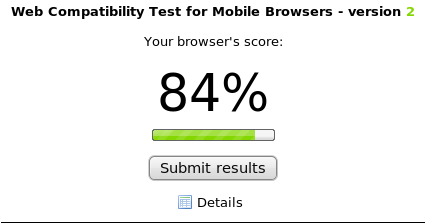
<p>That test, in the same spirit as the <a href="http://www.acidtests.org/">ACID tests</a>, combines in a single page <a href="http://dev.w3.org/2008/mobile-test/doc.html#tests">tests for 12 Web technologies</a>, ranging from well-deployed (but often poorly implemented on mobile devices) technologies such as HTTPS and PNG, to technologies we believe will matter in a year or two (like SVG animation and CSS Media Queries).</p>
<p>Tests are visualized by squares, sorted roughly in order of difficulty (first line, well-deployed technologies, second line, technologies increasingly used today, third line, technologies for tomorrow), and a browser needs to render each square in the same tone of green to pass completely the test - which as far as I know, no currently released browser (on mobile devices or elsewhere) does.</p>

<p>Enough words, everybody wants to see pictures, so here come a few screenshots of the test rendered in a variety of browsers:</p>
<div class='screenshots'>
<p style='margin:0.5em;height: 340; float:left;text-align:center; background-color:white;'><img src='http://www.w3.org/2008/04/wctmb/blazer4321.jpg' alt='Screenshot of the test in Blazer 4.3.2.1' width='320' height='320' /><br />Blazer 4.3.2.1</p>
<p style='margin:0.5em;height: 340; float:left;text-align:center; background-color:white;'><img src="http://www.w3.org/2008/04/wctmb/opera-mini-41beta.jpg" width='320' height='320' alt="Screenshot of test in Opera Mini 4.1 beta 1"/><br />Opera Mini 4.1 beta 1</p>
<p style='margin:0.5em;height: 340; float:left;text-align:center; background-color:white;'><img src="http://www.w3.org/2008/04/wctmb/netfront2-psp.jpg" alt="Screenshot of the test in Netfront on the PSP" width="320" height="176" /><br />PSP's Netfront</p>
<p style='margin:0.5em;height: 250; float:left;text-align:center; background-color:white;'><img src="http://www.w3.org/2008/04/wctmb/webkit-androidemulator-sdk_m5-rc15.png" alt="Screenshot of the test in Android webkit-based emulator" width="319" height="230" /><br />Android emulator webkit-based browser</p>
<p style='margin:0.5em;height: 250; float:left;text-align:center; background-color:white;'><img src="http://www.w3.org/2008/04/wctmb/firefox3beta3.png" alt="Screenshot of the test in Firefox 3, beta 3" width="388" height="194" /><br />Firefox 3 beta 3</p>
<p style='margin:0.5em;height: 250; float:left;text-align:center; background-color:white;'><img src="http://www.w3.org/2008/04/wctmb/ie6.png" alt="Screenshot of the test in IE6" width="443" height="196" /><br />Internet Explorer 6</p>
</div>
<h3 style='clear:left'>Test design</h3>
<dl>
<dt>So, what's the guiding idea behind this test?</dt>
<dd>To make it easy to spot at a glance how ready for the Web your browser is; given that we target in particular browsers installed on mobile devices, the test needs to be fairly quick to load, not too large in dimensions, and surveying a range of technologies that are relevant on mobile</dd>
<dt>How does it relate to the ACID tests?</dt>
<dd>The ACID tests were clearly an inspiration for this test, but there are some significant differences:<ul>
<li>the test doesn't try to detect specific bugs in well-known browsers - a rather large tasks on mobile devices where the number of browsers remains much larger than on dekstop computers -, it simply helps visualize rough support for a given technology;</li>
<li>the test is mobile-friendly in its dimensions and weight, allowing it to give meaningful results on a wider range of devices.</li>
</ul>
This of course doesn't mean mobile browsers shouldn't try to pass the ACID tests (and some already do, as a matter of fact)! But hopefully our test also helps setting a goal for a wider set of browsers.</dd>
<dt>Couldn't you find a better name?</dt>
<dd>No, actually, we couldn't! We thought about calling it a "mobile ACID test", but since it is not an ACID test, we preferred something more descriptive of its real nature; but we're very interested in better suggestions!</dd>
<dt>Why is X in there? Why isn't Y in there?</dt>
<dd>While we have <a href="http://dev.w3.org/2008/mobile-test/doc.html#tests">documented the reasons of our choices of technologies</a>, we're very much open to suggestions for modifications, additions, and improvements (especially in the form of concrete markup to add in the test); so please send them in to our group list <a href="mailto:public-mwts@w3.org">public-mwts@w3.org</a> (<a href="http://lists.w3.org/Archives/Public/public-mwts/">publicly archived</a>)!</dd>
</dl>

<h3>Running the test</h3>
<p>Running the test is as simple as pointing your browser to its address, namely <code><a href="http://dev.w3.org/2008/mobile-test/test.html">http://dev.w3.org/2008/mobile-test/test.html</a></code>.</p>
<p>Entering an address is a pain on a phone? Quite often, indeed, so a couple of alternatives to save you a bit of that pain:</p> 
<ul>
<li>if your phone has a camera and a QR code reader (which you can probably find out on your preferred search engine), you can point your camera's phone to the following code, and it will open the right page in your browser:<br /><img src="http://dev.w3.org/2008/mobile-test/qrcode.png" alt="QR code for Web compatibility test for mobile browsers" width="175" height="175" /></li>
<li>otherwise, here is a shorter equivalent URI for the test: <code>http://tinyurl.com/37e33p</code></li>
</ul>


<h3>Contribute!</h3>
<p>Want to help us with this? Here are a few ideas of how you can contribute to the impact of this test on interoperability:</p>
<ul>
<li>run your test on your browser and send a screenshot to <a href="mailto:www-archive@w3.org">www-archive@w3.org</a> (<a href="http://lists.w3.org/Archives/Public/www-archive/">publicly archived</a>) with the name and version of the said browser; we'll add submissions to our <a href="/2008/04/wctmb/">screenshot galleries</a>; to get a screenshot of your phone in action, you can either use a screenshot application on your phone if it has one, and if it doesn't, you can simply take a picture of it with your camera :o)</li>
<li>Kai Hendry has started posting <a href="http://flickr.com/photos/hendry/tags/wct/ ">screenshots on Flickr</a>, so if you're about to do the same, make sure to use the same <code>wct</code> tag;</li>
<li>send suggestions for additional tests, or improved tests, or more generally, feedback on the selection of tests to our group list, <a href="mailto:public-mwts@w3.org">public-mwts@w3.org</a> (<a href="http://lists.w3.org/Archives/Public/public-mwts/">publicly archived</a>), or simply on as comments below;</li>
<li>simply talk about this test around you, in your blog, to your prefered browser vendor, etc.; the more visible this test goes, the more likely it is to have an impact on browser vendors!</li>
</ul>]]>
        </description>
<dc:subject>W3C・QA News</dc:subject>
<dc:creator>Dominique Hazaël-Massieux</dc:creator>
<dc:language>en</dc:language>
<dc:date>2008-04-16T06:58:40+00:00</dc:date>
</item>


<item rdf:about="http://www.w3.org/QA/2008/04/proposed_activity_for_video_on.html">
<title>Proposed Activity for Video on the Web</title>
<link>http://www.w3.org/QA/2008/04/proposed_activity_for_video_on.html</link>
<description>        <![CDATA[<p>
W3C organized a workshop on Video on the Web in December 2007 in order
to share current experiences and examine the technologies (see <a href='http://www.w3.org/2007/08/video/report.html'>report</a>). Online video content and demand is increasing rapidly, becoming
omnipresent on the Web and the trend will continue for at least a few
years. These rapid changes are posing challenges to the underlying
technologies and standards that support the platform-independent
creation, authoring, encoding/decoding, and description of video. To
ensure the success of video as a "first class citizen" of the Web, the
community needs to build a solid architectural foundation that enables
people to create, navigate, search, and distribute video, and to manage
digital rights.</p>

<p>The general scope of the <a href='http://www.w3.org/2008/01/video-activity.html'>proposed Video on the Web activity</a> is to
provide cohesion in the video related activities of W3C, as well helping
other W3C Groups in their effort to provide video functionalities. In
addition, this activity will focus at implementing the next steps from
the W3C workshop on Video on the Web. The proposal is to create 3 new Working Groups around Video on the Web. Please, have a look at the following documents:
</p>
<ol>
<li><a href='http://www.w3.org/2008/01/video-activity.html'>Activity proposal</a></li>
  <li><a href='http://www.w3.org/2008/01/media-fragments-wg.html'>Media Fragments Working Group Charter</a></li>
<li><a href='http://www.w3.org/2008/01/media-guidelines-wg.html'>Media Best Practices and Guidelines Working Group Charter</a></li>
<li><a href='http://www.w3.org/2008/01/media-annotations-wg.html'>Media Annotations Working Group Charter</a></li>
</ol>

<p>We welcome general feedback, general expressions of interest (or lack of!) and
comments on the discussion list  <a href='mailto:public-video-comments&#x40;&#0119;&#0051;&#0046;&#0111;&#0114;&#0103;'>public-video-comments@w3.org</a>.</p>

<p>If you should have questions or need further information, please feel free to
contact me as well. I will be presenting the activity proposal during the Web Conference next week, on <a href='http://www.w3.org/2008/04/w3c-track.html#thu'>Thursday afternoon</a>.</p>

]]>
        </description>
<dc:subject>Technology</dc:subject>
<dc:creator>Philippe Le Hégaret</dc:creator>
<dc:language>en</dc:language>
<dc:date>2008-04-15T15:29:20+00:00</dc:date>
</item>


<item rdf:about="http://www.w3.org/QA/2008/04/badges.html">
<title>A validator is not an accessibility evaluation tool?</title>
<link>http://www.w3.org/QA/2008/04/badges.html</link>
<description>        <![CDATA[<p>Currently, the most active discussion thread on the HTML working group's public mailing list, public-html, is one regarding the issue of whether in HTML5 the <code>alt</code> attribute should always be required on images. And Henri Sivonen is among the most active participants in that discussion, posting to that thread (among other messages), the following:</p>

<blockquote><a href="http://lists.w3.org/Archives/Public/public-html/2008Apr/0322.html">http://lists.w3.org/Archives/Public/public-html/2008Apr/0322.html</a></blockquote>
<blockquote><a href="http://lists.w3.org/Archives/Public/public-html/2008Apr/0333.html">http://lists.w3.org/Archives/Public/public-html/2008Apr/0333.html</a></blockquote>

<p>The question of whether or not <code>alt</code> should always be required is an issue that affects the behavior of validators, so it shouldn't be much of a surprise to see Henri taking interest in the discussion around it, because he maintains a validator (more precisely, a conformance-checking tool) called <a href="http://validator.nu/">Validator.nu</a> that he's spent a lot of time developing and that he clearly wants to be a beneficial and serviceable as possible to the people who take time to use it.</p>

<p>Among the assertions that Henri makes in his postings to that thread is the following:</p>

<blockquote>An HTML5 validator isn't an accessibility evaluation tool--or at least  
I think it shouldn't be.</blockquote>

<p>He goes on to compare the purpose of a validator to that of a spell checker, and in a later message, adds this:</p>
 
<blockquote><p>A validator cannot check that a page is semantically correct. It can't  
properly check for accessibility, either.</p>
<p>We should dispel misconceptions about what validators do instead of  
catering to the misconceptions.</p>
</blockquote>

<p>And to clarify what he intends Validator.nu to be useful (and not useful) for, he adds this:</p>

<blockquote>The validator I develop is not a stamping tool. It is a tool that  
helps authors detect mistakes that they didn't intend to make, so that  
they don't need to spend time wondering about the effects about their  
unintentional doings. For example, the validator I develop helps  
author detect that the alt attribute was typoed as 'atl', which is  
useful, because atl wouldn't work... I'm not interested in developing a formal stamp. I am interested in developing a development tool.</blockquote>

<p>The assertion that earning a "this page is valid" stamp or badge should not be an end goal (or any kind of goal at all) for users of a validator or conformance checker is something that Henri has stated consistently since the earliest public versions of Validator.nu were available (and that others have been stating for quite a long time also) -- as is the assertion that a validator should be a development tool, not a tool for advocacy. Henri states that most succinctly is a section of the Validator.nu FAQ:</p>

<blockquote>Validation is a tool for you as a page author -- not something your readers need to verify.</blockquote>

<p>To make a somewhat ham-handed analogy of my own: Consider the case of when you create a document with a word processor like Microsoft Word or whatever and you run in through that application's built-in spell-checking and grammar-checking tools to find and fix any spelling or grammar problems. You're using those tools as an author to ensure that the document doesn't contain any unintentional errors before you share it with others. And after you use them, you would never consider embedding a badge in the page to indicate that it's free from spelling and grammar errors -- because the fact that it is free from such is something of real value to you as an author, it's of no value to have it highlighted to all your readers, and not something you want or need your readers to verify.</p>

<p>Anyway, that (bad) analogy aside, I think Henri and most other reasonable people would agree that there is great value in encouraging authors to produce valid content, and beyond that, to encourage authors to be familiar with best-practice accessibility and usability guidelines and to try to follow them to the best of their ability. The main difference of opinion here is around what role (if any) validators should be expected to have in encouraging authors to do those things.</p>]]>
        </description>
<dc:subject>HTML</dc:subject>
<dc:creator>Michael(tm) Smith</dc:creator>
<dc:language>en</dc:language>
<dc:date>2008-04-14T02:19:31+00:00</dc:date>
</item>


<item rdf:about="http://www.w3.org/QA/2008/04/unescape-html-entities-python.html">
<title>Unescape HTML Entities in Python</title>
<link>http://www.w3.org/QA/2008/04/unescape-html-entities-python.html</link>
<description>        <![CDATA[<p>I'm not a programmer, I mean a real programmer. I do hack code sometimes, mostly python, to be able to process files for recurring tasks. I had to read XHTML files to send to an XML parser (<a href="http://effbot.org/zone/element-index.htm" title="ElementTree Overview">ElementTree</a>). </p>

<p>This piece of code might be useful for someone and there will be certainly people who think that it is really programmed with my feet and suggest fixes. I usually work in UTF-8 but sometimes there might be character references and named entity in my files. So I wanted to convert everything to UTF-8 characters.</p>

<pre><code>def parsefile(path):
   try:
      file = open(path, "r")
      fileread = file.read()
      fileread = unescape(fileread.decode('utf-8')).encode('utf-8')
      file.close()
   except:
      print "Reading File Bug"
      sys.exit(1)
   return ET.fromstring(fileread)
</code></pre>

<p>The <a href="http://effbot.org/zone/re-sub.htm#unescape-html" title="re.sub&nbsp;Patterns">Unescape HTML Entities routine</a> was found on Frederik Lundh Web site. The code was  doing too much because it was converting <code>&amp;amp;</code>, <code>&amp;gt;</code> and <code>&amp;lt;</code>. I wanted to keep those in URL and where I have escaped code sections. So I slightly modified it for my own needs.</p>

<pre><code>def unescape(text):
   """Removes HTML or XML character references 
      and entities from a text string.
      keep &amp;amp;, &amp;gt;, &amp;lt; in the source code.
   from Fredrik Lundh
   http://effbot.org/zone/re-sub.htm#unescape-html
   """
   def fixup(m):
      text = m.group(0)
      if text[:2] == "&amp;#":
         # character reference
         try:
            if text[:3] == "&amp;#x":
               return unichr(int(text[3:-1], 16))
            else:
               return unichr(int(text[2:-1]))
         except ValueError:
            print "erreur de valeur"
            pass
      else:
         # named entity
         try:
            if text[1:-1] == "amp":
               text = "&amp;amp;amp;"
            elif text[1:-1] == "gt":
               text = "&amp;amp;gt;"
            elif text[1:-1] == "lt":
               text = "&amp;amp;lt;"
            else:
               print text[1:-1]
               text = unichr(htmlentitydefs.name2codepoint[text[1:-1]])
         except KeyError:
            print "keyerror"
            pass
      return text # leave as is
   return re.sub("&amp;#?\w+;", fixup, text)
</code></pre>

<p>Hope it helps. </p>
]]>
        
</description>
<dc:subject>XML</dc:subject>
<dc:creator>Karl Dubost</dc:creator>
<dc:language>en</dc:language>
<dc:date>2008-04-08T02:21:22+00:00</dc:date>
</item>


<item rdf:about="http://www.w3.org/QA/2008/03/pre-obsolete-design.html">
<title>Pre-Obsolete Design</title>
<link>http://www.w3.org/QA/2008/03/pre-obsolete-design.html</link>
<description>        <![CDATA[<p>Specifying a technology is a <a href="http://www.pantheon.org/articles/c/chronos.html">Chronos</a> dream. It is an attempt to take a snapshot of the state of art, to create stability for a little while. Technology users (such as Web designers and Web developers) are then able to create products (Web sites) with the basic assumption that people will have a similar user experience what ever the products they use. Douglas Coupland has shared in a <a href="http://www.guardian.co.uk/technology/2008/mar/22/gadgets.ebay">recent article in the Guardian</a> his relationship to devices:</p>

<blockquote>
  <p>What I essentially experienced this week was an ultra-high speed lesson in techno-obsolescence. Instead of taking 18 months to become doorstops, my new machines arrived pre-obsolete. They now reside in a Rubbermaid bin, along with my Museum of Old and Incompatible Cords, Adapters and Laptops. In about five years, when the bin fills to overflowing, its contents will be sent to the local landfill to be unearthed in one billion years by whatever species it is that supplants us.</p>
</blockquote>

<p>I have read on <a href="http://mezzoblue.com/">Dave Shea</a>'s blog about <a href="http://mezzoblue.com/archives/2008/03/18/mediatyping/">Mediatyping</a>. Dave Shea relates is unfortunate experience trying to setup a stylesheet for his blog that will work on mobile devices. He first started his design by specifying the CSS media type <code><a href="http://www.w3.org/TR/CSS21/media.html#media-types">handheld</a></code>. Dave said:</p>

<blockquote>
  <p>But here's the thing about media-specific style sheets: the browser in question has to support them. Mobile Safari grabs all screen media style sheets, and ignores the handheld media type entirely. So despite good intentions, my efforts were wasted on it. And that's what led me down the road of user agent sniffing...</p>
</blockquote>

<p>Dave went down the route of user agent sniffing. A discussion started on his blog to improve his code. A <a href="http://mezzoblue.com/archives/2008/03/18/mediatyping/#c038214">comment</a> by <a href="http://www.anildash.com/">Anil Dash</a> triggered a connection with Douglas' article:</p>

<blockquote>
  <p>what about what we've learned about the inadequacies of media types in CSS? Screen? Mobile? TV? Those aren't useful distinctions. It's another classic example of spec failure due to inadequate prognostication abilities. Someday we'll have the ability to see the future and this will all be easy.</p>
</blockquote>

<p>Chronos dream? We can't predict the future. A specification is here to fix time <strong>for a little while</strong>. The challenge is even greater for Web designers with the rise of ubiquitous computing. Small devices with a tremendous diversity in forms, size, capabilities factors and <strong>very short lifespan</strong>. W3C Working groups are working on these  challenging topics. For example, <a href="http://www.w3.org/2007/uwa/">Ubiquitous Web Applications</a> is working on a new version of <a href="http://www.webstandards.org/learn/articles/askw3c/feb2004/">CC/PP</a>. <a href="http://www.w3.org/Style/CSS/">CSS WG</a> is working on <a href="http://www.w3.org/TR/css3-mediaqueries/">Media Queries</a> with more customization capabilities. If a specification takes too much time to be released, it will be obsolete by the time it is published. If a specification is changing too often, people can't keep up with the changes and interoperability suffers. Finding the right compromise is difficult.</p>
]]>
        
</description>
<dc:subject>CSS</dc:subject>
<dc:creator>Karl Dubost</dc:creator>
<dc:language>en</dc:language>
<dc:date>2008-03-25T02:23:42+00:00</dc:date>
</item>


<item rdf:about="http://www.w3.org/QA/2008/03/world-map-statistics.html">
<title>World Map and Statistics Challenge</title>
<link>http://www.w3.org/QA/2008/03/world-map-statistics.html</link>
<description>        <![CDATA[<p>Very often when you are working in an international organization, there are data that I want to represent on a <a href="http://en.wikipedia.org/wiki/Wikipedia:Blank_maps#World">world map</a>. I often end up doing it by hand, but there must be a code already existing somewhere.</p>

<p>My requirements are simple: </p>

<ul>
<li>A <a href="http://upload.wikimedia.org/wikipedia/commons/0/03/BlankMap-World6.svg">world SVG map</a> with country id codes</li>
<li>A (html) table with the list of countries and associated data</li>
<li>A scale where values in a specific range get a specific color</li>
</ul>

<p>Given this input I would like to get a colored map such as this <a href="http://www.monde-diplomatique.fr/cartes/eaupotable">map for drinkable water access</a> by Philippe Rekacewicz. </p>

<p>If it doesn't exist yet, it could be a nice and very useful tool for everyone else. If it exists, please leave a comment. </p>
]]>
        
</description>
<dc:subject>SVG</dc:subject>
<dc:creator>Karl Dubost</dc:creator>
<dc:language>en</dc:language>
<dc:date>2008-03-24T05:17:51+00:00</dc:date>
</item>


<item rdf:about="http://www.w3.org/QA/2008/03/w3c-team-planet.html">
<title>W3C Team Planet... or Galaxy</title>
<link>http://www.w3.org/QA/2008/03/w3c-team-planet.html</link>
<description>        <![CDATA[<p>The <a href="/People/">W3C staff</a> (or W3C Team) are the people employed by the W3C organization. I'm one of them. Some of us have blogs for quite a long time, personal or professional, or both. </p>

<p>The question of creating a public aggregation of W3C staff blogs has generated many discussions inside the Team. That's normal. We are a group of persons, a community. When there is a new project, a community gives time for discussing individual opinions.  Questions were diverse, surprising sometimes, but there are just the mirror of what we are: humans.</p>

<ul>
<li>Is it good to have a blend of personal blogs?</li>
<li>Should it be archived?</li>
<li>Is there a risk to be taken as the voice of W3C?</li>
<li>What kind of disclaimers should be put on such a page?</li>
<li>Do I have the choice to be on it or not?</li>
<li>What should be the color of it?</li>
<li>Should the aggregated posts be only work related? Can we have personal items too?</li>
</ul>

<p>That was a very interesting debate which is certainly not finished. We will have new people coming in the staff, others leaving, people might change their minds in the future.  One important decision we made is to <strong>have an opt-in process</strong>. People from the W3C staff are free to join if they want and free to leave.</p>

<p>So here come the <a href="http://www.w3.org/2007/08/w3t-planet/">W3C Team blogs' Galaxy</a> and its <a href="http://www.w3.org/2007/08/w3t-planet/atom.xml">atom feed</a>.</p>
]]>
        
</description>
<dc:subject>W3C Life</dc:subject>
<dc:creator>Karl Dubost</dc:creator>
<dc:language>en</dc:language>
<dc:date>2008-03-24T02:29:57+00:00</dc:date>
</item>


<item rdf:about="http://www.w3.org/QA/2008/03/fix-the-web.html">
<title>If you had to fix the Web...</title>
<link>http://www.w3.org/QA/2008/03/fix-the-web.html</link>
<description>        <![CDATA[<p>"If you had to fix the Web... what would you do?"</p>

<p>Wait, wait before answering. Most of you reading me right now are geeks, computers addicted, working for the Web, intense users of the Web. I would like to hear the answers of people around you, in your family and your friends. I would like to hear the struggles of people who are just users of the Web without deep understanding of the technology. </p>

<p>Please ask them and report here in the comments, or on your blog with a link to here. </p>
]]>
        
</description>
<dc:subject>W3C Life</dc:subject>
<dc:creator>Karl Dubost</dc:creator>
<dc:language>en</dc:language>
<dc:date>2008-03-24T02:22:14+00:00</dc:date>
</item>


<item rdf:about="http://www.w3.org/QA/2008/03/css-drive-with-songs.html">
<title>Get a CSS Drive</title>
<link>http://www.w3.org/QA/2008/03/css-drive-with-songs.html</link>
<description>        <![CDATA[<p>A colleague from the W3C Team sent us an <a href="http://www.flickr.com/photos/yabin/2349092026/">interesting photo</a>. <a href="http://meyerweb.com/">Eric Meyer</a> had already posted on his flickr account this <a href="http://flickr.com/photos/meyerweb/298100710/">strange plate</a>. Then I imagined right away that I was driving on a long road in fluid landscapes, floating right or left, sunset shining in the background.  During my CSS drive, I was certainly listening <a href="http://www.bv3k.com/">Bran Van 3000</a> playing the "toone" <a href="http://www.alwaysontherun.net/branvan.htm#d7">More Shopping</a>. A band I discovered when I was living in Montréal:</p>

<blockquote>
  <p>Momus :<br/>
  Moloch passed the message to the Behemoth<br/>
  Whose master passed it on to Zebedee<br/>
  It was sent by Internet, by obscure protocols<br/>
  To its recipient, the delicious Miss Gee</p>
</blockquote>

<p>And maybe I would continue with Gilberto Gil, <a href="http://www.gilbertogil.com.br/sec_discografia_letra.php?id=281">Pela Internet</a> (<a href="http://www.gilbertogil.com.br/sec_discografia_player.php?id=281&amp;numero=11&amp;acao=play">listen the music</a>):</p>

<blockquote>
  <p>Criar meu web site<br/>
  Fazer minha home-page<br/>
  Com quantos gigabytes<br/>
  Se faz uma jangada<br/>
  Um barco que veleje </p>
</blockquote>

<p>Internet is fun. What would be your geek song?</p>
]]>
        
</description>
<dc:subject>CSS</dc:subject>
<dc:creator>Karl Dubost</dc:creator>
<dc:language>en</dc:language>
<dc:date>2008-03-21T09:12:55+00:00</dc:date>
</item>


<item rdf:about="http://www.w3.org/QA/2008/03/w3c-mailing-lists.html">
<title>Many ways to access W3C mailing-lists</title>
<link>http://www.w3.org/QA/2008/03/w3c-mailing-lists.html</link>
<description>        <![CDATA[<p>As anyone who has been involved in W3C will tell you, making open standards means a lot of discussions, and in the case of W3C, a lot of discussions by e-mail.</p>

<p>W3C mailing-lists are where a <em>lot</em> of things happen, and so the organization has been dedicating a lot of resources to its mail infrastructure over the year, often being <a href="http://www.w3.org/2007/10/spam-fight">at the forefront of the fight against spam</a>, so much that the "World Wide Web Consortium" sometimes get nicknamed "SMTP Consortium".</p>

<p>The flow of mail can be dreadful sometimes. For example, I think I must be receiving several hundreds, perhaps a thousand, of mails per day, from W3C participants or mailing-lists. And our system tells me that in my few years around here, I've sent over <span title="either this includes CVS commit notifications, or I really am quite verbose...">10,000 mails to W3C lists</span>.</p>

<p>It is fortunate that we have some simple but cool systems to manage this information overload:</p>

<ul>
<li><a href="http://lists.w3.org/">all w3c mailing-lists get archived on the Web</a></li>
<li>Almost every e-mail has a <code>Message-Id</code> identifier. That's convenient! So we can use that to provide a simple, but effective <a href="http://www.w3.org/mid/">gateway</a> from Mail to Web, and immediately find <a href="http://www.w3.org/mid/00da01bf2d47$1fda6e80$a60a1712@col.w3.org">any</a> mail ever archived at W3C by its identifier</li>
<li>Web archives means... <a href="http://www.w3.org/Search/Mail/Public/">Web-based search</a>, too</li>
<li>There are also <a href="http://lists.w3.org/Archives/Public/www-talk/feed.rss">feeds</a> for list discussions, and even a <a href="http://news.gmane.org/search.php?match=w3c">Mail to Usenet gateway</a> 
</li>
</ul>

<p>What all these systems bring, in a nutshell, is a choice in how one can find, access, and work on this mass of information exchanged by e-mail. This choice is good: it really leverages the power of the public web, the ability to harvest, process and enhance data. So it is quite exciting to see how a new actor can take this data and do cool things with it.</p>

<p>Yesterday, the Markmail team <a href="http://markmail.blogspot.com/2008/03/world-wide-web-consortium-lists-400000.html">announced</a> that they were opening a new search interface to the public w3c lists, with more than 400,000 messages loaded (less than our <a href="http://www.w3.org/Search/Mail/Public/">in-house search system</a>, but quite impressive nevertheless!). With some nice ideas and a lot of Web Technology magic (XML , XQuery, HTML, PNG, CSS, DOM...) they managed to come up with a very interesting <a href="http://w3.markmail.org/">interface</a> indeed. I can only wish all this were open source ;) .</p>

<p>Beyond the mere value of being able to access the e-mail discussion contents via many interfaces, there is a serious lesson to be noted: what gets published on the public web is likely to <em>stay</em> on the public web <a href="http://www.w3.org/Mail/ArchiveEditingPolicy">forever</a>. Indeed, even what we publish on our personal sites, content we feel free to "remove" at any point, may be indexed, cached, quoted, or even mirrored, copied, reused... Better try and behave accordingly.</p>]]>
        </description>
<dc:subject>Web Spotting</dc:subject>
<dc:creator>olivier Théreaux</dc:creator>
<dc:language>en</dc:language>
<dc:date>2008-03-18T16:10:00+00:00</dc:date>
</item>


<item rdf:about="http://www.w3.org/QA/2008/03/css-validator-update.html">
<title>CSS Validator gets an update</title>
<link>http://www.w3.org/QA/2008/03/css-validator-update.html</link>
<description>        <![CDATA[<p>Last week, we gave the <a href="http://jigsaw.w3.org/css-validator/">CSS Validator</a> a well deserved update. </p>

<p><a href="http://jigsaw.w3.org/css-validator/"><img src="/QA/Tools/css-validator/screenshot_banner.png" width="624" height="101" alt="screenshot of the new CSS validator UI for language selection" /></a></p>

<p>This is one update we are rather proud of, with more than 50 bugs closed, a polished User Interface, and some changes to the core that will make checking of CSS stylesheets much easier and reliable. You can see a more detailed list of the changes in the <a href="http://lists.w3.org/Archives/Public/www-validator-css/2008Mar/0020.html">announcement we made on the CSS validator's mailing-list</a>.</p>

<p>How come, however, that it took us more than a year to push this release through? More than a year since the last significant <a href="http://www.w3.org/QA/2006/12/the_fuji_css_validator_release.html">"Fuji" release</a>? A large chunk of the code was ready by the end of summer '07, but it did take us a few months to get all the changes translated into the many languages supported by the CSS validator (you may remember the calls for help sent to the <a href="http://lists.w3.org/Archives/Public/w3c-translators/2007OctDec/0108.html">translators forum</a> or <a href="http://www.w3.org/QA/2008/01/css_validator_translation.html">here on this blog</a>) and make sure all the bug fixes were properly added to the validator's test suite.</p>

<p>I am very hopeful that with our improved way of <a href="http://qa-dev.w3.org:8001/css-validator/translations.html">tracking and fostering</a> translations, and with the growing interest and help in the tool's development and translation (notably by opera software staff - thanks!) we can have a faster release cycle in the future. And that is fortunate, because there are some really nice changes brewing for this CSS validator: Yves and I will be blogging about the nitty-gritty-techie details of current work on the <a href="http://www.w3.org/blog/systeam/">Systems Team blog</a>, so watch that space too. And of course, as always when we start a new phase of development, now is a very good time to get involved, so if you want to hunt bugs, sharpen your java skills or help with <a href="http://qa-dev.w3.org:8001/css-validator/translations.html">translations</a>, contact us.</p>]]>
        </description>
<dc:subject>Tools</dc:subject>
<dc:creator>olivier Théreaux</dc:creator>
<dc:language>en</dc:language>
<dc:date>2008-03-18T15:18:49+00:00</dc:date>
</item>


<item rdf:about="http://www.w3.org/QA/2008/03/semantic_web-telephone_game.html">
<title>Telephone Game about the Semantic Web</title>
<link>http://www.w3.org/QA/2008/03/semantic_web-telephone_game.html</link>
<description>        <![CDATA[<p>I'm no Mark Twain, but reports of Google's demise are greatly exaggerated.</p>

<p>Today Tim Berners-Lee pointed me to this headline in the Times Online: "Google could be superseded, says web inventor."  This, in turn, has morphed into more ominous restatements in the blogosphere, including "Berners Lee predicts future eclipse of Google."</p>

<p>I spoke with Tim about the interview. Tim was asked "What will be the killer app of the Semantic Web?" A part of his reply was that text search is not necessarily the killer app for the Web of data. That is, while text search is important when searching among a Web of documents, there are other forms of query more suited to a Web of data (cf. W3C's <a href="http://www.w3.org/TR/rdf-sparql-query/">SPARQL Recommendation</a>).  The comment seems to have been seriously distorted on its way to a headline.</p>

<p>Because of the importance of vendor-neutrality to his role as W3C Director, Tim does not go about publicly predicting the demise of this or that company. In fact, Tim made clear to the reporter that he does not make statements about specific companies.  Thus, reading "Google" in the headline came as a big surprise.</p>

<p>If next week you read that Tim has predicted the demise of a different company, please check back here.</p>]]>
        </description>
<dc:subject>Semantic Web</dc:subject>
<dc:creator>Ian Jacobs</dc:creator>
<dc:language>en</dc:language>
<dc:date>2008-03-13T19:30:56+00:00</dc:date>
</item>


</rdf:RDF>