World Wide Web Consortium (W3C)
- Founded in 1994 by Tim Berners-Lee
- Mission is to lead the Web to its full potential
- Consortium of industry members who use a consensus process to create interoperable
standards
- Royalty-free standards mean anyone can implement
- Staff based at sites in Massachussetts, France, and Japan support the
consensus process
Web Accessibility Initiative (WAI)
- Founded in 1997
- Develops guidelines, support materials, and resources
- Gathers experts from around the world in disability accommodation, technology
standards, assistive technology, and policy
- Guidelines are widely referenced in corporate and national policies
- Authorized Translations facilitate worldwide adoption
- Activities: Guidelines, technology review, education and outreach, research
and development
Range of disabilities
Accessibility is not just about the visually impaired. WAI guidelines address
the needs of people who:
- Are blind or visually impaired (including color deficits)
- Are deaf or hearing impaired
- Have mobility or speech impediments
- Have brain injury, cognitive, or learning disabilities
How disabilities impact Web use
- Perception of content: output from the computer
- Interaction with content: input to the computer
- Understandability of content: design, complexity, structure of content
Assistive technologies sometimes but not always used to help with these
issues
- Output: screen reader, screen magnifier, braille display, captioning
- Input: keyboard, mouse, speech, switches
- Understandability: reorganization, highlighting, navigation supports
How People with Disabilities Use the Web
Designing for accessibility
- Accessibility is both a design and technology issue
- Some issues are principally design (e.g. color scheme, page layout)
- Some issues involve good use of the technology (e.g. proper encoding
of features like headings, regions, lists, etc.)
- A good design reduces need for technological accessibility features,
and makes it much easier to implement them when needed
- Universal Design: designing for all users makes a better experience even
for those without identified special needs
Demo comparison of accessible and inaccessible site
WAI Guidelines
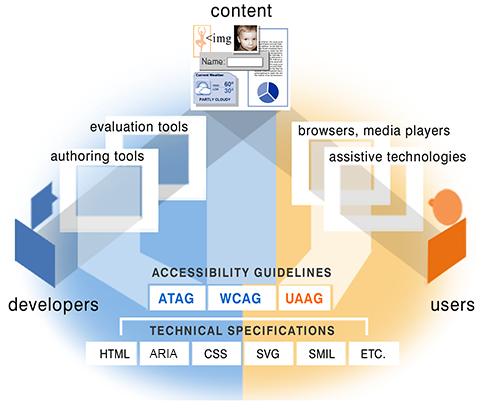
Guideline support materials
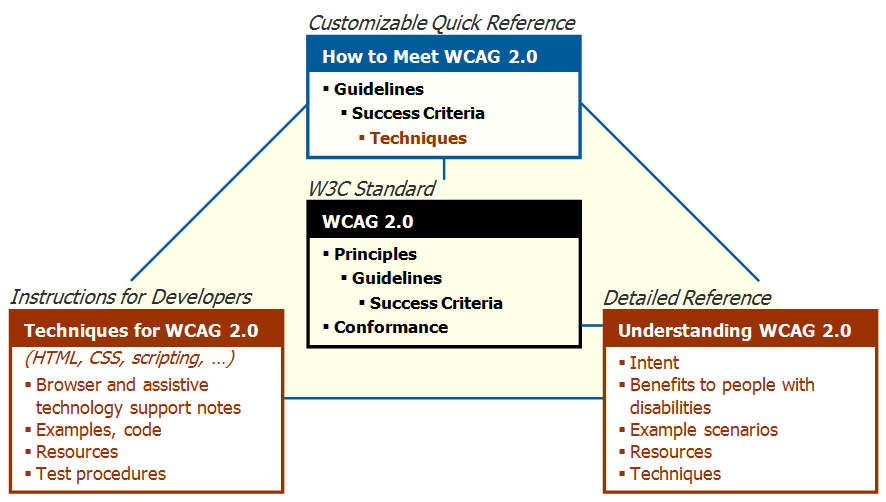
WCAG 2.0 is the most mature and is used for this example, but the other
guidelines provide similar materials.
- Background information
- Guidelines: WCAG
2.0
- Support materials
Relationship among WCAG 2.0 materials
Technology Stewardship
WAI reviews technologies to ensure they provide accessibility features and
do not have accessibility problems. The wide range of technologies include:
- General content languages such as HTML 5
- Special-purpose content languages such as MathML
- Graphics such as SVG, PNG
- Style formats such as CSS, XSL
- Media formats such as Audio, Video, Timed Text
- Interaction formats such as the Widgets suite
- Geolocation services
- Core syntaxes such as XML, RDF
Research
WAI coordinates with research organizations to:
- Identify research priorities
- Foster collaboration among research organizations
- Incorporate research results into WAI guidelines work

